
DSW End Point Assessment Insurance Practitioner
DJ
Published · 19 slides · 0 views

1 / 1


Description
DSW End Point Assessment Insurance Practitioner Level 3 Purpose To provide you with a clear understanding of the End Point Assessment process so that you understand why and when this happens, whats involved and what your responsibilities
Related Topics
Share
Embed code
Download this presentation From Below
"DSW End Point Assessment Insurance Practitioner" is the property of its rightful owner. Permission is granted to download and print the materials on this website for personal, non-commercial use only, and to display it on your personal computer provided you do not modify the materials and that you retain all copyright notices contained in the materials. By downloading content from our website, you accept the terms of this agreement.
Presentation Transcript
01
DSW End Point Assessment
Insurance Practitioner Level 3<br>
Insurance Practitioner Level 3<br>
02
Purpose To provide you with a clear understanding of the End Point Assessment process so that you understand why and when this happens, what's involved and what your responsibilities are. Benefit You will have a clear understanding of the requirements of the Insurance Practitioner End Point Assessment and how DSW can help you.<br>
03
Contents What is End Point Assessment?
Assessment Design and Delivery
When does End Point Assessment happen?
What happens during End Point Assessment?
Insurance Practitioner
Overview
Professional Discussion underpinned by Portfolio
Case Study Test
Multiple Choice Exam
Grading<br>
Assessment Design and Delivery
When does End Point Assessment happen?
What happens during End Point Assessment?
Insurance Practitioner
Overview
Professional Discussion underpinned by Portfolio
Case Study Test
Multiple Choice Exam
Grading<br>
04
What is End Point Assessment? End Point Assessment (EPA) is the name given to a series of assessments an apprentice must take to prove their ability to do the job they have been training for.
These take place at the end of an apprenticeship following a period of training and development often referred to as the 'on-programme' period.
The focus of the EPA is on the apprentice being able to prove their competence in their role, through the work they have done
This entails demonstrating competence in the defined learning outcomes derived from competencies set out in the standard
The EPA forms 100% of the assessment of the apprenticeship<br>
These take place at the end of an apprenticeship following a period of training and development often referred to as the 'on-programme' period.
The focus of the EPA is on the apprentice being able to prove their competence in their role, through the work they have done
This entails demonstrating competence in the defined learning outcomes derived from competencies set out in the standard
The EPA forms 100% of the assessment of the apprenticeship<br>
05
Assessment Design and Delivery Our assessment materials are created in line with robust design principles that are recognised by Ofqual (the Government regulator for qualifications in England). These principles are:
Validity – we assess against the appropriate knowledge, skills and behaviours
Reliability / Comparability – we maintain consistency across our assessment materials and decisions
Manageability – our assessments maintain quality without placing unreasonable demands on apprentices and centres
Minimising Bias – our assessments are designed to allow equal opportunity for all to succeed<br>
Validity – we assess against the appropriate knowledge, skills and behaviours
Reliability / Comparability – we maintain consistency across our assessment materials and decisions
Manageability – our assessments maintain quality without placing unreasonable demands on apprentices and centres
Minimising Bias – our assessments are designed to allow equal opportunity for all to succeed<br>
06
When does End Point Assessment
happen? The end point assessment phase begins when:
On-programme phase of the apprenticeship has been completed
L2 in Maths and English has been achieved
Mandatory professional qualifications have been partially achieved:
CII – 30 credits from mandatory units
CILA – CH2 and CH3
Employer and training provider agree with the apprentice that they are competent
The apprentice then reaches ‘Gateway’ and starts preparing to go through the end point assessment process.<br>
happen? The end point assessment phase begins when:
On-programme phase of the apprenticeship has been completed
L2 in Maths and English has been achieved
Mandatory professional qualifications have been partially achieved:
CII – 30 credits from mandatory units
CILA – CH2 and CH3
Employer and training provider agree with the apprentice that they are competent
The apprentice then reaches ‘Gateway’ and starts preparing to go through the end point assessment process.<br>
07
What happens during
End Point Assessment? Apprentice completes the required assessments with continued support from the employer and training provider
All assessments must be passed for the apprentice to be deemed competent
Typically this will be completed over a four month period before the completion date is reached. All assessment methods must be taken within a 6 month period.<br>
End Point Assessment? Apprentice completes the required assessments with continued support from the employer and training provider
All assessments must be passed for the apprentice to be deemed competent
Typically this will be completed over a four month period before the completion date is reached. All assessment methods must be taken within a 6 month period.<br>
08
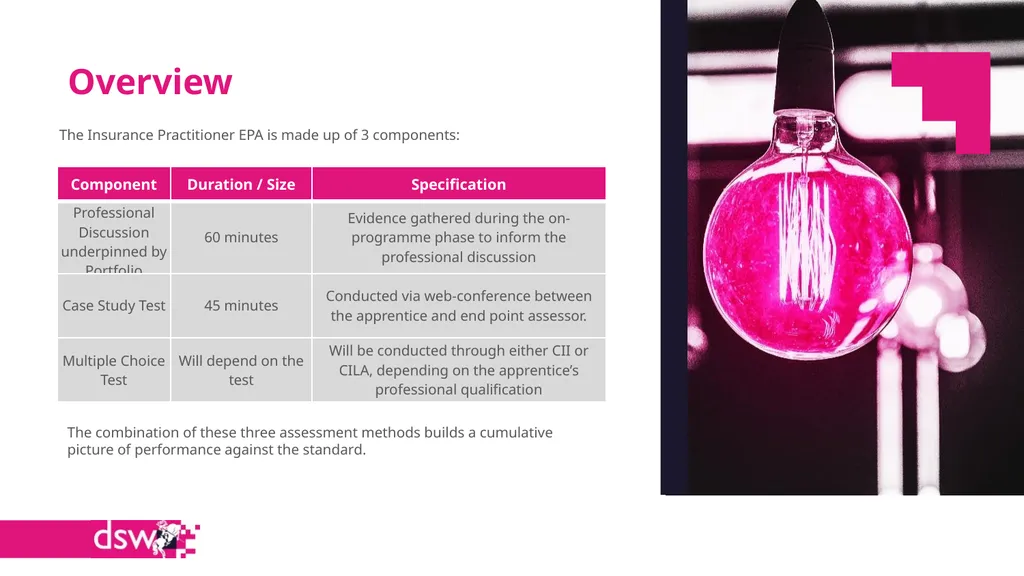
Overview The Insurance Practitioner EPA is made up of 3 components: The combination of these three assessment methods builds a cumulative picture of performance against the standard.<br>
09
Portfolio of Evidence A ‘Showcase’ portfolio built up during the on-programme period of the apprenticeship (prior to Gateway) which illustrates the application of the knowledge, skills and behaviours.
The evidence should:
Consists of a blend of evidence
Show application of knowledge, skills and behaviours
Contain substantial ‘real work’ tasks that have been completed by the Apprentice
DSW provide an evidence referencing table to allow the apprentice to map their evidence to the listed learning outcomes.
The apprentice should submit approximately 12 pieces of evidence to evidence the pass and distinction descriptors assigned to this component.
This evidence is not formally assessed but will inform the professional discussion.<br>
The evidence should:
Consists of a blend of evidence
Show application of knowledge, skills and behaviours
Contain substantial ‘real work’ tasks that have been completed by the Apprentice
DSW provide an evidence referencing table to allow the apprentice to map their evidence to the listed learning outcomes.
The apprentice should submit approximately 12 pieces of evidence to evidence the pass and distinction descriptors assigned to this component.
This evidence is not formally assessed but will inform the professional discussion.<br>
10
Context Statement Apprentices are encouraged to produce a context statement which can be used to accompany their Portfolio of Evidence. While the Context Statement itself is not assessed, it can be used to provide context to the evidence contained within the portfolio.
The context statement allows the apprentice to tell their story. Think of it as the ‘glue’ that holds the portfolio together. It helps the independent end point assessor to build a clearer picture of who the apprentice is and what they are capable of, prior to the final stage of EPA which is the professional discussion.
The context statement is classed as anecdotal evidence (the apprentices account of what took place). All anecdotal evidence needs to be corroborated to prove that this took place. This can be done through the use of product and performance evidence.<br>
The context statement allows the apprentice to tell their story. Think of it as the ‘glue’ that holds the portfolio together. It helps the independent end point assessor to build a clearer picture of who the apprentice is and what they are capable of, prior to the final stage of EPA which is the professional discussion.
The context statement is classed as anecdotal evidence (the apprentices account of what took place). All anecdotal evidence needs to be corroborated to prove that this took place. This can be done through the use of product and performance evidence.<br>
11
Evidence Types Some descriptors may be covered by a single piece of evidence, but some may require multiple pieces of evidence. The focus should be on quality, rather than quantity. The important thing is to ensure each descriptor is met in full.
A rich portfolio will contain a range of different evidence types. This would need to be a blend of anecdotal, product and performance evidence.
The following slide provides list of suggested evidence types.<br>
A rich portfolio will contain a range of different evidence types. This would need to be a blend of anecdotal, product and performance evidence.
The following slide provides list of suggested evidence types.<br>
12
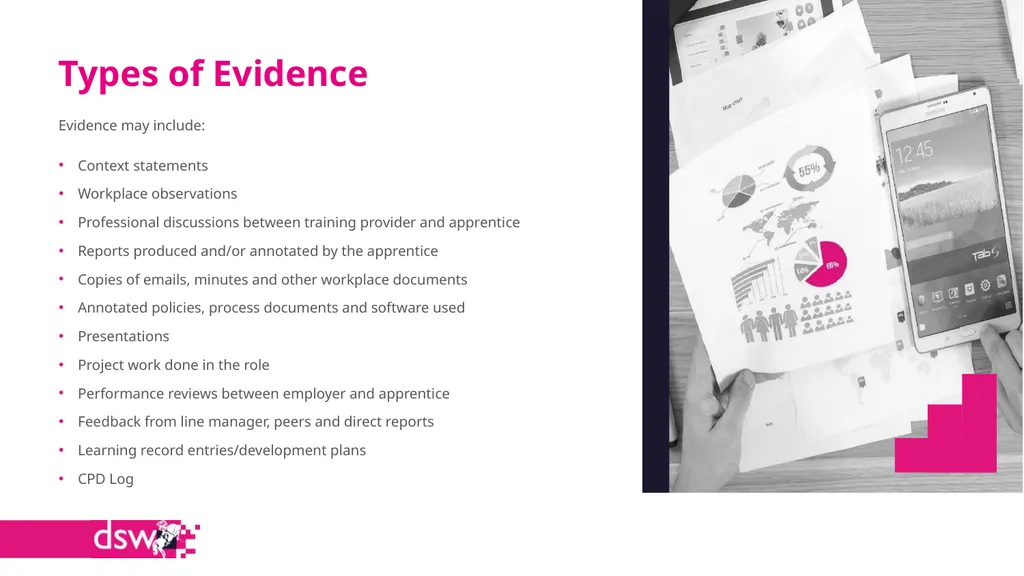
Types of Evidence Context statements
Workplace observations
Professional discussions between training provider and apprentice
Reports produced and/or annotated by the apprentice
Copies of emails, minutes and other workplace documents
Annotated policies, process documents and software used
Presentations
Project work done in the role
Performance reviews between employer and apprentice
Feedback from line manager, peers and direct reports
Learning record entries/development plans
CPD Log Evidence may include:<br>
Workplace observations
Professional discussions between training provider and apprentice
Reports produced and/or annotated by the apprentice
Copies of emails, minutes and other workplace documents
Annotated policies, process documents and software used
Presentations
Project work done in the role
Performance reviews between employer and apprentice
Feedback from line manager, peers and direct reports
Learning record entries/development plans
CPD Log Evidence may include:<br>
13
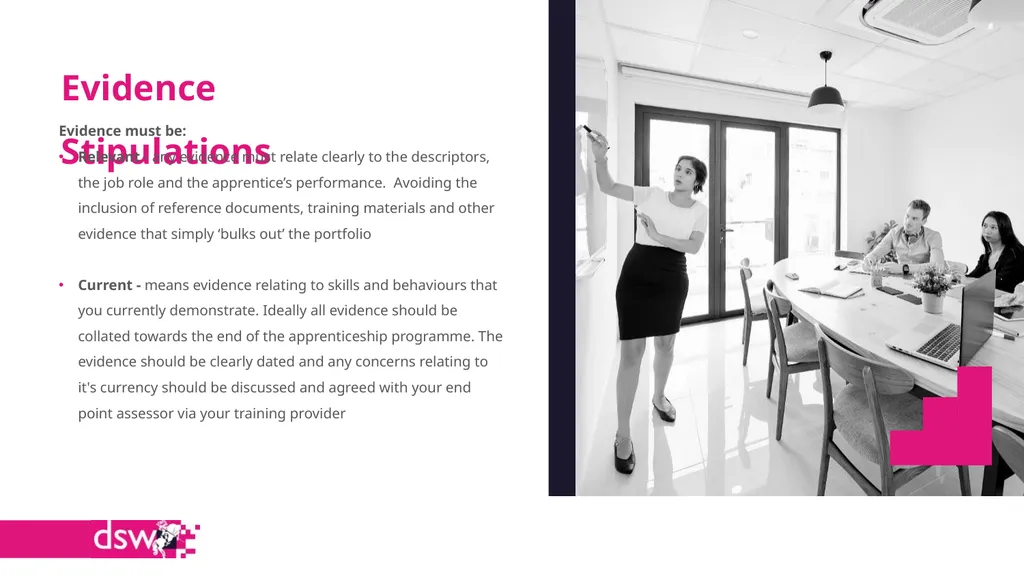
Evidence Stipulations Evidence must be:
Sufficient – competence is demonstrated in all of the defined descriptors. It does not mean a mass of evidence. It simply means collecting, annotating and referencing quality evidence to show the end point assessor that competence has been met
Authentic - the apprentice must be able to explain and talk around the examples provided, therefore, only evidence that relates to their own performance should be submitted. This should be backed up with the use of product and performance evidence.<br>
Sufficient – competence is demonstrated in all of the defined descriptors. It does not mean a mass of evidence. It simply means collecting, annotating and referencing quality evidence to show the end point assessor that competence has been met
Authentic - the apprentice must be able to explain and talk around the examples provided, therefore, only evidence that relates to their own performance should be submitted. This should be backed up with the use of product and performance evidence.<br>
14
Evidence Stipulations Evidence must be:
Relevant - any evidence must relate clearly to the descriptors, the job role and the apprentice’s performance. Avoiding the inclusion of reference documents, training materials and other evidence that simply ‘bulks out’ the portfolio
Current - means evidence relating to skills and behaviours that you currently demonstrate. Ideally all evidence should be collated towards the end of the apprenticeship programme. The evidence should be clearly dated and any concerns relating to it's currency should be discussed and agreed with your end point assessor via your training provider<br>
Relevant - any evidence must relate clearly to the descriptors, the job role and the apprentice’s performance. Avoiding the inclusion of reference documents, training materials and other evidence that simply ‘bulks out’ the portfolio
Current - means evidence relating to skills and behaviours that you currently demonstrate. Ideally all evidence should be collated towards the end of the apprenticeship programme. The evidence should be clearly dated and any concerns relating to it's currency should be discussed and agreed with your end point assessor via your training provider<br>
15
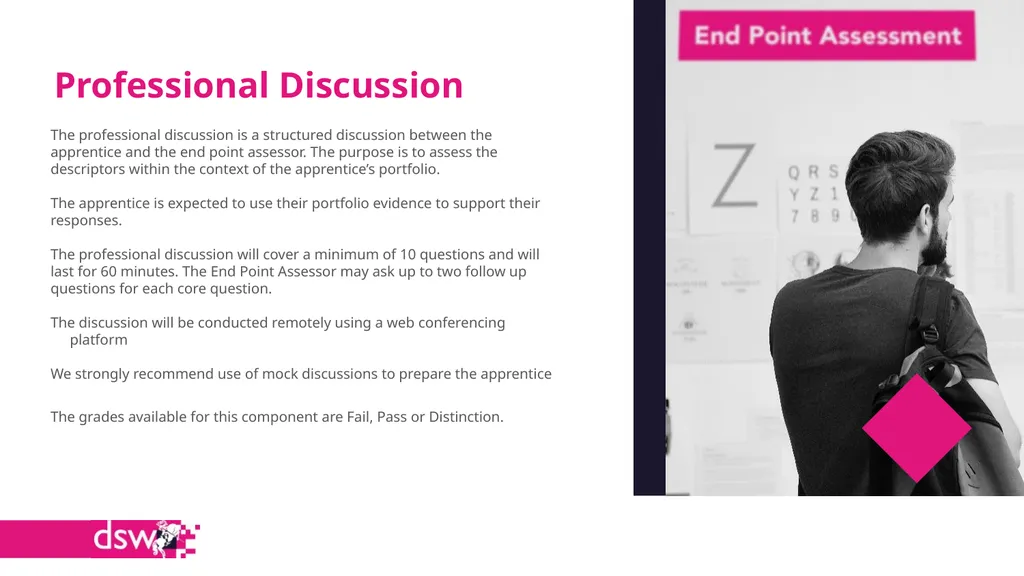
Professional Discussion The professional discussion is a structured discussion between the apprentice and the end point assessor. The purpose is to assess the descriptors within the context of the apprentice’s portfolio.
The apprentice is expected to use their portfolio evidence to support their responses.
The professional discussion will cover a minimum of 10 questions and will last for 60 minutes. The End Point Assessor may ask up to two follow up questions for each core question.
The discussion will be conducted remotely using a web conferencing platform
We strongly recommend use of mock discussions to prepare the apprentice
The grades available for this component are Fail, Pass or Distinction.<br>
The apprentice is expected to use their portfolio evidence to support their responses.
The professional discussion will cover a minimum of 10 questions and will last for 60 minutes. The End Point Assessor may ask up to two follow up questions for each core question.
The discussion will be conducted remotely using a web conferencing platform
We strongly recommend use of mock discussions to prepare the apprentice
The grades available for this component are Fail, Pass or Distinction.<br>
16
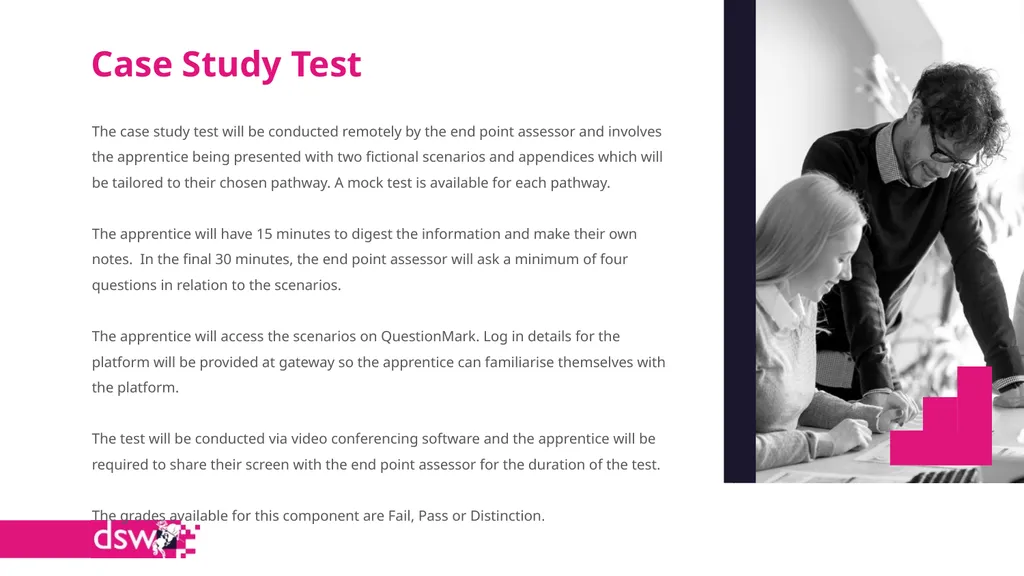
Case Study Test The case study test will be conducted remotely by the end point assessor and involves the apprentice being presented with two fictional scenarios and appendices which will be tailored to their chosen pathway. A mock test is available for each pathway.
The apprentice will have 15 minutes to digest the information and make their own notes. In the final 30 minutes, the end point assessor will ask a minimum of four questions in relation to the scenarios.
The apprentice will access the scenarios on QuestionMark. Log in details for the platform will be provided at gateway so the apprentice can familiarise themselves with the platform.
The test will be conducted via video conferencing software and the apprentice will be required to share their screen with the end point assessor for the duration of the test.
The grades available for this component are Fail, Pass or Distinction.<br>
The apprentice will have 15 minutes to digest the information and make their own notes. In the final 30 minutes, the end point assessor will ask a minimum of four questions in relation to the scenarios.
The apprentice will access the scenarios on QuestionMark. Log in details for the platform will be provided at gateway so the apprentice can familiarise themselves with the platform.
The test will be conducted via video conferencing software and the apprentice will be required to share their screen with the end point assessor for the duration of the test.
The grades available for this component are Fail, Pass or Distinction.<br>
17
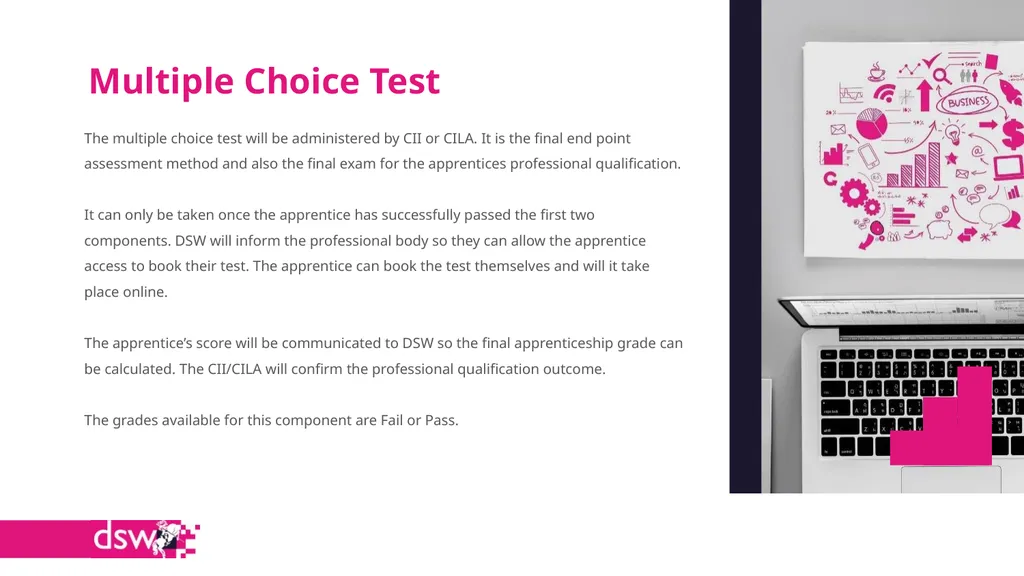
Multiple Choice Test The multiple choice test will be administered by CII or CILA. It is the final end point assessment method and also the final exam for the apprentices professional qualification.
It can only be taken once the apprentice has successfully passed the first two components. DSW will inform the professional body so they can allow the apprentice access to book their test. The apprentice can book the test themselves and will it take place online.
The apprentice’s score will be communicated to DSW so the final apprenticeship grade can be calculated. The CII/CILA will confirm the professional qualification outcome.
The grades available for this component are Fail or Pass.<br>
It can only be taken once the apprentice has successfully passed the first two components. DSW will inform the professional body so they can allow the apprentice access to book their test. The apprentice can book the test themselves and will it take place online.
The apprentice’s score will be communicated to DSW so the final apprenticeship grade can be calculated. The CII/CILA will confirm the professional qualification outcome.
The grades available for this component are Fail or Pass.<br>
18
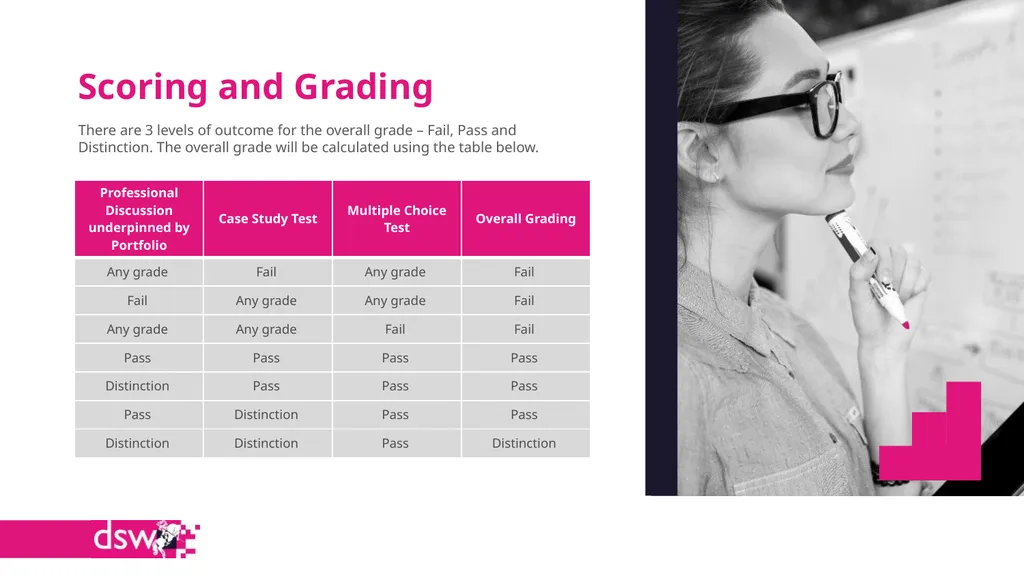
Scoring and Grading There are 3 levels of outcome for the overall grade – Fail, Pass and Distinction. The overall grade will be calculated using the table below.<br>
19
Questions & queries 01302 760 008
info@dswapprenticeships.co.uk
www.dswapprenticeships.co.uk
DSW House, Unit 3, Hayfield Business Park,
Field Lane, Auckley, Doncaster, South Yorkshire,
DN9 3FL<br>
info@dswapprenticeships.co.uk
www.dswapprenticeships.co.uk
DSW House, Unit 3, Hayfield Business Park,
Field Lane, Auckley, Doncaster, South Yorkshire,
DN9 3FL<br>