
DWYPD SANITARY DIGNITY IMPLEMENTATION FRAMEWORK
SN
Published · 17 slides · 0 views
1 / 1
Description
DWYPD SANITARY DIGNITY IMPLEMENTATION FRAMEWORK PRESENTATION TO THE PORTFOLIO COMMITTEE ON HIGHER EDUCATION AND TRAINING 01 April 2026 Introduction The Sanitary Dignity Implementation Framework (SDIF), which is the main policy document for
Related Topics
Share
Embed code
Download this presentation From Below
"DWYPD SANITARY DIGNITY IMPLEMENTATION FRAMEWORK" is the property of its rightful owner. Permission is granted to download and print the materials on this website for personal, non-commercial use only, and to display it on your personal computer provided you do not modify the materials and that you retain all copyright notices contained in the materials. By downloading content from our website, you accept the terms of this agreement.
Presentation Transcript
01
DWYPD SANITARY DIGNITY IMPLEMENTATION FRAMEWORK
PRESENTATION TO THE PORTFOLIO COMMITTEE ON HIGHER EDUCATION AND TRAINING 01 April 2026<br>
02
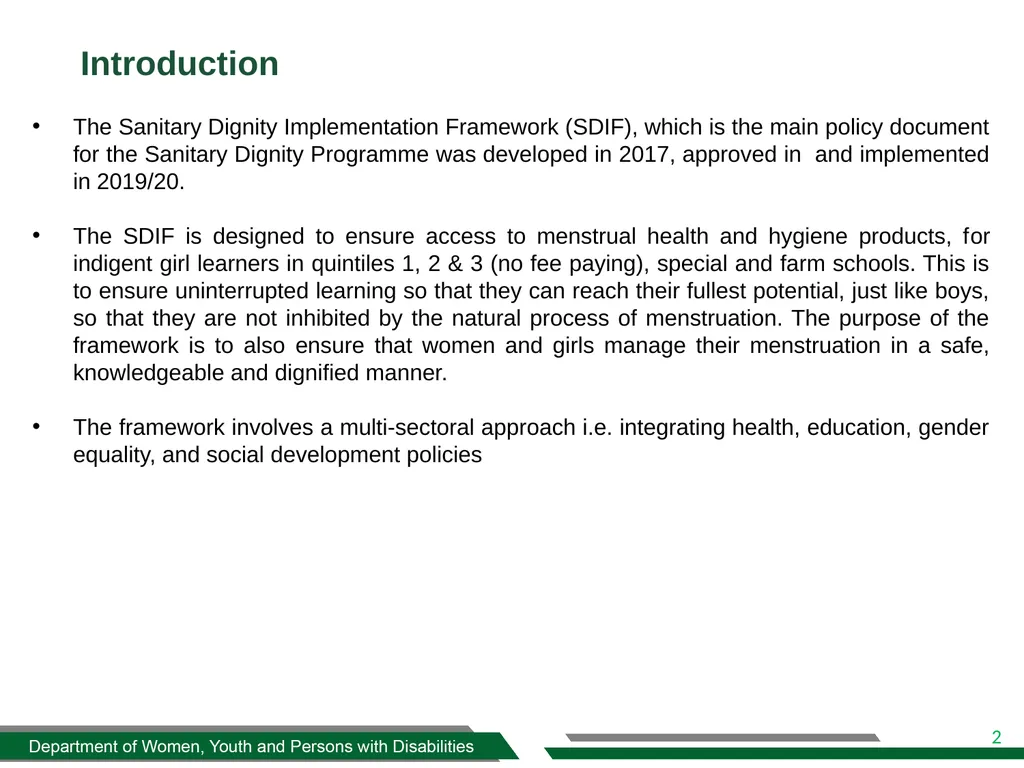
Introduction The Sanitary Dignity Implementation Framework (SDIF), which is the main policy document for the Sanitary Dignity Programme was developed in 2017, approved in and implemented in 2019/20.
The SDIF is designed to ensure access to menstrual health and hygiene products, for indigent girl learners in quintiles 1, 2 & 3 (no fee paying), special and farm schools. This is to ensure uninterrupted learning so that they can reach their fullest potential, just like boys, so that they are not inhibited by the natural process of menstruation. The purpose of the framework is to also ensure that women and girls manage their menstruation in a safe, knowledgeable and dignified manner.
The framework involves a multi-sectoral approach i.e. integrating health, education, gender equality, and social development policies<br>
The SDIF is designed to ensure access to menstrual health and hygiene products, for indigent girl learners in quintiles 1, 2 & 3 (no fee paying), special and farm schools. This is to ensure uninterrupted learning so that they can reach their fullest potential, just like boys, so that they are not inhibited by the natural process of menstruation. The purpose of the framework is to also ensure that women and girls manage their menstruation in a safe, knowledgeable and dignified manner.
The framework involves a multi-sectoral approach i.e. integrating health, education, gender equality, and social development policies<br>
03
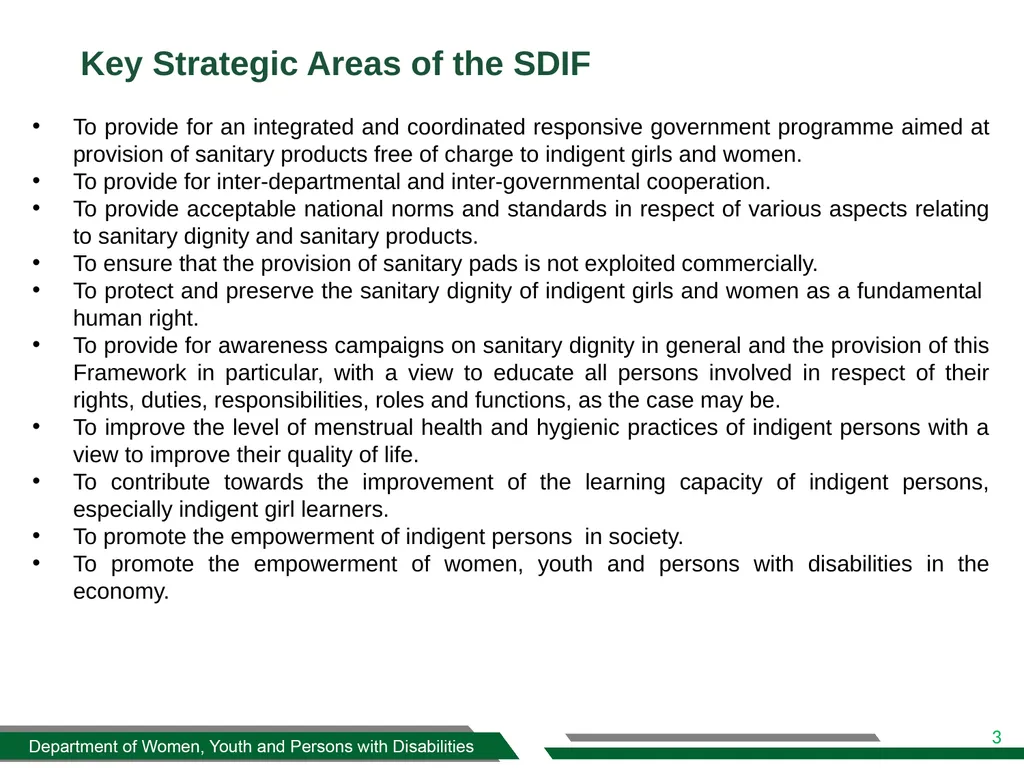
Key Strategic Areas of the SDIF To provide for an integrated and coordinated responsive government programme aimed at provision of sanitary products free of charge to indigent girls and women.
To provide for inter-departmental and inter-governmental cooperation.
To provide acceptable national norms and standards in respect of various aspects relating to sanitary dignity and sanitary products.
To ensure that the provision of sanitary pads is not exploited commercially.
To protect and preserve the sanitary dignity of indigent girls and women as a fundamental human right.
To provide for awareness campaigns on sanitary dignity in general and the provision of this Framework in particular, with a view to educate all persons involved in respect of their rights, duties, responsibilities, roles and functions, as the case may be.
To improve the level of menstrual health and hygienic practices of indigent persons with a view to improve their quality of life.
To contribute towards the improvement of the learning capacity of indigent persons, especially indigent girl learners.
To promote the empowerment of indigent persons in society.
To promote the empowerment of women, youth and persons with disabilities in the economy.<br>
To provide for inter-departmental and inter-governmental cooperation.
To provide acceptable national norms and standards in respect of various aspects relating to sanitary dignity and sanitary products.
To ensure that the provision of sanitary pads is not exploited commercially.
To protect and preserve the sanitary dignity of indigent girls and women as a fundamental human right.
To provide for awareness campaigns on sanitary dignity in general and the provision of this Framework in particular, with a view to educate all persons involved in respect of their rights, duties, responsibilities, roles and functions, as the case may be.
To improve the level of menstrual health and hygienic practices of indigent persons with a view to improve their quality of life.
To contribute towards the improvement of the learning capacity of indigent persons, especially indigent girl learners.
To promote the empowerment of indigent persons in society.
To promote the empowerment of women, youth and persons with disabilities in the economy.<br>
04
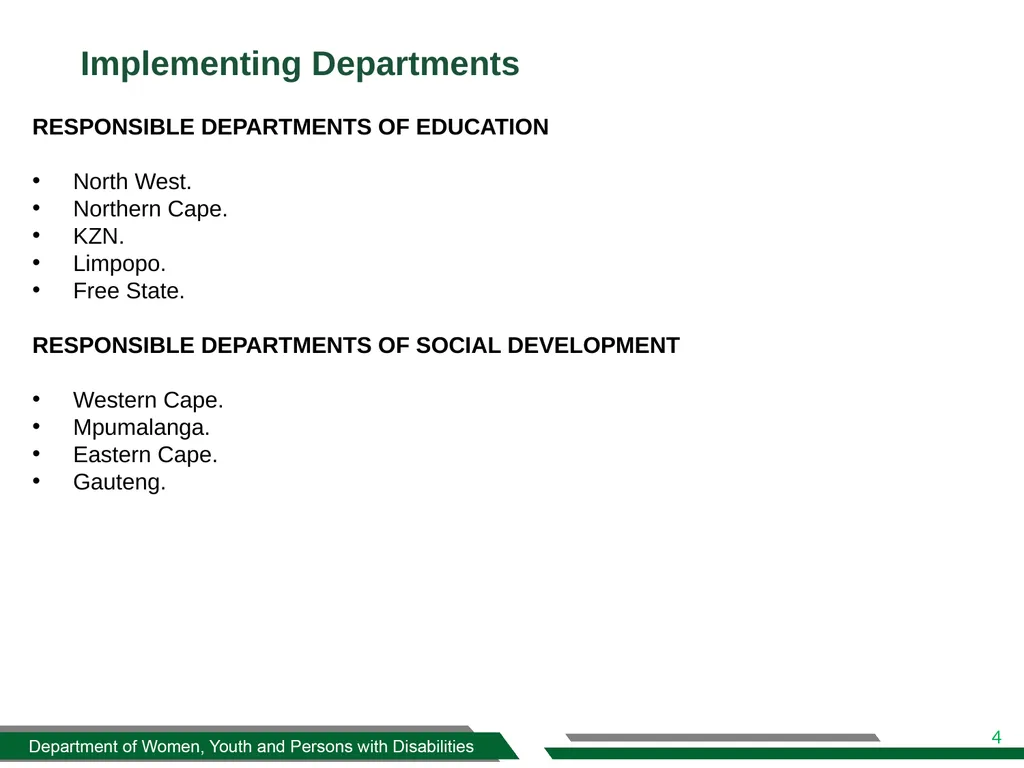
Implementing Departments RESPONSIBLE DEPARTMENTS OF EDUCATION
North West.
Northern Cape.
KZN.
Limpopo.
Free State.
RESPONSIBLE DEPARTMENTS OF SOCIAL DEVELOPMENT
Western Cape.
Mpumalanga.
Eastern Cape.
Gauteng.<br>
North West.
Northern Cape.
KZN.
Limpopo.
Free State.
RESPONSIBLE DEPARTMENTS OF SOCIAL DEVELOPMENT
Western Cape.
Mpumalanga.
Eastern Cape.
Gauteng.<br>
05
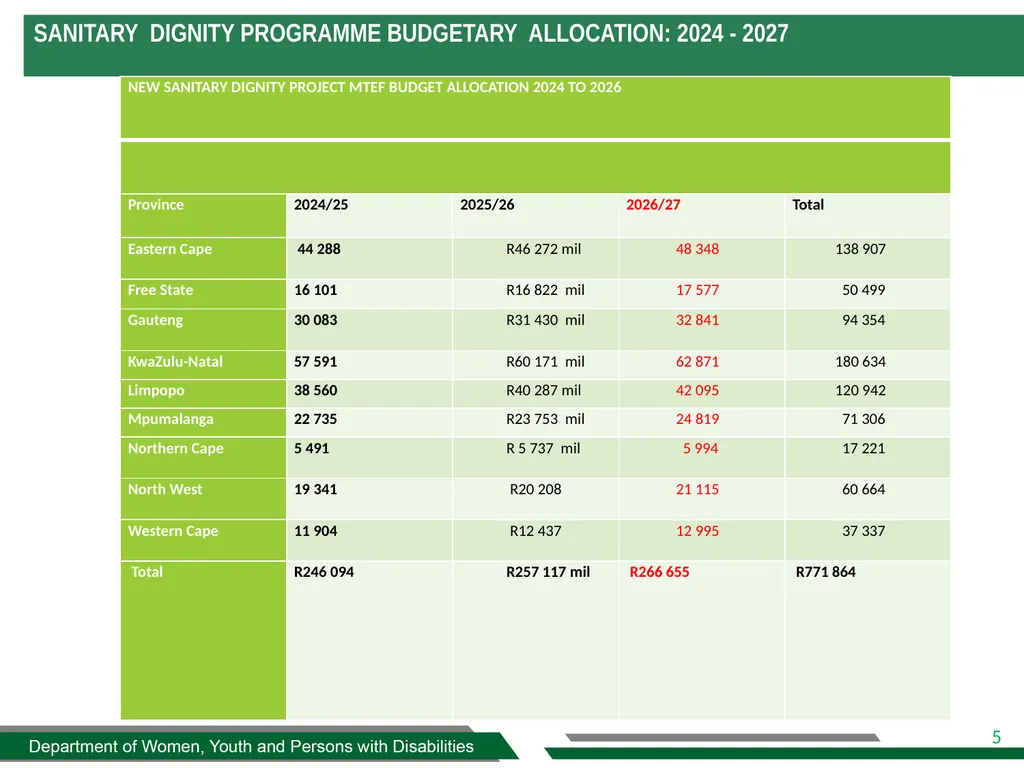
SANITARY DIGNITY PROGRAMME BUDGETARY ALLOCATION: 2024 - 2027<br>
06
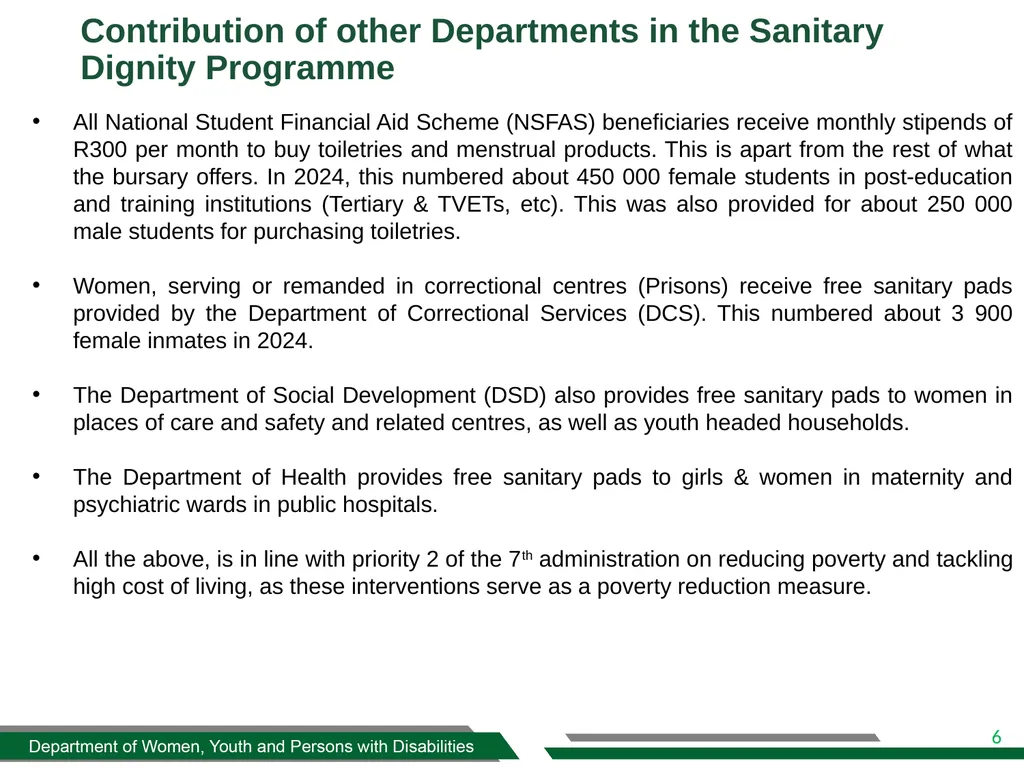
Contribution of other Departments in the Sanitary Dignity Programme All National Student Financial Aid Scheme (NSFAS) beneficiaries receive monthly stipends of R300 per month to buy toiletries and menstrual products. This is apart from the rest of what the bursary offers. In 2024, this numbered about 450 000 female students in post-education and training institutions (Tertiary & TVETs, etc). This was also provided for about 250 000 male students for purchasing toiletries.
Women, serving or remanded in correctional centres (Prisons) receive free sanitary pads provided by the Department of Correctional Services (DCS). This numbered about 3 900 female inmates in 2024.
The Department of Social Development (DSD) also provides free sanitary pads to women in places of care and safety and related centres, as well as youth headed households.
The Department of Health provides free sanitary pads to girls & women in maternity and psychiatric wards in public hospitals.
All the above, is in line with priority 2 of the 7th administration on reducing poverty and tackling high cost of living, as these interventions serve as a poverty reduction measure.<br>
Women, serving or remanded in correctional centres (Prisons) receive free sanitary pads provided by the Department of Correctional Services (DCS). This numbered about 3 900 female inmates in 2024.
The Department of Social Development (DSD) also provides free sanitary pads to women in places of care and safety and related centres, as well as youth headed households.
The Department of Health provides free sanitary pads to girls & women in maternity and psychiatric wards in public hospitals.
All the above, is in line with priority 2 of the 7th administration on reducing poverty and tackling high cost of living, as these interventions serve as a poverty reduction measure.<br>
07
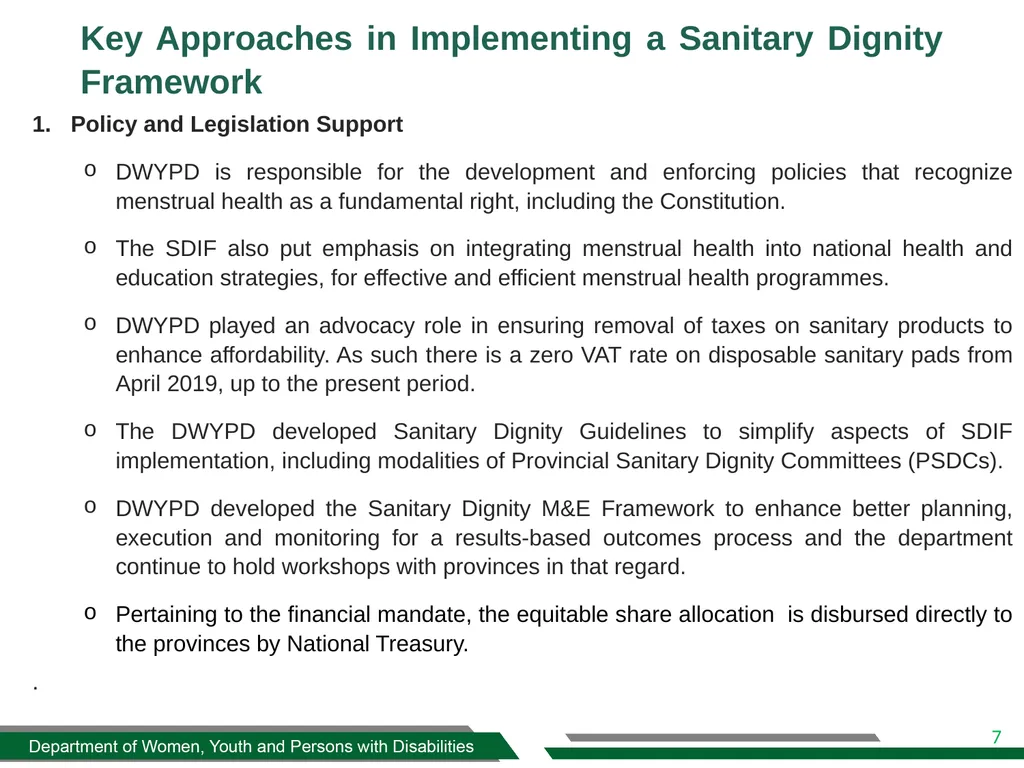
Key Approaches in Implementing a Sanitary Dignity Framework Policy and Legislation Support
DWYPD is responsible for the development and enforcing policies that recognize menstrual health as a fundamental right, including the Constitution.
The SDIF also put emphasis on integrating menstrual health into national health and education strategies, for effective and efficient menstrual health programmes.
DWYPD played an advocacy role in ensuring removal of taxes on sanitary products to enhance affordability. As such there is a zero VAT rate on disposable sanitary pads from April 2019, up to the present period.
The DWYPD developed Sanitary Dignity Guidelines to simplify aspects of SDIF implementation, including modalities of Provincial Sanitary Dignity Committees (PSDCs).
DWYPD developed the Sanitary Dignity M&E Framework to enhance better planning, execution and monitoring for a results-based outcomes process and the department continue to hold workshops with provinces in that regard.
Pertaining to the financial mandate, the equitable share allocation is disbursed directly to the provinces by National Treasury.
.<br>
DWYPD is responsible for the development and enforcing policies that recognize menstrual health as a fundamental right, including the Constitution.
The SDIF also put emphasis on integrating menstrual health into national health and education strategies, for effective and efficient menstrual health programmes.
DWYPD played an advocacy role in ensuring removal of taxes on sanitary products to enhance affordability. As such there is a zero VAT rate on disposable sanitary pads from April 2019, up to the present period.
The DWYPD developed Sanitary Dignity Guidelines to simplify aspects of SDIF implementation, including modalities of Provincial Sanitary Dignity Committees (PSDCs).
DWYPD developed the Sanitary Dignity M&E Framework to enhance better planning, execution and monitoring for a results-based outcomes process and the department continue to hold workshops with provinces in that regard.
Pertaining to the financial mandate, the equitable share allocation is disbursed directly to the provinces by National Treasury.
.<br>
08
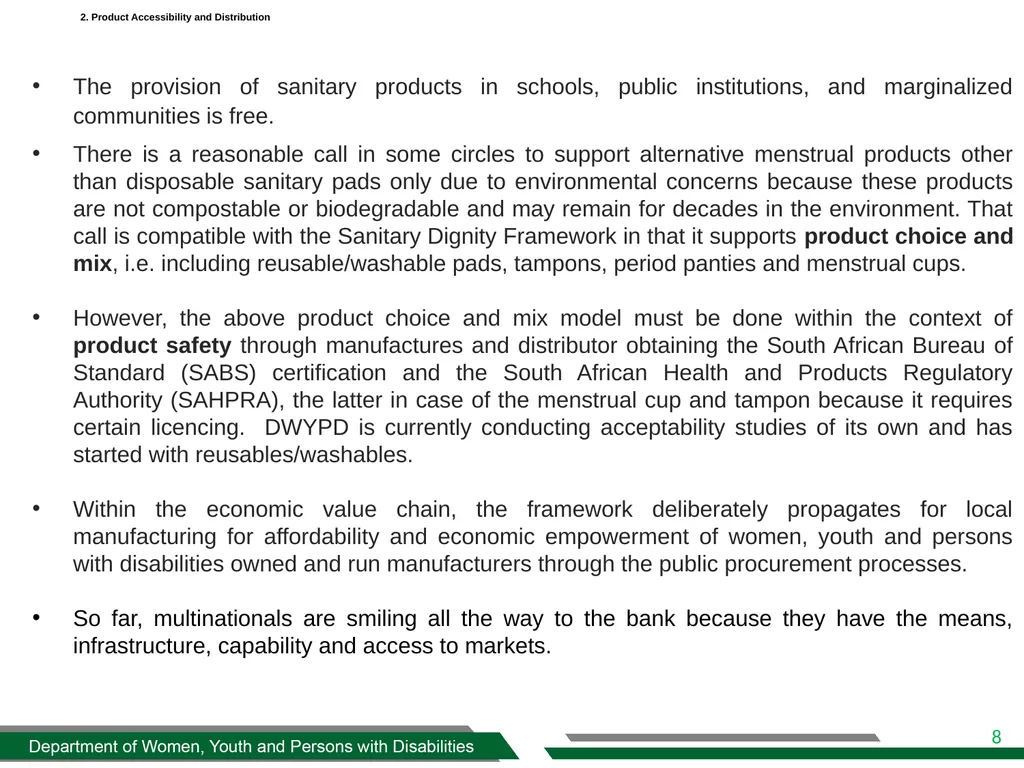
2. Product Accessibility and Distribution The provision of sanitary products in schools, public institutions, and marginalized communities is free.
There is a reasonable call in some circles to support alternative menstrual products other than disposable sanitary pads only due to environmental concerns because these products are not compostable or biodegradable and may remain for decades in the environment. That call is compatible with the Sanitary Dignity Framework in that it supports product choice and mix, i.e. including reusable/washable pads, tampons, period panties and menstrual cups.
However, the above product choice and mix model must be done within the context of product safety through manufactures and distributor obtaining the South African Bureau of Standard (SABS) certification and the South African Health and Products Regulatory Authority (SAHPRA), the latter in case of the menstrual cup and tampon because it requires certain licencing. DWYPD is currently conducting acceptability studies of its own and has started with reusables/washables.
Within the economic value chain, the framework deliberately propagates for local manufacturing for affordability and economic empowerment of women, youth and persons with disabilities owned and run manufacturers through the public procurement processes.
So far, multinationals are smiling all the way to the bank because they have the means, infrastructure, capability and access to markets.<br>
There is a reasonable call in some circles to support alternative menstrual products other than disposable sanitary pads only due to environmental concerns because these products are not compostable or biodegradable and may remain for decades in the environment. That call is compatible with the Sanitary Dignity Framework in that it supports product choice and mix, i.e. including reusable/washable pads, tampons, period panties and menstrual cups.
However, the above product choice and mix model must be done within the context of product safety through manufactures and distributor obtaining the South African Bureau of Standard (SABS) certification and the South African Health and Products Regulatory Authority (SAHPRA), the latter in case of the menstrual cup and tampon because it requires certain licencing. DWYPD is currently conducting acceptability studies of its own and has started with reusables/washables.
Within the economic value chain, the framework deliberately propagates for local manufacturing for affordability and economic empowerment of women, youth and persons with disabilities owned and run manufacturers through the public procurement processes.
So far, multinationals are smiling all the way to the bank because they have the means, infrastructure, capability and access to markets.<br>
09
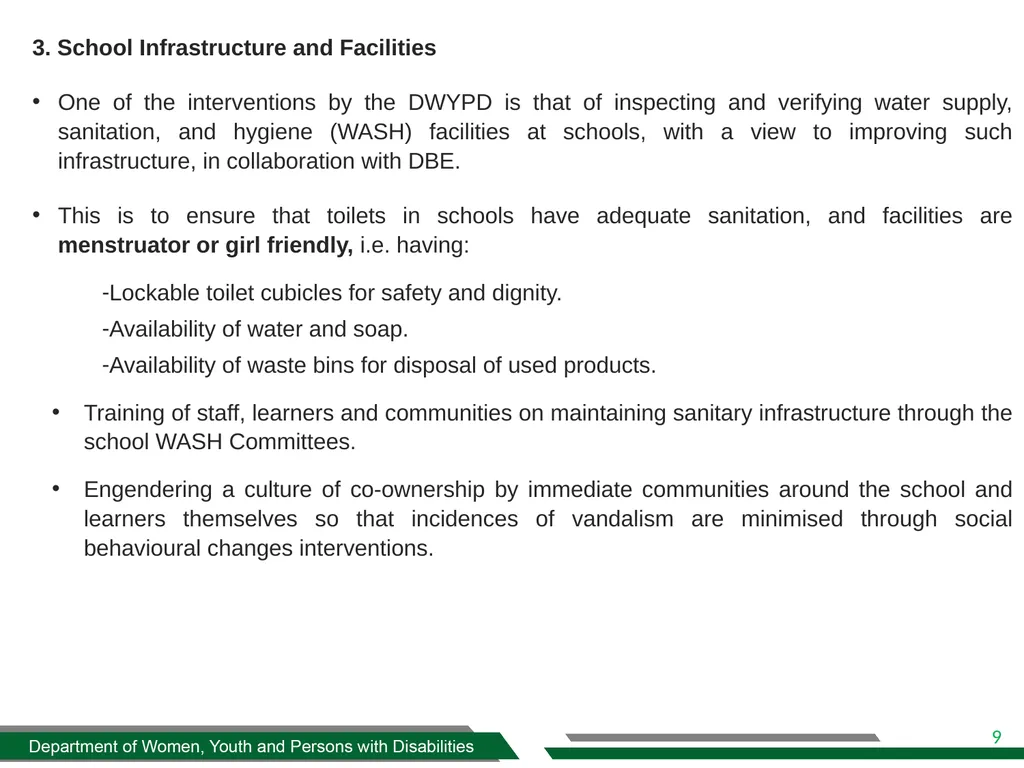
3. School Infrastructure and Facilities
One of the interventions by the DWYPD is that of inspecting and verifying water supply, sanitation, and hygiene (WASH) facilities at schools, with a view to improving such infrastructure, in collaboration with DBE.
This is to ensure that toilets in schools have adequate sanitation, and facilities are menstruator or girl friendly, i.e. having:
Lockable toilet cubicles for safety and dignity.
Availability of water and soap.
Availability of waste bins for disposal of used products.
Training of staff, learners and communities on maintaining sanitary infrastructure through the school WASH Committees.
Engendering a culture of co-ownership by immediate communities around the school and learners themselves so that incidences of vandalism are minimised through social behavioural changes interventions.<br>
One of the interventions by the DWYPD is that of inspecting and verifying water supply, sanitation, and hygiene (WASH) facilities at schools, with a view to improving such infrastructure, in collaboration with DBE.
This is to ensure that toilets in schools have adequate sanitation, and facilities are menstruator or girl friendly, i.e. having:
Lockable toilet cubicles for safety and dignity.
Availability of water and soap.
Availability of waste bins for disposal of used products.
Training of staff, learners and communities on maintaining sanitary infrastructure through the school WASH Committees.
Engendering a culture of co-ownership by immediate communities around the school and learners themselves so that incidences of vandalism are minimised through social behavioural changes interventions.<br>
10
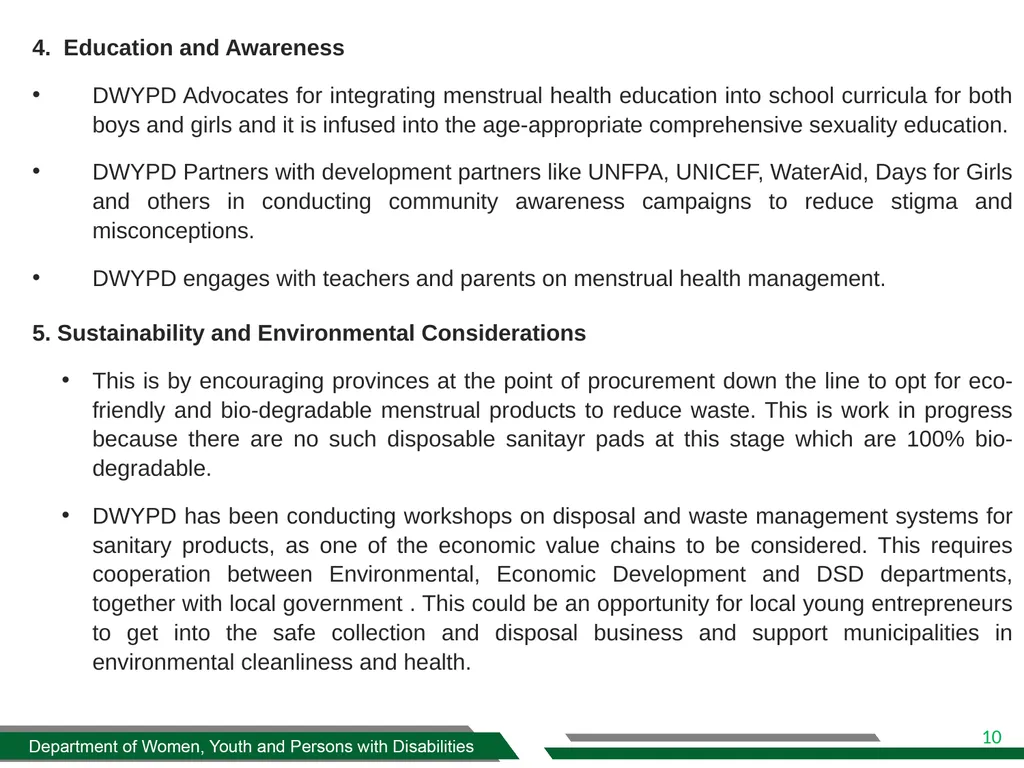
4. Education and Awareness
DWYPD Advocates for integrating menstrual health education into school curricula for both boys and girls and it is infused into the age-appropriate comprehensive sexuality education.
DWYPD Partners with development partners like UNFPA, UNICEF, WaterAid, Days for Girls and others in conducting community awareness campaigns to reduce stigma and misconceptions.
DWYPD engages with teachers and parents on menstrual health management.
5. Sustainability and Environmental Considerations
This is by encouraging provinces at the point of procurement down the line to opt for eco-friendly and bio-degradable menstrual products to reduce waste. This is work in progress because there are no such disposable sanitayr pads at this stage which are 100% bio-degradable.
DWYPD has been conducting workshops on disposal and waste management systems for sanitary products, as one of the economic value chains to be considered. This requires cooperation between Environmental, Economic Development and DSD departments, together with local government . This could be an opportunity for local young entrepreneurs to get into the safe collection and disposal business and support municipalities in environmental cleanliness and health.<br>
DWYPD Advocates for integrating menstrual health education into school curricula for both boys and girls and it is infused into the age-appropriate comprehensive sexuality education.
DWYPD Partners with development partners like UNFPA, UNICEF, WaterAid, Days for Girls and others in conducting community awareness campaigns to reduce stigma and misconceptions.
DWYPD engages with teachers and parents on menstrual health management.
5. Sustainability and Environmental Considerations
This is by encouraging provinces at the point of procurement down the line to opt for eco-friendly and bio-degradable menstrual products to reduce waste. This is work in progress because there are no such disposable sanitayr pads at this stage which are 100% bio-degradable.
DWYPD has been conducting workshops on disposal and waste management systems for sanitary products, as one of the economic value chains to be considered. This requires cooperation between Environmental, Economic Development and DSD departments, together with local government . This could be an opportunity for local young entrepreneurs to get into the safe collection and disposal business and support municipalities in environmental cleanliness and health.<br>
11
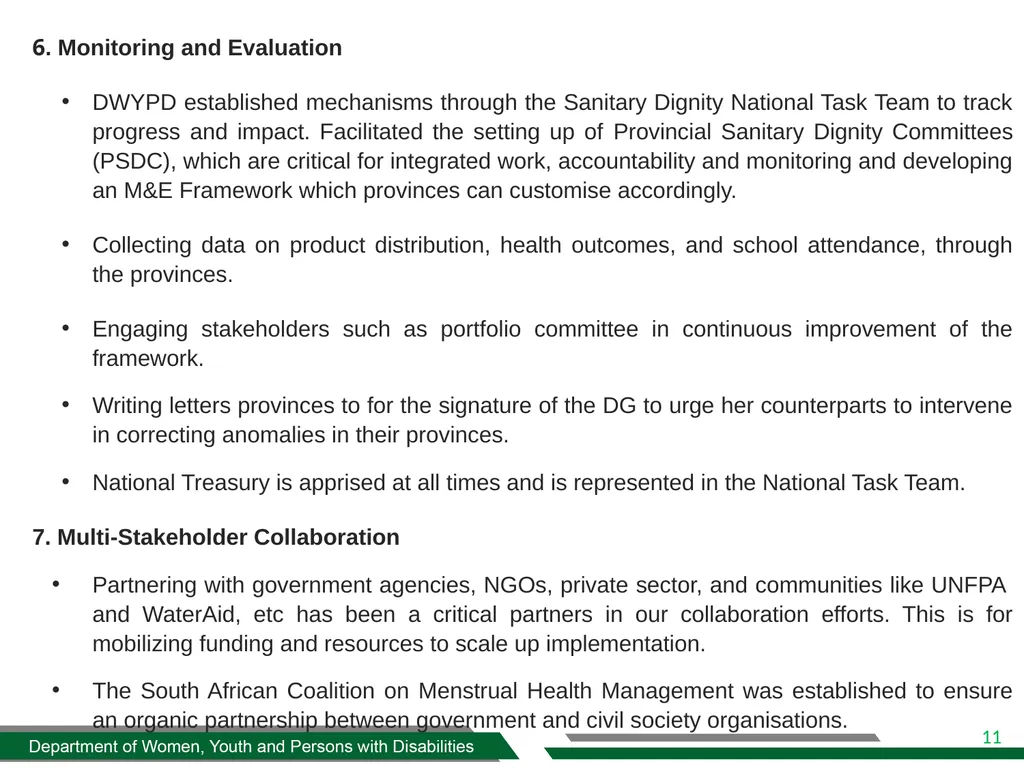
6. Monitoring and Evaluation
DWYPD established mechanisms through the Sanitary Dignity National Task Team to track progress and impact. Facilitated the setting up of Provincial Sanitary Dignity Committees (PSDC), which are critical for integrated work, accountability and monitoring and developing an M&E Framework which provinces can customise accordingly.
Collecting data on product distribution, health outcomes, and school attendance, through the provinces.
Engaging stakeholders such as portfolio committee in continuous improvement of the framework.
Writing letters provinces to for the signature of the DG to urge her counterparts to intervene in correcting anomalies in their provinces.
National Treasury is apprised at all times and is represented in the National Task Team.
7. Multi-Stakeholder Collaboration
Partnering with government agencies, NGOs, private sector, and communities like UNFPA and WaterAid, etc has been a critical partners in our collaboration efforts. This is for mobilizing funding and resources to scale up implementation.
The South African Coalition on Menstrual Health Management was established to ensure an organic partnership between government and civil society organisations.<br>
DWYPD established mechanisms through the Sanitary Dignity National Task Team to track progress and impact. Facilitated the setting up of Provincial Sanitary Dignity Committees (PSDC), which are critical for integrated work, accountability and monitoring and developing an M&E Framework which provinces can customise accordingly.
Collecting data on product distribution, health outcomes, and school attendance, through the provinces.
Engaging stakeholders such as portfolio committee in continuous improvement of the framework.
Writing letters provinces to for the signature of the DG to urge her counterparts to intervene in correcting anomalies in their provinces.
National Treasury is apprised at all times and is represented in the National Task Team.
7. Multi-Stakeholder Collaboration
Partnering with government agencies, NGOs, private sector, and communities like UNFPA and WaterAid, etc has been a critical partners in our collaboration efforts. This is for mobilizing funding and resources to scale up implementation.
The South African Coalition on Menstrual Health Management was established to ensure an organic partnership between government and civil society organisations.<br>
12
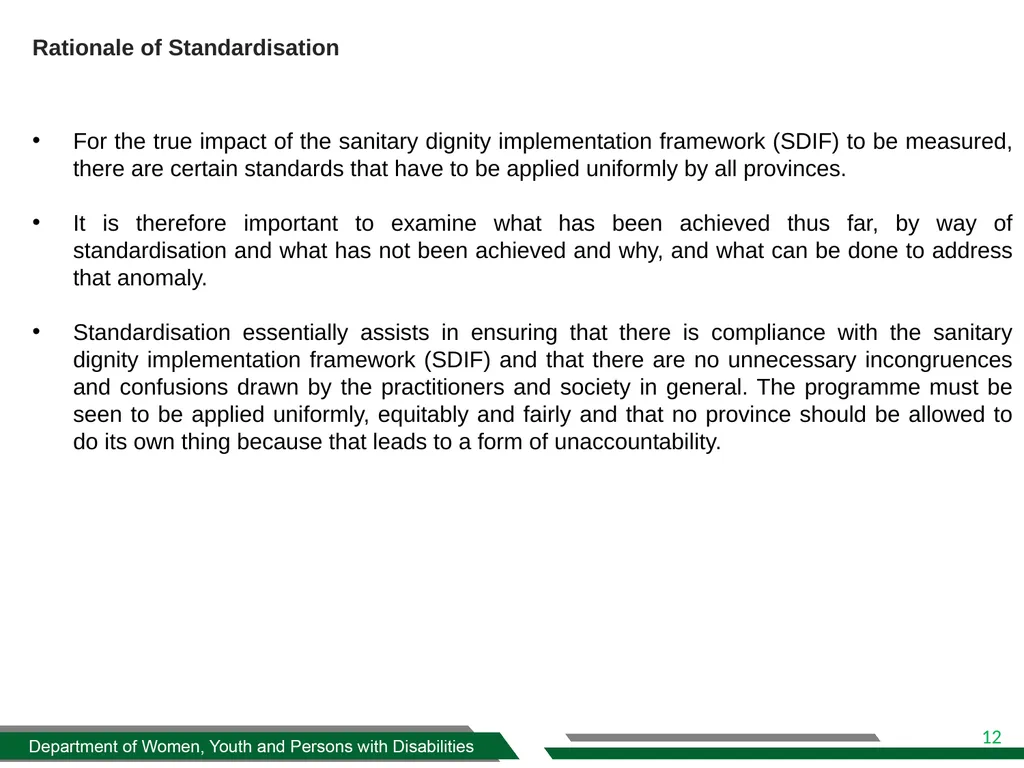
Rationale of Standardisation
For the true impact of the sanitary dignity implementation framework (SDIF) to be measured, there are certain standards that have to be applied uniformly by all provinces.
It is therefore important to examine what has been achieved thus far, by way of standardisation and what has not been achieved and why, and what can be done to address that anomaly.
Standardisation essentially assists in ensuring that there is compliance with the sanitary dignity implementation framework (SDIF) and that there are no unnecessary incongruences and confusions drawn by the practitioners and society in general. The programme must be seen to be applied uniformly, equitably and fairly and that no province should be allowed to do its own thing because that leads to a form of unaccountability.<br>
For the true impact of the sanitary dignity implementation framework (SDIF) to be measured, there are certain standards that have to be applied uniformly by all provinces.
It is therefore important to examine what has been achieved thus far, by way of standardisation and what has not been achieved and why, and what can be done to address that anomaly.
Standardisation essentially assists in ensuring that there is compliance with the sanitary dignity implementation framework (SDIF) and that there are no unnecessary incongruences and confusions drawn by the practitioners and society in general. The programme must be seen to be applied uniformly, equitably and fairly and that no province should be allowed to do its own thing because that leads to a form of unaccountability.<br>
13
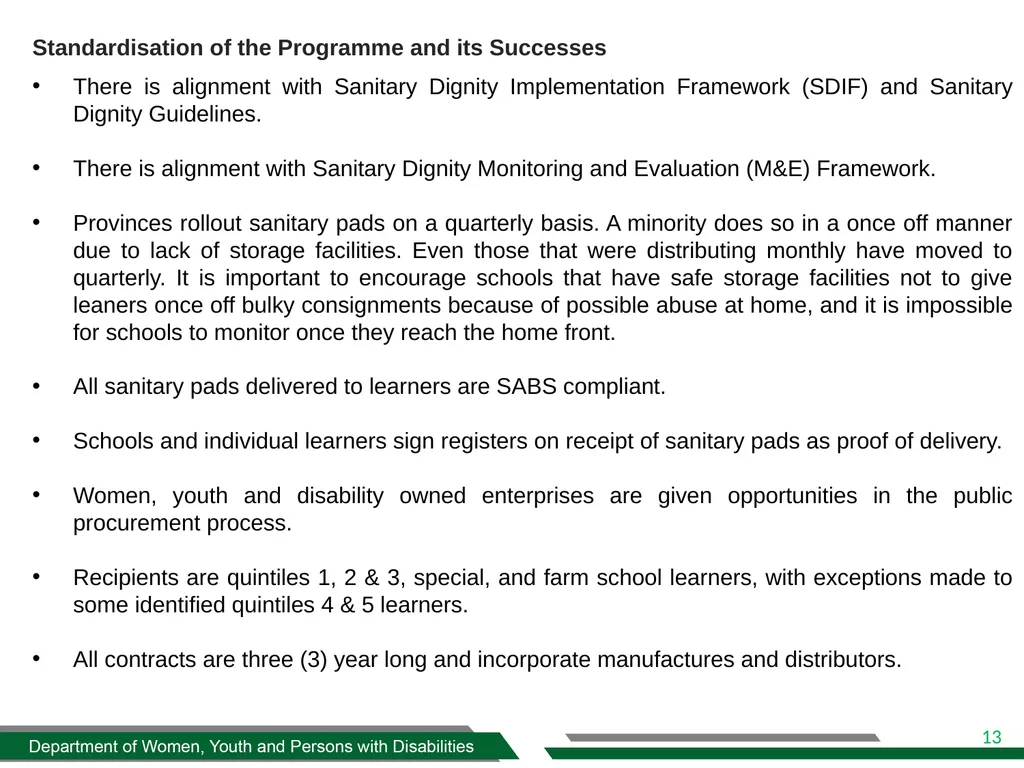
Standardisation of the Programme and its Successes
There is alignment with Sanitary Dignity Implementation Framework (SDIF) and Sanitary Dignity Guidelines.
There is alignment with Sanitary Dignity Monitoring and Evaluation (M&E) Framework.
Provinces rollout sanitary pads on a quarterly basis. A minority does so in a once off manner due to lack of storage facilities. Even those that were distributing monthly have moved to quarterly. It is important to encourage schools that have safe storage facilities not to give leaners once off bulky consignments because of possible abuse at home, and it is impossible for schools to monitor once they reach the home front.
All sanitary pads delivered to learners are SABS compliant.
Schools and individual learners sign registers on receipt of sanitary pads as proof of delivery.
Women, youth and disability owned enterprises are given opportunities in the public procurement process.
Recipients are quintiles 1, 2 & 3, special, and farm school learners, with exceptions made to some identified quintiles 4 & 5 learners.
All contracts are three (3) year long and incorporate manufactures and distributors.<br>
There is alignment with Sanitary Dignity Implementation Framework (SDIF) and Sanitary Dignity Guidelines.
There is alignment with Sanitary Dignity Monitoring and Evaluation (M&E) Framework.
Provinces rollout sanitary pads on a quarterly basis. A minority does so in a once off manner due to lack of storage facilities. Even those that were distributing monthly have moved to quarterly. It is important to encourage schools that have safe storage facilities not to give leaners once off bulky consignments because of possible abuse at home, and it is impossible for schools to monitor once they reach the home front.
All sanitary pads delivered to learners are SABS compliant.
Schools and individual learners sign registers on receipt of sanitary pads as proof of delivery.
Women, youth and disability owned enterprises are given opportunities in the public procurement process.
Recipients are quintiles 1, 2 & 3, special, and farm school learners, with exceptions made to some identified quintiles 4 & 5 learners.
All contracts are three (3) year long and incorporate manufactures and distributors.<br>
14
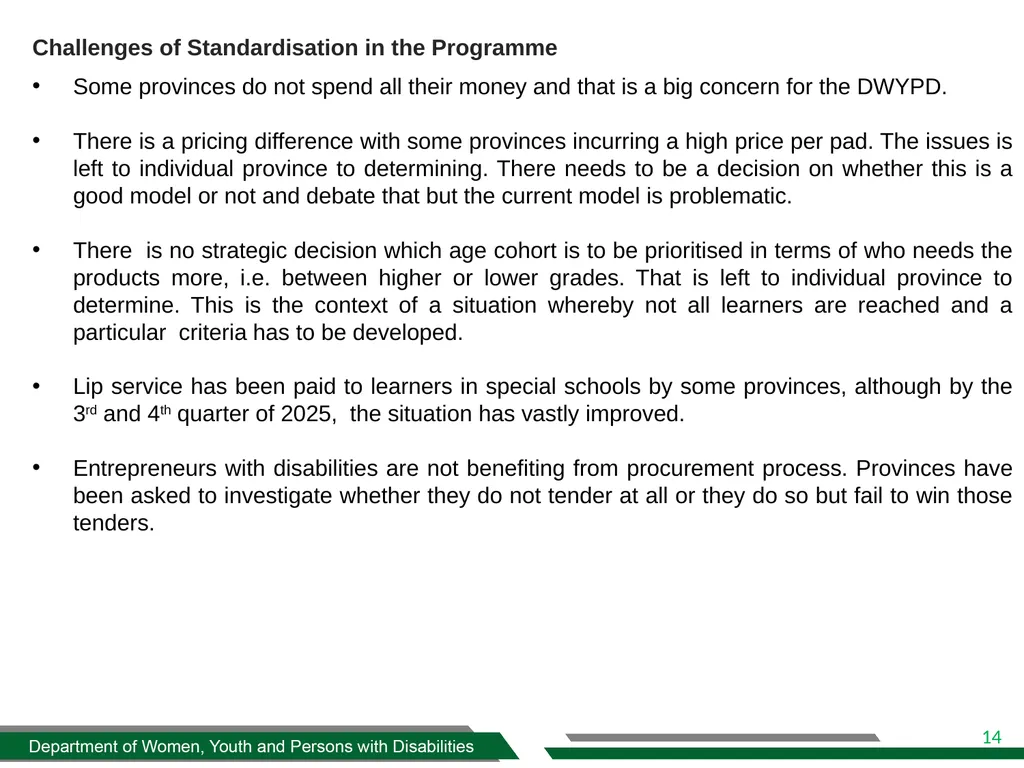
Challenges of Standardisation in the Programme
Some provinces do not spend all their money and that is a big concern for the DWYPD.
There is a pricing difference with some provinces incurring a high price per pad. The issues is left to individual province to determining. There needs to be a decision on whether this is a good model or not and debate that but the current model is problematic.
There is no strategic decision which age cohort is to be prioritised in terms of who needs the products more, i.e. between higher or lower grades. That is left to individual province to determine. This is the context of a situation whereby not all learners are reached and a particular criteria has to be developed.
Lip service has been paid to learners in special schools by some provinces, although by the 3rd and 4th quarter of 2025, the situation has vastly improved.
Entrepreneurs with disabilities are not benefiting from procurement process. Provinces have been asked to investigate whether they do not tender at all or they do so but fail to win those tenders.<br>
Some provinces do not spend all their money and that is a big concern for the DWYPD.
There is a pricing difference with some provinces incurring a high price per pad. The issues is left to individual province to determining. There needs to be a decision on whether this is a good model or not and debate that but the current model is problematic.
There is no strategic decision which age cohort is to be prioritised in terms of who needs the products more, i.e. between higher or lower grades. That is left to individual province to determine. This is the context of a situation whereby not all learners are reached and a particular criteria has to be developed.
Lip service has been paid to learners in special schools by some provinces, although by the 3rd and 4th quarter of 2025, the situation has vastly improved.
Entrepreneurs with disabilities are not benefiting from procurement process. Provinces have been asked to investigate whether they do not tender at all or they do so but fail to win those tenders.<br>
15
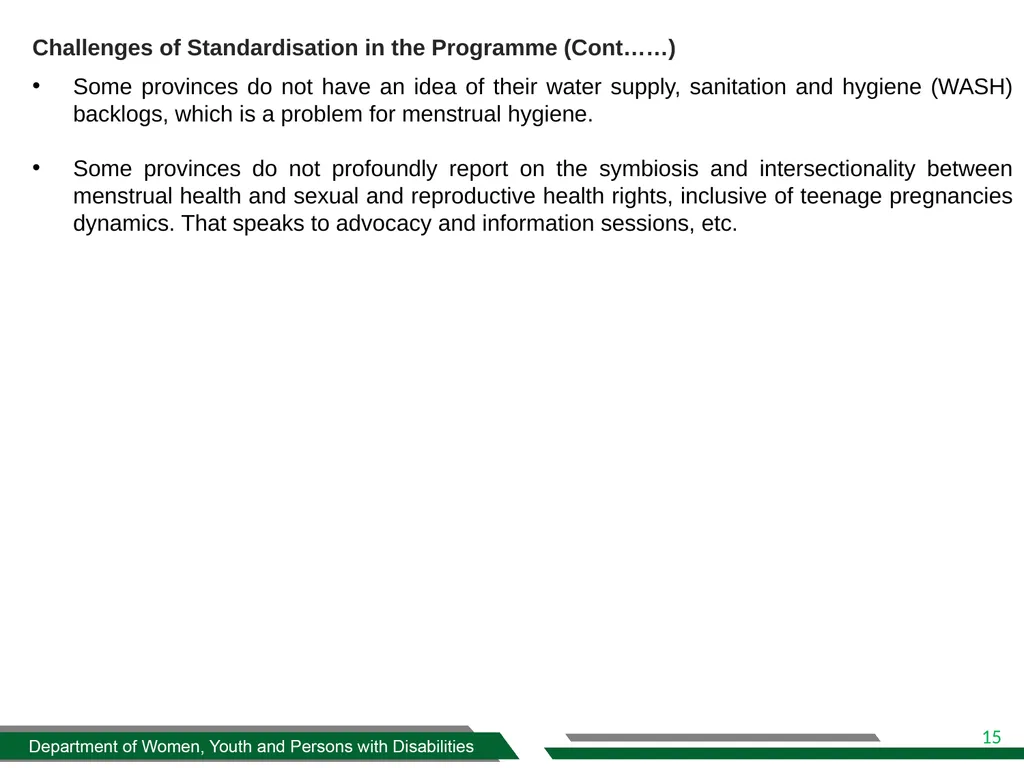
Challenges of Standardisation in the Programme (Cont……)
Some provinces do not have an idea of their water supply, sanitation and hygiene (WASH) backlogs, which is a problem for menstrual hygiene.
Some provinces do not profoundly report on the symbiosis and intersectionality between menstrual health and sexual and reproductive health rights, inclusive of teenage pregnancies dynamics. That speaks to advocacy and information sessions, etc.<br>
Some provinces do not have an idea of their water supply, sanitation and hygiene (WASH) backlogs, which is a problem for menstrual hygiene.
Some provinces do not profoundly report on the symbiosis and intersectionality between menstrual health and sexual and reproductive health rights, inclusive of teenage pregnancies dynamics. That speaks to advocacy and information sessions, etc.<br>
16
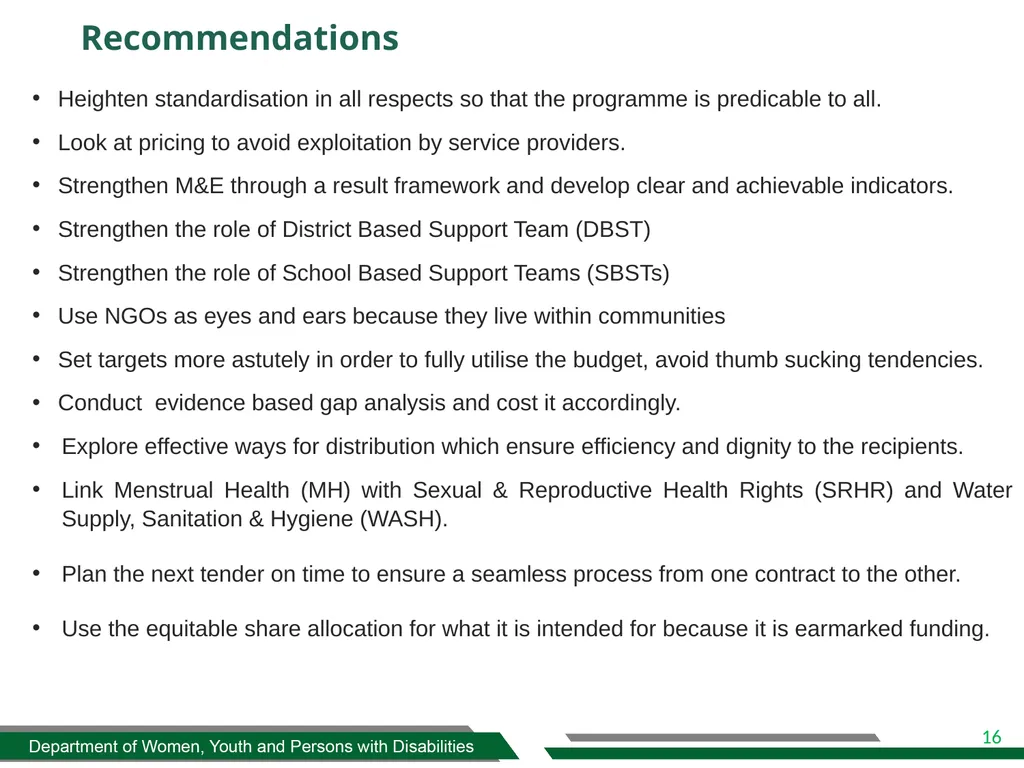
Recommendations Heighten standardisation in all respects so that the programme is predicable to all.
Look at pricing to avoid exploitation by service providers.
Strengthen M&E through a result framework and develop clear and achievable indicators.
Strengthen the role of District Based Support Team (DBST)
Strengthen the role of School Based Support Teams (SBSTs)
Use NGOs as eyes and ears because they live within communities
Set targets more astutely in order to fully utilise the budget, avoid thumb sucking tendencies.
Conduct evidence based gap analysis and cost it accordingly.
Explore effective ways for distribution which ensure efficiency and dignity to the recipients.
Link Menstrual Health (MH) with Sexual & Reproductive Health Rights (SRHR) and Water Supply, Sanitation & Hygiene (WASH).
Plan the next tender on time to ensure a seamless process from one contract to the other.
Use the equitable share allocation for what it is intended for because it is earmarked funding.<br>
Look at pricing to avoid exploitation by service providers.
Strengthen M&E through a result framework and develop clear and achievable indicators.
Strengthen the role of District Based Support Team (DBST)
Strengthen the role of School Based Support Teams (SBSTs)
Use NGOs as eyes and ears because they live within communities
Set targets more astutely in order to fully utilise the budget, avoid thumb sucking tendencies.
Conduct evidence based gap analysis and cost it accordingly.
Explore effective ways for distribution which ensure efficiency and dignity to the recipients.
Link Menstrual Health (MH) with Sexual & Reproductive Health Rights (SRHR) and Water Supply, Sanitation & Hygiene (WASH).
Plan the next tender on time to ensure a seamless process from one contract to the other.
Use the equitable share allocation for what it is intended for because it is earmarked funding.<br>
17
Thank you<br>