
E-LEARNING INITIATIVES AT MOTOROLA PRESENTED BY:


Description: E-LEARNING INITIATIVES AT MOTOROLA PRESENTED BY: Dr. Srinibash Dash School of Management GMU INTRODUCTION OF THE COMPANY Motorola was founded by the Galvin brothers in 1928 in the name of Galvin Manufacturing Corporation in Chicago,
Related Topics
Download Presentation
"E-LEARNING INITIATIVES AT MOTOROLA PRESENTED BY:" is the property of its rightful owner. Permission is granted to download and print the materials on this website for personal, non-commercial use only, and to display it on your personal computer provided you do not modify the materials and that you retain all copyright notices contained in the materials. By downloading content from our website, you accept the terms of this agreement.
Presentation Transcript
slide1. E-LEARNING INITIATIVES AT MOTOROLA PRESENTED BY:
Dr. Srinibash Dash
School of Management
GMU<br>
slide2. INTRODUCTION OF THE COMPANY Motorola was founded by the Galvin brothers in 1928 in the name of Galvin Manufacturing Corporation in Chicago, Ilinois, US.
Its first product was “Battery Eliminator”.
In 1930s the company successfully commercialized car radios in the name of Motorola.
In 1947 the company’s name was changed to Motorola Inc.
In 1950s it became a commercial producer and supplier of semiconductors.
During the period of 1965-1980 it expanded its international presence by adding plants in many countries.<br>
slide3. NEED FOR TRAINING IN MOTOROLA INC. Rising competition.
Increasing demand of the customers for new products.
Most workforce were not able to carry out even simple arithmetic calculations.
Drastic need for the upgradation of the employees skill.<br>
slide4. ESTABLISHMENT OF MOTOROLA TRAINING AND EDUCATION CENTER It was established in 1980 inorder to impart quality training to both workers and executives.
It understand MOTOROLA’s training requirements, design courses that catered to those requirements and update employee skills to help them adapt to the changing times.
It designed an elaborate program that trained employees in various work processes in manufacturing unit.
It believed that greater knowledge of work processes would translate into enhanced quality.<br>
slide5. MTEC RENAMED AS MU MTEC was renamed as MU in 1989.
It was given overall responsibility for all the training needs of the company.
It had to cater a large number of employees with diverse training needs in different locations all over the world.
The training itself also had to be conducted at different locations worldwide.<br>
slide6. CHALLENGES FACED BY MU MU was able to realize its training objectives through classroom training programs. However, this mode of learning presented two major challenges. They are:
Firstly, the cost involved was too high.
Secondly, the classroom method could not cater to individual training needs effectively.<br>
slide7. NEW METHODS OF TRAINING AS ADOPTED BY MOTOROLA In order to eliminate the heavy time and cost incurred by the classroom method Motorola adopted three new methods. They are:
Self–Directed Learning Program.
E-Learning Program.<br>
slide8. SELF-DIRECTED LEARNING PROGRAM SDL is a learning process in which individuals identify their training needs, set training goals and formulate strategies for achieving those goals.
Learning under this system is highly customized and relevant to each employee.
Another advantage of SDL was that employees could update their skills as and when required.<br>
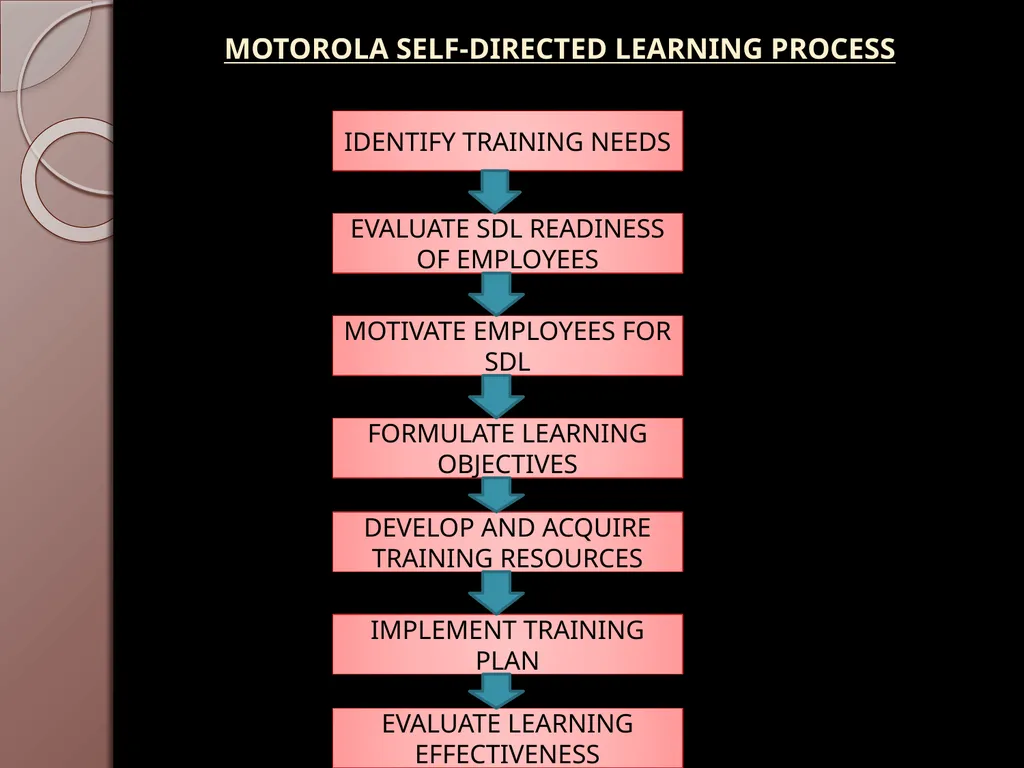
slide9. EVALUATE SDL READINESS OF EMPLOYEES EVALUATE LEARNING EFFECTIVENESS IMPLEMENT TRAINING PLAN FORMULATE LEARNING OBJECTIVES MOTIVATE EMPLOYEES FOR SDL IDENTIFY TRAINING NEEDS DEVELOP AND ACQUIRE TRAINING RESOURCES MOTOROLA SELF-DIRECTED LEARNING PROCESS<br>
slide10. E-LEARNING PROGRAMS E-Learning also called as distributed learning technology is a form of learning that uses a network for delivery, interactions or facilitation. The network might use LAN,WAN, Intranet or Internet. E-Learning solutions enable new levels of learning across a company using many advanced technologies.<br>
slide11. E-LEARNING PROGRAMS IN MOTOROLA In order to remain competitive the employees need to be trained on new technologies quickly.
In October 2000, an e-learning programs was set up by MU.
MU’s e-learning program was the e-learning portal that allowed employees to learn new skills from their desks using internet and intranet.
The portal developed both synchronous and asynchronous programs which allowed a blend of both trainer-led and self-directed learning.<br>
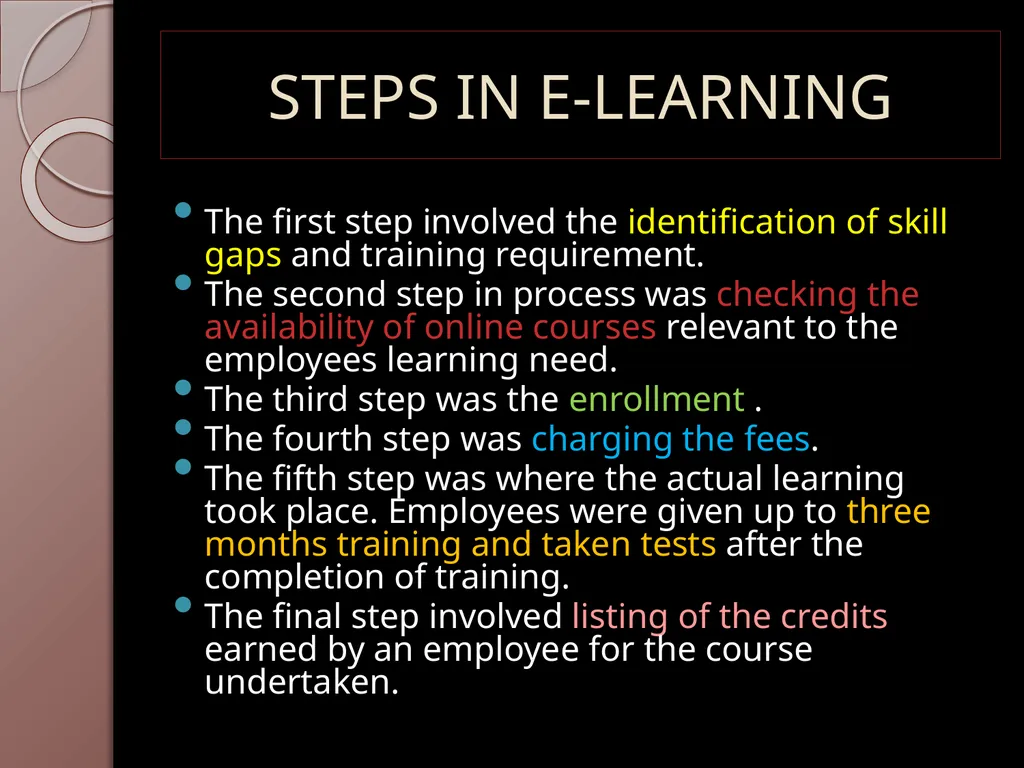
slide12. STEPS IN E-LEARNING The first step involved the identification of skill gaps and training requirement.
The second step in process was checking the availability of online courses relevant to the employees learning need.
The third step was the enrollment .
The fourth step was charging the fees.
The fifth step was where the actual learning took place. Employees were given up to three months training and taken tests after the completion of training.
The final step involved listing of the credits earned by an employee for the course undertaken.<br>
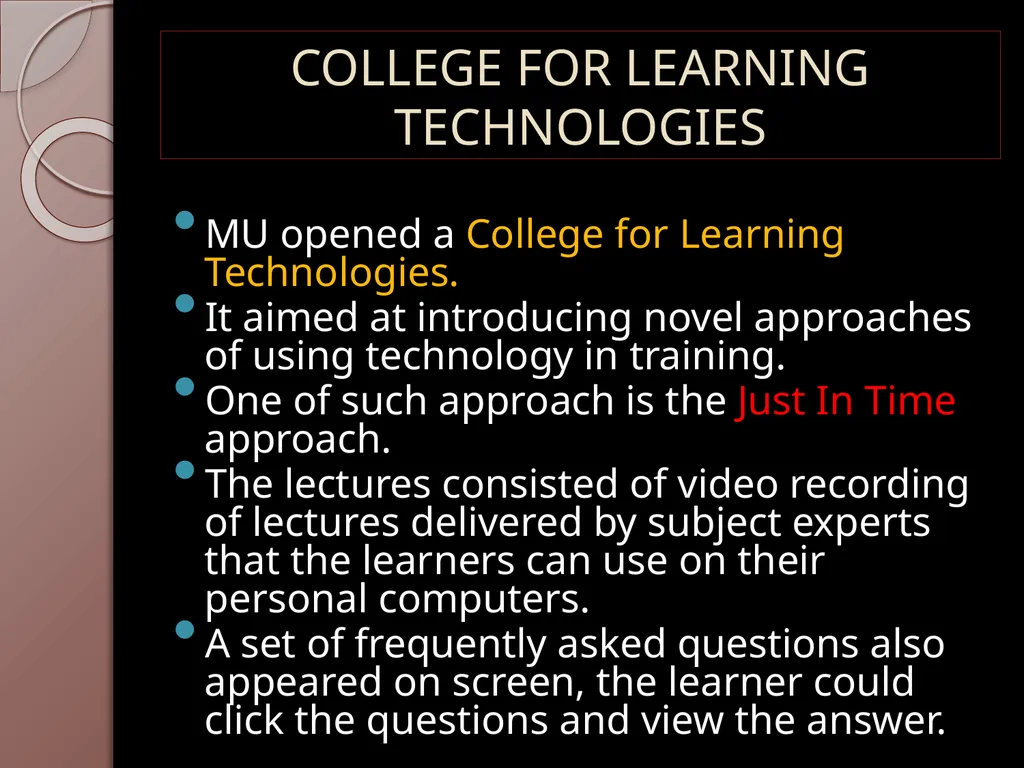
slide13. COLLEGE FOR LEARNING TECHNOLOGIES MU opened a College for Learning Technologies.
It aimed at introducing novel approaches of using technology in training.
One of such approach is the Just In Time approach.
The lectures consisted of video recording of lectures delivered by subject experts that the learners can use on their personal computers.
A set of frequently asked questions also appeared on screen, the learner could click the questions and view the answer.<br>
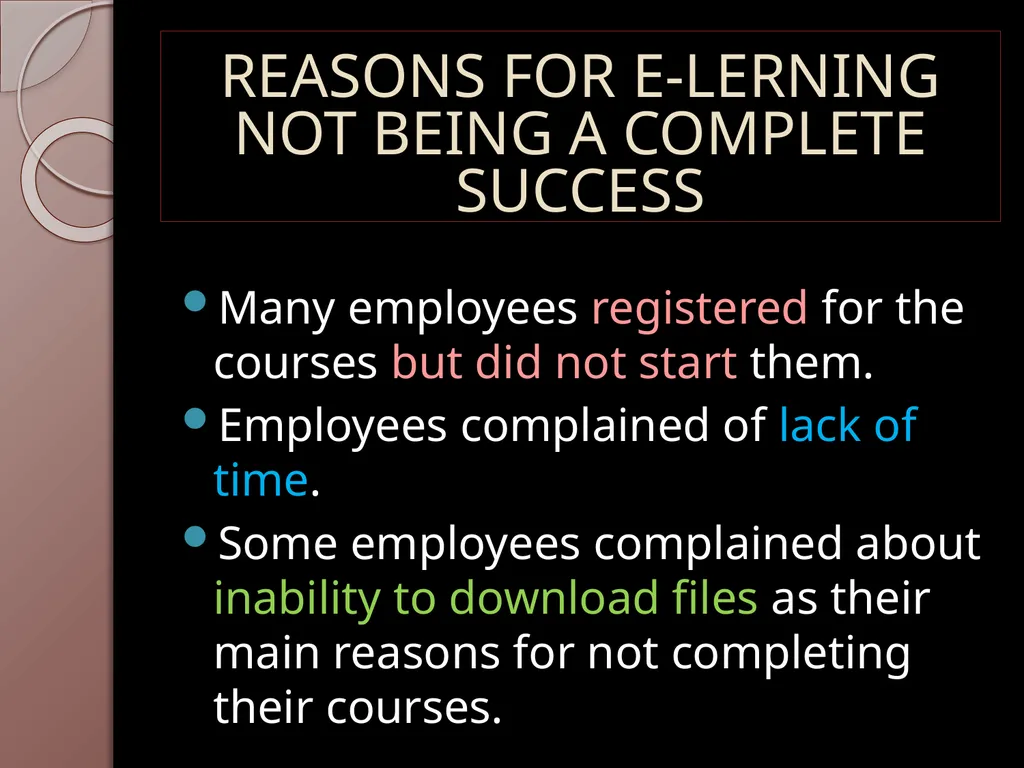
slide14. REASONS FOR E-LERNING NOT BEING A COMPLETE SUCCESS Many employees registered for the courses but did not start them.
Employees complained of lack of time.
Some employees complained about inability to download files as their main reasons for not completing their courses.<br>
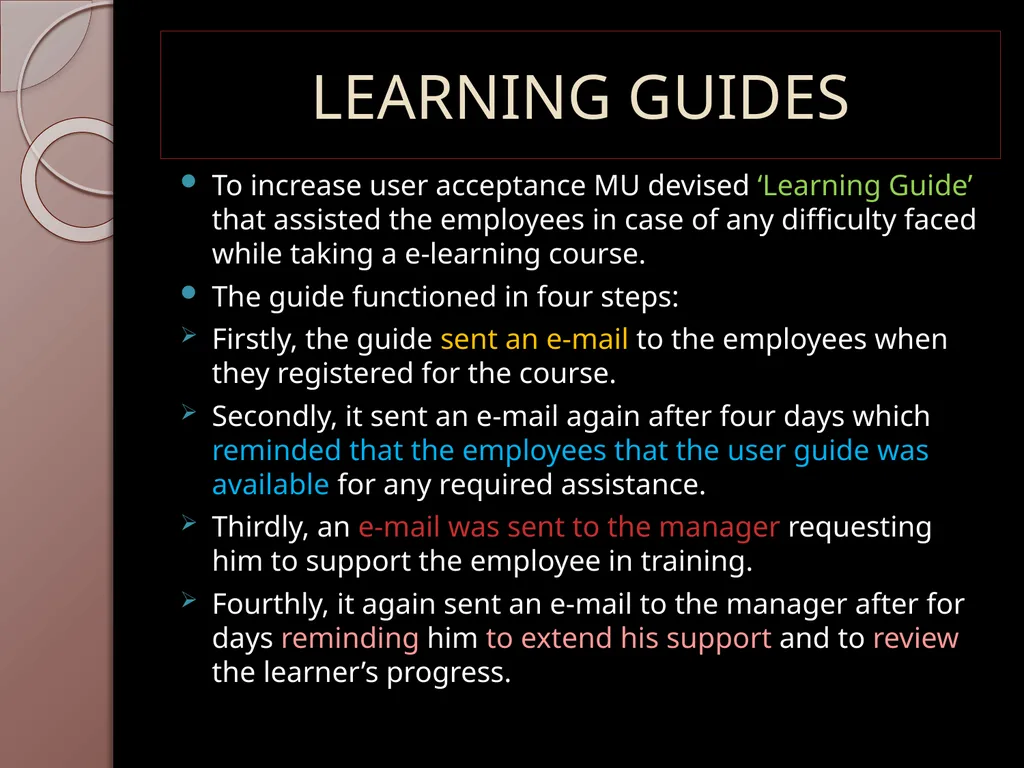
slide15. LEARNING GUIDES To increase user acceptance MU devised ‘Learning Guide’ that assisted the employees in case of any difficulty faced while taking a e-learning course.
The guide functioned in four steps:
Firstly, the guide sent an e-mail to the employees when they registered for the course.
Secondly, it sent an e-mail again after four days which reminded that the employees that the user guide was available for any required assistance.
Thirdly, an e-mail was sent to the manager requesting him to support the employee in training.
Fourthly, it again sent an e-mail to the manager after for days reminding him to extend his support and to review the learner’s progress.<br>
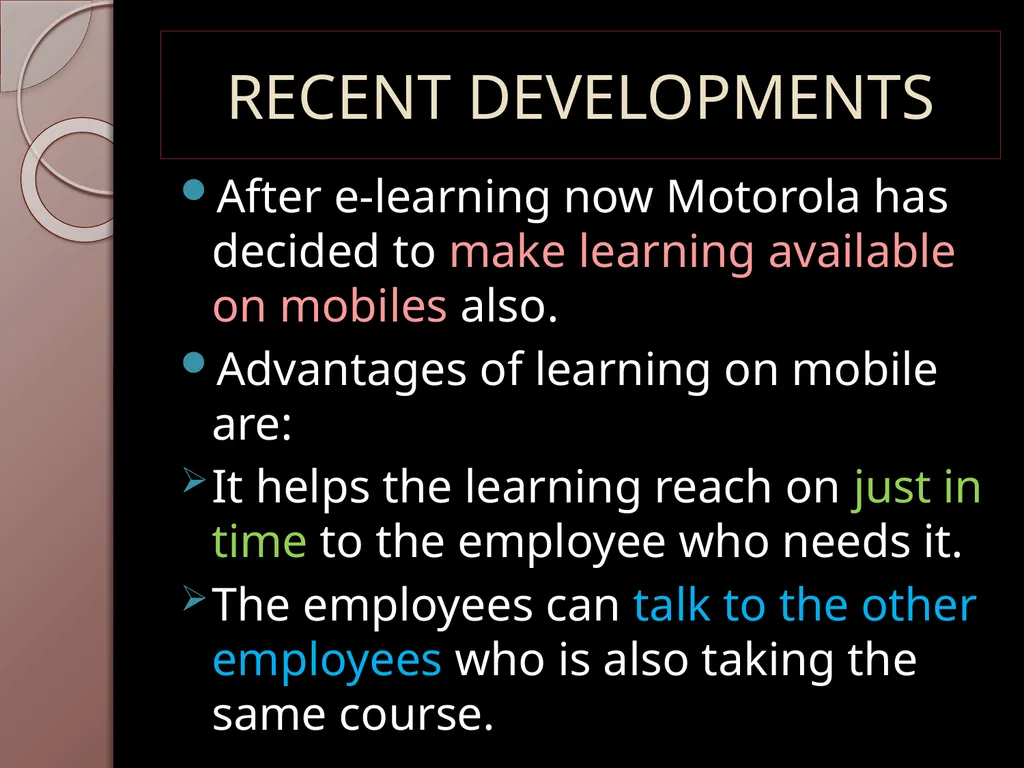
slide16. RECENT DEVELOPMENTS After e-learning now Motorola has decided to make learning available on mobiles also.
Advantages of learning on mobile are:
It helps the learning reach on just in time to the employee who needs it.
The employees can talk to the other employees who is also taking the same course.<br>
slide17. CONCLUSION Motorola incorporated e-learning into its corporate strategy inorder to reduce training cost and time.
E-Learning helped the company to maintain consistency in the course delivery through out the world at reduced cost.<br>
slide18. THANK YOU<br>
Dr. Srinibash Dash
School of Management
GMU<br>
slide2. INTRODUCTION OF THE COMPANY Motorola was founded by the Galvin brothers in 1928 in the name of Galvin Manufacturing Corporation in Chicago, Ilinois, US.
Its first product was “Battery Eliminator”.
In 1930s the company successfully commercialized car radios in the name of Motorola.
In 1947 the company’s name was changed to Motorola Inc.
In 1950s it became a commercial producer and supplier of semiconductors.
During the period of 1965-1980 it expanded its international presence by adding plants in many countries.<br>
slide3. NEED FOR TRAINING IN MOTOROLA INC. Rising competition.
Increasing demand of the customers for new products.
Most workforce were not able to carry out even simple arithmetic calculations.
Drastic need for the upgradation of the employees skill.<br>
slide4. ESTABLISHMENT OF MOTOROLA TRAINING AND EDUCATION CENTER It was established in 1980 inorder to impart quality training to both workers and executives.
It understand MOTOROLA’s training requirements, design courses that catered to those requirements and update employee skills to help them adapt to the changing times.
It designed an elaborate program that trained employees in various work processes in manufacturing unit.
It believed that greater knowledge of work processes would translate into enhanced quality.<br>
slide5. MTEC RENAMED AS MU MTEC was renamed as MU in 1989.
It was given overall responsibility for all the training needs of the company.
It had to cater a large number of employees with diverse training needs in different locations all over the world.
The training itself also had to be conducted at different locations worldwide.<br>
slide6. CHALLENGES FACED BY MU MU was able to realize its training objectives through classroom training programs. However, this mode of learning presented two major challenges. They are:
Firstly, the cost involved was too high.
Secondly, the classroom method could not cater to individual training needs effectively.<br>
slide7. NEW METHODS OF TRAINING AS ADOPTED BY MOTOROLA In order to eliminate the heavy time and cost incurred by the classroom method Motorola adopted three new methods. They are:
Self–Directed Learning Program.
E-Learning Program.<br>
slide8. SELF-DIRECTED LEARNING PROGRAM SDL is a learning process in which individuals identify their training needs, set training goals and formulate strategies for achieving those goals.
Learning under this system is highly customized and relevant to each employee.
Another advantage of SDL was that employees could update their skills as and when required.<br>
slide9. EVALUATE SDL READINESS OF EMPLOYEES EVALUATE LEARNING EFFECTIVENESS IMPLEMENT TRAINING PLAN FORMULATE LEARNING OBJECTIVES MOTIVATE EMPLOYEES FOR SDL IDENTIFY TRAINING NEEDS DEVELOP AND ACQUIRE TRAINING RESOURCES MOTOROLA SELF-DIRECTED LEARNING PROCESS<br>
slide10. E-LEARNING PROGRAMS E-Learning also called as distributed learning technology is a form of learning that uses a network for delivery, interactions or facilitation. The network might use LAN,WAN, Intranet or Internet. E-Learning solutions enable new levels of learning across a company using many advanced technologies.<br>
slide11. E-LEARNING PROGRAMS IN MOTOROLA In order to remain competitive the employees need to be trained on new technologies quickly.
In October 2000, an e-learning programs was set up by MU.
MU’s e-learning program was the e-learning portal that allowed employees to learn new skills from their desks using internet and intranet.
The portal developed both synchronous and asynchronous programs which allowed a blend of both trainer-led and self-directed learning.<br>
slide12. STEPS IN E-LEARNING The first step involved the identification of skill gaps and training requirement.
The second step in process was checking the availability of online courses relevant to the employees learning need.
The third step was the enrollment .
The fourth step was charging the fees.
The fifth step was where the actual learning took place. Employees were given up to three months training and taken tests after the completion of training.
The final step involved listing of the credits earned by an employee for the course undertaken.<br>
slide13. COLLEGE FOR LEARNING TECHNOLOGIES MU opened a College for Learning Technologies.
It aimed at introducing novel approaches of using technology in training.
One of such approach is the Just In Time approach.
The lectures consisted of video recording of lectures delivered by subject experts that the learners can use on their personal computers.
A set of frequently asked questions also appeared on screen, the learner could click the questions and view the answer.<br>
slide14. REASONS FOR E-LERNING NOT BEING A COMPLETE SUCCESS Many employees registered for the courses but did not start them.
Employees complained of lack of time.
Some employees complained about inability to download files as their main reasons for not completing their courses.<br>
slide15. LEARNING GUIDES To increase user acceptance MU devised ‘Learning Guide’ that assisted the employees in case of any difficulty faced while taking a e-learning course.
The guide functioned in four steps:
Firstly, the guide sent an e-mail to the employees when they registered for the course.
Secondly, it sent an e-mail again after four days which reminded that the employees that the user guide was available for any required assistance.
Thirdly, an e-mail was sent to the manager requesting him to support the employee in training.
Fourthly, it again sent an e-mail to the manager after for days reminding him to extend his support and to review the learner’s progress.<br>
slide16. RECENT DEVELOPMENTS After e-learning now Motorola has decided to make learning available on mobiles also.
Advantages of learning on mobile are:
It helps the learning reach on just in time to the employee who needs it.
The employees can talk to the other employees who is also taking the same course.<br>
slide17. CONCLUSION Motorola incorporated e-learning into its corporate strategy inorder to reduce training cost and time.
E-Learning helped the company to maintain consistency in the course delivery through out the world at reduced cost.<br>
slide18. THANK YOU<br>