
E16-The Prevent-Teach-Reinforce FBA/BIP Model for
MS
Published · 73 slides · 0 views

1 / 1




Description
E16-The Prevent-Teach-Reinforce FBABIP Model for Middle High School Students Rose Iovannone, Ph.D., BCBA-D iovannoneusf.edu 813-974-1696 The contents of this training were developed under grant H324P04003 from the Department of
Related Topics
Share
Embed code
Download this presentation From Below
"E16-The Prevent-Teach-Reinforce FBA/BIP Model for" is the property of its rightful owner. Permission is granted to download and print the materials on this website for personal, non-commercial use only, and to display it on your personal computer provided you do not modify the materials and that you retain all copyright notices contained in the materials. By downloading content from our website, you accept the terms of this agreement.
Presentation Transcript
01
E16-The Prevent-Teach-Reinforce FBA/BIP Model for Middle & High School Students Rose Iovannone, Ph.D., BCBA-D
iovannone@usf.edu
813-974-1696 The contents of this training were developed under grant H324P04003 from the Department of Education Key Words: Tier III, FBA/BIP<br>
iovannone@usf.edu
813-974-1696 The contents of this training were developed under grant H324P04003 from the Department of Education Key Words: Tier III, FBA/BIP<br>
02
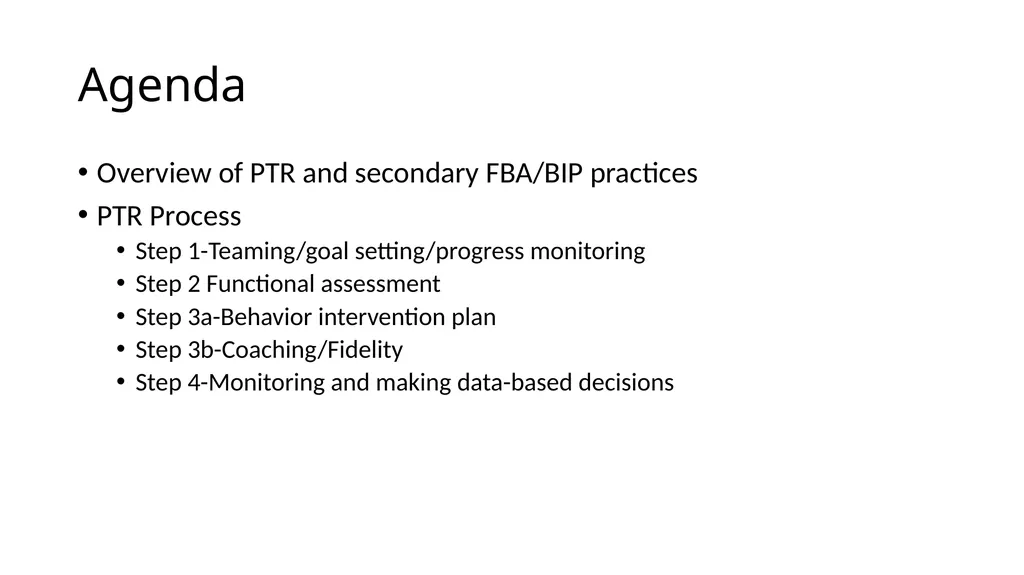
Agenda Overview of PTR and secondary FBA/BIP practices
PTR Process
Step 1-Teaming/goal setting/progress monitoring
Step 2 Functional assessment
Step 3a-Behavior intervention plan
Step 3b-Coaching/Fidelity
Step 4-Monitoring and making data-based decisions<br>
PTR Process
Step 1-Teaming/goal setting/progress monitoring
Step 2 Functional assessment
Step 3a-Behavior intervention plan
Step 3b-Coaching/Fidelity
Step 4-Monitoring and making data-based decisions<br>
03
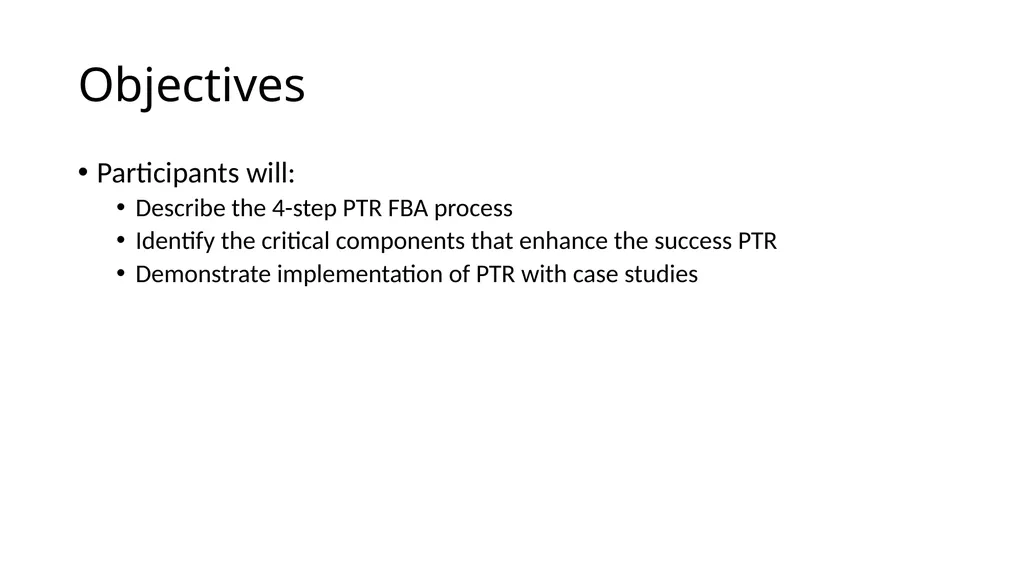
Objectives Participants will:
Describe the 4-step PTR FBA process
Identify the critical components that enhance the success PTR
Demonstrate implementation of PTR with case studies<br>
Describe the 4-step PTR FBA process
Identify the critical components that enhance the success PTR
Demonstrate implementation of PTR with case studies<br>
04
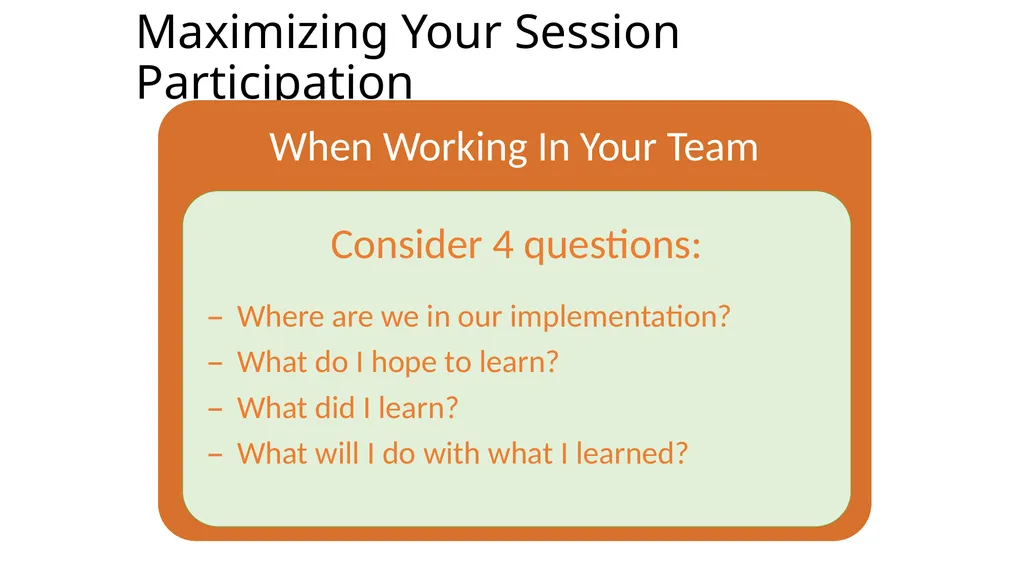
Maximizing Your Session Participation When Working In Your Team Consider 4 questions:
Where are we in our implementation?
What do I hope to learn?
What did I learn?
What will I do with what I learned?<br>
Where are we in our implementation?
What do I hope to learn?
What did I learn?
What will I do with what I learned?<br>
05
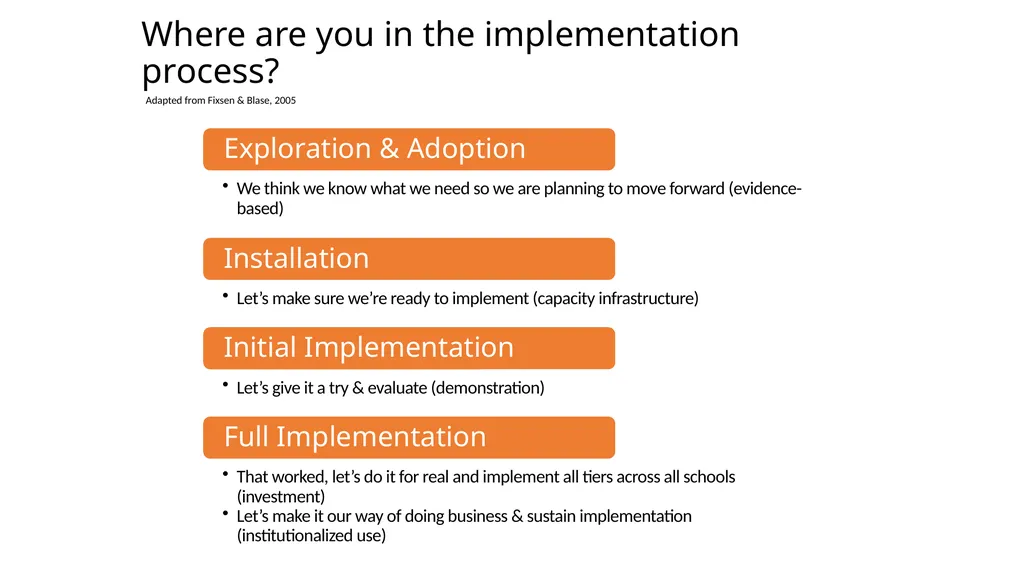
Where are you in the implementation process?
Adapted from Fixsen & Blase, 2005<br>
06
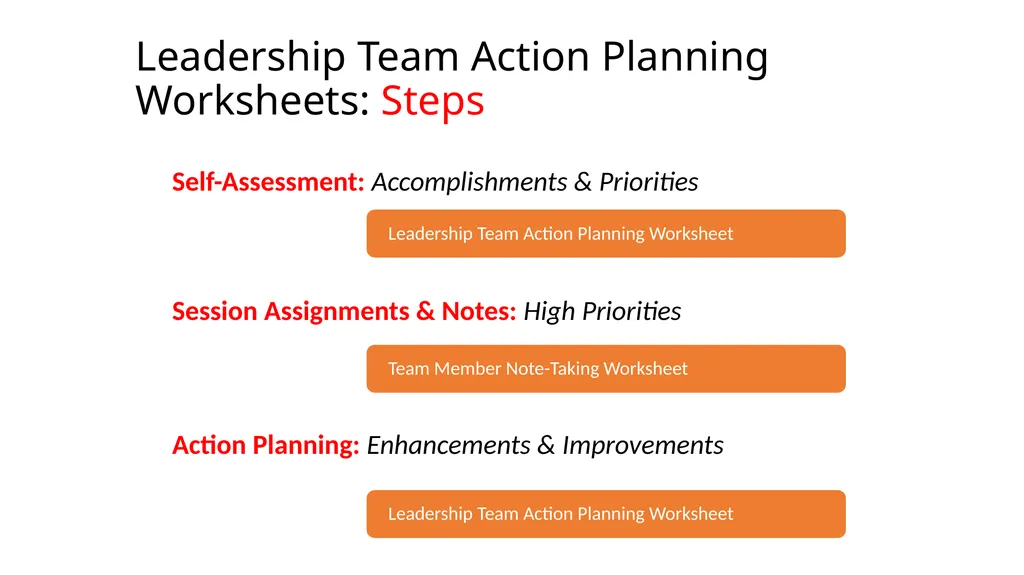
Leadership Team Action Planning
Worksheets: Steps<br>
07
Who is Here? Why are you Here?<br>
08
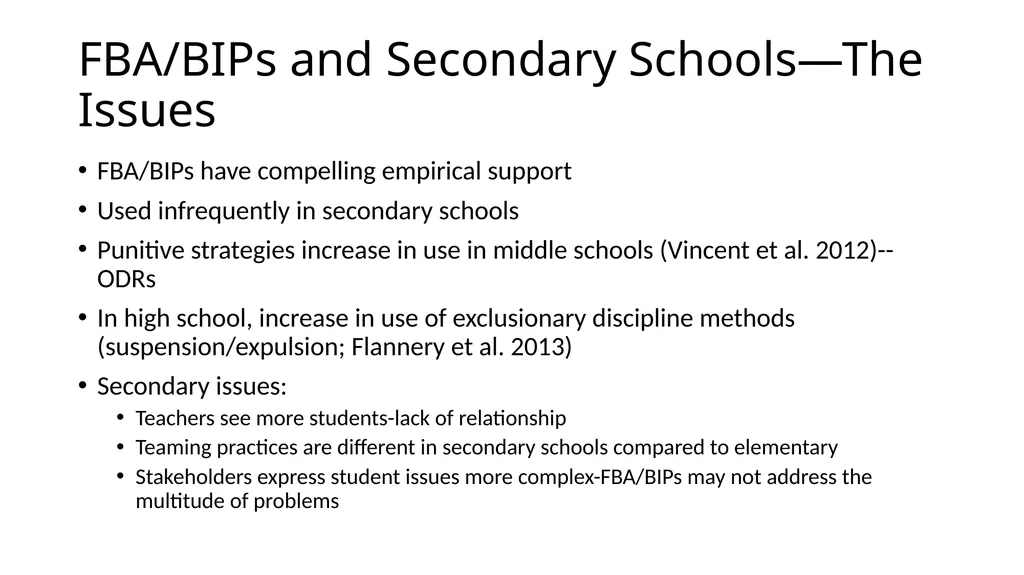
FBA/BIPs and Secondary Schools—The Issues FBA/BIPs have compelling empirical support
Used infrequently in secondary schools
Punitive strategies increase in use in middle schools (Vincent et al. 2012)--ODRs
In high school, increase in use of exclusionary discipline methods (suspension/expulsion; Flannery et al. 2013)
Secondary issues:
Teachers see more students-lack of relationship
Teaming practices are different in secondary schools compared to elementary
Stakeholders express student issues more complex-FBA/BIPs may not address the multitude of problems<br>
Used infrequently in secondary schools
Punitive strategies increase in use in middle schools (Vincent et al. 2012)--ODRs
In high school, increase in use of exclusionary discipline methods (suspension/expulsion; Flannery et al. 2013)
Secondary issues:
Teachers see more students-lack of relationship
Teaming practices are different in secondary schools compared to elementary
Stakeholders express student issues more complex-FBA/BIPs may not address the multitude of problems<br>
09
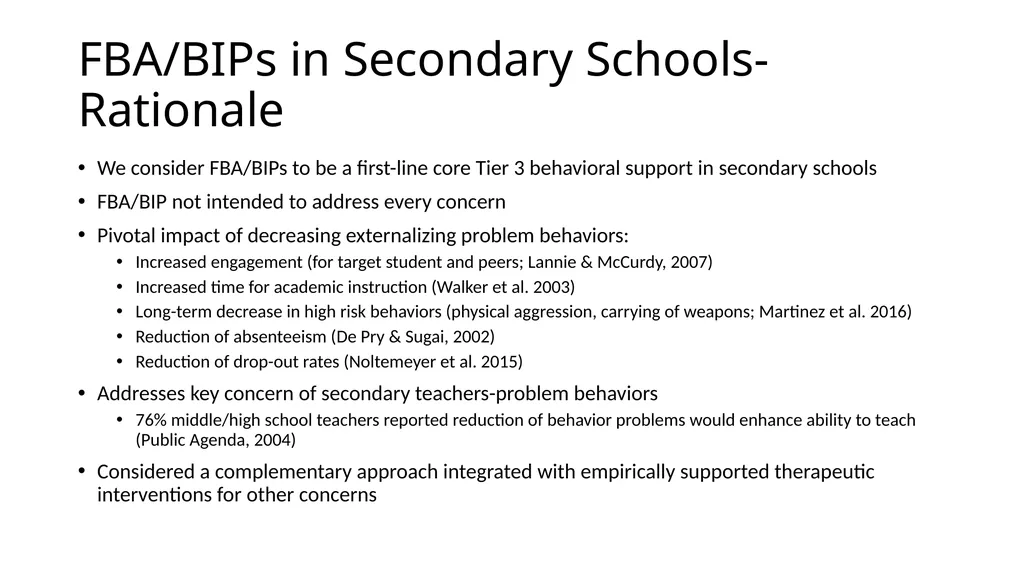
FBA/BIPs in Secondary Schools-Rationale We consider FBA/BIPs to be a first-line core Tier 3 behavioral support in secondary schools
FBA/BIP not intended to address every concern
Pivotal impact of decreasing externalizing problem behaviors:
Increased engagement (for target student and peers; Lannie & McCurdy, 2007)
Increased time for academic instruction (Walker et al. 2003)
Long-term decrease in high risk behaviors (physical aggression, carrying of weapons; Martinez et al. 2016)
Reduction of absenteeism (De Pry & Sugai, 2002)
Reduction of drop-out rates (Noltemeyer et al. 2015)
Addresses key concern of secondary teachers-problem behaviors
76% middle/high school teachers reported reduction of behavior problems would enhance ability to teach (Public Agenda, 2004)
Considered a complementary approach integrated with empirically supported therapeutic interventions for other concerns<br>
FBA/BIP not intended to address every concern
Pivotal impact of decreasing externalizing problem behaviors:
Increased engagement (for target student and peers; Lannie & McCurdy, 2007)
Increased time for academic instruction (Walker et al. 2003)
Long-term decrease in high risk behaviors (physical aggression, carrying of weapons; Martinez et al. 2016)
Reduction of absenteeism (De Pry & Sugai, 2002)
Reduction of drop-out rates (Noltemeyer et al. 2015)
Addresses key concern of secondary teachers-problem behaviors
76% middle/high school teachers reported reduction of behavior problems would enhance ability to teach (Public Agenda, 2004)
Considered a complementary approach integrated with empirically supported therapeutic interventions for other concerns<br>
10
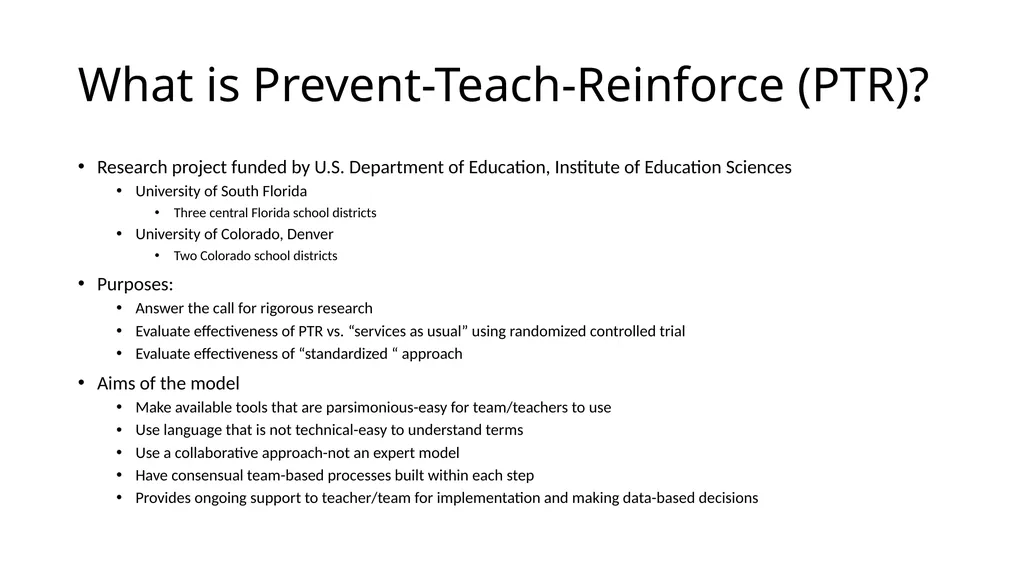
What is Prevent-Teach-Reinforce (PTR)? Research project funded by U.S. Department of Education, Institute of Education Sciences
University of South Florida
Three central Florida school districts
University of Colorado, Denver
Two Colorado school districts
Purposes:
Answer the call for rigorous research
Evaluate effectiveness of PTR vs. “services as usual” using randomized controlled trial
Evaluate effectiveness of “standardized “ approach
Aims of the model
Make available tools that are parsimonious-easy for team/teachers to use
Use language that is not technical-easy to understand terms
Use a collaborative approach-not an expert model
Have consensual team-based processes built within each step
Provides ongoing support to teacher/team for implementation and making data-based decisions<br>
University of South Florida
Three central Florida school districts
University of Colorado, Denver
Two Colorado school districts
Purposes:
Answer the call for rigorous research
Evaluate effectiveness of PTR vs. “services as usual” using randomized controlled trial
Evaluate effectiveness of “standardized “ approach
Aims of the model
Make available tools that are parsimonious-easy for team/teachers to use
Use language that is not technical-easy to understand terms
Use a collaborative approach-not an expert model
Have consensual team-based processes built within each step
Provides ongoing support to teacher/team for implementation and making data-based decisions<br>
11
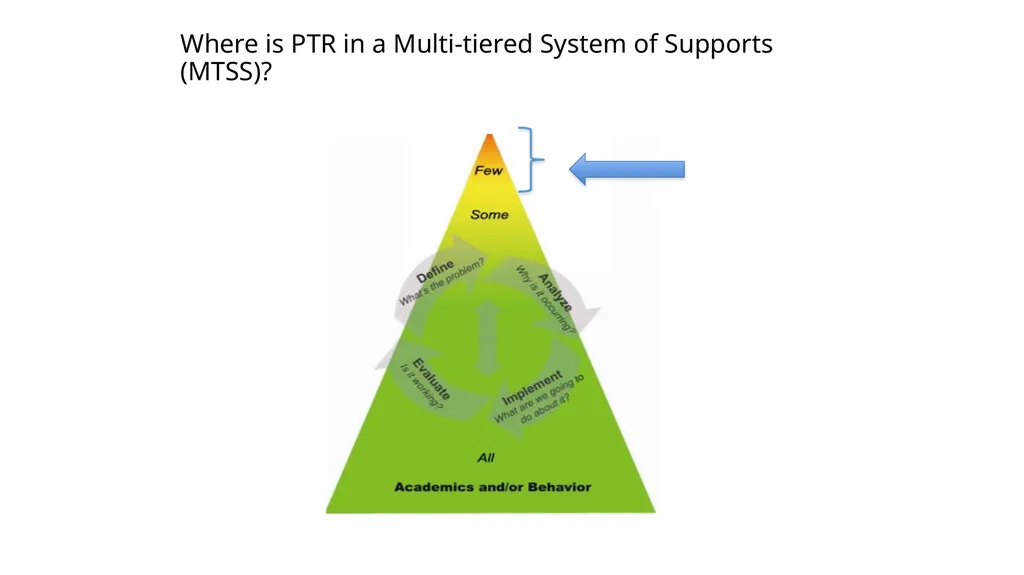
Where is PTR in a Multi-tiered System of Supports (MTSS)?<br>
12
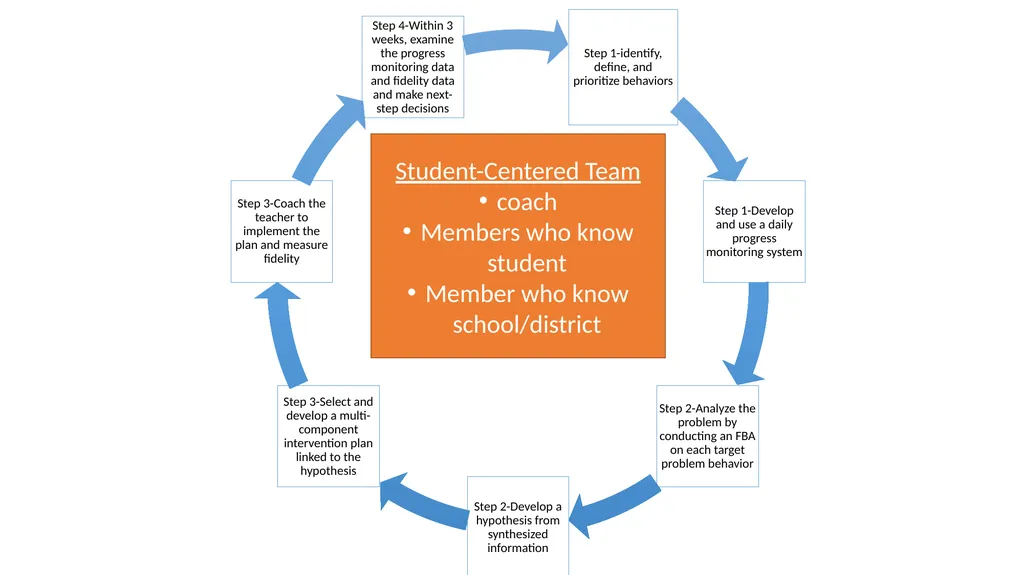
Student-Centered Team
coach
Members who know student
Member who know school/district<br>
coach
Members who know student
Member who know school/district<br>
13
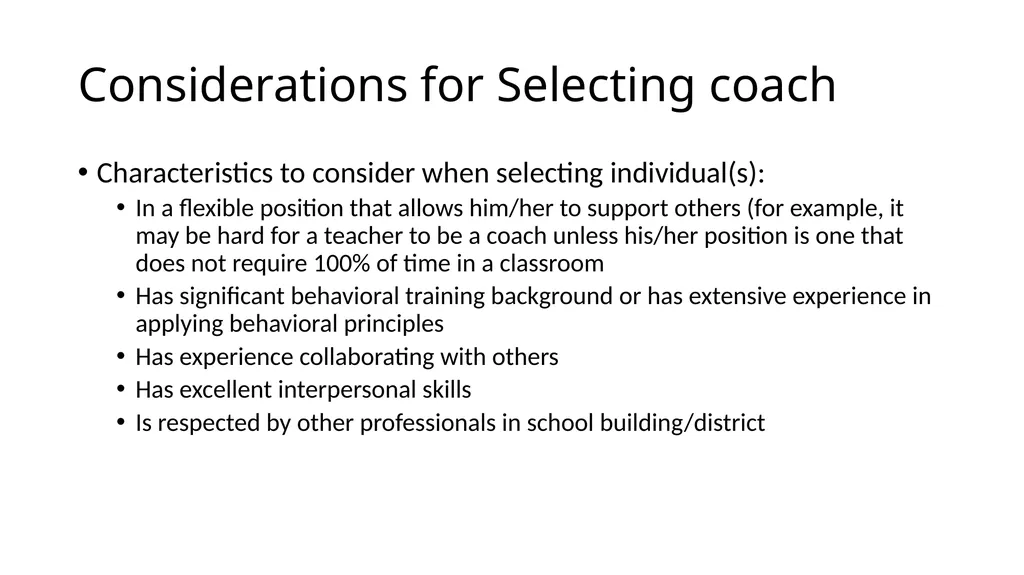
Considerations for Selecting coach Characteristics to consider when selecting individual(s):
In a flexible position that allows him/her to support others (for example, it may be hard for a teacher to be a coach unless his/her position is one that does not require 100% of time in a classroom
Has significant behavioral training background or has extensive experience in applying behavioral principles
Has experience collaborating with others
Has excellent interpersonal skills
Is respected by other professionals in school building/district<br>
In a flexible position that allows him/her to support others (for example, it may be hard for a teacher to be a coach unless his/her position is one that does not require 100% of time in a classroom
Has significant behavioral training background or has extensive experience in applying behavioral principles
Has experience collaborating with others
Has excellent interpersonal skills
Is respected by other professionals in school building/district<br>
14
Research Support for PTR<br>
15
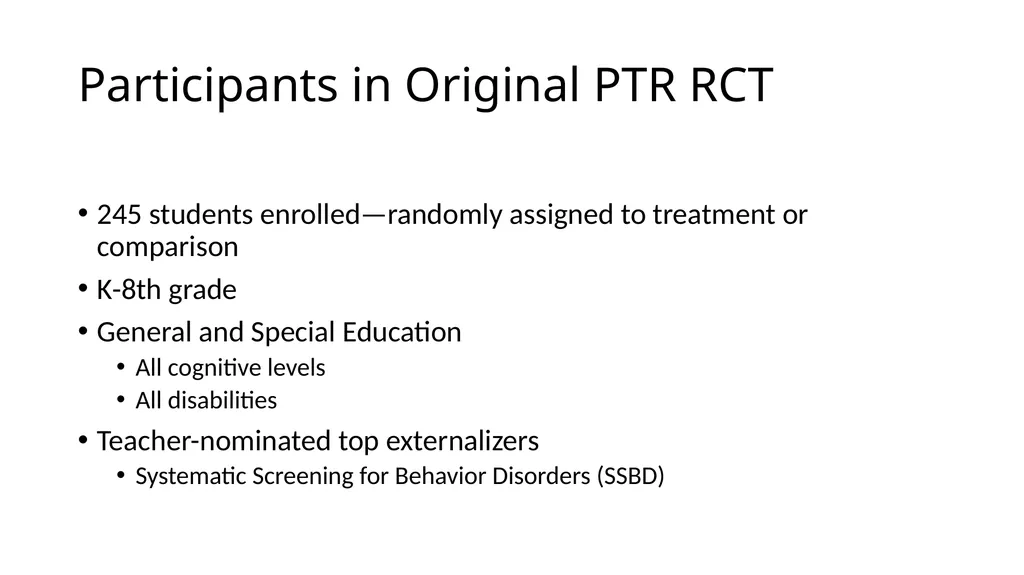
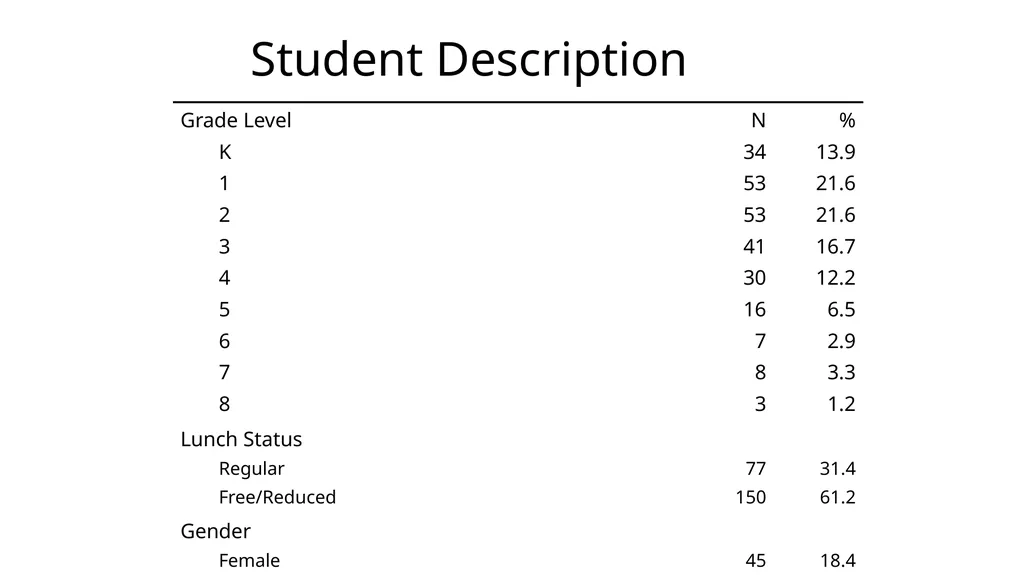
Participants in Original PTR RCT 245 students enrolled—randomly assigned to treatment or comparison
K-8th grade
General and Special Education
All cognitive levels
All disabilities
Teacher-nominated top externalizers
Systematic Screening for Behavior Disorders (SSBD)<br>
K-8th grade
General and Special Education
All cognitive levels
All disabilities
Teacher-nominated top externalizers
Systematic Screening for Behavior Disorders (SSBD)<br>
16
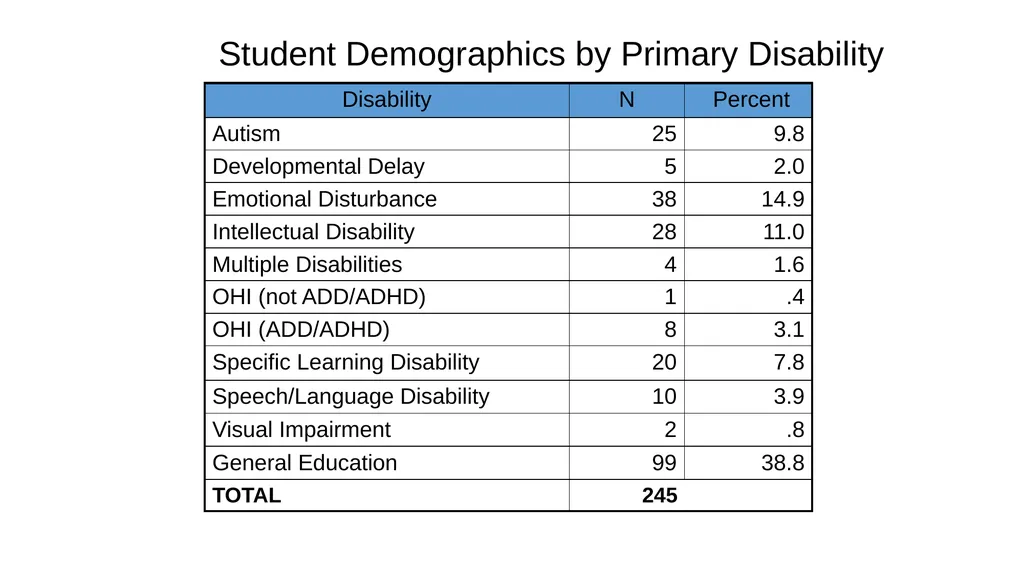
Student Demographics by Primary Disability<br>
17
Student Description<br>
18
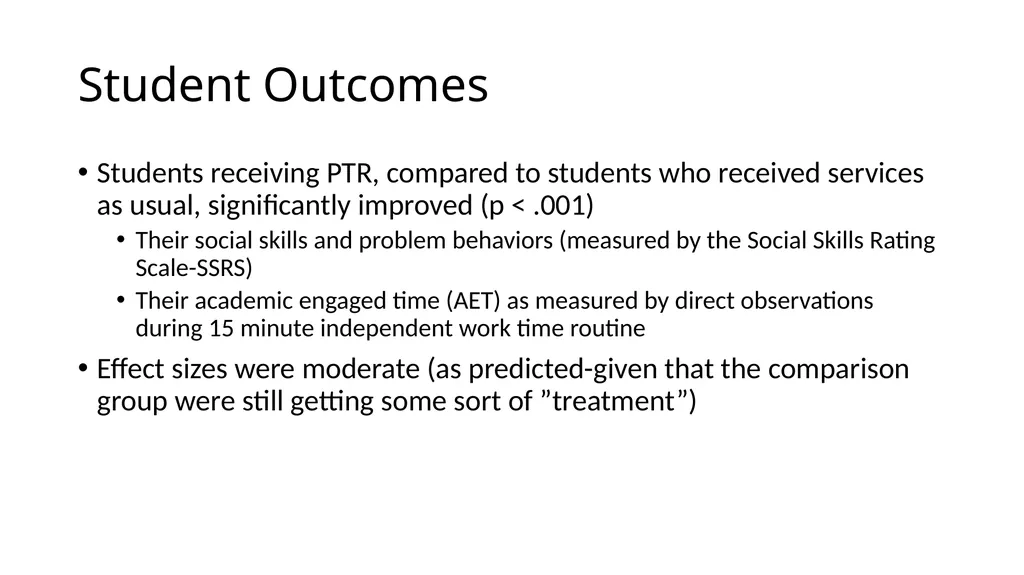
Student Outcomes Students receiving PTR, compared to students who received services as usual, significantly improved (p < .001)
Their social skills and problem behaviors (measured by the Social Skills Rating Scale-SSRS)
Their academic engaged time (AET) as measured by direct observations during 15 minute independent work time routine
Effect sizes were moderate (as predicted-given that the comparison group were still getting some sort of ”treatment”)<br>
Their social skills and problem behaviors (measured by the Social Skills Rating Scale-SSRS)
Their academic engaged time (AET) as measured by direct observations during 15 minute independent work time routine
Effect sizes were moderate (as predicted-given that the comparison group were still getting some sort of ”treatment”)<br>
19
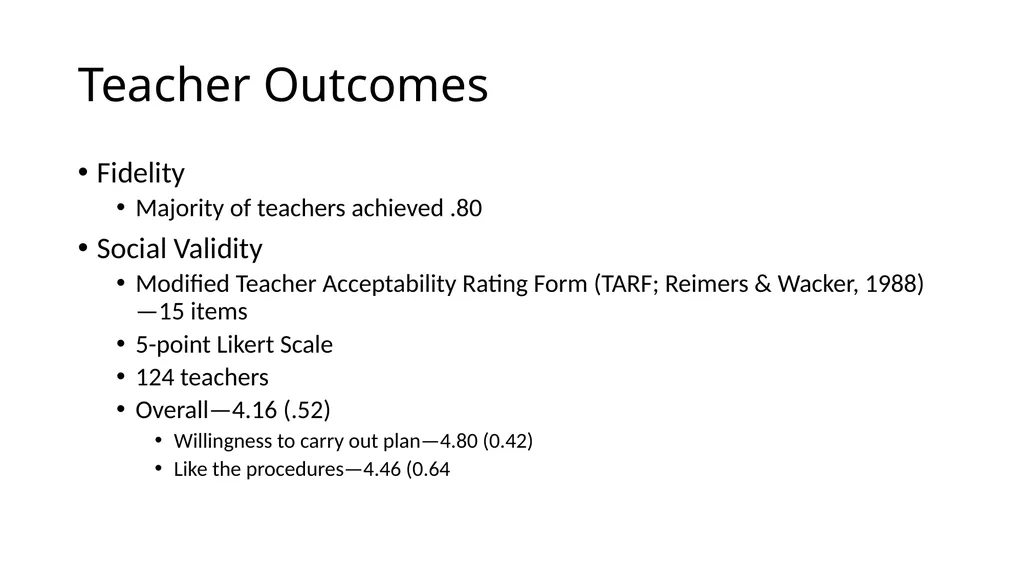
Teacher Outcomes Fidelity
Majority of teachers achieved .80
Social Validity
Modified Teacher Acceptability Rating Form (TARF; Reimers & Wacker, 1988)—15 items
5-point Likert Scale
124 teachers
Overall—4.16 (.52)
Willingness to carry out plan—4.80 (0.42)
Like the procedures—4.46 (0.64<br>
Majority of teachers achieved .80
Social Validity
Modified Teacher Acceptability Rating Form (TARF; Reimers & Wacker, 1988)—15 items
5-point Likert Scale
124 teachers
Overall—4.16 (.52)
Willingness to carry out plan—4.80 (0.42)
Like the procedures—4.46 (0.64<br>
20
Other Research<br>
21
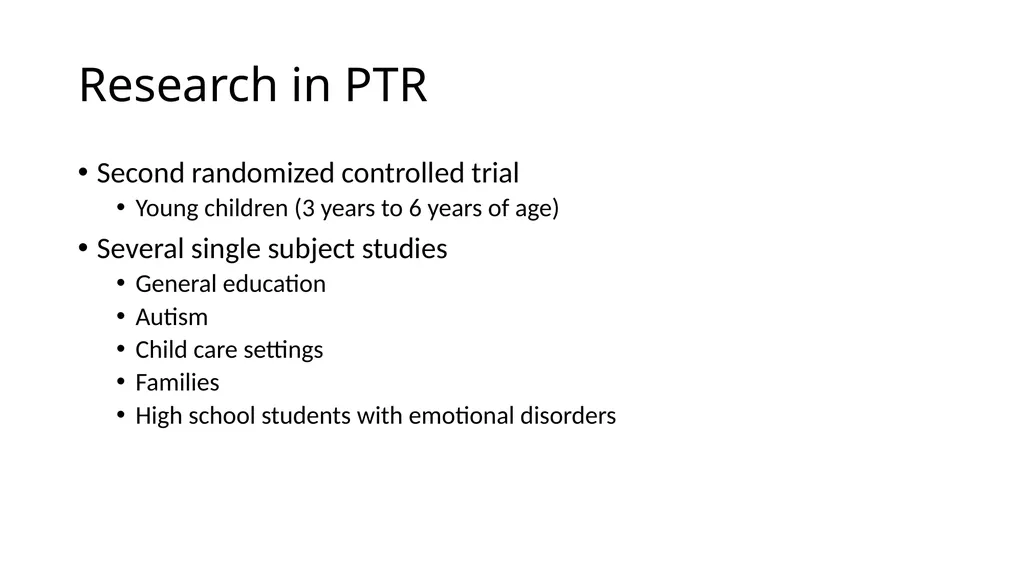
Research in PTR Second randomized controlled trial
Young children (3 years to 6 years of age)
Several single subject studies
General education
Autism
Child care settings
Families
High school students with emotional disorders<br>
Young children (3 years to 6 years of age)
Several single subject studies
General education
Autism
Child care settings
Families
High school students with emotional disorders<br>
22
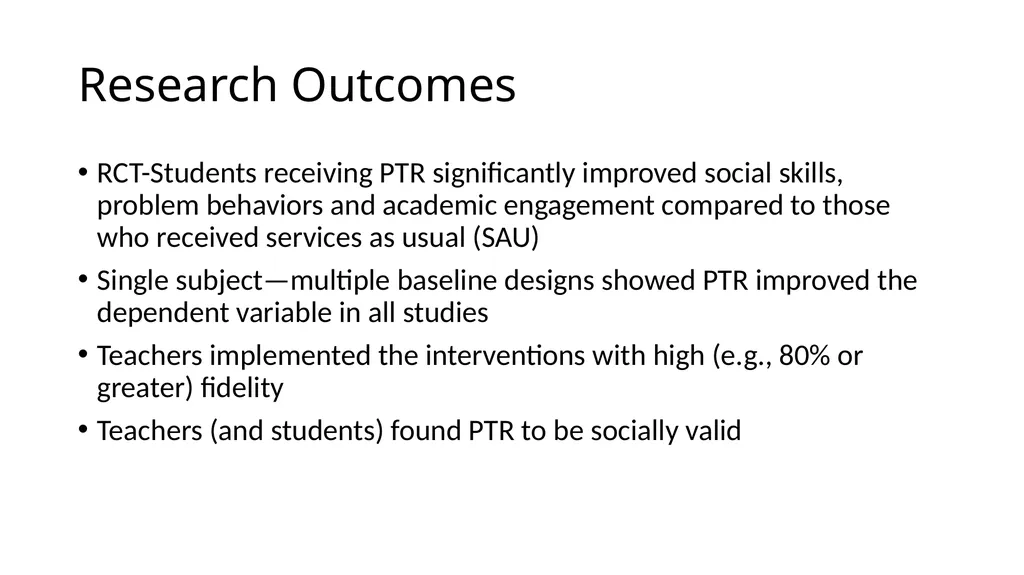
Research Outcomes RCT-Students receiving PTR significantly improved social skills, problem behaviors and academic engagement compared to those who received services as usual (SAU)
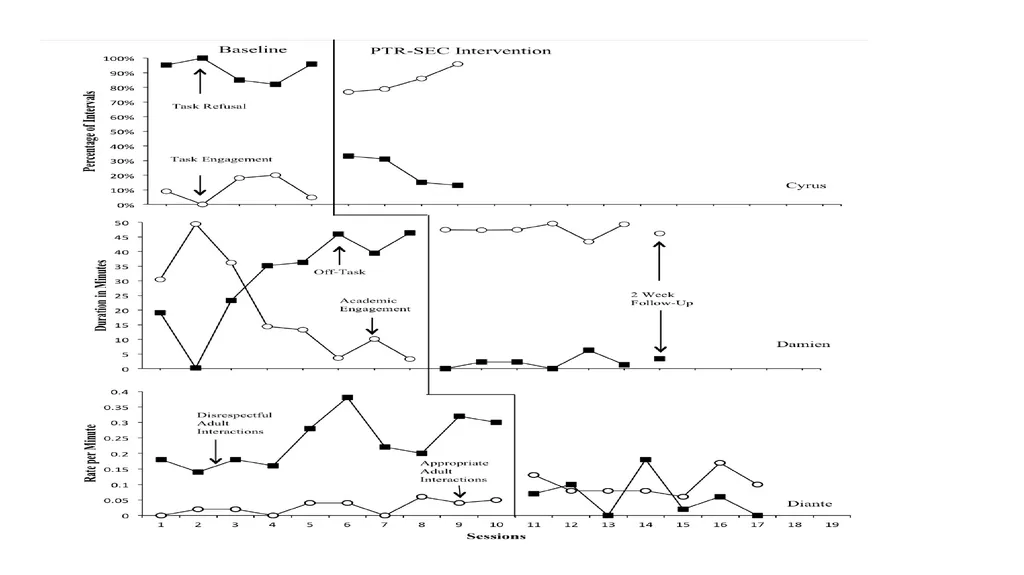
Single subject—multiple baseline designs showed PTR improved the dependent variable in all studies
Teachers implemented the interventions with high (e.g., 80% or greater) fidelity
Teachers (and students) found PTR to be socially valid<br>
Single subject—multiple baseline designs showed PTR improved the dependent variable in all studies
Teachers implemented the interventions with high (e.g., 80% or greater) fidelity
Teachers (and students) found PTR to be socially valid<br>
23
The PTR Process<br>
24
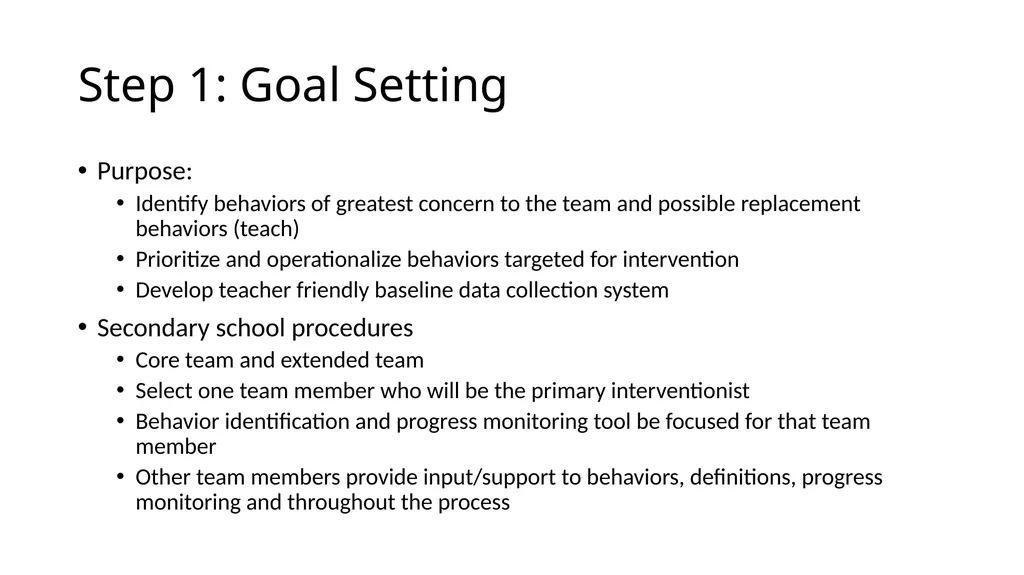
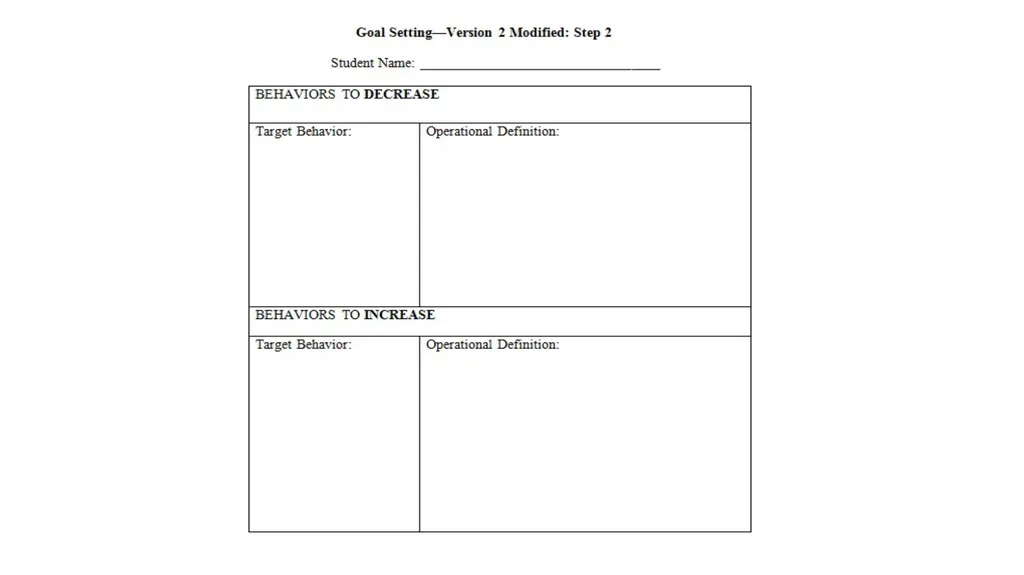
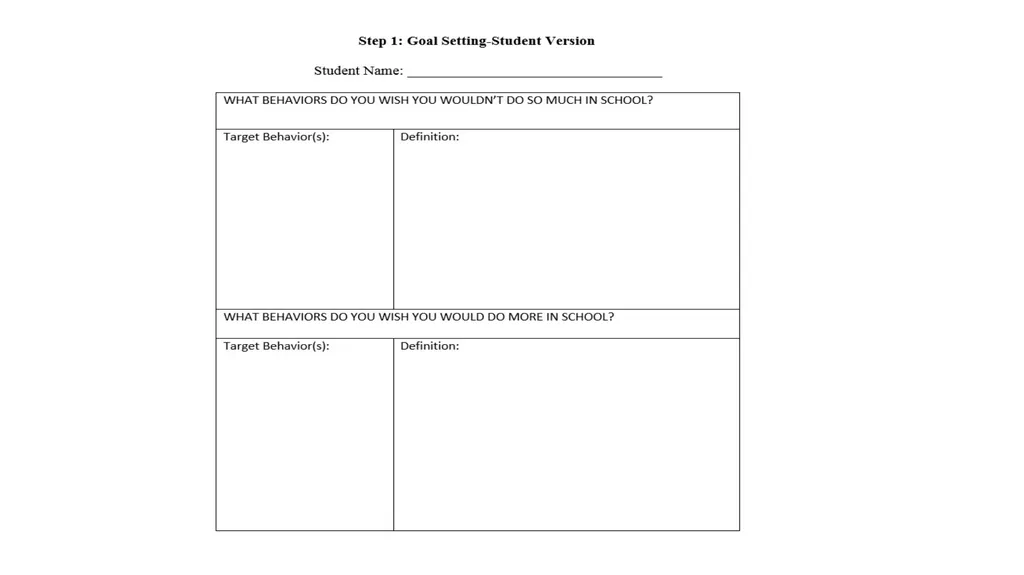
Step 1: Goal Setting Purpose:
Identify behaviors of greatest concern to the team and possible replacement behaviors (teach)
Prioritize and operationalize behaviors targeted for intervention
Develop teacher friendly baseline data collection system
Secondary school procedures
Core team and extended team
Select one team member who will be the primary interventionist
Behavior identification and progress monitoring tool be focused for that team member
Other team members provide input/support to behaviors, definitions, progress monitoring and throughout the process<br>
Identify behaviors of greatest concern to the team and possible replacement behaviors (teach)
Prioritize and operationalize behaviors targeted for intervention
Develop teacher friendly baseline data collection system
Secondary school procedures
Core team and extended team
Select one team member who will be the primary interventionist
Behavior identification and progress monitoring tool be focused for that team member
Other team members provide input/support to behaviors, definitions, progress monitoring and throughout the process<br>
25
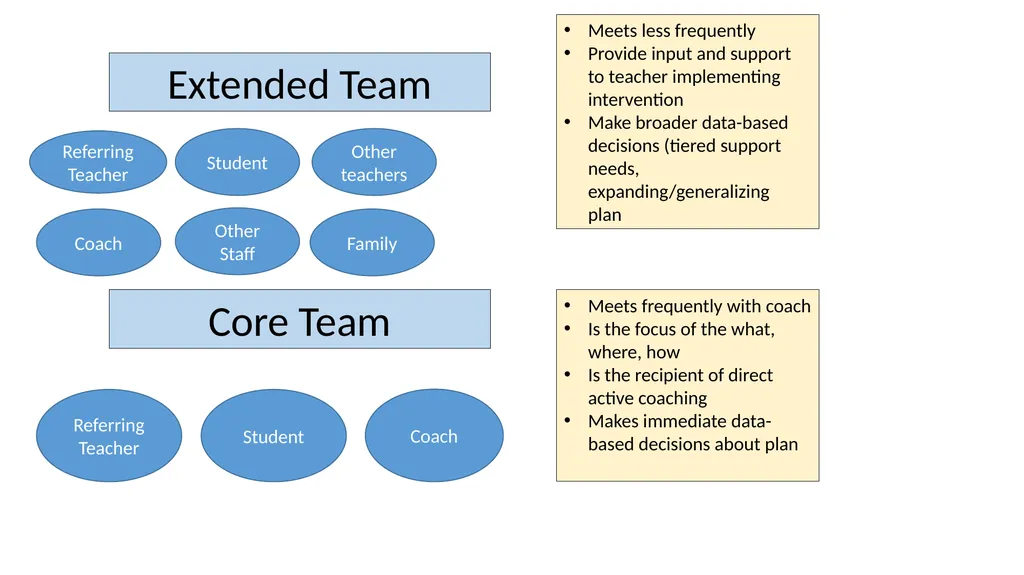
Extended Team Core Team Meets less frequently
Provide input and support to teacher implementing intervention
Make broader data-based decisions (tiered support needs, expanding/generalizing plan Meets frequently with coach
Is the focus of the what, where, how
Is the recipient of direct active coaching
Makes immediate data-based decisions about plan Referring Teacher Student Referring Teacher Student Other teachers Coach Other Staff Family Coach<br>
Provide input and support to teacher implementing intervention
Make broader data-based decisions (tiered support needs, expanding/generalizing plan Meets frequently with coach
Is the focus of the what, where, how
Is the recipient of direct active coaching
Makes immediate data-based decisions about plan Referring Teacher Student Referring Teacher Student Other teachers Coach Other Staff Family Coach<br>
26
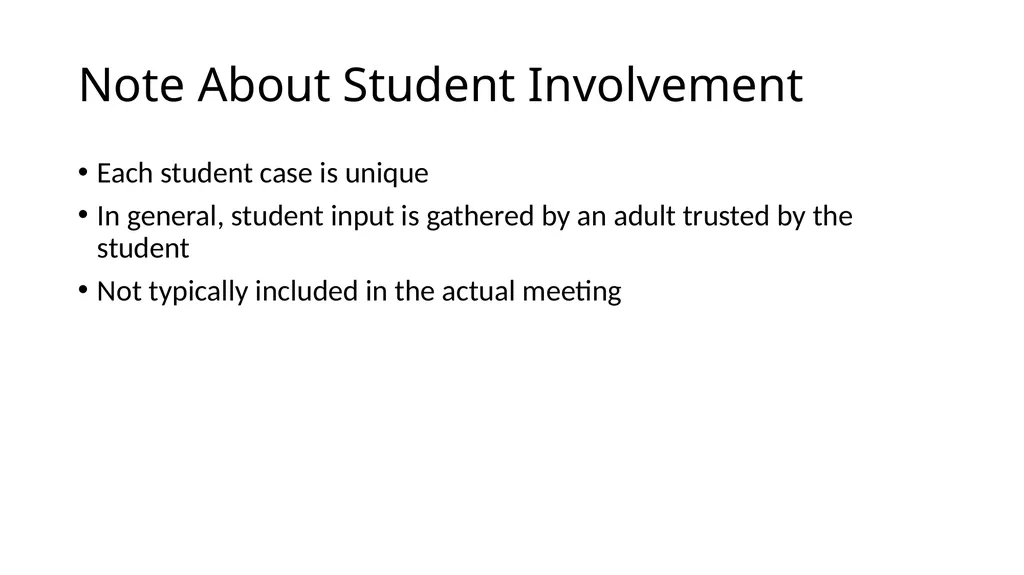
Note About Student Involvement Each student case is unique
In general, student input is gathered by an adult trusted by the student
Not typically included in the actual meeting<br>
In general, student input is gathered by an adult trusted by the student
Not typically included in the actual meeting<br>
27
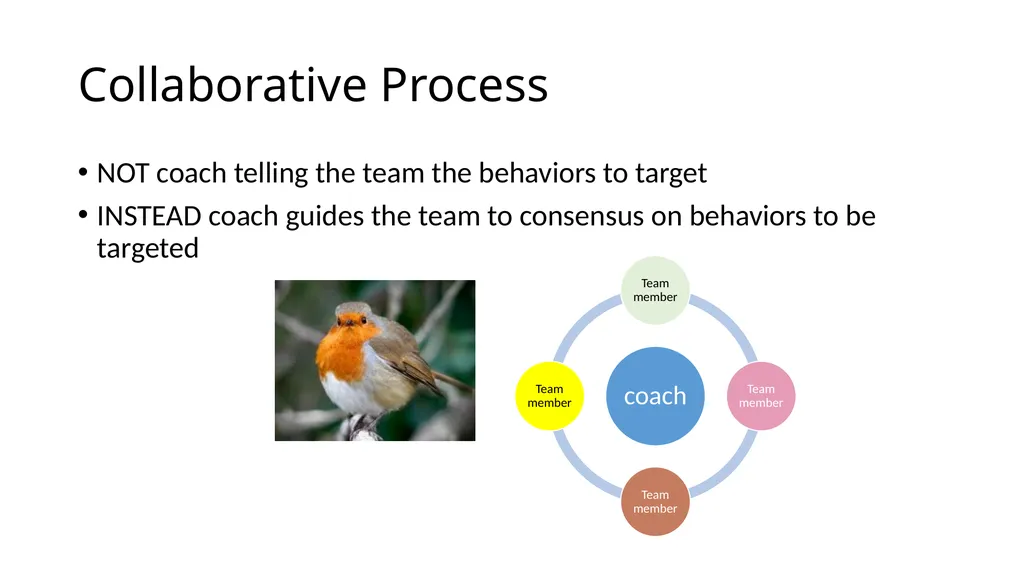
Collaborative Process NOT coach telling the team the behaviors to target
INSTEAD coach guides the team to consensus on behaviors to be targeted<br>
INSTEAD coach guides the team to consensus on behaviors to be targeted<br>
28
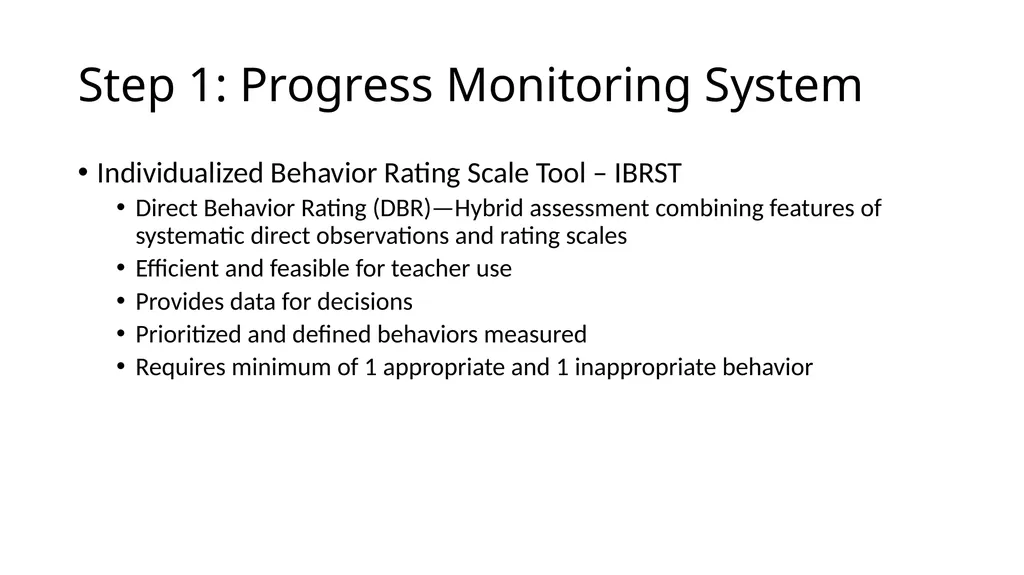
Step 1: Progress Monitoring System Individualized Behavior Rating Scale Tool – IBRST
Direct Behavior Rating (DBR)—Hybrid assessment combining features of systematic direct observations and rating scales
Efficient and feasible for teacher use
Provides data for decisions
Prioritized and defined behaviors measured
Requires minimum of 1 appropriate and 1 inappropriate behavior<br>
Direct Behavior Rating (DBR)—Hybrid assessment combining features of systematic direct observations and rating scales
Efficient and feasible for teacher use
Provides data for decisions
Prioritized and defined behaviors measured
Requires minimum of 1 appropriate and 1 inappropriate behavior<br>
29
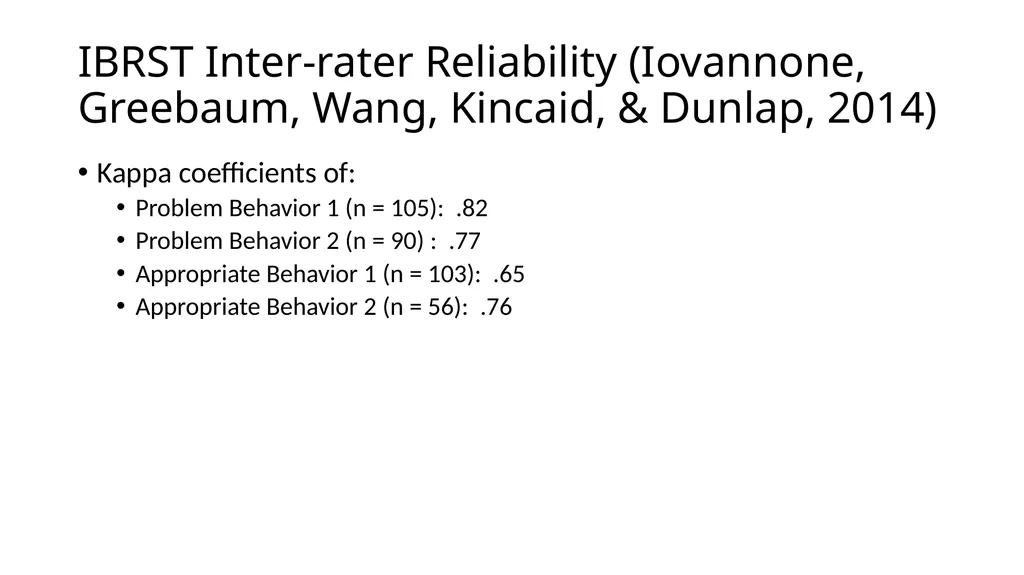
IBRST Inter-rater Reliability (Iovannone, Greebaum, Wang, Kincaid, & Dunlap, 2014) Kappa coefficients of:
Problem Behavior 1 (n = 105): .82
Problem Behavior 2 (n = 90) : .77
Appropriate Behavior 1 (n = 103): .65
Appropriate Behavior 2 (n = 56): .76<br>
Problem Behavior 1 (n = 105): .82
Problem Behavior 2 (n = 90) : .77
Appropriate Behavior 1 (n = 103): .65
Appropriate Behavior 2 (n = 56): .76<br>
30
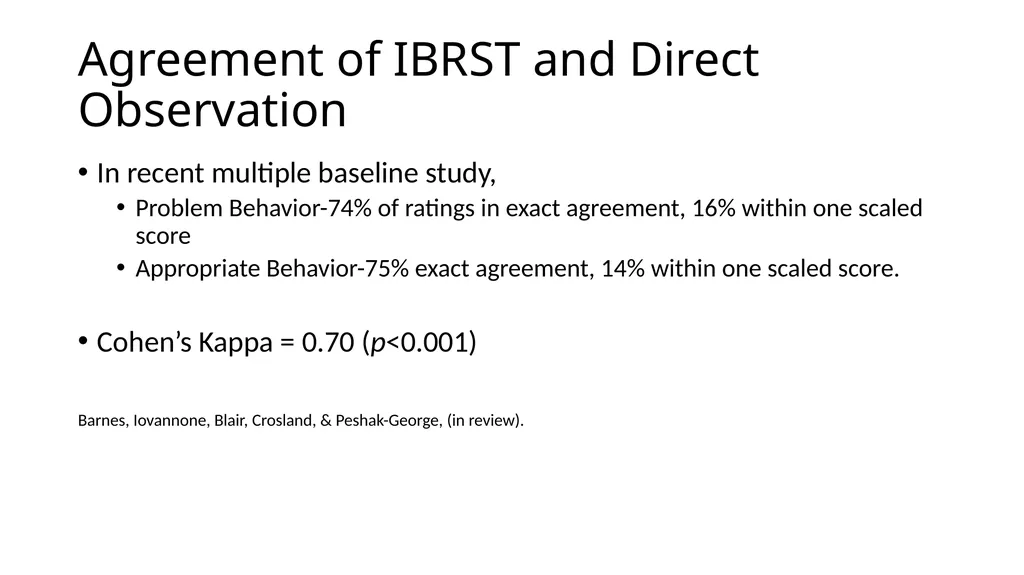
Agreement of IBRST and Direct Observation In recent multiple baseline study,
Problem Behavior-74% of ratings in exact agreement, 16% within one scaled score
Appropriate Behavior-75% exact agreement, 14% within one scaled score.
Cohen’s Kappa = 0.70 (p<0.001)
Barnes, Iovannone, Blair, Crosland, & Peshak-George, (in review).<br>
Problem Behavior-74% of ratings in exact agreement, 16% within one scaled score
Appropriate Behavior-75% exact agreement, 14% within one scaled score.
Cohen’s Kappa = 0.70 (p<0.001)
Barnes, Iovannone, Blair, Crosland, & Peshak-George, (in review).<br>
31
Sample Middle/High School Goals and IBRSTS<br>
32
Step 2:
PTR Functional Behavior Assessment Analyze the Problem<br>
33
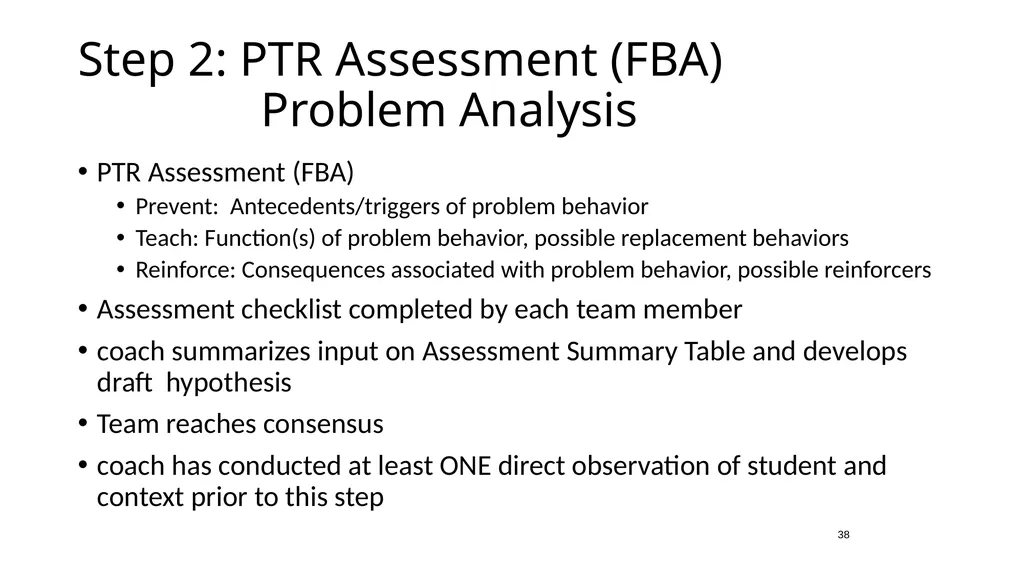
Step 2: PTR Assessment (FBA)
Problem Analysis PTR Assessment (FBA)
Prevent: Antecedents/triggers of problem behavior
Teach: Function(s) of problem behavior, possible replacement behaviors
Reinforce: Consequences associated with problem behavior, possible reinforcers
Assessment checklist completed by each team member
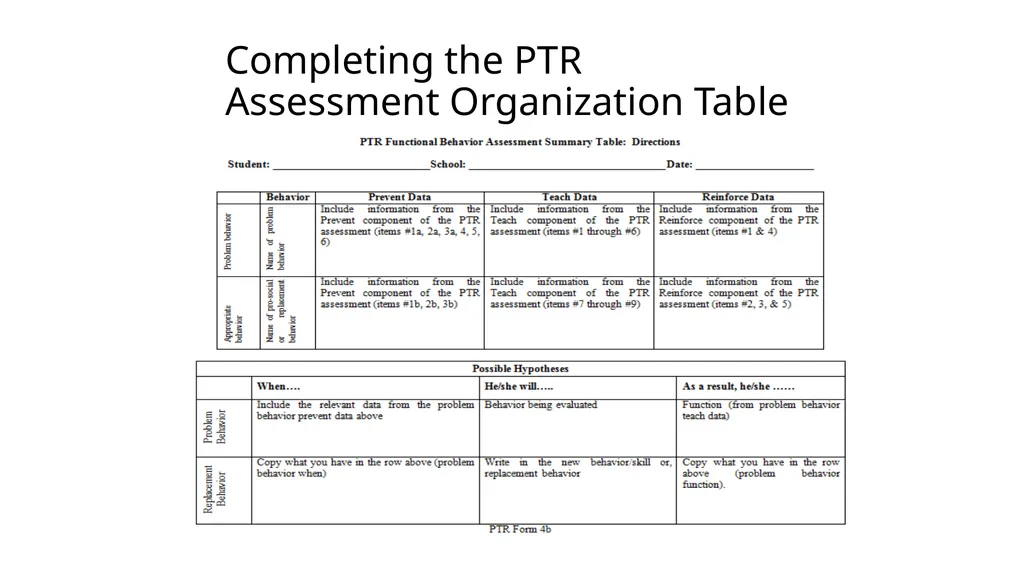
coach summarizes input on Assessment Summary Table and develops draft hypothesis
Team reaches consensus
coach has conducted at least ONE direct observation of student and context prior to this step 38<br>
Prevent: Antecedents/triggers of problem behavior
Teach: Function(s) of problem behavior, possible replacement behaviors
Reinforce: Consequences associated with problem behavior, possible reinforcers
Assessment checklist completed by each team member
coach summarizes input on Assessment Summary Table and develops draft hypothesis
Team reaches consensus
coach has conducted at least ONE direct observation of student and context prior to this step 38<br>
34
Several Versions of PTR Assessment Secondary Version
Teacher versions
Student versions
Each relevant team member completes a PTR Assessment for targeted behavior(s) to be decreased
Student is interviewed
Coach conducts at least one observation<br>
Teacher versions
Student versions
Each relevant team member completes a PTR Assessment for targeted behavior(s) to be decreased
Student is interviewed
Coach conducts at least one observation<br>
35
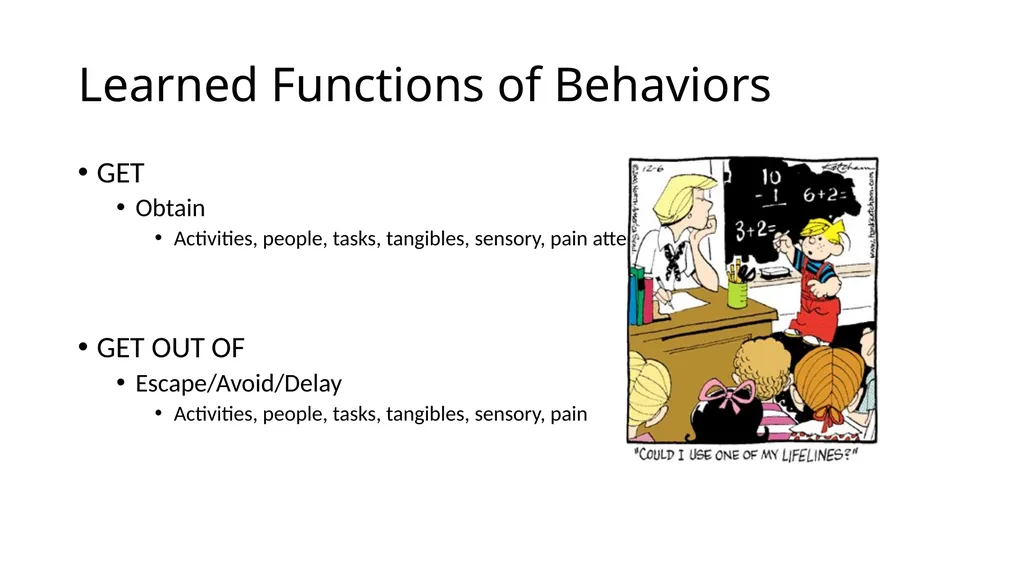
Learned Functions of Behaviors GET
Obtain
Activities, people, tasks, tangibles, sensory, pain attenuation
GET OUT OF
Escape/Avoid/Delay
Activities, people, tasks, tangibles, sensory, pain<br>
Obtain
Activities, people, tasks, tangibles, sensory, pain attenuation
GET OUT OF
Escape/Avoid/Delay
Activities, people, tasks, tangibles, sensory, pain<br>
36
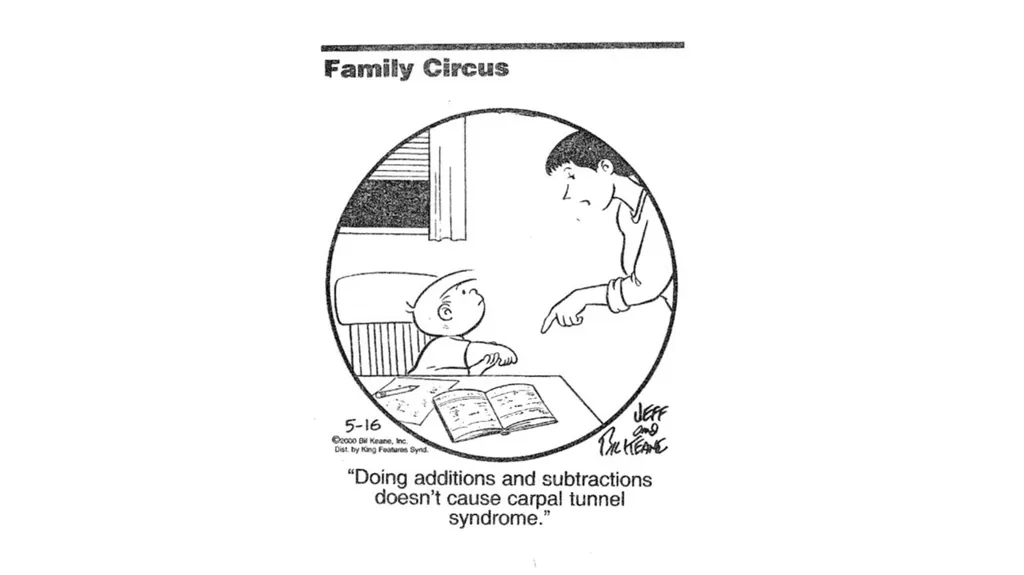
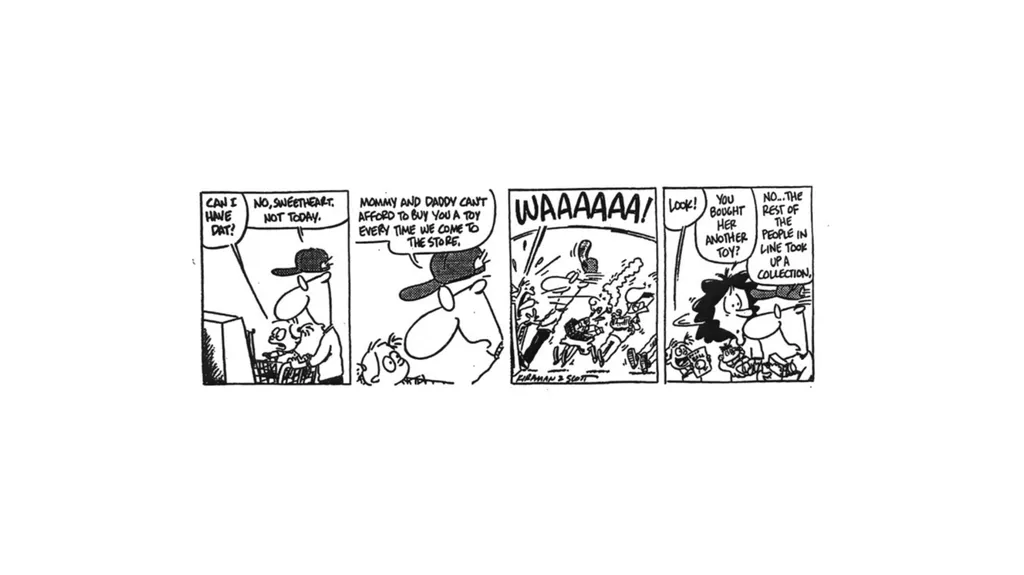
NAME THAT FUNCTION!<br>
37
Iovannone, Anderson, & Scott, 2013 Are Power, Control, Jealousy, Revenge Functions?<br>
38
Completing the PTR Assessment Organization Table<br>
39
Sample Middle/High School Hypothesis Statements<br>
40
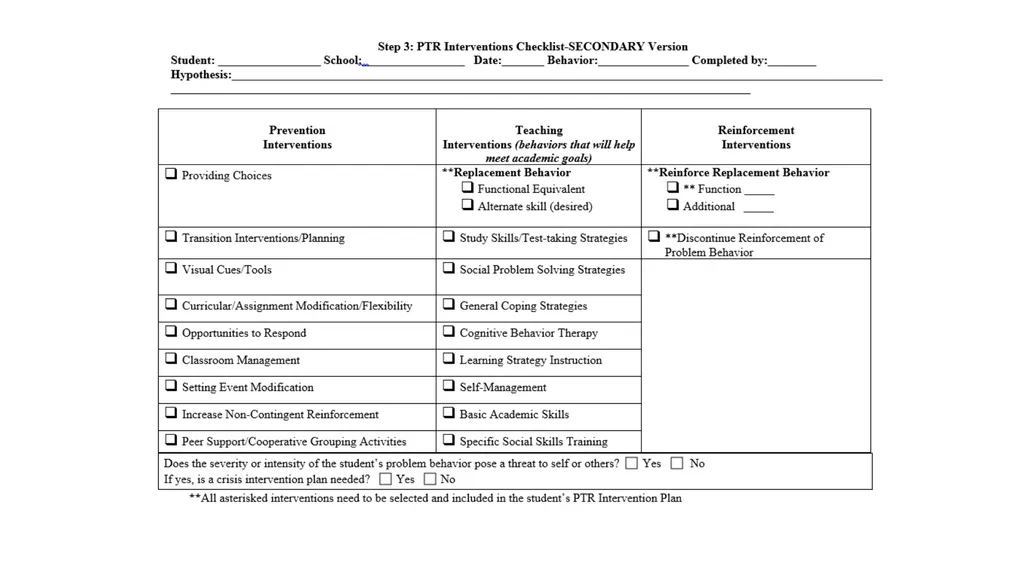
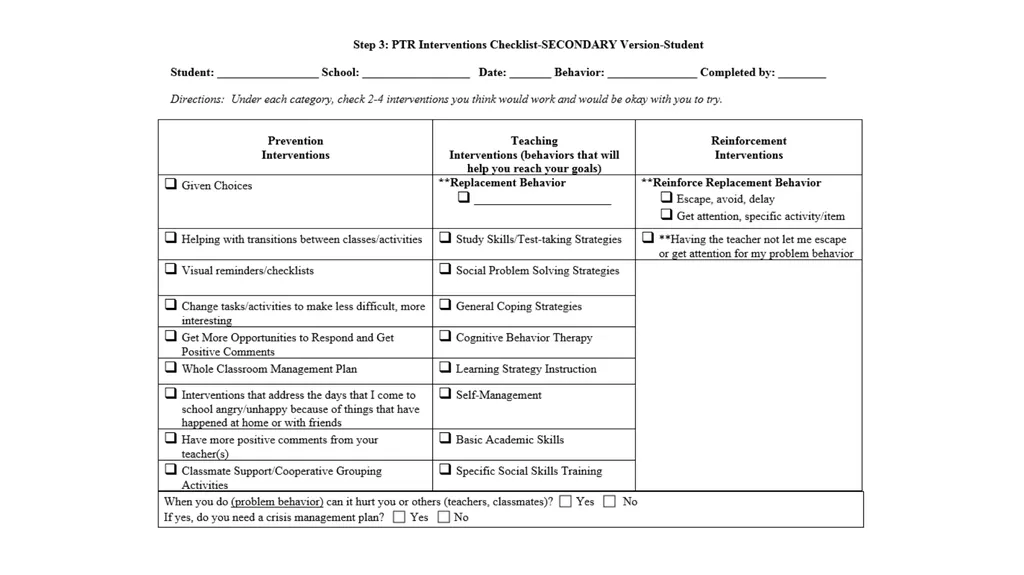
Step 3: PTR Intervention Plan Developing and implementing an intervention<br>
41
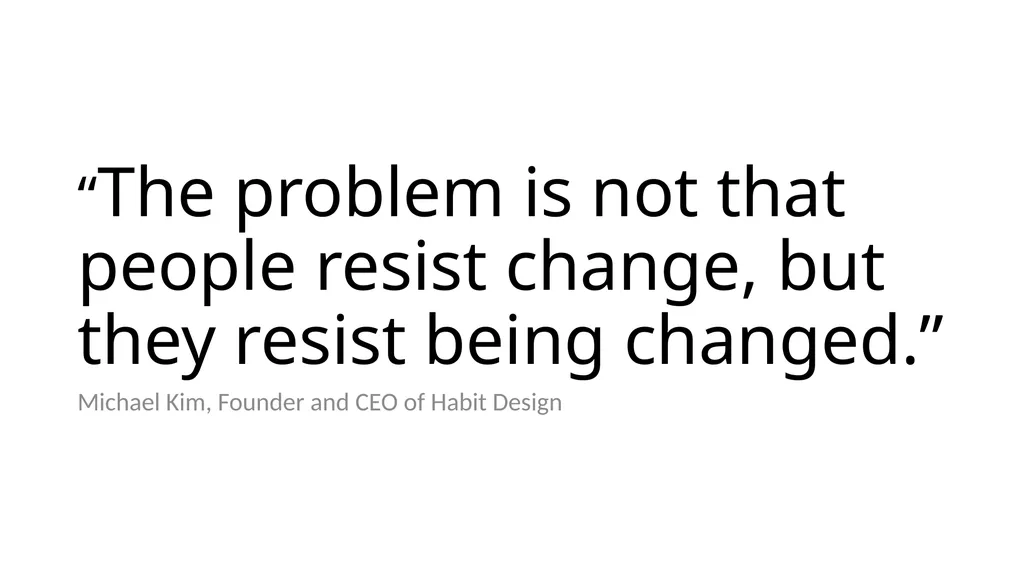
“The problem is not that people resist change, but they resist being changed.” Michael Kim, Founder and CEO of Habit Design<br>
42
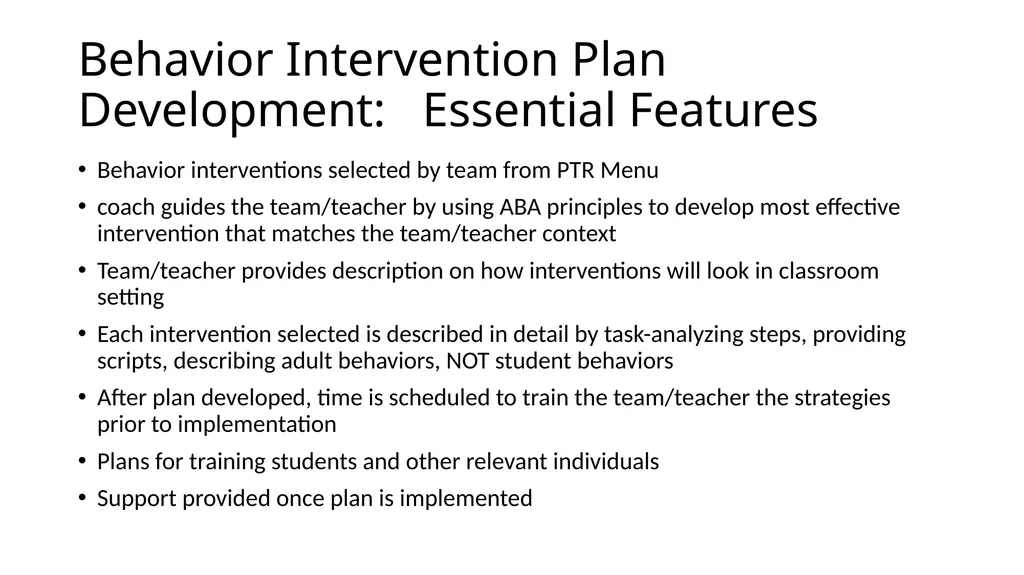
Behavior Intervention Plan Development: Essential Features Behavior interventions selected by team from PTR Menu
coach guides the team/teacher by using ABA principles to develop most effective intervention that matches the team/teacher context
Team/teacher provides description on how interventions will look in classroom setting
Each intervention selected is described in detail by task-analyzing steps, providing scripts, describing adult behaviors, NOT student behaviors
After plan developed, time is scheduled to train the team/teacher the strategies prior to implementation
Plans for training students and other relevant individuals
Support provided once plan is implemented<br>
coach guides the team/teacher by using ABA principles to develop most effective intervention that matches the team/teacher context
Team/teacher provides description on how interventions will look in classroom setting
Each intervention selected is described in detail by task-analyzing steps, providing scripts, describing adult behaviors, NOT student behaviors
After plan developed, time is scheduled to train the team/teacher the strategies prior to implementation
Plans for training students and other relevant individuals
Support provided once plan is implemented<br>
43
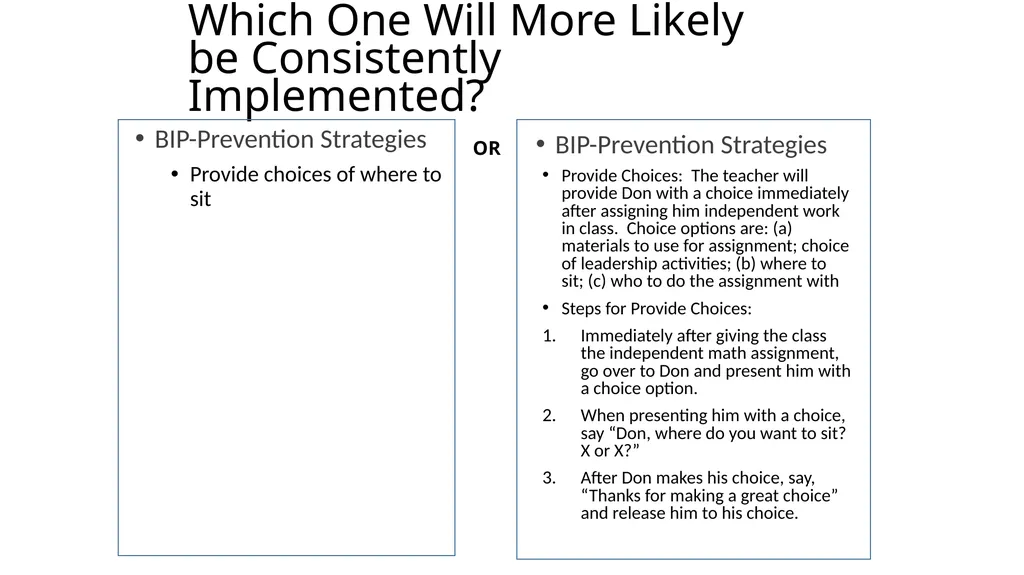
Which One Will More Likely be Consistently Implemented? Provide choices of where to sit Provide Choices: The teacher will provide Don with a choice immediately after assigning him independent work in class. Choice options are: (a) materials to use for assignment; choice of leadership activities; (b) where to sit; (c) who to do the assignment with
Steps for Provide Choices:
Immediately after giving the class the independent math assignment, go over to Don and present him with a choice option.
When presenting him with a choice, say “Don, where do you want to sit? X or X?”
After Don makes his choice, say, “Thanks for making a great choice” and release him to his choice. BIP-Prevention Strategies BIP-Prevention Strategies OR<br>
Steps for Provide Choices:
Immediately after giving the class the independent math assignment, go over to Don and present him with a choice option.
When presenting him with a choice, say “Don, where do you want to sit? X or X?”
After Don makes his choice, say, “Thanks for making a great choice” and release him to his choice. BIP-Prevention Strategies BIP-Prevention Strategies OR<br>
44
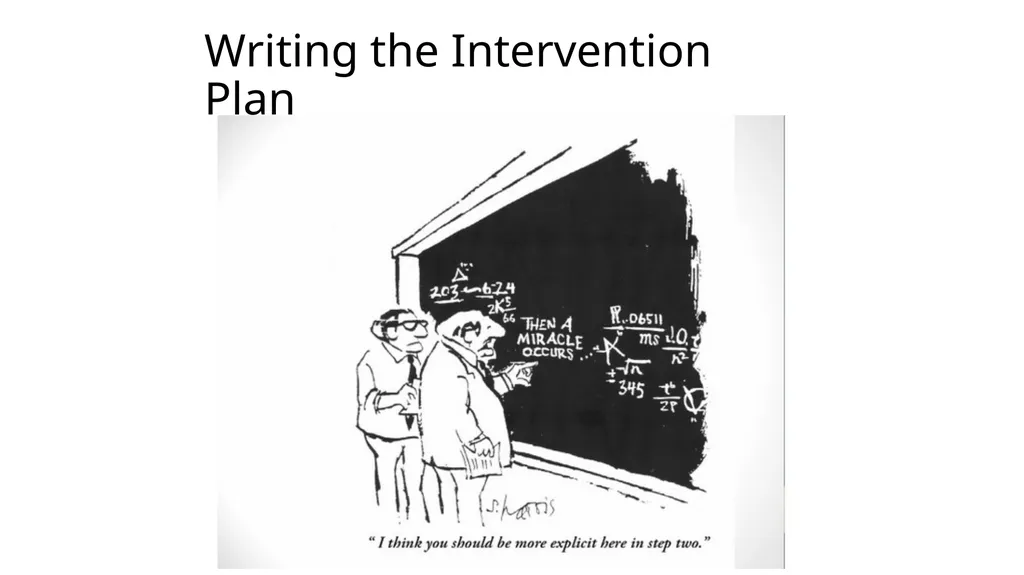
Writing the Intervention Plan<br>
45
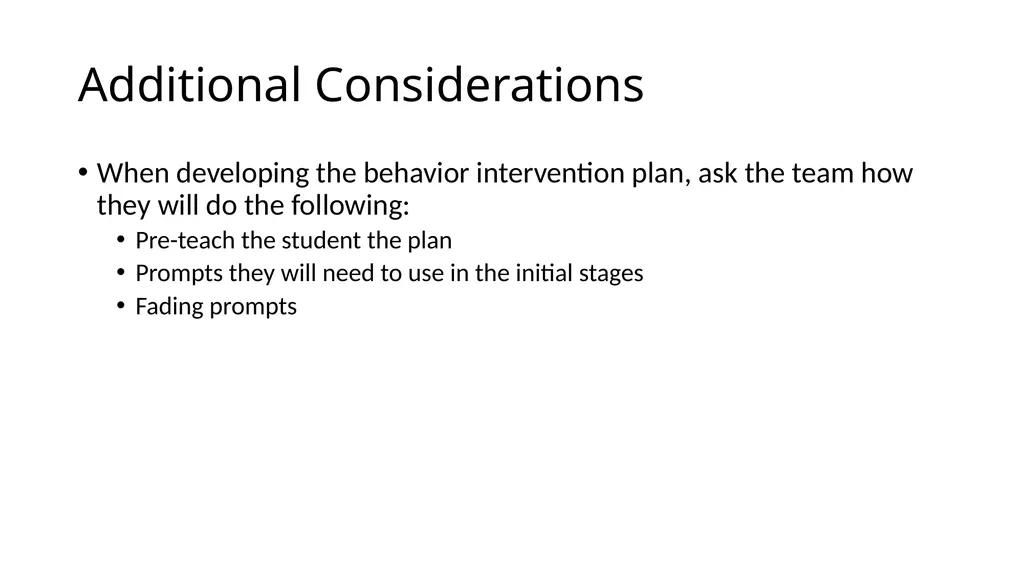
Additional Considerations When developing the behavior intervention plan, ask the team how they will do the following:
Pre-teach the student the plan
Prompts they will need to use in the initial stages
Fading prompts<br>
Pre-teach the student the plan
Prompts they will need to use in the initial stages
Fading prompts<br>
46
Sample Middle/High School BIPs<br>
47
Coaching/Fidelity<br>
48
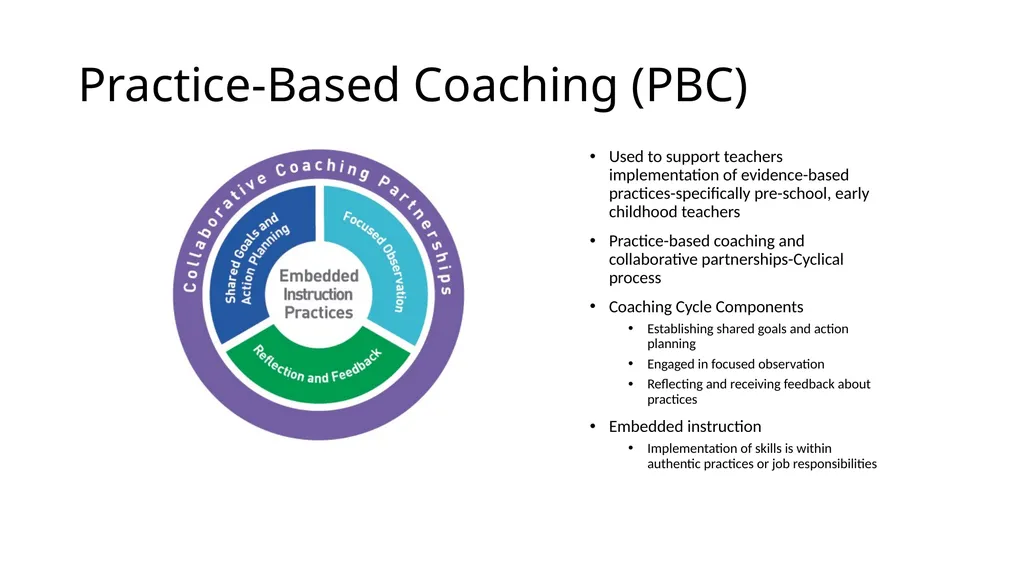
Practice-Based Coaching (PBC) Used to support teachers implementation of evidence-based practices-specifically pre-school, early childhood teachers
Practice-based coaching and collaborative partnerships-Cyclical process
Coaching Cycle Components
Establishing shared goals and action planning
Engaged in focused observation
Reflecting and receiving feedback about practices
Embedded instruction
Implementation of skills is within authentic practices or job responsibilities<br>
Practice-based coaching and collaborative partnerships-Cyclical process
Coaching Cycle Components
Establishing shared goals and action planning
Engaged in focused observation
Reflecting and receiving feedback about practices
Embedded instruction
Implementation of skills is within authentic practices or job responsibilities<br>
49
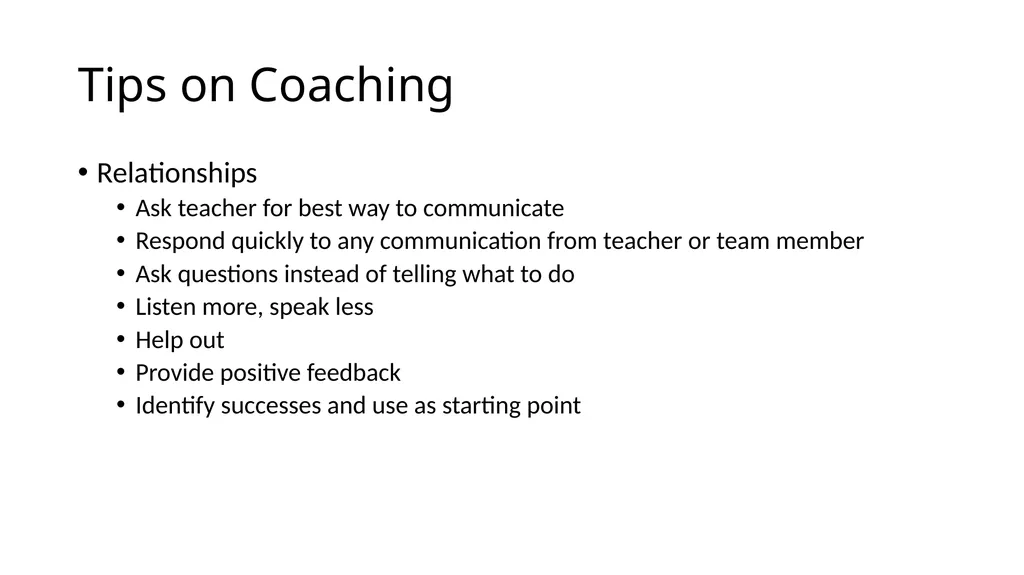
Tips on Coaching Relationships
Ask teacher for best way to communicate
Respond quickly to any communication from teacher or team member
Ask questions instead of telling what to do
Listen more, speak less
Help out
Provide positive feedback
Identify successes and use as starting point<br>
Ask teacher for best way to communicate
Respond quickly to any communication from teacher or team member
Ask questions instead of telling what to do
Listen more, speak less
Help out
Provide positive feedback
Identify successes and use as starting point<br>
50
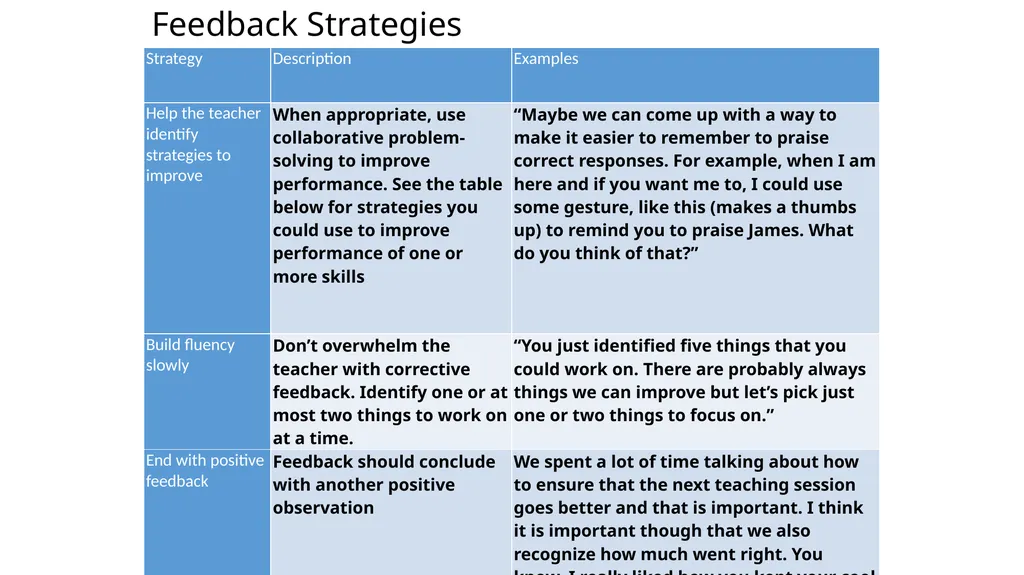
Feedback Strategies<br>
51
Feedback Strategies<br>
52
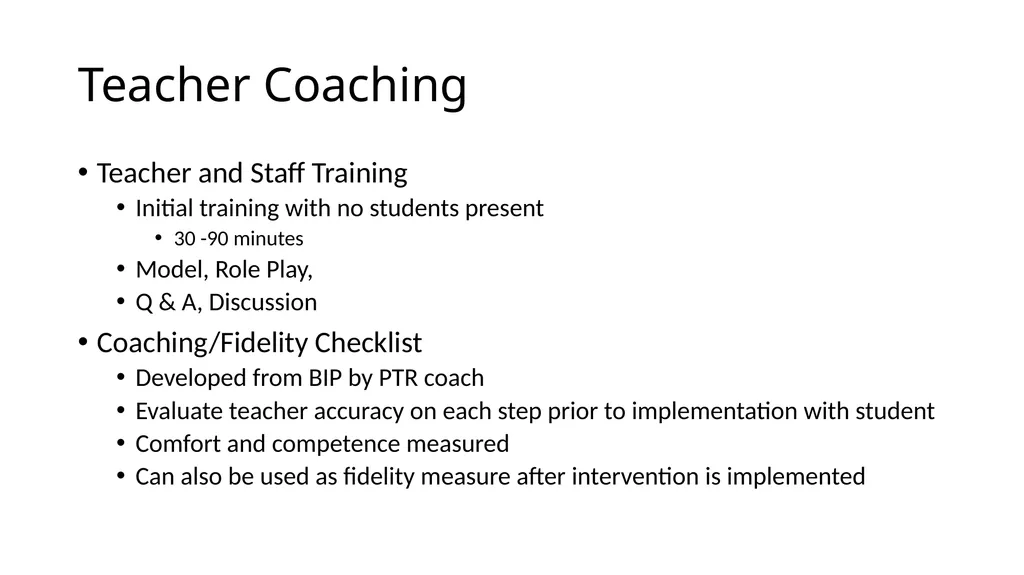
Teacher Coaching Teacher and Staff Training
Initial training with no students present
30 -90 minutes
Model, Role Play,
Q & A, Discussion
Coaching/Fidelity Checklist
Developed from BIP by PTR coach
Evaluate teacher accuracy on each step prior to implementation with student
Comfort and competence measured
Can also be used as fidelity measure after intervention is implemented<br>
Initial training with no students present
30 -90 minutes
Model, Role Play,
Q & A, Discussion
Coaching/Fidelity Checklist
Developed from BIP by PTR coach
Evaluate teacher accuracy on each step prior to implementation with student
Comfort and competence measured
Can also be used as fidelity measure after intervention is implemented<br>
53
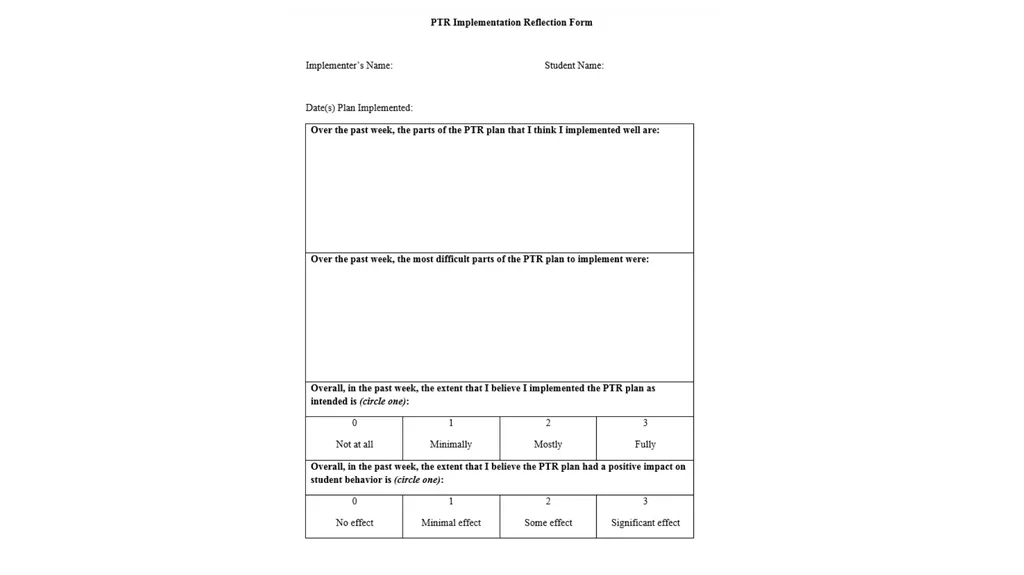
Sample Middle/High School Coaching/Fidelity Checklists<br>
54
Step 4: Progress Monitoring<br>
55
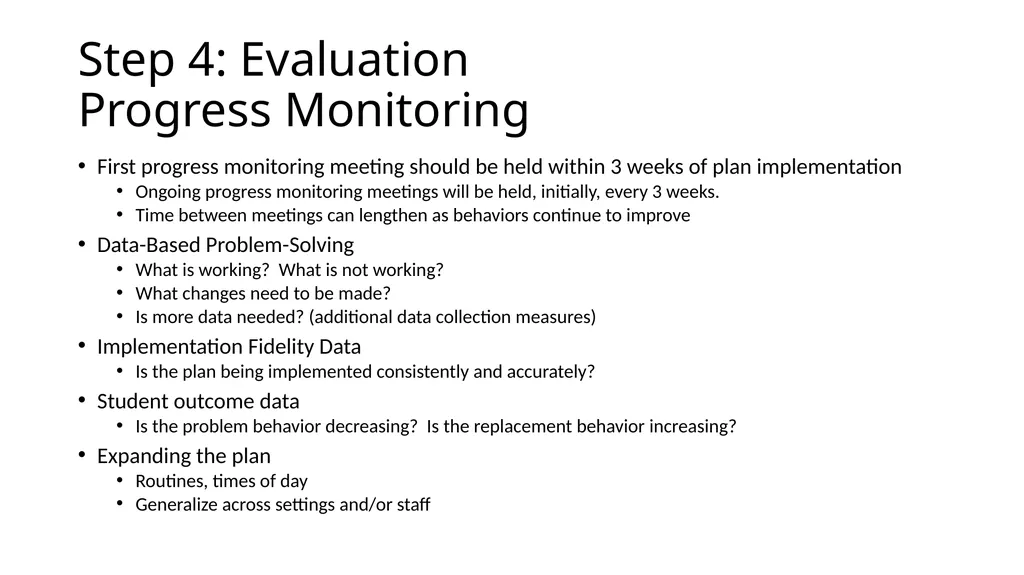
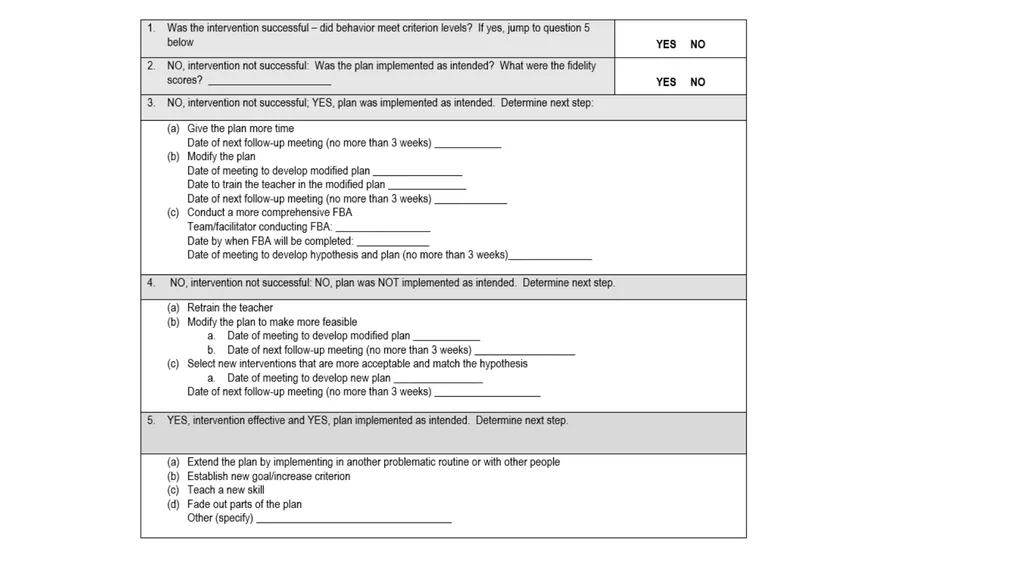
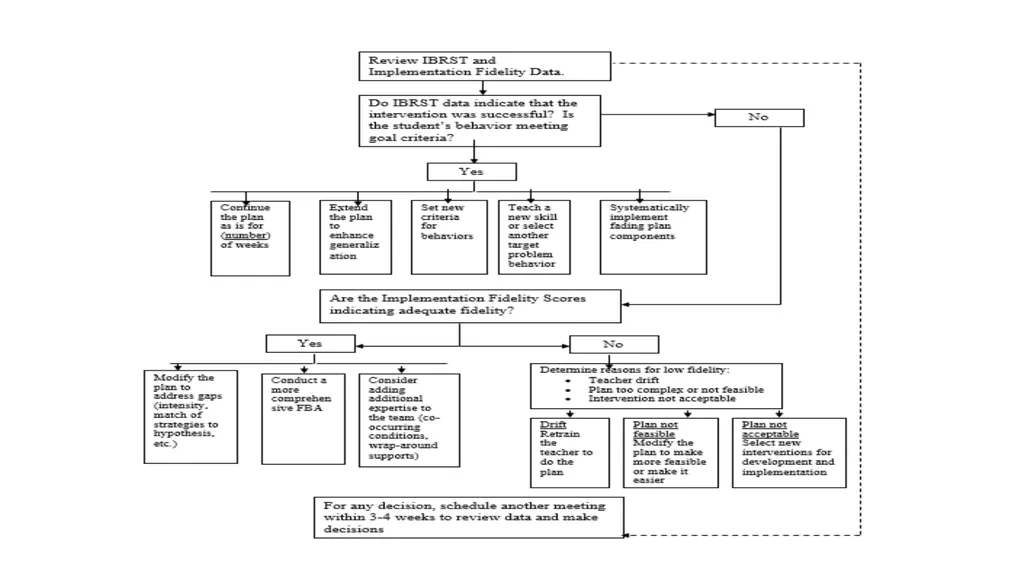
Step 4: Evaluation
Progress Monitoring First progress monitoring meeting should be held within 3 weeks of plan implementation
Ongoing progress monitoring meetings will be held, initially, every 3 weeks.
Time between meetings can lengthen as behaviors continue to improve
Data-Based Problem-Solving
What is working? What is not working?
What changes need to be made?
Is more data needed? (additional data collection measures)
Implementation Fidelity Data
Is the plan being implemented consistently and accurately?
Student outcome data
Is the problem behavior decreasing? Is the replacement behavior increasing?
Expanding the plan
Routines, times of day
Generalize across settings and/or staff<br>
Ongoing progress monitoring meetings will be held, initially, every 3 weeks.
Time between meetings can lengthen as behaviors continue to improve
Data-Based Problem-Solving
What is working? What is not working?
What changes need to be made?
Is more data needed? (additional data collection measures)
Implementation Fidelity Data
Is the plan being implemented consistently and accurately?
Student outcome data
Is the problem behavior decreasing? Is the replacement behavior increasing?
Expanding the plan
Routines, times of day
Generalize across settings and/or staff<br>
56
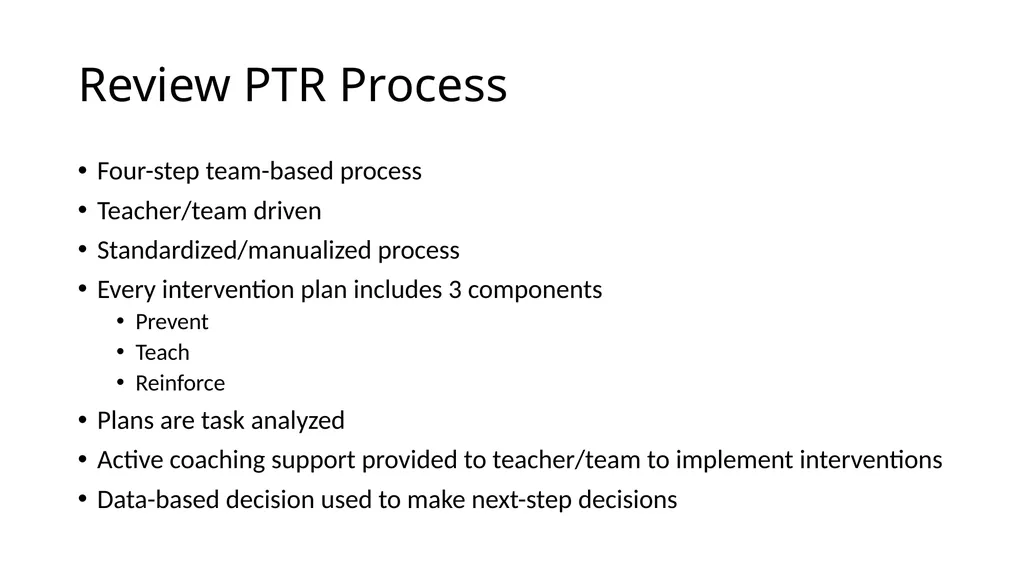
Review PTR Process Four-step team-based process
Teacher/team driven
Standardized/manualized process
Every intervention plan includes 3 components
Prevent
Teach
Reinforce
Plans are task analyzed
Active coaching support provided to teacher/team to implement interventions
Data-based decision used to make next-step decisions<br>
Teacher/team driven
Standardized/manualized process
Every intervention plan includes 3 components
Prevent
Teach
Reinforce
Plans are task analyzed
Active coaching support provided to teacher/team to implement interventions
Data-based decision used to make next-step decisions<br>
57
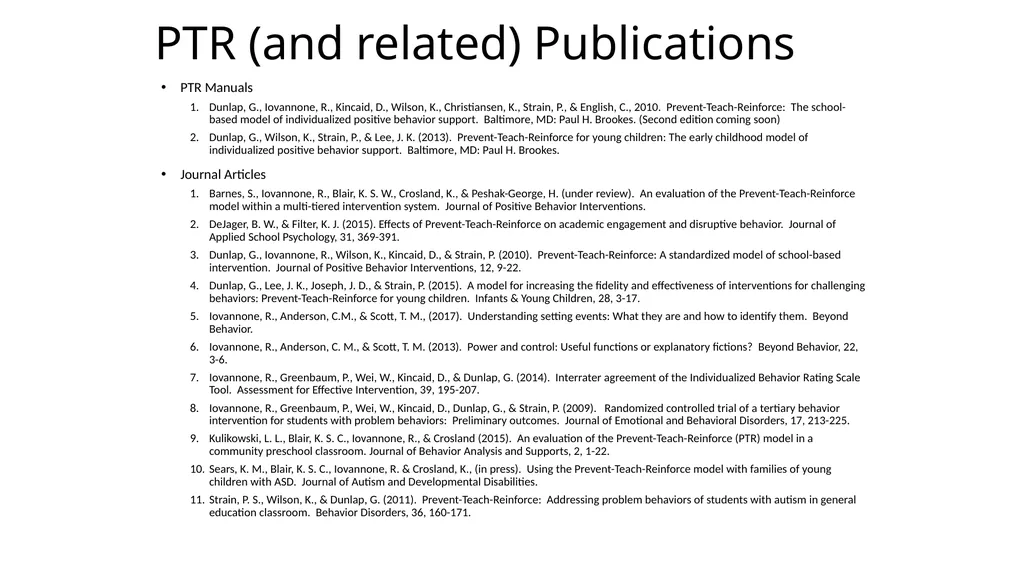
PTR (and related) Publications PTR Manuals
Dunlap, G., Iovannone, R., Kincaid, D., Wilson, K., Christiansen, K., Strain, P., & English, C., 2010. Prevent-Teach-Reinforce: The school-based model of individualized positive behavior support. Baltimore, MD: Paul H. Brookes. (Second edition coming soon)
Dunlap, G., Wilson, K., Strain, P., & Lee, J. K. (2013). Prevent-Teach-Reinforce for young children: The early childhood model of individualized positive behavior support. Baltimore, MD: Paul H. Brookes.
Journal Articles
Barnes, S., Iovannone, R., Blair, K. S. W., Crosland, K., & Peshak-George, H. (under review). An evaluation of the Prevent-Teach-Reinforce model within a multi-tiered intervention system. Journal of Positive Behavior Interventions.
DeJager, B. W., & Filter, K. J. (2015). Effects of Prevent-Teach-Reinforce on academic engagement and disruptive behavior. Journal of Applied School Psychology, 31, 369-391.
Dunlap, G., Iovannone, R., Wilson, K., Kincaid, D., & Strain, P. (2010). Prevent-Teach-Reinforce: A standardized model of school-based intervention. Journal of Positive Behavior Interventions, 12, 9-22.
Dunlap, G., Lee, J. K., Joseph, J. D., & Strain, P. (2015). A model for increasing the fidelity and effectiveness of interventions for challenging behaviors: Prevent-Teach-Reinforce for young children. Infants & Young Children, 28, 3-17.
Iovannone, R., Anderson, C.M., & Scott, T. M., (2017). Understanding setting events: What they are and how to identify them. Beyond Behavior.
Iovannone, R., Anderson, C. M., & Scott, T. M. (2013). Power and control: Useful functions or explanatory fictions? Beyond Behavior, 22, 3-6.
Iovannone, R., Greenbaum, P., Wei, W., Kincaid, D., & Dunlap, G. (2014). Interrater agreement of the Individualized Behavior Rating Scale Tool. Assessment for Effective Intervention, 39, 195-207.
Iovannone, R., Greenbaum, P., Wei, W., Kincaid, D., Dunlap, G., & Strain, P. (2009). Randomized controlled trial of a tertiary behavior intervention for students with problem behaviors: Preliminary outcomes. Journal of Emotional and Behavioral Disorders, 17, 213-225.
Kulikowski, L. L., Blair, K. S. C., Iovannone, R., & Crosland (2015). An evaluation of the Prevent-Teach-Reinforce (PTR) model in a community preschool classroom. Journal of Behavior Analysis and Supports, 2, 1-22.
Sears, K. M., Blair, K. S. C., Iovannone, R. & Crosland, K., (in press). Using the Prevent-Teach-Reinforce model with families of young children with ASD. Journal of Autism and Developmental Disabilities.
Strain, P. S., Wilson, K., & Dunlap, G. (2011). Prevent-Teach-Reinforce: Addressing problem behaviors of students with autism in general education classroom. Behavior Disorders, 36, 160-171.<br>
Dunlap, G., Iovannone, R., Kincaid, D., Wilson, K., Christiansen, K., Strain, P., & English, C., 2010. Prevent-Teach-Reinforce: The school-based model of individualized positive behavior support. Baltimore, MD: Paul H. Brookes. (Second edition coming soon)
Dunlap, G., Wilson, K., Strain, P., & Lee, J. K. (2013). Prevent-Teach-Reinforce for young children: The early childhood model of individualized positive behavior support. Baltimore, MD: Paul H. Brookes.
Journal Articles
Barnes, S., Iovannone, R., Blair, K. S. W., Crosland, K., & Peshak-George, H. (under review). An evaluation of the Prevent-Teach-Reinforce model within a multi-tiered intervention system. Journal of Positive Behavior Interventions.
DeJager, B. W., & Filter, K. J. (2015). Effects of Prevent-Teach-Reinforce on academic engagement and disruptive behavior. Journal of Applied School Psychology, 31, 369-391.
Dunlap, G., Iovannone, R., Wilson, K., Kincaid, D., & Strain, P. (2010). Prevent-Teach-Reinforce: A standardized model of school-based intervention. Journal of Positive Behavior Interventions, 12, 9-22.
Dunlap, G., Lee, J. K., Joseph, J. D., & Strain, P. (2015). A model for increasing the fidelity and effectiveness of interventions for challenging behaviors: Prevent-Teach-Reinforce for young children. Infants & Young Children, 28, 3-17.
Iovannone, R., Anderson, C.M., & Scott, T. M., (2017). Understanding setting events: What they are and how to identify them. Beyond Behavior.
Iovannone, R., Anderson, C. M., & Scott, T. M. (2013). Power and control: Useful functions or explanatory fictions? Beyond Behavior, 22, 3-6.
Iovannone, R., Greenbaum, P., Wei, W., Kincaid, D., & Dunlap, G. (2014). Interrater agreement of the Individualized Behavior Rating Scale Tool. Assessment for Effective Intervention, 39, 195-207.
Iovannone, R., Greenbaum, P., Wei, W., Kincaid, D., Dunlap, G., & Strain, P. (2009). Randomized controlled trial of a tertiary behavior intervention for students with problem behaviors: Preliminary outcomes. Journal of Emotional and Behavioral Disorders, 17, 213-225.
Kulikowski, L. L., Blair, K. S. C., Iovannone, R., & Crosland (2015). An evaluation of the Prevent-Teach-Reinforce (PTR) model in a community preschool classroom. Journal of Behavior Analysis and Supports, 2, 1-22.
Sears, K. M., Blair, K. S. C., Iovannone, R. & Crosland, K., (in press). Using the Prevent-Teach-Reinforce model with families of young children with ASD. Journal of Autism and Developmental Disabilities.
Strain, P. S., Wilson, K., & Dunlap, G. (2011). Prevent-Teach-Reinforce: Addressing problem behaviors of students with autism in general education classroom. Behavior Disorders, 36, 160-171.<br>
58
Questions?<br>
59
Please Provide Feedback Your feedback is important to us! Please take a few moments at the end of the session to complete an evaluation form for this session. Forms are available:
In our mobile application by clicking the link in the session description.
Online underneath the posted presentations at www.pbis.org/presentations/chicago_forum_18<br>
In our mobile application by clicking the link in the session description.
Online underneath the posted presentations at www.pbis.org/presentations/chicago_forum_18<br>
60
Save the dates, February 20 – 23, 2019 for the… Washington, DC
Grand Hyatt Washington Pre-Conference Workshops
FEBRUARY 20
Skill-Building Workshops
FEBRUARY 23
Breakout Sessions
FEBRUARY 21 - 22
Networking | Posters | Exhibits For more information, visit:
conference.apbs.org<br>
Grand Hyatt Washington Pre-Conference Workshops
FEBRUARY 20
Skill-Building Workshops
FEBRUARY 23
Breakout Sessions
FEBRUARY 21 - 22
Networking | Posters | Exhibits For more information, visit:
conference.apbs.org<br>