EART30351 Lecture 3 Moisture in the atmosphere Mass mixing ratio w, gkg-1 Volume mixing ratio x, ppmv w εx where ε 1829 0.622 Vapour pressure, mb. e nw kT (nw no. water molecules m-3) Dew Point TD, K. Temperature at which a
"EART30351 Lecture 3 Moisture in the atmosphere" is the property of its rightful owner. Permission is granted to
download and print the materials on this website for personal, non-commercial use only, and to display it
on your personal computer provided you do not modify the materials and that you retain all copyright
notices contained in the materials. By downloading content from our website, you accept the terms of this
agreement.
Presentation Transcript
01
EART30351 Lecture 3<br>
02
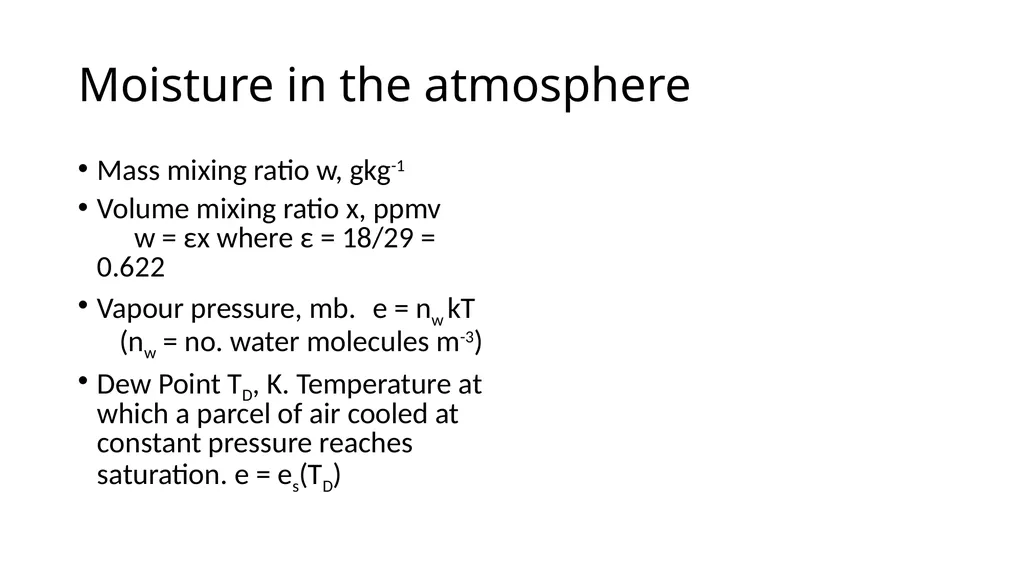
Moisture in the atmosphere Mass mixing ratio w, gkg-1
Volume mixing ratio x, ppmv w = εx where ε = 18/29 = 0.622
Vapour pressure, mb. e = nw kT (nw = no. water molecules m-3)
Dew Point TD, K. Temperature at which a parcel of air cooled at constant pressure reaches saturation. e = es(TD)<br>
03
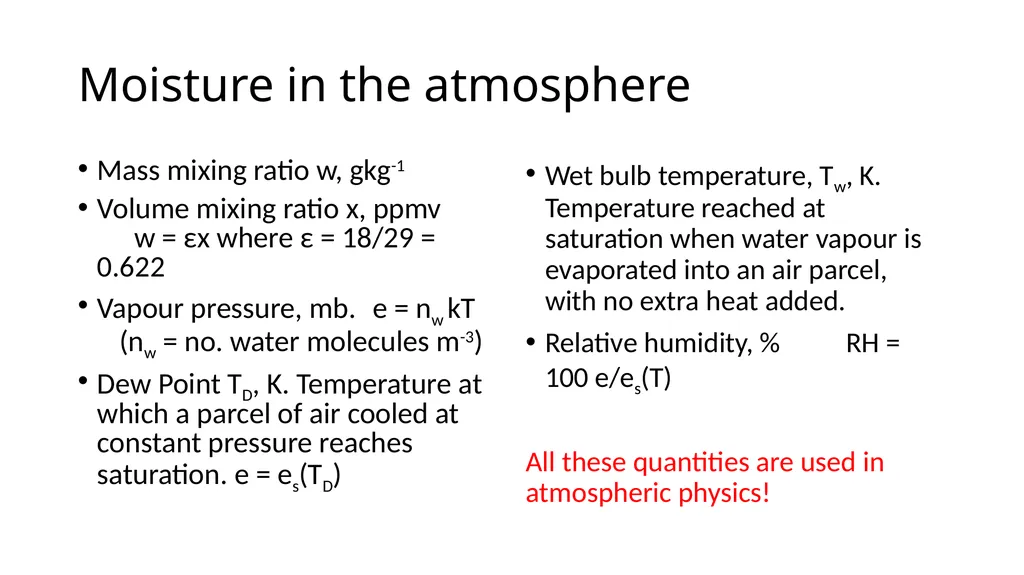
Moisture in the atmosphere Mass mixing ratio w, gkg-1
Volume mixing ratio x, ppmv w = εx where ε = 18/29 = 0.622
Vapour pressure, mb. e = nw kT (nw = no. water molecules m-3)
Dew Point TD, K. Temperature at which a parcel of air cooled at constant pressure reaches saturation. e = es(TD) Wet bulb temperature, Tw, K. Temperature reached at saturation when water vapour is evaporated into an air parcel, with no extra heat added.
Relative humidity, % RH = 100 e/es(T)
All these quantities are used in atmospheric physics!<br>
04
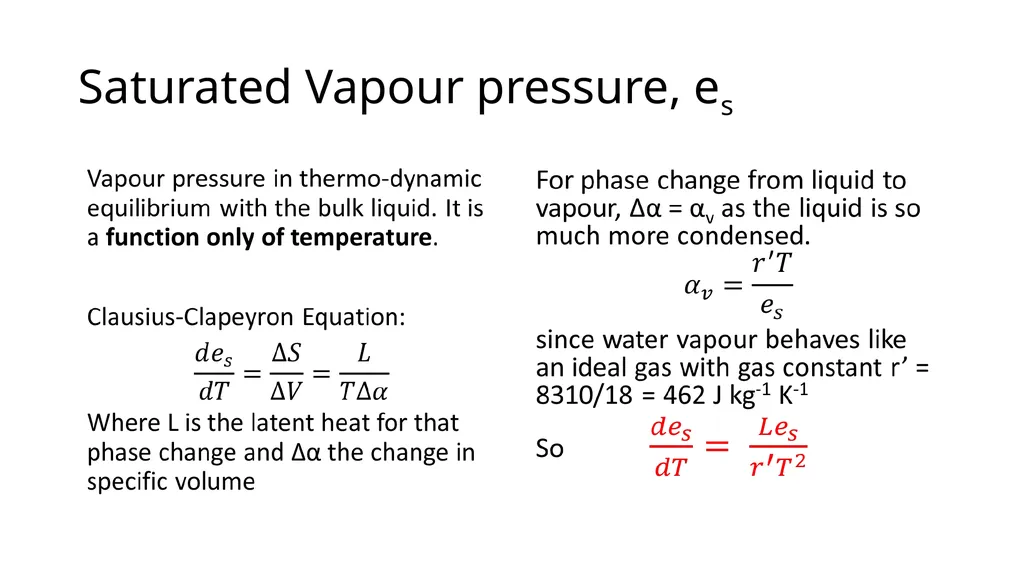
Saturated Vapour pressure, es<br>
05
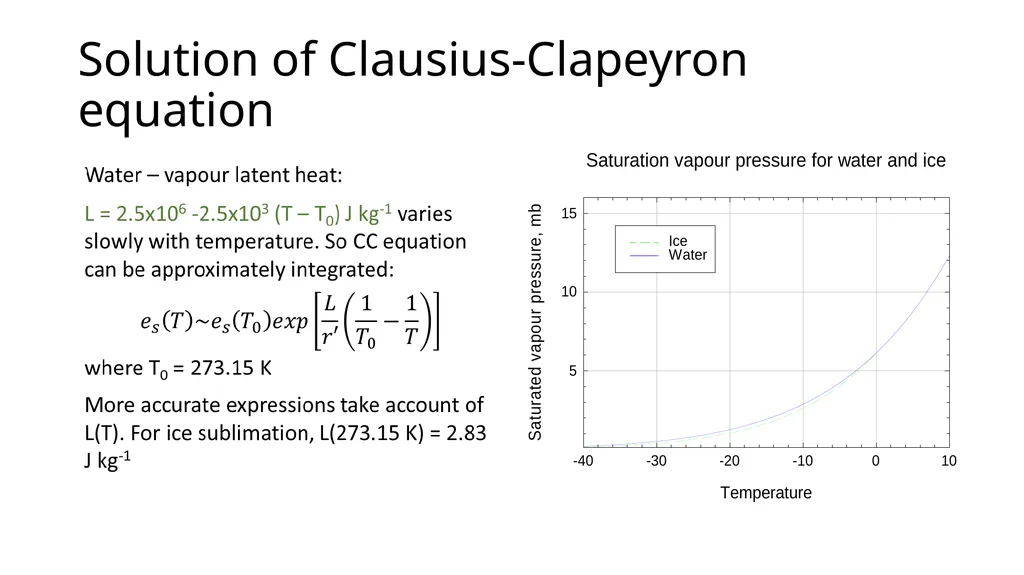
Solution of Clausius-Clapeyron equation<br>
06
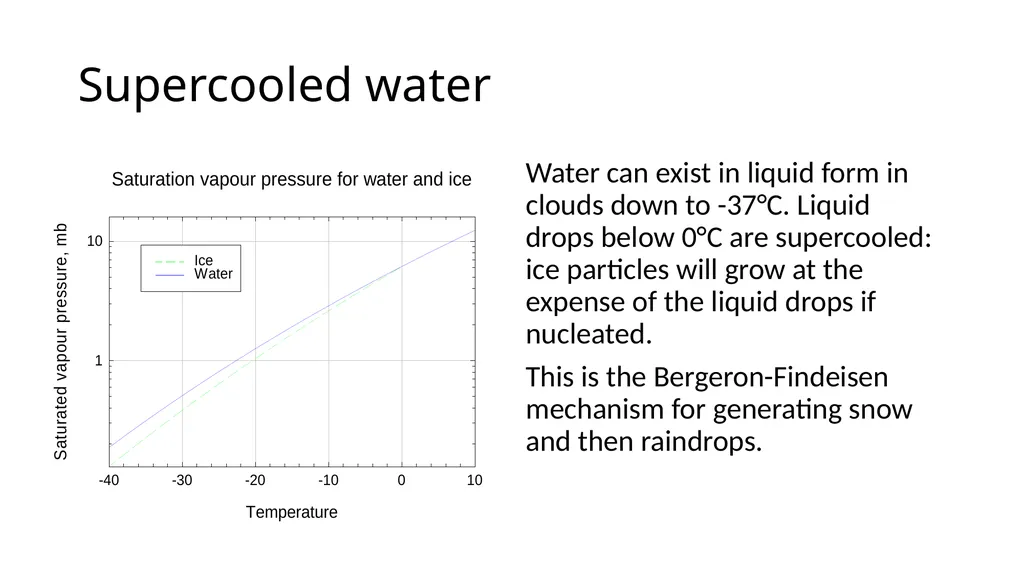
Supercooled water Water can exist in liquid form in clouds down to -37°C. Liquid drops below 0°C are supercooled: ice particles will grow at the expense of the liquid drops if nucleated.
This is the Bergeron-Findeisen mechanism for generating snow and then raindrops.<br>
07
Effect of latent heating Latent heat of evaporation of water (or sublimation of ice) is very large and dominates atmospheric thermodynamics.
Ascending air cools more slowly when it saturates, and so remains more buoyant
Evaporating precipitation cools the air and causes downdraughts<br>
08
Effect of latent heating Latent heat of evaporation of water (or sublimation of ice) is very large and dominates atmospheric thermodynamics.
Ascending air cools more slowly when it saturates, and so remains more buoyant
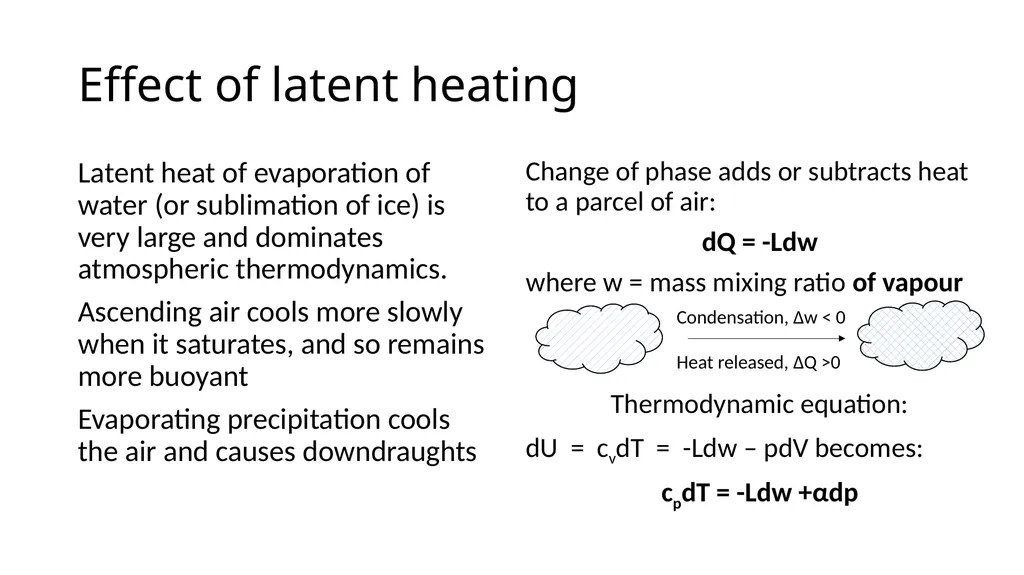
Evaporating precipitation cools the air and causes downdraughts Change of phase adds or subtracts heat to a parcel of air:
dQ = -Ldw
where w = mass mixing ratio of vapour
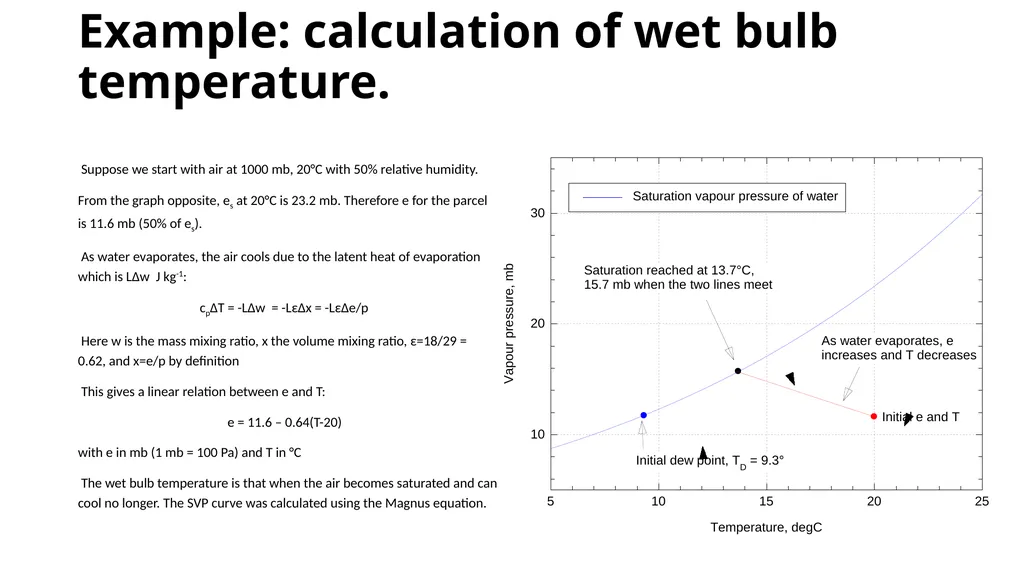
Example: calculation of wet bulb temperature. Suppose we start with air at 1000 mb, 20°C with 50% relative humidity.
From the graph opposite, es at 20°C is 23.2 mb. Therefore e for the parcel is 11.6 mb (50% of es).
As water evaporates, the air cools due to the latent heat of evaporation which is LΔw J kg-1:
cpΔT = -LΔw = -LεΔx = -LεΔe/p
Here w is the mass mixing ratio, x the volume mixing ratio, ε=18/29 = 0.62, and x=e/p by definition
This gives a linear relation between e and T:
e = 11.6 – 0.64(T-20)
with e in mb (1 mb = 100 Pa) and T in °C
The wet bulb temperature is that when the air becomes saturated and can cool no longer. The SVP curve was calculated using the Magnus equation.<br>
10
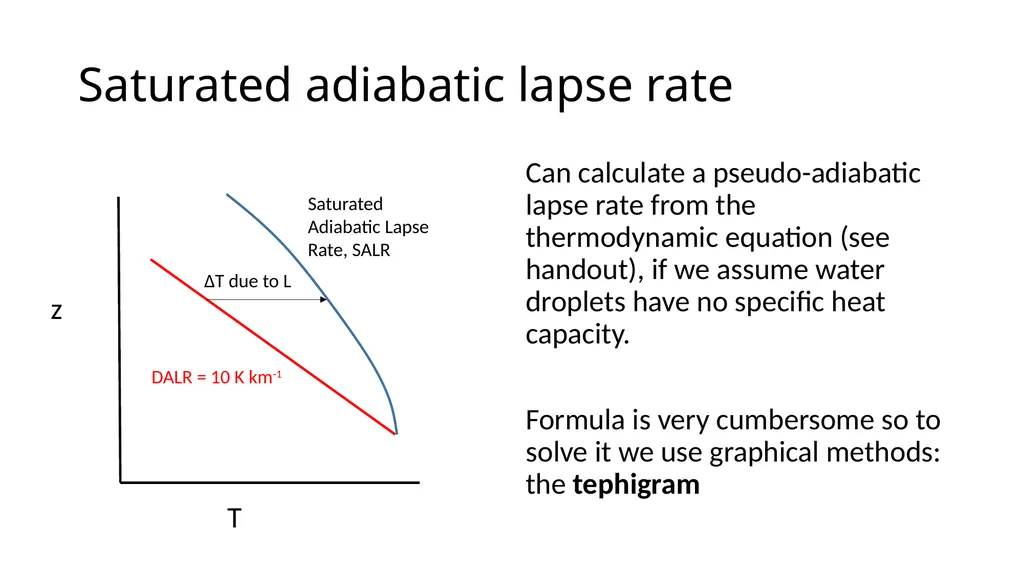
Saturated adiabatic lapse rate Can calculate a pseudo-adiabatic lapse rate from the thermodynamic equation (see handout), if we assume water droplets have no specific heat capacity.
Formula is very cumbersome so to solve it we use graphical methods: the tephigram T z DALR = 10 K km-1 Saturated Adiabatic Lapse Rate, SALR ΔT due to L<br>