03
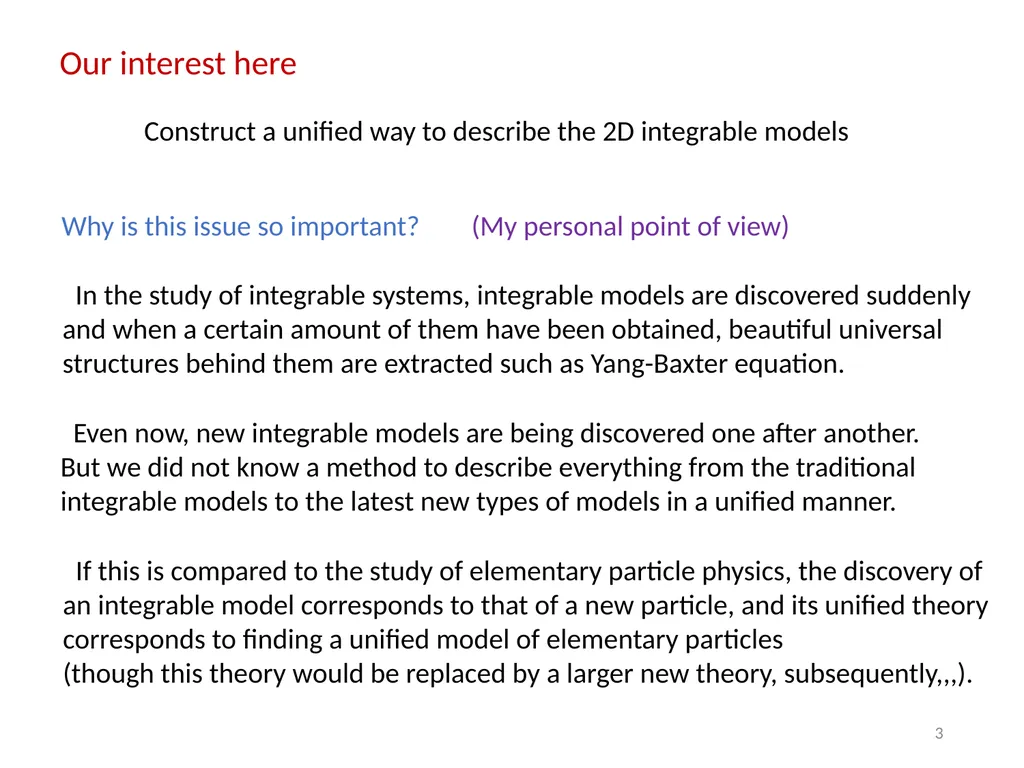
Our interest here Construct a unified way to describe the 2D integrable models In the study of integrable systems, integrable models are discovered suddenly
and when a certain amount of them have been obtained, beautiful universal
structures behind them are extracted such as Yang-Baxter equation. Why is this issue so important? (My personal point of view) 3 If this is compared to the study of elementary particle physics, the discovery of
an integrable model corresponds to that of a new particle, and its unified theory
corresponds to finding a unified model of elementary particles
(though this theory would be replaced by a larger new theory, subsequently,,,). Even now, new integrable models are being discovered one after another.
But we did not know a method to describe everything from the traditional
integrable models to the latest new types of models in a unified manner.<br>
04
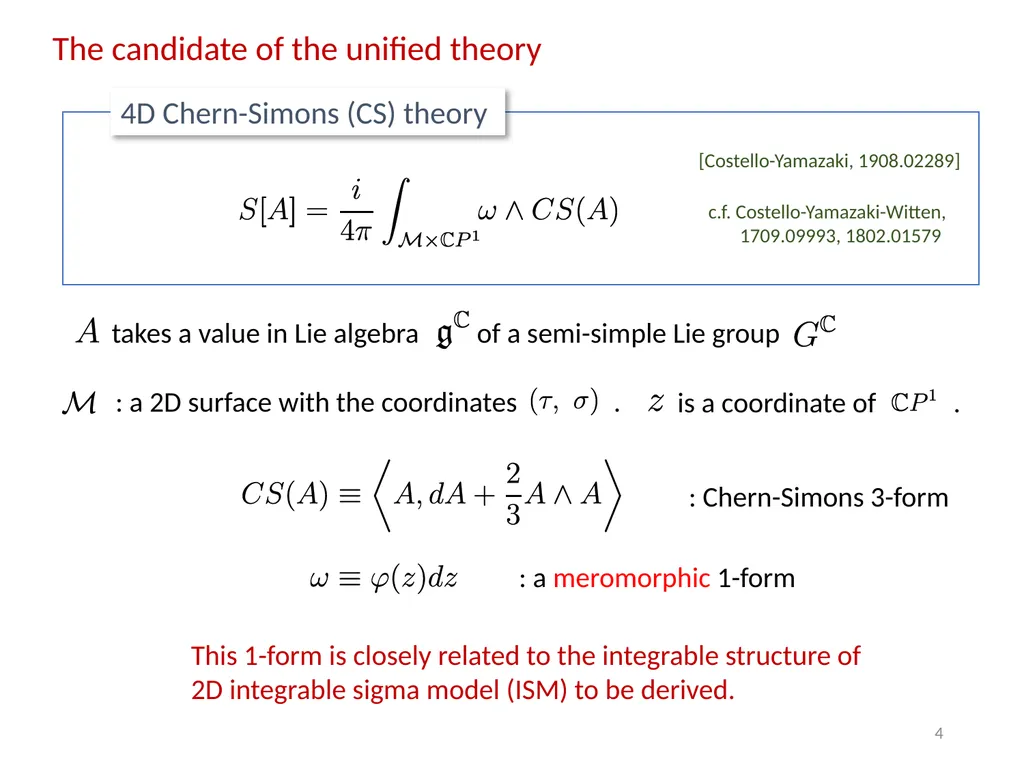
The candidate of the unified theory [Costello-Yamazaki, 1908.02289] : a 2D surface with the coordinates . : a meromorphic 1-form is a coordinate of . 4 This 1-form is closely related to the integrable structure of
2D integrable sigma model (ISM) to be derived. 4D Chern-Simons (CS) theory : Chern-Simons 3-form c.f. Costello-Yamazaki-Witten,
1709.09993, 1802.01579 takes a value in Lie algebra of a semi-simple Lie group<br>
05
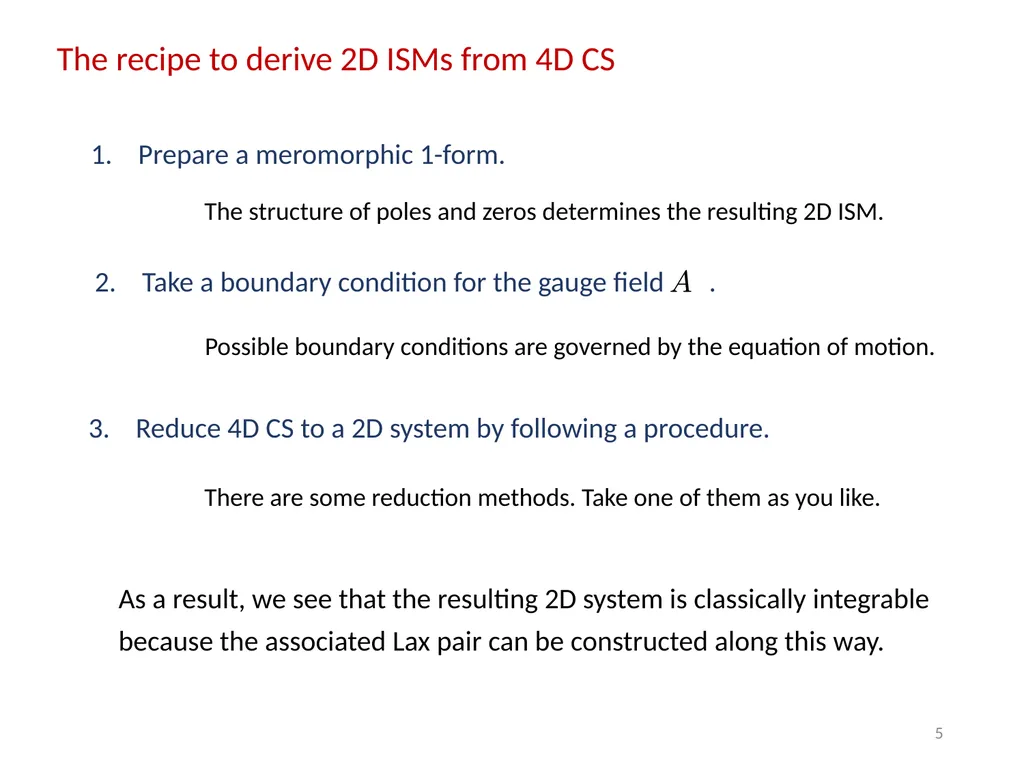
5 The recipe to derive 2D ISMs from 4D CS 1. Prepare a meromorphic 1-form. The structure of poles and zeros determines the resulting 2D ISM. 2. Take a boundary condition for the gauge field . Possible boundary conditions are governed by the equation of motion. 3. Reduce 4D CS to a 2D system by following a procedure. There are some reduction methods. Take one of them as you like. As a result, we see that the resulting 2D system is classically integrable
because the associated Lax pair can be constructed along this way.<br>
06
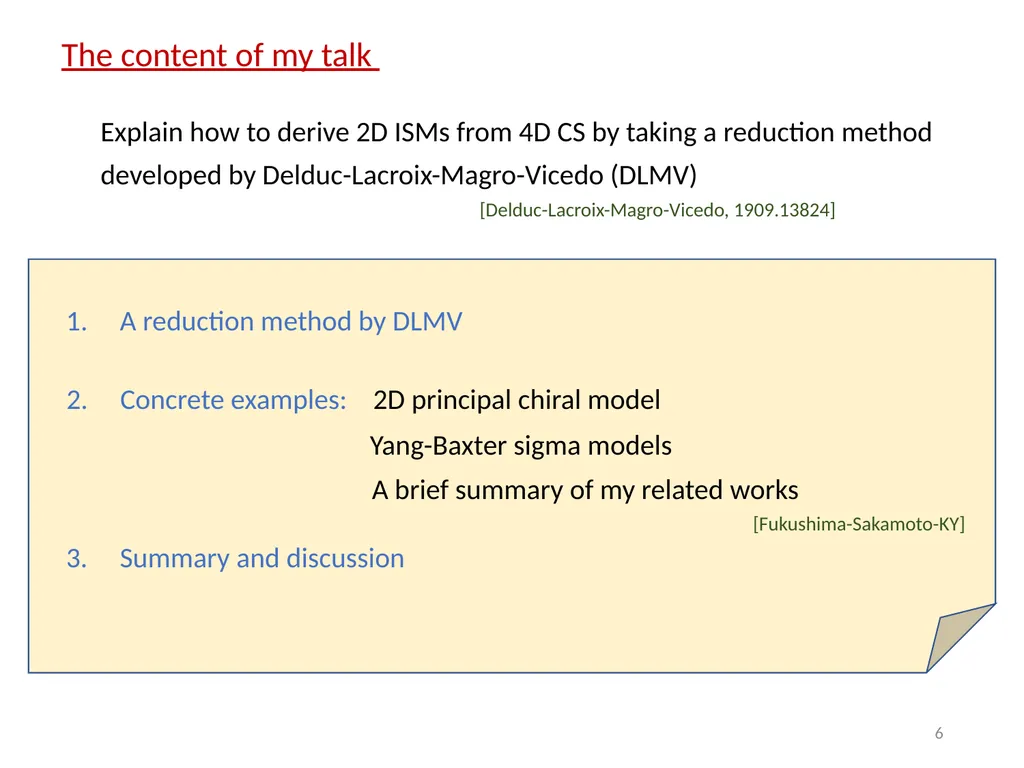
6 The content of my talk Explain how to derive 2D ISMs from 4D CS by taking a reduction method
developed by Delduc-Lacroix-Magro-Vicedo (DLMV) 1. A reduction method by DLMV 2. Concrete examples: 2D principal chiral model 3. Summary and discussion A brief summary of my related works [Fukushima-Sakamoto-KY] [Delduc-Lacroix-Magro-Vicedo, 1909.13824] Yang-Baxter sigma models<br>
07
7 1. A reduction method by DLMV<br>
08
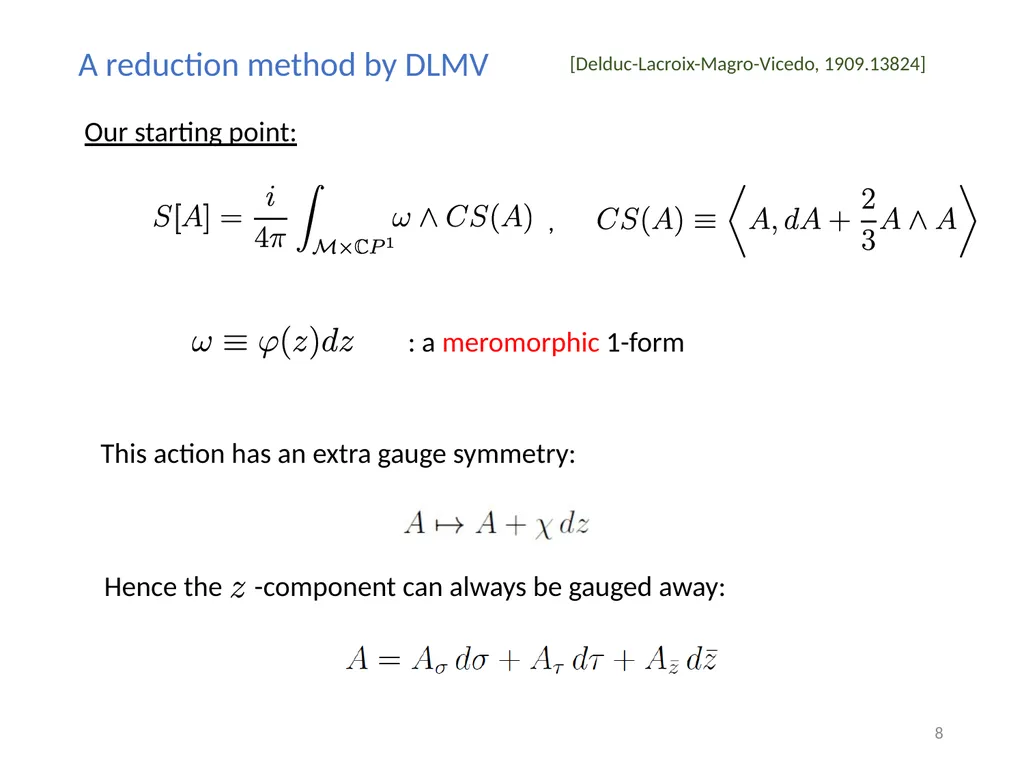
8 A reduction method by DLMV Our starting point: This action has an extra gauge symmetry: Hence the -component can always be gauged away: : a meromorphic 1-form , [Delduc-Lacroix-Magro-Vicedo, 1909.13824]<br>
09
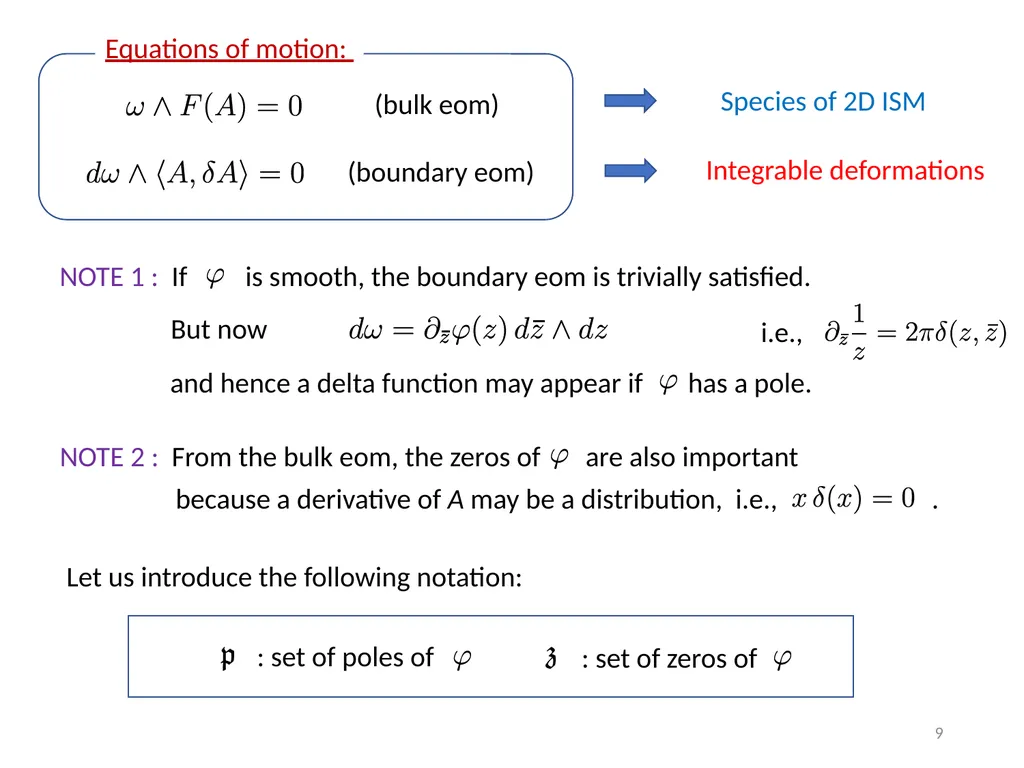
9 (bulk eom) (boundary eom) NOTE 1 : If is smooth, the boundary eom is trivially satisfied. But now and hence a delta function may appear if has a pole. Species of 2D ISM Integrable deformations NOTE 2 : From the bulk eom, the zeros of are also important
because a derivative of A may be a distribution, i.e., . Let us introduce the following notation: : set of poles of : set of zeros of Equations of motion: i.e.,<br>
10
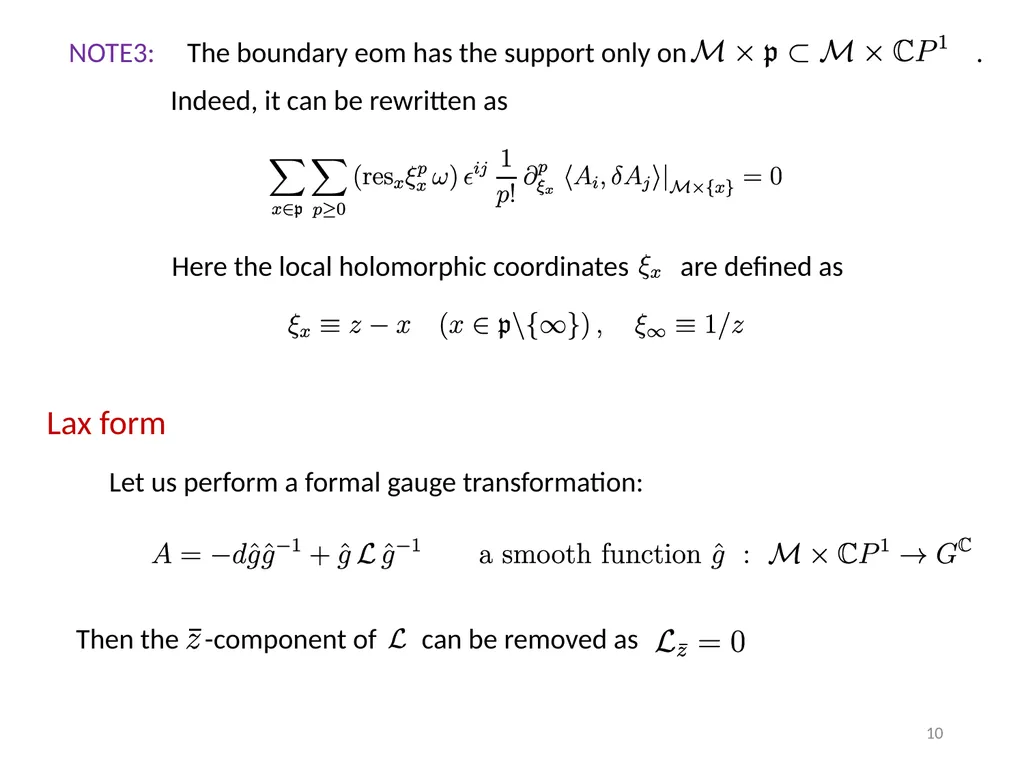
10 NOTE3: The boundary eom has the support only on . Indeed, it can be rewritten as Here the local holomorphic coordinates are defined as Lax form Let us perform a formal gauge transformation: Then the -component of can be removed as<br>
11
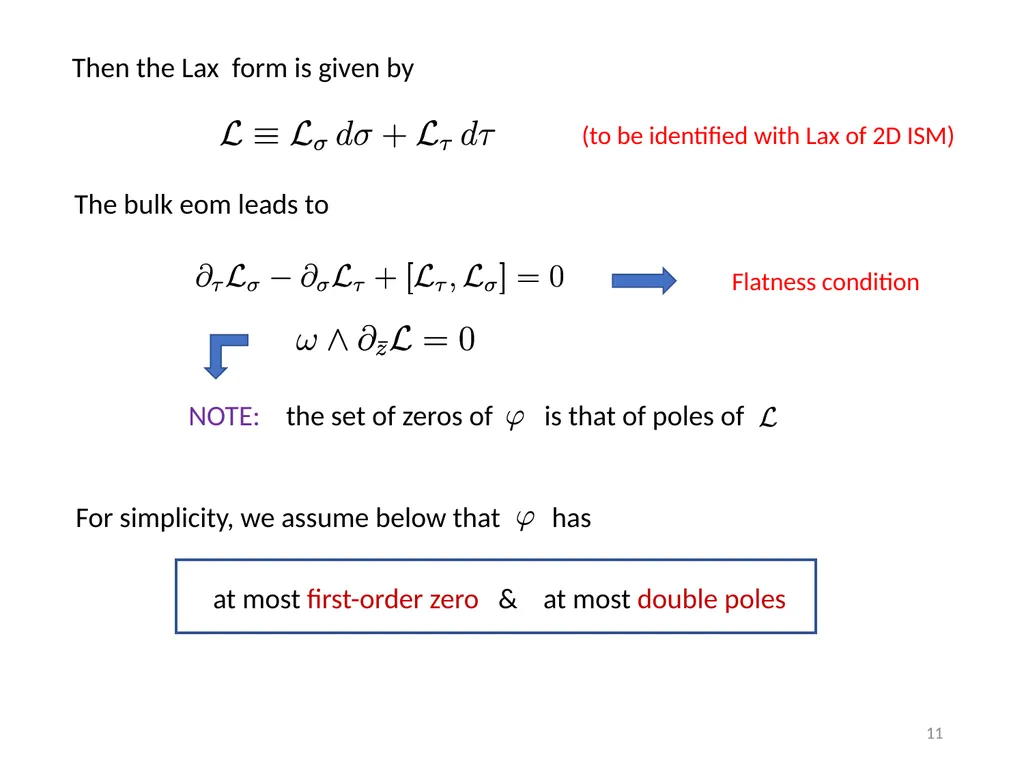
11 Then the Lax form is given by The bulk eom leads to Flatness condition NOTE: the set of zeros of is that of poles of (to be identified with Lax of 2D ISM) For simplicity, we assume below that has at most first-order zero & at most double poles<br>
12
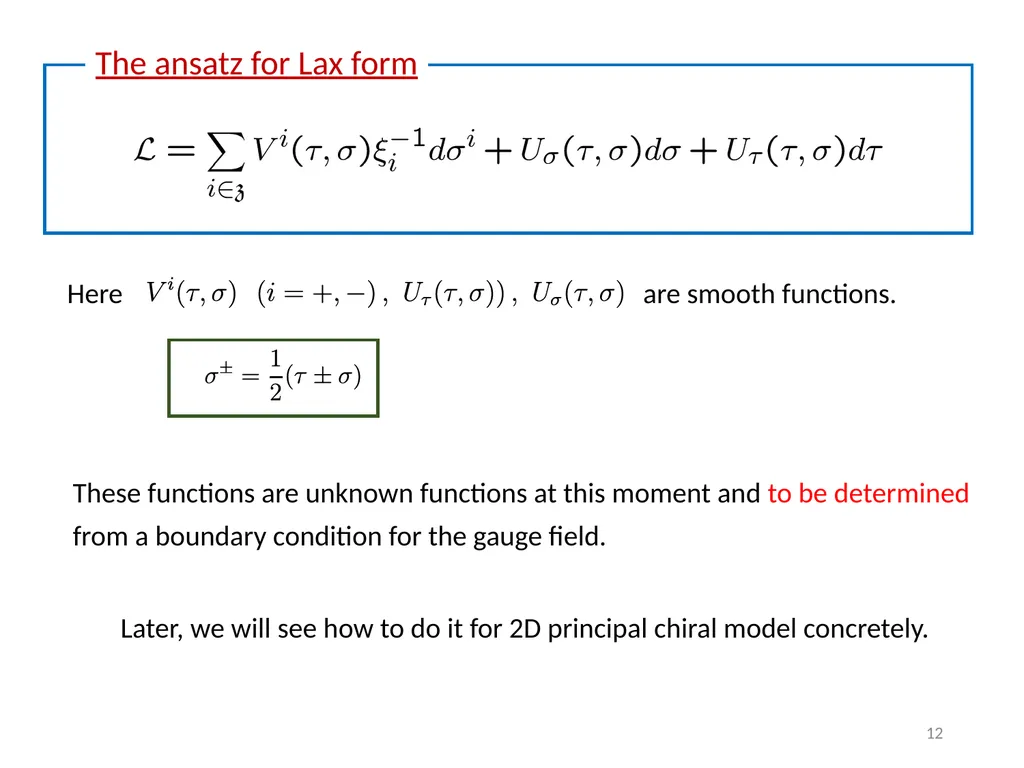
12 Here are smooth functions. These functions are unknown functions at this moment and to be determined
from a boundary condition for the gauge field. Later, we will see how to do it for 2D principal chiral model concretely. The ansatz for Lax form<br>
13
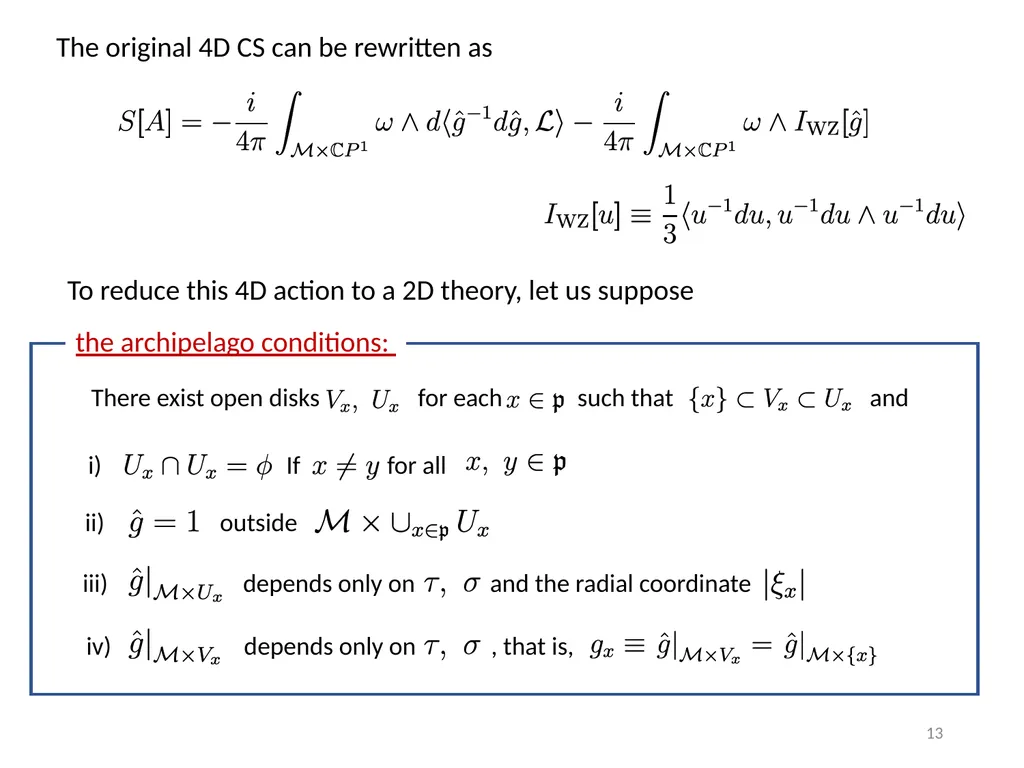
13 The original 4D CS can be rewritten as To reduce this 4D action to a 2D theory, let us suppose the archipelago conditions: i) If for all ii) outside depends only on and the radial coordinate iv) depends only on , that is,<br>
14
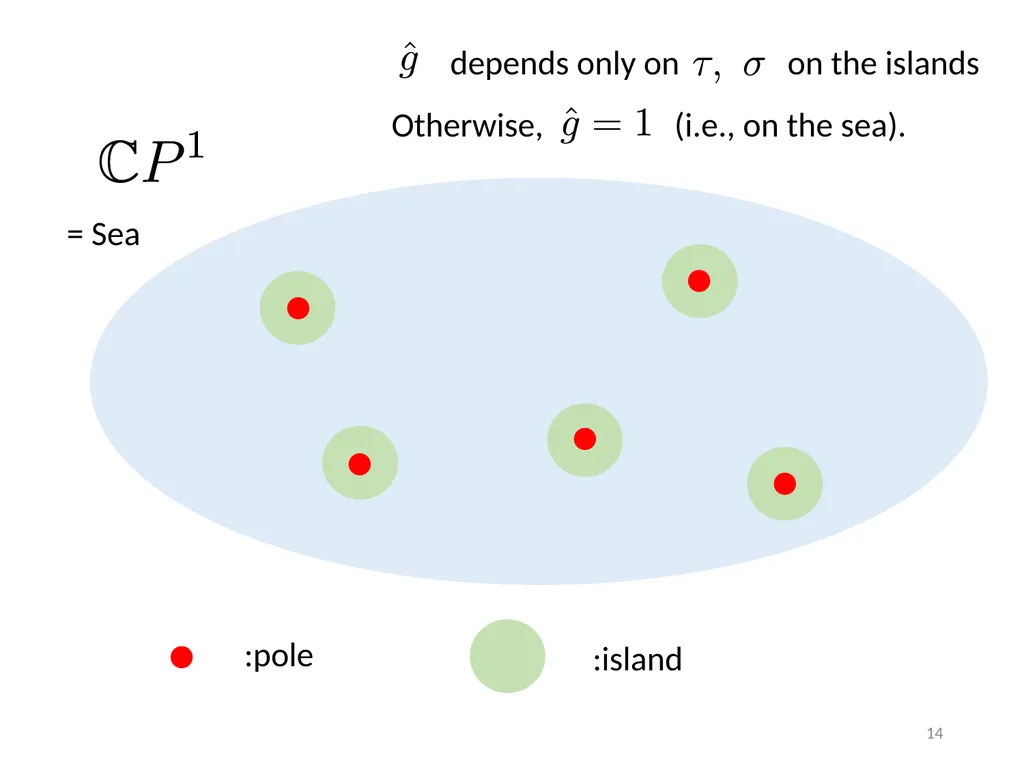
14 :pole :island = Sea depends only on on the islands Otherwise, (i.e., on the sea).<br>
15
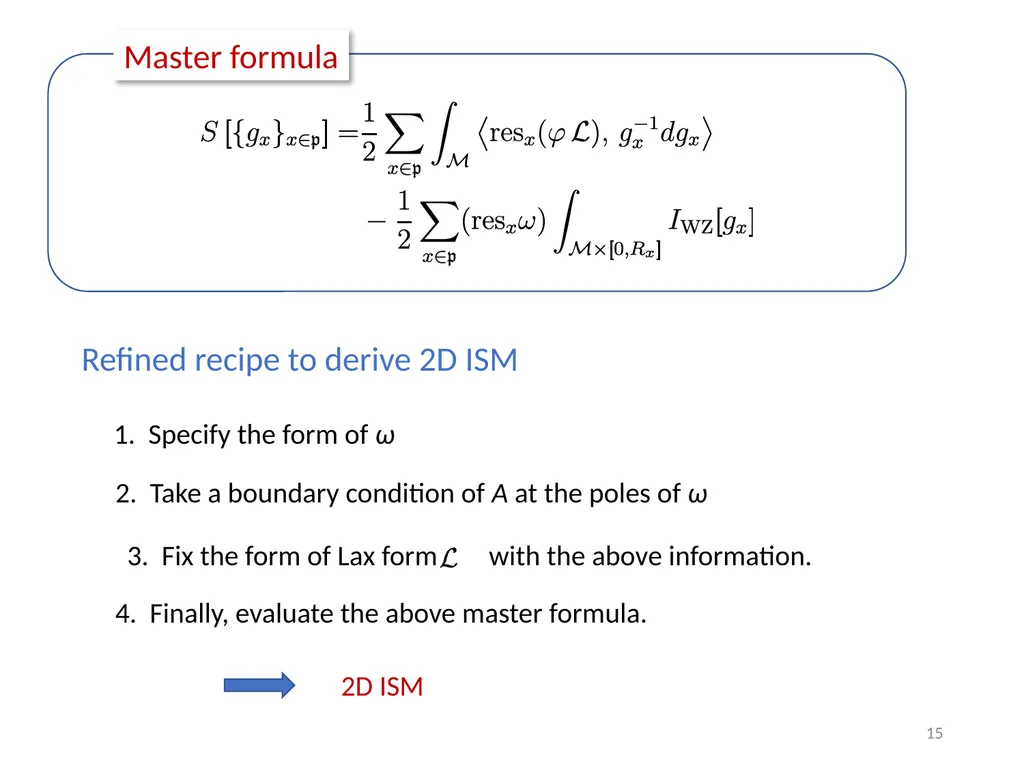
15 Refined recipe to derive 2D ISM 1. Specify the form of ω 2. Take a boundary condition of A at the poles of ω 3. Fix the form of Lax form with the above information. 4. Finally, evaluate the above master formula. 2D ISM Master formula<br>
16
16 2. Concrete Examples<br>
17
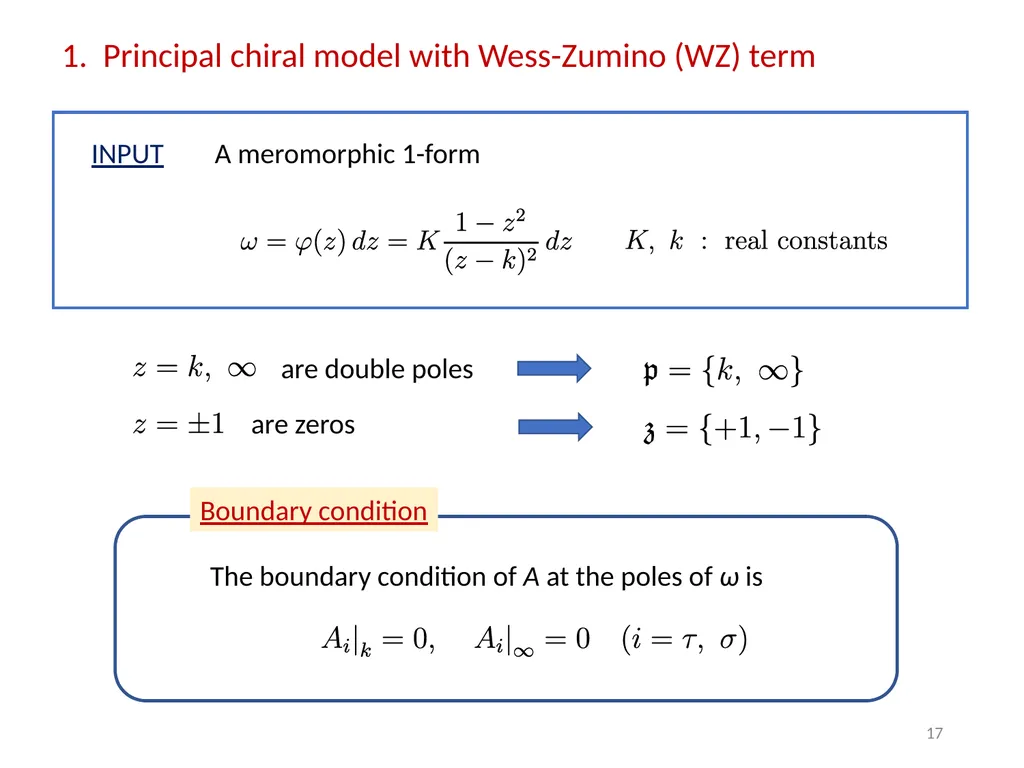
17 1. Principal chiral model with Wess-Zumino (WZ) term A meromorphic 1-form are double poles are zeros INPUT<br>
18
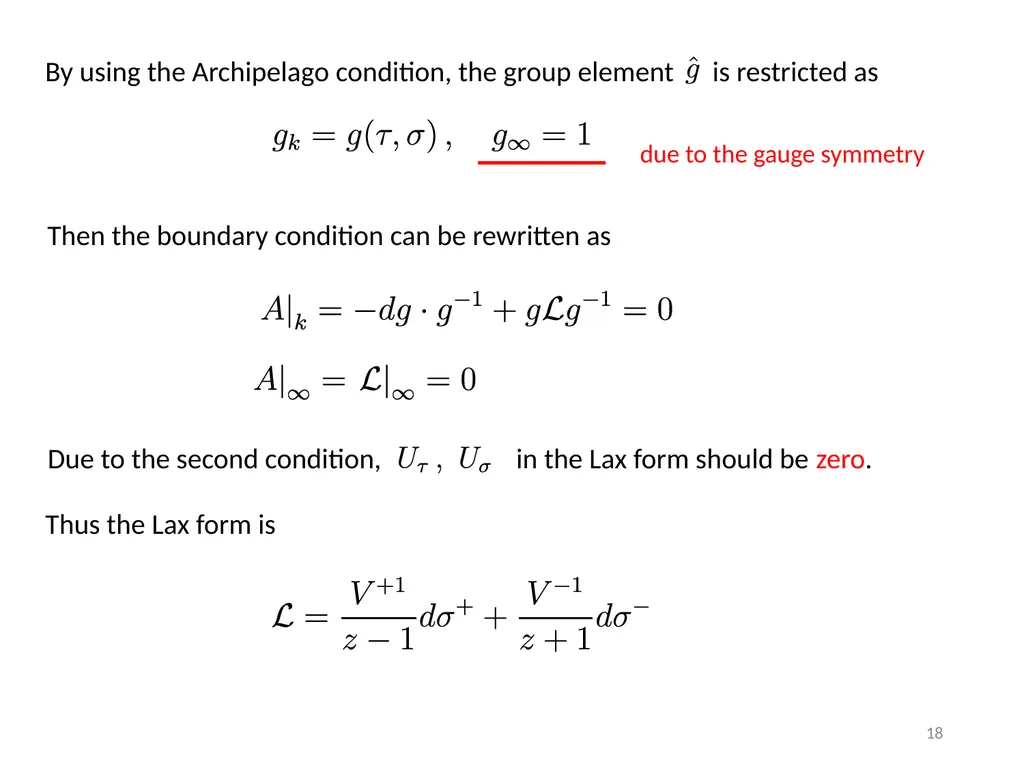
18 By using the Archipelago condition, the group element is restricted as due to the gauge symmetry Then the boundary condition can be rewritten as Due to the second condition, in the Lax form should be zero. Thus the Lax form is<br>
19
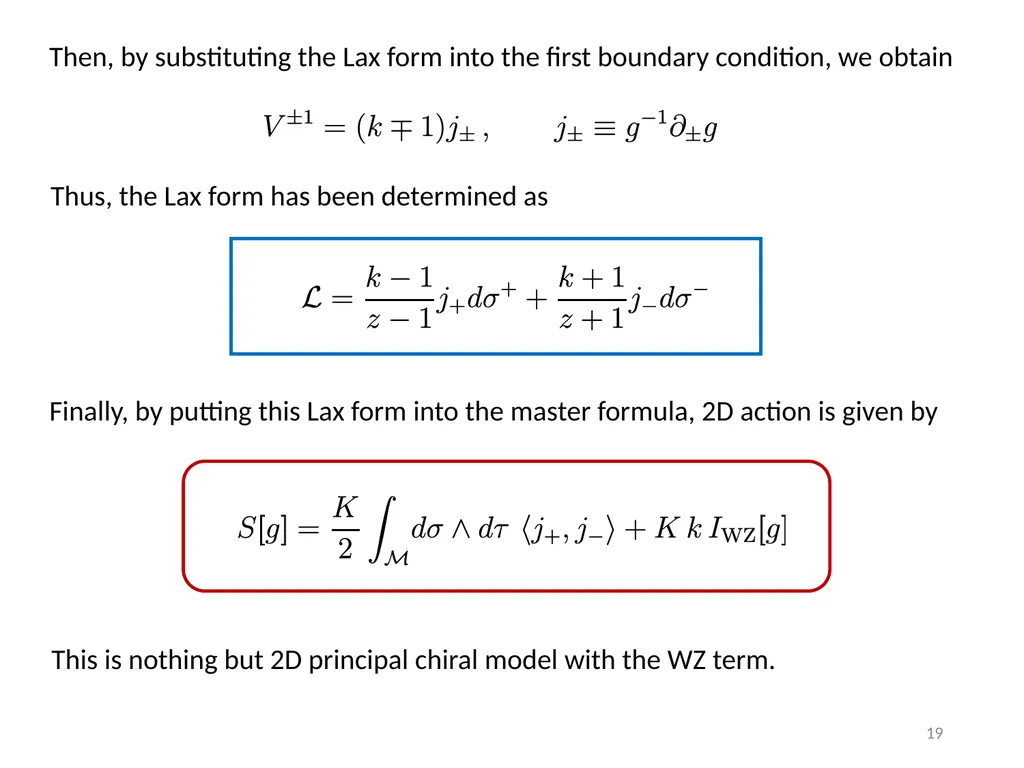
19 Then, by substituting the Lax form into the first boundary condition, we obtain Thus, the Lax form has been determined as Finally, by putting this Lax form into the master formula, 2D action is given by This is nothing but 2D principal chiral model with the WZ term.<br>
20
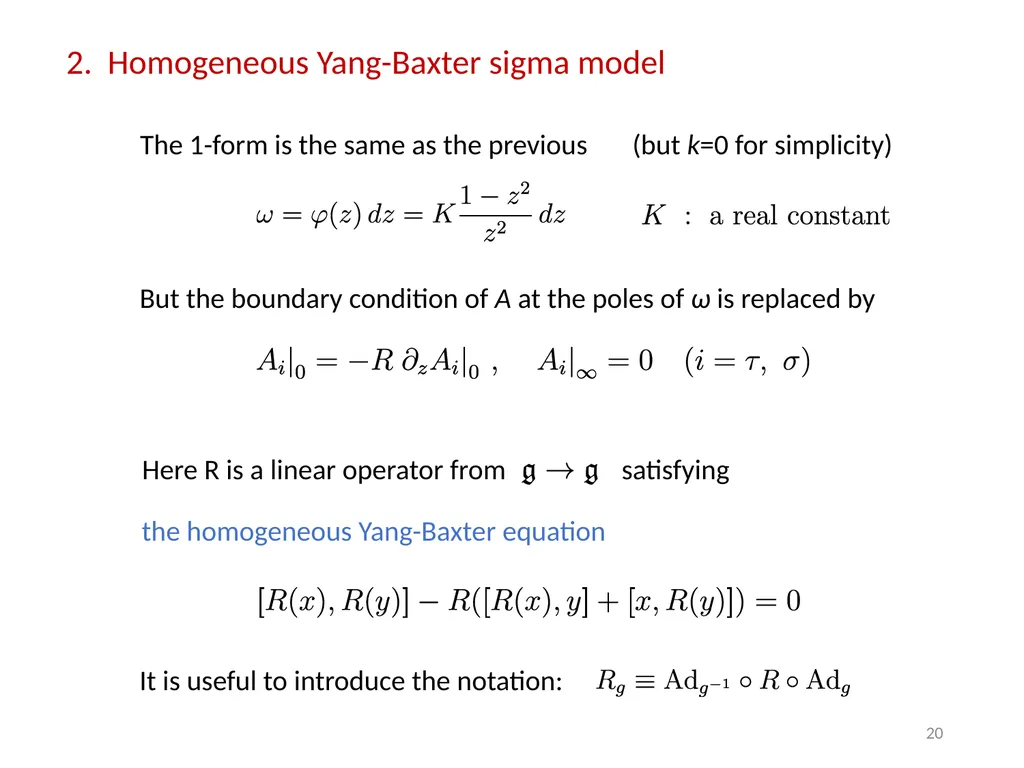
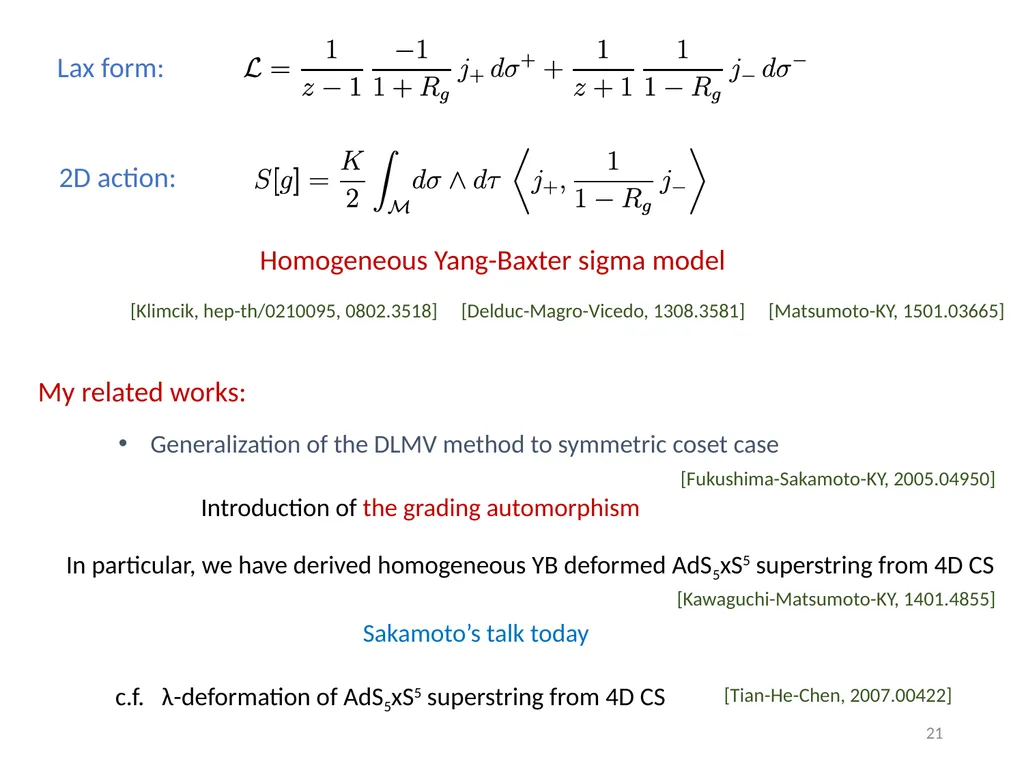
20 2. Homogeneous Yang-Baxter sigma model The 1-form is the same as the previous (but k=0 for simplicity) But the boundary condition of A at the poles of ω is replaced by Here R is a linear operator from satisfying the homogeneous Yang-Baxter equation It is useful to introduce the notation:<br>
21
21 Lax form: 2D action: Homogeneous Yang-Baxter sigma model [Klimcik, hep-th/0210095, 0802.3518] [Delduc-Magro-Vicedo, 1308.3581] [Matsumoto-KY, 1501.03665]<br>
23
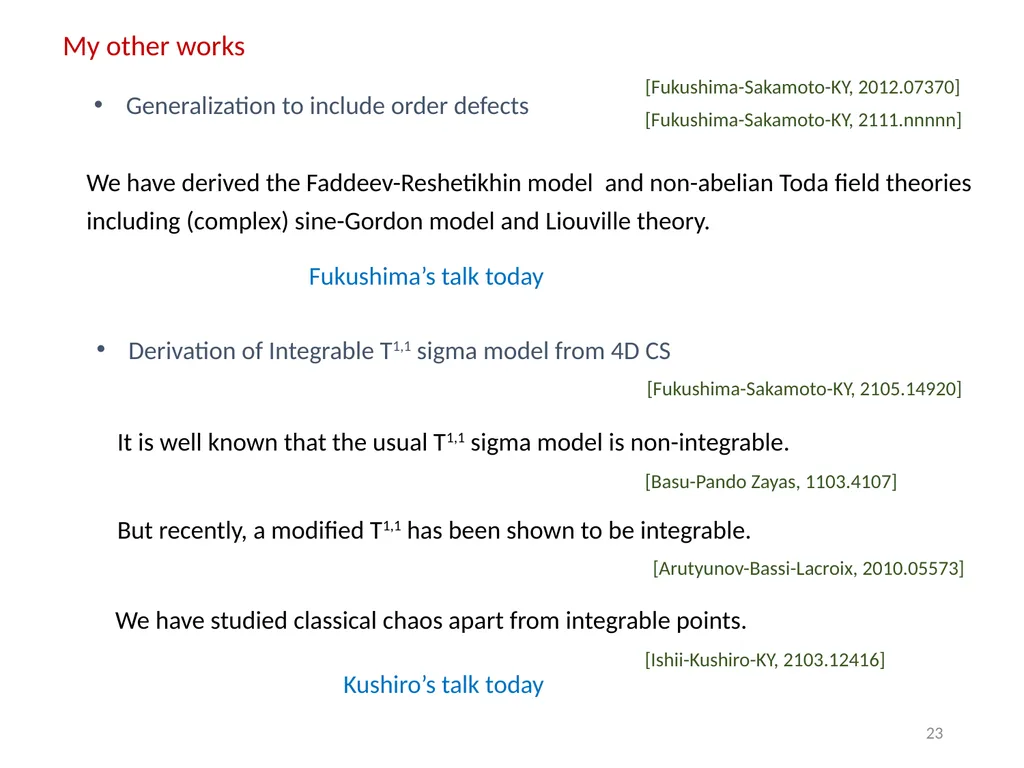
23 [Fukushima-Sakamoto-KY, 2012.07370] Generalization to include order defects [Fukushima-Sakamoto-KY, 2111.nnnnn] We have derived the Faddeev-Reshetikhin model and non-abelian Toda field theories
including (complex) sine-Gordon model and Liouville theory. Fukushima’s talk today My other works<br>
24
24 3. Summary and Discussion<br>
25
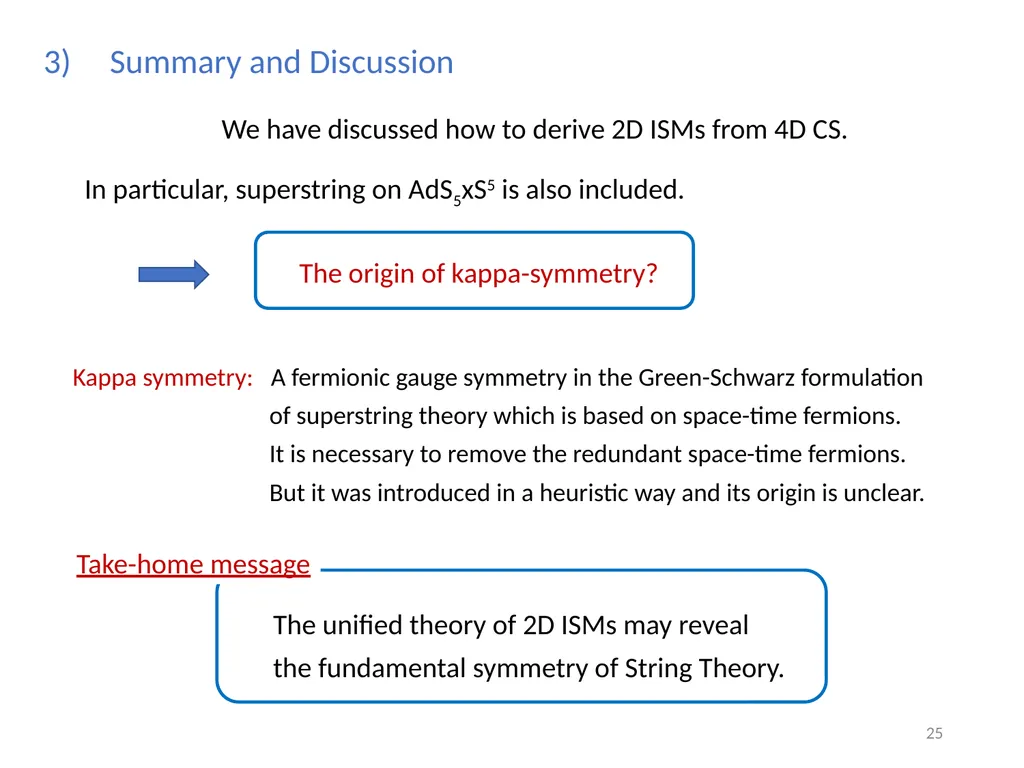
25 3) Summary and Discussion We have discussed how to derive 2D ISMs from 4D CS. In particular, superstring on AdS5xS5 is also included. The origin of kappa-symmetry? Kappa symmetry: A fermionic gauge symmetry in the Green-Schwarz formulation
of superstring theory which is based on space-time fermions.
It is necessary to remove the redundant space-time fermions.
But it was introduced in a heuristic way and its origin is unclear. The unified theory of 2D ISMs may reveal
the fundamental symmetry of String Theory. Take-home message<br>
26
Thank you for
your attention! 26<br>
27
27 But 4D CS scenario might be a tip of the iceberg!<br>
28
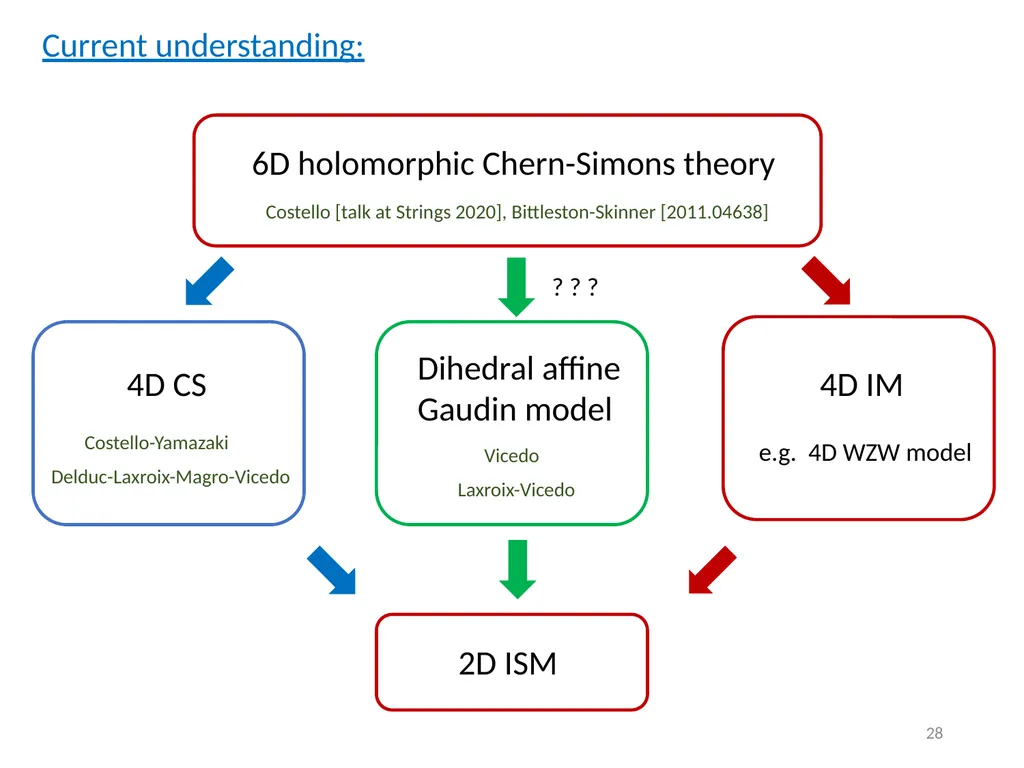
28 Current understanding: 2D ISM Costello-Yamazaki Delduc-Laxroix-Magro-Vicedo 4D CS<br>