
EASTERN ILLINOIS UNIVERSITY Preparing Students for
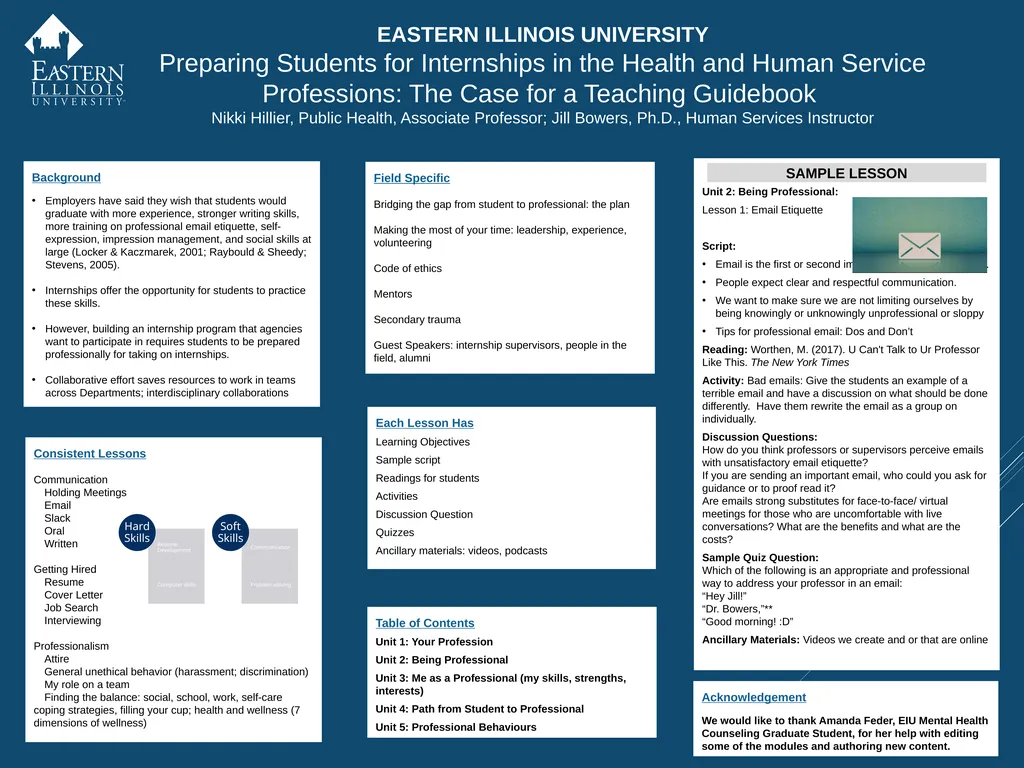
Description: EASTERN ILLINOIS UNIVERSITY Preparing Students for Internships in the Health and Human Service Professions: The Case for a Teaching Guidebook Nikki Hillier, Public Health, Associate Professor; Jill Bowers, Ph.D., Human Services Instructor
Related Topics
Download Presentation
"EASTERN ILLINOIS UNIVERSITY Preparing Students for" is the property of its rightful owner. Permission is granted to download and print the materials on this website for personal, non-commercial use only, and to display it on your personal computer provided you do not modify the materials and that you retain all copyright notices contained in the materials. By downloading content from our website, you accept the terms of this agreement.
Presentation Transcript
slide1. EASTERN ILLINOIS UNIVERSITY
Preparing Students for Internships in the Health and Human Service Professions: The Case for a Teaching Guidebook
Nikki Hillier, Public Health, Associate Professor; Jill Bowers, Ph.D., Human Services Instructor Background
Employers have said they wish that students would graduate with more experience, stronger writing skills, more training on professional email etiquette, self-expression, impression management, and social skills at large (Locker & Kaczmarek, 2001; Raybould & Sheedy; Stevens, 2005).
Internships offer the opportunity for students to practice these skills.
However, building an internship program that agencies want to participate in requires students to be prepared professionally for taking on internships.
Collaborative effort saves resources to work in teams across Departments; interdisciplinary collaborations Field Specific
Bridging the gap from student to professional: the plan
Making the most of your time: leadership, experience, volunteering
Code of ethics
Mentors Secondary trauma
Guest Speakers: internship supervisors, people in the field, alumni Unit 2: Being Professional:
Lesson 1: Email Etiquette
Script:
Email is the first or second impression people get from us.
People expect clear and respectful communication.
We want to make sure we are not limiting ourselves by being knowingly or unknowingly unprofessional or sloppy
Tips for professional email: Dos and Don’t
Reading: Worthen, M. (2017). U Can't Talk to Ur Professor Like This. The New York Times.
Activity: Bad emails: Give the students an example of a terrible email and have a discussion on what should be done differently. Have them rewrite the email as a group on individually.
Discussion Questions:
How do you think professors or supervisors perceive emails with unsatisfactory email etiquette?
If you are sending an important email, who could you ask for guidance or to proof read it?
Are emails strong substitutes for face-to-face/ virtual meetings for those who are uncomfortable with live conversations? What are the benefits and what are the costs?
Sample Quiz Question:
Which of the following is an appropriate and professional way to address your professor in an email:
“Hey Jill!”
“Dr. Bowers,”**
“Good morning! :D”
Ancillary Materials: Videos we create and or that are online Table of Contents
Unit 1: Your Profession
Unit 2: Being Professional
Unit 3: Me as a Professional (my skills, strengths, interests)
Unit 4: Path from Student to Professional
Unit 5: Professional Behaviours Consistent Lessons
Communication
Holding Meetings
Email
Slack
Oral
Written
Getting Hired
Resume
Cover Letter
Job Search
Interviewing
Professionalism
Attire
General unethical behavior (harassment; discrimination)
My role on a team
Finding the balance: social, school, work, self-care coping strategies, filling your cup; health and wellness (7 dimensions of wellness) Each Lesson Has
Learning Objectives
Sample script
Readings for students
Activities
Discussion Question
Quizzes
Ancillary materials: videos, podcasts SAMPLE LESSON Acknowledgement
We would like to thank Amanda Feder, EIU Mental Health Counseling Graduate Student, for her help with editing some of the modules and authoring new content.<br>
Employers have said they wish that students would graduate with more experience, stronger writing skills, more training on professional email etiquette, self-expression, impression management, and social skills at large (Locker & Kaczmarek, 2001; Raybould & Sheedy; Stevens, 2005).
Internships offer the opportunity for students to practice these skills.
However, building an internship program that agencies want to participate in requires students to be prepared professionally for taking on internships.
Collaborative effort saves resources to work in teams across Departments; interdisciplinary collaborations Field Specific
Bridging the gap from student to professional: the plan
Making the most of your time: leadership, experience, volunteering
Code of ethics
Mentors Secondary trauma
Guest Speakers: internship supervisors, people in the field, alumni Unit 2: Being Professional:
Lesson 1: Email Etiquette
Script:
Email is the first or second impression people get from us.
People expect clear and respectful communication.
We want to make sure we are not limiting ourselves by being knowingly or unknowingly unprofessional or sloppy
Tips for professional email: Dos and Don’t
Reading: Worthen, M. (2017). U Can't Talk to Ur Professor Like This. The New York Times.
Activity: Bad emails: Give the students an example of a terrible email and have a discussion on what should be done differently. Have them rewrite the email as a group on individually.
Discussion Questions:
How do you think professors or supervisors perceive emails with unsatisfactory email etiquette?
If you are sending an important email, who could you ask for guidance or to proof read it?
Are emails strong substitutes for face-to-face/ virtual meetings for those who are uncomfortable with live conversations? What are the benefits and what are the costs?
Sample Quiz Question:
Which of the following is an appropriate and professional way to address your professor in an email:
“Hey Jill!”
“Dr. Bowers,”**
“Good morning! :D”
Ancillary Materials: Videos we create and or that are online Table of Contents
Unit 1: Your Profession
Unit 2: Being Professional
Unit 3: Me as a Professional (my skills, strengths, interests)
Unit 4: Path from Student to Professional
Unit 5: Professional Behaviours Consistent Lessons
Communication
Holding Meetings
Slack
Oral
Written
Getting Hired
Resume
Cover Letter
Job Search
Interviewing
Professionalism
Attire
General unethical behavior (harassment; discrimination)
My role on a team
Finding the balance: social, school, work, self-care coping strategies, filling your cup; health and wellness (7 dimensions of wellness) Each Lesson Has
Learning Objectives
Sample script
Readings for students
Activities
Discussion Question
Quizzes
Ancillary materials: videos, podcasts SAMPLE LESSON Acknowledgement
We would like to thank Amanda Feder, EIU Mental Health Counseling Graduate Student, for her help with editing some of the modules and authoring new content.<br>