ECE 340 Lectures 16-18 Diffusion of carriers Remember Brownian motion of electrons holes! When E-field 0, but T 0, thermal velocity vT But net drift velocity vd So net current Jd What if
"ECE 340 Lectures 16-18 Diffusion of carriers" is the property of its rightful owner. Permission is granted to
download and print the materials on this website for personal, non-commercial use only, and to display it
on your personal computer provided you do not modify the materials and that you retain all copyright
notices contained in the materials. By downloading content from our website, you accept the terms of this
agreement.
Presentation Transcript
01
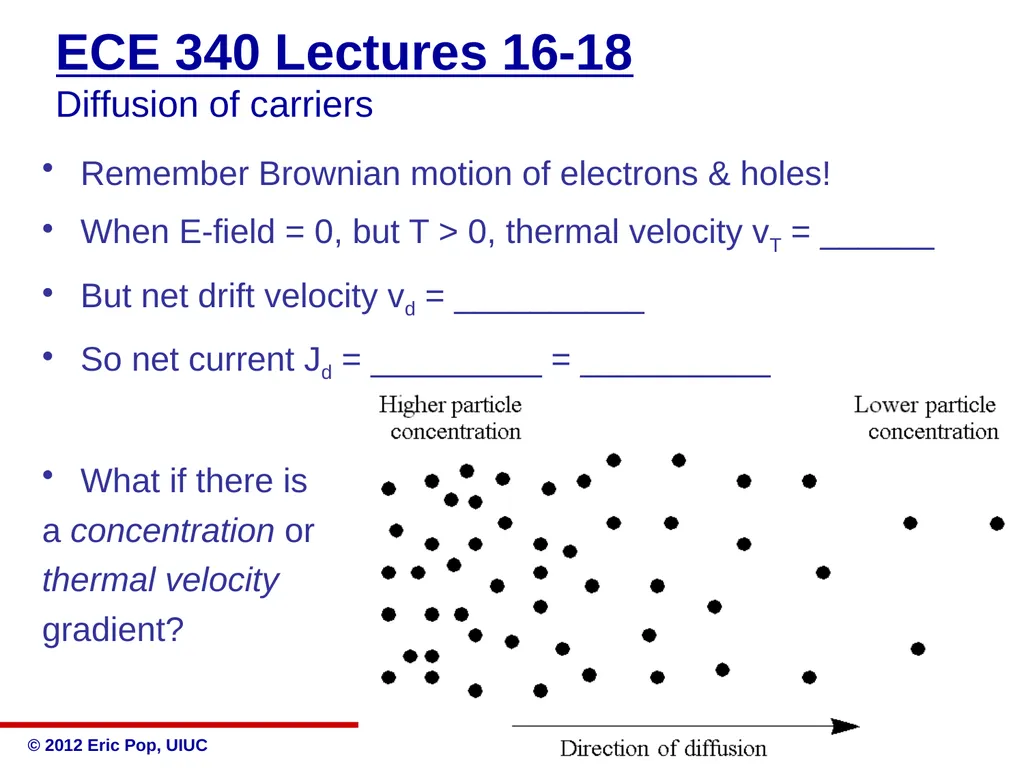
ECE 340 Lectures 16-18 Diffusion of carriers Remember Brownian motion of electrons & holes!
When E-field = 0, but T > 0, thermal velocity vT = ______
But net drift velocity vd = __________
So net current Jd = _________ = __________
What if there is
a concentration or
thermal velocity
gradient? 1<br>
02
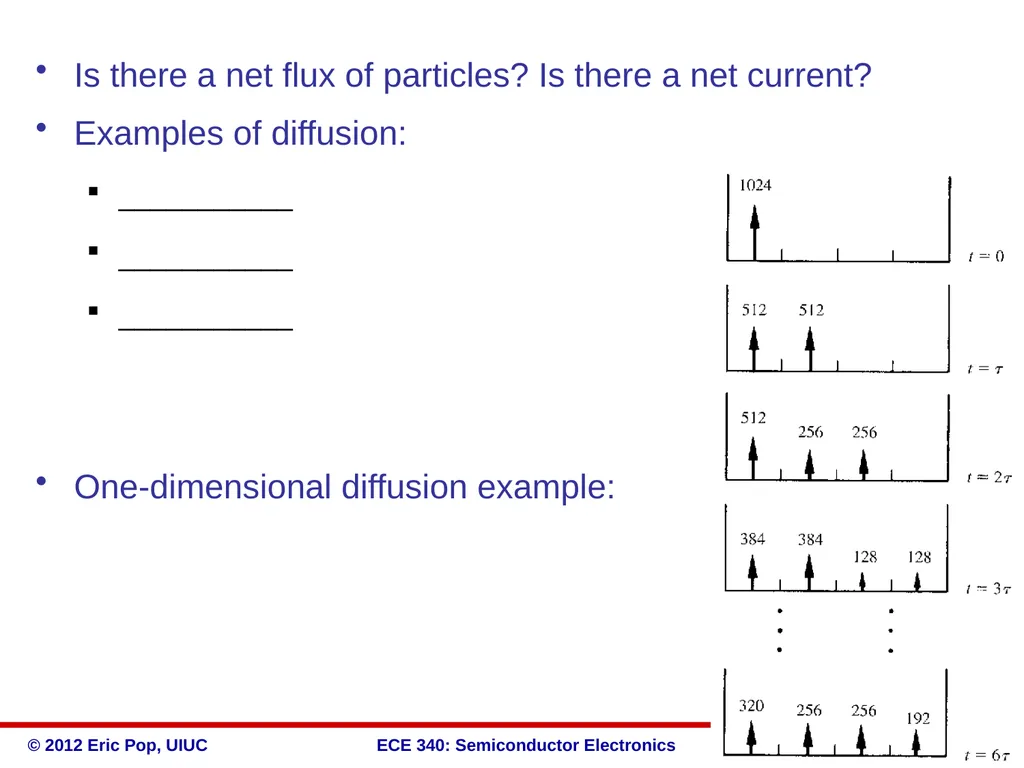
Is there a net flux of particles? Is there a net current?
Examples of diffusion:
___________
___________
___________
One-dimensional diffusion example: 2<br>
03
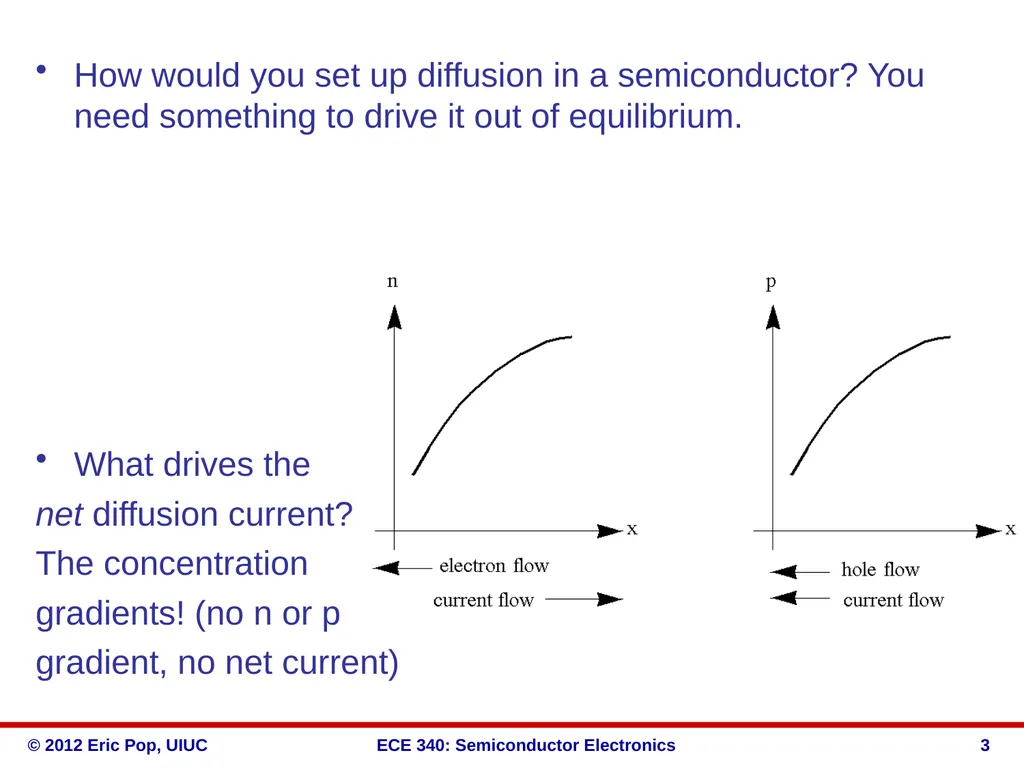
How would you set up diffusion in a semiconductor? You need something to drive it out of equilibrium.
What drives the
net diffusion current?
The concentration
gradients! (no n or p
gradient, no net current) 3<br>
04
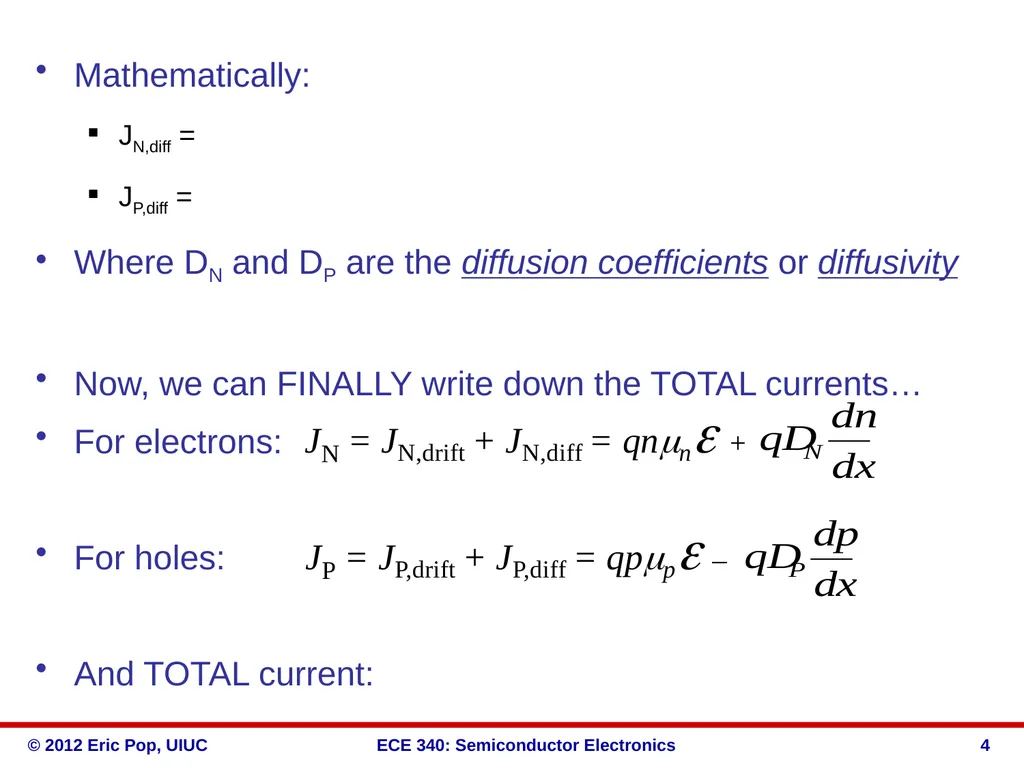
Mathematically:
JN,diff =
JP,diff =
Where DN and DP are the diffusion coefficients or diffusivity
Now, we can FINALLY write down the TOTAL currents…
For electrons:
For holes:
And TOTAL current: 4<br>
05
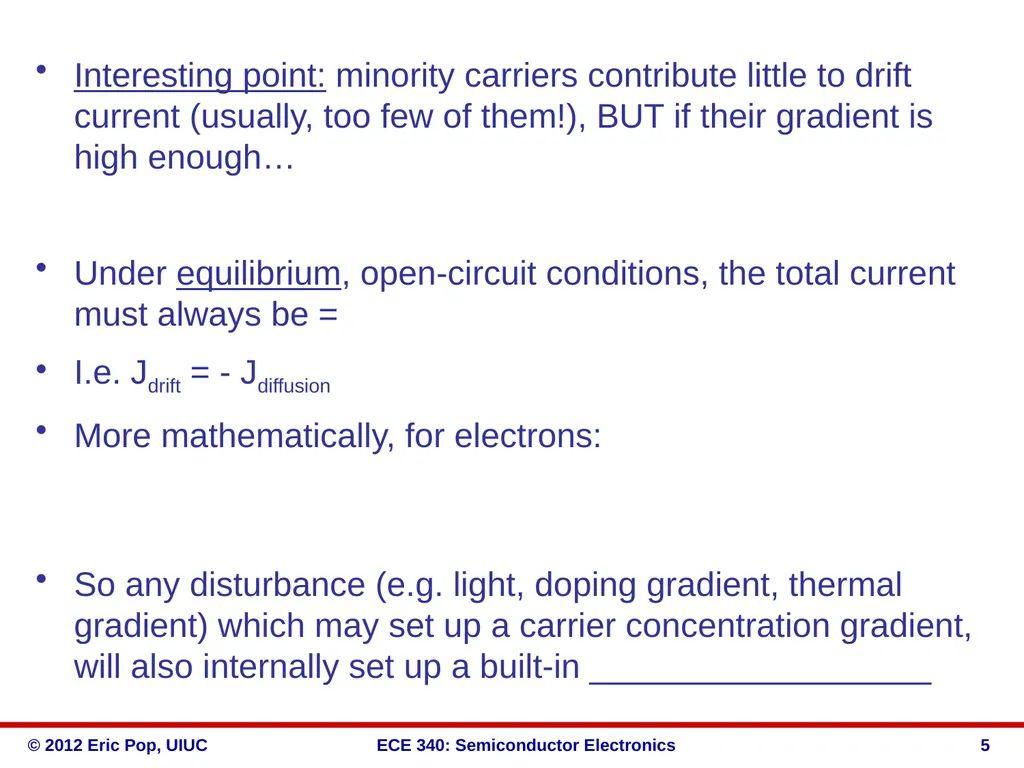
Interesting point: minority carriers contribute little to drift current (usually, too few of them!), BUT if their gradient is high enough…
Under equilibrium, open-circuit conditions, the total current must always be =
I.e. Jdrift = - Jdiffusion
More mathematically, for electrons:
So any disturbance (e.g. light, doping gradient, thermal gradient) which may set up a carrier concentration gradient, will also internally set up a built-in __________________ 5<br>
06
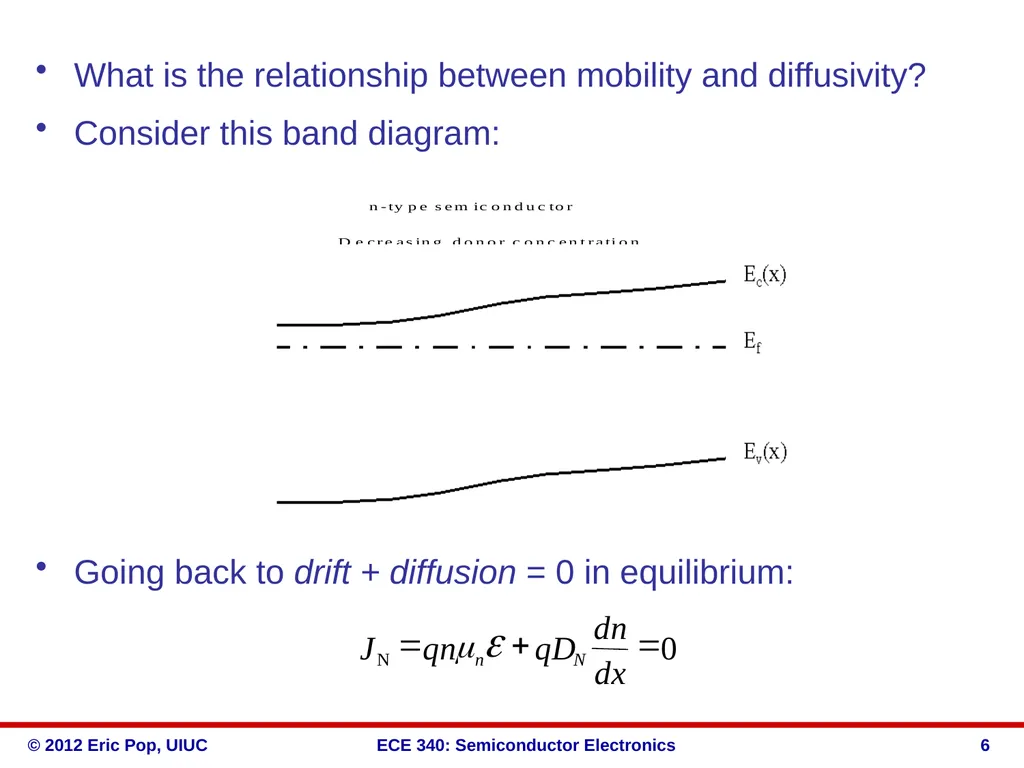
What is the relationship between mobility and diffusivity?
Consider this band diagram:
Going back to drift + diffusion = 0 in equilibrium: 6<br>
07
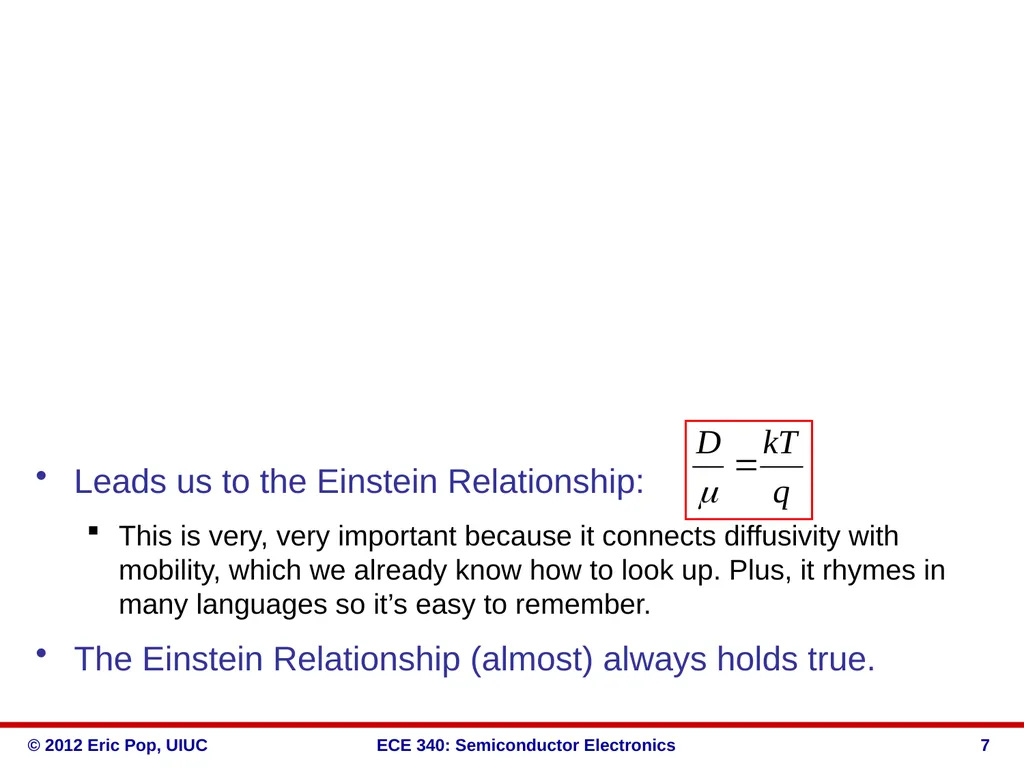
Leads us to the Einstein Relationship:
This is very, very important because it connects diffusivity with mobility, which we already know how to look up. Plus, it rhymes in many languages so it’s easy to remember.
The Einstein Relationship (almost) always holds true. 7<br>
08
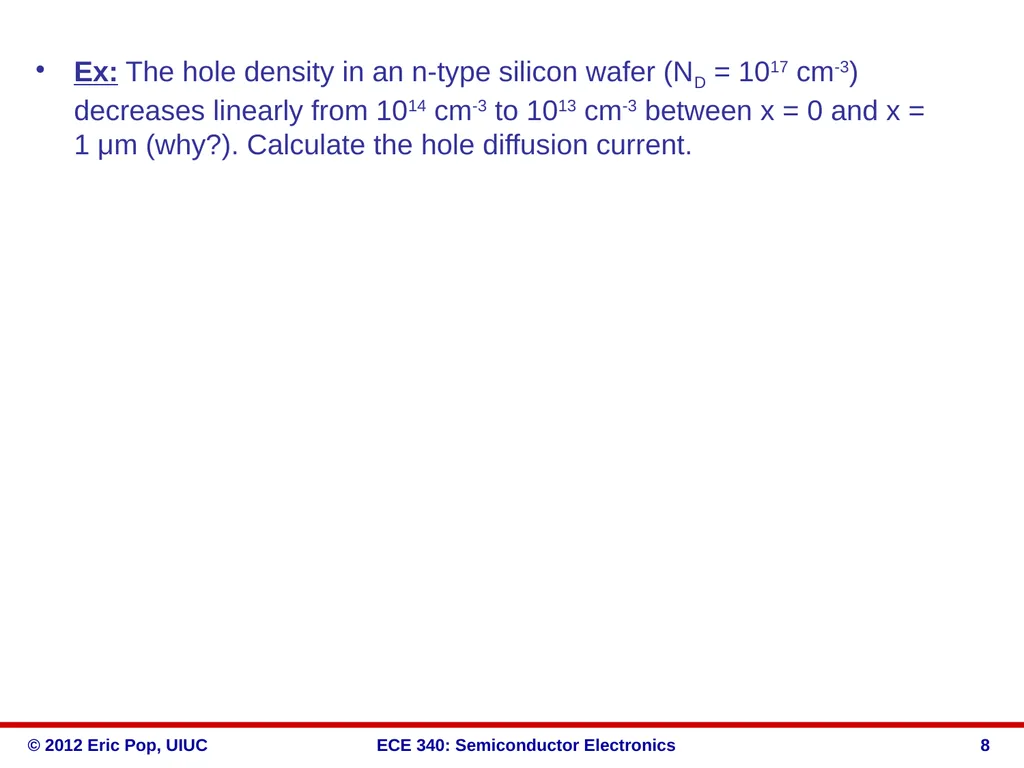
Ex: The hole density in an n-type silicon wafer (ND = 1017 cm-3) decreases linearly from 1014 cm-3 to 1013 cm-3 between x = 0 and x = 1 μm (why?). Calculate the hole diffusion current. 8<br>
09
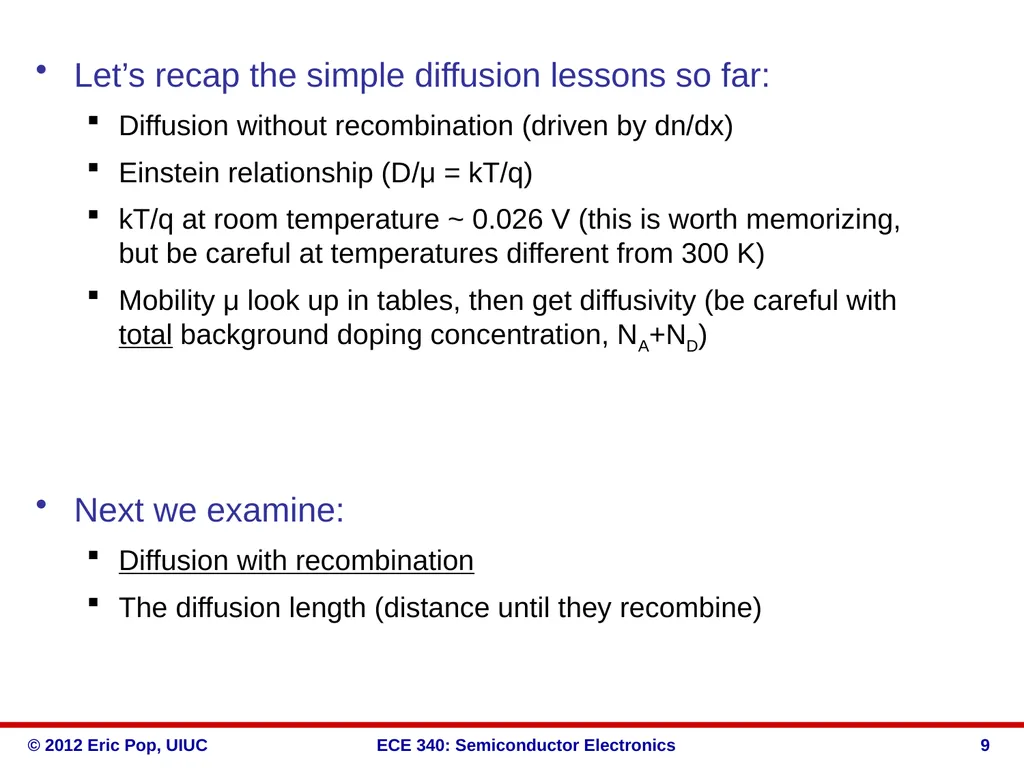
Let’s recap the simple diffusion lessons so far:
Diffusion without recombination (driven by dn/dx)
Einstein relationship (D/μ = kT/q)
kT/q at room temperature ~ 0.026 V (this is worth memorizing, but be careful at temperatures different from 300 K)
Mobility μ look up in tables, then get diffusivity (be careful with total background doping concentration, NA+ND)
Next we examine:
Diffusion with recombination
The diffusion length (distance until they recombine) 9<br>
10
Assume holes (p) are minority carriers
Consider simple volume element where we have both generation, recombination, and holes passing through due to a concentration gradient (dp/dx)
Simple “bean counting”
in the little volume
Rate of “bean” or “bubble” population increase = (current IN – current OUT) – bean recombination 10<br>
11
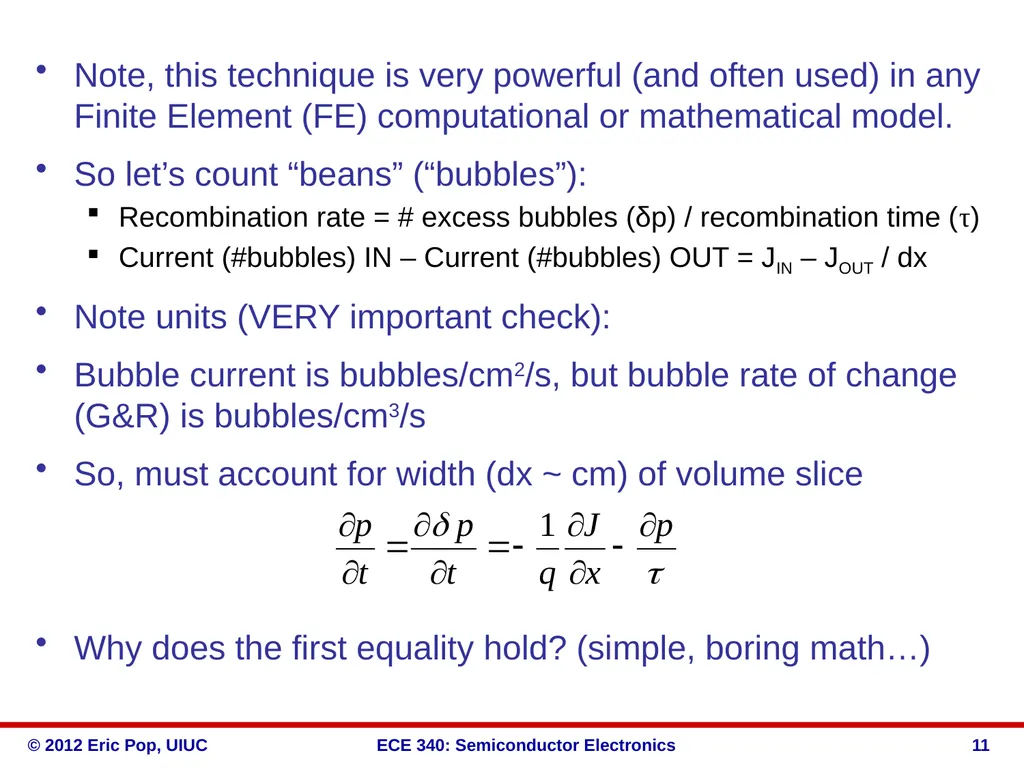
Note, this technique is very powerful (and often used) in any Finite Element (FE) computational or mathematical model.
So let’s count “beans” (“bubbles”):
Recombination rate = # excess bubbles (δp) / recombination time (τ)
Current (#bubbles) IN – Current (#bubbles) OUT = JIN – JOUT / dx
Note units (VERY important check):
Bubble current is bubbles/cm2/s, but bubble rate of change (G&R) is bubbles/cm3/s
So, must account for width (dx ~ cm) of volume slice
Why does the first equality hold? (simple, boring math…) 11<br>
12
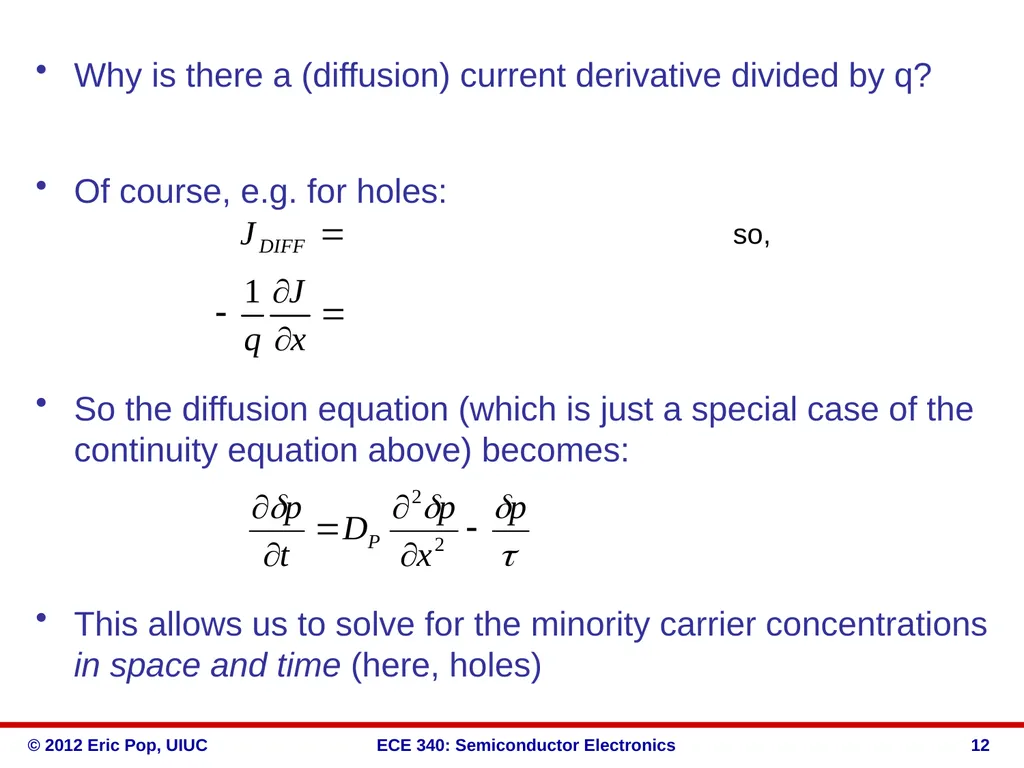
Why is there a (diffusion) current derivative divided by q?
Of course, e.g. for holes:
so,
So the diffusion equation (which is just a special case of the continuity equation above) becomes:
This allows us to solve for the minority carrier concentrations in space and time (here, holes) 12<br>
13
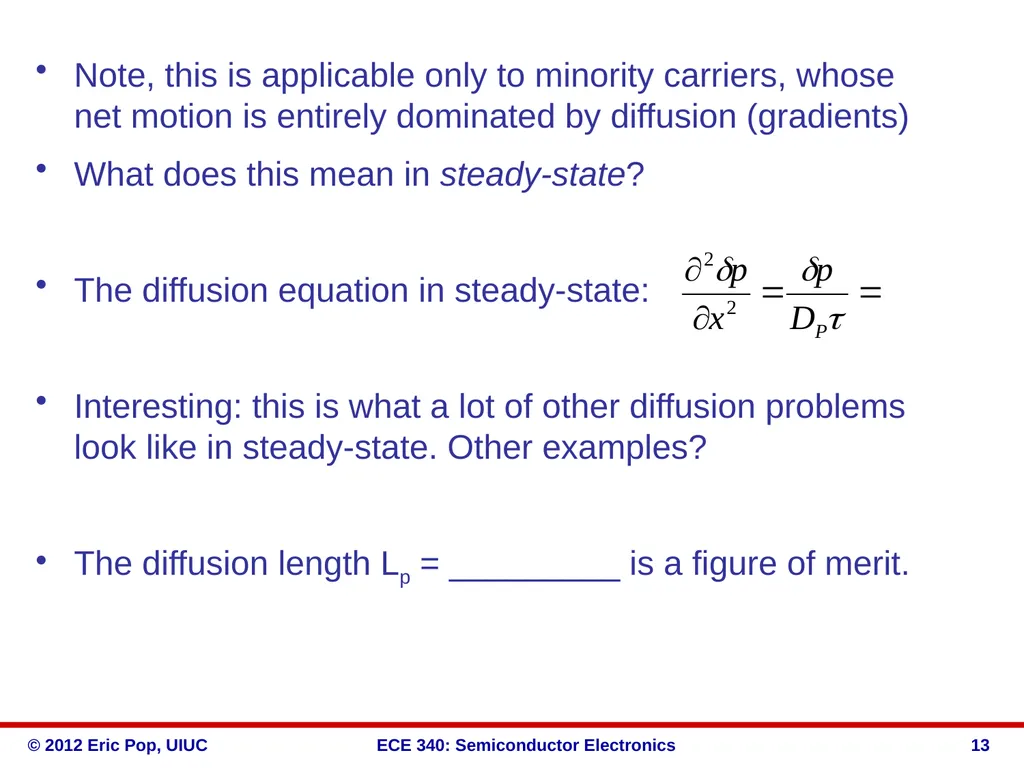
Note, this is applicable only to minority carriers, whose net motion is entirely dominated by diffusion (gradients)
What does this mean in steady-state?
The diffusion equation in steady-state:
Interesting: this is what a lot of other diffusion problems look like in steady-state. Other examples?
The diffusion length Lp = _________ is a figure of merit. 13<br>
14
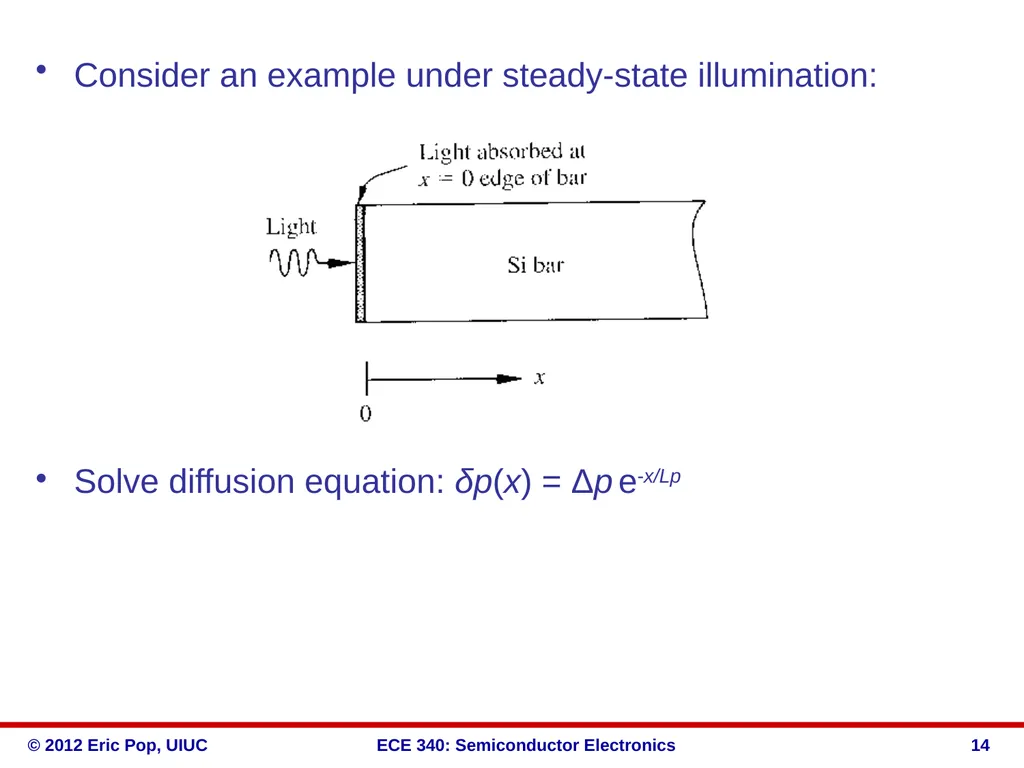
Consider an example under steady-state illumination:
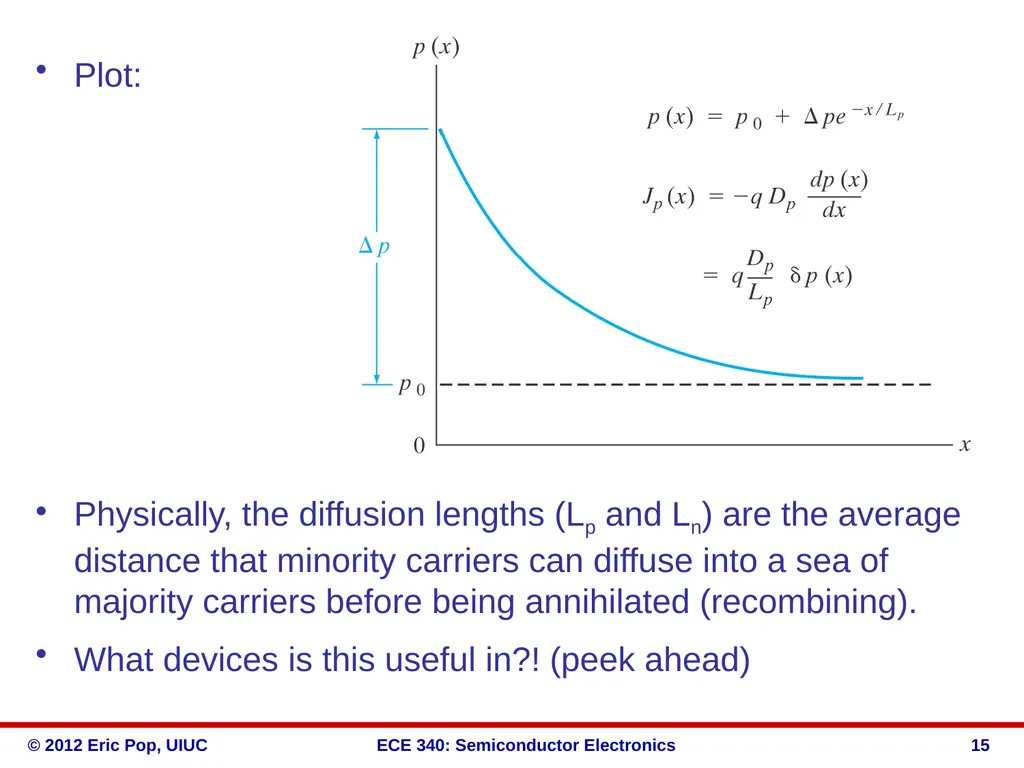
Physically, the diffusion lengths (Lp and Ln) are the average distance that minority carriers can diffuse into a sea of majority carriers before being annihilated (recombining).
What devices is this useful in?! (peek ahead) 15<br>
16
Ex: A) Calculate minority carrier diffusion length in silicon with ND = 1016 cm-3 and τp = 1 μs. B) Assuming 1015 cm-3 excess holes photogenerated at the surface, what is the diffusion current at 1 μm depth? 16<br>