ECO Recent and Planned Changes in SRD Regulations Presented by Robin Donoghue Contents CEPT, ECC, ECO, who are we? European Frequency Management Framework Recent Changes to SRD Regulations What the Future Holds! CEPT, ECC, ECO, who are we?
"ECO Recent and Planned Changes in SRD Regulations" is the property of its rightful owner. Permission is granted to
download and print the materials on this website for personal, non-commercial use only, and to display it
on your personal computer provided you do not modify the materials and that you retain all copyright
notices contained in the materials. By downloading content from our website, you accept the terms of this
agreement.
Presentation Transcript
01
ECO Recent and Planned Changes in SRD Regulations Presented by Robin Donoghue<br>
02
Contents CEPT, ECC, ECO, who are we?
European Frequency Management Framework
Recent Changes to SRD Regulations
What the Future Holds!<br>
03
CEPT, ECC, ECO, who are we? European Frequency Management Framework Four slides (from our 2017 presentation)
Who we are
What we do
How we fit in the European framework
Where you can find our documents<br>
04
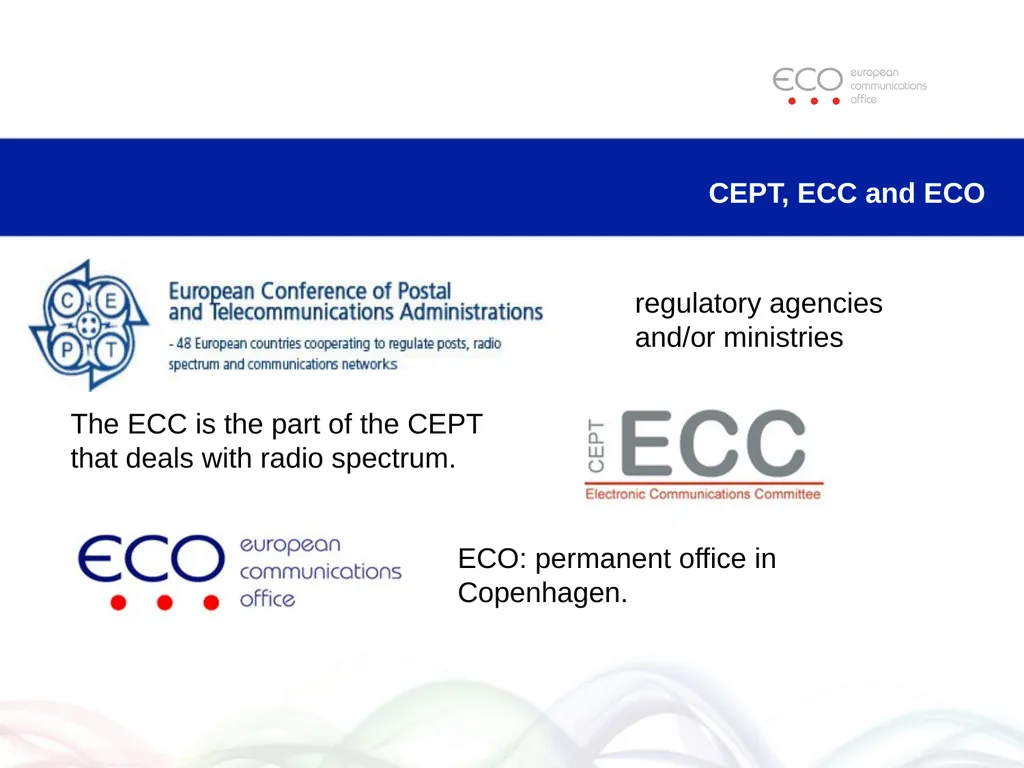
CEPT, ECC and ECO regulatory agencies and/or ministries The ECC is the part of the CEPT that deals with radio spectrum. ECO: permanent office in Copenhagen.<br>
05
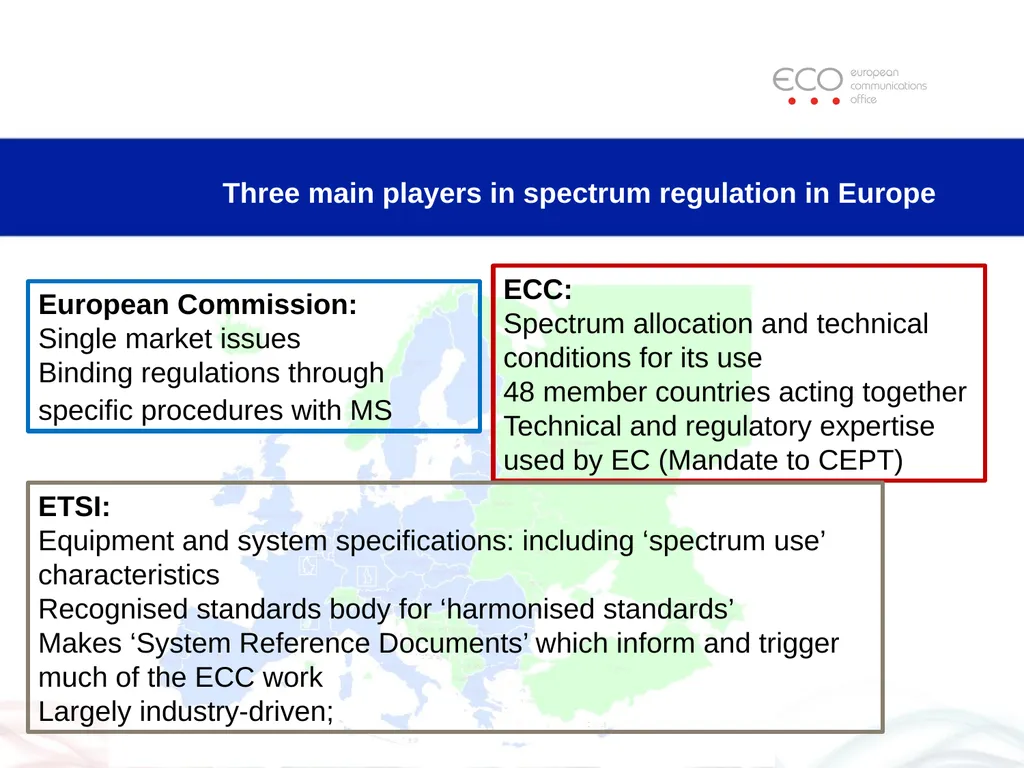
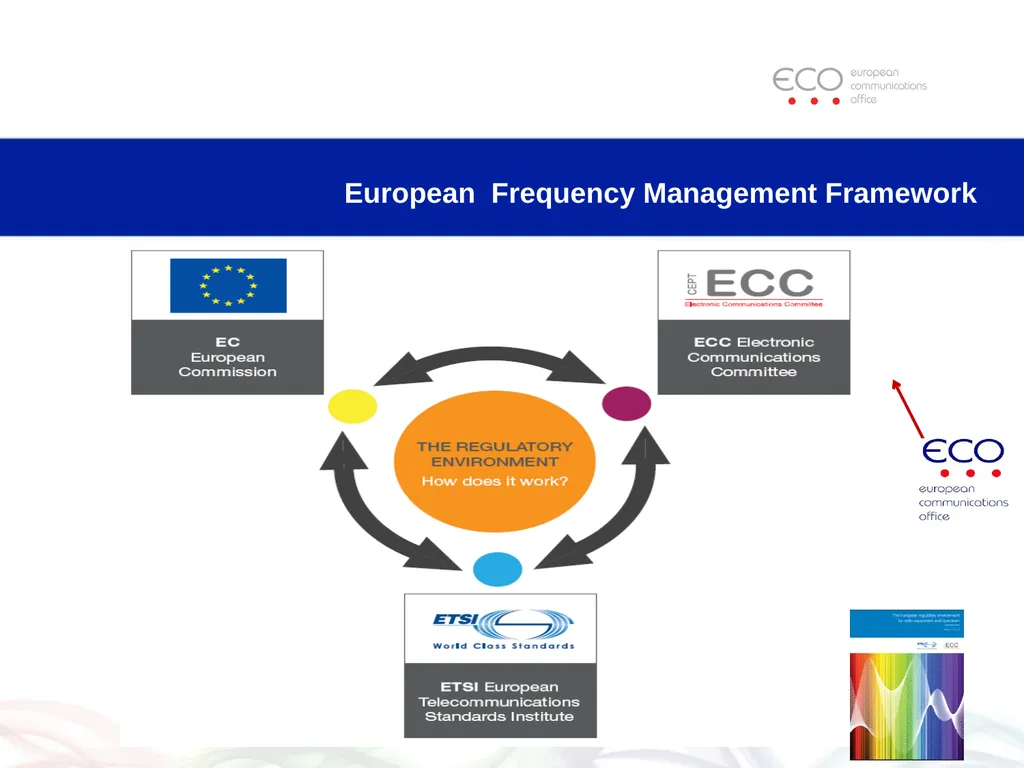
Three main players in spectrum regulation in Europe European Commission:
Single market issues
Binding regulations through specific procedures with MS ECC:
Spectrum allocation and technical conditions for its use
48 member countries acting together
Technical and regulatory expertise used by EC (Mandate to CEPT) ETSI:
Equipment and system specifications: including ‘spectrum use’ characteristics
Recognised standards body for ‘harmonised standards’
Makes ‘System Reference Documents’ which inform and trigger much of the ECC work
Largely industry-driven;<br>
06
European Frequency Management Framework<br>
07
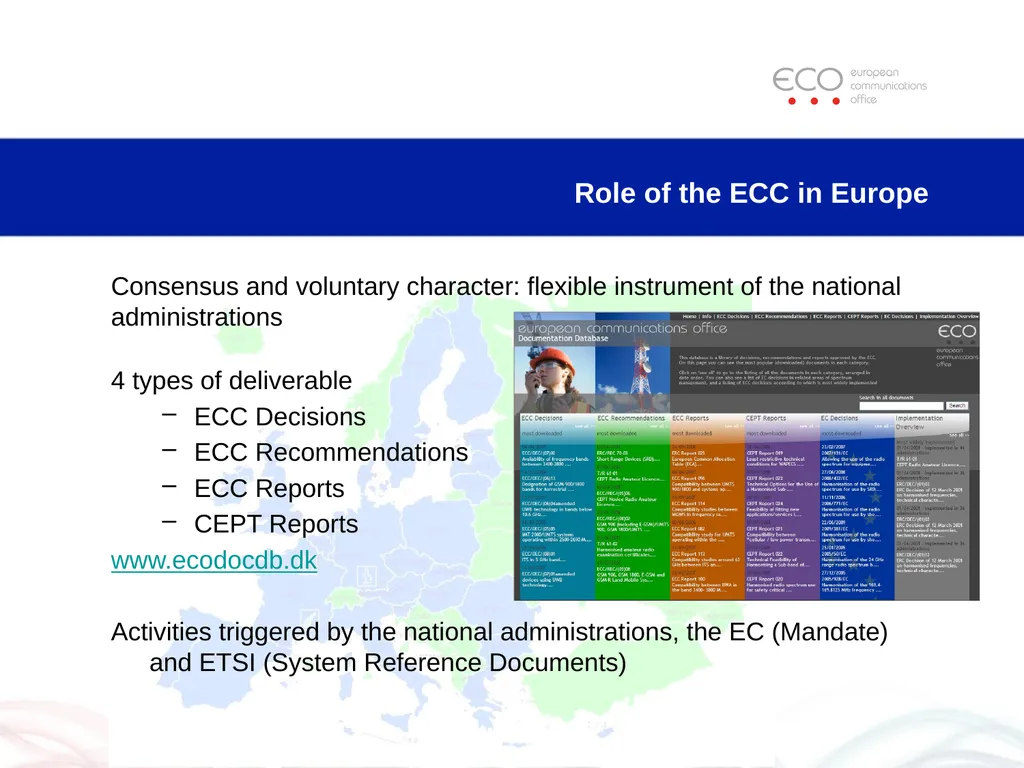
Role of the ECC in Europe Consensus and voluntary character: flexible instrument of the national administrations
Activities triggered by the national administrations, the EC (Mandate) and ETSI (System Reference Documents)<br>
08
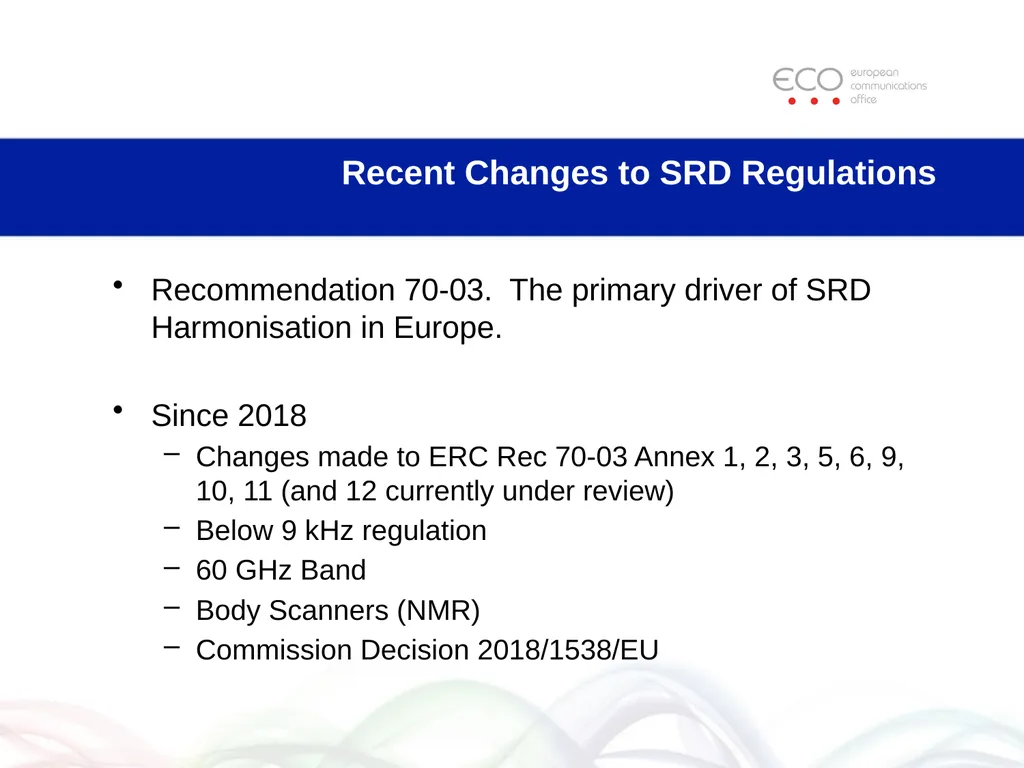
Recent Changes to SRD Regulations Recommendation 70-03. The primary driver of SRD Harmonisation in Europe.
Since 2018
Changes made to ERC Rec 70-03 Annex 1, 2, 3, 5, 6, 9, 10, 11 (and 12 currently under review)
Below 9 kHz regulation
60 GHz Band
Body Scanners (NMR)
Commission Decision 2018/1538/EU<br>
09
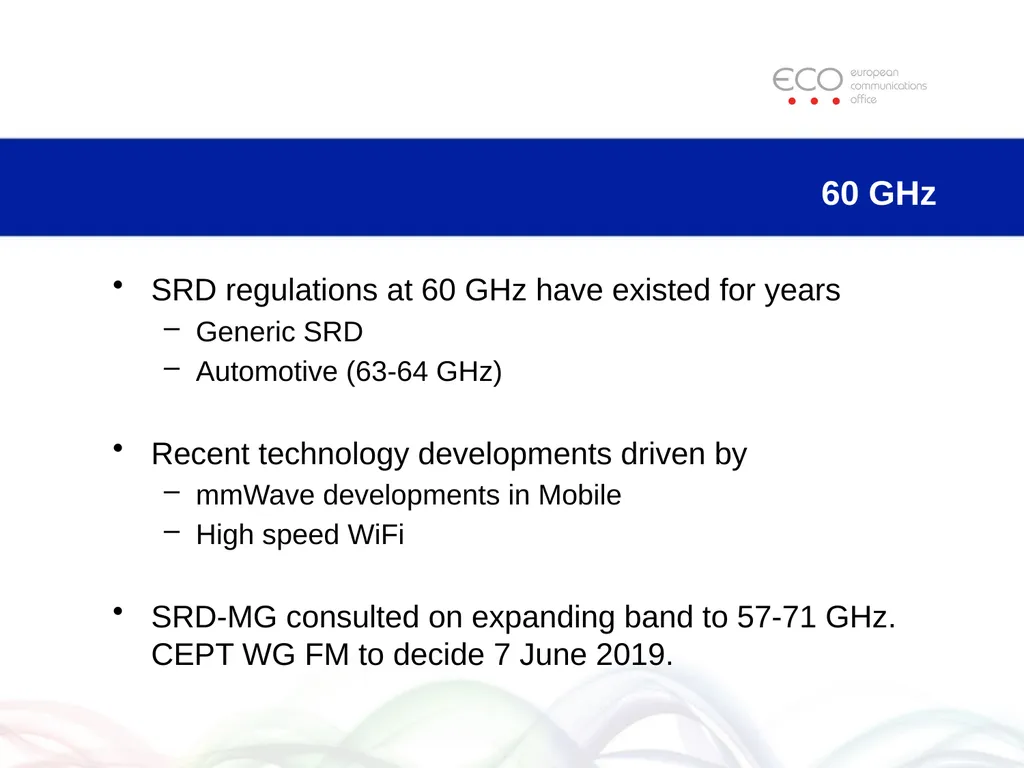
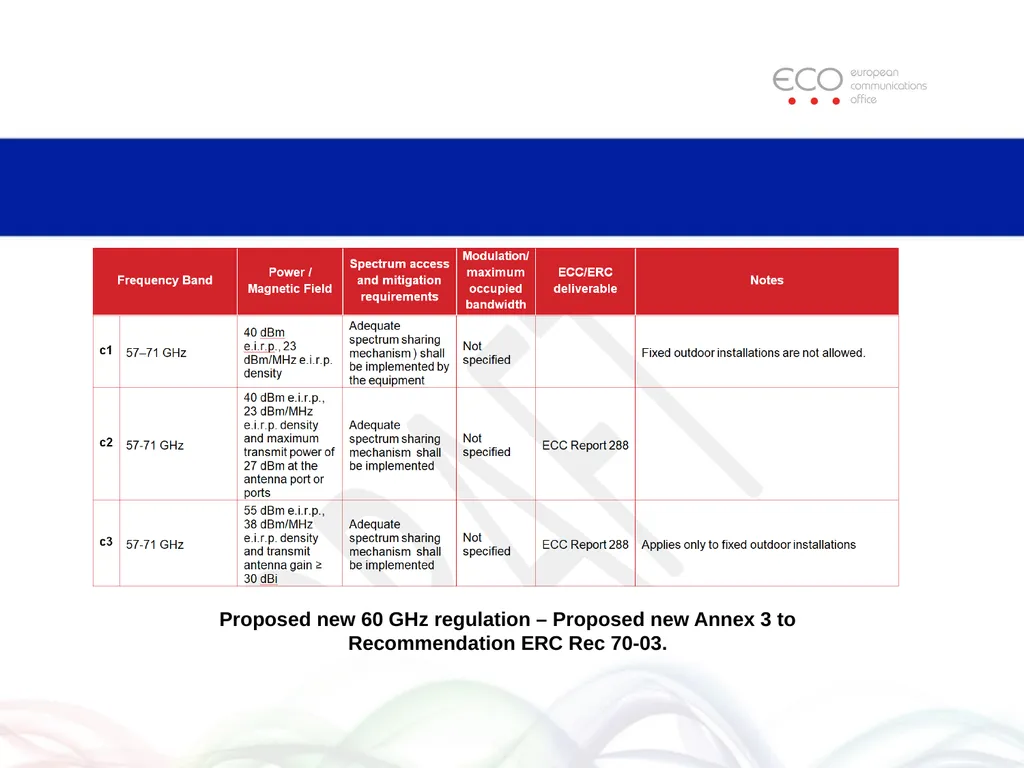
60 GHz SRD regulations at 60 GHz have existed for years
Generic SRD
Automotive (63-64 GHz)
Recent technology developments driven by
mmWave developments in Mobile
High speed WiFi
SRD-MG consulted on expanding band to 57-71 GHz. CEPT WG FM to decide 7 June 2019.<br>
10
Proposed new 60 GHz regulation – Proposed new Annex 3 to Recommendation ERC Rec 70-03.<br>
11
Bristol University trials on Broadband to trains https://www.youtube.com/watch?v=OlDOihcqJZg<br>
12
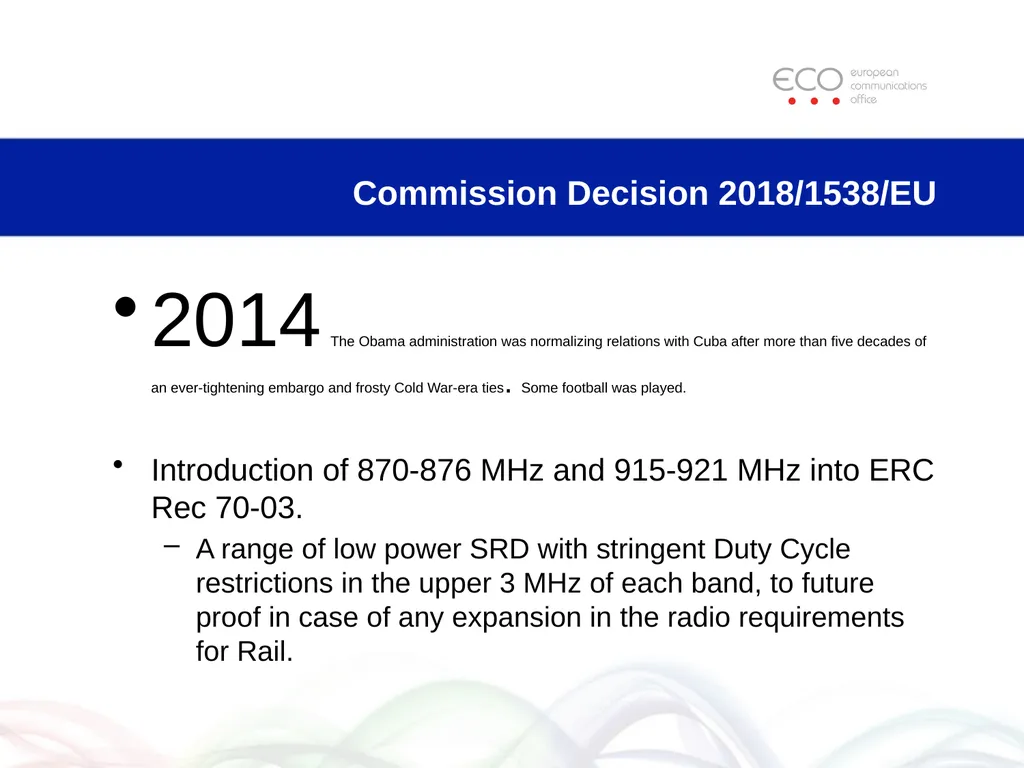
Commission Decision 2018/1538/EU 2014 The Obama administration was normalizing relations with Cuba after more than five decades of an ever-tightening embargo and frosty Cold War-era ties. Some football was played.
Introduction of 870-876 MHz and 915-921 MHz into ERC Rec 70-03.
A range of low power SRD with stringent Duty Cycle restrictions in the upper 3 MHz of each band, to future proof in case of any expansion in the radio requirements for Rail.<br>
13
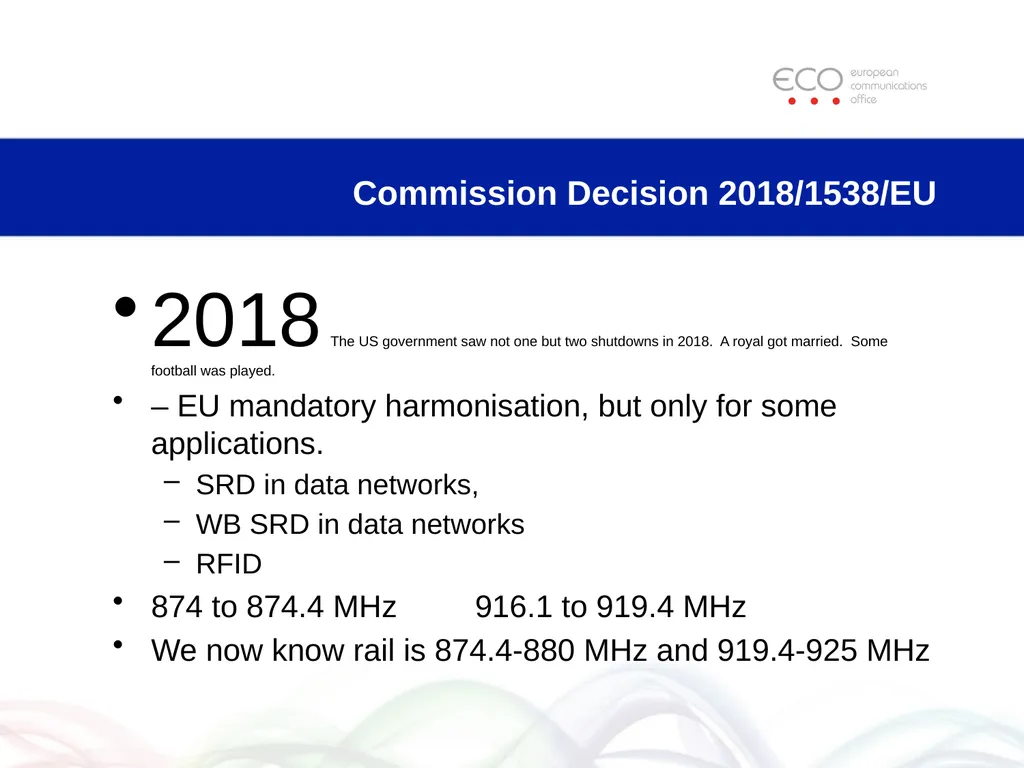
Commission Decision 2018/1538/EU 2018 The US government saw not one but two shutdowns in 2018. A royal got married. Some football was played.
– EU mandatory harmonisation, but only for some applications.
SRD in data networks,
WB SRD in data networks
RFID
874 to 874.4 MHz 916.1 to 919.4 MHz
We now know rail is 874.4-880 MHz and 919.4-925 MHz<br>
14
What the Future Holds! 2-3 May 2019 CEPT Workshop on New Spectrum Solutions for Industry Sectors
Common Themes
Connectivity is becoming increasingly important for a wide range of services and applications.
If demand for dedicated spectrum continues, there is insufficient spectrum to meet the stated needs of all industry sectors.
Demand exists across all frequency bands (VHF to mmWave) and the sweet spot varies for different sectors.<br>
15
What the Future Holds! The Way Forward
There is a need to better understand the needs of industry sectors and how these translate into spectrum requirements.
It should be considered if there are synergies across sectors, based on common radio interface requirements.
Options for spectrum sharing should be further explored and appropriate authorisation regimes should be explored.
Facilitate complementary and hybrid solutions between services and applications.
Learn from one another’s experience, especially from ongoing tests and trials.<br>
16
What the Future Holds! How important is the SRD Industry.
From the Wi-Fi industry – Worldwide, Wi-Fi generated $2 Trillion USD economic value in 2018 and rises to $3.5 Trillion in 2023.
It is clear SRD have a vital role to play in delivering “last mile” communications. Particularly indoors.
There is a real opportunity for the SRD industry to augment the Mobile industry in the delivery of communication for everyone.<br>
17
What the Future Holds! Local mesh and small cells are going to be ever more important.
One academic once said to me;- of the million times more data transferred since 19XX, maybe 50 times comes from better equipment, better coding & modulation techniques and better regulation. The other 20,000 times comes from smaller call sizes.<br>
18
What the Future Holds! From the Common Themes of the CEPT Workshop
If demand for dedicated spectrum continues, there is insufficient spectrum to meet the stated needs of all industry sectors.
Sharing technologies and the industries supporting these are clearly best placed to meet the challenges ahead for spectrum.
All large players in communications are now active in considering their spectrum needs.<br>
19
What the Future Holds! One view from our Workshop
“to meet the insatiable demand for new spectrum, regulators need to insure that only mission critical and safety of life application have exclusive use of spectrum, only as much as they need for their critical services and only where they need it.”<br>