
Economic Developments in Europe from 7th to 14th
T
Published · 19 slides · 0 views

1 / 1

Description
Economic Developments in Europe from 7th to 14th Century FEUDALISM Definition A political, economic, legal, military and cultural relationship - based on the holding of lands in fieffee and on the resulting relations between lord and
Related Topics
Share
Embed code
Download this presentation From Below
"Economic Developments in Europe from 7th to 14th" is the property of its rightful owner. Permission is granted to download and print the materials on this website for personal, non-commercial use only, and to display it on your personal computer provided you do not modify the materials and that you retain all copyright notices contained in the materials. By downloading content from our website, you accept the terms of this agreement.
Presentation Transcript
01
Economic Developments in Europe from 7th to 14th Century FEUDALISM<br>
02
Definition A political, economic, legal, military and cultural relationship - based on the holding of lands in fief/fee and on the resulting relations between lord and vassal - that served as a form of government system in the absence of a fixed government system.<br>
03
Origin Derived from the Latin word ‘feudalis’ meaning ‘fee’ signifying the ‘fief’ / ‘land’ as payment for regular military service.
18th century: Adam Smith in his book ‘Wealth of Nations’, 1776, described economic systems and used the word for the first time.
Rome: Feudalism was said to be created by emperor Charlemagne, crowned king by Pope Leo-III in 800 AD (Father of Feudalism)
England: William-I (Duke of Normandy) started the system after defeating king Harold (Anglo-Saxon) at the Battle of Hastings (14th Oct. 1066) beginning the Norman conquest of England.<br>
18th century: Adam Smith in his book ‘Wealth of Nations’, 1776, described economic systems and used the word for the first time.
Rome: Feudalism was said to be created by emperor Charlemagne, crowned king by Pope Leo-III in 800 AD (Father of Feudalism)
England: William-I (Duke of Normandy) started the system after defeating king Harold (Anglo-Saxon) at the Battle of Hastings (14th Oct. 1066) beginning the Norman conquest of England.<br>
04
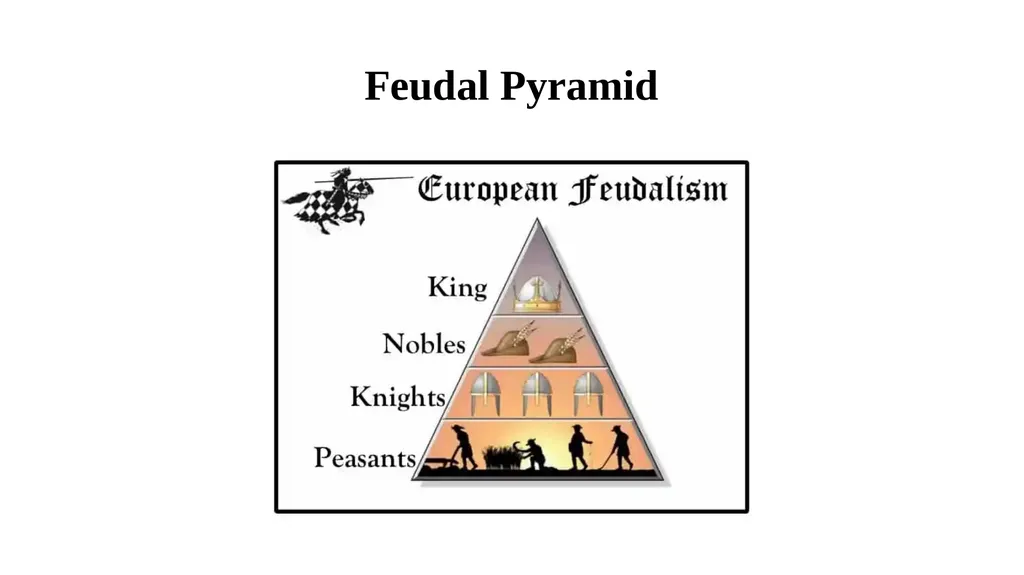
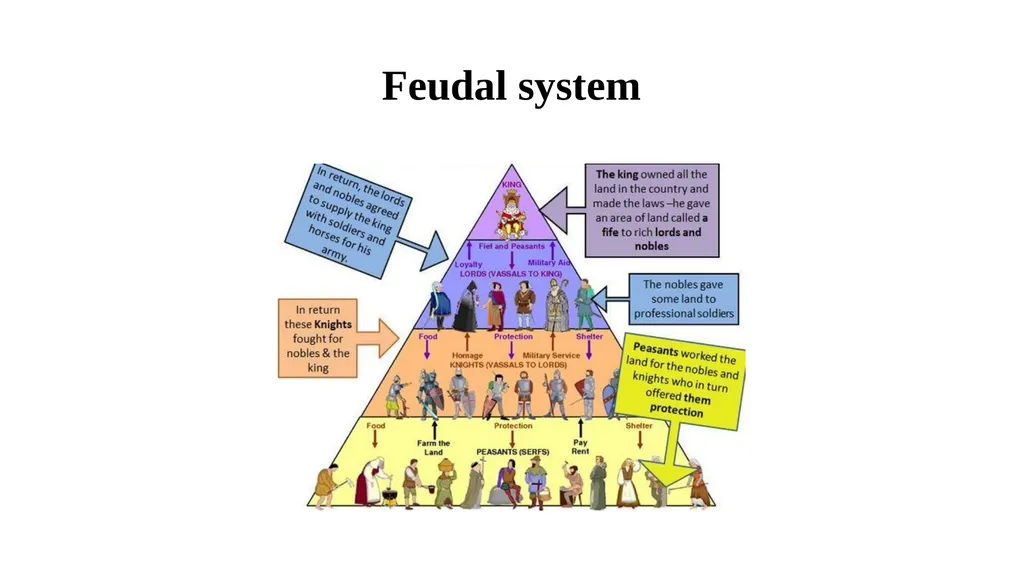
Feudal Pyramid<br>
05
Feudal system<br>
06
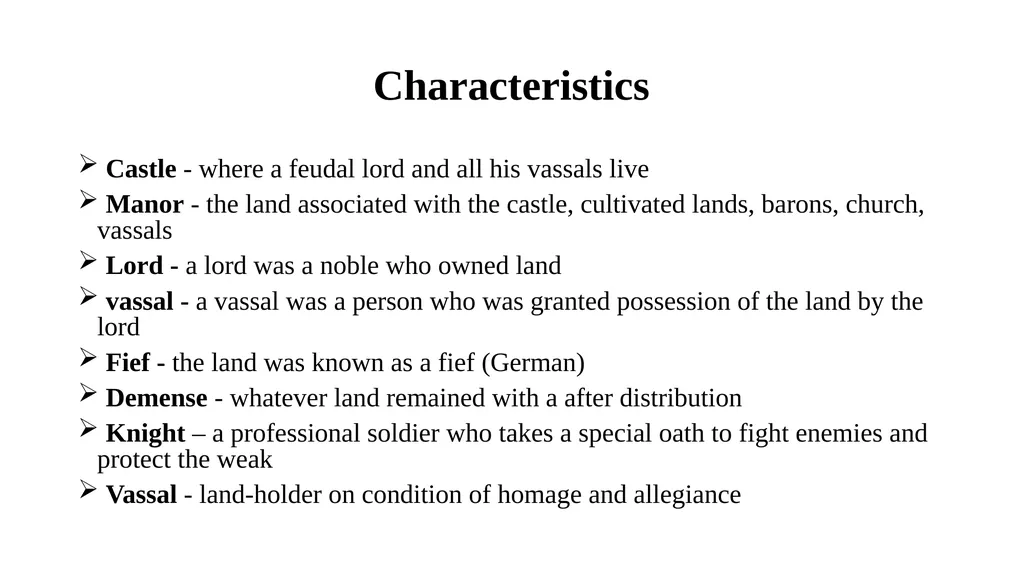
Characteristics Castle - where a feudal lord and all his vassals live
Manor - the land associated with the castle, cultivated lands, barons, church, vassals
Lord - a lord was a noble who owned land
vassal - a vassal was a person who was granted possession of the land by the lord
Fief - the land was known as a fief (German)
Demense - whatever land remained with a after distribution
Knight – a professional soldier who takes a special oath to fight enemies and protect the weak
Vassal - land-holder on condition of homage and allegiance<br>
Manor - the land associated with the castle, cultivated lands, barons, church, vassals
Lord - a lord was a noble who owned land
vassal - a vassal was a person who was granted possession of the land by the lord
Fief - the land was known as a fief (German)
Demense - whatever land remained with a after distribution
Knight – a professional soldier who takes a special oath to fight enemies and protect the weak
Vassal - land-holder on condition of homage and allegiance<br>
07
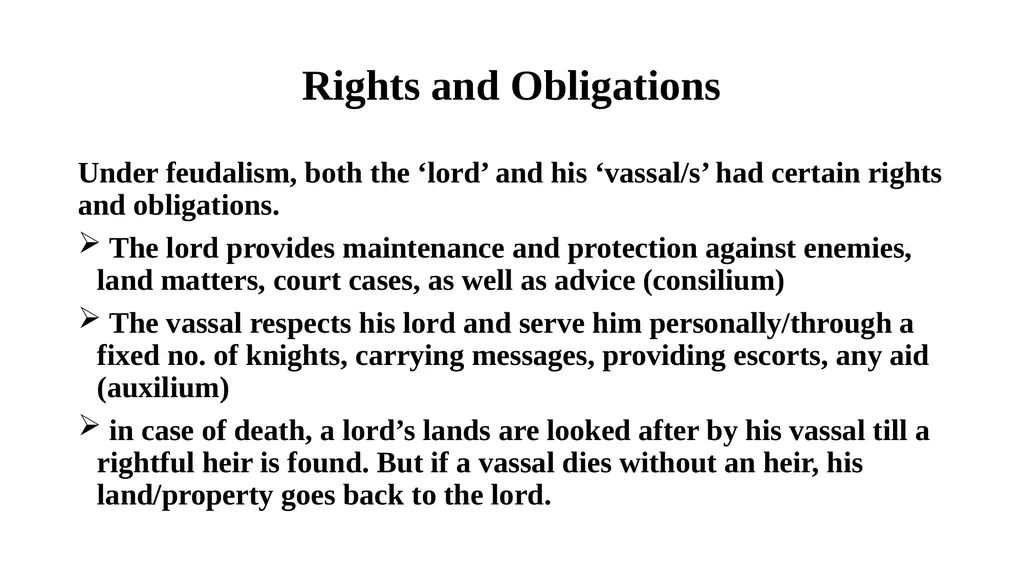
Rights and Obligations Under feudalism, both the ‘lord’ and his ‘vassal/s’ had certain rights and obligations.
The lord provides maintenance and protection against enemies, land matters, court cases, as well as advice (consilium)
The vassal respects his lord and serve him personally/through a fixed no. of knights, carrying messages, providing escorts, any aid (auxilium)
in case of death, a lord’s lands are looked after by his vassal till a rightful heir is found. But if a vassal dies without an heir, his land/property goes back to the lord.<br>
The lord provides maintenance and protection against enemies, land matters, court cases, as well as advice (consilium)
The vassal respects his lord and serve him personally/through a fixed no. of knights, carrying messages, providing escorts, any aid (auxilium)
in case of death, a lord’s lands are looked after by his vassal till a rightful heir is found. But if a vassal dies without an heir, his land/property goes back to the lord.<br>
08
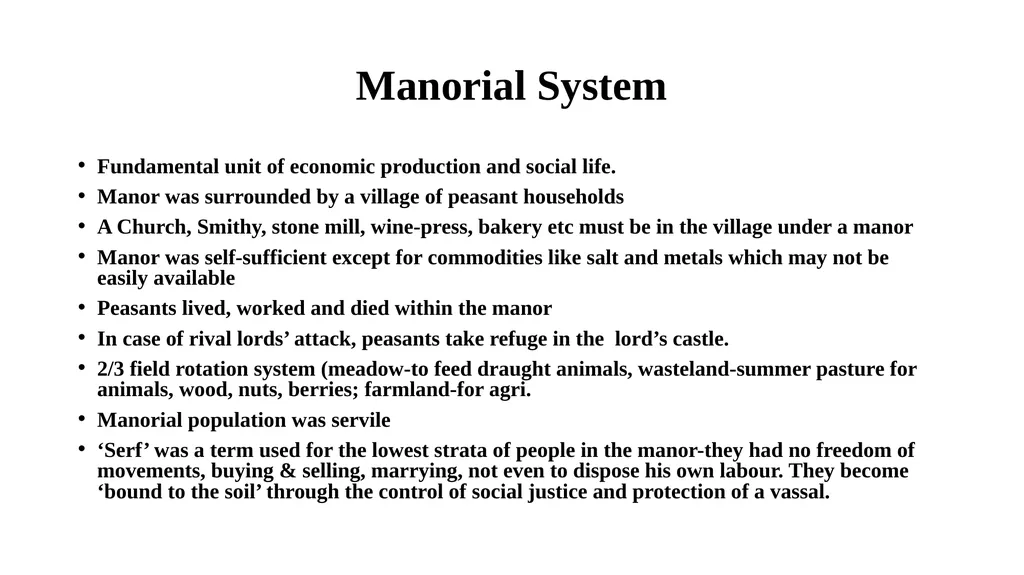
Manorial System Fundamental unit of economic production and social life.
Manor was surrounded by a village of peasant households
A Church, Smithy, stone mill, wine-press, bakery etc must be in the village under a manor
Manor was self-sufficient except for commodities like salt and metals which may not be easily available
Peasants lived, worked and died within the manor
In case of rival lords’ attack, peasants take refuge in the lord’s castle.
2/3 field rotation system (meadow-to feed draught animals, wasteland-summer pasture for animals, wood, nuts, berries; farmland-for agri.
Manorial population was servile
‘Serf’ was a term used for the lowest strata of people in the manor-they had no freedom of movements, buying & selling, marrying, not even to dispose his own labour. They become ‘bound to the soil’ through the control of social justice and protection of a vassal.<br>
Manor was surrounded by a village of peasant households
A Church, Smithy, stone mill, wine-press, bakery etc must be in the village under a manor
Manor was self-sufficient except for commodities like salt and metals which may not be easily available
Peasants lived, worked and died within the manor
In case of rival lords’ attack, peasants take refuge in the lord’s castle.
2/3 field rotation system (meadow-to feed draught animals, wasteland-summer pasture for animals, wood, nuts, berries; farmland-for agri.
Manorial population was servile
‘Serf’ was a term used for the lowest strata of people in the manor-they had no freedom of movements, buying & selling, marrying, not even to dispose his own labour. They become ‘bound to the soil’ through the control of social justice and protection of a vassal.<br>
09
Manorial System Continued...... One source of ‘feudal serfdom’ was ‘slavery of ancient world’ and the ‘Dark Ages’ (476-800/1000)
Roman land-owners parcelled out large areas of their unproductive ‘latifundia’ to tenents on payment of ‘tithes’ or ‘crops’.
Flights from invaders and crop failure led freemen to become serfs
Coercion was also a good instrument mostly used by lords
A villein/tenent had to give half a week’s labour to the lord-ploughing, making dykes, trashing, carrying etc
A lord either selects a wife for his villein or marry the daughter etc...
Freeholders pleased the lord through payment of every due and were free, but they were to conform with the laws in the manorial society<br>
Roman land-owners parcelled out large areas of their unproductive ‘latifundia’ to tenents on payment of ‘tithes’ or ‘crops’.
Flights from invaders and crop failure led freemen to become serfs
Coercion was also a good instrument mostly used by lords
A villein/tenent had to give half a week’s labour to the lord-ploughing, making dykes, trashing, carrying etc
A lord either selects a wife for his villein or marry the daughter etc...
Freeholders pleased the lord through payment of every due and were free, but they were to conform with the laws in the manorial society<br>
10
Manorial System Continued..... With time, manorial staff grew in the form of stewards and seneschals
Their role was overseers, preside in manorial courts, keep accounts, represent the lord on all occasions
Reeves (bailiff/steward/sheriff) acted as intermediaries between the villagers and the lord, organisation of rural services
Beadles (junior official in a court of justice) and Redknights/redmen served summonses and carry orders
Haywards superintended hedges, Woodward saw to pastures n wood
Sower, thrasher, plough-teams, herders etc
Growth of manorial staff indicated emerging differentiation within the manorial peasantry.<br>
Their role was overseers, preside in manorial courts, keep accounts, represent the lord on all occasions
Reeves (bailiff/steward/sheriff) acted as intermediaries between the villagers and the lord, organisation of rural services
Beadles (junior official in a court of justice) and Redknights/redmen served summonses and carry orders
Haywards superintended hedges, Woodward saw to pastures n wood
Sower, thrasher, plough-teams, herders etc
Growth of manorial staff indicated emerging differentiation within the manorial peasantry.<br>
11
Feudal Revolution Feudalism was a term invented in the 17th century
Used as a pejorative by commentators to describe any outdated/unfair law/custom
The word first appeared in the Frankish charter of 884.
Feudalism was coined during the French Revolt in 1748. 18th cent. writers of enlightenment wrote about feudalism to criticise the ancient French regime/monarchy because Enlightenment writers mock anything of the the Dark Age.
In the late 19th and early 20th centuries, John Horace Round & Frederic William Maitland (historians of medieaval Britain) where Round argued that Feudalism was imported by the Normans. Maitland contended that the fundamentals of fuedalism were already embedded in Britain. The debate still continue today.<br>
Used as a pejorative by commentators to describe any outdated/unfair law/custom
The word first appeared in the Frankish charter of 884.
Feudalism was coined during the French Revolt in 1748. 18th cent. writers of enlightenment wrote about feudalism to criticise the ancient French regime/monarchy because Enlightenment writers mock anything of the the Dark Age.
In the late 19th and early 20th centuries, John Horace Round & Frederic William Maitland (historians of medieaval Britain) where Round argued that Feudalism was imported by the Normans. Maitland contended that the fundamentals of fuedalism were already embedded in Britain. The debate still continue today.<br>
12
Feudal Revolutions In the 20th cent., historian Francois-Louis Ganshof defined feudalism from a anarrow military and legal perspective saying that feudal relationships existed only within the medieaval nobility itself (Feudalism 1944). Gunshof’s definition: when a lord granted a fief to a vassal, the vassal provided military service in return.
Marc Bloch, most influential 20th cent medieaval historian in (Feudal Society) conceived feudalism as a ‘type of society that was not limited to solely to the nobility, he recognised there was a hierarchical relationship between lords and vassals, but he also saw a similar relationship between lords and peasants. His consideartion of peasants as parts of the feudal system kept Bloch a part from his peers. Just as the vassal performed military service for fief, the peasant performed physical labour in return for protection. Both are a form of feudal relationship.<br>
Marc Bloch, most influential 20th cent medieaval historian in (Feudal Society) conceived feudalism as a ‘type of society that was not limited to solely to the nobility, he recognised there was a hierarchical relationship between lords and vassals, but he also saw a similar relationship between lords and peasants. His consideartion of peasants as parts of the feudal system kept Bloch a part from his peers. Just as the vassal performed military service for fief, the peasant performed physical labour in return for protection. Both are a form of feudal relationship.<br>
13
Position of Women in the Feudal Economy Vast difference between men and women in the feudal society
Role of women was divided in terms of class
They occupied all subordinate roles in the family
Noble women had time for luxury while peasant women performed a great deal of labour
Noble women were educated but very few played roles in the estate
But the entire ‘legal framework’ of feudalism ignored women
Vassalage, fiefdom etc had no mention about women.
They could become ‘nuns’ but not priests, could be labelled as ‘witches’
Some granted ‘sainthood’ but not recognised as ‘persons’ in their own rights
When fiefs became hereditary, some women got hereditary rights but as an exception, not a norm
Women had shorter life span. Their place in feudal society was merely ‘labour’. They were invisible!<br>
Role of women was divided in terms of class
They occupied all subordinate roles in the family
Noble women had time for luxury while peasant women performed a great deal of labour
Noble women were educated but very few played roles in the estate
But the entire ‘legal framework’ of feudalism ignored women
Vassalage, fiefdom etc had no mention about women.
They could become ‘nuns’ but not priests, could be labelled as ‘witches’
Some granted ‘sainthood’ but not recognised as ‘persons’ in their own rights
When fiefs became hereditary, some women got hereditary rights but as an exception, not a norm
Women had shorter life span. Their place in feudal society was merely ‘labour’. They were invisible!<br>
14
Feudal Technology Lynn Townsend White Jr (American Historian, Prof. of Medieaval History, Pfizer Award for Medieaval technology) made an impt. intervention in the growing debate on feudalism, esp. on technology in 1962.
According to him, the larger medieaval culture of technology was rooted in Christian theological traditions which encouraged the production of labour-saving machines.
Certain technological inventions for medieaval agriculture were the use of Iron plough for tilling, stiff harness, crank in hand querns and rotary grindstones, water-mill for mechanical power, marling for soil improvement, 3 field system for crop rotation.
Northern wheel plough was equiped with coulter, horizontal share and moldboard
These greatly increased production by making the tillage of rich, heavy, badly drained river bottom soils possible
It saved labour by making cross-ploughing superfluous compared to the lighter Mediterrannean plough.<br>
According to him, the larger medieaval culture of technology was rooted in Christian theological traditions which encouraged the production of labour-saving machines.
Certain technological inventions for medieaval agriculture were the use of Iron plough for tilling, stiff harness, crank in hand querns and rotary grindstones, water-mill for mechanical power, marling for soil improvement, 3 field system for crop rotation.
Northern wheel plough was equiped with coulter, horizontal share and moldboard
These greatly increased production by making the tillage of rich, heavy, badly drained river bottom soils possible
It saved labour by making cross-ploughing superfluous compared to the lighter Mediterrannean plough.<br>
15
Feudal Technology Continued...... As this heavy machine/plough needed pooling ploughing power, peasants pooled their oxen together, thus laying the basis for manorial system-the medieaval co-operative agricultural community.
In the late 8th century, the heavy plough was supplemented by the three field system and the ox was replaced by a horse.
The invention of the stirrup and horse-shoe shaped the military organisation of feudal society, claimed White. (Carolingian Franks introduced these in the 8th century.)
Harness and new horse-collar were introduced in the late 9th and early 10th century.<br>
In the late 8th century, the heavy plough was supplemented by the three field system and the ox was replaced by a horse.
The invention of the stirrup and horse-shoe shaped the military organisation of feudal society, claimed White. (Carolingian Franks introduced these in the 8th century.)
Harness and new horse-collar were introduced in the late 9th and early 10th century.<br>
16
Henri Pirenne’s Thesis on
Rise of Feudalism in Europe Henri Pirenne (23.12.1862-25.10.1935) Belgian Historian of Medieaval History. (Medieaval Cities:Their Origins and the Revival of Trade, 1927) and (Mohammed and Charlemagne, 1937)
His thesis notes that in the 9th cent, long distance trade was at a low ebb and the only settlements not purely agricultural were the ecclesiastical, military and administrative centers that served the feudal ruling classes
When trade revived in the late 10th & 11th centuries, merchants and artisans came to the centers where trade and manufacture were concentrated, They became the “new men” living outside the feudal structure and in the peripheries of the established order. The feudal core remained static and inert.
When the developing merchant class became strong enough, it threw off feudal obligations, formed a bourgeois (middle class) mercantile community in whose hands economic and political power came to concentrate.<br>
His thesis notes that in the 9th cent, long distance trade was at a low ebb and the only settlements not purely agricultural were the ecclesiastical, military and administrative centers that served the feudal ruling classes
When trade revived in the late 10th & 11th centuries, merchants and artisans came to the centers where trade and manufacture were concentrated, They became the “new men” living outside the feudal structure and in the peripheries of the established order. The feudal core remained static and inert.
When the developing merchant class became strong enough, it threw off feudal obligations, formed a bourgeois (middle class) mercantile community in whose hands economic and political power came to concentrate.<br>
17
Pirenne’s Thesis Contd... Traditionally, historians (Edward Gibbon put forward in the 18th cent), have dated the Middle Ages from the fall of the Roman empire (5th cent). Pirenne challenged this notion. He pointed out that the economy of the Roman Mediterrannean economy continued even after barbarian attacks and the fall of Rome.
Rome’s way of doing things did not suddenly change after its fall in 476. The barbarians did not destroy the custom/pol/eco.system of Rome, but tried to preserve it by continuing the Feudal system.
According to him, the real break in Roman history occurred in the 8th cent. due to Arab expansion. Islamic conquest of today’s Turkey, Syria, Palestine, North Africa, Spain and Portugal raptured economic ties to western Europe which cut off the region from trade and turned it into a stagnant backwater.
Wealth flowed out in the form of raw materials. This resulted in a steady decline and impoverishment. Till the time of Charlemagne, Western Europe became entirely agrarian with no long distance trade. It promoted the growth of feudalism.<br>
Rome’s way of doing things did not suddenly change after its fall in 476. The barbarians did not destroy the custom/pol/eco.system of Rome, but tried to preserve it by continuing the Feudal system.
According to him, the real break in Roman history occurred in the 8th cent. due to Arab expansion. Islamic conquest of today’s Turkey, Syria, Palestine, North Africa, Spain and Portugal raptured economic ties to western Europe which cut off the region from trade and turned it into a stagnant backwater.
Wealth flowed out in the form of raw materials. This resulted in a steady decline and impoverishment. Till the time of Charlemagne, Western Europe became entirely agrarian with no long distance trade. It promoted the growth of feudalism.<br>
18
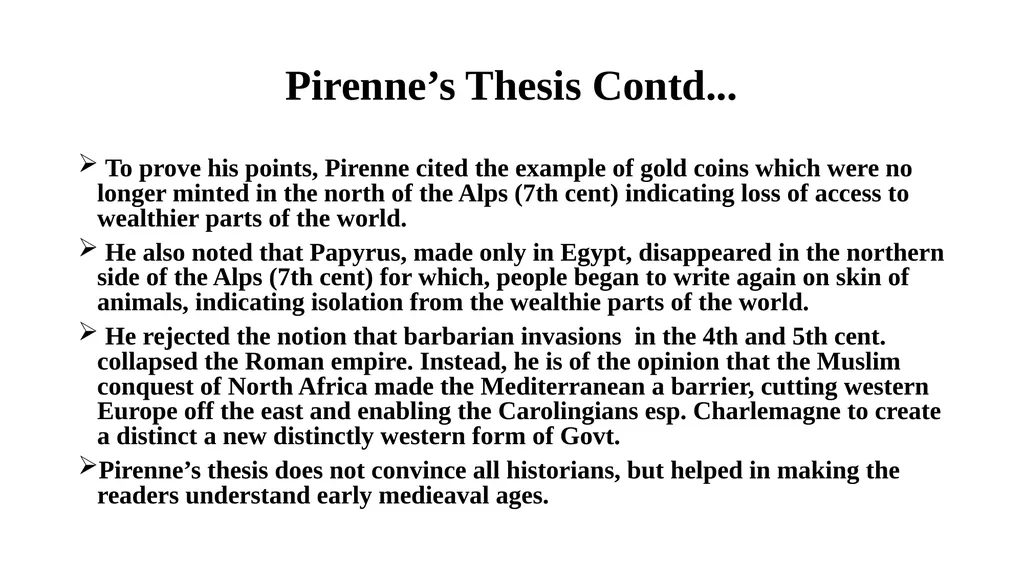
Pirenne’s Thesis Contd... To prove his points, Pirenne cited the example of gold coins which were no longer minted in the north of the Alps (7th cent) indicating loss of access to wealthier parts of the world.
He also noted that Papyrus, made only in Egypt, disappeared in the northern side of the Alps (7th cent) for which, people began to write again on skin of animals, indicating isolation from the wealthie parts of the world.
He rejected the notion that barbarian invasions in the 4th and 5th cent. collapsed the Roman empire. Instead, he is of the opinion that the Muslim conquest of North Africa made the Mediterranean a barrier, cutting western Europe off the east and enabling the Carolingians esp. Charlemagne to create a distinct a new distinctly western form of Govt.
Pirenne’s thesis does not convince all historians, but helped in making the readers understand early medieaval ages.<br>
He also noted that Papyrus, made only in Egypt, disappeared in the northern side of the Alps (7th cent) for which, people began to write again on skin of animals, indicating isolation from the wealthie parts of the world.
He rejected the notion that barbarian invasions in the 4th and 5th cent. collapsed the Roman empire. Instead, he is of the opinion that the Muslim conquest of North Africa made the Mediterranean a barrier, cutting western Europe off the east and enabling the Carolingians esp. Charlemagne to create a distinct a new distinctly western form of Govt.
Pirenne’s thesis does not convince all historians, but helped in making the readers understand early medieaval ages.<br>
19
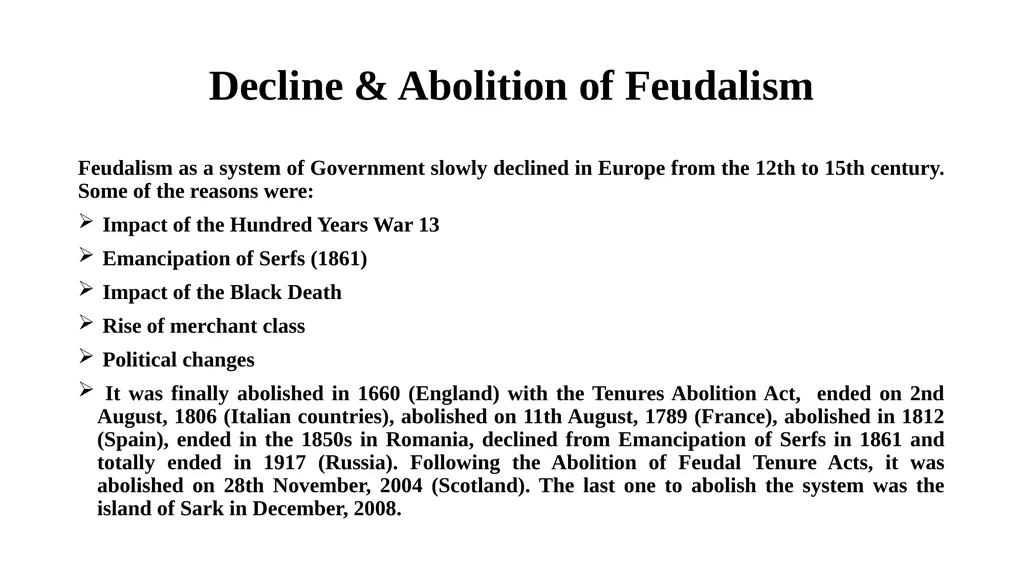
Decline & Abolition of Feudalism Feudalism as a system of Government slowly declined in Europe from the 12th to 15th century. Some of the reasons were:
Impact of the Hundred Years War 13
Emancipation of Serfs (1861)
Impact of the Black Death
Rise of merchant class
Political changes
It was finally abolished in 1660 (England) with the Tenures Abolition Act, ended on 2nd August, 1806 (Italian countries), abolished on 11th August, 1789 (France), abolished in 1812 (Spain), ended in the 1850s in Romania, declined from Emancipation of Serfs in 1861 and totally ended in 1917 (Russia). Following the Abolition of Feudal Tenure Acts, it was abolished on 28th November, 2004 (Scotland). The last one to abolish the system was the island of Sark in December, 2008.<br>
Impact of the Hundred Years War 13
Emancipation of Serfs (1861)
Impact of the Black Death
Rise of merchant class
Political changes
It was finally abolished in 1660 (England) with the Tenures Abolition Act, ended on 2nd August, 1806 (Italian countries), abolished on 11th August, 1789 (France), abolished in 1812 (Spain), ended in the 1850s in Romania, declined from Emancipation of Serfs in 1861 and totally ended in 1917 (Russia). Following the Abolition of Feudal Tenure Acts, it was abolished on 28th November, 2004 (Scotland). The last one to abolish the system was the island of Sark in December, 2008.<br>