
EDUCATION & ‘the FUTURE’ – exploring a problematic
TG
Published · 47 slides · 0 views
1 / 1


Description
EDUCATION the FUTURE exploring a problematic relationship Professor Keri Facer, Graduate School of Education, University of Bristol, AHRC Leadership Fellow for the Connected Communities Programme kerileef ahrcconect The Future is
Related Topics
Share
Embed code
Download this presentation From Below
"EDUCATION & ‘the FUTURE’ – exploring a problematic" is the property of its rightful owner. Permission is granted to download and print the materials on this website for personal, non-commercial use only, and to display it on your personal computer provided you do not modify the materials and that you retain all copyright notices contained in the materials. By downloading content from our website, you accept the terms of this agreement.
Presentation Transcript
01
EDUCATION & ‘the FUTURE’ – exploring a problematic relationship Professor Keri Facer, Graduate School of Education, University of Bristol,
AHRC Leadership Fellow for the Connected Communities Programme
@kerileef @ahrcconect<br>
AHRC Leadership Fellow for the Connected Communities Programme
@kerileef @ahrcconect<br>
02
‘The Future’ is everywhere in education Training the workforce of tomorrow with the high schools of today is like trying to teach kids about today’s computers on a 50-year-old mainframe (Gates, 2005)
So make no mistake. Our future is on the line. The nation that out-educates us today is going to out-compete us tomorrow. (Obama, 2010)
We can’t go on like this. If we carry on excusing this kind of failure, we face a future of where [sic] our most stubborn social problems get worse, not better, and where our economy gets left behind, as countries out-educate and out-compete us. So nothing else will do: we need big change in the way we do education in our country. (Cameron, 2010)
You have to fulfil your potential. What do you want to be when you grow up? Where’s that going to get you in the long run? This is really important for your future!<br>
So make no mistake. Our future is on the line. The nation that out-educates us today is going to out-compete us tomorrow. (Obama, 2010)
We can’t go on like this. If we carry on excusing this kind of failure, we face a future of where [sic] our most stubborn social problems get worse, not better, and where our economy gets left behind, as countries out-educate and out-compete us. So nothing else will do: we need big change in the way we do education in our country. (Cameron, 2010)
You have to fulfil your potential. What do you want to be when you grow up? Where’s that going to get you in the long run? This is really important for your future!<br>
03
The educational contract:
Invest in education now and the student (and society) will be better in future<br>
Invest in education now and the student (and society) will be better in future<br>
04
So – what sorts of futures do we tend to imagine education needs to prepare for?<br>
05
The Beyond Current Horizons Project… …
Applied Foresight Process - insights into technology change 2035 and beyond.. And implications for education
Drawing on expert insight – over 85 academics from UK, Europe, US
Drawing on public and student insights – over 1500 young people, publics
Exploring – preferable, possible and probable futures (Wendell Bell)
Core questions – what are the big trends, critical uncertainties, what different scenarios might these lead to?<br>
Applied Foresight Process - insights into technology change 2035 and beyond.. And implications for education
Drawing on expert insight – over 85 academics from UK, Europe, US
Drawing on public and student insights – over 1500 young people, publics
Exploring – preferable, possible and probable futures (Wendell Bell)
Core questions – what are the big trends, critical uncertainties, what different scenarios might these lead to?<br>
06
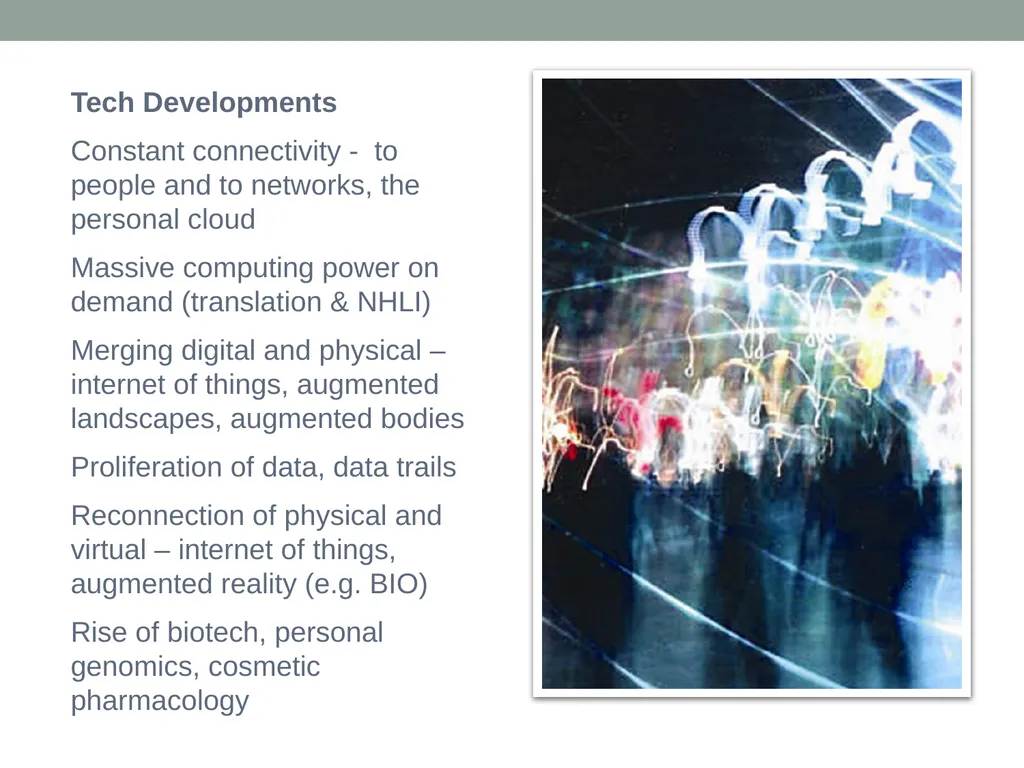
Tech Developments
Constant connectivity - to people and to networks, the personal cloud
Massive computing power on demand (translation & NHLI)
Merging digital and physical – internet of things, augmented landscapes, augmented bodies
Proliferation of data, data trails
Reconnection of physical and virtual – internet of things, augmented reality (e.g. BIO)
Rise of biotech, personal genomics, cosmetic pharmacology<br>
Constant connectivity - to people and to networks, the personal cloud
Massive computing power on demand (translation & NHLI)
Merging digital and physical – internet of things, augmented landscapes, augmented bodies
Proliferation of data, data trails
Reconnection of physical and virtual – internet of things, augmented reality (e.g. BIO)
Rise of biotech, personal genomics, cosmetic pharmacology<br>
07
Rise of biotech – personal genomes, bespoke medicine, cosmetic pharmacology
When asked whether healthy children under the age of 16 should be restricted from taking these drugs, unsurprisingly, most respondents (86%) said that they should. But one-third of respondents said they would feel pressure to give cognition-enhancing drugs to their children if other children at school were taking them.
Nature, 2009<br>
When asked whether healthy children under the age of 16 should be restricted from taking these drugs, unsurprisingly, most respondents (86%) said that they should. But one-third of respondents said they would feel pressure to give cognition-enhancing drugs to their children if other children at school were taking them.
Nature, 2009<br>
08
Who ‘is’ the student in education – what are their ‘edges’? What happens when students are augmented?
What conception of ‘individual’ or ‘agent’ are we working with in education?<br>
What conception of ‘individual’ or ‘agent’ are we working with in education?<br>
09
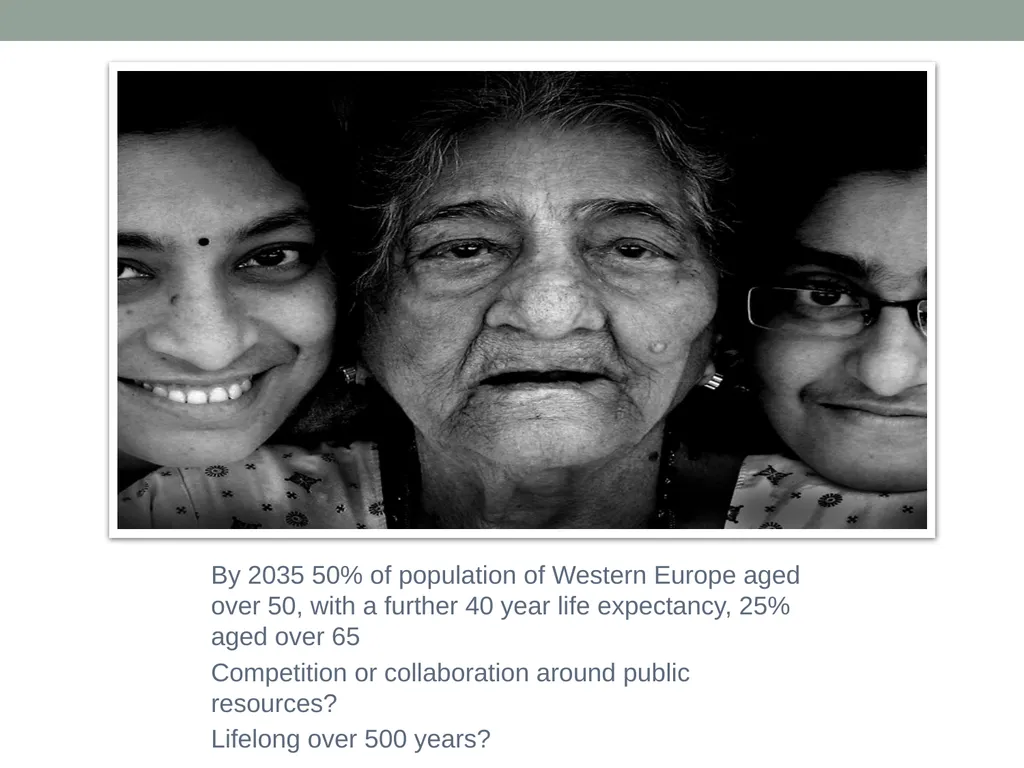
By 2035 50% of population of Western Europe aged over 50, with a further 40 year life expectancy, 25% aged over 65
Competition or collaboration around public resources?
Lifelong over 500 years?<br>
Competition or collaboration around public resources?
Lifelong over 500 years?<br>
10
Where should educational resources be invested?
In early years, in universities, lifelong?
UK part time education has dropped by significant % in last 5 years – but if demographic trends continue, we will need to think about educational institutions that are capable of adapting to the needs and interests and working patterns of much older adults<br>
In early years, in universities, lifelong?
UK part time education has dropped by significant % in last 5 years – but if demographic trends continue, we will need to think about educational institutions that are capable of adapting to the needs and interests and working patterns of much older adults<br>
11
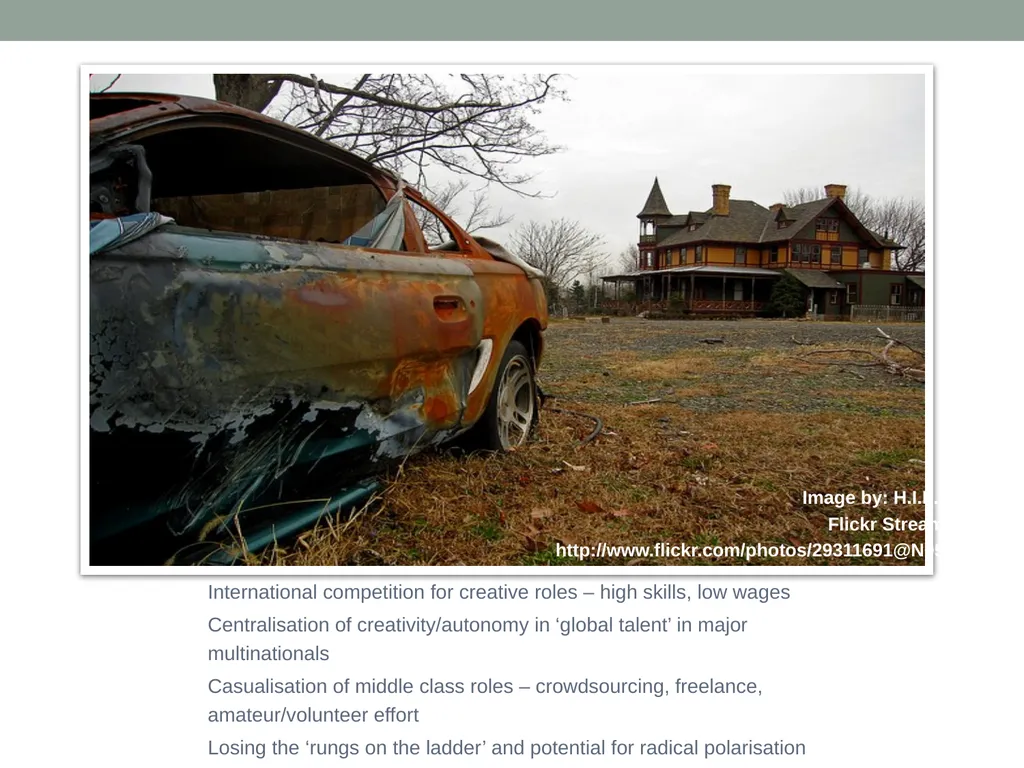
International competition for creative roles – high skills, low wages
Centralisation of creativity/autonomy in ‘global talent’ in major multinationals
Casualisation of middle class roles – crowdsourcing, freelance, amateur/volunteer effort
Losing the ‘rungs on the ladder’ and potential for radical polarisation Image by: H.I.L.T
Flickr Stream
http://www.flickr.com/photos/29311691@N05/<br>
Centralisation of creativity/autonomy in ‘global talent’ in major multinationals
Casualisation of middle class roles – crowdsourcing, freelance, amateur/volunteer effort
Losing the ‘rungs on the ladder’ and potential for radical polarisation Image by: H.I.L.T
Flickr Stream
http://www.flickr.com/photos/29311691@N05/<br>
12
What does ‘economic resilience’ actually look like for people today?
Do we need to get beyond a reliance on ‘jobs’ towards a recognition of the other factors that make for resilience?
Communities
Family and home care
Local economies able to withstand global shocks?
What would an education system look like that operated with a concept of interdependent economic resilience?<br>
Do we need to get beyond a reliance on ‘jobs’ towards a recognition of the other factors that make for resilience?
Communities
Family and home care
Local economies able to withstand global shocks?
What would an education system look like that operated with a concept of interdependent economic resilience?<br>
13
Missing from these analyses Radical positive transformation - the possibility that things might work out in wonderful ways… what happens when free energy from solar is realised?
Significant political breakdown of existing governmental structures – e.g. future of europe
Rise of state/faith structures
Breakdown as a consequence of climate/conflict – and mass migration<br>
Significant political breakdown of existing governmental structures – e.g. future of europe
Rise of state/faith structures
Breakdown as a consequence of climate/conflict – and mass migration<br>
14
So… what are the ethics of telling stories of the future in education if these stories are always partial?<br>
15
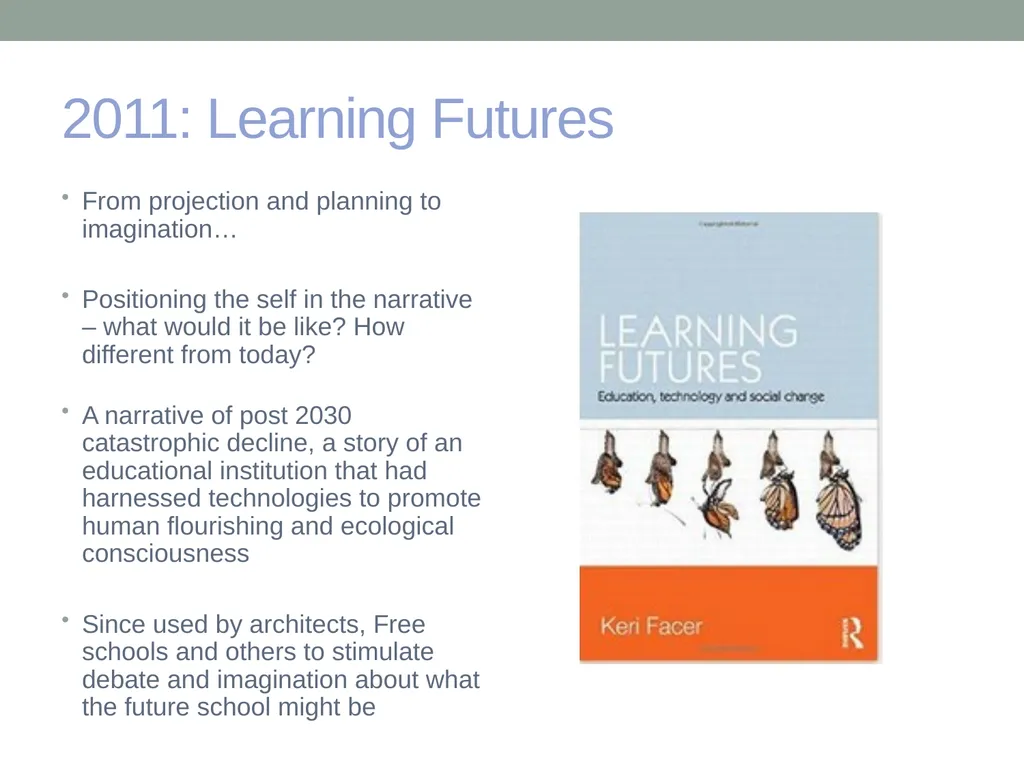
2011: Learning Futures From projection and planning to imagination…
Positioning the self in the narrative – what would it be like? How different from today?
A narrative of post 2030 catastrophic decline, a story of an educational institution that had harnessed technologies to promote human flourishing and ecological consciousness
Since used by architects, Free schools and others to stimulate debate and imagination about what the future school might be<br>
Positioning the self in the narrative – what would it be like? How different from today?
A narrative of post 2030 catastrophic decline, a story of an educational institution that had harnessed technologies to promote human flourishing and ecological consciousness
Since used by architects, Free schools and others to stimulate debate and imagination about what the future school might be<br>
16
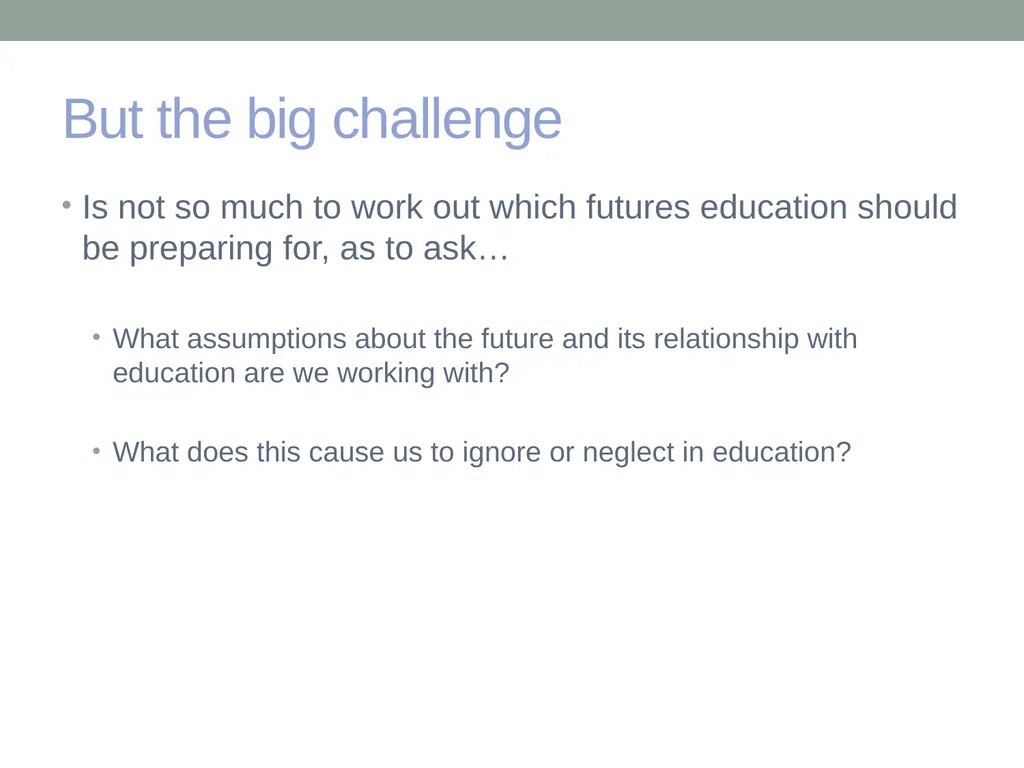
But the big challenge Is not so much to work out which futures education should be preparing for, as to ask…
What assumptions about the future and its relationship with education are we working with?
What does this cause us to ignore or neglect in education?<br>
What assumptions about the future and its relationship with education are we working with?
What does this cause us to ignore or neglect in education?<br>
17
Dominant orientations toward the future in education<br>
18
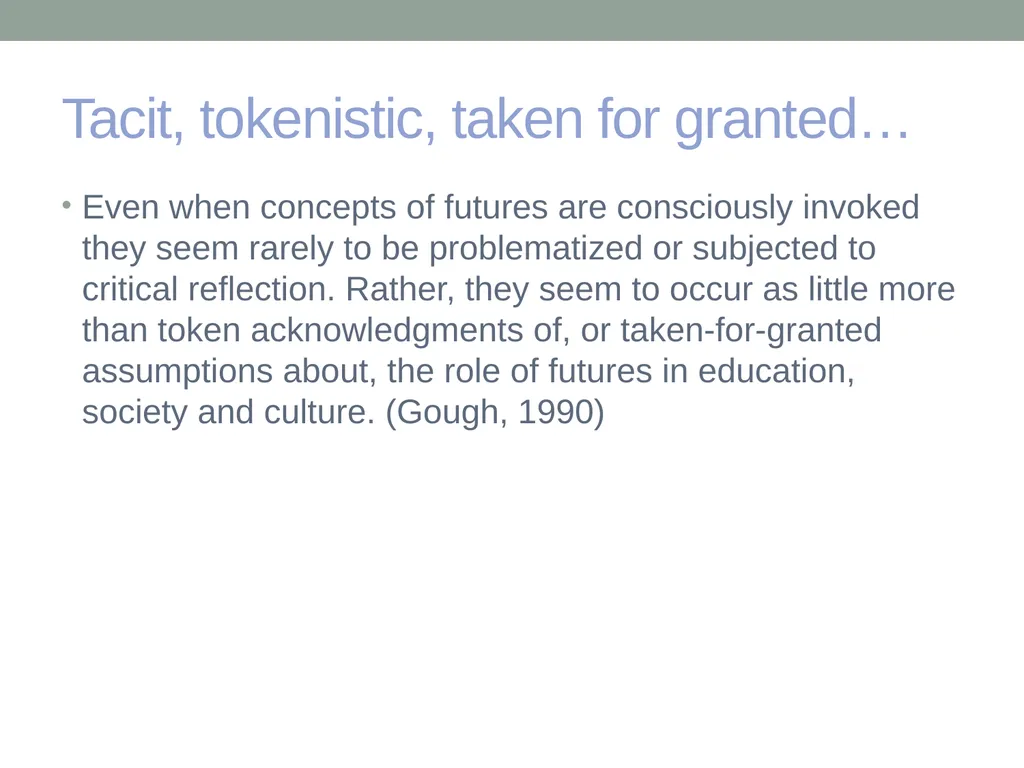
Tacit, tokenistic, taken for granted… Even when concepts of futures are consciously invoked they seem rarely to be problematized or subjected to critical reflection. Rather, they seem to occur as little more than token acknowledgments of, or taken-for-granted assumptions about, the role of futures in education, society and culture. (Gough, 1990)<br>
19
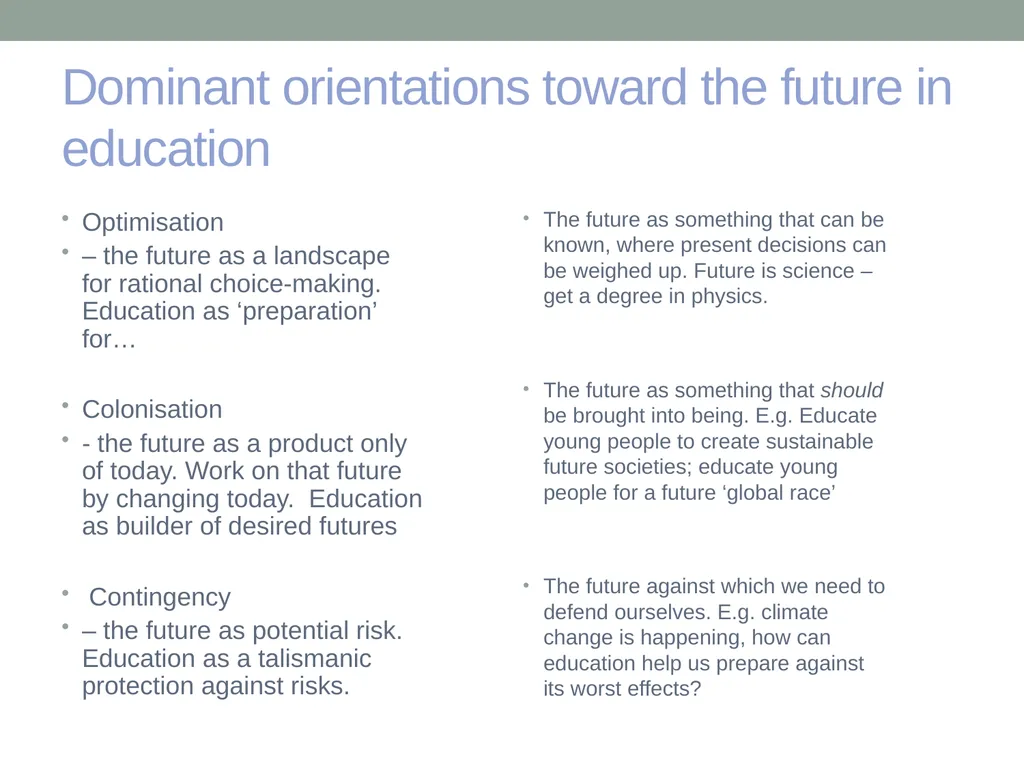
Dominant orientations toward the future in education Optimisation
– the future as a landscape for rational choice-making. Education as ‘preparation’ for…
Colonisation
- the future as a product only of today. Work on that future by changing today. Education as builder of desired futures
Contingency
– the future as potential risk. Education as a talismanic protection against risks. The future as something that can be known, where present decisions can be weighed up. Future is science – get a degree in physics.
The future as something that should be brought into being. E.g. Educate young people to create sustainable future societies; educate young people for a future ‘global race’
The future against which we need to defend ourselves. E.g. climate change is happening, how can education help us prepare against its worst effects?<br>
– the future as a landscape for rational choice-making. Education as ‘preparation’ for…
Colonisation
- the future as a product only of today. Work on that future by changing today. Education as builder of desired futures
Contingency
– the future as potential risk. Education as a talismanic protection against risks. The future as something that can be known, where present decisions can be weighed up. Future is science – get a degree in physics.
The future as something that should be brought into being. E.g. Educate young people to create sustainable future societies; educate young people for a future ‘global race’
The future against which we need to defend ourselves. E.g. climate change is happening, how can education help us prepare against its worst effects?<br>
20
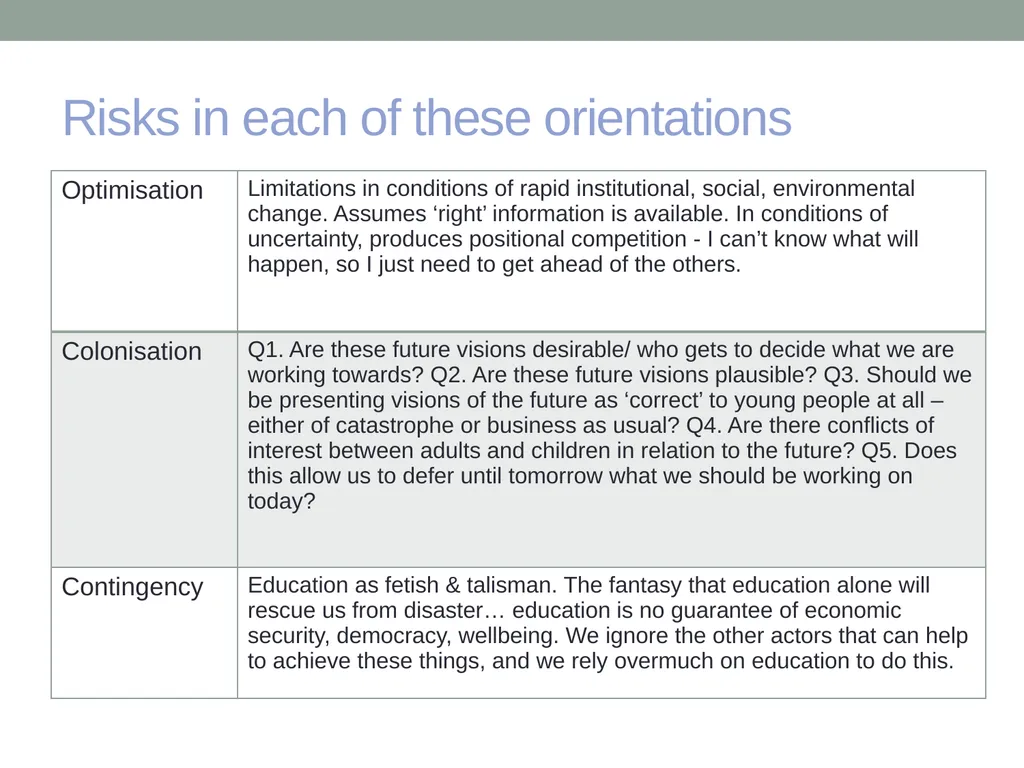
Risks in each of these orientations<br>
21
Alternative perspectives<br>
22
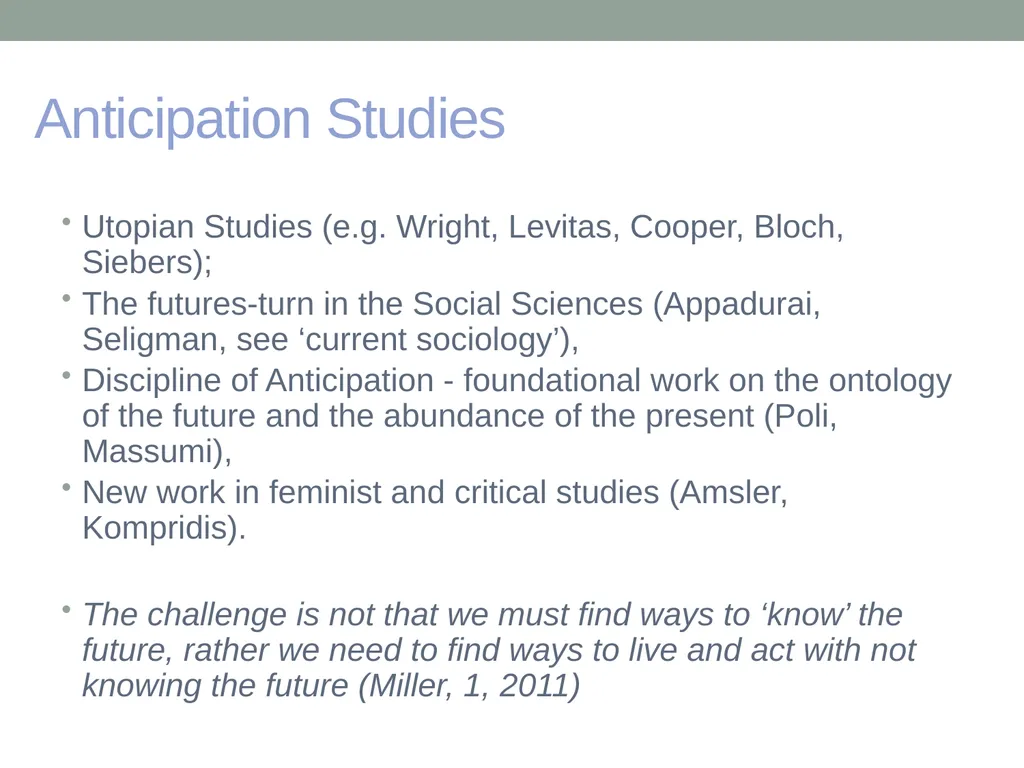
Anticipation Studies Utopian Studies (e.g. Wright, Levitas, Cooper, Bloch, Siebers);
The futures-turn in the Social Sciences (Appadurai, Seligman, see ‘current sociology’),
Discipline of Anticipation - foundational work on the ontology of the future and the abundance of the present (Poli, Massumi),
New work in feminist and critical studies (Amsler, Kompridis).
The challenge is not that we must find ways to ‘know’ the future, rather we need to find ways to live and act with not knowing the future (Miller, 1, 2011)<br>
The futures-turn in the Social Sciences (Appadurai, Seligman, see ‘current sociology’),
Discipline of Anticipation - foundational work on the ontology of the future and the abundance of the present (Poli, Massumi),
New work in feminist and critical studies (Amsler, Kompridis).
The challenge is not that we must find ways to ‘know’ the future, rather we need to find ways to live and act with not knowing the future (Miller, 1, 2011)<br>
23
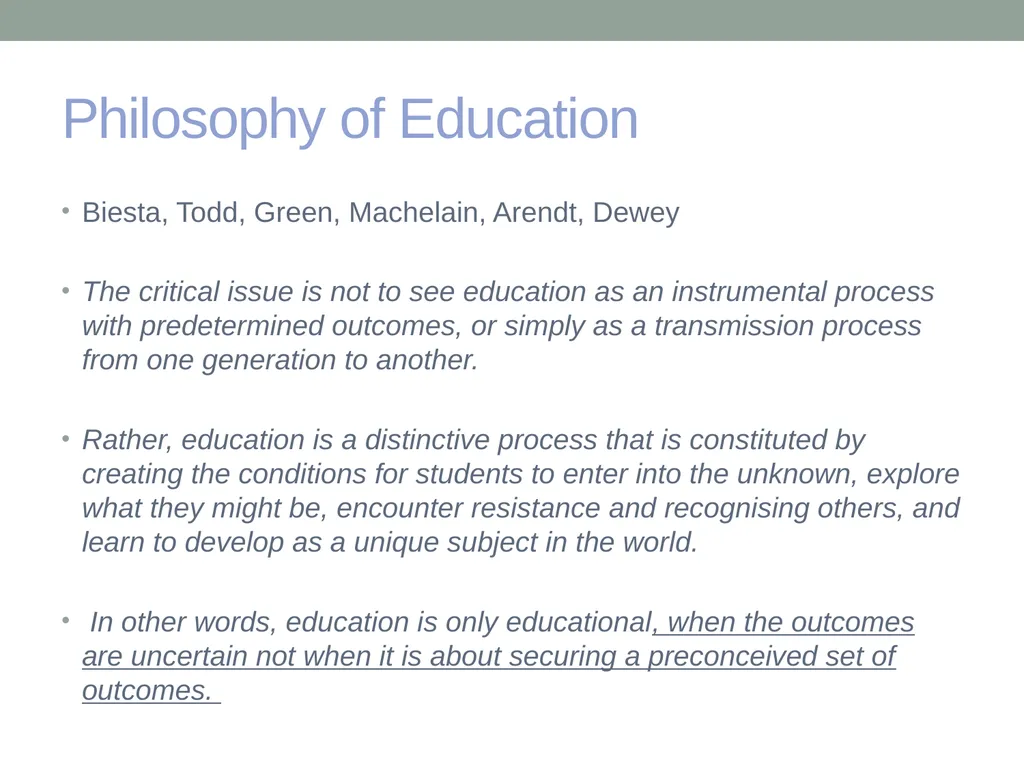
Philosophy of Education Biesta, Todd, Green, Machelain, Arendt, Dewey
The critical issue is not to see education as an instrumental process with predetermined outcomes, or simply as a transmission process from one generation to another.
Rather, education is a distinctive process that is constituted by creating the conditions for students to enter into the unknown, explore what they might be, encounter resistance and recognising others, and learn to develop as a unique subject in the world.
In other words, education is only educational, when the outcomes are uncertain not when it is about securing a preconceived set of outcomes.<br>
The critical issue is not to see education as an instrumental process with predetermined outcomes, or simply as a transmission process from one generation to another.
Rather, education is a distinctive process that is constituted by creating the conditions for students to enter into the unknown, explore what they might be, encounter resistance and recognising others, and learn to develop as a unique subject in the world.
In other words, education is only educational, when the outcomes are uncertain not when it is about securing a preconceived set of outcomes.<br>
24
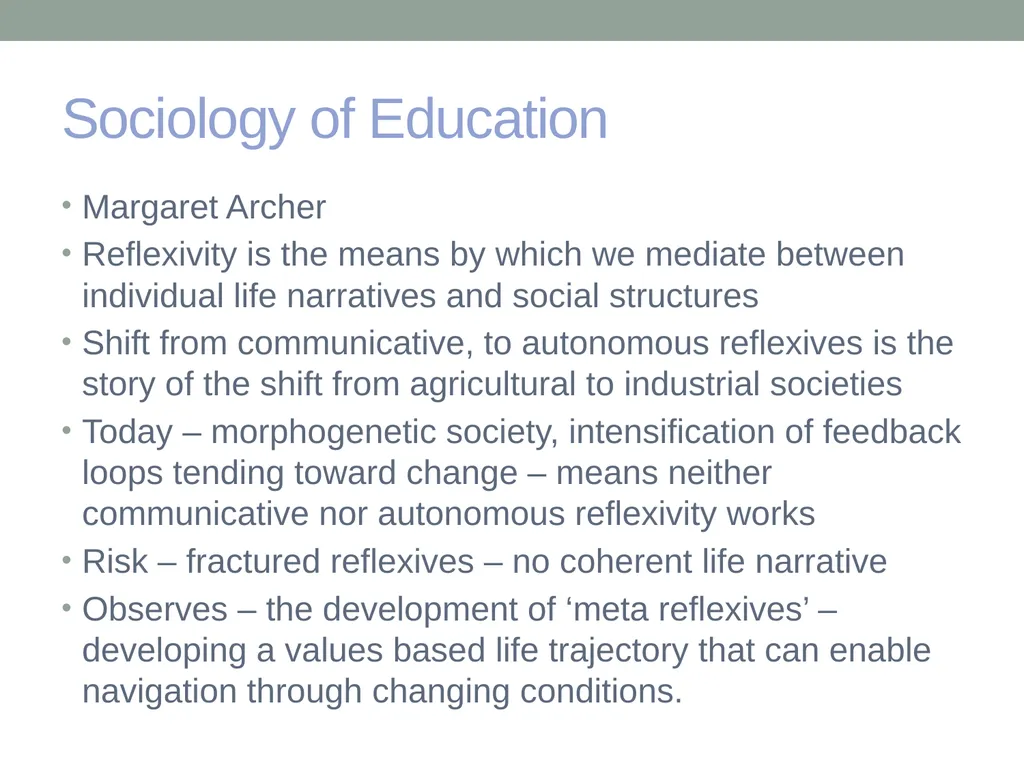
Sociology of Education Margaret Archer
Reflexivity is the means by which we mediate between individual life narratives and social structures
Shift from communicative, to autonomous reflexives is the story of the shift from agricultural to industrial societies
Today – morphogenetic society, intensification of feedback loops tending toward change – means neither communicative nor autonomous reflexivity works
Risk – fractured reflexives – no coherent life narrative
Observes – the development of ‘meta reflexives’ – developing a values based life trajectory that can enable navigation through changing conditions.<br>
Reflexivity is the means by which we mediate between individual life narratives and social structures
Shift from communicative, to autonomous reflexives is the story of the shift from agricultural to industrial societies
Today – morphogenetic society, intensification of feedback loops tending toward change – means neither communicative nor autonomous reflexivity works
Risk – fractured reflexives – no coherent life narrative
Observes – the development of ‘meta reflexives’ – developing a values based life trajectory that can enable navigation through changing conditions.<br>
25
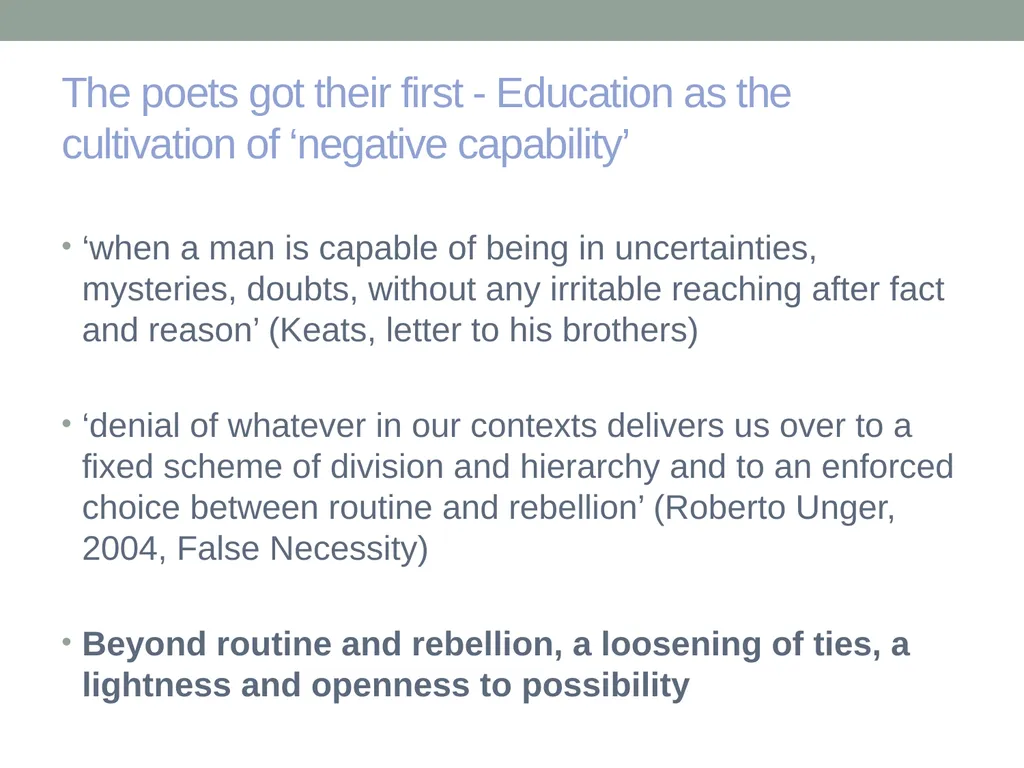
The poets got their first - Education as the cultivation of ‘negative capability’ ‘when a man is capable of being in uncertainties, mysteries, doubts, without any irritable reaching after fact and reason’ (Keats, letter to his brothers)
‘denial of whatever in our contexts delivers us over to a fixed scheme of division and hierarchy and to an enforced choice between routine and rebellion’ (Roberto Unger, 2004, False Necessity)
Beyond routine and rebellion, a loosening of ties, a lightness and openness to possibility<br>
‘denial of whatever in our contexts delivers us over to a fixed scheme of division and hierarchy and to an enforced choice between routine and rebellion’ (Roberto Unger, 2004, False Necessity)
Beyond routine and rebellion, a loosening of ties, a lightness and openness to possibility<br>
26
A new set of assumptions to underpin education’s relations with the future ?<br>
27
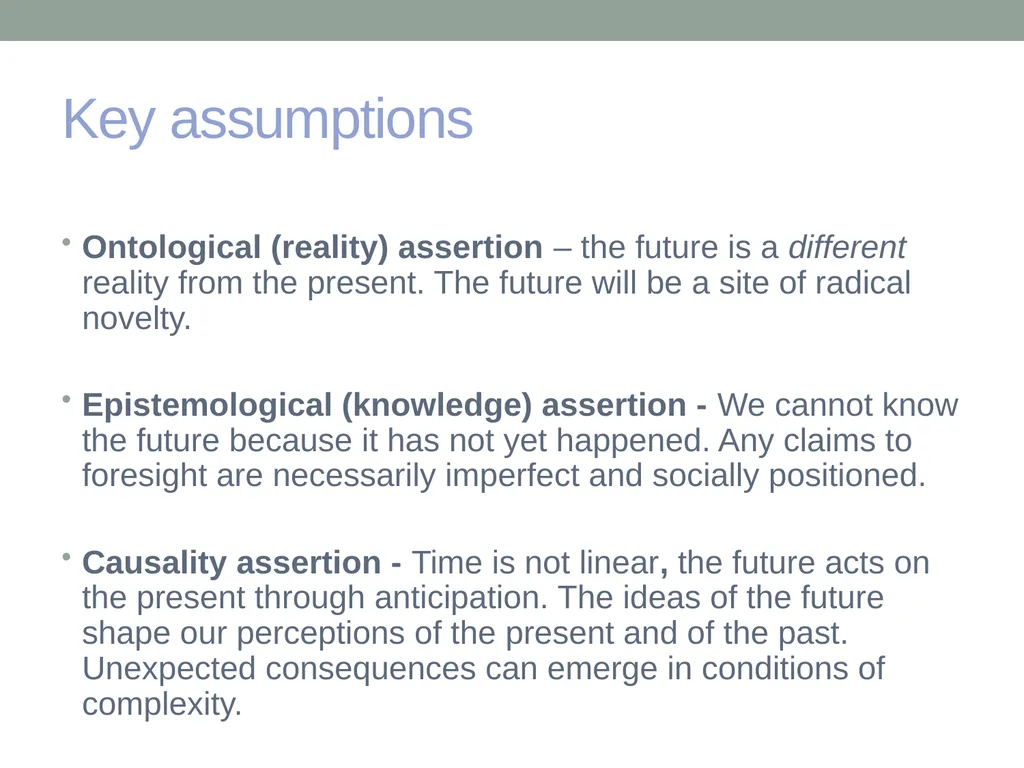
Key assumptions Ontological (reality) assertion – the future is a different reality from the present. The future will be a site of radical novelty.
Epistemological (knowledge) assertion - We cannot know the future because it has not yet happened. Any claims to foresight are necessarily imperfect and socially positioned.
Causality assertion - Time is not linear, the future acts on the present through anticipation. The ideas of the future shape our perceptions of the present and of the past. Unexpected consequences can emerge in conditions of complexity.<br>
Epistemological (knowledge) assertion - We cannot know the future because it has not yet happened. Any claims to foresight are necessarily imperfect and socially positioned.
Causality assertion - Time is not linear, the future acts on the present through anticipation. The ideas of the future shape our perceptions of the present and of the past. Unexpected consequences can emerge in conditions of complexity.<br>
28
The educational contract, therefore…Is no longer to prepare young people for (or against) a future we have already imagined…
Instead, education’s role is…
to create the conditions that will enable students to confront uncertainty and to participate in the dynamic disclosure, imagination and creation of possibility in the present<br>
Instead, education’s role is…
to create the conditions that will enable students to confront uncertainty and to participate in the dynamic disclosure, imagination and creation of possibility in the present<br>
29
Reframing education’s relationship to the future by developing a curriculum oriented toward uncovering the possibilities of the present<br>
30
Elements of a curriculum of the present? Recognition of the abundance of the present
Forward dreaming (not prediction)
Critique
Friendship
Recognition of multiple ways of knowing
Education as an ecotone<br>
Forward dreaming (not prediction)
Critique
Friendship
Recognition of multiple ways of knowing
Education as an ecotone<br>
31
Recognise the present as rich, deep and abundant The idea of the ‘thick present’ (Poli, 2010):
The multiple layers of reality that are the materials for creating futures, from the physical attributes of the world, to the social and historical structures, to the anticipatory practices that work backwards from the possibilities we conceive about the future upon the present.
The present has a surplus of possibilities (Massumi, 2003)
[…] in every situation there are any number of levels of organisation and tendencies in play, in cooperation with each other or at cross-purposes. […] This uncertainty can actually be empowering — once you realise that it gives you a margin of manoeuvrability and you focus on that, rather than on projecting success or failure. It gives you the feeling that there is always an opening to experiment, to try and see. This brings a sense of potential to the situation. The present’s ‘boundary condition’, to borrow a phrase from science, is never a closed door. It is an open threshold — a threshold of potential.<br>
The multiple layers of reality that are the materials for creating futures, from the physical attributes of the world, to the social and historical structures, to the anticipatory practices that work backwards from the possibilities we conceive about the future upon the present.
The present has a surplus of possibilities (Massumi, 2003)
[…] in every situation there are any number of levels of organisation and tendencies in play, in cooperation with each other or at cross-purposes. […] This uncertainty can actually be empowering — once you realise that it gives you a margin of manoeuvrability and you focus on that, rather than on projecting success or failure. It gives you the feeling that there is always an opening to experiment, to try and see. This brings a sense of potential to the situation. The present’s ‘boundary condition’, to borrow a phrase from science, is never a closed door. It is an open threshold — a threshold of potential.<br>
32
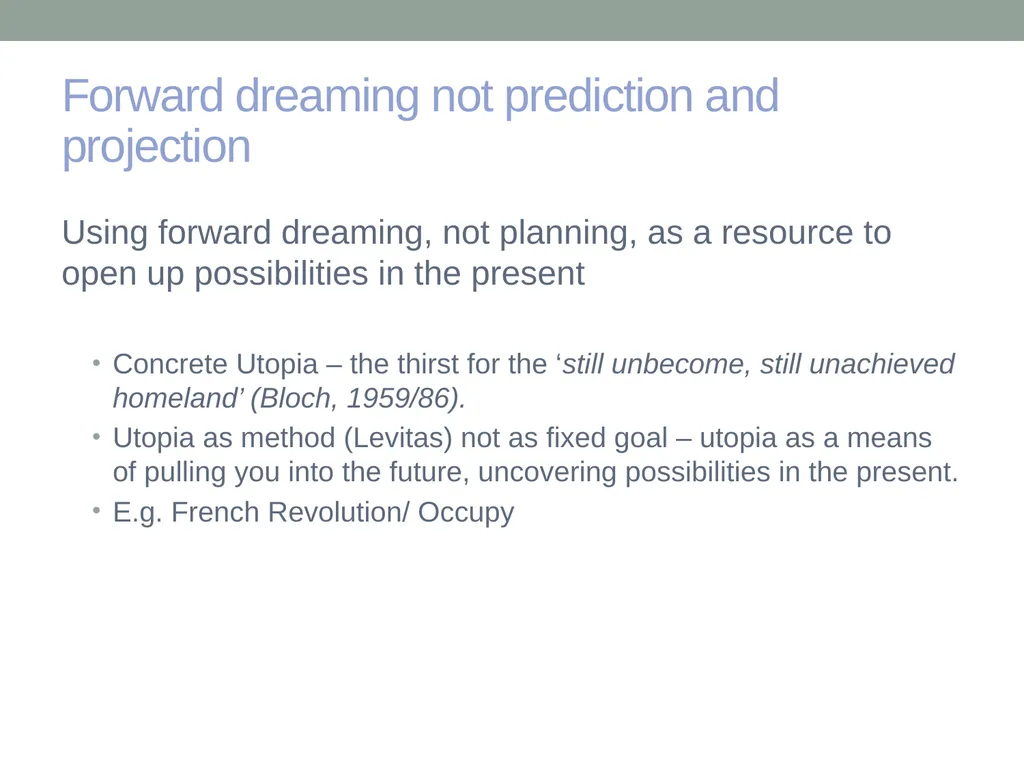
Forward dreaming not prediction and projection Using forward dreaming, not planning, as a resource to open up possibilities in the present
Concrete Utopia – the thirst for the ‘still unbecome, still unachieved homeland’ (Bloch, 1959/86).
Utopia as method (Levitas) not as fixed goal – utopia as a means of pulling you into the future, uncovering possibilities in the present.
E.g. French Revolution/ Occupy<br>
Concrete Utopia – the thirst for the ‘still unbecome, still unachieved homeland’ (Bloch, 1959/86).
Utopia as method (Levitas) not as fixed goal – utopia as a means of pulling you into the future, uncovering possibilities in the present.
E.g. French Revolution/ Occupy<br>
33
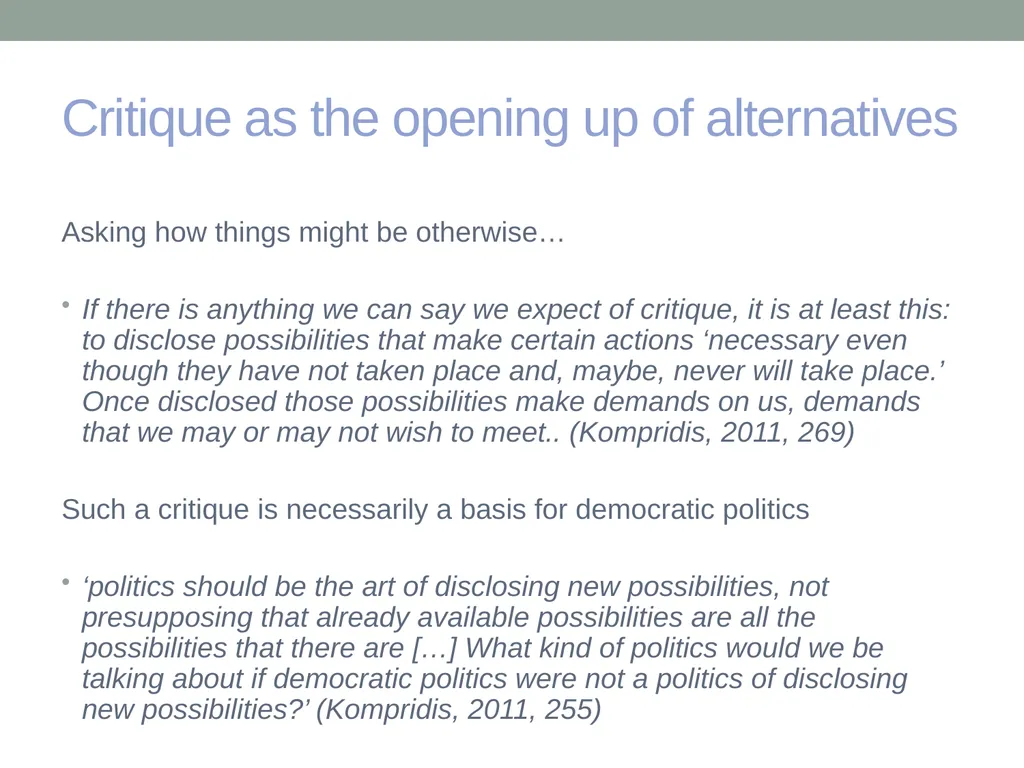
Critique as the opening up of alternatives Asking how things might be otherwise…
If there is anything we can say we expect of critique, it is at least this: to disclose possibilities that make certain actions ‘necessary even though they have not taken place and, maybe, never will take place.’ Once disclosed those possibilities make demands on us, demands that we may or may not wish to meet.. (Kompridis, 2011, 269)
Such a critique is necessarily a basis for democratic politics
‘politics should be the art of disclosing new possibilities, not presupposing that already available possibilities are all the possibilities that there are […] What kind of politics would we be talking about if democratic politics were not a politics of disclosing new possibilities?’ (Kompridis, 2011, 255)<br>
If there is anything we can say we expect of critique, it is at least this: to disclose possibilities that make certain actions ‘necessary even though they have not taken place and, maybe, never will take place.’ Once disclosed those possibilities make demands on us, demands that we may or may not wish to meet.. (Kompridis, 2011, 269)
Such a critique is necessarily a basis for democratic politics
‘politics should be the art of disclosing new possibilities, not presupposing that already available possibilities are all the possibilities that there are […] What kind of politics would we be talking about if democratic politics were not a politics of disclosing new possibilities?’ (Kompridis, 2011, 255)<br>
34
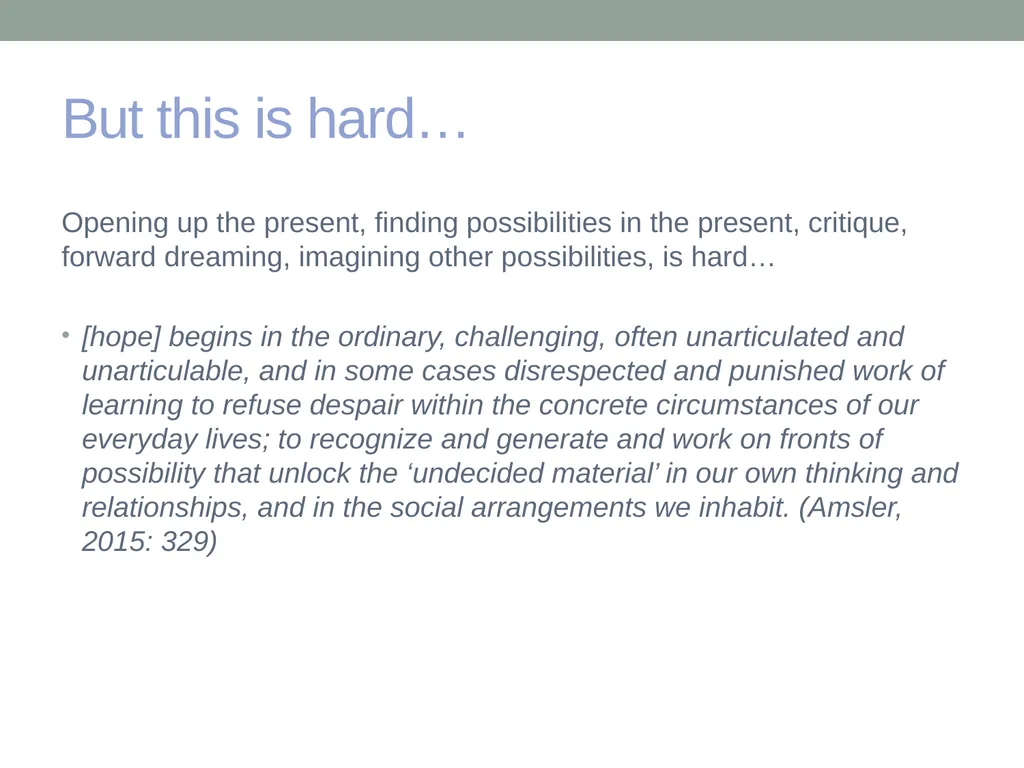
But this is hard… Opening up the present, finding possibilities in the present, critique, forward dreaming, imagining other possibilities, is hard…
[hope] begins in the ordinary, challenging, often unarticulated and unarticulable, and in some cases disrespected and punished work of learning to refuse despair within the concrete circumstances of our everyday lives; to recognize and generate and work on fronts of possibility that unlock the ‘undecided material’ in our own thinking and relationships, and in the social arrangements we inhabit. (Amsler, 2015: 329)<br>
[hope] begins in the ordinary, challenging, often unarticulated and unarticulable, and in some cases disrespected and punished work of learning to refuse despair within the concrete circumstances of our everyday lives; to recognize and generate and work on fronts of possibility that unlock the ‘undecided material’ in our own thinking and relationships, and in the social arrangements we inhabit. (Amsler, 2015: 329)<br>
35
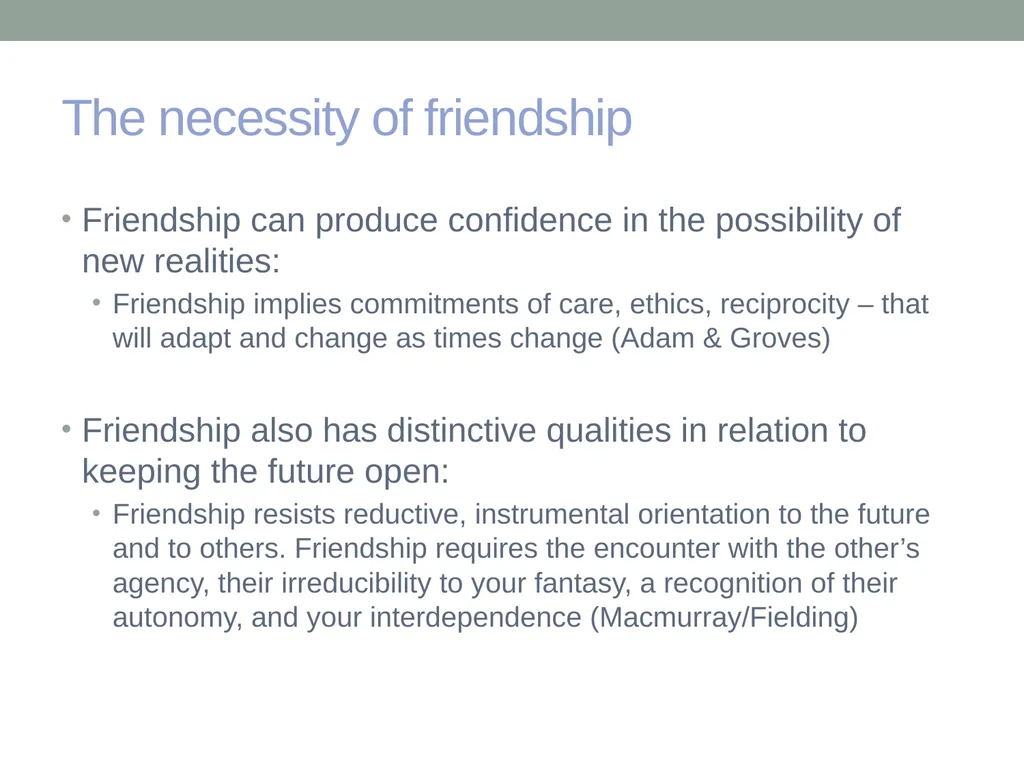
The necessity of friendship Friendship can produce confidence in the possibility of new realities:
Friendship implies commitments of care, ethics, reciprocity – that will adapt and change as times change (Adam & Groves)
Friendship also has distinctive qualities in relation to keeping the future open:
Friendship resists reductive, instrumental orientation to the future and to others. Friendship requires the encounter with the other’s agency, their irreducibility to your fantasy, a recognition of their autonomy, and your interdependence (Macmurray/Fielding)<br>
Friendship implies commitments of care, ethics, reciprocity – that will adapt and change as times change (Adam & Groves)
Friendship also has distinctive qualities in relation to keeping the future open:
Friendship resists reductive, instrumental orientation to the future and to others. Friendship requires the encounter with the other’s agency, their irreducibility to your fantasy, a recognition of their autonomy, and your interdependence (Macmurray/Fielding)<br>
36
Recognition of multiple ways of knowing Uncovering possibilities requires the capacity to see the world through multiple lenses –
Co-existence of rational and spiritual ways of knowing
Co-existence of theory and practice
Co-existence of indigenous and western knowledge
Beyond ‘conservative’ and ‘progressive’ education – the challenge is to harness different ways of knowing to reframe perceptions of the present
Literature… renders the world less fixed, less banal, more susceptible to recreation. Literature subjunctivises, makes strange, renders the obvious less so, the unknowable less so as well, matters of value more open to reason and intuition. Literature in this spirit, is an instrument of freedom, lightness, imagination and yes, reason. It is our only hope against the long gray night’ (Bruner, 1986: 159)<br>
Co-existence of rational and spiritual ways of knowing
Co-existence of theory and practice
Co-existence of indigenous and western knowledge
Beyond ‘conservative’ and ‘progressive’ education – the challenge is to harness different ways of knowing to reframe perceptions of the present
Literature… renders the world less fixed, less banal, more susceptible to recreation. Literature subjunctivises, makes strange, renders the obvious less so, the unknowable less so as well, matters of value more open to reason and intuition. Literature in this spirit, is an instrument of freedom, lightness, imagination and yes, reason. It is our only hope against the long gray night’ (Bruner, 1986: 159)<br>
37
E.g. Connected Communities Systematic approach to research as a set of encounters between different ways of knowing
£30m investment
324 Projects
from six month scoping studies to five year multi institution collaborations, topics ranging from energy and environment, arts, healthcare, creative economy, heritage
700+ academics, 500+ community partners
Showcase events, mailing lists, summits, festivals – to encourage collaboration and knowledge exchange between projects, community partners and academics.<br>
£30m investment
324 Projects
from six month scoping studies to five year multi institution collaborations, topics ranging from energy and environment, arts, healthcare, creative economy, heritage
700+ academics, 500+ community partners
Showcase events, mailing lists, summits, festivals – to encourage collaboration and knowledge exchange between projects, community partners and academics.<br>
38
Reframing education’s relationship with the future<br>
39
A different metaphor - Education as an ‘ecotone’ A distinct temporality
A site of interaction between past, present and future – between what we think we know and what we can imagine and what we can uncover
A unique process through which societies enable new ways of being, new subjects, to emerge, flourish and create novelty
A place that has a value in and of itself – it is not just of use for ‘serving the economy’ or for ‘preparing for the future’ – but, just as health is intrinsically valuable and has its own logics, so too does education.<br>
A site of interaction between past, present and future – between what we think we know and what we can imagine and what we can uncover
A unique process through which societies enable new ways of being, new subjects, to emerge, flourish and create novelty
A place that has a value in and of itself – it is not just of use for ‘serving the economy’ or for ‘preparing for the future’ – but, just as health is intrinsically valuable and has its own logics, so too does education.<br>
40
To summarise<br>
41
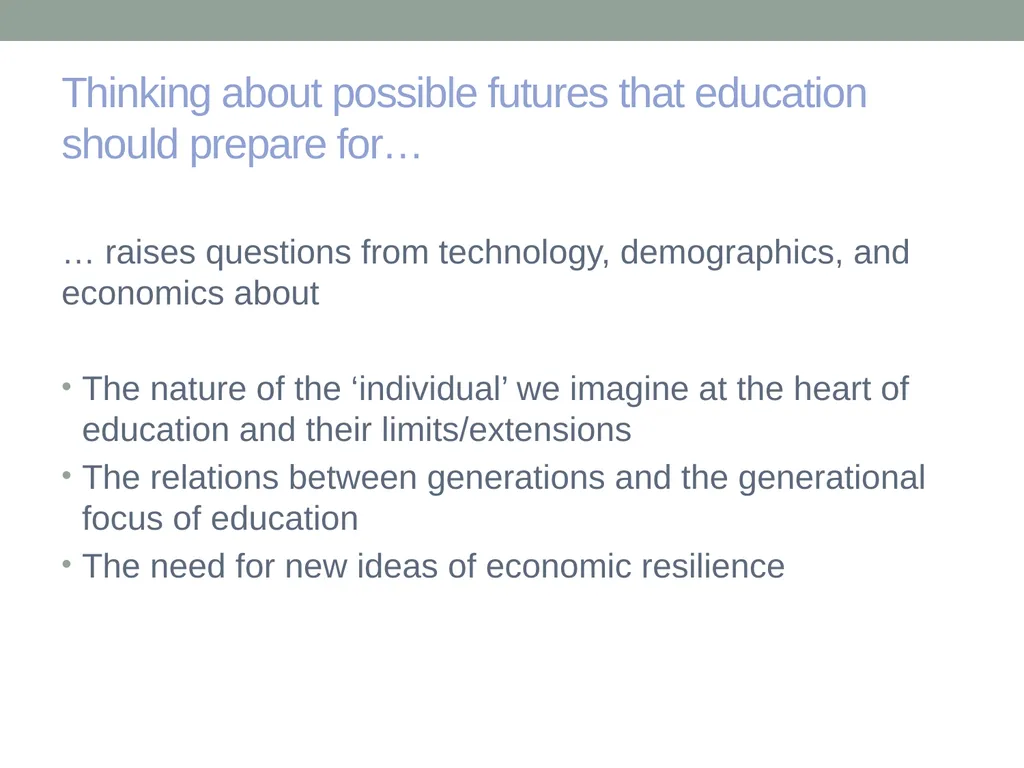
Thinking about possible futures that education should prepare for… … raises questions from technology, demographics, and economics about
The nature of the ‘individual’ we imagine at the heart of education and their limits/extensions
The relations between generations and the generational focus of education
The need for new ideas of economic resilience<br>
The nature of the ‘individual’ we imagine at the heart of education and their limits/extensions
The relations between generations and the generational focus of education
The need for new ideas of economic resilience<br>
42
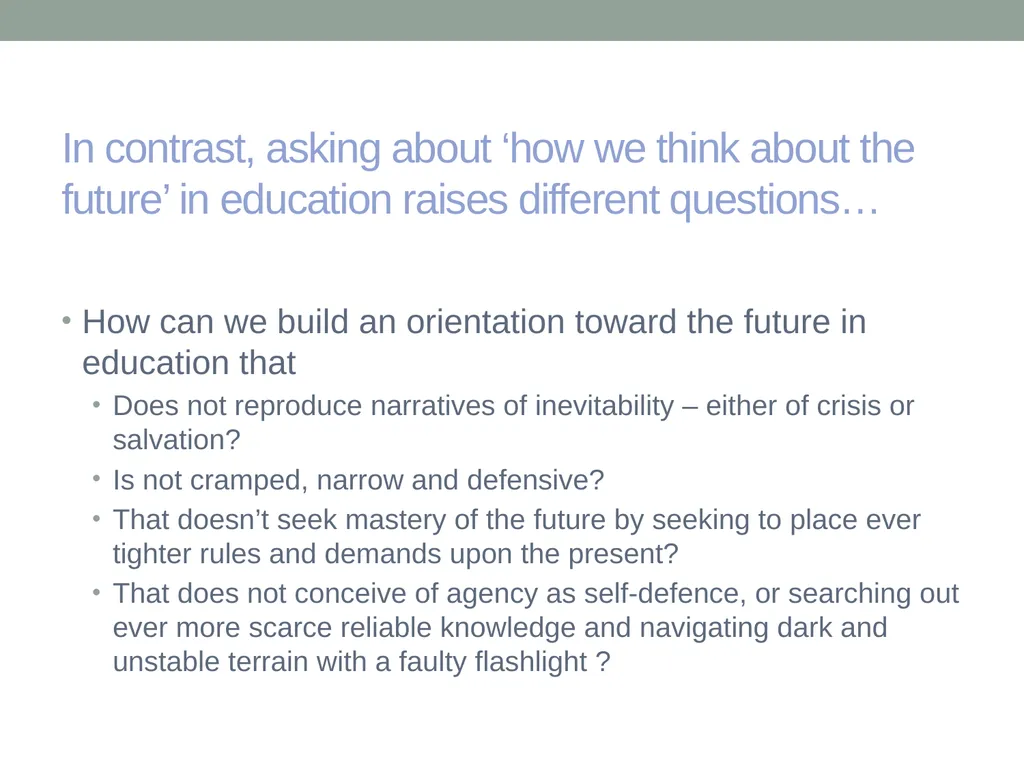
In contrast, asking about ‘how we think about the future’ in education raises different questions… How can we build an orientation toward the future in education that
Does not reproduce narratives of inevitability – either of crisis or salvation?
Is not cramped, narrow and defensive?
That doesn’t seek mastery of the future by seeking to place ever tighter rules and demands upon the present?
That does not conceive of agency as self-defence, or searching out ever more scarce reliable knowledge and navigating dark and unstable terrain with a faulty flashlight ?<br>
Does not reproduce narratives of inevitability – either of crisis or salvation?
Is not cramped, narrow and defensive?
That doesn’t seek mastery of the future by seeking to place ever tighter rules and demands upon the present?
That does not conceive of agency as self-defence, or searching out ever more scarce reliable knowledge and navigating dark and unstable terrain with a faulty flashlight ?<br>
43
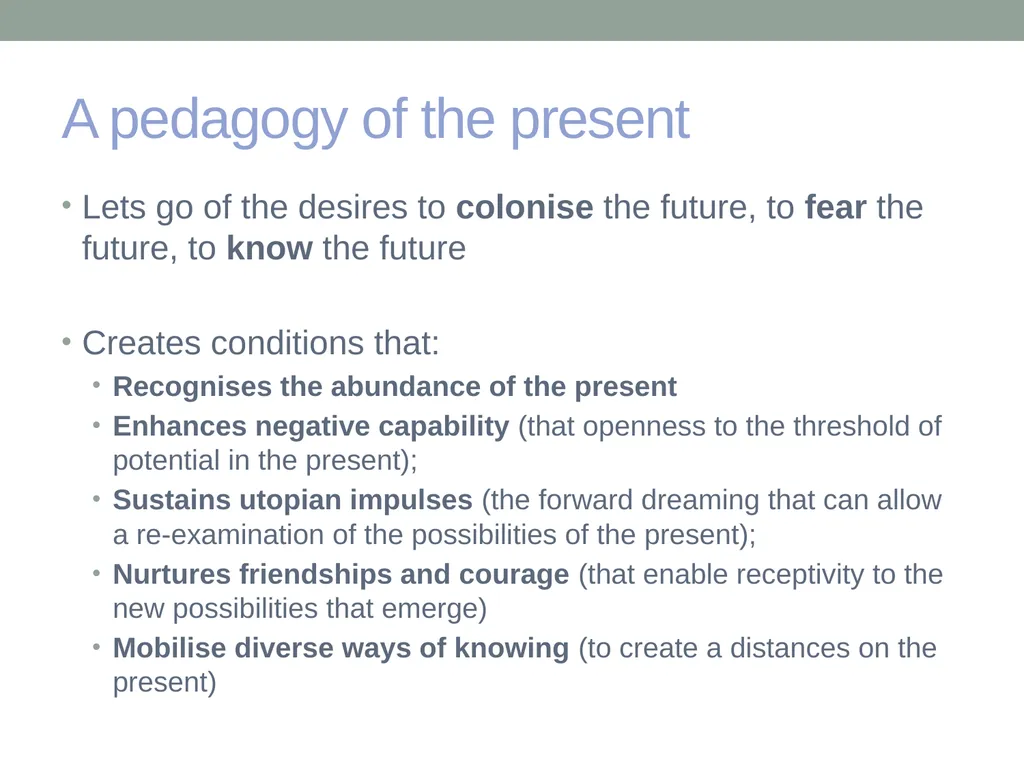
A pedagogy of the present Lets go of the desires to colonise the future, to fear the future, to know the future
Creates conditions that:
Recognises the abundance of the present
Enhances negative capability (that openness to the threshold of potential in the present);
Sustains utopian impulses (the forward dreaming that can allow a re-examination of the possibilities of the present);
Nurtures friendships and courage (that enable receptivity to the new possibilities that emerge)
Mobilise diverse ways of knowing (to create a distances on the present)<br>
Creates conditions that:
Recognises the abundance of the present
Enhances negative capability (that openness to the threshold of potential in the present);
Sustains utopian impulses (the forward dreaming that can allow a re-examination of the possibilities of the present);
Nurtures friendships and courage (that enable receptivity to the new possibilities that emerge)
Mobilise diverse ways of knowing (to create a distances on the present)<br>
44
If we look, we can see the seeds of this education everywhere, eg…. Blackfoot College, Canada
Universite de la Tierra, Mexico
Swaraj University, India
Chto Delat, St Petersburg
Foundation Year, Bristol
Co-operative Social Science Centre
University of strategic optimism
Connected Communities
Enlivened Learning
WAAS
++++<br>
Universite de la Tierra, Mexico
Swaraj University, India
Chto Delat, St Petersburg
Foundation Year, Bristol
Co-operative Social Science Centre
University of strategic optimism
Connected Communities
Enlivened Learning
WAAS
++++<br>
45
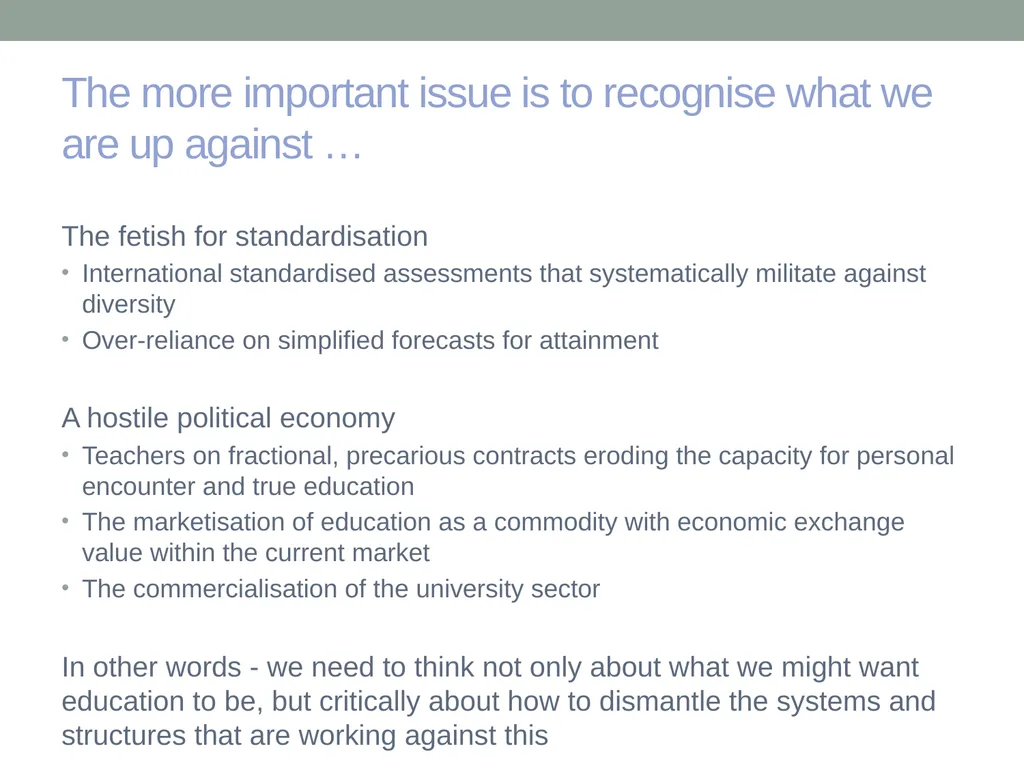
The more important issue is to recognise what we are up against … The fetish for standardisation
International standardised assessments that systematically militate against diversity
Over-reliance on simplified forecasts for attainment
A hostile political economy
Teachers on fractional, precarious contracts eroding the capacity for personal encounter and true education
The marketisation of education as a commodity with economic exchange value within the current market
The commercialisation of the university sector
In other words - we need to think not only about what we might want education to be, but critically about how to dismantle the systems and structures that are working against this<br>
International standardised assessments that systematically militate against diversity
Over-reliance on simplified forecasts for attainment
A hostile political economy
Teachers on fractional, precarious contracts eroding the capacity for personal encounter and true education
The marketisation of education as a commodity with economic exchange value within the current market
The commercialisation of the university sector
In other words - we need to think not only about what we might want education to be, but critically about how to dismantle the systems and structures that are working against this<br>
46
Thank you Keri.Facer@bristol.ac.uk
@kerileef
@ahrcconnect
www.connected-communities.org<br>
@kerileef
@ahrcconnect
www.connected-communities.org<br>
47
Thank you Permission to use images under Creative Commons Licence from:
(three ages) icultist http://www.flickr.com/photos/icultist
(rusted car) H.I.L.T http://www.flickr.com/photos/29311691@N05
London Metropolitan Archive<br>
(three ages) icultist http://www.flickr.com/photos/icultist
(rusted car) H.I.L.T http://www.flickr.com/photos/29311691@N05
London Metropolitan Archive<br>