
Educational Content Developed by ASBMR and the
LD
Published · 49 slides · 0 views

1 / 1



Description
Educational Content Developed by ASBMR and the Faculty Listed Below Stuart L. Silverman, MD, FACP, FACR (Chair) Medical Director Cedars-Sinai Bone Center of Excellence Los Angeles, California Cheryl L. Lambing, MD, FAAFP Clinical Professor
Related Topics
Download this presentation From Below
"Educational Content Developed by ASBMR and the" is the property of its rightful owner. Permission is granted to download and print the materials on this website for personal, non-commercial use only, and to display it on your personal computer provided you do not modify the materials and that you retain all copyright notices contained in the materials. By downloading content from our website, you accept the terms of this agreement.
Share
Embed code
Presentation Transcript
01
Educational Content Developed by
ASBMR and the Faculty Listed Below Stuart L. Silverman, MD, FACP, FACR (Chair)
Medical Director
Cedars-Sinai Bone Center of Excellence
Los Angeles, California
Cheryl L. Lambing, MD, FAAFP
Clinical Professor
University of California, Los Angeles
Los Angeles, California
E. Michael Lewiecki, MD, FACP, FACE
Clinical Assistant Professor of Medicine
University of New Mexico School of Medicine
Albuquerque, New Mexico Michael McClung, MD, FACP, FACE
Director
Oregon Osteoporosis Center
Portland, Oregon
Ethel S. Siris, MD
Madeline C. Stabile Professor
of Clinical Medicine
Columbia University
New York, New York
Nelson B. Watts, MD, FACP, MACE
Director
Mercy Health Osteoporosis and
Bone Health Services
Cincinnati, Ohio<br>
Medical Director
Cedars-Sinai Bone Center of Excellence
Los Angeles, California
Cheryl L. Lambing, MD, FAAFP
Clinical Professor
University of California, Los Angeles
Los Angeles, California
E. Michael Lewiecki, MD, FACP, FACE
Clinical Assistant Professor of Medicine
University of New Mexico School of Medicine
Albuquerque, New Mexico Michael McClung, MD, FACP, FACE
Director
Oregon Osteoporosis Center
Portland, Oregon
Ethel S. Siris, MD
Madeline C. Stabile Professor
of Clinical Medicine
Columbia University
New York, New York
Nelson B. Watts, MD, FACP, MACE
Director
Mercy Health Osteoporosis and
Bone Health Services
Cincinnati, Ohio<br>
02
Osteoporosis Education for the PCP? Curriculum for PCPs
AAFP chapter meetings
www.osteocme.org<br>
AAFP chapter meetings
www.osteocme.org<br>
03
Learning Objectives Improve the ability to assess risk factors for osteoporosis and apply evidence-based screening recommendations to these at-risk patients within one’s practice
Develop strategies to improve the treatment of patients with osteoporosis
Utilize the tools and other information provided within this initiative, including patient education tools and systems-based approaches to facilitate improving the assessment and care being provided to patients with osteoporosis<br>
Develop strategies to improve the treatment of patients with osteoporosis
Utilize the tools and other information provided within this initiative, including patient education tools and systems-based approaches to facilitate improving the assessment and care being provided to patients with osteoporosis<br>
04
What is osteoporosis?
Why you should care?
Whom to test and how?
Whom to treat and how? Postmenopausal Osteoporosis in the Primary Care Setting<br>
Why you should care?
Whom to test and how?
Whom to treat and how? Postmenopausal Osteoporosis in the Primary Care Setting<br>
05
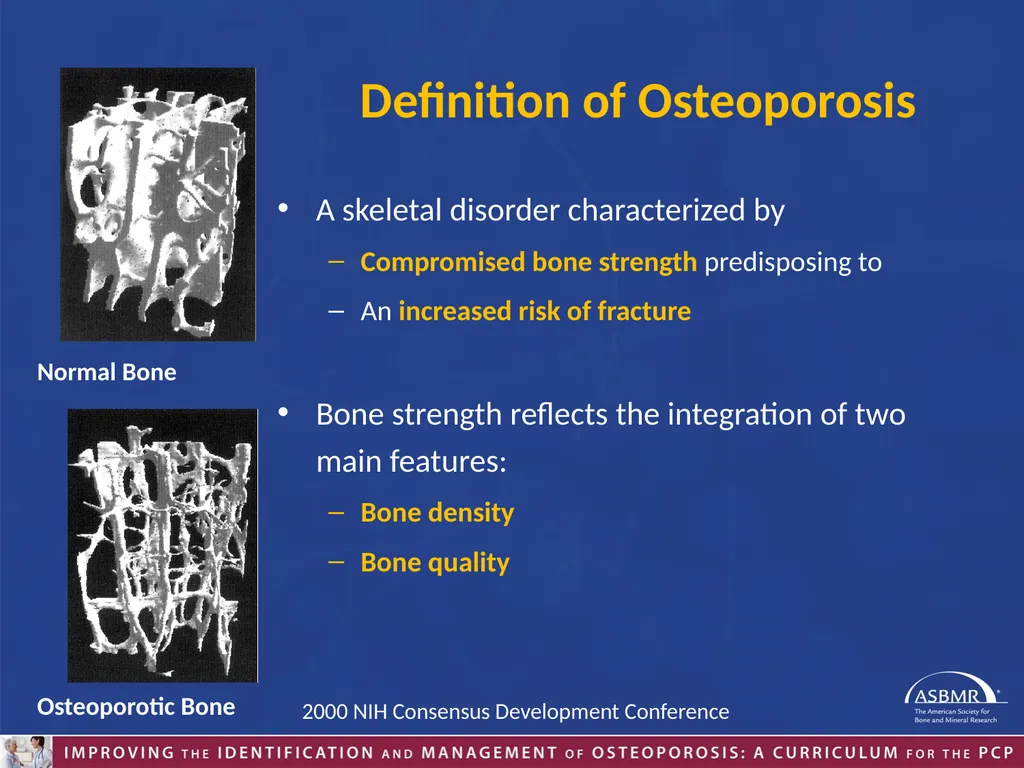
2000 NIH Consensus Development Conference Definition of Osteoporosis Normal Bone Osteoporotic Bone A skeletal disorder characterized by
Compromised bone strength predisposing to
An increased risk of fracture
Bone strength reflects the integration of two main features:
Bone density
Bone quality<br>
Compromised bone strength predisposing to
An increased risk of fracture
Bone strength reflects the integration of two main features:
Bone density
Bone quality<br>
06
Osteoporosis Is a Serious
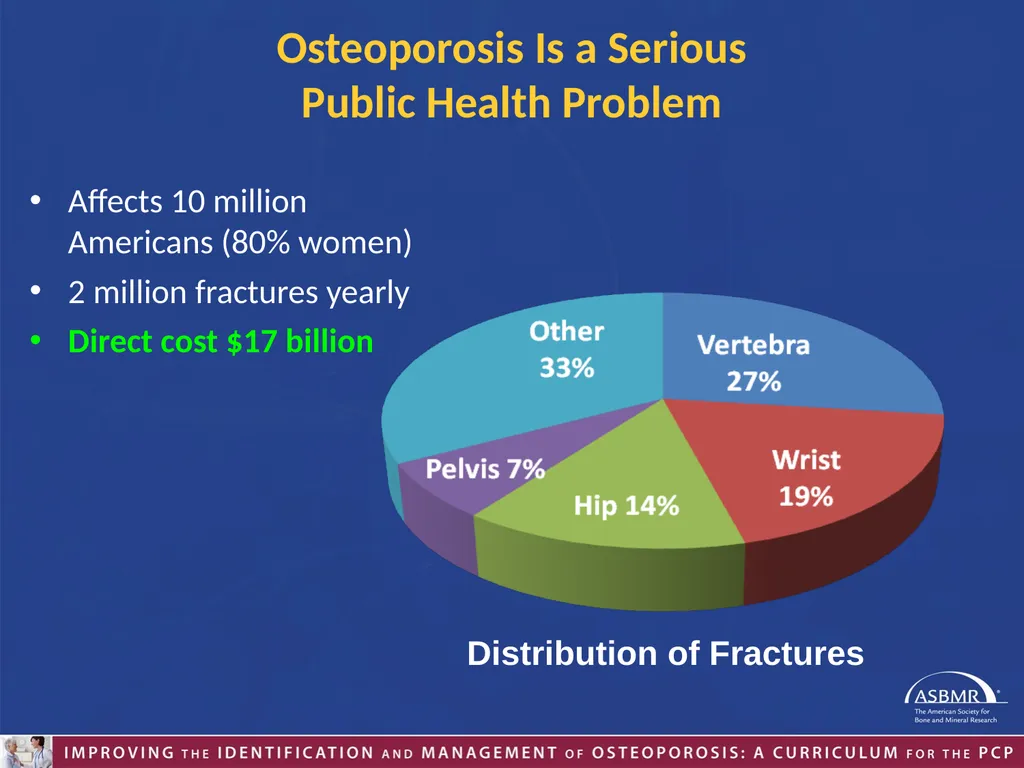
Public Health Problem Affects 10 million Americans (80% women)
2 million fractures yearly
Direct cost $17 billion Distribution of Fractures<br>
2 million fractures yearly
Direct cost $17 billion Distribution of Fractures<br>
07
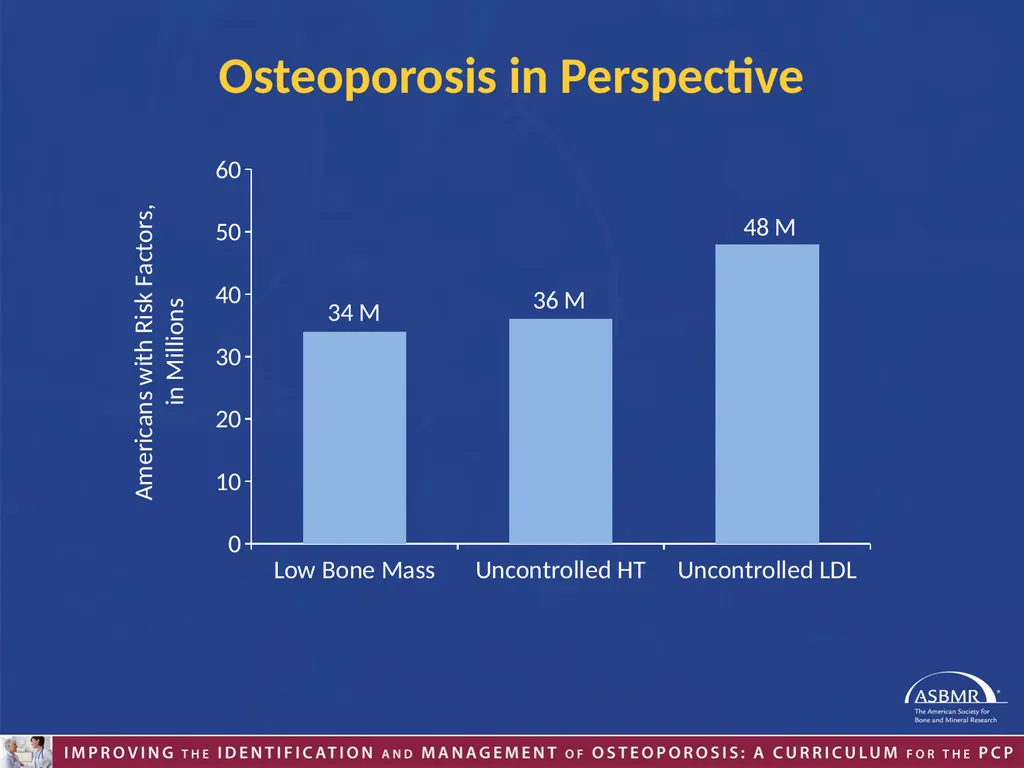
Osteoporosis in Perspective<br>
08
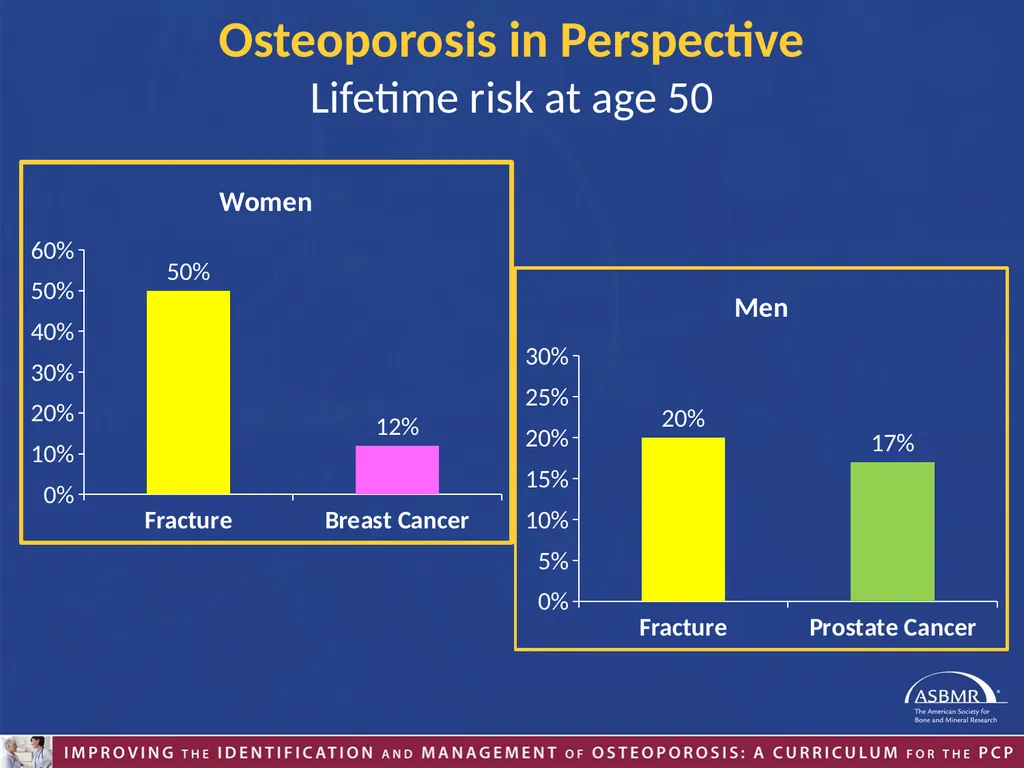
Osteoporosis in Perspective
Lifetime risk at age 50<br>
09
Identified Treatment Gap
NCQA HEDIS NCQA State of Healthcare 2012 - HMO Statistics (Commercial or Medicare data from 2011).
http://www.ncqa.org/Portals/0/State%20of%20Health%20Care/2012/SOHC%20Report%20Web.pdf.
Accessed February 2013. *2011 HMO Rates<br>
http://www.ncqa.org/Portals/0/State%20of%20Health%20Care/2012/SOHC%20Report%20Web.pdf.
Accessed February 2013. *2011 HMO Rates<br>
10
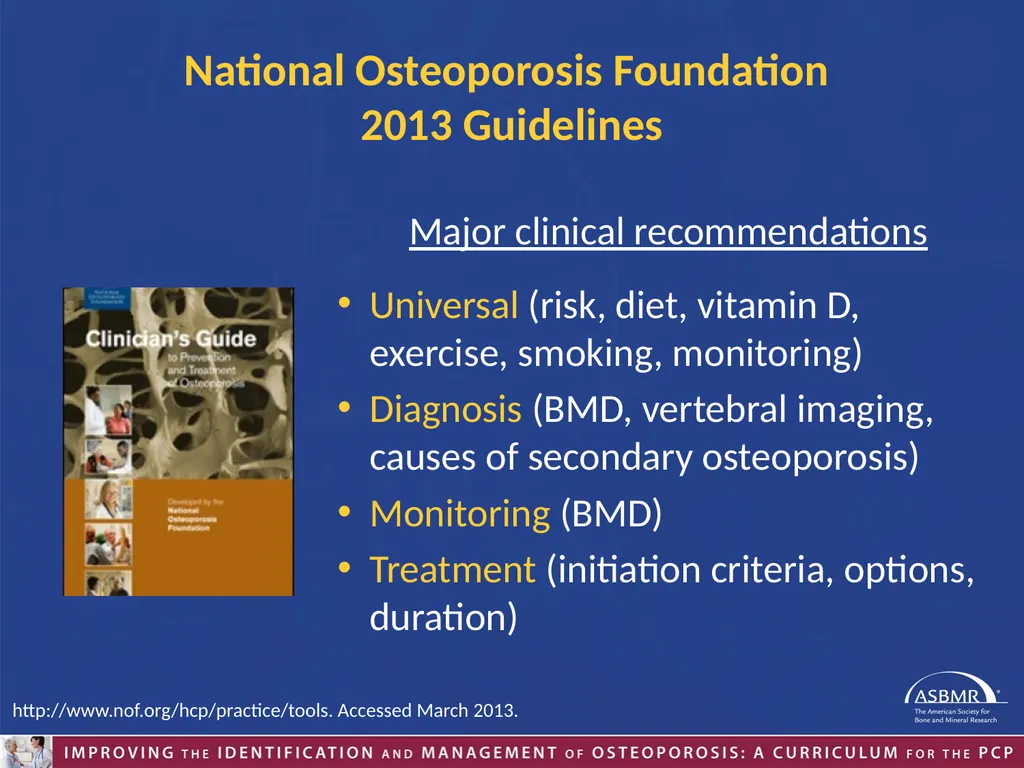
National Osteoporosis Foundation
2013 Guidelines Universal (risk, diet, vitamin D, exercise, smoking, monitoring)
Diagnosis (BMD, vertebral imaging, causes of secondary osteoporosis)
Monitoring (BMD)
Treatment (initiation criteria, options, duration) Major clinical recommendations http://www.nof.org/hcp/practice/tools. Accessed March 2013.<br>
Diagnosis (BMD, vertebral imaging, causes of secondary osteoporosis)
Monitoring (BMD)
Treatment (initiation criteria, options, duration) Major clinical recommendations http://www.nof.org/hcp/practice/tools. Accessed March 2013.<br>
11
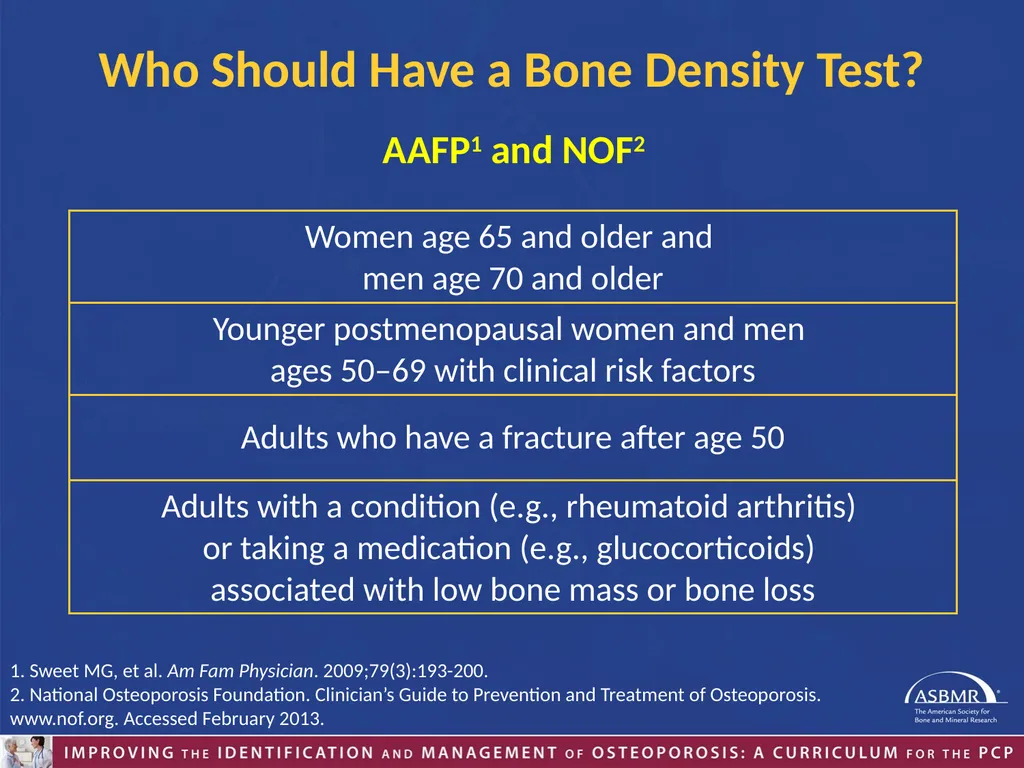
Who Should Have a Bone Density Test? AAFP1 and NOF2 1. Sweet MG, et al. Am Fam Physician. 2009;79(3):193-200.
2. National Osteoporosis Foundation. Clinician’s Guide to Prevention and Treatment of Osteoporosis. www.nof.org. Accessed February 2013.<br>
2. National Osteoporosis Foundation. Clinician’s Guide to Prevention and Treatment of Osteoporosis. www.nof.org. Accessed February 2013.<br>
12
Reimbursement for DXA
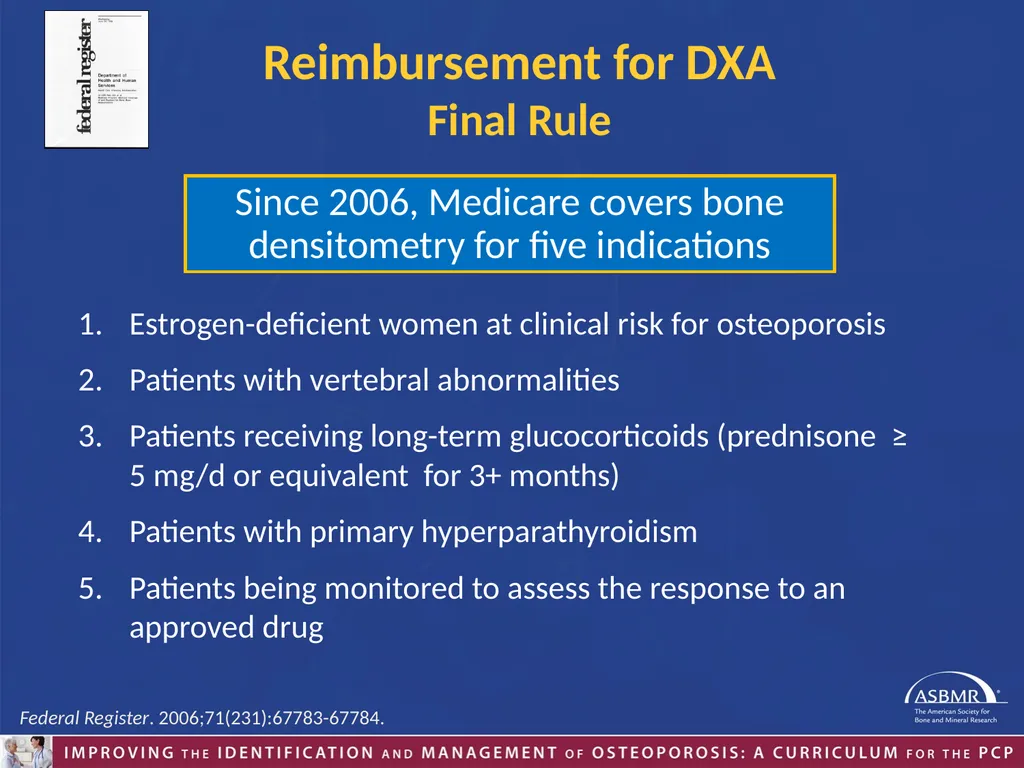
Final Rule Estrogen-deficient women at clinical risk for osteoporosis
Patients with vertebral abnormalities
Patients receiving long-term glucocorticoids (prednisone ≥ 5 mg/d or equivalent for 3+ months)
Patients with primary hyperparathyroidism
Patients being monitored to assess the response to an approved drug Federal Register. 2006;71(231):67783-67784. Since 2006, Medicare covers bone densitometry for five indications<br>
Patients with vertebral abnormalities
Patients receiving long-term glucocorticoids (prednisone ≥ 5 mg/d or equivalent for 3+ months)
Patients with primary hyperparathyroidism
Patients being monitored to assess the response to an approved drug Federal Register. 2006;71(231):67783-67784. Since 2006, Medicare covers bone densitometry for five indications<br>
13
WHO Criteria for
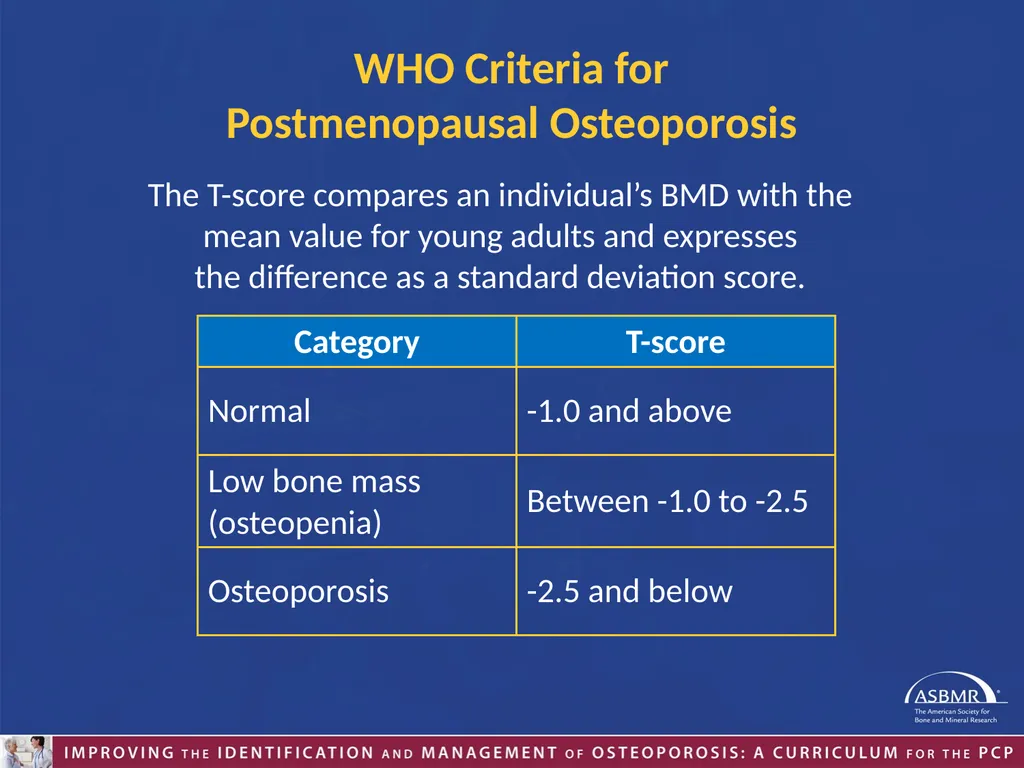
Postmenopausal Osteoporosis The T-score compares an individual’s BMD with the
mean value for young adults and expresses
the difference as a standard deviation score.<br>
mean value for young adults and expresses
the difference as a standard deviation score.<br>
14
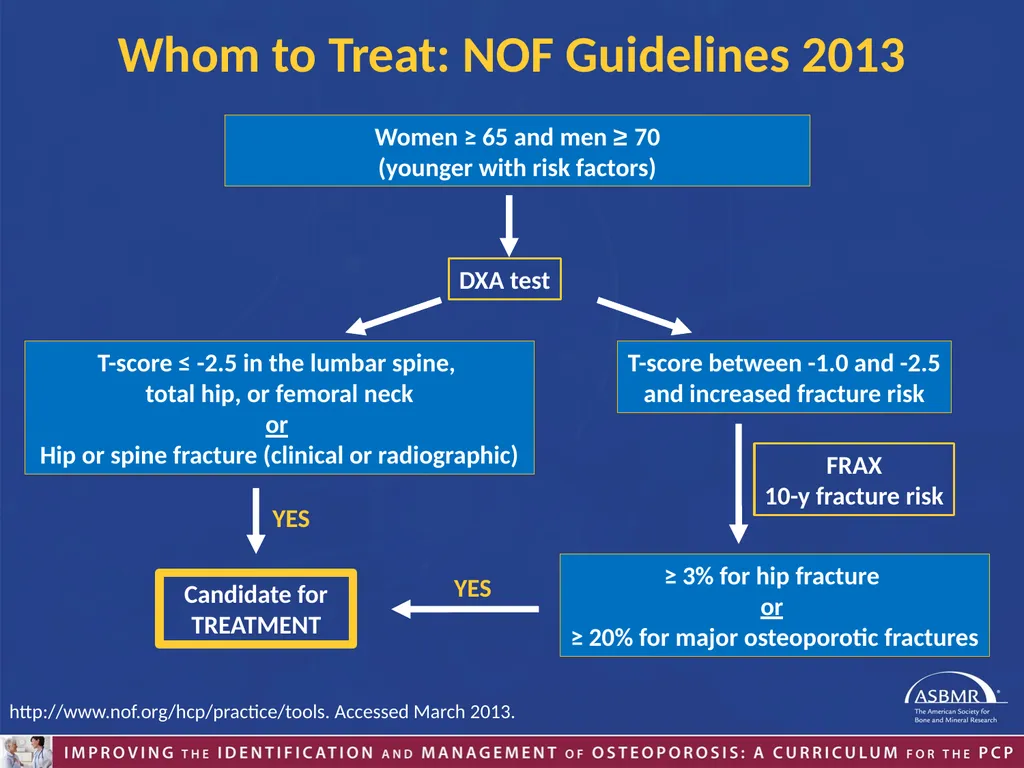
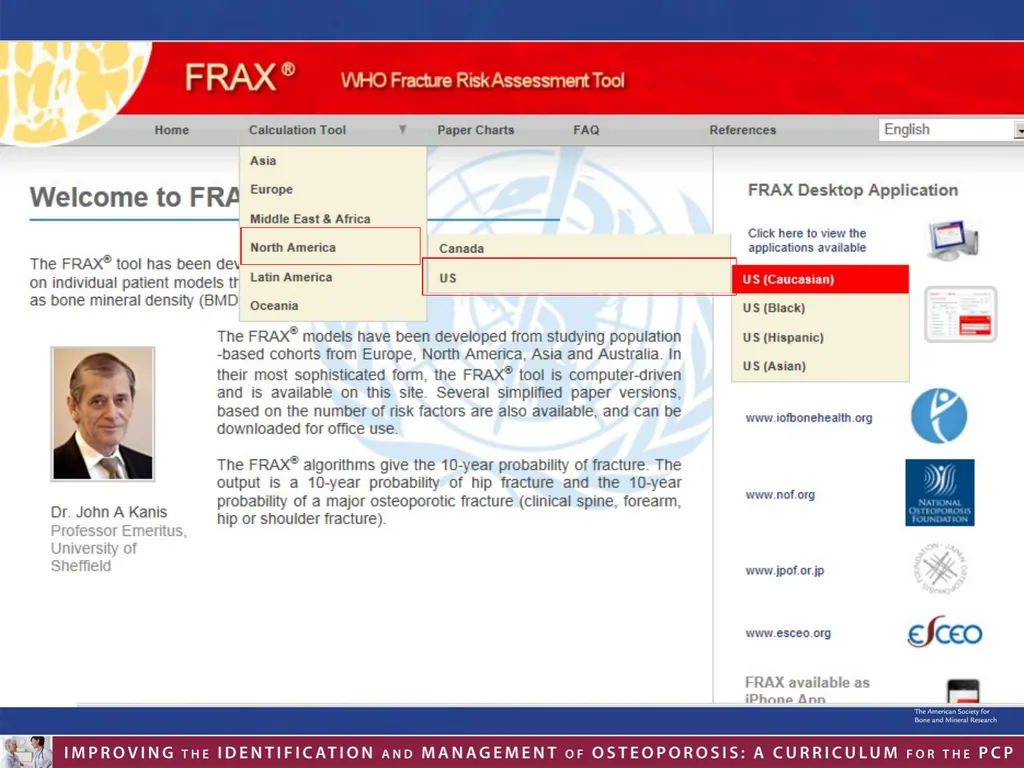
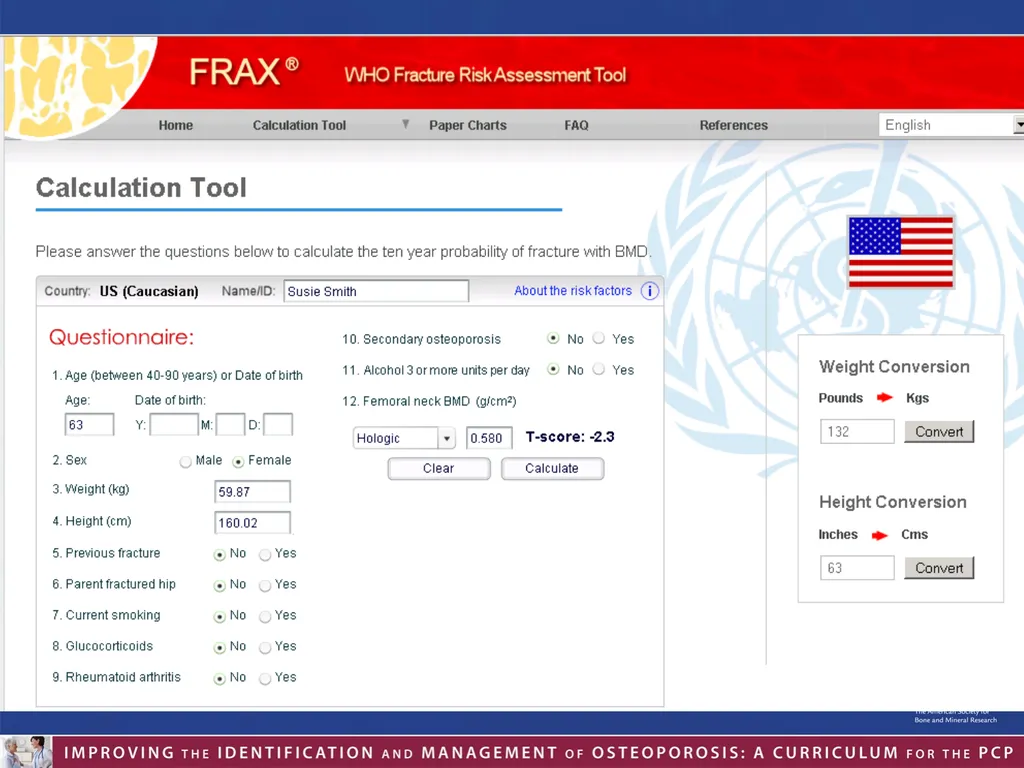
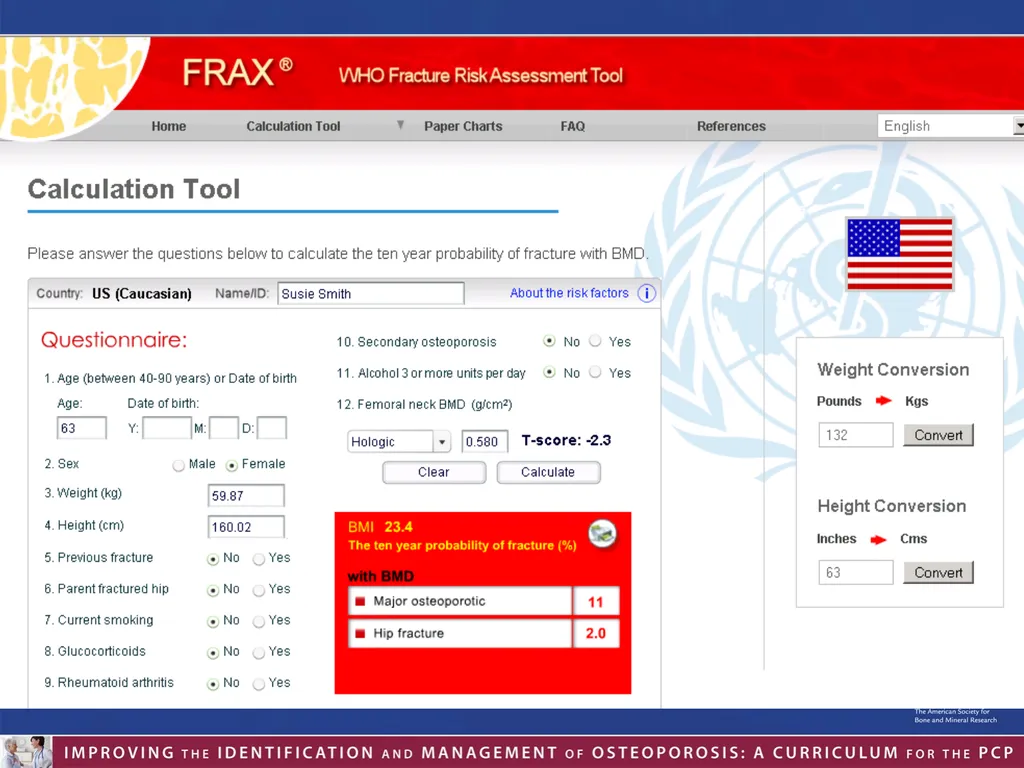
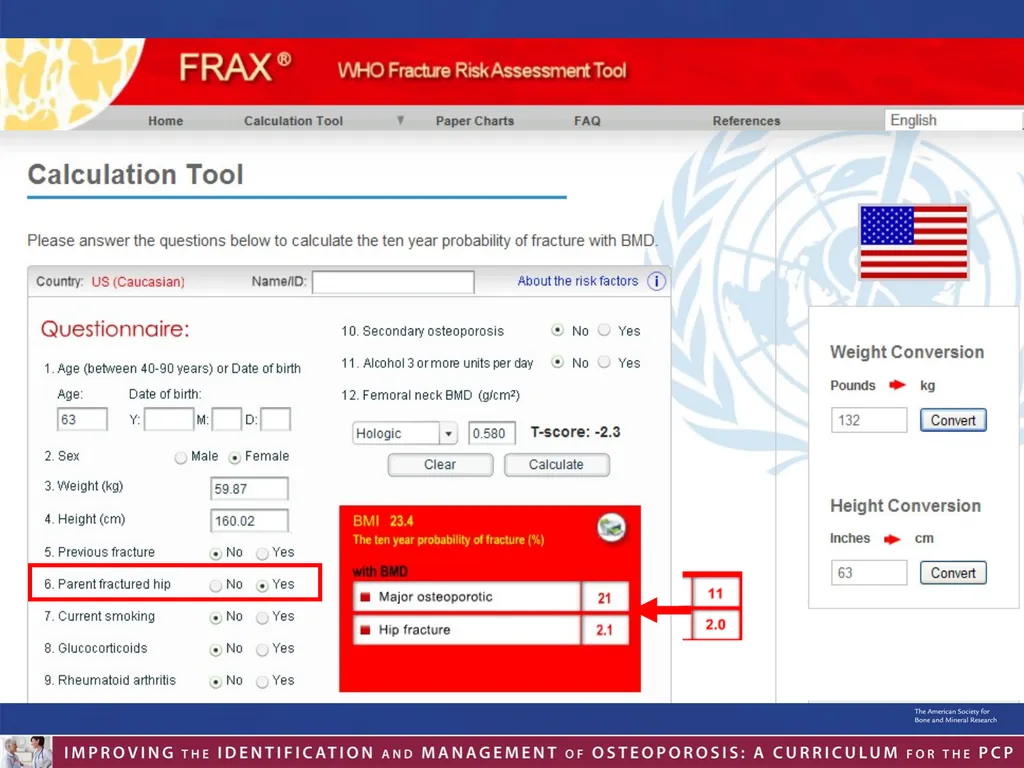
Whom to Treat: NOF Guidelines 2013 Women ≥ 65 and men ≥ 70
(younger with risk factors) DXA test ≥ 3% for hip fracture
or
≥ 20% for major osteoporotic fractures FRAX
10-y fracture risk http://www.nof.org/hcp/practice/tools. Accessed March 2013.<br>
(younger with risk factors) DXA test ≥ 3% for hip fracture
or
≥ 20% for major osteoporotic fractures FRAX
10-y fracture risk http://www.nof.org/hcp/practice/tools. Accessed March 2013.<br>
15
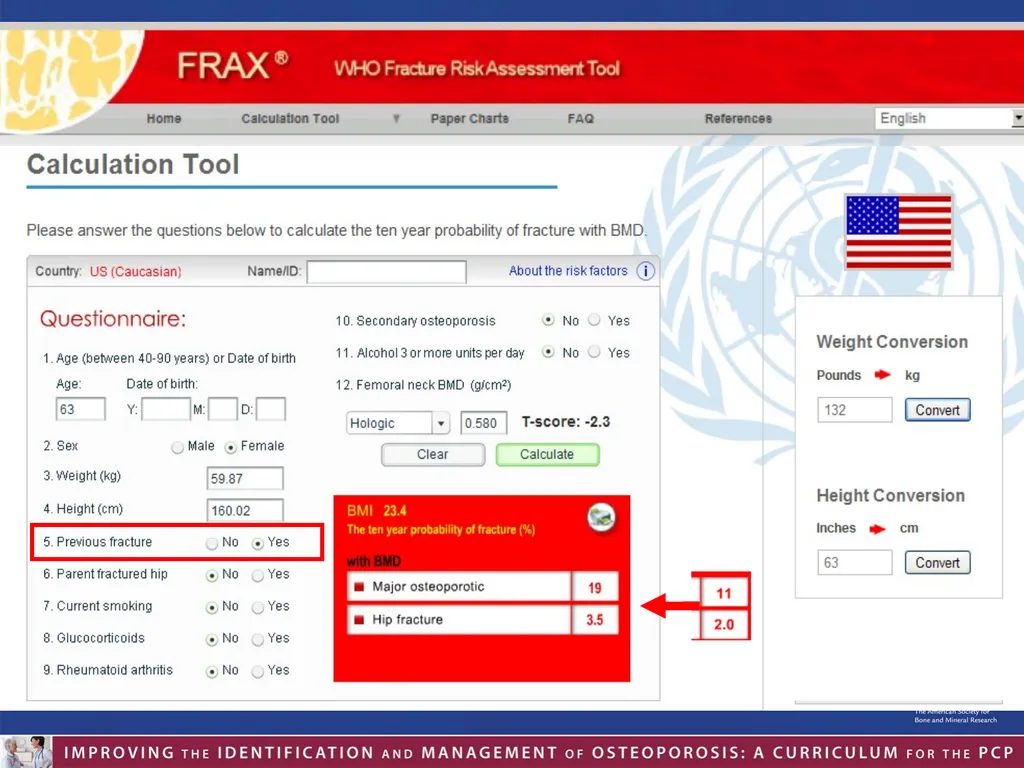
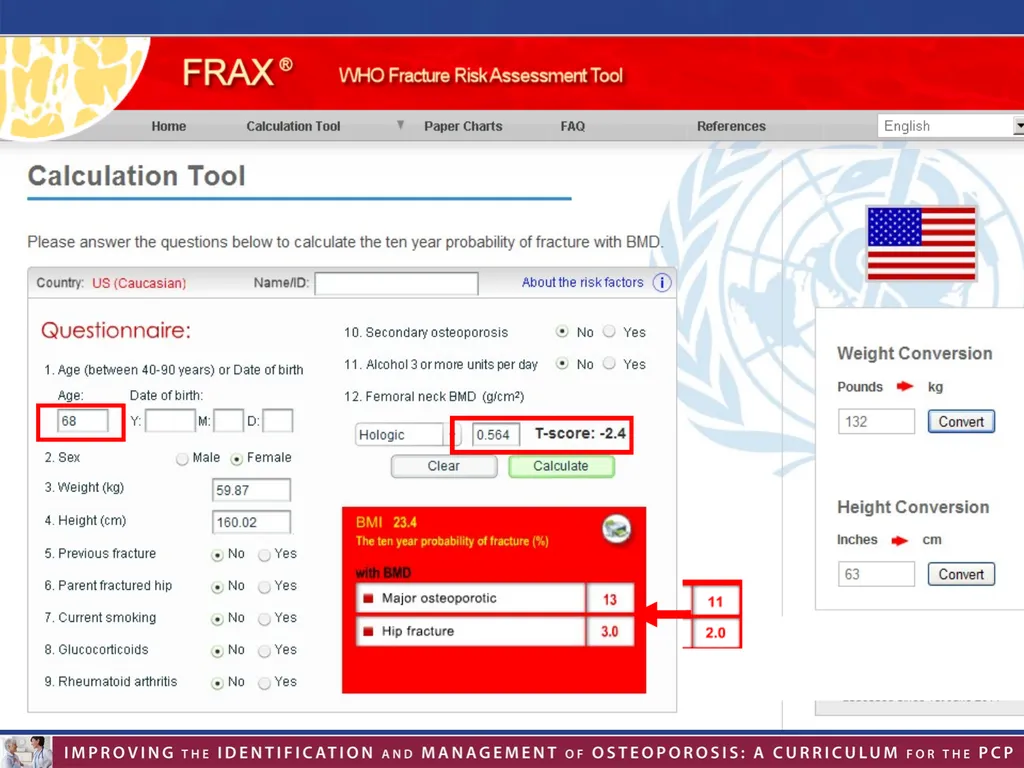
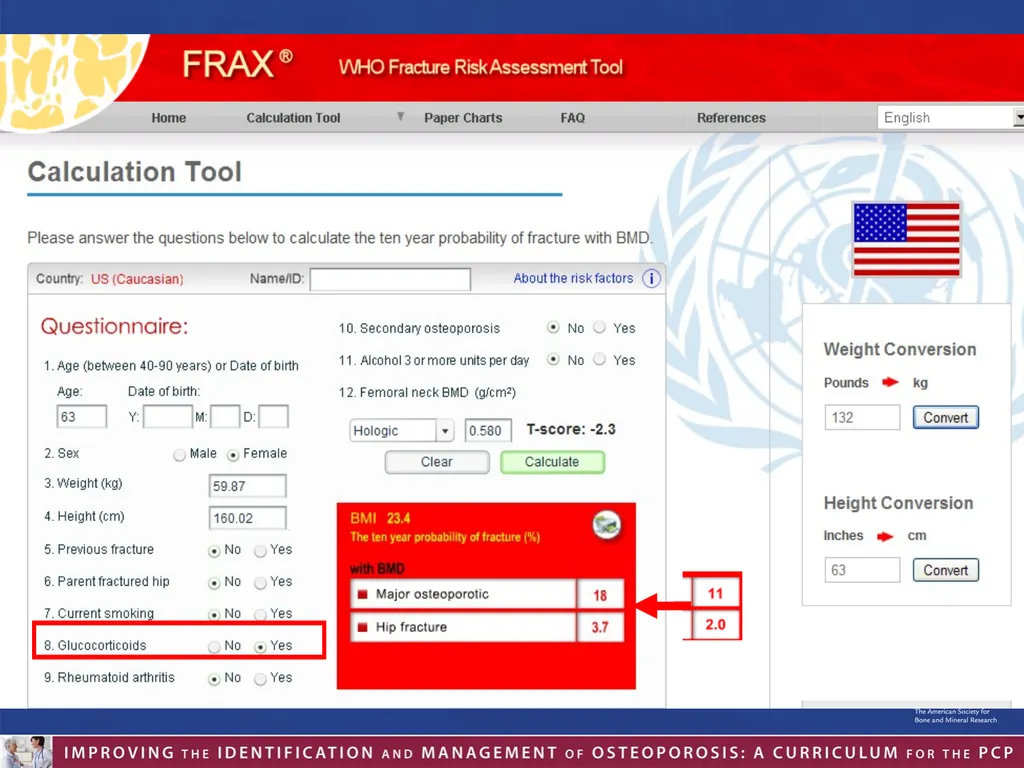
Web Version 3.4<br>
16
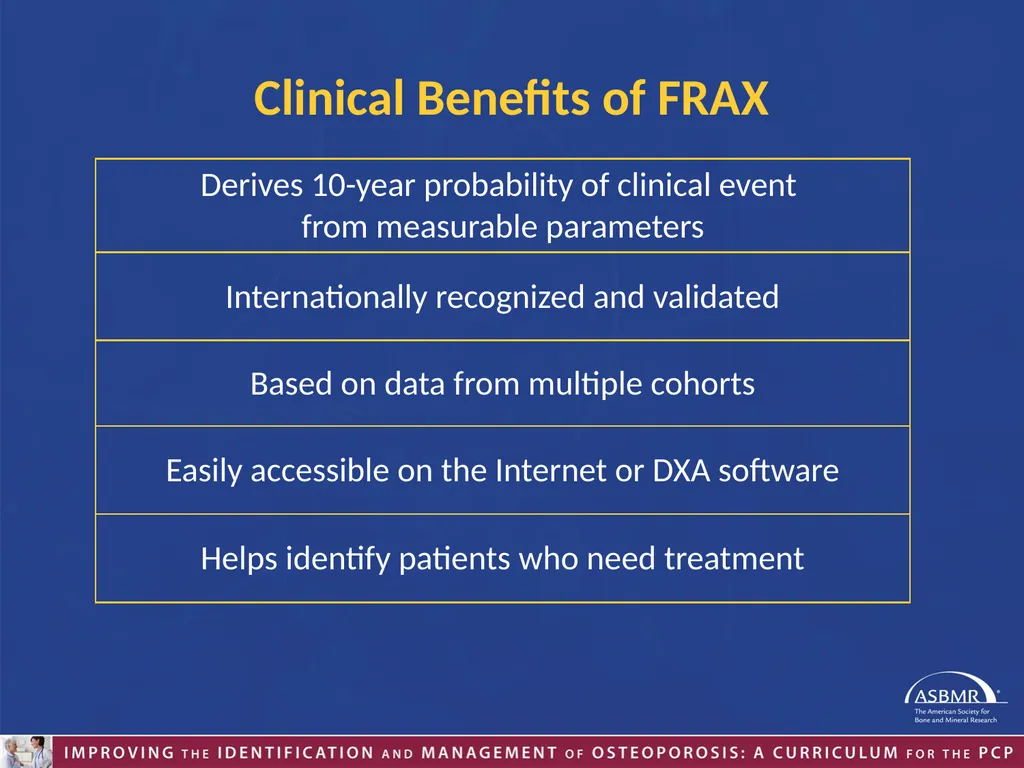
Clinical Benefits of FRAX<br>
17
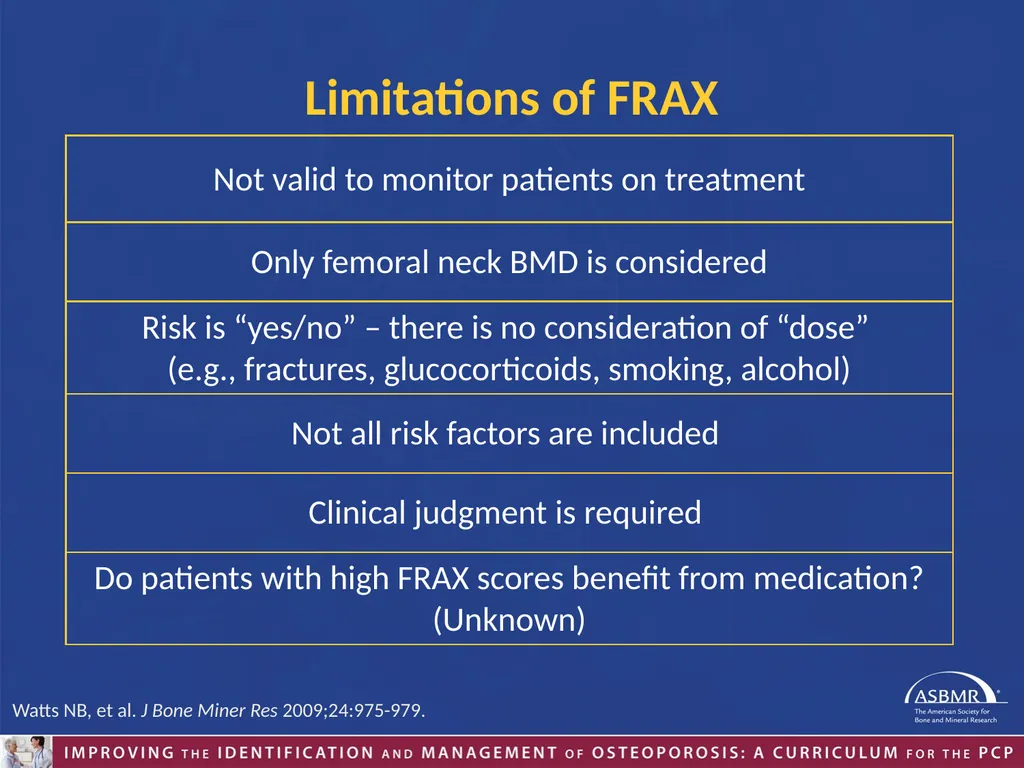
Limitations of FRAX Watts NB, et al. J Bone Miner Res 2009;24:975-979.<br>
18
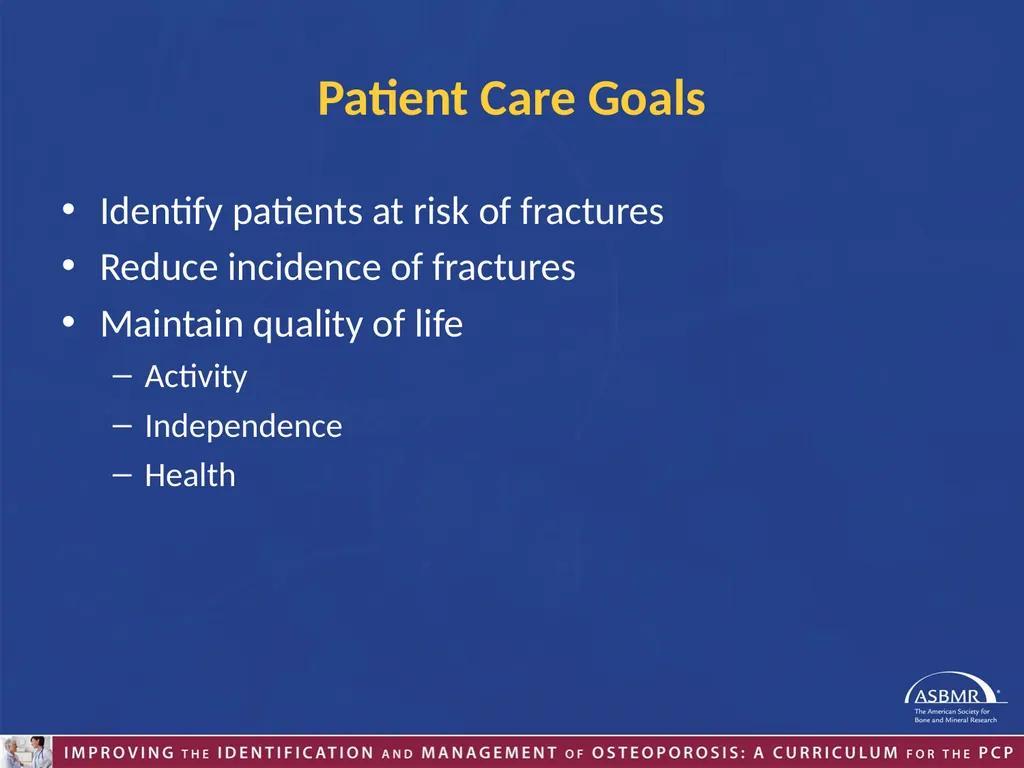
Patient Care Goals Identify patients at risk of fractures
Reduce incidence of fractures
Maintain quality of life
Activity
Independence
Health<br>
Reduce incidence of fractures
Maintain quality of life
Activity
Independence
Health<br>
19
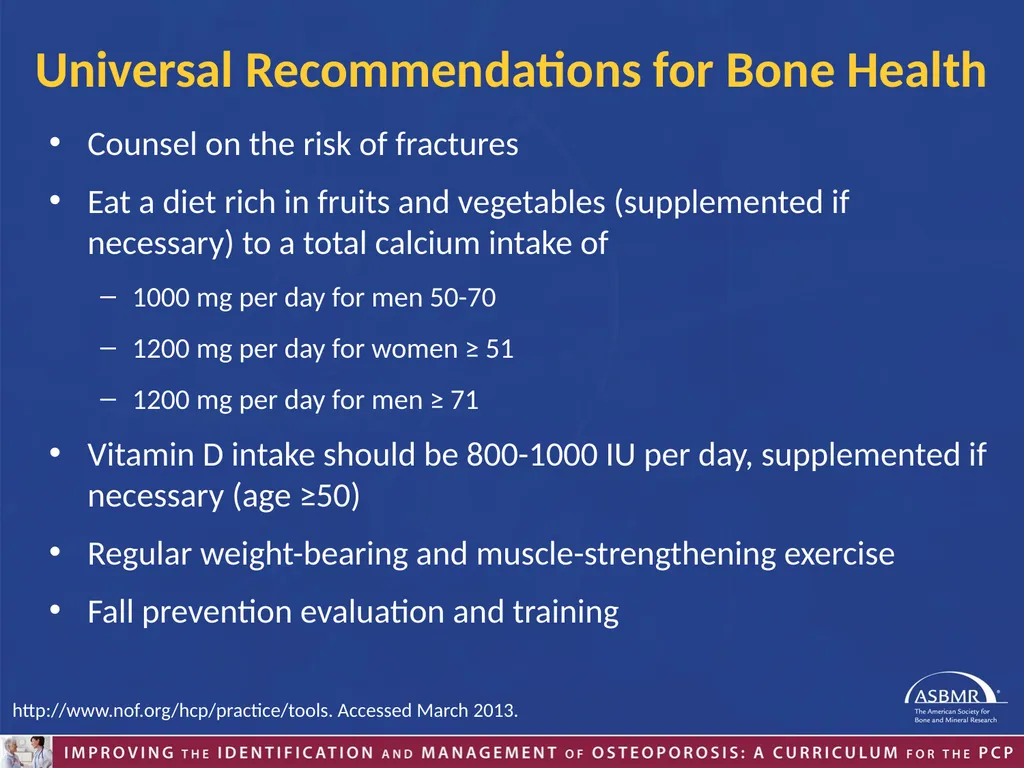
Universal Recommendations for Bone Health Counsel on the risk of fractures
Eat a diet rich in fruits and vegetables (supplemented if necessary) to a total calcium intake of
1000 mg per day for men 50-70
1200 mg per day for women ≥ 51
1200 mg per day for men ≥ 71
Vitamin D intake should be 800-1000 IU per day, supplemented if necessary (age ≥50)
Regular weight-bearing and muscle-strengthening exercise
Fall prevention evaluation and training http://www.nof.org/hcp/practice/tools. Accessed March 2013.<br>
Eat a diet rich in fruits and vegetables (supplemented if necessary) to a total calcium intake of
1000 mg per day for men 50-70
1200 mg per day for women ≥ 51
1200 mg per day for men ≥ 71
Vitamin D intake should be 800-1000 IU per day, supplemented if necessary (age ≥50)
Regular weight-bearing and muscle-strengthening exercise
Fall prevention evaluation and training http://www.nof.org/hcp/practice/tools. Accessed March 2013.<br>
20
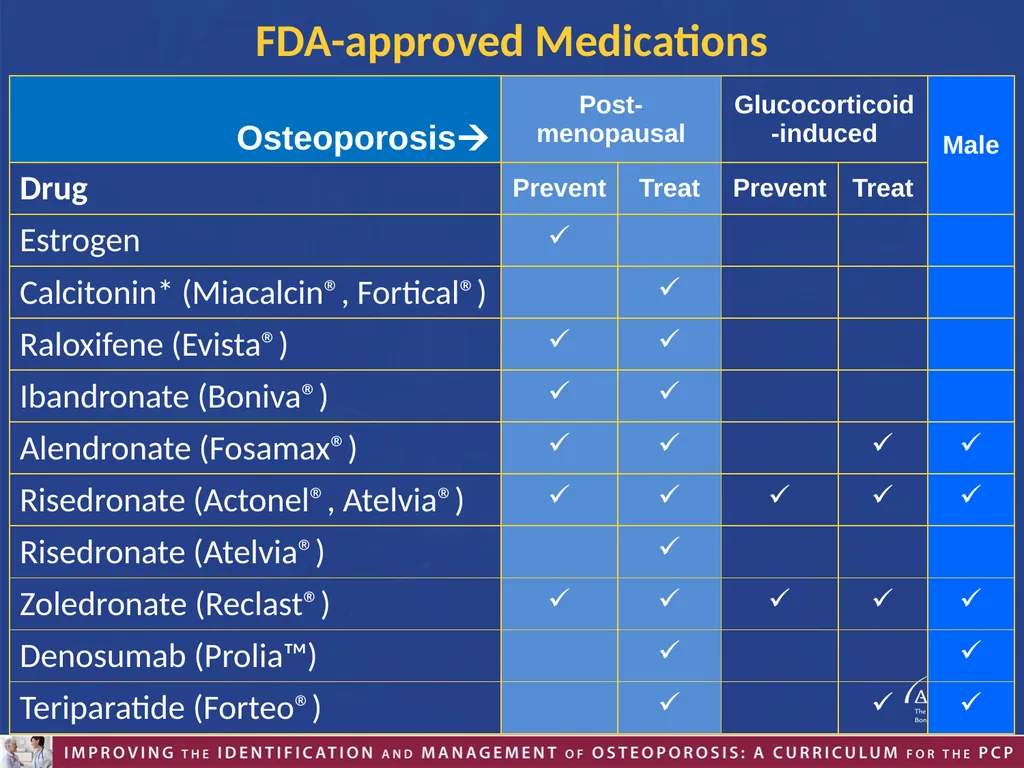
FDA-approved Medications<br>
21
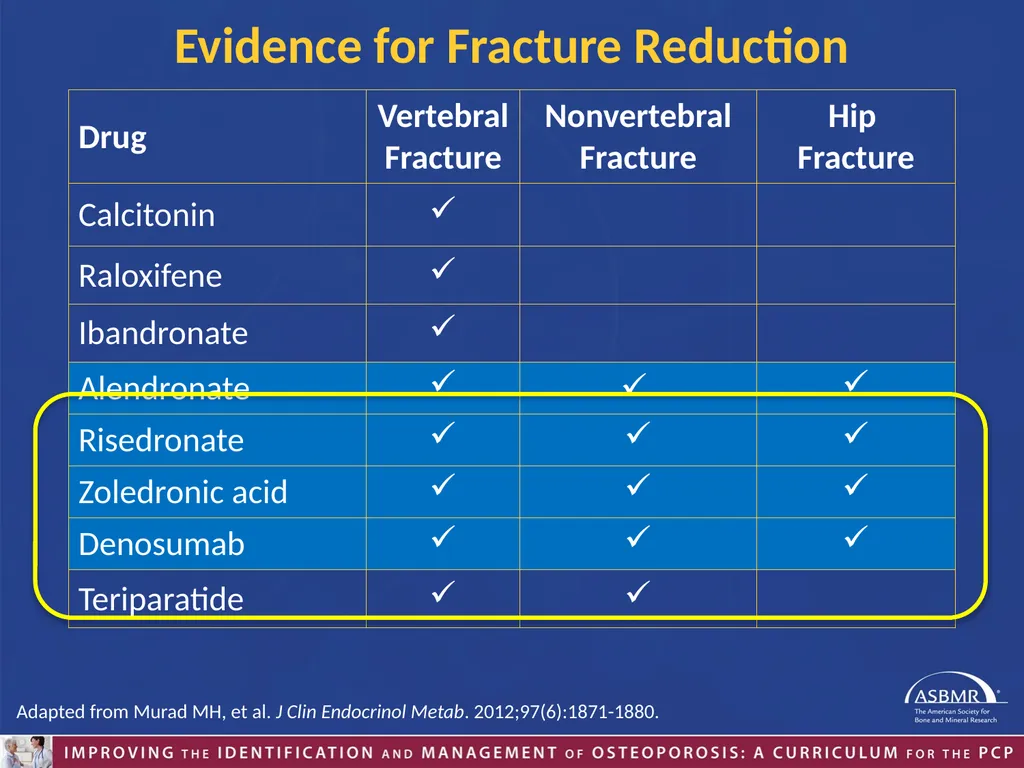
Evidence for Fracture Reduction Adapted from Murad MH, et al. J Clin Endocrinol Metab. 2012;97(6):1871-1880.<br>
22
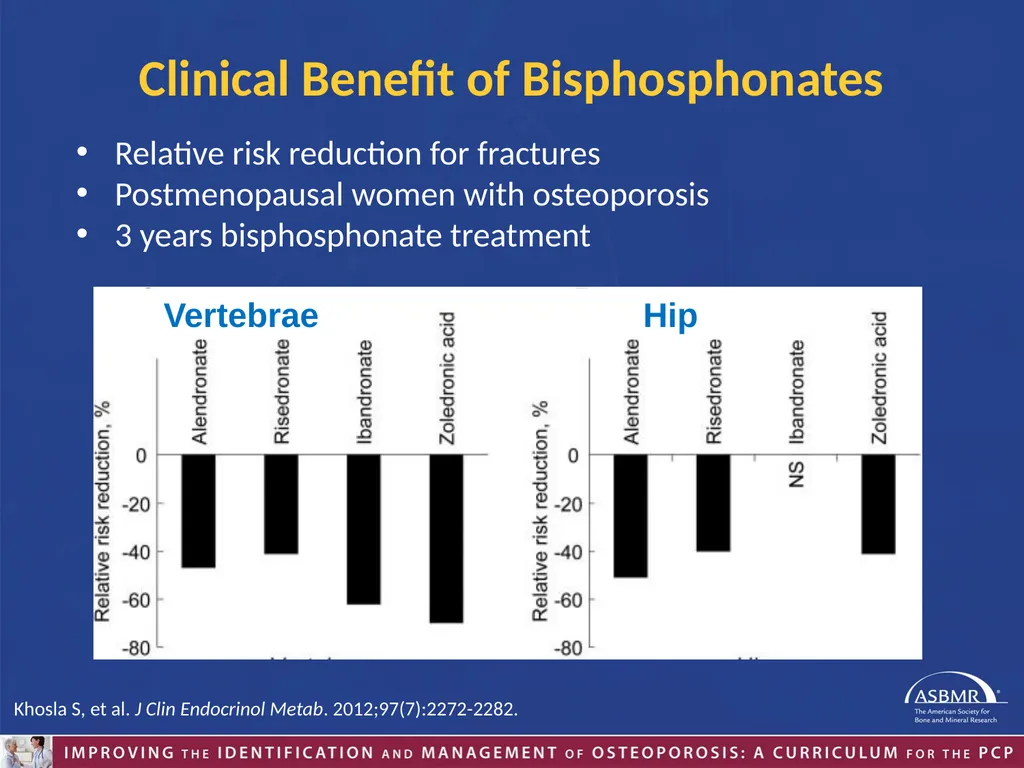
Clinical Benefit of Bisphosphonates Relative risk reduction for fractures
Postmenopausal women with osteoporosis
3 years bisphosphonate treatment Khosla S, et al. J Clin Endocrinol Metab. 2012;97(7):2272-2282.<br>
Postmenopausal women with osteoporosis
3 years bisphosphonate treatment Khosla S, et al. J Clin Endocrinol Metab. 2012;97(7):2272-2282.<br>
23
Bisphosphonates
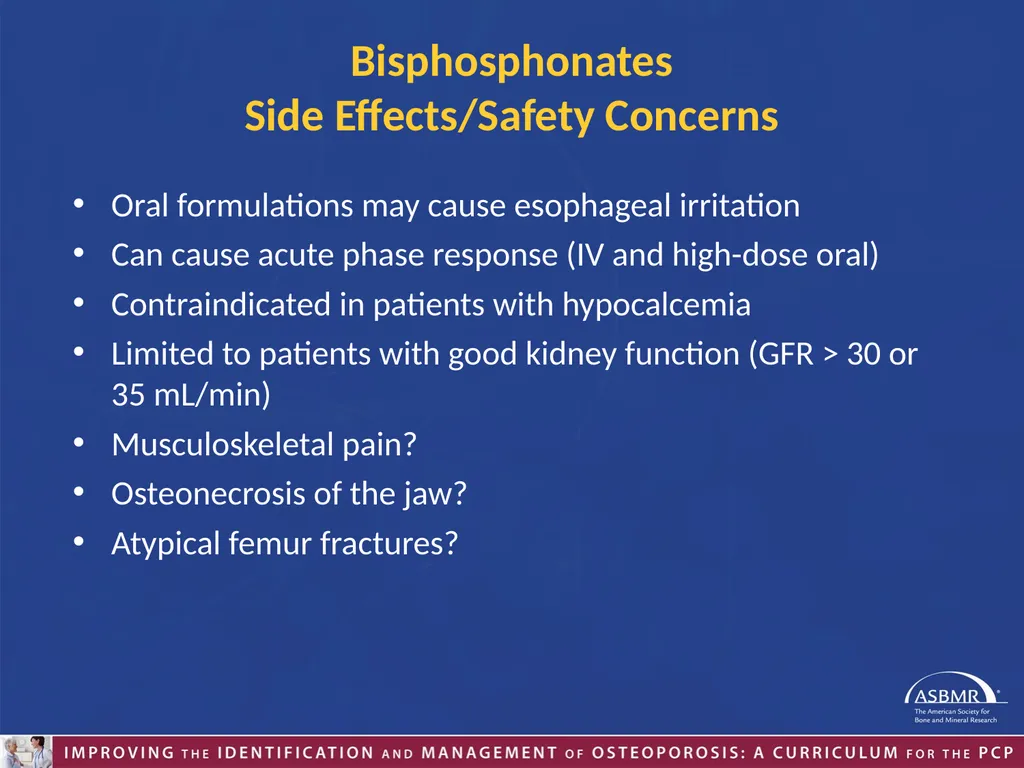
Side Effects/Safety Concerns Oral formulations may cause esophageal irritation
Can cause acute phase response (IV and high-dose oral)
Contraindicated in patients with hypocalcemia
Limited to patients with good kidney function (GFR > 30 or 35 mL/min)
Musculoskeletal pain?
Osteonecrosis of the jaw?
Atypical femur fractures?<br>
Can cause acute phase response (IV and high-dose oral)
Contraindicated in patients with hypocalcemia
Limited to patients with good kidney function (GFR > 30 or 35 mL/min)
Musculoskeletal pain?
Osteonecrosis of the jaw?
Atypical femur fractures?<br>
24
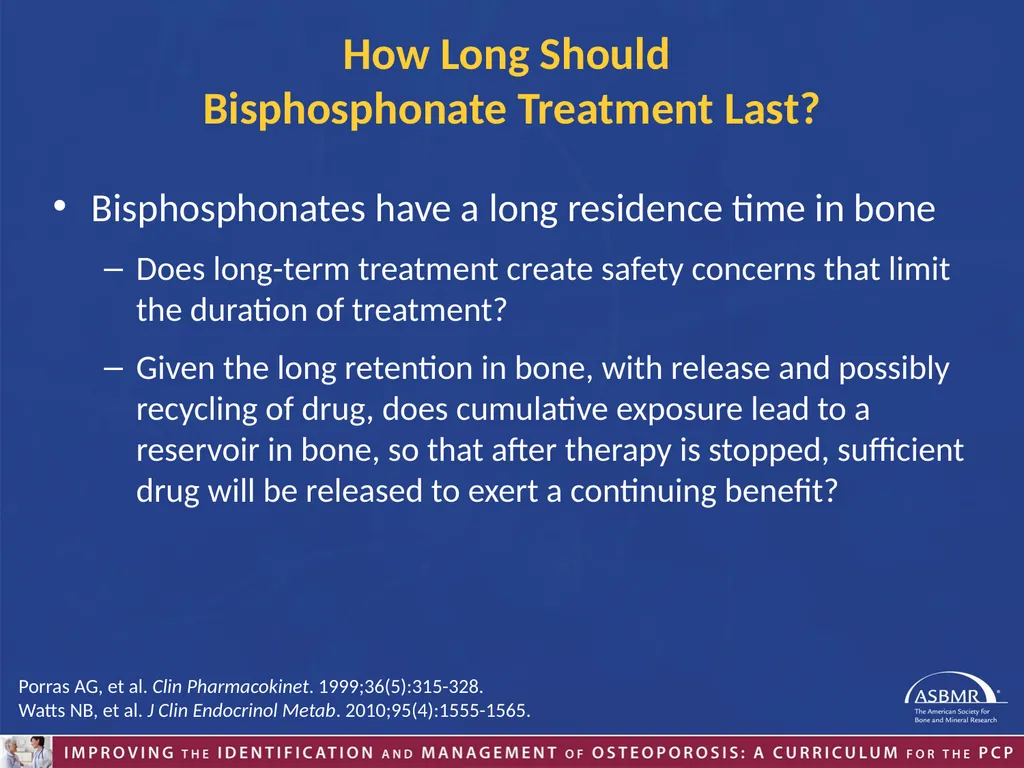
Bisphosphonates have a long residence time in bone
Does long-term treatment create safety concerns that limit the duration of treatment?
Given the long retention in bone, with release and possibly recycling of drug, does cumulative exposure lead to a reservoir in bone, so that after therapy is stopped, sufficient drug will be released to exert a continuing benefit? How Long Should Bisphosphonate Treatment Last? Porras AG, et al. Clin Pharmacokinet. 1999;36(5):315-328.
Watts NB, et al. J Clin Endocrinol Metab. 2010;95(4):1555-1565.<br>
Does long-term treatment create safety concerns that limit the duration of treatment?
Given the long retention in bone, with release and possibly recycling of drug, does cumulative exposure lead to a reservoir in bone, so that after therapy is stopped, sufficient drug will be released to exert a continuing benefit? How Long Should Bisphosphonate Treatment Last? Porras AG, et al. Clin Pharmacokinet. 1999;36(5):315-328.
Watts NB, et al. J Clin Endocrinol Metab. 2010;95(4):1555-1565.<br>
25
Long-term Experience with Alendronate
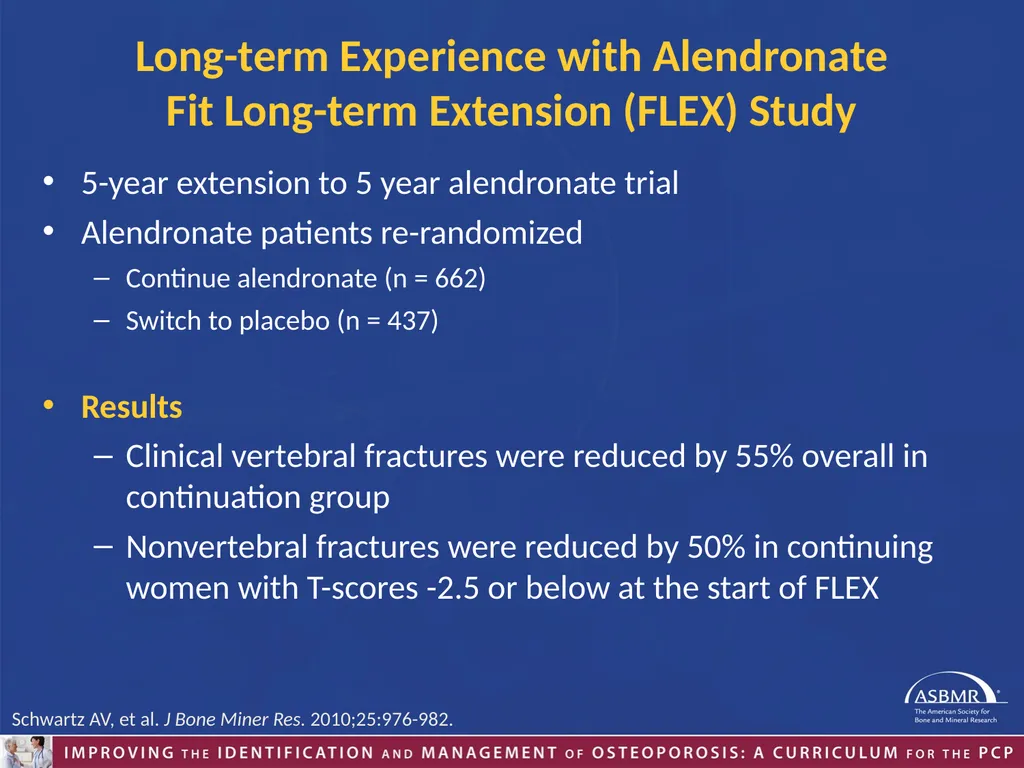
Fit Long-term Extension (FLEX) Study 5-year extension to 5 year alendronate trial
Alendronate patients re-randomized
Continue alendronate (n = 662)
Switch to placebo (n = 437)
Results
Clinical vertebral fractures were reduced by 55% overall in continuation group
Nonvertebral fractures were reduced by 50% in continuing women with T-scores -2.5 or below at the start of FLEX Schwartz AV, et al. J Bone Miner Res. 2010;25:976-982.<br>
Alendronate patients re-randomized
Continue alendronate (n = 662)
Switch to placebo (n = 437)
Results
Clinical vertebral fractures were reduced by 55% overall in continuation group
Nonvertebral fractures were reduced by 50% in continuing women with T-scores -2.5 or below at the start of FLEX Schwartz AV, et al. J Bone Miner Res. 2010;25:976-982.<br>
26
Clinical Vertebral Fractures
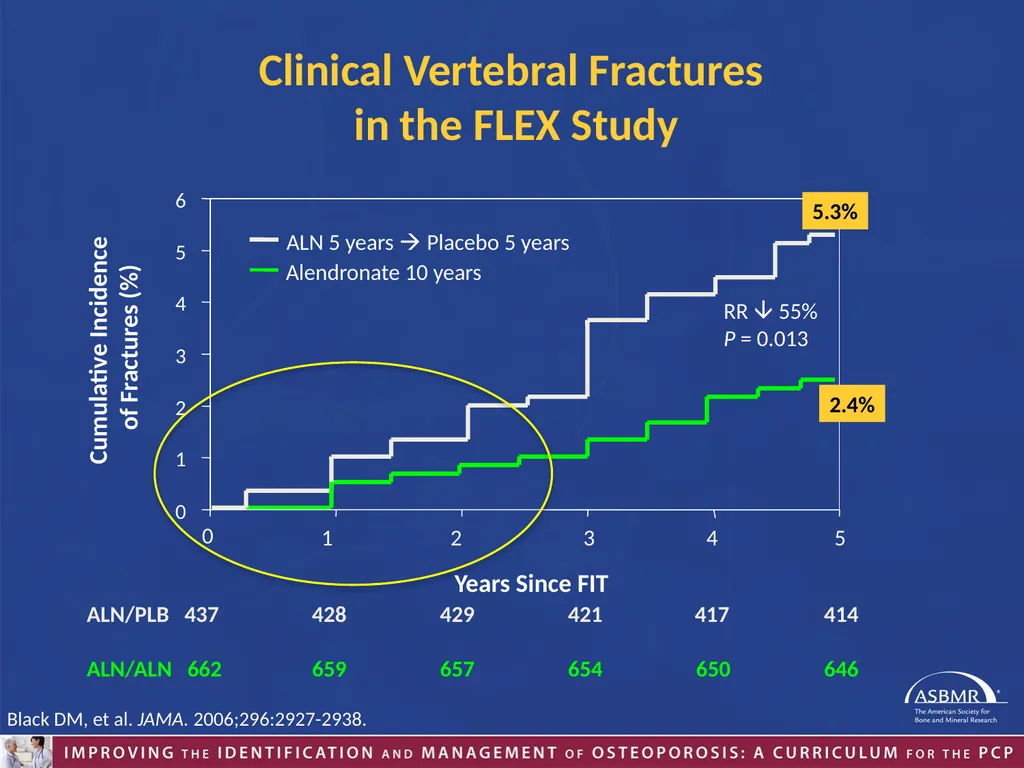
in the FLEX Study 0 1 2 4 5 Cumulative Incidence
of Fractures (%) Years Since FIT ALN/PLB 437 428 429 421 417 414
ALN/ALN 662 659 657 654 650 646 3 0 1 2 3 4 5 6 ALN 5 years Placebo 5 years Alendronate 10 years 5.3% RR 55%
P = 0.013 2.4% Black DM, et al. JAMA. 2006;296:2927-2938.<br>
of Fractures (%) Years Since FIT ALN/PLB 437 428 429 421 417 414
ALN/ALN 662 659 657 654 650 646 3 0 1 2 3 4 5 6 ALN 5 years Placebo 5 years Alendronate 10 years 5.3% RR 55%
P = 0.013 2.4% Black DM, et al. JAMA. 2006;296:2927-2938.<br>
27
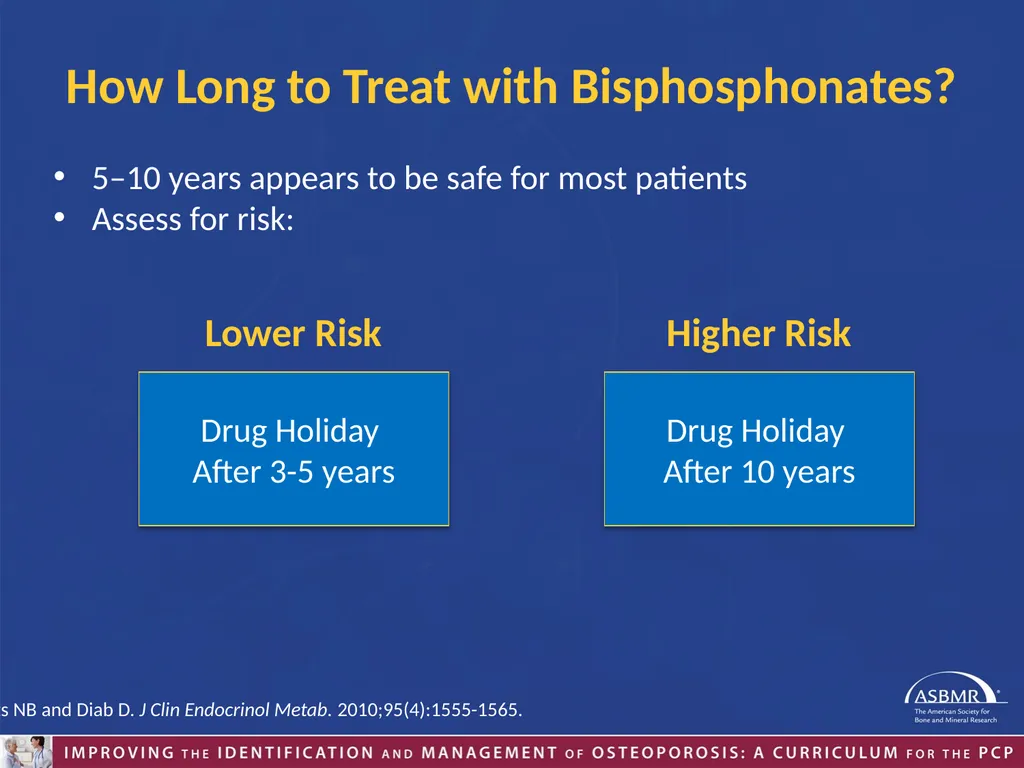
How Long to Treat with Bisphosphonates? 5–10 years appears to be safe for most patients
Assess for risk: Watts NB and Diab D. J Clin Endocrinol Metab. 2010;95(4):1555-1565. Drug Holiday
After 3-5 years Drug Holiday
After 10 years Higher Risk Lower Risk<br>
Assess for risk: Watts NB and Diab D. J Clin Endocrinol Metab. 2010;95(4):1555-1565. Drug Holiday
After 3-5 years Drug Holiday
After 10 years Higher Risk Lower Risk<br>
28
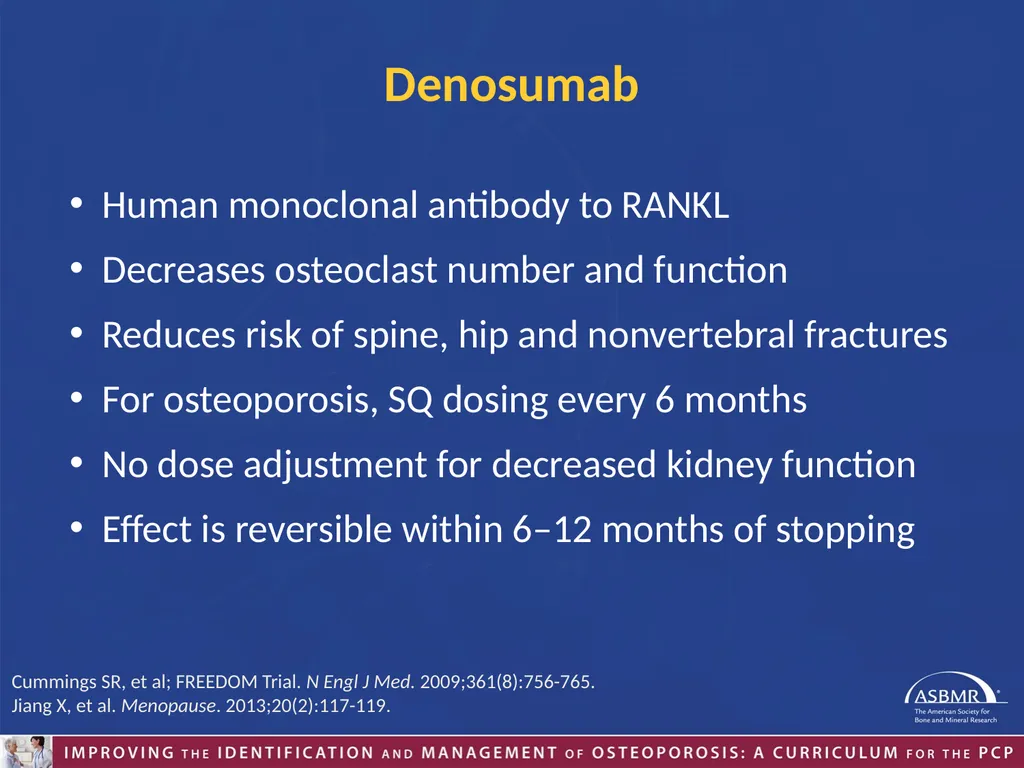
Denosumab Human monoclonal antibody to RANKL
Decreases osteoclast number and function
Reduces risk of spine, hip and nonvertebral fractures
For osteoporosis, SQ dosing every 6 months
No dose adjustment for decreased kidney function
Effect is reversible within 6–12 months of stopping Cummings SR, et al; FREEDOM Trial. N Engl J Med. 2009;361(8):756-765.
Jiang X, et al. Menopause. 2013;20(2):117-119.<br>
Decreases osteoclast number and function
Reduces risk of spine, hip and nonvertebral fractures
For osteoporosis, SQ dosing every 6 months
No dose adjustment for decreased kidney function
Effect is reversible within 6–12 months of stopping Cummings SR, et al; FREEDOM Trial. N Engl J Med. 2009;361(8):756-765.
Jiang X, et al. Menopause. 2013;20(2):117-119.<br>
29
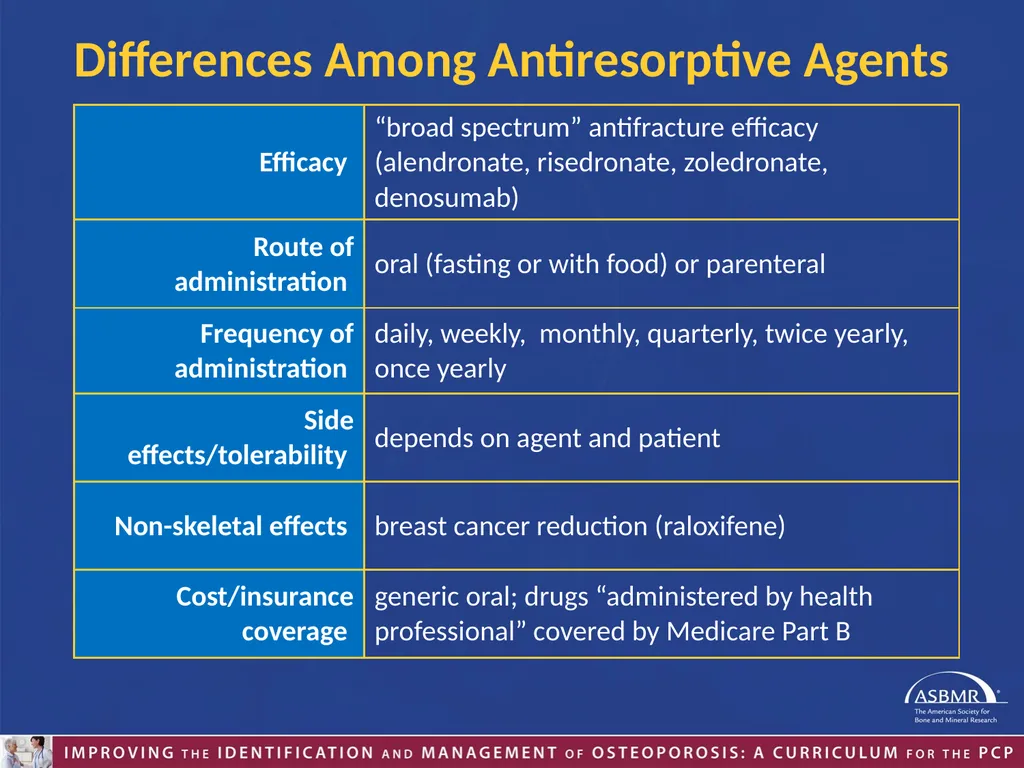
Differences Among Antiresorptive Agents<br>
30
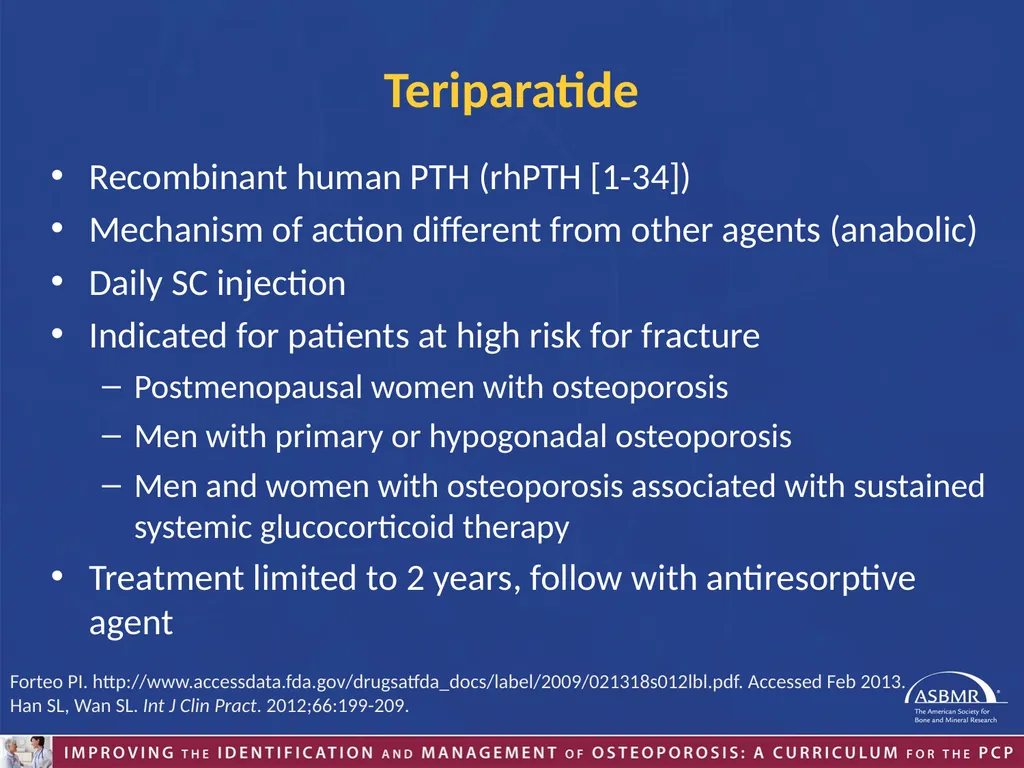
Teriparatide Recombinant human PTH (rhPTH [1-34])
Mechanism of action different from other agents (anabolic)
Daily SC injection
Indicated for patients at high risk for fracture
Postmenopausal women with osteoporosis
Men with primary or hypogonadal osteoporosis
Men and women with osteoporosis associated with sustained systemic glucocorticoid therapy
Treatment limited to 2 years, follow with antiresorptive agent Forteo PI. http://www.accessdata.fda.gov/drugsatfda_docs/label/2009/021318s012lbl.pdf. Accessed Feb 2013.
Han SL, Wan SL. Int J Clin Pract. 2012;66:199-209.<br>
Mechanism of action different from other agents (anabolic)
Daily SC injection
Indicated for patients at high risk for fracture
Postmenopausal women with osteoporosis
Men with primary or hypogonadal osteoporosis
Men and women with osteoporosis associated with sustained systemic glucocorticoid therapy
Treatment limited to 2 years, follow with antiresorptive agent Forteo PI. http://www.accessdata.fda.gov/drugsatfda_docs/label/2009/021318s012lbl.pdf. Accessed Feb 2013.
Han SL, Wan SL. Int J Clin Pract. 2012;66:199-209.<br>
31
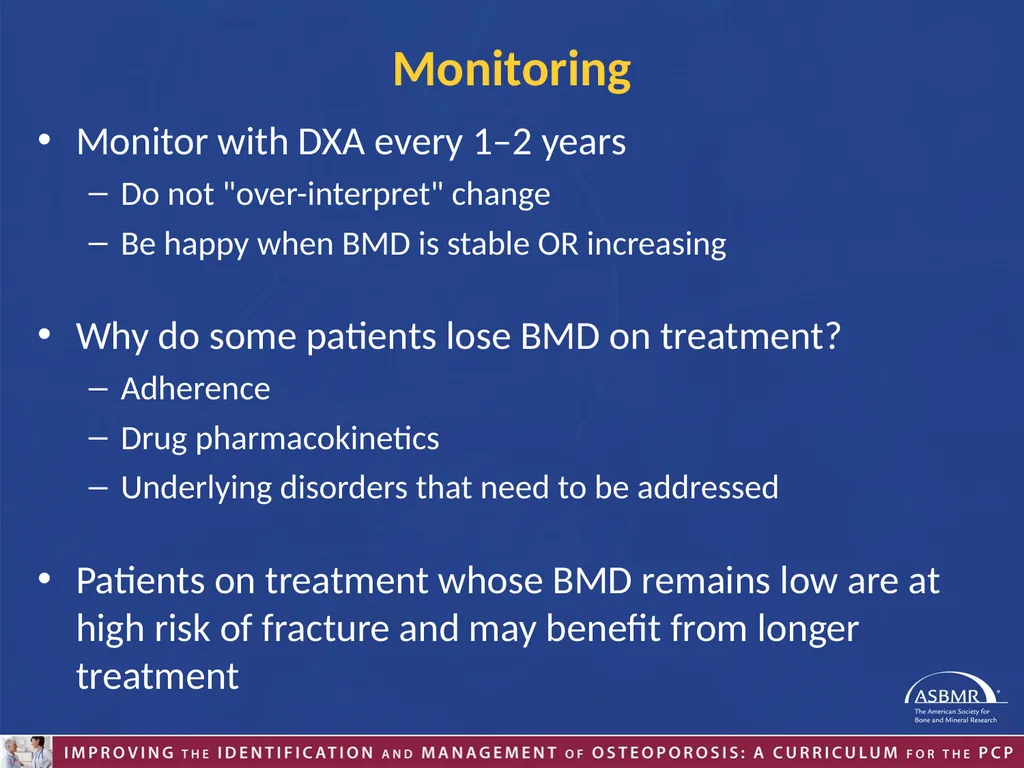
Monitor with DXA every 1–2 years
Do not "over-interpret" change
Be happy when BMD is stable OR increasing
Why do some patients lose BMD on treatment?
Adherence
Drug pharmacokinetics
Underlying disorders that need to be addressed
Patients on treatment whose BMD remains low are at high risk of fracture and may benefit from longer treatment Monitoring<br>
Do not "over-interpret" change
Be happy when BMD is stable OR increasing
Why do some patients lose BMD on treatment?
Adherence
Drug pharmacokinetics
Underlying disorders that need to be addressed
Patients on treatment whose BMD remains low are at high risk of fracture and may benefit from longer treatment Monitoring<br>
32
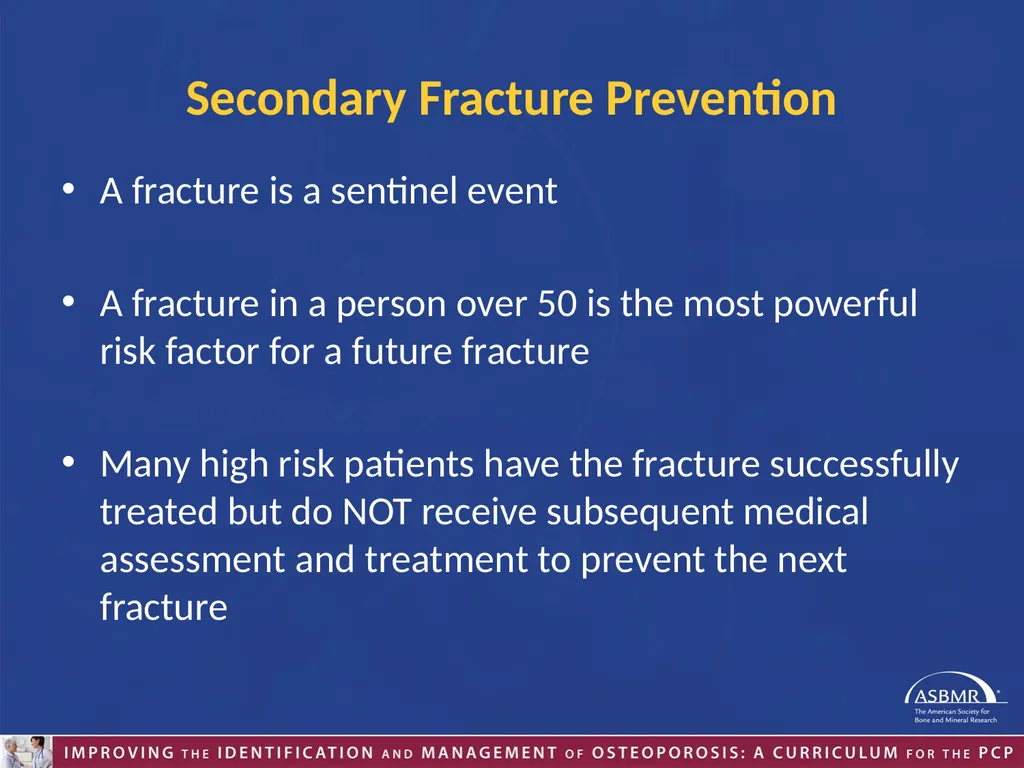
Secondary Fracture Prevention A fracture is a sentinel event
A fracture in a person over 50 is the most powerful risk factor for a future fracture
Many high risk patients have the fracture successfully treated but do NOT receive subsequent medical assessment and treatment to prevent the next fracture<br>
A fracture in a person over 50 is the most powerful risk factor for a future fracture
Many high risk patients have the fracture successfully treated but do NOT receive subsequent medical assessment and treatment to prevent the next fracture<br>
33
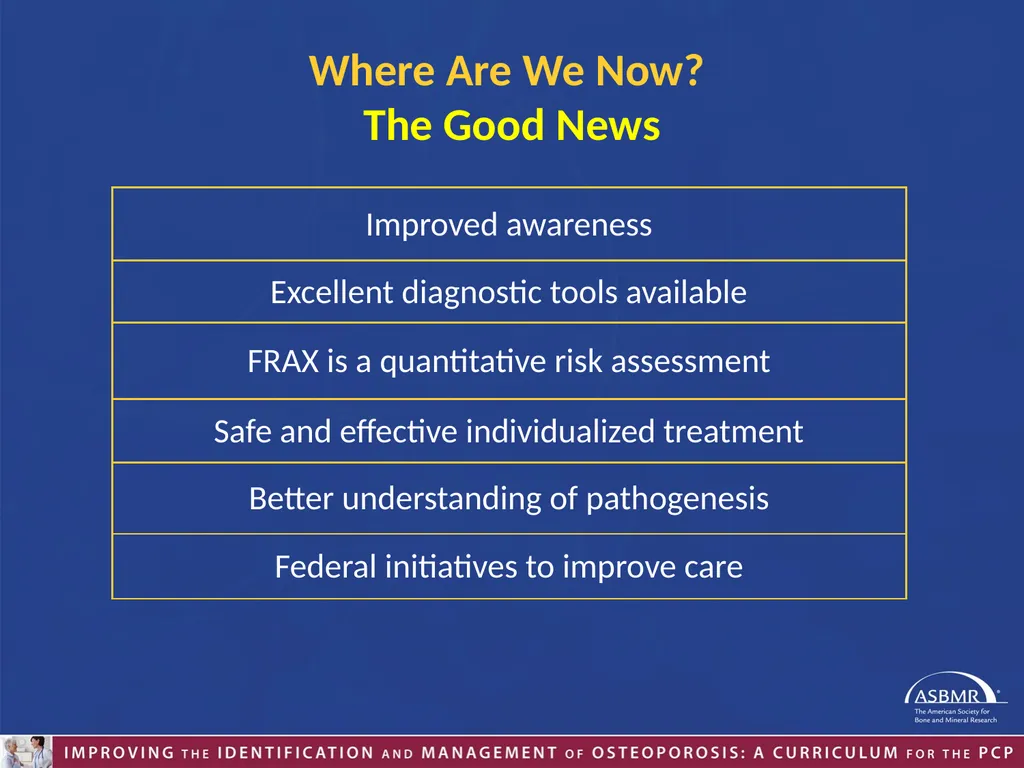
Where Are We Now?
The Good News<br>
34
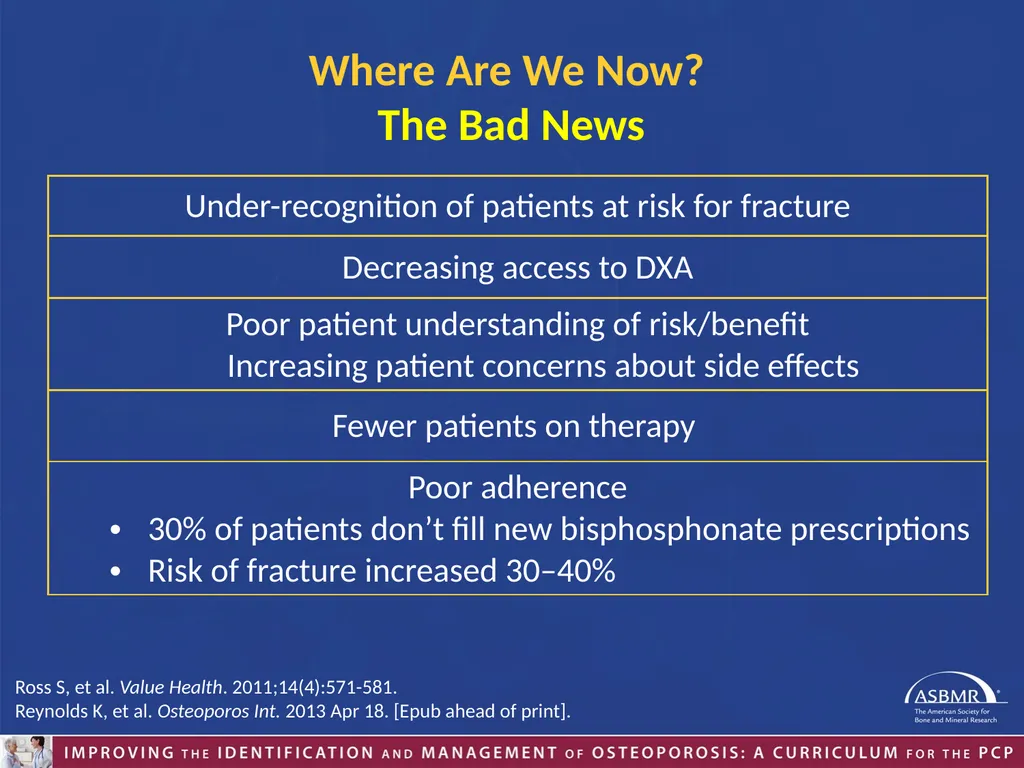
Where Are We Now?
The Bad News Ross S, et al. Value Health. 2011;14(4):571-581.
Reynolds K, et al. Osteoporos Int. 2013 Apr 18. [Epub ahead of print].<br>
Reynolds K, et al. Osteoporos Int. 2013 Apr 18. [Epub ahead of print].<br>
35
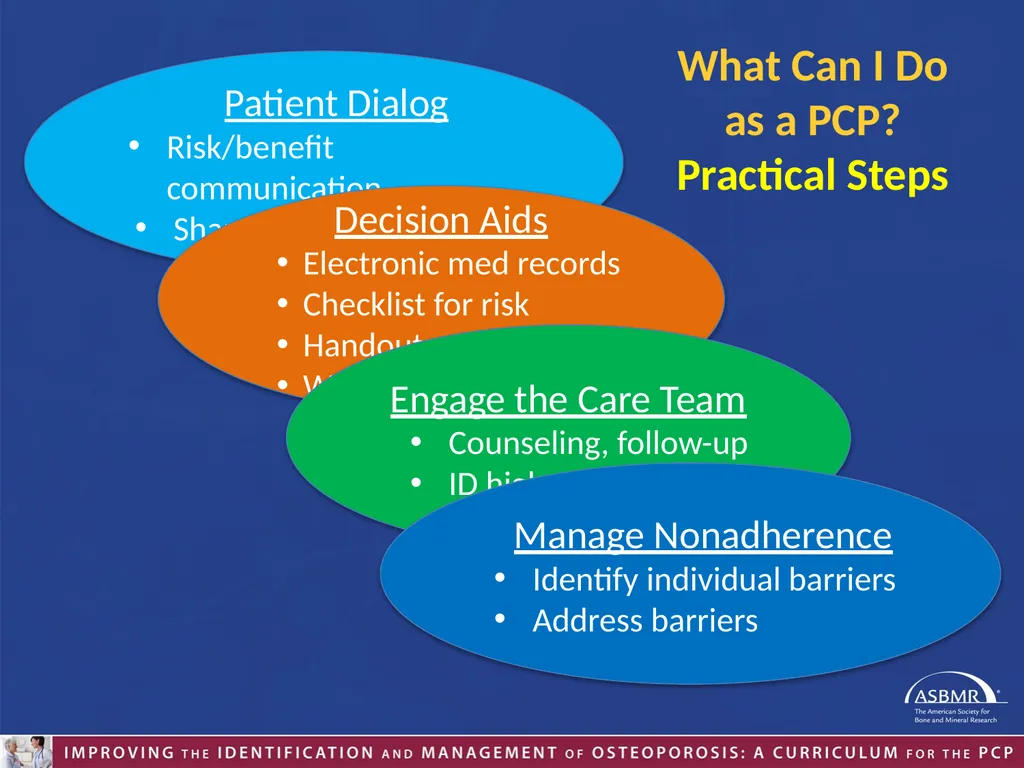
What Can I Do as a PCP?
Practical Steps Patient Dialog
Risk/benefit communication
Shared decision making Decision Aids
Electronic med records
Checklist for risk
Handouts
Web resources Engage the Care Team
Counseling, follow-up
ID high-risk patients Manage Nonadherence
Identify individual barriers
Address barriers<br>
Risk/benefit communication
Shared decision making Decision Aids
Electronic med records
Checklist for risk
Handouts
Web resources Engage the Care Team
Counseling, follow-up
ID high-risk patients Manage Nonadherence
Identify individual barriers
Address barriers<br>
36
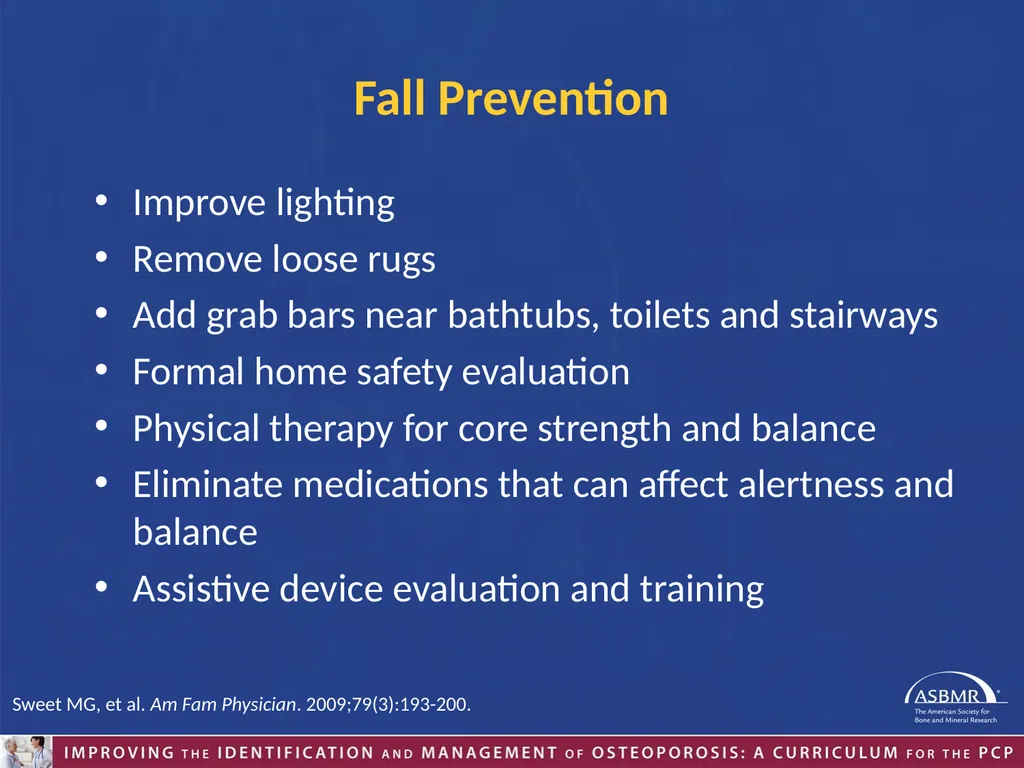
Fall Prevention Improve lighting
Remove loose rugs
Add grab bars near bathtubs, toilets and stairways
Formal home safety evaluation
Physical therapy for core strength and balance
Eliminate medications that can affect alertness and balance
Assistive device evaluation and training Sweet MG, et al. Am Fam Physician. 2009;79(3):193-200.<br>
Remove loose rugs
Add grab bars near bathtubs, toilets and stairways
Formal home safety evaluation
Physical therapy for core strength and balance
Eliminate medications that can affect alertness and balance
Assistive device evaluation and training Sweet MG, et al. Am Fam Physician. 2009;79(3):193-200.<br>
37
What Can I Do as a PCP?
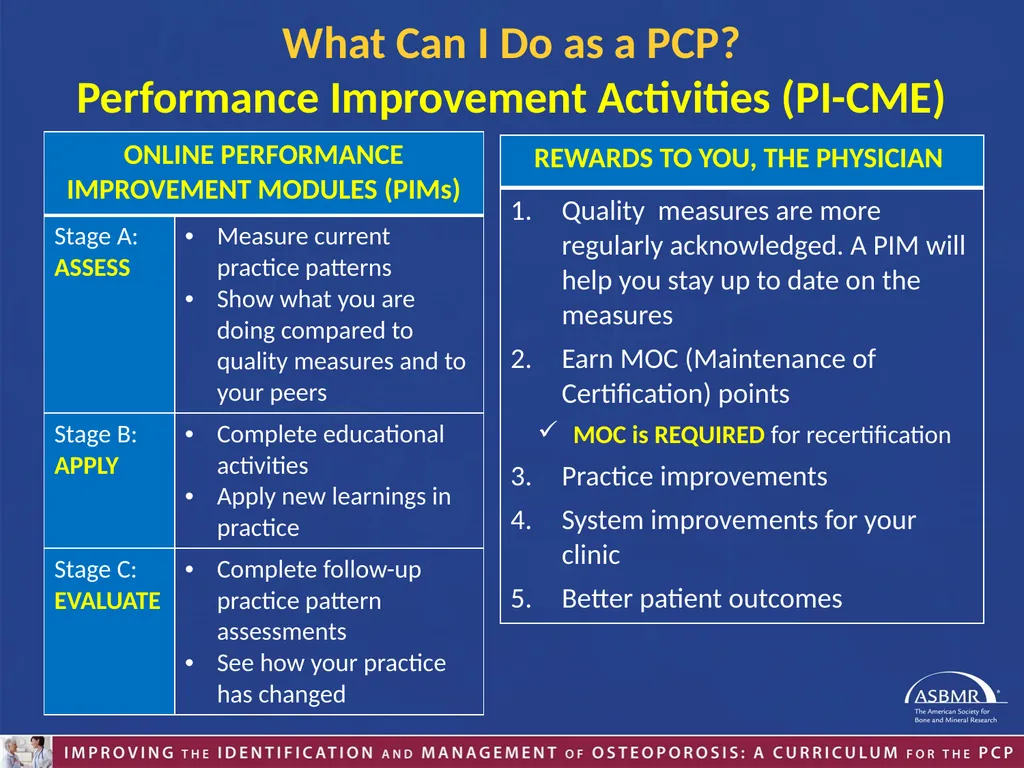
Performance Improvement Activities (PI-CME)<br>
38
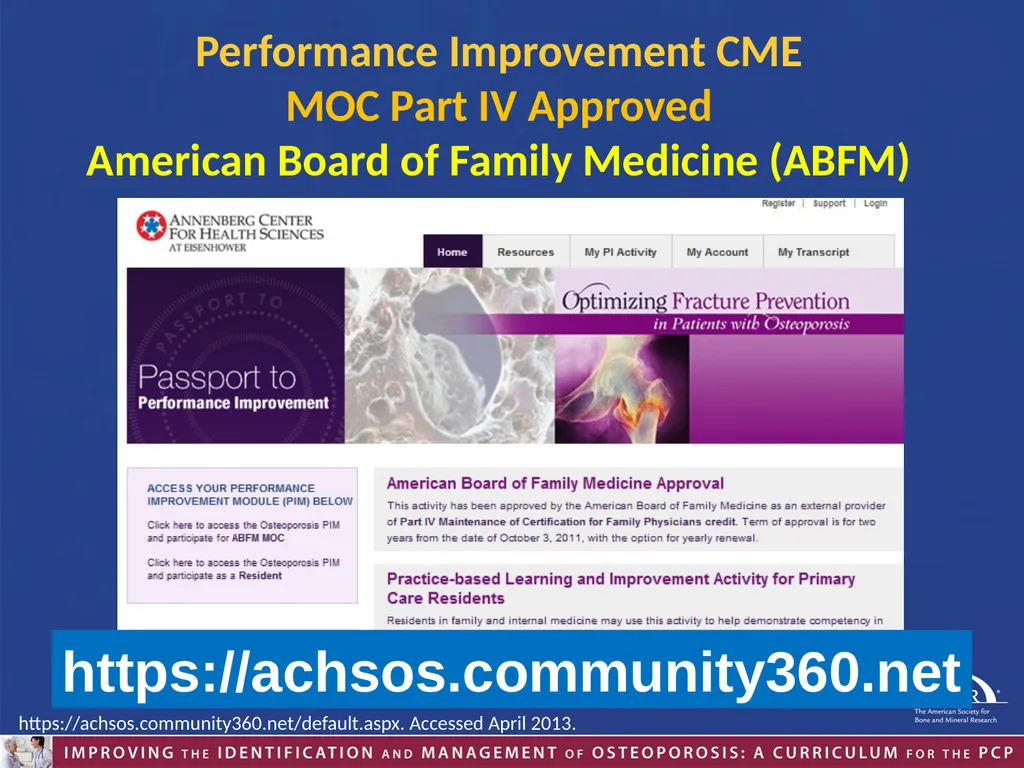
Performance Improvement CME
MOC Part IV Approved
American Board of Family Medicine (ABFM) https://achsos.community360.net/default.aspx. Accessed April 2013. https://achsos.community360.net<br>
MOC Part IV Approved
American Board of Family Medicine (ABFM) https://achsos.community360.net/default.aspx. Accessed April 2013. https://achsos.community360.net<br>
39
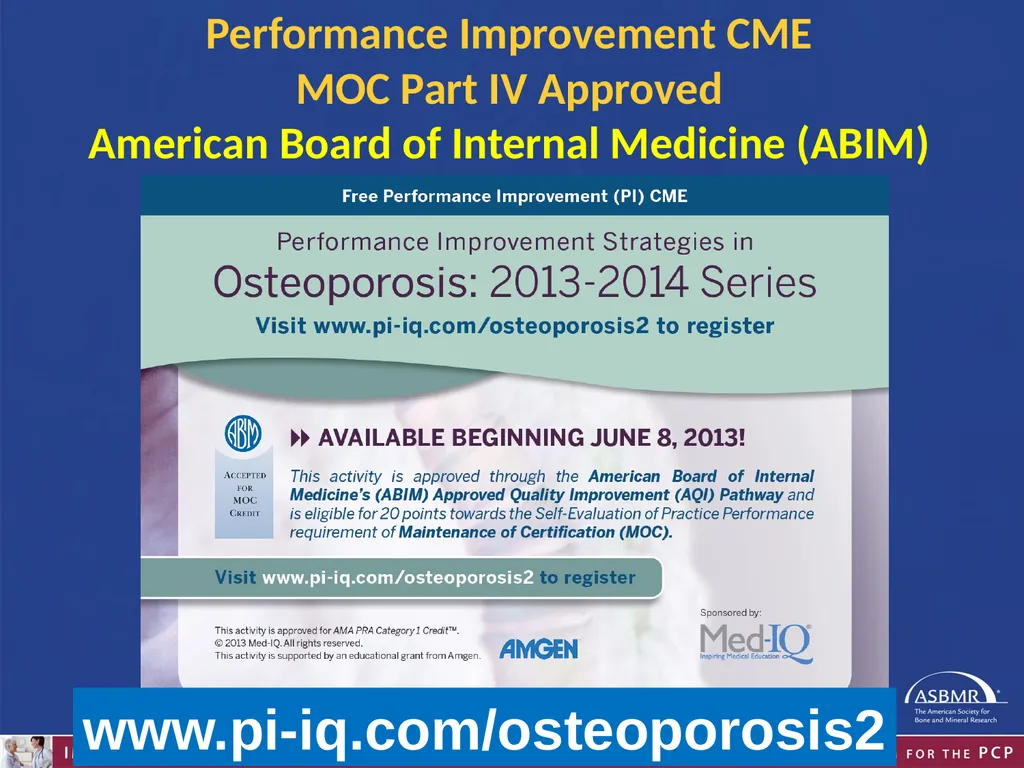
Performance Improvement CME
MOC Part IV Approved
American Board of Internal Medicine (ABIM) www.pi-iq.com/osteoporosis2<br>
MOC Part IV Approved
American Board of Internal Medicine (ABIM) www.pi-iq.com/osteoporosis2<br>
40
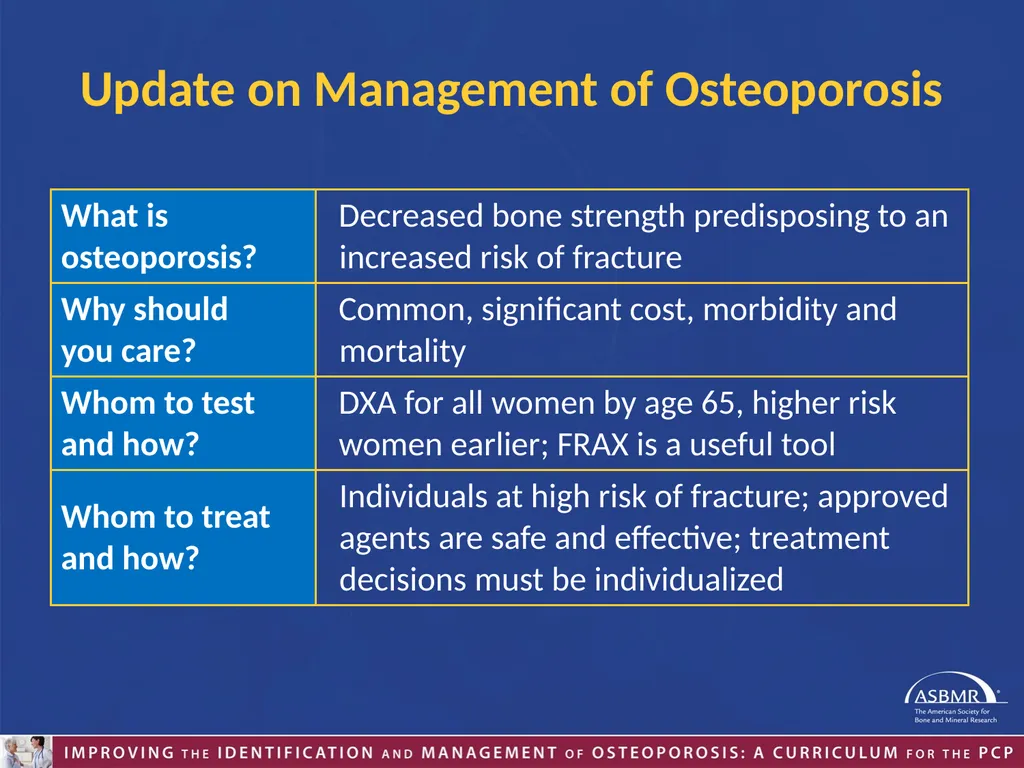
Update on Management of Osteoporosis<br>
41
Online Tools and Resources www.osteoCME.org
FRAX
AAFP guidelines
NOF Clinician’s Guide 2013
ACP treatment guidelines 2008
NBHA resource center for Fracture Liaison Services<br>
FRAX
AAFP guidelines
NOF Clinician’s Guide 2013
ACP treatment guidelines 2008
NBHA resource center for Fracture Liaison Services<br>
42
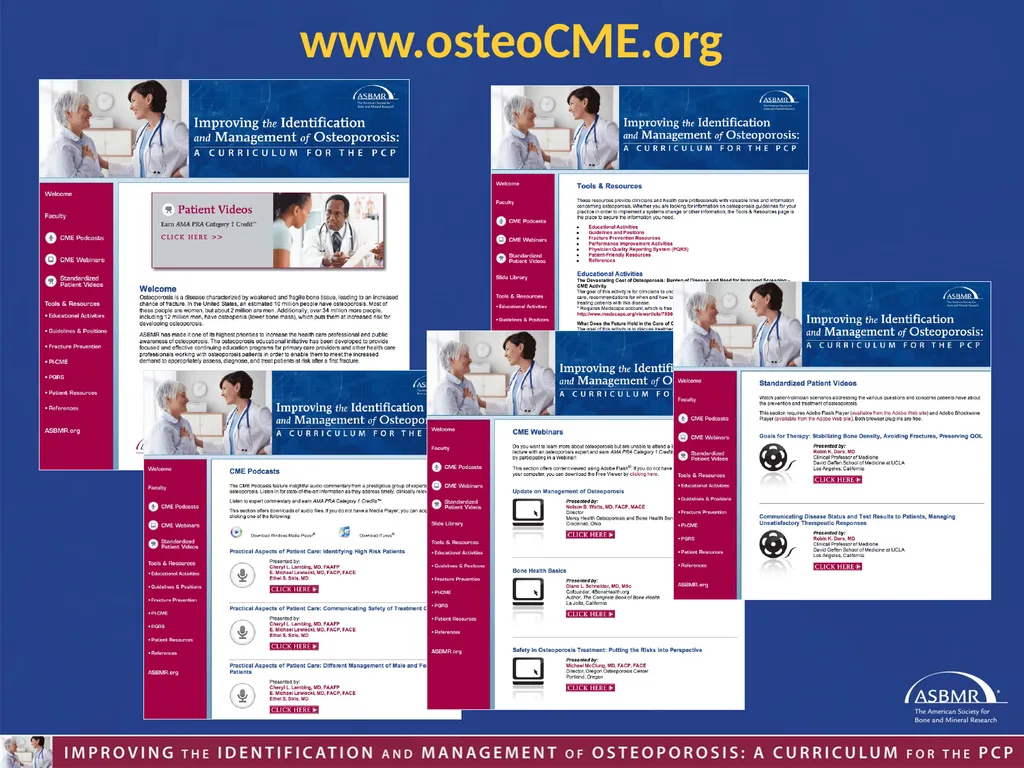
www.osteoCME.org<br>