
Eduqas GCE Media Studies First Teaching: 2017
GB
Published · 37 slides · 0 views

1 / 1
Description
Eduqas GCE Media Studies First Teaching: 2017 First Assessment: AS 2018 A level - 2019 OverviewAims This specification offers learners exciting opportunities to: Make connections: between different media forms and products, between media
Related Topics
Share
Embed code
Download this presentation From Below
"Eduqas GCE Media Studies First Teaching: 2017" is the property of its rightful owner. Permission is granted to download and print the materials on this website for personal, non-commercial use only, and to display it on your personal computer provided you do not modify the materials and that you retain all copyright notices contained in the materials. By downloading content from our website, you accept the terms of this agreement.
Presentation Transcript
01
Eduqas GCE Media Studies
First Teaching: 2017
First Assessment:
AS – 2018
A level - 2019<br>
First Teaching: 2017
First Assessment:
AS – 2018
A level - 2019<br>
02
Overview/Aims This specification offers learners exciting opportunities to:
Make connections: between different media forms and products, between media products and their contexts, and between theory and practical work.
Engage with a range of rich and stimulating media forms and products.
Develop media production skills, apply their knowledge and understanding of the theoretical framework to media forms and products.<br>
Make connections: between different media forms and products, between media products and their contexts, and between theory and practical work.
Engage with a range of rich and stimulating media forms and products.
Develop media production skills, apply their knowledge and understanding of the theoretical framework to media forms and products.<br>
03
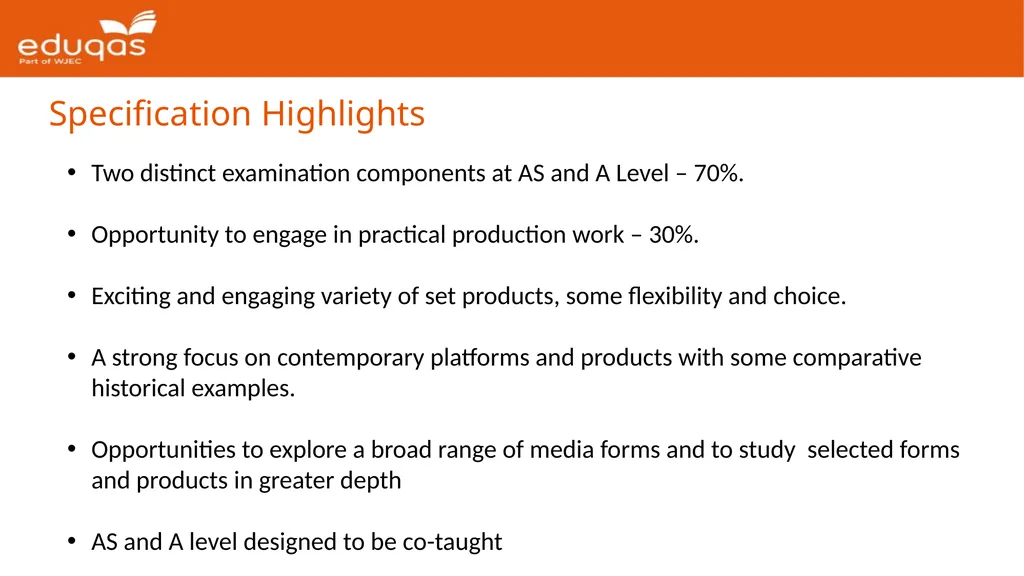
Two distinct examination components at AS and A Level – 70%.
Opportunity to engage in practical production work – 30%.
Exciting and engaging variety of set products, some flexibility and choice.
A strong focus on contemporary platforms and products with some comparative historical examples.
Opportunities to explore a broad range of media forms and to study selected forms and products in greater depth
AS and A level designed to be co-taught Specification Highlights<br>
Opportunity to engage in practical production work – 30%.
Exciting and engaging variety of set products, some flexibility and choice.
A strong focus on contemporary platforms and products with some comparative historical examples.
Opportunities to explore a broad range of media forms and to study selected forms and products in greater depth
AS and A level designed to be co-taught Specification Highlights<br>
04
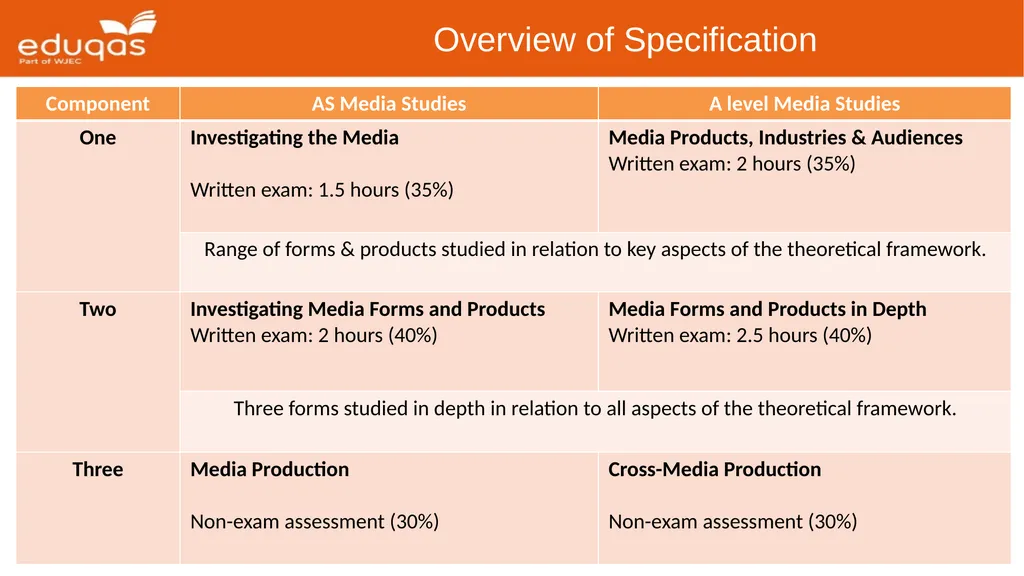
Overview of Specification<br>
05
Theoretical Framework The theoretical framework for analysing and creating media provides learners with the tools to develop a critical understanding and appreciation of the media.
The framework consists of four inter-related areas:
media language: how the media use forms, codes, conventions to communicate meanings
representation: how the media portray events, issues, individuals and social groups
media industries: how the media industries' processes of production, distribution and circulation affect media forms and platforms
audiences: how media forms target, reach and address audiences, how audiences interpret and respond to them, and how members of audiences become producers themselves.<br>
The framework consists of four inter-related areas:
media language: how the media use forms, codes, conventions to communicate meanings
representation: how the media portray events, issues, individuals and social groups
media industries: how the media industries' processes of production, distribution and circulation affect media forms and platforms
audiences: how media forms target, reach and address audiences, how audiences interpret and respond to them, and how members of audiences become producers themselves.<br>
06
Contexts of Media Learners develop knowledge and understanding of media products in relation to relevant contexts of media.
Historical Contexts including:
the dynamic and historically relative nature of genre
the effect of historical context on representations.
Social and Cultural Contexts including:
the effect of social and cultural contexts on representations
how and why particular social groups may be under-represented or misrepresented.
Economic and Political Contexts including:
production, distribution and circulation in a global context
the significance of patterns of ownership & control, funding and regulation.<br>
Historical Contexts including:
the dynamic and historically relative nature of genre
the effect of historical context on representations.
Social and Cultural Contexts including:
the effect of social and cultural contexts on representations
how and why particular social groups may be under-represented or misrepresented.
Economic and Political Contexts including:
production, distribution and circulation in a global context
the significance of patterns of ownership & control, funding and regulation.<br>
07
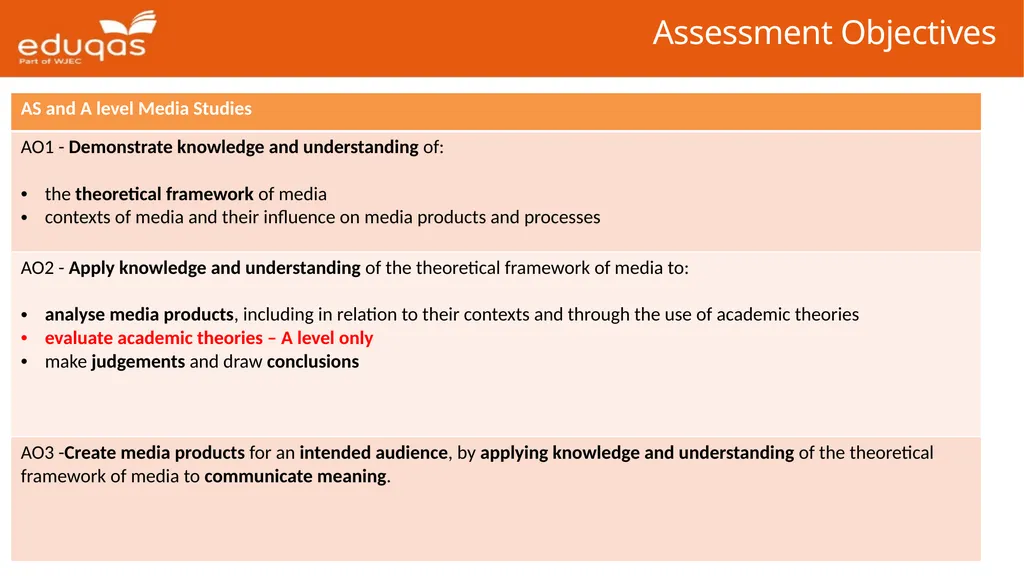
Assessment Objectives<br>
08
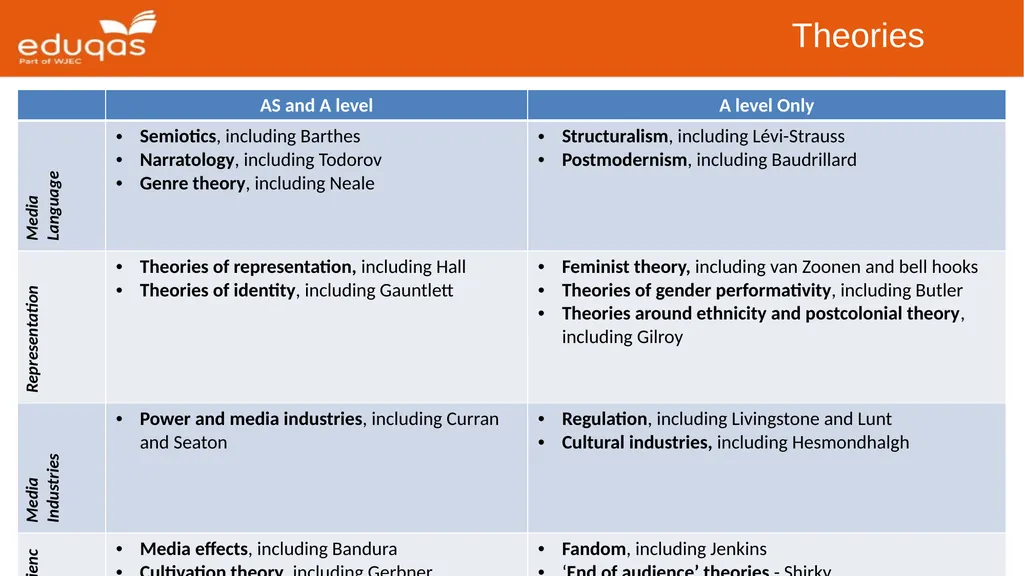
Theories and theoretical approaches Learners will study a range of key theoretical approaches and theories to inform and support their analysis of media products and processes.
Those listed on the next slide must be studied; appropriate additional theories may be studied.
At AS level learners must be able to apply theories.
At A level learners must also evaluate theories.<br>
Those listed on the next slide must be studied; appropriate additional theories may be studied.
At AS level learners must be able to apply theories.
At A level learners must also evaluate theories.<br>
09
Theories<br>
10
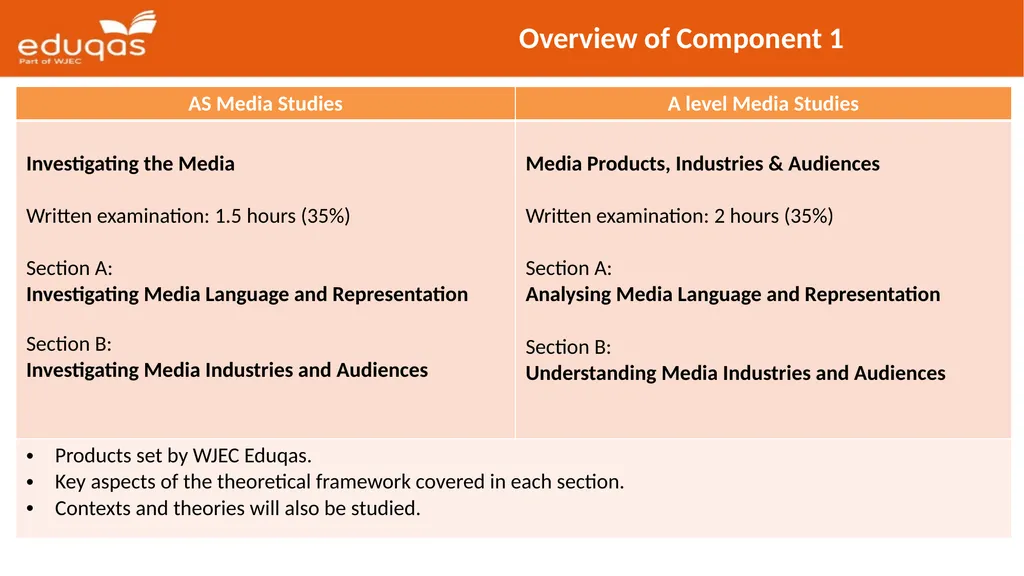
Overview of Component 1<br>
11
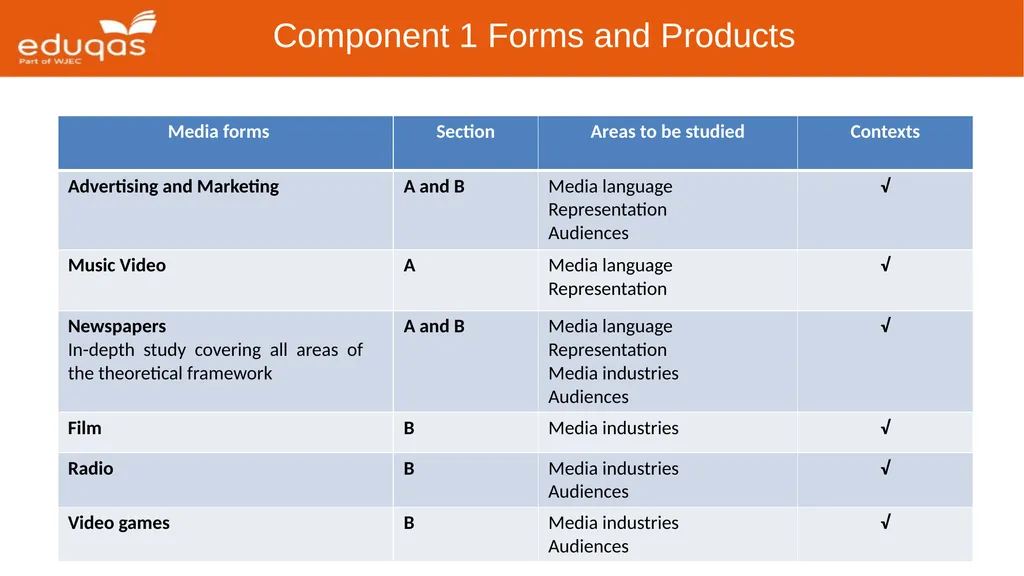
Component 1 Forms and Products<br>
12
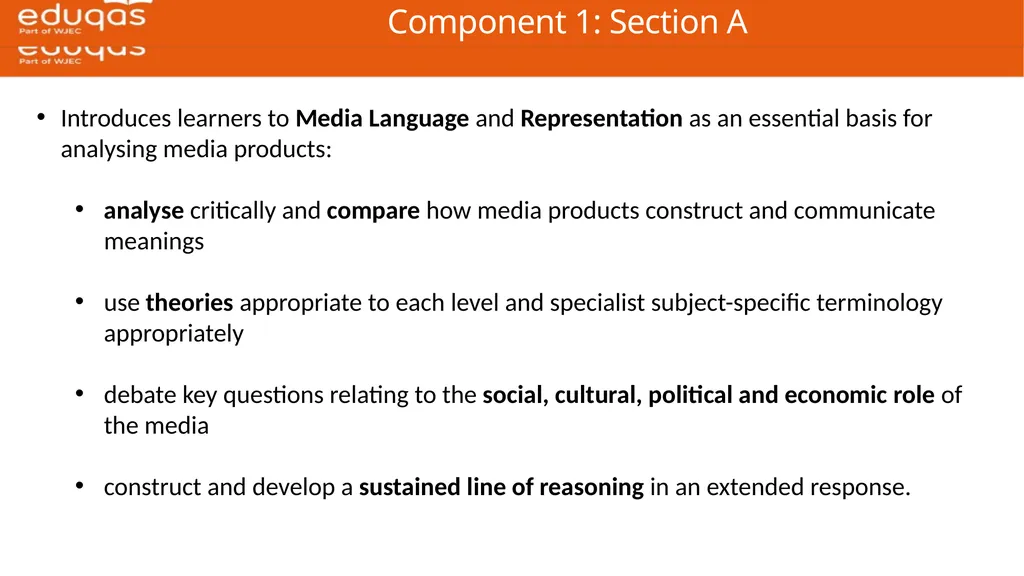
Component 1: Section A Introduces learners to Media Language and Representation as an essential basis for analysing media products:
analyse critically and compare how media products construct and communicate meanings
use theories appropriate to each level and specialist subject-specific terminology appropriately
debate key questions relating to the social, cultural, political and economic role of the media
construct and develop a sustained line of reasoning in an extended response.<br>
analyse critically and compare how media products construct and communicate meanings
use theories appropriate to each level and specialist subject-specific terminology appropriately
debate key questions relating to the social, cultural, political and economic role of the media
construct and develop a sustained line of reasoning in an extended response.<br>
13
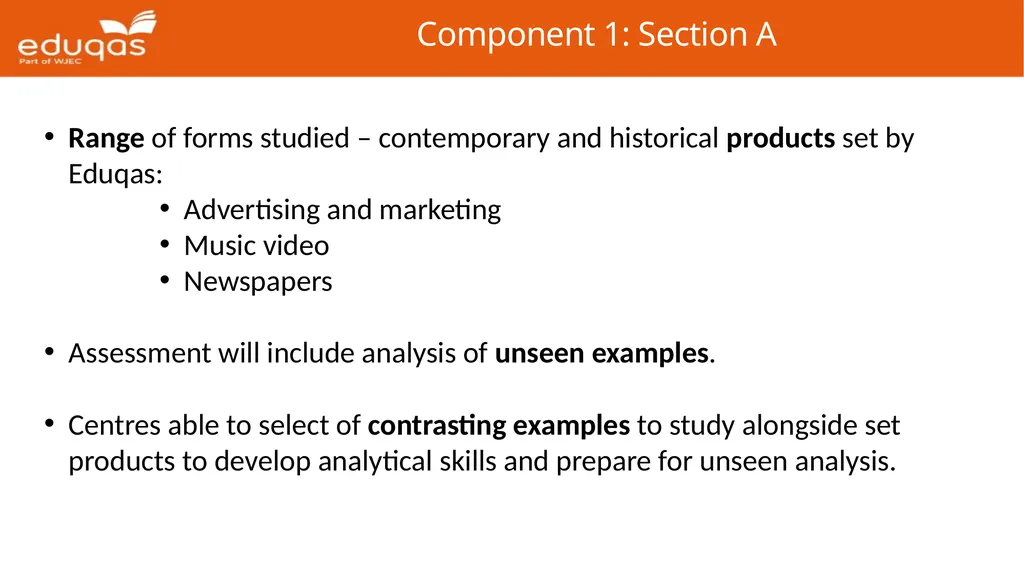
Range of forms studied – contemporary and historical products set by Eduqas:
Advertising and marketing
Music video
Newspapers
Assessment will include analysis of unseen examples.
Centres able to select of contrasting examples to study alongside set products to develop analytical skills and prepare for unseen analysis. Component 1: Section A<br>
Advertising and marketing
Music video
Newspapers
Assessment will include analysis of unseen examples.
Centres able to select of contrasting examples to study alongside set products to develop analytical skills and prepare for unseen analysis. Component 1: Section A<br>
14
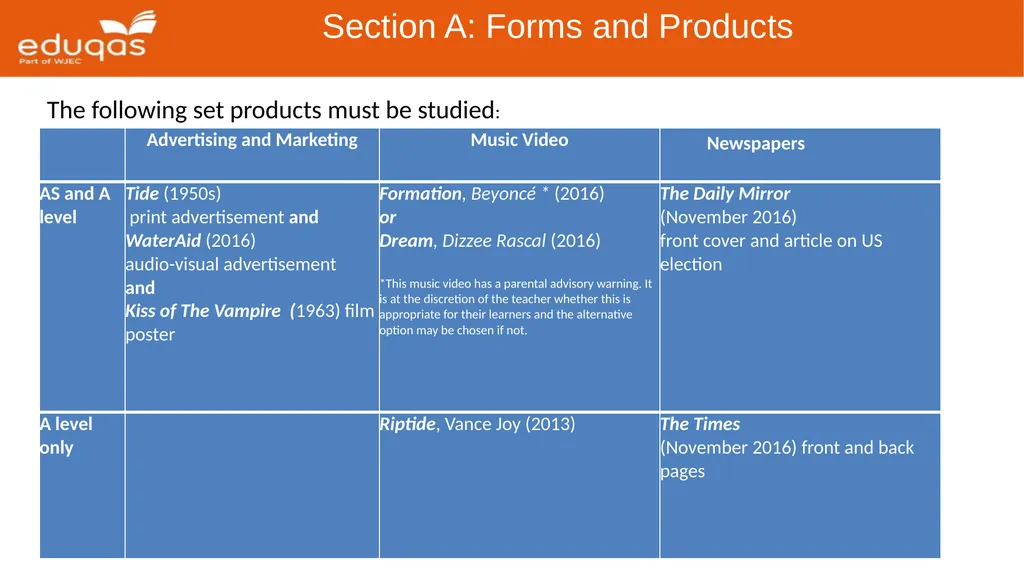
Section A: Forms and Products The following set products must be studied:<br>
15
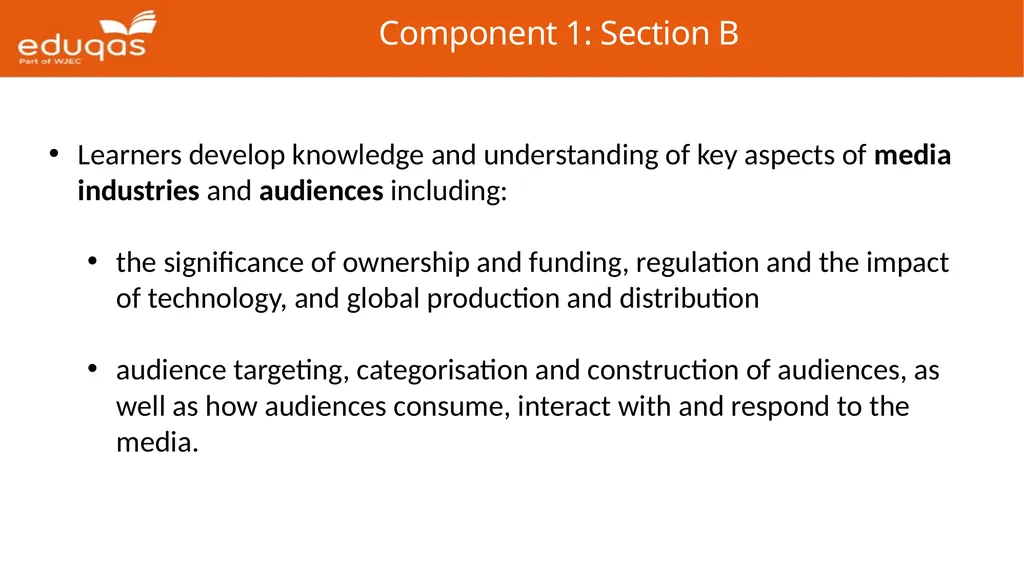
Component 1: Section B Learners develop knowledge and understanding of key aspects of media industries and audiences including:
the significance of ownership and funding, regulation and the impact of technology, and global production and distribution
audience targeting, categorisation and construction of audiences, as well as how audiences consume, interact with and respond to the media.<br>
the significance of ownership and funding, regulation and the impact of technology, and global production and distribution
audience targeting, categorisation and construction of audiences, as well as how audiences consume, interact with and respond to the media.<br>
16
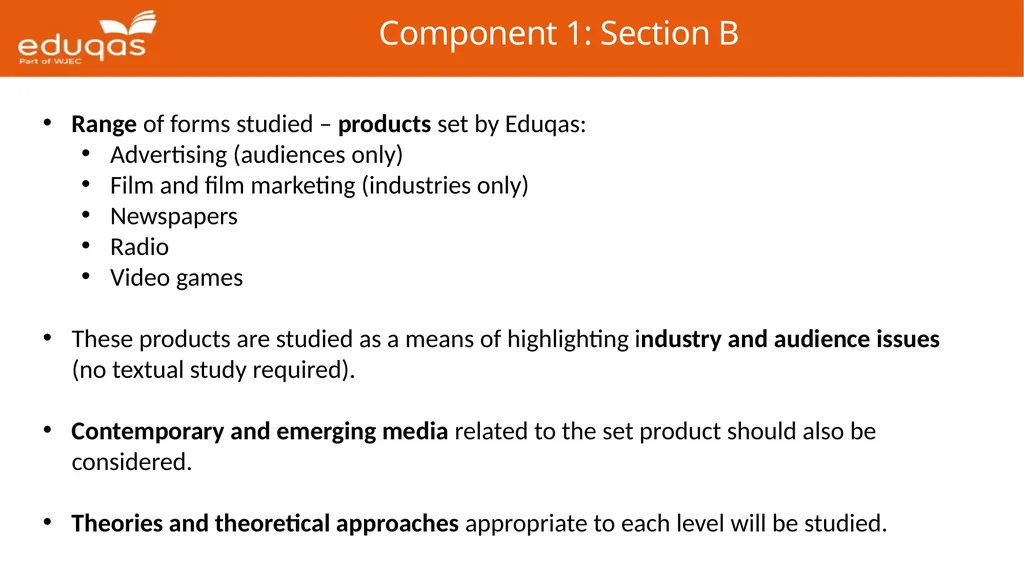
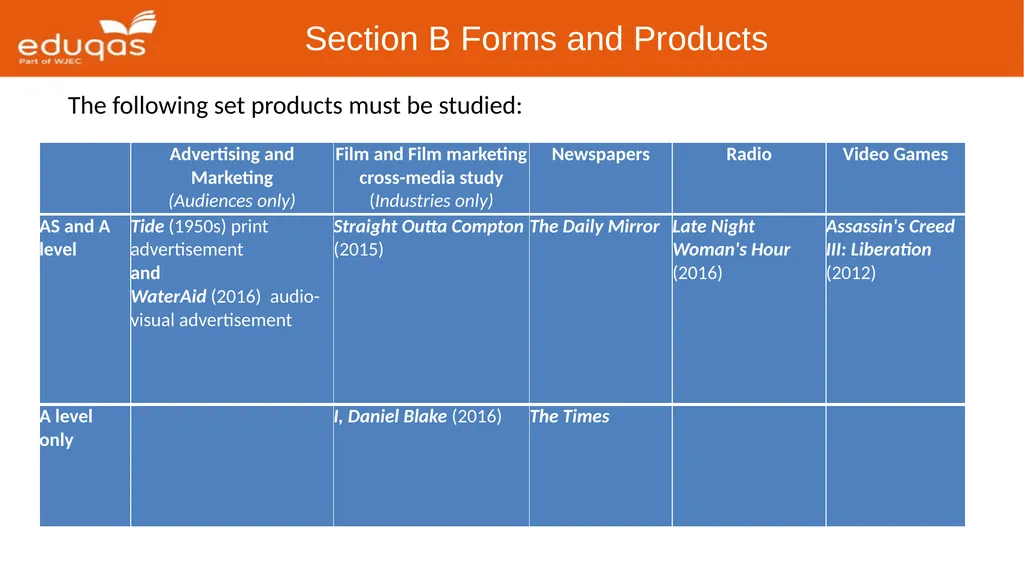
Range of forms studied – products set by Eduqas:
Advertising (audiences only)
Film and film marketing (industries only)
Newspapers
Radio
Video games
These products are studied as a means of highlighting industry and audience issues (no textual study required).
Contemporary and emerging media related to the set product should also be considered.
Theories and theoretical approaches appropriate to each level will be studied. Component 1: Section B<br>
Advertising (audiences only)
Film and film marketing (industries only)
Newspapers
Radio
Video games
These products are studied as a means of highlighting industry and audience issues (no textual study required).
Contemporary and emerging media related to the set product should also be considered.
Theories and theoretical approaches appropriate to each level will be studied. Component 1: Section B<br>
17
Section B Forms and Products The following set products must be studied:<br>
18
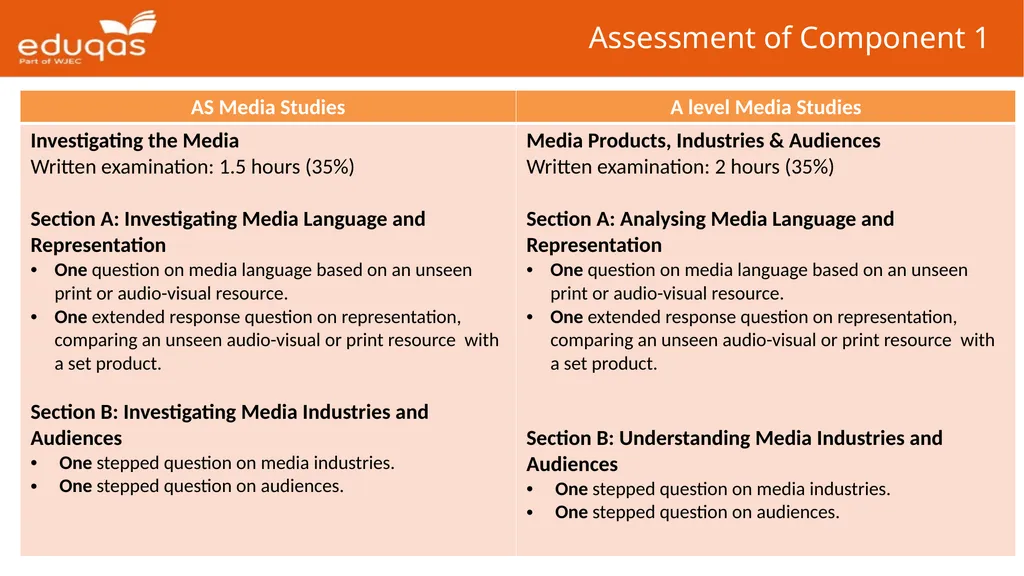
Assessment of Component 1<br>
19
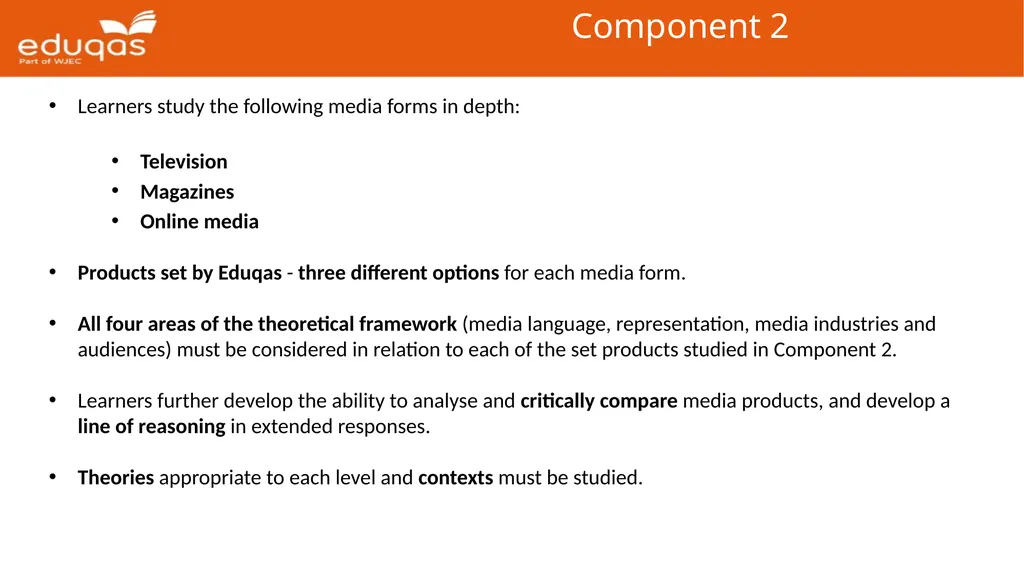
Component 2 Learners study the following media forms in depth:
Television
Magazines
Online media
Products set by Eduqas - three different options for each media form.
All four areas of the theoretical framework (media language, representation, media industries and audiences) must be considered in relation to each of the set products studied in Component 2.
Learners further develop the ability to analyse and critically compare media products, and develop a line of reasoning in extended responses.
Theories appropriate to each level and contexts must be studied.<br>
Television
Magazines
Online media
Products set by Eduqas - three different options for each media form.
All four areas of the theoretical framework (media language, representation, media industries and audiences) must be considered in relation to each of the set products studied in Component 2.
Learners further develop the ability to analyse and critically compare media products, and develop a line of reasoning in extended responses.
Theories appropriate to each level and contexts must be studied.<br>
20
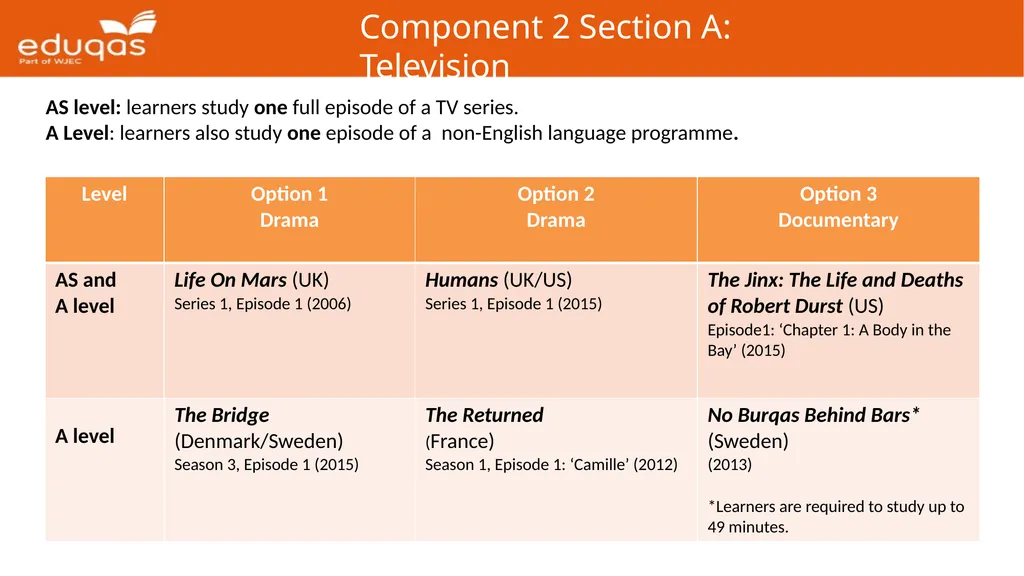
Component 2 Section A:
Television AS level: learners study one full episode of a TV series.
A Level: learners also study one episode of a non-English language programme.<br>
Television AS level: learners study one full episode of a TV series.
A Level: learners also study one episode of a non-English language programme.<br>
21
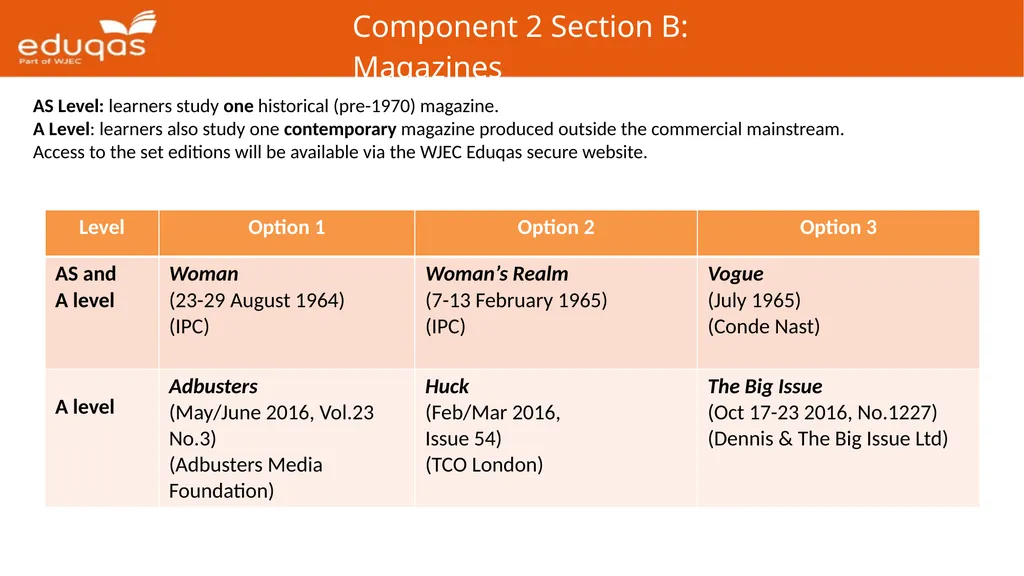
Component 2 Section B:
Magazines AS Level: learners study one historical (pre-1970) magazine.
A Level: learners also study one contemporary magazine produced outside the commercial mainstream.
Access to the set editions will be available via the WJEC Eduqas secure website.<br>
Magazines AS Level: learners study one historical (pre-1970) magazine.
A Level: learners also study one contemporary magazine produced outside the commercial mainstream.
Access to the set editions will be available via the WJEC Eduqas secure website.<br>
22
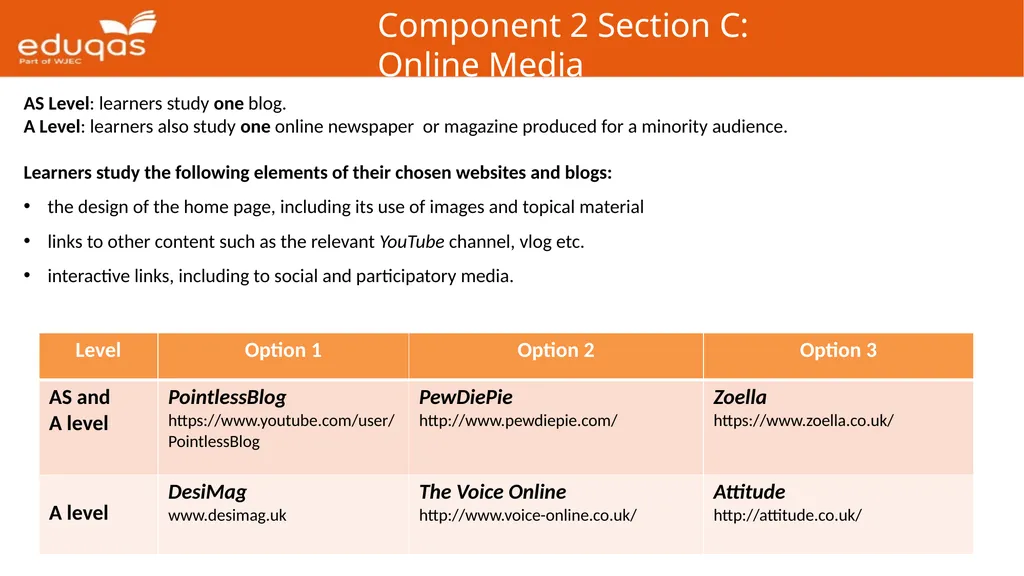
Component 2 Section C:
Online Media AS Level: learners study one blog.
A Level: learners also study one online newspaper or magazine produced for a minority audience.
Learners study the following elements of their chosen websites and blogs:
the design of the home page, including its use of images and topical material
links to other content such as the relevant YouTube channel, vlog etc.
interactive links, including to social and participatory media.<br>
Online Media AS Level: learners study one blog.
A Level: learners also study one online newspaper or magazine produced for a minority audience.
Learners study the following elements of their chosen websites and blogs:
the design of the home page, including its use of images and topical material
links to other content such as the relevant YouTube channel, vlog etc.
interactive links, including to social and participatory media.<br>
23
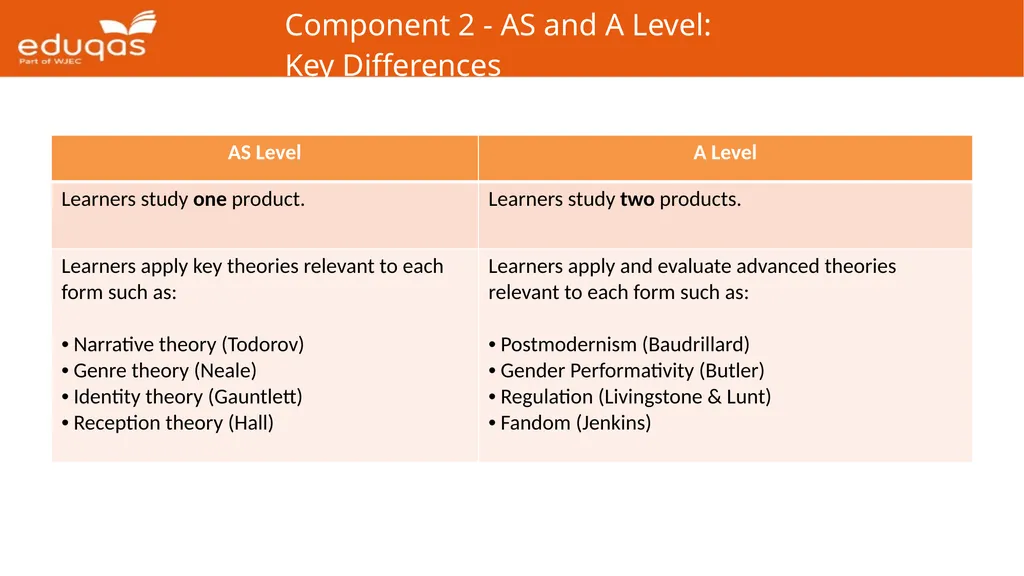
Component 2 - AS and A Level:
Key Differences<br>
Key Differences<br>
24
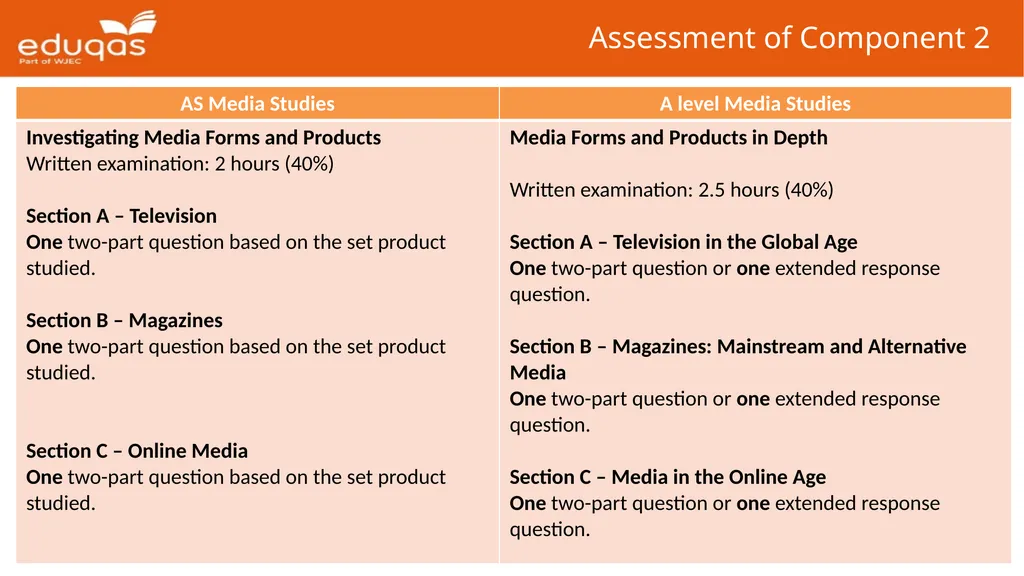
Assessment of Component 2<br>
25
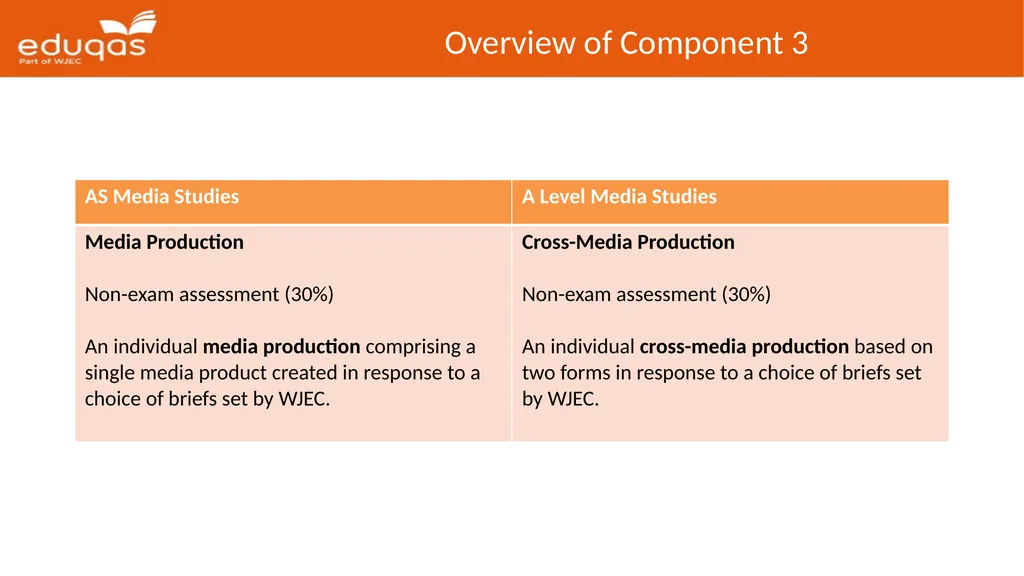
Overview of Component 3<br>
26
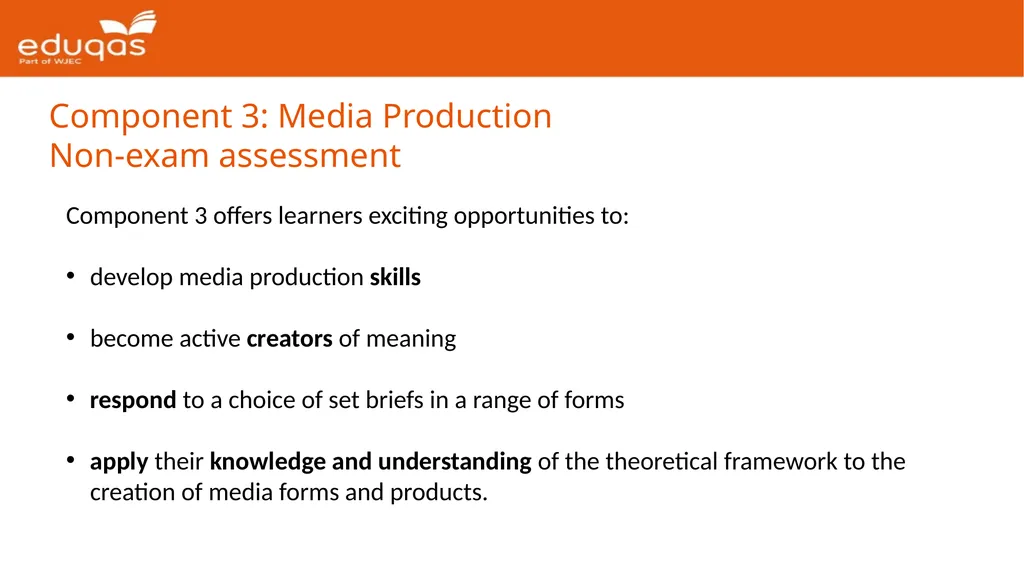
Component 3: Media Production
Non-exam assessment Component 3 offers learners exciting opportunities to:
develop media production skills
become active creators of meaning
respond to a choice of set briefs in a range of forms
apply their knowledge and understanding of the theoretical framework to the creation of media forms and products.<br>
Non-exam assessment Component 3 offers learners exciting opportunities to:
develop media production skills
become active creators of meaning
respond to a choice of set briefs in a range of forms
apply their knowledge and understanding of the theoretical framework to the creation of media forms and products.<br>
27
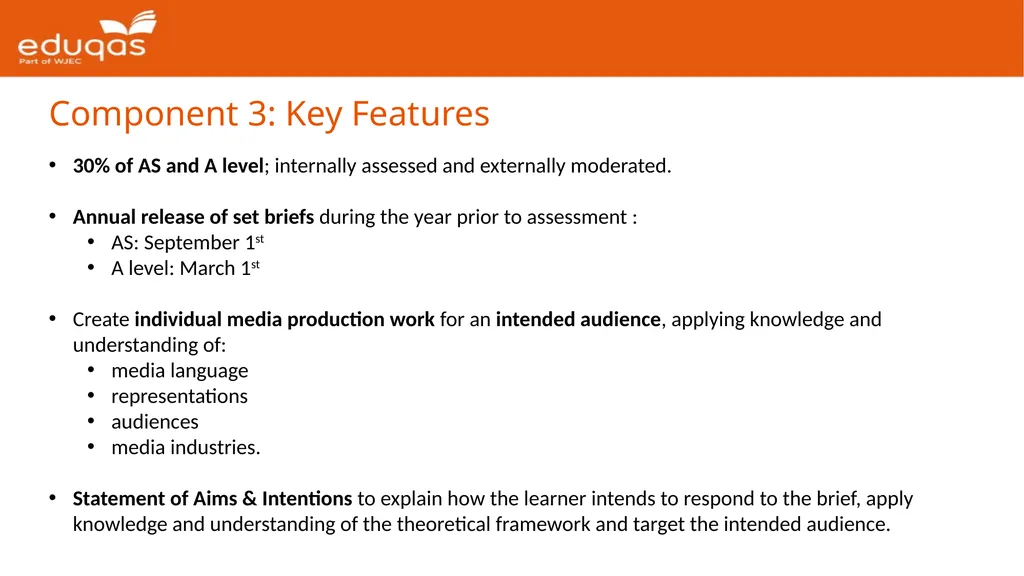
Component 3: Key Features 30% of AS and A level; internally assessed and externally moderated.
Annual release of set briefs during the year prior to assessment :
AS: September 1st
A level: March 1st
Create individual media production work for an intended audience, applying knowledge and understanding of:
media language
representations
audiences
media industries.
Statement of Aims & Intentions to explain how the learner intends to respond to the brief, apply knowledge and understanding of the theoretical framework and target the intended audience.<br>
Annual release of set briefs during the year prior to assessment :
AS: September 1st
A level: March 1st
Create individual media production work for an intended audience, applying knowledge and understanding of:
media language
representations
audiences
media industries.
Statement of Aims & Intentions to explain how the learner intends to respond to the brief, apply knowledge and understanding of the theoretical framework and target the intended audience.<br>
28
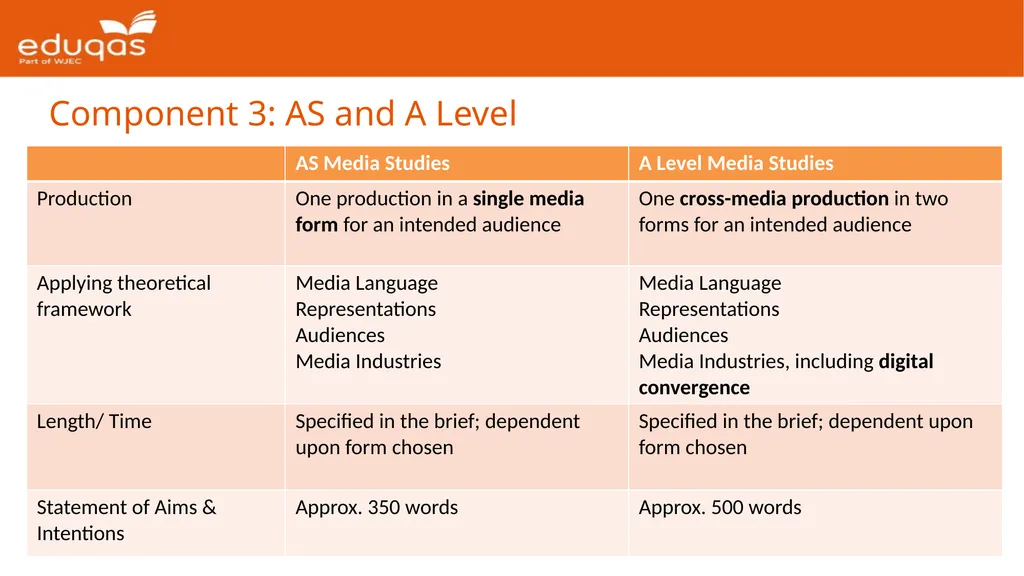
Component 3: AS and A Level<br>
29
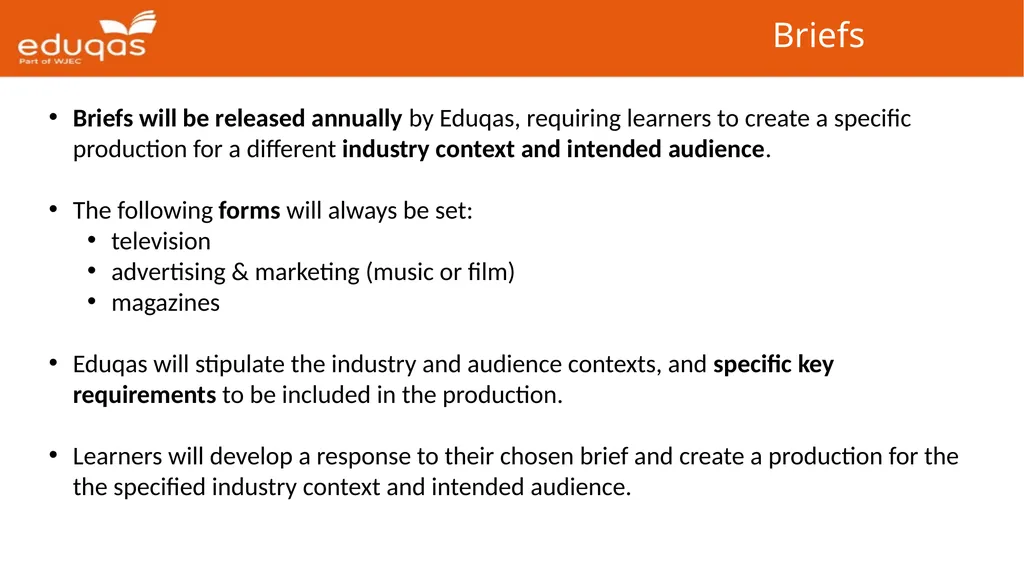
Briefs Briefs will be released annually by Eduqas, requiring learners to create a specific production for a different industry context and intended audience.
The following forms will always be set:
television
advertising & marketing (music or film)
magazines
Eduqas will stipulate the industry and audience contexts, and specific key requirements to be included in the production.
Learners will develop a response to their chosen brief and create a production for the the specified industry context and intended audience.<br>
The following forms will always be set:
television
advertising & marketing (music or film)
magazines
Eduqas will stipulate the industry and audience contexts, and specific key requirements to be included in the production.
Learners will develop a response to their chosen brief and create a production for the the specified industry context and intended audience.<br>
30
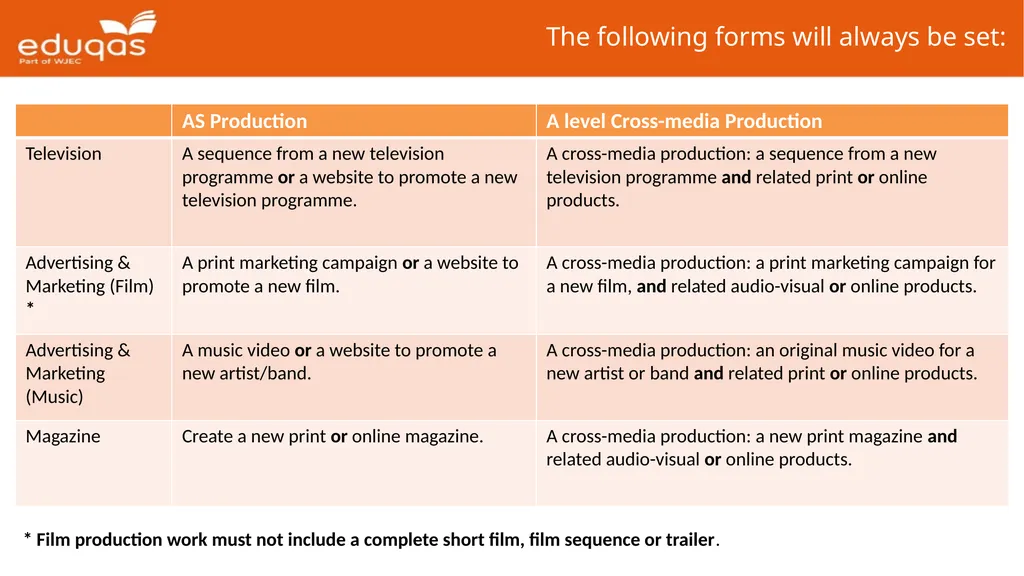
The following forms will always be set: * Film production work must not include a complete short film, film sequence or trailer.<br>
31
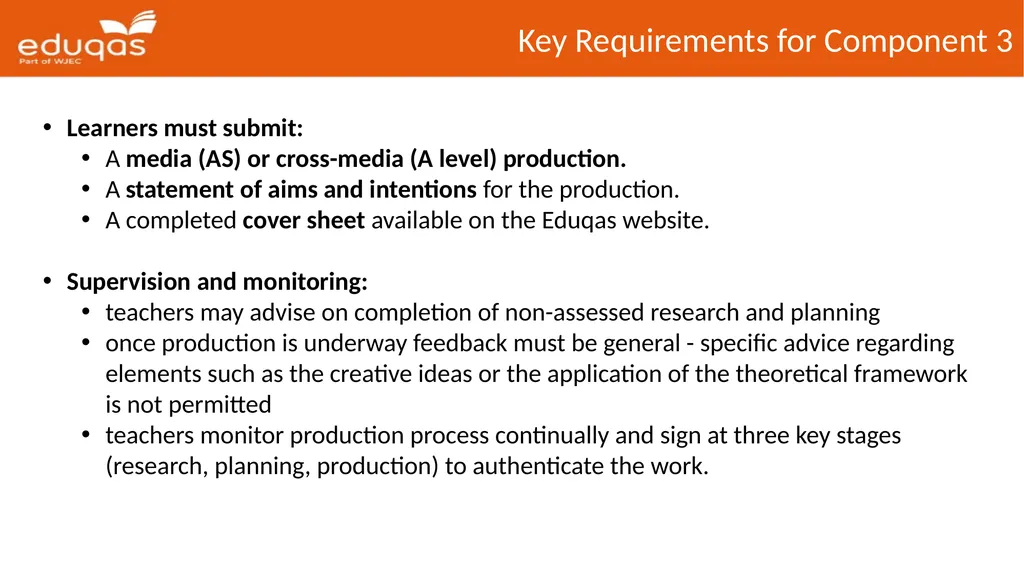
Learners must submit:
A media (AS) or cross-media (A level) production.
A statement of aims and intentions for the production.
A completed cover sheet available on the Eduqas website.
Supervision and monitoring:
teachers may advise on completion of non-assessed research and planning
once production is underway feedback must be general - specific advice regarding elements such as the creative ideas or the application of the theoretical framework is not permitted
teachers monitor production process continually and sign at three key stages (research, planning, production) to authenticate the work. Key Requirements for Component 3<br>
A media (AS) or cross-media (A level) production.
A statement of aims and intentions for the production.
A completed cover sheet available on the Eduqas website.
Supervision and monitoring:
teachers may advise on completion of non-assessed research and planning
once production is underway feedback must be general - specific advice regarding elements such as the creative ideas or the application of the theoretical framework is not permitted
teachers monitor production process continually and sign at three key stages (research, planning, production) to authenticate the work. Key Requirements for Component 3<br>
32
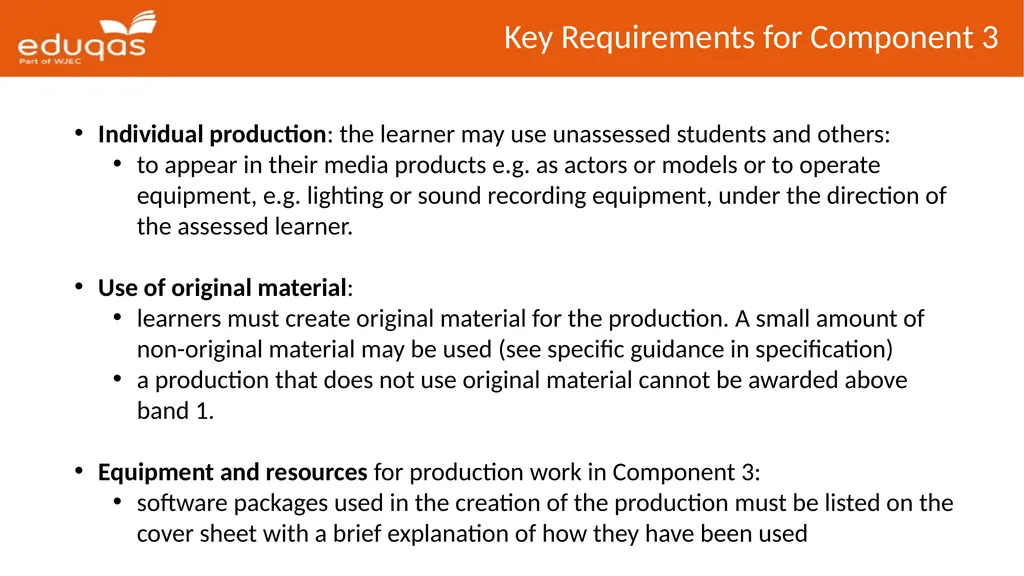
Individual production: the learner may use unassessed students and others:
to appear in their media products e.g. as actors or models or to operate equipment, e.g. lighting or sound recording equipment, under the direction of the assessed learner.
Use of original material:
learners must create original material for the production. A small amount of non-original material may be used (see specific guidance in specification)
a production that does not use original material cannot be awarded above band 1.
Equipment and resources for production work in Component 3:
software packages used in the creation of the production must be listed on the cover sheet with a brief explanation of how they have been used Key Requirements for Component 3<br>
to appear in their media products e.g. as actors or models or to operate equipment, e.g. lighting or sound recording equipment, under the direction of the assessed learner.
Use of original material:
learners must create original material for the production. A small amount of non-original material may be used (see specific guidance in specification)
a production that does not use original material cannot be awarded above band 1.
Equipment and resources for production work in Component 3:
software packages used in the creation of the production must be listed on the cover sheet with a brief explanation of how they have been used Key Requirements for Component 3<br>
33
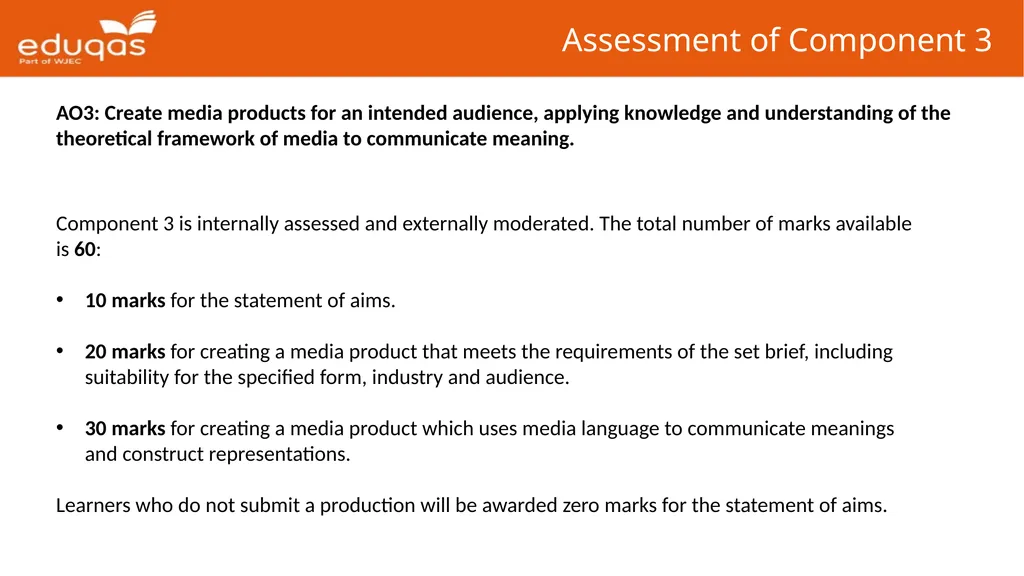
Assessment of Component 3 AO3: Create media products for an intended audience, applying knowledge and understanding of the theoretical framework of media to communicate meaning. Component 3 is internally assessed and externally moderated. The total number of marks available is 60:
10 marks for the statement of aims.
20 marks for creating a media product that meets the requirements of the set brief, including suitability for the specified form, industry and audience.
30 marks for creating a media product which uses media language to communicate meanings and construct representations.
Learners who do not submit a production will be awarded zero marks for the statement of aims.<br>
10 marks for the statement of aims.
20 marks for creating a media product that meets the requirements of the set brief, including suitability for the specified form, industry and audience.
30 marks for creating a media product which uses media language to communicate meanings and construct representations.
Learners who do not submit a production will be awarded zero marks for the statement of aims.<br>
34
Resources for Teachers
Supporting teaching and learning We are planning a number of resources to support teaching and learning. These include:
Teacher Guidance
Course plans
Factsheets on set products
Digital resources on specific topics e.g. News, TV Drama
Text book<br>
Supporting teaching and learning We are planning a number of resources to support teaching and learning. These include:
Teacher Guidance
Course plans
Factsheets on set products
Digital resources on specific topics e.g. News, TV Drama
Text book<br>
35
Resources for Teachers
Supporting teaching and learning Visit our website to access qualification information and download key documents.
eduqas.co.uk/qualifications/media-studies
Free Eduqas digital resources to support the teaching and learning of a broad range of subjects.
resources.eduqas.co.uk<br>
Supporting teaching and learning Visit our website to access qualification information and download key documents.
eduqas.co.uk/qualifications/media-studies
Free Eduqas digital resources to support the teaching and learning of a broad range of subjects.
resources.eduqas.co.uk<br>
36
We are here to support you in the delivery of the new qualifications.
Jo Johnson
Subject Officer
Jo.johnson@eduqas.co.uk
Sally Quinn
Subject Support Officer
Sally.quinn@eduqas.co.uk<br>
Jo Johnson
Subject Officer
Jo.johnson@eduqas.co.uk
Sally Quinn
Subject Support Officer
Sally.quinn@eduqas.co.uk<br>
37
Any questions? We will now be answering your questions. Please submit any questions you may have.
Feedback is also welcome, use the feedback section to let us know how we’ve done.<br>
Feedback is also welcome, use the feedback section to let us know how we’ve done.<br>