EE359 Lecture 8 Outline Announcements Schedule changes next week No lecture next Tues 23. Makeup class: Wed 25 11:30-12:50pm wlunch in Gates B03 Project proposals due 27; I can provide early feedback MT week of 217, 6-8pm (pizza
"EE359 – Lecture 8 Outline Announcements Schedule" is the property of its rightful owner. Permission is granted to
download and print the materials on this website for personal, non-commercial use only, and to display it
on your personal computer provided you do not modify the materials and that you retain all copyright
notices contained in the materials. By downloading content from our website, you accept the terms of this
agreement.
Presentation Transcript
01
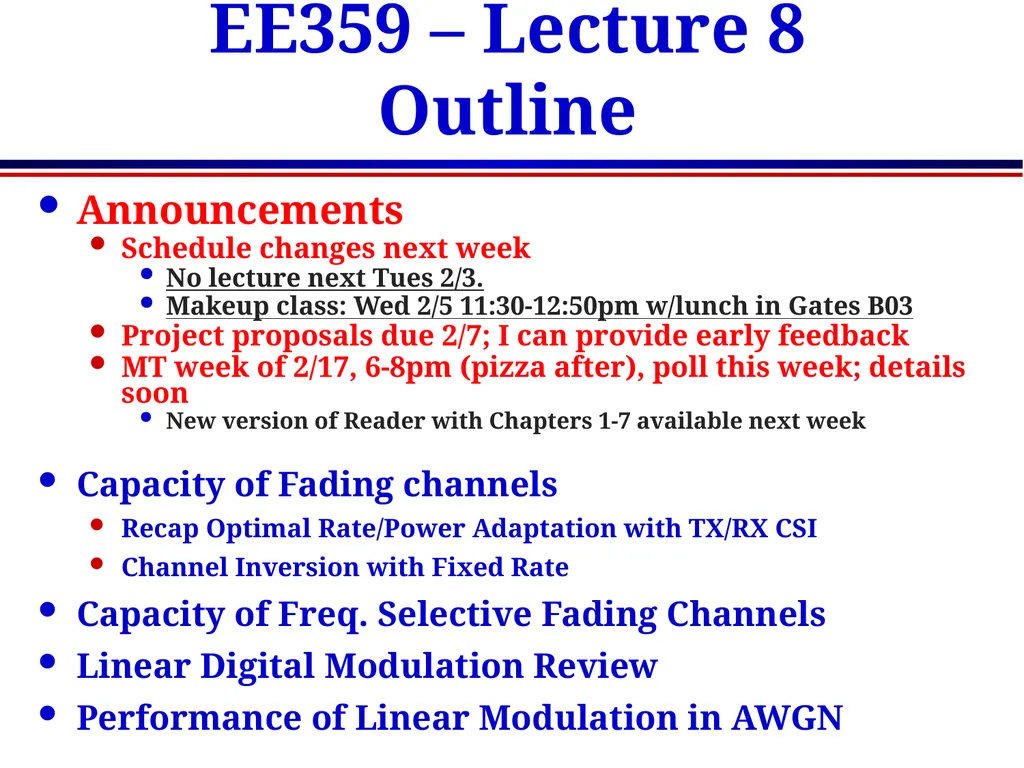
EE359 – Lecture 8 Outline Announcements
Schedule changes next week
No lecture next Tues 2/3.
Makeup class: Wed 2/5 11:30-12:50pm w/lunch in Gates B03
Project proposals due 2/7; I can provide early feedback
MT week of 2/17, 6-8pm (pizza after), poll this week; details soon
New version of Reader with Chapters 1-7 available next week
Capacity of Fading channels
Recap Optimal Rate/Power Adaptation with TX/RX CSI
Channel Inversion with Fixed Rate
Capacity of Freq. Selective Fading Channels
Linear Digital Modulation Review
Performance of Linear Modulation in AWGN<br>
02
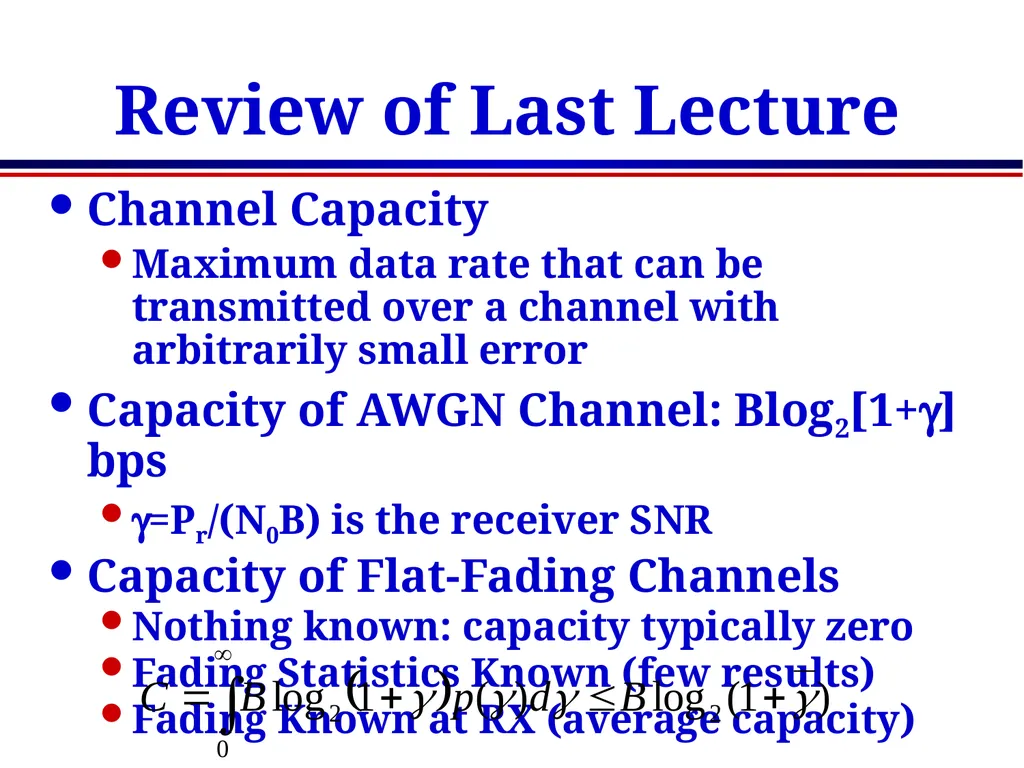
Review of Last Lecture Channel Capacity
Maximum data rate that can be transmitted over a channel with arbitrarily small error
Capacity of AWGN Channel: Blog2[1+g] bps
g=Pr/(N0B) is the receiver SNR
Capacity of Flat-Fading Channels
Nothing known: capacity typically zero
Fading Statistics Known (few results)
Fading Known at RX (average capacity)<br>
03
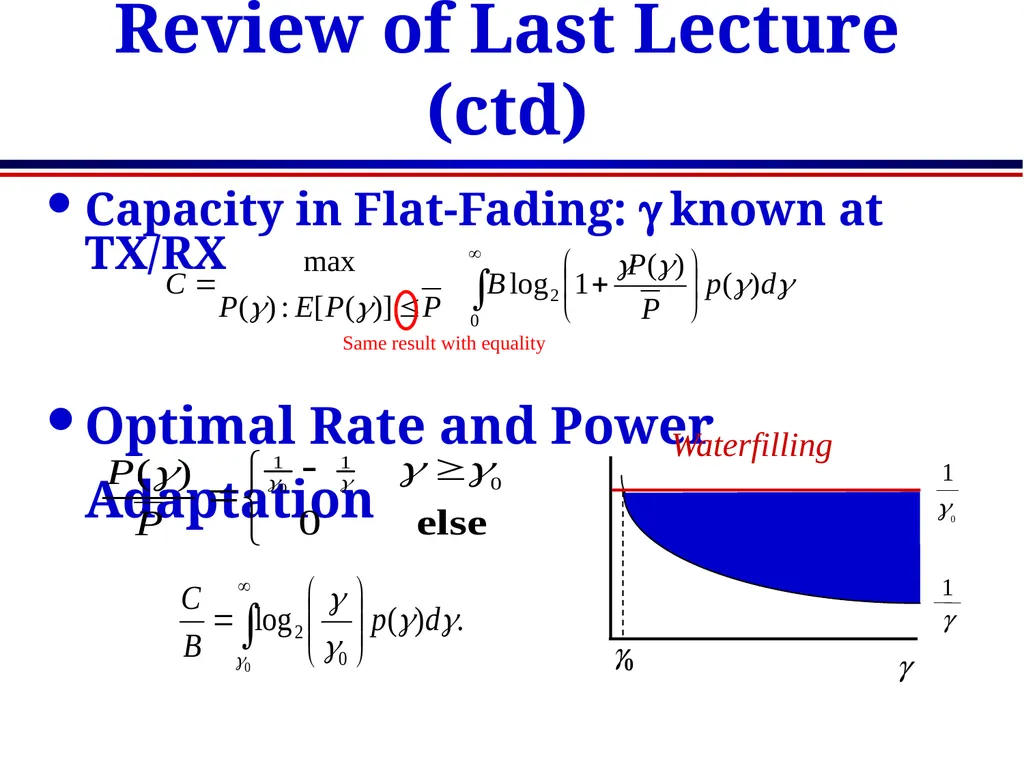
Review of Last Lecture (ctd) Capacity in Flat-Fading: g known at TX/RX
Optimal Rate and Power Adaptation
The instantaneous power/rate only depend on p(g) through g0 Waterfilling Same result with equality<br>
04
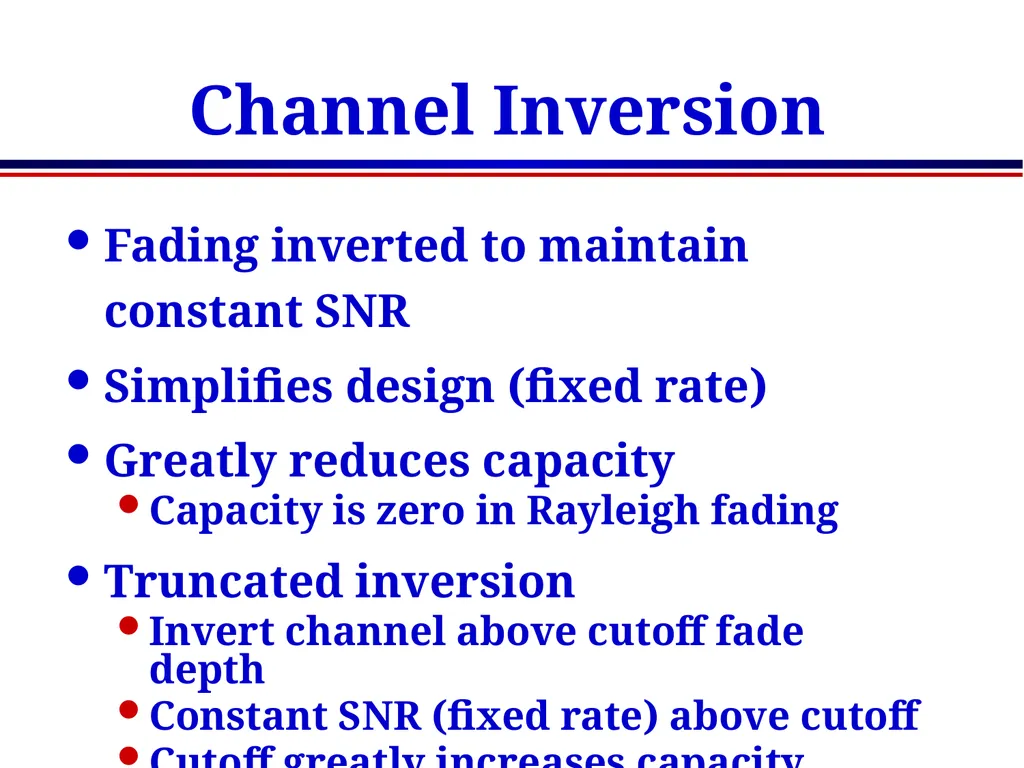
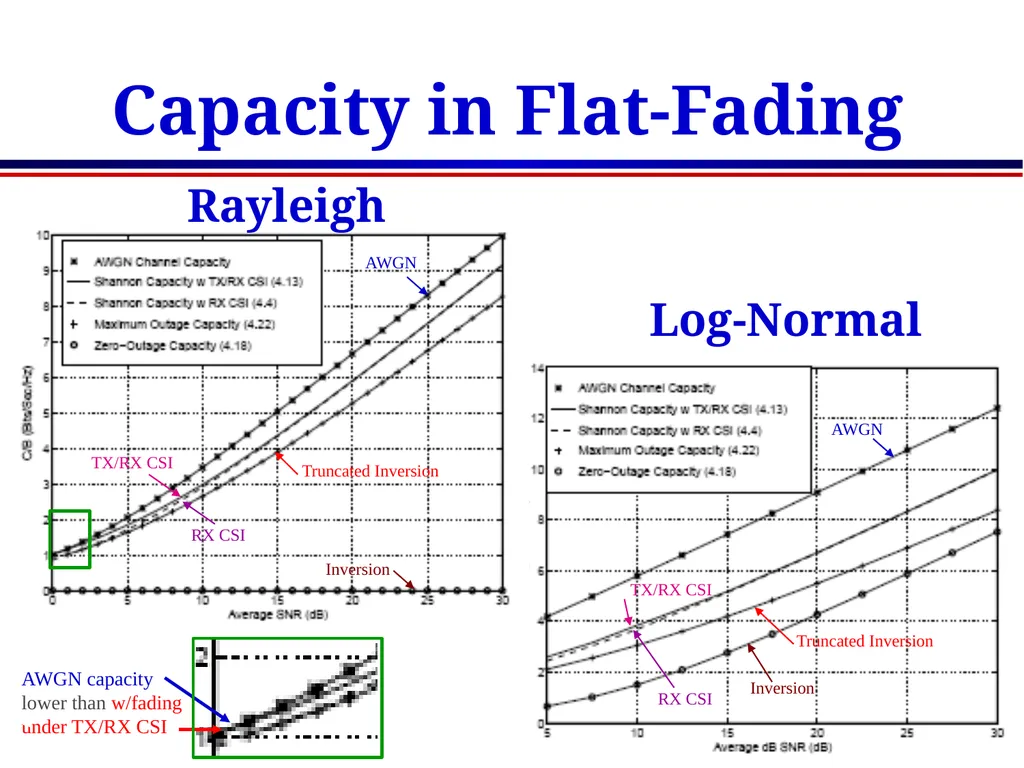
Channel Inversion Fading inverted to maintain constant SNR
Simplifies design (fixed rate)
Greatly reduces capacity
Capacity is zero in Rayleigh fading
Truncated inversion
Invert channel above cutoff fade depth
Constant SNR (fixed rate) above cutoff
Cutoff greatly increases capacity
Close to optimal<br>
05
Capacity in Flat-Fading Rayleigh Log-Normal AWGN capacity
lower than w/fading
under TX/RX CSI AWGN TX/RX CSI RX CSI Truncated Inversion Inversion AWGN TX/RX CSI RX CSI Truncated Inversion Inversion<br>
06
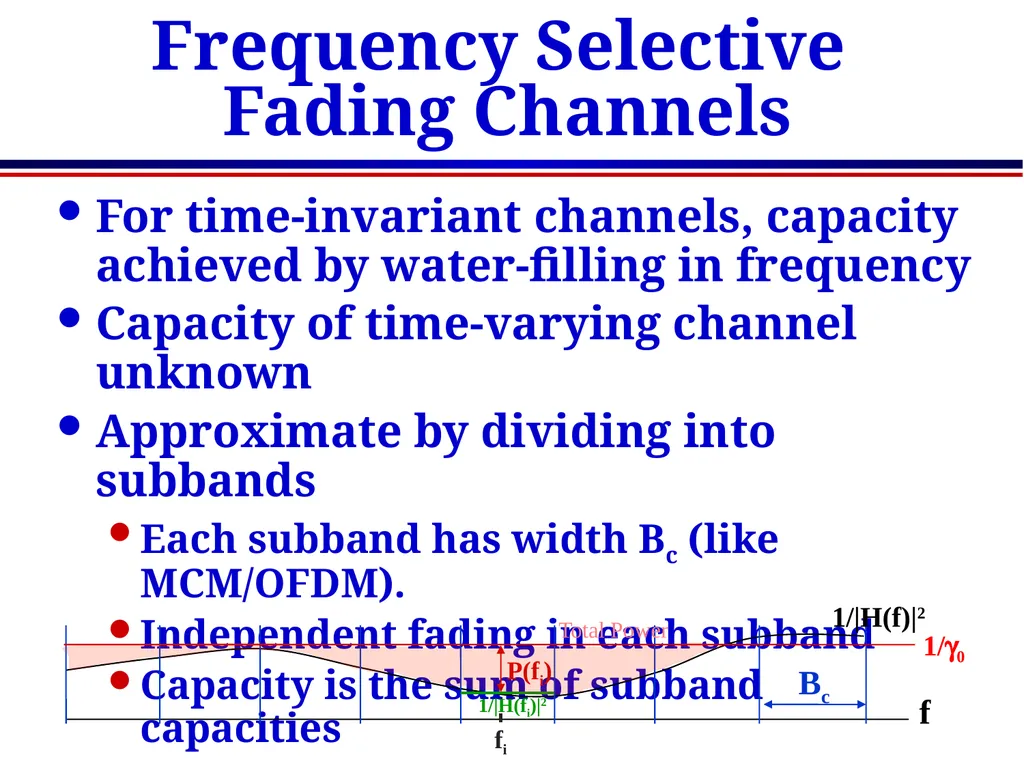
Frequency Selective Fading Channels For time-invariant channels, capacity achieved by water-filling in frequency
Capacity of time-varying channel unknown
Approximate by dividing into subbands
Each subband has width Bc (like MCM/OFDM).
Independent fading in each subband
Capacity is the sum of subband capacities f P(fi) 1/|H(f)|2<br>
07
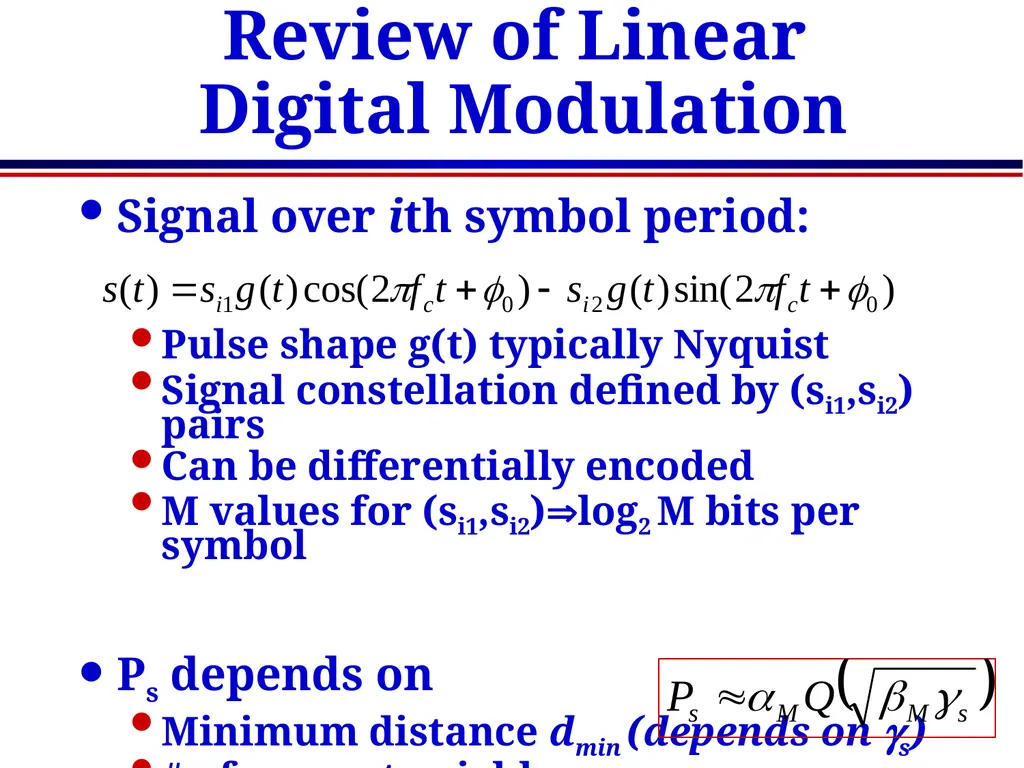
Review of Linear Digital Modulation Signal over ith symbol period:
Pulse shape g(t) typically Nyquist
Signal constellation defined by (si1,si2) pairs
Can be differentially encoded
M values for (si1,si2)log2 M bits per symbol
Ps depends on
Minimum distance dmin (depends on gs)
# of nearest neighbors aM
Approximate expression:
Standard/alternate Q function<br>
08
Main Points Channel inversion practical, but should truncate or get a large capacity loss
Capacity of wideband channel obtained by breaking up channel into subbands
Similar to multicarrier modulation
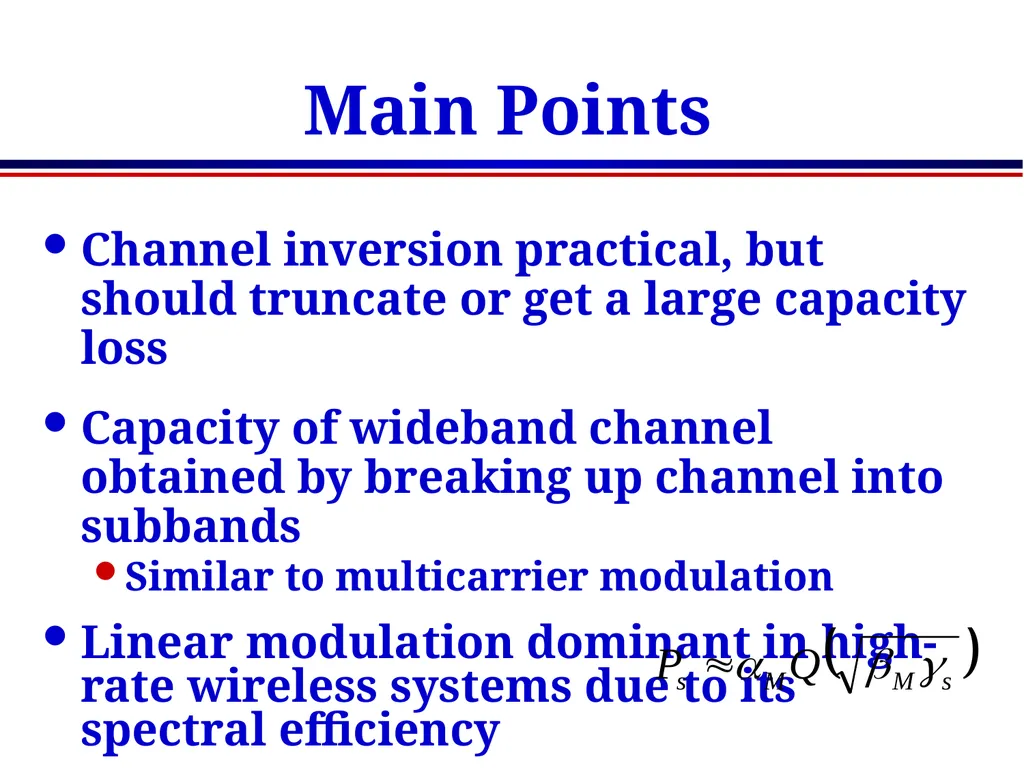
Linear modulation dominant in high-rate wireless systems due to its spectral efficiency
Ps approximation in AWGN:
Alternate Q function useful in diversity analysis<br>