
EE360: Lecture 15 Outline Sensor Networks and
TG
Published · 48 slides · 0 views

1 / 1




Description
EE360: Lecture 15 Outline Sensor Networks and Energy Efficient Radios Announcements 2nd paper summary due March 5 (extended by 2 days) March 5 lecture moved to March 7, 12-1:15pm, Packard 364 Poster session W 312: 4:30pm setup, 4:45 start,
Related Topics
Share
Embed code
Download this presentation From Below
"EE360: Lecture 15 Outline Sensor Networks and" is the property of its rightful owner. Permission is granted to download and print the materials on this website for personal, non-commercial use only, and to display it on your personal computer provided you do not modify the materials and that you retain all copyright notices contained in the materials. By downloading content from our website, you accept the terms of this agreement.
Presentation Transcript
01
EE360: Lecture 15 Outline
Sensor Networks and
Energy Efficient Radios Announcements
2nd paper summary due March 5 (extended by 2 days)
March 5 lecture moved to March 7, 12-1:15pm, Packard 364
Poster session W 3/12: 4:30pm setup, 4:45 start, pizza@6.
Next HW posted by Wed, due March 10
Overview of sensor network applications
Technology thrusts
Energy-Efficient Radios
Energy-Efficient Protocols
Cross-layer design of sensor network protocols<br>
2nd paper summary due March 5 (extended by 2 days)
March 5 lecture moved to March 7, 12-1:15pm, Packard 364
Poster session W 3/12: 4:30pm setup, 4:45 start, pizza@6.
Next HW posted by Wed, due March 10
Overview of sensor network applications
Technology thrusts
Energy-Efficient Radios
Energy-Efficient Protocols
Cross-layer design of sensor network protocols<br>
02
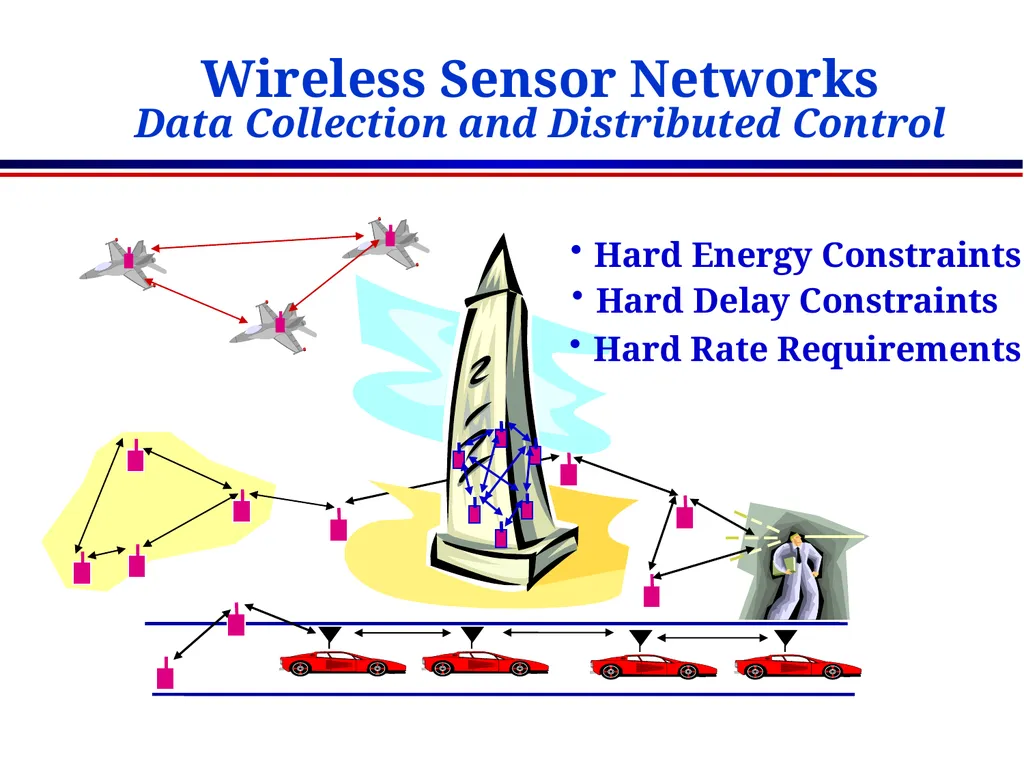
2 Wireless Sensor Networks
Data Collection and Distributed Control<br>
03
3 Application Domains Home networking: Smart appliances, home security, smart floors, smart buildings
Automotive: Diagnostics, occupant safety, collision avoidance
Industrial automation: Factory automation, hazardous material control
Traffic management: Flow monitoring, collision avoidance
Security: Building/office security, equipment tagging, homeland security
Environmental monitoring: Habitat monitoring, seismic activity, local/global environmental trends, agricultural<br>
Automotive: Diagnostics, occupant safety, collision avoidance
Industrial automation: Factory automation, hazardous material control
Traffic management: Flow monitoring, collision avoidance
Security: Building/office security, equipment tagging, homeland security
Environmental monitoring: Habitat monitoring, seismic activity, local/global environmental trends, agricultural<br>
04
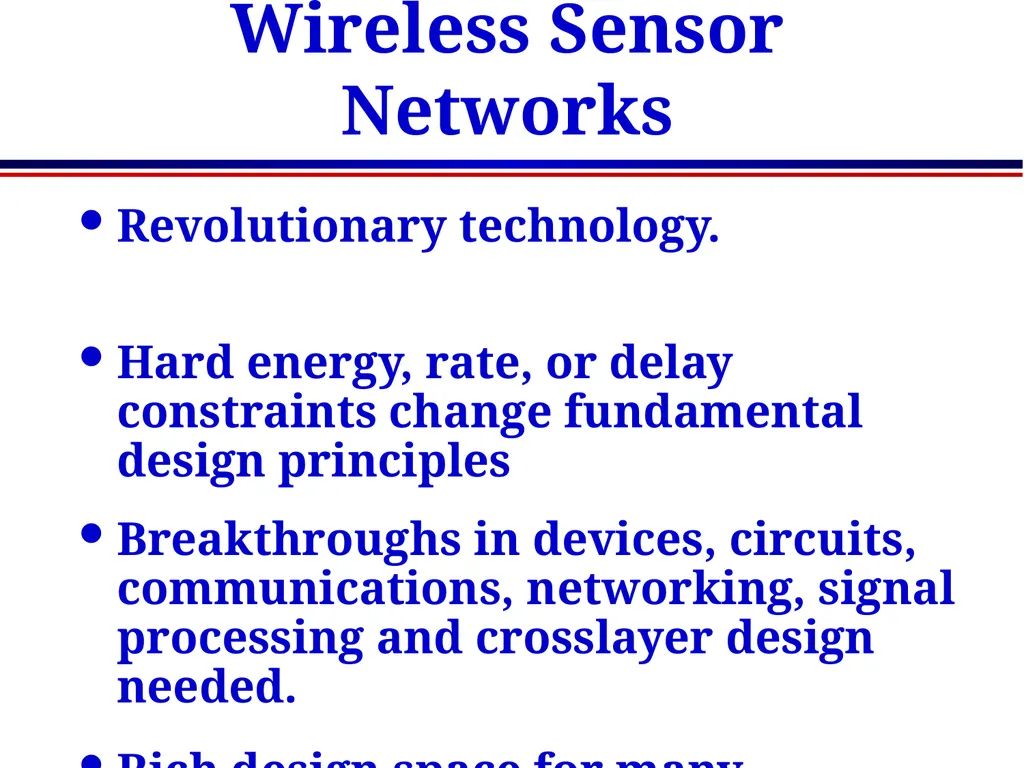
4 Wireless Sensor Networks Revolutionary technology.
Hard energy, rate, or delay constraints change fundamental design principles
Breakthroughs in devices, circuits, communications, networking, signal processing and crosslayer design needed.
Rich design space for many industrial and commercial applications.<br>
Hard energy, rate, or delay constraints change fundamental design principles
Breakthroughs in devices, circuits, communications, networking, signal processing and crosslayer design needed.
Rich design space for many industrial and commercial applications.<br>
05
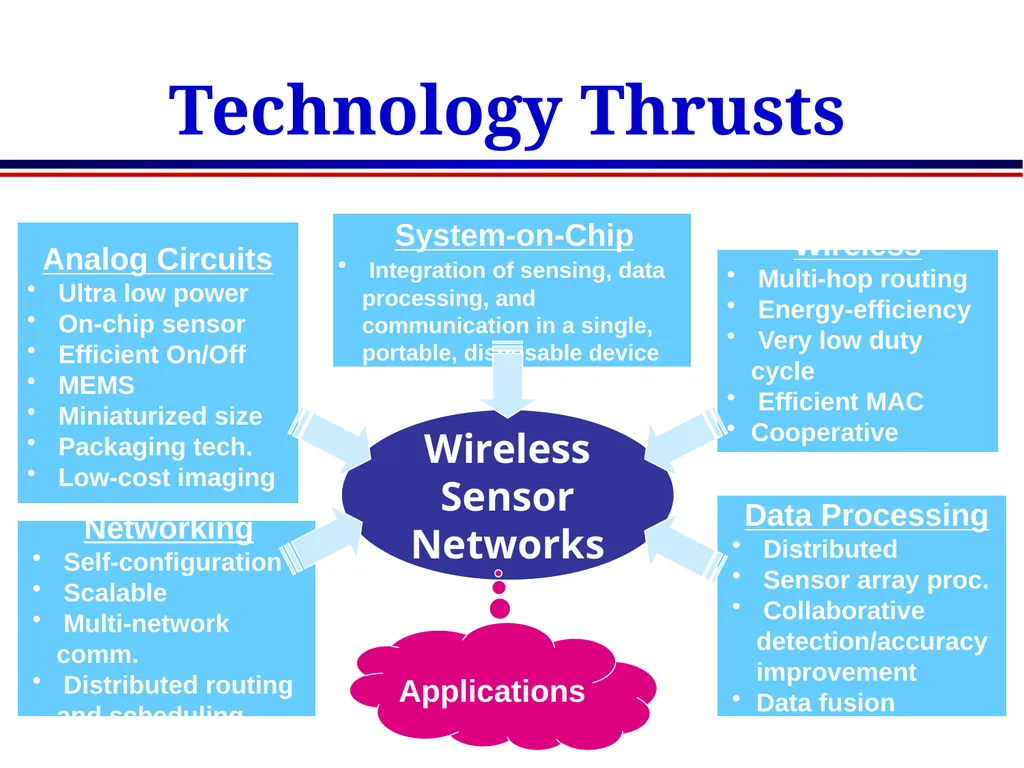
5 Technology Thrusts Wireless Sensor Networks Analog Circuits
Ultra low power
On-chip sensor
Efficient On/Off
MEMS
Miniaturized size
Packaging tech.
Low-cost imaging Networking
Self-configuration
Scalable
Multi-network comm.
Distributed routing and scheduling Wireless
Multi-hop routing
Energy-efficiency
Very low duty cycle
Efficient MAC
Cooperative Comm. Data Processing
Distributed
Sensor array proc.
Collaborative detection/accuracy improvement
Data fusion System-on-Chip
Integration of sensing, data processing, and communication in a single, portable, disposable device Applications<br>
Ultra low power
On-chip sensor
Efficient On/Off
MEMS
Miniaturized size
Packaging tech.
Low-cost imaging Networking
Self-configuration
Scalable
Multi-network comm.
Distributed routing and scheduling Wireless
Multi-hop routing
Energy-efficiency
Very low duty cycle
Efficient MAC
Cooperative Comm. Data Processing
Distributed
Sensor array proc.
Collaborative detection/accuracy improvement
Data fusion System-on-Chip
Integration of sensing, data processing, and communication in a single, portable, disposable device Applications<br>
06
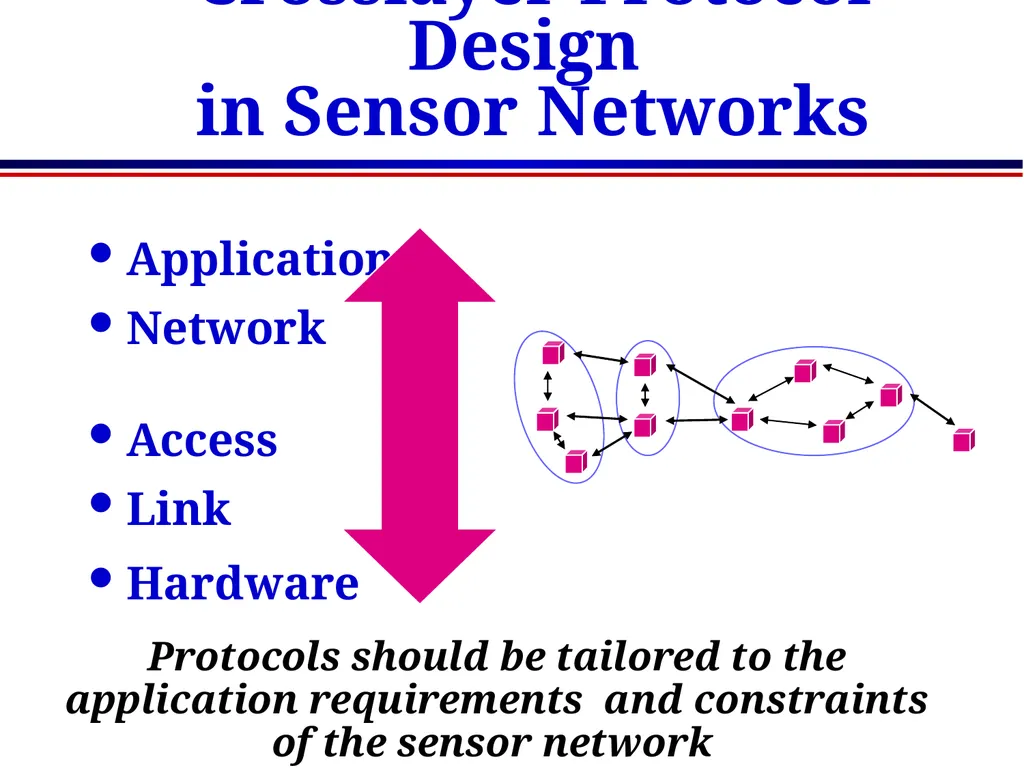
Crosslayer Protocol Design
in Sensor Networks Application
Network
Access
Link
Hardware Protocols should be tailored to the application requirements and constraints of the sensor network<br>
Network
Access
Link
Hardware Protocols should be tailored to the application requirements and constraints of the sensor network<br>
07
Energy-Constrained Nodes Each node can only send a finite number of bits.
Energy minimized by sending each bit very slowly.
Introduces a delay versus energy tradeoff for each bit.
Short-range networks must consider both transmit and processing energy.
Sophisticated techniques not necessarily energy-efficient.
Sleep modes save energy but complicate networking.
Changes everything about the network design:
Bit allocation must be optimized across all protocols.
Delay vs. throughput vs. node/network lifetime tradeoffs.
Optimization of node cooperation.<br>
Energy minimized by sending each bit very slowly.
Introduces a delay versus energy tradeoff for each bit.
Short-range networks must consider both transmit and processing energy.
Sophisticated techniques not necessarily energy-efficient.
Sleep modes save energy but complicate networking.
Changes everything about the network design:
Bit allocation must be optimized across all protocols.
Delay vs. throughput vs. node/network lifetime tradeoffs.
Optimization of node cooperation.<br>
08
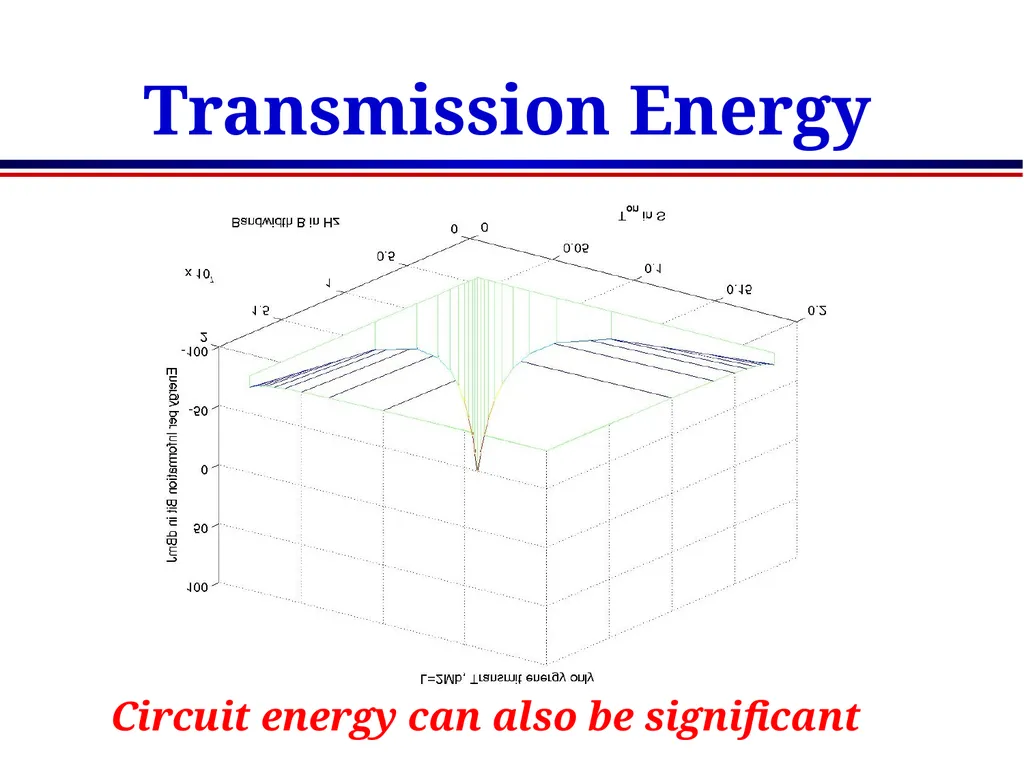
Transmission Energy Circuit energy can also be significant<br>
09
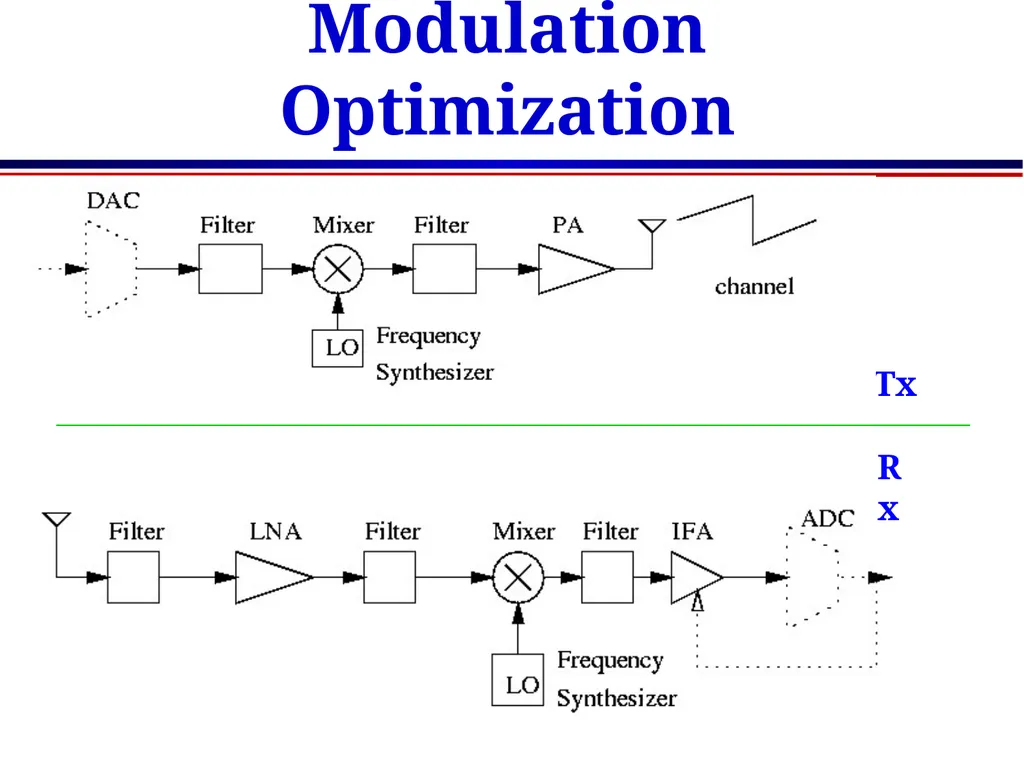
Modulation Optimization Tx Rx<br>
10
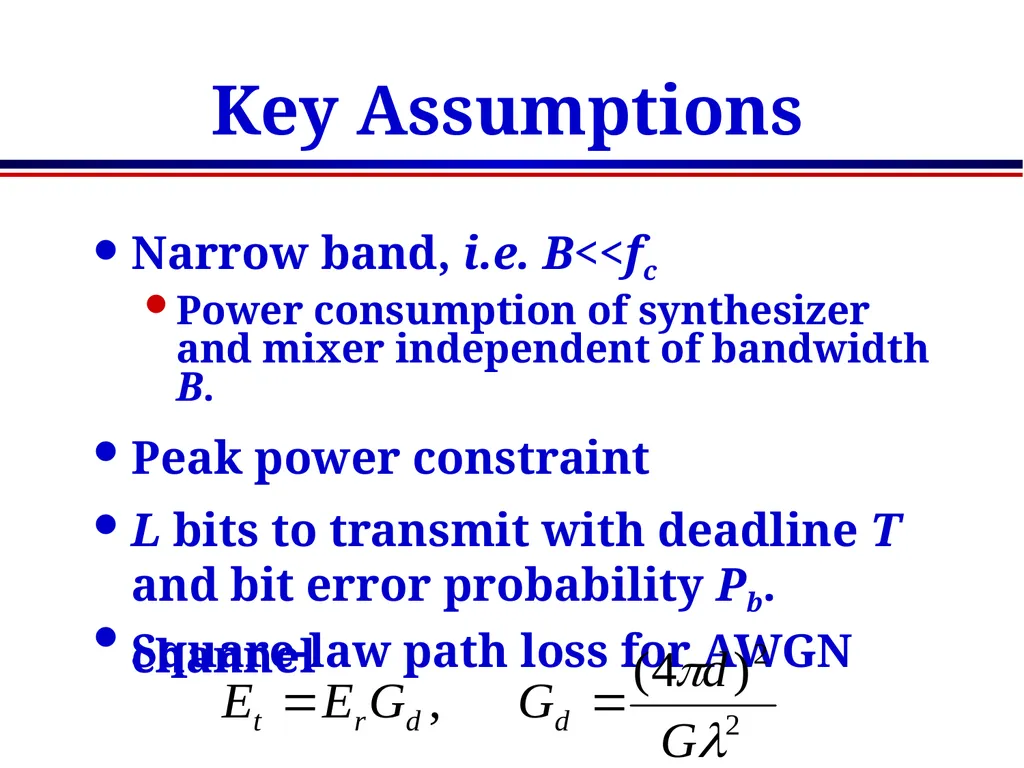
Key Assumptions Narrow band, i.e. B<<fc
Power consumption of synthesizer and mixer independent of bandwidth B.
Peak power constraint
L bits to transmit with deadline T and bit error probability Pb.
Square-law path loss for AWGN channel<br>
Power consumption of synthesizer and mixer independent of bandwidth B.
Peak power constraint
L bits to transmit with deadline T and bit error probability Pb.
Square-law path loss for AWGN channel<br>
11
Multi-Mode Operation
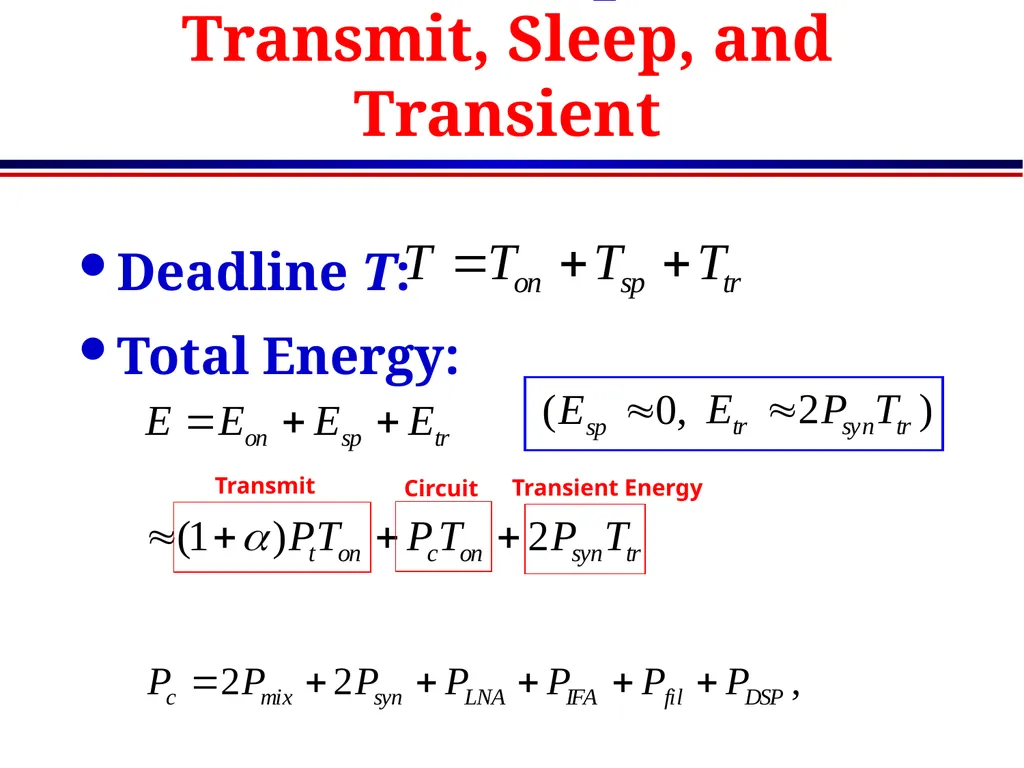
Transmit, Sleep, and Transient Deadline T:
Total Energy: where a is the amplifier efficiency and<br>
Total Energy: where a is the amplifier efficiency and<br>
12
Energy Consumption:
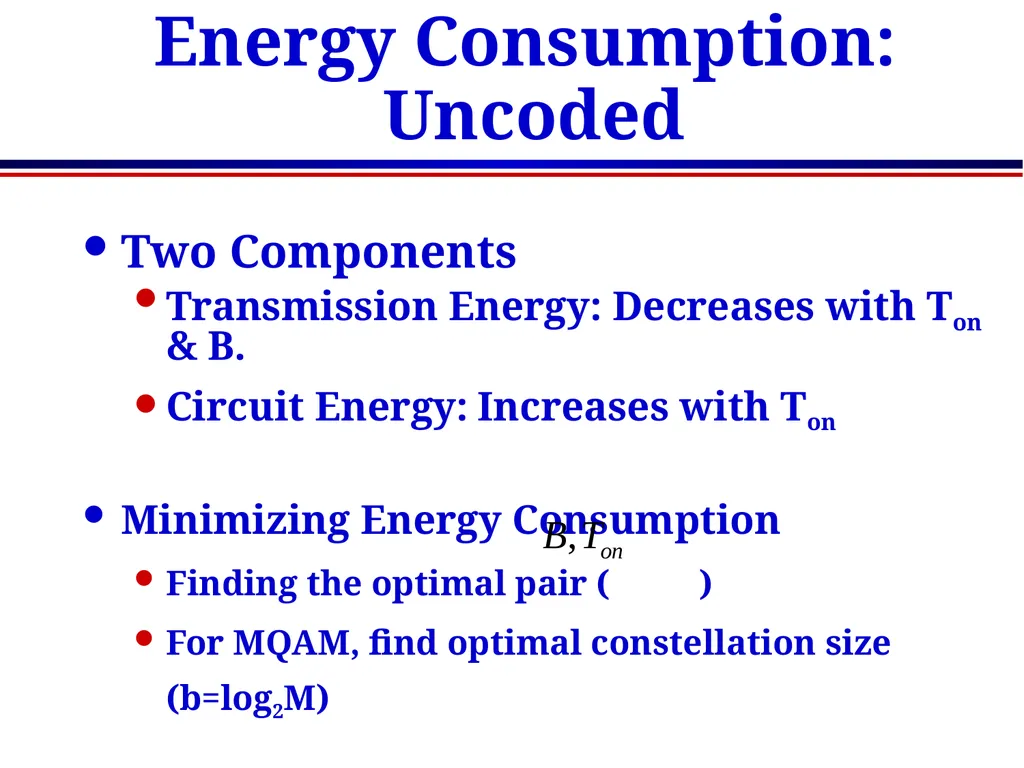
Uncoded Two Components
Transmission Energy: Decreases with Ton & B.
Circuit Energy: Increases with Ton
Minimizing Energy Consumption
Finding the optimal pair ( )
For MQAM, find optimal constellation size (b=log2M)<br>
Transmission Energy: Decreases with Ton & B.
Circuit Energy: Increases with Ton
Minimizing Energy Consumption
Finding the optimal pair ( )
For MQAM, find optimal constellation size (b=log2M)<br>
13
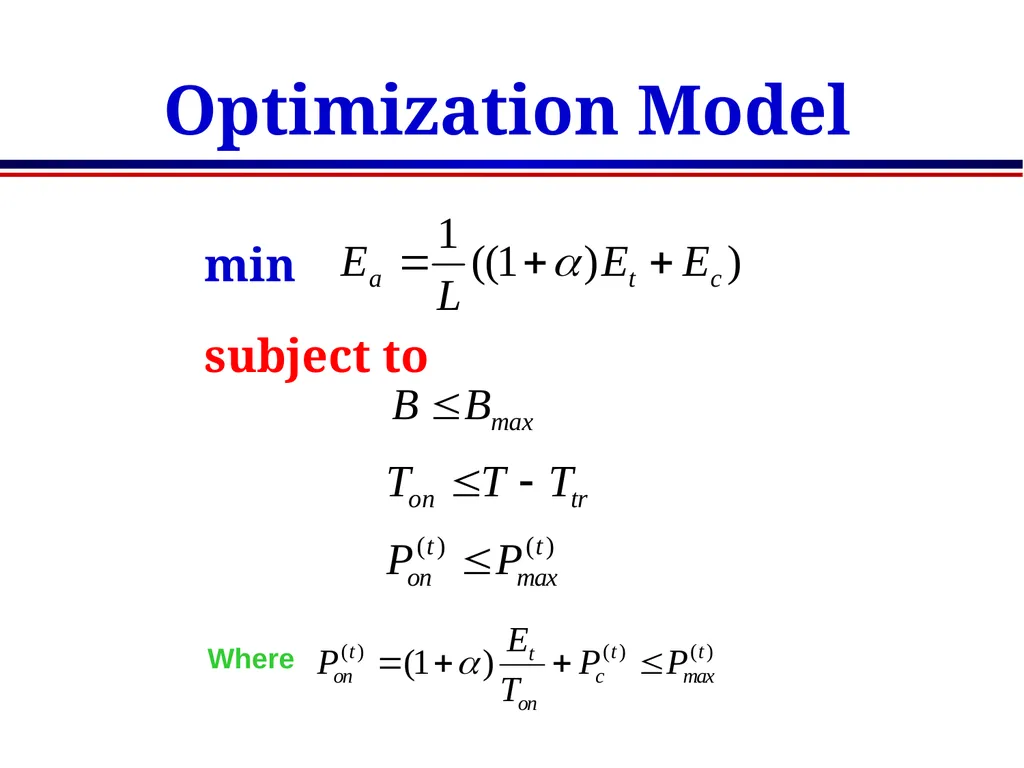
Optimization Model min
subject to
Where<br>
subject to
Where<br>
14
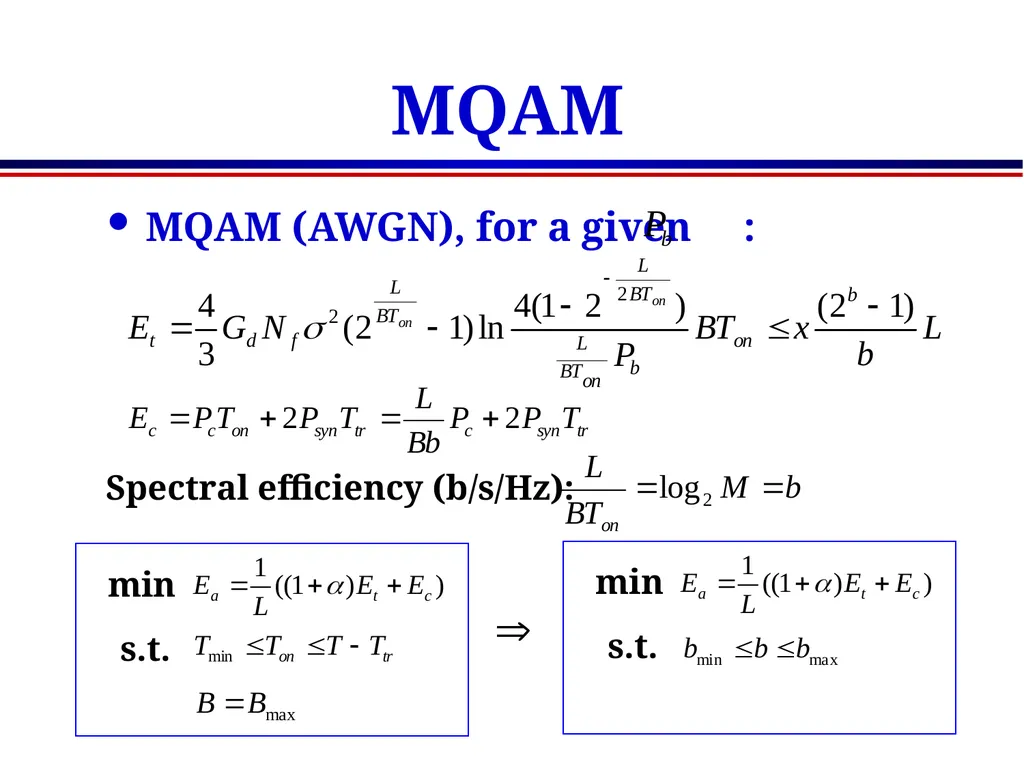
MQAM MQAM (AWGN), for a given : min s.t. Spectral efficiency (b/s/Hz): min s.t.<br>
15
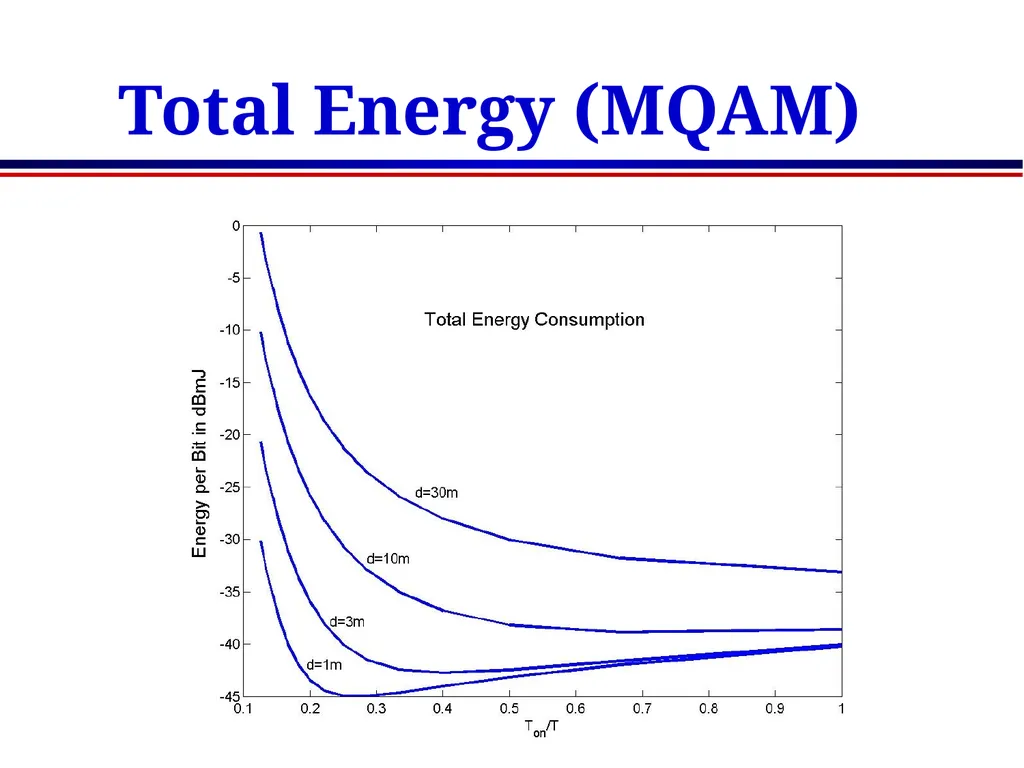
Total Energy (MQAM)<br>
16
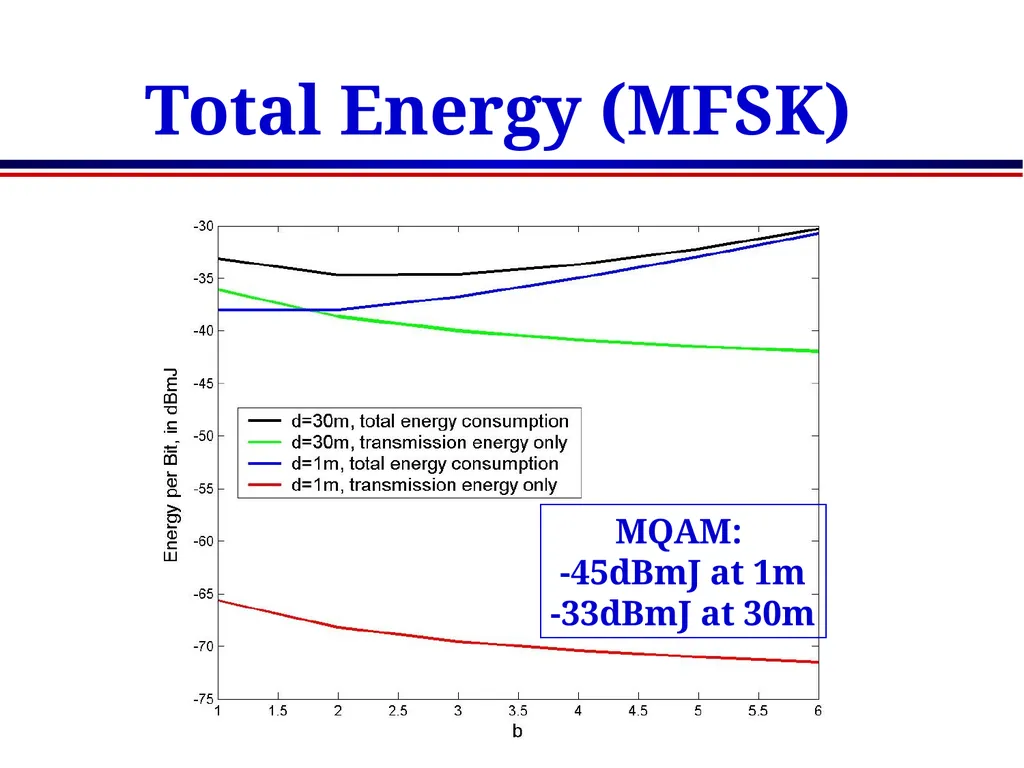
Total Energy (MFSK) MQAM:
-45dBmJ at 1m
-33dBmJ at 30m<br>
-45dBmJ at 1m
-33dBmJ at 30m<br>
17
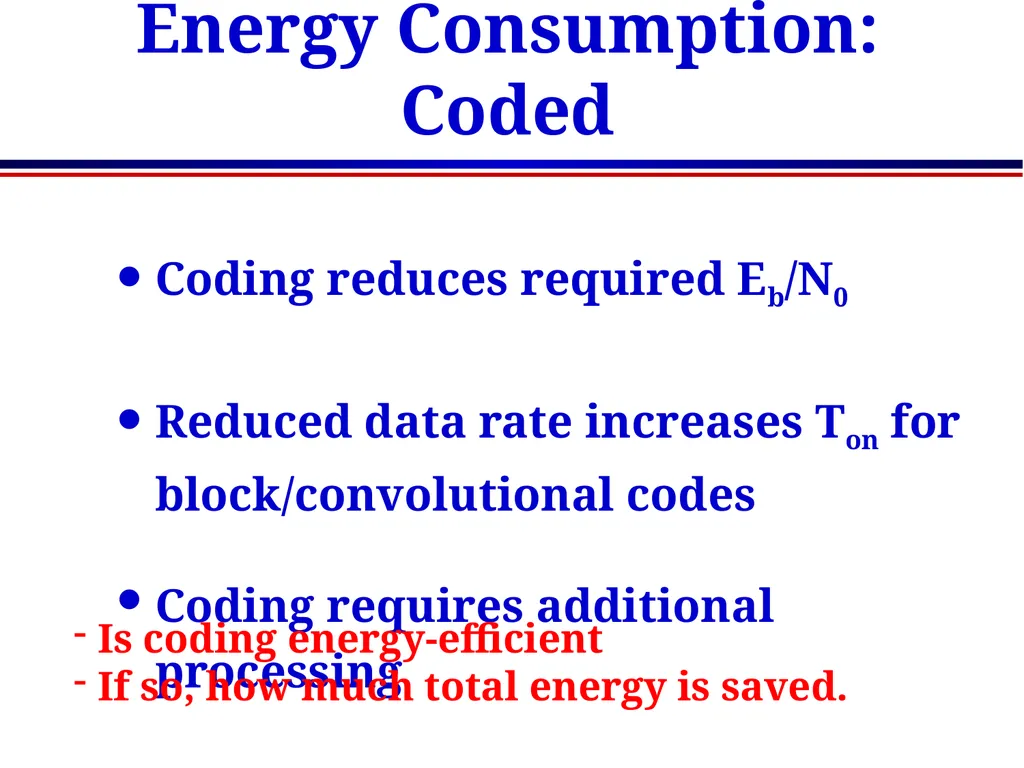
Energy Consumption: Coded Coding reduces required Eb/N0
Reduced data rate increases Ton for block/convolutional codes
Coding requires additional processing Is coding energy-efficient
If so, how much total energy is saved.<br>
Reduced data rate increases Ton for block/convolutional codes
Coding requires additional processing Is coding energy-efficient
If so, how much total energy is saved.<br>
18
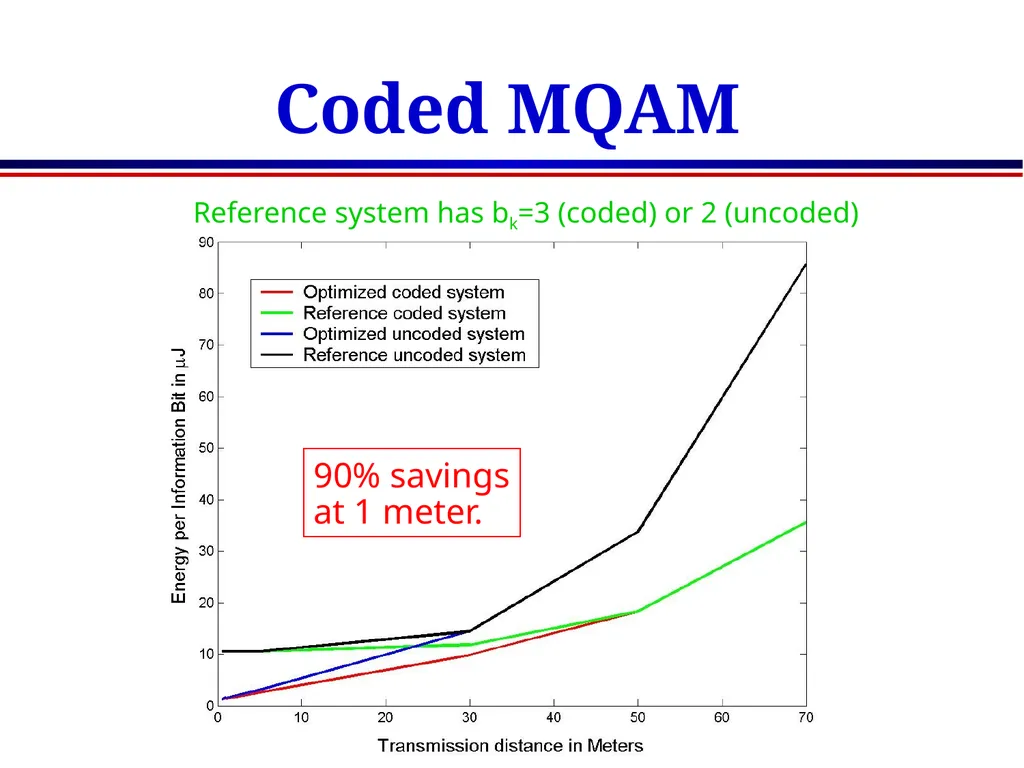
MQAM Optimization Find BER expression for coded MQAM
Assume trellis coding with 4.7 dB coding gain
Yields required Eb/N0
Depends on constellation size (bk)
Find transmit energy for sending L bits in Ton sec.
Find circuit energy consumption based on uncoded system and codec model
Optimize Ton and bk to minimize energy<br>
Assume trellis coding with 4.7 dB coding gain
Yields required Eb/N0
Depends on constellation size (bk)
Find transmit energy for sending L bits in Ton sec.
Find circuit energy consumption based on uncoded system and codec model
Optimize Ton and bk to minimize energy<br>
19
Coded MQAM Reference system has bk=3 (coded) or 2 (uncoded) 90% savings
at 1 meter.<br>
at 1 meter.<br>
20
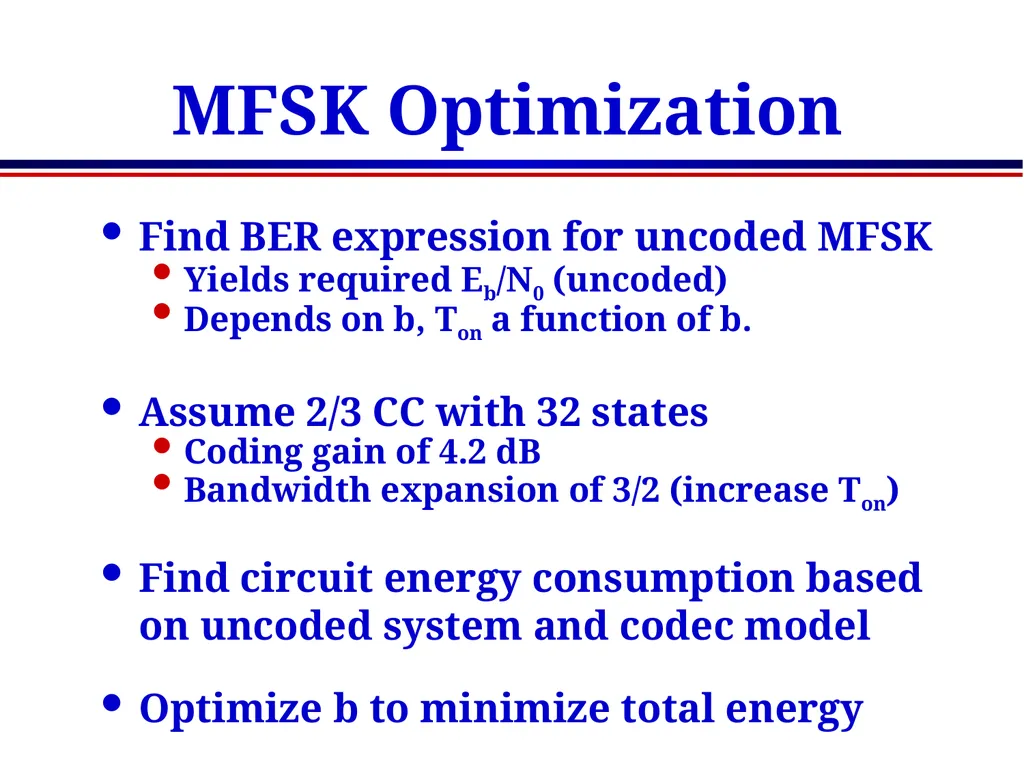
MFSK Optimization Find BER expression for uncoded MFSK
Yields required Eb/N0 (uncoded)
Depends on b, Ton a function of b.
Assume 2/3 CC with 32 states
Coding gain of 4.2 dB
Bandwidth expansion of 3/2 (increase Ton)
Find circuit energy consumption based on uncoded system and codec model
Optimize b to minimize total energy<br>
Yields required Eb/N0 (uncoded)
Depends on b, Ton a function of b.
Assume 2/3 CC with 32 states
Coding gain of 4.2 dB
Bandwidth expansion of 3/2 (increase Ton)
Find circuit energy consumption based on uncoded system and codec model
Optimize b to minimize total energy<br>
21
Benefits of Coding<br>
22
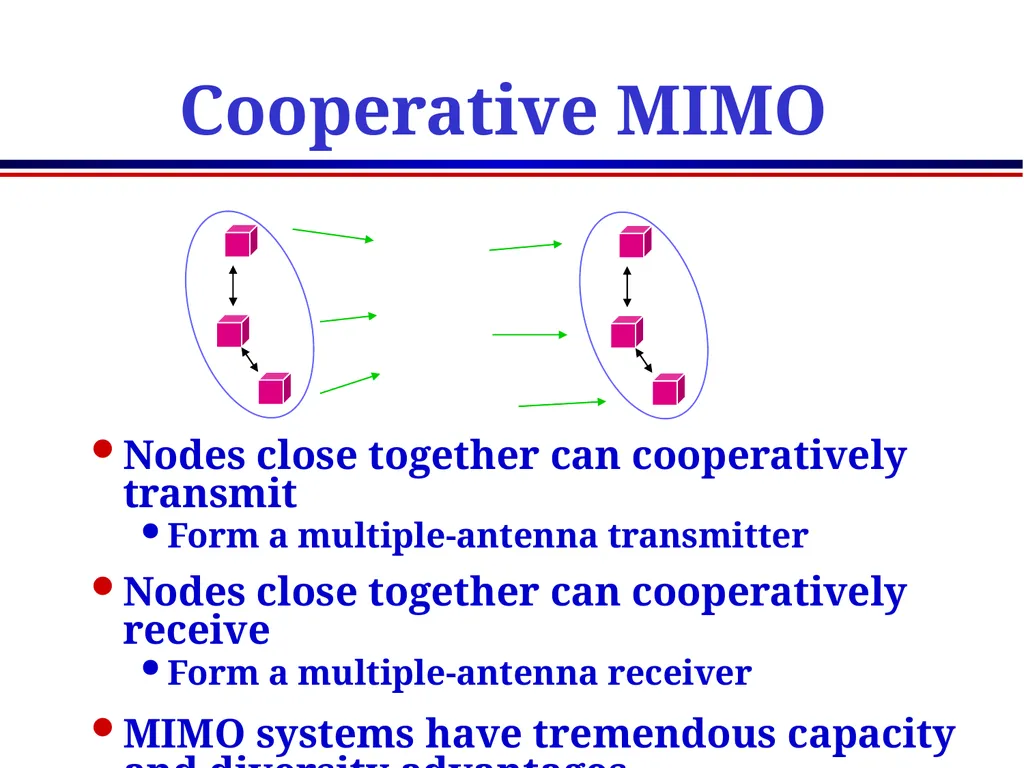
Cooperative MIMO Nodes close together can cooperatively transmit
Form a multiple-antenna transmitter
Nodes close together can cooperatively receive
Form a multiple-antenna receiver
MIMO systems have tremendous capacity and diversity advantages<br>
Form a multiple-antenna transmitter
Nodes close together can cooperatively receive
Form a multiple-antenna receiver
MIMO systems have tremendous capacity and diversity advantages<br>
23
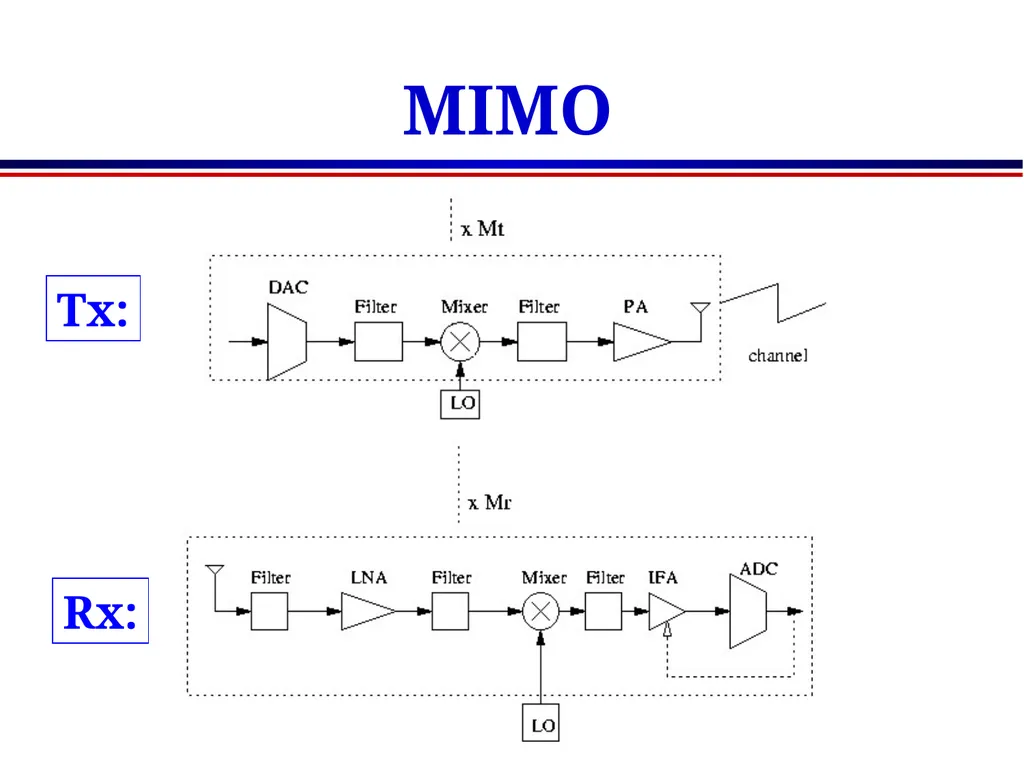
MIMO Tx: Rx:<br>
24
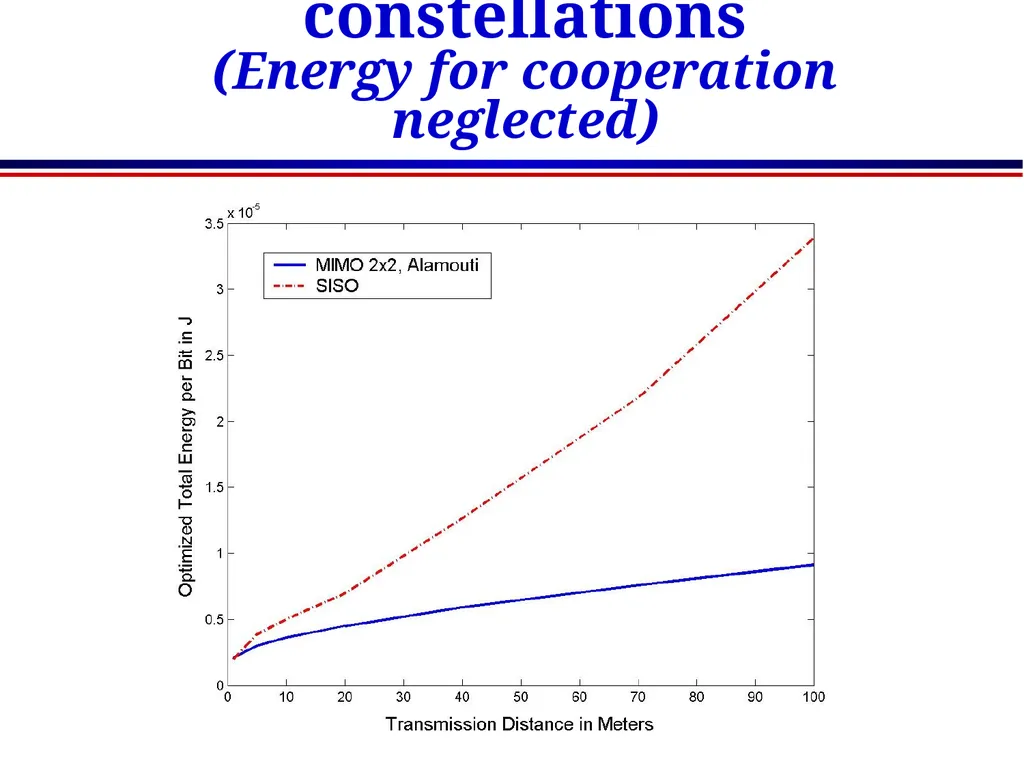
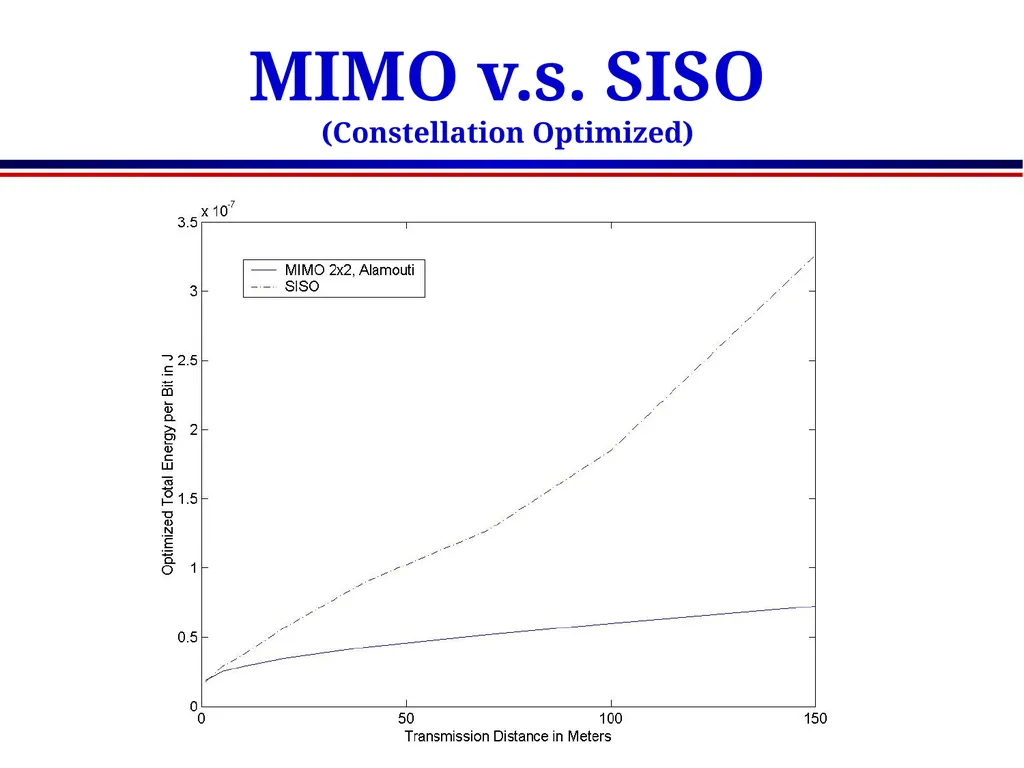
MIMO: optimized constellations
(Energy for cooperation neglected)<br>
25
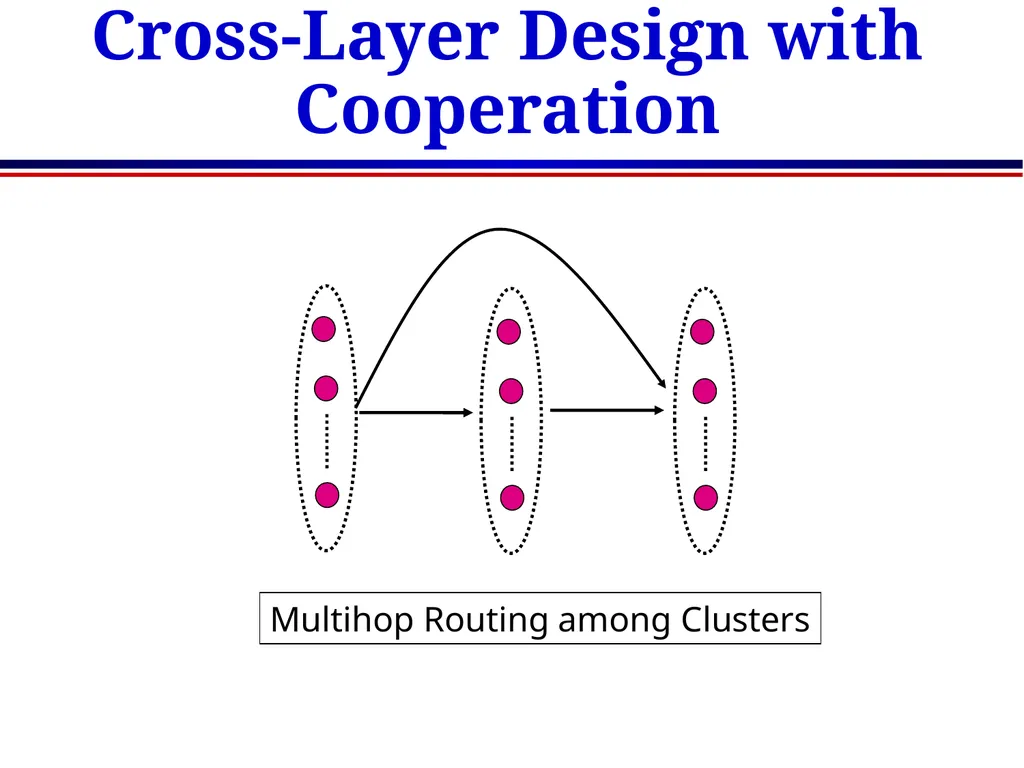
Cross-Layer Design with Cooperation Multihop Routing among Clusters<br>
26
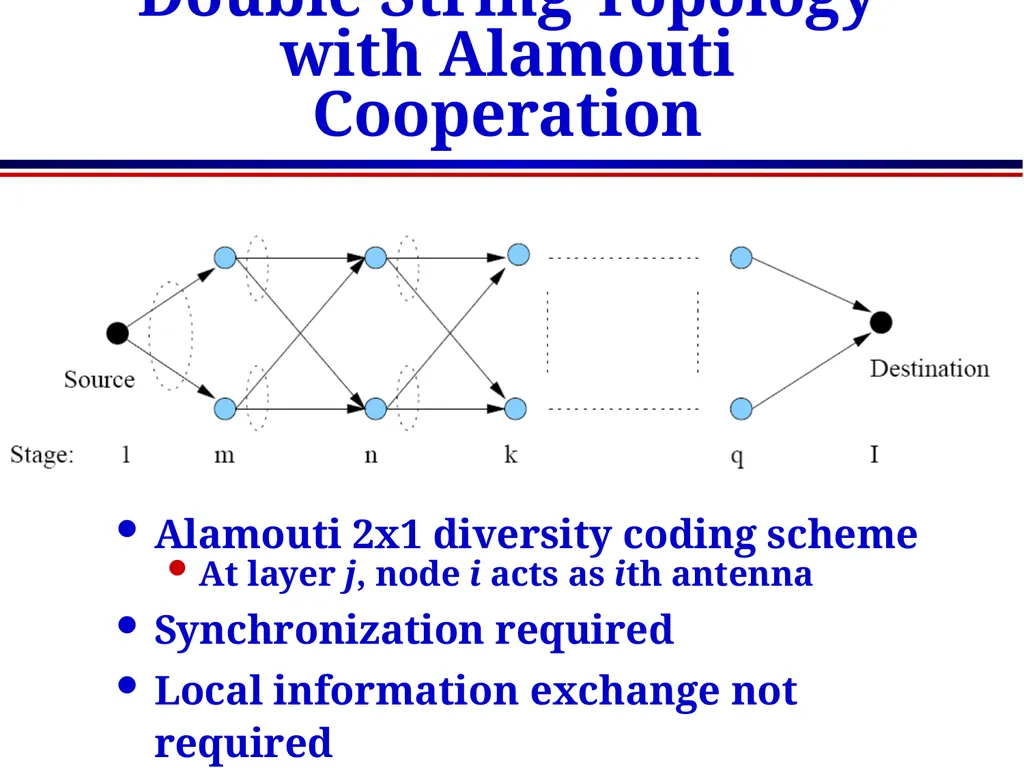
Double String Topology with Alamouti Cooperation Alamouti 2x1 diversity coding scheme
At layer j, node i acts as ith antenna
Synchronization required
Local information exchange not required<br>
At layer j, node i acts as ith antenna
Synchronization required
Local information exchange not required<br>
27
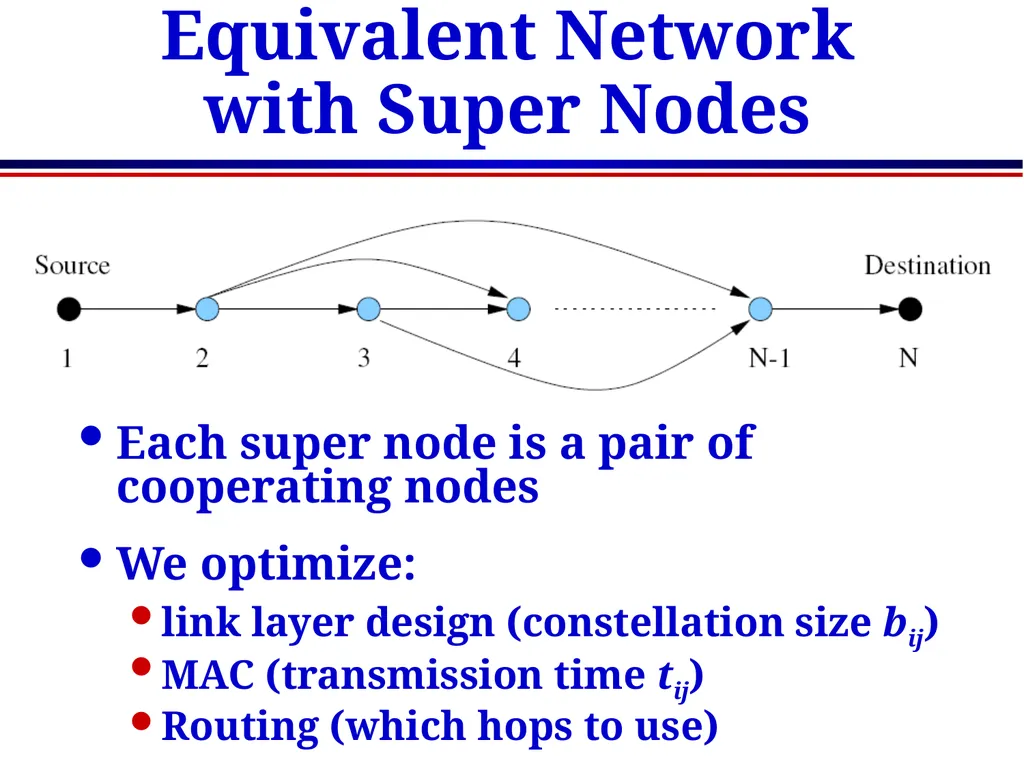
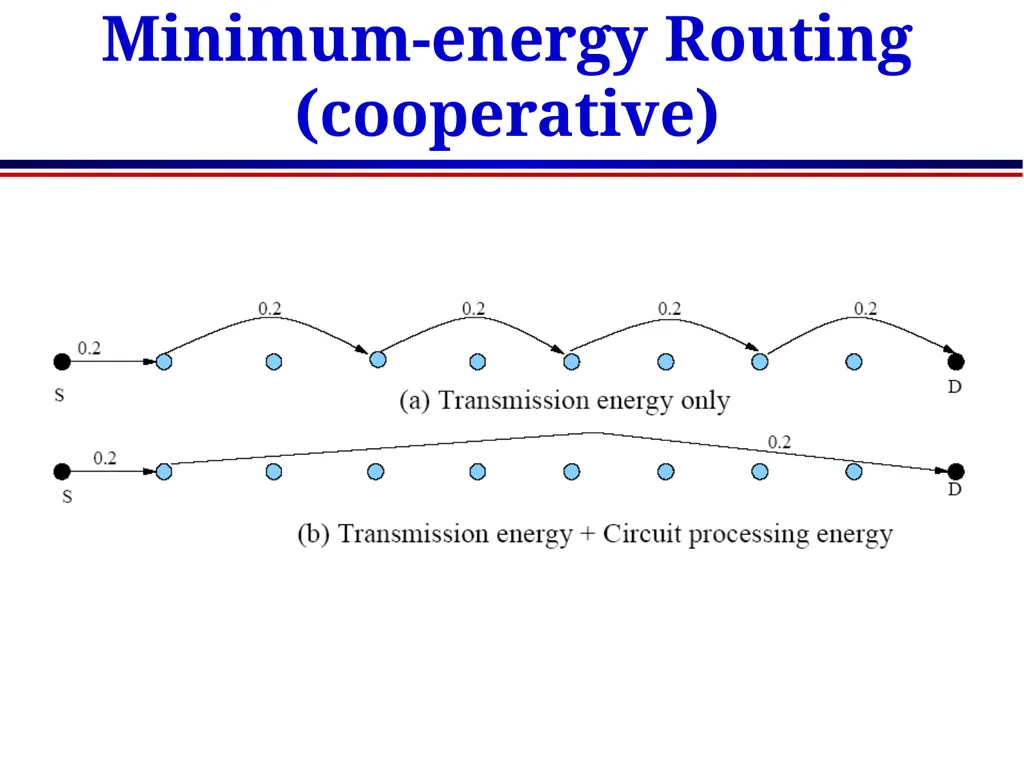
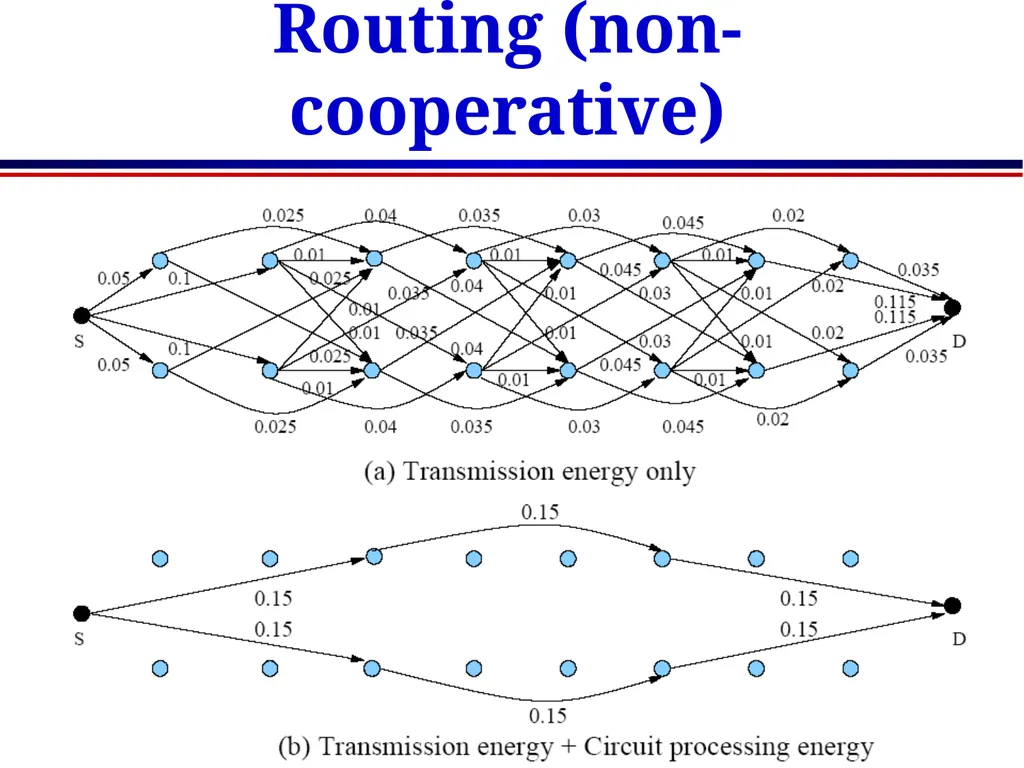
Equivalent Network with Super Nodes Each super node is a pair of cooperating nodes
We optimize:
link layer design (constellation size bij)
MAC (transmission time tij)
Routing (which hops to use)<br>
We optimize:
link layer design (constellation size bij)
MAC (transmission time tij)
Routing (which hops to use)<br>
28
Minimum-energy Routing (cooperative)<br>
29
Minimum-energy Routing (non-cooperative)<br>
30
MIMO v.s. SISO
(Constellation Optimized)<br>
31
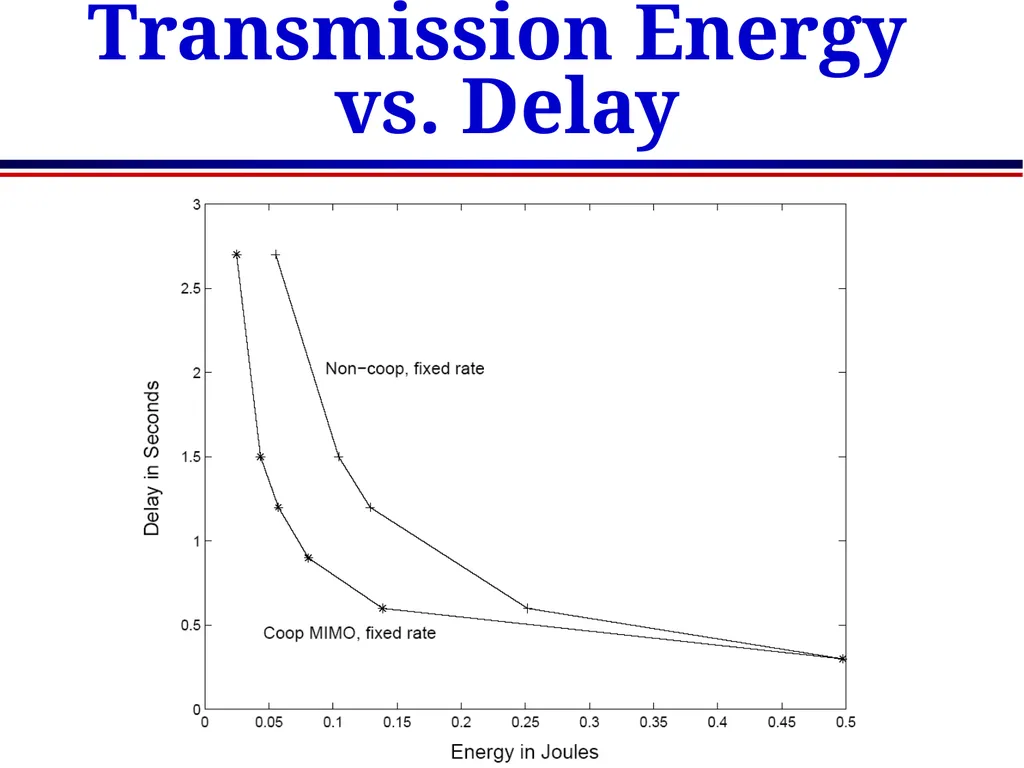
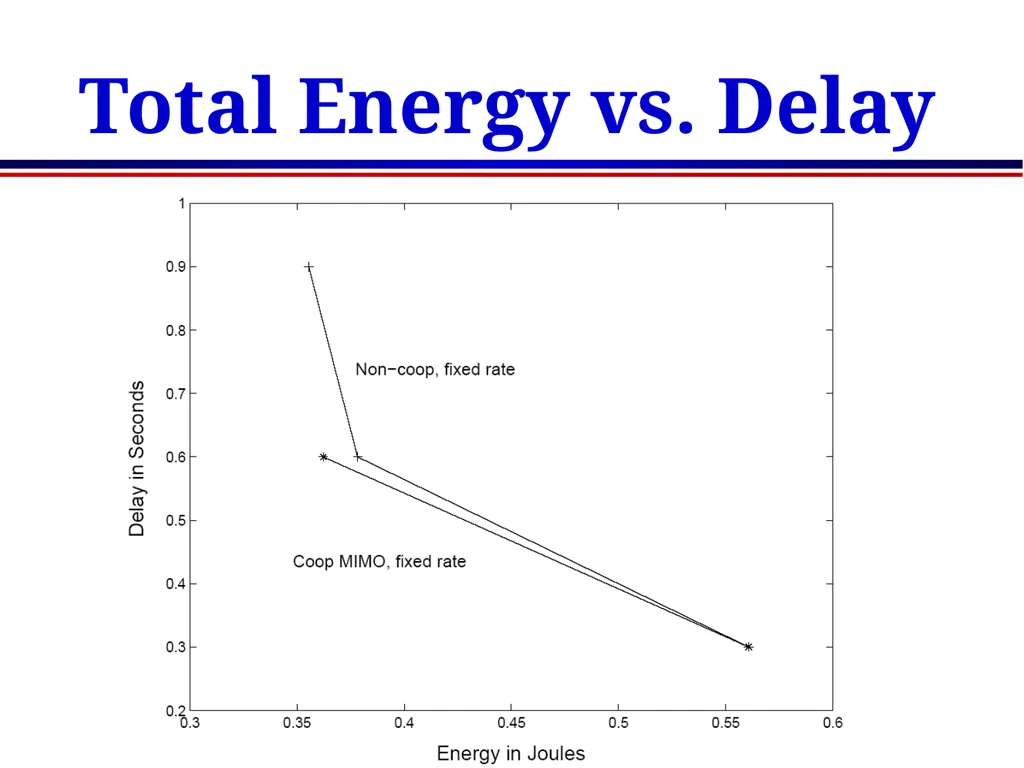
Delay/Energy Tradeoff Packet Delay: transmission delay + deterministic queuing delay
Different ordering of tij’s results in different delay performance
Define the scheduling delay as total time needed for sink node to receive packets from all nodes
There is fundamental tradeoff between the scheduling delay and total energy consumption<br>
Different ordering of tij’s results in different delay performance
Define the scheduling delay as total time needed for sink node to receive packets from all nodes
There is fundamental tradeoff between the scheduling delay and total energy consumption<br>
32
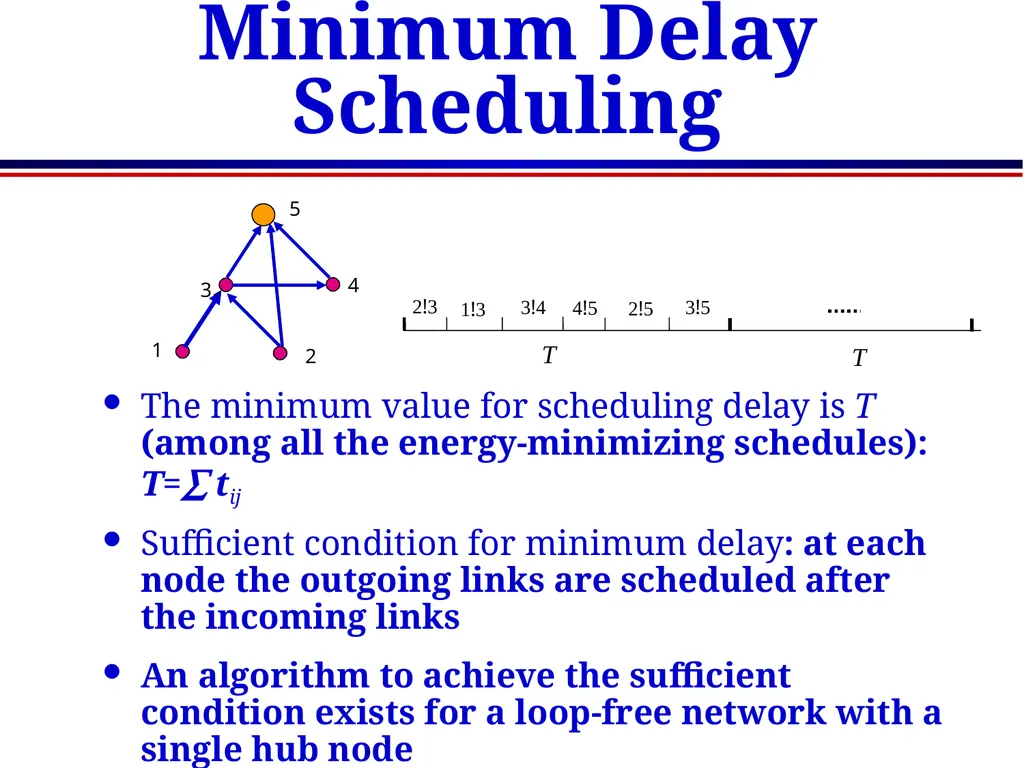
Minimum Delay Scheduling The minimum value for scheduling delay is T (among all the energy-minimizing schedules): T=å tij
Sufficient condition for minimum delay: at each node the outgoing links are scheduled after the incoming links
An algorithm to achieve the sufficient condition exists for a loop-free network with a single hub node
An minimum-delay schedule for the example: {2!3, 1!3, 3!4, 4!5, 2!5, 3!5} 1 2 3 4 5 T T<br>
Sufficient condition for minimum delay: at each node the outgoing links are scheduled after the incoming links
An algorithm to achieve the sufficient condition exists for a loop-free network with a single hub node
An minimum-delay schedule for the example: {2!3, 1!3, 3!4, 4!5, 2!5, 3!5} 1 2 3 4 5 T T<br>
33
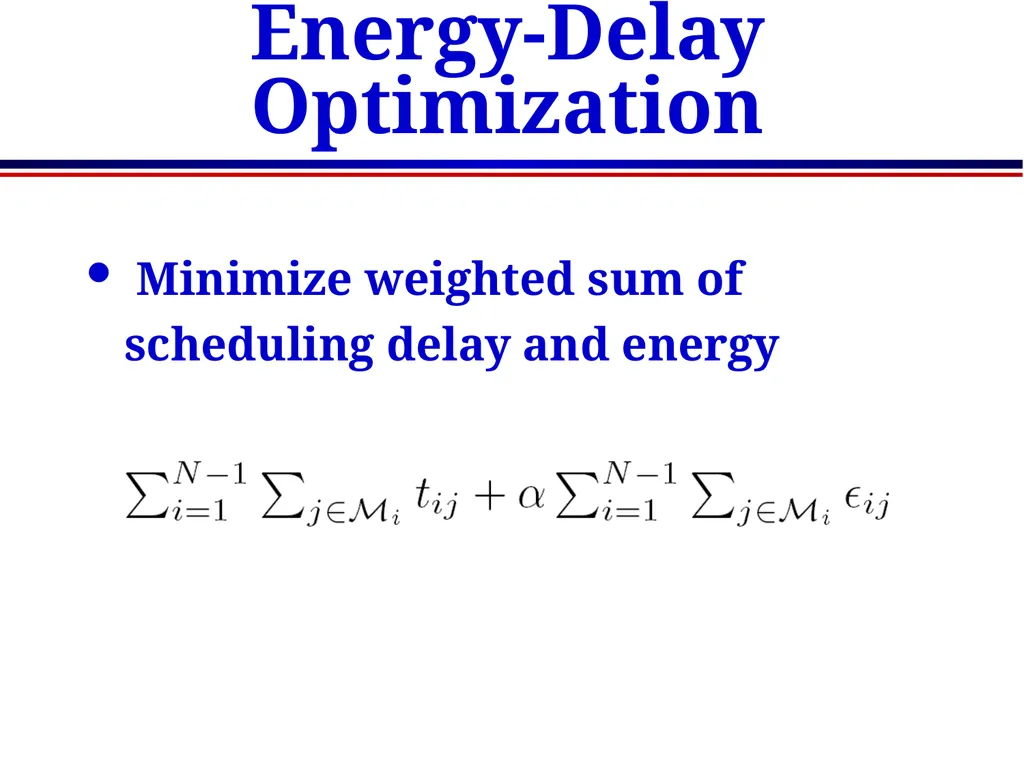
Energy-Delay Optimization Minimize weighted sum of scheduling delay and energy<br>
34
Transmission Energy
vs. Delay<br>
35
Total Energy vs. Delay<br>
36
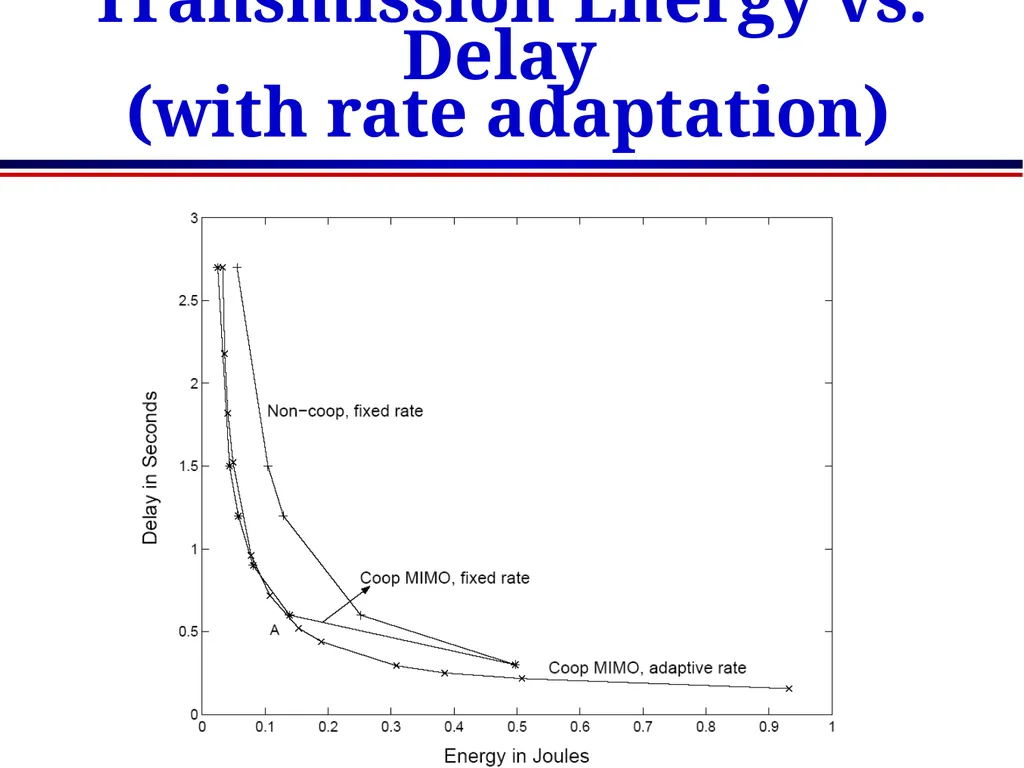
Transmission Energy vs. Delay
(with rate adaptation)<br>
37
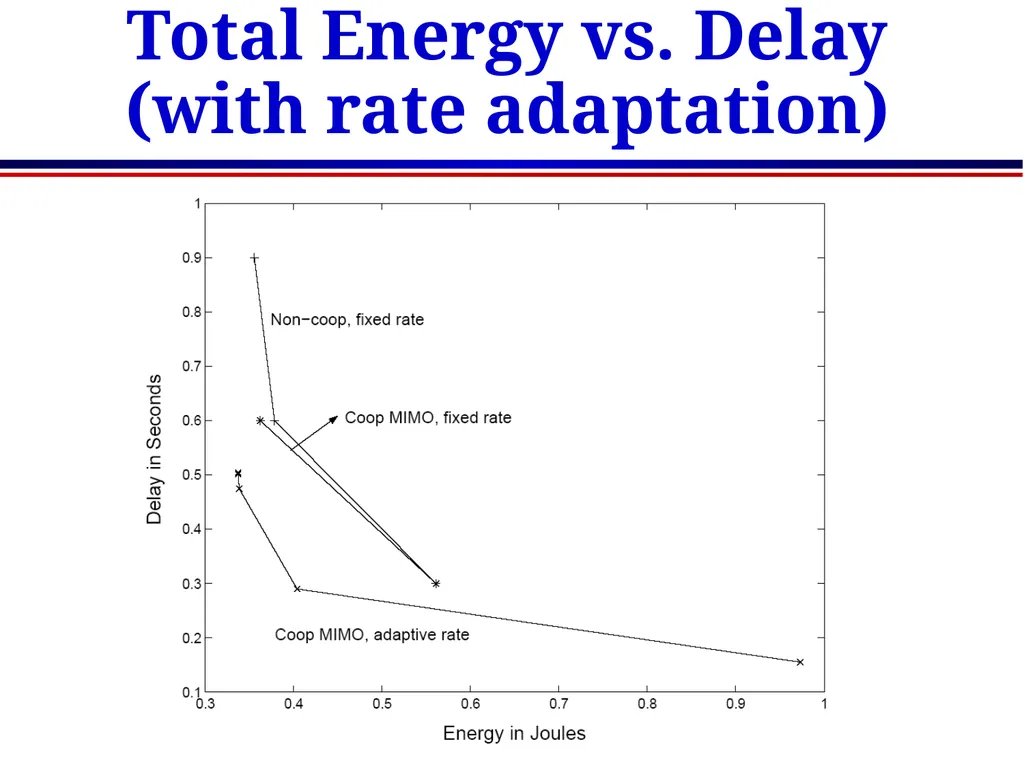
Total Energy vs. Delay
(with rate adaptation)<br>
38
MAC Protocols Each node has bits to transmit via MQAM
Want to minimize total energy required
TDMA considered, optimizing time slots assignment (or equivalently , where )<br>
Want to minimize total energy required
TDMA considered, optimizing time slots assignment (or equivalently , where )<br>
39
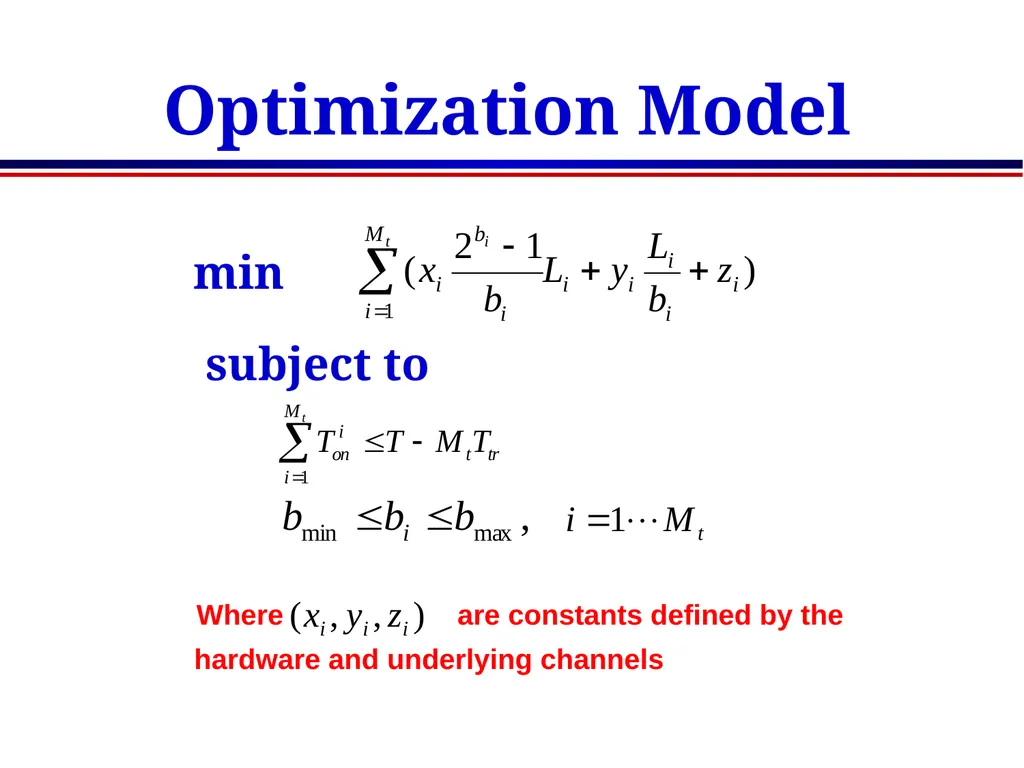
Optimization Model min
subject to
Where are constants defined by the
hardware and underlying channels<br>
subject to
Where are constants defined by the
hardware and underlying channels<br>
40
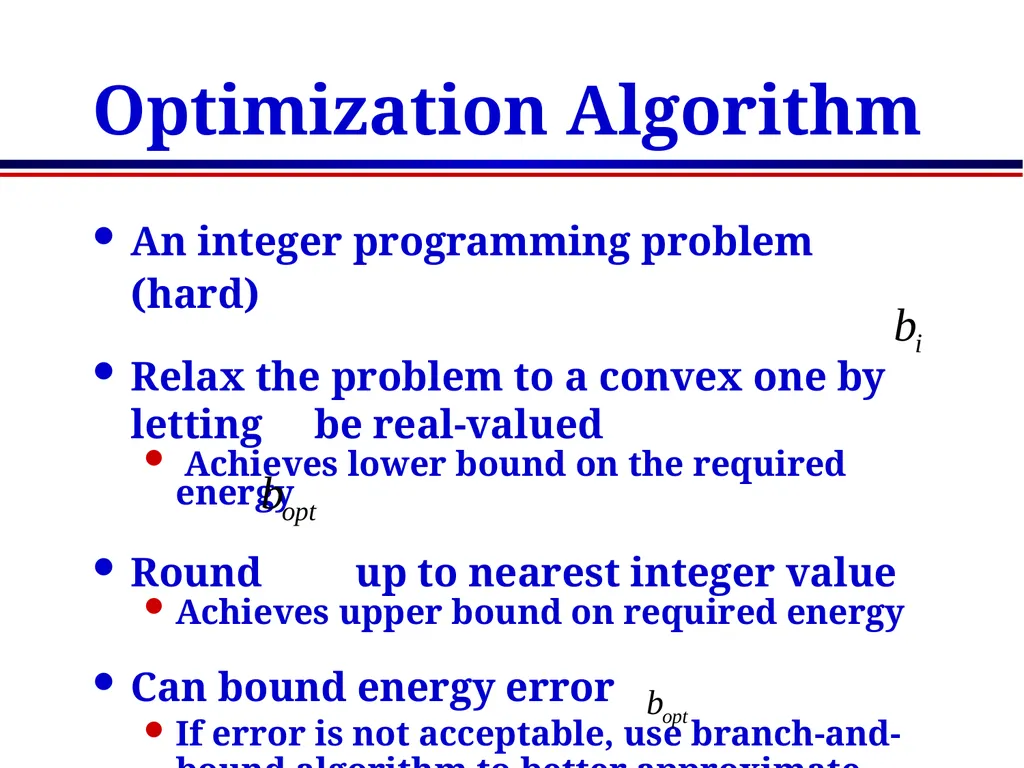
Optimization Algorithm An integer programming problem (hard)
Relax the problem to a convex one by letting be real-valued
Achieves lower bound on the required energy
Round up to nearest integer value
Achieves upper bound on required energy
Can bound energy error
If error is not acceptable, use branch-and-bound algorithm to better approximate<br>
Relax the problem to a convex one by letting be real-valued
Achieves lower bound on the required energy
Round up to nearest integer value
Achieves upper bound on required energy
Can bound energy error
If error is not acceptable, use branch-and-bound algorithm to better approximate<br>
41
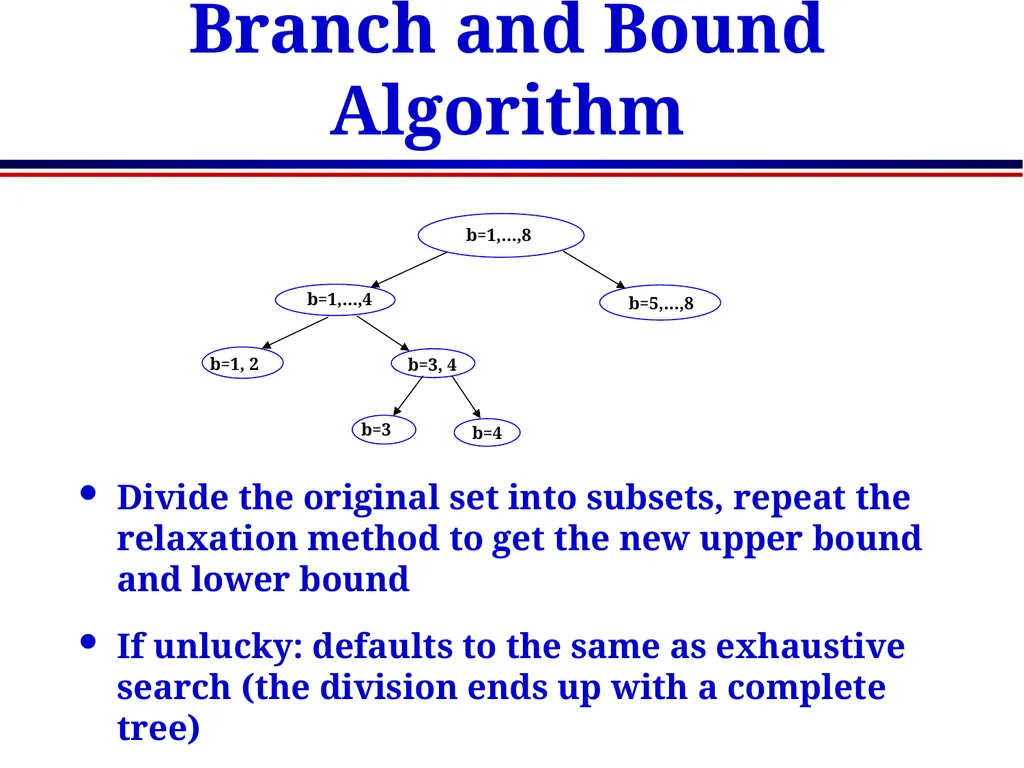
Branch and Bound Algorithm Divide the original set into subsets, repeat the relaxation method to get the new upper bound and lower bound
If unlucky: defaults to the same as exhaustive search (the division ends up with a complete tree)
Can dramatically reduce computation cost b=1,…,8 b=1,…,4 b=5,…,8 b=1, 2 b=3, 4 b=3 b=4<br>
If unlucky: defaults to the same as exhaustive search (the division ends up with a complete tree)
Can dramatically reduce computation cost b=1,…,8 b=1,…,4 b=5,…,8 b=1, 2 b=3, 4 b=3 b=4<br>
42
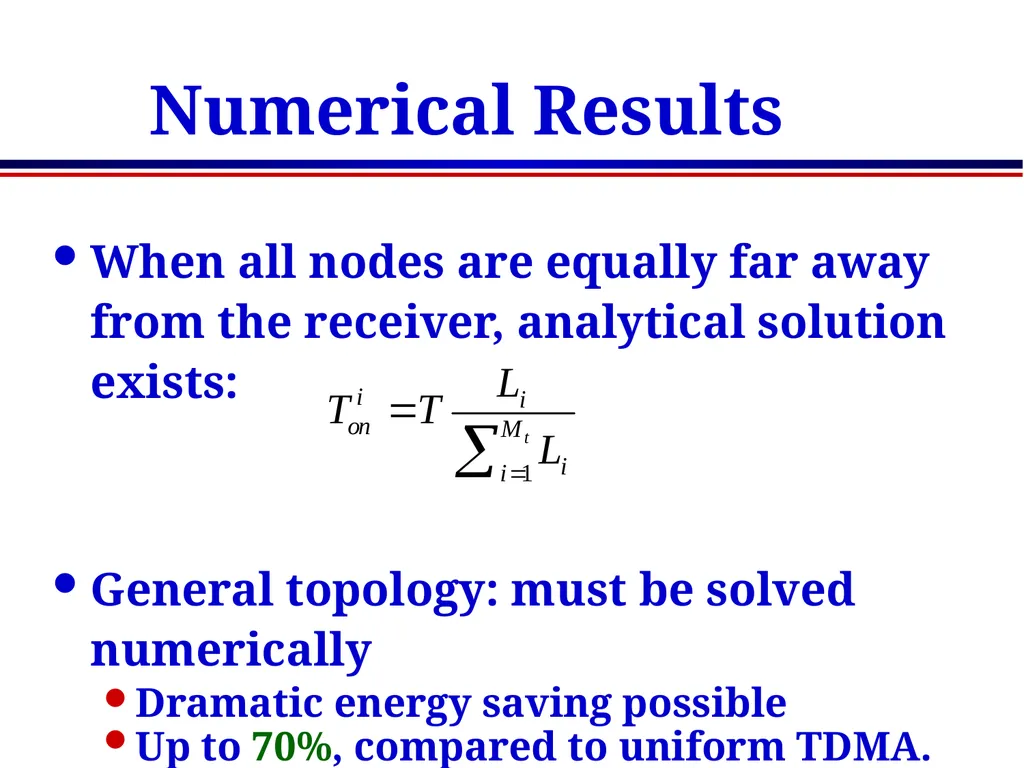
Numerical Results When all nodes are equally far away from the receiver, analytical solution exists:
General topology: must be solved numerically
Dramatic energy saving possible
Up to 70%, compared to uniform TDMA.<br>
General topology: must be solved numerically
Dramatic energy saving possible
Up to 70%, compared to uniform TDMA.<br>
43
Minimum-Energy Routing
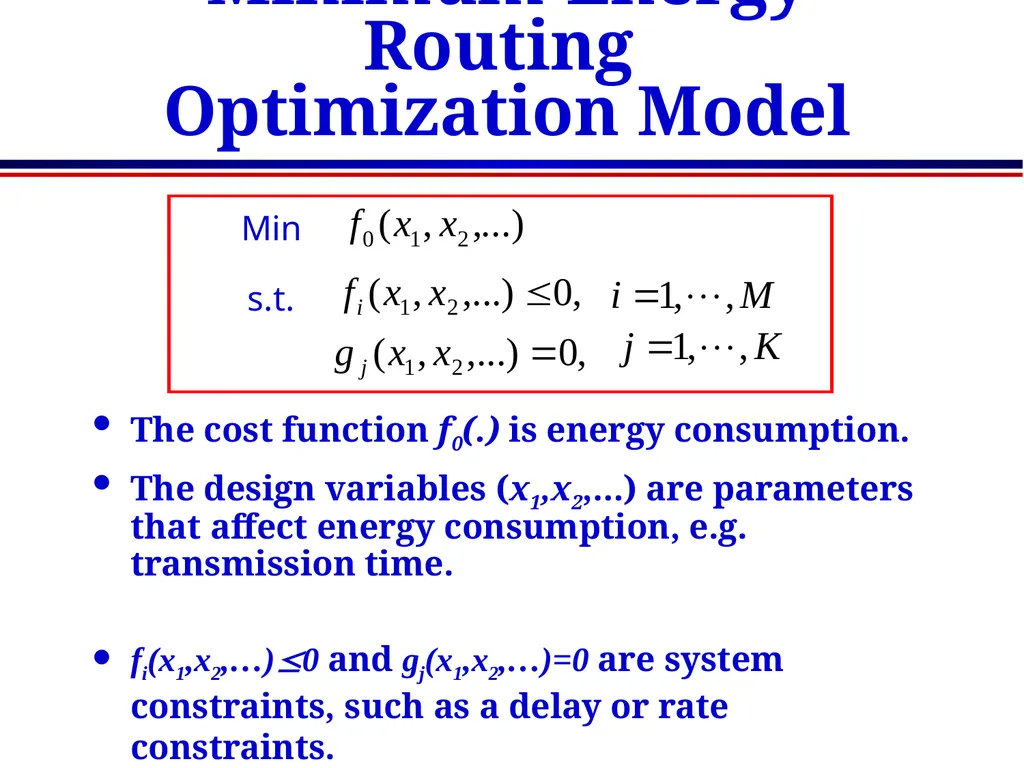
Optimization Model The cost function f0(.) is energy consumption.
The design variables (x1,x2,…) are parameters that affect energy consumption, e.g. transmission time.
fi(x1,x2,…)0 and gj(x1,x2,…)=0 are system constraints, such as a delay or rate constraints.
If not convex, relaxation methods can be used.
Focus on TD systems Min s.t.<br>
The design variables (x1,x2,…) are parameters that affect energy consumption, e.g. transmission time.
fi(x1,x2,…)0 and gj(x1,x2,…)=0 are system constraints, such as a delay or rate constraints.
If not convex, relaxation methods can be used.
Focus on TD systems Min s.t.<br>
44
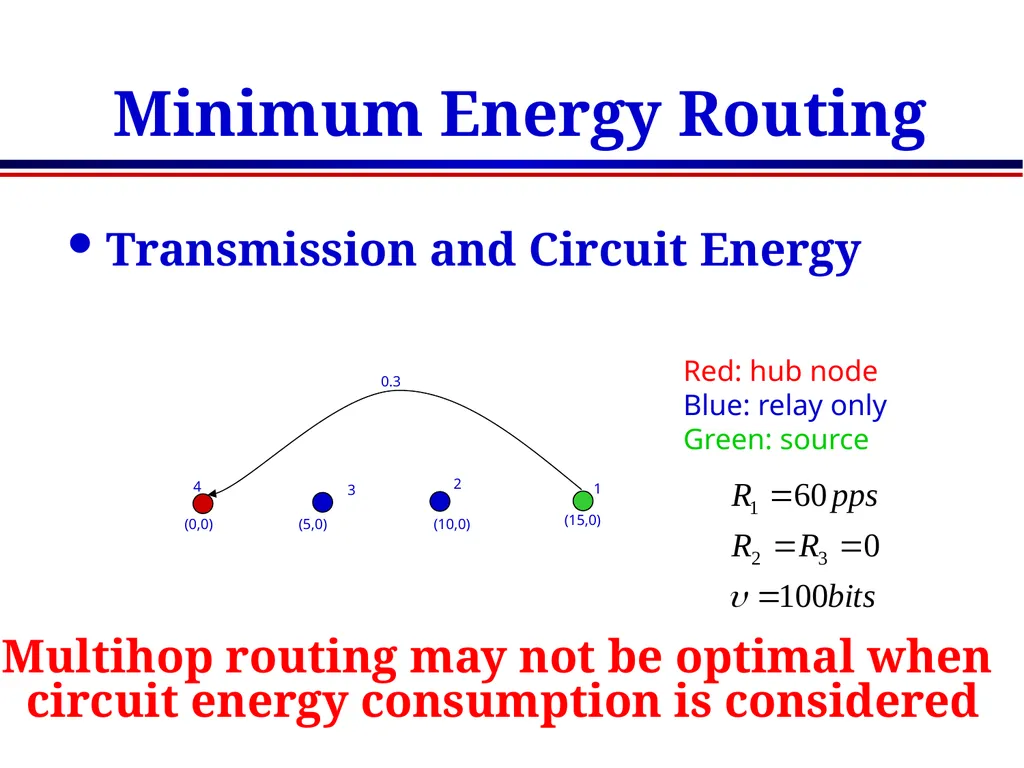
Minimum Energy Routing Transmission and Circuit Energy 4 3 2 1 0.3 (0,0) (5,0) (10,0) (15,0) Multihop routing may not be optimal when
circuit energy consumption is considered Red: hub node
Blue: relay only
Green: source<br>
circuit energy consumption is considered Red: hub node
Blue: relay only
Green: source<br>
45
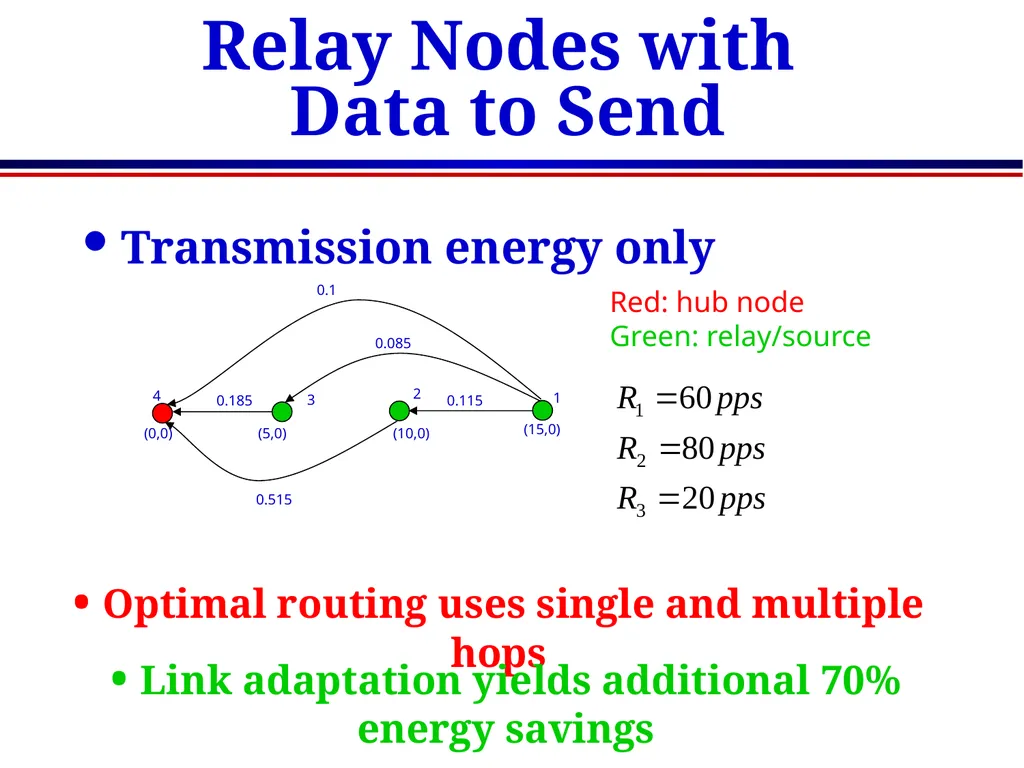
Relay Nodes with
Data to Send Transmission energy only 4 3 2 1 0.115 0.515 0.185 0.085 0.1 Red: hub node
Green: relay/source (0,0) (5,0) (10,0) (15,0) • Optimal routing uses single and multiple hops • Link adaptation yields additional 70% energy savings<br>
Green: relay/source (0,0) (5,0) (10,0) (15,0) • Optimal routing uses single and multiple hops • Link adaptation yields additional 70% energy savings<br>
46
Summary Protocol designs must take into account energy constraints
Efficient protocols tailored to the application
For large sensor networks, in-network processing and cooperation is essential
Cross-layer design critical<br>
Efficient protocols tailored to the application
For large sensor networks, in-network processing and cooperation is essential
Cross-layer design critical<br>
47
Cognitive radios are
also sensor networks<br>
48
Presentation Multiantenna-assisted spectrum sensing for cognitive radio.
By Wang, Pu, et al.
Appeared in IEEE Trans. Vehicular Technology, in 2010
Presented by Christina<br>
By Wang, Pu, et al.
Appeared in IEEE Trans. Vehicular Technology, in 2010
Presented by Christina<br>