Eggs All these dishes include egg Where do eggs come from? Eggs are laid by hens. During 2019, in the UK: 13,093 million eggs were eaten; 11,388 million eggs were produced; 1,676 million eggs were imported and 271 million eggs were
"Eggs All these dishes include egg Where do eggs" is the property of its rightful owner. Permission is granted to
download and print the materials on this website for personal, non-commercial use only, and to display it
on your personal computer provided you do not modify the materials and that you retain all copyright
notices contained in the materials. By downloading content from our website, you accept the terms of this
agreement.
Presentation Transcript
01
Eggs<br>
02
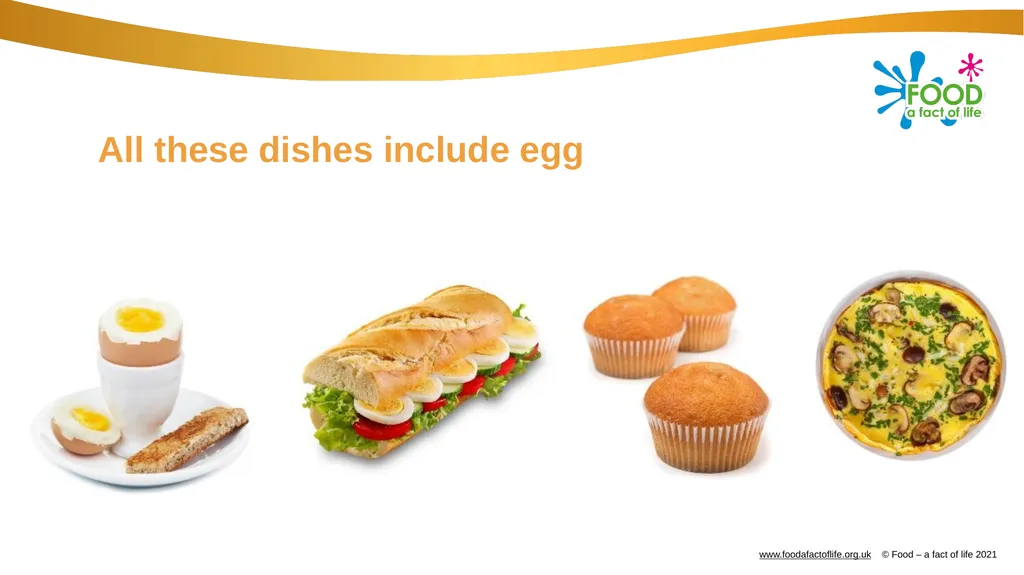
All these dishes include egg<br>
03
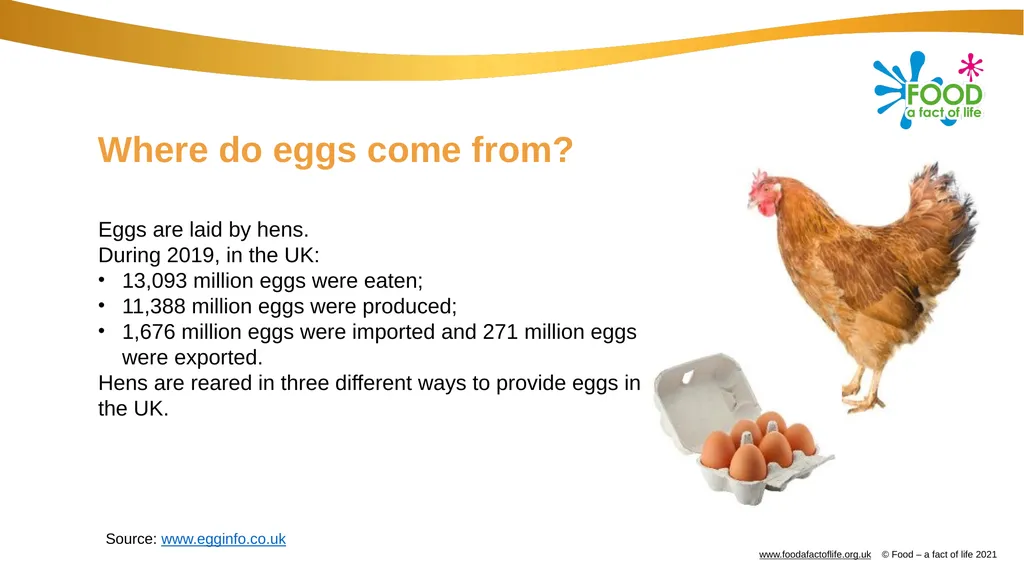
Where do eggs come from? Eggs are laid by hens.
During 2019, in the UK:
13,093 million eggs were eaten;
11,388 million eggs were produced;
1,676 million eggs were imported and 271 million eggs were exported.
Hens are reared in three different ways to provide eggs in the UK. Source: www.egginfo.co.uk<br>
04
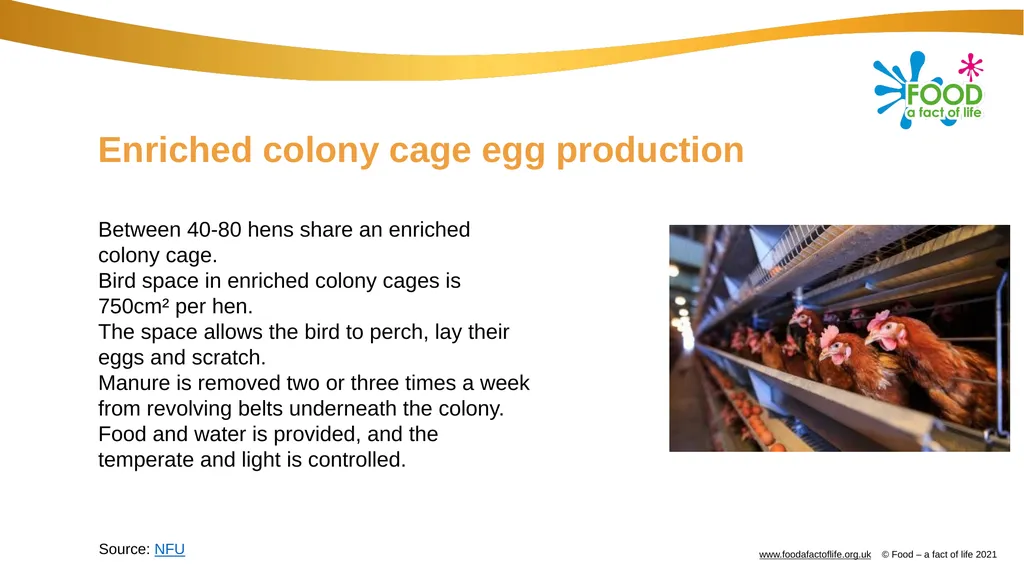
Enriched colony cage egg production Between 40-80 hens share an enriched colony cage.
Bird space in enriched colony cages is 750cm² per hen.
The space allows the bird to perch, lay their eggs and scratch.
Manure is removed two or three times a week from revolving belts underneath the colony.
Food and water is provided, and the temperate and light is controlled. Source: NFU<br>
05
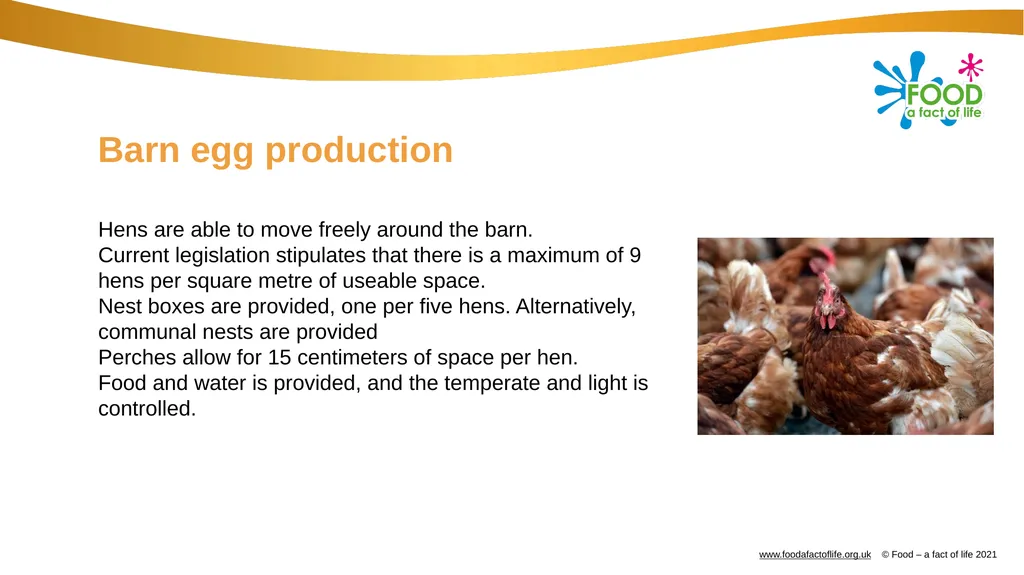
Barn egg production Hens are able to move freely around the barn.
Current legislation stipulates that there is a maximum of 9 hens per square metre of useable space.
Nest boxes are provided, one per five hens. Alternatively, communal nests are provided
Perches allow for 15 centimeters of space per hen.
Food and water is provided, and the temperate and light is controlled.<br>
06
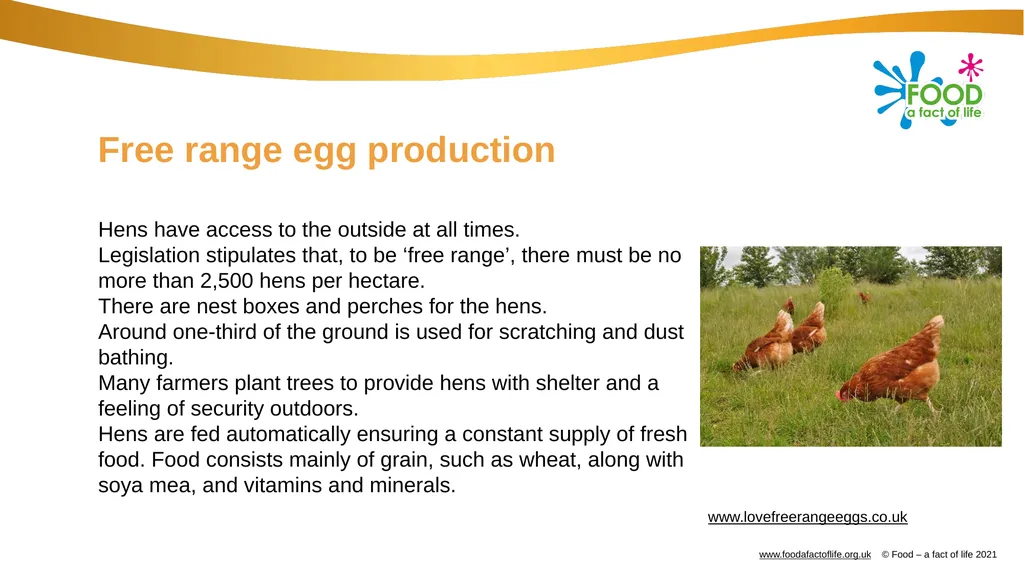
Free range egg production Hens have access to the outside at all times.
Legislation stipulates that, to be ‘free range’, there must be no more than 2,500 hens per hectare.
There are nest boxes and perches for the hens.
Around one-third of the ground is used for scratching and dust bathing.
Many farmers plant trees to provide hens with shelter and a feeling of security outdoors.
Hens are fed automatically ensuring a constant supply of fresh food. Food consists mainly of grain, such as wheat, along with soya mea, and vitamins and minerals. www.lovefreerangeeggs.co.uk<br>
07
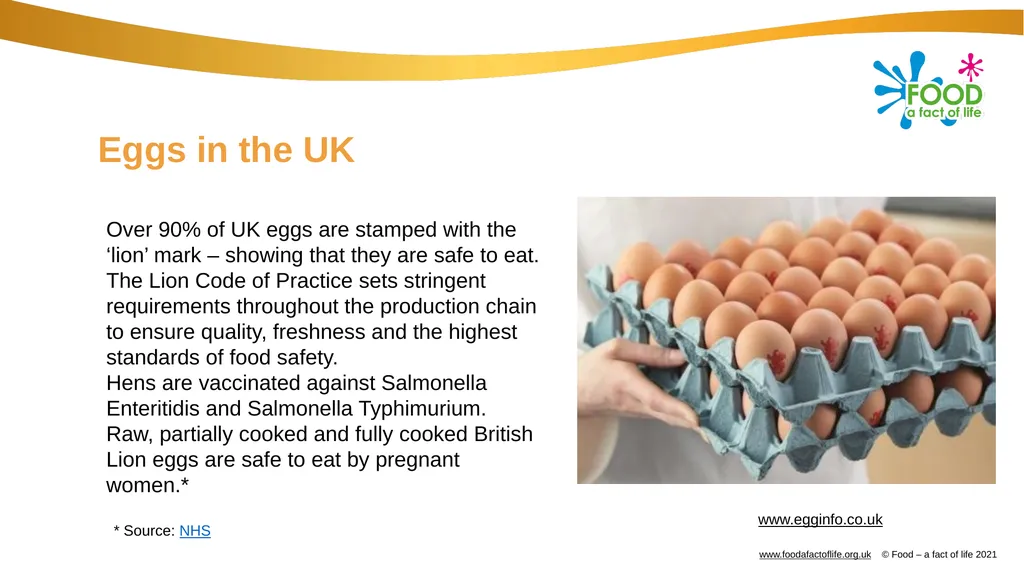
Eggs in the UK Over 90% of UK eggs are stamped with the ‘lion’ mark – showing that they are safe to eat.
The Lion Code of Practice sets stringent requirements throughout the production chain to ensure quality, freshness and the highest standards of food safety.
Hens are vaccinated against Salmonella Enteritidis and Salmonella Typhimurium.
Raw, partially cooked and fully cooked British Lion eggs are safe to eat by pregnant women.* * Source: NHS www.egginfo.co.uk<br>
08
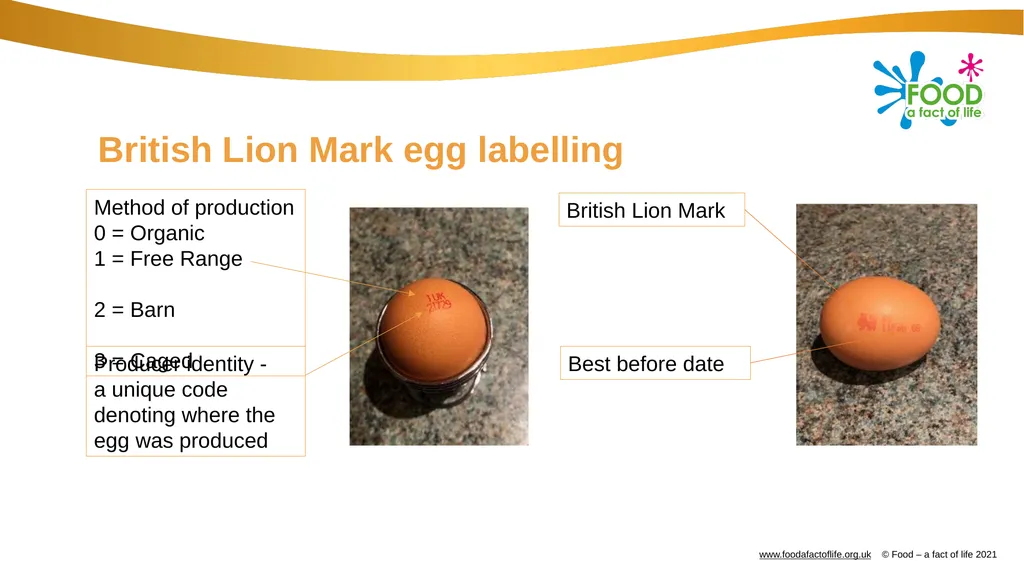
British Lion Mark egg labelling British Lion Mark Method of production
0 = Organic
1 = Free Range
2 = Barn
3 = Caged Producer identity -
a unique code denoting where the egg was produced Best before date<br>
09
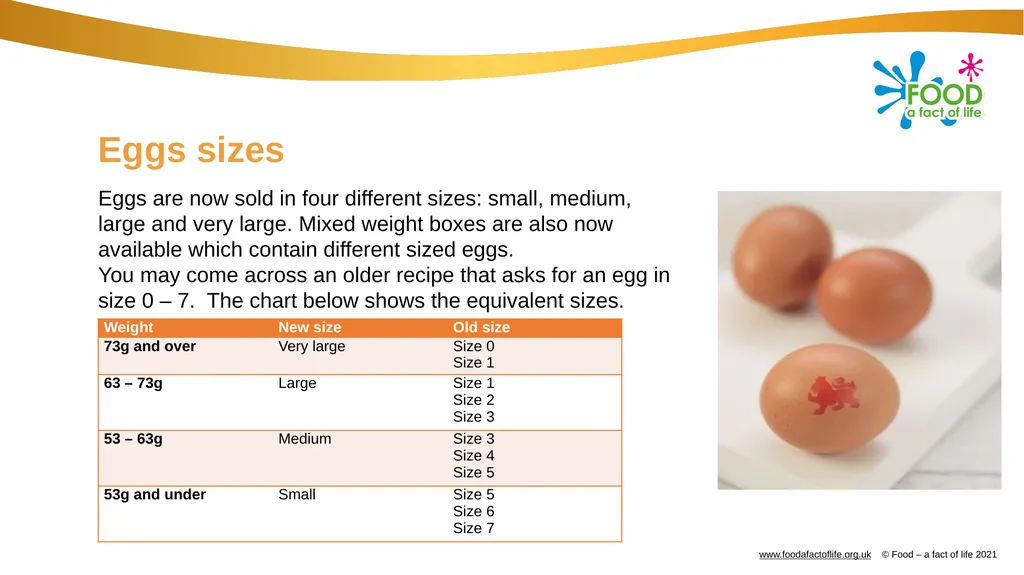
Eggs sizes Eggs are now sold in four different sizes: small, medium, large and very large. Mixed weight boxes are also now available which contain different sized eggs.
You may come across an older recipe that asks for an egg in size 0 – 7. The chart below shows the equivalent sizes.<br>
10
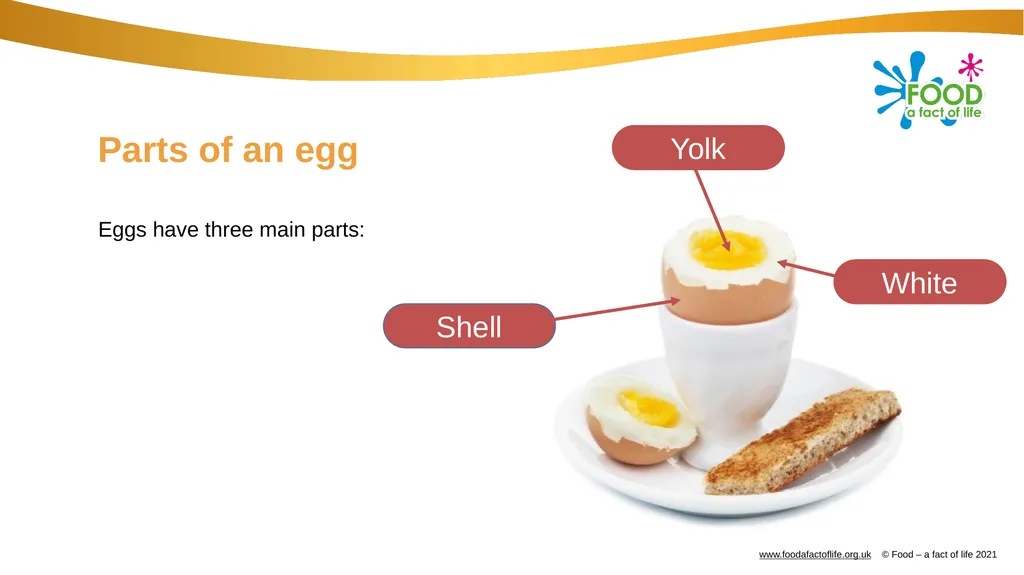
Parts of an egg Eggs have three main parts:<br>
11
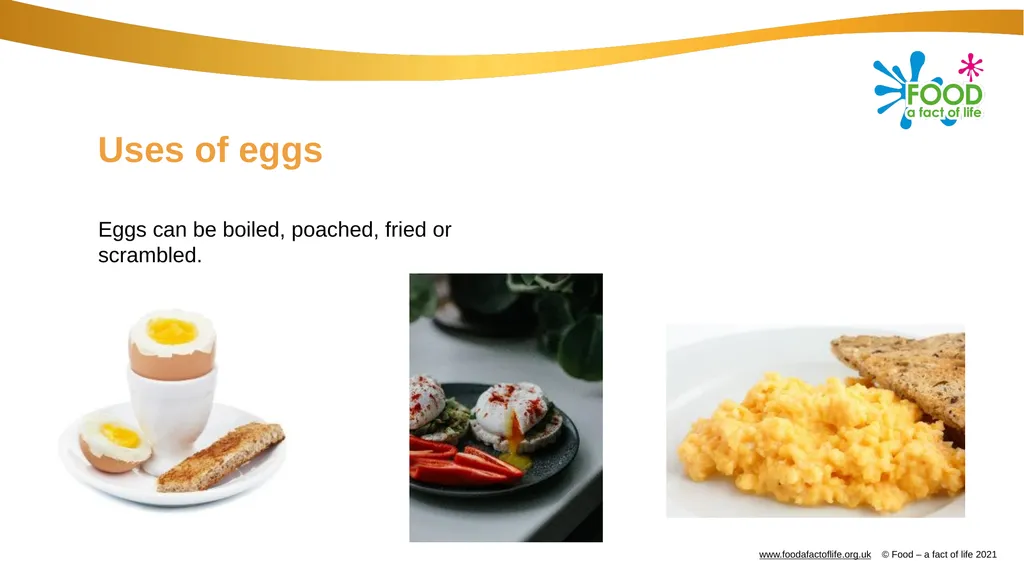
Uses of eggs Eggs can be boiled, poached, fried or scrambled.<br>
12
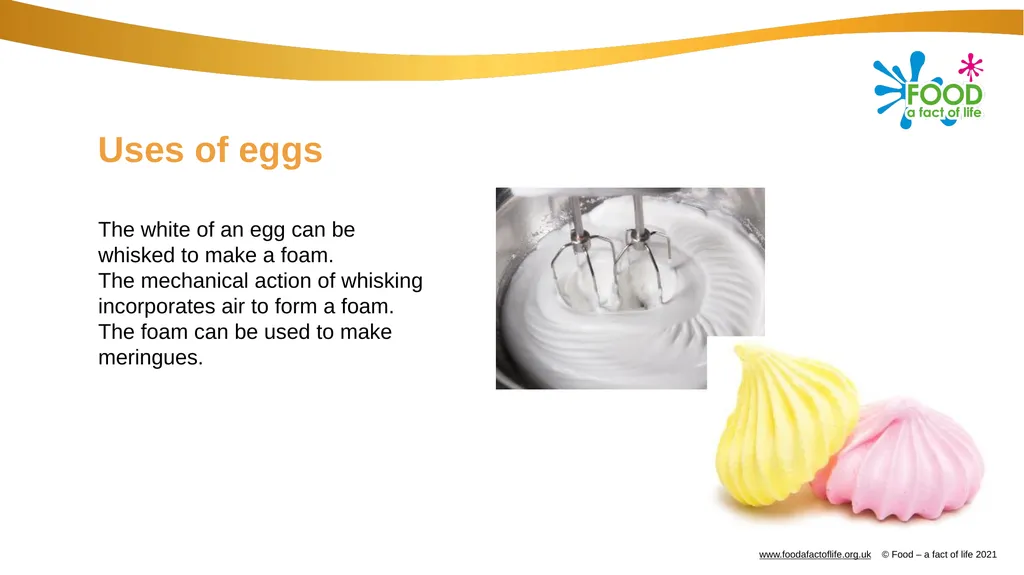
Uses of eggs The white of an egg can be whisked to make a foam.
The mechanical action of whisking incorporates air to form a foam.
The foam can be used to make meringues.<br>
13
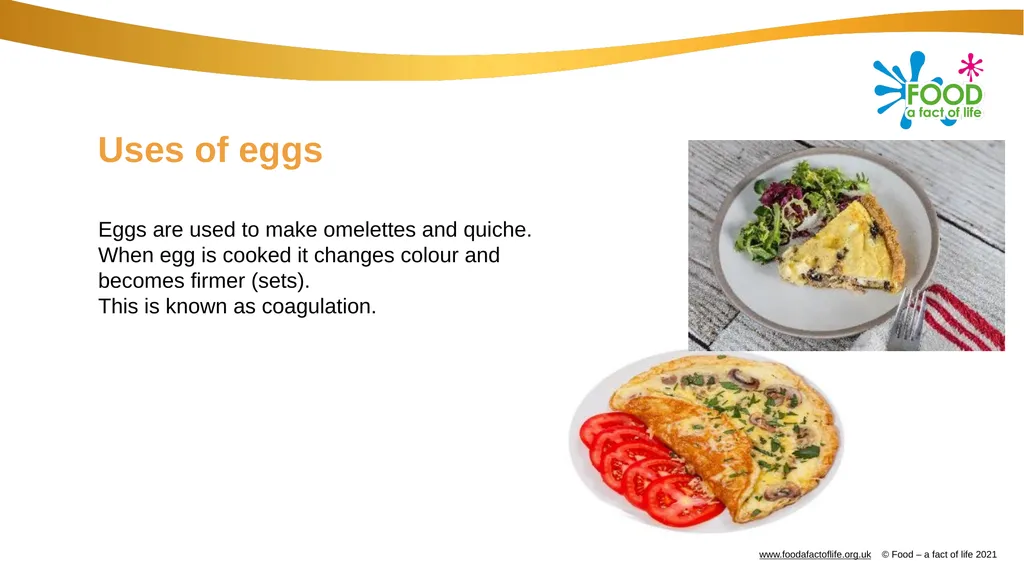
Uses of eggs Eggs are used to make omelettes and quiche.
When egg is cooked it changes colour and becomes firmer (sets).
This is known as coagulation.<br>
14
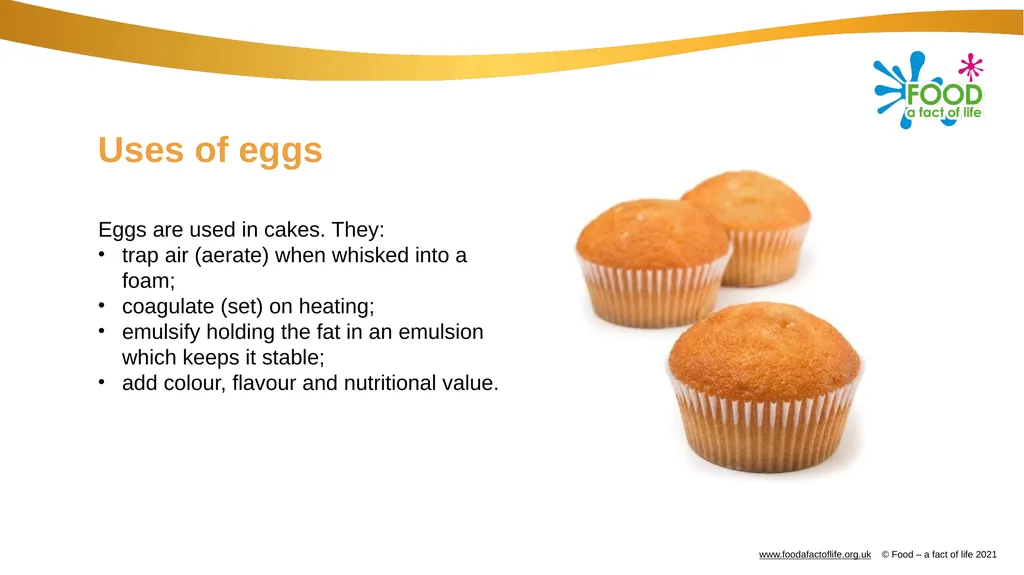
Uses of eggs Eggs are used in cakes. They:
trap air (aerate) when whisked into a foam;
coagulate (set) on heating;
emulsify holding the fat in an emulsion which keeps it stable;
add colour, flavour and nutritional value.<br>
15
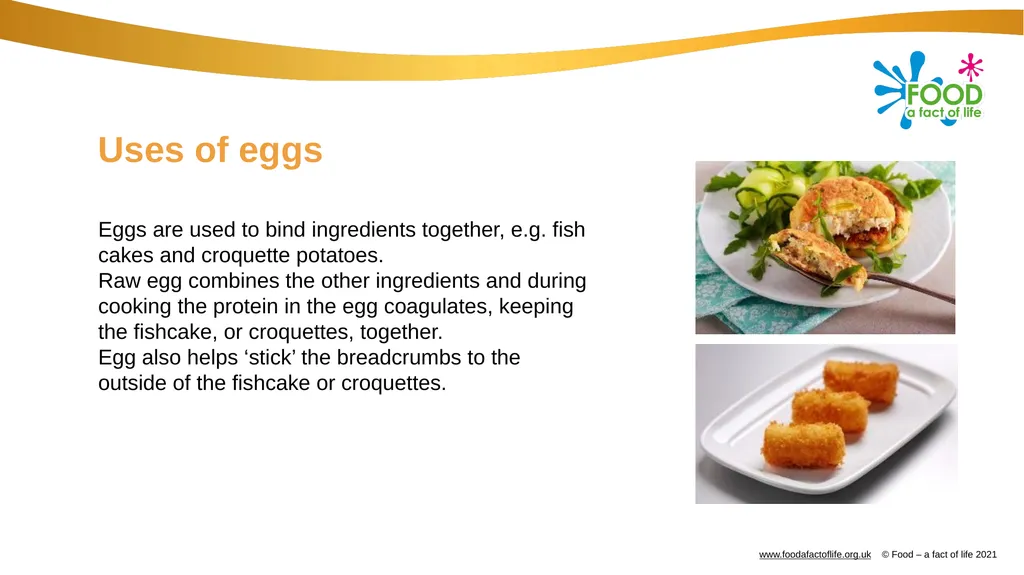
Uses of eggs Eggs are used to bind ingredients together, e.g. fish cakes and croquette potatoes.
Raw egg combines the other ingredients and during cooking the protein in the egg coagulates, keeping the fishcake, or croquettes, together.
Egg also helps ‘stick’ the breadcrumbs to the outside of the fishcake or croquettes.<br>
16
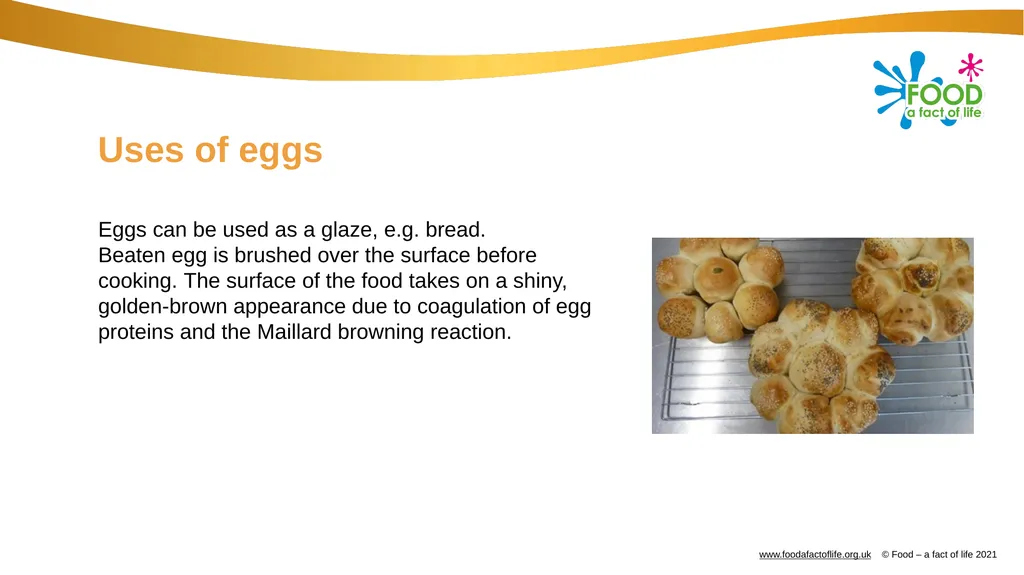
Uses of eggs Eggs can be used as a glaze, e.g. bread.
Beaten egg is brushed over the surface before cooking. The surface of the food takes on a shiny, golden-brown appearance due to coagulation of egg proteins and the Maillard browning reaction.<br>
17
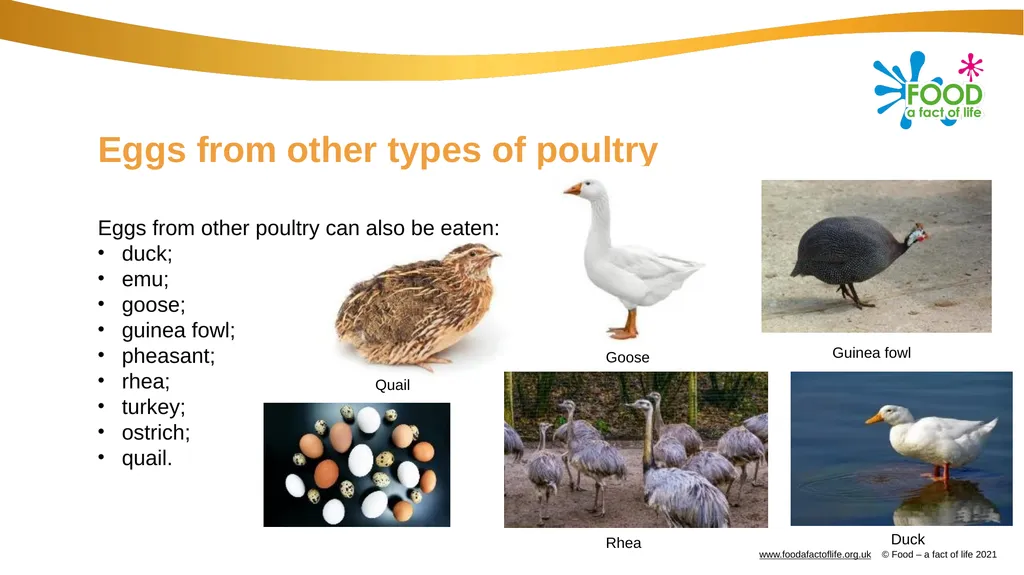
Eggs from other types of poultry Eggs from other poultry can also be eaten:
duck;
emu;
goose;
guinea fowl;
pheasant;
rhea;
turkey;
ostrich;
quail. Guinea fowl Goose Quail Duck Rhea<br>
18
Eggs For further information, go to:
www.foodafactoflife.org.uk This resource meets the Guidelines for producers and users of school education resources about food.<br>