
Electricity Pricing Mr. Shahid Sattar Executive
DJ
Published · 16 slides · 0 views

1 / 1


Description
Electricity Pricing Mr. Shahid Sattar Executive Director, APTMA Former Member Energy, Planning Commission 1 What is electricity pricing? Electricity prices generally reflect the cost to build, finance, maintain, and operate power plants and
Related Topics
Share
Embed code
Download this presentation From Below
"Electricity Pricing Mr. Shahid Sattar Executive" is the property of its rightful owner. Permission is granted to download and print the materials on this website for personal, non-commercial use only, and to display it on your personal computer provided you do not modify the materials and that you retain all copyright notices contained in the materials. By downloading content from our website, you accept the terms of this agreement.
Presentation Transcript
01
Electricity Pricing Mr. Shahid Sattar
Executive Director, APTMA
Former Member Energy, Planning Commission 1<br>
Executive Director, APTMA
Former Member Energy, Planning Commission 1<br>
02
What is electricity pricing? Electricity prices generally reflect the cost to build, finance, maintain, and operate power plants and the electricity grid.
Due to the complications of electricity generation, the cost to supply electricity varies minute by minute in electricity markets.
The worldwide acknowledged cardinal principle is that least cost/competitive electricity pricing only possible through multi-seller competitive sales of electricity to consumers at all levels. 2<br>
Due to the complications of electricity generation, the cost to supply electricity varies minute by minute in electricity markets.
The worldwide acknowledged cardinal principle is that least cost/competitive electricity pricing only possible through multi-seller competitive sales of electricity to consumers at all levels. 2<br>
03
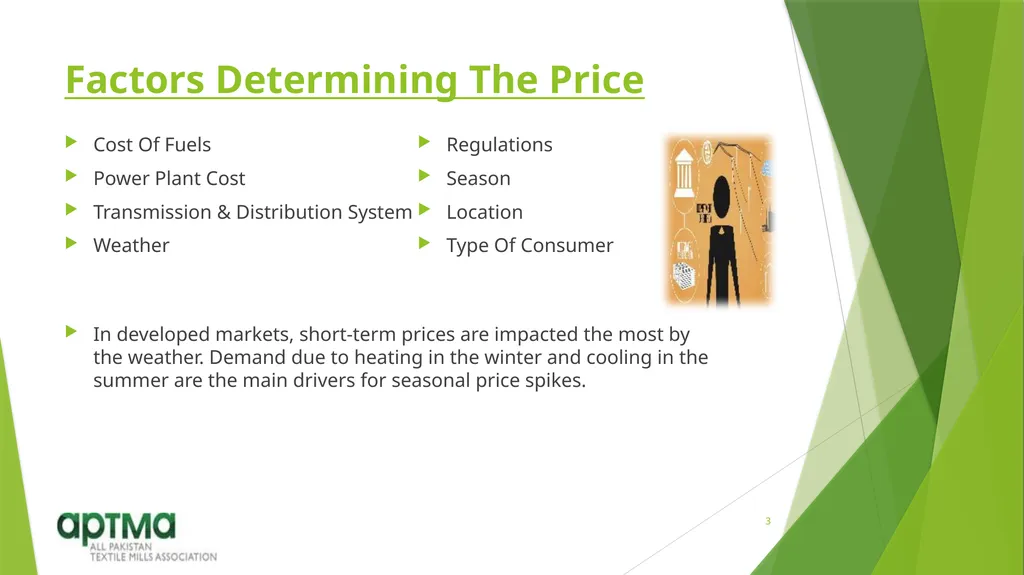
In developed markets, short-term prices are impacted the most by the weather. Demand due to heating in the winter and cooling in the summer are the main drivers for seasonal price spikes. Cost Of Fuels
Power Plant Cost
Transmission & Distribution System
Weather
Regulations
Season
Location
Type Of Consumer Factors Determining The Price 3<br>
Power Plant Cost
Transmission & Distribution System
Weather
Regulations
Season
Location
Type Of Consumer Factors Determining The Price 3<br>
04
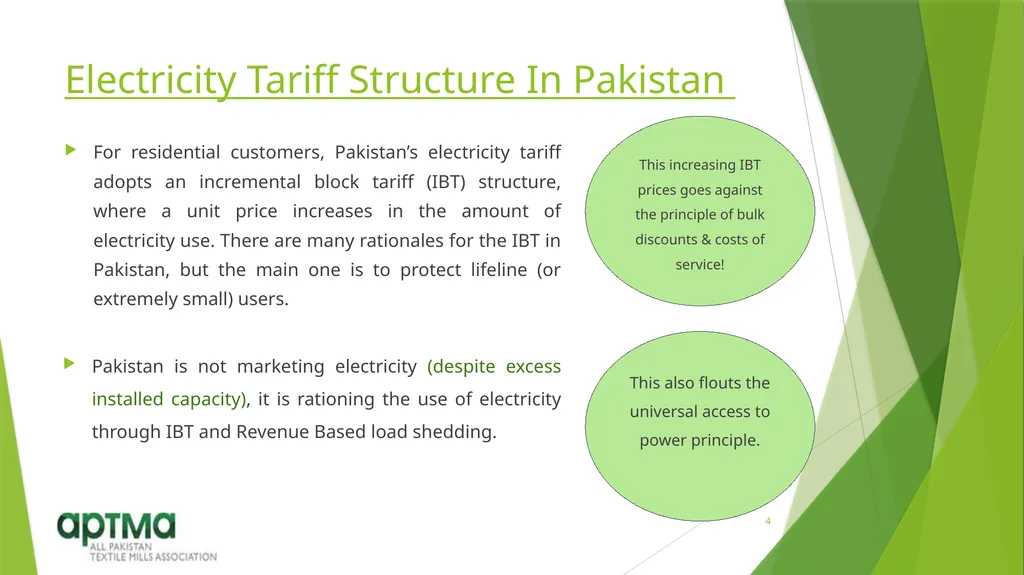
Electricity Tariff Structure In Pakistan For residential customers, Pakistan’s electricity tariff adopts an incremental block tariff (IBT) structure, where a unit price increases in the amount of electricity use. There are many rationales for the IBT in Pakistan, but the main one is to protect lifeline (or extremely small) users. This increasing IBT prices goes against the principle of bulk discounts & costs of service! Pakistan is not marketing electricity (despite excess installed capacity), it is rationing the use of electricity through IBT and Revenue Based load shedding. This also flouts the universal access to power principle. 4<br>
05
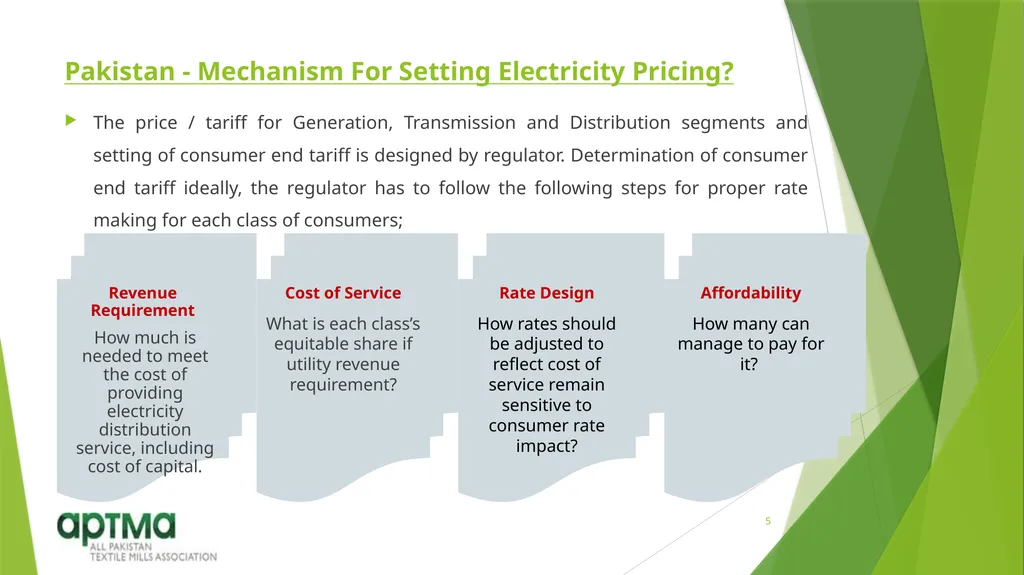
Pakistan - Mechanism For Setting Electricity Pricing? Revenue Requirement
How much is needed to meet the cost of providing electricity distribution service, including cost of capital. The price / tariff for Generation, Transmission and Distribution segments and setting of consumer end tariff is designed by regulator. Determination of consumer end tariff ideally, the regulator has to follow the following steps for proper rate making for each class of consumers; Cost of Service
What is each class’s equitable share if utility revenue requirement? Rate Design
How rates should be adjusted to reflect cost of service remain sensitive to consumer rate impact? Affordability
How many can manage to pay for it? 5<br>
How much is needed to meet the cost of providing electricity distribution service, including cost of capital. The price / tariff for Generation, Transmission and Distribution segments and setting of consumer end tariff is designed by regulator. Determination of consumer end tariff ideally, the regulator has to follow the following steps for proper rate making for each class of consumers; Cost of Service
What is each class’s equitable share if utility revenue requirement? Rate Design
How rates should be adjusted to reflect cost of service remain sensitive to consumer rate impact? Affordability
How many can manage to pay for it? 5<br>
06
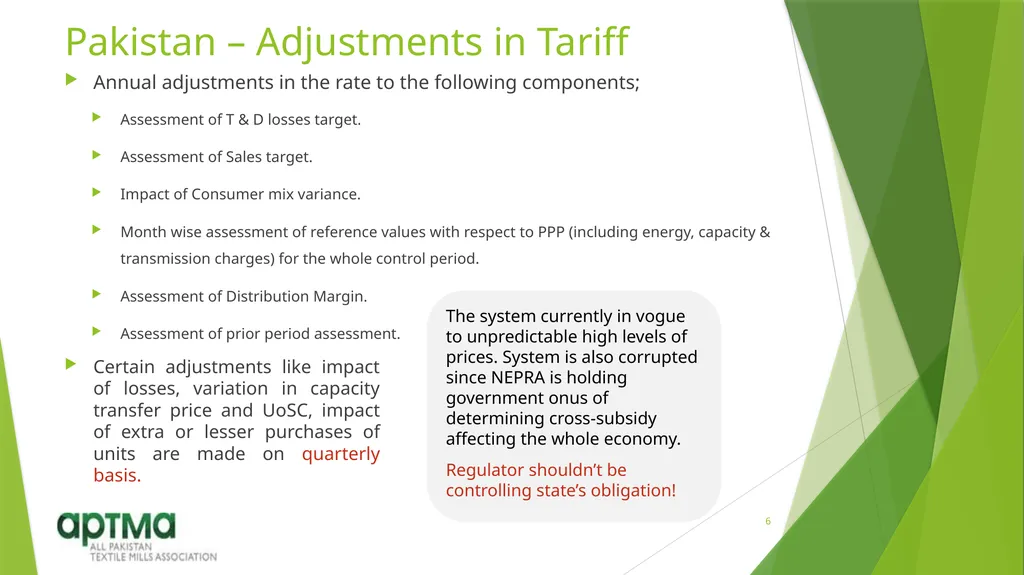
Pakistan – Adjustments in Tariff Annual adjustments in the rate to the following components; Assessment of T & D losses target.
Assessment of Sales target.
Impact of Consumer mix variance.
Month wise assessment of reference values with respect to PPP (including energy, capacity & transmission charges) for the whole control period.
Assessment of Distribution Margin.
Assessment of prior period assessment. Certain adjustments like impact of losses, variation in capacity transfer price and UoSC, impact of extra or lesser purchases of units are made on quarterly basis. 6 The system currently in vogue to unpredictable high levels of prices. System is also corrupted since NEPRA is holding government onus of determining cross-subsidy affecting the whole economy.
Regulator shouldn’t be controlling state’s obligation!<br>
Assessment of Sales target.
Impact of Consumer mix variance.
Month wise assessment of reference values with respect to PPP (including energy, capacity & transmission charges) for the whole control period.
Assessment of Distribution Margin.
Assessment of prior period assessment. Certain adjustments like impact of losses, variation in capacity transfer price and UoSC, impact of extra or lesser purchases of units are made on quarterly basis. 6 The system currently in vogue to unpredictable high levels of prices. System is also corrupted since NEPRA is holding government onus of determining cross-subsidy affecting the whole economy.
Regulator shouldn’t be controlling state’s obligation!<br>
07
Mechanism Opted In Other Countries For Setting Electricity Prices In standard regulated markets like the US, there are multilevel governance structures that set electricity rates. Rates are determined through a regulatory process that is overseen by Public Service Commission (PSC), which also regulate utility rates in each state.
Electricity pricing is fundamentally governed by principles of Least Cost and competitive procurement at generation level and competitive selling at distribution level. 7<br>
Electricity pricing is fundamentally governed by principles of Least Cost and competitive procurement at generation level and competitive selling at distribution level. 7<br>
08
In the UK, some of the big household suppliers produce or generate a proportion of their own energy. But they buy most of it either direct from the producers who generated the power or sourced the gas, and the rest is bought from the traded wholesale markets.
The UK suppliers are usually paying the price set by the traded market, where a variety of producers, utilities and speculators are active every day.
Truly competitive markets (retail and wholesale) are driven by competition where players compete in the market for selling electricity, either short- or long- term without any pre-assurance from demand side. 8<br>
The UK suppliers are usually paying the price set by the traded market, where a variety of producers, utilities and speculators are active every day.
Truly competitive markets (retail and wholesale) are driven by competition where players compete in the market for selling electricity, either short- or long- term without any pre-assurance from demand side. 8<br>
09
There are broadly at least three approaches to tariff setting identifiable in the EU:
Average Historical Cost Approach
The Average Reproduction Cost
The Marginal Cost approach The purpose of setting methodologies across countries is based upon the fundamental principle of competitive price discovery all across the EU. 9<br>
Average Historical Cost Approach
The Average Reproduction Cost
The Marginal Cost approach The purpose of setting methodologies across countries is based upon the fundamental principle of competitive price discovery all across the EU. 9<br>
10
In Liberia all customers pay the same price per kilowatt-hour (kWh), regardless of level of consumption or other attributes.
In South Africa tariffs are differentiated by voltage levels, time of day, season, and customer category, and customers may pay fixed and demand charges as well as levies for cross-subsidization.
The countries differ in how they incorporate the following features in their tariffs:
Schedules for high-voltage customers
Time-of-use pricing
Demand charges
Sector-specific tariffs
Block tariffs Rest Of The World Usually decreasing prices in each subsequent block as opposed to Pakistan’s increasing level of tariffs. 10<br>
In South Africa tariffs are differentiated by voltage levels, time of day, season, and customer category, and customers may pay fixed and demand charges as well as levies for cross-subsidization.
The countries differ in how they incorporate the following features in their tariffs:
Schedules for high-voltage customers
Time-of-use pricing
Demand charges
Sector-specific tariffs
Block tariffs Rest Of The World Usually decreasing prices in each subsequent block as opposed to Pakistan’s increasing level of tariffs. 10<br>
11
India has divided the country in 5 regions;
Northern,
Southern,
Eastern,
Western and
Northeastern region.
Within every state, they have an SLDC (State Load Dispatch Center). The distribution system is carried out by many distribution companies (DISCOMS) and SEBs (State Electricity Board). There are two tariff systems, one for the consumer which they pay to the DISCOMS and the other one is for the DISCOMS which they pay to the generating stations. The total cost levied on the consumer is divided into three parts usually referred as 3 part tariff system,
Fixed cost,
Semi fixed cost, and
Variable cost.
10% electricity is traded in India that has significantly brought down the prices in recent years.
Increasing levels of B2B trades via wheeling has kept the cost of electricity competitive for industries. 11<br>
Northern,
Southern,
Eastern,
Western and
Northeastern region.
Within every state, they have an SLDC (State Load Dispatch Center). The distribution system is carried out by many distribution companies (DISCOMS) and SEBs (State Electricity Board). There are two tariff systems, one for the consumer which they pay to the DISCOMS and the other one is for the DISCOMS which they pay to the generating stations. The total cost levied on the consumer is divided into three parts usually referred as 3 part tariff system,
Fixed cost,
Semi fixed cost, and
Variable cost.
10% electricity is traded in India that has significantly brought down the prices in recent years.
Increasing levels of B2B trades via wheeling has kept the cost of electricity competitive for industries. 11<br>
12
China’s electricity prices for industrial consumers depend upon the category of industry, type of electricity usage, and region where it is located.
China’s industrial power rates vary from region to region and are based on different voltage levels and transformer capacities. China charges electricity fees according to four types of electricity usage;
residential electricity,
agriculture production electricity,
general commercial and industrial electricity, and
large-scale industrial electricity.
China’s electricity grid is reliable and does not require the back-up power generation needed in other lower cost manufacturing destinations in Asia like India, Vietnam, Myanmar, and Cambodia
Price determination is completely state controlled with special rates for export oriented sectors and special emphasis on affordability in less developed areas. 12<br>
China’s industrial power rates vary from region to region and are based on different voltage levels and transformer capacities. China charges electricity fees according to four types of electricity usage;
residential electricity,
agriculture production electricity,
general commercial and industrial electricity, and
large-scale industrial electricity.
China’s electricity grid is reliable and does not require the back-up power generation needed in other lower cost manufacturing destinations in Asia like India, Vietnam, Myanmar, and Cambodia
Price determination is completely state controlled with special rates for export oriented sectors and special emphasis on affordability in less developed areas. 12<br>
13
Electricity tariffs in Bangladesh are unbundled reflecting the current electricity supply market of the country.
Three types of tariffs are in operation in Bangladesh:
Bulk or wholesale tariff - the rate at which Bangladesh Power Development Board (BPDB) purchases power from the generating entities.
Wheeling charges paid to PGCB have been kept affordable (B2B deals – resulting in rapidly increasing market share).
Retail Tariff - the rate at which the distribution companies sell to consumers
Continued… 13<br>
Three types of tariffs are in operation in Bangladesh:
Bulk or wholesale tariff - the rate at which Bangladesh Power Development Board (BPDB) purchases power from the generating entities.
Wheeling charges paid to PGCB have been kept affordable (B2B deals – resulting in rapidly increasing market share).
Retail Tariff - the rate at which the distribution companies sell to consumers
Continued… 13<br>
14
As a single buyer, BPDB procures power supply from IPPs, small independent power producers (SIPPs), rental power plants, corporatized generation companies and other publicly-owned power plants based on negotiated bulk power tariff rates.
BPDB’s bulk supply tariffs are function of fuel type, plant load factor and other parameters
In return, BPDB sells electricity to distribution utilities based on Bangladesh Energy Regulatory Commission (BERC) regulated wholesale tariff rates. There is a huge buildup of subsidy in the system as a result of lower than cost wholesale tariffs.
Power Grid Company of Bangladesh (PGCB) as the national grid operator is allowed to recover its costs through wheeling charges to distribution utilities. Wheeling charges are set by the government through executive orders. PGCB’s wheeling rate has remained unchanged over the long term. 14<br>
BPDB’s bulk supply tariffs are function of fuel type, plant load factor and other parameters
In return, BPDB sells electricity to distribution utilities based on Bangladesh Energy Regulatory Commission (BERC) regulated wholesale tariff rates. There is a huge buildup of subsidy in the system as a result of lower than cost wholesale tariffs.
Power Grid Company of Bangladesh (PGCB) as the national grid operator is allowed to recover its costs through wheeling charges to distribution utilities. Wheeling charges are set by the government through executive orders. PGCB’s wheeling rate has remained unchanged over the long term. 14<br>
15
Canada: The wholesale price is dynamic, changing hourly based on the demand for electricity in Ontario and the availability of supply – the methodology for determining price in Canada is;
Forecasting demand for electricity
Offers to supply and bids to purchase are submitted into the electricity market
Setting the market price where supply meets demand
Charging the wholesale price to large consumers
The average of the twelve market clearing prices set in each hour is called the Hourly Ontario Energy Price, or HOEP. The HOEP is charged to large consumers that participate in the market, as well as local distribution companies (LDCs) who in turn recover it from business customers that pay the wholesale market price.
Basic Principle Applicable is Competitive Pricing! 15<br>
Forecasting demand for electricity
Offers to supply and bids to purchase are submitted into the electricity market
Setting the market price where supply meets demand
Charging the wholesale price to large consumers
The average of the twelve market clearing prices set in each hour is called the Hourly Ontario Energy Price, or HOEP. The HOEP is charged to large consumers that participate in the market, as well as local distribution companies (LDCs) who in turn recover it from business customers that pay the wholesale market price.
Basic Principle Applicable is Competitive Pricing! 15<br>
16
THANK YOU 16<br>