ELECTROCHEMISTRY INTRODUCTION .Electrochemistry is
Description: ELECTROCHEMISTRY INTRODUCTION .Electrochemistry is that branch of chemistry which deals with the study of production of electricity from energy released during spontaneous chemical reactions and the use of Electrical energy to bring about
Related Topics
Download Presentation
"ELECTROCHEMISTRY INTRODUCTION .Electrochemistry is" is the property of its rightful owner. Permission is granted to download and print the materials on this website for personal, non-commercial use only, and to display it on your personal computer provided you do not modify the materials and that you retain all copyright notices contained in the materials. By downloading content from our website, you accept the terms of this agreement.
Presentation Transcript
slide1. ELECTROCHEMISTRY<br>
slide2. INTRODUCTION .Electrochemistry is that branch of chemistry
which deals with the study of production of
electricity from energy released during
spontaneous chemical reactions and the use of
Electrical energy to bring about non-spontaneous chemical transformations.<br>
slide3. IMPORTANCE OF ELECTROCHEMISTRY Importance of Electrochemistry
1. Production of metals like Na, Mg. Ca and Al.
2. Electroplating.
3. Purification of metals.
4. Batteries and cells used in various instruments.<br>
slide4. ELECTROLYTES Electrolytes are of two types:
1. Strong electrolytes The electrolytes that completely dissociate or ionise into ions are
called strong electrolytes. e.g., HCl, NaOH, K2SO4
2. Weak electrolytes The electrolytes that dissociate partially (ex < 1) are called weak
electrolytes, e.g., CH3COOH, H2CO3, NH4OHH2S, etc.<br>
slide5. ELECTROCHEMICAL AND ELECTROLYTIC CELL In electrochemical cell electric current is produced by the redox reaction taking place inside the cell, eg. Galvanic cell or Voltaic cell
In electrolytic cell the chemical reaction inside the cell is caused due to external electric current.
In electrochemical cell anode is –vely charged whereas reverse is true for electrolytic cell.<br>
slide6. SALT BRIDGE Function of salt bridge
1. It completes the circuit and allows the flow of current.
2. It maintains the electrical neutrality on both sides. Salt-bridge generally contains
solution of strong electrolyte such as KNO3, KCl etc. KCI is preferred thebecause
transport numbers of K+ and Cl-are almost same.<br>
slide7. Electrode Potential When an electrode is in contact with the solution of its ions in a half-cell, it has a tendency to
lose or gain electrons which is known as electrode potential. It is expressed in volts. It is an
intensive property, i.e., independent of the amount of species in the reaction.<br>
slide8. Standard Hydrogen Electrode Standard hydrogen electrode (SHE) Standard hydrogen electrode (SHE). also known as normal
hydrogen electrode (NHE), consists of platinum wire, carrying platinum foil coated with finely
divided platinum black. The wire is sealed into a glass tube. placed in beaker containing 1 M
HCl. The hydrogen gas at 1 atm pressure is bubbled through the solution at 298K. Half-cell is<br>
slide9. Molar Conductivity The conductivity of all the ions produced when 1 mole of an electrolyte is dissolved in V mL of
solution is known as molar conductivity.
It is related to specific conductance as
Λm = (k x 1000/M)
where. M = molarity.
It units are Ω-1 cm2 mol-1 or S cm2 mol-1.
Equivalent conductivity<br>
slide10. ELECTROLYSIS It is the process of decomposition of an electrolyte when electric current is passed through
either its aqueous solution or molten state,
1. In electrolytic cell both oxidation and reduction takes place in the same cell.
2. Anode is positively charged and cathode is negatively charged, In electrolytic cell.
3. During electrolysis of molten electrolyte, cations are liberated at cathode. while anions at the anode
4. When two or more ions compete at the electrodes. the ion with higher reductionpotential gets liberated at the cathode while the ion with lower reduction potential at the anode<br>
slide11. How to predict the products of electrolysis When an aqueous solution of an electrolyte is electrolysed, if the cation has higher reduction
potential than water (-0.83 V), cation is liberated at the cathode (e.g.. in the electrolysis of copper and silver salts) otherwise H2 gas is liberated due to reduction of water (e.g., in the
electrolysis of K, Na, Ca salts, etc.) Similarly if anion has higher oxidation potential than water(- 1.23 V), anion is liberated (e.g., Br-), otherwise O2 gas is liberated due to oxidation of water(e.g., in caseof F-, aqueous solution of Na2SO4 as oxidation potential of SO42- IS -0.2 V
Discharge potential is defined as the minimum potential that must be applied acrosstheelectrodes to bring about the electrolysis and subsequent discharge of the ion on the electrode<br>
slide12. FARADAY’S LAW OF ELECTROLYSIS 1. First law
The amount of the substance deposited or liberated at cathode directly proportional to the
quantity of electricity passed through electrolyte.
W ∝ I x t = I x t x Z = Q x Z
I current in amp, t = time in sec,
Q = quantity of charge (coulomb)
Z is a constant known as electrochemical equivalent.
When I = 1 amp, t = 1 sec then Q = 1 coulomb, then w = Z.
Thus, electrochemical equivalent I” the amount of the substance deposited or liberated by
passing 1A current for 1 sec (i.e.. 1 coulomb, I x t = Q)<br>
slide13. 2. Second law
When the same quantity of electricity is passed through different electrolytes. the amounts of
the substance deposited or liberated at the electrodes arc directly proportional to theirequivalent weights.
Hence, electrochemical equivalent ∝ equivalent weight.<br>
slide14. BATTERIES These are source of electrical energy which may have one or more cells connected in series.For a good quality battery it should be reasonably light. compact and its voltage should notvary appreciably during its use.<br>
slide15. PRIMARY BATTERIES In the primary batteries. the reaction occurs only once and after use over a period of time battery becomes dead and cannot be reused again<br>
slide16. SECONDARY BATTRIES Secondary Batteries
These cells can be recharged and can be used again and again, e.g.,
(i) Lead Storage battery
Anode-Spongy lead
Cathode-Grid of lead packed with PbO2
Electrolyte-38% H2SO4 by mass
When recharged the cell reactions are reversed.<br>
slide17. FUEL CELLS Galvanic cells which use energy of combustion of fuels like H2, CH4, CH3OH, etc., as the source to produce electrical energy are called fuel cells. The fuel cells are pollution free and have high efficiency.<br>
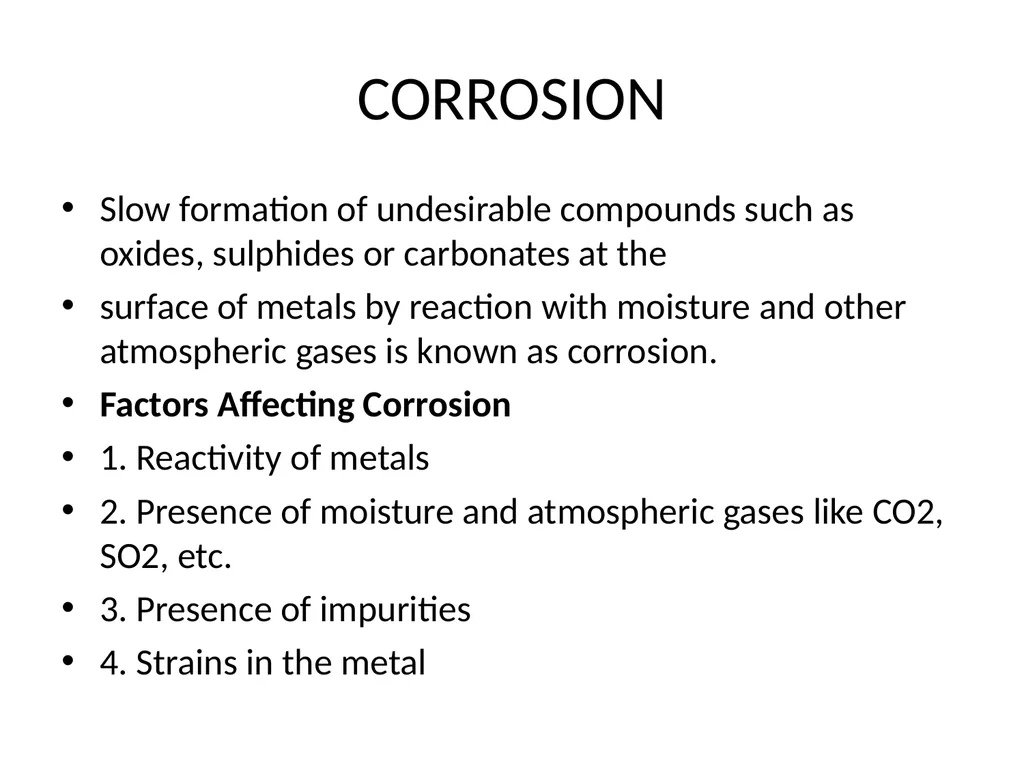
slide18. CORROSION Slow formation of undesirable compounds such as oxides, sulphides or carbonates at the
surface of metals by reaction with moisture and other atmospheric gases is known as corrosion.
Factors Affecting Corrosion
1. Reactivity of metals
2. Presence of moisture and atmospheric gases like CO2, SO2, etc.
3. Presence of impurities
4. Strains in the metal<br>

slide2. INTRODUCTION .Electrochemistry is that branch of chemistry
which deals with the study of production of
electricity from energy released during
spontaneous chemical reactions and the use of
Electrical energy to bring about non-spontaneous chemical transformations.<br>
slide3. IMPORTANCE OF ELECTROCHEMISTRY Importance of Electrochemistry
1. Production of metals like Na, Mg. Ca and Al.
2. Electroplating.
3. Purification of metals.
4. Batteries and cells used in various instruments.<br>
slide4. ELECTROLYTES Electrolytes are of two types:
1. Strong electrolytes The electrolytes that completely dissociate or ionise into ions are
called strong electrolytes. e.g., HCl, NaOH, K2SO4
2. Weak electrolytes The electrolytes that dissociate partially (ex < 1) are called weak
electrolytes, e.g., CH3COOH, H2CO3, NH4OHH2S, etc.<br>
slide5. ELECTROCHEMICAL AND ELECTROLYTIC CELL In electrochemical cell electric current is produced by the redox reaction taking place inside the cell, eg. Galvanic cell or Voltaic cell
In electrolytic cell the chemical reaction inside the cell is caused due to external electric current.
In electrochemical cell anode is –vely charged whereas reverse is true for electrolytic cell.<br>
slide6. SALT BRIDGE Function of salt bridge
1. It completes the circuit and allows the flow of current.
2. It maintains the electrical neutrality on both sides. Salt-bridge generally contains
solution of strong electrolyte such as KNO3, KCl etc. KCI is preferred thebecause
transport numbers of K+ and Cl-are almost same.<br>
slide7. Electrode Potential When an electrode is in contact with the solution of its ions in a half-cell, it has a tendency to
lose or gain electrons which is known as electrode potential. It is expressed in volts. It is an
intensive property, i.e., independent of the amount of species in the reaction.<br>
slide8. Standard Hydrogen Electrode Standard hydrogen electrode (SHE) Standard hydrogen electrode (SHE). also known as normal
hydrogen electrode (NHE), consists of platinum wire, carrying platinum foil coated with finely
divided platinum black. The wire is sealed into a glass tube. placed in beaker containing 1 M
HCl. The hydrogen gas at 1 atm pressure is bubbled through the solution at 298K. Half-cell is<br>
slide9. Molar Conductivity The conductivity of all the ions produced when 1 mole of an electrolyte is dissolved in V mL of
solution is known as molar conductivity.
It is related to specific conductance as
Λm = (k x 1000/M)
where. M = molarity.
It units are Ω-1 cm2 mol-1 or S cm2 mol-1.
Equivalent conductivity<br>
slide10. ELECTROLYSIS It is the process of decomposition of an electrolyte when electric current is passed through
either its aqueous solution or molten state,
1. In electrolytic cell both oxidation and reduction takes place in the same cell.
2. Anode is positively charged and cathode is negatively charged, In electrolytic cell.
3. During electrolysis of molten electrolyte, cations are liberated at cathode. while anions at the anode
4. When two or more ions compete at the electrodes. the ion with higher reductionpotential gets liberated at the cathode while the ion with lower reduction potential at the anode<br>
slide11. How to predict the products of electrolysis When an aqueous solution of an electrolyte is electrolysed, if the cation has higher reduction
potential than water (-0.83 V), cation is liberated at the cathode (e.g.. in the electrolysis of copper and silver salts) otherwise H2 gas is liberated due to reduction of water (e.g., in the
electrolysis of K, Na, Ca salts, etc.) Similarly if anion has higher oxidation potential than water(- 1.23 V), anion is liberated (e.g., Br-), otherwise O2 gas is liberated due to oxidation of water(e.g., in caseof F-, aqueous solution of Na2SO4 as oxidation potential of SO42- IS -0.2 V
Discharge potential is defined as the minimum potential that must be applied acrosstheelectrodes to bring about the electrolysis and subsequent discharge of the ion on the electrode<br>
slide12. FARADAY’S LAW OF ELECTROLYSIS 1. First law
The amount of the substance deposited or liberated at cathode directly proportional to the
quantity of electricity passed through electrolyte.
W ∝ I x t = I x t x Z = Q x Z
I current in amp, t = time in sec,
Q = quantity of charge (coulomb)
Z is a constant known as electrochemical equivalent.
When I = 1 amp, t = 1 sec then Q = 1 coulomb, then w = Z.
Thus, electrochemical equivalent I” the amount of the substance deposited or liberated by
passing 1A current for 1 sec (i.e.. 1 coulomb, I x t = Q)<br>
slide13. 2. Second law
When the same quantity of electricity is passed through different electrolytes. the amounts of
the substance deposited or liberated at the electrodes arc directly proportional to theirequivalent weights.
Hence, electrochemical equivalent ∝ equivalent weight.<br>
slide14. BATTERIES These are source of electrical energy which may have one or more cells connected in series.For a good quality battery it should be reasonably light. compact and its voltage should notvary appreciably during its use.<br>
slide15. PRIMARY BATTERIES In the primary batteries. the reaction occurs only once and after use over a period of time battery becomes dead and cannot be reused again<br>
slide16. SECONDARY BATTRIES Secondary Batteries
These cells can be recharged and can be used again and again, e.g.,
(i) Lead Storage battery
Anode-Spongy lead
Cathode-Grid of lead packed with PbO2
Electrolyte-38% H2SO4 by mass
When recharged the cell reactions are reversed.<br>
slide17. FUEL CELLS Galvanic cells which use energy of combustion of fuels like H2, CH4, CH3OH, etc., as the source to produce electrical energy are called fuel cells. The fuel cells are pollution free and have high efficiency.<br>
slide18. CORROSION Slow formation of undesirable compounds such as oxides, sulphides or carbonates at the
surface of metals by reaction with moisture and other atmospheric gases is known as corrosion.
Factors Affecting Corrosion
1. Reactivity of metals
2. Presence of moisture and atmospheric gases like CO2, SO2, etc.
3. Presence of impurities
4. Strains in the metal<br>