
Elements and Compounds Elements and Compounds What
CB
Published · 19 slides · 0 views
1 / 1

Description
Elements and Compounds Elements and Compounds What Are You Made of? If you look at your hand, what do you see? Of course, you see skin, which consists of cells. But what are skin cells made of? Like all living cells, they are made of
Related Topics
Share
Embed code
Download this presentation From Below
"Elements and Compounds Elements and Compounds What" is the property of its rightful owner. Permission is granted to download and print the materials on this website for personal, non-commercial use only, and to display it on your personal computer provided you do not modify the materials and that you retain all copyright notices contained in the materials. By downloading content from our website, you accept the terms of this agreement.
Presentation Transcript
01
Elements and Compounds<br>
02
Elements and Compounds
What Are You Made of?
If you look at your hand, what do you see? Of course, you see skin, which consists of cells. But what are skin cells made of? Like all living cells, they are made of matter. In fact, all things are made of matter. Matter is anything that takes up space and has mass. Matter, in turn, is made up of chemical substances. A chemical substance is matter that has a definite composition that is consistent throughout. A chemical substance may be either an element or a compound.
Elements and Atoms
An element is a pure substance. It cannot be broken down into other types of substances. Each element is made up of just one type of atom.
Structure of an Atom
An atom is the smallest particle of an element that still has the properties of that element. Every substance is composed of atoms. Atoms are extremely small, typically about a ten-billionth of a meter in diameter. However, atoms do not have well-defined boundaries.<br>
What Are You Made of?
If you look at your hand, what do you see? Of course, you see skin, which consists of cells. But what are skin cells made of? Like all living cells, they are made of matter. In fact, all things are made of matter. Matter is anything that takes up space and has mass. Matter, in turn, is made up of chemical substances. A chemical substance is matter that has a definite composition that is consistent throughout. A chemical substance may be either an element or a compound.
Elements and Atoms
An element is a pure substance. It cannot be broken down into other types of substances. Each element is made up of just one type of atom.
Structure of an Atom
An atom is the smallest particle of an element that still has the properties of that element. Every substance is composed of atoms. Atoms are extremely small, typically about a ten-billionth of a meter in diameter. However, atoms do not have well-defined boundaries.<br>
03
Every atom is composed of a central area — called the nucleus — and one or more subatomic particles called electrons, which move around the nucleus. The nucleus also consists of subatomic particles. It contains one or more protons and typically a similar number of neutrons. The number of protons in the nucleus determines the type of element an atom represents. An atom of hydrogen, for example, contains just one proton. Atoms of the same element may have different numbers of neutrons in the nucleus. Atoms of the same element with the same number of protons — but different numbers of neutrons — are called isotopes.
Protons have a positive electric charge and neutrons have no electric charge. Virtually all of an atom's mass is in the protons and neutrons in the nucleus. Electrons surrounding the nucleus have almost no mass, as well as a negative electric charge. If the number of protons and electrons in an atom are equal, then an atom is electrically neutral, because the positive and negative charges cancel each other out. If an atom has more or fewer electrons than protons, then it has an overall negative or positive charge, respectively, and it is called an ion.
The negatively-charged electrons of an atom are attracted to the positively-charged protons in the nucleus by a force called electromagnetic force, for which opposite charges attract. Electromagnetic force between protons in the nucleus causes these subatomic particles to repel each other, because they have the same charge. However, the protons and neutrons in the nucleus are attracted to each other by a different force, called nuclear force, which is usually stronger than the electromagnetic force. Nuclear force repels the positively-charged protons from each other.<br>
Protons have a positive electric charge and neutrons have no electric charge. Virtually all of an atom's mass is in the protons and neutrons in the nucleus. Electrons surrounding the nucleus have almost no mass, as well as a negative electric charge. If the number of protons and electrons in an atom are equal, then an atom is electrically neutral, because the positive and negative charges cancel each other out. If an atom has more or fewer electrons than protons, then it has an overall negative or positive charge, respectively, and it is called an ion.
The negatively-charged electrons of an atom are attracted to the positively-charged protons in the nucleus by a force called electromagnetic force, for which opposite charges attract. Electromagnetic force between protons in the nucleus causes these subatomic particles to repel each other, because they have the same charge. However, the protons and neutrons in the nucleus are attracted to each other by a different force, called nuclear force, which is usually stronger than the electromagnetic force. Nuclear force repels the positively-charged protons from each other.<br>
04
Periodic Table of the Elements
There are almost 120 known elements. The majority of elements are metals. Examples of metals are iron (Fe) and copper (Cu). Metals are good conductors of electricity and heat. Nonmetal elements are far fewer in number. They include hydrogen (H) and oxygen (O). They lack the properties of metals.
The periodic table of the elements arranges elements in groups based on their properties. The element most important to life is carbon (C).
What type of element is it: metal or nonmetal?
Compounds and Molecules
A compound is a unique substance that consists of two or more elements combined in fixed proportions. This means that the composition of a compound is always the same. The smallest particle of most compounds in living things is called a molecule.
Consider water as an example. A molecule of water always contains one atom of oxygen and two atoms of hydrogen. The composition of water is expressed by the chemical formula H2O.
What causes the atoms of a water molecule to “stick” together? The answer is chemical bonds. A chemical bond is a force that holds together the atoms of molecules. Bonds in molecules involve the sharing of electrons among atoms. New chemical bonds form when substances react with one another. A chemical reaction is a process that changes some chemical substances into others. A chemical reaction is needed to form a compound, and another chemical reaction is needed to separate the substances in that compound.<br>
There are almost 120 known elements. The majority of elements are metals. Examples of metals are iron (Fe) and copper (Cu). Metals are good conductors of electricity and heat. Nonmetal elements are far fewer in number. They include hydrogen (H) and oxygen (O). They lack the properties of metals.
The periodic table of the elements arranges elements in groups based on their properties. The element most important to life is carbon (C).
What type of element is it: metal or nonmetal?
Compounds and Molecules
A compound is a unique substance that consists of two or more elements combined in fixed proportions. This means that the composition of a compound is always the same. The smallest particle of most compounds in living things is called a molecule.
Consider water as an example. A molecule of water always contains one atom of oxygen and two atoms of hydrogen. The composition of water is expressed by the chemical formula H2O.
What causes the atoms of a water molecule to “stick” together? The answer is chemical bonds. A chemical bond is a force that holds together the atoms of molecules. Bonds in molecules involve the sharing of electrons among atoms. New chemical bonds form when substances react with one another. A chemical reaction is a process that changes some chemical substances into others. A chemical reaction is needed to form a compound, and another chemical reaction is needed to separate the substances in that compound.<br>
05
Summary
All matter consists of chemical substances. A chemical substance has a definite composition which is consistent throughout. A chemical substance may be either an element or a compound.
An element is a pure substance that cannot be broken down into other types of substances.
An atom is the smallest particle of an element that still has the properties of that element. Atoms, in turn, are composed of subatomic particles, including negative electrons, positive protons, and neutral neutrons. The number of protons in an atom determines the element it represents.
Atoms have equal numbers of electrons and protons, so they have no charge. Ions are atoms that have lost or gained electrons, and as a result have either a positive or negative charge. Atoms with the same number of protons — but different numbers of neutrons — are called isotopes.
There are almost 120 known elements. The majority of elements are metals. A smaller number are nonmetals. The latter include carbon, hydrogen, and oxygen.
A compound is a substance that consists of two or more elements in a unique composition. The smallest particle of a compound is called a molecule. Chemical bonds hold together the atoms of molecules. Compounds can form only in chemical reactions, and they can break down only in other chemical reactions.<br>
All matter consists of chemical substances. A chemical substance has a definite composition which is consistent throughout. A chemical substance may be either an element or a compound.
An element is a pure substance that cannot be broken down into other types of substances.
An atom is the smallest particle of an element that still has the properties of that element. Atoms, in turn, are composed of subatomic particles, including negative electrons, positive protons, and neutral neutrons. The number of protons in an atom determines the element it represents.
Atoms have equal numbers of electrons and protons, so they have no charge. Ions are atoms that have lost or gained electrons, and as a result have either a positive or negative charge. Atoms with the same number of protons — but different numbers of neutrons — are called isotopes.
There are almost 120 known elements. The majority of elements are metals. A smaller number are nonmetals. The latter include carbon, hydrogen, and oxygen.
A compound is a substance that consists of two or more elements in a unique composition. The smallest particle of a compound is called a molecule. Chemical bonds hold together the atoms of molecules. Compounds can form only in chemical reactions, and they can break down only in other chemical reactions.<br>
06
Biochemical Compounds
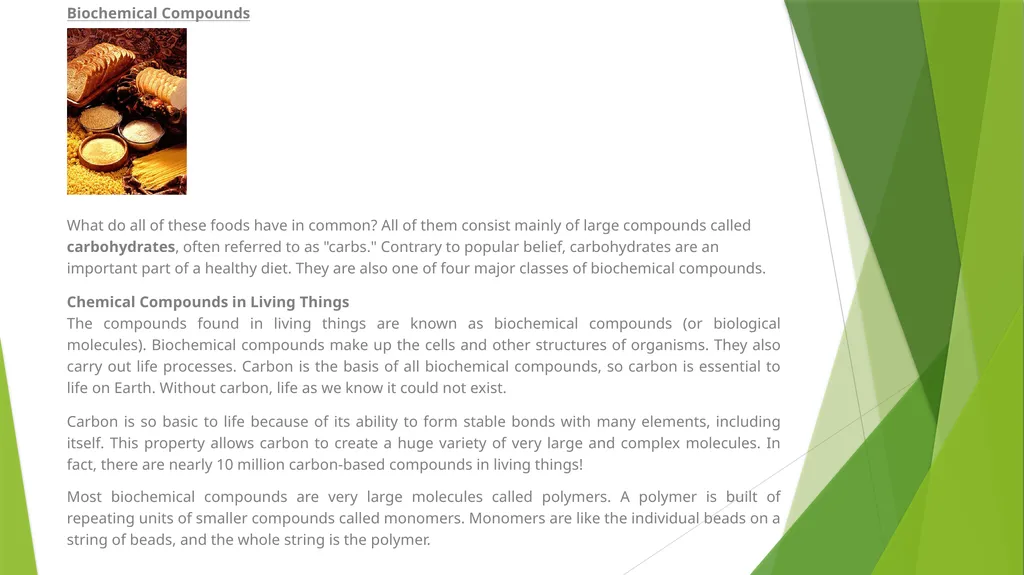
What do all of these foods have in common? All of them consist mainly of large compounds called carbohydrates, often referred to as "carbs." Contrary to popular belief, carbohydrates are an important part of a healthy diet. They are also one of four major classes of biochemical compounds.
Chemical Compounds in Living Things
The compounds found in living things are known as biochemical compounds (or biological molecules). Biochemical compounds make up the cells and other structures of organisms. They also carry out life processes. Carbon is the basis of all biochemical compounds, so carbon is essential to life on Earth. Without carbon, life as we know it could not exist.
Carbon is so basic to life because of its ability to form stable bonds with many elements, including itself. This property allows carbon to create a huge variety of very large and complex molecules. In fact, there are nearly 10 million carbon-based compounds in living things!
Most biochemical compounds are very large molecules called polymers. A polymer is built of repeating units of smaller compounds called monomers. Monomers are like the individual beads on a string of beads, and the whole string is the polymer.<br>
What do all of these foods have in common? All of them consist mainly of large compounds called carbohydrates, often referred to as "carbs." Contrary to popular belief, carbohydrates are an important part of a healthy diet. They are also one of four major classes of biochemical compounds.
Chemical Compounds in Living Things
The compounds found in living things are known as biochemical compounds (or biological molecules). Biochemical compounds make up the cells and other structures of organisms. They also carry out life processes. Carbon is the basis of all biochemical compounds, so carbon is essential to life on Earth. Without carbon, life as we know it could not exist.
Carbon is so basic to life because of its ability to form stable bonds with many elements, including itself. This property allows carbon to create a huge variety of very large and complex molecules. In fact, there are nearly 10 million carbon-based compounds in living things!
Most biochemical compounds are very large molecules called polymers. A polymer is built of repeating units of smaller compounds called monomers. Monomers are like the individual beads on a string of beads, and the whole string is the polymer.<br>
07
Classes of Biochemical Compounds
Although there are millions of different biochemical compounds in Earth's living things, all biochemical compounds contain the elements carbon, hydrogen, and oxygen. Some contain only these elements, while others contain additional elements, as well. The vast number of biochemical compounds can be grouped into just four major classes: carbohydrates, lipids, proteins, and nucleic acids.
Carbohydrates
Carbohydrates include sugars and starches. These compounds contain only the elements carbon, hydrogen, and oxygen. In living things, carbohydrates provide energy to cells, store energy, and form certain structures (such as the cell walls of plants). The monomer that makes up large carbohydrate compounds is called a monosaccharide. The sugar glucose is a monosaccharide. It contains six carbon atoms (C), along with several atoms of hydrogen (H) and oxygen (O). Thousands of glucose molecules can join together to form a polysaccharide, such as starch.
Lipids
Lipids include fats and oils. They contain primarily the elements carbon, hydrogen, and oxygen, although some lipids contain additional elements, such as phosphorus. Lipids function in living things to store energy, form cell membranes, and carry messages. Lipids consist of repeating units that join together to form chains called fatty acids. Most naturally occurring fatty acids have an unbranched chain of an even number (generally between 4 and 28) of carbon atoms.<br>
Although there are millions of different biochemical compounds in Earth's living things, all biochemical compounds contain the elements carbon, hydrogen, and oxygen. Some contain only these elements, while others contain additional elements, as well. The vast number of biochemical compounds can be grouped into just four major classes: carbohydrates, lipids, proteins, and nucleic acids.
Carbohydrates
Carbohydrates include sugars and starches. These compounds contain only the elements carbon, hydrogen, and oxygen. In living things, carbohydrates provide energy to cells, store energy, and form certain structures (such as the cell walls of plants). The monomer that makes up large carbohydrate compounds is called a monosaccharide. The sugar glucose is a monosaccharide. It contains six carbon atoms (C), along with several atoms of hydrogen (H) and oxygen (O). Thousands of glucose molecules can join together to form a polysaccharide, such as starch.
Lipids
Lipids include fats and oils. They contain primarily the elements carbon, hydrogen, and oxygen, although some lipids contain additional elements, such as phosphorus. Lipids function in living things to store energy, form cell membranes, and carry messages. Lipids consist of repeating units that join together to form chains called fatty acids. Most naturally occurring fatty acids have an unbranched chain of an even number (generally between 4 and 28) of carbon atoms.<br>
08
Proteins
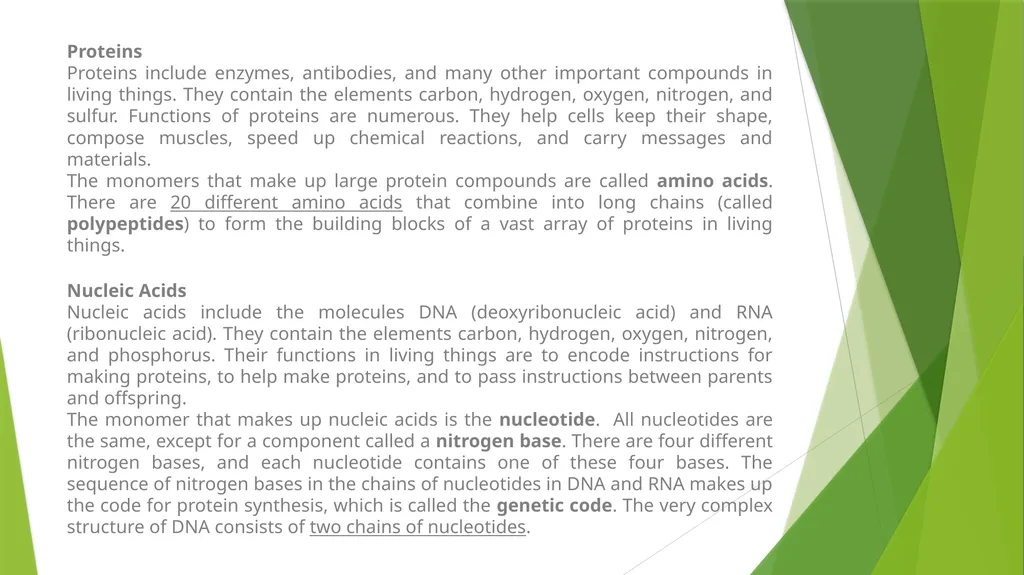
Proteins include enzymes, antibodies, and many other important compounds in living things. They contain the elements carbon, hydrogen, oxygen, nitrogen, and sulfur. Functions of proteins are numerous. They help cells keep their shape, compose muscles, speed up chemical reactions, and carry messages and materials.
The monomers that make up large protein compounds are called amino acids. There are 20 different amino acids that combine into long chains (called polypeptides) to form the building blocks of a vast array of proteins in living things.
Nucleic Acids
Nucleic acids include the molecules DNA (deoxyribonucleic acid) and RNA (ribonucleic acid). They contain the elements carbon, hydrogen, oxygen, nitrogen, and phosphorus. Their functions in living things are to encode instructions for making proteins, to help make proteins, and to pass instructions between parents and offspring.
The monomer that makes up nucleic acids is the nucleotide. All nucleotides are the same, except for a component called a nitrogen base. There are four different nitrogen bases, and each nucleotide contains one of these four bases. The sequence of nitrogen bases in the chains of nucleotides in DNA and RNA makes up the code for protein synthesis, which is called the genetic code. The very complex structure of DNA consists of two chains of nucleotides.<br>
Proteins include enzymes, antibodies, and many other important compounds in living things. They contain the elements carbon, hydrogen, oxygen, nitrogen, and sulfur. Functions of proteins are numerous. They help cells keep their shape, compose muscles, speed up chemical reactions, and carry messages and materials.
The monomers that make up large protein compounds are called amino acids. There are 20 different amino acids that combine into long chains (called polypeptides) to form the building blocks of a vast array of proteins in living things.
Nucleic Acids
Nucleic acids include the molecules DNA (deoxyribonucleic acid) and RNA (ribonucleic acid). They contain the elements carbon, hydrogen, oxygen, nitrogen, and phosphorus. Their functions in living things are to encode instructions for making proteins, to help make proteins, and to pass instructions between parents and offspring.
The monomer that makes up nucleic acids is the nucleotide. All nucleotides are the same, except for a component called a nitrogen base. There are four different nitrogen bases, and each nucleotide contains one of these four bases. The sequence of nitrogen bases in the chains of nucleotides in DNA and RNA makes up the code for protein synthesis, which is called the genetic code. The very complex structure of DNA consists of two chains of nucleotides.<br>
09
Summary
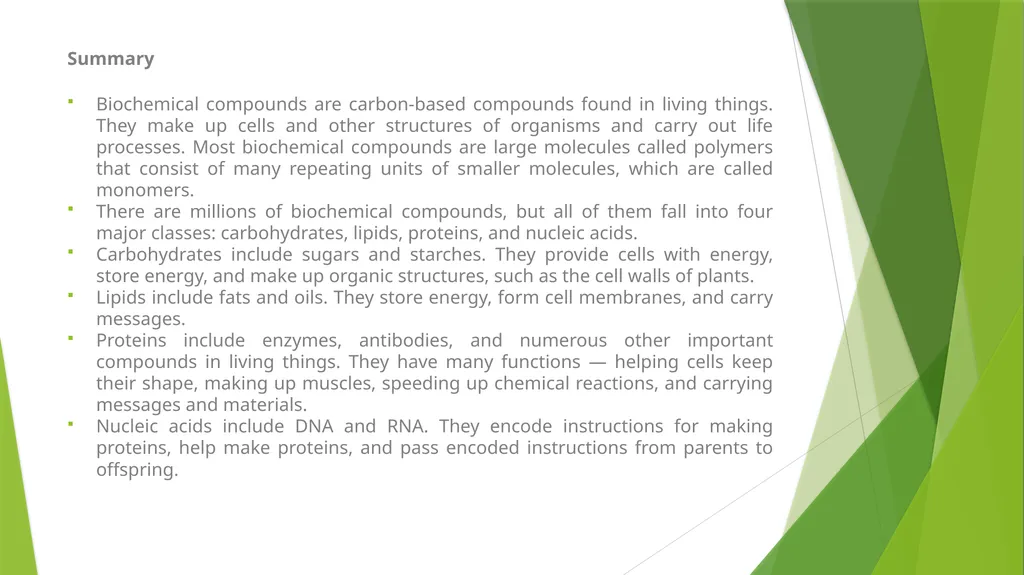
Biochemical compounds are carbon-based compounds found in living things. They make up cells and other structures of organisms and carry out life processes. Most biochemical compounds are large molecules called polymers that consist of many repeating units of smaller molecules, which are called monomers.
There are millions of biochemical compounds, but all of them fall into four major classes: carbohydrates, lipids, proteins, and nucleic acids.
Carbohydrates include sugars and starches. They provide cells with energy, store energy, and make up organic structures, such as the cell walls of plants.
Lipids include fats and oils. They store energy, form cell membranes, and carry messages.
Proteins include enzymes, antibodies, and numerous other important compounds in living things. They have many functions — helping cells keep their shape, making up muscles, speeding up chemical reactions, and carrying messages and materials.
Nucleic acids include DNA and RNA. They encode instructions for making proteins, help make proteins, and pass encoded instructions from parents to offspring.<br>
Biochemical compounds are carbon-based compounds found in living things. They make up cells and other structures of organisms and carry out life processes. Most biochemical compounds are large molecules called polymers that consist of many repeating units of smaller molecules, which are called monomers.
There are millions of biochemical compounds, but all of them fall into four major classes: carbohydrates, lipids, proteins, and nucleic acids.
Carbohydrates include sugars and starches. They provide cells with energy, store energy, and make up organic structures, such as the cell walls of plants.
Lipids include fats and oils. They store energy, form cell membranes, and carry messages.
Proteins include enzymes, antibodies, and numerous other important compounds in living things. They have many functions — helping cells keep their shape, making up muscles, speeding up chemical reactions, and carrying messages and materials.
Nucleic acids include DNA and RNA. They encode instructions for making proteins, help make proteins, and pass encoded instructions from parents to offspring.<br>
10
Multiple Choice
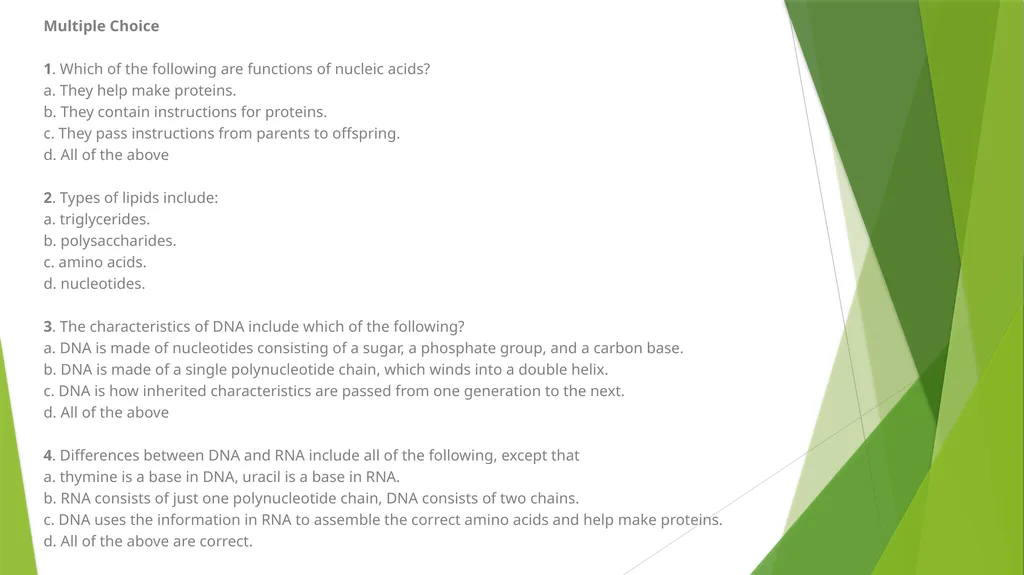
1. Which of the following are functions of nucleic acids?
a. They help make proteins.
b. They contain instructions for proteins.
c. They pass instructions from parents to offspring.
d. All of the above
2. Types of lipids include:
a. triglycerides.
b. polysaccharides.
c. amino acids.
d. nucleotides.
3. The characteristics of DNA include which of the following?
a. DNA is made of nucleotides consisting of a sugar, a phosphate group, and a carbon base.
b. DNA is made of a single polynucleotide chain, which winds into a double helix.
c. DNA is how inherited characteristics are passed from one generation to the next.
d. All of the above
4. Differences between DNA and RNA include all of the following, except that
a. thymine is a base in DNA, uracil is a base in RNA.
b. RNA consists of just one polynucleotide chain, DNA consists of two chains.
c. DNA uses the information in RNA to assemble the correct amino acids and help make proteins.
d. All of the above are correct.<br>
1. Which of the following are functions of nucleic acids?
a. They help make proteins.
b. They contain instructions for proteins.
c. They pass instructions from parents to offspring.
d. All of the above
2. Types of lipids include:
a. triglycerides.
b. polysaccharides.
c. amino acids.
d. nucleotides.
3. The characteristics of DNA include which of the following?
a. DNA is made of nucleotides consisting of a sugar, a phosphate group, and a carbon base.
b. DNA is made of a single polynucleotide chain, which winds into a double helix.
c. DNA is how inherited characteristics are passed from one generation to the next.
d. All of the above
4. Differences between DNA and RNA include all of the following, except that
a. thymine is a base in DNA, uracil is a base in RNA.
b. RNA consists of just one polynucleotide chain, DNA consists of two chains.
c. DNA uses the information in RNA to assemble the correct amino acids and help make proteins.
d. All of the above are correct.<br>
11
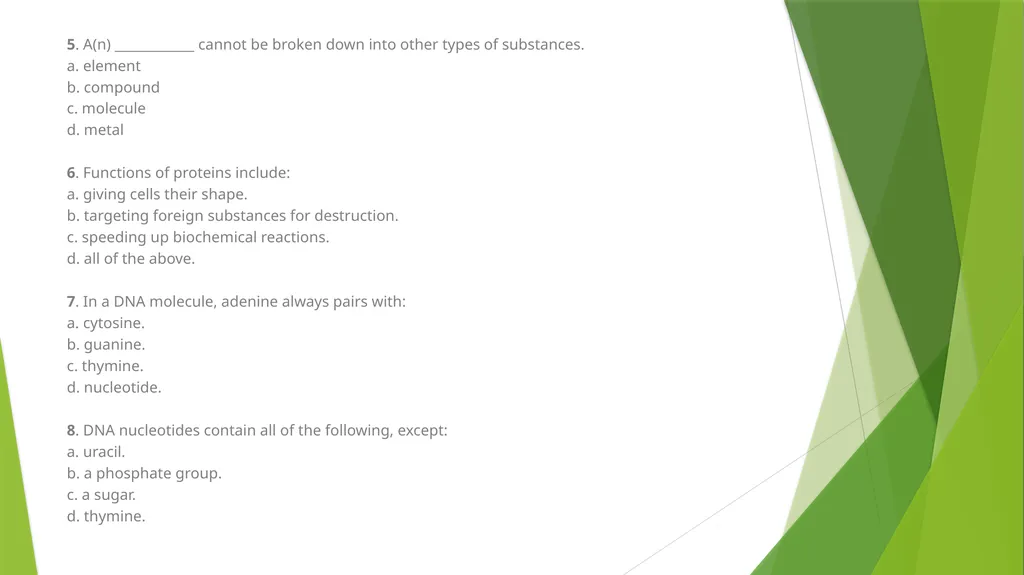
5. A(n) ____________ cannot be broken down into other types of substances.
a. element
b. compound
c. molecule
d. metal
6. Functions of proteins include:
a. giving cells their shape.
b. targeting foreign substances for destruction.
c. speeding up biochemical reactions.
d. all of the above.
7. In a DNA molecule, adenine always pairs with:
a. cytosine.
b. guanine.
c. thymine.
d. nucleotide.
8. DNA nucleotides contain all of the following, except:
a. uracil.
b. a phosphate group.
c. a sugar.
d. thymine.<br>
a. element
b. compound
c. molecule
d. metal
6. Functions of proteins include:
a. giving cells their shape.
b. targeting foreign substances for destruction.
c. speeding up biochemical reactions.
d. all of the above.
7. In a DNA molecule, adenine always pairs with:
a. cytosine.
b. guanine.
c. thymine.
d. nucleotide.
8. DNA nucleotides contain all of the following, except:
a. uracil.
b. a phosphate group.
c. a sugar.
d. thymine.<br>
12
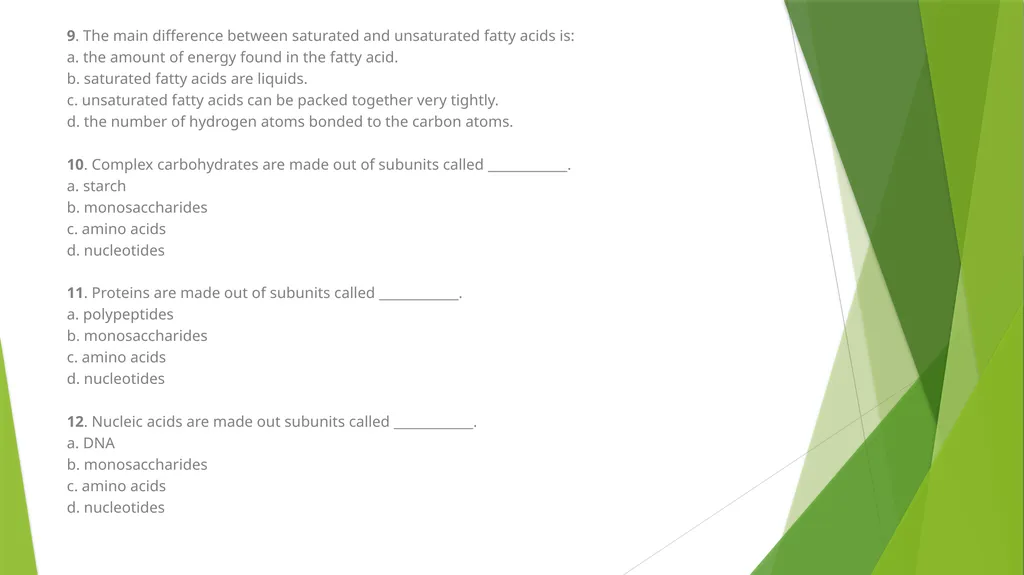
9. The main difference between saturated and unsaturated fatty acids is:
a. the amount of energy found in the fatty acid.
b. saturated fatty acids are liquids.
c. unsaturated fatty acids can be packed together very tightly.
d. the number of hydrogen atoms bonded to the carbon atoms.
10. Complex carbohydrates are made out of subunits called ____________.
a. starch
b. monosaccharides
c. amino acids
d. nucleotides
11. Proteins are made out of subunits called ____________.
a. polypeptides
b. monosaccharides
c. amino acids
d. nucleotides
12. Nucleic acids are made out subunits called ____________.
a. DNA
b. monosaccharides
c. amino acids
d. nucleotides<br>
a. the amount of energy found in the fatty acid.
b. saturated fatty acids are liquids.
c. unsaturated fatty acids can be packed together very tightly.
d. the number of hydrogen atoms bonded to the carbon atoms.
10. Complex carbohydrates are made out of subunits called ____________.
a. starch
b. monosaccharides
c. amino acids
d. nucleotides
11. Proteins are made out of subunits called ____________.
a. polypeptides
b. monosaccharides
c. amino acids
d. nucleotides
12. Nucleic acids are made out subunits called ____________.
a. DNA
b. monosaccharides
c. amino acids
d. nucleotides<br>
13
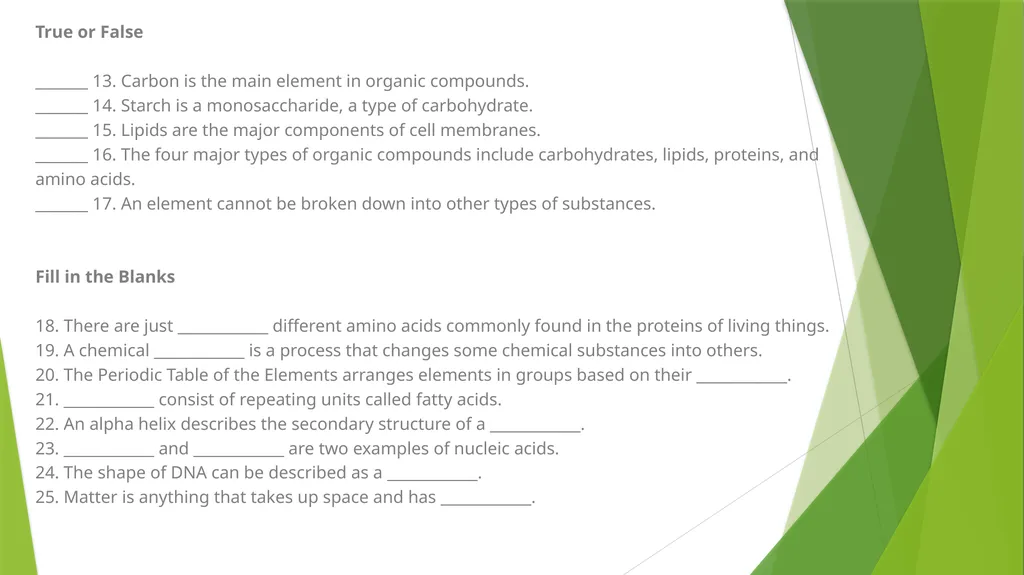
True or False
_______ 13. Carbon is the main element in organic compounds.
_______ 14. Starch is a monosaccharide, a type of carbohydrate.
_______ 15. Lipids are the major components of cell membranes.
_______ 16. The four major types of organic compounds include carbohydrates, lipids, proteins, and amino acids.
_______ 17. An element cannot be broken down into other types of substances.
Fill in the Blanks
18. There are just ____________ different amino acids commonly found in the proteins of living things.
19. A chemical ____________ is a process that changes some chemical substances into others.
20. The Periodic Table of the Elements arranges elements in groups based on their ____________.
21. ____________ consist of repeating units called fatty acids.
22. An alpha helix describes the secondary structure of a ____________.
23. ____________ and ____________ are two examples of nucleic acids.
24. The shape of DNA can be described as a ____________.
25. Matter is anything that takes up space and has ____________.<br>
_______ 13. Carbon is the main element in organic compounds.
_______ 14. Starch is a monosaccharide, a type of carbohydrate.
_______ 15. Lipids are the major components of cell membranes.
_______ 16. The four major types of organic compounds include carbohydrates, lipids, proteins, and amino acids.
_______ 17. An element cannot be broken down into other types of substances.
Fill in the Blanks
18. There are just ____________ different amino acids commonly found in the proteins of living things.
19. A chemical ____________ is a process that changes some chemical substances into others.
20. The Periodic Table of the Elements arranges elements in groups based on their ____________.
21. ____________ consist of repeating units called fatty acids.
22. An alpha helix describes the secondary structure of a ____________.
23. ____________ and ____________ are two examples of nucleic acids.
24. The shape of DNA can be described as a ____________.
25. Matter is anything that takes up space and has ____________.<br>
14
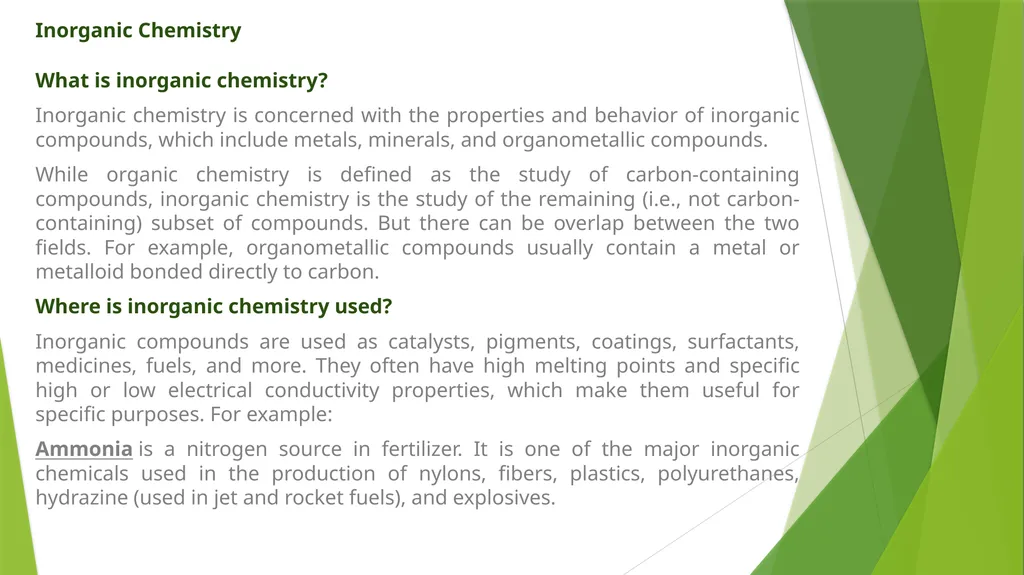
Inorganic Chemistry
What is inorganic chemistry?
Inorganic chemistry is concerned with the properties and behavior of inorganic compounds, which include metals, minerals, and organometallic compounds.
While organic chemistry is defined as the study of carbon-containing compounds, inorganic chemistry is the study of the remaining (i.e., not carbon-containing) subset of compounds. But there can be overlap between the two fields. For example, organometallic compounds usually contain a metal or metalloid bonded directly to carbon.
Where is inorganic chemistry used?
Inorganic compounds are used as catalysts, pigments, coatings, surfactants, medicines, fuels, and more. They often have high melting points and specific high or low electrical conductivity properties, which make them useful for specific purposes. For example:
Ammonia is a nitrogen source in fertilizer. It is one of the major inorganic chemicals used in the production of nylons, fibers, plastics, polyurethanes, hydrazine (used in jet and rocket fuels), and explosives.<br>
What is inorganic chemistry?
Inorganic chemistry is concerned with the properties and behavior of inorganic compounds, which include metals, minerals, and organometallic compounds.
While organic chemistry is defined as the study of carbon-containing compounds, inorganic chemistry is the study of the remaining (i.e., not carbon-containing) subset of compounds. But there can be overlap between the two fields. For example, organometallic compounds usually contain a metal or metalloid bonded directly to carbon.
Where is inorganic chemistry used?
Inorganic compounds are used as catalysts, pigments, coatings, surfactants, medicines, fuels, and more. They often have high melting points and specific high or low electrical conductivity properties, which make them useful for specific purposes. For example:
Ammonia is a nitrogen source in fertilizer. It is one of the major inorganic chemicals used in the production of nylons, fibers, plastics, polyurethanes, hydrazine (used in jet and rocket fuels), and explosives.<br>
15
Chlorine is used in the manufacture of polyvinyl chloride (used for pipes, clothing, furniture etc.), agrochemicals (e.g., fertilizer, insecticide, or soil treatment), pharmaceuticals, and chemicals for water treatment and sterilization.
Titanium dioxide is the naturally occurring oxide of titanium, which is used as a white powder pigment in paints, coatings, plastics, paper, inks, fibers, food, and cosmetics. it also has good ultraviolet light resistance properties, and there is a growing demand for its use in photocatalysts.<br>
Titanium dioxide is the naturally occurring oxide of titanium, which is used as a white powder pigment in paints, coatings, plastics, paper, inks, fibers, food, and cosmetics. it also has good ultraviolet light resistance properties, and there is a growing demand for its use in photocatalysts.<br>
16
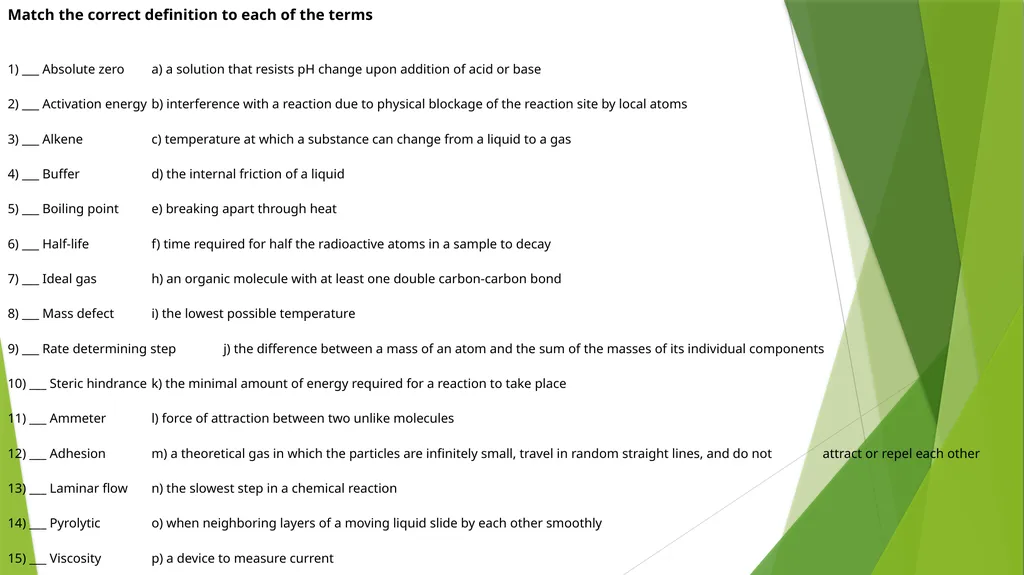
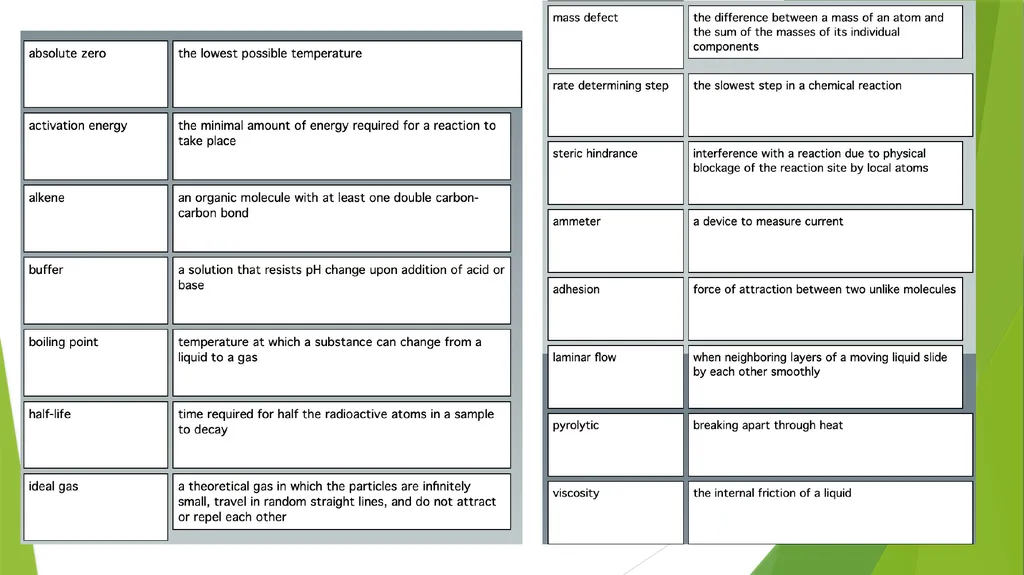
Match the correct definition to each of the terms
1) ___ Absolute zero a) a solution that resists pH change upon addition of acid or base
2) ___ Activation energy b) interference with a reaction due to physical blockage of the reaction site by local atoms
3) ___ Alkene c) temperature at which a substance can change from a liquid to a gas
4) ___ Buffer d) the internal friction of a liquid
5) ___ Boiling point e) breaking apart through heat
6) ___ Half-life f) time required for half the radioactive atoms in a sample to decay
7) ___ Ideal gas h) an organic molecule with at least one double carbon-carbon bond
8) ___ Mass defect i) the lowest possible temperature
9) ___ Rate determining step j) the difference between a mass of an atom and the sum of the masses of its individual components
10) ___ Steric hindrance k) the minimal amount of energy required for a reaction to take place
11) ___ Ammeter l) force of attraction between two unlike molecules
12) ___ Adhesion m) a theoretical gas in which the particles are infinitely small, travel in random straight lines, and do not attract or repel each other
13) ___ Laminar flow n) the slowest step in a chemical reaction
14) ___ Pyrolytic o) when neighboring layers of a moving liquid slide by each other smoothly
15) ___ Viscosity p) a device to measure current<br>
1) ___ Absolute zero a) a solution that resists pH change upon addition of acid or base
2) ___ Activation energy b) interference with a reaction due to physical blockage of the reaction site by local atoms
3) ___ Alkene c) temperature at which a substance can change from a liquid to a gas
4) ___ Buffer d) the internal friction of a liquid
5) ___ Boiling point e) breaking apart through heat
6) ___ Half-life f) time required for half the radioactive atoms in a sample to decay
7) ___ Ideal gas h) an organic molecule with at least one double carbon-carbon bond
8) ___ Mass defect i) the lowest possible temperature
9) ___ Rate determining step j) the difference between a mass of an atom and the sum of the masses of its individual components
10) ___ Steric hindrance k) the minimal amount of energy required for a reaction to take place
11) ___ Ammeter l) force of attraction between two unlike molecules
12) ___ Adhesion m) a theoretical gas in which the particles are infinitely small, travel in random straight lines, and do not attract or repel each other
13) ___ Laminar flow n) the slowest step in a chemical reaction
14) ___ Pyrolytic o) when neighboring layers of a moving liquid slide by each other smoothly
15) ___ Viscosity p) a device to measure current<br>