Elements, Compounds, and Mixtures Objectives 8.P.1.1 8.P.1.2 I can: Define all new vocabulary terms: element, pure substance, metal, nonmetal, metalloid. Describe the characteristics of elements, and give examples. Classify elements as
"Elements, Compounds, and Mixtures Objectives" is the property of its rightful owner. Permission is granted to
download and print the materials on this website for personal, non-commercial use only, and to display it
on your personal computer provided you do not modify the materials and that you retain all copyright
notices contained in the materials. By downloading content from our website, you accept the terms of this
agreement.
Presentation Transcript
01
Elements, Compounds, and Mixtures<br>
02
Objectives 8.P.1.1
8.P.1.2
I can:
Define all new vocabulary terms: element, pure substance, metal, nonmetal, metalloid.
Describe the characteristics of elements, and give examples.
Classify elements as metals, nonmetals, or metalloids.
Distinguish between metals, nonmetals, and metalloids.<br>
03
Elements A substance that cannot be separated or broken down into simpler substances.
Pure substance – only has one type of particle (atoms).
Every atom in a piece of gold is the same, no matter where it is found.
Every atom of iron is the same
spoon, steel rod, meteorite
Elements are found on the periodic table
111 elements known I can describe the characteristics of elements, and give examples.<br>
04
I can describe the characteristics of elements, and give examples.<br>
05
Properties of Elements Characteristic properties – do not depend on the amt. of the element present.
Boiling point, melting pt., density, reactivity with acid, color, hardness, flammability
Can be used to identify elements
Identified by their physical and chemical properties
Categorized by similar properties
Metals, nonmetals, or metalloids I can describe the characteristics of elements, and give examples.<br>
06
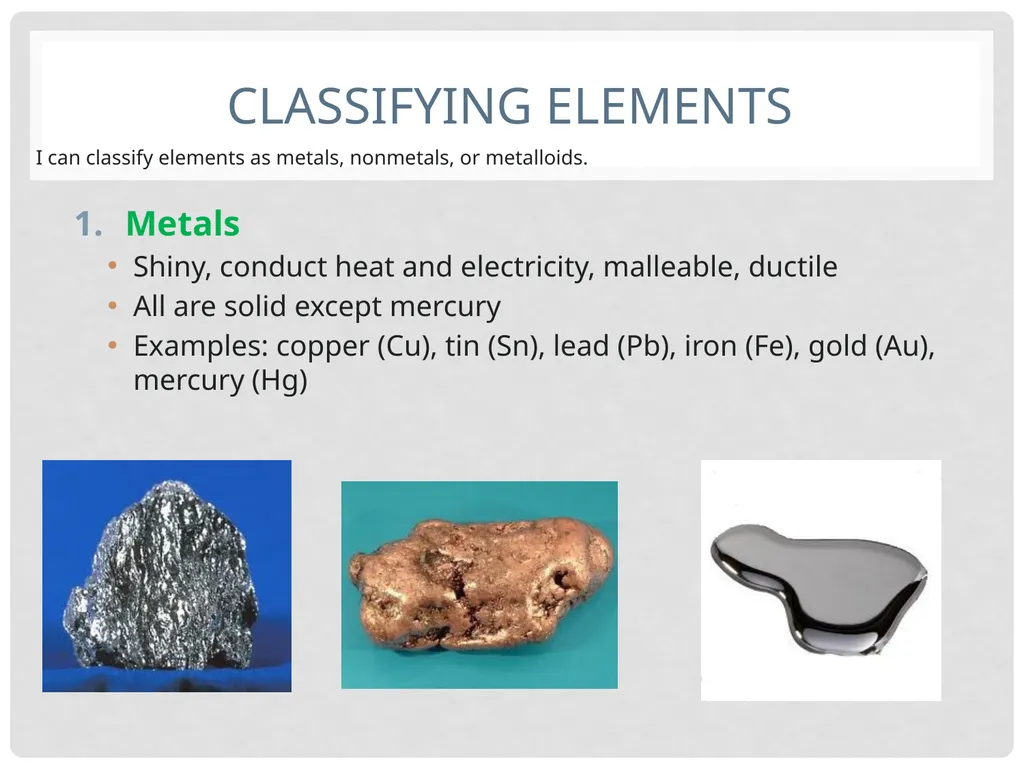
Classifying Elements Metals
Shiny, conduct heat and electricity, malleable, ductile
All are solid except mercury
Examples: copper (Cu), tin (Sn), lead (Pb), iron (Fe), gold (Au), mercury (Hg) I can classify elements as metals, nonmetals, or metalloids.<br>
07
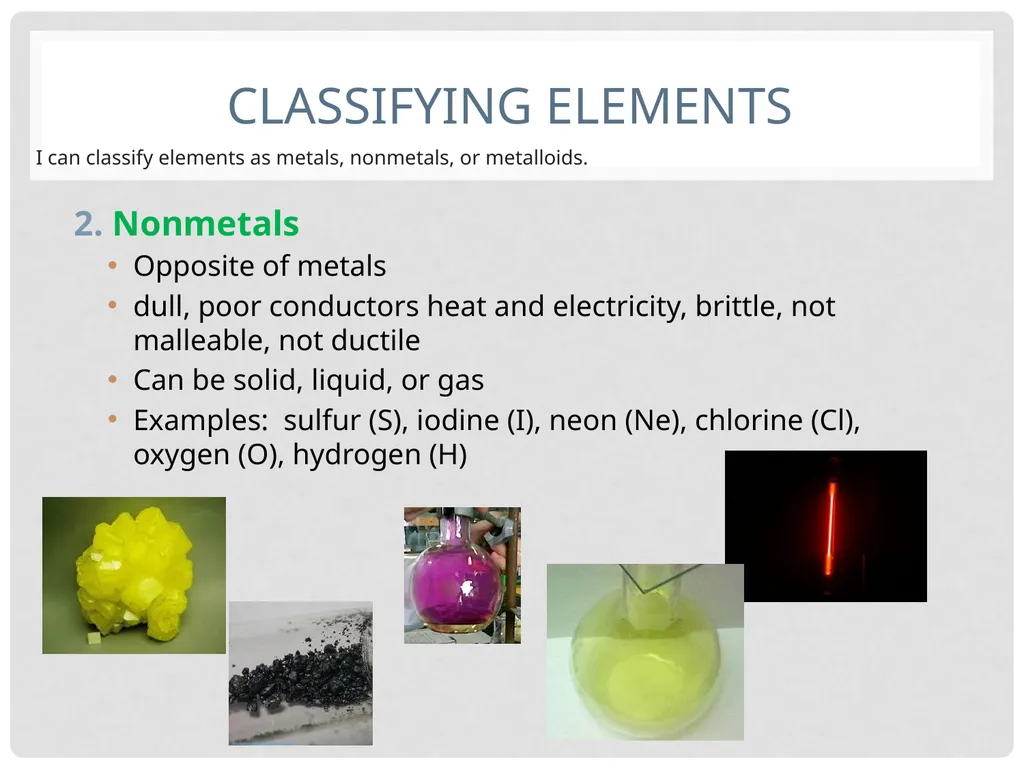
Classifying Elements 2. Nonmetals
Opposite of metals
dull, poor conductors heat and electricity, brittle, not malleable, not ductile
Can be solid, liquid, or gas
Examples: sulfur (S), iodine (I), neon (Ne), chlorine (Cl), oxygen (O), hydrogen (H) I can classify elements as metals, nonmetals, or metalloids.<br>
08
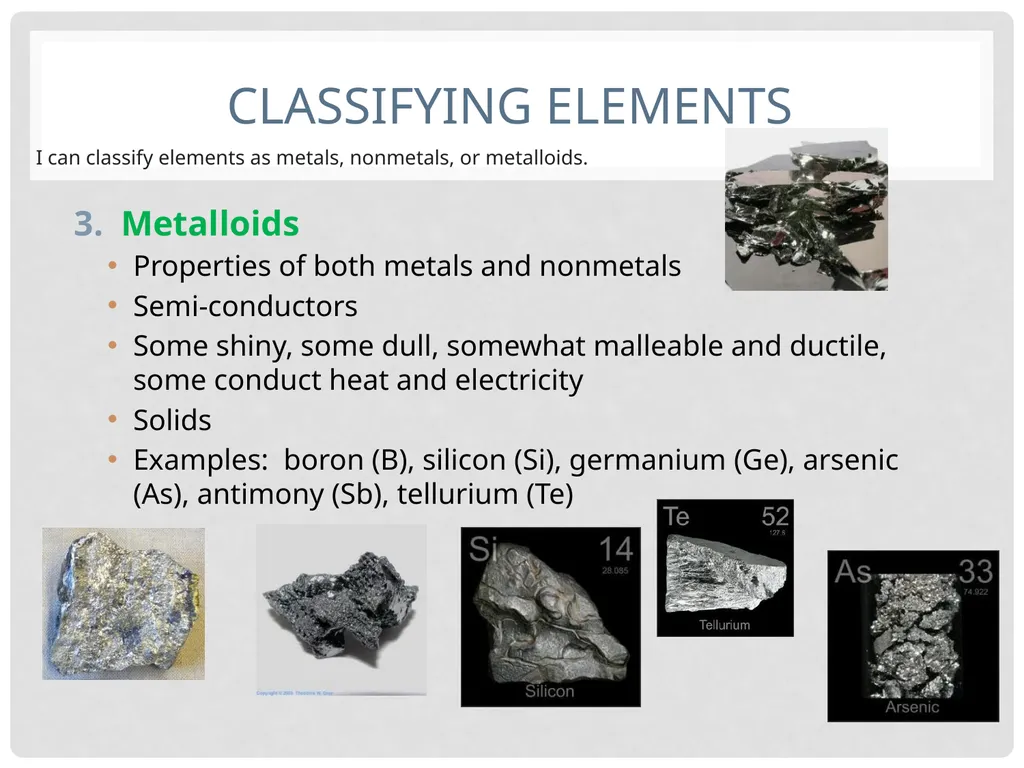
Classifying elements 3. Metalloids
Properties of both metals and nonmetals
Semi-conductors
Some shiny, some dull, somewhat malleable and ductile, some conduct heat and electricity
Solids
Examples: boron (B), silicon (Si), germanium (Ge), arsenic (As), antimony (Sb), tellurium (Te) I can classify elements as metals, nonmetals, or metalloids.<br>
09
I can distinguish between metals, nonmetals, and metalloids.<br>
10
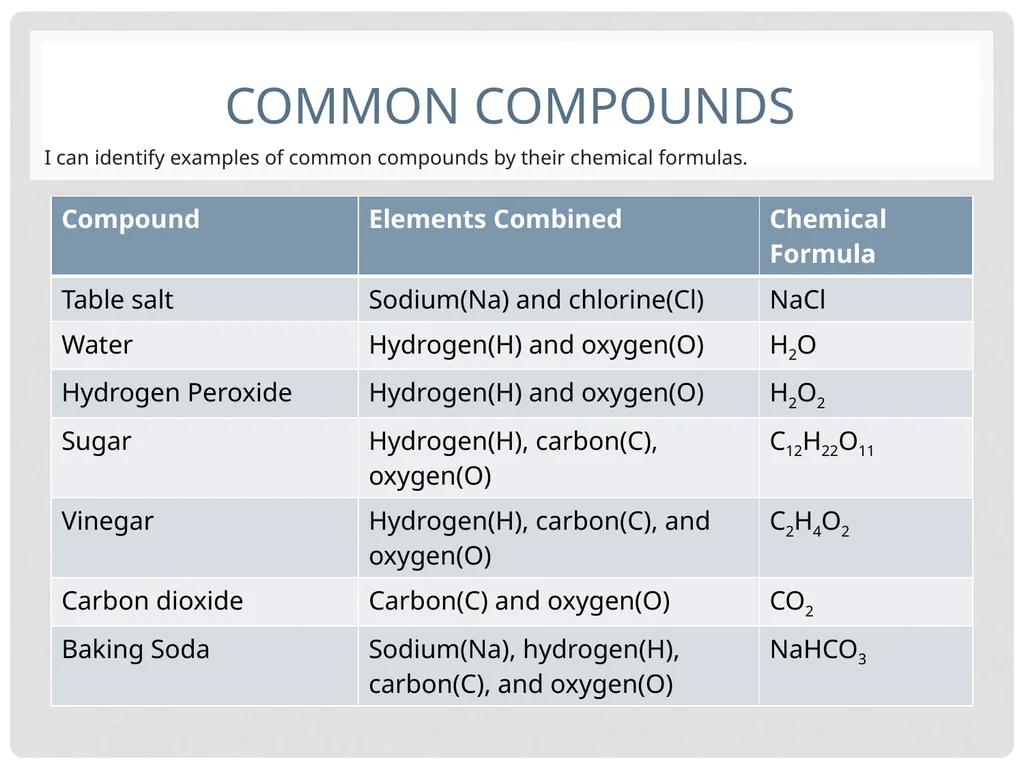
Compounds Pure substance composed of two or more elements that are chemically combined.
Elements are rarely found alone in nature, so they combine with other elements.
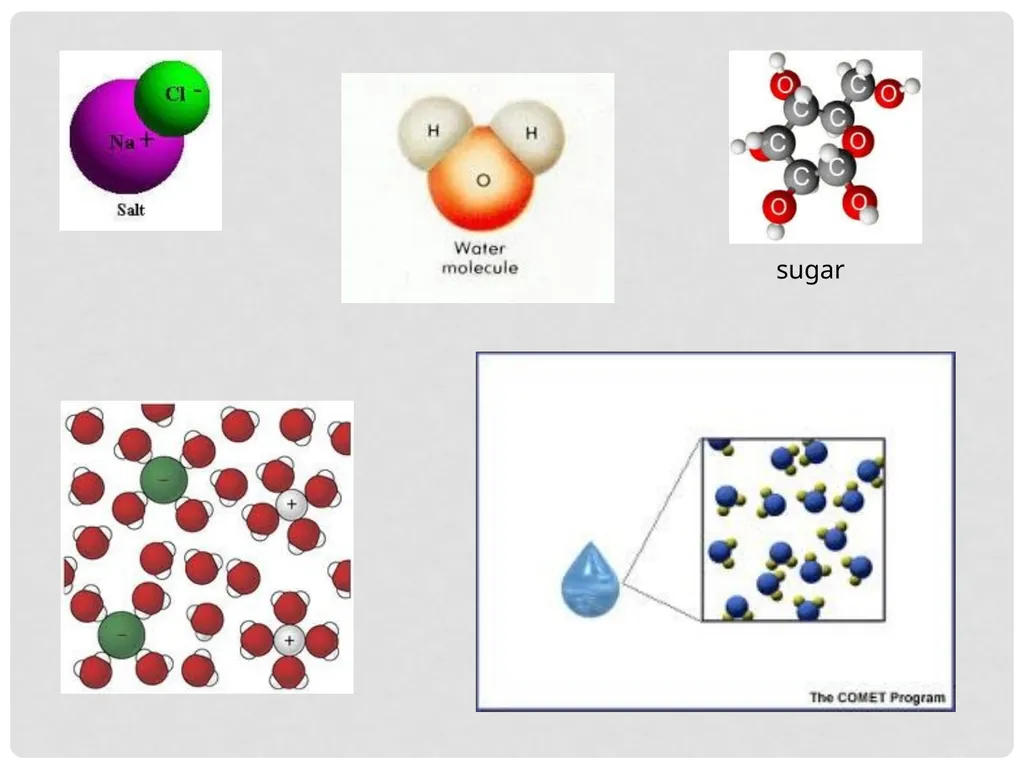
Compounds form a particle called a molecule (two or more atoms joined together).
Found in a set ratio of elements
Examples of common compounds:
Table Salt
Sugar
Water
Hydrogen Peroxide
Vinegar
Carbon Dioxide
Baking Soda I can identify examples of common compounds by their chemical formulas.<br>
11
Common Compounds I can identify examples of common compounds by their chemical formulas.<br>
12
sugar<br>
13
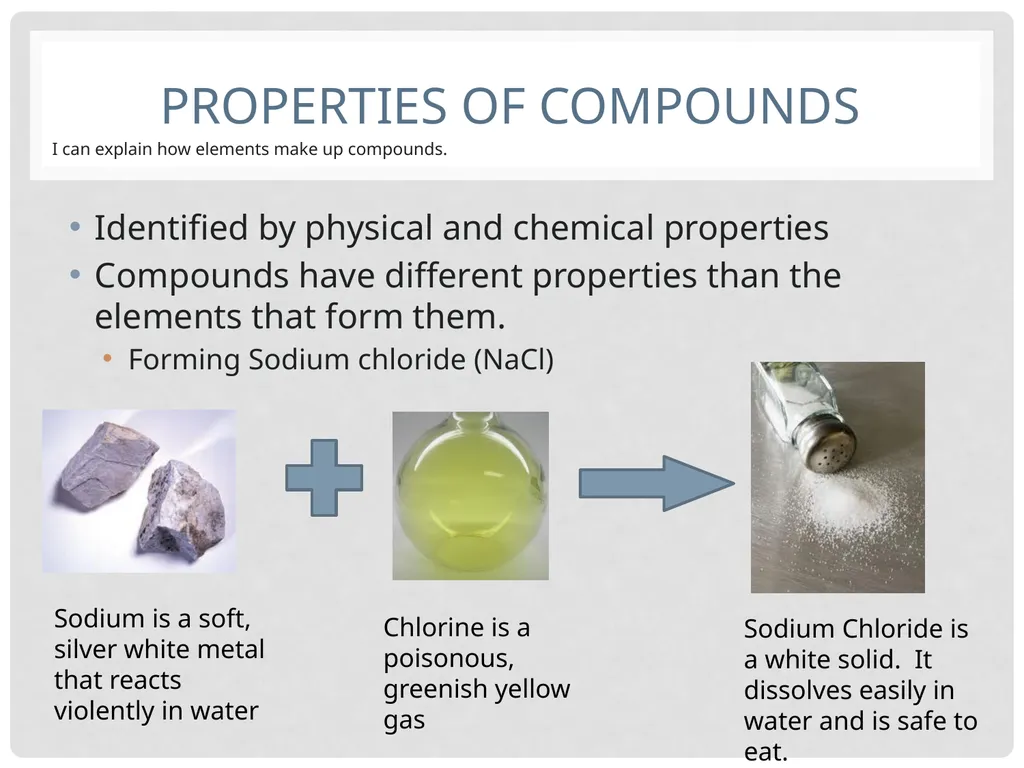
Properties of Compounds Identified by physical and chemical properties
Compounds have different properties than the elements that form them.
Forming Sodium chloride (NaCl) Sodium is a soft, silver white metal that reacts violently in water Chlorine is a poisonous, greenish yellow gas Sodium Chloride is a white solid. It dissolves easily in water and is safe to eat. I can explain how elements make up compounds.<br>
14
Sodium reacting with water<br>
15
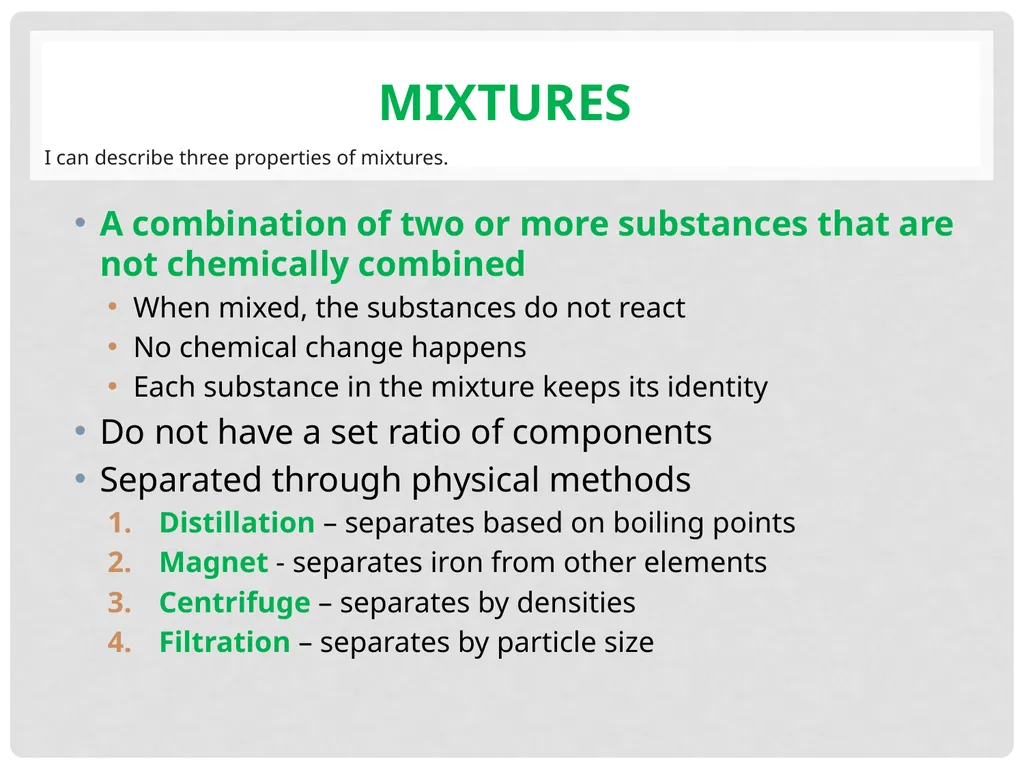
Mixtures A combination of two or more substances that are not chemically combined
When mixed, the substances do not react
No chemical change happens
Each substance in the mixture keeps its identity
Do not have a set ratio of components
Separated through physical methods
Distillation – separates based on boiling points
Magnet - separates iron from other elements
Centrifuge – separates by densities
Filtration – separates by particle size I can describe three properties of mixtures.<br>
16
Mixtures vs. compounds I can distinguish between a mixture and a compound.<br>
17
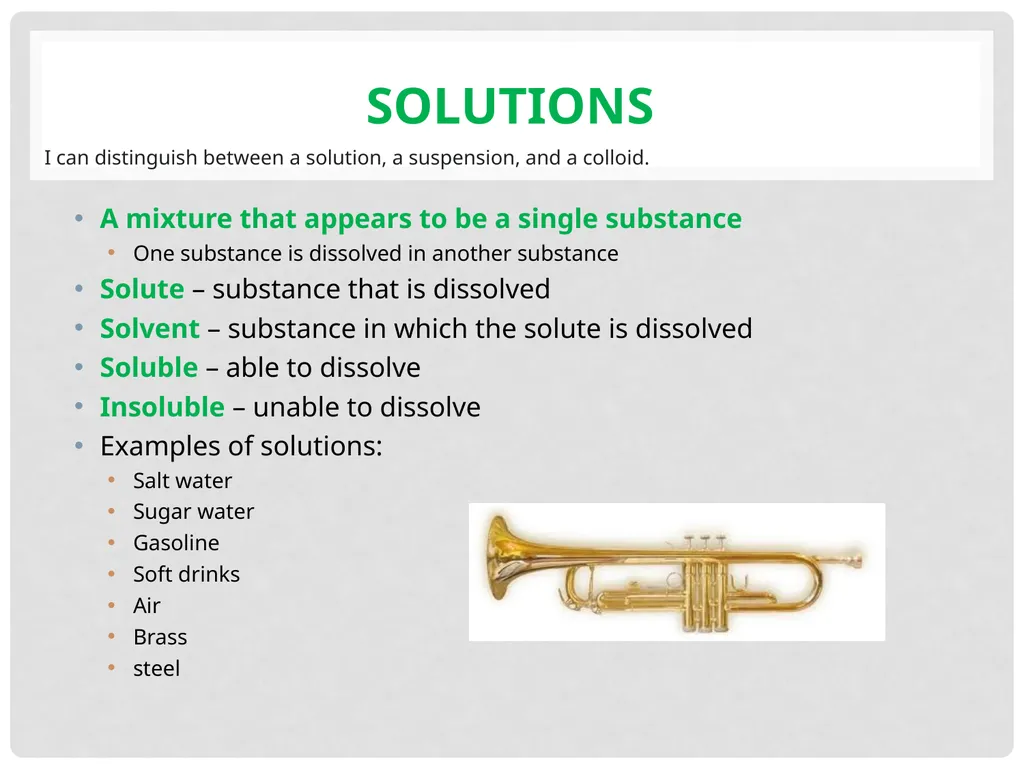
Solutions A mixture that appears to be a single substance
One substance is dissolved in another substance
Solute – substance that is dissolved
Solvent – substance in which the solute is dissolved
Soluble – able to dissolve
Insoluble – unable to dissolve
Examples of solutions:
Salt water
Sugar water
Gasoline
Soft drinks
Air
Brass
steel I can distinguish between a solution, a suspension, and a colloid.<br>
18
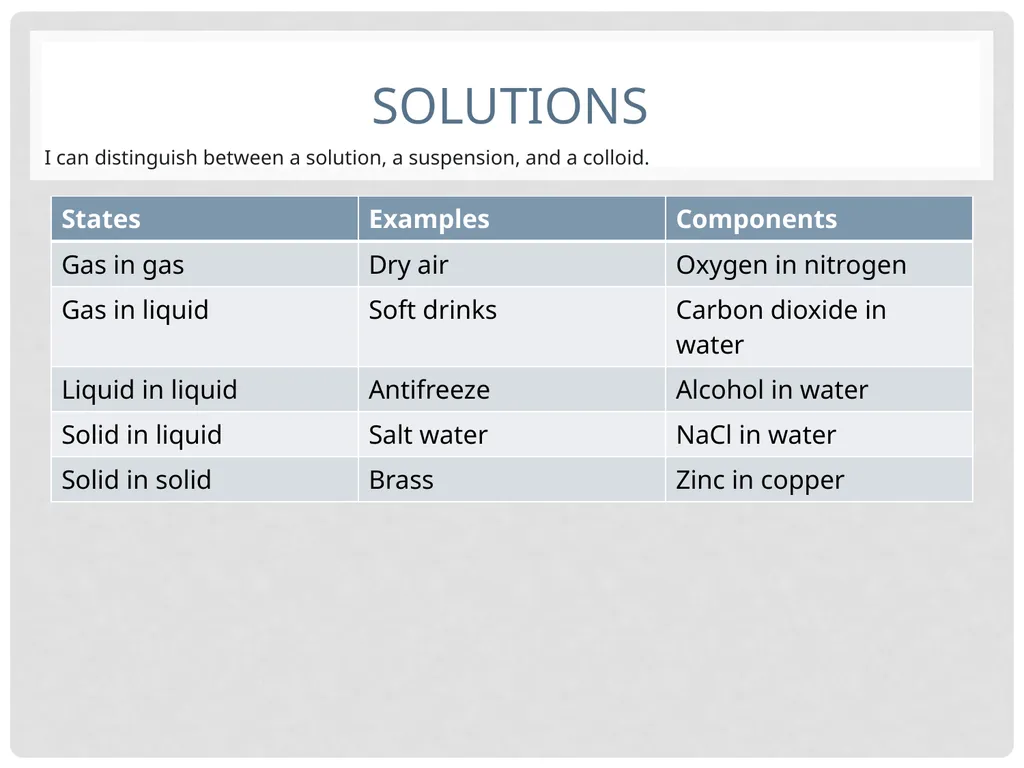
Solutions I can distinguish between a solution, a suspension, and a colloid.<br>
19
Concentration of solutions I can analyze a solution in terms of its solute and solvent.<br>
20
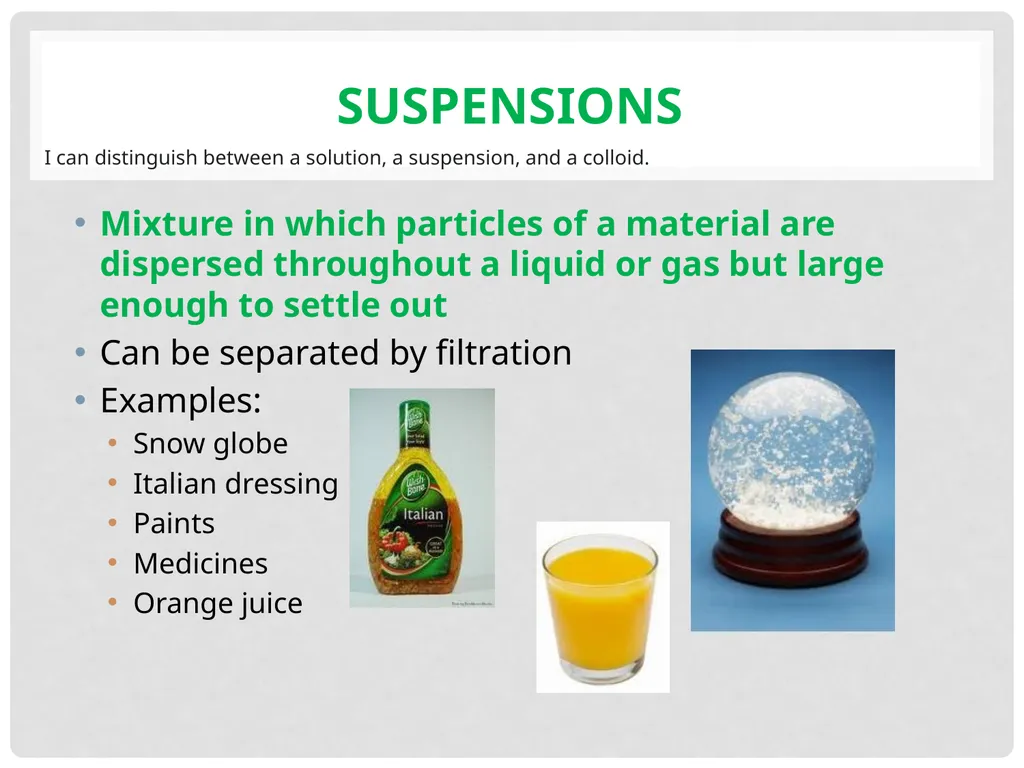
suspensions Mixture in which particles of a material are dispersed throughout a liquid or gas but large enough to settle out
Can be separated by filtration
Examples:
Snow globe
Italian dressing
Paints
Medicines
Orange juice I can distinguish between a solution, a suspension, and a colloid.<br>
21
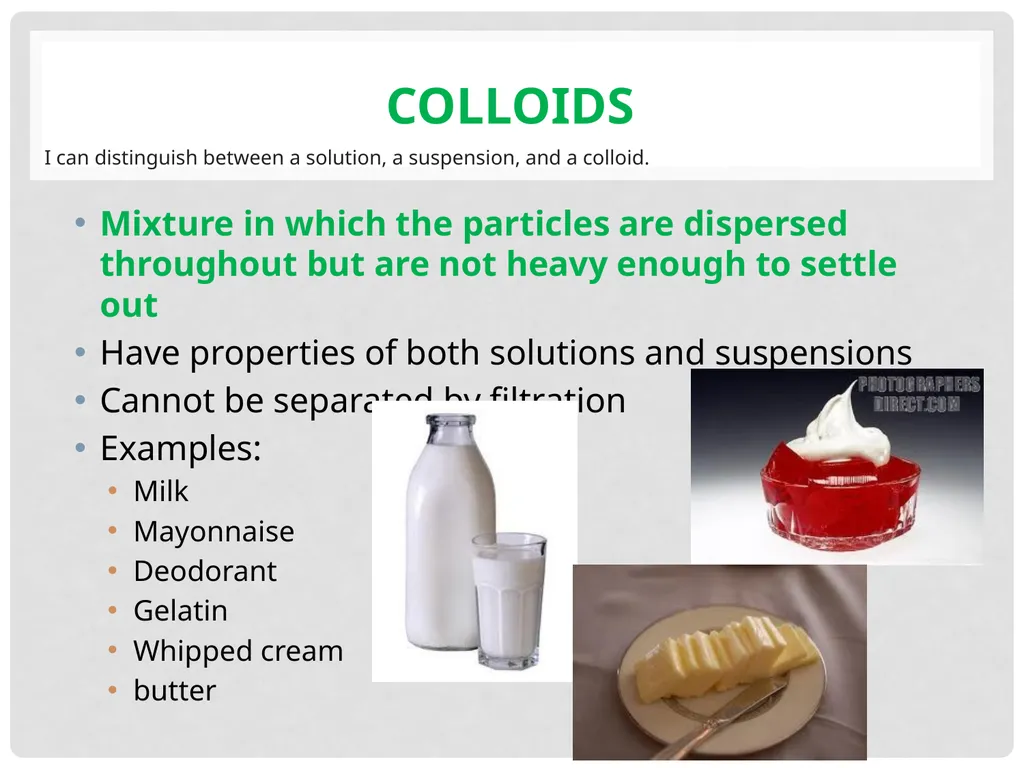
Colloids Mixture in which the particles are dispersed throughout but are not heavy enough to settle out
Have properties of both solutions and suspensions
Cannot be separated by filtration
Examples:
Milk
Mayonnaise
Deodorant
Gelatin
Whipped cream
butter I can distinguish between a solution, a suspension, and a colloid.<br>