
ELFT Training Packages for Primary Care
SB
Published · 64 slides · 0 views
1 / 1

Description
ELFT Training Packages for Primary Care Psychiatric Disorders in Childhood and Adolescence Responsible Clinician for contact: Frank Röhricht Associate Medical Director Learning Aims Objectives Upon completion of this presentation, you
Related Topics
Share
Embed code
Download this presentation From Below
"ELFT Training Packages for Primary Care" is the property of its rightful owner. Permission is granted to download and print the materials on this website for personal, non-commercial use only, and to display it on your personal computer provided you do not modify the materials and that you retain all copyright notices contained in the materials. By downloading content from our website, you accept the terms of this agreement.
Presentation Transcript
01
ELFT Training Packages
for Primary Care
‘Psychiatric Disorders in Childhood and Adolescence’ Responsible Clinician for contact:
Frank Röhricht
Associate Medical Director<br>
Frank Röhricht
Associate Medical Director<br>
02
Learning Aims & Objectives Upon completion of this presentation, you will:
Acknowledge unique variations in presenting psychiatric symptoms in this age group
Understand the high likelihood of co-morbidity in this age group
Be aware of the use of multimodal treatment in children and adolescents<br>
Acknowledge unique variations in presenting psychiatric symptoms in this age group
Understand the high likelihood of co-morbidity in this age group
Be aware of the use of multimodal treatment in children and adolescents<br>
03
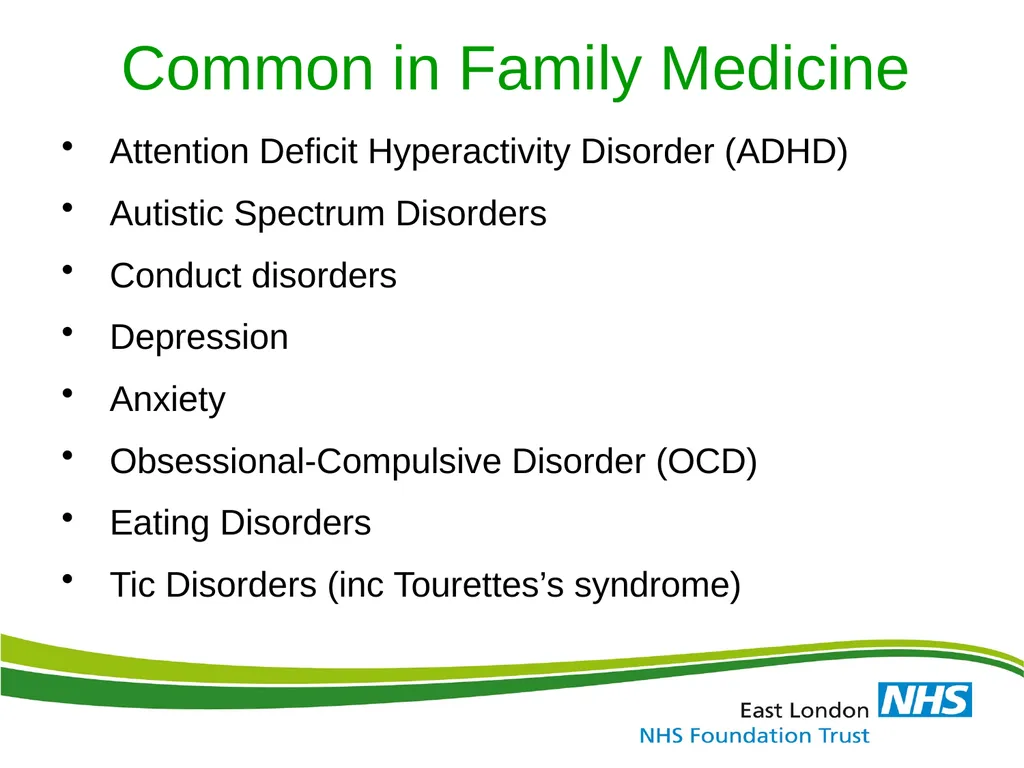
Common in Family Medicine Attention Deficit Hyperactivity Disorder (ADHD)
Autistic Spectrum Disorders
Conduct disorders
Depression
Anxiety
Obsessional-Compulsive Disorder (OCD)
Eating Disorders
Tic Disorders (inc Tourettes’s syndrome)<br>
Autistic Spectrum Disorders
Conduct disorders
Depression
Anxiety
Obsessional-Compulsive Disorder (OCD)
Eating Disorders
Tic Disorders (inc Tourettes’s syndrome)<br>
04
The Diagnostic Dilemma Regardless of the presenting symptoms, Children and Adolescents are often referred “for evaluation for ADHD”<br>
05
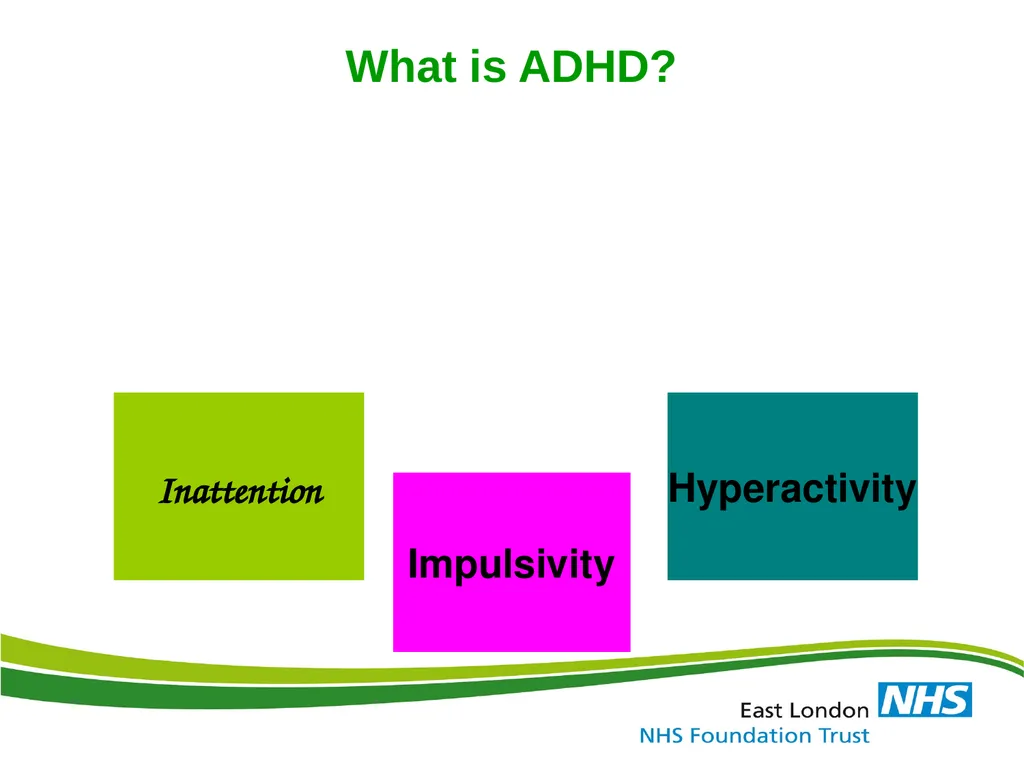
Inattention Hyperactivity Impulsivity What is ADHD?<br>
06
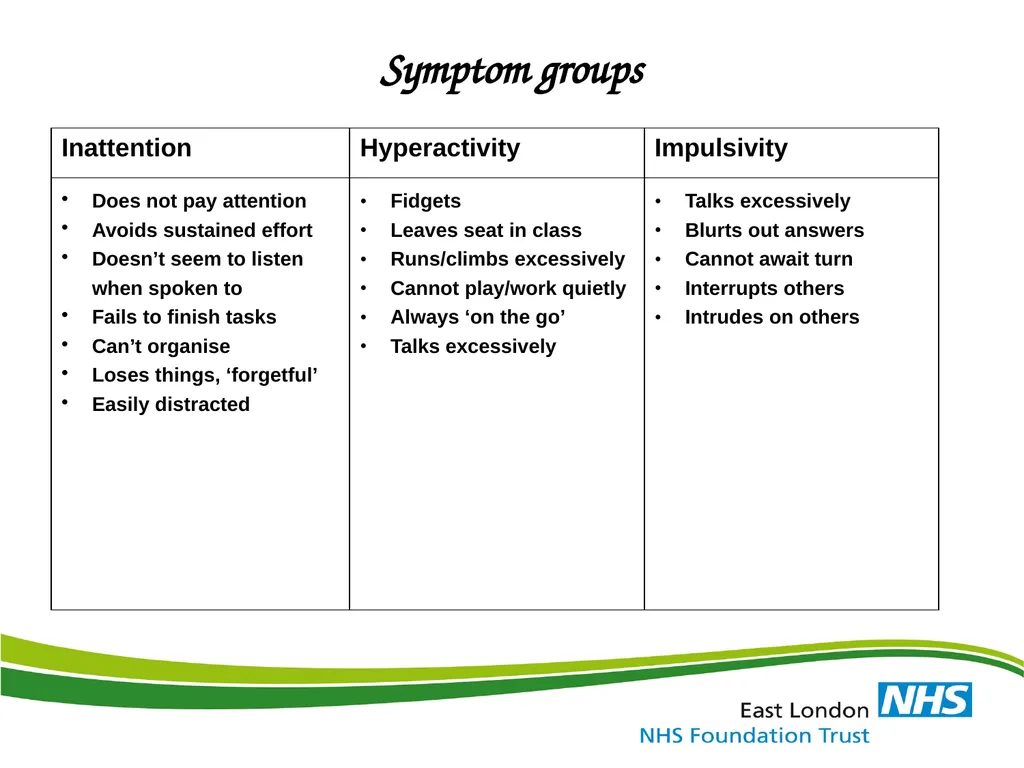
Symptom groups<br>
07
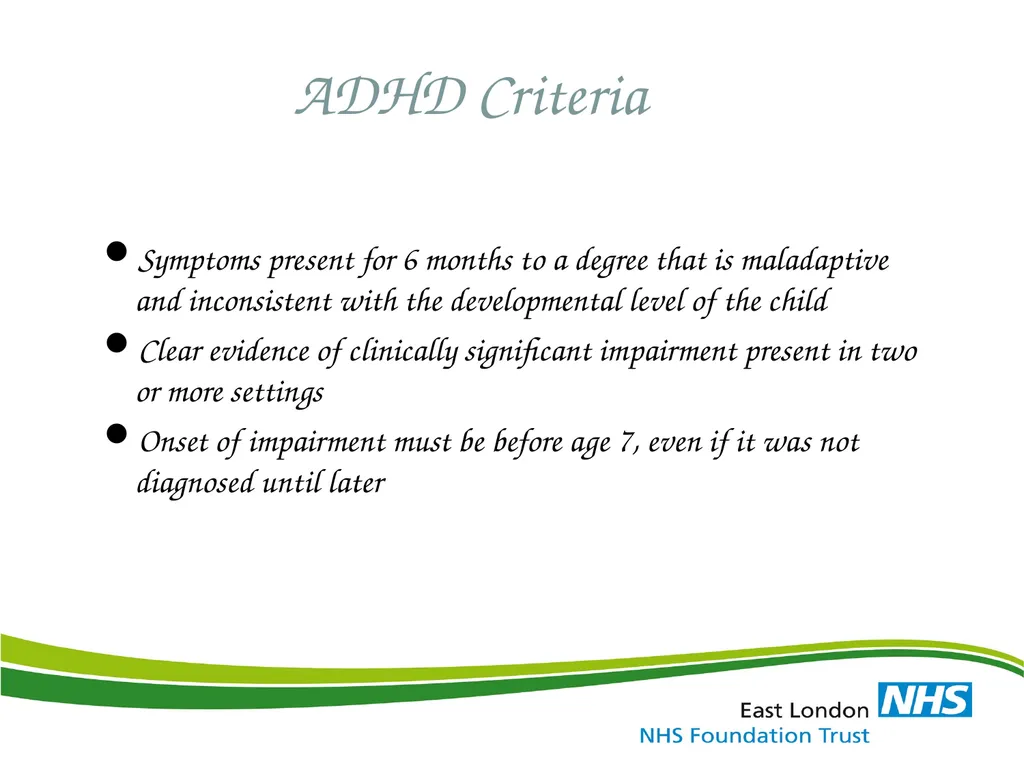
ADHD Criteria Symptoms present for 6 months to a degree that is maladaptive and inconsistent with the developmental level of the child
Clear evidence of clinically significant impairment present in two or more settings
Onset of impairment must be before age 7, even if it was not diagnosed until later<br>
Clear evidence of clinically significant impairment present in two or more settings
Onset of impairment must be before age 7, even if it was not diagnosed until later<br>
08
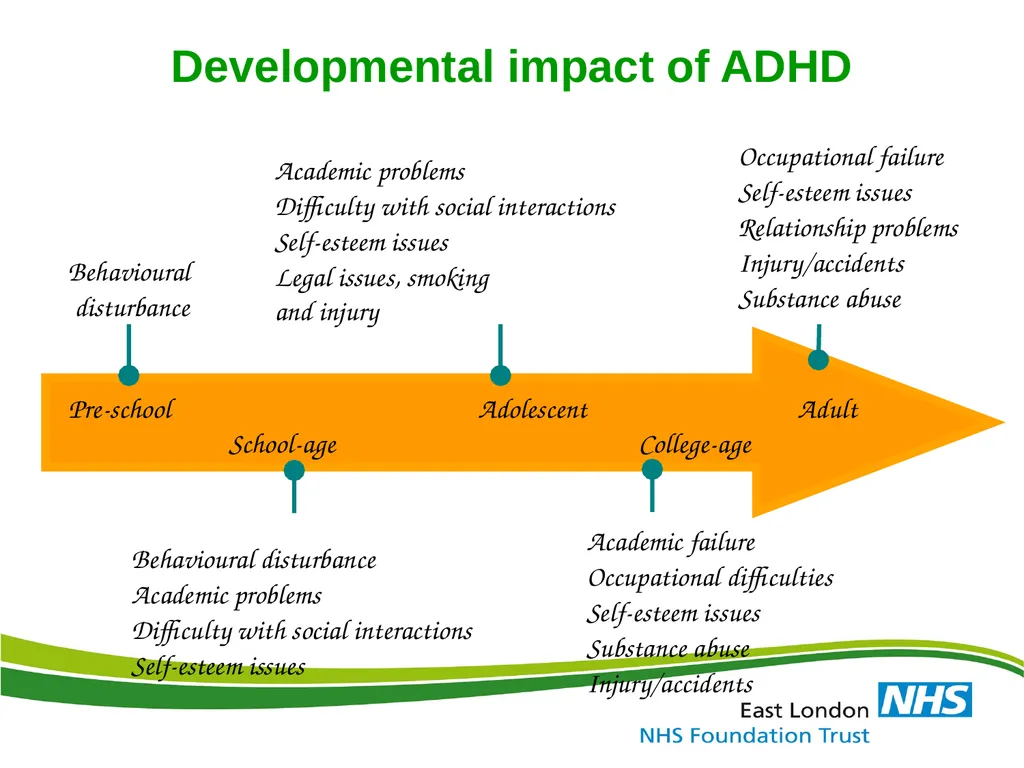
Developmental impact of ADHD Pre-school Adolescent Adult School-age College-age Behavioural
disturbance Behavioural disturbance
Academic problems
Difficulty with social interactions
Self-esteem issues Academic problems
Difficulty with social interactions
Self-esteem issues
Legal issues, smoking and injury Academic failure
Occupational difficulties
Self-esteem issues
Substance abuse
Injury/accidents Occupational failure
Self-esteem issues
Relationship problems
Injury/accidents
Substance abuse<br>
disturbance Behavioural disturbance
Academic problems
Difficulty with social interactions
Self-esteem issues Academic problems
Difficulty with social interactions
Self-esteem issues
Legal issues, smoking and injury Academic failure
Occupational difficulties
Self-esteem issues
Substance abuse
Injury/accidents Occupational failure
Self-esteem issues
Relationship problems
Injury/accidents
Substance abuse<br>
09
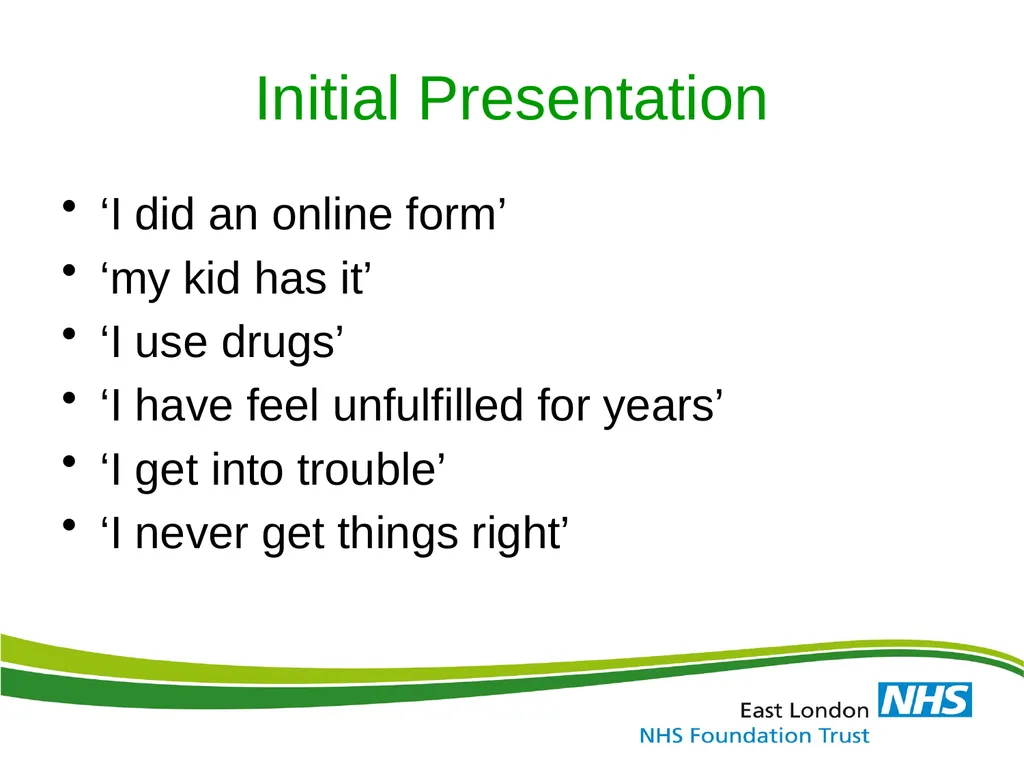
Initial Presentation ‘I did an online form’
‘my kid has it’
‘I use drugs’
‘I have feel unfulfilled for years’
‘I get into trouble’
‘I never get things right’<br>
‘my kid has it’
‘I use drugs’
‘I have feel unfulfilled for years’
‘I get into trouble’
‘I never get things right’<br>
10
Advice after Diagnosis NICE Sept 2008 Self-instruction manuals for parents and other materials based on behavioural techniques
Stress value of balanced diet and regular exercise
Dietary change generally not recommended
Dietary fatty acids not recommended<br>
Stress value of balanced diet and regular exercise
Dietary change generally not recommended
Dietary fatty acids not recommended<br>
11
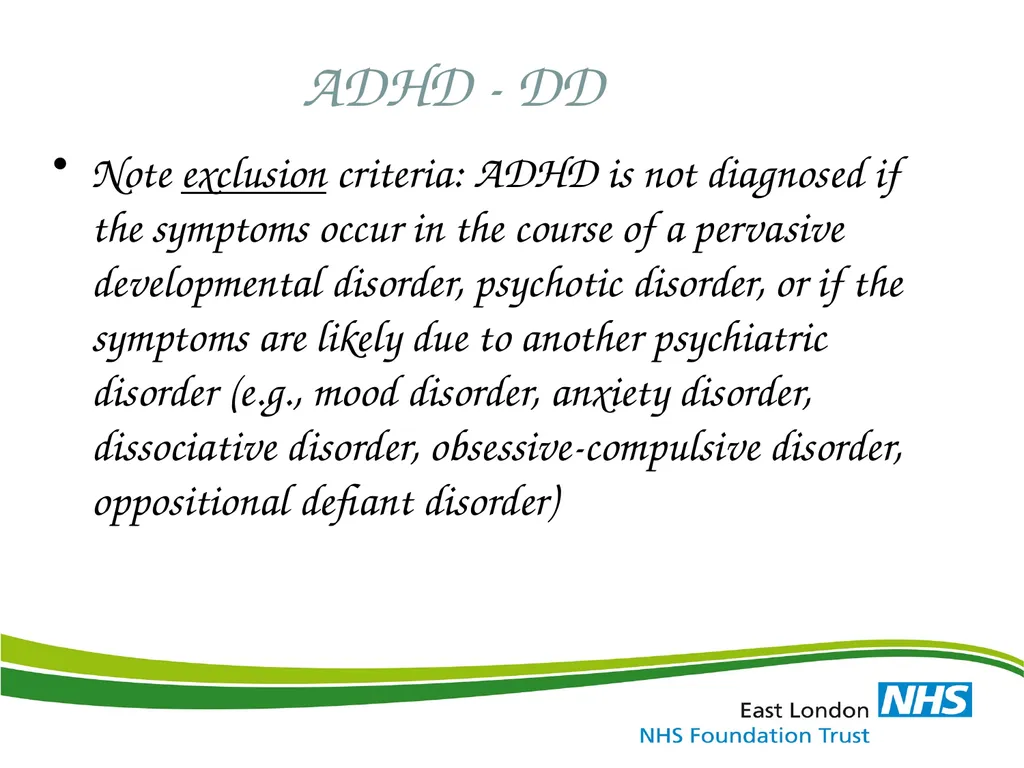
ADHD - DD Note exclusion criteria: ADHD is not diagnosed if the symptoms occur in the course of a pervasive developmental disorder, psychotic disorder, or if the symptoms are likely due to another psychiatric disorder (e.g., mood disorder, anxiety disorder, dissociative disorder, obsessive-compulsive disorder, oppositional defiant disorder)<br>
12
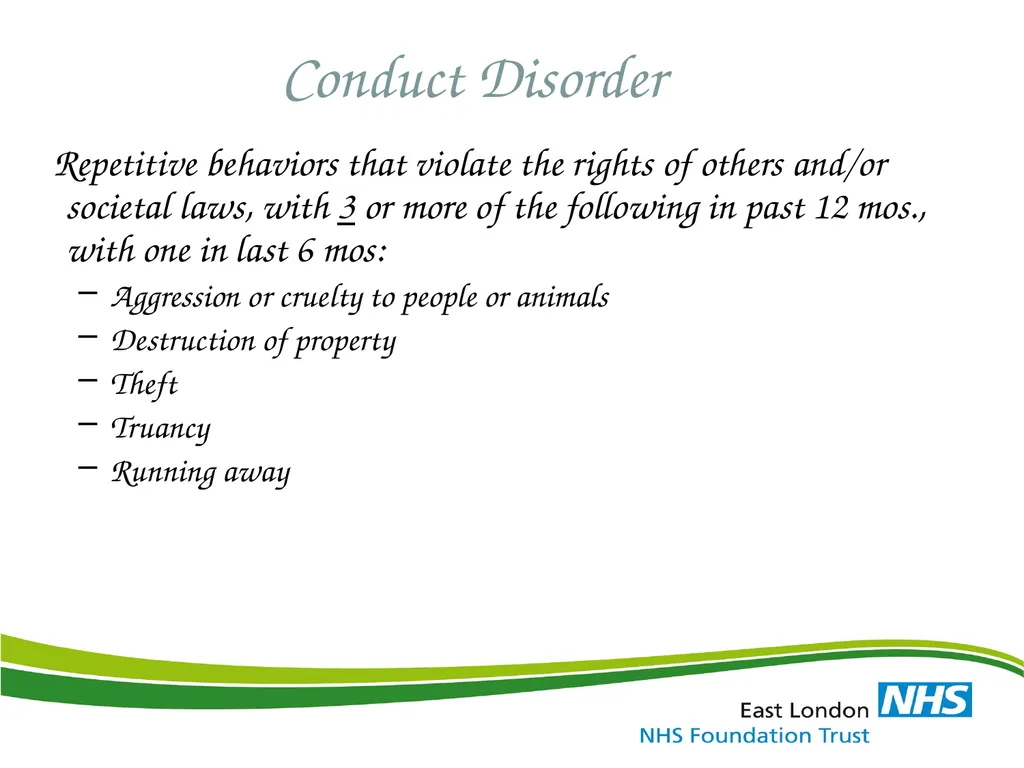
Conduct Disorder Repetitive behaviors that violate the rights of others and/or societal laws, with 3 or more of the following in past 12 mos., with one in last 6 mos:
Aggression or cruelty to people or animals
Destruction of property
Theft
Truancy
Running away<br>
Aggression or cruelty to people or animals
Destruction of property
Theft
Truancy
Running away<br>
13
Conduct Disorder -Affects 12% of boys and 7% of girls
-Most frequent reason for psychiatric hospital admissions for children and adolescents
There are two distinct groups:<br>
-Most frequent reason for psychiatric hospital admissions for children and adolescents
There are two distinct groups:<br>
14
Conduct Disorder-Childhood Onset Oppositional Defiant Disorder in preschool years developing into a serious conduct disorder by adolescence
This group has a 2-3 fold likelihood of becoming juvenile offenders<br>
This group has a 2-3 fold likelihood of becoming juvenile offenders<br>
15
Conduct Disorder-Adolescent Onset Behaviorally normal until middle school, when symptoms of Conduct Disorder become prevalent
This group has a more favorable prognosis; more likely to respond to treatment<br>
This group has a more favorable prognosis; more likely to respond to treatment<br>
16
Conduct Disorder-Psychosocial Correlates Harsh punishment
Institutional living
Inconsistent parental figures (living with different relatives for years) Poor parental monitoring in early childhood
Parental conflict
Maternal depression
Paternal alcoholism<br>
Institutional living
Inconsistent parental figures (living with different relatives for years) Poor parental monitoring in early childhood
Parental conflict
Maternal depression
Paternal alcoholism<br>
17
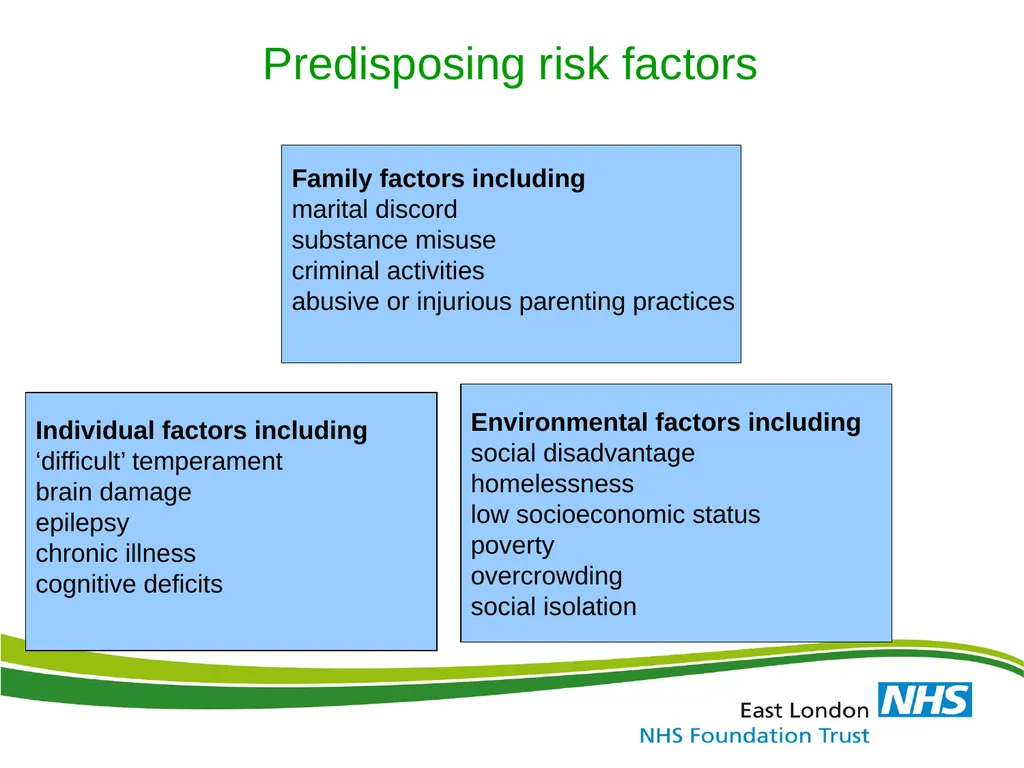
Predisposing risk factors Family factors including
marital discord
substance misuse
criminal activities
abusive or injurious parenting practices Environmental factors including
social disadvantage
homelessness
low socioeconomic status
poverty
overcrowding
social isolation Individual factors including
‘difficult’ temperament
brain damage
epilepsy
chronic illness
cognitive deficits<br>
marital discord
substance misuse
criminal activities
abusive or injurious parenting practices Environmental factors including
social disadvantage
homelessness
low socioeconomic status
poverty
overcrowding
social isolation Individual factors including
‘difficult’ temperament
brain damage
epilepsy
chronic illness
cognitive deficits<br>
18
Conduct Disorder Conduct Disorder develops as a result of biological risk and childhood experiences, so there are opportunities for early intervention
Treatment includes family therapy, behavior management training, social skills group, and teaching problem-solving skills<br>
Treatment includes family therapy, behavior management training, social skills group, and teaching problem-solving skills<br>
19
Associated conditions Conduct disorders are often seen in association with:
attention deficit hyperactivity disorder (ADHD)
depression
learning disabilities (particularly dyslexia)
substance misuse
less frequently, psychosis and autism<br>
attention deficit hyperactivity disorder (ADHD)
depression
learning disabilities (particularly dyslexia)
substance misuse
less frequently, psychosis and autism<br>
20
What Else Could It Be? “He won’t be still and he makes noises.”
Consider Tic Disorders…<br>
Consider Tic Disorders…<br>
21
Transient Tic Disorder Single or multiple motor and/or vocal tics, occurring many times a day, nearly every day, for at least 4 weeks, but no longer than 12 months
Most transient tics are simple, not complex, and do not usually cause distress<br>
Most transient tics are simple, not complex, and do not usually cause distress<br>
22
Tourette’s Disorder Multiple motor and one or more vocal tics lasting at least 1 year, many times a day, nearly every day, without a tic-free period of more than three consecutive months
Onset before y. 18; peak onset at 5 to 8 y.
Severity tends to peak around 8 to 11 years, with improvement/ resolution during puberty<br>
Onset before y. 18; peak onset at 5 to 8 y.
Severity tends to peak around 8 to 11 years, with improvement/ resolution during puberty<br>
23
Prevalence Transient tics occur in 6-13% of all children
Chronic tic disorder occurs in 1-2%, with 3:1 ratio of boys:girls
Tourette’s is much less common, occurring in 5-10/10,000<br>
Chronic tic disorder occurs in 1-2%, with 3:1 ratio of boys:girls
Tourette’s is much less common, occurring in 5-10/10,000<br>
24
Co-morbidity of Tourette’s Disorder 40% of Tourette’s children also meet criteria for OCD
>20% of children with any tic disorder have OCD
Many children with Tourette’s Disorder have depression or anxiety
8-27% of children with Tourette’s also have ADHD, but most have impulsivity<br>
>20% of children with any tic disorder have OCD
Many children with Tourette’s Disorder have depression or anxiety
8-27% of children with Tourette’s also have ADHD, but most have impulsivity<br>
25
Recognizing Tics Typically, brief clonic movements of eyes, face, neck and shoulders
Most common: eye-blinking, facial grimacing and head-jerking
Typically, vocal tics involve throat-clearing, grunting or barking
Tics may be simple (brief) or complex (elaborate)<br>
Most common: eye-blinking, facial grimacing and head-jerking
Typically, vocal tics involve throat-clearing, grunting or barking
Tics may be simple (brief) or complex (elaborate)<br>
26
Non-tics Habits such as hair-twirling and skin-picking are not tics
Compulsions of OCD are not tics
Allergic throat-clearing and sniffing are not tics<br>
Compulsions of OCD are not tics
Allergic throat-clearing and sniffing are not tics<br>
27
Treatment Education for patient, family and school personnel
Pharmacotherapy
Alpha agonists, clonidine and guanfacine
Neuroleptics, such as risperidone
Nicotine patches may be useful for severe tics resistant to other medications<br>
Pharmacotherapy
Alpha agonists, clonidine and guanfacine
Neuroleptics, such as risperidone
Nicotine patches may be useful for severe tics resistant to other medications<br>
28
What Else Could It Be? “He doesn’t have tics…he’s just restless and inattentive…”<br>
29
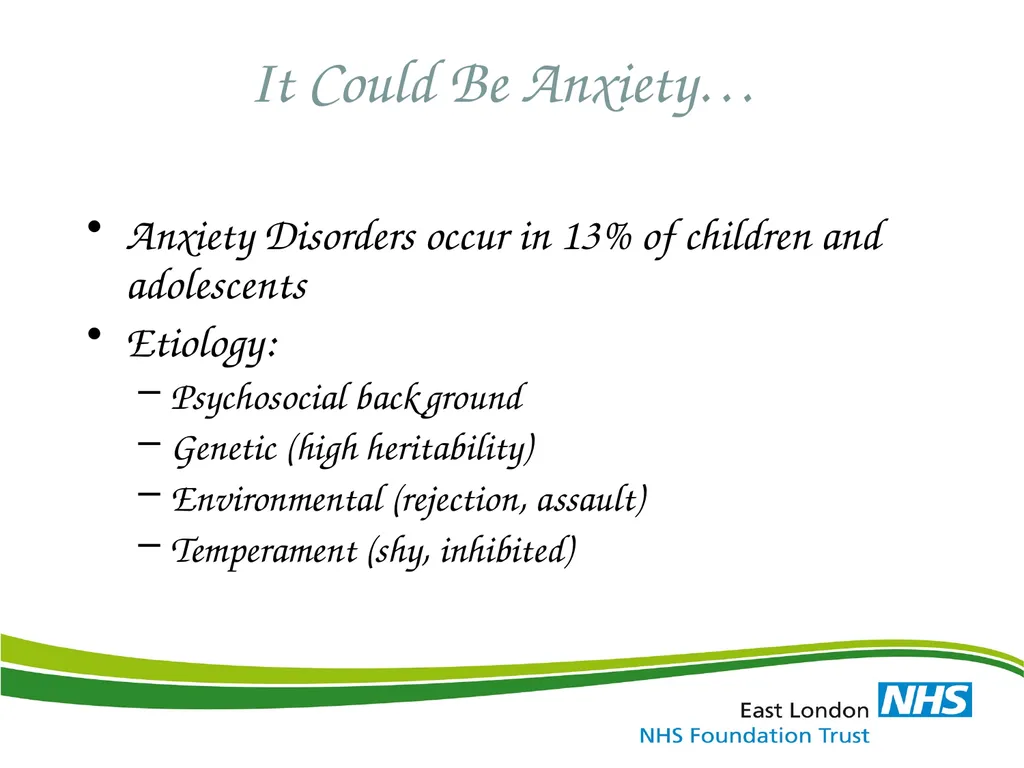
It Could Be Anxiety… Anxiety Disorders occur in 13% of children and adolescents
Etiology:
Psychosocial background
Genetic (high heritability)
Environmental (rejection, assault)
Temperament (shy, inhibited)<br>
Etiology:
Psychosocial background
Genetic (high heritability)
Environmental (rejection, assault)
Temperament (shy, inhibited)<br>
30
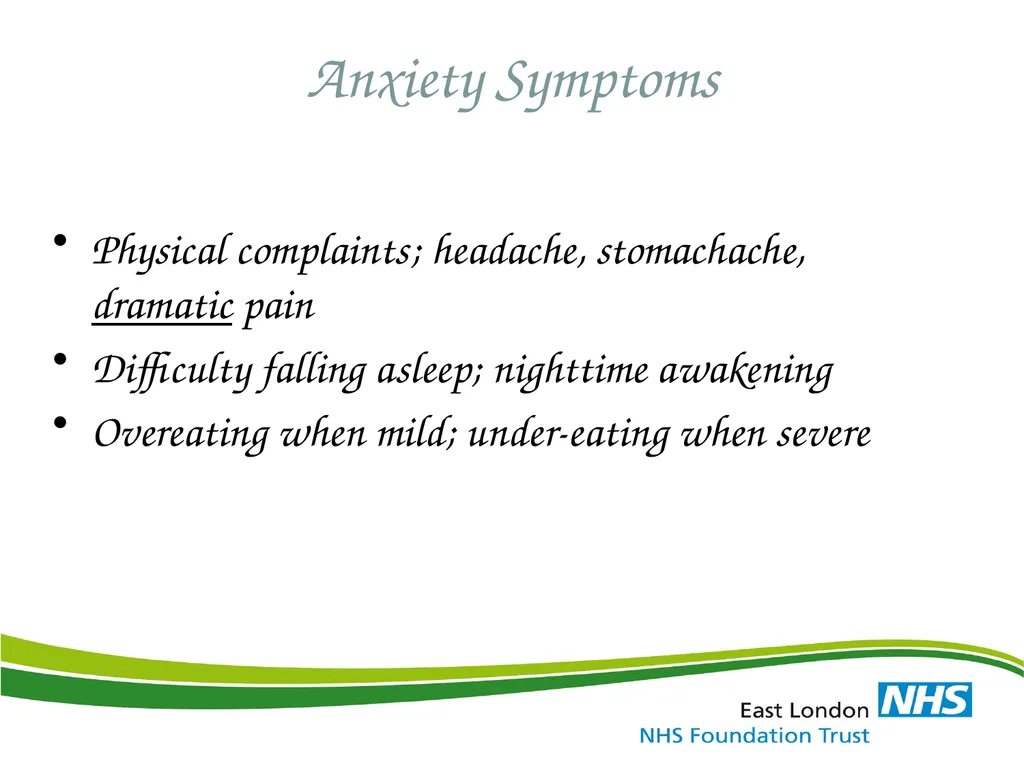
Anxiety Symptoms Physical complaints; headache, stomachache, dramatic pain
Difficulty falling asleep; nighttime awakening
Overeating when mild; under-eating when severe<br>
Difficulty falling asleep; nighttime awakening
Overeating when mild; under-eating when severe<br>
31
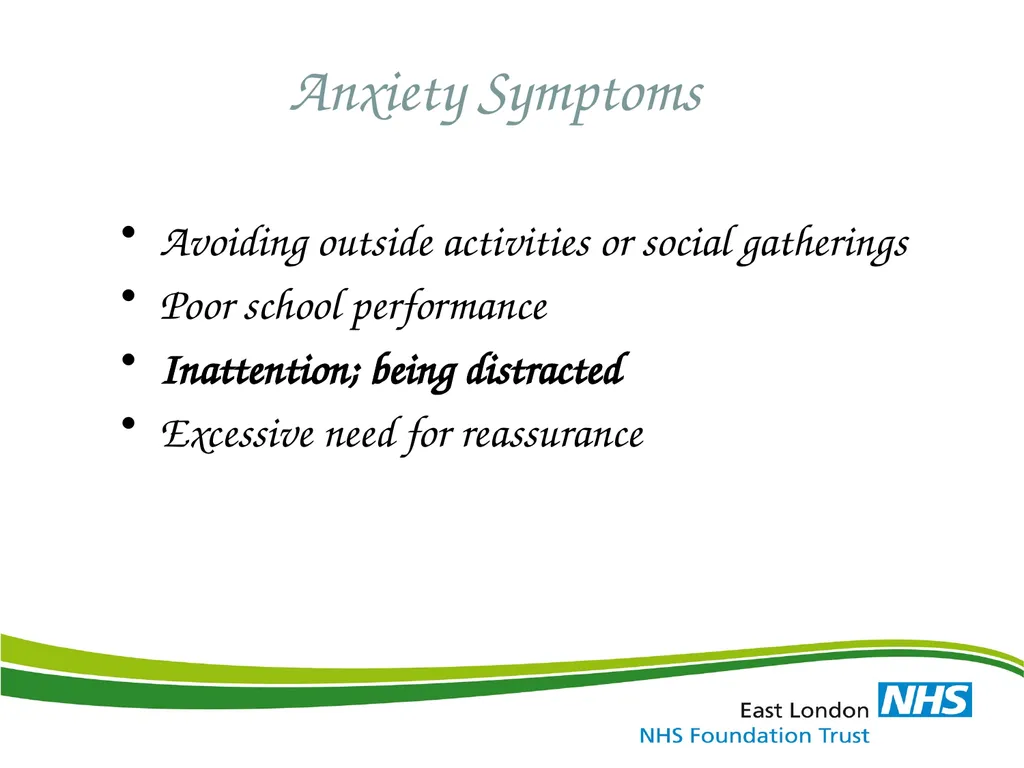
Anxiety Symptoms Avoiding outside activities or social gatherings
Poor school performance
Inattention; being distracted
Excessive need for reassurance<br>
Poor school performance
Inattention; being distracted
Excessive need for reassurance<br>
32
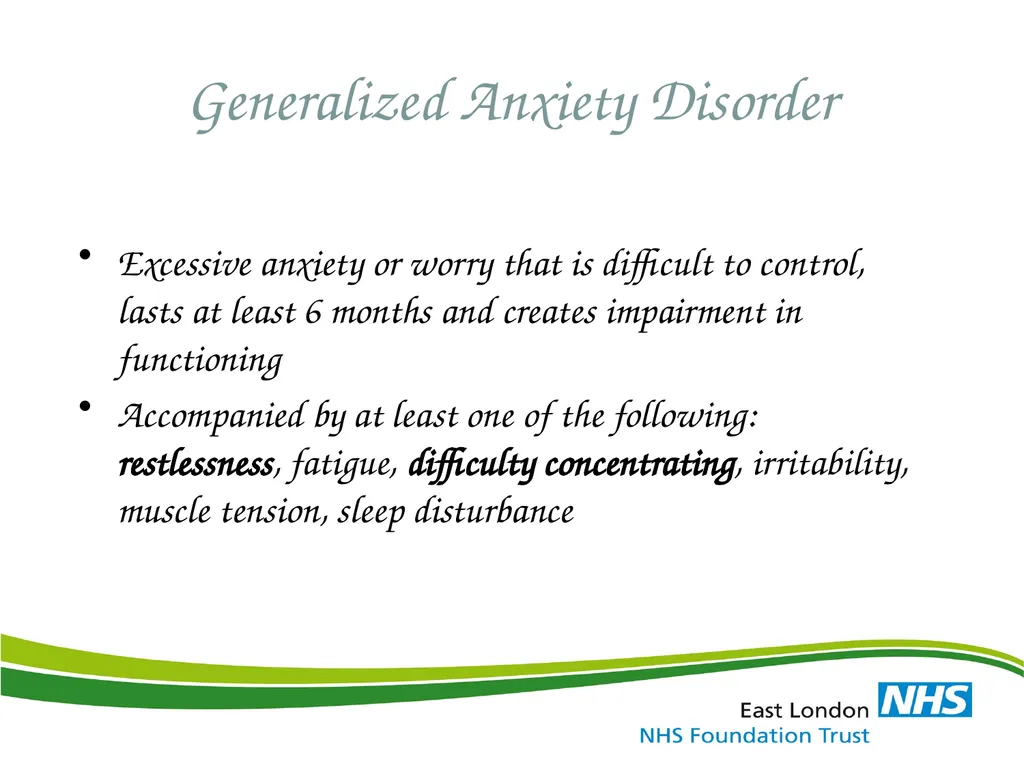
Generalized Anxiety Disorder Excessive anxiety or worry that is difficult to control, lasts at least 6 months and creates impairment in functioning
Accompanied by at least one of the following: restlessness, fatigue, difficulty concentrating, irritability, muscle tension, sleep disturbance<br>
Accompanied by at least one of the following: restlessness, fatigue, difficulty concentrating, irritability, muscle tension, sleep disturbance<br>
33
Generalized Anxiety Disorder Mean age of onset between 10-13 years of age
Prevalence: Latency age 3%; adolescent 10%
Worry themes: Academics, natural disasters, social life, physical assault<br>
Prevalence: Latency age 3%; adolescent 10%
Worry themes: Academics, natural disasters, social life, physical assault<br>
34
Separation Anxiety Disorder The most common anxiety disorder of childhood
Most commonly occurs at age 7 or 8 years, but may occur in adolescence
Psychosocial theory is that angry feelings toward parents are displaced, so the environment is perceived as threatening<br>
Most commonly occurs at age 7 or 8 years, but may occur in adolescence
Psychosocial theory is that angry feelings toward parents are displaced, so the environment is perceived as threatening<br>
35
Separation Anxiety Criteria A. Developmentally inappropriate, excessive worry concerning separation from those to whom the youngster is attached, evidenced by at least three of the following:
B. The duration of the disturbance is at least 4 weeks
C. The onset is before age 18 years
D. The disturbance causes clinically significant distress or impairment in social, academic or other important areas of functioning<br>
B. The duration of the disturbance is at least 4 weeks
C. The onset is before age 18 years
D. The disturbance causes clinically significant distress or impairment in social, academic or other important areas of functioning<br>
36
Separation Anxiety Criteria -Recurrent and excessive distress when separation from home or major attachment figures occurs or is anticipated
-Persistent, excessive worry about losing, or possible harm befalling, major attachment figures<br>
-Persistent, excessive worry about losing, or possible harm befalling, major attachment figures<br>
37
Separation Anxiety Criteria -Persistent, excessive worry that an event will lead to separation from a major attachment figure (e.g., getting lost or being kidnapped)
-Persistent reluctance or refusal to go to school or elsewhere because of fear of separation
-Persistently, excessively fearful or reluctant to be alone or without major attachment figures at home or without significant adults in other settings
-Persistent reluctance or refusal to go to sleep without being near a major attachment figure or to sleep away from home<br>
-Persistent reluctance or refusal to go to school or elsewhere because of fear of separation
-Persistently, excessively fearful or reluctant to be alone or without major attachment figures at home or without significant adults in other settings
-Persistent reluctance or refusal to go to sleep without being near a major attachment figure or to sleep away from home<br>
38
Separation Anxiety Criteria -Repeated nightmares involving the theme of separation
-Repeated complaints of physical symptoms (such as headaches, stomachaches, nausea, or vomiting) when separation from major attachment figures occurs or is anticipated<br>
-Repeated complaints of physical symptoms (such as headaches, stomachaches, nausea, or vomiting) when separation from major attachment figures occurs or is anticipated<br>
39
Separation Anxiety Disorder School refusal is a frequent symptom
Co-morbid depression may be present
Treatment consists of individual and family therapy and psycho-education, and, if that is not sufficient, or if symptoms are severe, medications may be necessary
-What else could it be??<br>
Co-morbid depression may be present
Treatment consists of individual and family therapy and psycho-education, and, if that is not sufficient, or if symptoms are severe, medications may be necessary
-What else could it be??<br>
40
Obsessive-Compulsive Disorder Recurrent, time-consuming obsessions or compulsions that cause distress and/or impairment. The compulsive behaviors are often an attempt to reduce the obsessive thoughts.<br>
41
Obsessional-Compulsive disorder (OCD) All people with OCD should have access to evidence-based treatments: CBT including exposure and response prevention (ERP) and/or pharmacology
If CBT ineffective or refused - review and consider adding an SSRI
Sertraline and fluvoxamine are the only SSRIs licensed for use in children and young people with OCD*
Monitor carefully and frequently
If successful, continue for 6 months post remission
Withdraw slowly with monitoring<br>
If CBT ineffective or refused - review and consider adding an SSRI
Sertraline and fluvoxamine are the only SSRIs licensed for use in children and young people with OCD*
Monitor carefully and frequently
If successful, continue for 6 months post remission
Withdraw slowly with monitoring<br>
42
Obsessional-Compulsive disorder (OCD) Considerations for work with children:
Symptoms are similar in children, young people and adults and they respond to the same treatments
Stressful life events may worsen symptoms or relapse may occur:
- school transitions and examination times
- relationship difficulties
- transition from adolescence to adult life
(careful planning of transition to adult services needed)
Parents may feel guilty and anxious
Tendency to increase in severity if left untreated<br>
Symptoms are similar in children, young people and adults and they respond to the same treatments
Stressful life events may worsen symptoms or relapse may occur:
- school transitions and examination times
- relationship difficulties
- transition from adolescence to adult life
(careful planning of transition to adult services needed)
Parents may feel guilty and anxious
Tendency to increase in severity if left untreated<br>
43
Obsessive-Compulsive Disorder Half of adults with OCD report their symptoms began in childhood or adolescence
High degree of genetic etiology
First-line treatment is CBT
sertraline is approved for OCD age 6+
fluvoxamine age 8+ years
Caution: monitor drug interactions<br>
High degree of genetic etiology
First-line treatment is CBT
sertraline is approved for OCD age 6+
fluvoxamine age 8+ years
Caution: monitor drug interactions<br>
44
Social Phobia Social phobia involves fear of embarrassment in social situations, during a performance, speaking in front of a group, starting a conversation, or eating in public.
Social phobia is more common in adults, but can occur in children or adolescents and may interfere with school functioning
-What else could it be??<br>
Social phobia is more common in adults, but can occur in children or adolescents and may interfere with school functioning
-What else could it be??<br>
45
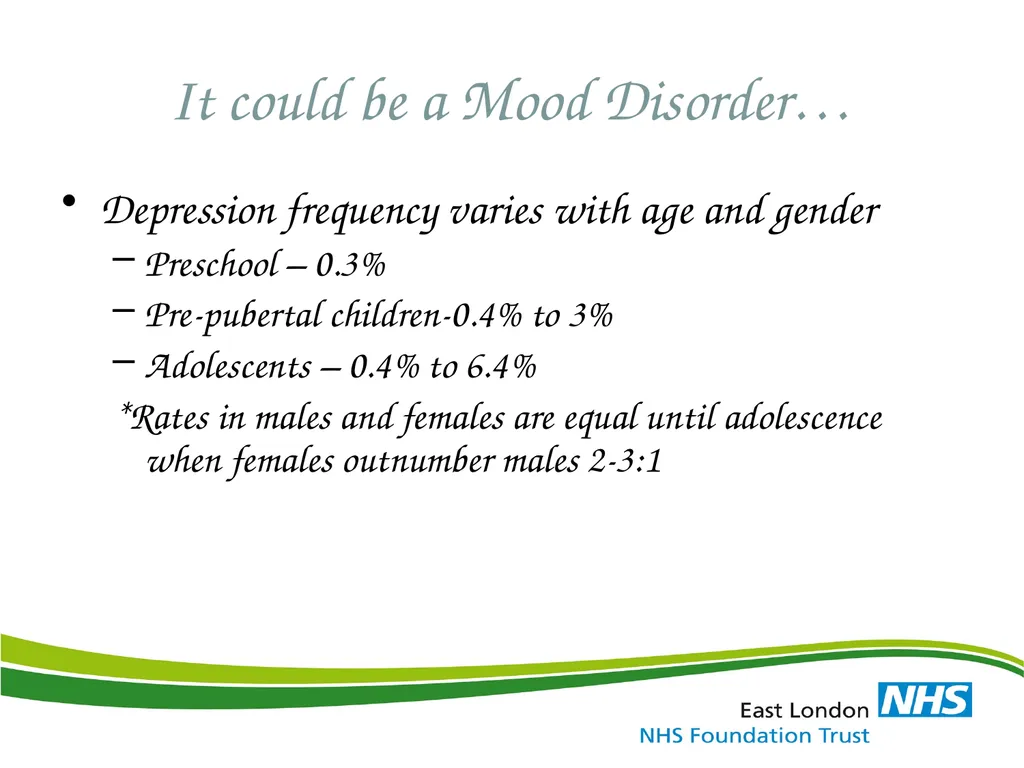
It could be a Mood Disorder… Depression frequency varies with age and gender
Preschool – 0.3%
Pre-pubertal children-0.4% to 3%
Adolescents – 0.4% to 6.4%
*Rates in males and females are equal until adolescence when females outnumber males 2-3:1<br>
Preschool – 0.3%
Pre-pubertal children-0.4% to 3%
Adolescents – 0.4% to 6.4%
*Rates in males and females are equal until adolescence when females outnumber males 2-3:1<br>
46
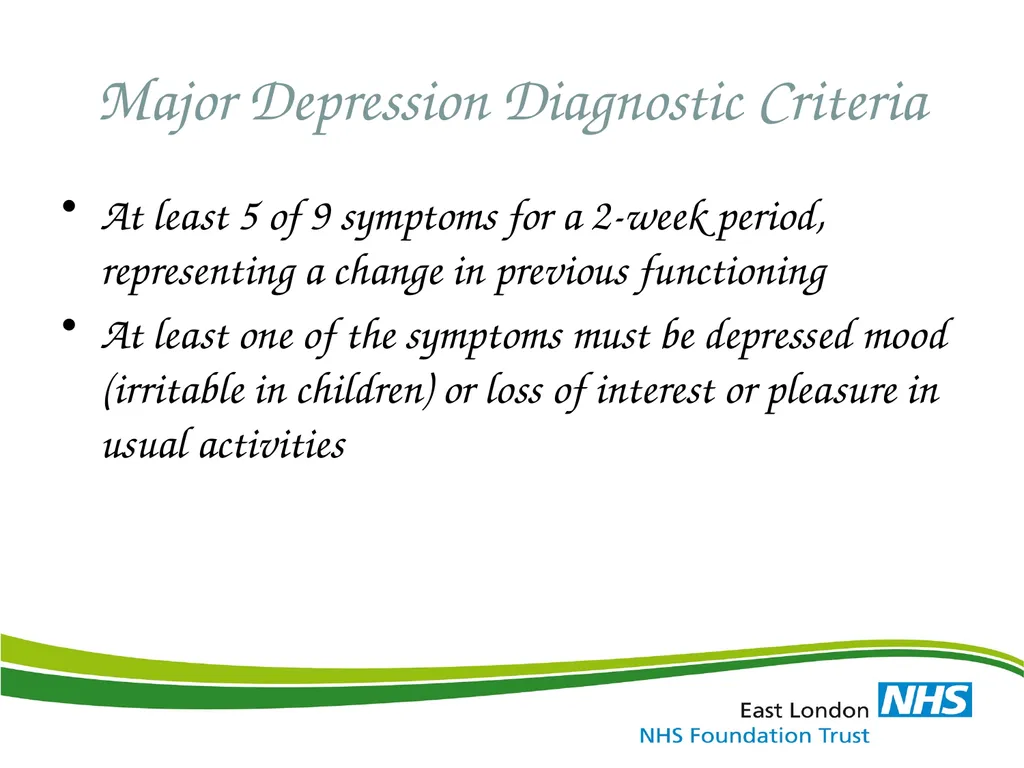
Major Depression Diagnostic Criteria At least 5 of 9 symptoms for a 2-week period, representing a change in previous functioning
At least one of the symptoms must be depressed mood (irritable in children) or loss of interest or pleasure in usual activities<br>
At least one of the symptoms must be depressed mood (irritable in children) or loss of interest or pleasure in usual activities<br>
47
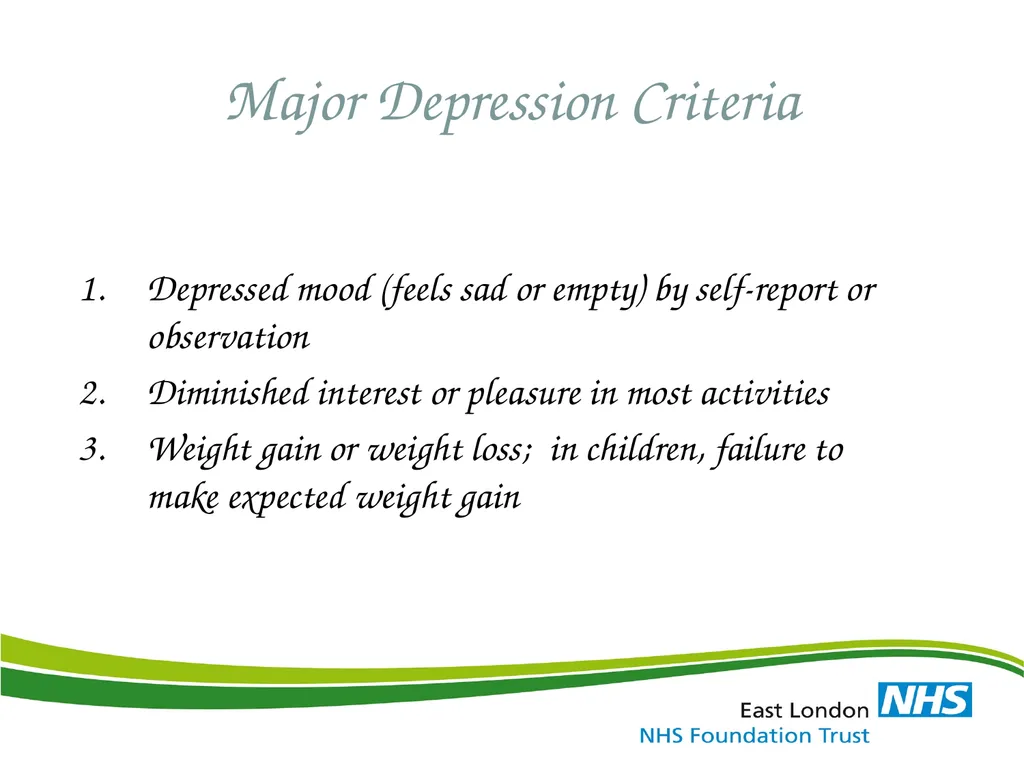
Major Depression Criteria Depressed mood (feels sad or empty) by self-report or observation
Diminished interest or pleasure in most activities
Weight gain or weight loss; in children, failure to make expected weight gain<br>
Diminished interest or pleasure in most activities
Weight gain or weight loss; in children, failure to make expected weight gain<br>
48
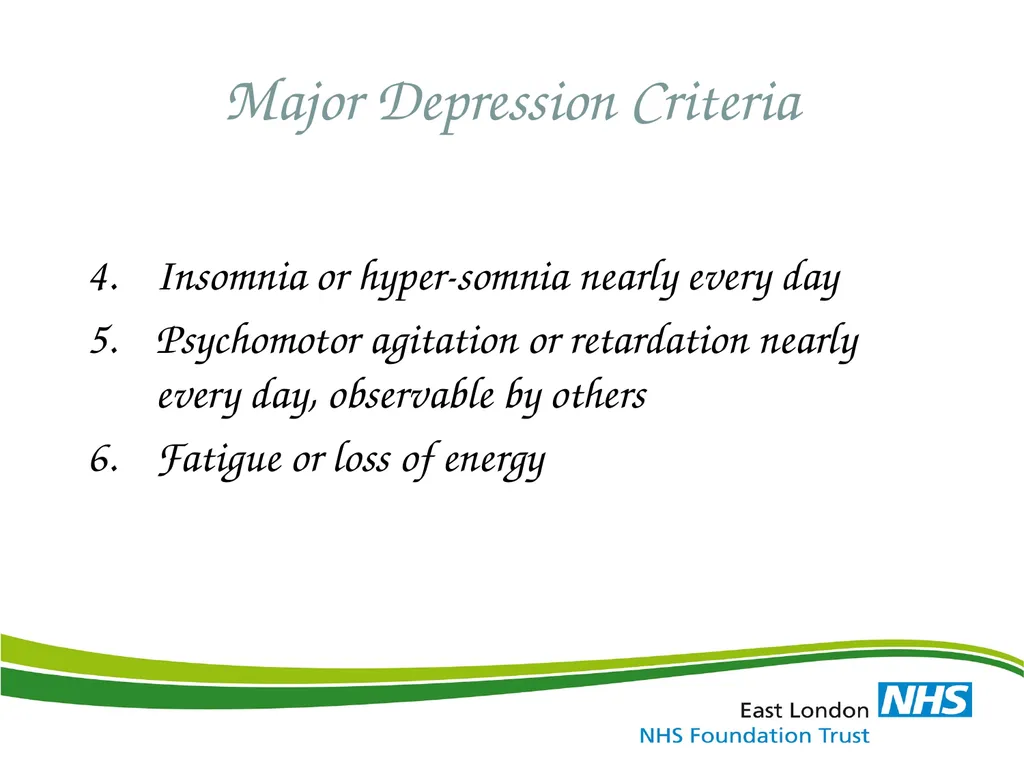
Major Depression Criteria Insomnia or hyper-somnia nearly every day
Psychomotor agitation or retardation nearly every day, observable by others
Fatigue or loss of energy<br>
Psychomotor agitation or retardation nearly every day, observable by others
Fatigue or loss of energy<br>
49
Major Depression Criteria Feelings of worthlessness or guilt (which may be delusional)
Inability to concentrate; indecisiveness
Recurrent thoughts of death (not just fear of dying), recurrent suicidal ideation without a specific plan, or a suicide attempt or a specific plan<br>
Inability to concentrate; indecisiveness
Recurrent thoughts of death (not just fear of dying), recurrent suicidal ideation without a specific plan, or a suicide attempt or a specific plan<br>
50
Major Depression Criteria The symptoms cause clinically significant distress or impairment
The symptoms do not meet criteria for a Bipolar Mixed Episode
The symptoms are not better accounted for by bereavement (>2 mos. after the loss)<br>
The symptoms do not meet criteria for a Bipolar Mixed Episode
The symptoms are not better accounted for by bereavement (>2 mos. after the loss)<br>
51
Major Depression Symptoms Symptoms that increase with age:
Sleep/Appetite Changes
Fatigue
Anhedonia (“I’m bored”)
Psychomotor retardation
Hopelessness
Delusions<br>
Sleep/Appetite Changes
Fatigue
Anhedonia (“I’m bored”)
Psychomotor retardation
Hopelessness
Delusions<br>
52
Major Depression Symptoms Symptoms that decrease with age, but may be seen in children:
Somatic complaints (head, stomach, muscle aches)
Behavioral problems
Guilt, irritability
Hallucinations<br>
Somatic complaints (head, stomach, muscle aches)
Behavioral problems
Guilt, irritability
Hallucinations<br>
53
Major Depression Symptoms Symptoms that are consistent across age groups:
Depressed mood
Impaired concentration
Suicidal ideation *<br>
Depressed mood
Impaired concentration
Suicidal ideation *<br>
54
Suicide Suicide is the 4th leading cause of death in children aged 10-15 years
Suicide is the 3rd leading cause of death among adolescents and young adults aged 15-25 years
Rates of suicide attempts are 3 times higher in females
Rates of completed suicides are 5 times higher in males<br>
Suicide is the 3rd leading cause of death among adolescents and young adults aged 15-25 years
Rates of suicide attempts are 3 times higher in females
Rates of completed suicides are 5 times higher in males<br>
55
Major Depression - Etiology Psychosocial models/life stressors
Organic etiologies/infections, medications, endocrine disorders, neurological disorders
Lifetime risk of depression in children of depressed parents is 15-45%<br>
Organic etiologies/infections, medications, endocrine disorders, neurological disorders
Lifetime risk of depression in children of depressed parents is 15-45%<br>
56
Major Depression - Outcome 2/3 recover within one year
Recurrence rate: 70% in 5 years
Pre-pubertal: 30% become Bipolar
Adolescents: 20% become Bipolar
Increased risk for depression as adults<br>
Recurrence rate: 70% in 5 years
Pre-pubertal: 30% become Bipolar
Adolescents: 20% become Bipolar
Increased risk for depression as adults<br>
57
Major Depression - Treatment Cognitive Therapy
Interpersonal therapy
Group therapy
Family therapy<br>
Interpersonal therapy
Group therapy
Family therapy<br>
58
Major Depression - Treatment Medications are reserved for moderate to severe depression
Weigh risks and benefits of medications and monitor for suicidality (q wk x 4, then q 2 wks x 4, then q 3 mos if stable
Escitalopram is approved for treatment of depression in 12-17 year-olds
Fluoxetine is the only FDA-approved antidepressant for child and adolescent depression, down to age 8<br>
Weigh risks and benefits of medications and monitor for suicidality (q wk x 4, then q 2 wks x 4, then q 3 mos if stable
Escitalopram is approved for treatment of depression in 12-17 year-olds
Fluoxetine is the only FDA-approved antidepressant for child and adolescent depression, down to age 8<br>
59
59 Indicators of regular drug use
in young people Family & friends remark on a “personality change”
Extreme mood swings may be evident
Possible change in physical appearance or wellbeing
Change in school / job performance
Increase in secretive communication
Change in social group
Seeking money, or increase in money supply if dealing
Unexplained accidents<br>
Extreme mood swings may be evident
Possible change in physical appearance or wellbeing
Change in school / job performance
Increase in secretive communication
Change in social group
Seeking money, or increase in money supply if dealing
Unexplained accidents<br>
60
Assessment:
The basic approach (1) Often young people are not very forthcoming with information until you win their trust
If the young person is likely to suffer harm, and / or harm others, then strenuous attempts must be made to gain relevant information from any source
However, if a crisis does not exist, then it is not justifiable to intervene without the consent of the young person, or to engage in any deceptive practises, which can permanently damage the young person's trust in health professionals 60<br>
If the young person is likely to suffer harm, and / or harm others, then strenuous attempts must be made to gain relevant information from any source
However, if a crisis does not exist, then it is not justifiable to intervene without the consent of the young person, or to engage in any deceptive practises, which can permanently damage the young person's trust in health professionals 60<br>
61
Assessment:
The basic approach (2) Must be conducted sensitively
Use open-ended questions
Take particular note of:
which drug/s (think polydrug use) have been used immediately before their presentation (i.e., responsible for intoxication)
quantity and the route of administration (to assess potential harms)
past history of drug use (indicators of long-term harm)
the “function” drug use serves for them
environment in which drug use occurs (e.g., whether safe, supported) 61<br>
Use open-ended questions
Take particular note of:
which drug/s (think polydrug use) have been used immediately before their presentation (i.e., responsible for intoxication)
quantity and the route of administration (to assess potential harms)
past history of drug use (indicators of long-term harm)
the “function” drug use serves for them
environment in which drug use occurs (e.g., whether safe, supported) 61<br>
62
What does the young person want? Determine why the young person is presenting now
What does he or she perceive immediate needs to be?
Try and meet his or her requests whenever possible as a starting point (even if far short of clinically ideal)
Often young people are pre-contemplators in regard to their AOD use 62<br>
What does he or she perceive immediate needs to be?
Try and meet his or her requests whenever possible as a starting point (even if far short of clinically ideal)
Often young people are pre-contemplators in regard to their AOD use 62<br>
63
Parental involvement (1) Parental involvement can be extremely important to success of treatment with adolescents and is generally a desired part of treatment
However, some parents view treatment as a method of punishment and want to control all aspects of treatment and have total access to communications between the youth and clinical staff. It is inappropriate for parents to dictate the terms of treatment.
Remember, the young person, not the parent, is the patient.
Respect and acknowledge the parent’s concerns about the child’s drug use, but insure treatment is designed to meet the needs of the youth. 63<br>
However, some parents view treatment as a method of punishment and want to control all aspects of treatment and have total access to communications between the youth and clinical staff. It is inappropriate for parents to dictate the terms of treatment.
Remember, the young person, not the parent, is the patient.
Respect and acknowledge the parent’s concerns about the child’s drug use, but insure treatment is designed to meet the needs of the youth. 63<br>
64
Parental involvement (2) Reassure parents/caregivers that a harm minimisation approach is effective:
reducing the risks is the priority until the young person decides he or she wishes to moderate AOD use
Reduce the parents’ sense of guilt
seldom are parents responsible for their child’s drug use
drug use is far from unusual in young people
Offer information, support, counselling and referral 64<br>
reducing the risks is the priority until the young person decides he or she wishes to moderate AOD use
Reduce the parents’ sense of guilt
seldom are parents responsible for their child’s drug use
drug use is far from unusual in young people
Offer information, support, counselling and referral 64<br>