
Embryology Anatomy & Physiology What is

Description: Embryology Anatomy Physiology What is Embryology? Embryology- The branch of biology and medicine concerned with the study of embryos and their development. Basically the study of growth and formation from a Zygote to a Developed fetus.
Related Topics
Download Presentation
"Embryology Anatomy & Physiology What is" is the property of its rightful owner. Permission is granted to download and print the materials on this website for personal, non-commercial use only, and to display it on your personal computer provided you do not modify the materials and that you retain all copyright notices contained in the materials. By downloading content from our website, you accept the terms of this agreement.
Presentation Transcript
slide1. Embryology Anatomy & Physiology<br>
slide2. What is Embryology? Embryology- The branch of biology and medicine concerned with the study of embryos and their development.
Basically the study of growth and formation from a Zygote to a Developed fetus.<br>
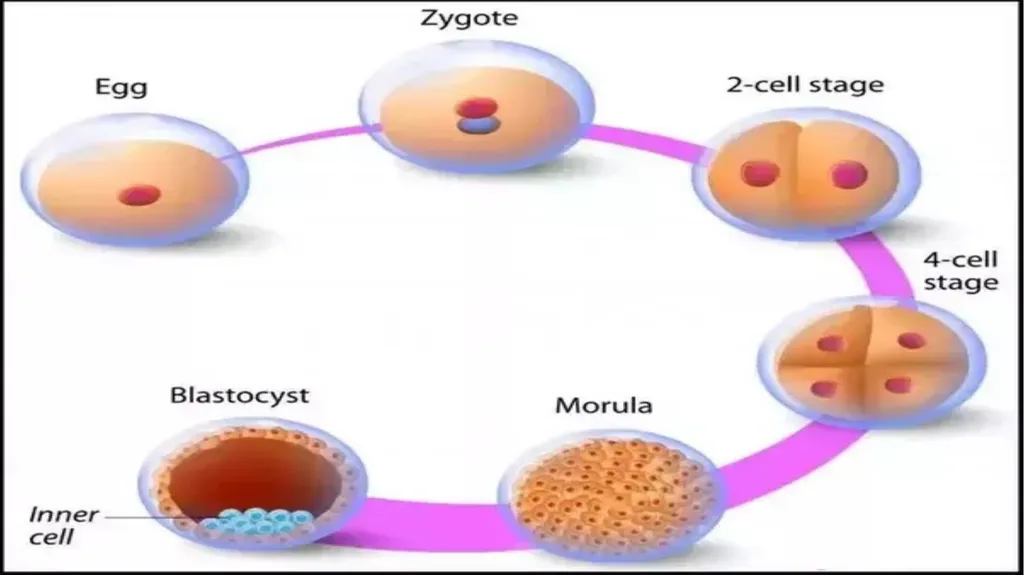
slide4. Stages of fetal development Stage 1: Zygote
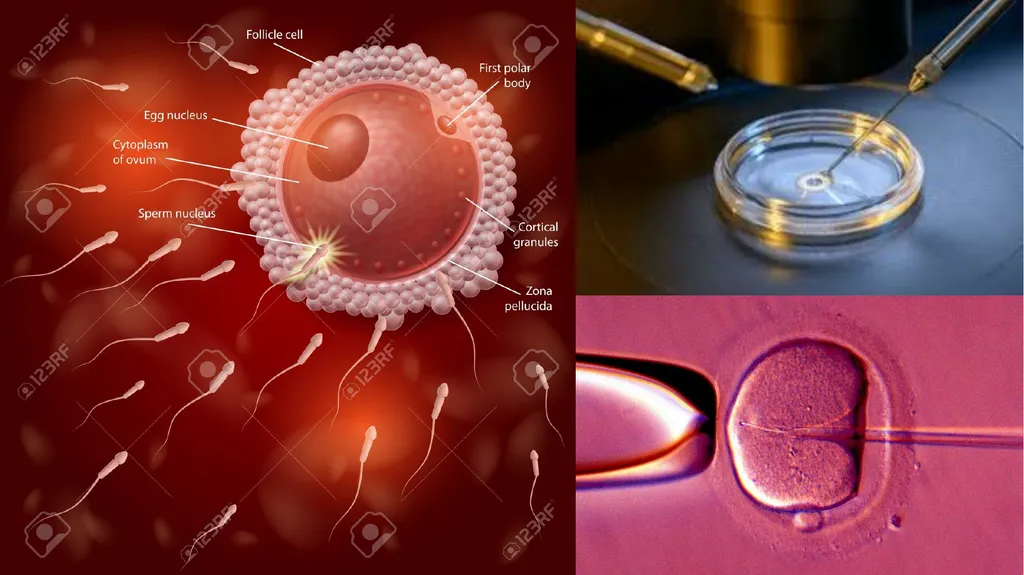
This stage is happening primarily in the uterine tubes. This is when sperm meets egg.
A peroxide layer is formed around the egg after it has been fertilized by one single sperm cell. This causes the egg to harden and prevent abnormal conditions known as polyspermy.<br>
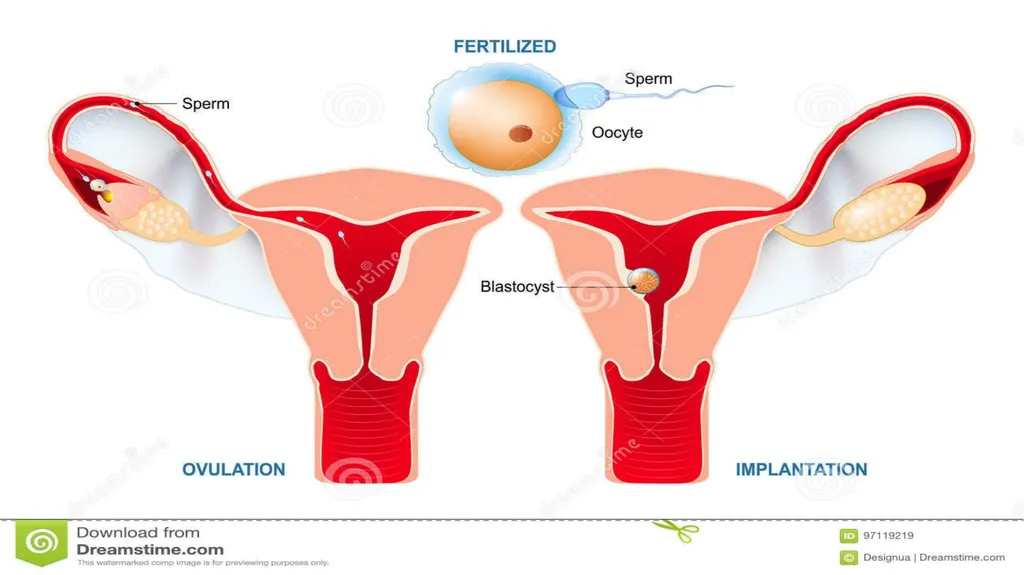
slide6. Stage 2: Implantation After an egg has been released from a uterine tube it will either rupture or attach to the uterine wall for development.
This is where the egg will sit for a good 4-9 weeks. The place where the egg implants will serve as the neural tube in week 4 of development.
Can cause abnormal bleeding, however bleeding is not usually heavy. One of the early signs to tell that a female may be pregnant.<br>
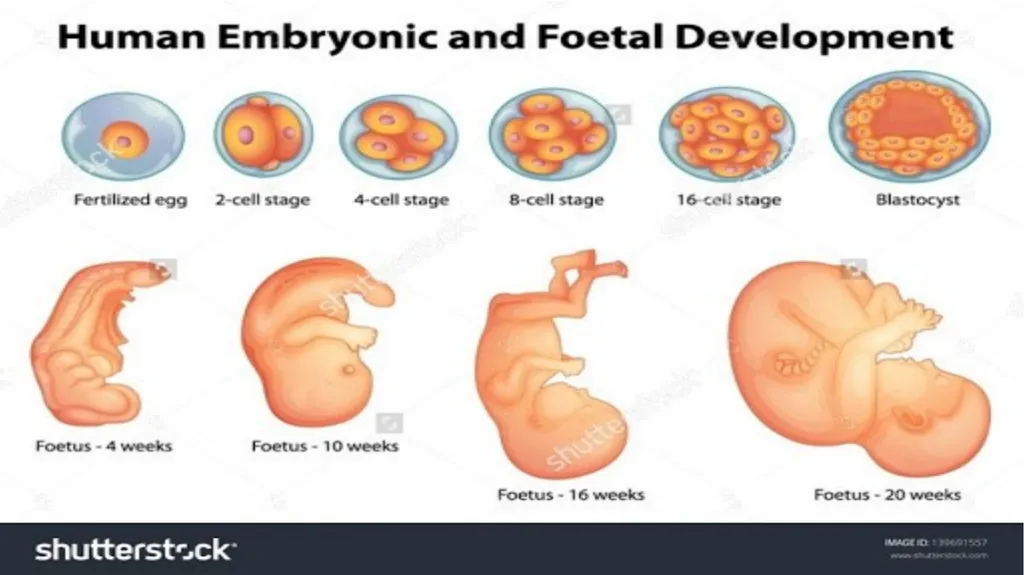
slide8. Stage 3 Cellular division/Morula stage Once when an egg is implanted into the uterine wall it will then begin to undergo rapid cellular division from 1 cell, to 2 cells to 4 cells, to 8 cells, and then finally to 16 cells.
The 16 cell stage is called the morula stage.
Interesting thing to pay attention to, The cells that are dividing in the egg are stem cells. Why are these important?<br>
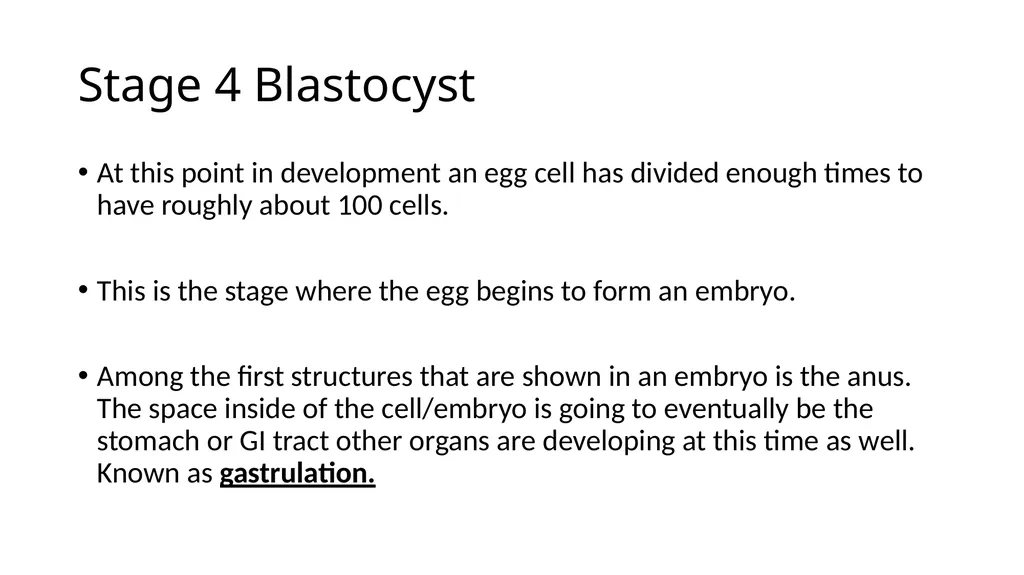
slide10. Stage 4 Blastocyst At this point in development an egg cell has divided enough times to have roughly about 100 cells.
This is the stage where the egg begins to form an embryo.
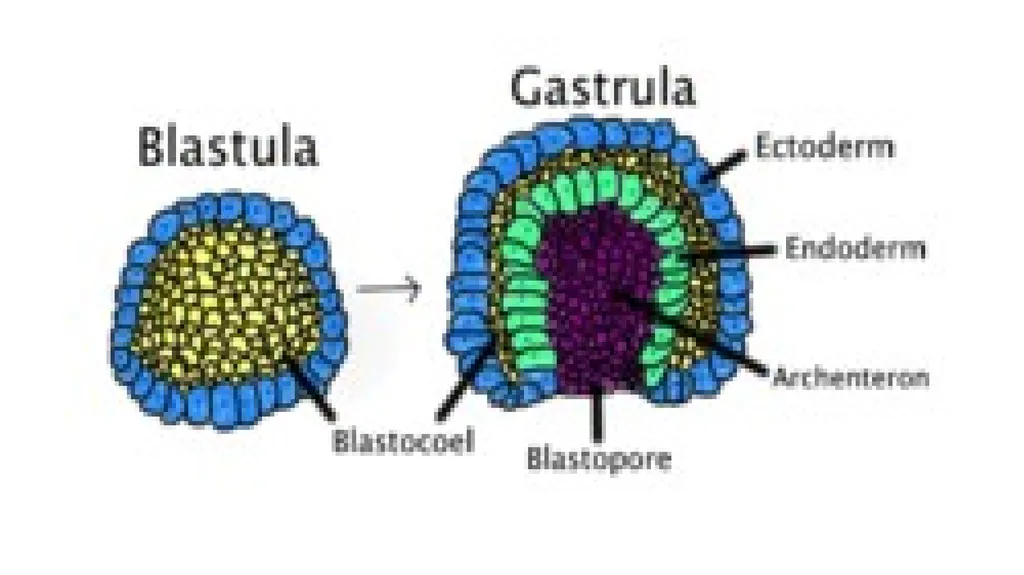
Among the first structures that are shown in an embryo is the anus. The space inside of the cell/embryo is going to eventually be the stomach or GI tract other organs are developing at this time as well. Known as gastrulation.<br>
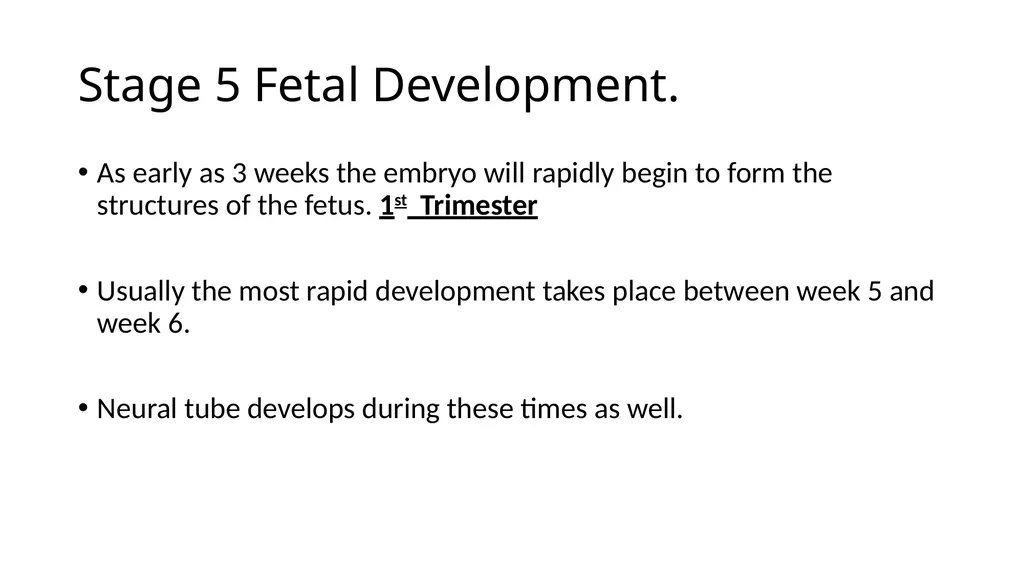
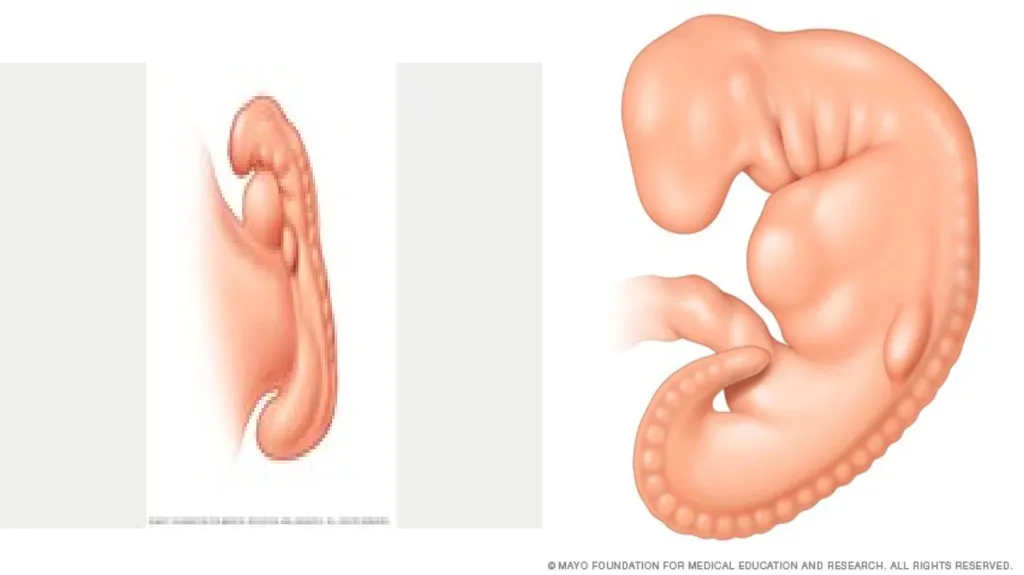
slide12. Stage 5 Fetal Development. As early as 3 weeks the embryo will rapidly begin to form the structures of the fetus. 1st Trimester
Usually the most rapid development takes place between week 5 and week 6.
Neural tube develops during these times as well.<br>
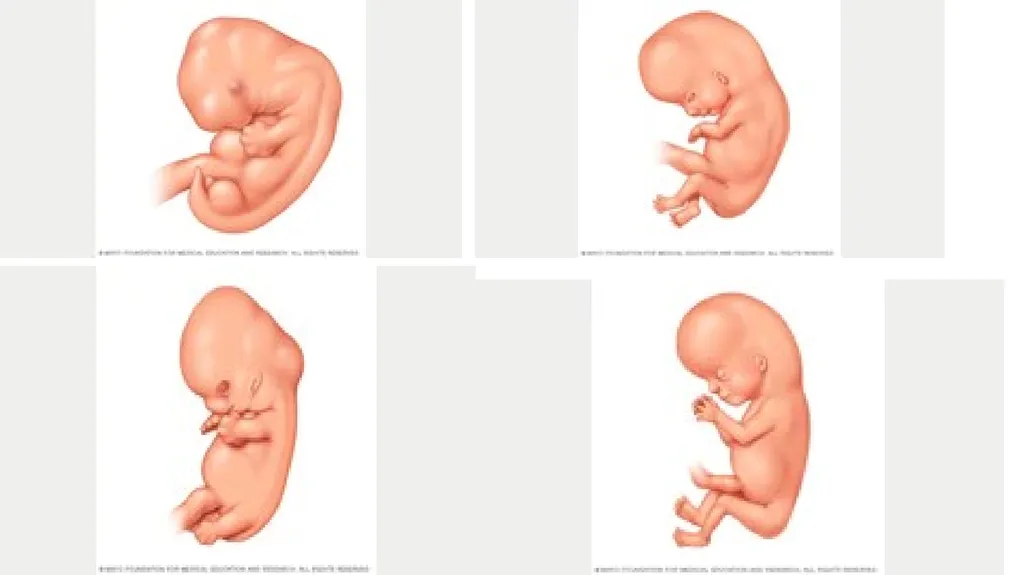
slide14. Weeks 7-12 Rapid development of fetus and more structures become easier to observe in these stages.
Structures such as head (week 7), nose (week 8), toes and REM sleep/dreams (week 9), elbows and joints/Hearing and reacting to loud noises (week 10), Fingernails (week 11), And Genitals in week 12.
Sex of fetus can be determined in week 12 of embryonic development.
Fetus is on average 2.1 inches long and 49 ounces.<br>
slide16. 2nd Trimester Not really many new organs/structures formed by the fetus, this is just a growth stage.
Mothers will begin to develop a “baby bump” and stomachs will enlarge.
After these 12 weeks the fetus should be around 2 pounds.<br>
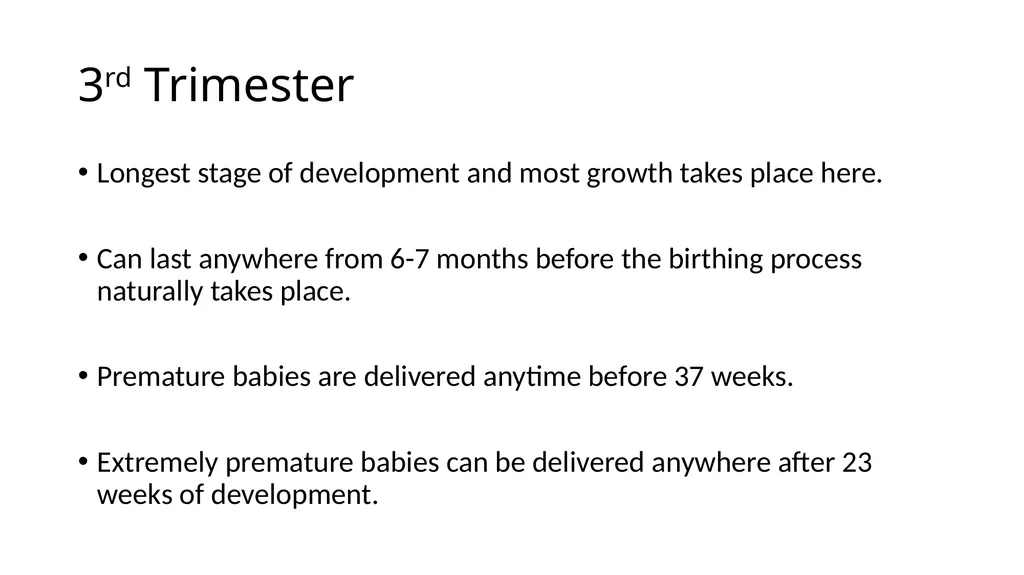
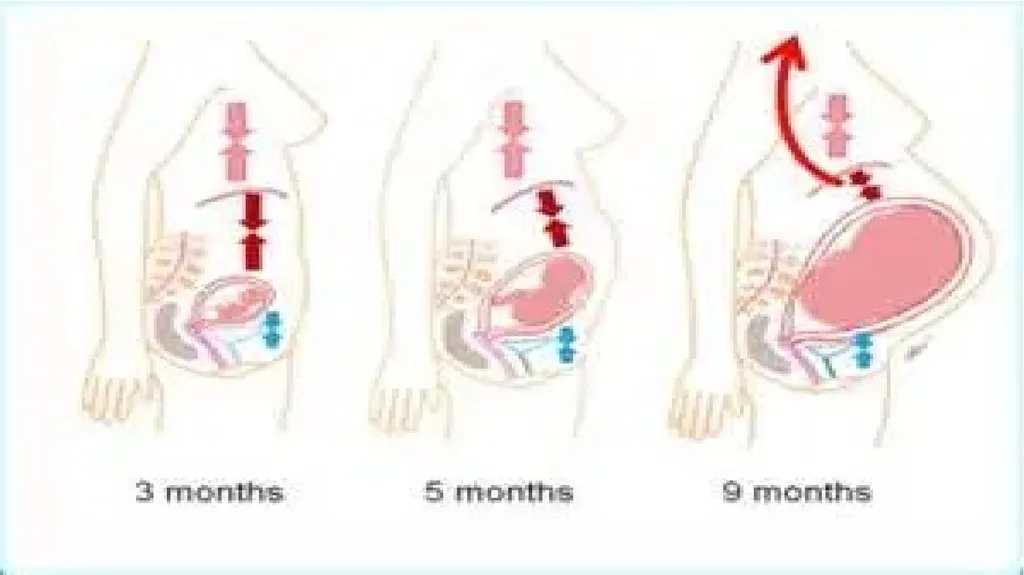
slide17. 3rd Trimester Longest stage of development and most growth takes place here.
Can last anywhere from 6-7 months before the birthing process naturally takes place.
Premature babies are delivered anytime before 37 weeks.
Extremely premature babies can be delivered anywhere after 23 weeks of development.<br>
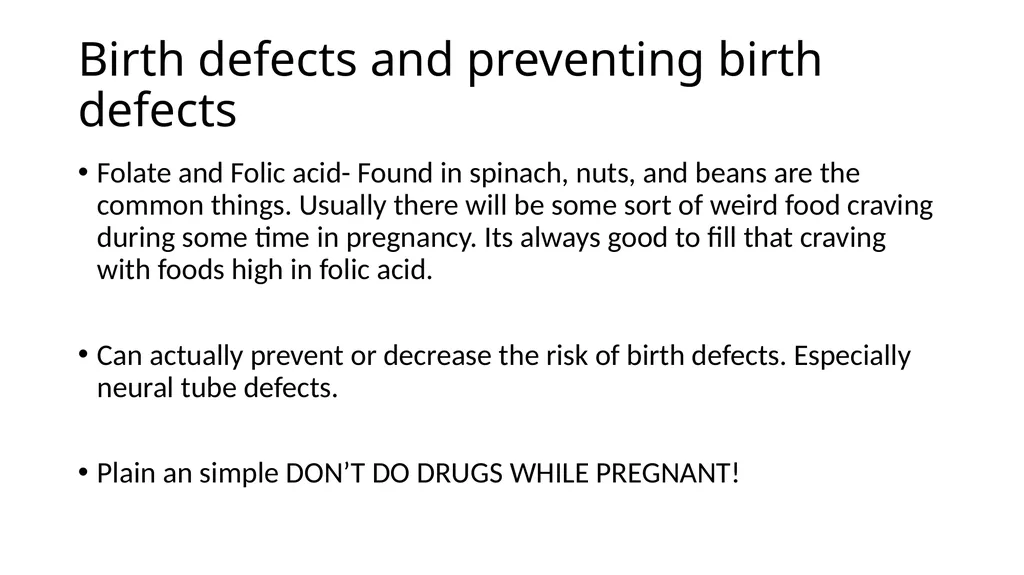
slide19. Birth defects and preventing birth defects Folate and Folic acid- Found in spinach, nuts, and beans are the common things. Usually there will be some sort of weird food craving during some time in pregnancy. Its always good to fill that craving with foods high in folic acid.
Can actually prevent or decrease the risk of birth defects. Especially neural tube defects.
Plain an simple DON’T DO DRUGS WHILE PREGNANT!<br>
slide2. What is Embryology? Embryology- The branch of biology and medicine concerned with the study of embryos and their development.
Basically the study of growth and formation from a Zygote to a Developed fetus.<br>
slide4. Stages of fetal development Stage 1: Zygote
This stage is happening primarily in the uterine tubes. This is when sperm meets egg.
A peroxide layer is formed around the egg after it has been fertilized by one single sperm cell. This causes the egg to harden and prevent abnormal conditions known as polyspermy.<br>
slide6. Stage 2: Implantation After an egg has been released from a uterine tube it will either rupture or attach to the uterine wall for development.
This is where the egg will sit for a good 4-9 weeks. The place where the egg implants will serve as the neural tube in week 4 of development.
Can cause abnormal bleeding, however bleeding is not usually heavy. One of the early signs to tell that a female may be pregnant.<br>
slide8. Stage 3 Cellular division/Morula stage Once when an egg is implanted into the uterine wall it will then begin to undergo rapid cellular division from 1 cell, to 2 cells to 4 cells, to 8 cells, and then finally to 16 cells.
The 16 cell stage is called the morula stage.
Interesting thing to pay attention to, The cells that are dividing in the egg are stem cells. Why are these important?<br>
slide10. Stage 4 Blastocyst At this point in development an egg cell has divided enough times to have roughly about 100 cells.
This is the stage where the egg begins to form an embryo.
Among the first structures that are shown in an embryo is the anus. The space inside of the cell/embryo is going to eventually be the stomach or GI tract other organs are developing at this time as well. Known as gastrulation.<br>
slide12. Stage 5 Fetal Development. As early as 3 weeks the embryo will rapidly begin to form the structures of the fetus. 1st Trimester
Usually the most rapid development takes place between week 5 and week 6.
Neural tube develops during these times as well.<br>
slide14. Weeks 7-12 Rapid development of fetus and more structures become easier to observe in these stages.
Structures such as head (week 7), nose (week 8), toes and REM sleep/dreams (week 9), elbows and joints/Hearing and reacting to loud noises (week 10), Fingernails (week 11), And Genitals in week 12.
Sex of fetus can be determined in week 12 of embryonic development.
Fetus is on average 2.1 inches long and 49 ounces.<br>
slide16. 2nd Trimester Not really many new organs/structures formed by the fetus, this is just a growth stage.
Mothers will begin to develop a “baby bump” and stomachs will enlarge.
After these 12 weeks the fetus should be around 2 pounds.<br>
slide17. 3rd Trimester Longest stage of development and most growth takes place here.
Can last anywhere from 6-7 months before the birthing process naturally takes place.
Premature babies are delivered anytime before 37 weeks.
Extremely premature babies can be delivered anywhere after 23 weeks of development.<br>
slide19. Birth defects and preventing birth defects Folate and Folic acid- Found in spinach, nuts, and beans are the common things. Usually there will be some sort of weird food craving during some time in pregnancy. Its always good to fill that craving with foods high in folic acid.
Can actually prevent or decrease the risk of birth defects. Especially neural tube defects.
Plain an simple DON’T DO DRUGS WHILE PREGNANT!<br>