
Emotivism Intuitionists reject the naturalist
TA
Published · 18 slides · 0 views

1 / 1
Description
Emotivism Intuitionists reject the naturalist claim that moral knowledge is absolute and can be seen in the facts of the world through our senses. Some would also disagree with intuitionists as well and argue that morality is no kind of
Related Topics
Share
Embed code
Download this presentation From Below
"Emotivism Intuitionists reject the naturalist" is the property of its rightful owner. Permission is granted to download and print the materials on this website for personal, non-commercial use only, and to display it on your personal computer provided you do not modify the materials and that you retain all copyright notices contained in the materials. By downloading content from our website, you accept the terms of this agreement.
Presentation Transcript
01
Emotivism Intuitionists reject the naturalist claim that moral knowledge is absolute and can be seen in the facts of the world through our senses.
Some would also disagree with intuitionists as well and argue that morality is no kind of fact at all: it’s all relative.
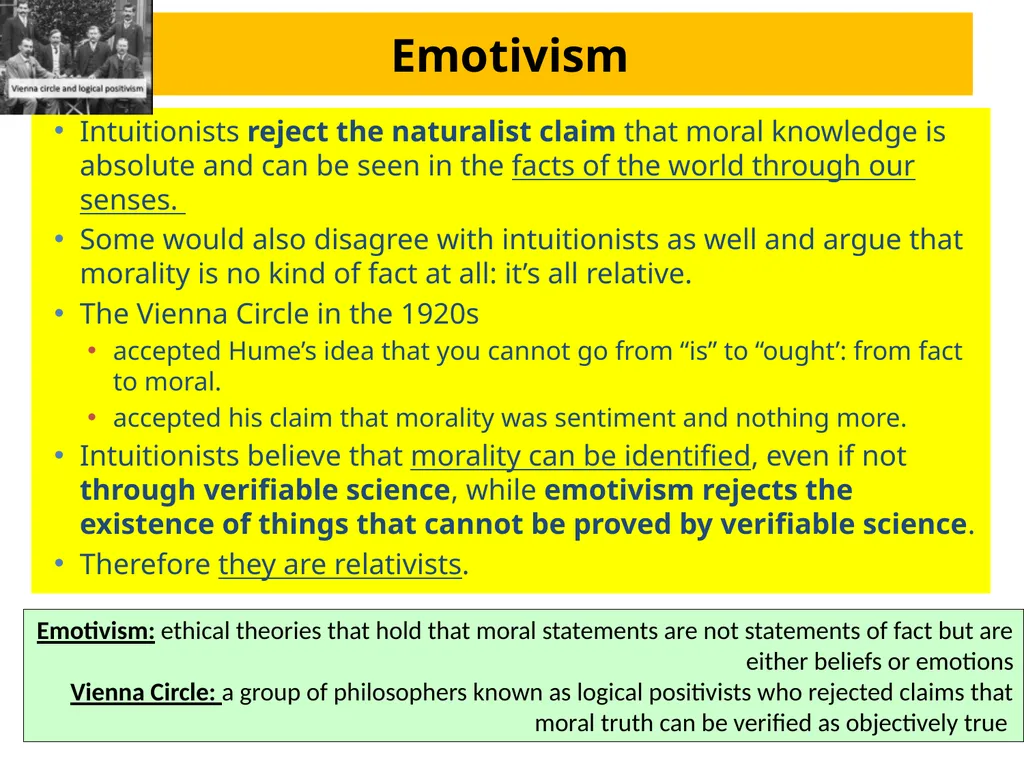
The Vienna Circle in the 1920s
accepted Hume’s idea that you cannot go from “is” to “ought’: from fact to moral.
accepted his claim that morality was sentiment and nothing more.
Intuitionists believe that morality can be identified, even if not through verifiable science, while emotivism rejects the existence of things that cannot be proved by verifiable science.
Therefore they are relativists. Emotivism: ethical theories that hold that moral statements are not statements of fact but are either beliefs or emotions
Vienna Circle: a group of philosophers known as logical positivists who rejected claims that moral truth can be verified as objectively true<br>
02
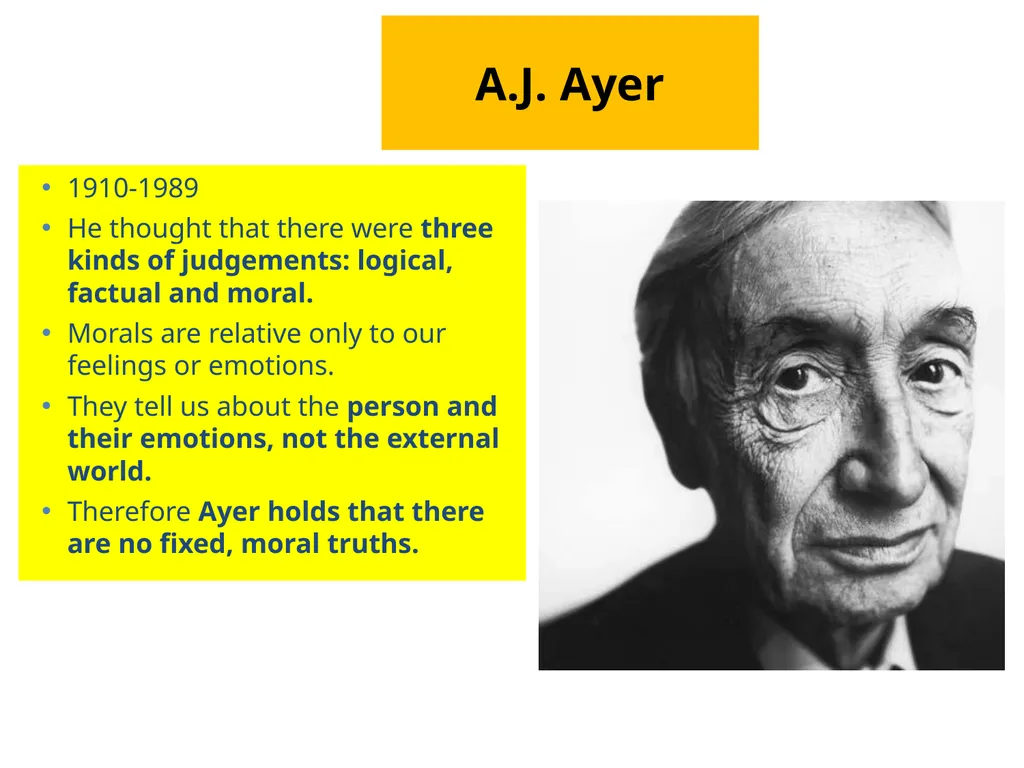
A.J. Ayer 1910-1989
He thought that there were three kinds of judgements: logical, factual and moral.
Morals are relative only to our feelings or emotions.
They tell us about the person and their emotions, not the external world.
Therefore Ayer holds that there are no fixed, moral truths.<br>
He thought that there were three kinds of judgements: logical, factual and moral.
Morals are relative only to our feelings or emotions.
They tell us about the person and their emotions, not the external world.
Therefore Ayer holds that there are no fixed, moral truths.<br>
03
A.J. Ayer A meaningful statement about the world is one that can be verified.
There are two categories of meaningful statements:
Factual statements: verified by our senses. E.g. it is raining outside.
Logical statements: verified analytically. E.g. 2 + 2 = 4. they are true by definition.
Moral and theological judgements are not observable and not verified by definition. They are not, therefore, facts about the world.
Emotivism is sometimes called the ‘hurrah/boo theory.”
To say “generosity is good,” is to say, “hurrah to generosity” and to say “lying is bad,” is to say, “boo to lying.”<br>
04
A.J. Ayer Ayer writes:
“for in saying that a certain type of action is right or wrong, I am not making any factual statement, not even a statement about my own state of mind. I am merely expressing certain moral sentiments. And the man who is ostensibly contradicting me is merely expressing his moral sentiments. So there is plainly no sense in asking which of us in the right. For neither of us is asserting genuine proposition.”
Moral arguments are expressions of feelings.
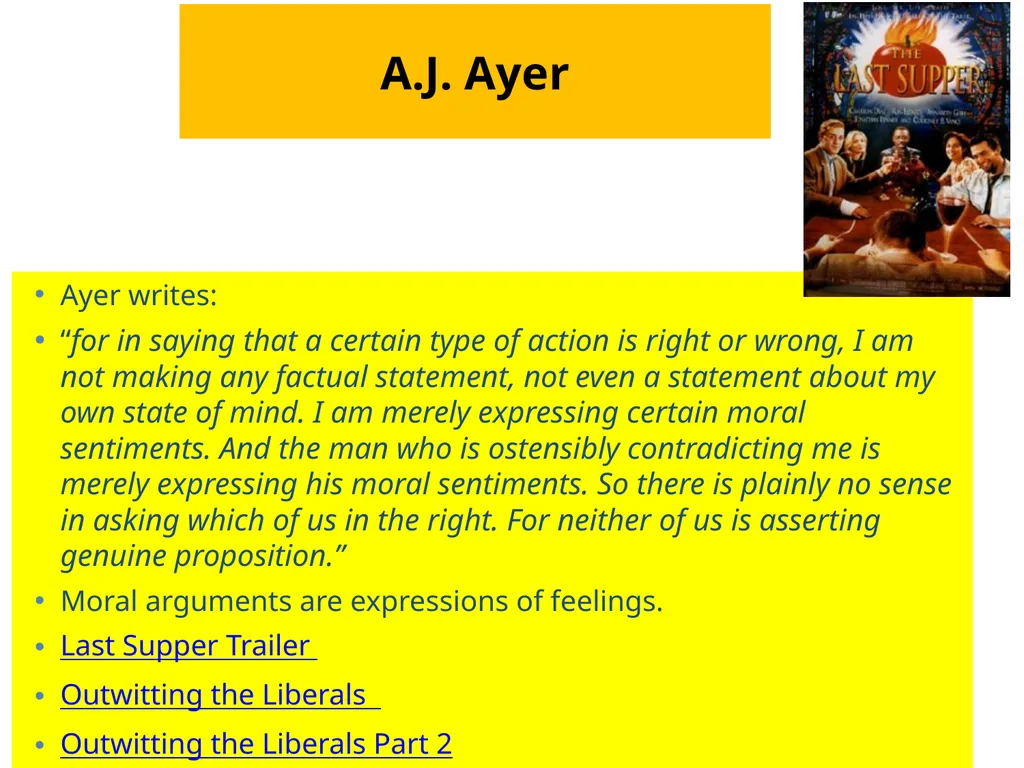
Last Supper Trailer
Outwitting the Liberals
Outwitting the Liberals Part 2<br>
05
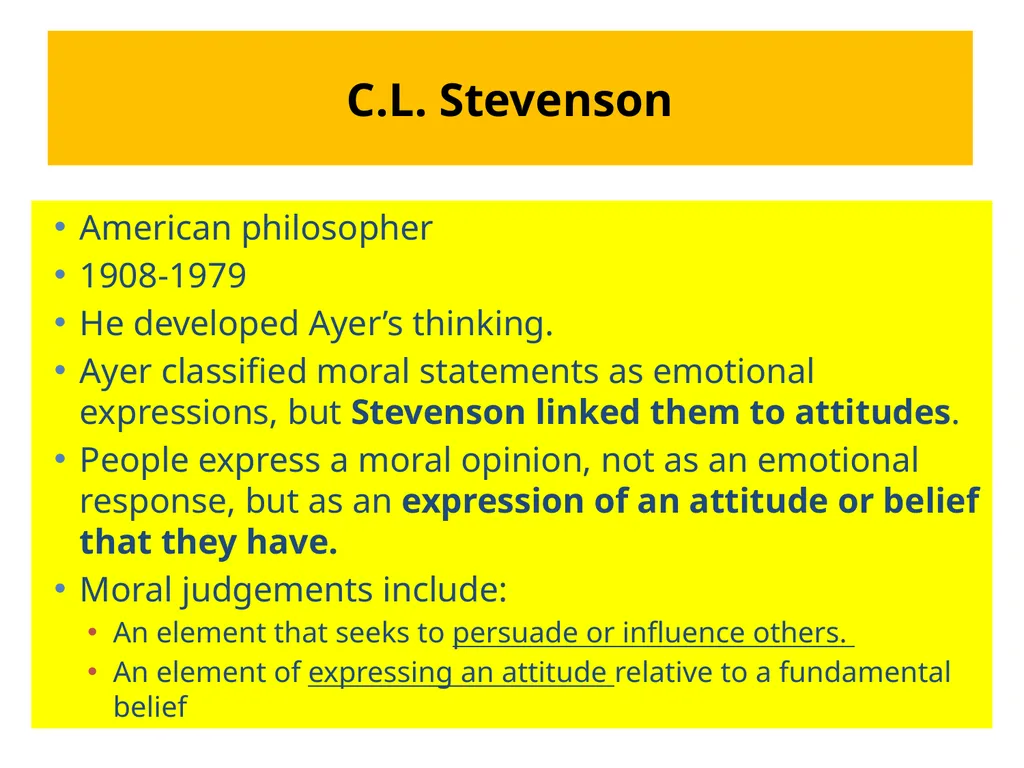
C.L. Stevenson American philosopher
1908-1979
He developed Ayer’s thinking.
Ayer classified moral statements as emotional expressions, but Stevenson linked them to attitudes.
People express a moral opinion, not as an emotional response, but as an expression of an attitude or belief that they have.
Moral judgements include:
An element that seeks to persuade or influence others.
An element of expressing an attitude relative to a fundamental belief<br>
06
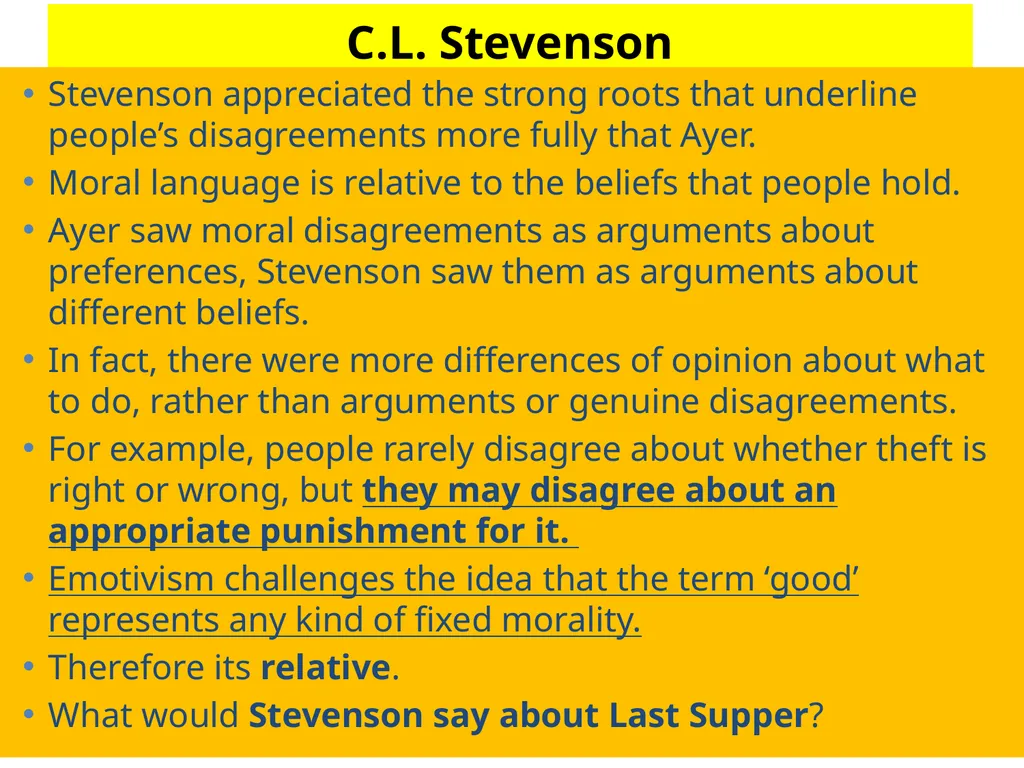
C.L. Stevenson Stevenson appreciated the strong roots that underline people’s disagreements more fully that Ayer.
Moral language is relative to the beliefs that people hold.
Ayer saw moral disagreements as arguments about preferences, Stevenson saw them as arguments about different beliefs.
In fact, there were more differences of opinion about what to do, rather than arguments or genuine disagreements.
For example, people rarely disagree about whether theft is right or wrong, but they may disagree about an appropriate punishment for it.
Emotivism challenges the idea that the term ‘good’ represents any kind of fixed morality.
Therefore its relative.
What would Stevenson say about Last Supper?<br>
07
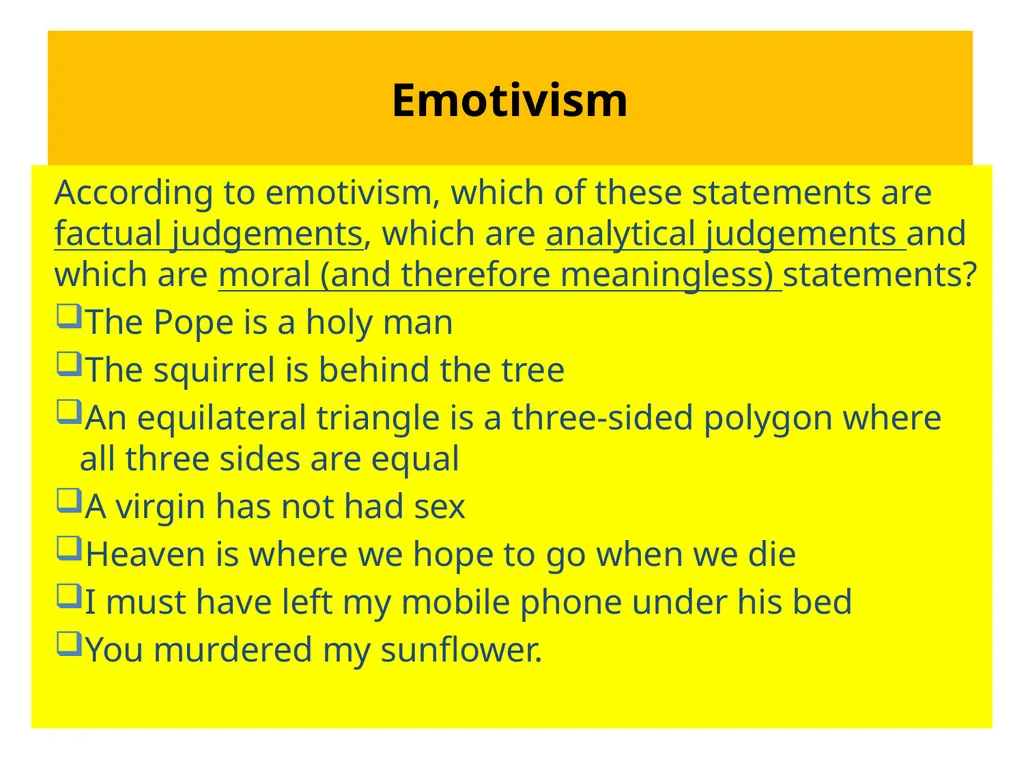
Emotivism According to emotivism, which of these statements are factual judgements, which are analytical judgements and which are moral (and therefore meaningless) statements?
The Pope is a holy man
The squirrel is behind the tree
An equilateral triangle is a three-sided polygon where all three sides are equal
A virgin has not had sex
Heaven is where we hope to go when we die
I must have left my mobile phone under his bed
You murdered my sunflower.<br>
The Pope is a holy man
The squirrel is behind the tree
An equilateral triangle is a three-sided polygon where all three sides are equal
A virgin has not had sex
Heaven is where we hope to go when we die
I must have left my mobile phone under his bed
You murdered my sunflower.<br>
08
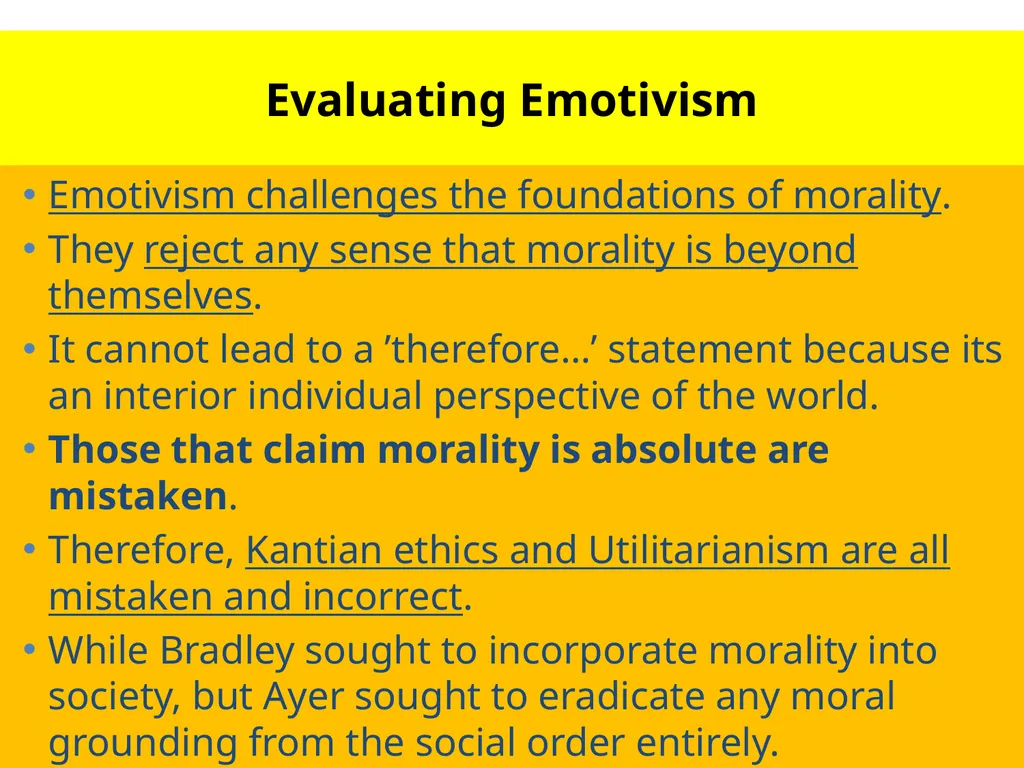
Evaluating Emotivism Emotivism challenges the foundations of morality.
They reject any sense that morality is beyond themselves.
It cannot lead to a ’therefore…’ statement because its an interior individual perspective of the world.
Those that claim morality is absolute are mistaken.
Therefore, Kantian ethics and Utilitarianism are all mistaken and incorrect.
While Bradley sought to incorporate morality into society, but Ayer sought to eradicate any moral grounding from the social order entirely.<br>
09
Evaluating Emotivism Alistair MacIntyre is not satisfied by emotivism.
He questions ‘emotive meaning.’
He says that thing that makes moral utterances a guide to our actions is their relevance to the people around them, not about whether they are factual or descriptive.
For example, to say your house is on fire means something very different if you hear the news on holiday or if you hear it shouted while you are in your home in bed.
Emotivists merge meaning and use. They do not distinguish between statements that change significance when used differently.<br>
10
Evaluating Emotivism Secondly, MacIntyre argues that Stevenson paints a picture of a thoroughly unpleasant world where everyone is trying to get ahead by enforcing their views on each other.
He also argues that Stevenson does not explain how the moral views are formed in the first place.
Thirdly, emotivism is according to MacIntyre, opaque. It does not give any help in explaining how we can distinguish the feelings and attitudes that are moral from other feelings and attitudes we might have.<br>
11
Emotivism This theory that believes objective moral laws do not exist.
This is a non-cognitivist theory; moral terms express personal emotional attitudes and not propositions
Ethical terms are just expressions of personal approval (hurrah) or disapproval (boo); explains why people disagree about morality. Emotivism is often referred to as ‘boo hurrah ethics’.
A.J. Ayer - ethical statements are neither verifiable nor analytic; made to express joy or pain (emotion). Moral statements are discussed in order to be persuasive.
Emotivism is not subjectivism (based merely on opinions). Rather moral views are statements of emotion.<br>
12
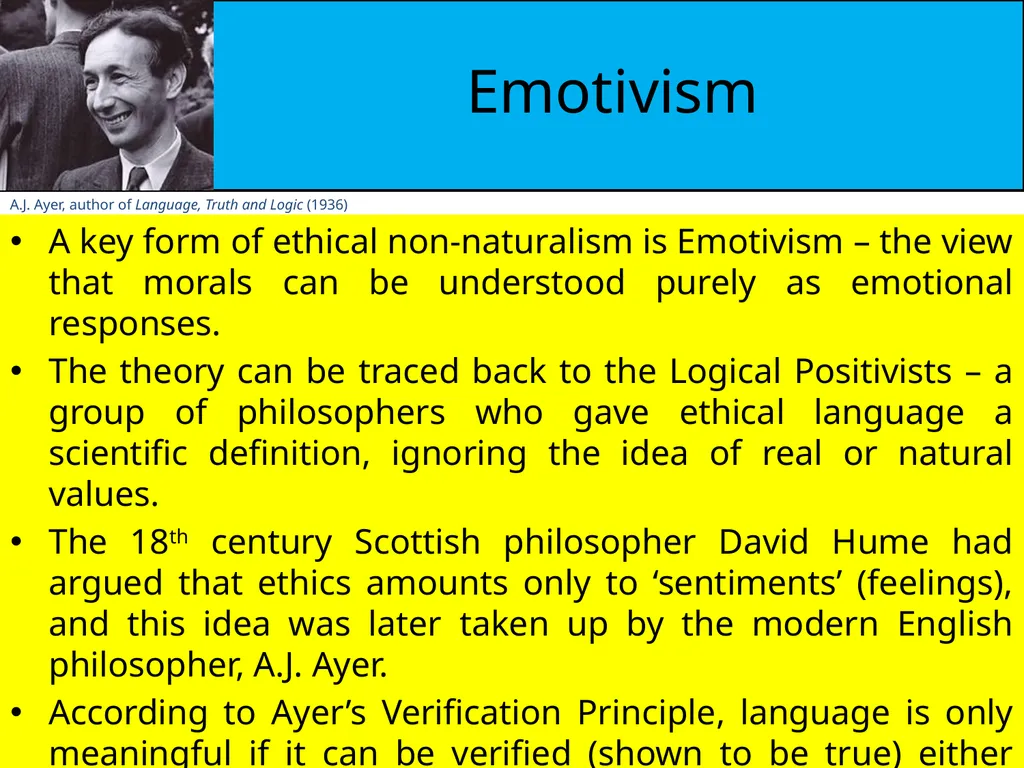
Emotivism A key form of ethical non-naturalism is Emotivism – the view that morals can be understood purely as emotional responses.
The theory can be traced back to the Logical Positivists – a group of philosophers who gave ethical language a scientific definition, ignoring the idea of real or natural values.
The 18th century Scottish philosopher David Hume had argued that ethics amounts only to ‘sentiments’ (feelings), and this idea was later taken up by the modern English philosopher, A.J. Ayer.
According to Ayer’s Verification Principle, language is only meaningful if it can be verified (shown to be true) either analytically or synthetically. Ayer did not think that this applied to religious beliefs or moral ideas. A.J. Ayer, author of Language, Truth and Logic (1936)<br>
13
The nature of ethical language, according to Ayer Ayer argued that ethical language really expresses our feelings about something or somebody we do / do not like.
We simply express our approval or disapproval, so that to say ‘lying is wrong’ is a bit like saying ‘boo to lying’.
Ayer claimed, “in saying a certain type of action is right or wrong, I am not making any factual statement … I am merely expressing certain moral sentiments.”
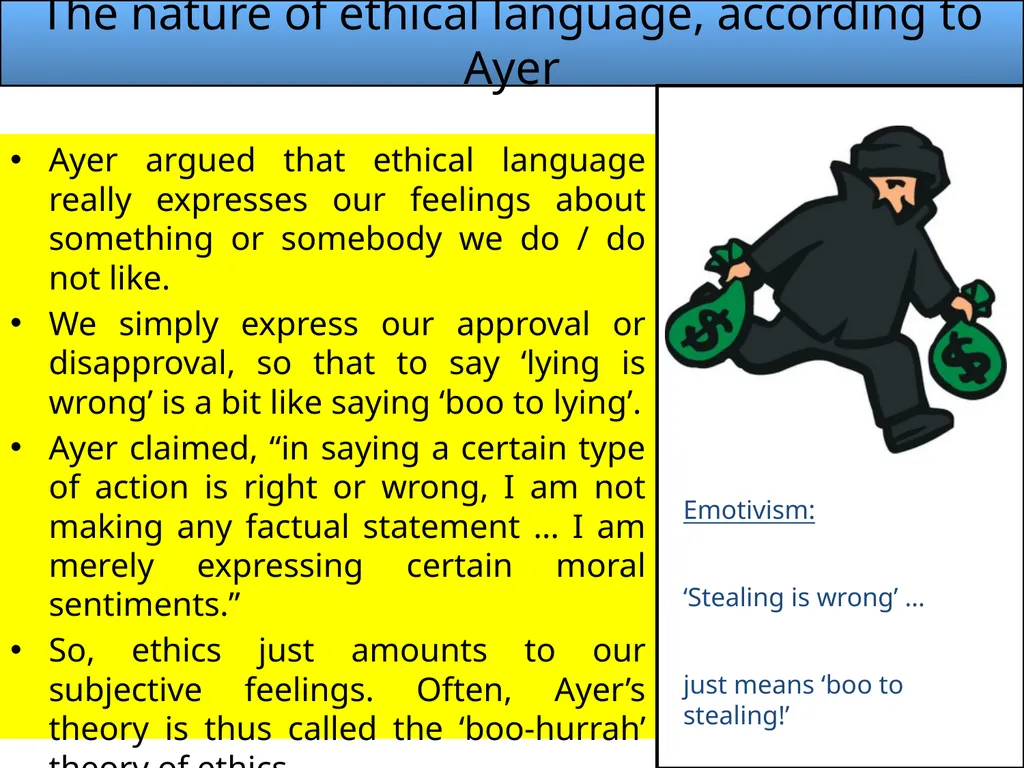
So, ethics just amounts to our subjective feelings. Often, Ayer’s theory is thus called the ‘boo-hurrah’ theory of ethics. Emotivism:
‘Stealing is wrong’ …
just means ‘boo to stealing!’<br>
14
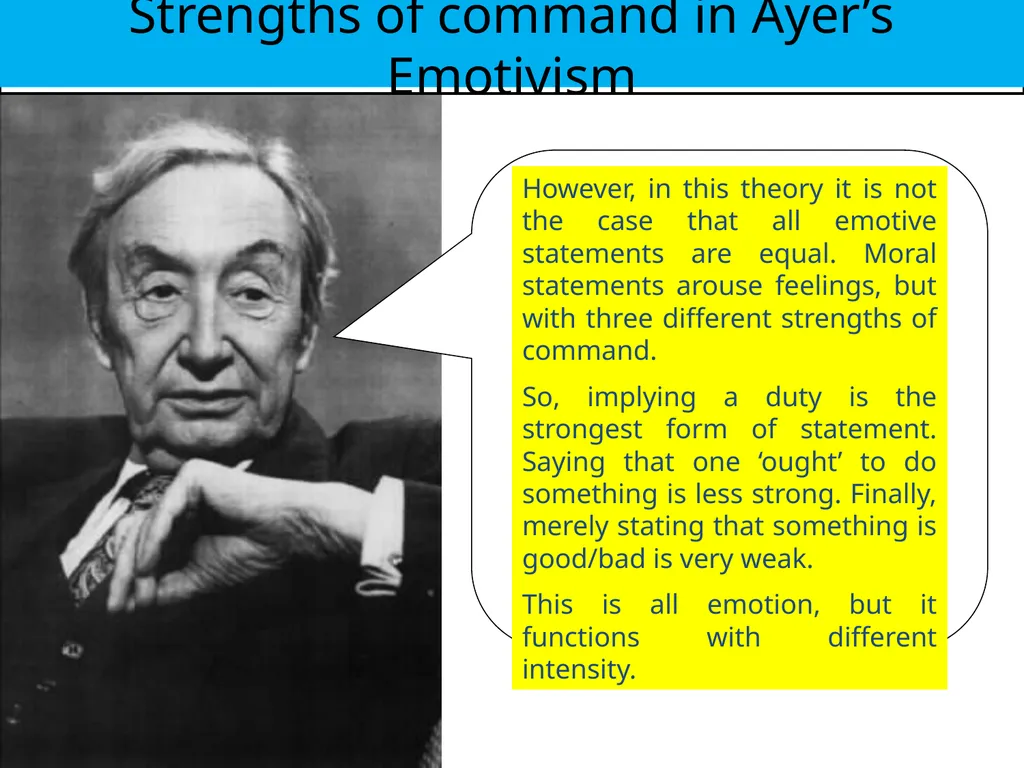
Strengths of command in Ayer’s Emotivism However, in this theory it is not the case that all emotive statements are equal. Moral statements arouse feelings, but with three different strengths of command.
So, implying a duty is the strongest form of statement. Saying that one ‘ought’ to do something is less strong. Finally, merely stating that something is good/bad is very weak.
This is all emotion, but it functions with different intensity.<br>
So, implying a duty is the strongest form of statement. Saying that one ‘ought’ to do something is less strong. Finally, merely stating that something is good/bad is very weak.
This is all emotion, but it functions with different intensity.<br>
15
More Emotivism – C.L. Stevenson Another key Emotivist philosopher was C.L. Stevenson, who developed similar ideas to Ayer.
However, unlike Ayer, Stevenson claimed that there are such things as real disagreements in attitudes, rather than just differing emotions.
Stevenson did not just emphasise the persuasive side of ethics, but also the view that attitudes are based on beliefs.
So, if I say that ‘capital punishment is wrong’, I have an attitude which is shaped by my prior beliefs. Disagreements are not just different emotions, but also issues of different underlying convictions – what life is, its value, etc.
Stevenson’s views thus give more meaning to moral disagreement, whereas Ayer only sees these as conflicts of feelings.<br>
16
Strengths of Emotivism Ayer’s approach to ethics lacks the problem of speculative and metaphysical ideas – it is based on the observation of behaviour, rather than God or timeless forms.
It is easy to think of ideas which link with Emotivism – people making moral claims with great emotional conviction and less ‘proof’.
Stevenson is able to explain the complex meaning of ethical terms and gives some hope for resolving ethical disputes, because he emphasises underlying beliefs and definitions.<br>
17
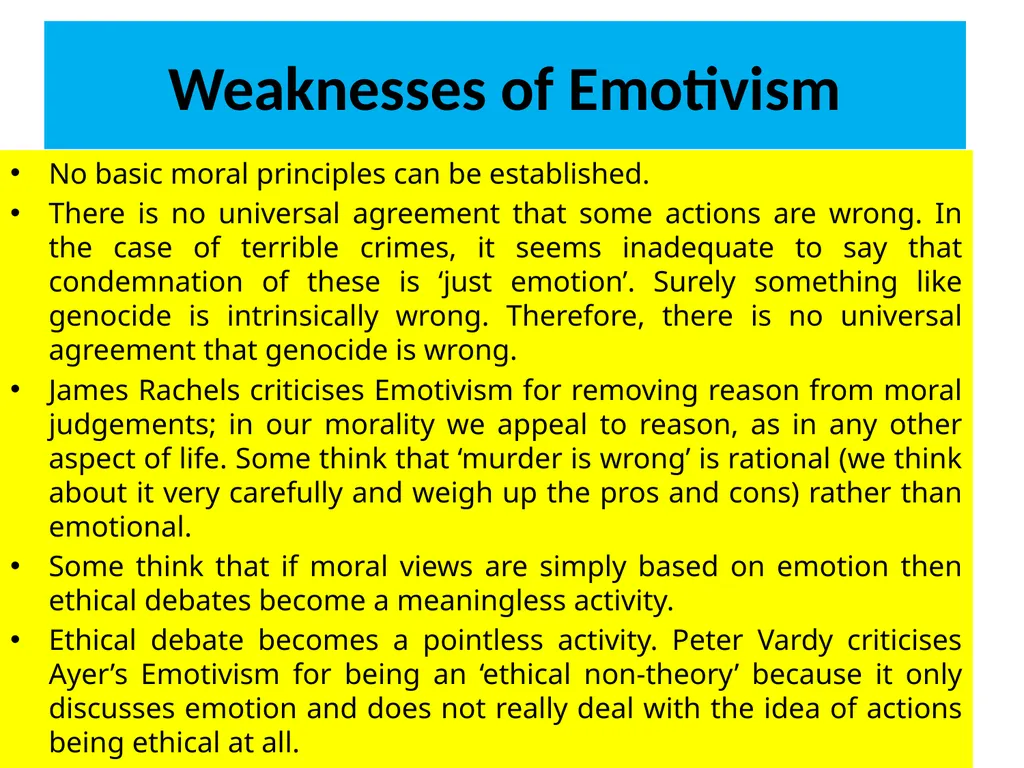
Weaknesses of Emotivism No basic moral principles can be established.
There is no universal agreement that some actions are wrong. In the case of terrible crimes, it seems inadequate to say that condemnation of these is ‘just emotion’. Surely something like genocide is intrinsically wrong. Therefore, there is no universal agreement that genocide is wrong.
James Rachels criticises Emotivism for removing reason from moral judgements; in our morality we appeal to reason, as in any other aspect of life. Some think that ‘murder is wrong’ is rational (we think about it very carefully and weigh up the pros and cons) rather than emotional.
Some think that if moral views are simply based on emotion then ethical debates become a meaningless activity.
Ethical debate becomes a pointless activity. Peter Vardy criticises Ayer’s Emotivism for being an ‘ethical non-theory’ because it only discusses emotion and does not really deal with the idea of actions being ethical at all.<br>
18
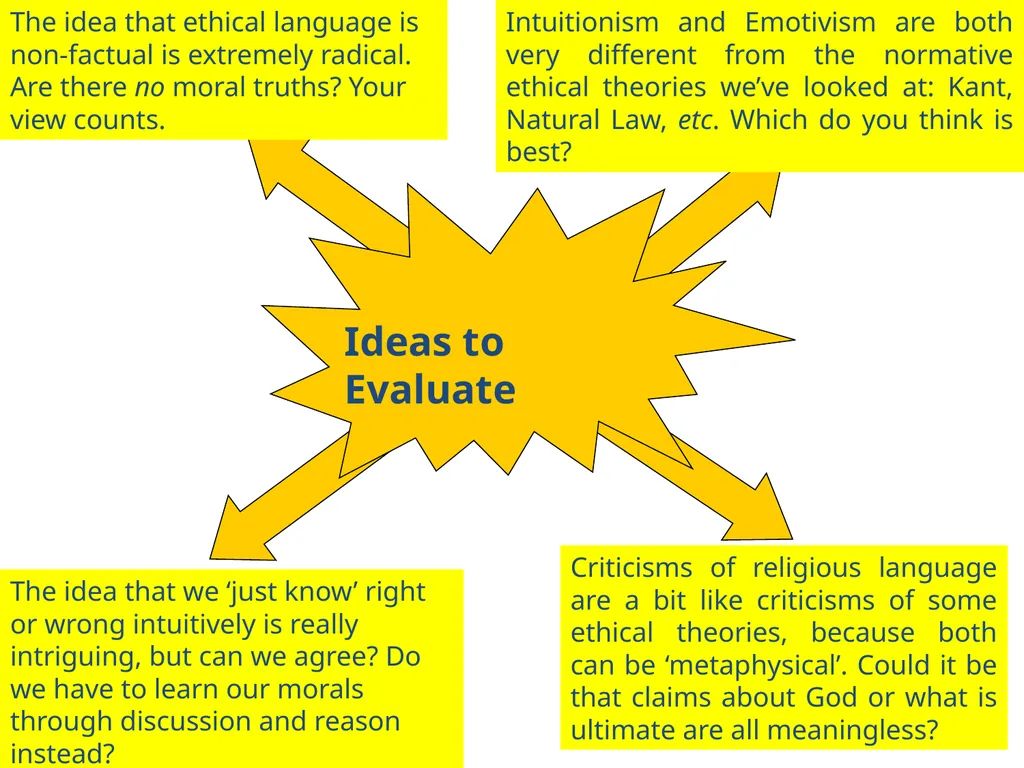
Ideas to Evaluate The idea that ethical language is non-factual is extremely radical. Are there no moral truths? Your view counts. Intuitionism and Emotivism are both very different from the normative ethical theories we’ve looked at: Kant, Natural Law, etc. Which do you think is best? The idea that we ‘just know’ right or wrong intuitively is really intriguing, but can we agree? Do we have to learn our morals through discussion and reason instead? Criticisms of religious language are a bit like criticisms of some ethical theories, because both can be ‘metaphysical’. Could it be that claims about God or what is ultimate are all meaningless?<br>