
Empiricism, Rationalism, and Kant Really Good
PC
Published · 56 slides · 0 views

1 / 1

Description
Empiricism, Rationalism, and Kant Really Good Noodles 1 Really Good Noodles Neo: I used to eat there. Really good noodles. I have these memories from my life. None of them happened. What does that mean? Trinity: That the Matrix cant
Related Topics
Share
Embed code
Download this presentation From Below
"Empiricism, Rationalism, and Kant Really Good" is the property of its rightful owner. Permission is granted to download and print the materials on this website for personal, non-commercial use only, and to display it on your personal computer provided you do not modify the materials and that you retain all copyright notices contained in the materials. By downloading content from our website, you accept the terms of this agreement.
Presentation Transcript
01
Empiricism, Rationalism, and Kant Really Good Noodles 1<br>
02
Really Good Noodles Neo: “I used to eat there. Really good noodles. I have these memories from my life. None of them happened. What does that mean?”
Trinity: “That the Matrix can’t tell you who you are.” 2<br>
Trinity: “That the Matrix can’t tell you who you are.” 2<br>
03
Two sources of knowledge 1) External, from sensory experience
Neo sees, touches, tastes the noodles: they are real
Philosophical framework: Empiricism
= All our knowledge arises out of sense experience
But none of his empirical experience was real!
2) An internal source of knowledge
Trinity: there is a knowledge of self that doesn’t arise from sense experience
Philosophical framework: rationalism
This is the way to attain reality 3<br>
Neo sees, touches, tastes the noodles: they are real
Philosophical framework: Empiricism
= All our knowledge arises out of sense experience
But none of his empirical experience was real!
2) An internal source of knowledge
Trinity: there is a knowledge of self that doesn’t arise from sense experience
Philosophical framework: rationalism
This is the way to attain reality 3<br>
04
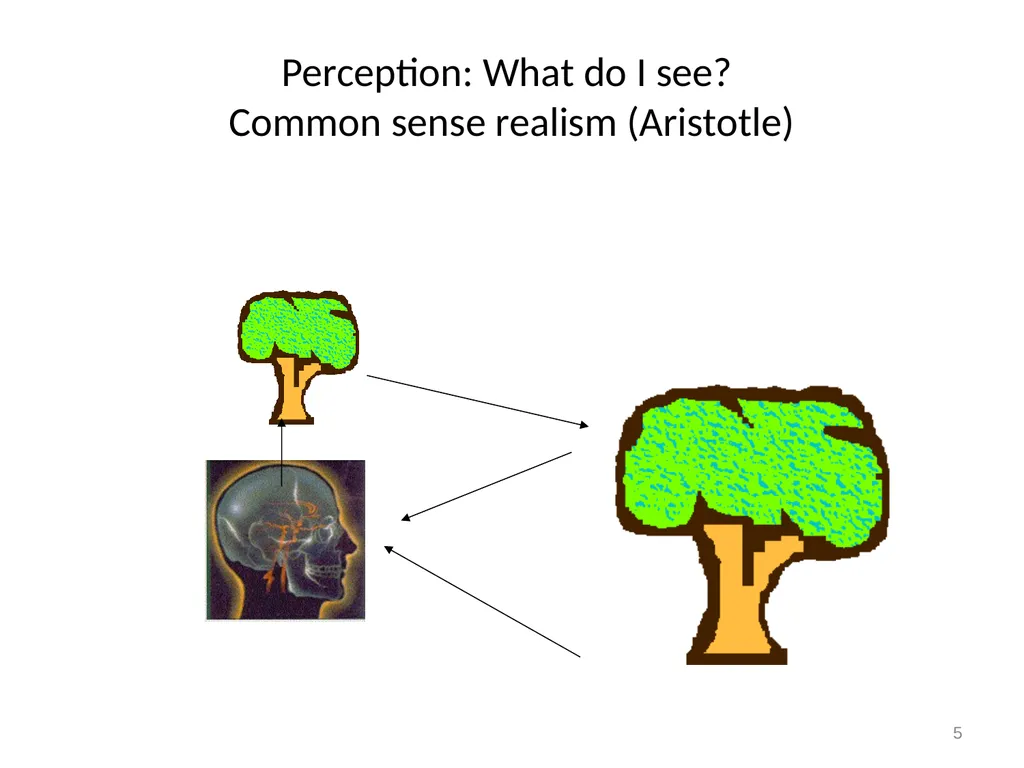
Ancient Empiricism of Aristotle We abstract the essence or “form” of something
from the sense impression we receive from the real object outside of us
This puts us in direct contact with the real world 4<br>
from the sense impression we receive from the real object outside of us
This puts us in direct contact with the real world 4<br>
05
5 Perception: What do I see?
Common sense realism (Aristotle)<br>
06
Modern empiricism of Locke All knowledge begins with sense impressions:
sweet food with a certain shape and color, versus bitter things
We build up our science from simple ideas to complex ones:
sweet, plus purple, plus oval = “plum”
But we are still a long way from knowing the substance of the plum:
a specific configuration of atoms 6<br>
sweet food with a certain shape and color, versus bitter things
We build up our science from simple ideas to complex ones:
sweet, plus purple, plus oval = “plum”
But we are still a long way from knowing the substance of the plum:
a specific configuration of atoms 6<br>
07
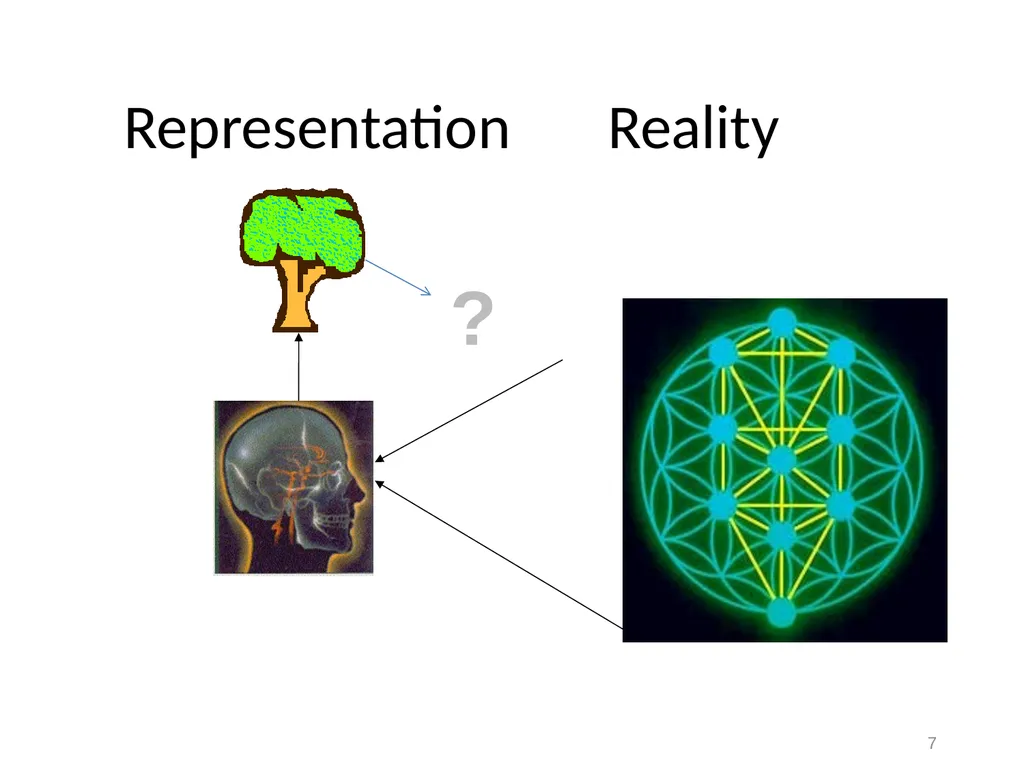
Representation Reality 7 ?<br>
08
Hume’s radical empiricism All we know are sensuous “impressions” and the ideas we base on them
involving habitual “associations” between impressions
We never know things outside of us directly
Perhaps our ideas are caused
by the external world
by ourselves
by God (as Bishop Berkeley argued)
But we can never answer such “metaphysical” questions
because they go beyond the data of sense experience 8<br>
involving habitual “associations” between impressions
We never know things outside of us directly
Perhaps our ideas are caused
by the external world
by ourselves
by God (as Bishop Berkeley argued)
But we can never answer such “metaphysical” questions
because they go beyond the data of sense experience 8<br>
09
How define reality? “What is real? How do you define real? If you're talking about what you can feel, what you can smell, what you can taste and see, then real is simply electrical signals interpreted by your brain.”
Morpheus 9<br>
Morpheus 9<br>
10
Is that air he is breathing? Note: Morpheus first defines reality as an empiricist: reality = what we sense
He is talking to Neo and supposing what Neo believes: that reality = what we directly sense
In the “Construct,” a virtual reality simulator, he asks Neo, Do you think that is really air that you are breathing?
Morpheus is not an empiricist: there is a reality beyond what we sense
But this is something you can only know for yourself! 10<br>
He is talking to Neo and supposing what Neo believes: that reality = what we directly sense
In the “Construct,” a virtual reality simulator, he asks Neo, Do you think that is really air that you are breathing?
Morpheus is not an empiricist: there is a reality beyond what we sense
But this is something you can only know for yourself! 10<br>
11
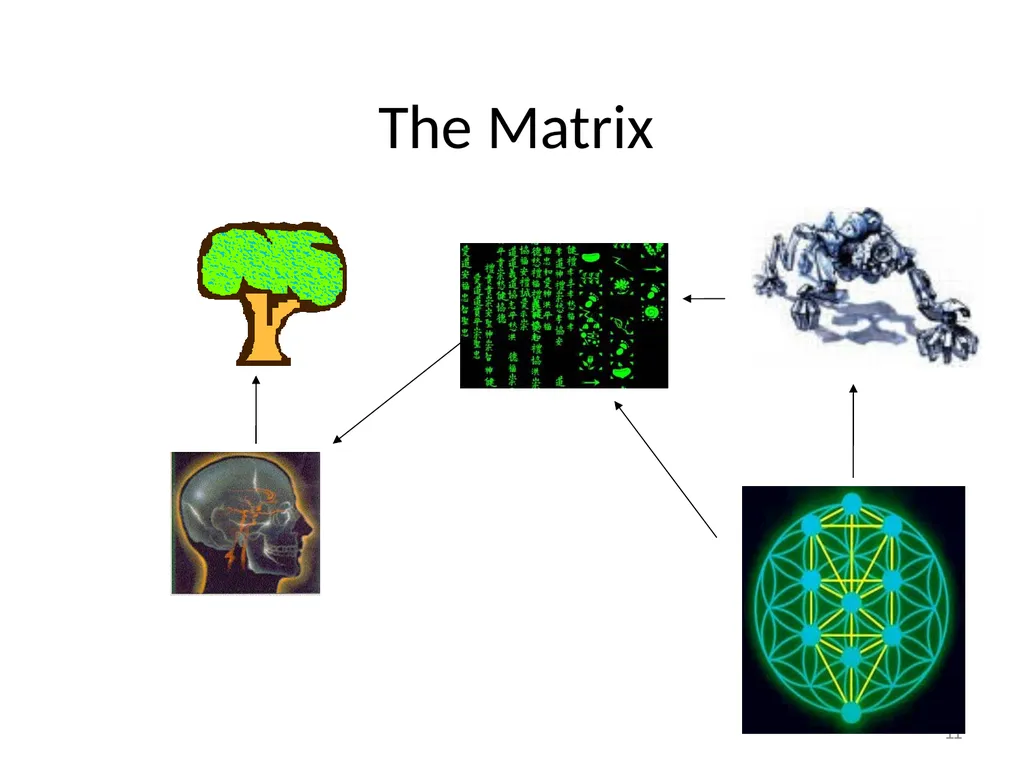
11 The Matrix<br>
12
The Matrix refutes Empiricism A Matrix: an artificial simulation of reality based on a computer code
If a “Matrix” is possible, and empiricism is correct, we can never know what is really real
So we could now be in a Matrix
And there would be no escape!
The Matrix argues that we can know reality
even in a highly perfected Matrix
Hence, empiricism must be wrong 12<br>
If a “Matrix” is possible, and empiricism is correct, we can never know what is really real
So we could now be in a Matrix
And there would be no escape!
The Matrix argues that we can know reality
even in a highly perfected Matrix
Hence, empiricism must be wrong 12<br>
13
Empiricism or Rationalism Two exclusive theories of knowledge
Knowledge from the outside, from sensory impressions
Knowledge from within
If one is wrong, the other must be right
But we have just seen that empiricism is wrong
if we are to take the film, The Matrix, seriously
Hence, rationalism must be right
(unless there is a third possibility) 13<br>
Knowledge from the outside, from sensory impressions
Knowledge from within
If one is wrong, the other must be right
But we have just seen that empiricism is wrong
if we are to take the film, The Matrix, seriously
Hence, rationalism must be right
(unless there is a third possibility) 13<br>
14
If not empiricism, then rationalism Descartes: if all our sense impressions are false, illusory, there is still a reality:
the person who has the sense experiences, or who dreams the dream
I think, therefore I am (Cogito, ergo sum)
Even if I am dreaming now, and everything I experience is unreal,
Perhaps it’s a fiction created by a deceiving demon,
it remains true that I the dreamer am real
What then am “I”? 14<br>
the person who has the sense experiences, or who dreams the dream
I think, therefore I am (Cogito, ergo sum)
Even if I am dreaming now, and everything I experience is unreal,
Perhaps it’s a fiction created by a deceiving demon,
it remains true that I the dreamer am real
What then am “I”? 14<br>
15
“I” = self-consciousness 1) I see the sun rising in the morning
2) = The consciousness of an object, the rising sun
Is this a sense impression that represents an external reality or an object in a dream?
It’s an illusion in either case: the sun doesn’t rise; it only seems to do so.
Copernicus, modern science: It’s the earth that turns.
But we don’t directly sense that! 15<br>
2) = The consciousness of an object, the rising sun
Is this a sense impression that represents an external reality or an object in a dream?
It’s an illusion in either case: the sun doesn’t rise; it only seems to do so.
Copernicus, modern science: It’s the earth that turns.
But we don’t directly sense that! 15<br>
16
Reflection 3) The consciousness of being conscious of the rising sun (or something in a dream)
A reality: Self-consciousness is consciousness that I at least, the conscious being, am real
This is the starting point for a reconstruction of reality 16<br>
A reality: Self-consciousness is consciousness that I at least, the conscious being, am real
This is the starting point for a reconstruction of reality 16<br>
17
Modern science: sensory experience is an appearance, not reality 1) Aristotle: the sun really goes around the earth because that is what we see
Also fire goes up, stars move in circles, bodies fall because of their inner nature to go down
Reality is the way it appears to be
2) Modern science: Copernican revolution
The sun does not go around, fire does not go up, etc.
Appearances, based on sense experiences, do not give us reality
I.e., we are in a natural Matrix, but we can escape it through science,
through the step-by-step reflective method of reason 17<br>
Also fire goes up, stars move in circles, bodies fall because of their inner nature to go down
Reality is the way it appears to be
2) Modern science: Copernican revolution
The sun does not go around, fire does not go up, etc.
Appearances, based on sense experiences, do not give us reality
I.e., we are in a natural Matrix, but we can escape it through science,
through the step-by-step reflective method of reason 17<br>
18
Matter and spirit Physical things are
extended in space
divisible into parts
governed by external causes
Self-consciousness is
a unity with itself—not with an outside cause
indivisible: no left and right side of my self-consciousness
Hence: I (my consciousness) am not material 18<br>
extended in space
divisible into parts
governed by external causes
Self-consciousness is
a unity with itself—not with an outside cause
indivisible: no left and right side of my self-consciousness
Hence: I (my consciousness) am not material 18<br>
19
First steps of Knowledge 1) Perhaps it’s all a dream
2) But I at least really exist.
What then am I?
3) I am a self-conscious being
4) I am not a material being; I am a “spirit” 19<br>
2) But I at least really exist.
What then am I?
3) I am a self-conscious being
4) I am not a material being; I am a “spirit” 19<br>
20
Entering the Matrix 4) Possible states of spirit:
capable of living in an illusion, a dream
capable of living in, animating, a physical body
Other possible states?
Existence without a body?
Entering a Matrix? (Neo’s spirit enters the Matrix, not his body, which lies in a gooey pod) 20<br>
capable of living in an illusion, a dream
capable of living in, animating, a physical body
Other possible states?
Existence without a body?
Entering a Matrix? (Neo’s spirit enters the Matrix, not his body, which lies in a gooey pod) 20<br>
21
Implications of first steps We begin in ignorance
We move from ignorance to truths about ourselves
Steps go from simple starting point (I think) to complexities (I am a spiritual being in search of truth)
= Progress in deepening our understanding
How is this evolution possible?
Descartes: We have within us an idea of perfection:
an ideal of perfect (complete, total) knowledge;
of perfect existence—ideal of becoming a better person
Hence: next step: examining this a priori idea of perfection 21<br>
We move from ignorance to truths about ourselves
Steps go from simple starting point (I think) to complexities (I am a spiritual being in search of truth)
= Progress in deepening our understanding
How is this evolution possible?
Descartes: We have within us an idea of perfection:
an ideal of perfect (complete, total) knowledge;
of perfect existence—ideal of becoming a better person
Hence: next step: examining this a priori idea of perfection 21<br>
22
A splinter in the mind Morpheus: “Let me tell you why you're here. You're here because you know something. What you know you can't explain. But you feel it. You've felt it your entire life. That there's something wrong with the world. You don't know what it is but it's there, like a splinter in your mind driving you mad. It is this feeling that has brought you to me.
Do you know what I'm talking about?”
Neo: “The Matrix?” 22<br>
Do you know what I'm talking about?”
Neo: “The Matrix?” 22<br>
23
Two issues 1) What is the Matrix? the false picture of reality that has trapped our consciousness
because of sense experience and regular associations
2) What is the truth? It’s a journey that begins with self-awareness
Morpheus: “You take the red pill, you stay in Wonderland, and I show you how deep the rabbit hole goes... Remember, all I'm offering is the truth, nothing more...” 23<br>
because of sense experience and regular associations
2) What is the truth? It’s a journey that begins with self-awareness
Morpheus: “You take the red pill, you stay in Wonderland, and I show you how deep the rabbit hole goes... Remember, all I'm offering is the truth, nothing more...” 23<br>
24
Idea of truth We find within ourselves an idea of true or perfect knowledge,
that drives us “like a splinter in our minds”
We are in ignorance and are impelled by a drive to find the truth
to go beyond appearances and conventional knowledge
Contrast with a cow contentedly chewing its cud
Does the cow care if the cud is real or not? 24<br>
that drives us “like a splinter in our minds”
We are in ignorance and are impelled by a drive to find the truth
to go beyond appearances and conventional knowledge
Contrast with a cow contentedly chewing its cud
Does the cow care if the cud is real or not? 24<br>
25
What is the source of this idea/duty? 1) Does it come from the external world?
No, because our senses can, do, deceive us
We need an internal basis for evaluating the truth of sense experience
2) Does it come from ourselves?
No, because I, by myself, am ignorant
I am driven to find the truth by the idea of the truth which comes from within myself, but is not created by me
3) Hence the idea of perfection must come from a Perfect Being, not from an imperfect one like myself
The desire for truth within us comes from God, a perfect being, who would not deceive us 25<br>
No, because our senses can, do, deceive us
We need an internal basis for evaluating the truth of sense experience
2) Does it come from ourselves?
No, because I, by myself, am ignorant
I am driven to find the truth by the idea of the truth which comes from within myself, but is not created by me
3) Hence the idea of perfection must come from a Perfect Being, not from an imperfect one like myself
The desire for truth within us comes from God, a perfect being, who would not deceive us 25<br>
26
Does the Perfect Being exist? I have an idea of perfect knowledge, of truth; of personal perfection–which is what I am striving to realize.
But, I think, perhaps this is only a subjective illusion, a fanciful invention of my own
Descartes: But if Perfection does not exist, if it is only an idea and not a reality, such an unreal idea would be imperfect!
It would not be an idea of perfection!
contrary to my experience that I have such an idea
Hence it is necessary to think of the Perfect Being as real, as existing 26<br>
But, I think, perhaps this is only a subjective illusion, a fanciful invention of my own
Descartes: But if Perfection does not exist, if it is only an idea and not a reality, such an unreal idea would be imperfect!
It would not be an idea of perfection!
contrary to my experience that I have such an idea
Hence it is necessary to think of the Perfect Being as real, as existing 26<br>
27
The idea of perfection/truth is real 1) The idea of perfection is not an invention of imagination:
it is the basis of my discontent with what exists, with ignorance.
2) It is not an imaginary idea,
like a unicorn,
but a real one that drives me “like a splinter in my mind” 27<br>
it is the basis of my discontent with what exists, with ignorance.
2) It is not an imaginary idea,
like a unicorn,
but a real one that drives me “like a splinter in my mind” 27<br>
28
Method of reason (rationalism) The above set of ideas involves a chain of truths,
starting with a simple reflective awareness of my existence
and moving to more complex ideas and implications
= Method of reason
1) Analysis: break down one’s initial beliefs into their basic components (method of doubt)
2) Synthesis: build up from simple truths to more complex ones in steps
= An internal process of my own thinking
It’s not a construction of complex ideas derived from simple sensations (Locke’s empiricism) 28<br>
starting with a simple reflective awareness of my existence
and moving to more complex ideas and implications
= Method of reason
1) Analysis: break down one’s initial beliefs into their basic components (method of doubt)
2) Synthesis: build up from simple truths to more complex ones in steps
= An internal process of my own thinking
It’s not a construction of complex ideas derived from simple sensations (Locke’s empiricism) 28<br>
29
How do I know the method of reason is reliable? Perhaps I am being deceived by an evil demon—
or the Machine God of The Matrix
But I have within me an idea of Perfection
And this can only have been put in me by a Perfect Being
which I must think of as existing
So the method of thinking that I am following is guided by a Perfect Being,
not a deceiving (imperfect) demon 29<br>
or the Machine God of The Matrix
But I have within me an idea of Perfection
And this can only have been put in me by a Perfect Being
which I must think of as existing
So the method of thinking that I am following is guided by a Perfect Being,
not a deceiving (imperfect) demon 29<br>
30
Next step: the external world I am conscious of X… material beings outside of myself.
I am a self-conscious, spiritual being, not an extended material being– the source of sensations in me
which I can accept as directly given to me and organized by habitual associations
the blue pill
or reorganize and evaluate according to a rationalist, scientific method
the red pill 30<br>
I am a self-conscious, spiritual being, not an extended material being– the source of sensations in me
which I can accept as directly given to me and organized by habitual associations
the blue pill
or reorganize and evaluate according to a rationalist, scientific method
the red pill 30<br>
31
The choice Scientific reasoning involves a choice (blue pill or red pill?)
Allow the external impressions to determine my thought
Empiricism: the sun comes up in the morning
Or put these impressions in their proper place following a rational method of analysis and synthesis
Rationalism: the earth moves around the sun, and so it only appears to come up in the morning 31<br>
Allow the external impressions to determine my thought
Empiricism: the sun comes up in the morning
Or put these impressions in their proper place following a rational method of analysis and synthesis
Rationalism: the earth moves around the sun, and so it only appears to come up in the morning 31<br>
32
Method and Content Rationalist method of thought: step by step movement from simple to complex
Nature of the external world:
1) An already existing complexity? (The world created in six days, according to the Bible):
which contradicts rational method
2) A process of movement from an initial simple state, to the present complexity that we find now
i.e., an evolution from initial simple elements
This idea accords with rational method 32<br>
Nature of the external world:
1) An already existing complexity? (The world created in six days, according to the Bible):
which contradicts rational method
2) A process of movement from an initial simple state, to the present complexity that we find now
i.e., an evolution from initial simple elements
This idea accords with rational method 32<br>
33
Theology and science The Church (in 1620), relying on the Bible, says that the world that exists now always existed as it presently appears
But this contradicts the (rationalist) method of science
However, Descartes argues, God is free to create as he chooses: irrationally or rationally
The Bible/Church says he created irrationally: all at once without any process.
Believers must accept that
(But doesn’t this make God an evil demon?) 33<br>
But this contradicts the (rationalist) method of science
However, Descartes argues, God is free to create as he chooses: irrationally or rationally
The Bible/Church says he created irrationally: all at once without any process.
Believers must accept that
(But doesn’t this make God an evil demon?) 33<br>
34
A rationalist universe? But a scientist is free to speculate:
what if God had created the world according to a rational method? How would proceed?
Answer: an evolutionary process beginning with the simplest elements of matter (Descartes’ The World):
Analysis of our existing world down to its basic elements, and the laws governing their movement
Synthesis from these simplest elements to the more complicated world we experience around us
Planets circling suns: the outcome of this process (Copernican worldview) 34<br>
what if God had created the world according to a rational method? How would proceed?
Answer: an evolutionary process beginning with the simplest elements of matter (Descartes’ The World):
Analysis of our existing world down to its basic elements, and the laws governing their movement
Synthesis from these simplest elements to the more complicated world we experience around us
Planets circling suns: the outcome of this process (Copernican worldview) 34<br>
35
Descartes’ conception of Physics Recall: Initial concept of matter:
spatial extension
divisibility
external causality: nothing moves unless something else moves it.
A moving object goes in a in a straight line unless or until something else causes it to change direction
(Principle of inertia from Galileo)
Contrasts with Aristotle’s theory of the elements, and different forms of motion
Fire goes up, stars move in circles, etc.
Things move themselves 35<br>
spatial extension
divisibility
external causality: nothing moves unless something else moves it.
A moving object goes in a in a straight line unless or until something else causes it to change direction
(Principle of inertia from Galileo)
Contrasts with Aristotle’s theory of the elements, and different forms of motion
Fire goes up, stars move in circles, etc.
Things move themselves 35<br>
36
Duality of spirit and matter Spirit: free self-determined movement of consciousness following a rational method
Matter: deterministic movement from the outside, going from simple to complex
Evolution of the universe from simple elements, acting and reacting on each other 36<br>
Matter: deterministic movement from the outside, going from simple to complex
Evolution of the universe from simple elements, acting and reacting on each other 36<br>
37
What is a human being? A (temporary) unity of body and soul
As embodied spirits, we are moved by our passions
As spirits in a body, we are also able to direct our passions through awareness of truth 37<br>
As embodied spirits, we are moved by our passions
As spirits in a body, we are also able to direct our passions through awareness of truth 37<br>
38
Controlling our desires 1) I desire to eat cream-puffs
I see a cream puff and want it.
2) I know that too many are not good for me (science of health)
3) I can redirect my attention to things that are good for me:
stay away from the temptation of cream puffs
prepare healthful foods with tasty sauces instead: e.g., really good noodles 38<br>
I see a cream puff and want it.
2) I know that too many are not good for me (science of health)
3) I can redirect my attention to things that are good for me:
stay away from the temptation of cream puffs
prepare healthful foods with tasty sauces instead: e.g., really good noodles 38<br>
39
Science in practical life Freedom of thought to break away from objects given in sensation:
= disconnecting from the Matrix of conventional beliefs
and rearrange the data according to rational method from simple to complex
= follow the truth down the rabbit hole of our Wonderland 39<br>
= disconnecting from the Matrix of conventional beliefs
and rearrange the data according to rational method from simple to complex
= follow the truth down the rabbit hole of our Wonderland 39<br>
40
The Matrix is everywhere MORPHEUS (to Neo): The Matrix is everywhere. It is all around us, even now in this very room. You can see it when you look out your window or when you turn on your television. You can feel it when you go to work, when you go to church, when you pay your taxes. It is the world that has been pulled over your eyes to blind you from the truth. 40<br>
41
NEO: What truth?
MOPHEUS : That you are a slave, Neo. Like everyone else you were born into bondage, born into a prison that you cannot smell or taste or touch. A prison for your mind.... 41<br>
MOPHEUS : That you are a slave, Neo. Like everyone else you were born into bondage, born into a prison that you cannot smell or taste or touch. A prison for your mind.... 41<br>
42
The materialist view of life 1) Taking matter, bodies as primary: individuals fight over limited material resources
The more people who eat the pie, the smaller each piece: win/lose, zero sum game
Conflict of egos: Hobbes’ war of all against all, leading to the need for an external power to rule over us
The State,
the Market,
the Church,
giving rise to The Matrix of our society 42<br>
The more people who eat the pie, the smaller each piece: win/lose, zero sum game
Conflict of egos: Hobbes’ war of all against all, leading to the need for an external power to rule over us
The State,
the Market,
the Church,
giving rise to The Matrix of our society 42<br>
43
The way of spirit 2) Taking spirit, pursuit of truth, as primary
When I share my ideas with others, I do not lose anything
Pursuit of truth should be a cooperative, not a competitive process: win/win
No more Matrix:
together, we can be free of external ruling powers
and the beliefs that justify their rule 43<br>
When I share my ideas with others, I do not lose anything
Pursuit of truth should be a cooperative, not a competitive process: win/win
No more Matrix:
together, we can be free of external ruling powers
and the beliefs that justify their rule 43<br>
44
Problem of Descartes’ dualism Spirit is free, self-moving
Matter is unfree, externally determined by other material causes
How then can spirit move matter (as we seem to experience ourselves doing?) 44<br>
Matter is unfree, externally determined by other material causes
How then can spirit move matter (as we seem to experience ourselves doing?) 44<br>
45
Two metaphysical responses: 1) Hobbes’ Materialism All reality is deterministic: follows from principle of inertia: all bodies move as a result of the action on them of other bodies
Free will, spirit, is an illusion
But then how is science itself possible?
Modern science breaks from the determinism of sensations
Hence, we must be at least mentally free 45<br>
Free will, spirit, is an illusion
But then how is science itself possible?
Modern science breaks from the determinism of sensations
Hence, we must be at least mentally free 45<br>
46
2) Leibniz’ Spiritualism Consider action and reaction: I press on the stone, and the stone equally presses on me
Newton’s third law contradicts the first one!
Nothing is moved by outside forces
> Everything has within itself an internal living force.
>Externally determined matter is an illusion 46<br>
Newton’s third law contradicts the first one!
Nothing is moved by outside forces
> Everything has within itself an internal living force.
>Externally determined matter is an illusion 46<br>
47
Matter is an illusion Hence, there are only spiritual beings, moving themselves,
even on the simplest level of the basic elements:
“monads” (primitive “I thinks”) not “atoms”
How could purposefully acting, self-determining human beings evolve from the natural world
if the natural world consists of externally determined beings? 47<br>
even on the simplest level of the basic elements:
“monads” (primitive “I thinks”) not “atoms”
How could purposefully acting, self-determining human beings evolve from the natural world
if the natural world consists of externally determined beings? 47<br>
48
3) Hume’s empiricist scepticism 1) rationalism leads to conflicting metaphysical positions
Materialism (Hobbes)
Spiritualism (Berkeley, Leibniz)
Dualism (Descartes
2) Pure reason cannot determine which is correct
3) Therefore we must be content with empiricist sense experience
We can never know the nature of ultimate reality 48<br>
Materialism (Hobbes)
Spiritualism (Berkeley, Leibniz)
Dualism (Descartes
2) Pure reason cannot determine which is correct
3) Therefore we must be content with empiricist sense experience
We can never know the nature of ultimate reality 48<br>
49
4) Kant’s reply to Hume 1) Empiricism makes science impossible; but science is real
No universal truths, no laws are possible from empirical generalizations
2) Rationalism follows from modern science: the Copernican revolution:
“Viewed from earth, the planets sometimes move backwards, sometimes forward, and sometimes not at all. But if the standpoint selected is the sun, an act which only reason can perform, according to the Copernican hypothesis they move constantly in their regular course.” 49<br>
No universal truths, no laws are possible from empirical generalizations
2) Rationalism follows from modern science: the Copernican revolution:
“Viewed from earth, the planets sometimes move backwards, sometimes forward, and sometimes not at all. But if the standpoint selected is the sun, an act which only reason can perform, according to the Copernican hypothesis they move constantly in their regular course.” 49<br>
50
But Descartes’ carries rationalism too far 1) The concept of spirit reflects our own (1st person) internal experience of thinking, and our own pursuit of the ideal of perfection (idea of God)
2) But scientific knowledge adopts an external (3rd person) point of view both on ourselves and on the world
We impose our concept of matter as spatially extended, temporally evolving, and externally caused, on everything, including ourselves
But we should be aware that this is our concept and our scientific practice 50<br>
2) But scientific knowledge adopts an external (3rd person) point of view both on ourselves and on the world
We impose our concept of matter as spatially extended, temporally evolving, and externally caused, on everything, including ourselves
But we should be aware that this is our concept and our scientific practice 50<br>
51
We deceive ourselves As long as we take the results of scientific explanation as objectively true, we must accept a determinist world in which we have no freedom
In accepting this perspective we deceive ourselves
And so others can deceive us
Such explanations in terms of causal determinism are our way of organizing our own experience
It is practically useful (see William James’ Pragmatism),
and so not the operation of a deceiving demon 51<br>
In accepting this perspective we deceive ourselves
And so others can deceive us
Such explanations in terms of causal determinism are our way of organizing our own experience
It is practically useful (see William James’ Pragmatism),
and so not the operation of a deceiving demon 51<br>
52
Subjective rationalism These fundamental concepts are a priori structures of experiencing,
not empirically derived generalizations
Awareness of this subjectivity of our basic concept of matter frees us from the prison of determinism
And allows us to believe in (not know) the primacy of our self-moving spirit (and community of spirits)
What follows is a critique of all forms of enslavement by others 52<br>
not empirically derived generalizations
Awareness of this subjectivity of our basic concept of matter frees us from the prison of determinism
And allows us to believe in (not know) the primacy of our self-moving spirit (and community of spirits)
What follows is a critique of all forms of enslavement by others 52<br>
53
A fourth possibility? How explain the idea of perfection in us
Driving us like a splinter in the mind?
1) The external world
2) Our own consciousness
3) God
4) It’s an a priori given structure of our consciousness, underlying all our thoughts
Where it comes from we can’t know 53<br>
Driving us like a splinter in the mind?
1) The external world
2) Our own consciousness
3) God
4) It’s an a priori given structure of our consciousness, underlying all our thoughts
Where it comes from we can’t know 53<br>
54
What’s wrong with the ontological argument? Kant agrees that we have an idea of perfection (idea of God)
driving us to know the truth
driving us to become better people
But this idea does not by itself prove the existence of a Perfect Being
“Existence is not a concept”
I have a complete, clear conception of $20. What I don’t know is, does it exist? Is it in my pocket?
When I find this $20 in my pocket, this does not add some new concept, that of existence, to my prior conception of $20 54<br>
driving us to know the truth
driving us to become better people
But this idea does not by itself prove the existence of a Perfect Being
“Existence is not a concept”
I have a complete, clear conception of $20. What I don’t know is, does it exist? Is it in my pocket?
When I find this $20 in my pocket, this does not add some new concept, that of existence, to my prior conception of $20 54<br>
55
Going beyond knowledge But then we can’t prove the existence of anything on the basis of our concept of it
I have a clear concept of God: all-powerful, all-knowing, etc.
Existence adds nothing to this concept
On the other hand, I intuitively know that my a priori way of experiencing the world does not create reality itself
Reality exists beyond my concepts of it
including my scientific concepts of cause and effect 55<br>
I have a clear concept of God: all-powerful, all-knowing, etc.
Existence adds nothing to this concept
On the other hand, I intuitively know that my a priori way of experiencing the world does not create reality itself
Reality exists beyond my concepts of it
including my scientific concepts of cause and effect 55<br>
56
From knowledge to belief And so there are two things:
My idea of perfection, driving me to improve my knowledge, and better my life
A sense of reality beyond all my a priori concepts
A Perfect Being (God) could exist
But we could never prove that it does through purely rational argumentation
It may be that in our practical, moral life, we must believe in God
just as we can believe that we act freely 56<br>
My idea of perfection, driving me to improve my knowledge, and better my life
A sense of reality beyond all my a priori concepts
A Perfect Being (God) could exist
But we could never prove that it does through purely rational argumentation
It may be that in our practical, moral life, we must believe in God
just as we can believe that we act freely 56<br>