Empowering the Defense Acquisition Workforce to Improve Mission Outcomes Using Data Science April 27, 2022 Report Briefing DATAWorks Conference The National Academies will identify relevant data science skills and capabilities necessary for
"Empowering the Defense Acquisition Workforce to" is the property of its rightful owner. Permission is granted to
download and print the materials on this website for personal, non-commercial use only, and to display it
on your personal computer provided you do not modify the materials and that you retain all copyright
notices contained in the materials. By downloading content from our website, you accept the terms of this
agreement.
Presentation Transcript
01
Empowering the Defense Acquisition Workforce to Improve Mission Outcomes Using Data Science April 27, 2022 Report Briefing DATAWorks Conference<br>
02
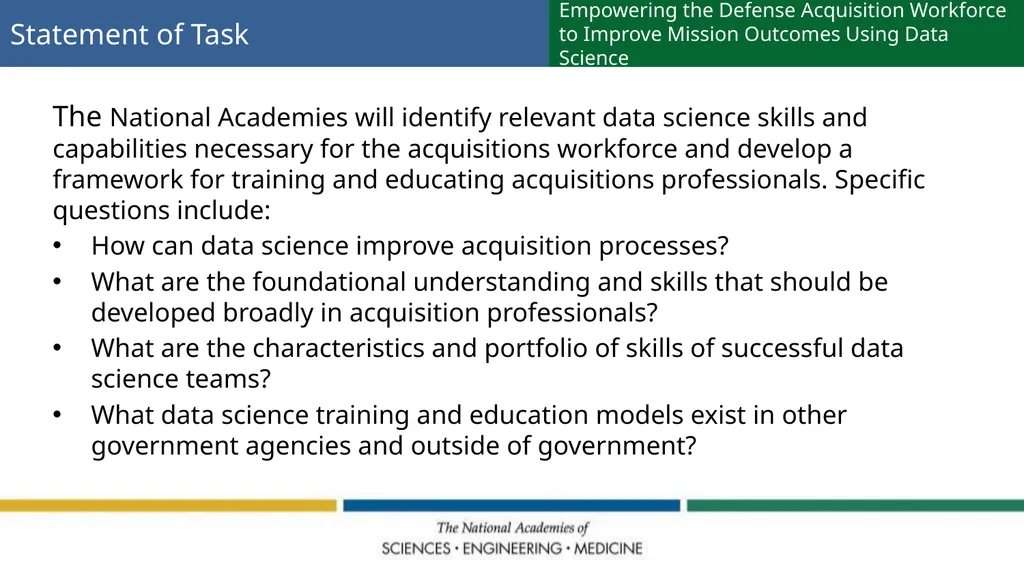
The National Academies will identify relevant data science skills and capabilities necessary for the acquisitions workforce and develop a framework for training and educating acquisitions professionals. Specific questions include:
How can data science improve acquisition processes?
What are the foundational understanding and skills that should be developed broadly in acquisition professionals?
What are the characteristics and portfolio of skills of successful data science teams?
What data science training and education models exist in other government agencies and outside of government? Empowering the Defense Acquisition Workforce to Improve Mission Outcomes Using Data Science Statement of Task<br>
03
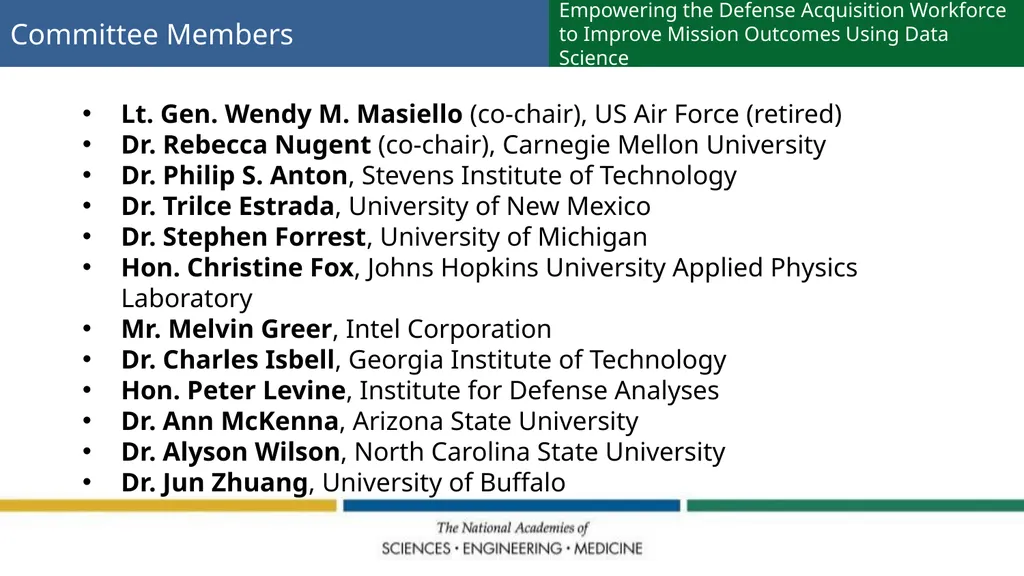
Lt. Gen. Wendy M. Masiello (co-chair), US Air Force (retired)
Dr. Rebecca Nugent (co-chair), Carnegie Mellon University
Dr. Philip S. Anton, Stevens Institute of Technology
Dr. Trilce Estrada, University of New Mexico
Dr. Stephen Forrest, University of Michigan
Hon. Christine Fox, Johns Hopkins University Applied Physics Laboratory
Mr. Melvin Greer, Intel Corporation
Dr. Charles Isbell, Georgia Institute of Technology
Hon. Peter Levine, Institute for Defense Analyses
Dr. Ann McKenna, Arizona State University
Dr. Alyson Wilson, North Carolina State University
Dr. Jun Zhuang, University of Buffalo Empowering the Defense Acquisition Workforce to Improve Mission Outcomes Using Data Science Committee Members<br>
04
Empowering the Defense Acquisition Workforce to Improve Mission Outcomes Using Data Science Report Assumptions Data are a strategic asset.
The effective use of data science will continue to strengthen defense acquisition decision-making and outcomes. Expanding these efforts will require coordinated efforts across the defense acquisition system.
Central to that effort is the development, growth, and sustainment of data science capabilities across the acquisition workforce.<br>
05
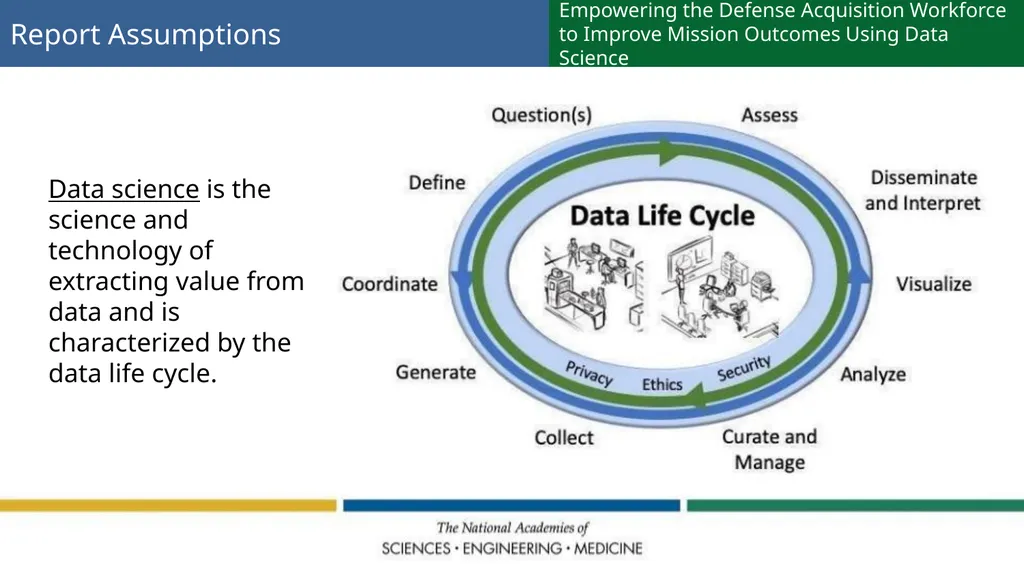
Empowering the Defense Acquisition Workforce to Improve Mission Outcomes Using Data Science Report Assumptions Data science is the science and technology of extracting value from data and is characterized by the data life cycle.<br>
06
Empowering the Defense Acquisition Workforce to Improve Mission Outcomes Using Data Science Report Findings, Conclusions and Recommendations Report Themes
Continue improving defense acquisition with data science
Opportunities exist to improve workforce abilities across the data life cycle
Data literacy skills are important throughout the acquisition workforce
Advanced capabilities improve data use in acquisition
Diverse training models can increase data capabilities and outcomes
Note: All findings, conclusions, and recommendations presented here are paraphrased. Please see the report for exact language and full context.<br>
07
Empowering the Defense Acquisition Workforce to Improve Mission Outcomes Using Data Science Continue Improving Defense Acquisition
with Data Science Recommendation 1.1: DoD and Congressional leaders and stakeholders should promote the cultural changes necessary to facilitate data-informed decision-making across DoD.
Recommendation 4.1: DoD should continue to seek improvements in data use by addressing shortfalls in data collection, curation, management, and sharing.<br>
08
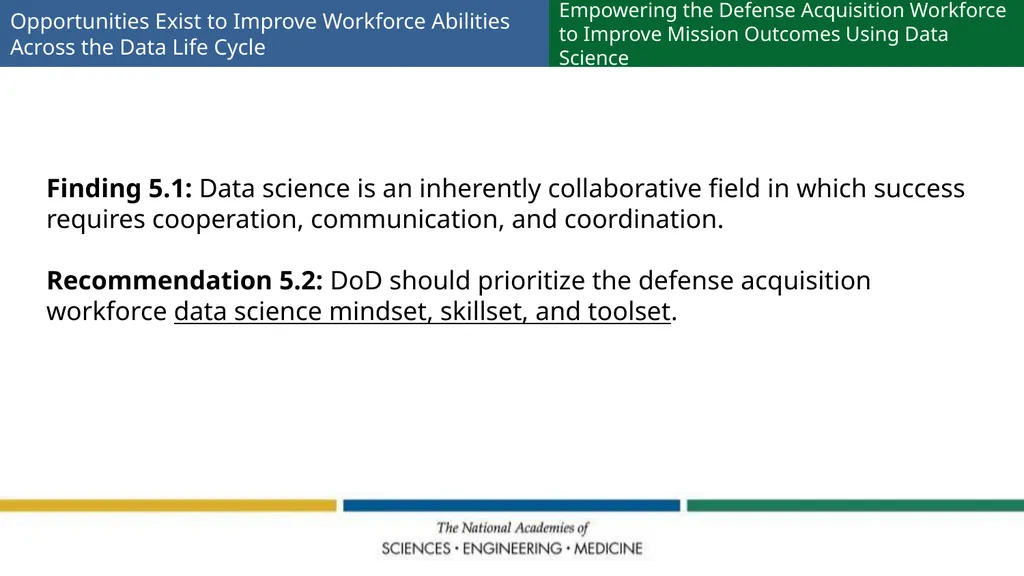
Empowering the Defense Acquisition Workforce to Improve Mission Outcomes Using Data Science Opportunities Exist to Improve Workforce Abilities Across the Data Life Cycle Finding 5.1: Data science is an inherently collaborative field in which success requires cooperation, communication, and coordination.
Recommendation 5.2: DoD should prioritize the defense acquisition workforce data science mindset, skillset, and toolset.<br>
09
Empowering the Defense Acquisition Workforce to Improve Mission Outcomes Using Data Science Data Literacy Skills Are Important Throughout
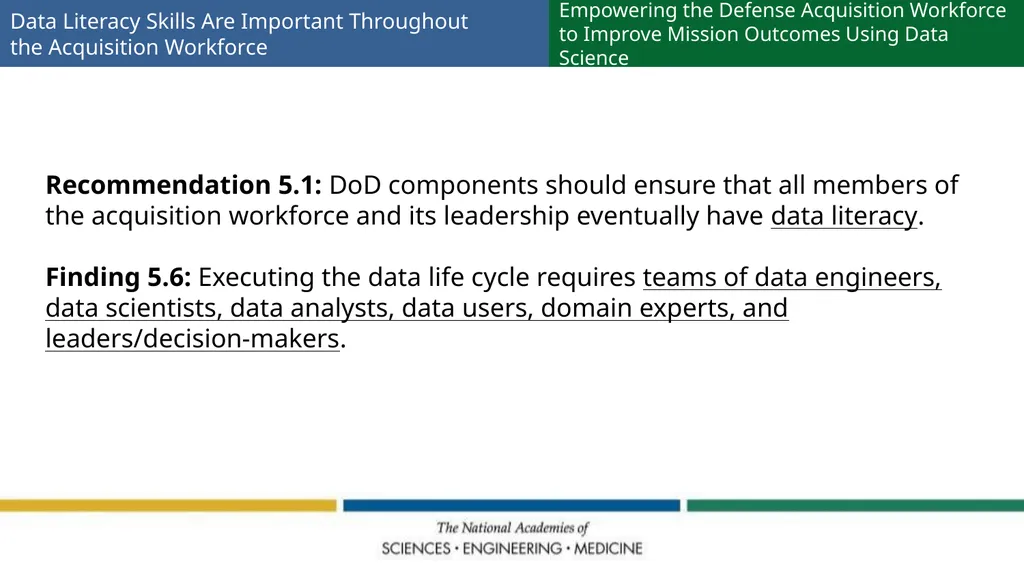
the Acquisition Workforce Recommendation 5.1: DoD components should ensure that all members of the acquisition workforce and its leadership eventually have data literacy.
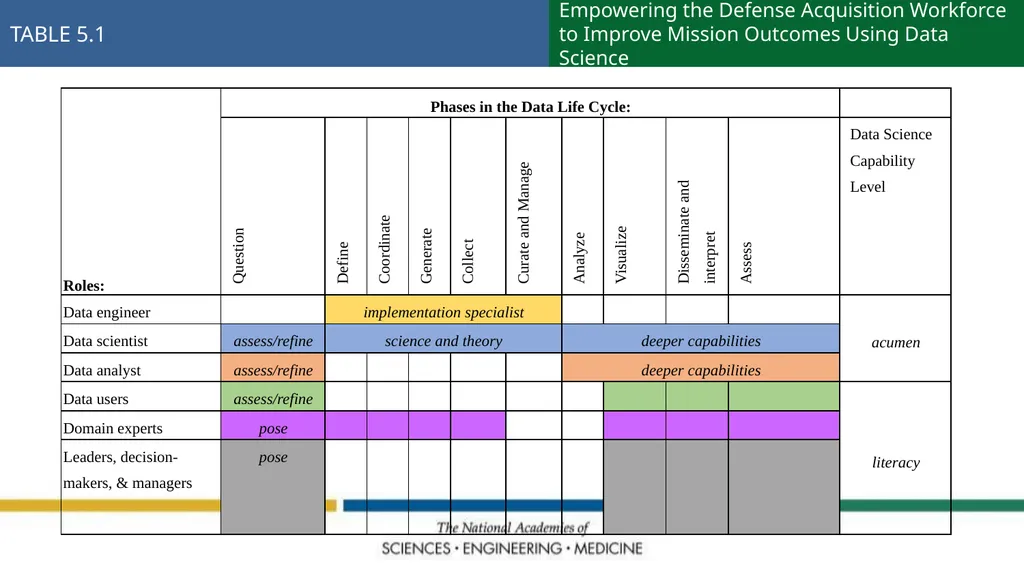
Finding 5.6: Executing the data life cycle requires teams of data engineers, data scientists, data analysts, data users, domain experts, and leaders/decision-makers.<br>
10
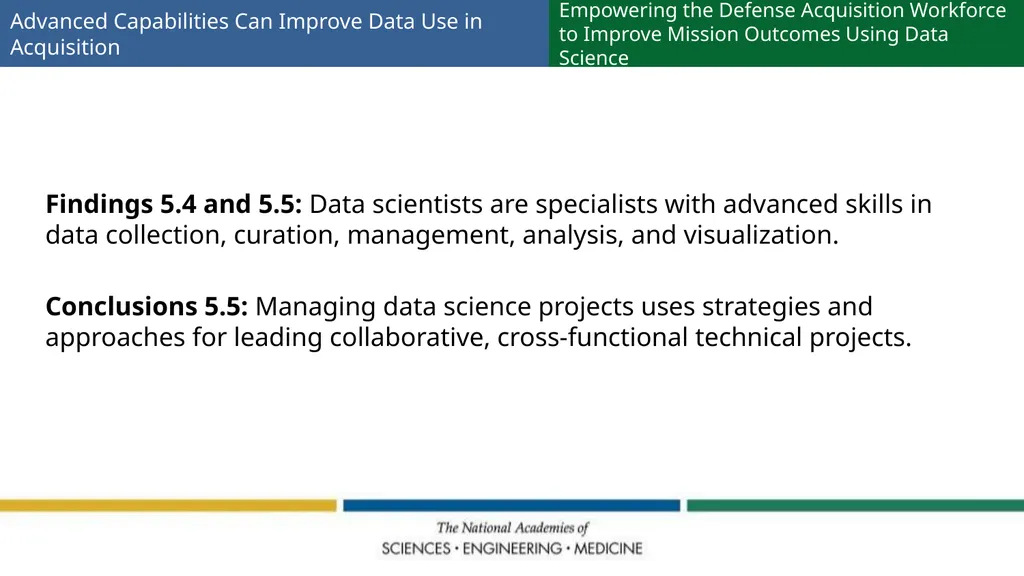
Empowering the Defense Acquisition Workforce to Improve Mission Outcomes Using Data Science Advanced Capabilities Can Improve Data Use in Acquisition Findings 5.4 and 5.5: Data scientists are specialists with advanced skills in data collection, curation, management, analysis, and visualization.
Conclusions 5.5: Managing data science projects uses strategies and approaches for leading collaborative, cross-functional technical projects.<br>
11
Empowering the Defense Acquisition Workforce to Improve Mission Outcomes Using Data Science TABLE 5.1<br>
12
Diverse Training Models Can Increase Data Capabilities
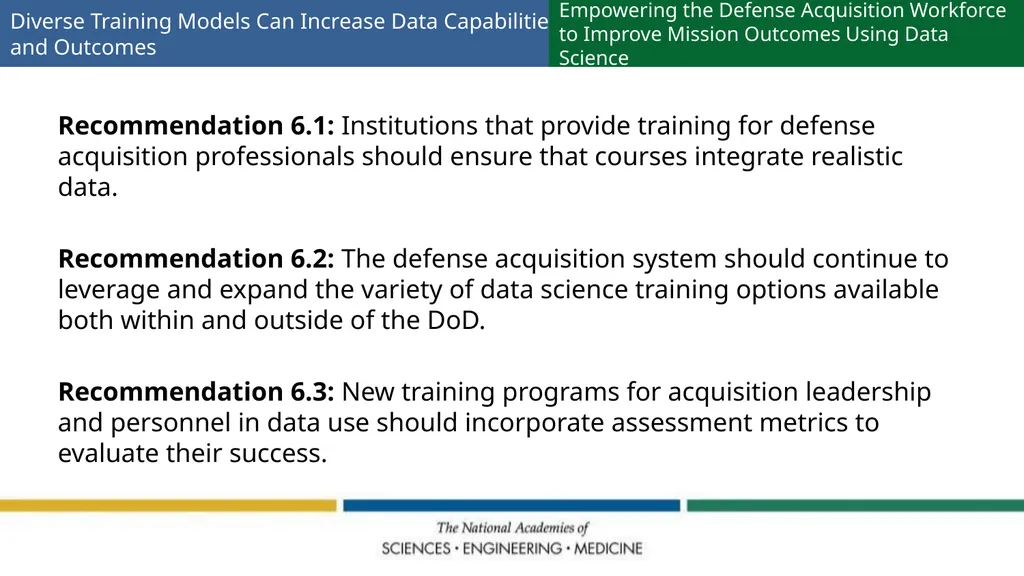
and Outcomes Recommendation 6.1: Institutions that provide training for defense acquisition professionals should ensure that courses integrate realistic data.
Recommendation 6.2: The defense acquisition system should continue to leverage and expand the variety of data science training options available both within and outside of the DoD.
Recommendation 6.3: New training programs for acquisition leadership and personnel in data use should incorporate assessment metrics to evaluate their success. Empowering the Defense Acquisition Workforce to Improve Mission Outcomes Using Data Science<br>
13
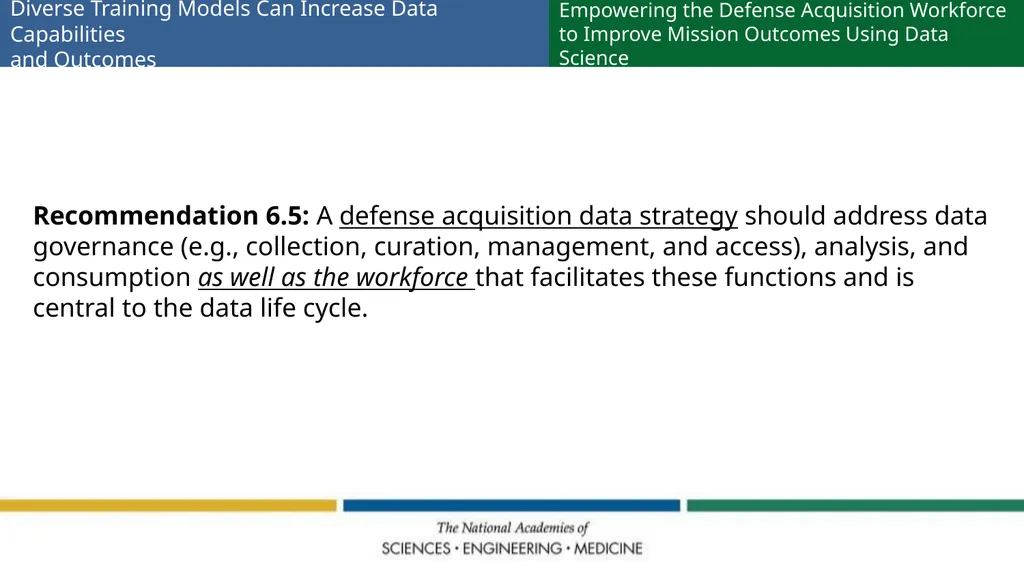
Empowering the Defense Acquisition Workforce to Improve Mission Outcomes Using Data Science Diverse Training Models Can Increase Data Capabilities
and Outcomes Recommendation 6.5: A defense acquisition data strategy should address data governance (e.g., collection, curation, management, and access), analysis, and consumption as well as the workforce that facilitates these functions and is central to the data life cycle.<br>