
Encountering Secular Science Michael Goheen


Description: Encountering Secular Science Michael Goheen Trinity Western University Langley, B.C., Canada Starting with the Gospel Restorative: Good news! God is restoring creation Comprehensive: Good news! God is restoring all of human life in the
Related Topics
Download Presentation
"Encountering Secular Science Michael Goheen" is the property of its rightful owner. Permission is granted to download and print the materials on this website for personal, non-commercial use only, and to display it on your personal computer provided you do not modify the materials and that you retain all copyright notices contained in the materials. By downloading content from our website, you accept the terms of this agreement.
Presentation Transcript
slide1. Encountering Secular Science Michael Goheen
Trinity Western University
Langley, B.C., Canada<br>
slide2. Starting with the Gospel Restorative: Good news! God is restoring creation
Comprehensive: Good news! God is restoring all of human life in the context of all of the creation
Story: Climax of long story of restoration
Mission: Given to church to make known<br>
slide3. The Spirit thrusts God’s people into worldwide mission
He impels young and old, men and women,
To go next door and far away
Into science and art, media and marketplace,
With the good news of God’s grace. . .
Following the apostles, the church is sent–
Sent with the gospel of the kingdom
To tell the news that our world belongs to God. …
In a world estranged from God,
where millions face confusing choices,
this mission is central to our being…
The rule of Jesus Christ covers the whole world.
To follow this Lord is to serve him everywhere,
without fitting in,
as lights in the darkness,
as salt in a spoiling world.<br>
slide4. Starting Observations Education good part of God’s creation
That has been corrupted by sin
Announcement of the kingdom includes education within its scope
Christian community sent to be good news in area of education
Will involve an encounter with education shaped by other idolatrous beliefs<br>
slide5. Gospel will shape every part of educational enterprise including: Purpose of education
Pedagogy
Curriculum
Structures
Leadership
Evaluation
Content of subject matter in various disciplines<br>
slide6. Importance of Ideas So then, just as you received Christ Jesus as Lord, continue to live in him, rooted and built up in him, strengthened in the faith as you were taught, and overflowing with thankfulness. See to it that no one takes you captive through the hollow and deceptive philosophy, which depends on human tradition and the basic principles of this world rather than on Christ.
- Colossian 2.6-8<br>
slide7. Ideas have legs Ideas have legs in the sense that they are not the disembodied abstractions of some ivory-tower academic, but are real spiritual forces that go somewhere, that are on the march in somebody’s army, and that have a widespread effect on our practical, everyday lives.<br>
slide8. Slaves of ideas? The ideas of economists and political philosophers, both when they are right and when they are wrong, are more powerful than is commonly understood. Indeed, the world is ruled by little else. Practical men, who believe themselves to be quite exempt, from any intellectual influences, are usually the slaves of some defunct economist. Madmen in authority, who hear voices in the air, are distilling their frenzy from some academic scribbler of a few years back. I am sure that the power of vested interests is vastly exaggerated compared with the gradual encroachment of ideas. (John Maynard Keynes)<br>
slide9. Power of ideas My point is that in such seemingly innocent-looking words and phrases a whole idolatrous perspective on the world, a whole distorted mind-set and humanistic thought-pattern is subliminally propagated in our civilization.<br>
slide10. Power of secularized scholarship ‘. . . science, secularised and isolated, has become a satanic power, an idol which dominates all of culture.’ (Herman Dooyeweerd)<br>
slide11. Idolatrous spirit of secular science Ideas must be free from all religious commitment
Gospel religious optional extra
‘Dogma-free’ scholarship an illusion
Deeply indebted to humanist religion
Helpful to trace historical roots of secular science<br>
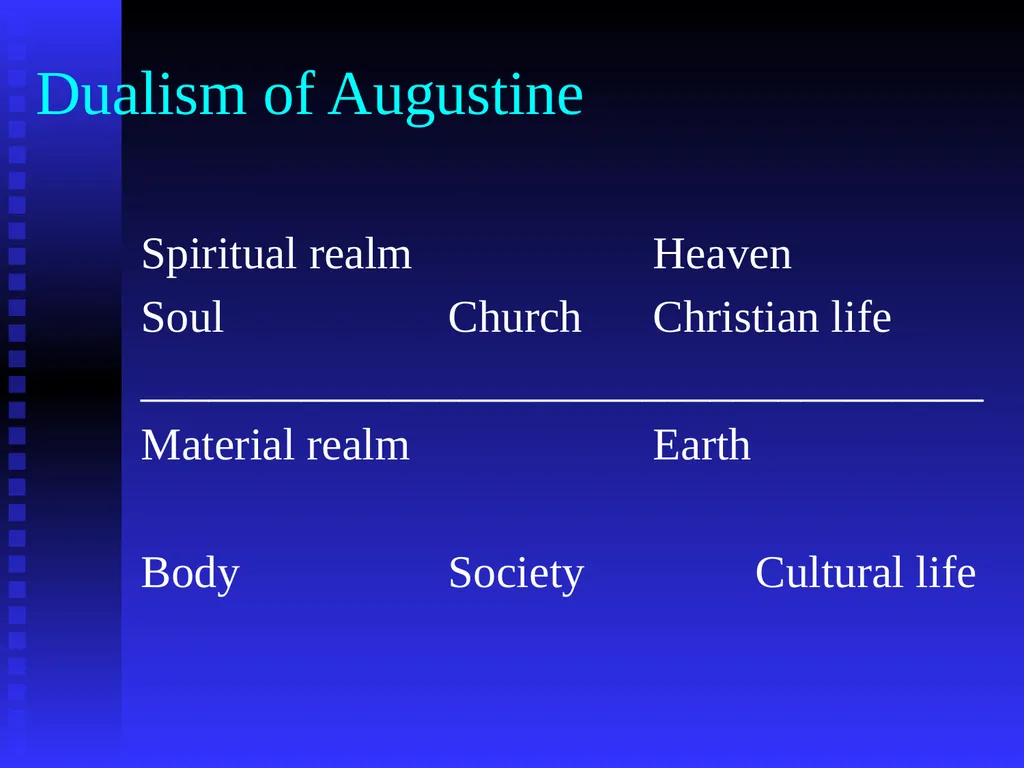
slide12. Dualism of Augustine Spiritual realm Heaven
Soul Church Christian life
_____________________________________
Material realm Earth
Body Society Cultural life<br>
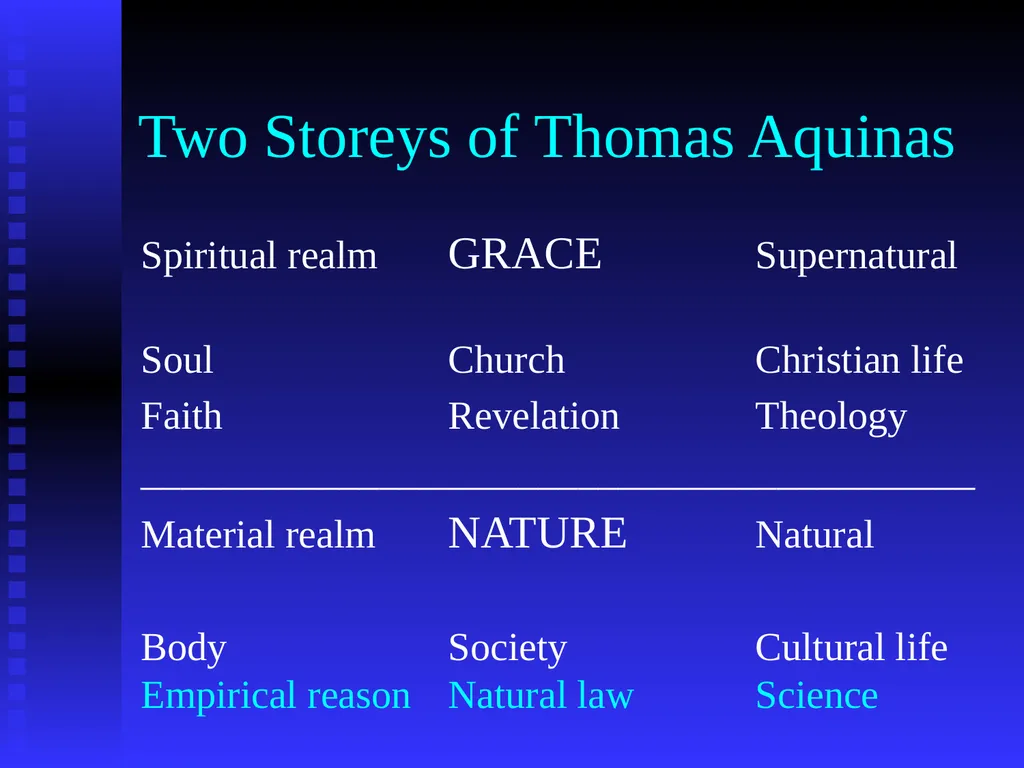
slide15. Two Storeys of Thomas Aquinas Spiritual realm GRACE Supernatural
Soul Church Christian life
Faith Revelation Theology
__________________________________________
Material realm NATURE Natural
Body Society Cultural life Empirical reason Natural law Science<br>
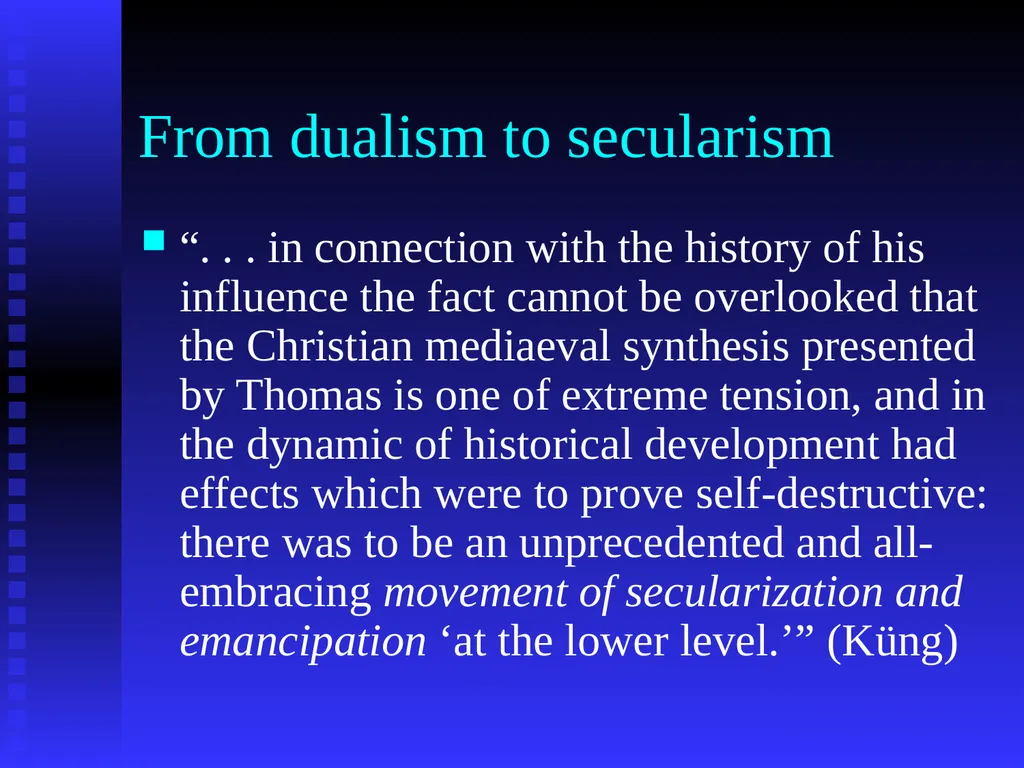
slide16. From dualism to secularism “. . . in connection with the history of his influence the fact cannot be overlooked that the Christian mediaeval synthesis presented by Thomas is one of extreme tension, and in the dynamic of historical development had effects which were to prove self-destructive: there was to be an unprecedented and all-embracing movement of secularization and emancipation ‘at the lower level.’” (Küng)<br>
slide17. Secularism in succeeding centuries While scholastic theologians granted a limited degree of autonomy to the realm of our natural life (and natural reason), the Renaissance humanists so greatly expanded the autonomy of nature that there was no longer any need for the realm of grace. If God and Christianity were already basically irrelevant to most of life, why not make their irrelevance complete? (Walsh and Middleton)<br>
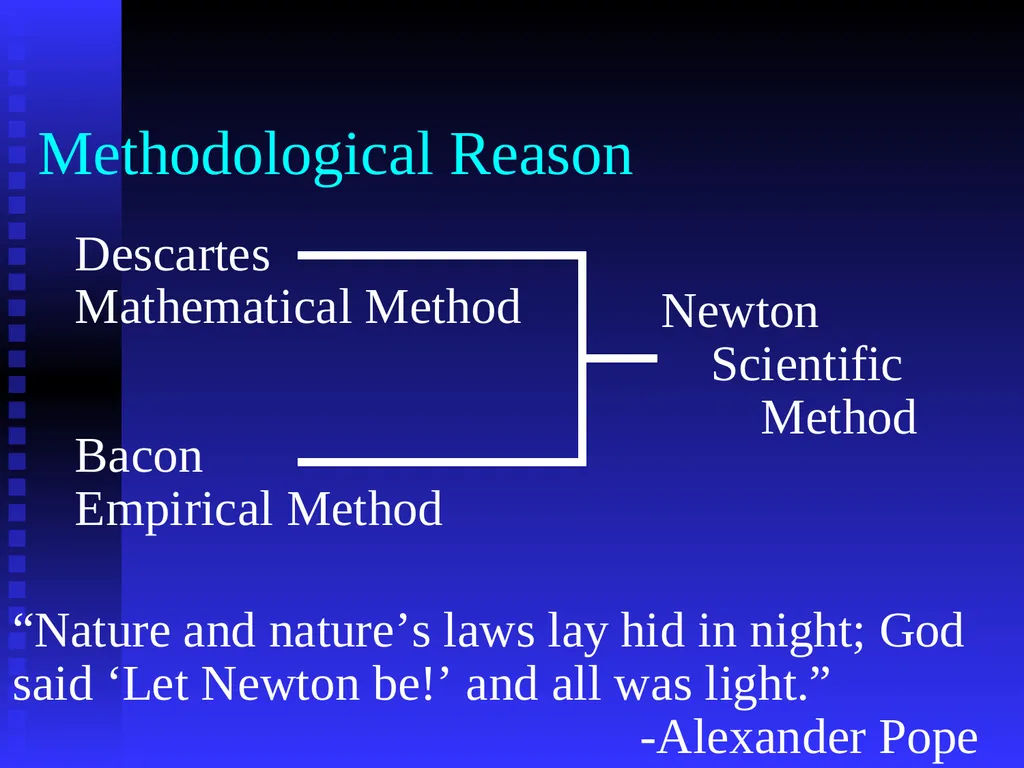
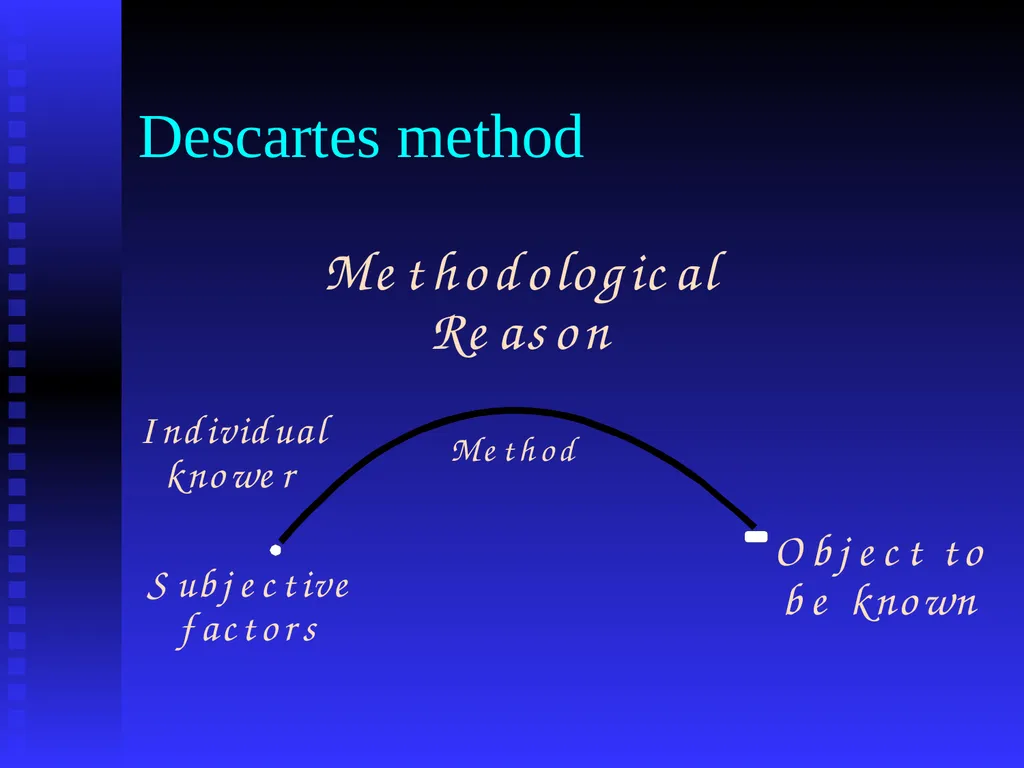
slide18. Methodological Reason<br>
slide19. Triumph of humanist vision Conflict with the church<br>
slide20. He sets the earth on its foundations; it can never be moved (Ps. 104:5).
O sun, stand still... so the sun stood still (Josh. 10:12f.).
The earth remains forever. The sun rises and the sun sets, and hurries back to where it rises (Eccl. 1:4f.).<br>
slide21. People give ear to an upstart astrologer who strove to show that the earth revolves, not the heavens or the firmament, the sun and the moon. Whosoever wishes to appear clever must devise some new system which of all systems, of course, is the best. This fool wishes to reverse the entire science of astronomy; but Sacred Scripture tells us that Joshua commanded the sun to stand still, and not the earth.
-Martin Luther<br>
slide22. The Copernican theory undoubtedly contained a challenge for the Catholic theology. But instead of accepting the challenge and reflecting on faith in a new perspective, the Church opted for an easy conservatism, keeping the enemy at bay by means of its anathemas. This failure to accept the challenge of a new world picture was a great loss to the Church and to Christianity.
-Max Wildiers<br>
slide23. Triumph of humanist vision Conflict with the church<br>
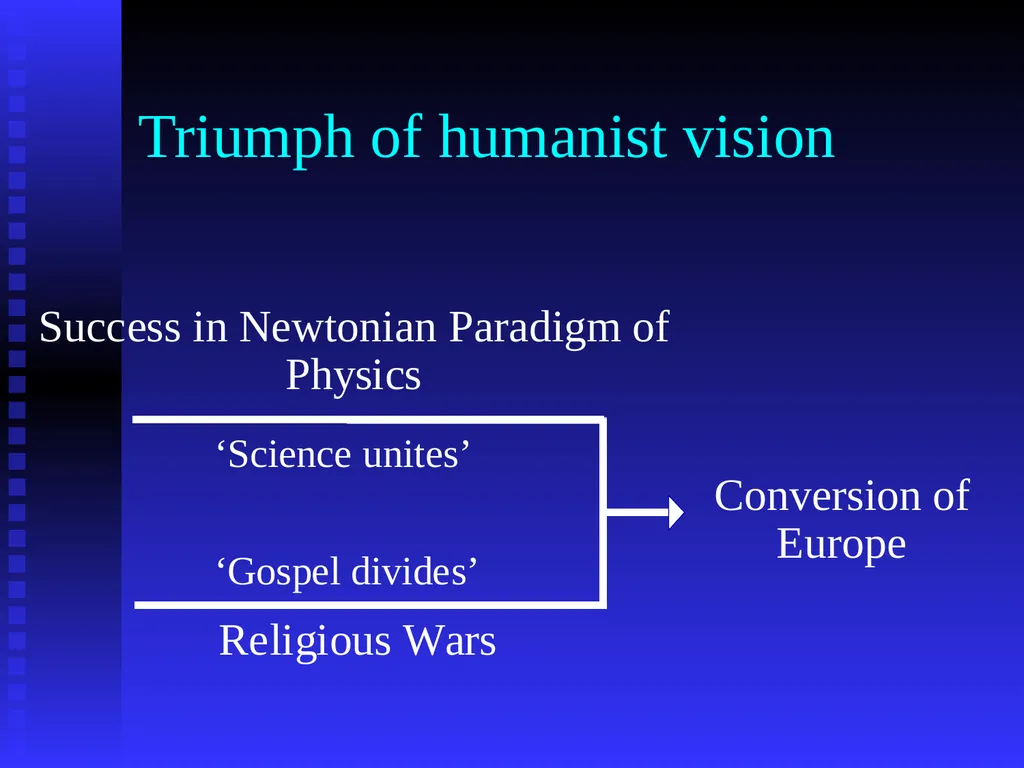
slide24. Triumph of humanist vision<br>
slide25. Historical results Creation separated from presence of God
Natural laws built into creation
Can be discerned by autonomous reason
Controlled to harness laws for social uses
Technology and rational organisation of society<br>
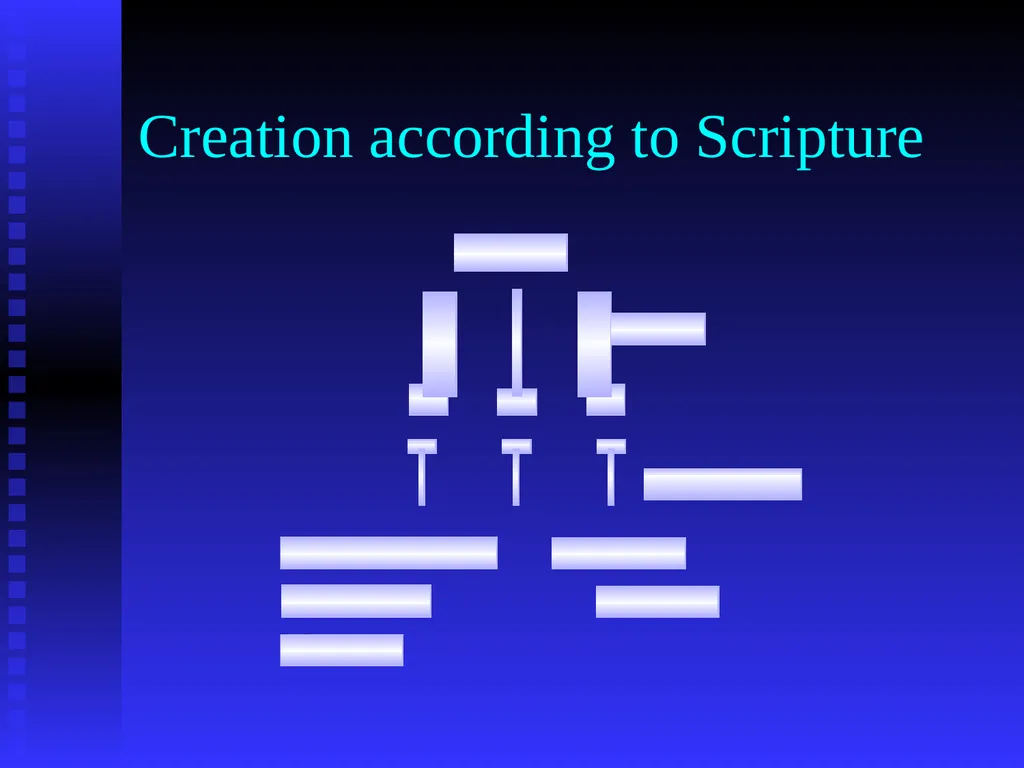
slide26. Creation according to Scripture<br>
slide27. Secular world devoid of God’s presence<br>
slide28. Deistic world devoid of God’s presence<br>
slide29. Descartes method<br>
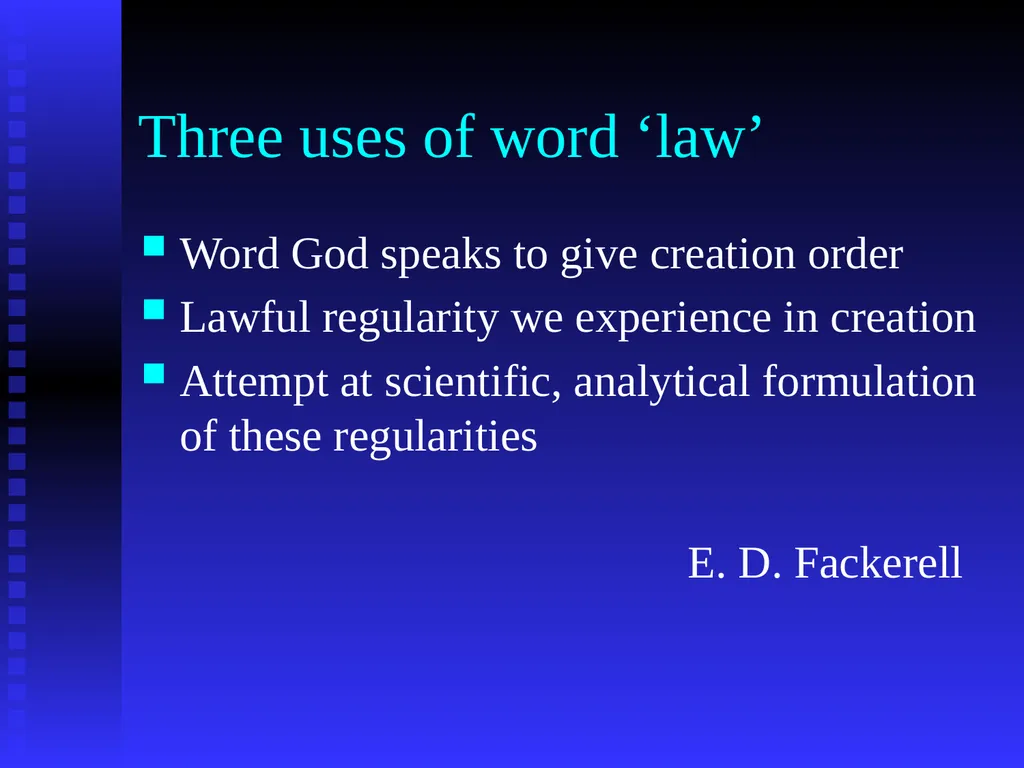
slide30. Three uses of word ‘law’ Word God speaks to give creation order
Lawful regularity we experience in creation
Attempt at scientific, analytical formulation of these regularities
E. D. Fackerell<br>
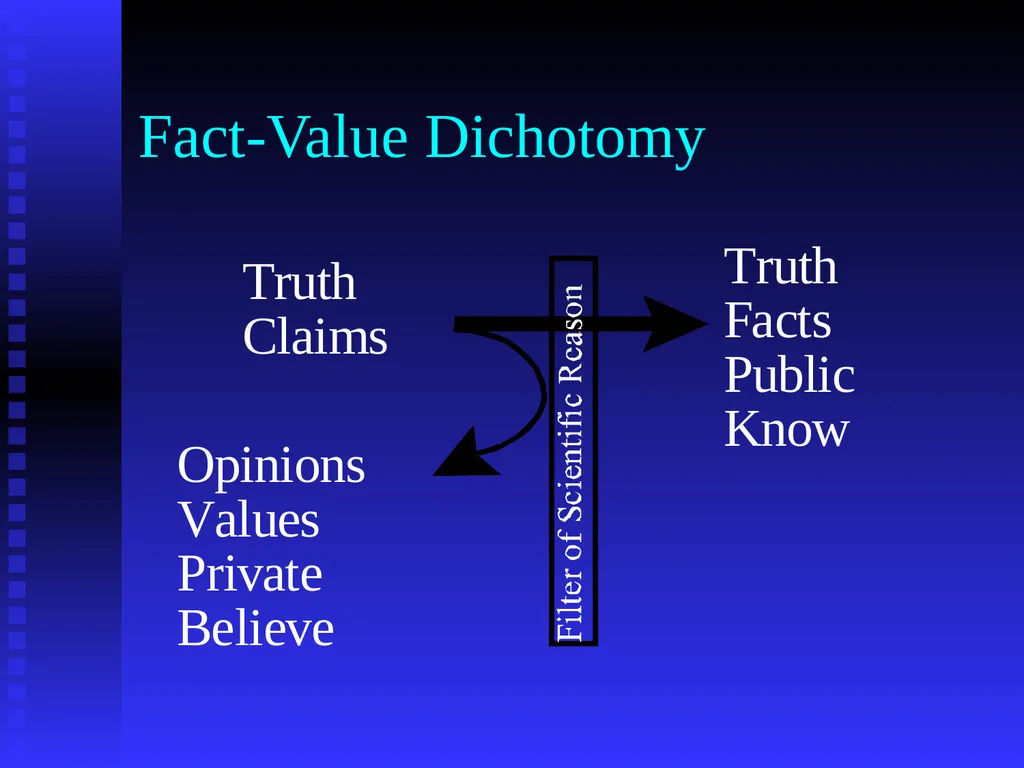
slide31. Fact-Value Dichotomy<br>
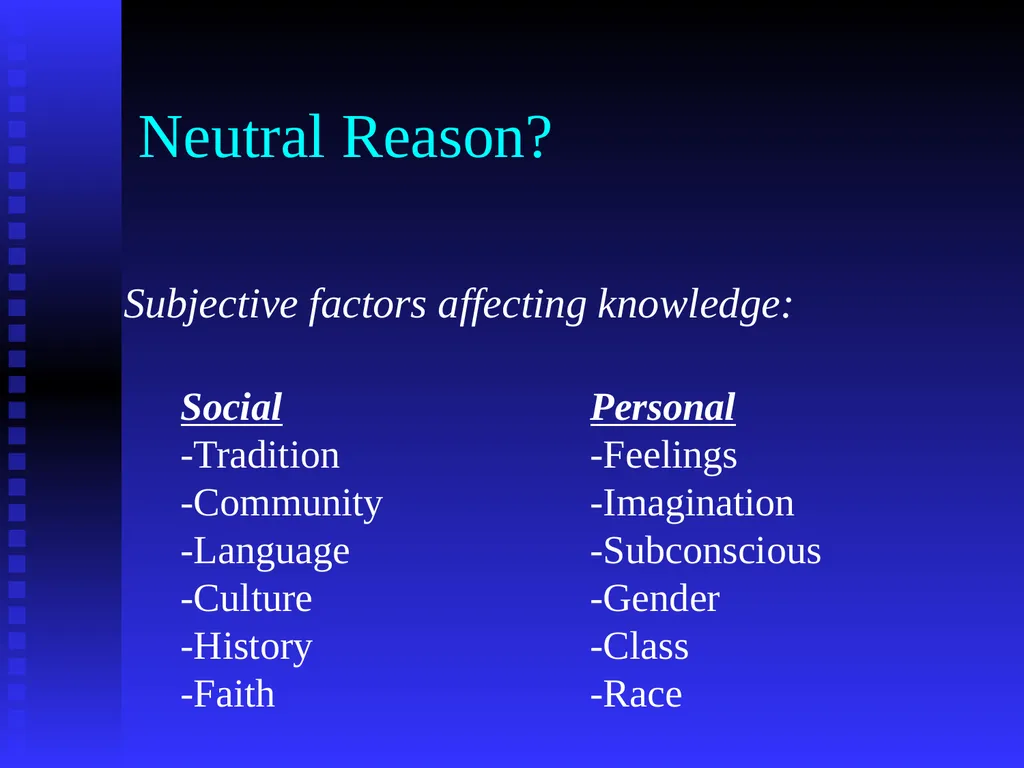
slide32. Neutral Reason? Subjective factors affecting knowledge: Social
-Tradition
-Community
-Language
-Culture
-History
-Faith Personal
-Feelings
-Imagination
-Subconscious
-Gender
-Class
-Race<br>
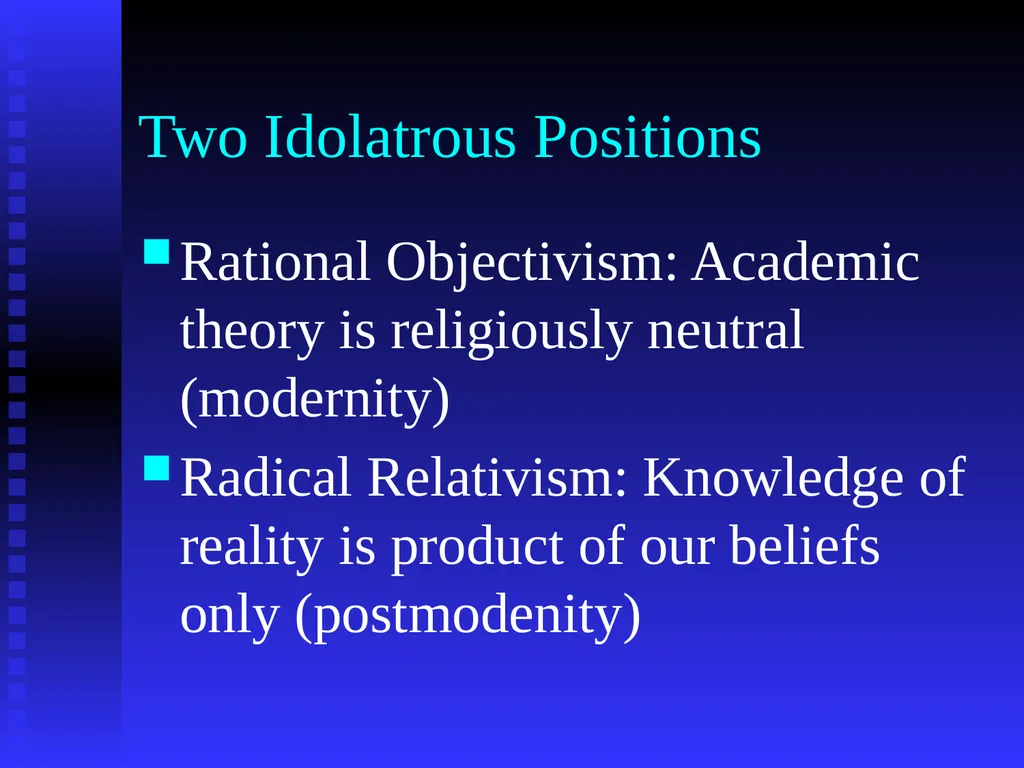
slide33. Two Idolatrous Positions Rational Objectivism: Academic theory is religiously neutral (modernity)
Radical Relativism: Knowledge of reality is product of our beliefs only (postmodenity)<br>
slide34. Testing our times by the Spirit’s sure word But rebel cries sound through our world.
Some, crushed by failure or hardened by pain, give up on life and hope and God;
Others, shaken but still hoping for human triumph, work feverishly to realise their dreams.
As believers in God we join this struggle of the spirits
Testing our times by the Spirit’s sure word<br>
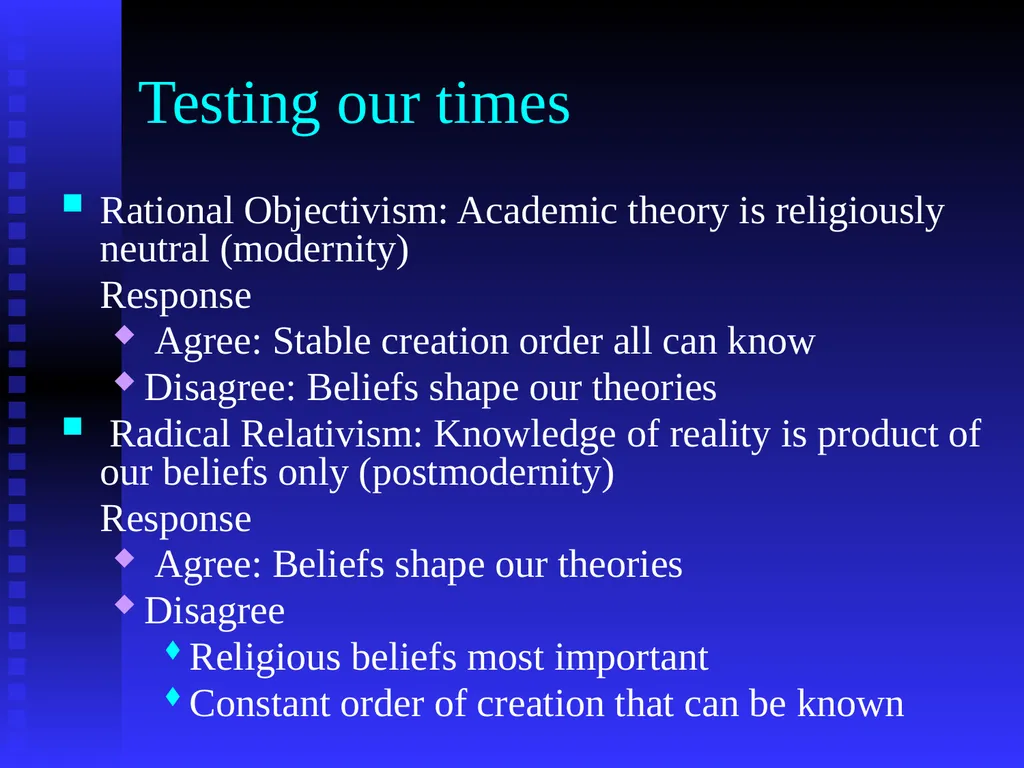
slide35. Testing our times Rational Objectivism: Academic theory is religiously neutral (modernity)
Response
Agree: Stable creation order all can know
Disagree: Beliefs shape our theories
Radical Relativism: Knowledge of reality is product of our beliefs only (postmodernity)
Response
Agree: Beliefs shape our theories
Disagree
Religious beliefs most important
Constant order of creation that can be known<br>
slide36. God’s Ruling Word The Bible shows us a personalistic world, not impersonal law. What we call scientific law is an approximate human description of just how faithfully and consistently God acts in ruling the world by speaking. There is not mathematical, physical, or theoretical cosmic machinery behind what we see and know, holding everything in place. Rather God rules and rules consistently
- Vern Poythress<br>
slide37. Three uses of word ‘law’ Word God speaks to give creation order
Lawful regularity we experience in creation
Attempt at scientific, analytical formulation of these regularities
E. D. Fackerell<br>
slide38. A Biblical Example John’s use of classical pagan thought<br>
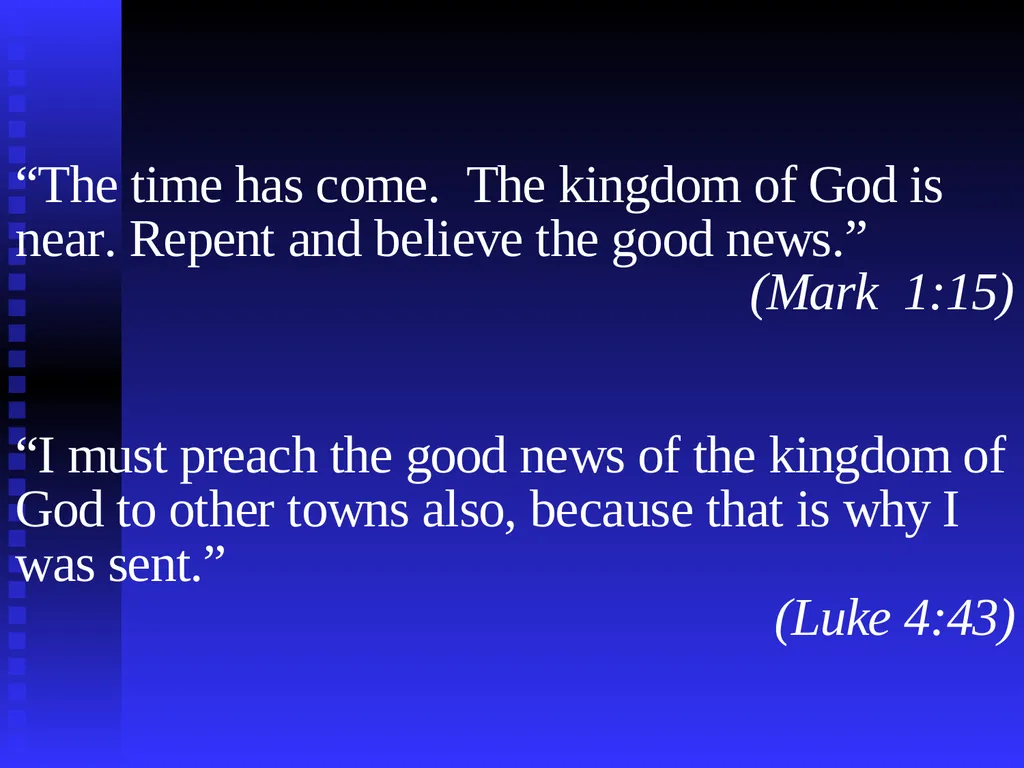
slide40. In the synoptic gospels the Kingdom of God is: Central image for the Jews
Central image for Jesus
Central image for Matthew, Mark, Luke<br>
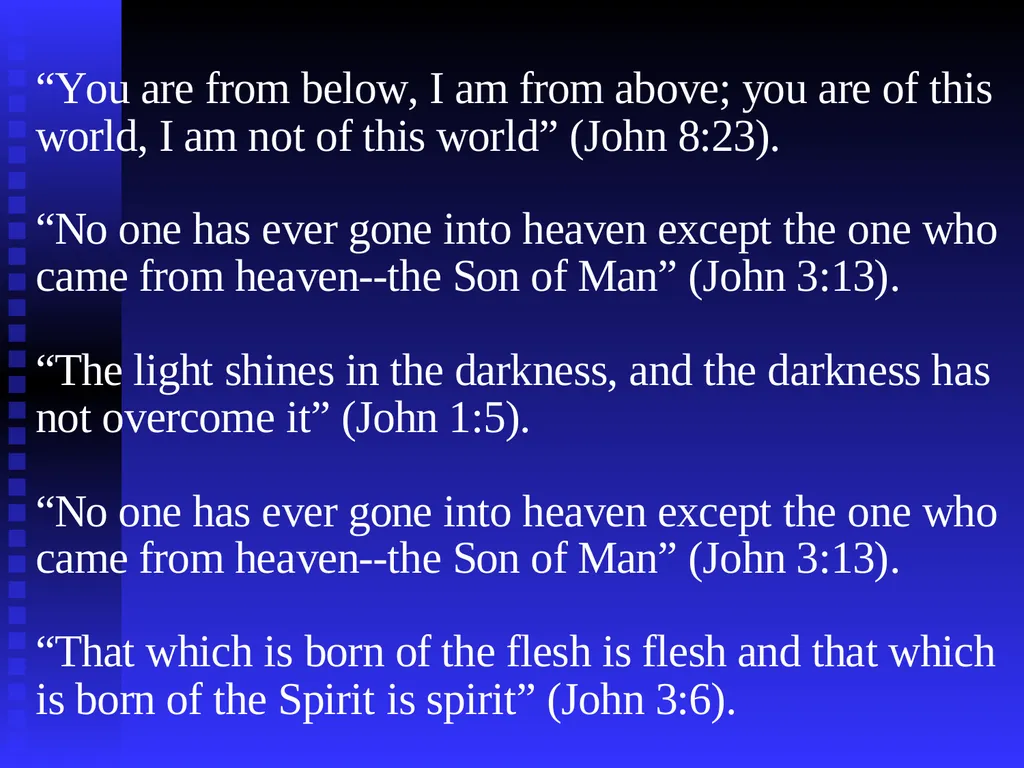
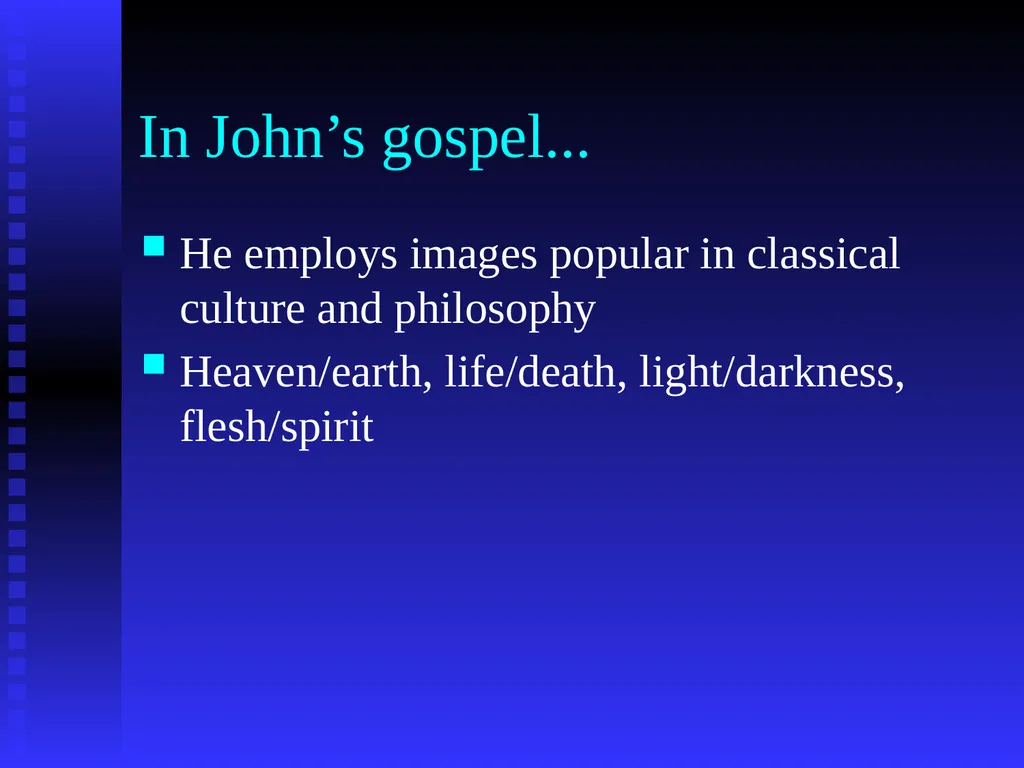
slide42. In John’s gospel... He employs images popular in classical culture and philosophy
Heaven/earth, life/death, light/darkness, flesh/spirit<br>
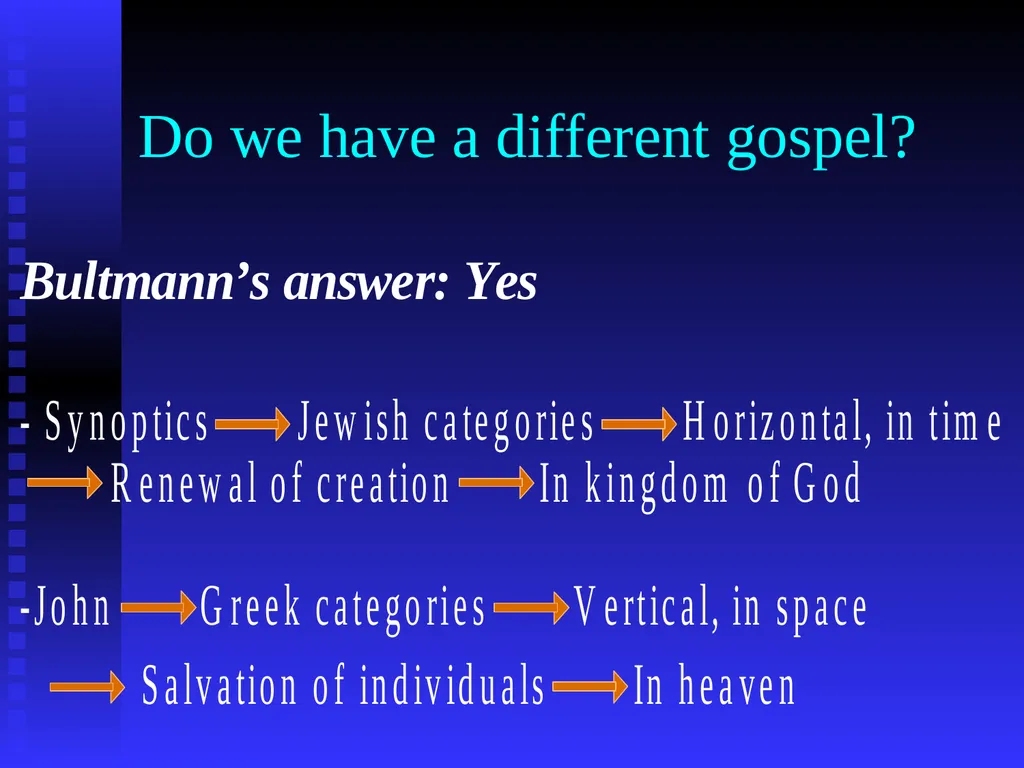
slide43. Do we have a different gospel?<br>
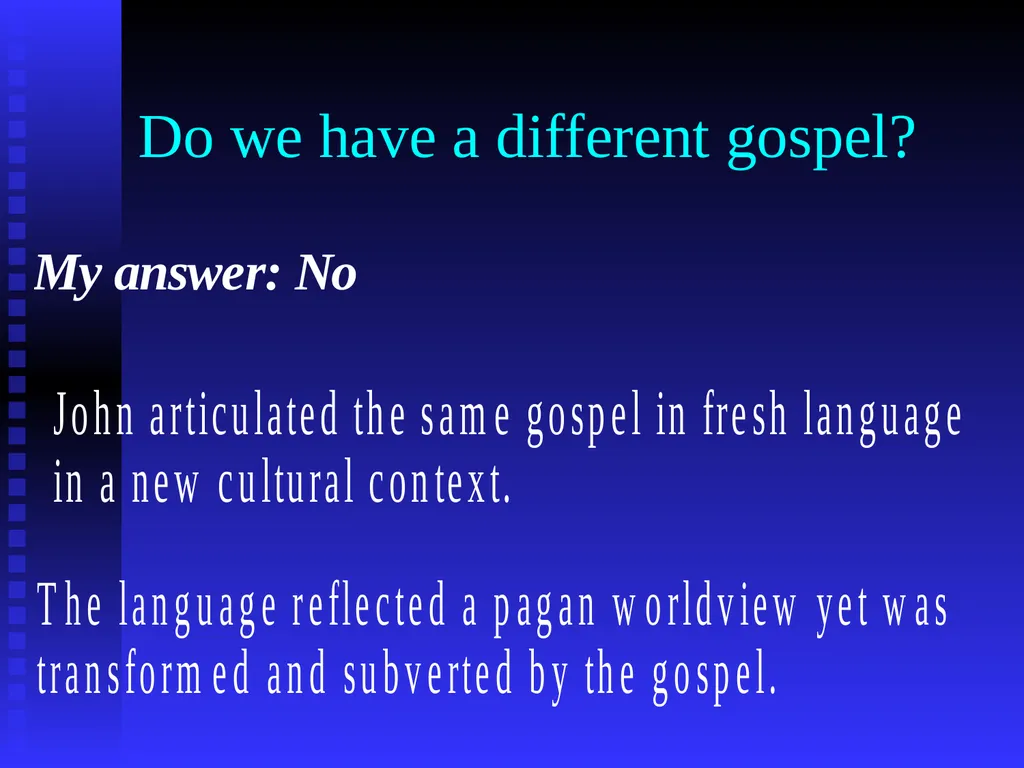
slide44. Do we have a different gospel?<br>
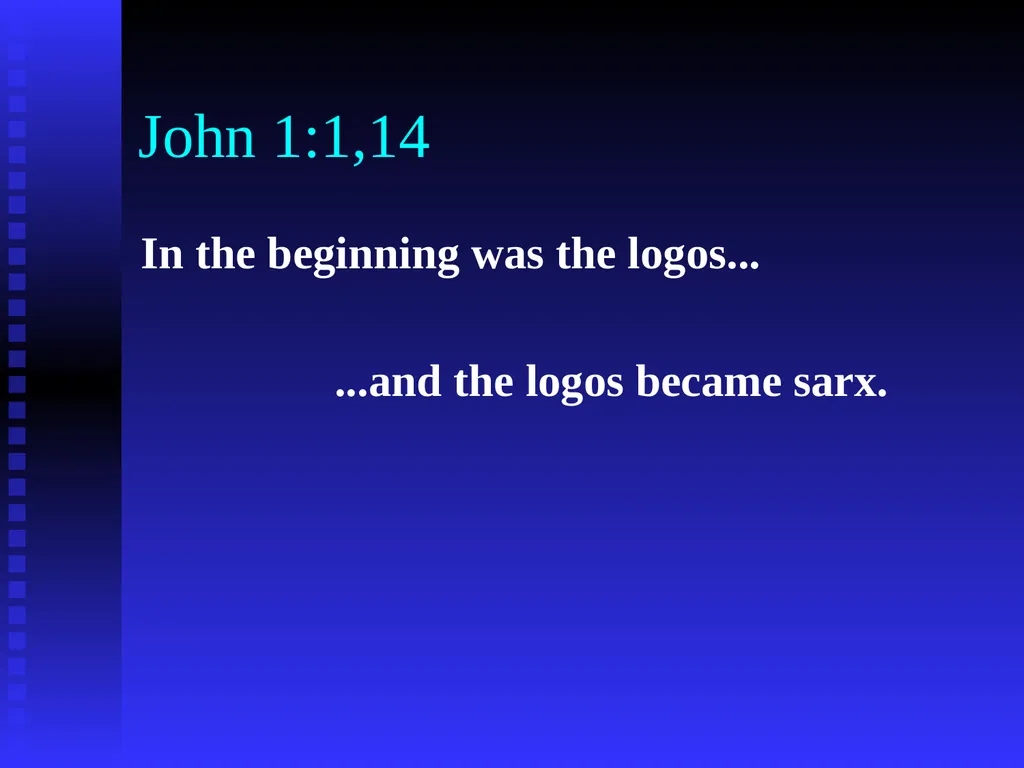
slide45. John 1:1,14 In the beginning was the logos...
...and the logos became sarx.<br>
slide46. Encounter with pagan thought Insight: Order to world
Idolatry: Order not spiritual principle that permeates universe but given by Jesus<br>
slide47. Discernment What is insight into God’s creation?
What is idolatry that twists that insight?<br>
slide48. Christian School Teacher? Deepen our understanding of the Western story and its idolatrous beliefs
Need to tackle this as an educational community
Need for spiritual weapons
Roots into the gospel
Prayer<br>
slide49. Prayer In ‘. . . our vocation to war against the spirit of apostasy . . .’ we cannot ‘battle this spirit in our own power. The warfare to which I refer is one of faith, a struggle even with ourselves, in the power of the Holy Spirit, a struggle which finds its dynamic in a life of prayer.’ (Herman Dooyeweerd)<br>
Trinity Western University
Langley, B.C., Canada<br>
slide2. Starting with the Gospel Restorative: Good news! God is restoring creation
Comprehensive: Good news! God is restoring all of human life in the context of all of the creation
Story: Climax of long story of restoration
Mission: Given to church to make known<br>
slide3. The Spirit thrusts God’s people into worldwide mission
He impels young and old, men and women,
To go next door and far away
Into science and art, media and marketplace,
With the good news of God’s grace. . .
Following the apostles, the church is sent–
Sent with the gospel of the kingdom
To tell the news that our world belongs to God. …
In a world estranged from God,
where millions face confusing choices,
this mission is central to our being…
The rule of Jesus Christ covers the whole world.
To follow this Lord is to serve him everywhere,
without fitting in,
as lights in the darkness,
as salt in a spoiling world.<br>
slide4. Starting Observations Education good part of God’s creation
That has been corrupted by sin
Announcement of the kingdom includes education within its scope
Christian community sent to be good news in area of education
Will involve an encounter with education shaped by other idolatrous beliefs<br>
slide5. Gospel will shape every part of educational enterprise including: Purpose of education
Pedagogy
Curriculum
Structures
Leadership
Evaluation
Content of subject matter in various disciplines<br>
slide6. Importance of Ideas So then, just as you received Christ Jesus as Lord, continue to live in him, rooted and built up in him, strengthened in the faith as you were taught, and overflowing with thankfulness. See to it that no one takes you captive through the hollow and deceptive philosophy, which depends on human tradition and the basic principles of this world rather than on Christ.
- Colossian 2.6-8<br>
slide7. Ideas have legs Ideas have legs in the sense that they are not the disembodied abstractions of some ivory-tower academic, but are real spiritual forces that go somewhere, that are on the march in somebody’s army, and that have a widespread effect on our practical, everyday lives.<br>
slide8. Slaves of ideas? The ideas of economists and political philosophers, both when they are right and when they are wrong, are more powerful than is commonly understood. Indeed, the world is ruled by little else. Practical men, who believe themselves to be quite exempt, from any intellectual influences, are usually the slaves of some defunct economist. Madmen in authority, who hear voices in the air, are distilling their frenzy from some academic scribbler of a few years back. I am sure that the power of vested interests is vastly exaggerated compared with the gradual encroachment of ideas. (John Maynard Keynes)<br>
slide9. Power of ideas My point is that in such seemingly innocent-looking words and phrases a whole idolatrous perspective on the world, a whole distorted mind-set and humanistic thought-pattern is subliminally propagated in our civilization.<br>
slide10. Power of secularized scholarship ‘. . . science, secularised and isolated, has become a satanic power, an idol which dominates all of culture.’ (Herman Dooyeweerd)<br>
slide11. Idolatrous spirit of secular science Ideas must be free from all religious commitment
Gospel religious optional extra
‘Dogma-free’ scholarship an illusion
Deeply indebted to humanist religion
Helpful to trace historical roots of secular science<br>
slide12. Dualism of Augustine Spiritual realm Heaven
Soul Church Christian life
_____________________________________
Material realm Earth
Body Society Cultural life<br>
slide15. Two Storeys of Thomas Aquinas Spiritual realm GRACE Supernatural
Soul Church Christian life
Faith Revelation Theology
__________________________________________
Material realm NATURE Natural
Body Society Cultural life Empirical reason Natural law Science<br>
slide16. From dualism to secularism “. . . in connection with the history of his influence the fact cannot be overlooked that the Christian mediaeval synthesis presented by Thomas is one of extreme tension, and in the dynamic of historical development had effects which were to prove self-destructive: there was to be an unprecedented and all-embracing movement of secularization and emancipation ‘at the lower level.’” (Küng)<br>
slide17. Secularism in succeeding centuries While scholastic theologians granted a limited degree of autonomy to the realm of our natural life (and natural reason), the Renaissance humanists so greatly expanded the autonomy of nature that there was no longer any need for the realm of grace. If God and Christianity were already basically irrelevant to most of life, why not make their irrelevance complete? (Walsh and Middleton)<br>
slide18. Methodological Reason<br>
slide19. Triumph of humanist vision Conflict with the church<br>
slide20. He sets the earth on its foundations; it can never be moved (Ps. 104:5).
O sun, stand still... so the sun stood still (Josh. 10:12f.).
The earth remains forever. The sun rises and the sun sets, and hurries back to where it rises (Eccl. 1:4f.).<br>
slide21. People give ear to an upstart astrologer who strove to show that the earth revolves, not the heavens or the firmament, the sun and the moon. Whosoever wishes to appear clever must devise some new system which of all systems, of course, is the best. This fool wishes to reverse the entire science of astronomy; but Sacred Scripture tells us that Joshua commanded the sun to stand still, and not the earth.
-Martin Luther<br>
slide22. The Copernican theory undoubtedly contained a challenge for the Catholic theology. But instead of accepting the challenge and reflecting on faith in a new perspective, the Church opted for an easy conservatism, keeping the enemy at bay by means of its anathemas. This failure to accept the challenge of a new world picture was a great loss to the Church and to Christianity.
-Max Wildiers<br>
slide23. Triumph of humanist vision Conflict with the church<br>
slide24. Triumph of humanist vision<br>
slide25. Historical results Creation separated from presence of God
Natural laws built into creation
Can be discerned by autonomous reason
Controlled to harness laws for social uses
Technology and rational organisation of society<br>
slide26. Creation according to Scripture<br>
slide27. Secular world devoid of God’s presence<br>
slide28. Deistic world devoid of God’s presence<br>
slide29. Descartes method<br>
slide30. Three uses of word ‘law’ Word God speaks to give creation order
Lawful regularity we experience in creation
Attempt at scientific, analytical formulation of these regularities
E. D. Fackerell<br>
slide31. Fact-Value Dichotomy<br>
slide32. Neutral Reason? Subjective factors affecting knowledge: Social
-Tradition
-Community
-Language
-Culture
-History
-Faith Personal
-Feelings
-Imagination
-Subconscious
-Gender
-Class
-Race<br>
slide33. Two Idolatrous Positions Rational Objectivism: Academic theory is religiously neutral (modernity)
Radical Relativism: Knowledge of reality is product of our beliefs only (postmodenity)<br>
slide34. Testing our times by the Spirit’s sure word But rebel cries sound through our world.
Some, crushed by failure or hardened by pain, give up on life and hope and God;
Others, shaken but still hoping for human triumph, work feverishly to realise their dreams.
As believers in God we join this struggle of the spirits
Testing our times by the Spirit’s sure word<br>
slide35. Testing our times Rational Objectivism: Academic theory is religiously neutral (modernity)
Response
Agree: Stable creation order all can know
Disagree: Beliefs shape our theories
Radical Relativism: Knowledge of reality is product of our beliefs only (postmodernity)
Response
Agree: Beliefs shape our theories
Disagree
Religious beliefs most important
Constant order of creation that can be known<br>
slide36. God’s Ruling Word The Bible shows us a personalistic world, not impersonal law. What we call scientific law is an approximate human description of just how faithfully and consistently God acts in ruling the world by speaking. There is not mathematical, physical, or theoretical cosmic machinery behind what we see and know, holding everything in place. Rather God rules and rules consistently
- Vern Poythress<br>
slide37. Three uses of word ‘law’ Word God speaks to give creation order
Lawful regularity we experience in creation
Attempt at scientific, analytical formulation of these regularities
E. D. Fackerell<br>
slide38. A Biblical Example John’s use of classical pagan thought<br>
slide40. In the synoptic gospels the Kingdom of God is: Central image for the Jews
Central image for Jesus
Central image for Matthew, Mark, Luke<br>
slide42. In John’s gospel... He employs images popular in classical culture and philosophy
Heaven/earth, life/death, light/darkness, flesh/spirit<br>
slide43. Do we have a different gospel?<br>
slide44. Do we have a different gospel?<br>
slide45. John 1:1,14 In the beginning was the logos...
...and the logos became sarx.<br>
slide46. Encounter with pagan thought Insight: Order to world
Idolatry: Order not spiritual principle that permeates universe but given by Jesus<br>
slide47. Discernment What is insight into God’s creation?
What is idolatry that twists that insight?<br>
slide48. Christian School Teacher? Deepen our understanding of the Western story and its idolatrous beliefs
Need to tackle this as an educational community
Need for spiritual weapons
Roots into the gospel
Prayer<br>
slide49. Prayer In ‘. . . our vocation to war against the spirit of apostasy . . .’ we cannot ‘battle this spirit in our own power. The warfare to which I refer is one of faith, a struggle even with ourselves, in the power of the Holy Spirit, a struggle which finds its dynamic in a life of prayer.’ (Herman Dooyeweerd)<br>