Endothelial keratoplasty versus penetrating keratoplasty for Fuchs endothelial dystrophy Mayank A Nanavasty, Xue Wang, Alex J Shortt Issue 2, 2014 A presentation to: Meeting name Date Table of Contents 01: Background Fuchs endothelial
"Endothelial keratoplasty versus penetrating" is the property of its rightful owner. Permission is granted to
download and print the materials on this website for personal, non-commercial use only, and to display it
on your personal computer provided you do not modify the materials and that you retain all copyright
notices contained in the materials. By downloading content from our website, you accept the terms of this
agreement.
Presentation Transcript
01
Endothelial keratoplasty versus penetrating keratoplasty for Fuchs endothelial dystrophy Mayank A Nanavasty, Xue Wang, Alex J Shortt Issue 2, 2014 A presentation to:
Meeting name
Date<br>
02
Table of Contents<br>
03
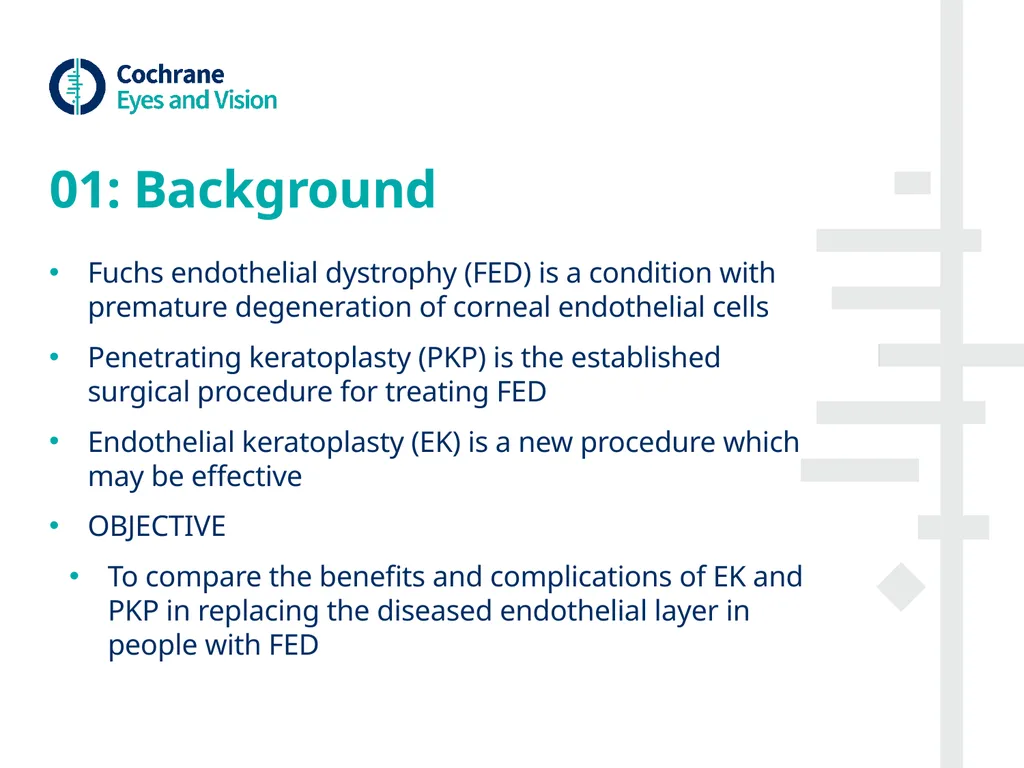
01: Background Fuchs endothelial dystrophy (FED) is a condition with premature degeneration of corneal endothelial cells
Penetrating keratoplasty (PKP) is the established surgical procedure for treating FED
Endothelial keratoplasty (EK) is a new procedure which may be effective
OBJECTIVE
To compare the benefits and complications of EK and PKP in replacing the diseased endothelial layer in people with FED<br>
04
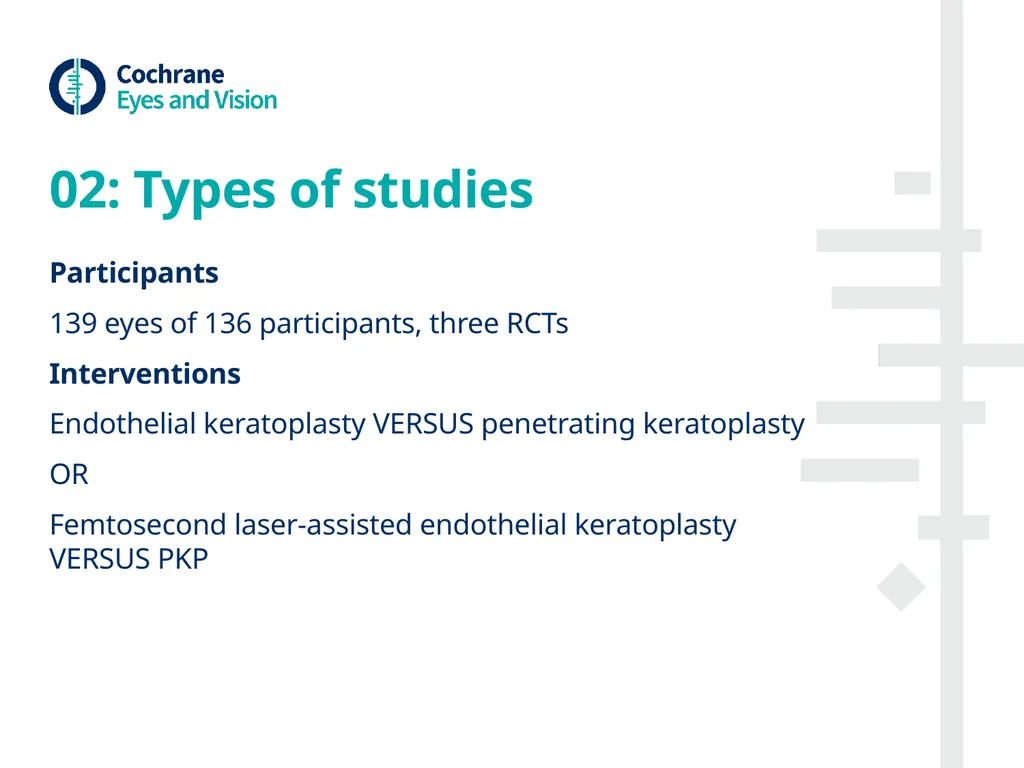
02: Types of studies Participants
139 eyes of 136 participants, three RCTs
Interventions
Endothelial keratoplasty VERSUS penetrating keratoplasty
OR
Femtosecond laser-assisted endothelial keratoplasty VERSUS PKP<br>
05
03: Key results “The RCTs comparing EK with PKP did not show any significant differences between procedures with respect to best corrected visual acuity (BCVA) at two years…”
MD 0.14 logMAR, 95% CI -0.08 to 0.36, P=0.23
“Only one RCT reported on irregular astigmatism (higher-order aberration), which was less with EK than PKP…”
MD -1.20 µm; 95% CI -1.53 to -0.87; P < 0.001<br>
06
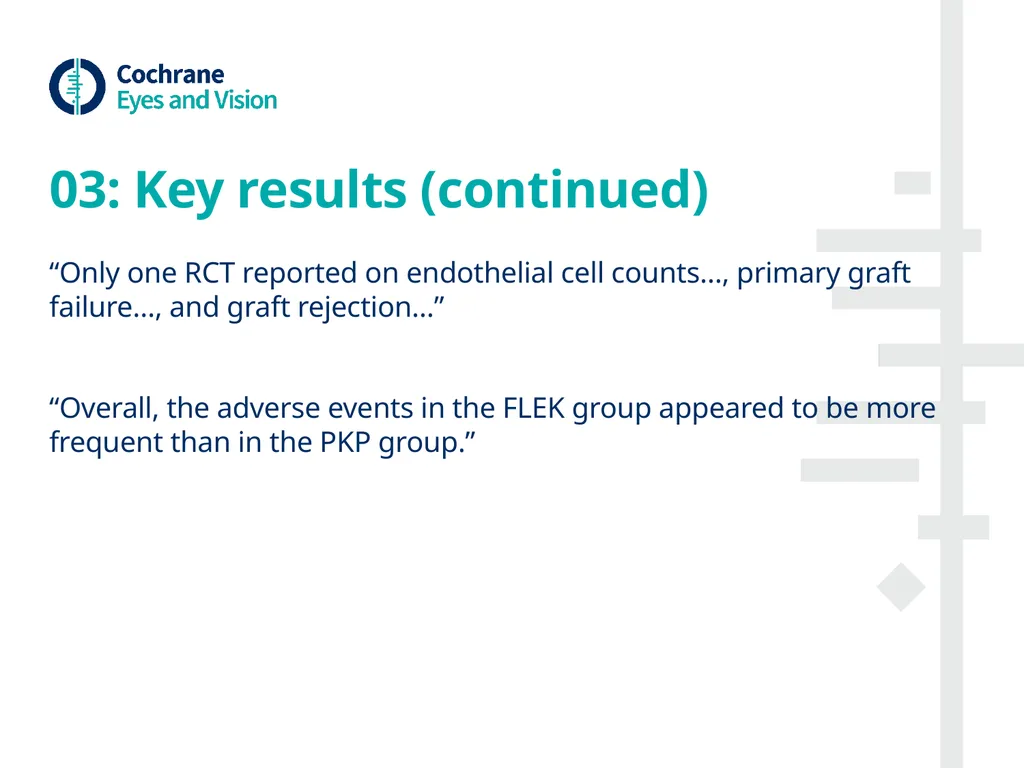
03: Key results (continued) “Only one RCT reported on endothelial cell counts…, primary graft failure…, and graft rejection…”
“Overall, the adverse events in the FLEK group appeared to be more frequent than in the PKP group.”<br>
07
03: Key results (continued)<br>
08
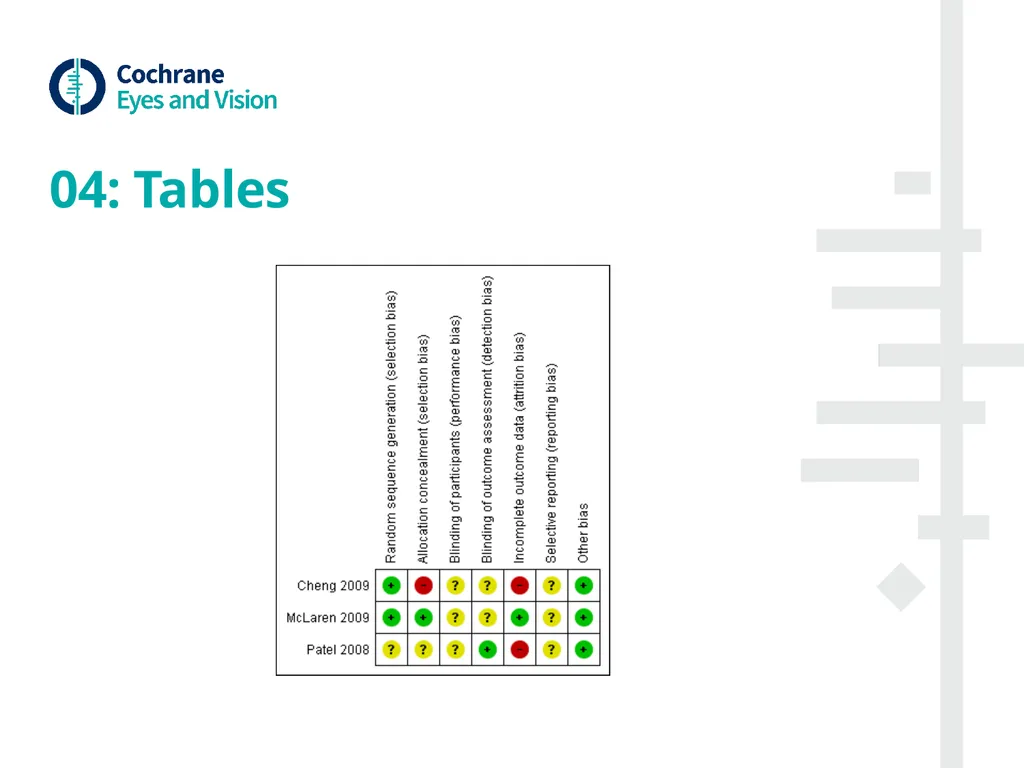
04: Tables<br>
09
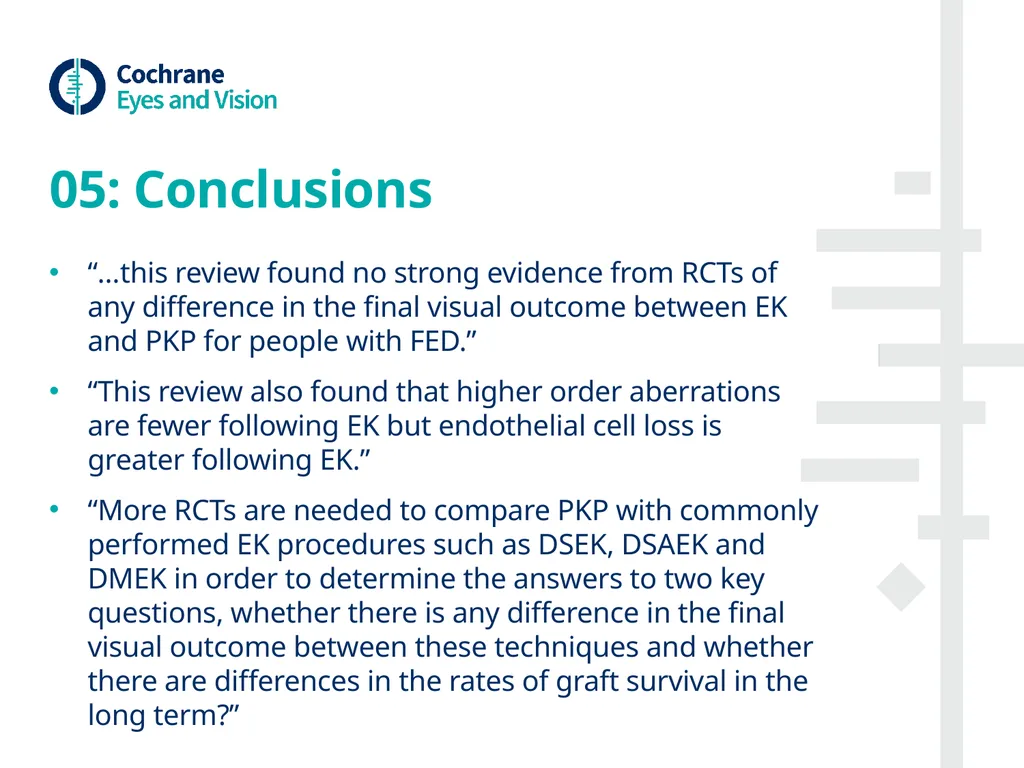
05: Conclusions “…this review found no strong evidence from RCTs of any difference in the final visual outcome between EK and PKP for people with FED.”
“This review also found that higher order aberrations are fewer following EK but endothelial cell loss is greater following EK.”
“More RCTs are needed to compare PKP with commonly performed EK procedures such as DSEK, DSAEK and DMEK in order to determine the answers to two key questions, whether there is any difference in the final visual outcome between these techniques and whether there are differences in the rates of graft survival in the long term?”<br>
10
06: Acknowledgements Cochrane Eyes and Vision US Satellite, funded by the National Eye Institute, National Institutes of Health
Cochrane Eyes and Vision Editorial Base, funded by the UK National Health Service Research and Development Programme
Mayank A Nanavasty, Xue Wang, Alex J Shortt
Review citation
Nanavaty MA, Wang X, Shortt AJ. Endothelial keratoplasty versus penetrating keratoplasty for Fuchs endothelial dystrophy. Cochrane Database of Systematic Reviews 2014, Issue 2. Art. No.: CD008420. DOI: 10.1002/14651858.CD008420.pub3<br>