Energy Efficiency Policy for Data Centres in Japan Workshop of Energy Efficiency Label for Data Centres 14 May 2025 in Copenhagen Dr. Tohru Shimizu, senior researcher, Climate Change Policy Group Climate Change and Energy Efficiency Unit,
"Energy Efficiency Policy for Data Centres in Japan" is the property of its rightful owner. Permission is granted to
download and print the materials on this website for personal, non-commercial use only, and to display it
on your personal computer provided you do not modify the materials and that you retain all copyright
notices contained in the materials. By downloading content from our website, you accept the terms of this
agreement.
Presentation Transcript
01
Energy Efficiency Policy for Data Centres in Japan Workshop of Energy Efficiency Label for Data Centres
14 May 2025 in Copenhagen
Dr. Tohru Shimizu, senior researcher, Climate Change Policy Group
Climate Change and Energy Efficiency Unit, The Institute of Energy Economics, Japan (IEEJ)
tohru.shimizu@tky.ieej.or.jp 1<br>
02
Act on Rationalization of Energy Use and Shift to Non-fossil Energy Outline of Act for data center operators
A Data center operator whose energy consumption exceeds 1,500 kiloliters of oil equivalent (kl-toe) per year is a designated business operator.
If the data center operator becomes a designated business operator;
Periodical reporting on energy use and energy conservation/efficiency implementation by operators
Energy use
Fuel: Crude oil and volatile oil (gasoline), heavy oil, and other petroleum products, Natural gas, Coal, cokes, and other coal products
Heat: Generated from the above fuel (steam, hot water, cold water, etc.)
Electricity: Generated from the above fuels
Non-fossil energy use in the data center
Energy conservation and efficiency efforts in the data center
Implement demand response as requested by the grid transmission operator or the aggregation operators
The plan of energy conservation and shift to non-fossil energy
Submission of mid- and long-term plans (3-5 years)
How to improve energy intensity in the next 3 to 5 years (Guidance targeted at an average 1% per year improvement in 5 years)
And METI had introduced benchmarking for data center operators in 2022 2<br>
03
Benchmarking for data center operator Benchmark Indicator: Power Usage Effectiveness (Total energy consumption (kWh) in the data centre divided by the total energy consumption (kWh) of IT equipment in the data centre.)
Target Year: 2030
Target level: PUE 1.4 or lower (top 15% of survey results for 2020)
specified business operator and sites:
Data centre operators (businesses that operate or use data centres and provide some of the equipment or functions related to information processing)
Businesses whose annual energy consumption from data centre operations alone is 1,500 kilolitres-toe or more
Businesses that have some or all of the energy management authorised rights for the ‘buildings and ancillary facilities’ of data centres
business sites are
Data centres used for information processing-related lending purposes
Facilities that have been in operation throughout the performance year (periodical reporting period)
Facilities with a total server room area of less than 300 square metres may be excluded from the scope.
Measurement: Japan Data Center Council (JDCC) “Guidelines for PUE Measurement and Calculation Method”
Start year: Reported from 2022 actual results
Result in 2022 (first year of reporting)
Average PUE: 1.652
Standard deviation: 0.245
Achieved targeted level operator/reported operator: 9/54 (16.7%) 3<br>
04
Energy Efficiency Technology for data centres To encourage energy efficiency improvements for data center operators, the development of new technologies is essential.
For example;
Photon-Electronics Integration
Replace the electrical wiring with optical wiring.
Energy saving, higher capacity, and lower latency (1/100 of power consumption in the entire network system).
Immersion Cooling
Immersing all servers in cooling liquid.
PUE 1.1 to 1.0 is expected.
AI-RAN
Integrates telecom base station networks (RAN) and data centres.
Low latency compared to conventional cloud-based DCs, and low power consumption is expected to be achieved by optimising the distribution of computing power according to communication and DC availability. 4 Source: KDDI Immersion Cooling demonstration<br>
05
Computing Efficiency Metric Computing Efficiency is one of the important elements to improve the energy efficiency of a data centre
Innovative technologies are;
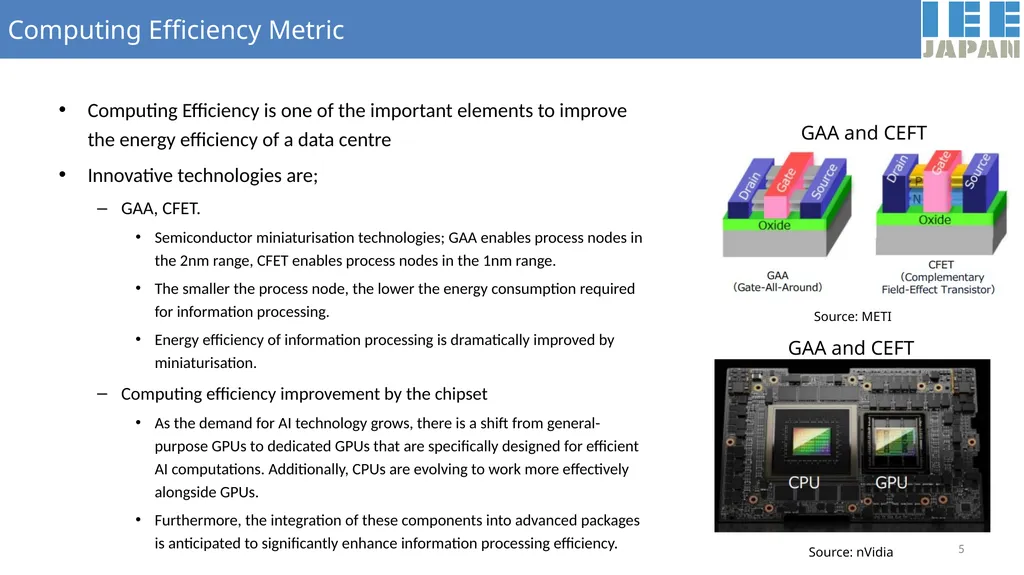
GAA, CFET.
Semiconductor miniaturisation technologies; GAA enables process nodes in the 2nm range, CFET enables process nodes in the 1nm range.
The smaller the process node, the lower the energy consumption required for information processing.
Energy efficiency of information processing is dramatically improved by miniaturisation.
Computing efficiency improvement by the chipset
As the demand for AI technology grows, there is a shift from general-purpose GPUs to dedicated GPUs that are specifically designed for efficient AI computations. Additionally, CPUs are evolving to work more effectively alongside GPUs.
Furthermore, the integration of these components into advanced packages is anticipated to significantly enhance information processing efficiency. 5 Source: METI GAA and CEFT Source: nVidia GAA and CEFT<br>
06
Thank You!
If you have any questions, please feel free to contact me.
Dr. Tohru Shimizu, senior researcher, Climate Change Policy Group
Climate Change and Energy Efficiency Unit,
The Institute of Energy Economics, Japan (IEEJ)
tohru.shimizu@tky.ieej.or.jp 6<br>