
Energy-efficient Phase-based Cache Tuning of
A
Published · 24 slides · 0 views
1 / 1

Description
Energy-efficient Phase-based Cache Tuning of Multimedia Applications in Embedded Systems Also Affiliated with NSF Center for High-Performance Reconfigurable Computing This work was supported by National Science Foundation (NSF) grant
Related Topics
Share
Embed code
Download this presentation From Below
"Energy-efficient Phase-based Cache Tuning of" is the property of its rightful owner. Permission is granted to download and print the materials on this website for personal, non-commercial use only, and to display it on your personal computer provided you do not modify the materials and that you retain all copyright notices contained in the materials. By downloading content from our website, you accept the terms of this agreement.
Presentation Transcript
01
Energy-efficient Phase-based Cache Tuning of Multimedia Applications in Embedded Systems + Also Affiliated with NSF Center for High-Performance Reconfigurable Computing This work was supported by National Science Foundation (NSF) grant CNS-0953447 Tosiron Adegbija and Ann Gordon-Ross+
Department of Electrical and Computer Engineering
University of Florida, Gainesville, Florida, USA<br>
Department of Electrical and Computer Engineering
University of Florida, Gainesville, Florida, USA<br>
02
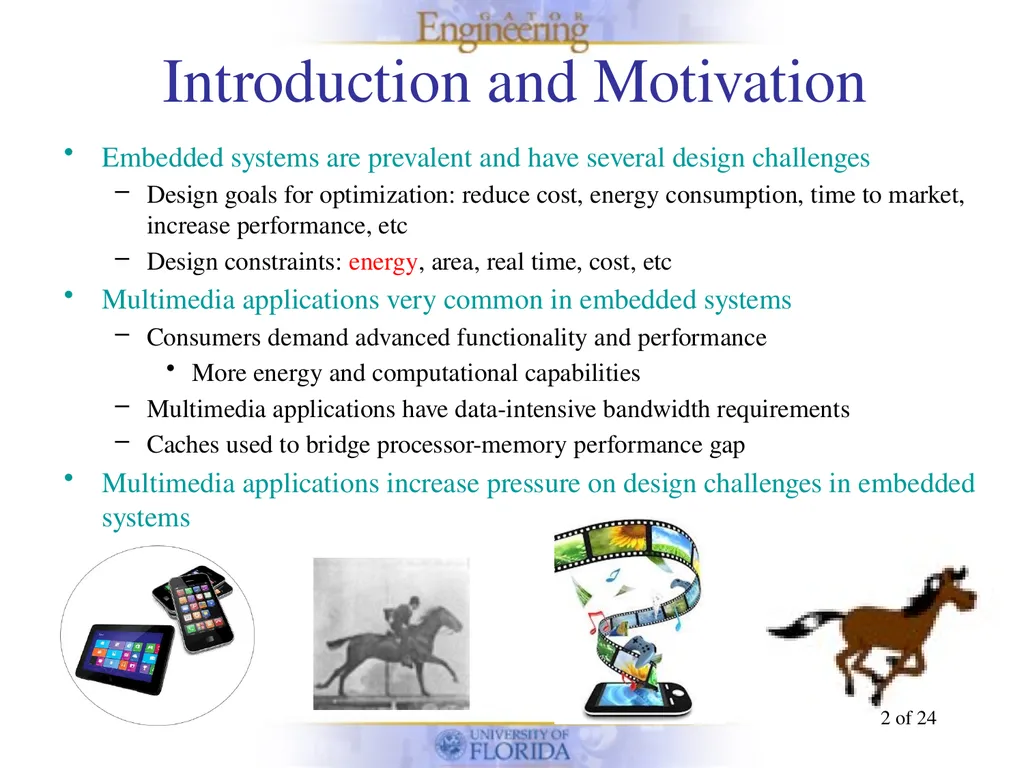
Introduction and Motivation Embedded systems are prevalent and have several design challenges
Design goals for optimization: reduce cost, energy consumption, time to market, increase performance, etc
Design constraints: energy, area, real time, cost, etc
Multimedia applications very common in embedded systems
Consumers demand advanced functionality and performance
More energy and computational capabilities
Multimedia applications have data-intensive bandwidth requirements
Caches used to bridge processor-memory performance gap
Multimedia applications increase pressure on design challenges in embedded systems 2 of 24<br>
Design goals for optimization: reduce cost, energy consumption, time to market, increase performance, etc
Design constraints: energy, area, real time, cost, etc
Multimedia applications very common in embedded systems
Consumers demand advanced functionality and performance
More energy and computational capabilities
Multimedia applications have data-intensive bandwidth requirements
Caches used to bridge processor-memory performance gap
Multimedia applications increase pressure on design challenges in embedded systems 2 of 24<br>
03
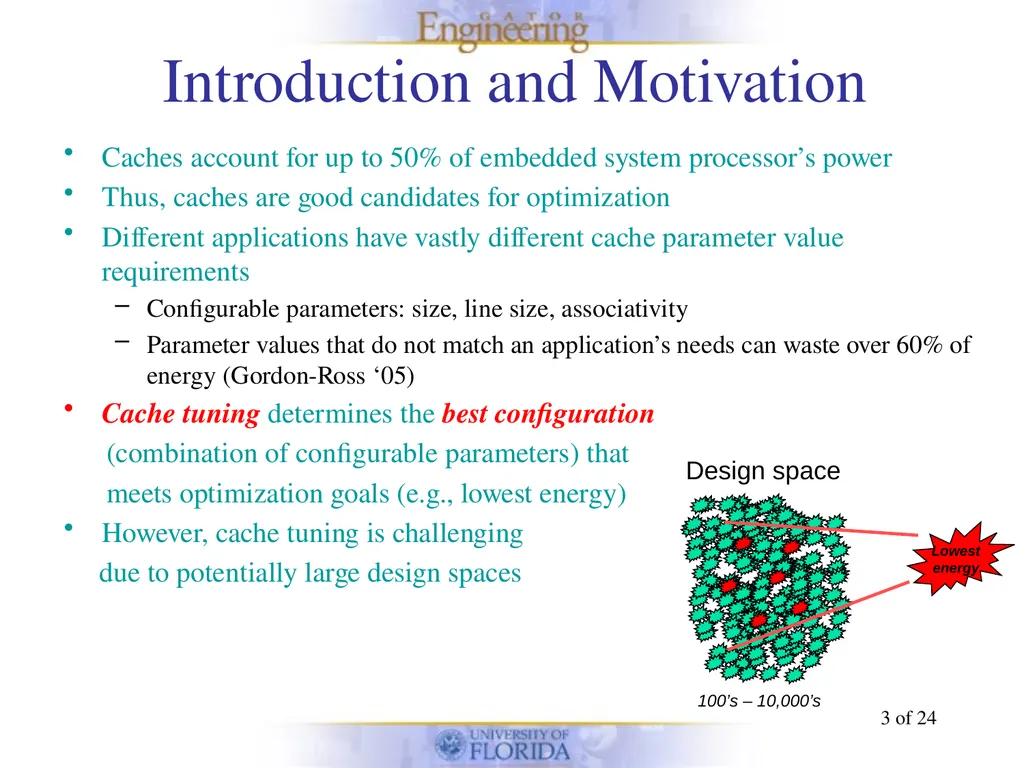
Introduction and Motivation Caches account for up to 50% of embedded system processor’s power
Thus, caches are good candidates for optimization
Different applications have vastly different cache parameter value requirements
Configurable parameters: size, line size, associativity
Parameter values that do not match an application’s needs can waste over 60% of energy (Gordon-Ross ‘05)
Cache tuning determines the best configuration
(combination of configurable parameters) that
meets optimization goals (e.g., lowest energy)
However, cache tuning is challenging
due to potentially large design spaces 3 of 24<br>
Thus, caches are good candidates for optimization
Different applications have vastly different cache parameter value requirements
Configurable parameters: size, line size, associativity
Parameter values that do not match an application’s needs can waste over 60% of energy (Gordon-Ross ‘05)
Cache tuning determines the best configuration
(combination of configurable parameters) that
meets optimization goals (e.g., lowest energy)
However, cache tuning is challenging
due to potentially large design spaces 3 of 24<br>
04
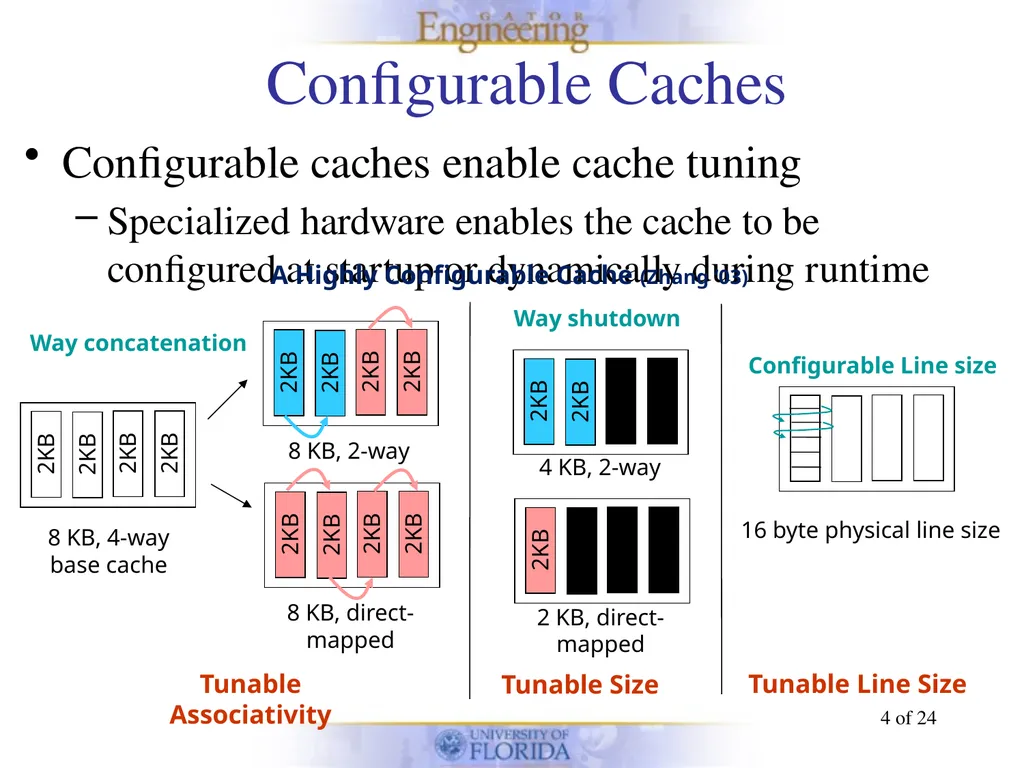
Configurable Caches Configurable caches enable cache tuning
Specialized hardware enables the cache to be configured at startup or dynamically during runtime 4 of 24<br>
Specialized hardware enables the cache to be configured at startup or dynamically during runtime 4 of 24<br>
05
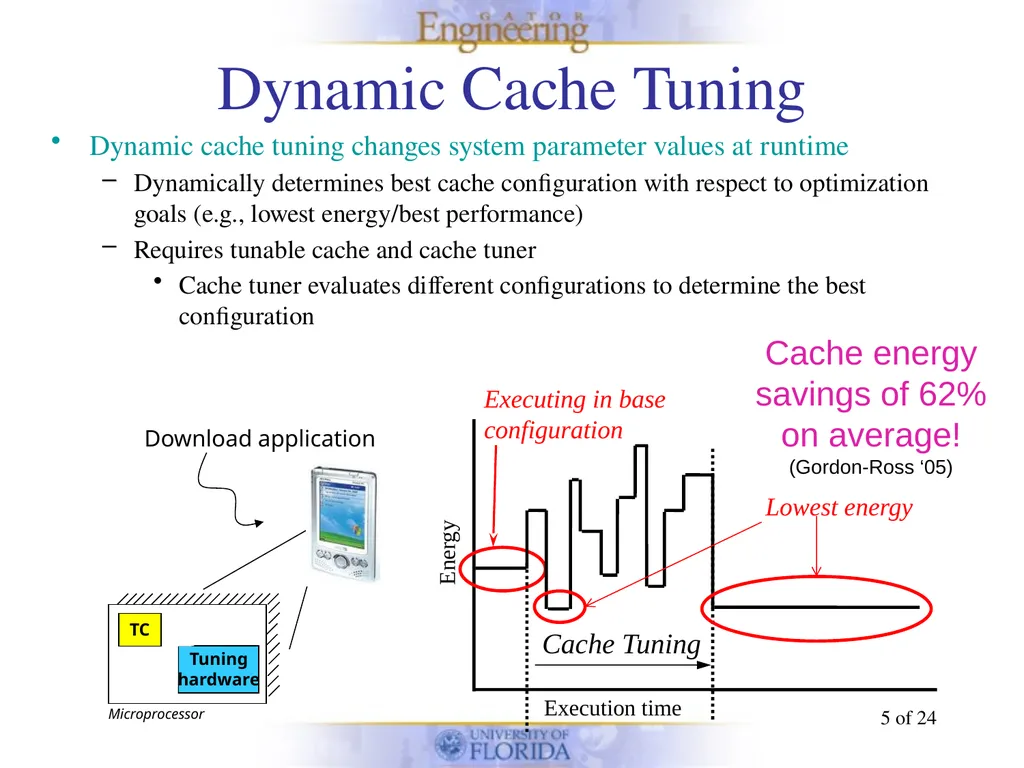
Dynamic Cache Tuning Microprocessor Cache energy savings of 62% on average!
(Gordon-Ross ‘05) Dynamic cache tuning changes system parameter values at runtime
Dynamically determines best cache configuration with respect to optimization goals (e.g., lowest energy/best performance)
Requires tunable cache and cache tuner
Cache tuner evaluates different configurations to determine the best configuration Lowest energy Execution time 5 of 24<br>
(Gordon-Ross ‘05) Dynamic cache tuning changes system parameter values at runtime
Dynamically determines best cache configuration with respect to optimization goals (e.g., lowest energy/best performance)
Requires tunable cache and cache tuner
Cache tuner evaluates different configurations to determine the best configuration Lowest energy Execution time 5 of 24<br>
06
Dynamic Cache Tuning Advantages
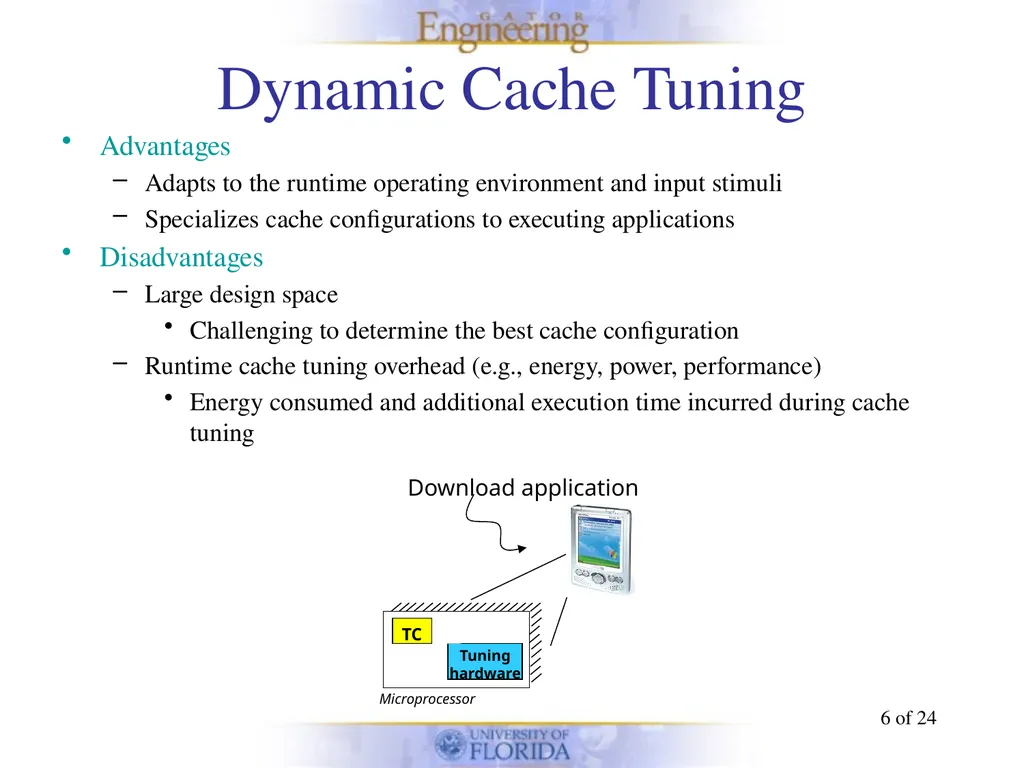
Adapts to the runtime operating environment and input stimuli
Specializes cache configurations to executing applications
Disadvantages
Large design space
Challenging to determine the best cache configuration
Runtime cache tuning overhead (e.g., energy, power, performance)
Energy consumed and additional execution time incurred during cache tuning 6 of 24<br>
Adapts to the runtime operating environment and input stimuli
Specializes cache configurations to executing applications
Disadvantages
Large design space
Challenging to determine the best cache configuration
Runtime cache tuning overhead (e.g., energy, power, performance)
Energy consumed and additional execution time incurred during cache tuning 6 of 24<br>
07
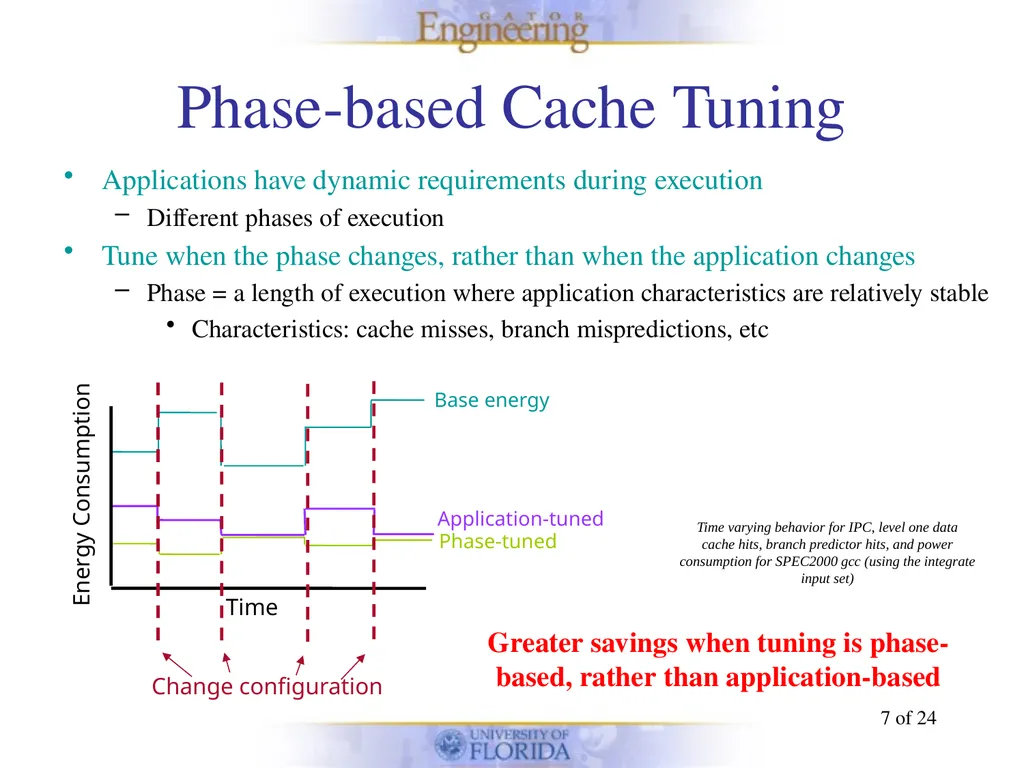
Phase-based Cache Tuning Time varying behavior for IPC, level one data cache hits, branch predictor hits, and power consumption for SPEC2000 gcc (using the integrate input set) Greater savings when tuning is phase-based, rather than application-based Applications have dynamic requirements during execution
Different phases of execution
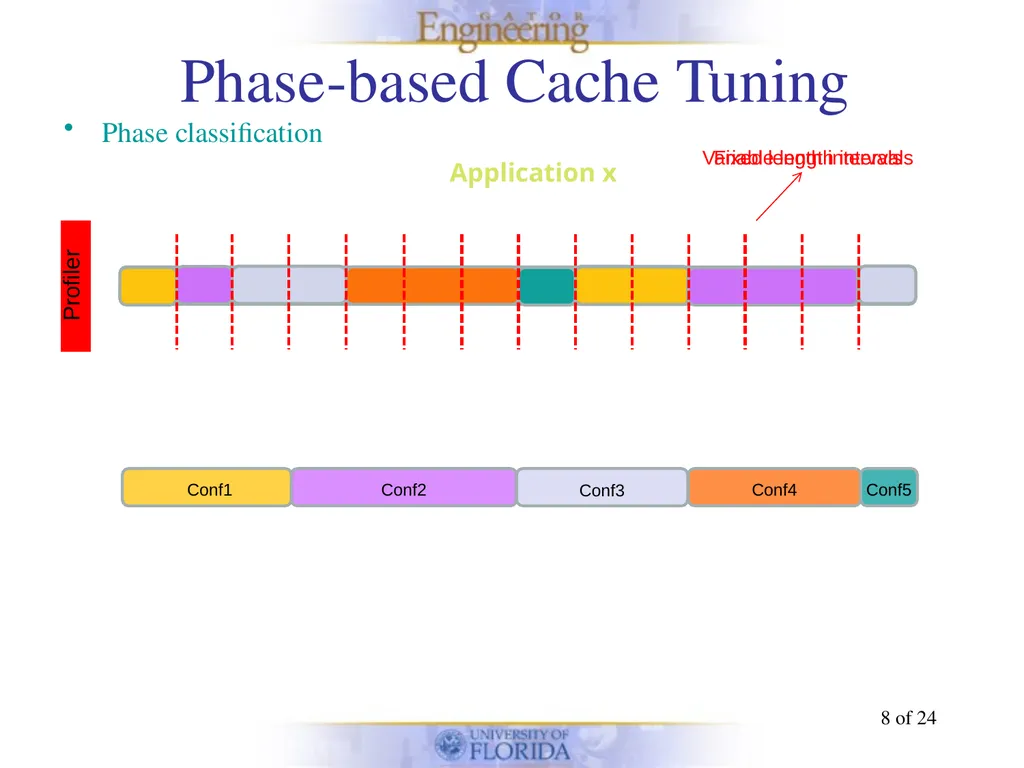
Tune when the phase changes, rather than when the application changes
Phase = a length of execution where application characteristics are relatively stable
Characteristics: cache misses, branch mispredictions, etc 7 of 24<br>
Different phases of execution
Tune when the phase changes, rather than when the application changes
Phase = a length of execution where application characteristics are relatively stable
Characteristics: cache misses, branch mispredictions, etc 7 of 24<br>
08
Phase-based Cache Tuning Phase classification Application x Conf1 Conf2 Conf3 Conf4 Conf5 Fixed length intervals Variable length intervals 8 of 24<br>
09
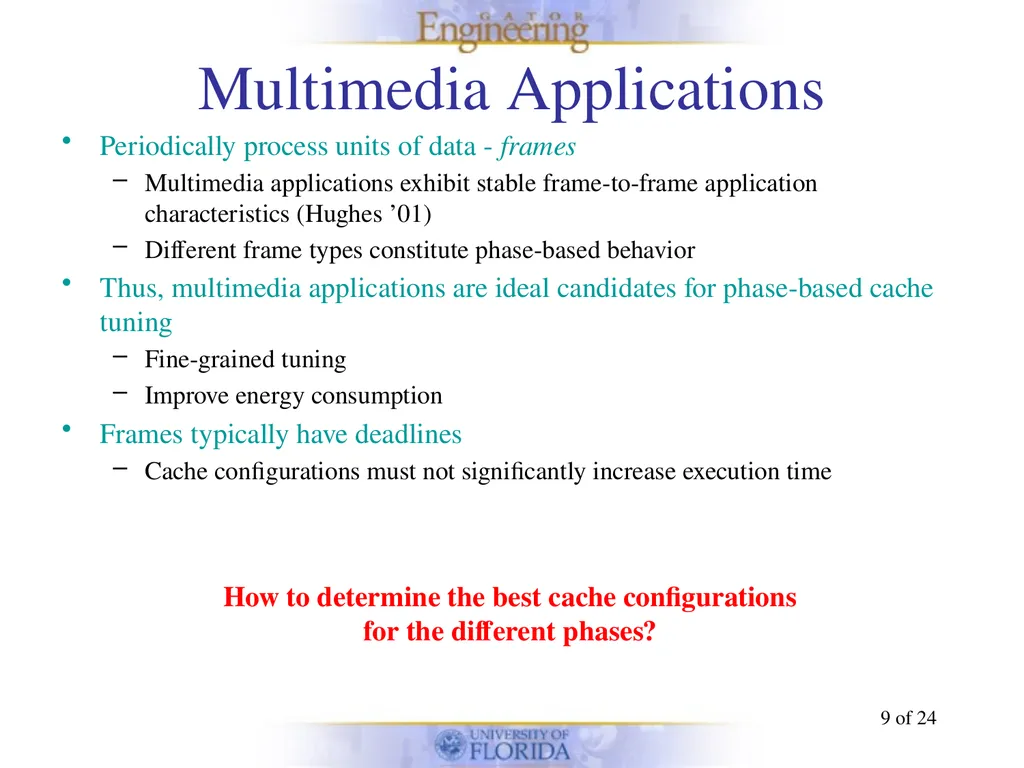
Multimedia Applications Periodically process units of data - frames
Multimedia applications exhibit stable frame-to-frame application characteristics (Hughes ’01)
Different frame types constitute phase-based behavior
Thus, multimedia applications are ideal candidates for phase-based cache tuning
Fine-grained tuning
Improve energy consumption
Frames typically have deadlines
Cache configurations must not significantly increase execution time How to determine the best cache configurations
for the different phases? 9 of 24<br>
Multimedia applications exhibit stable frame-to-frame application characteristics (Hughes ’01)
Different frame types constitute phase-based behavior
Thus, multimedia applications are ideal candidates for phase-based cache tuning
Fine-grained tuning
Improve energy consumption
Frames typically have deadlines
Cache configurations must not significantly increase execution time How to determine the best cache configurations
for the different phases? 9 of 24<br>
10
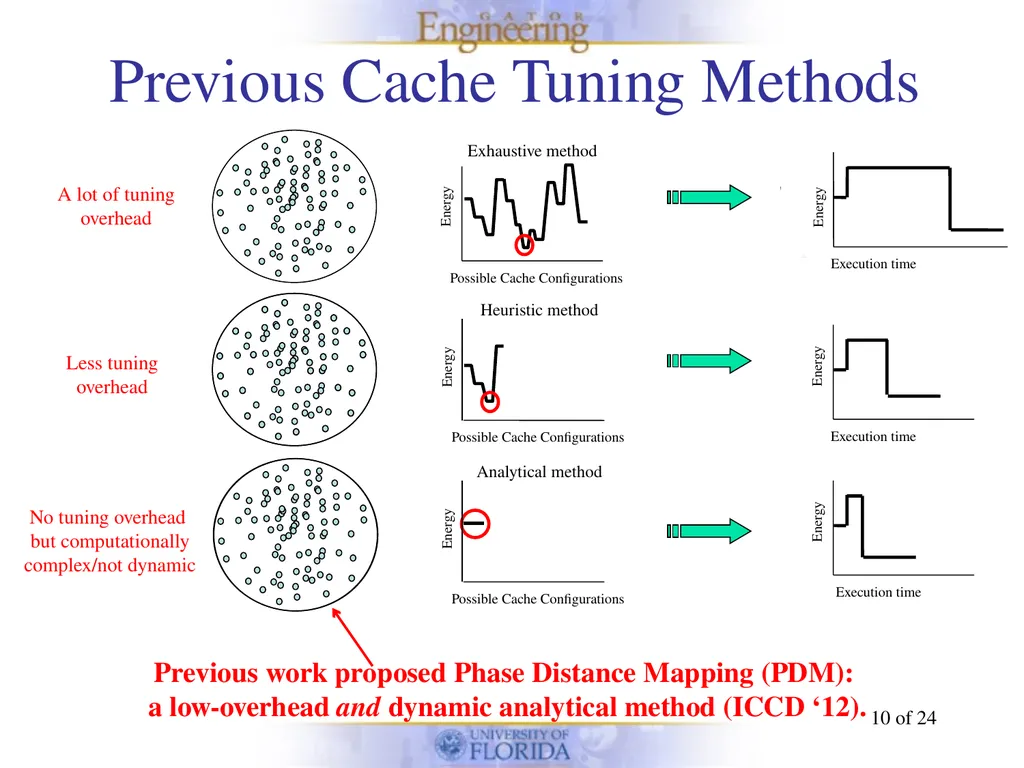
Previous Cache Tuning Methods A lot of tuning
overhead Less tuning
overhead No tuning overhead
but computationally
complex/not dynamic Previous work proposed Phase Distance Mapping (PDM):
a low-overhead and dynamic analytical method (ICCD ‘12). 10 of 24<br>
overhead Less tuning
overhead No tuning overhead
but computationally
complex/not dynamic Previous work proposed Phase Distance Mapping (PDM):
a low-overhead and dynamic analytical method (ICCD ‘12). 10 of 24<br>
11
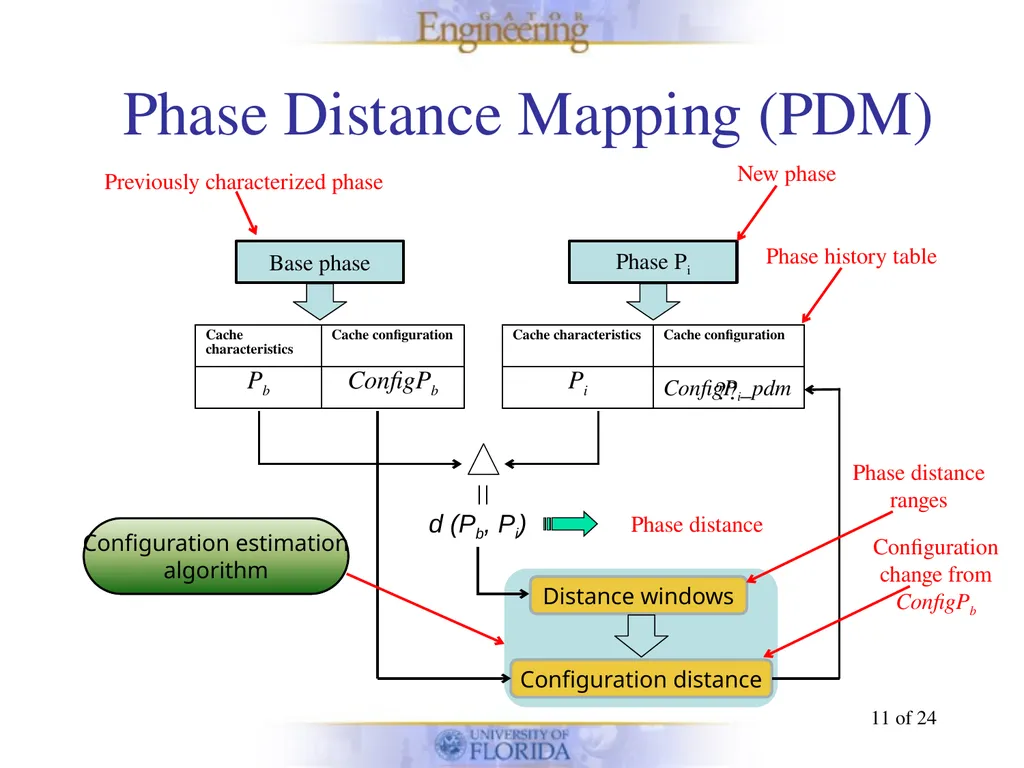
Base phase Phase Pi d (Pb, Pi) Configuration distance ConfigPi_pdm ?? Phase Distance Mapping (PDM) Distance windows 11 of 24<br>
12
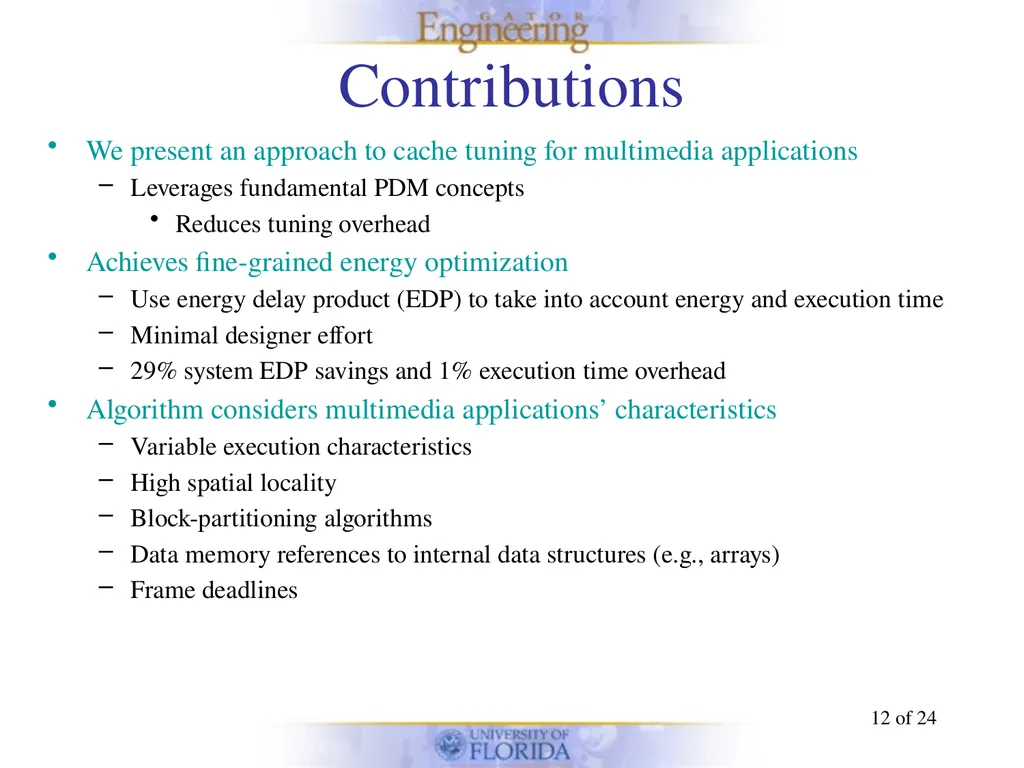
Contributions We present an approach to cache tuning for multimedia applications
Leverages fundamental PDM concepts
Reduces tuning overhead
Achieves fine-grained energy optimization
Use energy delay product (EDP) to take into account energy and execution time
Minimal designer effort
29% system EDP savings and 1% execution time overhead
Algorithm considers multimedia applications’ characteristics
Variable execution characteristics
High spatial locality
Block-partitioning algorithms
Data memory references to internal data structures (e.g., arrays)
Frame deadlines 12 of 24<br>
Leverages fundamental PDM concepts
Reduces tuning overhead
Achieves fine-grained energy optimization
Use energy delay product (EDP) to take into account energy and execution time
Minimal designer effort
29% system EDP savings and 1% execution time overhead
Algorithm considers multimedia applications’ characteristics
Variable execution characteristics
High spatial locality
Block-partitioning algorithms
Data memory references to internal data structures (e.g., arrays)
Frame deadlines 12 of 24<br>
13
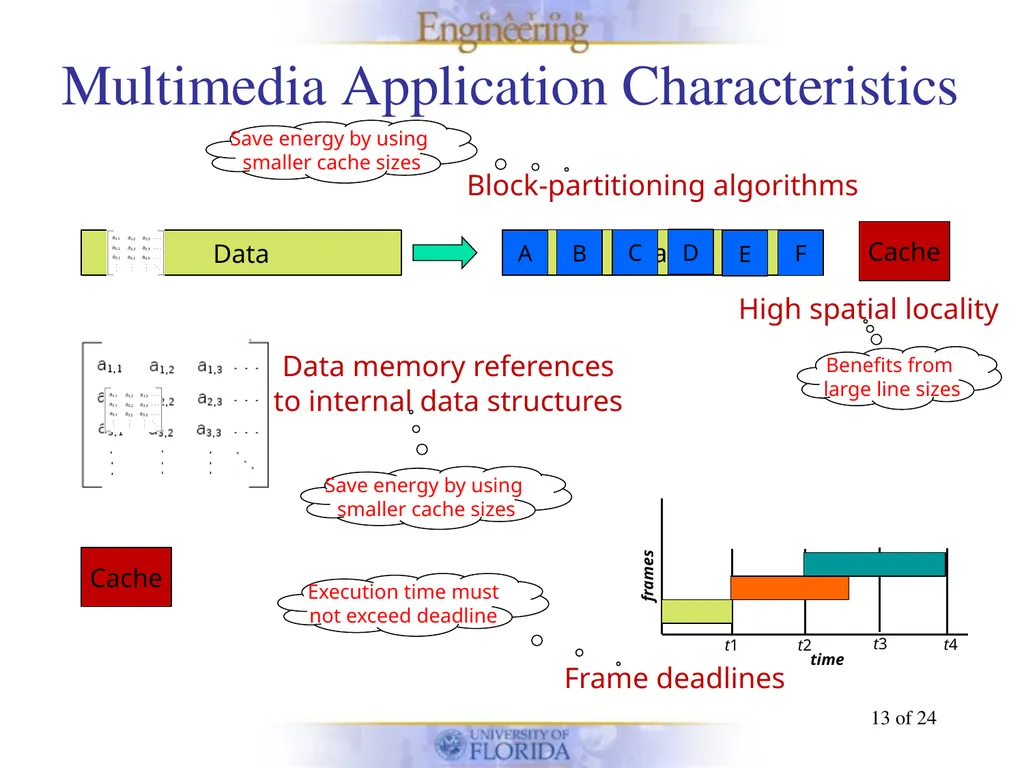
Cache Multimedia Application Characteristics Data Data A B C D E F Block-partitioning algorithms High spatial locality Benefits from
large line sizes Save energy by using
smaller cache sizes Cache Data memory references
to internal data structures Save energy by using
smaller cache sizes Frame deadlines Execution time must
not exceed deadline 13 of 24<br>
large line sizes Save energy by using
smaller cache sizes Cache Data memory references
to internal data structures Save energy by using
smaller cache sizes Frame deadlines Execution time must
not exceed deadline 13 of 24<br>
14
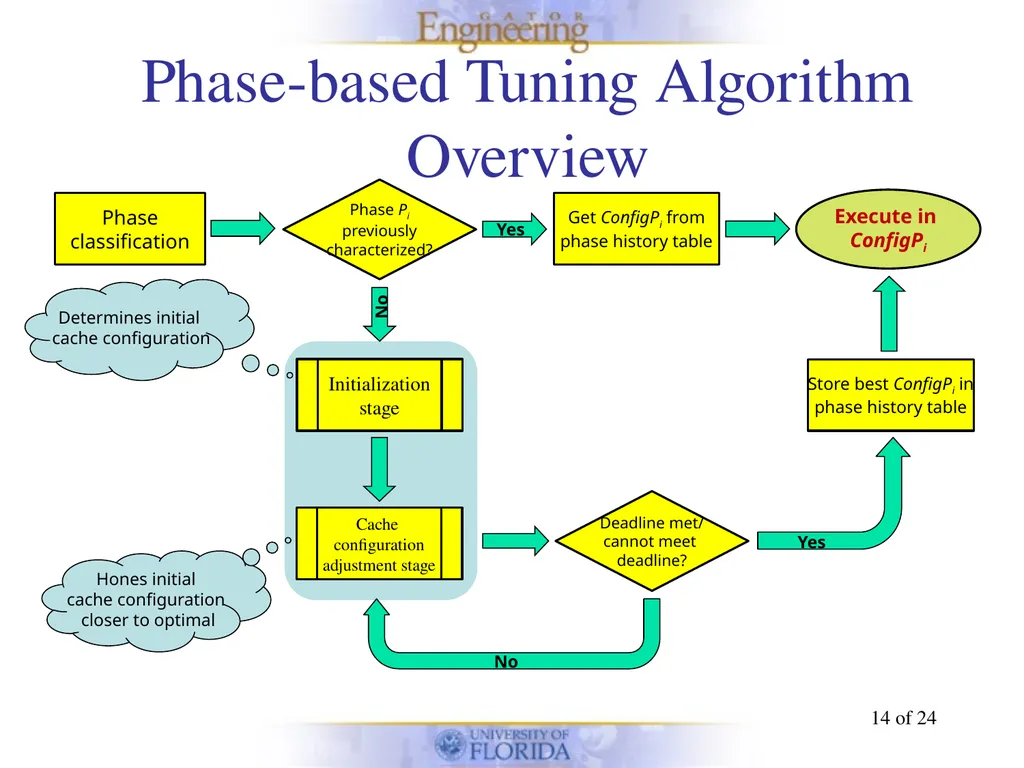
Phase-based Tuning Algorithm Overview Phase
classification Phase Pi
previously
characterized? Get ConfigPi from
phase history table Yes Execute in
ConfigPi Initialization
stage Cache
configuration
adjustment stage Store best ConfigPi in
phase history table Deadline met/
cannot meet
deadline? Determines initial
cache configuration Hones initial
cache configuration
closer to optimal 14 of 24<br>
classification Phase Pi
previously
characterized? Get ConfigPi from
phase history table Yes Execute in
ConfigPi Initialization
stage Cache
configuration
adjustment stage Store best ConfigPi in
phase history table Deadline met/
cannot meet
deadline? Determines initial
cache configuration Hones initial
cache configuration
closer to optimal 14 of 24<br>
15
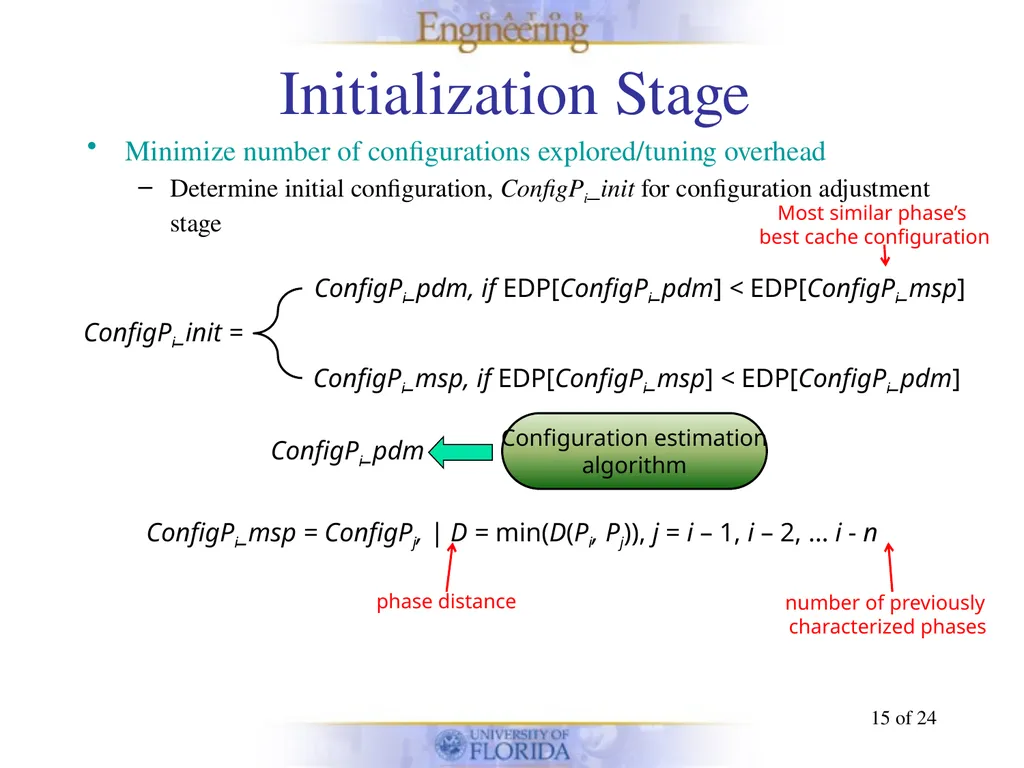
Initialization Stage Minimize number of configurations explored/tuning overhead
Determine initial configuration, ConfigPi_init for configuration adjustment stage ConfigPi_pdm, if EDP[ConfigPi_pdm] < EDP[ConfigPi_msp] ConfigPi_msp, if EDP[ConfigPi_msp] < EDP[ConfigPi_pdm] ConfigPi_msp = ConfigPj, | D = min(D(Pi, Pj)), j = i – 1, i – 2, … i - n 15 of 24<br>
Determine initial configuration, ConfigPi_init for configuration adjustment stage ConfigPi_pdm, if EDP[ConfigPi_pdm] < EDP[ConfigPi_msp] ConfigPi_msp, if EDP[ConfigPi_msp] < EDP[ConfigPi_pdm] ConfigPi_msp = ConfigPj, | D = min(D(Pi, Pj)), j = i – 1, i – 2, … i - n 15 of 24<br>
16
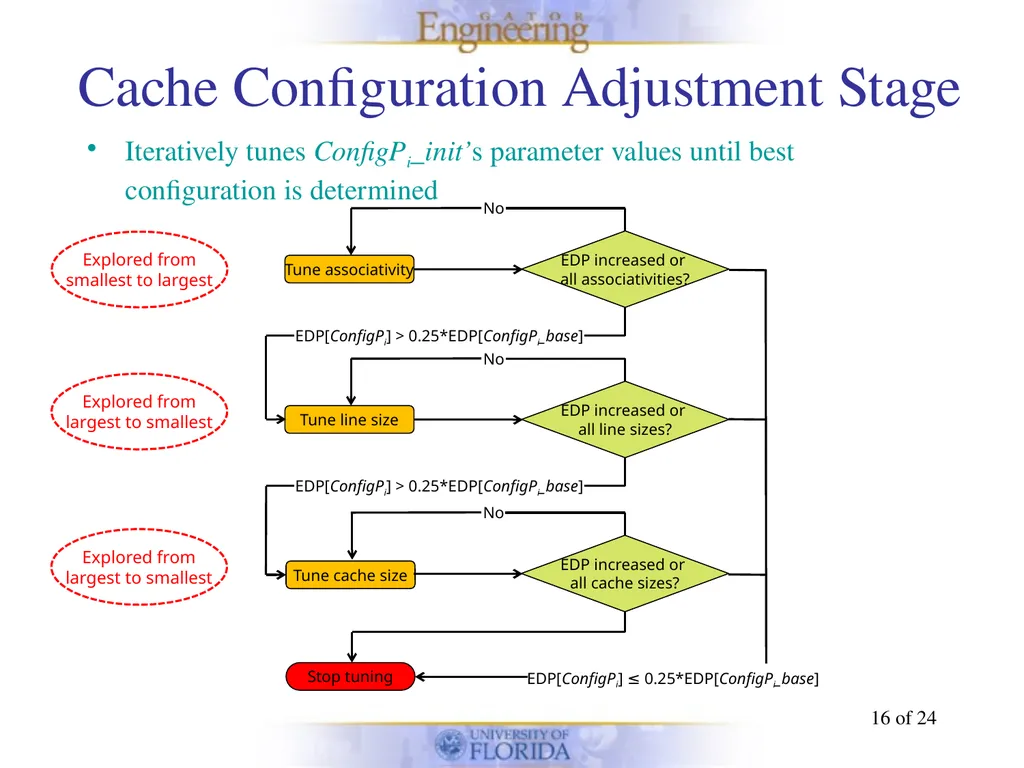
Cache Configuration Adjustment Stage Iteratively tunes ConfigPi_init’s parameter values until best configuration is determined Tune associativity EDP increased or
all associativities? EDP[ConfigPi] > 0.25*EDP[ConfigPi_base] No Tune line size Stop tuning EDP[ConfigPi] ≤ 0.25*EDP[ConfigPi_base] Explored from
smallest to largest Explored from
largest to smallest Explored from
largest to smallest 16 of 24<br>
all associativities? EDP[ConfigPi] > 0.25*EDP[ConfigPi_base] No Tune line size Stop tuning EDP[ConfigPi] ≤ 0.25*EDP[ConfigPi_base] Explored from
smallest to largest Explored from
largest to smallest Explored from
largest to smallest 16 of 24<br>
17
Experimental Results 17 of 24<br>
18
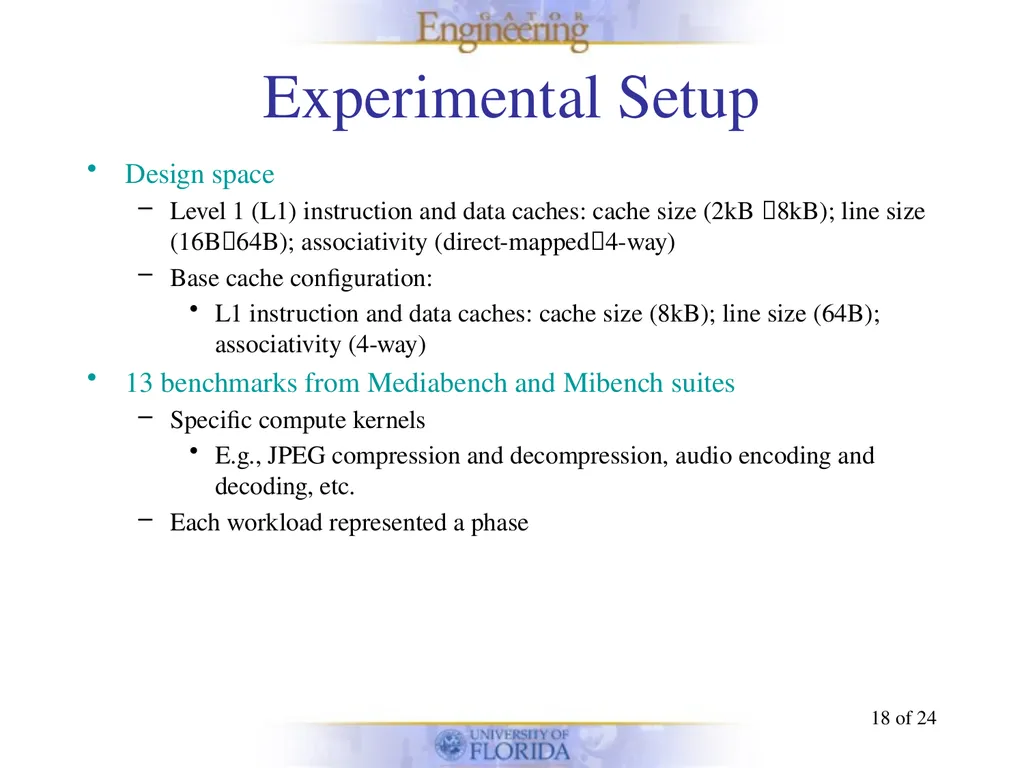
Experimental Setup Design space
Level 1 (L1) instruction and data caches: cache size (2kB 8kB); line size (16B64B); associativity (direct-mapped4-way)
Base cache configuration:
L1 instruction and data caches: cache size (8kB); line size (64B); associativity (4-way)
13 benchmarks from Mediabench and Mibench suites
Specific compute kernels
E.g., JPEG compression and decompression, audio encoding and decoding, etc.
Each workload represented a phase 18 of 24<br>
Level 1 (L1) instruction and data caches: cache size (2kB 8kB); line size (16B64B); associativity (direct-mapped4-way)
Base cache configuration:
L1 instruction and data caches: cache size (8kB); line size (64B); associativity (4-way)
13 benchmarks from Mediabench and Mibench suites
Specific compute kernels
E.g., JPEG compression and decompression, audio encoding and decoding, etc.
Each workload represented a phase 18 of 24<br>
19
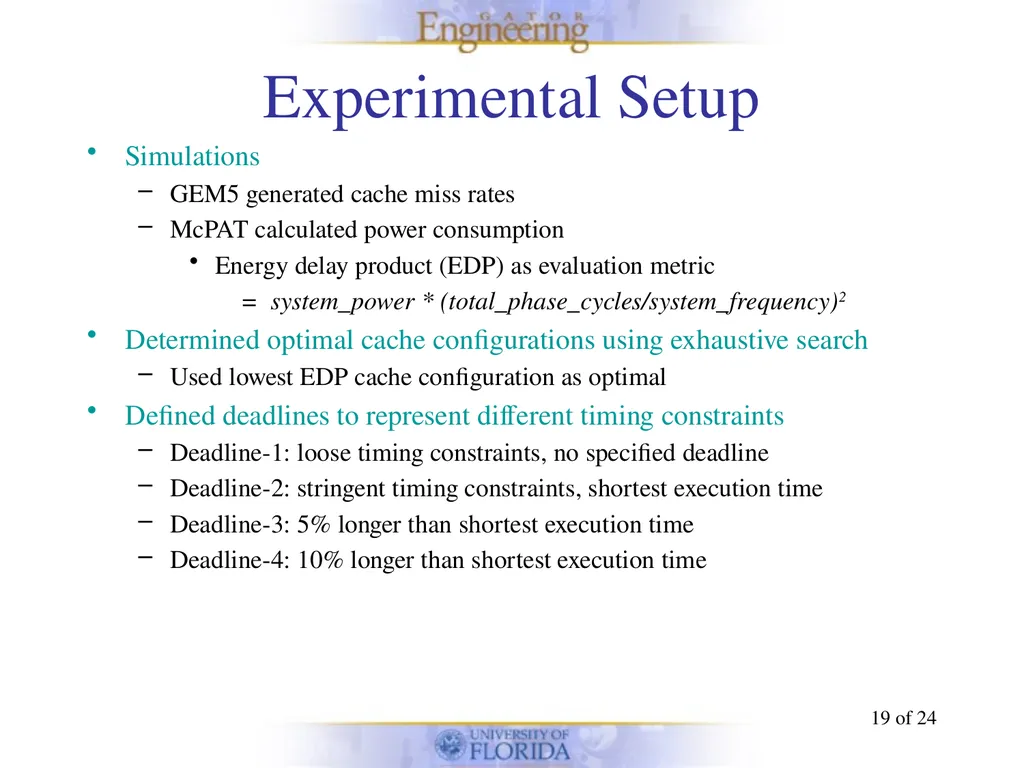
Experimental Setup Simulations
GEM5 generated cache miss rates
McPAT calculated power consumption
Energy delay product (EDP) as evaluation metric
= system_power * (total_phase_cycles/system_frequency)2
Determined optimal cache configurations using exhaustive search
Used lowest EDP cache configuration as optimal
Defined deadlines to represent different timing constraints
Deadline-1: loose timing constraints, no specified deadline
Deadline-2: stringent timing constraints, shortest execution time
Deadline-3: 5% longer than shortest execution time
Deadline-4: 10% longer than shortest execution time 19 of 24<br>
GEM5 generated cache miss rates
McPAT calculated power consumption
Energy delay product (EDP) as evaluation metric
= system_power * (total_phase_cycles/system_frequency)2
Determined optimal cache configurations using exhaustive search
Used lowest EDP cache configuration as optimal
Defined deadlines to represent different timing constraints
Deadline-1: loose timing constraints, no specified deadline
Deadline-2: stringent timing constraints, shortest execution time
Deadline-3: 5% longer than shortest execution time
Deadline-4: 10% longer than shortest execution time 19 of 24<br>
20
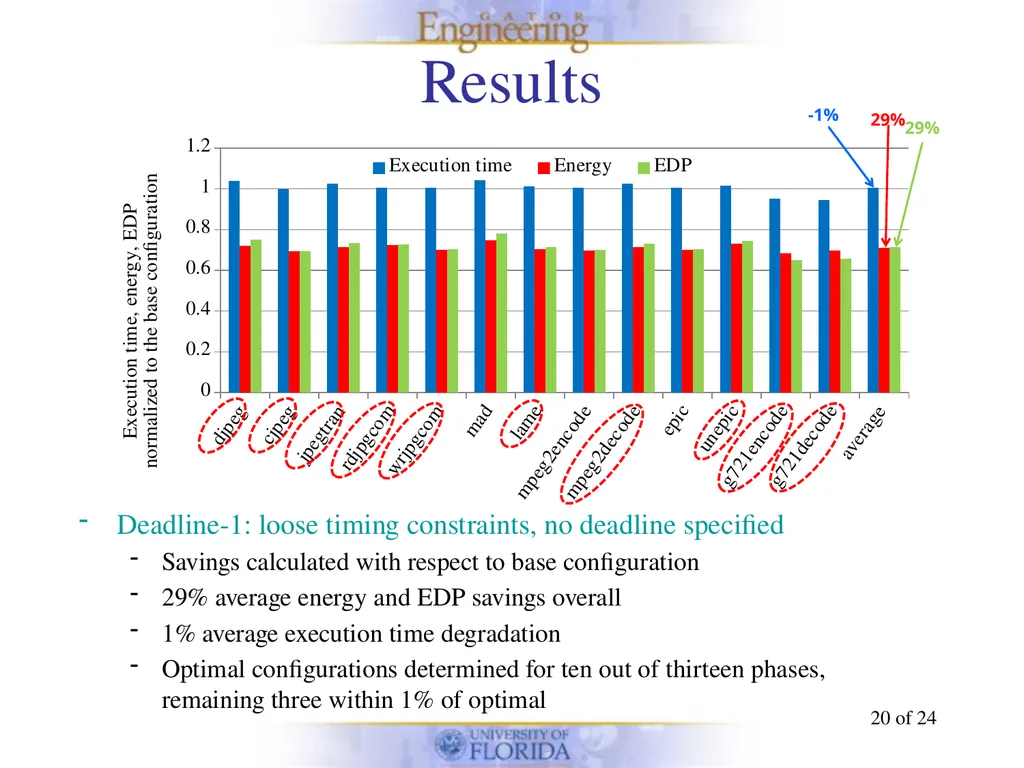
Results Deadline-1: loose timing constraints, no deadline specified
Savings calculated with respect to base configuration
29% average energy and EDP savings overall
1% average execution time degradation
Optimal configurations determined for ten out of thirteen phases, remaining three within 1% of optimal 20 of 24<br>
Savings calculated with respect to base configuration
29% average energy and EDP savings overall
1% average execution time degradation
Optimal configurations determined for ten out of thirteen phases, remaining three within 1% of optimal 20 of 24<br>
21
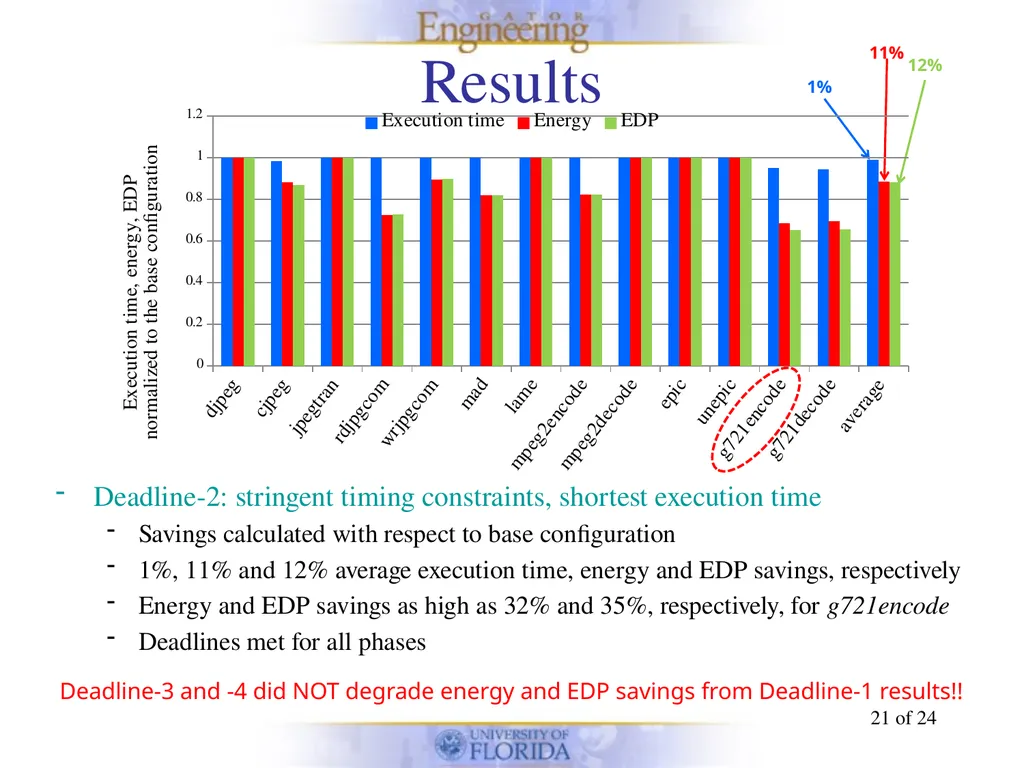
Results Deadline-2: stringent timing constraints, shortest execution time
Savings calculated with respect to base configuration
1%, 11% and 12% average execution time, energy and EDP savings, respectively
Energy and EDP savings as high as 32% and 35%, respectively, for g721encode
Deadlines met for all phases Deadline-3 and -4 did NOT degrade energy and EDP savings from Deadline-1 results!! 21 of 24<br>
Savings calculated with respect to base configuration
1%, 11% and 12% average execution time, energy and EDP savings, respectively
Energy and EDP savings as high as 32% and 35%, respectively, for g721encode
Deadlines met for all phases Deadline-3 and -4 did NOT degrade energy and EDP savings from Deadline-1 results!! 21 of 24<br>
22
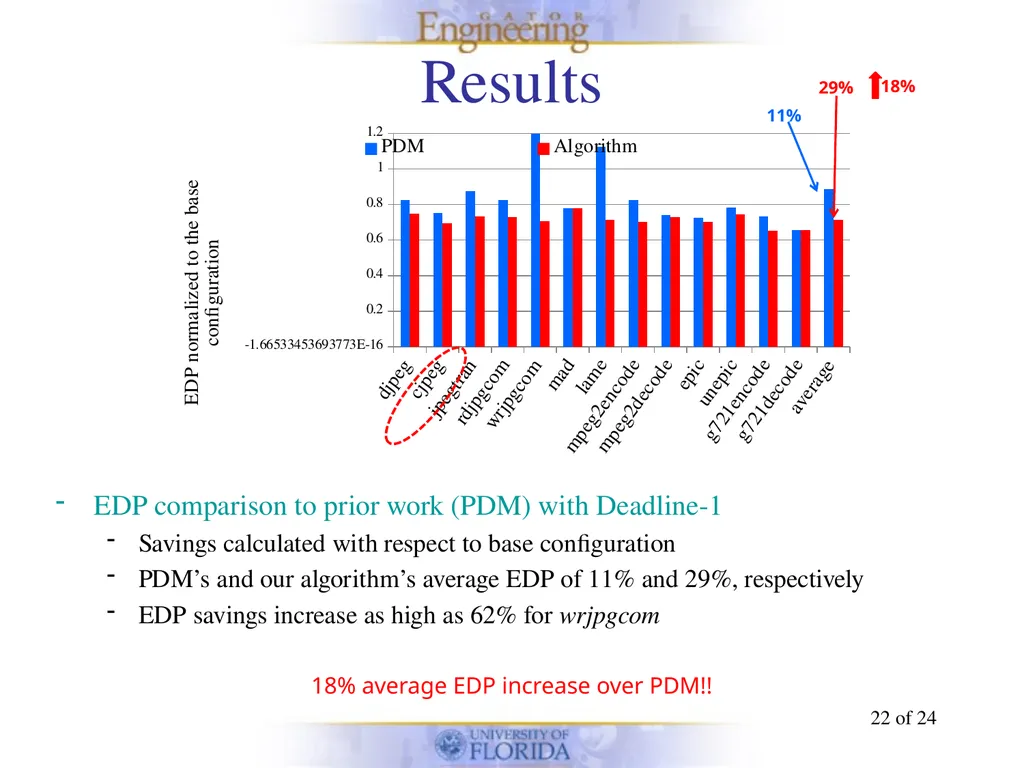
Results EDP comparison to prior work (PDM) with Deadline-1
Savings calculated with respect to base configuration
PDM’s and our algorithm’s average EDP of 11% and 29%, respectively
EDP savings increase as high as 62% for wrjpgcom 18% 18% average EDP increase over PDM!! 22 of 24<br>
Savings calculated with respect to base configuration
PDM’s and our algorithm’s average EDP of 11% and 29%, respectively
EDP savings increase as high as 62% for wrjpgcom 18% 18% average EDP increase over PDM!! 22 of 24<br>
23
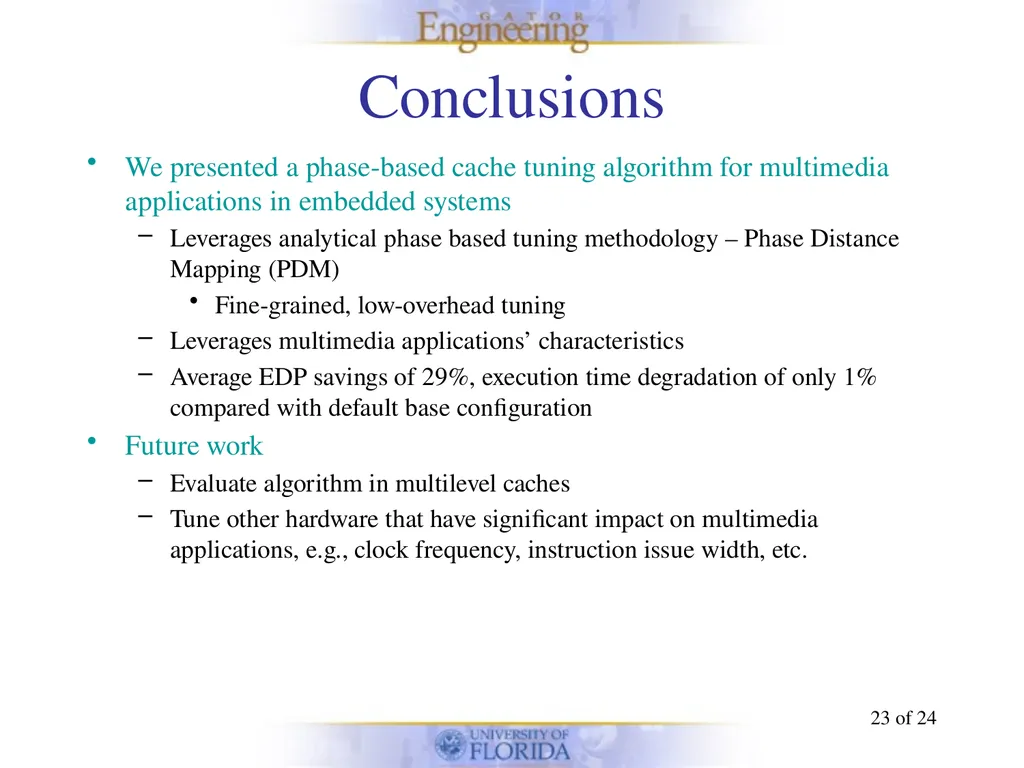
Conclusions We presented a phase-based cache tuning algorithm for multimedia applications in embedded systems
Leverages analytical phase based tuning methodology – Phase Distance Mapping (PDM)
Fine-grained, low-overhead tuning
Leverages multimedia applications’ characteristics
Average EDP savings of 29%, execution time degradation of only 1% compared with default base configuration
Future work
Evaluate algorithm in multilevel caches
Tune other hardware that have significant impact on multimedia applications, e.g., clock frequency, instruction issue width, etc. 23 of 24<br>
Leverages analytical phase based tuning methodology – Phase Distance Mapping (PDM)
Fine-grained, low-overhead tuning
Leverages multimedia applications’ characteristics
Average EDP savings of 29%, execution time degradation of only 1% compared with default base configuration
Future work
Evaluate algorithm in multilevel caches
Tune other hardware that have significant impact on multimedia applications, e.g., clock frequency, instruction issue width, etc. 23 of 24<br>
24
Questions? 24 of 24<br>