
ENFORCEMENT AND IMPLEMENTATION CHALLENGES OF
MT
Published · 23 slides · 0 views
1 / 1

Description
ENFORCEMENT AND IMPLEMENTATION CHALLENGES OF BUILDING CONTROL LAWS By 1Windapo, A.O., 2Omeife, C. 1Department of Construction Economics and Management, University of Cape Town, Rondebosch, 7701, South Africa 2Build Consult Ltd. Yaba, Lagoa
Related Topics
Share
Embed code
Download this presentation From Below
"ENFORCEMENT AND IMPLEMENTATION CHALLENGES OF" is the property of its rightful owner. Permission is granted to download and print the materials on this website for personal, non-commercial use only, and to display it on your personal computer provided you do not modify the materials and that you retain all copyright notices contained in the materials. By downloading content from our website, you accept the terms of this agreement.
Presentation Transcript
01
ENFORCEMENT AND IMPLEMENTATION CHALLENGES OF BUILDING CONTROL LAWS By
1Windapo, A.O., 2Omeife, C.
1Department of Construction Economics and Management, University of Cape Town, Rondebosch, 7701, South Africa
2Build Consult Ltd. Yaba, Lagoa<br>
1Windapo, A.O., 2Omeife, C.
1Department of Construction Economics and Management, University of Cape Town, Rondebosch, 7701, South Africa
2Build Consult Ltd. Yaba, Lagoa<br>
02
INTRODUCTION Rules and Regulations for building
The construction industry must has it’s performance benchmarks set by Building Rules and Regulations
Building regulations state the various processes of how a building should be constructed, altered or extended.
Rules and Regulations oversee:
The design
construction
maintenance
Demolition of buildings<br>
The construction industry must has it’s performance benchmarks set by Building Rules and Regulations
Building regulations state the various processes of how a building should be constructed, altered or extended.
Rules and Regulations oversee:
The design
construction
maintenance
Demolition of buildings<br>
03
INTRODUCTION…….cont’d BUILDING COLLAPSE
Building collapse is a global menace due to the spectrum of cases in the past and incessant reports across the globe in recent times.
Nigeria has become a significant source of concern due to the recent and frequent building collapses.
Nigeria has a set of regulations known as the National Building Code (NBC).
Despite the NBC the collapses still occur.
The causes of these short comings can be attributed to:
The social dynamics that occur between client and builders during construction
Limited technological knowledge
Environmental exposure and site conditions.
The quality of managerial services during the design and implementation of the building.<br>
Building collapse is a global menace due to the spectrum of cases in the past and incessant reports across the globe in recent times.
Nigeria has become a significant source of concern due to the recent and frequent building collapses.
Nigeria has a set of regulations known as the National Building Code (NBC).
Despite the NBC the collapses still occur.
The causes of these short comings can be attributed to:
The social dynamics that occur between client and builders during construction
Limited technological knowledge
Environmental exposure and site conditions.
The quality of managerial services during the design and implementation of the building.<br>
04
INTRODUCTION…….cont’d Regulations will always have non-compliance wherever they exist.
The success of Building standards relies on the level of implementation of them.
There is limited information to show the level of regulation compliance.
PURPOSE OF THIS STUDY
This paper examines the challenges to implementing, complying and enforcing the Building Control Law/Codes and the strategies to adopt. This is important as it will help understand the recent collapsed buildings which to a large extent can be attributed to the lack of implementation and enforcement of building regulations.<br>
The success of Building standards relies on the level of implementation of them.
There is limited information to show the level of regulation compliance.
PURPOSE OF THIS STUDY
This paper examines the challenges to implementing, complying and enforcing the Building Control Law/Codes and the strategies to adopt. This is important as it will help understand the recent collapsed buildings which to a large extent can be attributed to the lack of implementation and enforcement of building regulations.<br>
05
INTRODUCTION…….cont’d This presentation will cover:
Statutory Building Control Laws/Regulations Guiding the Design and Construction of Buildings
Building Regulations and Enforcement Theories
The Command and Control Strategy
The Compliance Strategy and Self-Regulation
The comparison of the 2 strategies
Implementation strategy
Indicators of Compliance
Challenges to implementation
Challenges to the enforcement of building control laws
The conclusions and reccomendations<br>
Statutory Building Control Laws/Regulations Guiding the Design and Construction of Buildings
Building Regulations and Enforcement Theories
The Command and Control Strategy
The Compliance Strategy and Self-Regulation
The comparison of the 2 strategies
Implementation strategy
Indicators of Compliance
Challenges to implementation
Challenges to the enforcement of building control laws
The conclusions and reccomendations<br>
06
STATUTORY BUILDING CONTROL LAWS/REGULATIONS GUIDING THE DESIGN AND CONSTRUCTION OF BUILDINGS Many building professionals in Nigeria see the NBC as a nothing more than a set of rules and are a transitory/incidental consideration for construction
Building regulations represent laws that dictate the design and implementation of buildings. This is to ensure the buildings are safe.
Building regulations can come in the form of bye-laws and incorporate other matters such as:
Clean Air Act
Fire Prevention Act
Codes for Building Materials
The NBC is not static and must respond to changes in technology.
A study was conducted (Windapo and Owolabi (2008)) found that 73% of those surveyed used British Standards, 23% used the NBC (Nigerian standards) and 4% used Codes of Practice. This indicates the NBC is not acknowledged by a majority of professionals<br>
Building regulations represent laws that dictate the design and implementation of buildings. This is to ensure the buildings are safe.
Building regulations can come in the form of bye-laws and incorporate other matters such as:
Clean Air Act
Fire Prevention Act
Codes for Building Materials
The NBC is not static and must respond to changes in technology.
A study was conducted (Windapo and Owolabi (2008)) found that 73% of those surveyed used British Standards, 23% used the NBC (Nigerian standards) and 4% used Codes of Practice. This indicates the NBC is not acknowledged by a majority of professionals<br>
07
STATUTORY BUILDING CONTROL LAWS/REGULATIONS GUIDING THE DESIGN AND CONSTRUCTION OF BUILDINGS The NBC was developed as solution to the poor conditions of Nigerian cities and building collapses.
The NBC is comprehensive in content but the issue is the implementation and enforcement of these laws and hence the increased spate of building failure and collapse in Nigeria.<br>
The NBC is comprehensive in content but the issue is the implementation and enforcement of these laws and hence the increased spate of building failure and collapse in Nigeria.<br>
08
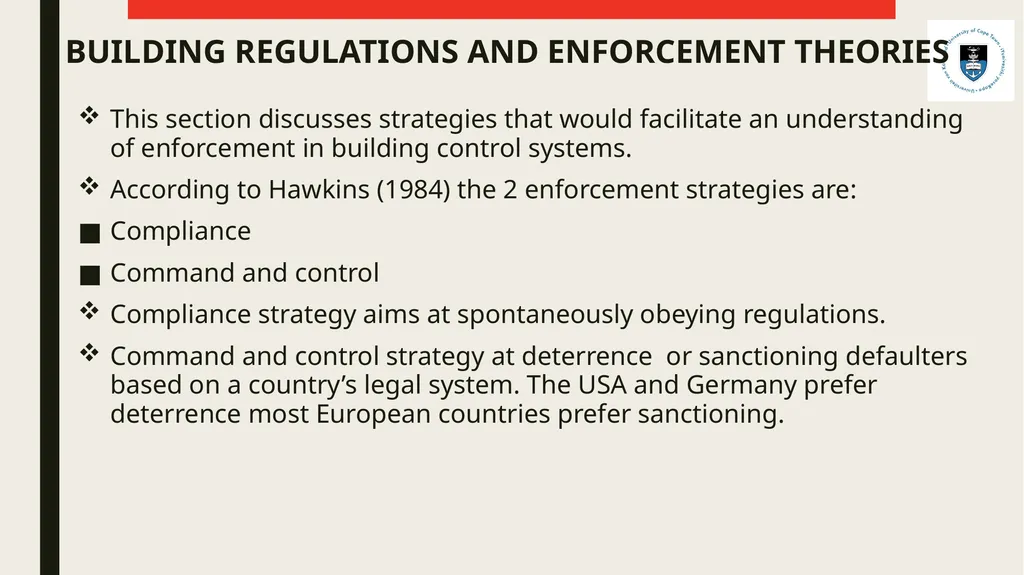
BUILDING REGULATIONS AND ENFORCEMENT THEORIES This section discusses strategies that would facilitate an understanding of enforcement in building control systems.
According to Hawkins (1984) the 2 enforcement strategies are:
Compliance
Command and control
Compliance strategy aims at spontaneously obeying regulations.
Command and control strategy at deterrence or sanctioning defaulters based on a country’s legal system. The USA and Germany prefer deterrence most European countries prefer sanctioning.<br>
According to Hawkins (1984) the 2 enforcement strategies are:
Compliance
Command and control
Compliance strategy aims at spontaneously obeying regulations.
Command and control strategy at deterrence or sanctioning defaulters based on a country’s legal system. The USA and Germany prefer deterrence most European countries prefer sanctioning.<br>
09
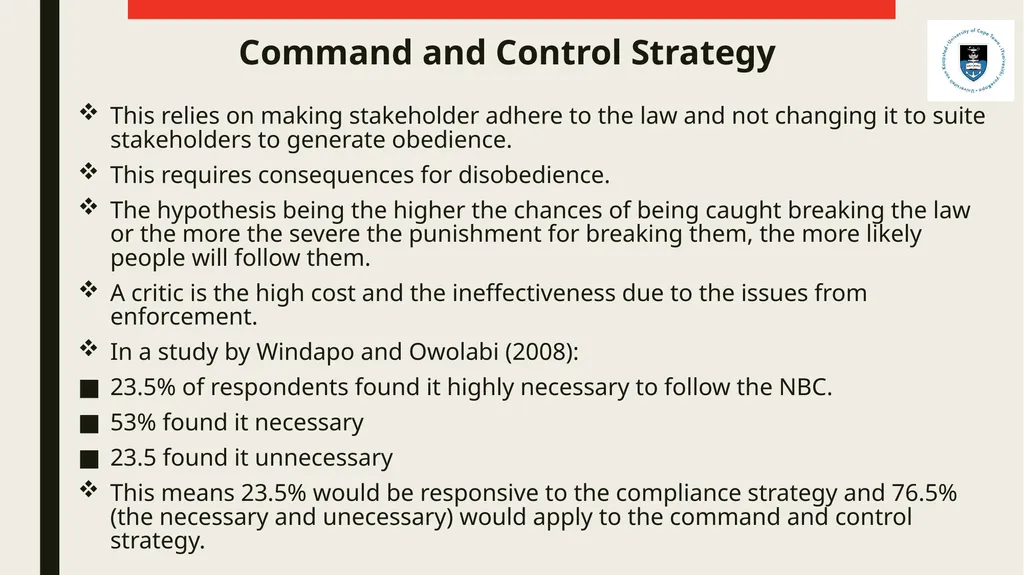
Command and Control Strategy This relies on making stakeholder adhere to the law and not changing it to suite stakeholders to generate obedience.
This requires consequences for disobedience.
The hypothesis being the higher the chances of being caught breaking the law or the more the severe the punishment for breaking them, the more likely people will follow them.
A critic is the high cost and the ineffectiveness due to the issues from enforcement.
In a study by Windapo and Owolabi (2008):
23.5% of respondents found it highly necessary to follow the NBC.
53% found it necessary
23.5 found it unnecessary
This means 23.5% would be responsive to the compliance strategy and 76.5% (the necessary and unecessary) would apply to the command and control strategy.<br>
This requires consequences for disobedience.
The hypothesis being the higher the chances of being caught breaking the law or the more the severe the punishment for breaking them, the more likely people will follow them.
A critic is the high cost and the ineffectiveness due to the issues from enforcement.
In a study by Windapo and Owolabi (2008):
23.5% of respondents found it highly necessary to follow the NBC.
53% found it necessary
23.5 found it unnecessary
This means 23.5% would be responsive to the compliance strategy and 76.5% (the necessary and unecessary) would apply to the command and control strategy.<br>
10
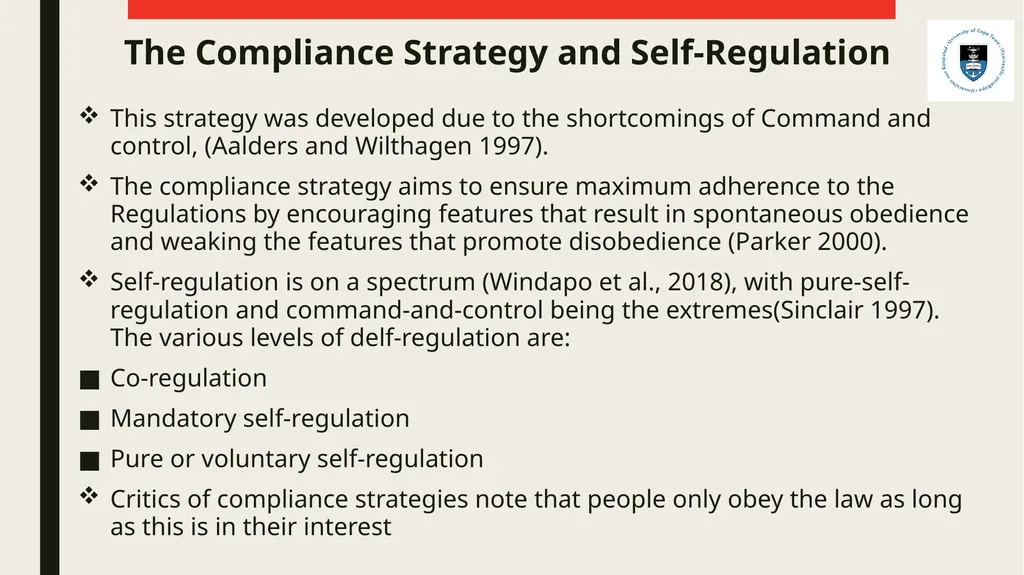
The Compliance Strategy and Self-Regulation This strategy was developed due to the shortcomings of Command and control, (Aalders and Wilthagen 1997).
The compliance strategy aims to ensure maximum adherence to the Regulations by encouraging features that result in spontaneous obedience and weaking the features that promote disobedience (Parker 2000).
Self-regulation is on a spectrum (Windapo et al., 2018), with pure-self-regulation and command-and-control being the extremes(Sinclair 1997). The various levels of delf-regulation are:
Co-regulation
Mandatory self-regulation
Pure or voluntary self-regulation
Critics of compliance strategies note that people only obey the law as long as this is in their interest<br>
The compliance strategy aims to ensure maximum adherence to the Regulations by encouraging features that result in spontaneous obedience and weaking the features that promote disobedience (Parker 2000).
Self-regulation is on a spectrum (Windapo et al., 2018), with pure-self-regulation and command-and-control being the extremes(Sinclair 1997). The various levels of delf-regulation are:
Co-regulation
Mandatory self-regulation
Pure or voluntary self-regulation
Critics of compliance strategies note that people only obey the law as long as this is in their interest<br>
11
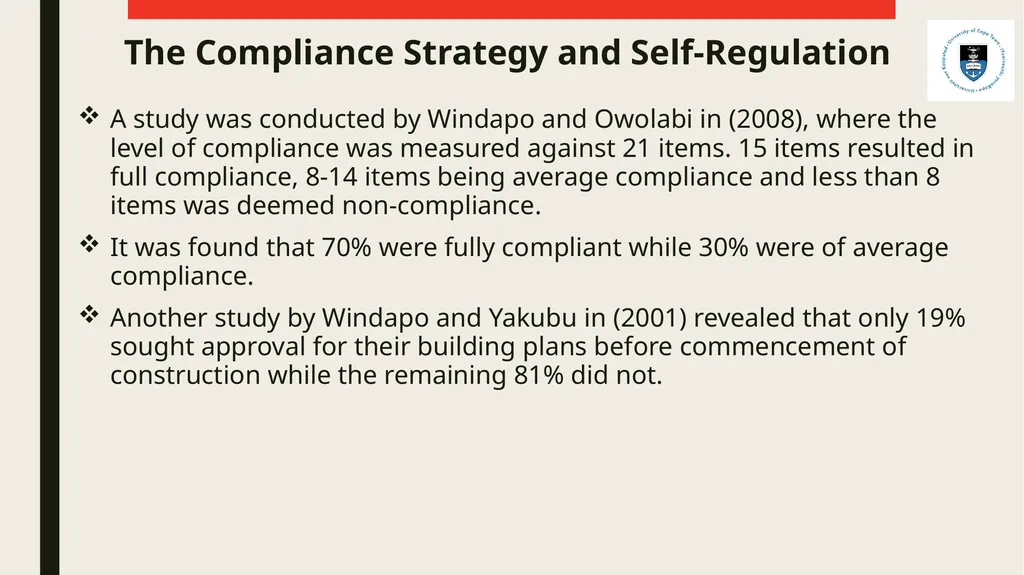
The Compliance Strategy and Self-Regulation A study was conducted by Windapo and Owolabi in (2008), where the level of compliance was measured against 21 items. 15 items resulted in full compliance, 8-14 items being average compliance and less than 8 items was deemed non-compliance.
It was found that 70% were fully compliant while 30% were of average compliance.
Another study by Windapo and Yakubu in (2001) revealed that only 19% sought approval for their building plans before commencement of construction while the remaining 81% did not.<br>
It was found that 70% were fully compliant while 30% were of average compliance.
Another study by Windapo and Yakubu in (2001) revealed that only 19% sought approval for their building plans before commencement of construction while the remaining 81% did not.<br>
12
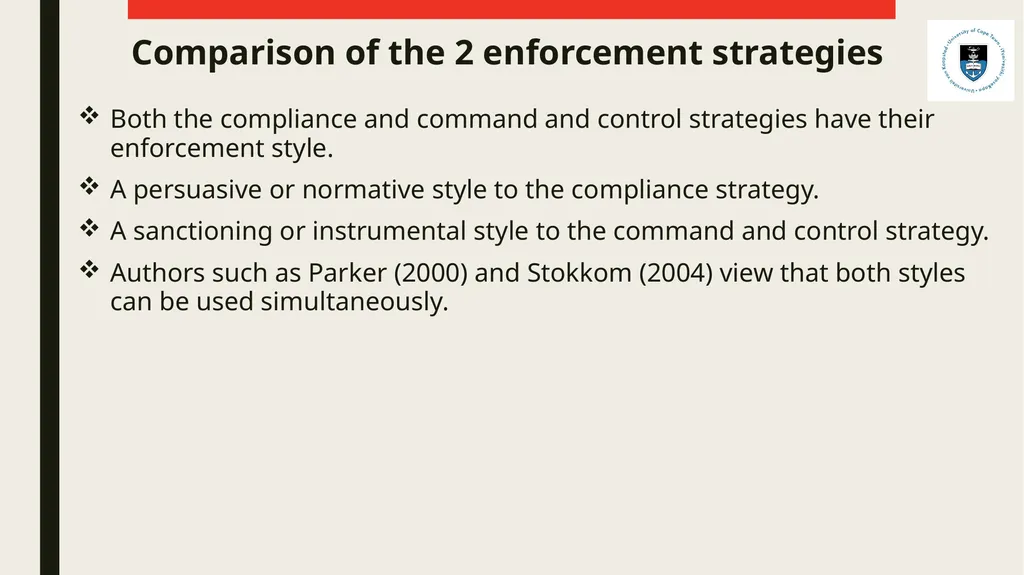
Comparison of the 2 enforcement strategies Both the compliance and command and control strategies have their enforcement style.
A persuasive or normative style to the compliance strategy.
A sanctioning or instrumental style to the command and control strategy.
Authors such as Parker (2000) and Stokkom (2004) view that both styles can be used simultaneously.<br>
A persuasive or normative style to the compliance strategy.
A sanctioning or instrumental style to the command and control strategy.
Authors such as Parker (2000) and Stokkom (2004) view that both styles can be used simultaneously.<br>
13
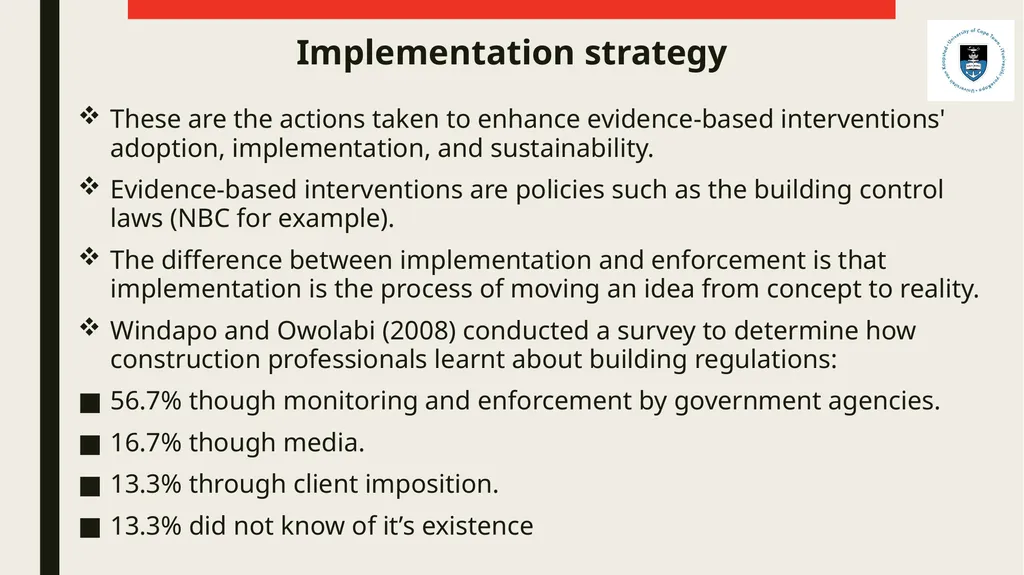
Implementation strategy These are the actions taken to enhance evidence-based interventions' adoption, implementation, and sustainability.
Evidence-based interventions are policies such as the building control laws (NBC for example).
The difference between implementation and enforcement is that implementation is the process of moving an idea from concept to reality.
Windapo and Owolabi (2008) conducted a survey to determine how construction professionals learnt about building regulations:
56.7% though monitoring and enforcement by government agencies.
16.7% though media.
13.3% through client imposition.
13.3% did not know of it’s existence<br>
Evidence-based interventions are policies such as the building control laws (NBC for example).
The difference between implementation and enforcement is that implementation is the process of moving an idea from concept to reality.
Windapo and Owolabi (2008) conducted a survey to determine how construction professionals learnt about building regulations:
56.7% though monitoring and enforcement by government agencies.
16.7% though media.
13.3% through client imposition.
13.3% did not know of it’s existence<br>
14
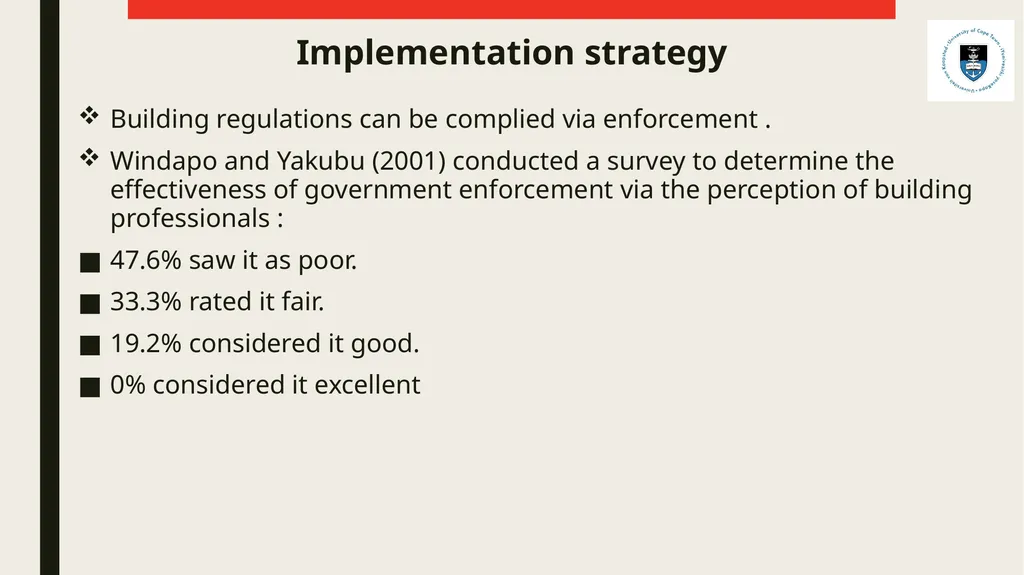
Implementation strategy Building regulations can be complied via enforcement .
Windapo and Yakubu (2001) conducted a survey to determine the effectiveness of government enforcement via the perception of building professionals :
47.6% saw it as poor.
33.3% rated it fair.
19.2% considered it good.
0% considered it excellent<br>
Windapo and Yakubu (2001) conducted a survey to determine the effectiveness of government enforcement via the perception of building professionals :
47.6% saw it as poor.
33.3% rated it fair.
19.2% considered it good.
0% considered it excellent<br>
15
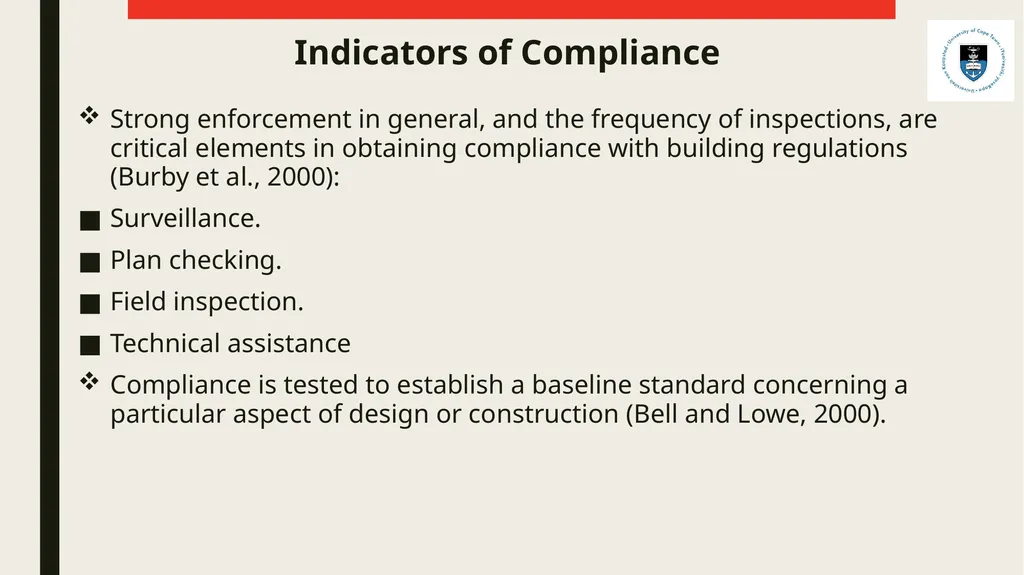
Indicators of Compliance Strong enforcement in general, and the frequency of inspections, are critical elements in obtaining compliance with building regulations (Burby et al., 2000):
Surveillance.
Plan checking.
Field inspection.
Technical assistance
Compliance is tested to establish a baseline standard concerning a particular aspect of design or construction (Bell and Lowe, 2000).<br>
Surveillance.
Plan checking.
Field inspection.
Technical assistance
Compliance is tested to establish a baseline standard concerning a particular aspect of design or construction (Bell and Lowe, 2000).<br>
16
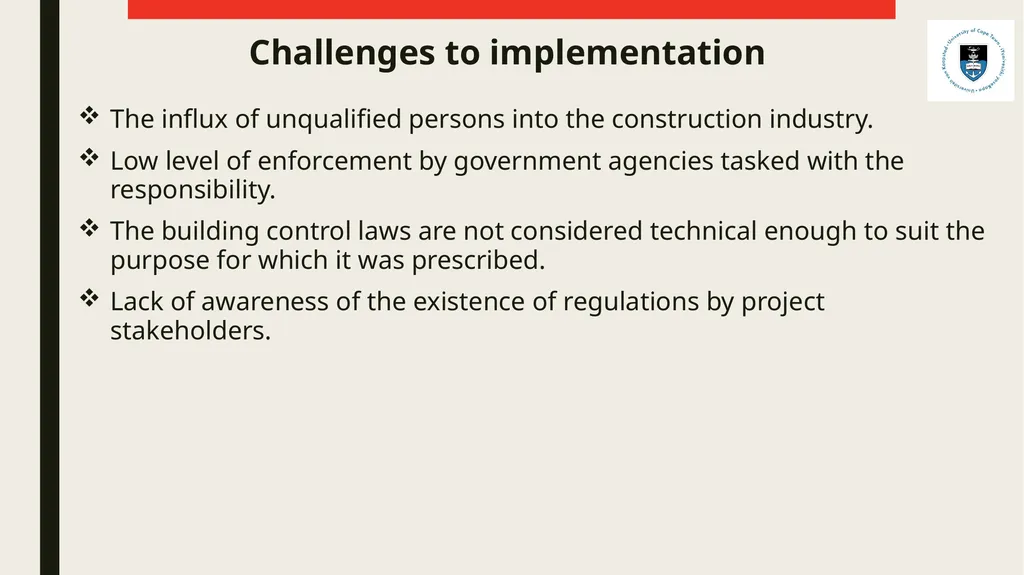
Challenges to implementation The influx of unqualified persons into the construction industry.
Low level of enforcement by government agencies tasked with the responsibility.
The building control laws are not considered technical enough to suit the purpose for which it was prescribed.
Lack of awareness of the existence of regulations by project stakeholders.<br>
Low level of enforcement by government agencies tasked with the responsibility.
The building control laws are not considered technical enough to suit the purpose for which it was prescribed.
Lack of awareness of the existence of regulations by project stakeholders.<br>
17
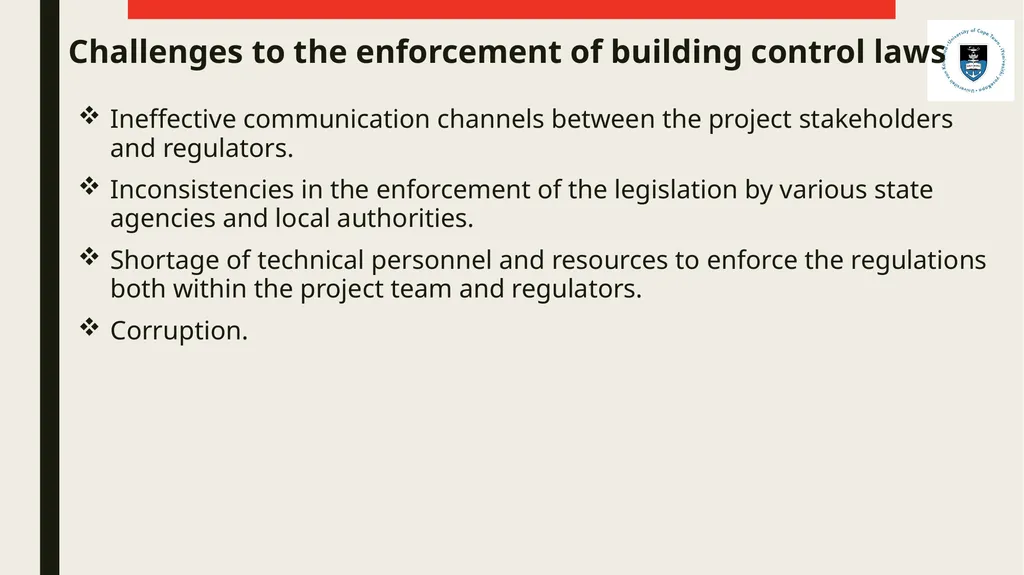
Challenges to the enforcement of building control laws Ineffective communication channels between the project stakeholders and regulators.
Inconsistencies in the enforcement of the legislation by various state agencies and local authorities.
Shortage of technical personnel and resources to enforce the regulations both within the project team and regulators.
Corruption.<br>
Inconsistencies in the enforcement of the legislation by various state agencies and local authorities.
Shortage of technical personnel and resources to enforce the regulations both within the project team and regulators.
Corruption.<br>
18
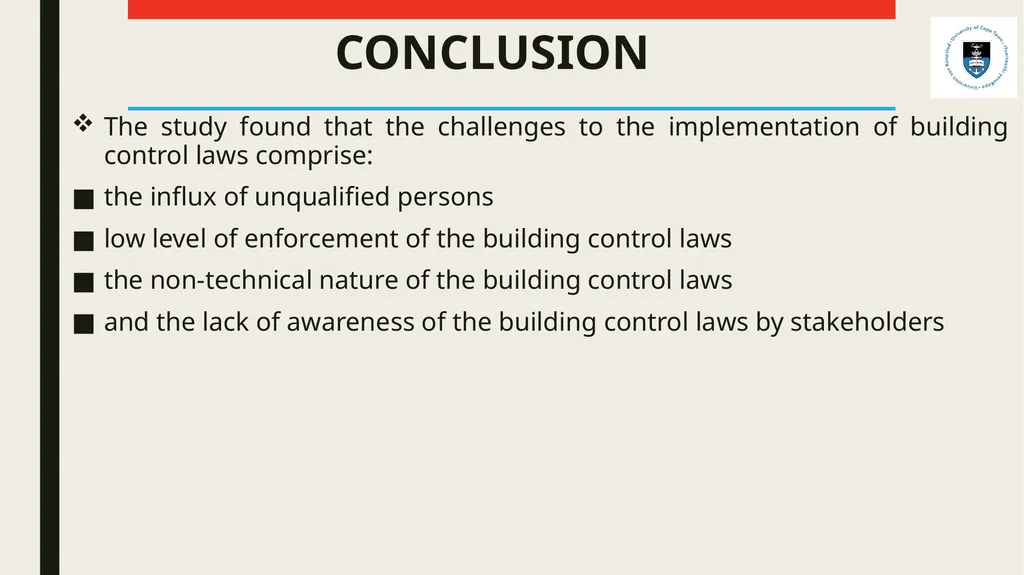
CONCLUSION The study found that the challenges to the implementation of building control laws comprise:
the influx of unqualified persons
low level of enforcement of the building control laws
the non-technical nature of the building control laws
and the lack of awareness of the building control laws by stakeholders<br>
the influx of unqualified persons
low level of enforcement of the building control laws
the non-technical nature of the building control laws
and the lack of awareness of the building control laws by stakeholders<br>
19
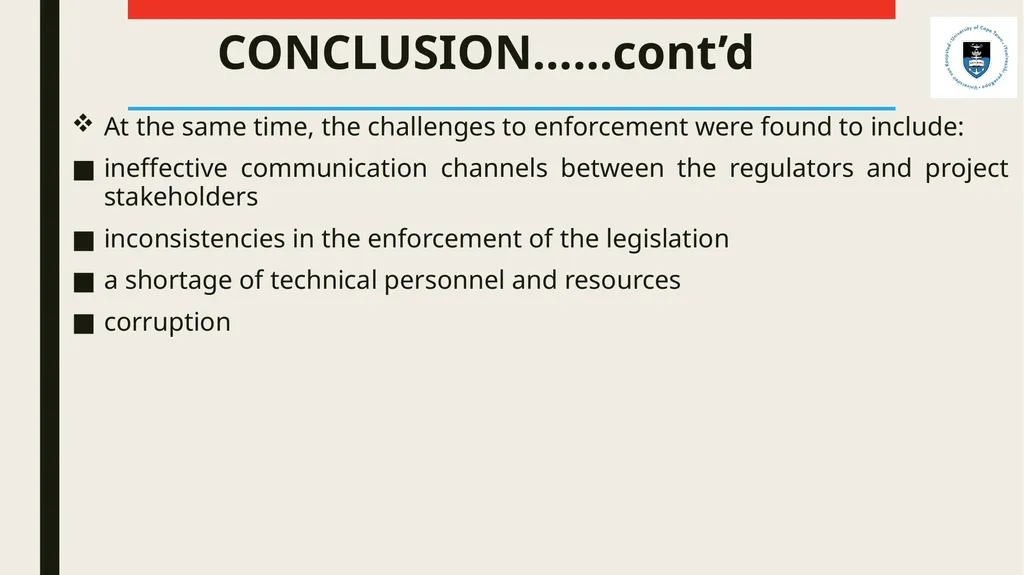
CONCLUSION……cont’d At the same time, the challenges to enforcement were found to include:
ineffective communication channels between the regulators and project stakeholders
inconsistencies in the enforcement of the legislation
a shortage of technical personnel and resources
corruption<br>
ineffective communication channels between the regulators and project stakeholders
inconsistencies in the enforcement of the legislation
a shortage of technical personnel and resources
corruption<br>
20
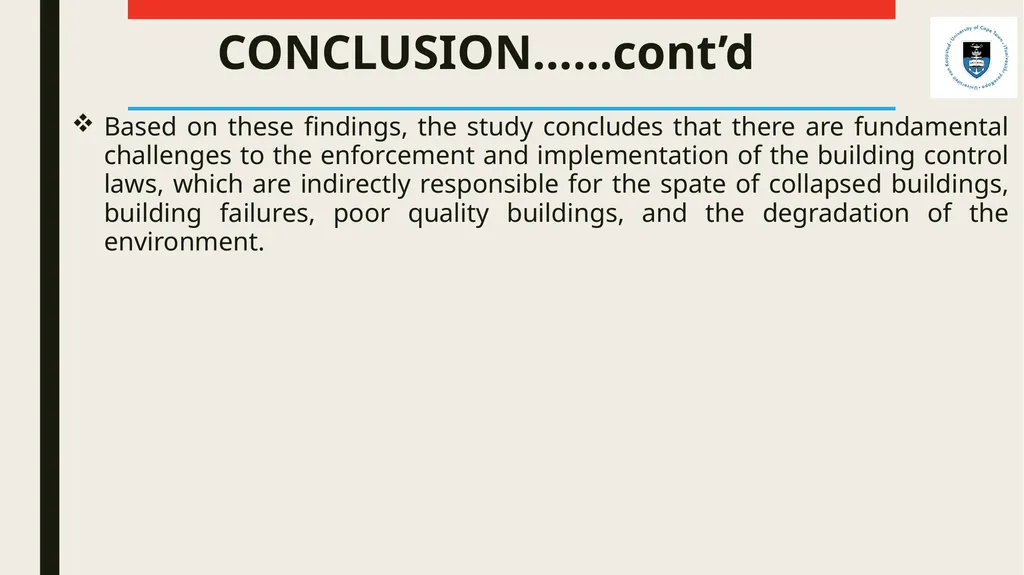
CONCLUSION……cont’d Based on these findings, the study concludes that there are fundamental challenges to the enforcement and implementation of the building control laws, which are indirectly responsible for the spate of collapsed buildings, building failures, poor quality buildings, and the degradation of the environment.<br>
21
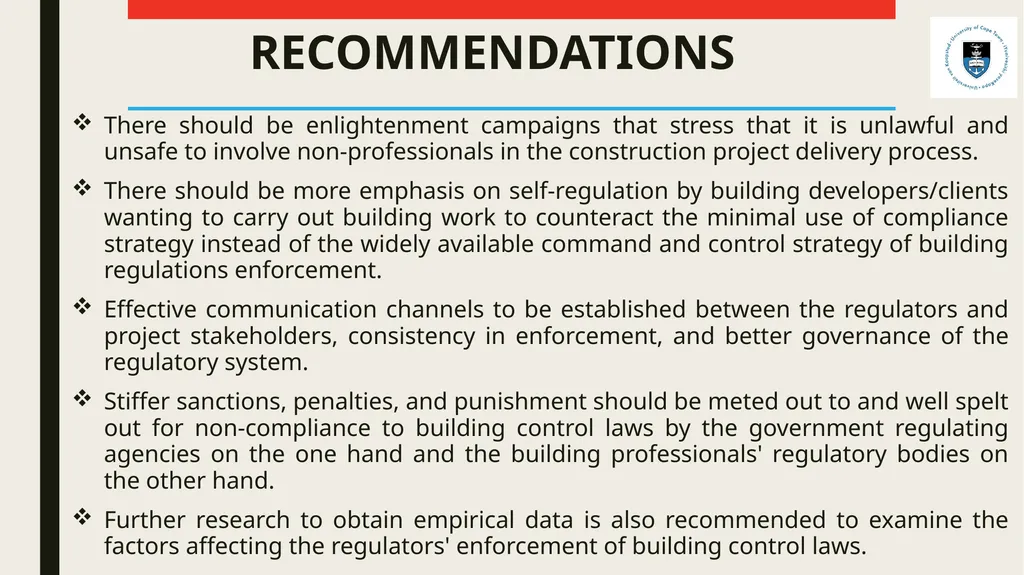
RECOMMENDATIONS There should be enlightenment campaigns that stress that it is unlawful and unsafe to involve non-professionals in the construction project delivery process.
There should be more emphasis on self-regulation by building developers/clients wanting to carry out building work to counteract the minimal use of compliance strategy instead of the widely available command and control strategy of building regulations enforcement.
Effective communication channels to be established between the regulators and project stakeholders, consistency in enforcement, and better governance of the regulatory system.
Stiffer sanctions, penalties, and punishment should be meted out to and well spelt out for non-compliance to building control laws by the government regulating agencies on the one hand and the building professionals' regulatory bodies on the other hand.
Further research to obtain empirical data is also recommended to examine the factors affecting the regulators' enforcement of building control laws.<br>
There should be more emphasis on self-regulation by building developers/clients wanting to carry out building work to counteract the minimal use of compliance strategy instead of the widely available command and control strategy of building regulations enforcement.
Effective communication channels to be established between the regulators and project stakeholders, consistency in enforcement, and better governance of the regulatory system.
Stiffer sanctions, penalties, and punishment should be meted out to and well spelt out for non-compliance to building control laws by the government regulating agencies on the one hand and the building professionals' regulatory bodies on the other hand.
Further research to obtain empirical data is also recommended to examine the factors affecting the regulators' enforcement of building control laws.<br>
22
thank YOU<br>
23
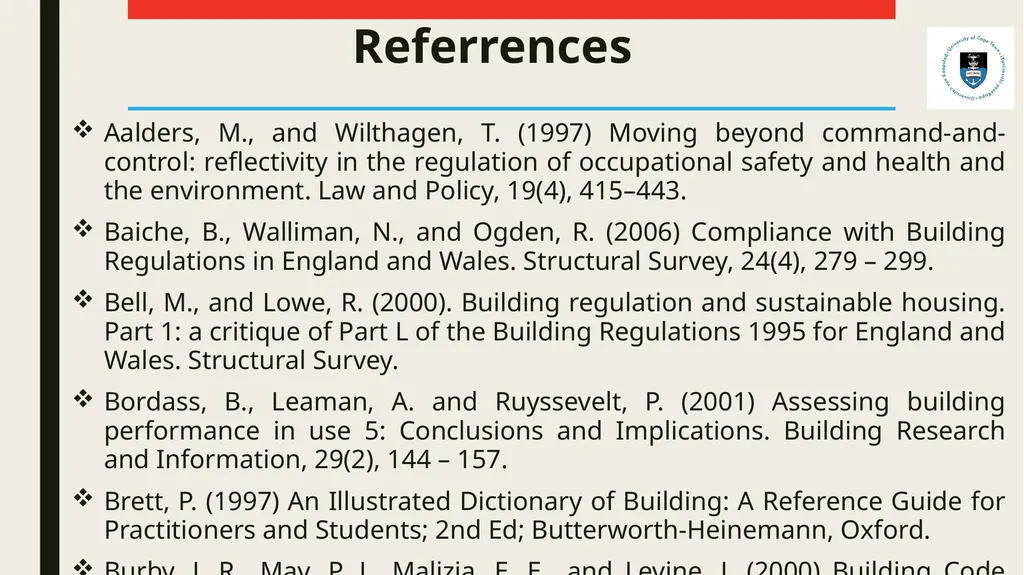
Referrences Aalders, M., and Wilthagen, T. (1997) Moving beyond command-and-control: reflectivity in the regulation of occupational safety and health and the environment. Law and Policy, 19(4), 415–443.
Baiche, B., Walliman, N., and Ogden, R. (2006) Compliance with Building Regulations in England and Wales. Structural Survey, 24(4), 279 – 299.
Bell, M., and Lowe, R. (2000). Building regulation and sustainable housing. Part 1: a critique of Part L of the Building Regulations 1995 for England and Wales. Structural Survey.
Bordass, B., Leaman, A. and Ruyssevelt, P. (2001) Assessing building performance in use 5: Conclusions and Implications. Building Research and Information, 29(2), 144 – 157.
Brett, P. (1997) An Illustrated Dictionary of Building: A Reference Guide for Practitioners and Students; 2nd Ed; Butterworth-Heinemann, Oxford.
Burby, J. R., May, P. J., Malizia, E. E., and Levine, J. (2000) Building Code Enforcement Burdens and Central City Decline. Journal of the American Planning Association, 66 (2), Spring, 2000, 143-161.
Federal Republic of Nigeria (1993) Proposed Draft National Building Code, Federal Ministry of Works and Housing, Lagos.
Glaeser, E. L., and Gyourko, J. (2003). The impact of building restrictions on housing. In Affordability,” Economic Policy Review.
Gunningham, N. (2011) Investigation of Industry Self-Regulation in Workplace Health and Safety in New Zealand, Journal of Safety Research, 31(13), 120–143.
Hawkins, K. (1984) Environment and enforcement: Regulation and the social definition of pollution. Oxford: Clarendon Press. Pp 92-97.
Josephson, P. E., and Hammarlund, Y. (1999) The causes and costs of defects in construction. Automation in Construction, 8, 681–687.
Korosec, R.P. (1990) Reforming the Workplace: A Study of Self-Regulation in Occupational Safety, American Political Science Review, 84(4), 1406-1407.
May, P. J. (2004). Compliance motivations: Affirmative and negative bases. Law & Society Review, 38(1), 41-68.
National Building Code (2006). The Federal Republic of Nigeria. 1st Edition Cape Town: LexisNexis Butterworths.
Noam, E. M. (1983) The Interaction of Building Codes and Housing Prices, AREUEA Journal, 10 pp 395 – 404.
Ogus (2002) Ogus, A. (2002). Comparing regulatory systems: institutions, processes and legal forms in industrialised countries (No. 1649-2016-135871). Working Paper Series No. 35, Manchester: Centre for Regulation and Competition.
Omollo, W. O. (2019). Barriers to the Effective Regulation of the Building Construction Industry: An Empirical Analysis. Journal of Construction Business and Management, 3(2), 49-58.
Parker, C. (2000). Reinventing regulation within the corporation: compliance-oriented regulatory innovation. Administration & Society, 32(5), 529-565.
Sinclair, D. (1997) Self-Regulation Versus Command and Control? Beyond False Dichotomies, Law and Policy, 19(4), 529.
Rees, J.V. (1988) “Reforming the workplace: a study of self-regulation in occupational safety,” University of Pennsylvania Press.
Stokkom, B. V. (2004). Handhaven: eerst kiezen, dan doen. Sociaal wetenschappelijke mogelijkheden en beperkingen, Den Haag: Expertise Centrum Rechtshandhaving.
Watermeyer, R. B and Milford, R. V. (2003) The Use of Performance Based Building Codes to Attain Sustainable Housing Objectives: The South African Approach; Paper presented at Global Policy Summit on the Role of Performance-Based Building Regulations in Addressing Societal Expectations, International Policy and Local Needs, National Academy of Sciences, Washington DC, USA, Nov 3-5; Accessed at: www.csir.co.za/akani on 27th October 2009.
Windapo, A. O. (2020) Identification, Causes and Prevention of Building Collapse In Nigeria. Presentation made at the Building Production and Structural Stability Webinar; Mandatory National Workshop organised by the Nigerian Institute of Building, 15-16 July 2020.
Windapo, A. O., Umeokafor, N. I., and Olatunji, A. (2018) Self-regulation to Occupational Health and Safety Legislative Requirements by Contractors in South Africa. In Saurin, T. A., Costa, D. B., Behm. M., and Emuze, F. (Eds.). Proc. Joint CIBW99 and TG59 Conference, Salvador, pp. 187–196.
Windapo and Owolabi (2008) Implementation, Compliance and Enforcement of the National Building Code: Challenges and Strategies to adopt. The Proceedings of the 38th Annual General Meeting/Conference of the Nigerian Institute of Building with the theme: The National Building Code and Nation Building. 15-19 October, Osogbo.
Windapo and Yakubu (2001) Planning/Building Regulations and Implementation by Contractors in Nigeria. The Professional Builder Journal, ISSN 0795-8854, July, pp. 15-21.
Yusuf, A. (2007) Building Regulations, What Next? In the Proceedings of a 2-Day Workshop on Regulating the Construction Practice, University of Lagos, FES Lecture Theatre, July 17-18, pp. 2-7.<br>
Baiche, B., Walliman, N., and Ogden, R. (2006) Compliance with Building Regulations in England and Wales. Structural Survey, 24(4), 279 – 299.
Bell, M., and Lowe, R. (2000). Building regulation and sustainable housing. Part 1: a critique of Part L of the Building Regulations 1995 for England and Wales. Structural Survey.
Bordass, B., Leaman, A. and Ruyssevelt, P. (2001) Assessing building performance in use 5: Conclusions and Implications. Building Research and Information, 29(2), 144 – 157.
Brett, P. (1997) An Illustrated Dictionary of Building: A Reference Guide for Practitioners and Students; 2nd Ed; Butterworth-Heinemann, Oxford.
Burby, J. R., May, P. J., Malizia, E. E., and Levine, J. (2000) Building Code Enforcement Burdens and Central City Decline. Journal of the American Planning Association, 66 (2), Spring, 2000, 143-161.
Federal Republic of Nigeria (1993) Proposed Draft National Building Code, Federal Ministry of Works and Housing, Lagos.
Glaeser, E. L., and Gyourko, J. (2003). The impact of building restrictions on housing. In Affordability,” Economic Policy Review.
Gunningham, N. (2011) Investigation of Industry Self-Regulation in Workplace Health and Safety in New Zealand, Journal of Safety Research, 31(13), 120–143.
Hawkins, K. (1984) Environment and enforcement: Regulation and the social definition of pollution. Oxford: Clarendon Press. Pp 92-97.
Josephson, P. E., and Hammarlund, Y. (1999) The causes and costs of defects in construction. Automation in Construction, 8, 681–687.
Korosec, R.P. (1990) Reforming the Workplace: A Study of Self-Regulation in Occupational Safety, American Political Science Review, 84(4), 1406-1407.
May, P. J. (2004). Compliance motivations: Affirmative and negative bases. Law & Society Review, 38(1), 41-68.
National Building Code (2006). The Federal Republic of Nigeria. 1st Edition Cape Town: LexisNexis Butterworths.
Noam, E. M. (1983) The Interaction of Building Codes and Housing Prices, AREUEA Journal, 10 pp 395 – 404.
Ogus (2002) Ogus, A. (2002). Comparing regulatory systems: institutions, processes and legal forms in industrialised countries (No. 1649-2016-135871). Working Paper Series No. 35, Manchester: Centre for Regulation and Competition.
Omollo, W. O. (2019). Barriers to the Effective Regulation of the Building Construction Industry: An Empirical Analysis. Journal of Construction Business and Management, 3(2), 49-58.
Parker, C. (2000). Reinventing regulation within the corporation: compliance-oriented regulatory innovation. Administration & Society, 32(5), 529-565.
Sinclair, D. (1997) Self-Regulation Versus Command and Control? Beyond False Dichotomies, Law and Policy, 19(4), 529.
Rees, J.V. (1988) “Reforming the workplace: a study of self-regulation in occupational safety,” University of Pennsylvania Press.
Stokkom, B. V. (2004). Handhaven: eerst kiezen, dan doen. Sociaal wetenschappelijke mogelijkheden en beperkingen, Den Haag: Expertise Centrum Rechtshandhaving.
Watermeyer, R. B and Milford, R. V. (2003) The Use of Performance Based Building Codes to Attain Sustainable Housing Objectives: The South African Approach; Paper presented at Global Policy Summit on the Role of Performance-Based Building Regulations in Addressing Societal Expectations, International Policy and Local Needs, National Academy of Sciences, Washington DC, USA, Nov 3-5; Accessed at: www.csir.co.za/akani on 27th October 2009.
Windapo, A. O. (2020) Identification, Causes and Prevention of Building Collapse In Nigeria. Presentation made at the Building Production and Structural Stability Webinar; Mandatory National Workshop organised by the Nigerian Institute of Building, 15-16 July 2020.
Windapo, A. O., Umeokafor, N. I., and Olatunji, A. (2018) Self-regulation to Occupational Health and Safety Legislative Requirements by Contractors in South Africa. In Saurin, T. A., Costa, D. B., Behm. M., and Emuze, F. (Eds.). Proc. Joint CIBW99 and TG59 Conference, Salvador, pp. 187–196.
Windapo and Owolabi (2008) Implementation, Compliance and Enforcement of the National Building Code: Challenges and Strategies to adopt. The Proceedings of the 38th Annual General Meeting/Conference of the Nigerian Institute of Building with the theme: The National Building Code and Nation Building. 15-19 October, Osogbo.
Windapo and Yakubu (2001) Planning/Building Regulations and Implementation by Contractors in Nigeria. The Professional Builder Journal, ISSN 0795-8854, July, pp. 15-21.
Yusuf, A. (2007) Building Regulations, What Next? In the Proceedings of a 2-Day Workshop on Regulating the Construction Practice, University of Lagos, FES Lecture Theatre, July 17-18, pp. 2-7.<br>