
ENG 384: ENGINEERING LAW AND MANAGERIAL ECONOMICS
DJ
Published · 258 slides · 0 views

1 / 1























Description
ENG 384: ENGINEERING LAW AND MANAGERIAL ECONOMICS Engr. O. J. OYEBODE BEng, MSc, MASCE, MNIM, MARSCP, MNICE, MNSE, MSN, R.Eng. (COREN) Lecturer in the Civil Engineering Department, COLLEGE OF ENGINEERING, AFE BABALOLA UNIVERSITY , ADO-EKITI
Related Topics
Share
Embed code
Download this presentation From Below
"ENG 384: ENGINEERING LAW AND MANAGERIAL ECONOMICS" is the property of its rightful owner. Permission is granted to download and print the materials on this website for personal, non-commercial use only, and to display it on your personal computer provided you do not modify the materials and that you retain all copyright notices contained in the materials. By downloading content from our website, you accept the terms of this agreement.
Presentation Transcript
01
ENG 384: ENGINEERING LAW AND MANAGERIAL ECONOMICS Engr. O. J. OYEBODE
BEng, MSc, MASCE, MNIM, MARSCP, MNICE, MNSE, MSN, R.Eng. (COREN)
Lecturer in the Civil Engineering Department, COLLEGE OF ENGINEERING,
AFE BABALOLA UNIVERSITY , ADO-EKITI (ABUAD)
20th January 2020<br>
BEng, MSc, MASCE, MNIM, MARSCP, MNICE, MNSE, MSN, R.Eng. (COREN)
Lecturer in the Civil Engineering Department, COLLEGE OF ENGINEERING,
AFE BABALOLA UNIVERSITY , ADO-EKITI (ABUAD)
20th January 2020<br>
02
Engr. OYEBODE, Oluwadare Joshua - Coordinator
Engr. Dr. Bello, Kareem Aderemi
Engr. Dr. Udeagbara Stephen Gekwu
Engr. (Mrs). IKPEZE, Onyinye Florence LECTURERS FOR ENG 384 2<br>
Engr. Dr. Bello, Kareem Aderemi
Engr. Dr. Udeagbara Stephen Gekwu
Engr. (Mrs). IKPEZE, Onyinye Florence LECTURERS FOR ENG 384 2<br>
03
ENG 384: COURSE OUTLINE Law for Engineering Practice: Its history, definition, nature and division. Source of Law; Legislation, case-law and custom. Distinction between criminal and civil law, organization of the courts, doctrine and binding precedent. Legislation codification interpretation. Equity: Definition and its main spheres. Law of contracts for Engineers: offer, acceptance, communication termination. General principles of criminal law. Law of torts: definition, classification and liabilities. Patents: requirements, application, and infringement. Registered designs: application, requirements, types and infringement. Company law. Labour law and Industrial Law<br>
04
Formation of contract, contractual capacity, misrepresentation, discharge and remedies, agency sale of goods; conditions and warranties, transfer of property title, risk breaches of contract wrongfully injury to third party, apportionment of damages between employer and employee. Industrial accidents; duties of employer to employees and others on industrial premises, as imposed by case-law acts e.g. Mines and quarries, Factories, Office, shops and railway premises (of Nigeria) extent of action arising from such acts. Labour Organization law in Nigeria-Union Membership, closed shop agency shops, sole bargaining agencies.<br>
05
Contract Procedure: Parties to a contract and their function: contract documents and their purpose: General conditions of contracts specifications, drawing up bills of quantities, forms of tenders; acceptance of tender. Types of contract: fixed-price, cost-plus, semi-contracts. Financial arrangements, board relations, money measurement for interim certificate.<br>
06
ENG 384: COURSE OUTLINE Managerial Economics: Managerial theories of firm behaviours, price competition in various market structure, non-price competitions and quality optimization. Efficiency and performance evaluation. Demand estimating and forecasting.
Managerial Accounting and Control: Financial goals and objectives. Analysis of cost behaviour standards for manufacturing and non-manufacturing costs. Absorption versus marginal costing. And large companies including consideration of centralize versus decentralized financial controls transfer, pricing etc. Control over capital projects, integrating project financial analysis with corporate strategy.<br>
Managerial Accounting and Control: Financial goals and objectives. Analysis of cost behaviour standards for manufacturing and non-manufacturing costs. Absorption versus marginal costing. And large companies including consideration of centralize versus decentralized financial controls transfer, pricing etc. Control over capital projects, integrating project financial analysis with corporate strategy.<br>
07
LECTURERS/FACILITATORS/ INSTRUCTORS:
Engr. OYEBODE, Oluwadare Joshua
08032151833, 08057932144,
oyebodedare@yahoo.com
Office F32, College of Engineering Building<br>
Engr. OYEBODE, Oluwadare Joshua
08032151833, 08057932144,
oyebodedare@yahoo.com
Office F32, College of Engineering Building<br>
08
COURSE EVALUATION
The marks awarded for this subject are assigned as follows:
Continuous Assessment (40%)
Attendance
Term Paper / case study / presentation on topical issues on Engineering law and management
Homework / Assignments (You lose marks for late submission)
Tests (both planned and impromptu) and
Mid Semester Test
End of Semester Examination (60%)<br>
The marks awarded for this subject are assigned as follows:
Continuous Assessment (40%)
Attendance
Term Paper / case study / presentation on topical issues on Engineering law and management
Homework / Assignments (You lose marks for late submission)
Tests (both planned and impromptu) and
Mid Semester Test
End of Semester Examination (60%)<br>
09
The Law of Contract Recommended Texts
Law and Management Engineering Practice by E.A, Okunade
Nigerian Law of Contract by IE, Sagay
Civil Engineering Practice: An Introduction by S, Scott
Omojola’s General Principles of Business and Cooperative Law in Nigeria by F, Omojola
Available in the University Library
2- Available in Departmental/School Libraries
3- Available on the Internet.
4- Available as Personal Collection<br>
Law and Management Engineering Practice by E.A, Okunade
Nigerian Law of Contract by IE, Sagay
Civil Engineering Practice: An Introduction by S, Scott
Omojola’s General Principles of Business and Cooperative Law in Nigeria by F, Omojola
Available in the University Library
2- Available in Departmental/School Libraries
3- Available on the Internet.
4- Available as Personal Collection<br>
10
Attendance: It is mandatory for every student taking this course to attend lectures and participate in all lecture activities. The course is highly technical and success will be enhanced by listening attentively always during lectures and asking questions where there are ideas/concepts that are not clearly understood.
Academic Ethics: Students are expected to exhibit a high level of moral decency with regards the performing of their academic work. Cheating during assignments, tests or examination or any other forms of academic fraud such as copies of another person’s work and submit it as your own (plagiarism) will not be tolerated. Students are forewarned that any case of academic misconduct will be referred to the University Authorities for appropriate disciplinary actions. Students should refer to the University Students’ Handbook for guidance on this and related issues.<br>
Academic Ethics: Students are expected to exhibit a high level of moral decency with regards the performing of their academic work. Cheating during assignments, tests or examination or any other forms of academic fraud such as copies of another person’s work and submit it as your own (plagiarism) will not be tolerated. Students are forewarned that any case of academic misconduct will be referred to the University Authorities for appropriate disciplinary actions. Students should refer to the University Students’ Handbook for guidance on this and related issues.<br>
11
The objectives of this course are to: Equip them with knowledge on legal system relating to engineering.
Impact the students with managerial skill for effective career growth;
The emphasis will be on the estimation techniques, production planning and control for managerial roles and network analysis. Issues concerning the Nigeria legal system will be addressed. Factors necessary for business establishment will be considered, which is inclusive of: (1) selecting a promising business idea, (2) initiating enterprises and obtaining initial capital, and (3) Legal issues for business beginners<br>
Impact the students with managerial skill for effective career growth;
The emphasis will be on the estimation techniques, production planning and control for managerial roles and network analysis. Issues concerning the Nigeria legal system will be addressed. Factors necessary for business establishment will be considered, which is inclusive of: (1) selecting a promising business idea, (2) initiating enterprises and obtaining initial capital, and (3) Legal issues for business beginners<br>
12
The objective of ENG 384 is to enrich the knowledge of students on law, management and engineering economics. To provide tools and the guidance to allow you to master; Concepts of Engineering Law, Managerial Economics
Effective and efficient Management of Engineering projects. Utilize the knowledge to solve real life community problems on engineering law issues through the scheduled course outline. That is, we wish to help you attain the tools, the mindset, and approaches that are useful in translating a physical situation into an analytical framework, and to use the various tools of mathematics to "solve" for wanted information.<br>
Effective and efficient Management of Engineering projects. Utilize the knowledge to solve real life community problems on engineering law issues through the scheduled course outline. That is, we wish to help you attain the tools, the mindset, and approaches that are useful in translating a physical situation into an analytical framework, and to use the various tools of mathematics to "solve" for wanted information.<br>
13
The aim of this course is to provide engineers with an understanding of the fundamental legal issues they need to be aware of from letter of appointment to letter of claim. It will provide prospective engineers with a practical insight into the current trends in engineering litigation in Nigeria and the legal basics they need to be aware of.
Studying engineering and law will give you this balance of theory and practice, the physical and intellectual capacity to make sound judgment.<br>
Studying engineering and law will give you this balance of theory and practice, the physical and intellectual capacity to make sound judgment.<br>
14
INTRODUCTION In any society, everybody is subject to the law. Everybody must do as the law says, or face the punishments which can be handed out to law-breakers. Engineers are no different. They, too, must obey the laws of their society. However, there are certain laws which will affect engineering practice.
Engineering law is the empirical study of the application of laws and legal strategy in engineering. Applied law aims to explain how law interacts with industry. The current school of thought within the academic community of lawyers and engineers is the pragmatic paradigm.<br>
Engineering law is the empirical study of the application of laws and legal strategy in engineering. Applied law aims to explain how law interacts with industry. The current school of thought within the academic community of lawyers and engineers is the pragmatic paradigm.<br>
15
Definition of Law Law can be defined as those rules and regulations, backed by sanctions when flouted, which guide the conduct and behaviour of members of a community or society, and which they accept and consider as binding.
Law is the system of rules which a particular country or community recognizes as regulating the actions of its members and which it may enforce by the imposition of penalties.<br>
Law is the system of rules which a particular country or community recognizes as regulating the actions of its members and which it may enforce by the imposition of penalties.<br>
16
Definition of Law Law is a system of rules that govern a society with the intention of maintaining social order, upholding justice and preventing harm to individuals and property. A body of rules of conduct of binding legal force and effect, prescribed, recognized, and enforced by controlling authority.
Another resource that can help us understand our responsibilities is the law. As we’ve already noted, the law is an imperfect guide to our moral obligations, but the law does often reflect our considered moral judgment and thus can be of some use.<br>
Another resource that can help us understand our responsibilities is the law. As we’ve already noted, the law is an imperfect guide to our moral obligations, but the law does often reflect our considered moral judgment and thus can be of some use.<br>
17
The Rule of Law
Our laws embody the basic moral values of our society. They impose limits on the conduct of individuals in order to promote the greater good and to make our communities safe places to live. It is against the law to steal, to be involved in drug abuse, to injure another person, to drive recklessly or to pollute the environment, to name just a few of the countless ways the law is designed to protect us. We are said to be ruled by law, not by those who enforce the law or wield government power. No one in the country is above the law. Everyone, no matter how wealthy or how powerful they are, must obey the law or face the consequences.<br>
Our laws embody the basic moral values of our society. They impose limits on the conduct of individuals in order to promote the greater good and to make our communities safe places to live. It is against the law to steal, to be involved in drug abuse, to injure another person, to drive recklessly or to pollute the environment, to name just a few of the countless ways the law is designed to protect us. We are said to be ruled by law, not by those who enforce the law or wield government power. No one in the country is above the law. Everyone, no matter how wealthy or how powerful they are, must obey the law or face the consequences.<br>
18
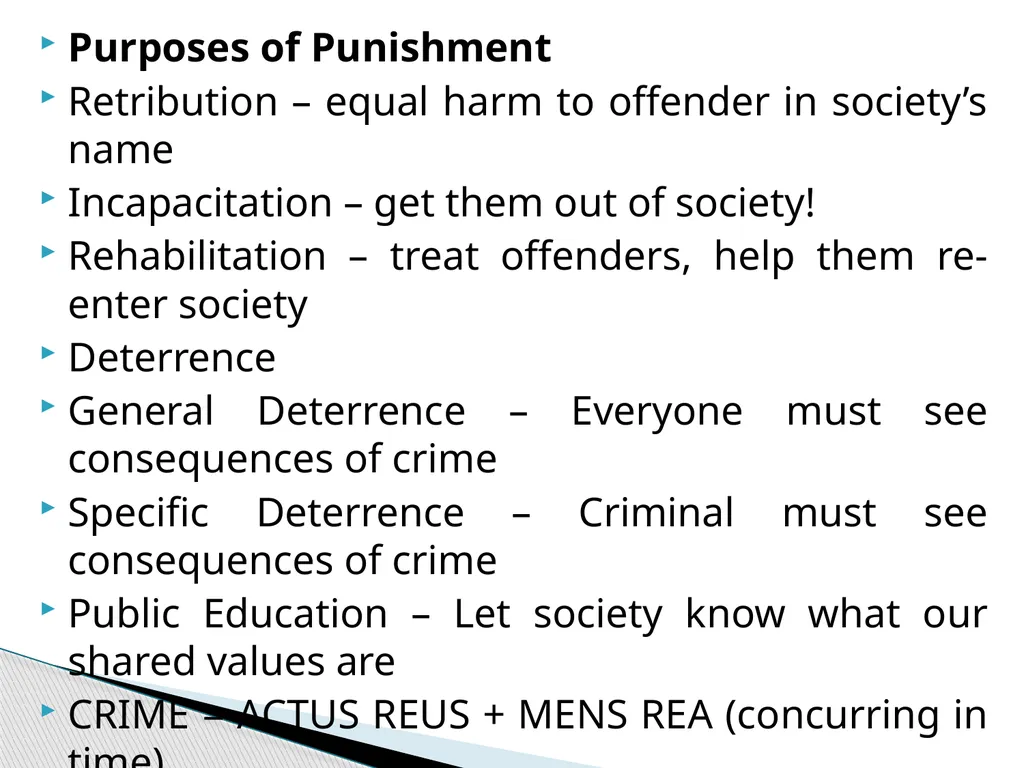
Purposes of Punishment
Retribution – equal harm to offender in society’s name
Incapacitation – get them out of society!
Rehabilitation – treat offenders, help them re-enter society
Deterrence
General Deterrence – Everyone must see consequences of crime
Specific Deterrence – Criminal must see consequences of crime
Public Education – Let society know what our shared values are
CRIME = ACTUS REUS + MENS REA (concurring in time)<br>
Retribution – equal harm to offender in society’s name
Incapacitation – get them out of society!
Rehabilitation – treat offenders, help them re-enter society
Deterrence
General Deterrence – Everyone must see consequences of crime
Specific Deterrence – Criminal must see consequences of crime
Public Education – Let society know what our shared values are
CRIME = ACTUS REUS + MENS REA (concurring in time)<br>
19
Engineering law (or law in engineering) is the empirical study of the application of laws and legal strategy in engineering. Applied law aims to explain how law interacts with industry. The current school of thought within the academic community of lawyers and engineers is the pragmatic paradigm.
Engineering Law provides soon-to-be engineers with an introductory understanding of the legal framework under which they will work.<br>
Engineering Law provides soon-to-be engineers with an introductory understanding of the legal framework under which they will work.<br>
20
Key topic areas for engineering law are: Contract administration, especially in construction, procurement, and supply chain.
Product liability, especially for manufactured products.
Intellectual property (IP) protection, which includes patents, copyrights, etc.
Safety legislation and regulations, which includes plant safety, risk management, food safety.
Standards and certification, which are product-specific constraints on design and testing processes.<br>
Product liability, especially for manufactured products.
Intellectual property (IP) protection, which includes patents, copyrights, etc.
Safety legislation and regulations, which includes plant safety, risk management, food safety.
Standards and certification, which are product-specific constraints on design and testing processes.<br>
21
Engineering Law provides soon-to-be engineers with an introductory understanding of the legal framework under which they will work. That is, all engineering is performed under the constraints imposed by our society’s laws and must take those laws into account. The course has been designed with the following goals in mind:
1) Give students a greater understanding of their and their company’s position relative to the law so that they can act and talk more intelligently on the subject and be a better asset for their company.<br>
1) Give students a greater understanding of their and their company’s position relative to the law so that they can act and talk more intelligently on the subject and be a better asset for their company.<br>
22
2) Highlight a few areas that often trip up people in industry so that students can avoid the pitfalls or raise a concern if their company seems like it might have some exposure.
3) Help students know when their company has a potential or actual legal problem and should call a lawyer.
Please note that this is merely an introductory class. This class will not make you a lawyer. You are advised to seek legal representation if and when you or your company encounters a legal issue.<br>
3) Help students know when their company has a potential or actual legal problem and should call a lawyer.
Please note that this is merely an introductory class. This class will not make you a lawyer. You are advised to seek legal representation if and when you or your company encounters a legal issue.<br>
23
A professional engineer (P.E.) is a person who is licensed to practice engineering in a particular state or country after meeting all requirements of the law. Whether the end result is a product, a process or service, engineers need to consider safety,
reliability, cost-effectiveness.
Engineering is a career based on logical, systematic problem solving, generally in high-tech, industrial, or scientific fields.<br>
Engineering is a career based on logical, systematic problem solving, generally in high-tech, industrial, or scientific fields.<br>
24
Engineering law can be defined as those rules and regulations, backed by sanctions when flouted, which guide the conduct and behaviour of members of engineering family in a community or society, and which they accept and consider as binding for their professional practice.
“practice of professional engineering” means any act of planning, designing, composing, evaluating, advising, reporting, directing or supervising that requires the application of engineering principles and concerns the safeguarding of life, health, property, economic interests, the public welfare, or the environment, or the managing of any such act. 24<br>
“practice of professional engineering” means any act of planning, designing, composing, evaluating, advising, reporting, directing or supervising that requires the application of engineering principles and concerns the safeguarding of life, health, property, economic interests, the public welfare, or the environment, or the managing of any such act. 24<br>
25
Such work or services may be either public or private, in connection with any utilities, structures, buildings, machines, equipment, processes, work systems, projects, and industrial or consumer products; equipment of a control, communications, computer, mechanical, petroleum, civil, chemical, electrical, hydraulic, pneumatic, or thermal nature. State laws, which vary by state, govern the licensing of professional engineers.<br>
26
Ignorance of the law is no excuse
The statement "ignorance of the law is no excuse" is an ancient legal doctrine:
Ignorance of the law excuses no man; not that all men know the law; but because 'tis an excuse every man will plead, and no man can tell how to confute him.
John Selden (1584-1654), posthumously published in Table Talk, 1689.
If a defendant were allowed to escape legal responsibility for his acts, merely by saying "I didn't know it was wrong/illegal", the system of using law to regulate human conduct would collapse.
So the doctrine is a practical necessity.<br>
The statement "ignorance of the law is no excuse" is an ancient legal doctrine:
Ignorance of the law excuses no man; not that all men know the law; but because 'tis an excuse every man will plead, and no man can tell how to confute him.
John Selden (1584-1654), posthumously published in Table Talk, 1689.
If a defendant were allowed to escape legal responsibility for his acts, merely by saying "I didn't know it was wrong/illegal", the system of using law to regulate human conduct would collapse.
So the doctrine is a practical necessity.<br>
27
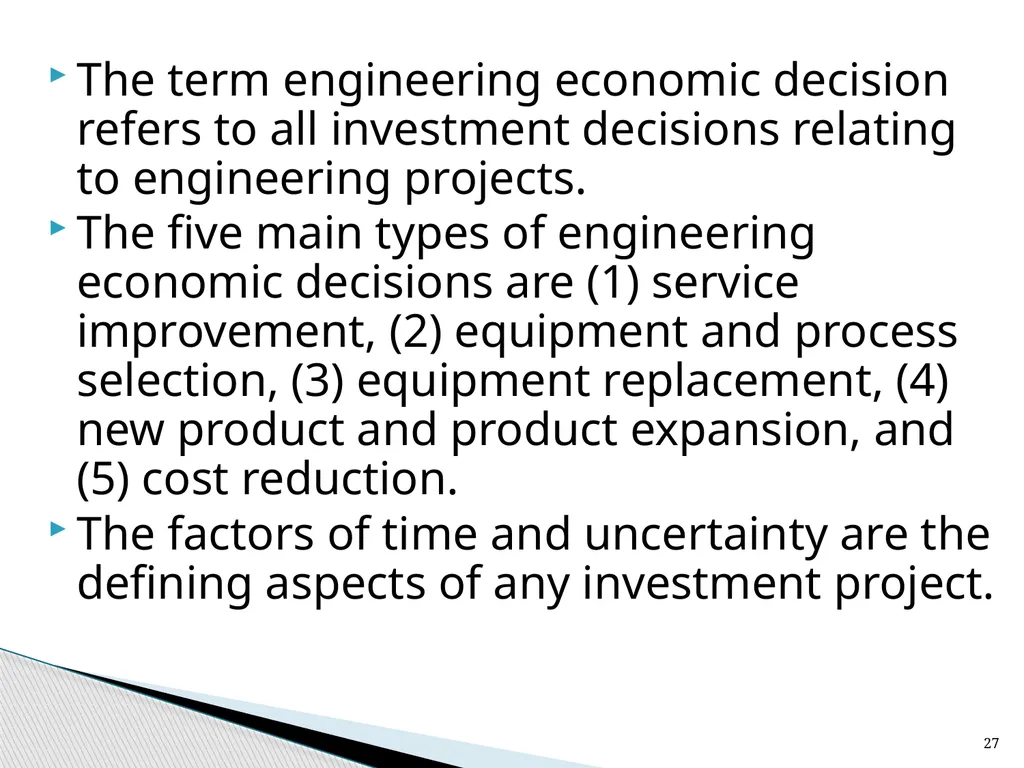
27 The term engineering economic decision refers to all investment decisions relating to engineering projects.
The five main types of engineering economic decisions are (1) service improvement, (2) equipment and process selection, (3) equipment replacement, (4) new product and product expansion, and (5) cost reduction.
The factors of time and uncertainty are the defining aspects of any investment project.<br>
The five main types of engineering economic decisions are (1) service improvement, (2) equipment and process selection, (3) equipment replacement, (4) new product and product expansion, and (5) cost reduction.
The factors of time and uncertainty are the defining aspects of any investment project.<br>
28
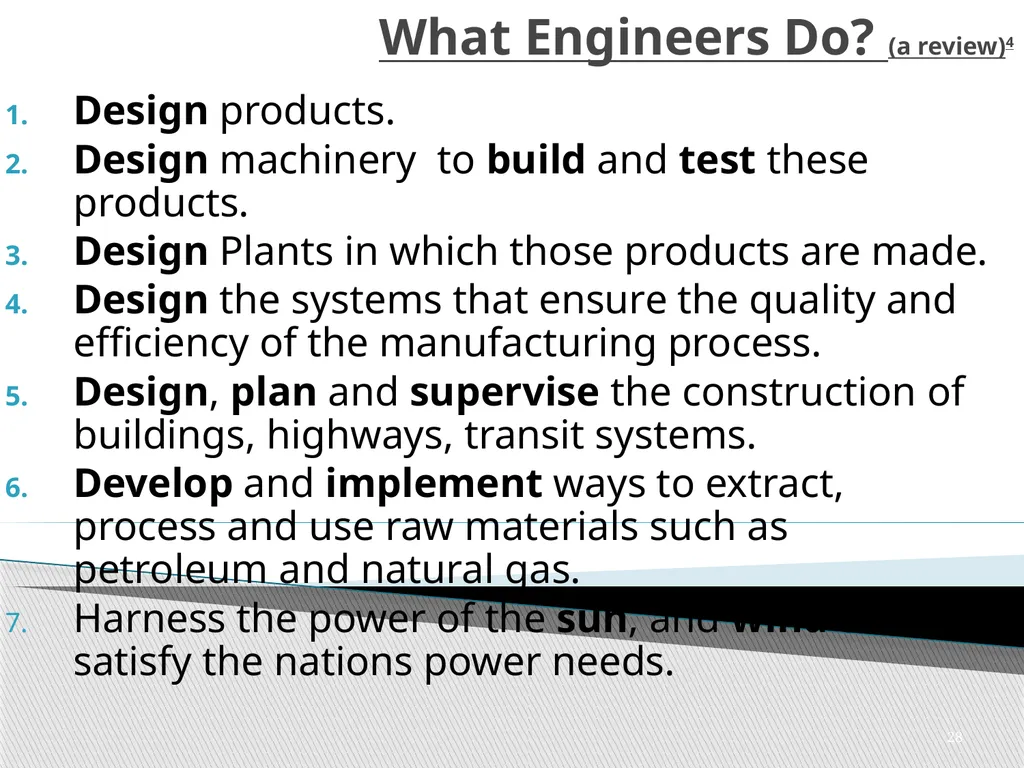
28 What Engineers Do? (a review)4 Design products.
Design machinery to build and test these products.
Design Plants in which those products are made.
Design the systems that ensure the quality and efficiency of the manufacturing process.
Design, plan and supervise the construction of buildings, highways, transit systems.
Develop and implement ways to extract, process and use raw materials such as petroleum and natural gas.
Harness the power of the sun, and wind to satisfy the nations power needs.<br>
Design machinery to build and test these products.
Design Plants in which those products are made.
Design the systems that ensure the quality and efficiency of the manufacturing process.
Design, plan and supervise the construction of buildings, highways, transit systems.
Develop and implement ways to extract, process and use raw materials such as petroleum and natural gas.
Harness the power of the sun, and wind to satisfy the nations power needs.<br>
29
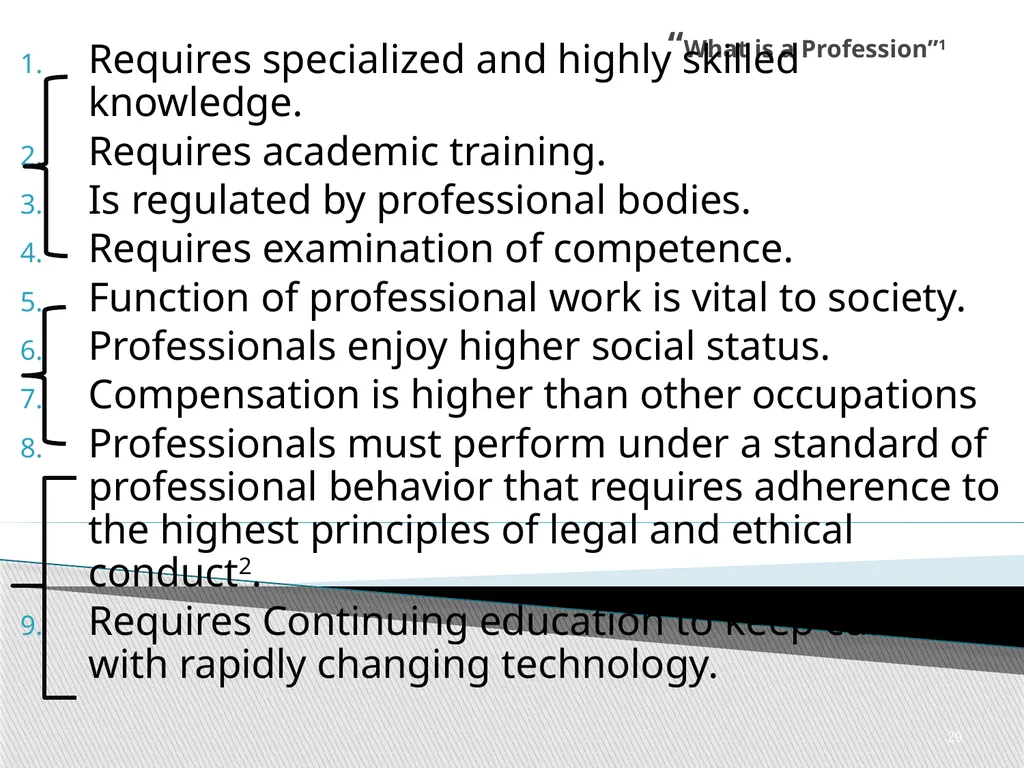
29 “What is a Profession”1 Requires specialized and highly skilled knowledge.
Requires academic training.
Is regulated by professional bodies.
Requires examination of competence.
Function of professional work is vital to society.
Professionals enjoy higher social status.
Compensation is higher than other occupations
Professionals must perform under a standard of professional behavior that requires adherence to the highest principles of legal and ethical conduct2.
Requires Continuing education to keep current with rapidly changing technology.<br>
Requires academic training.
Is regulated by professional bodies.
Requires examination of competence.
Function of professional work is vital to society.
Professionals enjoy higher social status.
Compensation is higher than other occupations
Professionals must perform under a standard of professional behavior that requires adherence to the highest principles of legal and ethical conduct2.
Requires Continuing education to keep current with rapidly changing technology.<br>
30
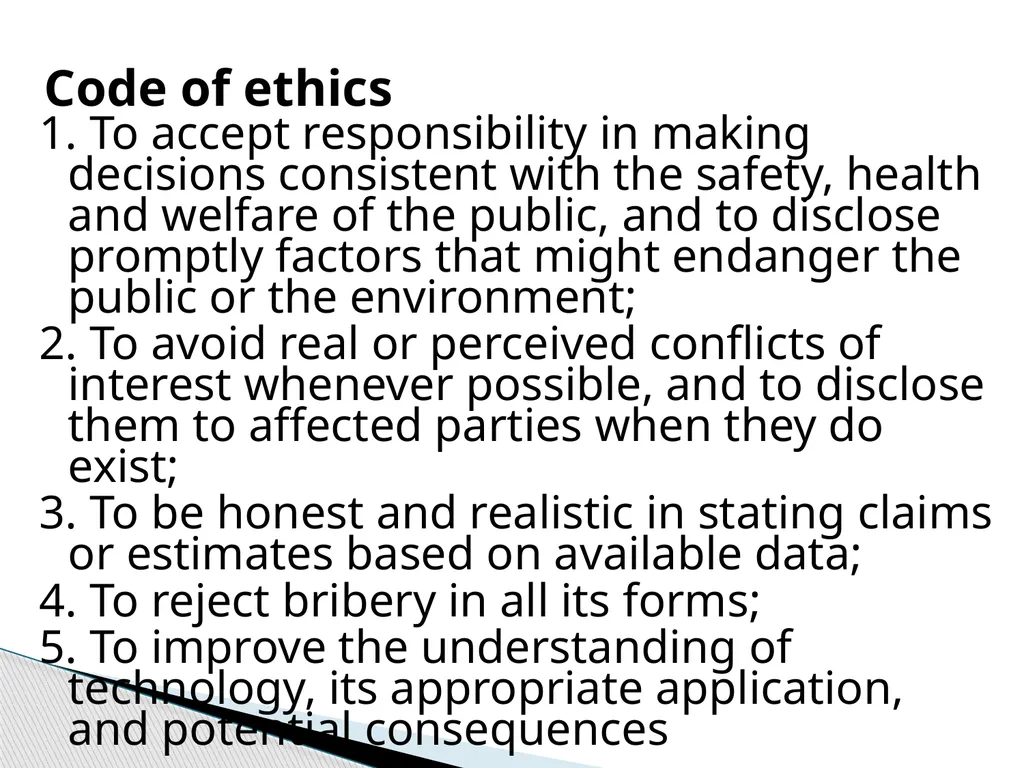
Code of ethics 1. To accept responsibility in making decisions consistent with the safety, health and welfare of the public, and to disclose promptly factors that might endanger the public or the environment;
2. To avoid real or perceived conflicts of interest whenever possible, and to disclose them to affected parties when they do exist;
3. To be honest and realistic in stating claims or estimates based on available data;
4. To reject bribery in all its forms;
5. To improve the understanding of technology, its appropriate application, and potential consequences<br>
2. To avoid real or perceived conflicts of interest whenever possible, and to disclose them to affected parties when they do exist;
3. To be honest and realistic in stating claims or estimates based on available data;
4. To reject bribery in all its forms;
5. To improve the understanding of technology, its appropriate application, and potential consequences<br>
31
6. to maintain and improve our technical competence and to undertake technological tasks for others only if qualified by training or experience, or after full disclosure of pertinent limitations;
7. to seek, accept, and offer honest criticism of technical work, to acknowledge and correct errors, and to credit properly the contributions of others;
8. to treat fairly all persons regardless of such factors as race, religion, gender, disability, age, or national origin;
9. to avoid injuring others, their property, reputation, or employment by false or malicious action;
10. to assist colleagues and co-workers in their professional development and to support them in following this code of ethics<br>
7. to seek, accept, and offer honest criticism of technical work, to acknowledge and correct errors, and to credit properly the contributions of others;
8. to treat fairly all persons regardless of such factors as race, religion, gender, disability, age, or national origin;
9. to avoid injuring others, their property, reputation, or employment by false or malicious action;
10. to assist colleagues and co-workers in their professional development and to support them in following this code of ethics<br>
32
Some cases of ethical decisions facing engineers Acknowledging mistakes
Conflict of interest
Safety of products
Environmental safety
Responsibility arising from what others do
Discrimination in the work place
Whistle blowing
Issuing non-expert statements<br>
Conflict of interest
Safety of products
Environmental safety
Responsibility arising from what others do
Discrimination in the work place
Whistle blowing
Issuing non-expert statements<br>
33
Big picture Codes of ethics are not a law
Ethical behavior is not always protected by law
Frequently ethical behavior may be perceived as disloyalty
Many companies realize that ethical behavior is essential for their long term prosperity
Ethically aware companies provide
Provide help to employees facing ethical conflicts
Allow employees to rise ethical concerns anonymously
Explicitly prevent any forms of retaliation for reporting unethical behavior<br>
Ethical behavior is not always protected by law
Frequently ethical behavior may be perceived as disloyalty
Many companies realize that ethical behavior is essential for their long term prosperity
Ethically aware companies provide
Provide help to employees facing ethical conflicts
Allow employees to rise ethical concerns anonymously
Explicitly prevent any forms of retaliation for reporting unethical behavior<br>
34
An engineer is a person who, by reason of his or her special knowledge of the mathematical and physical sciences and the principles and methods of engineering analysis and design, acquired by engineering education and engineering experience, is qualified to practice engineering. Engineers perform services or creative work as consultation, testimony, investigation, evaluation, planning, analysis, design and design coordination of engineering works and systems, planning the use of land and water, performing engineering surveys and studies, and the review of construction or other design products for the purpose of monitoring compliance with drawings and specifications.<br>
35
Definition of a Profession:
A calling requiring specialized knowledge and often long and intensive preparation including instruction in skills and methods as well as in the scientific, historical, or scholarly principles underlying such skills and methods, maintaining by force or organization or concerned opinion high standards of achievement and conduct, and committing its members to continued study and to a kind of work which has for its prime purpose the rendering of a public service.
Engineers must minimize costs and maximize benefits.<br>
A calling requiring specialized knowledge and often long and intensive preparation including instruction in skills and methods as well as in the scientific, historical, or scholarly principles underlying such skills and methods, maintaining by force or organization or concerned opinion high standards of achievement and conduct, and committing its members to continued study and to a kind of work which has for its prime purpose the rendering of a public service.
Engineers must minimize costs and maximize benefits.<br>
36
Characteristics of a Profession
advanced / specialized knowledge
intensive study and preparation
continued professional development
good judgement
high standards
leadership
ethical conduct
duty to protect the public interest<br>
advanced / specialized knowledge
intensive study and preparation
continued professional development
good judgement
high standards
leadership
ethical conduct
duty to protect the public interest<br>
37
37 Characteristics of a Successful Project Team Effective Leader
Group of interdependent individuals
Complementary skills
Shared, meaningful purpose
Specific goals<br>
Group of interdependent individuals
Complementary skills
Shared, meaningful purpose
Specific goals<br>
38
Well-defined roles and responsibilities
Mutual accountability
Collaborative approach
Confidence
Desire for continuous improvement<br>
Mutual accountability
Collaborative approach
Confidence
Desire for continuous improvement<br>
39
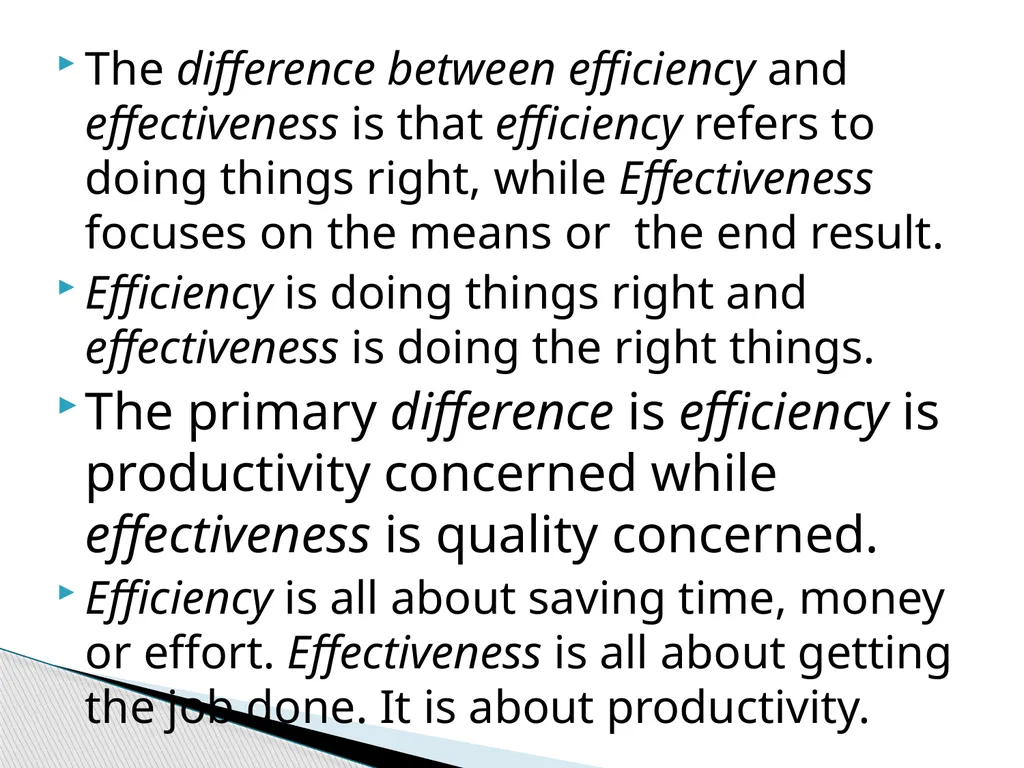
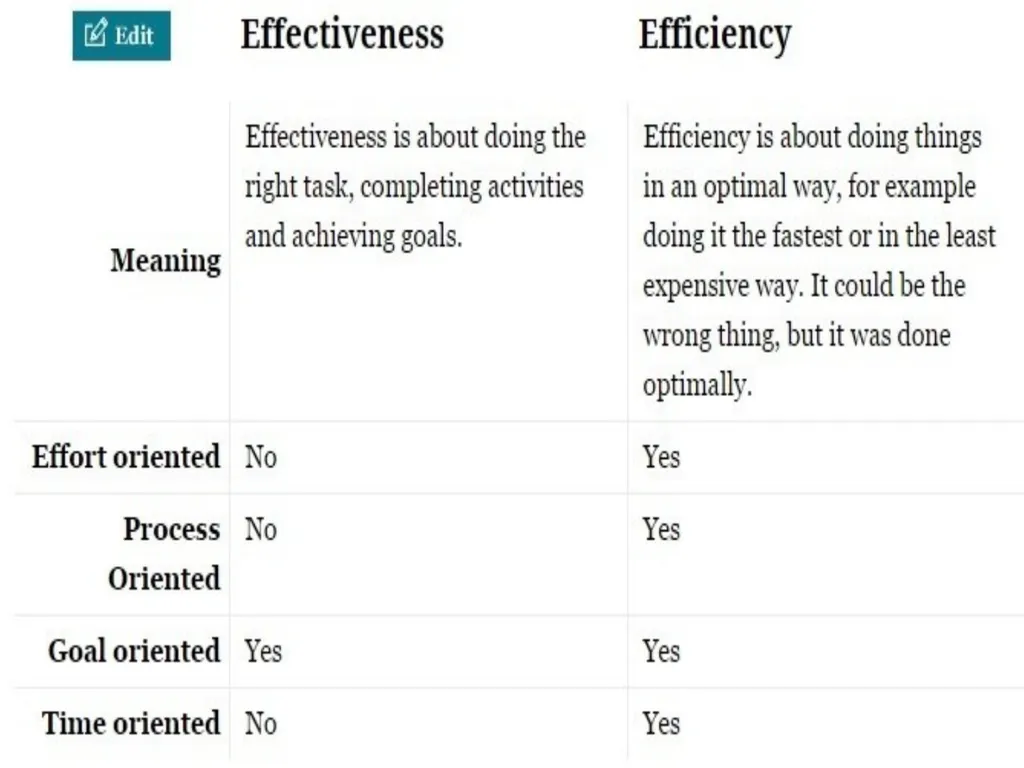
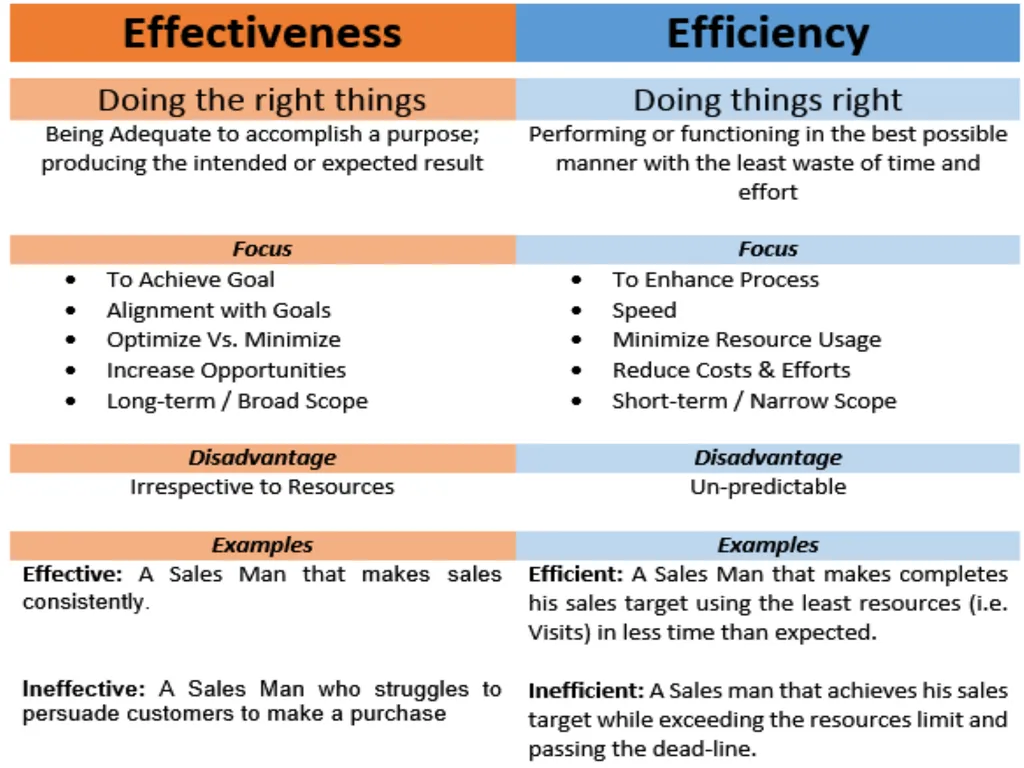
The difference between efficiency and effectiveness is that efficiency refers to doing things right, while Effectiveness focuses on the means or the end result.
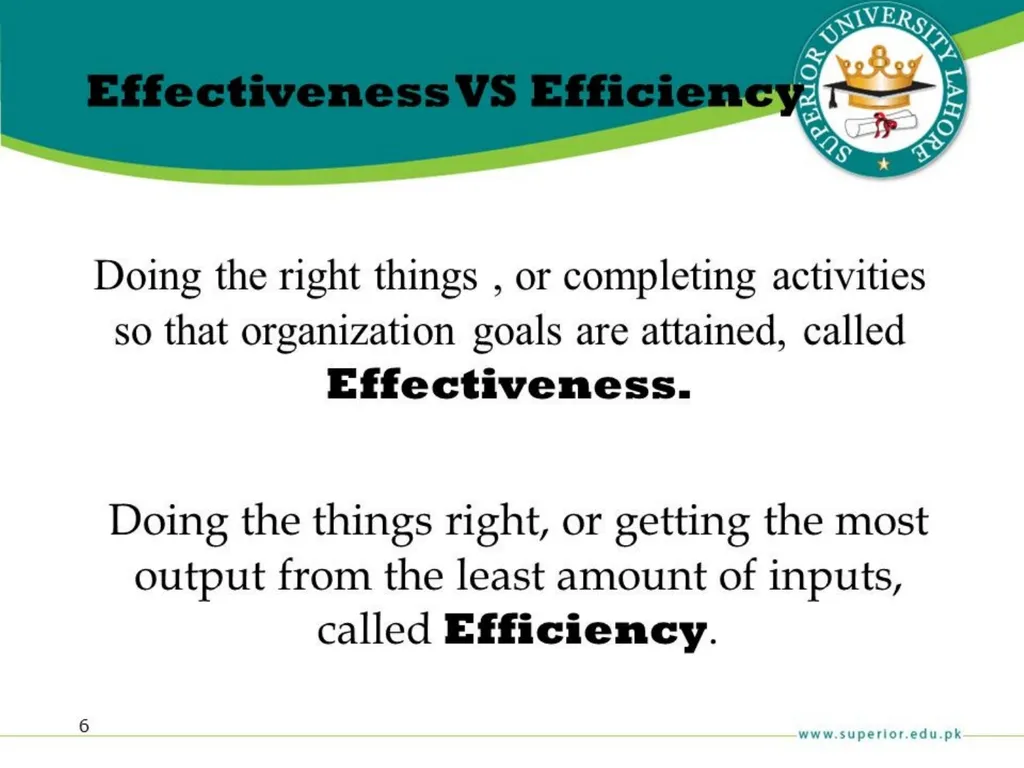
Efficiency is doing things right and effectiveness is doing the right things.
The primary difference is efficiency is productivity concerned while effectiveness is quality concerned.
Efficiency is all about saving time, money or effort. Effectiveness is all about getting the job done. It is about productivity.<br>
Efficiency is doing things right and effectiveness is doing the right things.
The primary difference is efficiency is productivity concerned while effectiveness is quality concerned.
Efficiency is all about saving time, money or effort. Effectiveness is all about getting the job done. It is about productivity.<br>
40
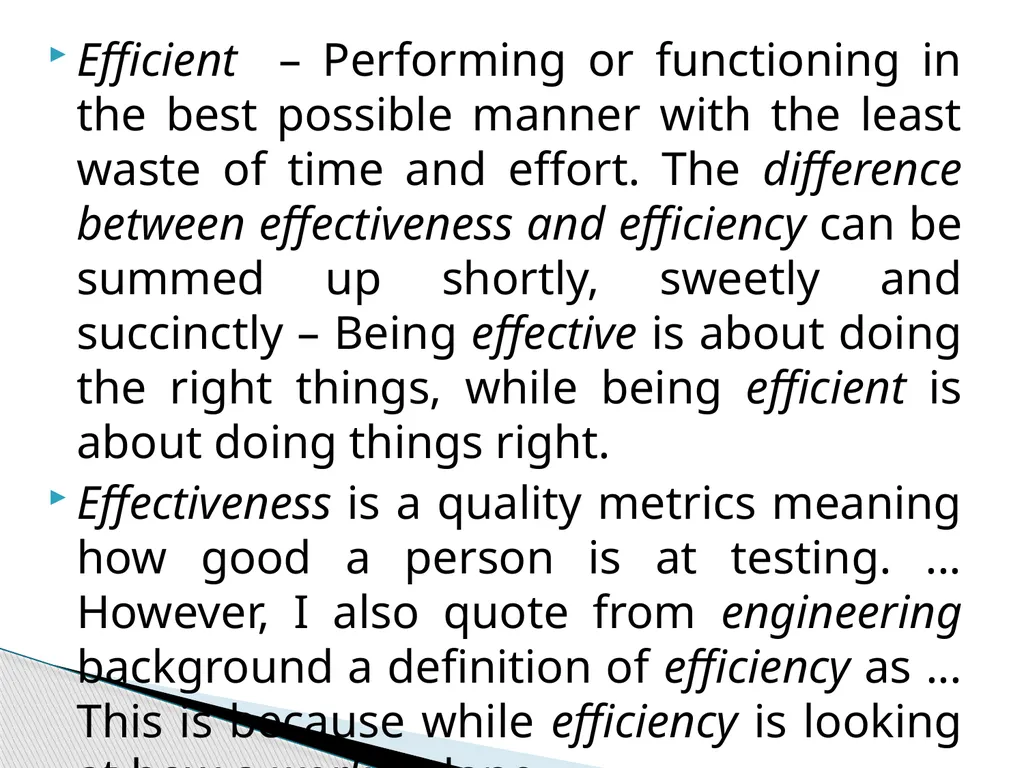
Efficient – Performing or functioning in the best possible manner with the least waste of time and effort. The difference between effectiveness and efficiency can be summed up shortly, sweetly and succinctly – Being effective is about doing the right things, while being efficient is about doing things right.
Effectiveness is a quality metrics meaning how good a person is at testing. ... However, I also quote from engineering background a definition of efficiency as ... This is because while efficiency is looking at how a work is done.<br>
Effectiveness is a quality metrics meaning how good a person is at testing. ... However, I also quote from engineering background a definition of efficiency as ... This is because while efficiency is looking at how a work is done.<br>
41
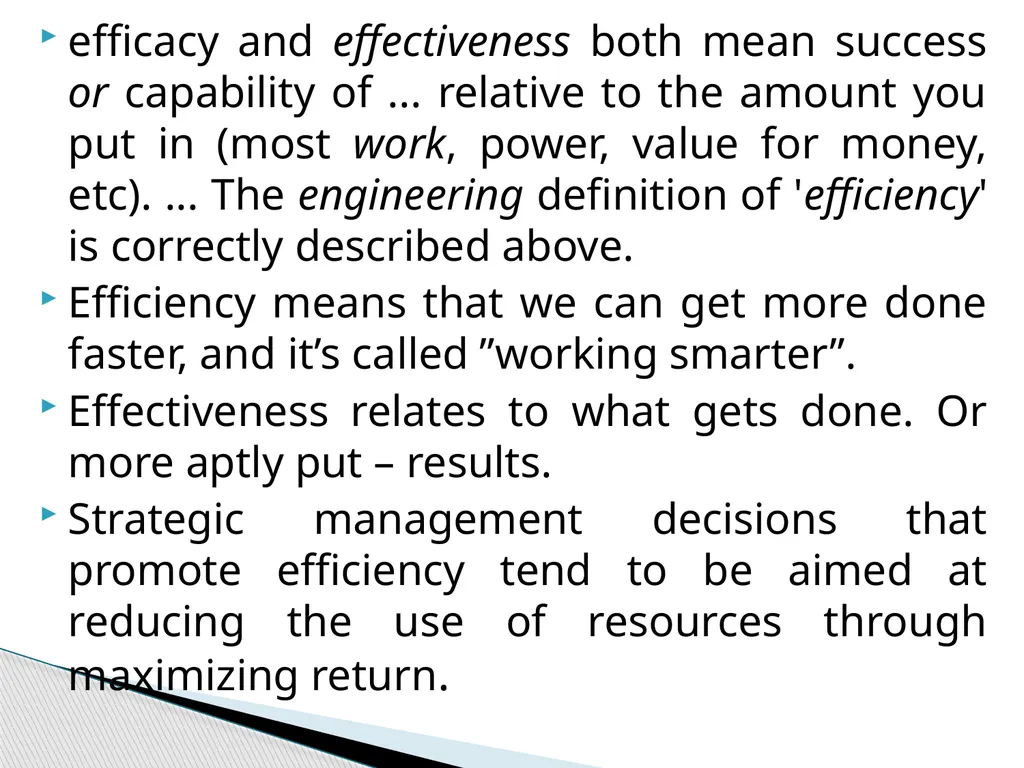
efficacy and effectiveness both mean success or capability of ... relative to the amount you put in (most work, power, value for money, etc). ... The engineering definition of 'efficiency' is correctly described above.
Efficiency means that we can get more done faster, and it’s called ”working smarter”.
Effectiveness relates to what gets done. Or more aptly put – results.
Strategic management decisions that promote efficiency tend to be aimed at reducing the use of resources through maximizing return.<br>
Efficiency means that we can get more done faster, and it’s called ”working smarter”.
Effectiveness relates to what gets done. Or more aptly put – results.
Strategic management decisions that promote efficiency tend to be aimed at reducing the use of resources through maximizing return.<br>
42
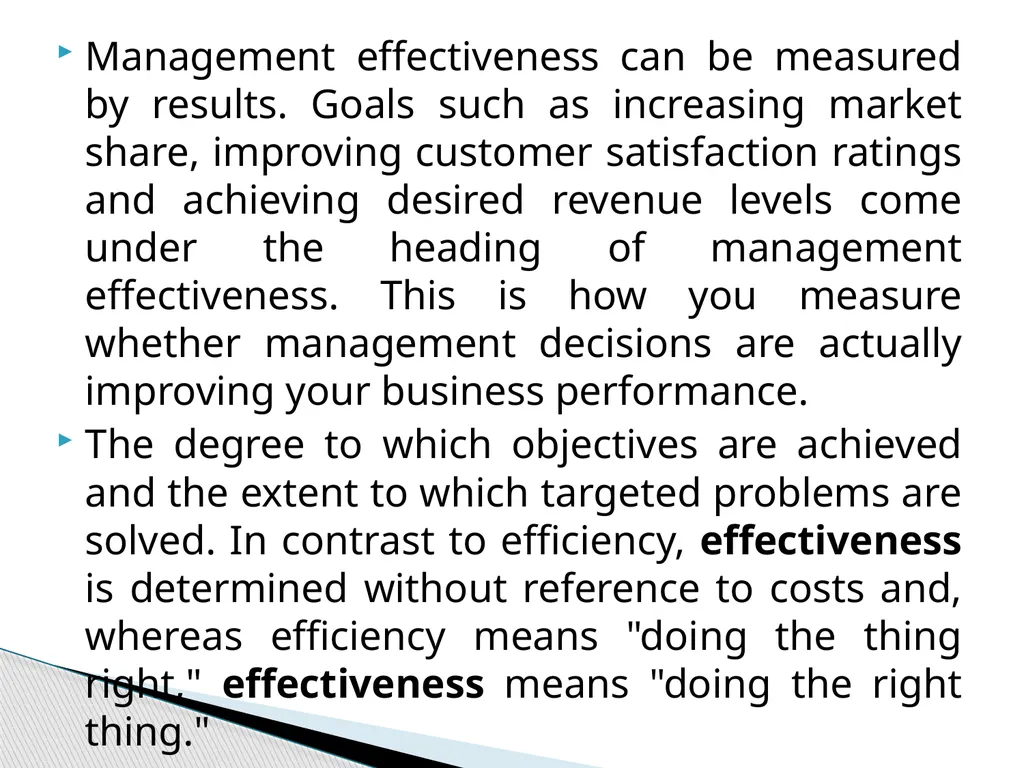
Management effectiveness can be measured by results. Goals such as increasing market share, improving customer satisfaction ratings and achieving desired revenue levels come under the heading of management effectiveness. This is how you measure whether management decisions are actually improving your business performance.
The degree to which objectives are achieved and the extent to which targeted problems are solved. In contrast to efficiency, effectiveness is determined without reference to costs and, whereas efficiency means "doing the thing right," effectiveness means "doing the right thing."<br>
The degree to which objectives are achieved and the extent to which targeted problems are solved. In contrast to efficiency, effectiveness is determined without reference to costs and, whereas efficiency means "doing the thing right," effectiveness means "doing the right thing."<br>
43
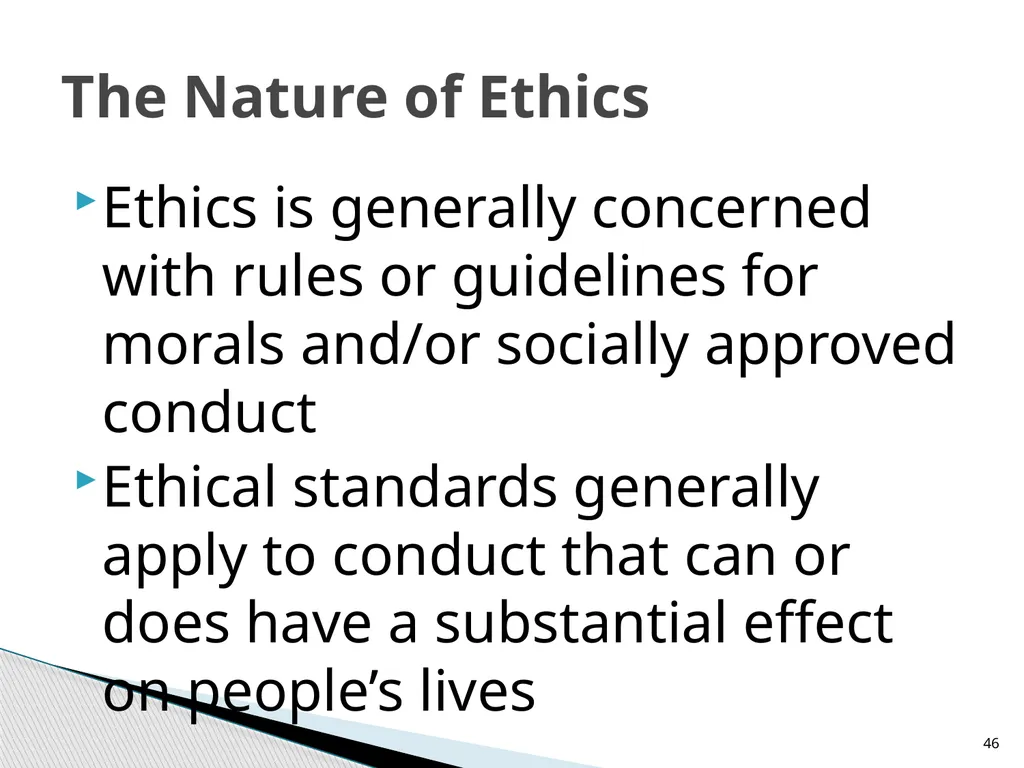
46 The Nature of Ethics Ethics is generally concerned with rules or guidelines for morals and/or socially approved conduct
Ethical standards generally apply to conduct that can or does have a substantial effect on people’s lives<br>
Ethical standards generally apply to conduct that can or does have a substantial effect on people’s lives<br>
44
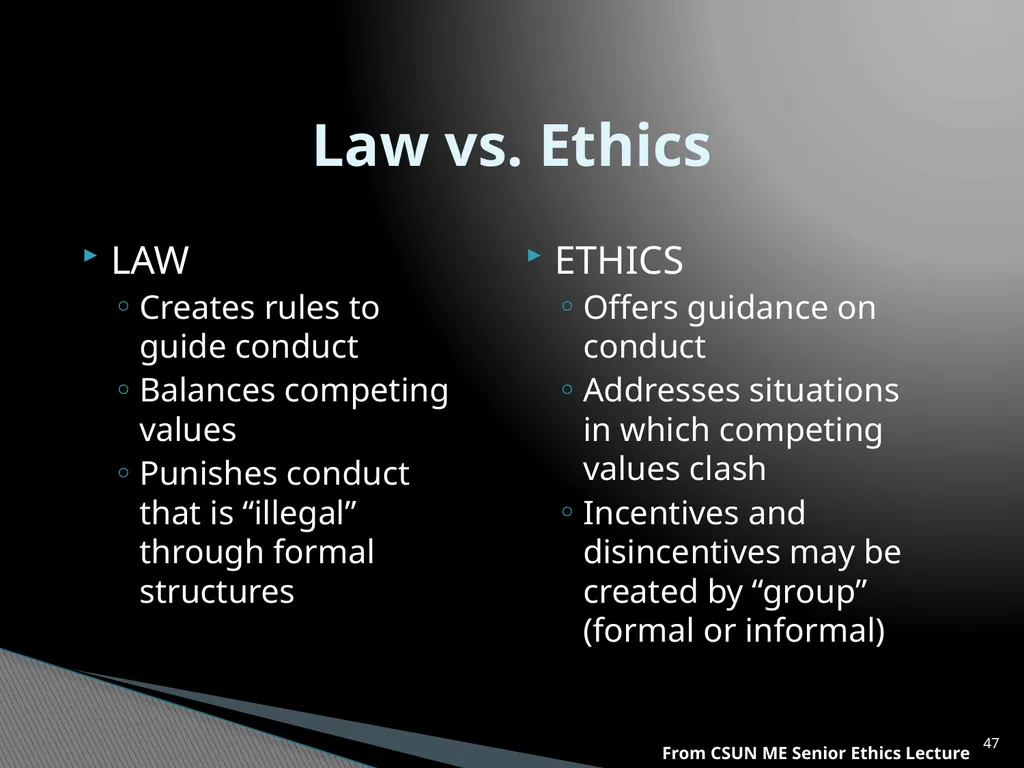
47 Law vs. Ethics LAW
Creates rules to guide conduct
Balances competing values
Punishes conduct that is “illegal” through formal structures ETHICS
Offers guidance on conduct
Addresses situations in which competing values clash
Incentives and disincentives may be created by “group” (formal or informal) From CSUN ME Senior Ethics Lecture<br>
Creates rules to guide conduct
Balances competing values
Punishes conduct that is “illegal” through formal structures ETHICS
Offers guidance on conduct
Addresses situations in which competing values clash
Incentives and disincentives may be created by “group” (formal or informal) From CSUN ME Senior Ethics Lecture<br>
45
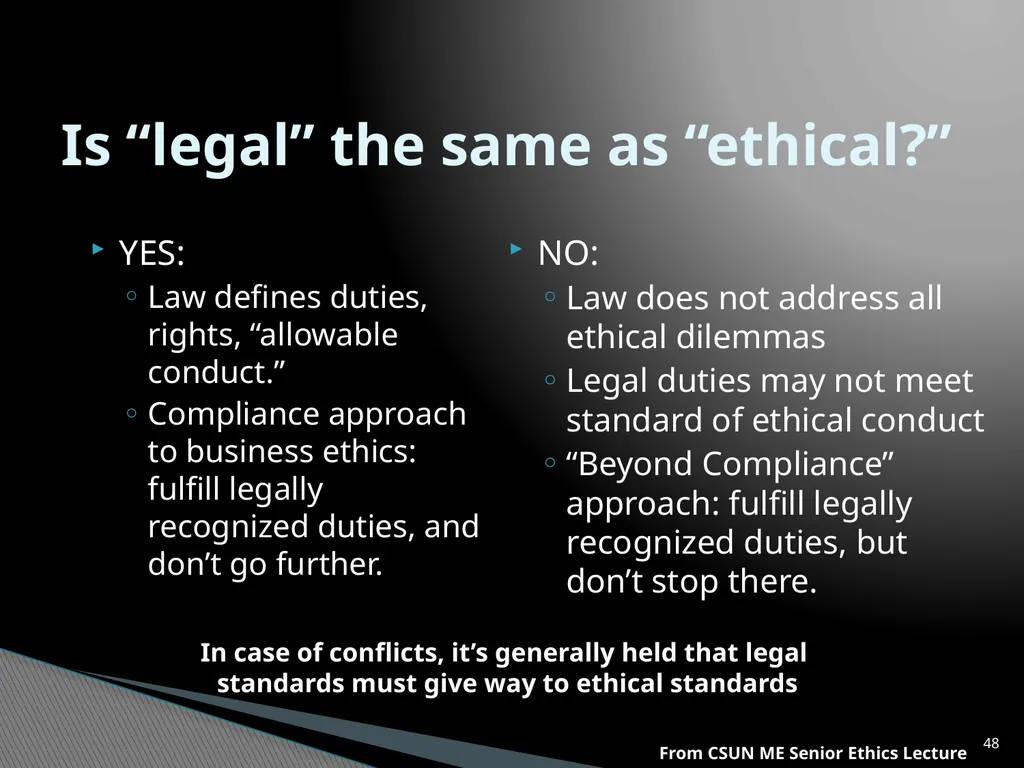
48 Is “legal” the same as “ethical?” YES:
Law defines duties, rights, “allowable conduct.”
Compliance approach to business ethics: fulfill legally recognized duties, and don’t go further. NO:
Law does not address all ethical dilemmas
Legal duties may not meet standard of ethical conduct
“Beyond Compliance” approach: fulfill legally recognized duties, but don’t stop there. From CSUN ME Senior Ethics Lecture In case of conflicts, it’s generally held that legal
standards must give way to ethical standards<br>
Law defines duties, rights, “allowable conduct.”
Compliance approach to business ethics: fulfill legally recognized duties, and don’t go further. NO:
Law does not address all ethical dilemmas
Legal duties may not meet standard of ethical conduct
“Beyond Compliance” approach: fulfill legally recognized duties, but don’t stop there. From CSUN ME Senior Ethics Lecture In case of conflicts, it’s generally held that legal
standards must give way to ethical standards<br>
46
49 Consider This: “You and Al” You are the manager for Big-Mart, a large discount retailer. You recently fired Al, a sales clerk, after Al punched a customer during a dispute in the store (Al admitted this after the customer complained).
Sue, manager of your competitor, Mega-Mart, calls you to tell you that Al has applied for a job at Mega-Mart, and to ask you whether Al is “good with customers.”
WHAT DO YOU DO? From CSUN ME Senior Ethics Lecture<br>
Sue, manager of your competitor, Mega-Mart, calls you to tell you that Al has applied for a job at Mega-Mart, and to ask you whether Al is “good with customers.”
WHAT DO YOU DO? From CSUN ME Senior Ethics Lecture<br>
47
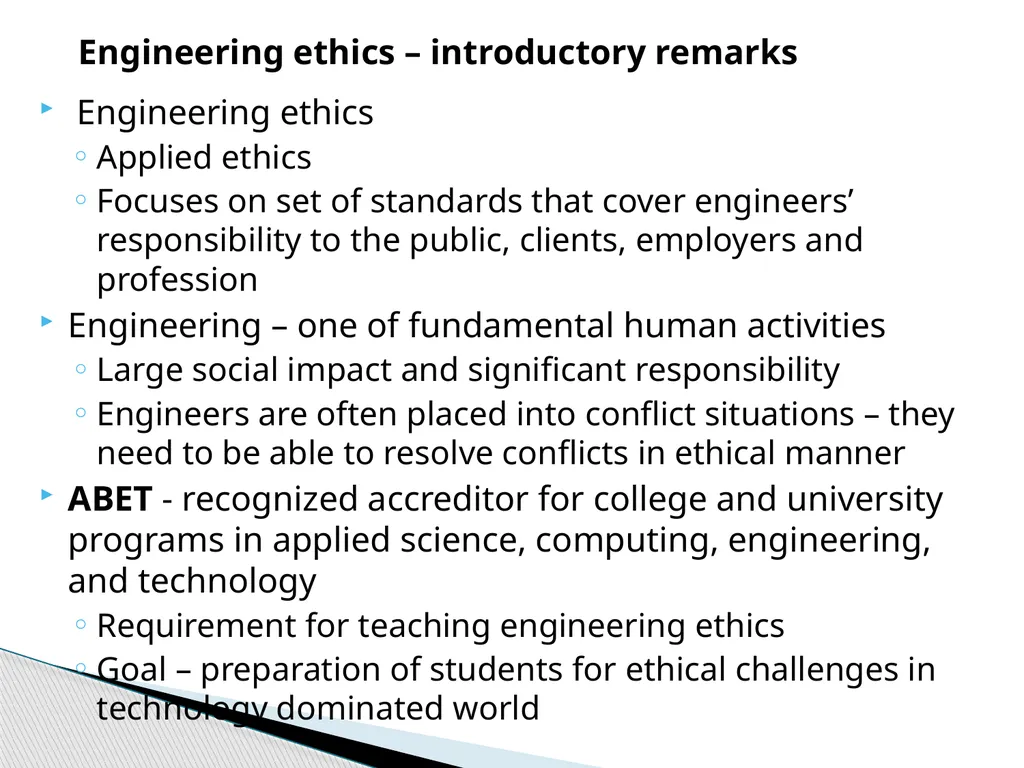
Engineering ethics – introductory remarks Engineering ethics
Applied ethics
Focuses on set of standards that cover engineers’ responsibility to the public, clients, employers and profession
Engineering – one of fundamental human activities
Large social impact and significant responsibility
Engineers are often placed into conflict situations – they need to be able to resolve conflicts in ethical manner
ABET - recognized accreditor for college and university programs in applied science, computing, engineering, and technology
Requirement for teaching engineering ethics
Goal – preparation of students for ethical challenges in technology dominated world<br>
Applied ethics
Focuses on set of standards that cover engineers’ responsibility to the public, clients, employers and profession
Engineering – one of fundamental human activities
Large social impact and significant responsibility
Engineers are often placed into conflict situations – they need to be able to resolve conflicts in ethical manner
ABET - recognized accreditor for college and university programs in applied science, computing, engineering, and technology
Requirement for teaching engineering ethics
Goal – preparation of students for ethical challenges in technology dominated world<br>
48
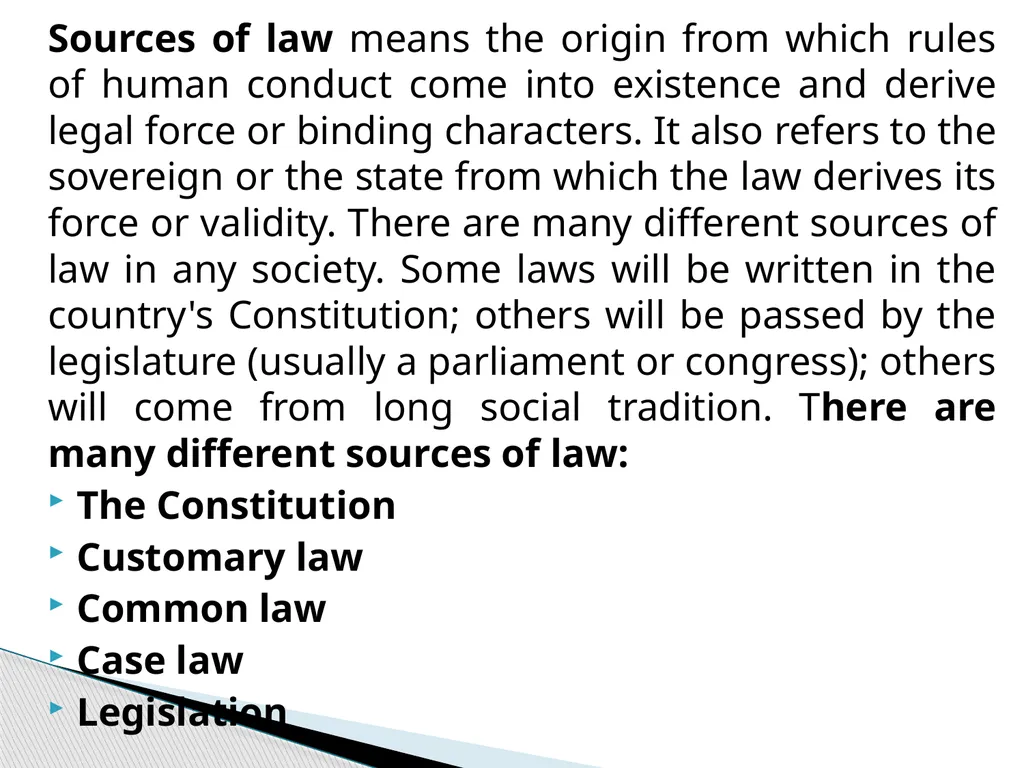
Sources of law means the origin from which rules of human conduct come into existence and derive legal force or binding characters. It also refers to the sovereign or the state from which the law derives its force or validity. There are many different sources of law in any society. Some laws will be written in the country's Constitution; others will be passed by the legislature (usually a parliament or congress); others will come from long social tradition. There are many different sources of law:
The Constitution
Customary law
Common law
Case law
Legislation<br>
The Constitution
Customary law
Common law
Case law
Legislation<br>
49
Nigerian legal system The Nigerian legal system is based on the English common law legal tradition. The sources of Nigerian law are: The Constitution, Legislation, English law, Customary law, Islamic law and Judicial precedents.
The three main sources of law are constitutional, statutory, and case law. The sources of law are ranked as follows: first, constitutional; second, statutory; and third, case law.<br>
The three main sources of law are constitutional, statutory, and case law. The sources of law are ranked as follows: first, constitutional; second, statutory; and third, case law.<br>
50
Sources of law is a legal term that refers to the authorities by which law is made. There are a number of different sources that are used to define the creation and force of law, though not all are used equally. Some examples of sources include legislation, government regulation, court decisions, and custom.
Several factors of law have contributed to the development of law. These factors are regarded as the sources of law.
There are different participants in the law:
Those who pass laws (legislature)
Those who apply laws (judiciary)
Those who enforce laws (police and others)<br>
Several factors of law have contributed to the development of law. These factors are regarded as the sources of law.
There are different participants in the law:
Those who pass laws (legislature)
Those who apply laws (judiciary)
Those who enforce laws (police and others)<br>
51
Sources of law
There are many different sources of law in any society. Some laws will be written in the country's Constitution; others will be passed by the legislature (usually a parliament or congress); others will come from long social tradition.
Constitutional law
In any country with a written Constitution, the Constitution will take precedence over any other source of law. For example, if the Constitution says there is freedom of speech for all citizens, but the social tradition is for women not to speak in public, a court will protect the right of any woman to speak in public if she chooses to do so; the Constitution takes priority over tradition.<br>
There are many different sources of law in any society. Some laws will be written in the country's Constitution; others will be passed by the legislature (usually a parliament or congress); others will come from long social tradition.
Constitutional law
In any country with a written Constitution, the Constitution will take precedence over any other source of law. For example, if the Constitution says there is freedom of speech for all citizens, but the social tradition is for women not to speak in public, a court will protect the right of any woman to speak in public if she chooses to do so; the Constitution takes priority over tradition.<br>
52
Sources of Law The sources of the law in Nigeria are:
Constitution- The system of laws, customs and conventions which define the composition and powers of organs of the state, and regulate the relations of the various state organs to one another and to the private citizen. It is the document containing the substance of the law<br>
Constitution- The system of laws, customs and conventions which define the composition and powers of organs of the state, and regulate the relations of the various state organs to one another and to the private citizen. It is the document containing the substance of the law<br>
53
Customary law
In developing countries which have been decolonized since the 1940s or 1950s, the law is generally a mixture of law introduced by the former colonial power and customary law which was there before colonization. That customary law often still takes priority in certain areas of life. Typically, customary law applies in those areas of life least affected by colonization. These may include land ownership, customary titles and family relationships. There may be special courts to deal with these matters, conducted according to tradition and presided over by a customary chief or group of elders. Alternatively, these matters may be dealt with by an ordinary court, but customary law may take precedence over other kinds of law in these cases. A custom is a rule which in a particular family or in a particular district or in a particular section, class or tribe, has from long usage obtained the force of law.<br>
In developing countries which have been decolonized since the 1940s or 1950s, the law is generally a mixture of law introduced by the former colonial power and customary law which was there before colonization. That customary law often still takes priority in certain areas of life. Typically, customary law applies in those areas of life least affected by colonization. These may include land ownership, customary titles and family relationships. There may be special courts to deal with these matters, conducted according to tradition and presided over by a customary chief or group of elders. Alternatively, these matters may be dealt with by an ordinary court, but customary law may take precedence over other kinds of law in these cases. A custom is a rule which in a particular family or in a particular district or in a particular section, class or tribe, has from long usage obtained the force of law.<br>
54
Common law is one of the major sources of law that has been in use for nearly 1,000 years. This type of law is based on judges' decisions as well as legislation deeming certain actions illegal. Common law may dictate the specific laws and penalties of certain crimes, including murder, rape, and theft. One common concept in this important source of law is that of precedent, which suggests that future courts follow the rulings of prior courts on specific issues.<br>
55
Legislation is that source of law which consists in the declaration of legal rules by a competent authority. Legislature is the direct source of law. Legislature frames new laws, amends the old laws and cancels existing laws in all countries. In modern times this is the most important source of law making. The term legislature means any form of law making. Its scope has now been restricted so a particular form of law making. It not only creates new rules of law it also sweeps away existing inconvenient rules.
Legislature: A legislature is a body which has the power to make laws. It may be a Parliament, or a Congress, or an Assembly, or a town council, or a council of chiefs.<br>
Legislature: A legislature is a body which has the power to make laws. It may be a Parliament, or a Congress, or an Assembly, or a town council, or a council of chiefs.<br>
56
It may have the power to pass laws which apply to the whole country, or just to part of it.
Legislation is that source of law which consists in the declaration of legal rules by a competent authority. Legislature is the direct source of law. Legislature frames new laws, amends the old laws and cancels existing laws in all countries. In modern times this is the most important source of law making. The term legislature means any form of law making. Its scope has now been restricted so a particular form of law making. It not only creates new rules of law it also sweeps away existing inconvenient rules.<br>
Legislation is that source of law which consists in the declaration of legal rules by a competent authority. Legislature is the direct source of law. Legislature frames new laws, amends the old laws and cancels existing laws in all countries. In modern times this is the most important source of law making. The term legislature means any form of law making. Its scope has now been restricted so a particular form of law making. It not only creates new rules of law it also sweeps away existing inconvenient rules.<br>
57
Case law
Legislatures pass laws, but courts work out what they mean in practice. Laws are interpreted and tested by a succession of trials, over a period of time, under a variety of circumstances.
Any case law that is from a court of equal or higher rank to the one where a case is now being heard, will normally take precedence over common law, should they differ. Also, a decision by a higher court (for example a court of appeal or supreme court) is binding upon a lower court. The lower court must follow what the higher court has said, in another case where the circumstances are similar.<br>
Legislatures pass laws, but courts work out what they mean in practice. Laws are interpreted and tested by a succession of trials, over a period of time, under a variety of circumstances.
Any case law that is from a court of equal or higher rank to the one where a case is now being heard, will normally take precedence over common law, should they differ. Also, a decision by a higher court (for example a court of appeal or supreme court) is binding upon a lower court. The lower court must follow what the higher court has said, in another case where the circumstances are similar.<br>
58
The common law, also referred to as case law, is a vast body of law that judges create, case by case, as they make rulings and as they determine the precise meaning of a law or regulation. Judges review the rulings of other judges in search of legal principles that can be applied to the dispute that comes before them. Judges may add refinements of their own pertaining to the specific facts before them, as the common law grows and evolves.<br>
59
Sources of Law Contd. Legislation- This is the major source of the Law. This comprises all the statues, edicts, acts, decrees, bye-laws, orders and regulations etc passed by the parliament (National Assembly or House of Assembly) i.e. law making bodies<br>
60
Sources of Law Contd. Case Law- These are rules or precedents of law laid down in cases decided in the most authoritative courts of the land, which are then binding on the lower courts. There are two distinct types of case law:
Common Law. These are principles of law that have been developed in cases decided over the centuries by judges of the higher courts, where statutory rules are not involved, called judicial precedents. An example is the set of common law rules relating to the formalities that must be gone through in order to enter a legally binding contract.
This involves the interpretation of statutes wherever the language of a statute is occasionally ambiguous or the statute does not apply clearly to a given set of facts. The courts may therefore be called upon to interpret or rule upon the meaning of a particular statutory provision<br>
Common Law. These are principles of law that have been developed in cases decided over the centuries by judges of the higher courts, where statutory rules are not involved, called judicial precedents. An example is the set of common law rules relating to the formalities that must be gone through in order to enter a legally binding contract.
This involves the interpretation of statutes wherever the language of a statute is occasionally ambiguous or the statute does not apply clearly to a given set of facts. The courts may therefore be called upon to interpret or rule upon the meaning of a particular statutory provision<br>
61
Sources of Law Contd. The major portion of Case Laws of Nigeria consists of English Law, comprising Acts or Orders-in-Council applying directly to Nigeria statutes of general application, the common law and doctrines of equity<br>
62
Sources of Law Contd. Customary Law (also called Native Law and Custom). This is the collection of largely unwritten codes, tenets and social principles, customs and traditions practices in a society and handed down from generation to generation. Sharia Law (Islamic Law is also under this category<br>
63
Sources of Law Contd. Codes of Guidance and other Official advice- apart from the statute and case laws, there are other rules of practice to be found in a variety of Codes of Guidance issued by the appropriate government or professional bodies, applicable only within the concerned are, trade or profession<br>
64
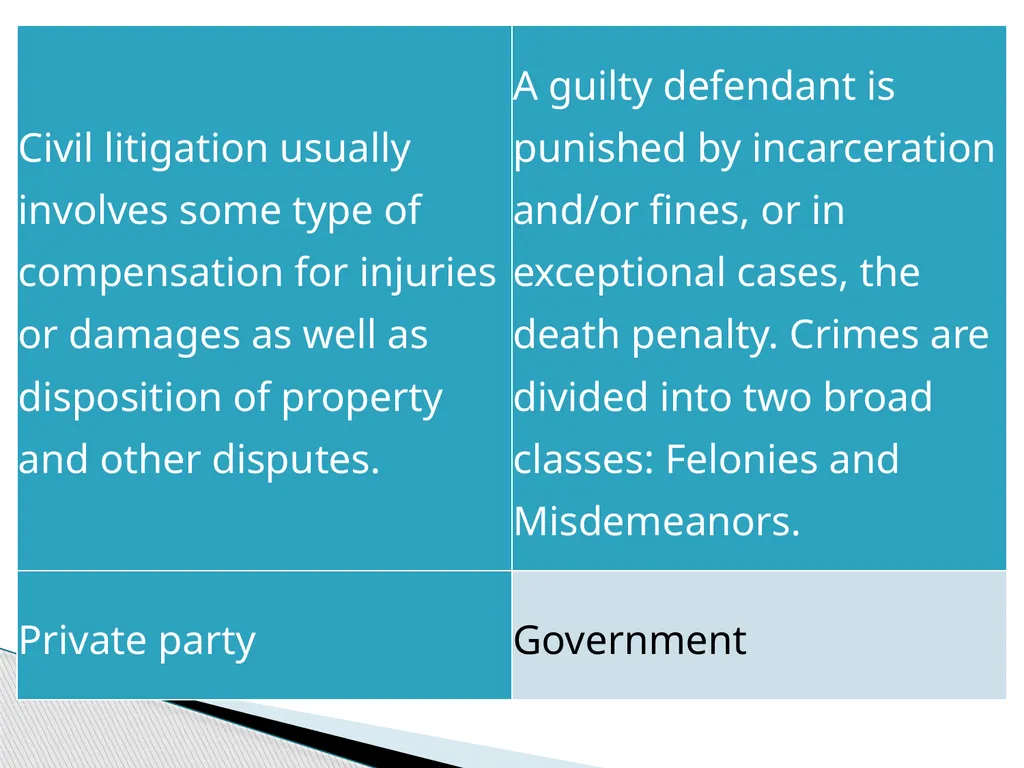
What is the difference between a criminal case and a civil case? Civil cases are generally brought by private individuals or corporations seeking to collect money owed or monetary damages. A criminal case is brought by the local, state or federal government in response to a suspected violation of law and seeks a fine, a jail sentence or both.<br>
65
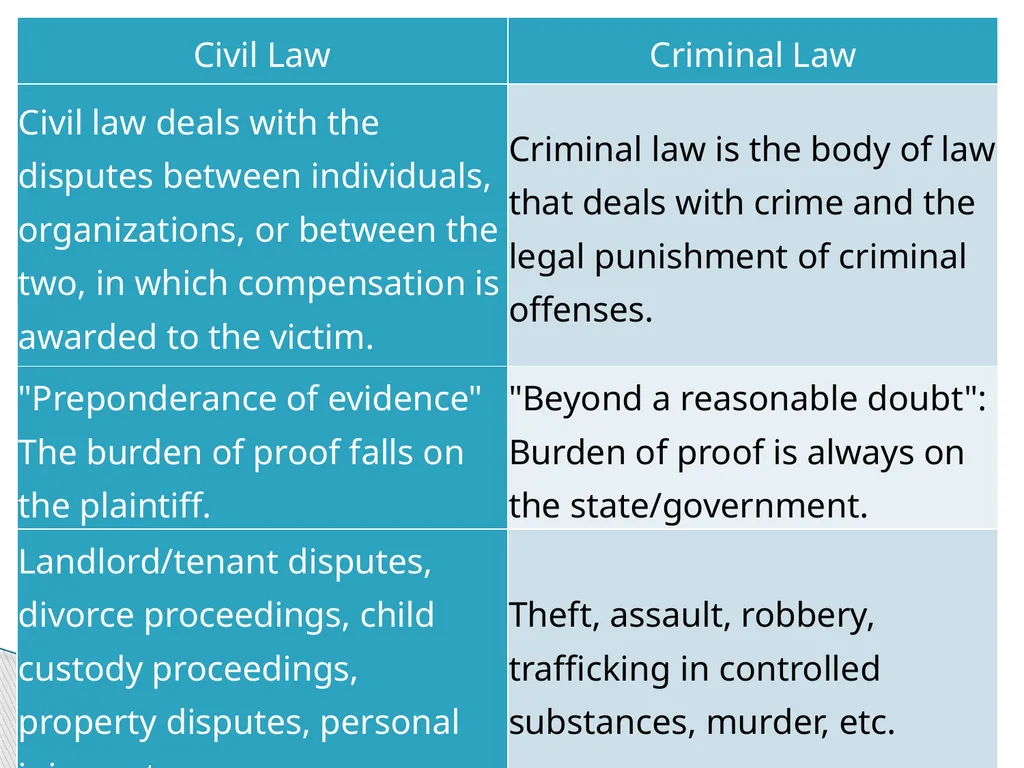
Criminal law deals with behaviour that is or can be construed as an offense against the public, society, or the state—even if the immediate victim is an individual. Examples are murder, assault, theft, and drunken driving. Civil law deals with behaviour that constitutes an injury to an individual or other private party, such as a corporation. Examples are defamation (including libel and slander), breach of contract, negligence resulting in injury or death, and property damage.
Criminal law is a category of public law that punishes behaviour that results in injury to people and/or property. In Canada, most criminal law is made by the federal government. Some laws made by the provincial and municipal governments are called "quasi-criminal." For example: offences under the Motor Vehicle Act.<br>
Criminal law is a category of public law that punishes behaviour that results in injury to people and/or property. In Canada, most criminal law is made by the federal government. Some laws made by the provincial and municipal governments are called "quasi-criminal." For example: offences under the Motor Vehicle Act.<br>
66
General Principles in Criminal Law. ... The basis of our system of criminal justice is that a person, although charged with an offence, is considered innocent until proved guilty of the offence. The magistrate, judge or jury, as the case may be, must be satisfied beyond a reasonable doubt that the person is guilty.
A legal doctrine is a framework, set of rules, procedural steps, or test, often established through precedent in the common law, through which judgments can be determined in a given legal case.<br>
A legal doctrine is a framework, set of rules, procedural steps, or test, often established through precedent in the common law, through which judgments can be determined in a given legal case.<br>
67
Guilty knowledge and wilfulness. A fundamental principle of Criminal Law is that a crime consists of both a mental and a physical element. Mens rea, a person's awareness of the fact that his or her conduct is criminal, is the mental element, and actus reus, the act itself, is the physical element.
Punishment has five recognized purposes: deterrence, incapacitation, rehabilitation, retribution, and restitution.<br>
Punishment has five recognized purposes: deterrence, incapacitation, rehabilitation, retribution, and restitution.<br>
68
Criminal laws regulate crimes, or wrongs committed against the government. Civil laws regulate disputes between private parties. This lesson explains the main differences between criminal and civil law.
Civil cases are generally brought by private individuals or corporations seeking to collect money owed or monetary damages. A criminal case is brought by the local, state or federal government in response to a suspected violation of law and seeks a fine, a jail sentence or both.<br>
Civil cases are generally brought by private individuals or corporations seeking to collect money owed or monetary damages. A criminal case is brought by the local, state or federal government in response to a suspected violation of law and seeks a fine, a jail sentence or both.<br>
69
Criminal law deals with offences by people against society as a whole. Prosecutions are usually brought in the name of the Head of State, or of the State itself.
Civil law deals with offences by people against other individuals. This may include disputes over fences and other land matters, defamation cases, damaged property, broken promises or a host of other disputes between people.<br>
Civil law deals with offences by people against other individuals. This may include disputes over fences and other land matters, defamation cases, damaged property, broken promises or a host of other disputes between people.<br>
70
In a criminal court, the two sides are called the prosecution and the defence. In a civil court the two sides are called the plaintiff (that is the person who is bringing the complaint) and the defendant or in some cases, the respondent.
In a criminal court, the judgment at the end of the hearing will be that the defendant is either guilty or not guilty. In a civil case there is no question of guilt, because nobody has been charged with any crime; the judgment will simply be either for the plaintiff or for the defence. 73<br>
In a criminal court, the judgment at the end of the hearing will be that the defendant is either guilty or not guilty. In a civil case there is no question of guilt, because nobody has been charged with any crime; the judgment will simply be either for the plaintiff or for the defence. 73<br>
71
Criminal law deals with behaviour that is or can be construed as an offense against the public, society, or the state—even if the immediate victim is an individual. Examples are murder, assault, theft, and drunken driving. Civil law deals with behaviour that constitutes an injury to an individual or other private party, such as a corporation. Examples are defamation (including libel and slander), breach of contract, negligence resulting in injury or death, and property damage. Criminal law and civil law differ with respect to how cases are initiated (who may bring charges or file suit), how cases are decided (by a judge or a jury), what kinds of punishment or penalty may be imposed, what standards of proof must be met, and what legal protections may be available to the defendant.<br>
72
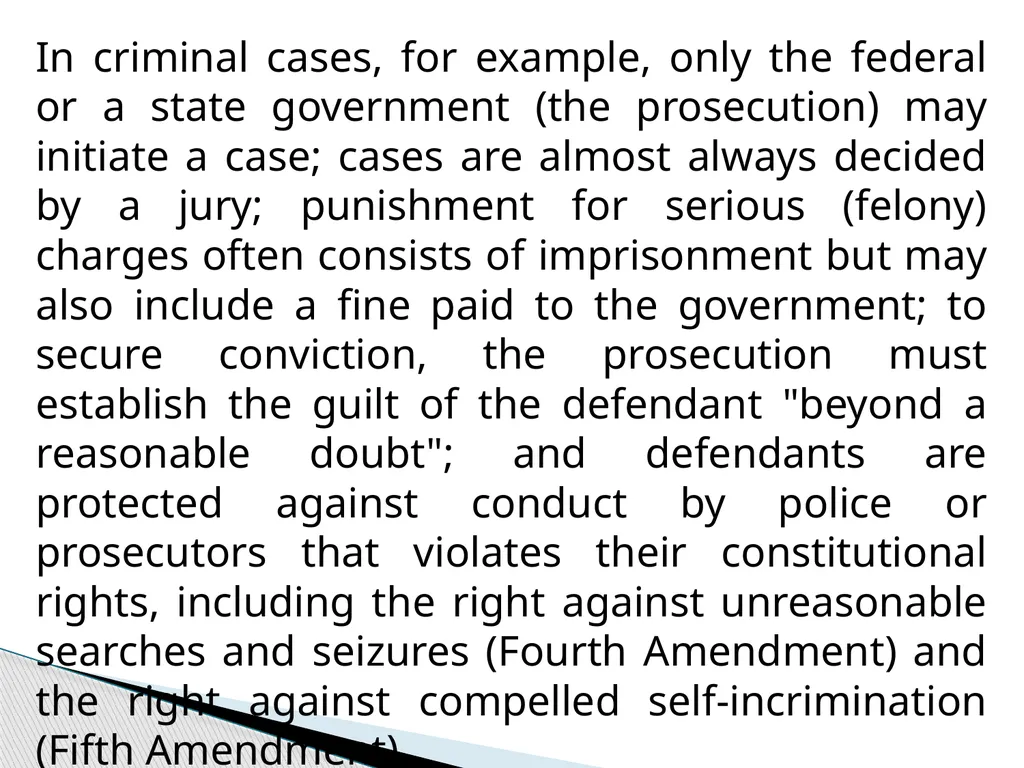
In criminal cases, for example, only the federal or a state government (the prosecution) may initiate a case; cases are almost always decided by a jury; punishment for serious (felony) charges often consists of imprisonment but may also include a fine paid to the government; to secure conviction, the prosecution must establish the guilt of the defendant "beyond a reasonable doubt"; and defendants are protected against conduct by police or prosecutors that violates their constitutional rights, including the right against unreasonable searches and seizures (Fourth Amendment) and the right against compelled self-incrimination (Fifth Amendment).<br>
73
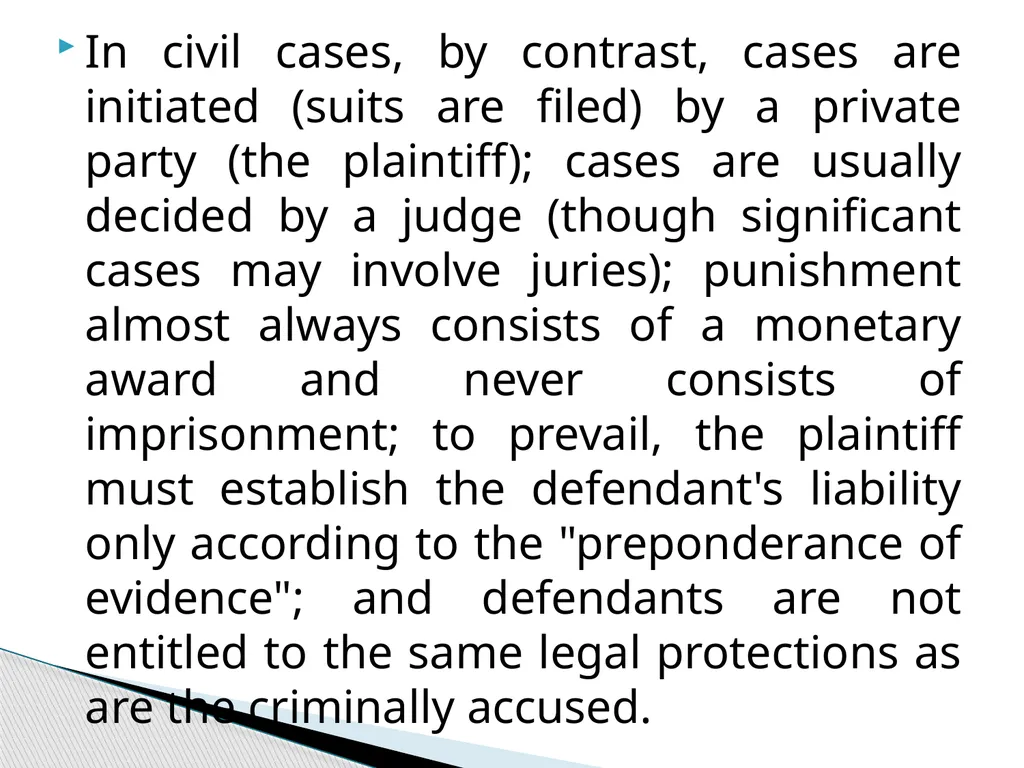
In civil cases, by contrast, cases are initiated (suits are filed) by a private party (the plaintiff); cases are usually decided by a judge (though significant cases may involve juries); punishment almost always consists of a monetary award and never consists of imprisonment; to prevail, the plaintiff must establish the defendant's liability only according to the "preponderance of evidence"; and defendants are not entitled to the same legal protections as are the criminally accused.<br>
74
Criminal law deals with behaviour that is or can be construed as an offense against the public, society, or the state—even if the immediate victim is an individual. Examples are murder, assault, theft, and drunken driving. Civil law deals with behaviour that constitutes an injury to an individual or other private party, such as a corporation. Examples are defamation (including libel and slander), breach of contract, negligence resulting in injury or death, and property damage.<br>
75
In criminal cases, for example, only the federal or a state government (the prosecution) may initiate a case; cases are almost always decided by a jury; punishment for serious (felony) charges often consists of imprisonment but may also include a fine paid to the government; to secure conviction, the prosecution must establish the guilt of the defendant "beyond a reasonable doubt"; and defendants are protected against conduct by police or prosecutors that violates their constitutional rights, including the right against unreasonable searches and seizures (Fourth Amendment) and the right against compelled self-incrimination (Fifth Amendment).<br>
76
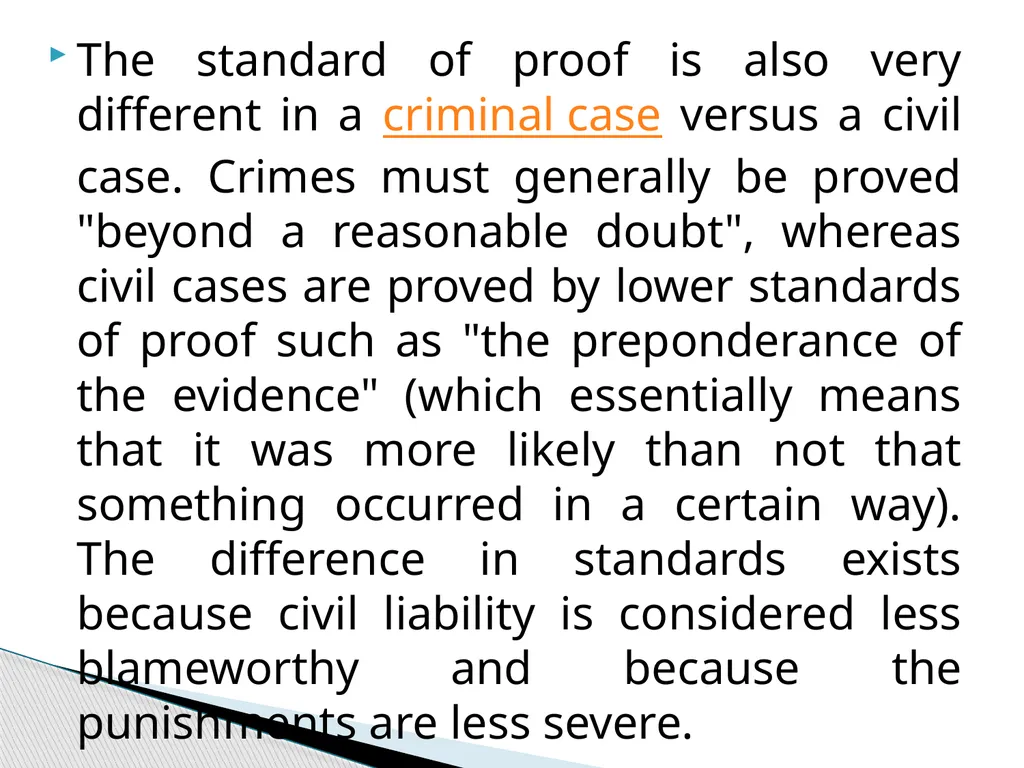
The standard of proof is also very different in a criminal case versus a civil case. Crimes must generally be proved "beyond a reasonable doubt", whereas civil cases are proved by lower standards of proof such as "the preponderance of the evidence" (which essentially means that it was more likely than not that something occurred in a certain way). The difference in standards exists because civil liability is considered less blameworthy and because the punishments are less severe.<br>
77
Importantly, because a single wrongful act may constitute both a public offense and a private injury, it may give rise to both criminal and civil charges. A widely cited example is that of the former American football player O.J. Simpson: in 1995 he was acquitted of having murdered his wife and her friend, but two years later he was found liable for their killings in a civil suit for wrongful death.
In civil law, a private party (e.g., a corporation or individual person) files the lawsuit and becomes the plaintiff. In criminal law, the litigation is always filed by the government, who is called the prosecution.<br>
In civil law, a private party (e.g., a corporation or individual person) files the lawsuit and becomes the plaintiff. In criminal law, the litigation is always filed by the government, who is called the prosecution.<br>
78
In criminal law, a guilty defendant is punished by either (1) incarceration in a jail or prison, (2) fine paid to the government, or, in exceptional cases, (3) execution of the defendant: the death penalty. Crimes are divided into two broad classes: felonies have a maximum possible sentence of more than one year incarceration, misdemeanors have a maximum possible sentence of less than one year incarceration.<br>
79
In contrast, a defendant in civil litigation is never incarcerated and never executed. In general, a losing defendant in civil litigation only reimburses the plaintiff for losses caused by the defendant's behaviour.
So-called punitive damages are never awarded in a civil case under contract law. In a civil case under tort law, there is a possibility of punitive damages, if the defendant's conduct is egregious and had either (1) a malicious intent (i.e., desire to cause harm), (2) gross negligence (i.e., conscious indifference), or (3) a willful disregard for the rights of others. The use of punitive damages makes a public example of the defendant and supposedly deters future wrongful conduct by others.<br>
80
Punitive damages are particularly important in torts involving dignitary harms (e.g., invasion of privacy) and civil rights, where the actual monetary injury to plaintiff(s) may be small.
One can purchase insurance that will pay damages and attorney's fees for tort claims. Such insurance coverage is a standard part of homeowner's insurance policies, automobile insurance, and insurance for businesses. In contrast, it is not possible for a defendant to purchase insurance to pay for his/her criminal acts.
While a court can order a defendant to pay damages, the plaintiff may receive nothing if the defendant has no assets and no insurance, or if the defendant is skillful in concealing assets. In this way, large awards for plaintiffs in tort cases are often an illusion.<br>
81
Sentences for drug distribution and trafficking can generally range from 3-5 years to life in prison. Drug trafficking/distribution is a felony, and is a more serious crime than drug possession. If you are found in possession of drugs, you could be charged with trafficking if police believe you intend to sell them.
Fourteen, including America and Cuba, have the death penalty on the books for drug traffickers but do not apply it in practice. Only in six countries—China, Iran,Saudi Arabia, Vietnam, Malaysia and Singapore—are drug offenders known to be routinely executed, Drug Trafficking Offence 86<br>
Fourteen, including America and Cuba, have the death penalty on the books for drug traffickers but do not apply it in practice. Only in six countries—China, Iran,Saudi Arabia, Vietnam, Malaysia and Singapore—are drug offenders known to be routinely executed, Drug Trafficking Offence 86<br>
82
Drug trafficking versus drug dealing. ... Drug trafficking generally refers to selling, transporting or importing a significant amount of a controlled substance. Because trafficking generally deals with larger amounts of substances, the sentences are much heavier and can even mean life in prison 87<br>
83
Doctrine and Binding Precedent Judicial precedent otherwise called the doctrine of “stare decisi” is to the effect that the decisions of a higher court a binding on lower courts deciding any case on similar or identical circumstances. It is based on the basic principle that like cases should be decided alike
Applicability depends mostly on the fact that the courts concerned are within the same judicial system and therefore it is closely connected with the hierarchy of courts within the same legal system. An original precedent is one that establishes a new rule and usually occurs in cases of first impression where no existing precedent is found.<br>
Applicability depends mostly on the fact that the courts concerned are within the same judicial system and therefore it is closely connected with the hierarchy of courts within the same legal system. An original precedent is one that establishes a new rule and usually occurs in cases of first impression where no existing precedent is found.<br>
84
A derivative precedent is one that merely extends the frontiers of an existing rule to accommodate similar or novel cases where there is no direct authority on the point under consideration
Declaratory precedents are of the least jurisprudential value as they contribute little or nothing to the development of the law except that they help to consolidate and strengthen the authority of past decisions.
Precedent is persuasive when it is within the powers of the lower court in which it is being urged to choose to follow or depart from it
Precedent is binding when the court in which it is being advanced is bound to follow it.
An important requirement for the workability of the doctrine of precedent is an established judicial hierarchy<br>
Declaratory precedents are of the least jurisprudential value as they contribute little or nothing to the development of the law except that they help to consolidate and strengthen the authority of past decisions.
Precedent is persuasive when it is within the powers of the lower court in which it is being urged to choose to follow or depart from it
Precedent is binding when the court in which it is being advanced is bound to follow it.
An important requirement for the workability of the doctrine of precedent is an established judicial hierarchy<br>
85
In deciding the punishment or remedies to be carried out, judges rely on the doctrine of binding precedent to provide judgment on a case. A precedent, in the English Law System, is a previous court decision which another court is bound to follow, by deciding a subsequent case in the same way.
The Latin name for the doctrine of precedent is stare decisis ('stand by that decided'). It is a principle that requires judges to follow the rulings and determinations of judges in higher courts, where a case involves similar facts and issues. Doctrine of binding precedent 90<br>
The Latin name for the doctrine of precedent is stare decisis ('stand by that decided'). It is a principle that requires judges to follow the rulings and determinations of judges in higher courts, where a case involves similar facts and issues. Doctrine of binding precedent 90<br>
86
“The Court has often recognized the 'fundamental importance of stare decisis, the basic legal principle that commands judicial respect for a court's earlier decisions and the rules of law they embody.
The Importance of Precedent. In a common law system, judges are obliged to make their rulings as consistent as reasonably possible with previous judicial decisions on the same subject. ... Each case decided by a common law court becomes a precedent, or guideline, for subsequent decisions involving similar disputes. 91<br>
The Importance of Precedent. In a common law system, judges are obliged to make their rulings as consistent as reasonably possible with previous judicial decisions on the same subject. ... Each case decided by a common law court becomes a precedent, or guideline, for subsequent decisions involving similar disputes. 91<br>
87
The definition of precedent is a decision that is the basis or reason for future decisions.
In law, a concurring opinion is in certain legal systems a written opinion by one or more judges of a court which agrees with the decision made by the majority of the court, but states different (or additional) reasons as the basis for his or her decision.
In common law legal systems, a precedent or authority is a legal case that establishes a principle or rule. This principle or rule is then used by the court or other judicial bodies use when deciding later cases with similar issues or facts. 92<br>
In law, a concurring opinion is in certain legal systems a written opinion by one or more judges of a court which agrees with the decision made by the majority of the court, but states different (or additional) reasons as the basis for his or her decision.
In common law legal systems, a precedent or authority is a legal case that establishes a principle or rule. This principle or rule is then used by the court or other judicial bodies use when deciding later cases with similar issues or facts. 92<br>
88
Doctrine and binding precedent Binding precedent means a precedent or an existing law that courts are bound to follow. For example, a lower court is bound to follow an applicable holding of a higher court in the same jurisdiction. Such precedents are also termed authoritative precedent or binding authority.
In legal systems based on common law, a precedent, or authority, is a principle or rule established in a previous legal case that is either binding on or persuasive for a court or other tribunal when deciding subsequent cases with similar issues or facts.<br>
In legal systems based on common law, a precedent, or authority, is a principle or rule established in a previous legal case that is either binding on or persuasive for a court or other tribunal when deciding subsequent cases with similar issues or facts.<br>
89
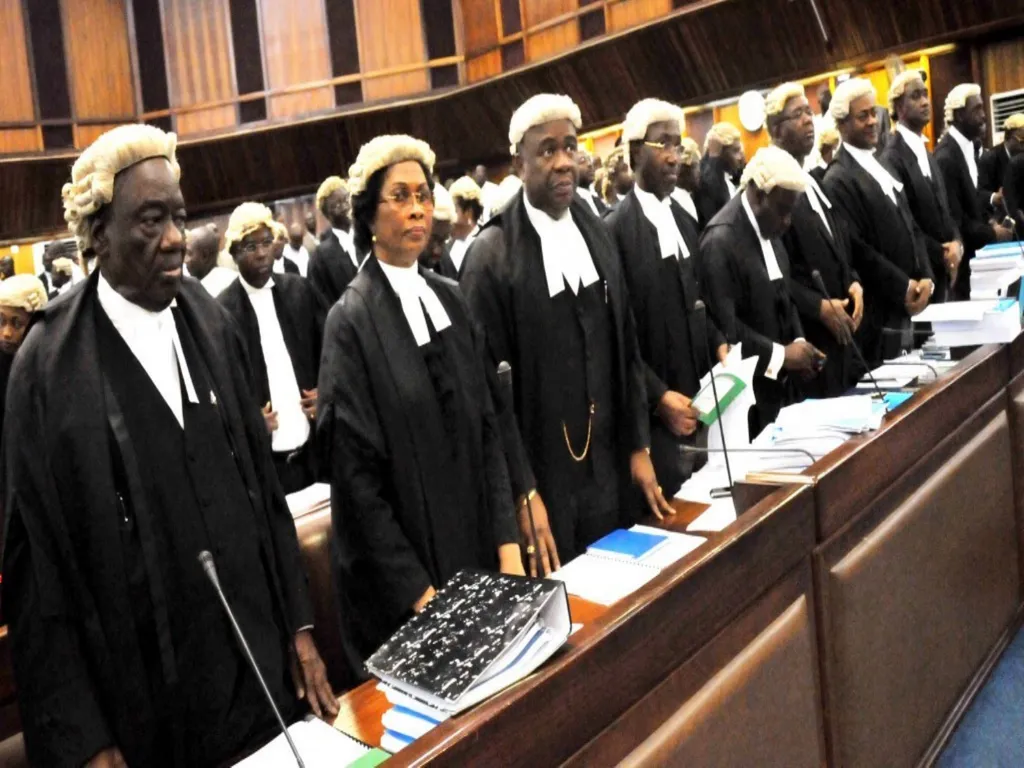
A court is a tribunal, often a governmental institution, with the authority to adjudicate legal disputes between parties and carry out the administration of justice in civil, criminal, and administrative matters in accordance with the rule of law. In both common law and civil law legal systems, courts are the central means for dispute resolution, and it is generally understood that all persons have an ability to bring their claims before a court.<br>
90
The system of courts that interpret and apply the law are collectively known as the judiciary. The place where a court sits is known as a venue. The room where court proceedings occur is known as a courtroom, and the building as a courthouse; court facilities range from simple and very small facilities in rural communities to large buildings in cities.<br>
91
Courts are recognized and renowned as the hallowed chambers of justice, where even-handed justice is meted out to all and sundry, without sentiment, emotion, favouritism or being unnecessarily embroiled in crass legalism. They are not only courts of law but courts of equity. As discussed in an earlier post, a party is entitled to fair hearing before a court and where there is a breach of the rule of fair hearing as guaranteed by the 1999 Constitution (As Amended), the whole proceedings automatically become vitiated with a basic and fundamental irregularity, which renders such proceedings null and void. The test of fair hearing is the impression of a reasonable person who was present at the trial- whether from his observation, justice has been done in the case.<br>
92
In Nigeria, the 1999 Constitution (As Amended) divides the structure of government into three arms – the legislative; the executive and the judiciary. By the provision of Section 6 of the 1999 Constitution (As Amended), judicial powers are vested in the courts. Courts are authorized by law to exercise jurisdiction at first instance and on appeals on all actions and proceedings relating to matters between persons, or between government or authority and any person in Nigeria to determine any question as to the civil rights and obligations of that person. It is in line with this that we will be considering in this article, the issues of hierarchy and jurisdiction of courts in Nigeria.<br>
93
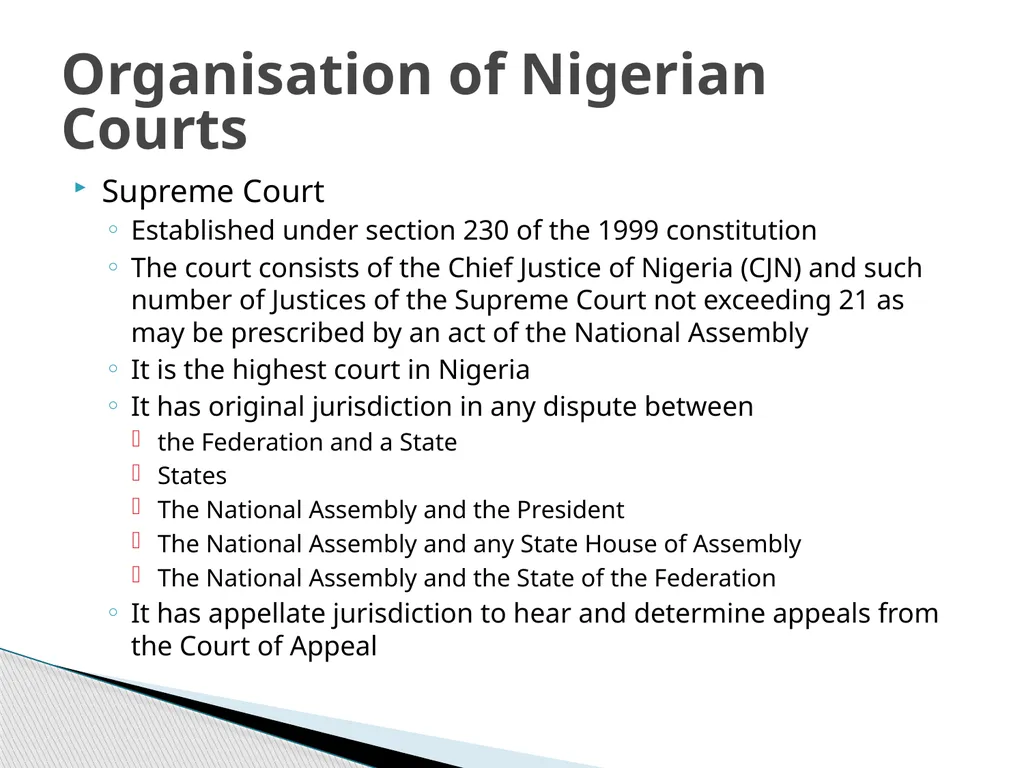
Organization of court The Supreme Court of Nigeria is the highest court in Nigeria. It is based in the capital, Abuja. The Supreme Court is mainly a court of appellate jurisdiction and is the final appeal court in the country. It also has original jurisdiction in State vs. State and State vs. Federal Government cases<br>
94
The Supreme Court is composed of the Chief Justice of Nigeria and such number of justices not more than 21, appointed by the President on the recommendation of the National Judicial Council, (NJC) and subject to confirmation by the Senate. Justices of the Supreme Court must be qualified to practice law in Nigeria, and must have been so qualified for a period not less than fifteen years. Justices of the Supreme Court of Nigeria have a mandatory retirement age of 70 years.<br>
95
Tier 3 Courts. Just below the Federal Court of Appeal are the tier 3 courts. They include: (1) the Federal High Court and (2) the High Court of a state/FCT, (3) the Customary Court of Appeal of a state/FCT and (4) the Sharia Court of Appeal of a state/FCT. The Federal High Court is based in Abuja.
The Chief Justice of Nigeria or CJN is the head of the judicial arm of the government of Nigeria, ... 2014–2016.<br>
The Chief Justice of Nigeria or CJN is the head of the judicial arm of the government of Nigeria, ... 2014–2016.<br>
96
The Nigerian legal system is based on the English common law legal tradition. The sources of Nigerian law are: The Constitution, Legislation, English law, Customary law, Islamic law and Judicial precedents<br>
97
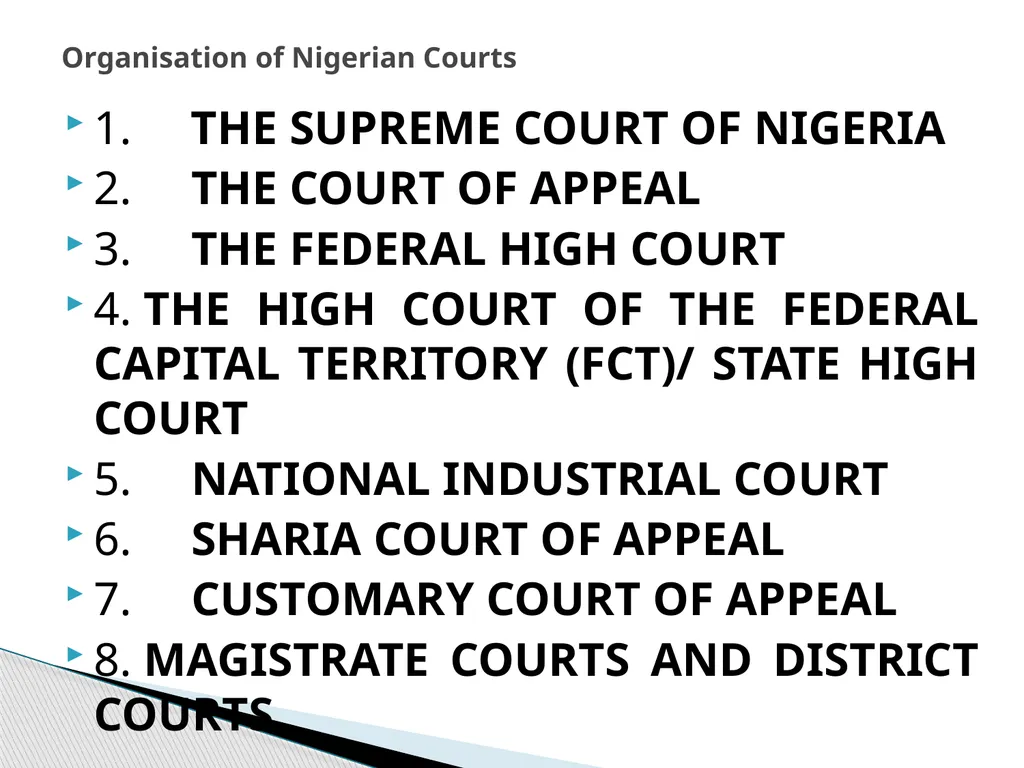
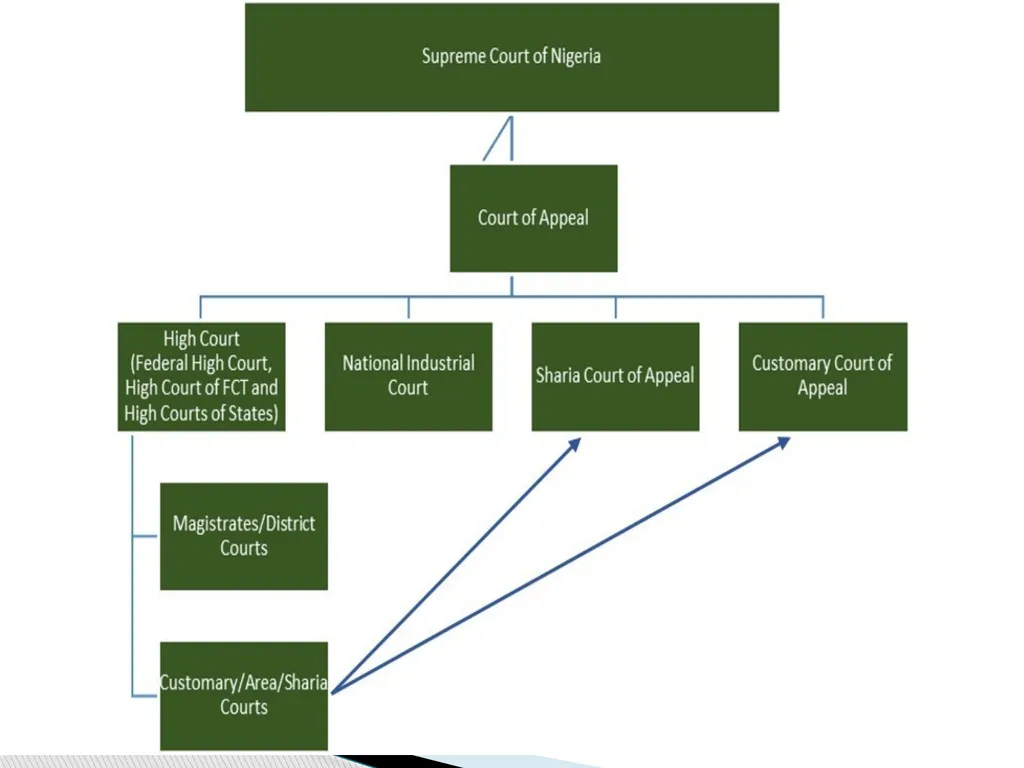
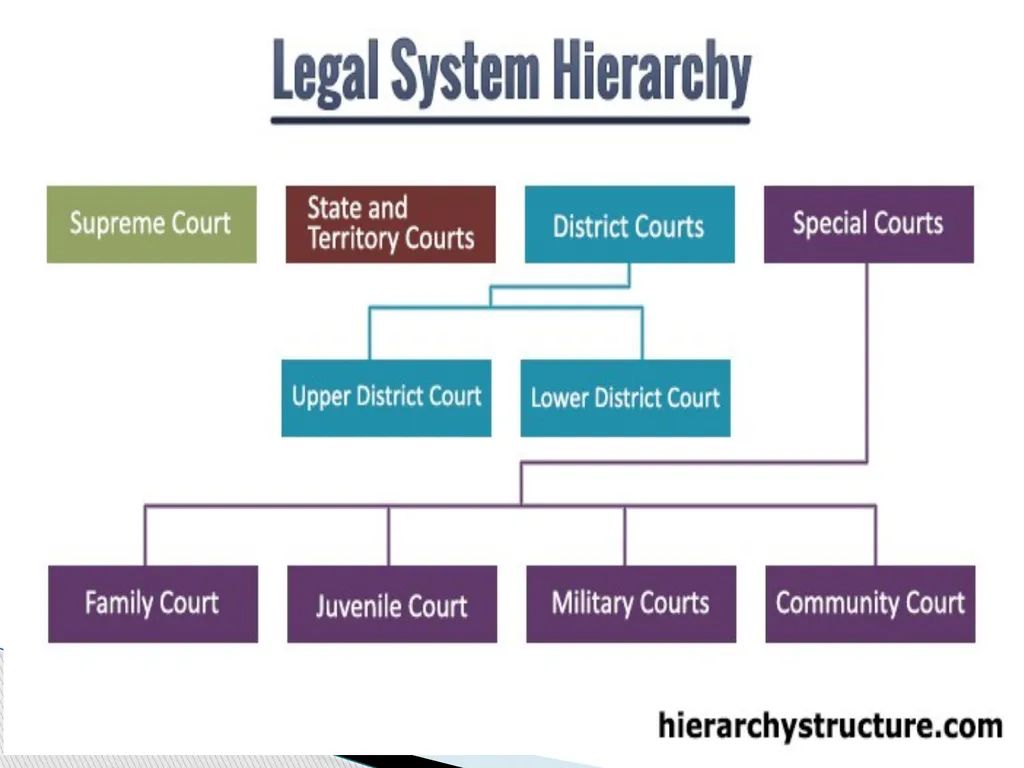
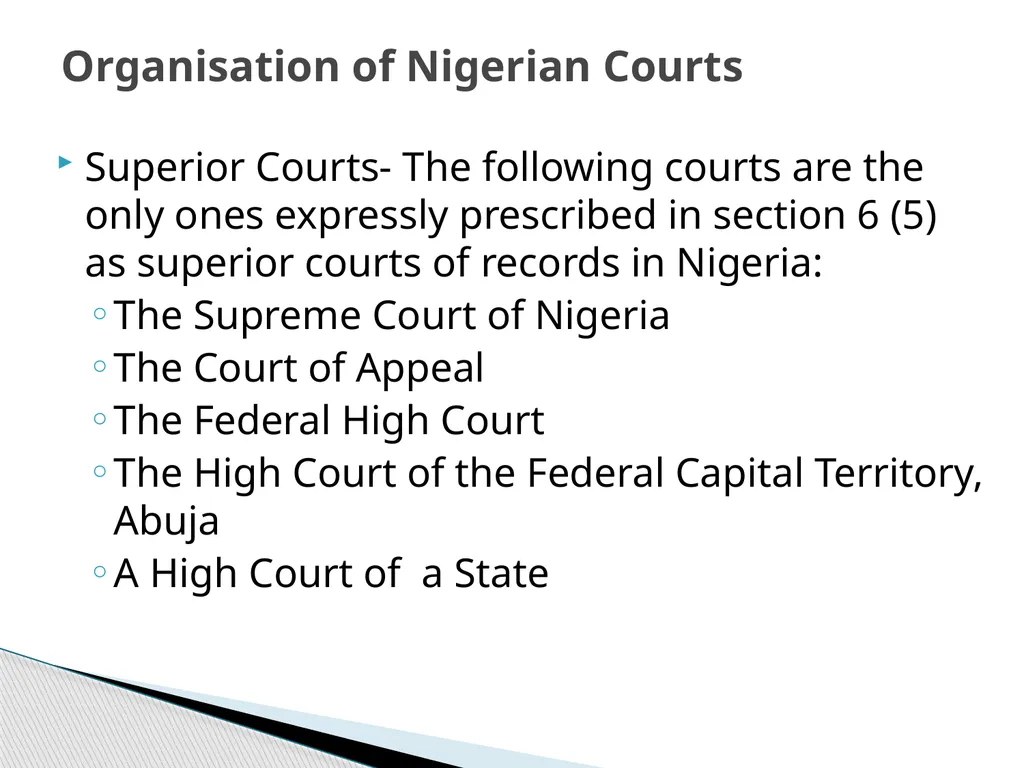
Organisation of Nigerian Courts 1. THE SUPREME COURT OF NIGERIA
2. THE COURT OF APPEAL
3. THE FEDERAL HIGH COURT
4. THE HIGH COURT OF THE FEDERAL CAPITAL TERRITORY (FCT)/ STATE HIGH COURT
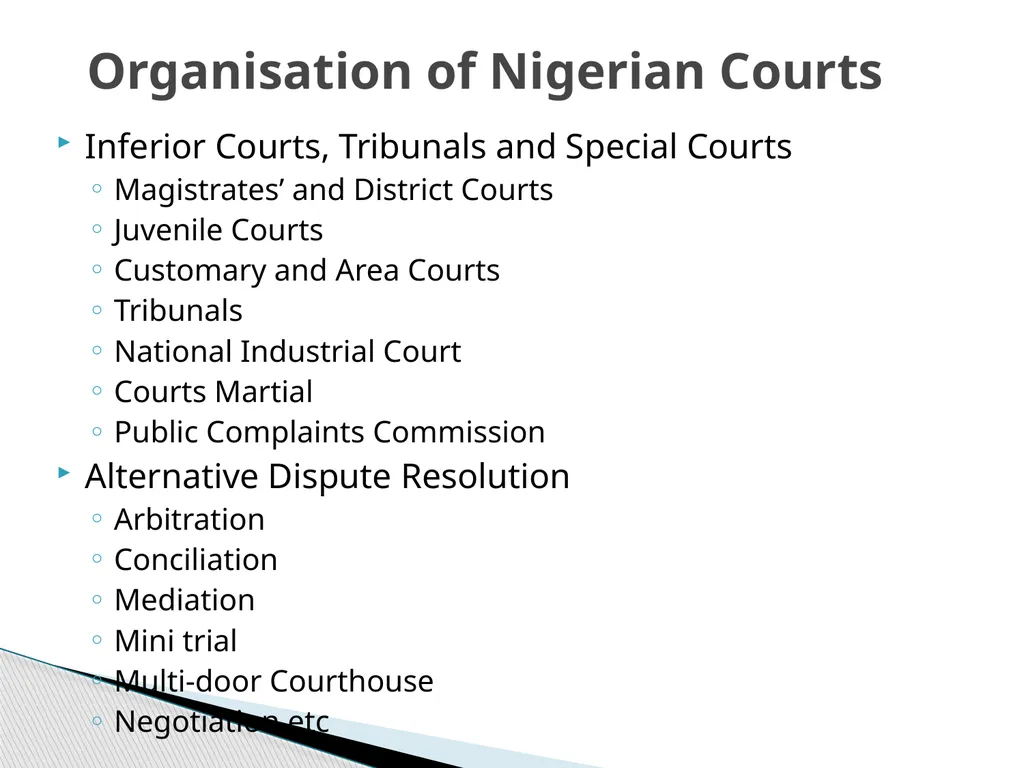
5. NATIONAL INDUSTRIAL COURT
6. SHARIA COURT OF APPEAL
7. CUSTOMARY COURT OF APPEAL
8. MAGISTRATE COURTS AND DISTRICT COURTS<br>
2. THE COURT OF APPEAL
3. THE FEDERAL HIGH COURT
4. THE HIGH COURT OF THE FEDERAL CAPITAL TERRITORY (FCT)/ STATE HIGH COURT
5. NATIONAL INDUSTRIAL COURT
6. SHARIA COURT OF APPEAL
7. CUSTOMARY COURT OF APPEAL
8. MAGISTRATE COURTS AND DISTRICT COURTS<br>
98
The Nigerian constitution recognizes courts as either Federal or State courts. A primary difference between both is that the President appoints Justices/Judges to federal courts, while State Governors appoint Judges to state courts. All appointments (federal or state) are based on the recommendations of the National Judicial Council<br>
99
The Federal courts are: the Supreme Court, the Court of Appeal and the Federal High Court.
The State courts include: the High Court of a State, the Customary Court of Appeal of a State and the Sharia Court of Appeal of a State. Each of the states (currently thirty-six) is constitutionally allowed to have all of these courts. However, the predominantly Muslim northern states tend to have Sharia courts rather than Customary courts. The predominantly Christian southern states tend to have Customary courts and not Sharia courts<br>
The State courts include: the High Court of a State, the Customary Court of Appeal of a State and the Sharia Court of Appeal of a State. Each of the states (currently thirty-six) is constitutionally allowed to have all of these courts. However, the predominantly Muslim northern states tend to have Sharia courts rather than Customary courts. The predominantly Christian southern states tend to have Customary courts and not Sharia courts<br>
100
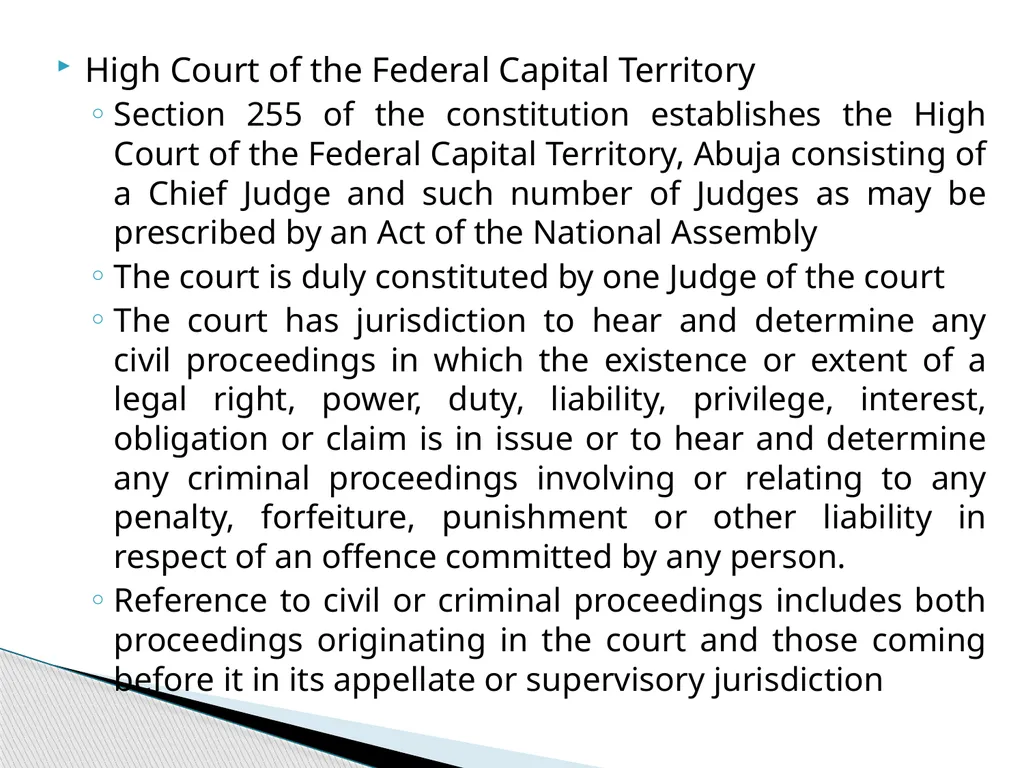
Due to the fact that the Nigerian capital (known as happy town or The Federal Capital Territory, FCT) is not a state, it has no Governor. Its courts that are equivalent to the state courts have their Judges appointed by the President and are thus federal courts. The FCT courts are: the High Court of the FCT, the Customary Court of Appeal of the FCT and the Sharia Court of Appeal of the FCT.<br>
101
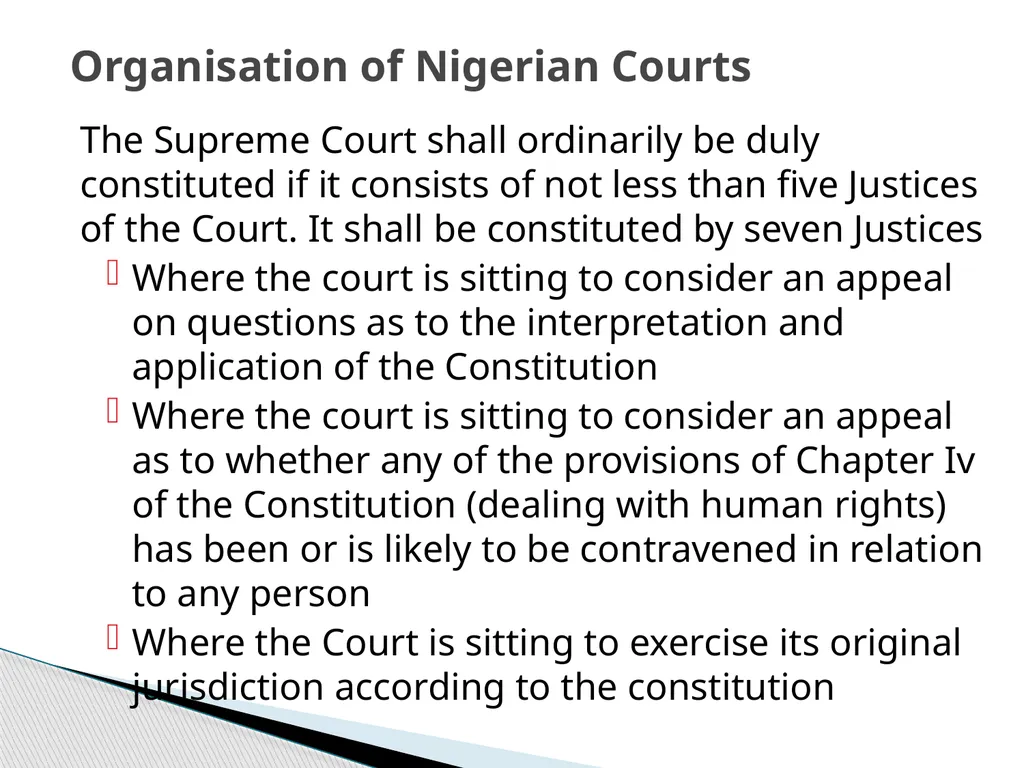
The Supreme Court of Nigeria is the highest court in Nigeria. It is based in the capital, Abuja. The Supreme Court is mainly a court of appellate jurisdiction and is the final appeal court in the country. It also has original jurisdiction in State vs. State and State vs. Federal Government cases. The Supreme Court is headed by a Chief Justice who is assisted by other Justices. The appointment of the Chief Justice and Justices requires confirmation by the Senate<br>
102
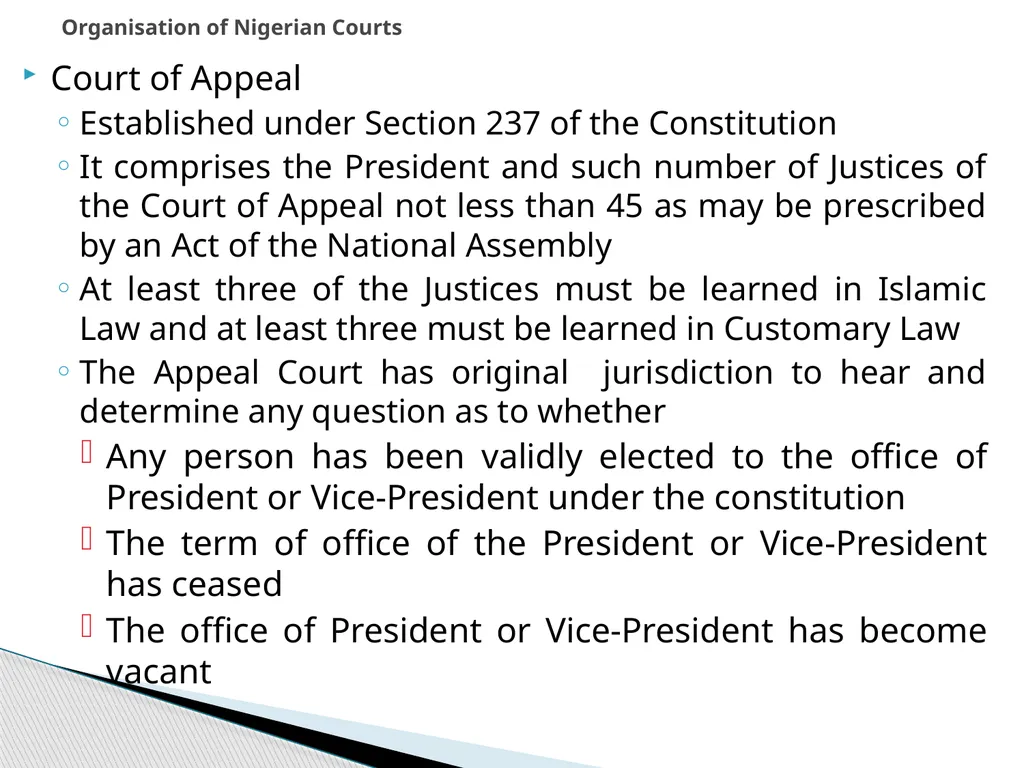
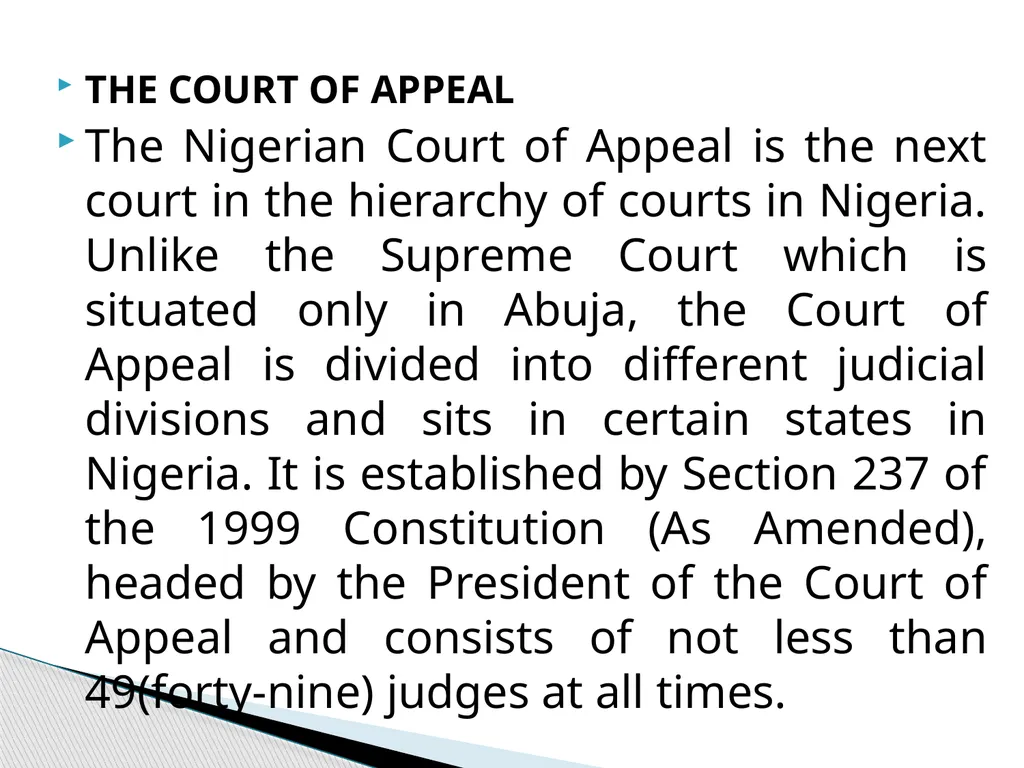
The next highest court is the Court of Appeal. The Court of Appeal is located in Abuja. However, in order to bring the administration of justice closer to the people, the Court of Appeal has multiple divisions (currently sixteen) in various parts of the country. The head of the Court of Appeal has the title: President of the Appeal Court. He/She is assisted by Justices. Only the appointment of the President of the Appeal Court requires Senate confirmation<br>
103
Just below the Federal Court of Appeal are the tier 3 courts. They include: (1) the Federal High Court and (2) the High Court of a state/FCT, (3) the Customary Court of Appeal of a state/FCT and (4) the Sharia Court of Appeal of a state/FCT.
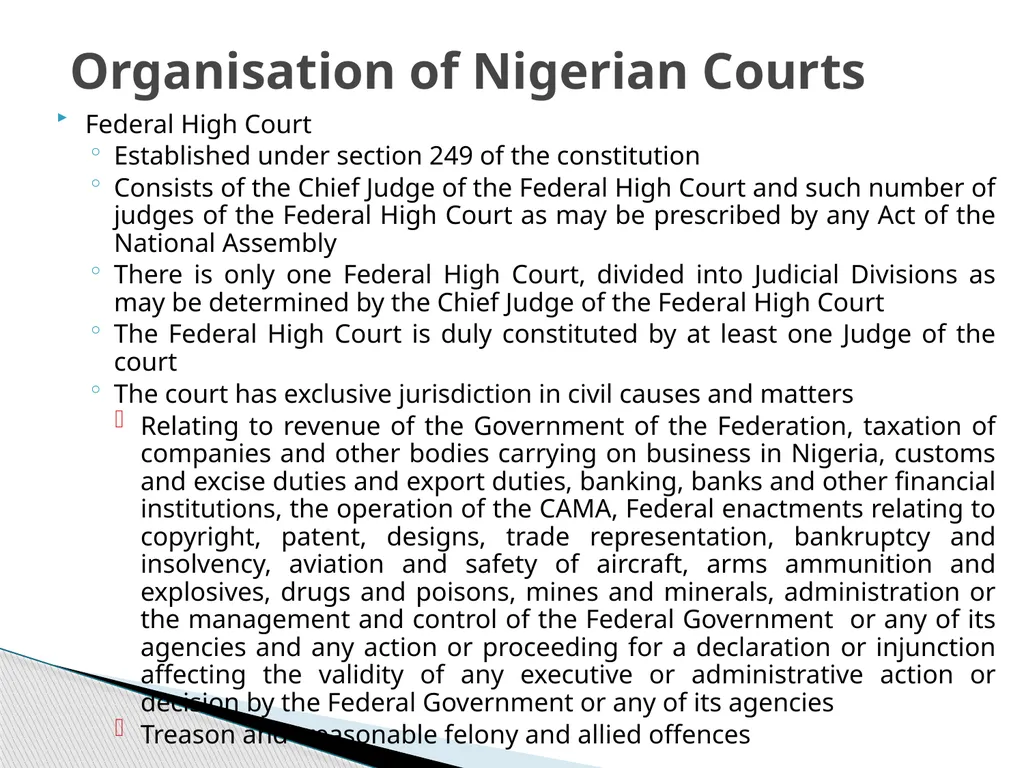
The Federal High Court is based in Abuja. In order to bring the administration of justice closer to the people it has a division in each of the thirty-six states of the country. The Federal High Court is generally a court of original jurisdiction. However, it has appellate jurisdiction from tribunals such as the Tax Appeal Tribunal. It is presided over by a Chief Judge who is assisted by other Judges<br>
The Federal High Court is based in Abuja. In order to bring the administration of justice closer to the people it has a division in each of the thirty-six states of the country. The Federal High Court is generally a court of original jurisdiction. However, it has appellate jurisdiction from tribunals such as the Tax Appeal Tribunal. It is presided over by a Chief Judge who is assisted by other Judges<br>
104
The lowest courts in the country are all state courts (there is no federal court in this group). They include
(i) the Magistrate Courts that handle English law cases
(ii) the Customary Courts that handle Customary law cases and
(iii) the Sharia Courts that handle Sharia law cases<br>
(i) the Magistrate Courts that handle English law cases
(ii) the Customary Courts that handle Customary law cases and
(iii) the Sharia Courts that handle Sharia law cases<br>
105
The Supreme Court of Nigeria which is the apex court in Nigeria was established in 1963 following the proclamation of the Federal Republic of Nigeria and the then 1960 Constitution which came into operation on October 1, 1963, following the abolition of Section 120 which abrogated the appellate jurisdiction of the judicial committee of the Privy Council which was Nigeria’s apex court.<br>
106
The Supreme Court which is presently situated in Abuja, Nigeria has original jurisdiction to the exclusion of any other court in certain disputes. The term “original jurisdiction” means it is the court of first instance and been the apex court in the country, it consequentially means no appeal can be heard in respect of those matters before another court in Nigeria. These matters includes: any dispute between the Federation and a State or between States if and in as far as that dispute involve any question (whether of law or fact) on which the existence or extent of a legal right depends. The Supreme Court does not have original jurisdiction on any criminal matter and finally, it has jurisdiction to the exclusion of any other court in Nigeria to hear and determine any appeal from the Court of Appeal.<br>
107
The Court is now provided for in Section 230 of the 1999 Constitution (As Amended) and by this provision, the court consists of the Chief Justice of Nigeria and not more than 21(Twenty One) judges at all times. The court’s decision on any matter is final and binding on all other courts in Nigeria without any form of appeal to any other body or person. This of course is without prejudice to the powers of the President or the Governor of a State with respect to prerogative of mercy for any person convicted of an offence under any law in Nigeria. Nigeria, the 1999 Constitution (As Amended) divides the structure of government into three arms – the legislative; the executive and the judiciary. By the provision of Section 6 of the 1999 Constitution (As Amended), judicial powers are vested in the courts. Courts are authorized by law to exercise jurisdiction at first instance and on appeals on all actions and proceedings relating to matters between persons, or between government or authority and any person in Nigeria to determine any question as to the civil rights and obligations of that person. It is in line with this that we will be considering in this article, the issues of hierarchy and jurisdiction of courts in Nigeria.<br>
108
The justice system is the mechanism that upholds the rule of law. Our courts provide a forum to resolve disputes and to test and enforce laws in a fair and rational manner. The courts are an impartial forum, and judges are free to apply the law without regard to the government's wishes or the weight of public opinion.
Court decisions are based on what the law says and what the evidence proves; there is no place in the courts for suspicion, bias or favoritism. This is why justice is often symbolized as a blindfolded figure balancing a set of scales, oblivious to anything that could detract from the pursuit of an outcome that is just and fair.<br>
Court decisions are based on what the law says and what the evidence proves; there is no place in the courts for suspicion, bias or favoritism. This is why justice is often symbolized as a blindfolded figure balancing a set of scales, oblivious to anything that could detract from the pursuit of an outcome that is just and fair.<br>
109
Organisation of Nigerian Courts Superior Courts- The following courts are the only ones expressly prescribed in section 6 (5) as superior courts of records in Nigeria:
The Supreme Court of Nigeria
The Court of Appeal
The Federal High Court
The High Court of the Federal Capital Territory, Abuja
A High Court of a State<br>
The Supreme Court of Nigeria
The Court of Appeal
The Federal High Court
The High Court of the Federal Capital Territory, Abuja
A High Court of a State<br>
110
The Sharia Court of Appeal of the FCT, Abuja
A Sharia Court of Appeal of a State
The Customary Court of Appeal of the FCT, Abuja
A Customary Court of Appeal of a State
Other courts as may be authorised by law to exercise jurisdiction on matters with respect to which the National Assembly may make laws
Other courts as may be authorised by law to exercise jurisdiction at first instance or on appeal on matters with respect to which a House of Assembly may make<br>
A Sharia Court of Appeal of a State
The Customary Court of Appeal of the FCT, Abuja
A Customary Court of Appeal of a State
Other courts as may be authorised by law to exercise jurisdiction on matters with respect to which the National Assembly may make laws
Other courts as may be authorised by law to exercise jurisdiction at first instance or on appeal on matters with respect to which a House of Assembly may make<br>
111
Organisation of Nigerian Courts Inferior Courts, Tribunals and Special Courts
Magistrates’ and District Courts
Juvenile Courts
Customary and Area Courts
Tribunals
National Industrial Court
Courts Martial
Public Complaints Commission
Alternative Dispute Resolution
Arbitration
Conciliation
Mediation
Mini trial
Multi-door Courthouse
Negotiation etc<br>
Magistrates’ and District Courts
Juvenile Courts
Customary and Area Courts
Tribunals
National Industrial Court
Courts Martial
Public Complaints Commission
Alternative Dispute Resolution
Arbitration
Conciliation
Mediation
Mini trial
Multi-door Courthouse
Negotiation etc<br>
112
Organisation of Nigerian Courts Supreme Court
Established under section 230 of the 1999 constitution
The court consists of the Chief Justice of Nigeria (CJN) and such number of Justices of the Supreme Court not exceeding 21 as may be prescribed by an act of the National Assembly
It is the highest court in Nigeria
It has original jurisdiction in any dispute between
the Federation and a State
States
The National Assembly and the President
The National Assembly and any State House of Assembly
The National Assembly and the State of the Federation
It has appellate jurisdiction to hear and determine appeals from the Court of Appeal<br>
Established under section 230 of the 1999 constitution
The court consists of the Chief Justice of Nigeria (CJN) and such number of Justices of the Supreme Court not exceeding 21 as may be prescribed by an act of the National Assembly
It is the highest court in Nigeria
It has original jurisdiction in any dispute between
the Federation and a State
States
The National Assembly and the President
The National Assembly and any State House of Assembly
The National Assembly and the State of the Federation
It has appellate jurisdiction to hear and determine appeals from the Court of Appeal<br>
113
Organisation of Nigerian Courts The Supreme Court shall ordinarily be duly constituted if it consists of not less than five Justices of the Court. It shall be constituted by seven Justices
Where the court is sitting to consider an appeal on questions as to the interpretation and application of the Constitution
Where the court is sitting to consider an appeal as to whether any of the provisions of Chapter Iv of the Constitution (dealing with human rights) has been or is likely to be contravened in relation to any person
Where the Court is sitting to exercise its original jurisdiction according to the constitution<br>
Where the court is sitting to consider an appeal on questions as to the interpretation and application of the Constitution
Where the court is sitting to consider an appeal as to whether any of the provisions of Chapter Iv of the Constitution (dealing with human rights) has been or is likely to be contravened in relation to any person
Where the Court is sitting to exercise its original jurisdiction according to the constitution<br>
114
Organisation of Nigerian Courts Court of Appeal
Established under Section 237 of the Constitution
It comprises the President and such number of Justices of the Court of Appeal not less than 45 as may be prescribed by an Act of the National Assembly
At least three of the Justices must be learned in Islamic Law and at least three must be learned in Customary Law
The Appeal Court has original jurisdiction to hear and determine any question as to whether
Any person has been validly elected to the office of President or Vice-President under the constitution
The term of office of the President or Vice-President has ceased
The office of President or Vice-President has become vacant<br>
Established under Section 237 of the Constitution
It comprises the President and such number of Justices of the Court of Appeal not less than 45 as may be prescribed by an Act of the National Assembly
At least three of the Justices must be learned in Islamic Law and at least three must be learned in Customary Law
The Appeal Court has original jurisdiction to hear and determine any question as to whether
Any person has been validly elected to the office of President or Vice-President under the constitution
The term of office of the President or Vice-President has ceased
The office of President or Vice-President has become vacant<br>
115
THE COURT OF APPEAL
The Nigerian Court of Appeal is the next court in the hierarchy of courts in Nigeria. Unlike the Supreme Court which is situated only in Abuja, the Court of Appeal is divided into different judicial divisions and sits in certain states in Nigeria. It is established by Section 237 of the 1999 Constitution (As Amended), headed by the President of the Court of Appeal and consists of not less than 49(forty-nine) judges at all times.<br>
The Nigerian Court of Appeal is the next court in the hierarchy of courts in Nigeria. Unlike the Supreme Court which is situated only in Abuja, the Court of Appeal is divided into different judicial divisions and sits in certain states in Nigeria. It is established by Section 237 of the 1999 Constitution (As Amended), headed by the President of the Court of Appeal and consists of not less than 49(forty-nine) judges at all times.<br>
116
The Court has appellate jurisdiction to hear and determine appeals from
The Federal High Court
The High Court of the Federal Capital Territory, Abuja
A high Court of a State
The Sharia Court of Appeal of the FCT, Abuja
A Sharia Court of Appeal of a State
The Customary Court of Appeal of the FCT, Abuja
A Customary Court of Appeal of a State
A Court Martial or other tribunal as may be prescribed by the National Assembly
The Court of Appeal is duly constituted for the purpose of hearing and determining appeals coming before it by a panel of at least 3 Justices of the Court of Appeal<br>
The Federal High Court
The High Court of the Federal Capital Territory, Abuja
A high Court of a State
The Sharia Court of Appeal of the FCT, Abuja
A Sharia Court of Appeal of a State
The Customary Court of Appeal of the FCT, Abuja
A Customary Court of Appeal of a State
A Court Martial or other tribunal as may be prescribed by the National Assembly
The Court of Appeal is duly constituted for the purpose of hearing and determining appeals coming before it by a panel of at least 3 Justices of the Court of Appeal<br>
117
Organisation of Nigerian Courts Federal High Court
Established under section 249 of the constitution
Consists of the Chief Judge of the Federal High Court and such number of judges of the Federal High Court as may be prescribed by any Act of the National Assembly
There is only one Federal High Court, divided into Judicial Divisions as may be determined by the Chief Judge of the Federal High Court
The Federal High Court is duly constituted by at least one Judge of the court
The court has exclusive jurisdiction in civil causes and matters
Relating to revenue of the Government of the Federation, taxation of companies and other bodies carrying on business in Nigeria, customs and excise duties and export duties, banking, banks and other financial institutions, the operation of the CAMA, Federal enactments relating to copyright, patent, designs, trade representation, bankruptcy and insolvency, aviation and safety of aircraft, arms ammunition and explosives, drugs and poisons, mines and minerals, administration or the management and control of the Federal Government or any of its agencies and any action or proceeding for a declaration or injunction affecting the validity of any executive or administrative action or decision by the Federal Government or any of its agencies
Treason and treasonable felony and allied offences<br>
Established under section 249 of the constitution
Consists of the Chief Judge of the Federal High Court and such number of judges of the Federal High Court as may be prescribed by any Act of the National Assembly
There is only one Federal High Court, divided into Judicial Divisions as may be determined by the Chief Judge of the Federal High Court
The Federal High Court is duly constituted by at least one Judge of the court
The court has exclusive jurisdiction in civil causes and matters
Relating to revenue of the Government of the Federation, taxation of companies and other bodies carrying on business in Nigeria, customs and excise duties and export duties, banking, banks and other financial institutions, the operation of the CAMA, Federal enactments relating to copyright, patent, designs, trade representation, bankruptcy and insolvency, aviation and safety of aircraft, arms ammunition and explosives, drugs and poisons, mines and minerals, administration or the management and control of the Federal Government or any of its agencies and any action or proceeding for a declaration or injunction affecting the validity of any executive or administrative action or decision by the Federal Government or any of its agencies
Treason and treasonable felony and allied offences<br>
118
High Court of the Federal Capital Territory
Section 255 of the constitution establishes the High Court of the Federal Capital Territory, Abuja consisting of a Chief Judge and such number of Judges as may be prescribed by an Act of the National Assembly
The court is duly constituted by one Judge of the court
The court has jurisdiction to hear and determine any civil proceedings in which the existence or extent of a legal right, power, duty, liability, privilege, interest, obligation or claim is in issue or to hear and determine any criminal proceedings involving or relating to any penalty, forfeiture, punishment or other liability in respect of an offence committed by any person.
Reference to civil or criminal proceedings includes both proceedings originating in the court and those coming before it in its appellate or supervisory jurisdiction<br>
Section 255 of the constitution establishes the High Court of the Federal Capital Territory, Abuja consisting of a Chief Judge and such number of Judges as may be prescribed by an Act of the National Assembly
The court is duly constituted by one Judge of the court
The court has jurisdiction to hear and determine any civil proceedings in which the existence or extent of a legal right, power, duty, liability, privilege, interest, obligation or claim is in issue or to hear and determine any criminal proceedings involving or relating to any penalty, forfeiture, punishment or other liability in respect of an offence committed by any person.
Reference to civil or criminal proceedings includes both proceedings originating in the court and those coming before it in its appellate or supervisory jurisdiction<br>
119
Organisation of Nigerian Courts High Court of A State
Section 270 of the constitution establishes a High Court for each State of the Federation. A State High Court consists of a Chief Judge and such number of Judges of the High Court as may be prescribed by a Law of the House of Assembly
A State High Court is duly constituted if it consists of at least a Judge of the court.
The court has jurisdiction to hear and determine any civil proceedings in which the existence or extent of a legal right, power, duty, liability, privilege, interest, obligation or claim is in issue. The court also has jurisdiction to hear and determine any criminal proceedings involving or relating to any penalty, forfeiture, punishment or other liability in respect of an offence committed by any person. This jurisdiction includes original, appellate and supervisory function<br>
Section 270 of the constitution establishes a High Court for each State of the Federation. A State High Court consists of a Chief Judge and such number of Judges of the High Court as may be prescribed by a Law of the House of Assembly
A State High Court is duly constituted if it consists of at least a Judge of the court.
The court has jurisdiction to hear and determine any civil proceedings in which the existence or extent of a legal right, power, duty, liability, privilege, interest, obligation or claim is in issue. The court also has jurisdiction to hear and determine any criminal proceedings involving or relating to any penalty, forfeiture, punishment or other liability in respect of an offence committed by any person. This jurisdiction includes original, appellate and supervisory function<br>
120
Tier 3 Courts. Just below the Federal Court of Appeal are the tier 3 courts. They include: (1) the Federal High Court and (2) the High Court of a state/FCT, (3) the Customary Court of Appeal of a state/FCT and (4) the Sharia Court of Appeal of a state/FCT. The Federal High Court is based in Abuja.
The Chief Justice of Nigeria or CJN is the head of the judicial arm of the government of Nigeria, ... 2014–2016.
Walter Samuel Nkanu Onnoghen, 2017<br>
The Chief Justice of Nigeria or CJN is the head of the judicial arm of the government of Nigeria, ... 2014–2016.
Walter Samuel Nkanu Onnoghen, 2017<br>
121
Organisation of Nigerian Courts Sharia Court of Appeal of the Federal Capital Territory
Section 260 of the constitution establishes the Sharia Court of Appeal of the Federal Capital Territory, Abuja consisting of a Grand Kadi and such number of Kadis of the Sharia Court of Appeal as may be prescribed by an Act of the National Assembly
For the purpose its functions, the court is duly constituted if it consists of at least three Kadis of the court
The court exercises appellate and supervisory jurisdiction in civil proceedings involving questions of Islamic personal law. The court is competent decide:
Any question of Islamic personal law regarding marriage concluded in accordance with that law and relating to family relationship or the guardianship of an infant
Where all the parties to the proceedings are Muslims
Any question of Islamic personal law regarding this, will or succession where the endower, donor, testator or deceased person is a Muslim
Any question of Islamic personal law regarding an infant, prodigal or person of unsound mind who is a Muslim or the maintenance or the guardianship of a Muslim who is physically or mentally inform
Where all the parties to the proceedings, being Muslims have requested the court that hears the case in the first instance to determine that case in accordance with Islamic personal law, any other question<br>
Section 260 of the constitution establishes the Sharia Court of Appeal of the Federal Capital Territory, Abuja consisting of a Grand Kadi and such number of Kadis of the Sharia Court of Appeal as may be prescribed by an Act of the National Assembly
For the purpose its functions, the court is duly constituted if it consists of at least three Kadis of the court
The court exercises appellate and supervisory jurisdiction in civil proceedings involving questions of Islamic personal law. The court is competent decide:
Any question of Islamic personal law regarding marriage concluded in accordance with that law and relating to family relationship or the guardianship of an infant
Where all the parties to the proceedings are Muslims
Any question of Islamic personal law regarding this, will or succession where the endower, donor, testator or deceased person is a Muslim
Any question of Islamic personal law regarding an infant, prodigal or person of unsound mind who is a Muslim or the maintenance or the guardianship of a Muslim who is physically or mentally inform
Where all the parties to the proceedings, being Muslims have requested the court that hears the case in the first instance to determine that case in accordance with Islamic personal law, any other question<br>
122
Organisation of Nigerian Courts Customary Court of Appeal of the Federal Capital Territory
Section 265 of the constitution establishes the Customary Court of Appeal of the Federal Capital Territory, Abuja consisting of a President and such number of Judges of the Customary Court of Appeal as may be prescribed by an Act of the National Assembly
For the purpose of discharging its functions, the Customary Court of Appeal of the Federal Capital Territory, Abuja is duly constituted if it consists of at least three Judges of the court
In addition to such other jurisdiction as may be conferred upon it by the National Assembly, the Customary Court of Appeal of the Federal Capital Territory, Abuja exercise appellate and supervisory jurisdiction in civil proceedings involving questions of customary law.<br>
Section 265 of the constitution establishes the Customary Court of Appeal of the Federal Capital Territory, Abuja consisting of a President and such number of Judges of the Customary Court of Appeal as may be prescribed by an Act of the National Assembly
For the purpose of discharging its functions, the Customary Court of Appeal of the Federal Capital Territory, Abuja is duly constituted if it consists of at least three Judges of the court
In addition to such other jurisdiction as may be conferred upon it by the National Assembly, the Customary Court of Appeal of the Federal Capital Territory, Abuja exercise appellate and supervisory jurisdiction in civil proceedings involving questions of customary law.<br>
123
Organisation of Nigerian Courts Sharia Court of Appeal of a State
Section 275 of the constitution provides for the establishment of a Sharia Court of Appeal for any State that requires it. The court consists of a Grand Kadi of a Sharia Court of Appeal and such number of Kadis as may be prescribed by the State House of Assembly.
For the purpose of exercising its jurisdiction under the constitution or any law, a Sharia Court of Appeal of a State is duly constituted if it consists of at least three Kadis of that court
The court exercises appellate and supervisory jurisdiction in civil proceedings involving questions of Islamic personal law. The court is competent decide:
Any question of Islamic personal law regarding marriage concluded in accordance with that law and relating to family relationship or the guardianship of an infant
Where all the parties to the proceedings are Muslims
Any question of Islamic personal law regarding wakf, will or succession where the endower, donor, testator or deceased person is a Muslim
Any question of Islamic personal law regarding an infant, prodigal or person of unsound mind who is a Muslim or the maintenance or the guardianship of a Muslim who is physically or mentally inform
Where all the parties to the proceedings, being Muslims have requested the court that hears the case in the first instance to determine that case in accordance with Islamic personal law, any other question<br>
Section 275 of the constitution provides for the establishment of a Sharia Court of Appeal for any State that requires it. The court consists of a Grand Kadi of a Sharia Court of Appeal and such number of Kadis as may be prescribed by the State House of Assembly.
For the purpose of exercising its jurisdiction under the constitution or any law, a Sharia Court of Appeal of a State is duly constituted if it consists of at least three Kadis of that court
The court exercises appellate and supervisory jurisdiction in civil proceedings involving questions of Islamic personal law. The court is competent decide:
Any question of Islamic personal law regarding marriage concluded in accordance with that law and relating to family relationship or the guardianship of an infant
Where all the parties to the proceedings are Muslims
Any question of Islamic personal law regarding wakf, will or succession where the endower, donor, testator or deceased person is a Muslim
Any question of Islamic personal law regarding an infant, prodigal or person of unsound mind who is a Muslim or the maintenance or the guardianship of a Muslim who is physically or mentally inform
Where all the parties to the proceedings, being Muslims have requested the court that hears the case in the first instance to determine that case in accordance with Islamic personal law, any other question<br>
124
Organisation of Nigerian Courts Customary Court of Appeal of a State
Section 280 of the Constitution establishes the Customary Court of Appeal for any State
The court consists of a President of the Customary Court of Appeal of the State and such number of Judges of the Customary Court of Appeal as may be prescribed by the House of Assembly of the State.
For the purpose of discharging its functions, the Customary Court of Appeal of a State is duly constituted if it consists of at least three Judges of the court
A Customary Court of Appeal of a state exercises appellate and supervisory jurisdiction in civil proceedings involving questions of customary law. Such appellate and supervisory jurisdiction covers such questions as may be prescribed by the House of Assembly of the State for which it is established<br>
Section 280 of the Constitution establishes the Customary Court of Appeal for any State
The court consists of a President of the Customary Court of Appeal of the State and such number of Judges of the Customary Court of Appeal as may be prescribed by the House of Assembly of the State.
For the purpose of discharging its functions, the Customary Court of Appeal of a State is duly constituted if it consists of at least three Judges of the court
A Customary Court of Appeal of a state exercises appellate and supervisory jurisdiction in civil proceedings involving questions of customary law. Such appellate and supervisory jurisdiction covers such questions as may be prescribed by the House of Assembly of the State for which it is established<br>
125
Organisation of Nigerian Courts Magistrates Courts
These are established by Magistrates Courts Laws in the Southern states and the District Courts Law in the Northern States. The Chief Judge of each state is responsible for the demarcation of the state into magisterial districts based on the needs of the different parts of the state.
A district or magisterial district as the case may be, has one or more magistrates ‘ or district courts of any grade and each district is usually under the administrative control of a Chief Magistrate
The jurisdiction and power of each magistrate depends on his rank and grade and is personal to him, which means that his jurisdiction follows him wherever he goes within his magisterial district.
Magistrates have limited jurisdiction in both civil and criminal matters
The exercise of territorial jurisdiction of magistrate is actually confined to cases where
The defendant resides or carries on business within his district
The cause of action arises fully and partly within his district
The subject matter of the action is within his district
The offence is committed wholly or partly within his district<br>
These are established by Magistrates Courts Laws in the Southern states and the District Courts Law in the Northern States. The Chief Judge of each state is responsible for the demarcation of the state into magisterial districts based on the needs of the different parts of the state.
A district or magisterial district as the case may be, has one or more magistrates ‘ or district courts of any grade and each district is usually under the administrative control of a Chief Magistrate
The jurisdiction and power of each magistrate depends on his rank and grade and is personal to him, which means that his jurisdiction follows him wherever he goes within his magisterial district.
Magistrates have limited jurisdiction in both civil and criminal matters
The exercise of territorial jurisdiction of magistrate is actually confined to cases where
The defendant resides or carries on business within his district
The cause of action arises fully and partly within his district
The subject matter of the action is within his district
The offence is committed wholly or partly within his district<br>
126
Organisation of Nigerian Courts Juvenile Courts
Juvenile courts are special courts established for the trial and welfare of children and young persons. These courts were first established under the Children and Young Persons Ordinance of 1943 providing for setting up of approved schools, remand homes and probation officers to cater for children under the age of 17.
The courts are magistrates’ or district courts specially designated and constituted for the purpose of trying juveniles.<br>
Juvenile courts are special courts established for the trial and welfare of children and young persons. These courts were first established under the Children and Young Persons Ordinance of 1943 providing for setting up of approved schools, remand homes and probation officers to cater for children under the age of 17.
The courts are magistrates’ or district courts specially designated and constituted for the purpose of trying juveniles.<br>
127
Organisation of Nigerian Courts Customary and Area Courts
With political emancipation and independence customary courts replaced the native courts. These courts are known as customary courts in those states carved out of the old Eastern and Western Regions and area courts in those of the old Northern Region.
Each state’s law determines the establishment of customary/area courts, the mode of establishment becomes a prerogative of the relevant legislative body.
The courts are presided over by either a legal practitioner or lay judges. The composition and quorum would depend on the establishing law.
Area courts are usually presided over by an Alkali sitting alone or with other members who are sufficiently versed in the customary law of the area of the court’s jurisdiction.
Customary and area courts are empowered to adjudicate in both civil and criminal cases though limited with respect to subject matter or the amount of claim they can entertain.
Their civil jurisdiction is more in the areas of property, matrimonial causes, custody of children and succession under customary law<br>
With political emancipation and independence customary courts replaced the native courts. These courts are known as customary courts in those states carved out of the old Eastern and Western Regions and area courts in those of the old Northern Region.
Each state’s law determines the establishment of customary/area courts, the mode of establishment becomes a prerogative of the relevant legislative body.
The courts are presided over by either a legal practitioner or lay judges. The composition and quorum would depend on the establishing law.
Area courts are usually presided over by an Alkali sitting alone or with other members who are sufficiently versed in the customary law of the area of the court’s jurisdiction.
Customary and area courts are empowered to adjudicate in both civil and criminal cases though limited with respect to subject matter or the amount of claim they can entertain.
Their civil jurisdiction is more in the areas of property, matrimonial causes, custody of children and succession under customary law<br>
128
Organisation of Nigerian Courts Tribunals: Are integral part of the entire adjudicatory system created by statue, they serve to complement the traditional court system by exercising judicial or quasi-judicial functions. The use of tribunal sis more prevalent during military administrations.<br>
129
A tort is simply a civil wrong. There are three general types of torts that may cause injury to another person. In civil law, torts are grounds for lawsuits to compensate a grieving party for any damages or injuries suffered. Many torts are accidents, like car accidents or slippery floors that make people fall down and get hurt. But some torts are done on purpose. These are called intentional torts. For example, if one person punches another person in the nose, it might be an intentional tort called battery. Law of Tort 137<br>
130
There are four elements to tort law: duty, breach of duty, causation, and injury. In order to claim damages, there must be a breach in the duty of the defendant towards the plaintiff, which results in an injury. The three main types of torts are negligence, strict liability (product liability), and intentional torts. A tort, in common law jurisdictions, is a civil wrong that causes someone else to suffer loss or harm resulting in legal liability for the person who commits the tortiousact. Afram Fondamentals of Well-Logging 138<br>
131
Organisation of Nigerian Courts National Industrial Court:
Established under section 20 of the Trade Disputes Act for the settlement of trade disputes, the interpretation of collective agreements and matters connected therewith.
The NIC is duly constituted by the President and all five members i.e. the President and the four ordinary members or by the President and two ordinary members.
The NIC is conferred with exclusive jurisdiction:
To make awards for the purpose of settling trade disputes
To determine questions as to the interpretation of
Any collective agreement
Any award made by an arbitration tribunal or by the court under Part I of the Act
The terms of settlement f any trade dispute as recorded in any memorandum under section 8 of the Act<br>
Established under section 20 of the Trade Disputes Act for the settlement of trade disputes, the interpretation of collective agreements and matters connected therewith.
The NIC is duly constituted by the President and all five members i.e. the President and the four ordinary members or by the President and two ordinary members.
The NIC is conferred with exclusive jurisdiction:
To make awards for the purpose of settling trade disputes
To determine questions as to the interpretation of
Any collective agreement
Any award made by an arbitration tribunal or by the court under Part I of the Act
The terms of settlement f any trade dispute as recorded in any memorandum under section 8 of the Act<br>
132
Organisation of Nigerian Courts Courts Martial
The Armed Forces Act provides for various offences, the punishment thereof and the mode of trial. One of the special courts for the trial of persons of the more serious offences in the armed forces is the court martial.
The composition, jurisdiction and powers of courts martial in the three armed forces – Army, Navy and the Air force are now provided for jointly in the Armed Force Decree.
The Decree recognizes two types of courts martial with different jurisdictions
The general court martial which consists of a president and not less than four members, a waiting member, a liaison officer and Judge Advocate
The special court martial consisting of a President and not less than two members, a waiting member, a liaison officer and Judge Advocate<br>
The Armed Forces Act provides for various offences, the punishment thereof and the mode of trial. One of the special courts for the trial of persons of the more serious offences in the armed forces is the court martial.
The composition, jurisdiction and powers of courts martial in the three armed forces – Army, Navy and the Air force are now provided for jointly in the Armed Force Decree.
The Decree recognizes two types of courts martial with different jurisdictions
The general court martial which consists of a president and not less than four members, a waiting member, a liaison officer and Judge Advocate
The special court martial consisting of a President and not less than two members, a waiting member, a liaison officer and Judge Advocate<br>
133
What is Contract A contract is a voluntary, deliberate, and legally binding agreement with specific terms entered into by two or more competent parties and generally have to do with employment, sale or lease, or tenancy. In this agreement, an ‘offer’ is made by one party and an ‘acceptance’ of that offer by the other.<br>
134
Contract A contract is defined as an agreement which is enforceable by law
A contract is an agreement which the law will enforce or recognise as affecting the legal rights and duties of the parties
A contract is a promise or a set of promises the law will enforce<br>
A contract is an agreement which the law will enforce or recognise as affecting the legal rights and duties of the parties
A contract is a promise or a set of promises the law will enforce<br>
135
Definitions of A Contract It is an agreement enforceable by law, between two or more persons to do some act or acts, their intention being to create legal relations and not merely to exchange mutual promises, both having given something, or having promised to give something of value as consideration for any benefit derived from the agreement
A contract is a legally binding agreement that gives rise to obligations that are enforced by law etc<br>
A contract is a legally binding agreement that gives rise to obligations that are enforced by law etc<br>
136
A contract is a legal agreement between two parties which is enforceable in a court of law or by binding arbitration. In other words, a contract is an exchange of promises with a specific remedy for breach of those promises.<br>
137
Characteristics of a Contract 1. There will be a promise or promises.
2. They will be made by “parties to the contract”.
3. They will create an obligation.
4. That obligation will be enforceable at law.
5. Often found in negotiations, rather than a formal document.<br>
2. They will be made by “parties to the contract”.
3. They will create an obligation.
4. That obligation will be enforceable at law.
5. Often found in negotiations, rather than a formal document.<br>
138
Contracts are normally enforceable whether or not in a written form, although a written contract protects all parties to it. Some contracts, (such as for sale of real property, instalment plans, or insurance policies) must be in writing to be legally binding and enforceable. A contract is like a promise between people. It is an understanding, a deal between two or more people or organisations to do certain things.<br>
139
Contract is an agreement between two or more parties representing a promise to be performed for consideration.
It is a written or spoken agreement, especially one concerning employment, sales, or tenancy, that is intended to be enforceable by law.
It is a binding agreement between two or more persons or parties ; especially one legally enforceable.
It is a business arrangement for the supply of goods or services at a fixed price.<br>
It is a written or spoken agreement, especially one concerning employment, sales, or tenancy, that is intended to be enforceable by law.
It is a binding agreement between two or more persons or parties ; especially one legally enforceable.
It is a business arrangement for the supply of goods or services at a fixed price.<br>
140
A contract is a voluntary arrangement between two or more parties that is enforceable by law as a binding legal agreement. Contract is a branch of the law of obligations in jurisdictions of the civil law tradition. Contract law concerns the rights and duties that arise from agreements.
A contract arises when the parties agree that there is an agreement. Formation of a contract generally requires an offer, acceptance, consideration, and a mutual intent to be bound. Each party to a contract must have capacity to enter the agreement. Minors, intoxicated persons, and those under a mental affliction may have insufficient capacity to enter a contract.<br>
A contract arises when the parties agree that there is an agreement. Formation of a contract generally requires an offer, acceptance, consideration, and a mutual intent to be bound. Each party to a contract must have capacity to enter the agreement. Minors, intoxicated persons, and those under a mental affliction may have insufficient capacity to enter a contract.<br>
141
Contract It does not mean that the legal profession plays a part in every contract; the majority of contracts are executed with both parties satisfied with their involvement and these never come to the court. However, when there is a dispute, provided that the courts are satisfied that a valid contract existed, they will enforce the details of the agreement.<br>
142
Formation of Contract The elements of a valid contract are offer, acceptance and consideration. An intention to enter legal relations can be added as the fourth.
Offer
For a contract to exist, there has to be an offer by one party (offeror) to another, and an acceptance by the person (offeree) to whom the offer is addressed. An offer is a definite undertaking or promise made by one party with the intention that it shall become binding on the party making it as soon as it is accepted by the party to whom it is addressed. Most daily activities of humans are contractual in nature. An offer can be made expressly or by conduct (implied). Invitation to treat eg auctions, display of goods in shelves, advertisement of goods in a catalogue, invitation to tender, buses, taxis etc, however is not an offer<br>
Offer
For a contract to exist, there has to be an offer by one party (offeror) to another, and an acceptance by the person (offeree) to whom the offer is addressed. An offer is a definite undertaking or promise made by one party with the intention that it shall become binding on the party making it as soon as it is accepted by the party to whom it is addressed. Most daily activities of humans are contractual in nature. An offer can be made expressly or by conduct (implied). Invitation to treat eg auctions, display of goods in shelves, advertisement of goods in a catalogue, invitation to tender, buses, taxis etc, however is not an offer<br>
143
Formation of Contract Acceptance
Acceptance is the final and unqualified expression of assent to the terms of the offer. Acceptance to an offer is the reciprocal act or action of the offeree to the offer in which he indicates his agreement to the terms of the offer as conveyed to him by the offeror
Acceptance may manifest by the conduct of the parties, by their words, by documents passing between them<br>
Acceptance is the final and unqualified expression of assent to the terms of the offer. Acceptance to an offer is the reciprocal act or action of the offeree to the offer in which he indicates his agreement to the terms of the offer as conveyed to him by the offeror
Acceptance may manifest by the conduct of the parties, by their words, by documents passing between them<br>
144
Formation of Contract Consideration
This defined in Curie vs Misa as “some right, interest, profit or benefit accruing to the one party or some forbearance, detriment, loss or responsibility given, suffered or undertaken by the other”.
The operative words are benefit and detriment and proving existence of one is enough. All simple contracts must be supported by consideration
Consideration is executed when one party performs in return for the promise of the other while it is executory when both parties are to perform their obligations in future<br>
This defined in Curie vs Misa as “some right, interest, profit or benefit accruing to the one party or some forbearance, detriment, loss or responsibility given, suffered or undertaken by the other”.
The operative words are benefit and detriment and proving existence of one is enough. All simple contracts must be supported by consideration
Consideration is executed when one party performs in return for the promise of the other while it is executory when both parties are to perform their obligations in future<br>
145
Formation of Contract Intention to Create Legal Relations
People make several promises in the course of dealing with one another but a contract will not be implied merely on the basis of the existence of mutual promises. There must be an intention to create or to enter into a transaction which is expected to have legal consequences.
This condition entails that the contract must have form. A contract has form when it is made by deed, signed sealed and delivered. Contracts which have form are more easily enforced in court than contracts without form
Under domestic, social and private arrangements, it is generally presumed that there is no intention to create legal relations whereas it is for commercial and business agreements<br>
People make several promises in the course of dealing with one another but a contract will not be implied merely on the basis of the existence of mutual promises. There must be an intention to create or to enter into a transaction which is expected to have legal consequences.
This condition entails that the contract must have form. A contract has form when it is made by deed, signed sealed and delivered. Contracts which have form are more easily enforced in court than contracts without form
Under domestic, social and private arrangements, it is generally presumed that there is no intention to create legal relations whereas it is for commercial and business agreements<br>
146
Elements of a contract **An Offer
**Consideration
**Terms and Conditions
**Agreement/Consent.
**Legal Capacity.
**Legality.<br>
**Consideration
**Terms and Conditions
**Agreement/Consent.
**Legal Capacity.
**Legality.<br>
147
**An Offer. One party offers to do -- or not do -- something for another party. ... **Consideration. This is "something of value" that is exchanged for the goods or services offered. ...
**Terms and Conditions. These are the specific details and understandings the parties agree to. ... **Agreement/Consent. ...
**Legal Capacity. ... **Legality.<br>
**Terms and Conditions. These are the specific details and understandings the parties agree to. ... **Agreement/Consent. ...
**Legal Capacity. ... **Legality.<br>
148
Elements of contracting Offer
Acceptance
Consideration
These are the basic elements, but contract law can get a lot more complicated<br>
Acceptance
Consideration
These are the basic elements, but contract law can get a lot more complicated<br>
149
Acceptance The point at which one party agrees to the other parties offer
Examples
Clicking that you accept the online contract
Winning an ebay auction
Buying the item from the store
Consideration
Generally, courts will only enforce a contract if both sides are getting something.
What each side gives the other is called consideration.<br>
Examples
Clicking that you accept the online contract
Winning an ebay auction
Buying the item from the store
Consideration
Generally, courts will only enforce a contract if both sides are getting something.
What each side gives the other is called consideration.<br>
150
On the basis of validity Valid Contract
An agreement enforceable by law when all the essential features of a valid contract are present.
A valid contract is a written or expressed agreement between two parties to provide a product or service.<br>
An agreement enforceable by law when all the essential features of a valid contract are present.
A valid contract is a written or expressed agreement between two parties to provide a product or service.<br>
151
Types of contract Valid Contract:
A contract is legally bind or valid (officially accepted) agreement between two parties .<br>
A contract is legally bind or valid (officially accepted) agreement between two parties .<br>
152
2. Voidable Contract
A contract becomes voidable when the consent is not free. Usually a contract becomes voidable when the consent of one of the parties to the contract is not free.
Eg- A, threatens to shoot B if he does not sell his bike to A. B agrees. This contract is voidable at the option of B<br>
A contract becomes voidable when the consent is not free. Usually a contract becomes voidable when the consent of one of the parties to the contract is not free.
Eg- A, threatens to shoot B if he does not sell his bike to A. B agrees. This contract is voidable at the option of B<br>
153
Types of contract Voidable Contract:
An agreement that is enforceable at law (legally binding) at the option of one or more parties to the agreement but not at the option of the other is called a voidable contract.
“An agreement enforceable by law at the option of one or more parties, but not at the option of the other”<br>
An agreement that is enforceable at law (legally binding) at the option of one or more parties to the agreement but not at the option of the other is called a voidable contract.
“An agreement enforceable by law at the option of one or more parties, but not at the option of the other”<br>
154
3. Void Contract
A void contract is the contract that has no legal effect at all.
“ A contract which ceases to be enforceable by law becomes void, when it ceases to be enforceable by law.”<br>
A void contract is the contract that has no legal effect at all.
“ A contract which ceases to be enforceable by law becomes void, when it ceases to be enforceable by law.”<br>
155
Types of contract Void Contract:
A contract which is ordinarily enforceable at law (legally binding) but cannot be enforced due to the taking place of a certain event is known as void contract.<br>
A contract which is ordinarily enforceable at law (legally binding) but cannot be enforced due to the taking place of a certain event is known as void contract.<br>
156
Types of contract 4. Unenforceable Contract:
An unenforceable contract is one which cannot be enforced by court law because of some technical defects such as absence of writing or want of stamps.
EXAMPLE: Under stamped promissory note is unenforceable.<br>
An unenforceable contract is one which cannot be enforced by court law because of some technical defects such as absence of writing or want of stamps.
EXAMPLE: Under stamped promissory note is unenforceable.<br>
157
Classification of Contracts Void contract: A void contract is one which has no binding effect whatsoever
Voidable Contract: a voidable contract is binding but one party has the right, at his option to set aside
Unenforceable contract: an unenforceable contract is valid in all respects but it can not be enforced in a law court if any of the parties defaults usually due to failure to follow some technical legal procedures or formalities<br>
Voidable Contract: a voidable contract is binding but one party has the right, at his option to set aside
Unenforceable contract: an unenforceable contract is valid in all respects but it can not be enforced in a law court if any of the parties defaults usually due to failure to follow some technical legal procedures or formalities<br>
158
On the basis of formation 1. Express Contract
Contracts formed with the words spoken or written, is an express contract.
Eg- A tells B on phone that he wants to buy his car for Rs 80,000 and B accepts the offer on phone, this is an express contract.<br>
Contracts formed with the words spoken or written, is an express contract.
Eg- A tells B on phone that he wants to buy his car for Rs 80,000 and B accepts the offer on phone, this is an express contract.<br>
159
2. Implied Contract
When the offer and acceptance is made by acts or conducts of the parties, it is an implied contract.
For example- A, a coolie in uniform takes up the luggage of B at Railway Station and B allows him to do so, then the law implies that B will have to pay for the services of A. This is an implied contract.<br>
When the offer and acceptance is made by acts or conducts of the parties, it is an implied contract.
For example- A, a coolie in uniform takes up the luggage of B at Railway Station and B allows him to do so, then the law implies that B will have to pay for the services of A. This is an implied contract.<br>
160
3. Quasi-Contract
Quasi-contract doesn’t arise by virtue of any agreement, but the law infers or recognises these contracts under special circumstances.
For eg- Claims for necessaries supplied to an incapable person.
2. Responsibilities of finder of goods.<br>
Quasi-contract doesn’t arise by virtue of any agreement, but the law infers or recognises these contracts under special circumstances.
For eg- Claims for necessaries supplied to an incapable person.
2. Responsibilities of finder of goods.<br>
161
On the basis of execution 1. Executed Contract
A contract is said to be executed contract when both the parties to a contract have performed their obligations.
For eg- When a bookseller sells a book on cash payment, it is an executed contract because both the parties have done what they were to do in a contract.<br>
A contract is said to be executed contract when both the parties to a contract have performed their obligations.
For eg- When a bookseller sells a book on cash payment, it is an executed contract because both the parties have done what they were to do in a contract.<br>
162
2. EXECUTORY CONTRACT
When either both the parties to a contract have still to perform their share of obligation, then it is executory contract.
For eg- A buys a car from B for Rs 100,000. Now, A has made the payment but B has not transferred the contract, it is an executory contract as the parties have to meet the obligation.<br>
When either both the parties to a contract have still to perform their share of obligation, then it is executory contract.
For eg- A buys a car from B for Rs 100,000. Now, A has made the payment but B has not transferred the contract, it is an executory contract as the parties have to meet the obligation.<br>
163
Classification of Contracts Executed Contract: An executed contract is one in which one or all the parties have done all that are required by the contract
Executory Contract: A executory contract is one in which the obligations of one or all the parties remain to be carried out<br>
Executory Contract: A executory contract is one in which the obligations of one or all the parties remain to be carried out<br>
164
Classification of Contracts Speciality Contract: A speciality contract is one made under seal and signed, sealed and delivered. Signature is usually witnessed and an action on it must be brought within twelve years. Consideration is not essential while it may operate as estoppel against the party making the statements contained in it except if there is fraud, duress, mistake or lack od capacity or illegality<br>
165
Classification of Contracts Simple Contract: Simple contracts are in the majority and they are all contracts not made under seal. A simple contract may be made orally or in writing or inferred from conduct but however it is made, consideration is essential. Action on it in respect of any breach must be brought within six years.<br>
166
Classification of Contracts Unilateral Contract: In unilateral contract, only one party is liable e.g. advertisement to find a lost item for reward
Bilateral Contract: In bilateral contract, there would have been a mutual exchange of promises in which case any of the parties who breaches the agreement will be liable<br>
Bilateral Contract: In bilateral contract, there would have been a mutual exchange of promises in which case any of the parties who breaches the agreement will be liable<br>
167
Contract Procedure – Types of Contract Negotiated Contract: This involves negotiation of a contract with a single contractor. This should only be done when it will result in positive advantages to the owner. Some of the situations justifying the usage of such are:
The owner has a business relationship with the contractor
The finds it difficult or even impossible to finance the project in any other way
The owner has let a contract through competition and then another contract of similar design comes on programme<br>
The owner has a business relationship with the contractor
The finds it difficult or even impossible to finance the project in any other way
The owner has let a contract through competition and then another contract of similar design comes on programme<br>
168
4. The geographical location of the area is such that only one contractor is available
5. A certain contractor is the only one available with either the expertise or the special plant required for carrying out the project
6. When the construction industry is grossly over stretched and negotiation offers the best approach
7. When a rapid start is required<br>
5. A certain contractor is the only one available with either the expertise or the special plant required for carrying out the project
6. When the construction industry is grossly over stretched and negotiation offers the best approach
7. When a rapid start is required<br>
169
Contract Procedure – Types of Contract Management Contracts – This is a system whereby a main contractor is appointed, either by negotiation or in competition, and works closely with the owner’s professional advisors. The management contractor is precluded from carrying out any of the physical works using directly employed labour.<br>
170
Lump sum Contract In this type of contract, the contractor offers to do the whole work as shown in drawings and described by specifications, for a total stipulated sum of money. There are no individual rates quoted, thus it becomes difficult to make adjustments in the contract value if any changes are to be made in the work later on. The schedule of different items of work is not provided and the contractor has to complete the work as per drawings and specifications for the agreed lump sum amount.<br>
171
Upon the completion of work, a fixed lump sum amount is paid to the contractor. Detailed measurements of different items are required
but the whole work is compared and checked with drawings and specifications before releasing the payment.<br>
but the whole work is compared and checked with drawings and specifications before releasing the payment.<br>
172
Cost Plus Fixed Fee Contract Cost Plus fixed fee contract is desirable when the scope and nature of the work can at least be broadly defined. The amount of fee is determined as a plump sum from a consideration of the scope of
work, its approximate cost, nature of work, estimated time of construction, manpower and equipment requirements etc. In order to negotiate such a type of contract, it is essential that the scope and some general details of the work are defined. Once this fee is fixed, the contractor cannot increase
the cost of work.<br>
work, its approximate cost, nature of work, estimated time of construction, manpower and equipment requirements etc. In order to negotiate such a type of contract, it is essential that the scope and some general details of the work are defined. Once this fee is fixed, the contractor cannot increase
the cost of work.<br>
173
Cost Plus Percentage of Cost Contract In this type of contract, instead of awarding the work on
lump sum or item rate basis, it is given on certain percentage over the actual cost of construction. The actual cost of construction is reported by the contractor and is paid to him by the owner together with a certain percentage as agreed earlier.
The contractor agrees to do the work in accordance with the drawings, specifications and other conditions of contract. In this type of contract, proper control has to be exercised by the owner.
the purchase of materials and in arranging labour.<br>
lump sum or item rate basis, it is given on certain percentage over the actual cost of construction. The actual cost of construction is reported by the contractor and is paid to him by the owner together with a certain percentage as agreed earlier.
The contractor agrees to do the work in accordance with the drawings, specifications and other conditions of contract. In this type of contract, proper control has to be exercised by the owner.
the purchase of materials and in arranging labour.<br>
174
The suitability merits and demerits of this type of contract are similar to cost plus fixed fee contracts. An additional demerit is the
tendency of the contractor to increase the cost of work to earn profit
by way of percentage of enhanced actual cost.<br>
tendency of the contractor to increase the cost of work to earn profit
by way of percentage of enhanced actual cost.<br>
175
Performance
Executed Executory
Both parties have
Performed their respective
Obligations. Both parties have obligations to perform<br>
Executed Executory
Both parties have
Performed their respective
Obligations. Both parties have obligations to perform<br>
176
Special Contracts
There are certain contracts which are used at different
occasions. Some of these contracts are listed below:
Turn-key Contract
Package Contract
Negotiated Contract
Continuing Contract
Running Contract<br>
There are certain contracts which are used at different
occasions. Some of these contracts are listed below:
Turn-key Contract
Package Contract
Negotiated Contract
Continuing Contract
Running Contract<br>
177
Turn-key Contract A turn-key contract is an integrated contract in which all
works pertaining to various disciplines such as civil, electrical, mechanical etc. are in the hands of a single contractor called the main contractor. The main contractor can sublet the contact to subcontractors who are specialists in their respective fields.
In this contract, the main advantage to the owner is that he need not coordinate the work of different contractors. The main contractor is responsible for all kinds of jobs starting from planning to commissioning stage. The owner takes over the entire work (which is fully operational and of proven performance) from the main contractor.<br>
works pertaining to various disciplines such as civil, electrical, mechanical etc. are in the hands of a single contractor called the main contractor. The main contractor can sublet the contact to subcontractors who are specialists in their respective fields.
In this contract, the main advantage to the owner is that he need not coordinate the work of different contractors. The main contractor is responsible for all kinds of jobs starting from planning to commissioning stage. The owner takes over the entire work (which is fully operational and of proven performance) from the main contractor.<br>
178
Package Contract In a package contract, two or more related jobs, each of which
could form a separate contract are combined in a single contract. In the field of engineering, generally, design and development are combined with construction and supply or maintenance.
In this type of contract, plan of work and standards are established and the work is carried out accordingly by the contractor. The main contractor is responsible for safeguarding the owner’s interest and for this reason, prior approval of design and technical aspects have to be taken from the owner. Responsibility for correctness of the design lines with the main contractor.<br>
could form a separate contract are combined in a single contract. In the field of engineering, generally, design and development are combined with construction and supply or maintenance.
In this type of contract, plan of work and standards are established and the work is carried out accordingly by the contractor. The main contractor is responsible for safeguarding the owner’s interest and for this reason, prior approval of design and technical aspects have to be taken from the owner. Responsibility for correctness of the design lines with the main contractor.<br>
179
Negotiated Contract In this type of contract, negotiation across the table takes place between representatives of the owner and the main contractor for project cost and other conditions of contract. In this type of contract, detailed projects specifications are arrived at by discussions between the owner and the main contractor and consultant.<br>
180
Contract Procedure – Contract Documents- Form of Agreement This form constitutes the formal agreement or legal undertaking between the employer or client and the contractor for the execution of the work in accordance with the other contract documents. It is usually incorporated in the GCC.
In the form, the contractor covenants to construct, complete and maintain the works in accordance with the contract, and the promoter covenants to pay the contractor at the time and in the manner prescribed by the contract.
The two parties or their agents would sign the agreement, which is then sealed and delivered in the presence of their respective witnesses<br>
In the form, the contractor covenants to construct, complete and maintain the works in accordance with the contract, and the promoter covenants to pay the contractor at the time and in the manner prescribed by the contract.
The two parties or their agents would sign the agreement, which is then sealed and delivered in the presence of their respective witnesses<br>
181
Vitiation of Contract Despite the existence of the four essentials for the existence of a valid contract, enforcement may still prove difficult if some conditions do not exist during the contract. These are
- There must be capacity- Every party to a contract must be legally capable of undertaking the obligation. There three types of incapacity
Infancy- The parties to contract must be of sufficient age (not below 18years)
Insanity- The law presumes an absence of ability to understand the nature of one’s action or their effect in the case of insanity
Drunkenness- This is similar to the condition of insanity<br>
- There must be capacity- Every party to a contract must be legally capable of undertaking the obligation. There three types of incapacity
Infancy- The parties to contract must be of sufficient age (not below 18years)
Insanity- The law presumes an absence of ability to understand the nature of one’s action or their effect in the case of insanity
Drunkenness- This is similar to the condition of insanity<br>
182
Vitiation of Contract Contd. The consent of a party to a contract must be genuine and must not be obtained by fraud, misrepresentation, duress, undue influence or mistake
Misrepresentation- Is a statement made by one party to the other, before or at the time of contracting with regard to some existing fact which is one of the causes inducing the other party to enter into the agreement and which proves to be untrue or inaccurate. This may be fraudulently, negligently or innocently made
Duress- This is actual or threatened interference with the personal liberty or safety of one of the parties to a contract. The presence of duress enables the party affected to repudiate the contract
Undue Influence- Represents coercion not by violence or threats of violence as duress, but coercion by mental moral or psychological persuasion
Mistake- A party cannot repudiate a contract by merely claiming that he entered into it by mistake. Mistake referred to here is such that is so basic as to strike at the very root of a contract eg mistake concerning the existence or identity of the subject matter of the contract. In this case, the contract is not voidable.
The subject matter of the contract must be legal – It must be possible to perform the contract without transgressing the law<br>
Misrepresentation- Is a statement made by one party to the other, before or at the time of contracting with regard to some existing fact which is one of the causes inducing the other party to enter into the agreement and which proves to be untrue or inaccurate. This may be fraudulently, negligently or innocently made
Duress- This is actual or threatened interference with the personal liberty or safety of one of the parties to a contract. The presence of duress enables the party affected to repudiate the contract
Undue Influence- Represents coercion not by violence or threats of violence as duress, but coercion by mental moral or psychological persuasion
Mistake- A party cannot repudiate a contract by merely claiming that he entered into it by mistake. Mistake referred to here is such that is so basic as to strike at the very root of a contract eg mistake concerning the existence or identity of the subject matter of the contract. In this case, the contract is not voidable.
The subject matter of the contract must be legal – It must be possible to perform the contract without transgressing the law<br>
183
Other Issues Under General Principles of Law of Contract Battle of the Forms: Documents for contracts pass from the customer or client to supplier or contractor and back, with each party’s conditions included in them. The sequence of documentation may sometimes be complicated as follows for example:
An invitation to sender is sent by the customer to the supplier
An offer by the supplier
A counter offer by the customer
An acceptance by the supplier made by returning the acknowledgement slip of the customer.
The last step above may involve the supplier sending his own order setting out his own conditions of sale, instead of returning acknowledgement slip. The party with last sent off wins the “battle”<br>
An invitation to sender is sent by the customer to the supplier
An offer by the supplier
A counter offer by the customer
An acceptance by the supplier made by returning the acknowledgement slip of the customer.
The last step above may involve the supplier sending his own order setting out his own conditions of sale, instead of returning acknowledgement slip. The party with last sent off wins the “battle”<br>
184
Other Issues Under General Principles of Law of Contract Terms of Contract: Ascertaining absolutely the terms on which the contract is being made in case a dispute later arises is important. These terms could be oral, written or a combination of both. Terms of contract are the provisions forming part of the contract itself. They must be distinguished from representations which are preliminary statements made during negotiation and which induce the making of a contract but are not part of it. Any optimistic statement or promises made or repeated just prior to signing or exchange is also regarded as part of the terms and not just ordinary representations. The standard terms of the two parties are likely to be different. Among the variable factors are:<br>
185
Other Issues Under General Principles of Law of Contract Is the price quoted a fixed price or has the supplier included a price variation clause?
Does the price include the cost of carriage to the customer’s site or is it ex-works?
Is the risk of accidental damage during transit to be borne by the supplier or the customer?
When is the ownership in goods to pass to the customer?
Will the supplier be responsible for defects in the goods or their failure to match the specification precisely or has such liability been excluded by a disclaimer clause?
Will the customer have a right to compensation if the goods are delivered late or the installation is not completed on time, or has he signed away this right by making the contract on the supplier’s terms?<br>
Does the price include the cost of carriage to the customer’s site or is it ex-works?
Is the risk of accidental damage during transit to be borne by the supplier or the customer?
When is the ownership in goods to pass to the customer?
Will the supplier be responsible for defects in the goods or their failure to match the specification precisely or has such liability been excluded by a disclaimer clause?
Will the customer have a right to compensation if the goods are delivered late or the installation is not completed on time, or has he signed away this right by making the contract on the supplier’s terms?<br>
186
Other Issues Under General Principles of Law of Contract Privity of Contract: The doctrine of privity of contract states that only parties to a contract can sue or be sued upon it. For example where a contract awards a job to a sub-contractor, the main contractor will continue to be liable in contract to the client for any defect in the job done by the sub-contractor<br>
187
Other Issues Under General Principles of Law of Contract Frustration and Force Majure Clauses: By the doctrine of frustration, a contract is treated as discharged and at the end from the moment of occurrence of a frustrating event, which is entirely beyond the contemplation of the parties as at the time of entering into the agreement, and which may render one of the parties unable to perform his obligations through. Examples of such circumstances are:
Imposition of embargo on the importation or exportation of materials or equipment involved in the contract by a government
New or change in government laws, requirements or specifications which renders performance illegal or impossible
Unexpected and adverse disasters e.g. floods, fire outbreaks, earthquakes
Strikes or work-to-rule actions by workers or agents connected to the contract
Unexpected disturbances such as social disorders, curfews etc
Death or sickness of one of the parties or a key player in the contract execution<br>
Imposition of embargo on the importation or exportation of materials or equipment involved in the contract by a government
New or change in government laws, requirements or specifications which renders performance illegal or impossible
Unexpected and adverse disasters e.g. floods, fire outbreaks, earthquakes
Strikes or work-to-rule actions by workers or agents connected to the contract
Unexpected disturbances such as social disorders, curfews etc
Death or sickness of one of the parties or a key player in the contract execution<br>
188
Other Issues Under General Principles of Law of Contract Agency: This a relationship which arises whenever one person (the agent) acts on behalf of another person (the principal) and has power to effect the principal’s legal position with regards to third parties. It is either the result of an express contract or it is implied because of the conduct of the parties<br>
189
Termination or Discharge of Contract When a contract is terminated or discharged, the parties are discharged from their obligations. Various ways by which contracts are discharged area:
By performance – Mutual due performance of the agreed obligations by both parties to a contract discharges the contract
By agreement – The two parties may agree to release each other from the obligations of a contract, while the contract itself may contain an agreed clause that after a certain time upon the happening of a particular event, the contract shall be discharged
By frustration – A contract which was capable of being performed when entered into may become frustrated before performance and in such event, it will be discharged
By breach – When a party does not perform his promise in the manner and at the time agreed, and this breach concerns a fundamental part of the contract, the injured party has the option to treat it as discharged contract<br>
By performance – Mutual due performance of the agreed obligations by both parties to a contract discharges the contract
By agreement – The two parties may agree to release each other from the obligations of a contract, while the contract itself may contain an agreed clause that after a certain time upon the happening of a particular event, the contract shall be discharged
By frustration – A contract which was capable of being performed when entered into may become frustrated before performance and in such event, it will be discharged
By breach – When a party does not perform his promise in the manner and at the time agreed, and this breach concerns a fundamental part of the contract, the injured party has the option to treat it as discharged contract<br>
190
Remedies for the Breach of Contract Where a breach of contract occurs, then a right of action (or remedy) exists in the courts to remedy the matter. Sometimes the injured party is not content with mere financial compensation for loss, in which case the circumstances will be examined to see whether he is entitled to any other remedy. In this regard, the terms of contract can be divided into two categories- conditions and warranties.
A condition is a term of major importance which goes directly to the substance of the contract. The breach of a condition may lead to the cancellation or repudiation of the contract
A warranty is a minor, subsidiary term which is the subject of a contract but collateral to the main purpose of such contract, the breach of which gives rise to a claim for damages<br>
A condition is a term of major importance which goes directly to the substance of the contract. The breach of a condition may lead to the cancellation or repudiation of the contract
A warranty is a minor, subsidiary term which is the subject of a contract but collateral to the main purpose of such contract, the breach of which gives rise to a claim for damages<br>
191
Remedies for the Breach of Contract Types of remedy
Termination/Cancellation: where the guilty party breaks a condition of the contract, the injured party may treat such a breach as repudiation of the entire contract
Damages – If the injured party is content with compensation for his loss, it is immaterial whether he is complaining of breach of condition or warranty
Specific performance (equitable remedy) – This is an order of court compelling the defendant to perform his part of the contract. Usually applied where monetary compensation or damages will not be adequate for the customer
Injunction (equitable remedy) – An injunction is also an order of the court of purely discretionary nature which is only issued on comparatively rare occasions
Exchange however cannot be a remedy. Sometimes in attempt to avoid arguments that may arise over the extent of damages to be claimed, liquidated damages clause is included in major contracts. Here the parties make a genuine pre estimate of the loss to follow from a particular breach of contract and the figure is included in the contract to fix the liability of the breaker of the clause.
Whether or not a contract is involved, if something subsequently goes wrong, arbitration is available as a mechanism for resolving all kinds of dispute. It is generally more satisfactory than taking the dispute to the law court.<br>
Termination/Cancellation: where the guilty party breaks a condition of the contract, the injured party may treat such a breach as repudiation of the entire contract
Damages – If the injured party is content with compensation for his loss, it is immaterial whether he is complaining of breach of condition or warranty
Specific performance (equitable remedy) – This is an order of court compelling the defendant to perform his part of the contract. Usually applied where monetary compensation or damages will not be adequate for the customer
Injunction (equitable remedy) – An injunction is also an order of the court of purely discretionary nature which is only issued on comparatively rare occasions
Exchange however cannot be a remedy. Sometimes in attempt to avoid arguments that may arise over the extent of damages to be claimed, liquidated damages clause is included in major contracts. Here the parties make a genuine pre estimate of the loss to follow from a particular breach of contract and the figure is included in the contract to fix the liability of the breaker of the clause.
Whether or not a contract is involved, if something subsequently goes wrong, arbitration is available as a mechanism for resolving all kinds of dispute. It is generally more satisfactory than taking the dispute to the law court.<br>
192
Extinction of Remedies Lapse of time. An action arising out of a simple contract has to be brought within 6 years while for speciality contracts it is 12 years.
Acceptance. The right to reject goods for breach of condition is taken away in a sale of goods contract where the buyer has accepted the goods or some of them.
Temporarily Discountenanced/Misrepresentation<br>
Acceptance. The right to reject goods for breach of condition is taken away in a sale of goods contract where the buyer has accepted the goods or some of them.
Temporarily Discountenanced/Misrepresentation<br>
193
Common Contracts Encountered in Engineering Practice Contract for sale of goods. This is defined as a contract whereby the seller transfers or agrees to transfer the property in goods to the buyer for a money consideration called the price. The word property here means ownership. This contract could be an outright sale or agreement to sell (futuristic). The difference between the two are:
A sale involves an actual transfer of the property in the goods while an agreement to sale will transfer ownership at a later date
For sale, if the buyer defaults, the buyer can be sued, for agreement to sell, the buyer can only be sued for unliquidated damages for breach of the contract
When seller defaults in the case of sale, the buyer can sue the seller for damages and delivery of the goods while in the case of agreement sell, the buyer can only sue for damages
Since goods pass to buyer in the case of sale, the buyer bears the risk or loss or deterioration whereas for agreement to sell, the seller bears risk or loss or deterioration until goods pass to buyer<br>
A sale involves an actual transfer of the property in the goods while an agreement to sale will transfer ownership at a later date
For sale, if the buyer defaults, the buyer can be sued, for agreement to sell, the buyer can only be sued for unliquidated damages for breach of the contract
When seller defaults in the case of sale, the buyer can sue the seller for damages and delivery of the goods while in the case of agreement sell, the buyer can only sue for damages
Since goods pass to buyer in the case of sale, the buyer bears the risk or loss or deterioration whereas for agreement to sell, the seller bears risk or loss or deterioration until goods pass to buyer<br>
194
Common Contracts Encountered in Engineering Practice Implied Warranties
The buyer shall have and enjoy quiet possession of goods except so far as it may be disturbed by the owner or other person entitled to the benefit of any charge or encumbrance so disclosed or known. This warranty will be broken if the buyer’s possession is disturbed by the seller or by the lawful acts of a third party whose title is superior to the seller’s
The goods shall be free from any undisclosed charge or encumbrance which was unknown to the buyer before or at the time when contract is made.<br>
The buyer shall have and enjoy quiet possession of goods except so far as it may be disturbed by the owner or other person entitled to the benefit of any charge or encumbrance so disclosed or known. This warranty will be broken if the buyer’s possession is disturbed by the seller or by the lawful acts of a third party whose title is superior to the seller’s
The goods shall be free from any undisclosed charge or encumbrance which was unknown to the buyer before or at the time when contract is made.<br>
195
Other Aspects of Contracts for Sale of Goods Exemption Clauses and Disclaimers. There are a few provisions which suppliers or manufacturers protect themselves with. Such are usually stated at the time of making the sale or included with the goods e.g.
Exclusion clauses, excluding all liabilities
Limitation clauses, accepting some liability but reducing it to a stated sum or to the contract price or percentage of it
Guarantees and similar clauses may be put in the second category since normally the manufacturer agrees to repair or replace defective parts free of charge for a stated period after delivery but excludes all further liability notably for consequential loss
The Law of Negligence or Product Liability. This law states that manufacturers are strictly liable to end users whether or not there is a contractual relationship between them if they launch into the market place products which are unsafe, dangerous etc.<br>
Exclusion clauses, excluding all liabilities
Limitation clauses, accepting some liability but reducing it to a stated sum or to the contract price or percentage of it
Guarantees and similar clauses may be put in the second category since normally the manufacturer agrees to repair or replace defective parts free of charge for a stated period after delivery but excludes all further liability notably for consequential loss
The Law of Negligence or Product Liability. This law states that manufacturers are strictly liable to end users whether or not there is a contractual relationship between them if they launch into the market place products which are unsafe, dangerous etc.<br>
196
Common Contracts Encountered in Engineering Practice Transfer of Risk.
Transfer of Title by a Non-Owner.
Estopped – Where the true owner is estopped from denying the actual seller’s right to sell, the purchaser will get a good title
Orders for Sale – Where a person, not the owner of the goods, sells them under a court order or under a legal power of sale, the purchaser gets a good title
Sale by a Factor – A purchaser will get a good title if he buys in good faith from a factor with whom the owner deposited the goods, whether or not the factor has actual authority
Sale by Seller in Possession – If a buyer of goods allows the seller to remain in possession of them or in possession of documents of title thereto, the seller can re-sell the goods to a second buyer who will get a good title
Sale by a Purchaser in Possession – Where a seller allows the buyer to get possession of goods or documents of title thereto, before paying for them, the buyer can sell the goods and pass a good title to the subsequent buyer<br>
Transfer of Title by a Non-Owner.
Estopped – Where the true owner is estopped from denying the actual seller’s right to sell, the purchaser will get a good title
Orders for Sale – Where a person, not the owner of the goods, sells them under a court order or under a legal power of sale, the purchaser gets a good title
Sale by a Factor – A purchaser will get a good title if he buys in good faith from a factor with whom the owner deposited the goods, whether or not the factor has actual authority
Sale by Seller in Possession – If a buyer of goods allows the seller to remain in possession of them or in possession of documents of title thereto, the seller can re-sell the goods to a second buyer who will get a good title
Sale by a Purchaser in Possession – Where a seller allows the buyer to get possession of goods or documents of title thereto, before paying for them, the buyer can sell the goods and pass a good title to the subsequent buyer<br>
197
Common Contracts Encountered in Engineering Practice Sale under voidable act – The buyer from a seller whose own title is voidable will get a good title provided
He had no knowledge of any defect in the seller’s title
The seller’s title had not been voided at the time of sale
Sale under common law power – Power of sale can be exercised at common law in certain circumstances such as by a pledge of goods or by a person selling as an agent of necessity. In such situations, the buyer will obtain a good title to the goods purchased by him
Sale in market overt – Where goods are sold in market overt, according to the usage of the market, the buyer acquires a good title to the goods, provided he buys them in good faith and without notice of any defect or want of title on the part of the seller<br>
He had no knowledge of any defect in the seller’s title
The seller’s title had not been voided at the time of sale
Sale under common law power – Power of sale can be exercised at common law in certain circumstances such as by a pledge of goods or by a person selling as an agent of necessity. In such situations, the buyer will obtain a good title to the goods purchased by him
Sale in market overt – Where goods are sold in market overt, according to the usage of the market, the buyer acquires a good title to the goods, provided he buys them in good faith and without notice of any defect or want of title on the part of the seller<br>
198
Common Contracts Encountered in Engineering Practice Contract for Supply and Services. This a contract where the supplier agrees to supply or offer some services to the client. Common law has recognised the implied conditions about supplier’s duties regarding services. These could be
Duty of care
Time
Charges
Contract for Hire. This enable the client to have the use and possession of goods though not ownership during the contract period
Contract for works and materials. Also know as engineering works contract
Contract for Agency. This is a relationship which arises whenever one person (the agent) acts on behalf of another person (the principal) and has power to effect the principal’s legal position with regard to third parties. Formation of agency may come about by an express agreement which in turn could be by word of mouth, in simple writing, or by deed. Agency may also come about without express agreement in which case it could be by implication, by necessity or by ratification
Contract for employment. This a matter of agreement between employer and employee<br>
Duty of care
Time
Charges
Contract for Hire. This enable the client to have the use and possession of goods though not ownership during the contract period
Contract for works and materials. Also know as engineering works contract
Contract for Agency. This is a relationship which arises whenever one person (the agent) acts on behalf of another person (the principal) and has power to effect the principal’s legal position with regard to third parties. Formation of agency may come about by an express agreement which in turn could be by word of mouth, in simple writing, or by deed. Agency may also come about without express agreement in which case it could be by implication, by necessity or by ratification
Contract for employment. This a matter of agreement between employer and employee<br>
199
Contract Procedure The contract procedure herein described mainly focuses on contracts for works and materials or engineering works contracts. Many of the principles however can also be applicable to some of the other contracts previously reviewed<br>
200
Contract Procedure: Parties to a Contract The principal parties to an engineering contract are the employer and contractor. The employer is also referred to as the owner, the client or the promoter. The employer may be an individual or a corporate body such as a government department, ministry, statutory body or limited liability company.
The employer appoints a project engineer (consultant) as his representative to design the project, supervise the constructional work, arrange for payments to the contractor and settle any disputes<br>
The employer appoints a project engineer (consultant) as his representative to design the project, supervise the constructional work, arrange for payments to the contractor and settle any disputes<br>
201
Contract Procedure: Parties to a Contract The role of the engineer is so important in an engineering contract that in a way, he is regarded as an additional party to the contract along with the employer and the contractor
There is also an engineer within the contractor’s organization (referred to as the site engineer, agent or project manager), but he is mainly responsible to the contractor and is not regarded as party to the contract<br>
There is also an engineer within the contractor’s organization (referred to as the site engineer, agent or project manager), but he is mainly responsible to the contractor and is not regarded as party to the contract<br>
202
Contract Procedure: Parties to a Contract – The Employer The Employer (client, owner, promoter): This is the party that awards the contract.
The responsibilities of the employer are
Defines the project and undertakes conceptual design
States the required performance and quality of job
Makes the site available
Ensures that the land he intends to build is suitable for the intended purpose
Ensures that all statutory consents such as planning building regulation approvals are obtained<br>
The responsibilities of the employer are
Defines the project and undertakes conceptual design
States the required performance and quality of job
Makes the site available
Ensures that the land he intends to build is suitable for the intended purpose
Ensures that all statutory consents such as planning building regulation approvals are obtained<br>
203
Contract Procedure: Parties to a Contract – The Employer Employs consultants (engineers) to carry out certain detailed engineering design depending on the professional experience and competence of his own management team as regards the type of work involved
Selects the appropriate contractor for the project through tendering or negotiation
Is liable to the contractor for acts or omissions of the engineer which are not reasonably foreseeable and which cause the contractor to incur delays and additional costs<br>
Selects the appropriate contractor for the project through tendering or negotiation
Is liable to the contractor for acts or omissions of the engineer which are not reasonably foreseeable and which cause the contractor to incur delays and additional costs<br>
204
Contract Procedure: Parties to a Contract – The Engineer The Engineer (Consultant) owes to the employer duties in contract and in common law to exercise all reasonable care and skill in the provision of engineering services including the preliminary investigations.
It is the duty of the engineer to ensure that adequate investigations are carried out prior to letting the contract regarding things such as an adequate soil survey, the nature and condition of access to site, any statutory restrictions which can affect the design and or construction of the works, the rights of adjacent landowners such as rights of light and way and pipe easements, the availability and capacity of sewers, water, gas and electricity services, availability of materials required for construction, ease of disposal of surplus materials, groundwater level and liability to flooding and subsidence<br>
It is the duty of the engineer to ensure that adequate investigations are carried out prior to letting the contract regarding things such as an adequate soil survey, the nature and condition of access to site, any statutory restrictions which can affect the design and or construction of the works, the rights of adjacent landowners such as rights of light and way and pipe easements, the availability and capacity of sewers, water, gas and electricity services, availability of materials required for construction, ease of disposal of surplus materials, groundwater level and liability to flooding and subsidence<br>
205
Contract Procedure: Parties to a Contract – The Engineer The specific duties of the engineer regarding the contractor include:
Furnishing the contractor with drawings and all necessary information which could assist him in carrying out the works
Issuance of variation orders altering the extent, nature, or quantity of works.
Suspension of the works
Nomination of sub-contractors and suppliers
Inspection of the work before covering up and approval for continuation. The engineer has the power to order the contractor to uncover any part of the works and to reinstate them to his satisfaction, to remove and replace sub-standard materials, and to remove and replace any unsatisfactory work. He is also empowered to object to the removal of any plant, goods or materials from the site and to require the removal of any of the contractor’s employees who mis-conducts himself or is incompetent<br>
Furnishing the contractor with drawings and all necessary information which could assist him in carrying out the works
Issuance of variation orders altering the extent, nature, or quantity of works.
Suspension of the works
Nomination of sub-contractors and suppliers
Inspection of the work before covering up and approval for continuation. The engineer has the power to order the contractor to uncover any part of the works and to reinstate them to his satisfaction, to remove and replace sub-standard materials, and to remove and replace any unsatisfactory work. He is also empowered to object to the removal of any plant, goods or materials from the site and to require the removal of any of the contractor’s employees who mis-conducts himself or is incompetent<br>
206
Contract Procedure: Parties to a Contract – The Engineer Issuance of certificates (interim and completion)
Pricing of variation orders where new rates or prices must be established
Pricing of additional sums which may be due to the contractor for suspension of the works, unforeseen circumstances etc
Adjudicating on the validity of claims presented by the contractor
Granting of extensions of time<br>
Pricing of variation orders where new rates or prices must be established
Pricing of additional sums which may be due to the contractor for suspension of the works, unforeseen circumstances etc
Adjudicating on the validity of claims presented by the contractor
Granting of extensions of time<br>
207
Contract Procedure: Parties to a Contract – The Contractor The contractor is responsible for all aspects of the construction, completion and maintenance of the works. This includes the provision of all labour, materials, equipment, their transportation and proper installation, and everything required for the construction, completion and maintenance of works. He is also responsible for the adequacy, stability and safety of all site operations and methods of construction, but excluding the design or specification of the permanent works, or where the temporary works has been designed by the engineer<br>
208
Contract Procedure: Parties to a Contract – The Contractor The contractor is to ensure that he has inspected and examined the site and surroundings including the ground and sub soil conditions before submitting tender.
The contractor is responsible for ensuring suitable access and means of communication. He is also responsible to provide himself with common services eg accommodation, water and power supply, security on site etc
Where a bond is required from the contractor when submitting his tender for the contract, his sureties, usually amounting to 10% of the tender total, must be banks, insurance companies or other institutions acceptable to and approved by th eemployer<br>
The contractor is responsible for ensuring suitable access and means of communication. He is also responsible to provide himself with common services eg accommodation, water and power supply, security on site etc
Where a bond is required from the contractor when submitting his tender for the contract, his sureties, usually amounting to 10% of the tender total, must be banks, insurance companies or other institutions acceptable to and approved by th eemployer<br>
209
Contract Procedure: Parties to a Contract – The Contractor The contractor is to provide all necessary superintendence during the execution of the works by sufficient persons having adequate knowledge of the operations to be carried out.
The contractor is to ensure the true proper setting out of the works and the correctness of the position, levels, dimensions and alignments of all parts of the works.
The contractor should provide adequate insurance cover against loss or damage to the works, and adequate insurance against accidents to workers.<br>
The contractor is to ensure the true proper setting out of the works and the correctness of the position, levels, dimensions and alignments of all parts of the works.
The contractor should provide adequate insurance cover against loss or damage to the works, and adequate insurance against accidents to workers.<br>
210
Contract Procedure: Parties to a Contract – The Contractor The contractor is to conform with the statutes and rules and regulations governing construction work in the locality. He should bring to the attention of the engineer any failure of the drawings, specifications or instructions to conform with any act, regulation or bye law, upon which the engineer shall immediately investigate the matter and make modifications
The contractor must ensure that public highways, bridges etc are not damaged when transporting constructional plant, equipment or temporary works.
The contractor should provide reasonable facilities for other relevant persons or sub-contractors as required by the engineer
The contractor must clear all plant, surplus materials, rubbish and temporary works from the site on completion of the permanent works
The contractor should notify the engineer whenever any work is ready for examination by the engineer before being covered.<br>
The contractor must ensure that public highways, bridges etc are not damaged when transporting constructional plant, equipment or temporary works.
The contractor should provide reasonable facilities for other relevant persons or sub-contractors as required by the engineer
The contractor must clear all plant, surplus materials, rubbish and temporary works from the site on completion of the permanent works
The contractor should notify the engineer whenever any work is ready for examination by the engineer before being covered.<br>
211
Contract Procedure – Contract Documents Contract Documents: These form the basis on which engineering contractor will prepare his tender and carry out and complete the contract works. They collectively detail all the requirements of the project in a comprehensive unambiguous way. These documents also identify all the rights and duties of the main parties to the contract – the promoter, the engineer and the contractor. They are all included in the information to be supplied to the tenderer<br>
212
Contract Procedure – Contract Documents We have the following types of contract documents:
General conditions of contract
Contract Drawings
Specification
Bill of Quantities (BOQ) or Bill of Engineering Measurement and Evaluation (BEME)
Instructions to tenderers
Form of Tender
Form of Agreement<br>
General conditions of contract
Contract Drawings
Specification
Bill of Quantities (BOQ) or Bill of Engineering Measurement and Evaluation (BEME)
Instructions to tenderers
Form of Tender
Form of Agreement<br>
213
Contract Documentation for Engineers Conditions of contract –a written agreement intended to be enforceable by law to bind the appointed contractor with the employer based on an agreed conditions.
Contract Drawings – technical / detailed construction drawings for measurement / costing by QS / engineers – prepared by architect / engineers.
Specification / Preambles - A concise description of materials and workmanship, standard or quality of workmanship. It must convey the architect and engineer’s requirements.
Bill of Quantities – prepared by Quantity Surveyor based on measurement from the construction drawings / building plans This document were itemized all the quantities for each categories of works applied in constructing the buildings. E.g. building works, mechanical, electrical works, civil, structural works, infrastructure works, etc. The contractor will priced /estimate all the works associated in completing the Projects. Example of BEME is shown in the next slide<br>
Contract Drawings – technical / detailed construction drawings for measurement / costing by QS / engineers – prepared by architect / engineers.
Specification / Preambles - A concise description of materials and workmanship, standard or quality of workmanship. It must convey the architect and engineer’s requirements.
Bill of Quantities – prepared by Quantity Surveyor based on measurement from the construction drawings / building plans This document were itemized all the quantities for each categories of works applied in constructing the buildings. E.g. building works, mechanical, electrical works, civil, structural works, infrastructure works, etc. The contractor will priced /estimate all the works associated in completing the Projects. Example of BEME is shown in the next slide<br>
214
Validity<br>
215
B.E.M.E B.E.M.E is an abbreviation for the Bill of Engineering Measurement and Evaluation which is one of the essential documents in bidding for a contract. It presents the extent or quantity of work to be done with specifications as prepared by the client to be evaluated by the contractor bidding for the contract in order to arrive at a contract sum for the project. Monday, January 20, 2020 223<br>
216
ELEMENTS OF B.E.M.E Monday, January 20, 2020 224<br>
217
HEADING
The heading shows the name of the client,the project Name and other basic information on the project e.g. the length, width, dualised or single lane e.t.c. Monday, January 20, 2020 225<br>
The heading shows the name of the client,the project Name and other basic information on the project e.g. the length, width, dualised or single lane e.t.c. Monday, January 20, 2020 225<br>
218
BEME
The item is the coding system adopted in the work classification of the job description as prescribed by the client or the client’s representative. Item, description, quantity, rate and amount must be orderly and well articulated to avoid confusion during the execution of the contracts. It is advised that each bill be itemized separately. Monday, January 20, 2020 226<br>
The item is the coding system adopted in the work classification of the job description as prescribed by the client or the client’s representative. Item, description, quantity, rate and amount must be orderly and well articulated to avoid confusion during the execution of the contracts. It is advised that each bill be itemized separately. Monday, January 20, 2020 226<br>
219
DESCRIPTION
The job description gives the brief but detailed explanation of the task to be executed by the contractor in accordance with the specification.
It represents the thought of the client on site. It serves as a guide for the contractor in the preparation of rate for each item. Monday, January 20, 2020 228<br>
The job description gives the brief but detailed explanation of the task to be executed by the contractor in accordance with the specification.
It represents the thought of the client on site. It serves as a guide for the contractor in the preparation of rate for each item. Monday, January 20, 2020 228<br>
220
Contract Procedure – Contract Documents- GCC General Conditions of Contract (GCC): The GCC define the terms under which the works is to be undertaken, the relationship between the promoter, the engineer and the contractor, the basic duties and responsibilities of these parties to the contract, the powers of the engineer and the terms of payment.
These conditions are designed to protect the interest of all the parties involved.
It is unwise to make modifications to the GCC as such can lead to uncertainties and disputes which are better avoided. Instead of making modifications to the GCC, it is desirable to add special conditions<br>
These conditions are designed to protect the interest of all the parties involved.
It is unwise to make modifications to the GCC as such can lead to uncertainties and disputes which are better avoided. Instead of making modifications to the GCC, it is desirable to add special conditions<br>
221
Contract Procedure – Contract Documents- GCC For building works, it is customary to make use of the standard conditions issued under the sanction of the associations of architects and other professionals and generally referred to as the Joint Contracts Tribunal Agreement and Schedule of Conditions of Building Contracts (JCT Conditions)
For Government contracts is recommended the General Conditions of Government Contracts for Building and Civil Engineering Works (GC/Wks/I)
Recommended for use of civil engineering construction which are the subject of international tender or to be performed overseas is the Federation International des Ingenieurs Conseils – The conditions of contract (international) for Works of Civil Engineering Construction (FIDIC Conditions)<br>
For Government contracts is recommended the General Conditions of Government Contracts for Building and Civil Engineering Works (GC/Wks/I)
Recommended for use of civil engineering construction which are the subject of international tender or to be performed overseas is the Federation International des Ingenieurs Conseils – The conditions of contract (international) for Works of Civil Engineering Construction (FIDIC Conditions)<br>
222
Contract Procedure – Contract Documents- Contract Drawings Contract Drawings- Normally depict the nature and scope of the work to be carried out under the contract. They must be produced to suitable scale and be in sufficient detail to permit a contractor to price the BOQ or BEME and to carry out the work satisfactorily.
Contract drawings should indicate information regarding the topography of the site, the location of the site, the nature of the ground, the water table level, position of existing and proposed works, floor plans and elevations, and the means of access to the site are necessary to be provided to the tendering contractors and must be clearly distinguished on the drawings<br>
Contract drawings should indicate information regarding the topography of the site, the location of the site, the nature of the ground, the water table level, position of existing and proposed works, floor plans and elevations, and the means of access to the site are necessary to be provided to the tendering contractors and must be clearly distinguished on the drawings<br>
223
Contract Procedure – Contract Documents- Contract Drawings All drawings should contain an abundance of descriptive and explanatory notes which should be legible and free from abbreviations
Dimensions should be amply inserted on the drawings
Each drawing should have in the right hand bottom corner a title block indicating the name and address of the engineer or consultant, the drawing number, scale and title of the drawing, name and initials of draughtsman, and date etc
Information on drawings overrides that given in the specification which in its turn overrides the BOQ/BEME. The three are however overridden by the GCC<br>
Dimensions should be amply inserted on the drawings
Each drawing should have in the right hand bottom corner a title block indicating the name and address of the engineer or consultant, the drawing number, scale and title of the drawing, name and initials of draughtsman, and date etc
Information on drawings overrides that given in the specification which in its turn overrides the BOQ/BEME. The three are however overridden by the GCC<br>
224
Contract Procedure – Contract Documents- Specification The specification amplifies the information given in the contract drawings and BEME. It describes in detail the work to be executed under the contract and nature and quality of the materials and workmanship or standard of performance. Details of any special responsibilities to be borne by contractor apart from those listed in the GCC are often stated here.
It may also contain clauses specifying the order in which various sections of the work are to be carried out, the methods to be adopted in execution of the work and details of any special facilities that are to be afforded to other contractors<br>
It may also contain clauses specifying the order in which various sections of the work are to be carried out, the methods to be adopted in execution of the work and details of any special facilities that are to be afforded to other contractors<br>
225
Contract Procedure – Contract Documents- BOQ/BEME A BOQ/BEME consists of an orderly schedule of the items of work to be carried out under the contract and their descriptions, with quantities entered against each item. Each item will include the materials, labour and plant required unless provision has been made elsewhere in the bill for a separate assessment of one of these components
The quantities are computed from the finished work shown on the drawings and the descriptions derived from the specification and the drawings
Quantities for engineering works are normally measured in accordance with Standard Methods of Measurement (SMM)
One of the primary functions of an engineering BOQ/BEME is to provide a basis on which tenders can be obtained and when the bills are priced, they afford a means of comparing the various tenders received<br>
The quantities are computed from the finished work shown on the drawings and the descriptions derived from the specification and the drawings
Quantities for engineering works are normally measured in accordance with Standard Methods of Measurement (SMM)
One of the primary functions of an engineering BOQ/BEME is to provide a basis on which tenders can be obtained and when the bills are priced, they afford a means of comparing the various tenders received<br>
226
Contract Procedure – Contract Documents- BOQ/BEME After the contract has been signed, the rates in the priced BOQ/BEME can be used to assess the value of the work as executed and help in the preparation of interim statements and calculation of bonus
The unit rates entered in by contractors against items in BOQ/BEME normally include overheads and profit.<br>
The unit rates entered in by contractors against items in BOQ/BEME normally include overheads and profit.<br>
227
Contract Procedure – Contract Documents- Instructions to Tenderers These aim to assist tenderers in the preparation of their tenders. These may include
Any documents that are to be submitted with the tenders, such as details of the legal and financial status and technical experience of the tenderer
The place, date and time for the delivery of tenders
Instructions concerning the visiting of the site by the tenderer
Instructions on whether tenders based on alternative designs will be considered and if so the conditions under which they may be submitted
Notes drawing special attention to any special conditions of contract, materials and methods of construction and usual site conditions
Instructions relating to the completion of the BOQ/BEME, submission of tender and supply of performance bond<br>
Any documents that are to be submitted with the tenders, such as details of the legal and financial status and technical experience of the tenderer
The place, date and time for the delivery of tenders
Instructions concerning the visiting of the site by the tenderer
Instructions on whether tenders based on alternative designs will be considered and if so the conditions under which they may be submitted
Notes drawing special attention to any special conditions of contract, materials and methods of construction and usual site conditions
Instructions relating to the completion of the BOQ/BEME, submission of tender and supply of performance bond<br>
228
Contract Procedure – Contract Documents- Form of Tender The form of tender is a pre-printed form to be filled by the tenderer. It constitutes a formal offer by the contractor to execute the contract works (as shown in the drawings and described in the BOQ/BEME and specifications) for the tender sum stipulated by him in the form, and to compete the works within the completion period stipulated by him in the form.
The appendix to the form covers items such as amount of bond, minimum amount of insurance, amount of liquidated damages for delay, period of maintenance, percentage of retention etc<br>
The appendix to the form covers items such as amount of bond, minimum amount of insurance, amount of liquidated damages for delay, period of maintenance, percentage of retention etc<br>
229
Contract Procedure – Contract Documents- Form of Agreement This form constitutes the formal agreement or legal undertaking between the employer or client and the contractor for the execution of the work in accordance with the other contract documents. It is usually incorporated in the GCC.
In the form, the contractor covenants to construct, complete and maintain the works in accordance with the contract, and the promoter covenants to pay the contractor at the time and in the manner prescribed by the contract.
The two parties or their agents would sign the agreement, which is then sealed and delivered in the presence of their respective witnesses<br>
In the form, the contractor covenants to construct, complete and maintain the works in accordance with the contract, and the promoter covenants to pay the contractor at the time and in the manner prescribed by the contract.
The two parties or their agents would sign the agreement, which is then sealed and delivered in the presence of their respective witnesses<br>
230
Contract Procedure – Types of Contract Lump Sum (Fixed Price Contracts): This is the simplest type of contract. The contractor agrees to carry out specified works for a fixed sum of money. The extent and nature of the works are depicted on the contract drawings, while the materials and workmanship or standard of performance requirements are normally detailed in the specification. No BEME/BOQ will be provided. So the tendering contractors often have to prepare theirs in order to build up their tenders.
This type of contract is suitable for small projects in which almost or all of the work is clearly definable<br>
This type of contract is suitable for small projects in which almost or all of the work is clearly definable<br>
231
Contract Procedure – Types of Contract Advantages of Lump Sum Contracts are:
Saves time and cost of preparing BEME/BOQ
Onus of deciding the full extent of the works is placed on the contractor
Responsibility for the payment of any unforeseen additional costs is placed on the contractor
The owner obtains the benefits of competitive bidding and has a clear idea what the project will cost at the time of signing the contract<br>
Saves time and cost of preparing BEME/BOQ
Onus of deciding the full extent of the works is placed on the contractor
Responsibility for the payment of any unforeseen additional costs is placed on the contractor
The owner obtains the benefits of competitive bidding and has a clear idea what the project will cost at the time of signing the contract<br>
232
Contract Procedure – Types of Contract Disadvantages of Lump Sum Contracts are:
Project execution may be extended because there is no incentive for the contractor to save time
The time scale is generally extended because the task has to be accurately specified before inviting tenders and contractors take their time in preparing the tenders
It may inhibit changes to the project since such will involve an extra payment to the contractor on his terms
No breakdown of the tender is immediately available
Problems can arise in pricing variations
It may lead to uncompleted projects and complicated litigations if the contractor becomes insolvent
The client will need to supervise the work to ensure adequate standards and the use of suitable materials
The contractor will generally inflate price so that it will cover all anticipated risks which may eventually not occur<br>
Project execution may be extended because there is no incentive for the contractor to save time
The time scale is generally extended because the task has to be accurately specified before inviting tenders and contractors take their time in preparing the tenders
It may inhibit changes to the project since such will involve an extra payment to the contractor on his terms
No breakdown of the tender is immediately available
Problems can arise in pricing variations
It may lead to uncompleted projects and complicated litigations if the contractor becomes insolvent
The client will need to supervise the work to ensure adequate standards and the use of suitable materials
The contractor will generally inflate price so that it will cover all anticipated risks which may eventually not occur<br>
233
Contract Procedure – Types of Contract Bill of Quantities Contracts: This is the most common type of contract used for engineering works. It incorporates a BOQ/BEME to be priced by the contractor
Advantages are:
The contractor is paid for the actual amount of work done
There is the facility for dealing with altered work
Adjudication of tenders is relatively straight forward as all tenderers price on a comparable basis
The BEME/BOQ gives tendering contractors a clear concept of the work involved
Most contractors are thoroughly familiar with this type of contract and are thus better able to submit a realistic price for the work<br>
Advantages are:
The contractor is paid for the actual amount of work done
There is the facility for dealing with altered work
Adjudication of tenders is relatively straight forward as all tenderers price on a comparable basis
The BEME/BOQ gives tendering contractors a clear concept of the work involved
Most contractors are thoroughly familiar with this type of contract and are thus better able to submit a realistic price for the work<br>
234
Contract Procedure – Types of Contract Schedule of Rates Contract: These are also referred to as Measurement Contracts or Unit-Price Contracts. Here the contractors are requested to insert unit prices against each item of types of work to be executed within the project and a comparison of the prices entered will enable most favourable offer to be ascertained. A Schedule of Rates Contract if similar to BOQ Contracts but without the quantities
This type of contract is mainly used for maintenance and similar contract where it is not possible to give realistic quantities of the work to be undertaken beforehand, or on projects where work is expected to begin on site before the completion of the design stage<br>
This type of contract is mainly used for maintenance and similar contract where it is not possible to give realistic quantities of the work to be undertaken beforehand, or on projects where work is expected to begin on site before the completion of the design stage<br>
235
Contract Procedure – Types of Contract Cost Plus or Cost Reimbursement Contracts: these are contracts paid for on the basis of the money spent in carrying out the specified works. The method of payment is by reimbursement of the contract’s actual prime cost plus a management fee. Prime cost refers to the total cost to the contractor of buying materials, goods and components, of using or hiring plant, and of employing labour and sub contractors in order to carry out the contract works. The management fee will cover the contractor’s overhead, supervision costs and profit
Of all the types of contract, this involves the most uncertainty as regards financial outcome
There are four variant of this type of contract, distinguished by the way in which the management fee is calculated. These are:
Prime Cost Plus Percentage-Fee Contracts
Prime Cost Plus Fixed Fee Contracts
Prime Cost Plus Sliding or Fluctuating Fee Contracts
Target Cost Contracts
(Reading Assignment – Read about the four items listed above)<br>
Of all the types of contract, this involves the most uncertainty as regards financial outcome
There are four variant of this type of contract, distinguished by the way in which the management fee is calculated. These are:
Prime Cost Plus Percentage-Fee Contracts
Prime Cost Plus Fixed Fee Contracts
Prime Cost Plus Sliding or Fluctuating Fee Contracts
Target Cost Contracts
(Reading Assignment – Read about the four items listed above)<br>
236
Contract Procedure – Types of Contract All in Contracts or Package Deals: Here the client normally gives his requirements in broad outline to contractors who are asked to submit full details of design, construction and cost and probably including maintenance of the works for limited period. Such contracts can take the form of fixed price, cost reimbursement, competitive or negotiated contracts
Such contracts are difficult to operate in times of high inflation and when the basic technology is changing rapidly<br>
Such contracts are difficult to operate in times of high inflation and when the basic technology is changing rapidly<br>
237
Contract Procedure – Types of Contract Turnkey Contracts: In this type of contract the owner invites the contractor to finance the project and then manage it exclusively for a specific period of time when it is estimated that he would have received back his investment plus adequate profit at which time he is then to hand the project over to the owner.<br>
238
Contract Procedure – Types of Contract Negotiated Contract: This involves negotiation of a contract with a single contractor. This should only be done when it will result in positive advantages to the owner. Some of the situations justifying the usage of such are:
The owner has a business relationship with the contractor
The finds it difficult or even impossible to finance the project in any other way
The owner has let a contract through competition and then another contract of similar design comes on programme
The geographical location of the area is such that only one contractor is available
A certain contractor is the only one available with either the expertise or the special plant required for carrying out the project
When the construction industry is grossly over stretched and negotiation offers the best approach
When a rapid start is required<br>
The owner has a business relationship with the contractor
The finds it difficult or even impossible to finance the project in any other way
The owner has let a contract through competition and then another contract of similar design comes on programme
The geographical location of the area is such that only one contractor is available
A certain contractor is the only one available with either the expertise or the special plant required for carrying out the project
When the construction industry is grossly over stretched and negotiation offers the best approach
When a rapid start is required<br>
239
Contract Procedure – Types of Contract Management Contracts – This is a system whereby a main contractor is appointed, either by negotiation or in competition, and works closely with the owner’s professional advisors. The management contractor is precluded from carrying out any of the physical works using directly employed labour.<br>
240
Contract Procedure – Methods of Obtaining Tenders Open Tendering: This is done by advertising in the press. Any contractor who responds to the advertisement is supplied with the tender documents.
Advantages
It offers full competition from all interested contractors
It allows the tender list to be compiled without favouritism
Disadvantages
It can result in an excessively long list of tenderers with much abortive tendering and waste of resources
It can result in tenders being awarded to contractors who are not adequately equipped financially or technically to undertake the work
It is a very inefficient process<br>
Advantages
It offers full competition from all interested contractors
It allows the tender list to be compiled without favouritism
Disadvantages
It can result in an excessively long list of tenderers with much abortive tendering and waste of resources
It can result in tenders being awarded to contractors who are not adequately equipped financially or technically to undertake the work
It is a very inefficient process<br>
241
Contract Procedure – Methods of Obtaining Tenders Selective Tendering: This is done by inviting selected contractors chose by the engineer and the promoter. The selection of contractors to be invited to tender can be based on approved lists or on pre qualification. This is based on the contractors’ financial standing, the technical and organizational ability and general experience and performance record
Advantages
It eliminates the worst features of open tendering by reducing the risk of an incompetent contractor getting the job
It affords maximum efficiency and economic advantage. Tender documents are few
It offers both a popular and a relatively straight forward procedure, ensuring the receipt of meaningful tenders with least delays
Disadvantages
It makes it more difficult for reputable contractors to secure the opportunity of tendering in a new field
The compilation and periodic review of lists of contractors to be invited for specific types and sizes of projects requires a detailed knowledge of their respective achievements, capabilities and reputation on the part of the promoter
If a contractor knows that he is on the approved list, he may take this for granted and no longer try to maintain necessary standard
When a contractor is too busy with other jobs at the moment he is invited to tender, he may submit an unrealistically high price rather than decline the offer in order to remain on the approved list
If too few responses are received from the invited contractors, time is wasted and additional expense is incurred in repeating the tender arrangements by inviting tenders from further contractors<br>
Advantages
It eliminates the worst features of open tendering by reducing the risk of an incompetent contractor getting the job
It affords maximum efficiency and economic advantage. Tender documents are few
It offers both a popular and a relatively straight forward procedure, ensuring the receipt of meaningful tenders with least delays
Disadvantages
It makes it more difficult for reputable contractors to secure the opportunity of tendering in a new field
The compilation and periodic review of lists of contractors to be invited for specific types and sizes of projects requires a detailed knowledge of their respective achievements, capabilities and reputation on the part of the promoter
If a contractor knows that he is on the approved list, he may take this for granted and no longer try to maintain necessary standard
When a contractor is too busy with other jobs at the moment he is invited to tender, he may submit an unrealistically high price rather than decline the offer in order to remain on the approved list
If too few responses are received from the invited contractors, time is wasted and additional expense is incurred in repeating the tender arrangements by inviting tenders from further contractors<br>
242
Contract Procedure – Methods of Obtaining Tenders Two Stage tendering or Negotiation: This is of value where early contractor selection is required but it is not feasible to negotiate with a single contractor without some form of competition
Advantages
There is early contractor selection accompanied by a quicker start to completion of the project
The contractor’s detailed pricing methods are known after the first stage and these are used in determining the rates at the second stage
The benefits of the expertise and experience of the contractor’s organization is available at the design stage
Construction may start even before the design is complete<br>
Advantages
There is early contractor selection accompanied by a quicker start to completion of the project
The contractor’s detailed pricing methods are known after the first stage and these are used in determining the rates at the second stage
The benefits of the expertise and experience of the contractor’s organization is available at the design stage
Construction may start even before the design is complete<br>
243
Contract Procedure – The Tendering Procedure The Tender period must be sufficient enough for a reasonable tender to be made.
Provisions must be made for queries and pre tender meetings in order to clarify doubtful points
Amendments to the tender conditions can only be made by the engineer if any new information comes to light
Tenders must be sent by registered post or hand delivered. Tenders are confidential and should remain unopened and secure until the designated time for opening. Tenderers may amend there tenders at any time before the opening time.
On opening day, the employer in addition to the engineer should be present when tenders are opened. The tenders are tabulated as to tender totals and the times of completion<br>
Provisions must be made for queries and pre tender meetings in order to clarify doubtful points
Amendments to the tender conditions can only be made by the engineer if any new information comes to light
Tenders must be sent by registered post or hand delivered. Tenders are confidential and should remain unopened and secure until the designated time for opening. Tenderers may amend there tenders at any time before the opening time.
On opening day, the employer in addition to the engineer should be present when tenders are opened. The tenders are tabulated as to tender totals and the times of completion<br>
244
6. After this, each tender is scrutinized for errors, overpricing in the rates etc. The tenderers are then notified of any errors and given an opportunity to amend them
7. Tender adjudication report is submitted by the Engineer to the Employer
8. Notification of final results is given to all tenderers, stating the tenderers who made those offers
9. A formal letter of acceptance is sent to the successful bidder, by which a legally binding contract is entered into
10. The Form of Agreement is drawn up signed and sealed by the employer and the contractor at this stage.<br>
7. Tender adjudication report is submitted by the Engineer to the Employer
8. Notification of final results is given to all tenderers, stating the tenderers who made those offers
9. A formal letter of acceptance is sent to the successful bidder, by which a legally binding contract is entered into
10. The Form of Agreement is drawn up signed and sealed by the employer and the contractor at this stage.<br>
245
Contract Procedure – Criteria for Selecting Contractor The lowest bidder is not necessarily the one selected. Some additional criteria are:
Reputation or past experience of contractor as to quality of job or its timely completion
Use of innovative solutions by the contractor which may lead to time or cost being cut
Health and vitality of contractor if the contractor goes out of business, an incomplete contract causes added costs and delay<br>
Reputation or past experience of contractor as to quality of job or its timely completion
Use of innovative solutions by the contractor which may lead to time or cost being cut
Health and vitality of contractor if the contractor goes out of business, an incomplete contract causes added costs and delay<br>
246
4. Ethics, a contractor may propose a method that would contravene Health and Safety at Work Law
5. Conditions of payment, cash flow costs should be assessed
6. Sub contractors, if contractor makes any use of sub contractors, the contract will be more difficult to control and more likely to over run
7. Flexibility, timing, the extent of the contractor’s resources and location
8. Location of the contractor<br>
5. Conditions of payment, cash flow costs should be assessed
6. Sub contractors, if contractor makes any use of sub contractors, the contract will be more difficult to control and more likely to over run
7. Flexibility, timing, the extent of the contractor’s resources and location
8. Location of the contractor<br>
247
1. Highlight three things you expect to gain from this course.
2. Why do we study Engineering law and managerial economy. Substantiate your discussion with a case study in your area of specialty
3. What is the name of current Minister for Justice in Nigeria
In Three sentences, Differentiate between Criminal law and Civil Law SNAP TEST 256<br>
2. Why do we study Engineering law and managerial economy. Substantiate your discussion with a case study in your area of specialty
3. What is the name of current Minister for Justice in Nigeria
In Three sentences, Differentiate between Criminal law and Civil Law SNAP TEST 256<br>
248
Mid Semester Test
On Monday
18th March 2020
8am-9am<br>
On Monday
18th March 2020
8am-9am<br>
249
Thank you for your attention<br>