
Engineering Law & Managerial Economics (ENG 384)
PT
Published · 76 slides · 0 views

1 / 1









Description
Engineering Law Managerial Economics (ENG 384) Prepared by Engr. OYEBODE, O.J. BEng, MSc, MNSE, MASCE, MNIM, MSM, MSN, REng. College of Engineering, ABUAD 27th April, 2020 Lecture 2 The Four Management Functions Planning. Identifying
Related Topics
Share
Embed code
Download this presentation From Below
"Engineering Law & Managerial Economics (ENG 384)" is the property of its rightful owner. Permission is granted to download and print the materials on this website for personal, non-commercial use only, and to display it on your personal computer provided you do not modify the materials and that you retain all copyright notices contained in the materials. By downloading content from our website, you accept the terms of this agreement.
Presentation Transcript
01
Engineering Law & Managerial Economics
(ENG 384)
Prepared by
Engr. OYEBODE, O.J.
BEng, MSc, MNSE, MASCE, MNIM, MSM, MSN, REng.
College of Engineering, ABUAD
27th April, 2020 Lecture<br>
02
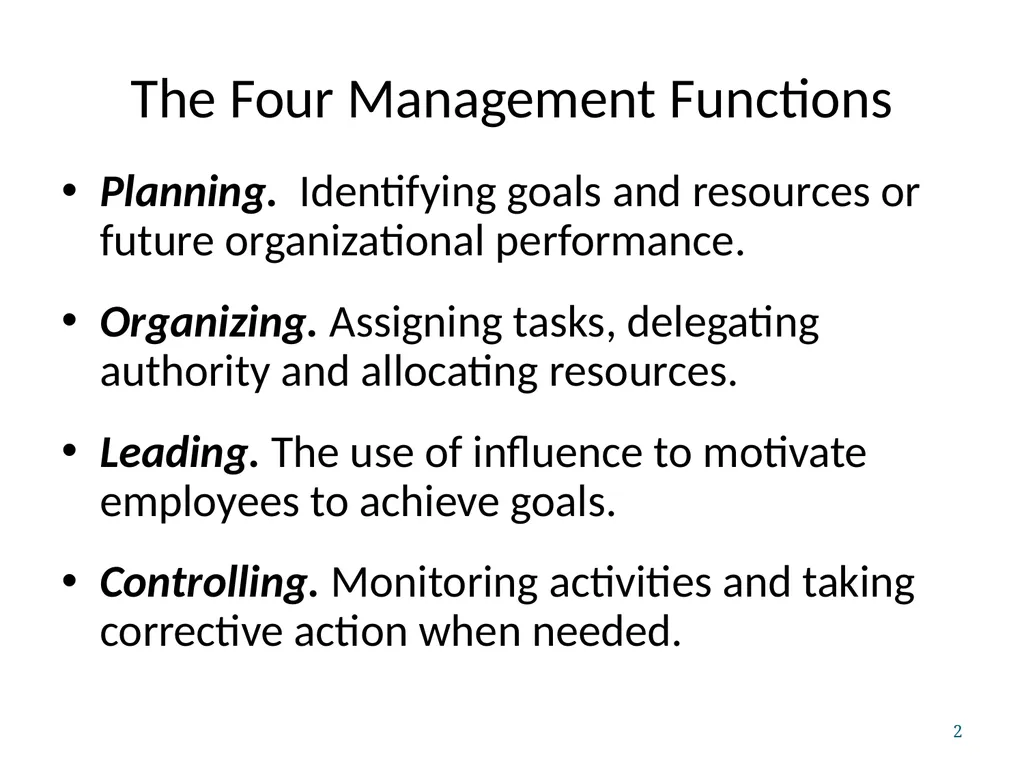
2 The Four Management Functions Planning. Identifying goals and resources or future organizational performance.
Organizing. Assigning tasks, delegating authority and allocating resources.
Leading. The use of influence to motivate employees to achieve goals.
Controlling. Monitoring activities and taking corrective action when needed. 0<br>
Organizing. Assigning tasks, delegating authority and allocating resources.
Leading. The use of influence to motivate employees to achieve goals.
Controlling. Monitoring activities and taking corrective action when needed. 0<br>
03
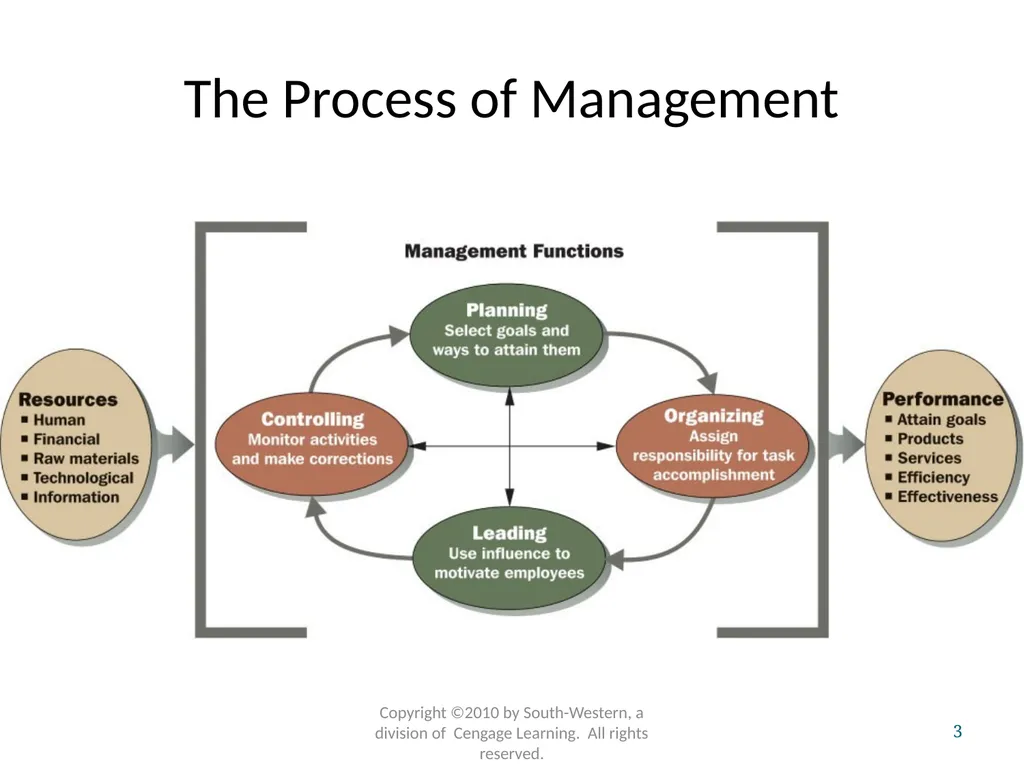
Copyright ©2010 by South-Western, a division of Cengage Learning. All rights reserved. 3 The Process of Management 0<br>
04
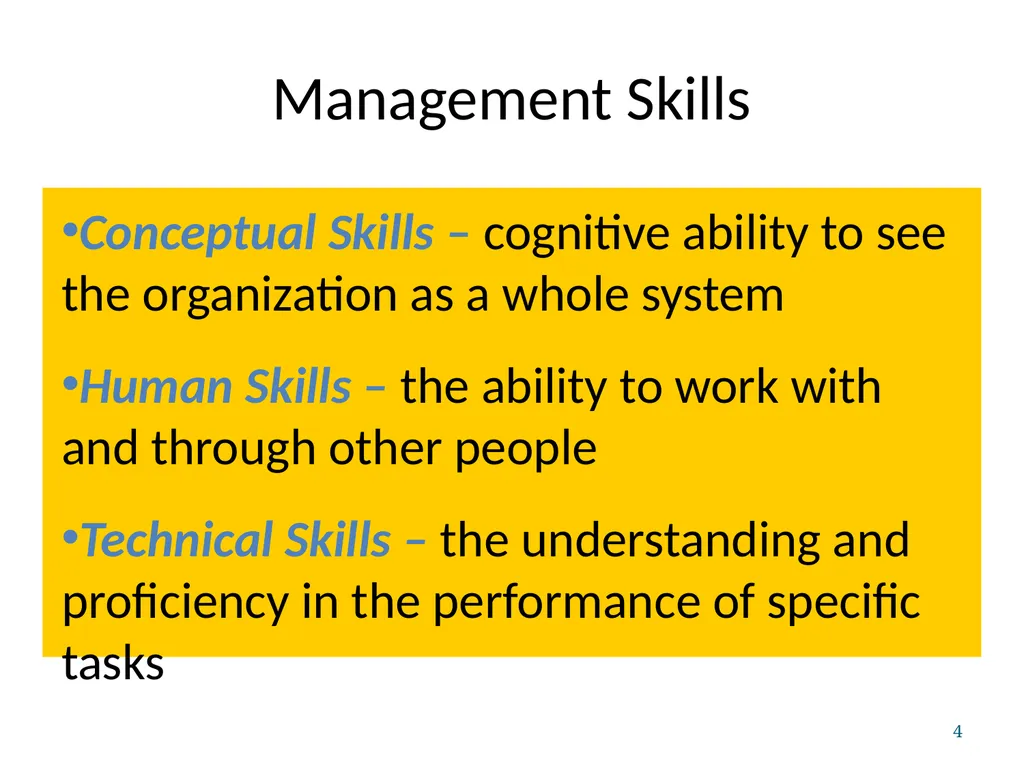
4 Management Skills Conceptual Skills – cognitive ability to see the organization as a whole system
Human Skills – the ability to work with and through other people
Technical Skills – the understanding and proficiency in the performance of specific tasks 0<br>
Human Skills – the ability to work with and through other people
Technical Skills – the understanding and proficiency in the performance of specific tasks 0<br>
05
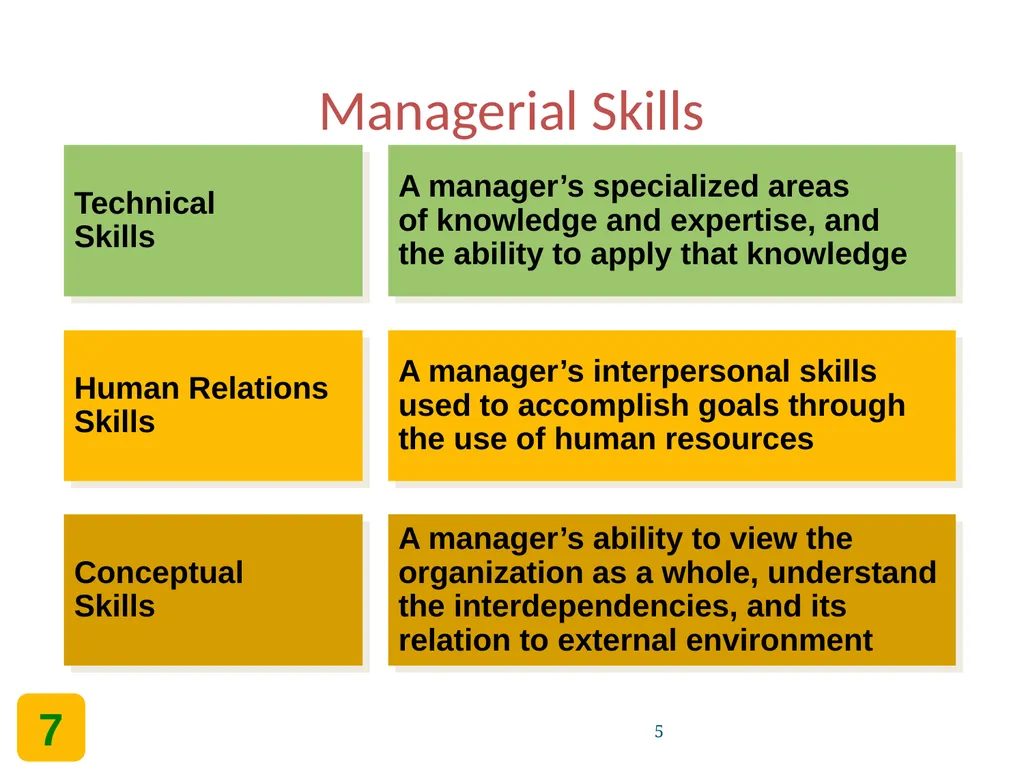
5 Managerial Skills 7<br>
06
Managerial Economics as a course required for effective resource management was put in place due to the following developments in the global business environment:
(a) Growing complexity of business decision-making processes.
(b) Increasing need for the use of economic logic, concept, theories, and tools of economic analysis in the process of decision-making.
(c) Rapid increases in the demand for professionally trained managerial manpower.<br>
(a) Growing complexity of business decision-making processes.
(b) Increasing need for the use of economic logic, concept, theories, and tools of economic analysis in the process of decision-making.
(c) Rapid increases in the demand for professionally trained managerial manpower.<br>
07
These developments have made it necessary that every manager aspiring for good leadership and achievement of organizational objectives be equipped with relevant economic principles and applications. Unfortunately, a gap has been observed in this respect among today’s managers. It is therefore the aim of this course to bridge such gap.
Managerial Economics is the application of economic theory and methodology to managerial decision making problems within various organizational settings such as a firm or a government agency.<br>
Managerial Economics is the application of economic theory and methodology to managerial decision making problems within various organizational settings such as a firm or a government agency.<br>
08
It is becoming more important for managers to make good decisions and to justify them, as their accountability either to senior management or to shareholders increases.
As the number and size of multinationals increases, the costs and benefits at stake in the decision-making process are also increasing.<br>
As the number and size of multinationals increases, the costs and benefits at stake in the decision-making process are also increasing.<br>
09
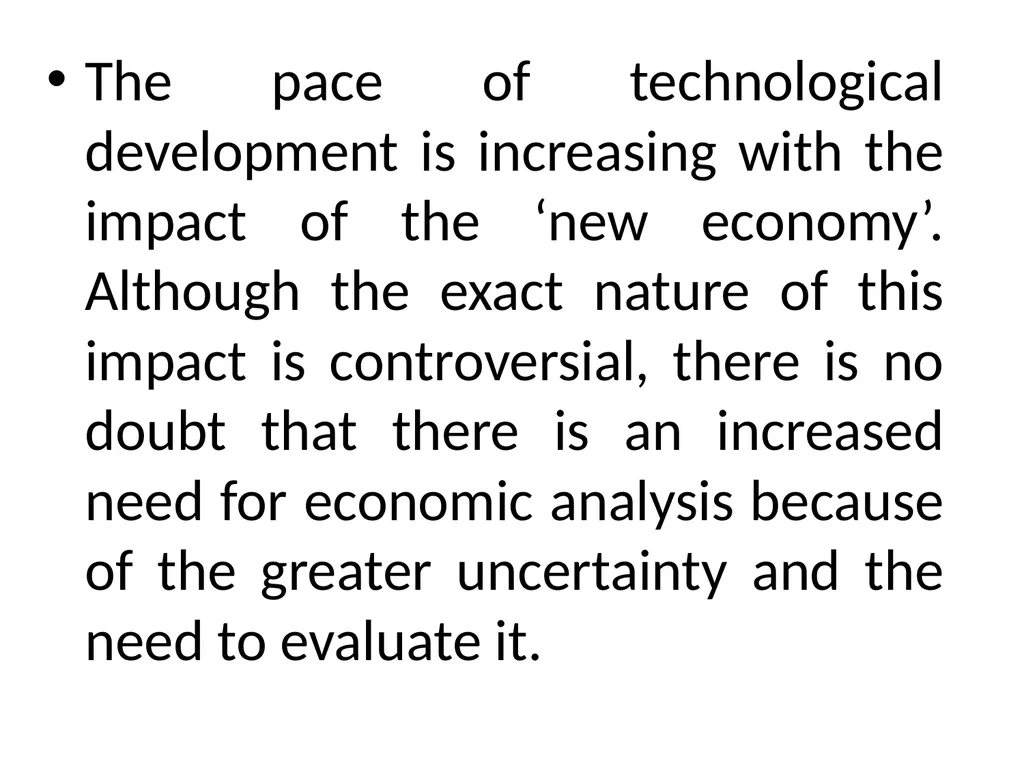
The pace of technological development is increasing with the impact of the ‘new economy’. Although the exact nature of this impact is controversial, there is no doubt that there is an increased need for economic analysis because of the greater uncertainty and the need to evaluate it.<br>
10
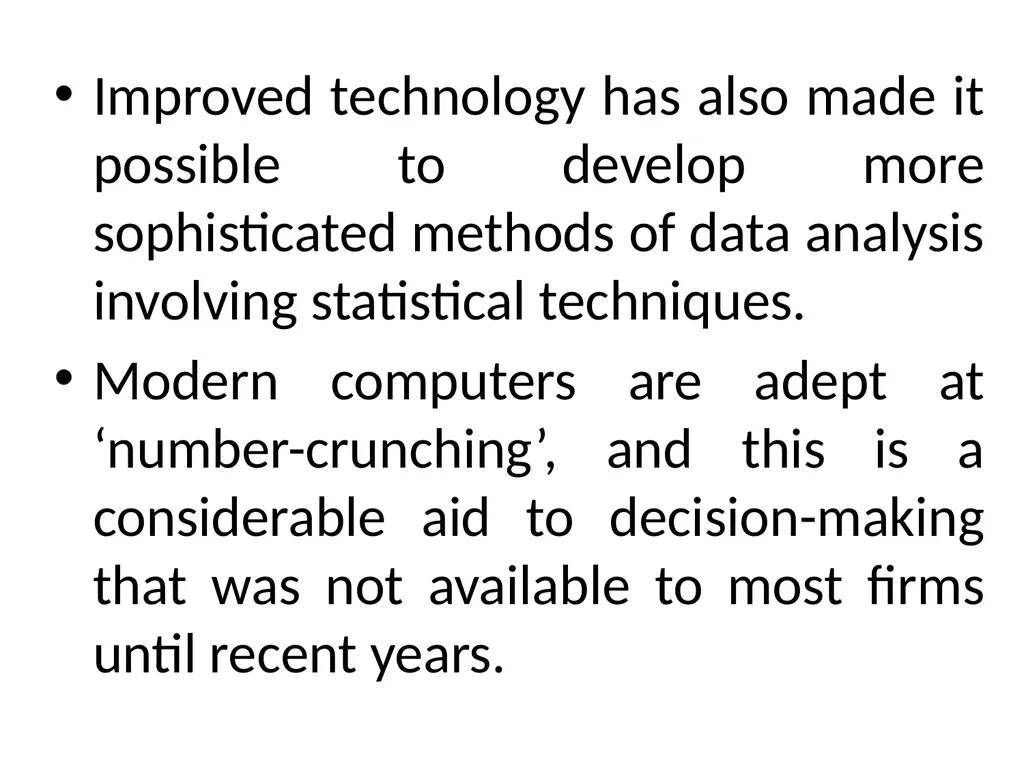
Improved technology has also made it possible to develop more sophisticated methods of data analysis involving statistical techniques.
Modern computers are adept at ‘number-crunching’, and this is a considerable aid to decision-making that was not available to most firms until recent years.<br>
Modern computers are adept at ‘number-crunching’, and this is a considerable aid to decision-making that was not available to most firms until recent years.<br>
11
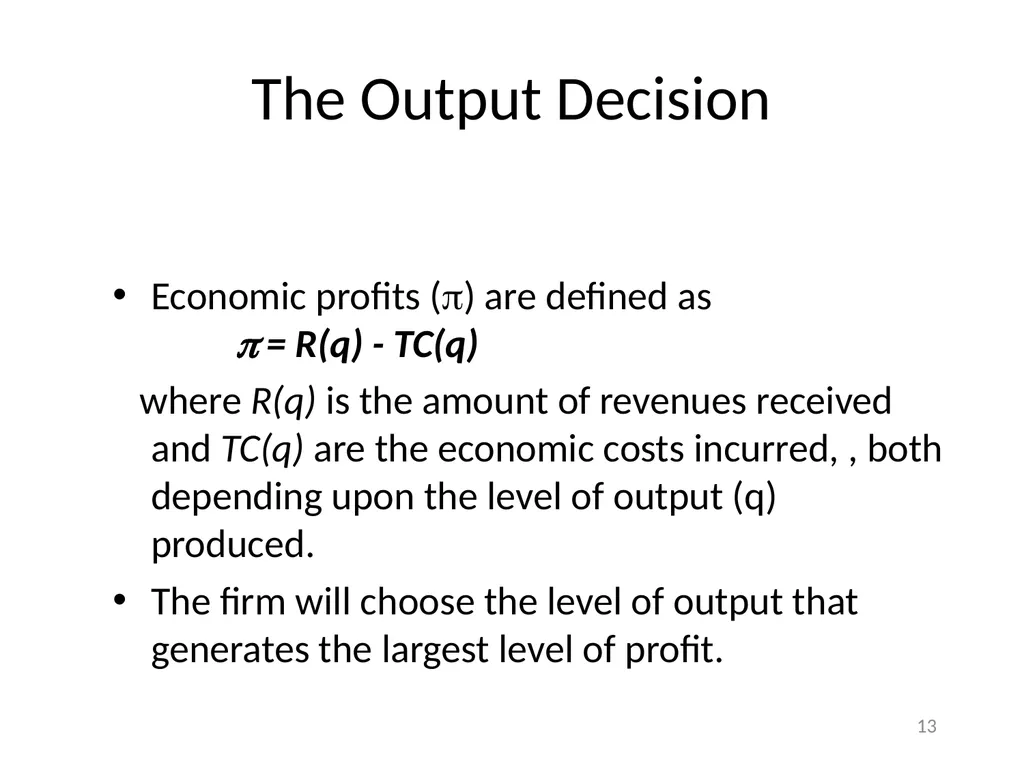
13 The Output Decision Economic profits () are defined as = R(q) - TC(q)
where R(q) is the amount of revenues received and TC(q) are the economic costs incurred, , both depending upon the level of output (q) produced.
The firm will choose the level of output that generates the largest level of profit.<br>
where R(q) is the amount of revenues received and TC(q) are the economic costs incurred, , both depending upon the level of output (q) produced.
The firm will choose the level of output that generates the largest level of profit.<br>
12
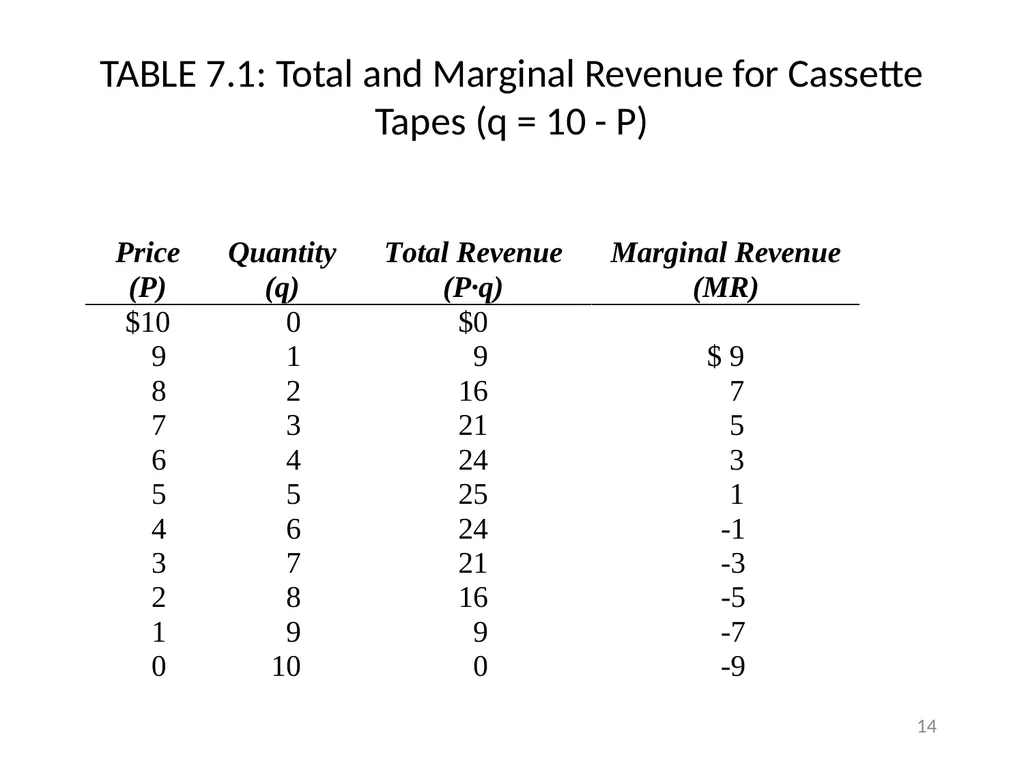
14 TABLE 7.1: Total and Marginal Revenue for Cassette Tapes (q = 10 - P)<br>
13
15 Profit Maximization If firms are strictly profit maximizers, they will make decisions in a “marginal” way
examine the marginal profit obtainable from producing one more unit of hiring one additional laborer<br>
examine the marginal profit obtainable from producing one more unit of hiring one additional laborer<br>
14
16 Managerial Decision Problems: Managerial decision problems arise in any organization (i.e. non-profit organization such as a hospital or a university or government agency), when they seek to achieve some goal or objective subject to limitations on the availability of essential inputs and in the face of legal constraints.<br>
15
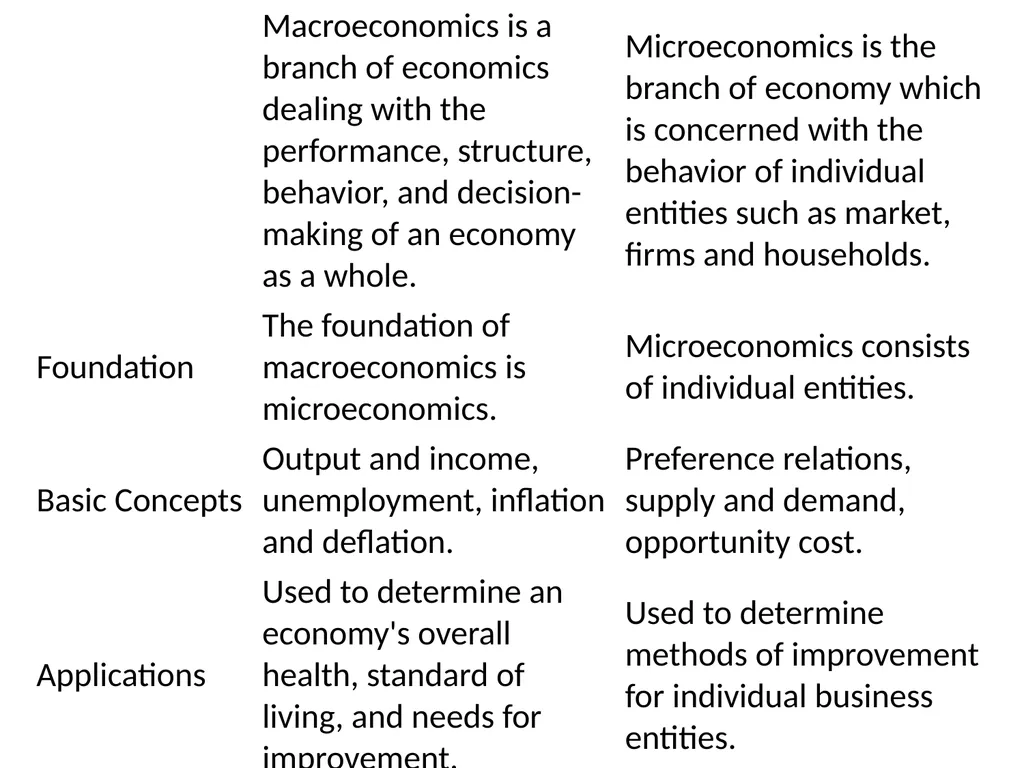
17 Microeconomics: This subject is the study of the economic behaviour of individuals decision-making units such as individual consumers, resources owners and business firm in the free enterprise system.<br>
16
18 Macroeconomics: On the other hand, this subject is the study of the total or aggregate level of output, income, employment, consumption, investment and prices for the economy viewed as a whole.<br>
17
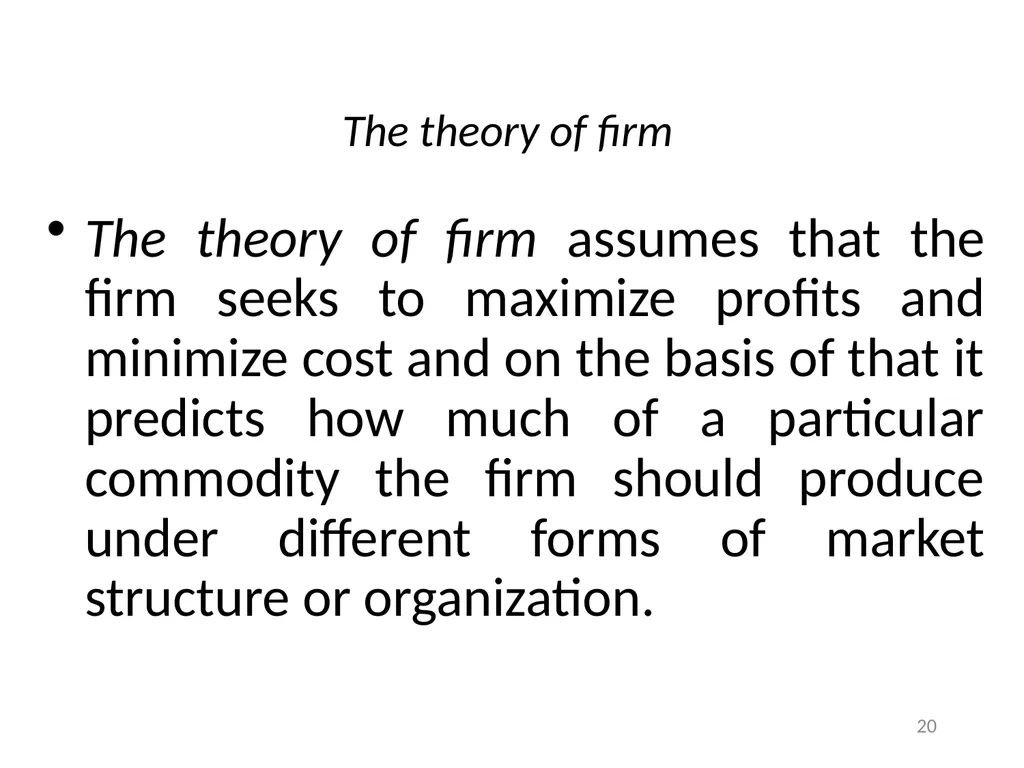
20 The theory of firm The theory of firm assumes that the firm seeks to maximize profits and minimize cost and on the basis of that it predicts how much of a particular commodity the firm should produce under different forms of market structure or organization.<br>
18
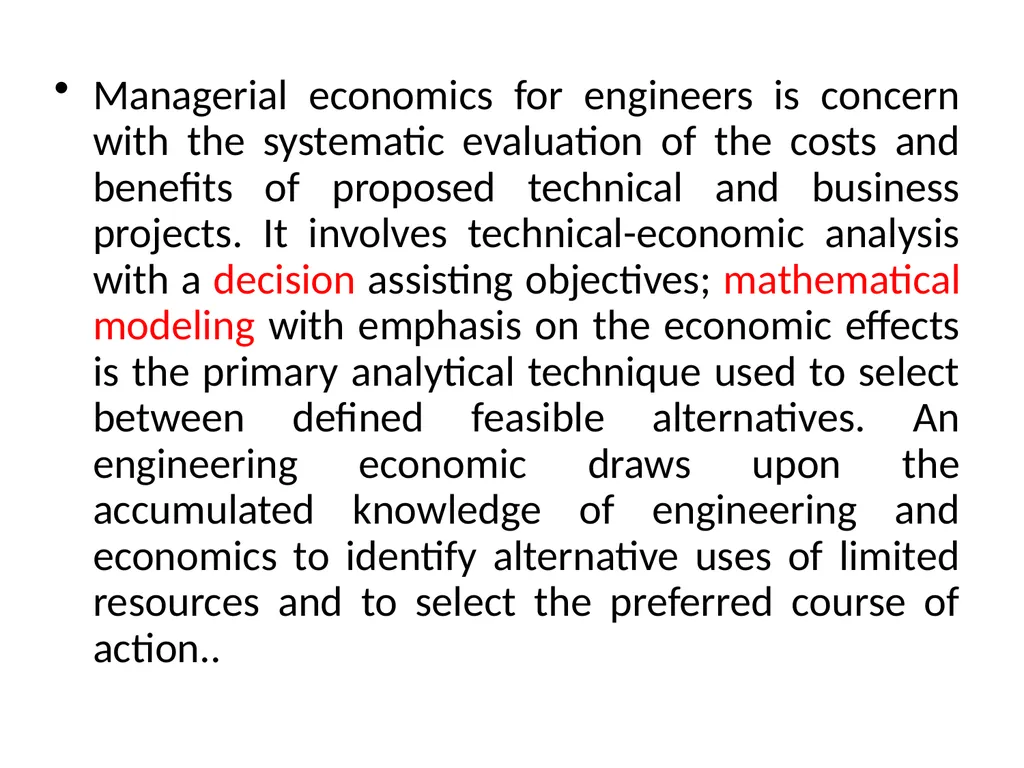
Managerial economics for engineers is concern with the systematic evaluation of the costs and benefits of proposed technical and business projects. It involves technical-economic analysis with a decision assisting objectives; mathematical modeling with emphasis on the economic effects is the primary analytical technique used to select between defined feasible alternatives. An engineering economic draws upon the accumulated knowledge of engineering and economics to identify alternative uses of limited resources and to select the preferred course of action..<br>
19
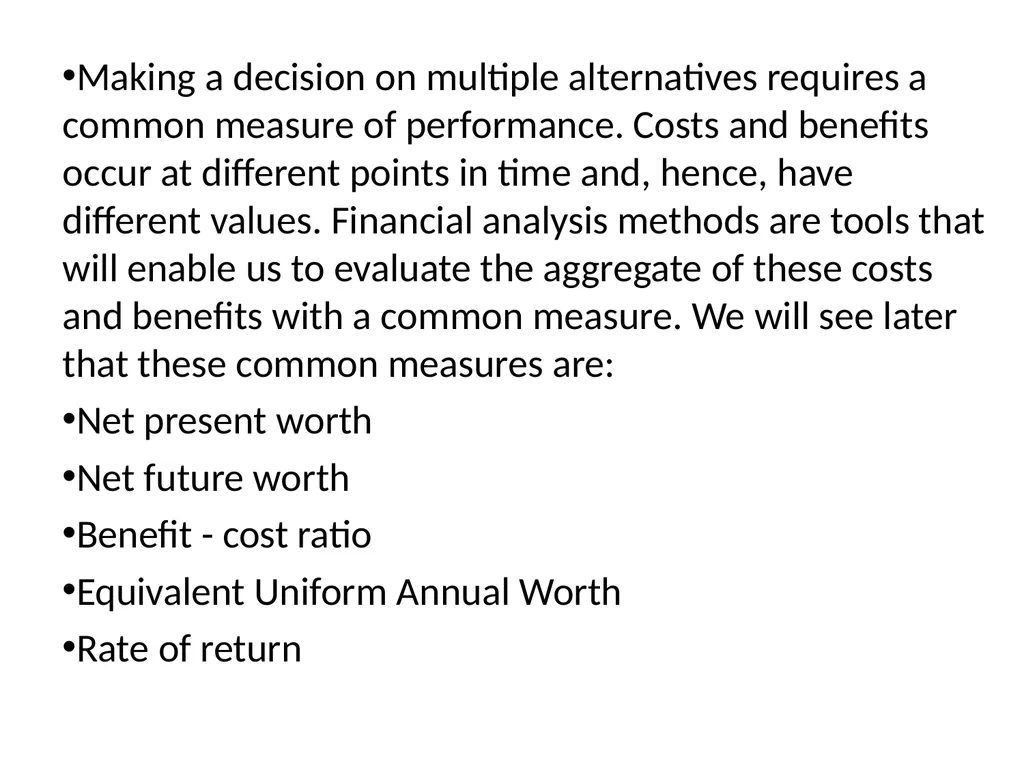
Making a decision on multiple alternatives requires a common measure of performance. Costs and benefits occur at different points in time and, hence, have different values. Financial analysis methods are tools that will enable us to evaluate the aggregate of these costs and benefits with a common measure. We will see later that these common measures are:
Net present worth
Net future worth
Benefit - cost ratio
Equivalent Uniform Annual Worth
Rate of return<br>
Net present worth
Net future worth
Benefit - cost ratio
Equivalent Uniform Annual Worth
Rate of return<br>
20
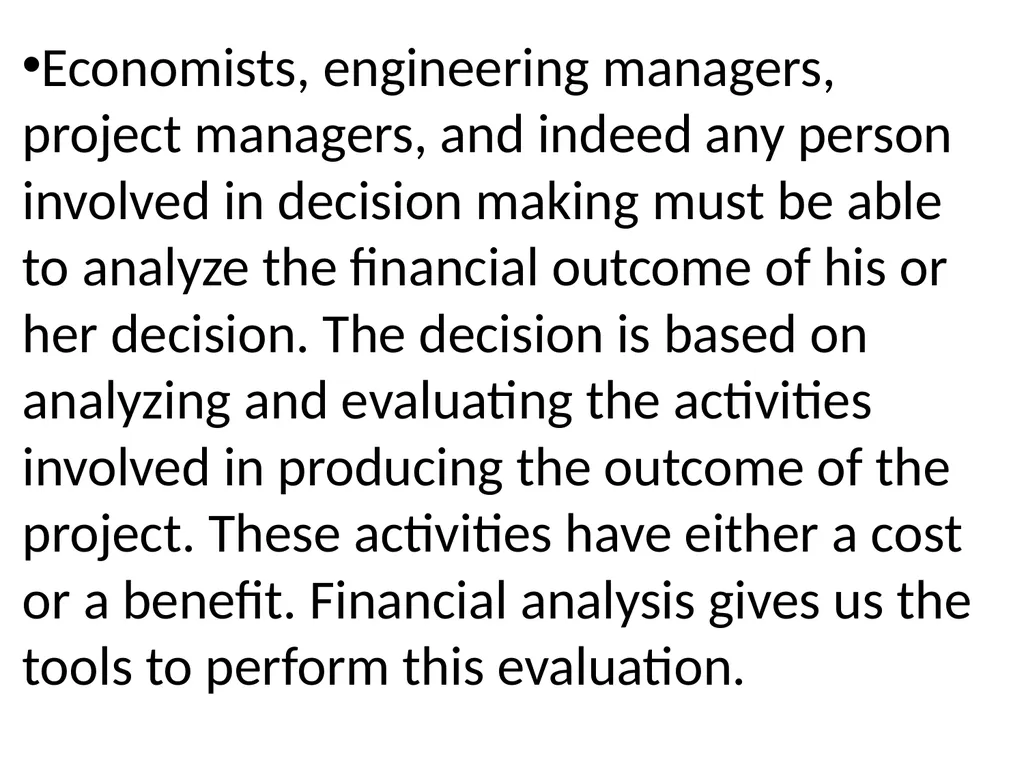
Economists, engineering managers, project managers, and indeed any person involved in decision making must be able to analyze the financial outcome of his or her decision. The decision is based on analyzing and evaluating the activities involved in producing the outcome of the project. These activities have either a cost or a benefit. Financial analysis gives us the tools to perform this evaluation.<br>
21
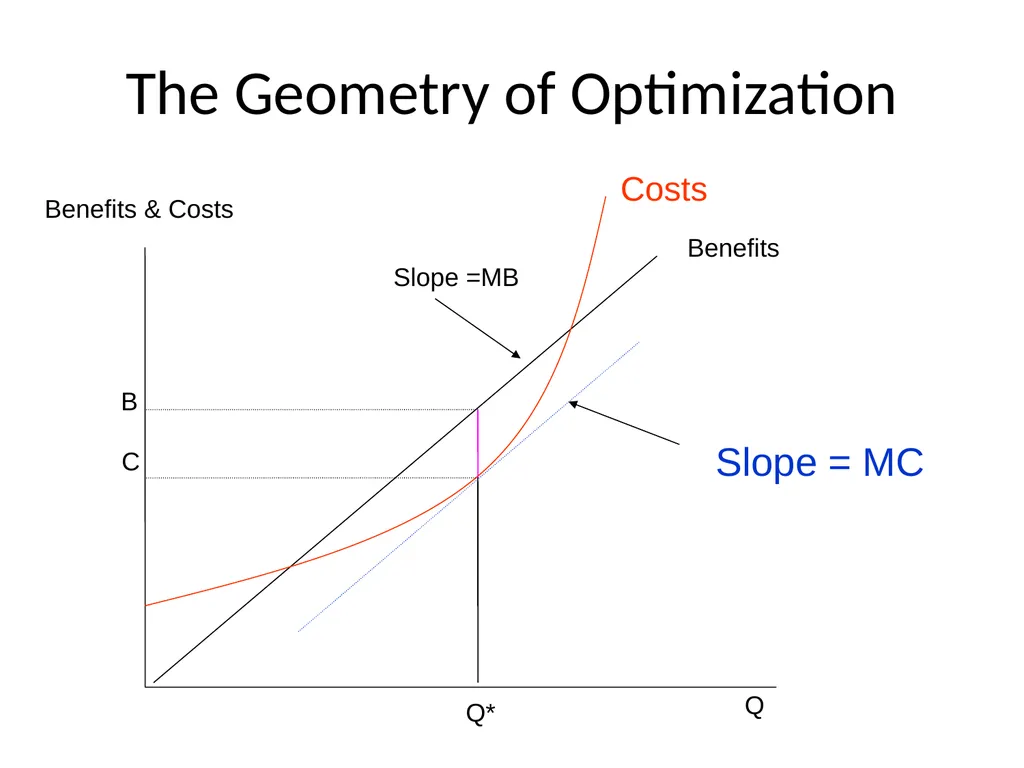
The Geometry of Optimization Benefits & Costs Benefits Costs Q* B C Slope = MC Slope =MB<br>
22
Costs and benefits do not always occur at one time; they occur at different points of time during the life of the project. In most cases, the lifetime worth, that is the lifetime aggregate of all the costs and benefits, taking into account the time of their occurrence, is used to compare different projects and to decide which alternative to choose. Engineers have an added responsibility and that is to include economics in their calculation and decisions to solve real life problem. Decision may be defined as a choice that can be made from available alternatives.<br>
23
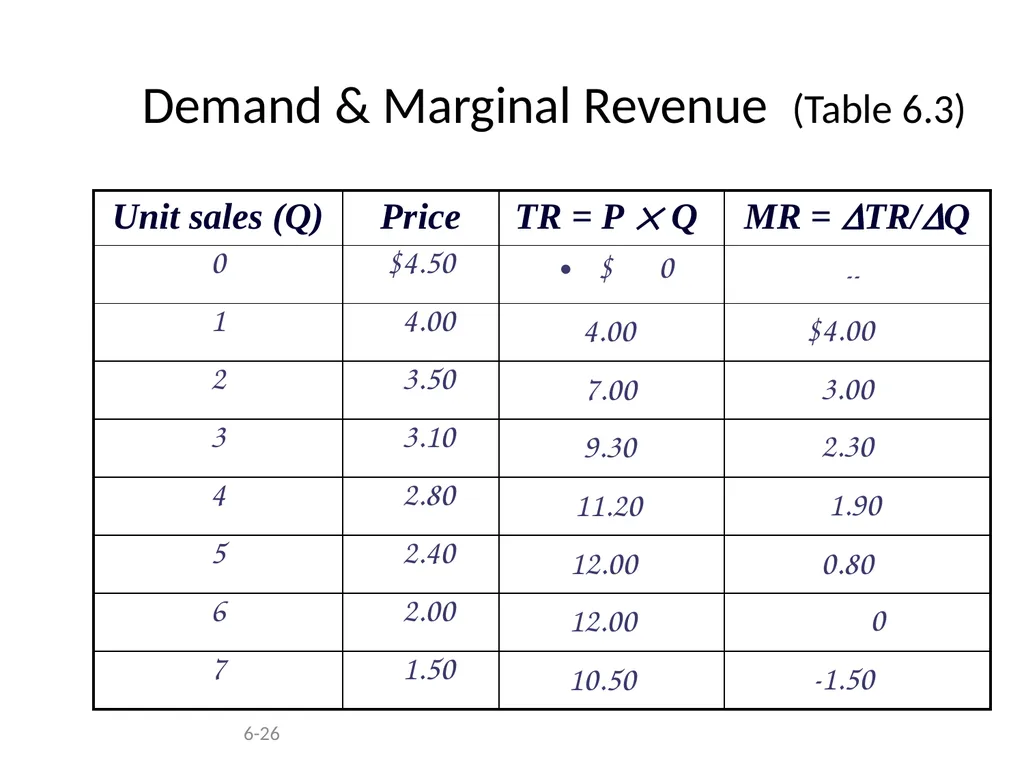
6-26 Demand & Marginal Revenue (Table 6.3) $ 0 $4.00 $7.00 $9.30 $11.20 $12.00 $12.00 $10.50 -- $4.00 $3.00 $2.30 $1.90 $0.80 $0 $-1.50<br>
24
Profit maximisation has been the prime objective of classical business organizations. To
maximise profit, certain conditions must be met, the first being that at optimum profit maximising
point, the firm’s marginal revenue must equal marginal cost. Second, to ensure that maximum profit is attained, the second derivative of the profit function is expected to be less than zero.<br>
maximise profit, certain conditions must be met, the first being that at optimum profit maximising
point, the firm’s marginal revenue must equal marginal cost. Second, to ensure that maximum profit is attained, the second derivative of the profit function is expected to be less than zero.<br>
25
Managerial Economics as a course required for effective resource management was put in place due to the following developments in the global business environment:
(a) Growing complexity of business decision-making processes.
(b) Increasing need for the use of economic logic, concept, theories, and tools of economic analysis in the process of decision-making.
(c) Rapid increases in the demand for professionally trained managerial manpower.<br>
(a) Growing complexity of business decision-making processes.
(b) Increasing need for the use of economic logic, concept, theories, and tools of economic analysis in the process of decision-making.
(c) Rapid increases in the demand for professionally trained managerial manpower.<br>
26
FINANCIAL ANALYSIS OF ENGINEERING PROJECT The financial analysis of a project involves the computation of
The present worth of a certain future amount or the benefits which would be derived from a project during certain number of years
Amount to be recovered annually from the beneficiaries of the project so that if needed the project may be replaced by a new one and
Annual installments for the recovery of the investment made for a project.<br>
The present worth of a certain future amount or the benefits which would be derived from a project during certain number of years
Amount to be recovered annually from the beneficiaries of the project so that if needed the project may be replaced by a new one and
Annual installments for the recovery of the investment made for a project.<br>
27
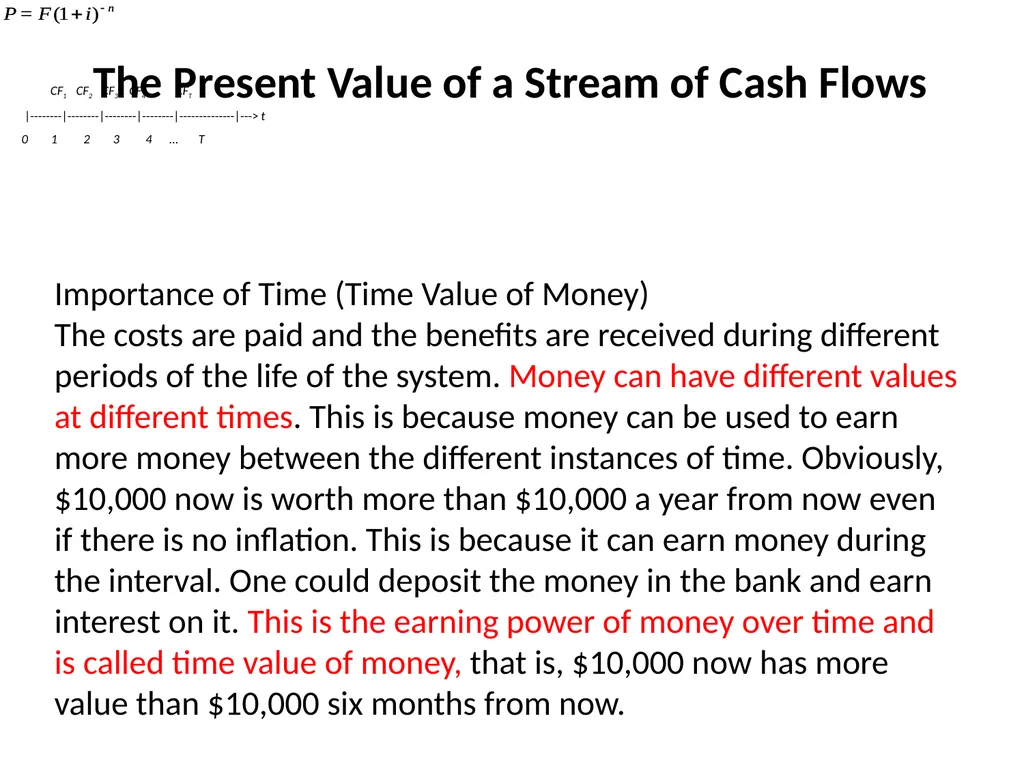
The Present Value of a Stream of Cash Flows CF1 CF2 CF3 CF4 CFT
|--------|--------|--------|--------|--------------|---> t
0 1 2 3 4 … T Importance of Time (Time Value of Money)
The costs are paid and the benefits are received during different periods of the life of the system. Money can have different values at different times. This is because money can be used to earn more money between the different instances of time. Obviously, $10,000 now is worth more than $10,000 a year from now even if there is no inflation. This is because it can earn money during the interval. One could deposit the money in the bank and earn interest on it. This is the earning power of money over time and is called time value of money, that is, $10,000 now has more value than $10,000 six months from now.<br>
|--------|--------|--------|--------|--------------|---> t
0 1 2 3 4 … T Importance of Time (Time Value of Money)
The costs are paid and the benefits are received during different periods of the life of the system. Money can have different values at different times. This is because money can be used to earn more money between the different instances of time. Obviously, $10,000 now is worth more than $10,000 a year from now even if there is no inflation. This is because it can earn money during the interval. One could deposit the money in the bank and earn interest on it. This is the earning power of money over time and is called time value of money, that is, $10,000 now has more value than $10,000 six months from now.<br>
28
Economists, engineering managers, project managers, and indeed any person involved in decision making must be able to analyze the financial outcome of his or her decision. The decision is based on analyzing and evaluating the activities involved in producing the outcome of the project. These activities have either a cost or a benefit. Financial analysis gives us the tools to perform this evaluation.
Costs and benefits do not always occur at one time; they occur at different points of time during the life of the project.<br>
Costs and benefits do not always occur at one time; they occur at different points of time during the life of the project.<br>
29
In most cases, the lifetime worth, that is the lifetime aggregate of all the costs and benefits, taking into account the time of their occurrence, is used to compare different projects and to decide which alternative to choose. When making an investment decision, the owners look at their capital and decide what is the best use of it. Should they invest their limited capital in the stock market, buy real estate for resale, or what? Owners know that a dollar received today is worth more than a dollar promised at a later time. They also understand that in weighing options the risk of losing their investment must be considered.<br>
30
People who invested in the overseas stock market quickly found during the late 1990s that they could lose a substantial amount of their portfolio if the market suddenly drops. For these reasons, a time value of money must be placed on all cash flows into and out of the company. When a choice is made between alternatives that involve different receipts and disbursements, it is essential that interest be considered. Economic studies in facility management generally involve decisions between such alternatives. When a facility manager is evaluating alternative solutions to a problem, the dollar value must be made comparable. The time value of money allows these comparisons.<br>
31
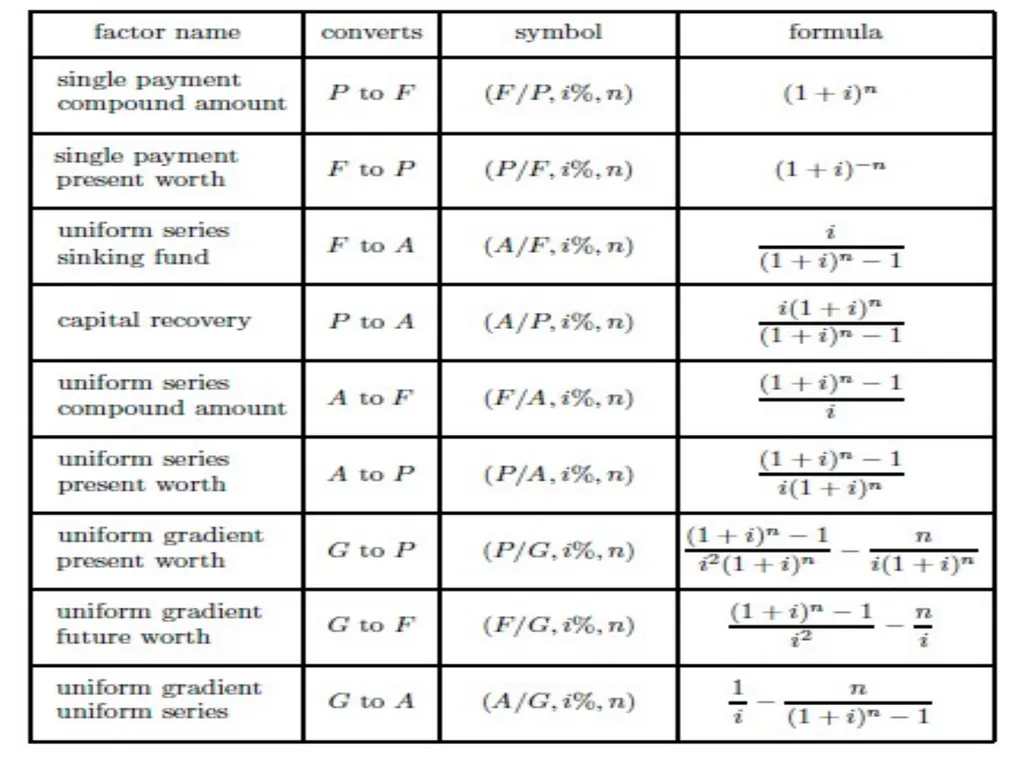
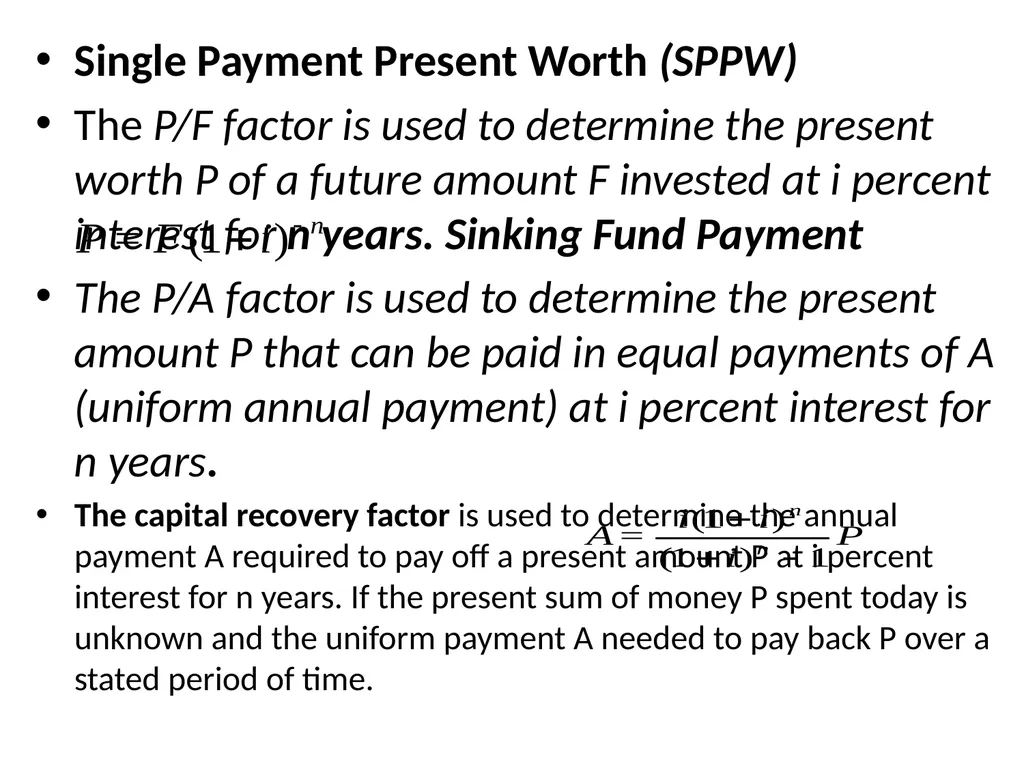
Single Payment Present Worth (SPPW)
The P/F factor is used to determine the present worth P of a future amount F invested at i percent interest for n years. Sinking Fund Payment
The P/A factor is used to determine the present amount P that can be paid in equal payments of A (uniform annual payment) at i percent interest for n years.
The capital recovery factor is used to determine the annual payment A required to pay off a present amount P at i percent interest for n years. If the present sum of money P spent today is unknown and the uniform payment A needed to pay back P over a stated period of time.<br>
The P/F factor is used to determine the present worth P of a future amount F invested at i percent interest for n years. Sinking Fund Payment
The P/A factor is used to determine the present amount P that can be paid in equal payments of A (uniform annual payment) at i percent interest for n years.
The capital recovery factor is used to determine the annual payment A required to pay off a present amount P at i percent interest for n years. If the present sum of money P spent today is unknown and the uniform payment A needed to pay back P over a stated period of time.<br>
32
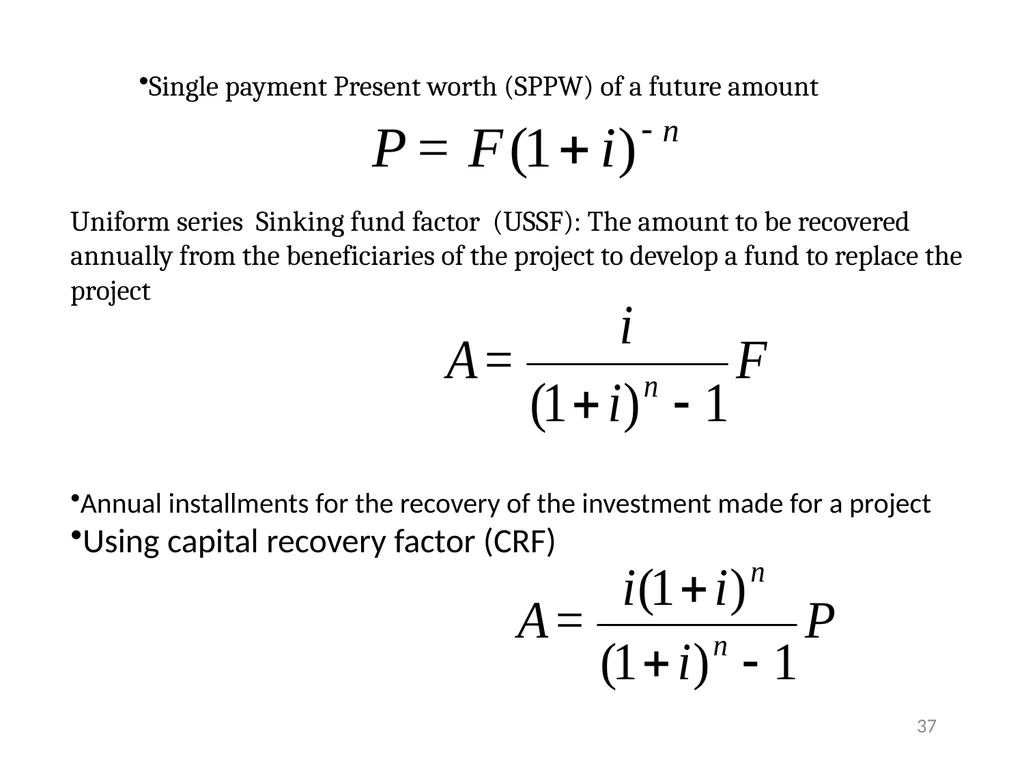
37 Single payment Present worth (SPPW) of a future amount Uniform series Sinking fund factor (USSF): The amount to be recovered annually from the beneficiaries of the project to develop a fund to replace the project Annual installments for the recovery of the investment made for a project
Using capital recovery factor (CRF)<br>
Using capital recovery factor (CRF)<br>
33
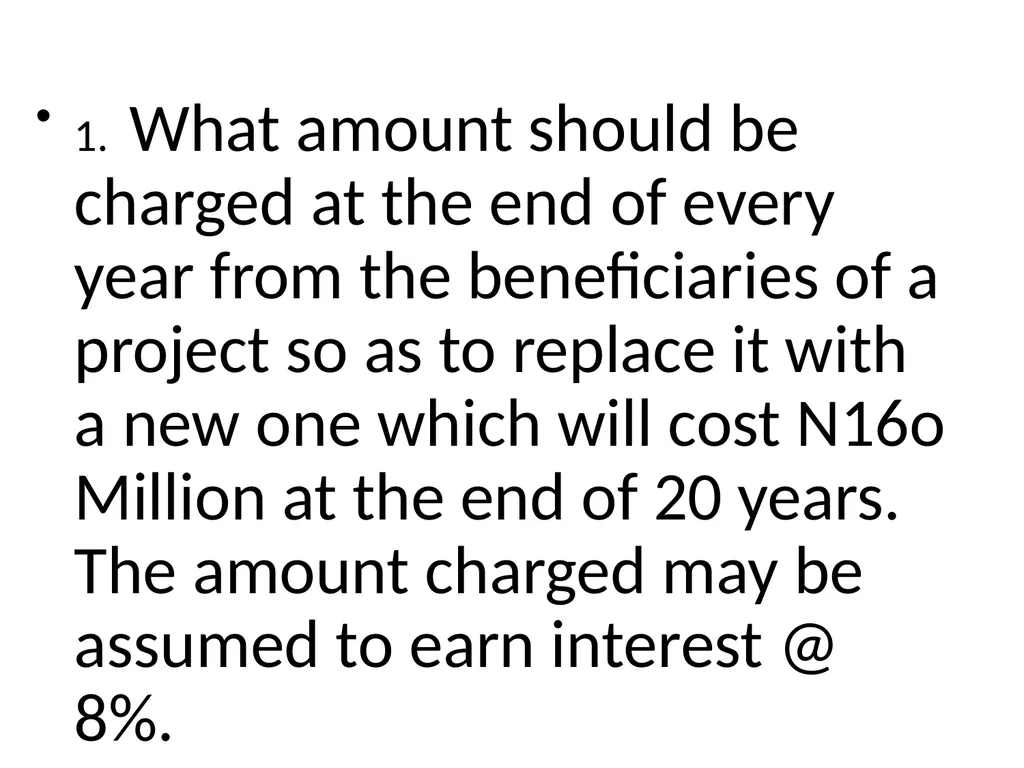
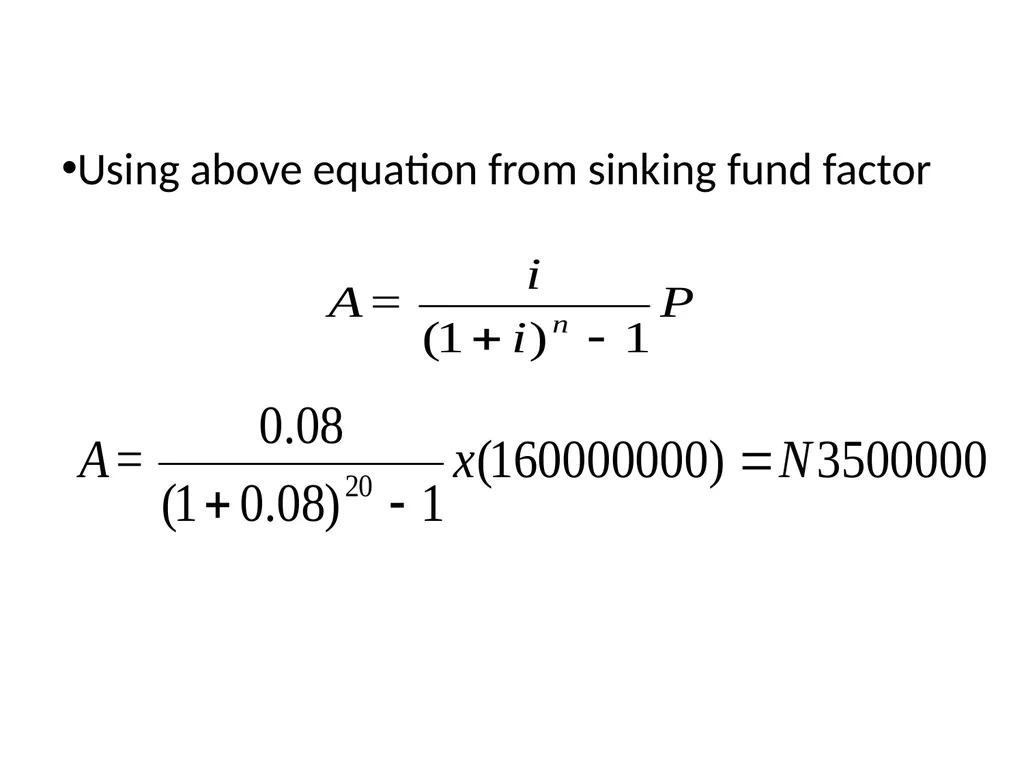
1. What amount should be charged at the end of every year from the beneficiaries of a project so as to replace it with a new one which will cost N16o Million at the end of 20 years. The amount charged may be assumed to earn interest @ 8%.<br>
34
Using above equation from sinking fund factor<br>
35
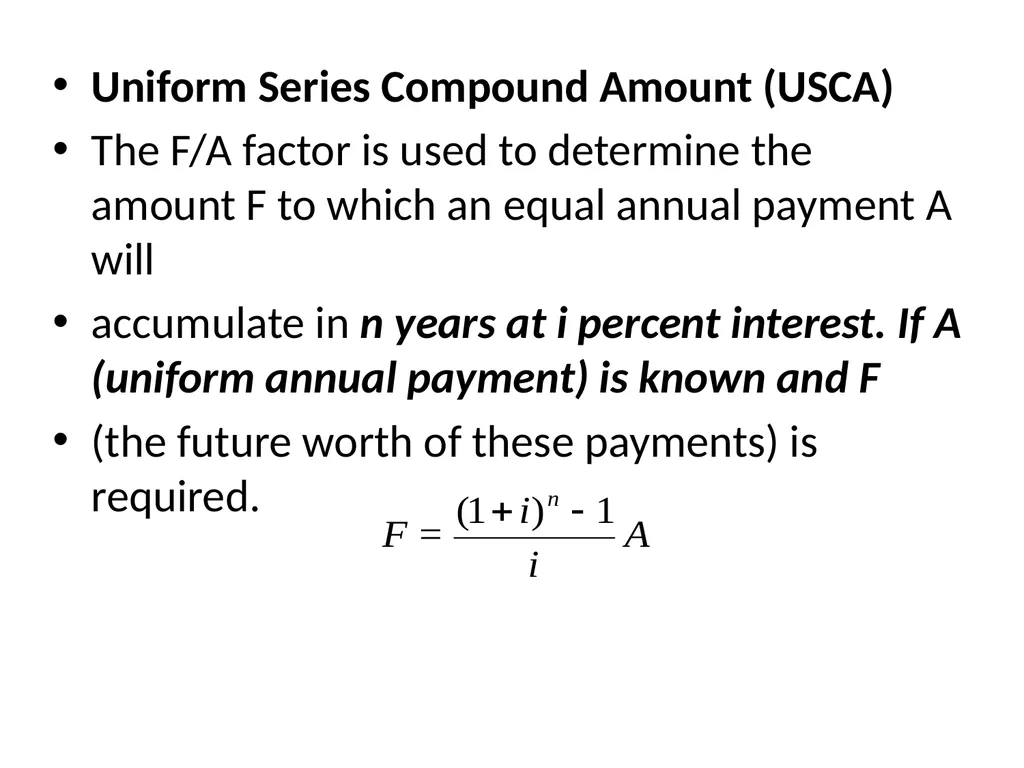
Uniform Series Compound Amount (USCA)
The F/A factor is used to determine the amount F to which an equal annual payment A will
accumulate in n years at i percent interest. If A (uniform annual payment) is known and F
(the future worth of these payments) is required.<br>
The F/A factor is used to determine the amount F to which an equal annual payment A will
accumulate in n years at i percent interest. If A (uniform annual payment) is known and F
(the future worth of these payments) is required.<br>
36
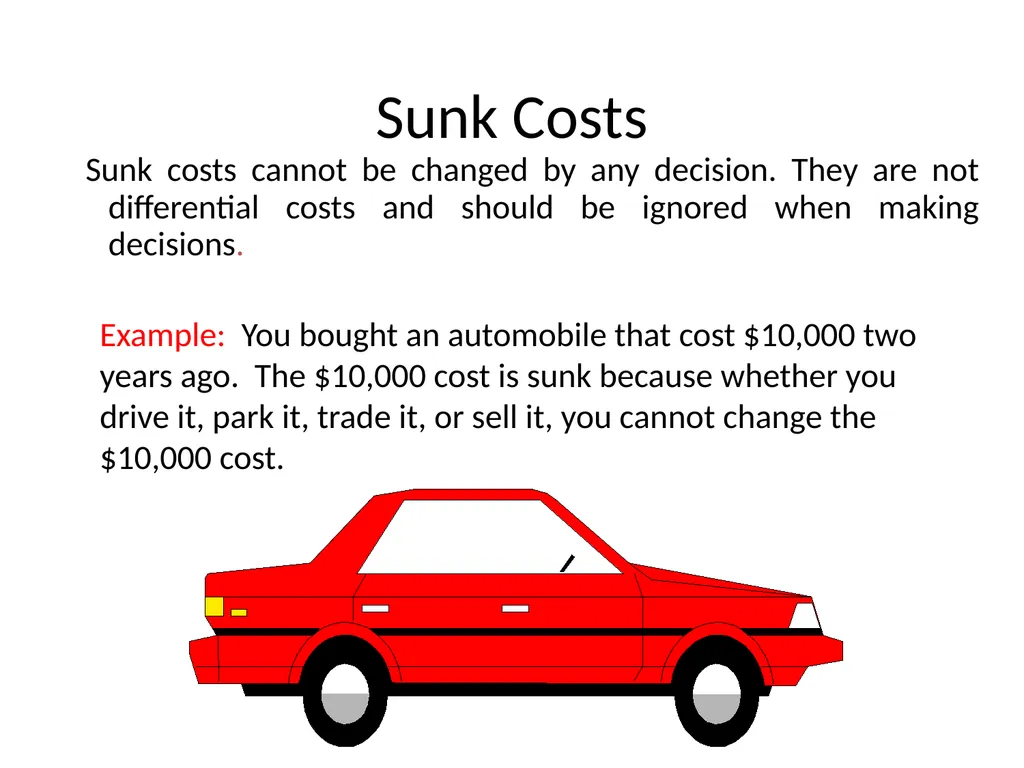
Sunk Costs Sunk costs cannot be changed by any decision. They are not differential costs and should be ignored when making decisions. Example: You bought an automobile that cost $10,000 two years ago. The $10,000 cost is sunk because whether you drive it, park it, trade it, or sell it, you cannot change the $10,000 cost.<br>
37
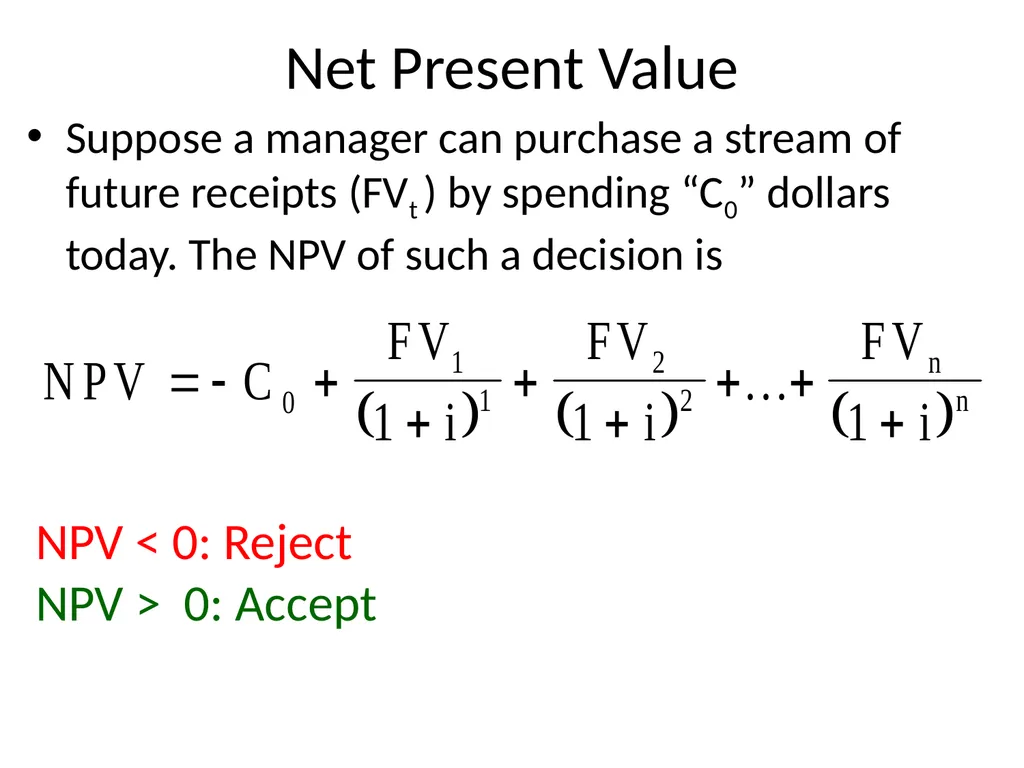
Net Present Value Suppose a manager can purchase a stream of future receipts (FVt ) by spending “C0” dollars today. The NPV of such a decision is NPV < 0: Reject
NPV > 0: Accept<br>
NPV > 0: Accept<br>
38
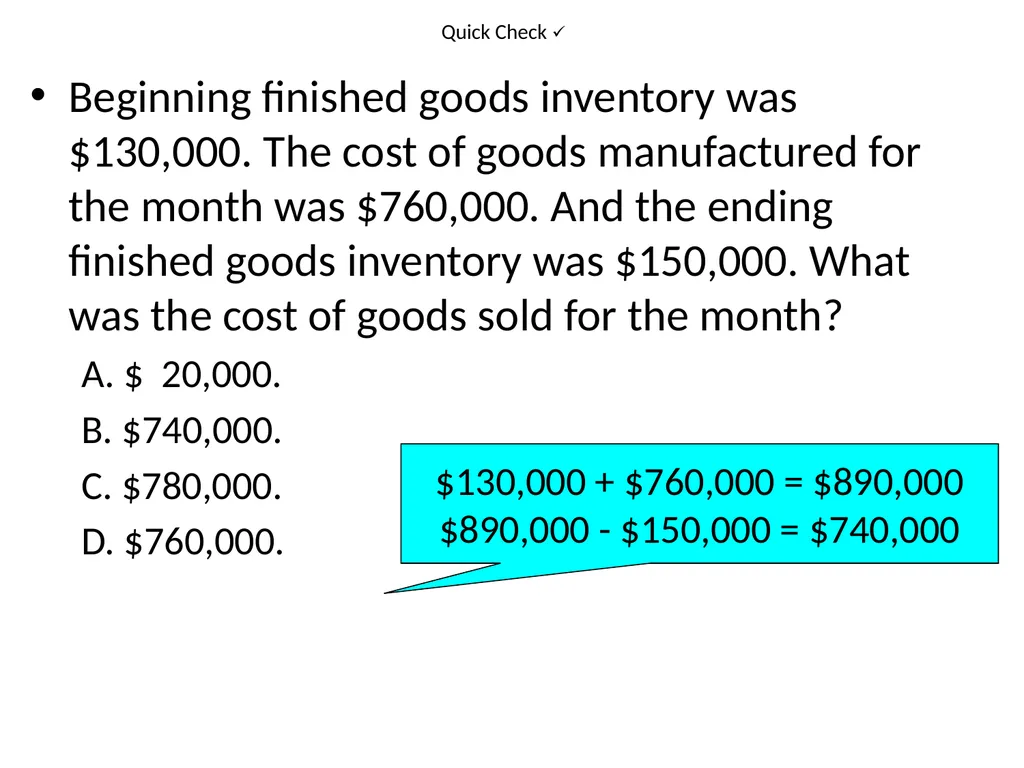
Beginning finished goods inventory was $130,000. The cost of goods manufactured for the month was $760,000. And the ending finished goods inventory was $150,000. What was the cost of goods sold for the month?
A. $ 20,000.
B. $740,000.
C. $780,000.
D. $760,000. $130,000 + $760,000 = $890,000
$890,000 - $150,000 = $740,000 Quick Check <br>
A. $ 20,000.
B. $740,000.
C. $780,000.
D. $760,000. $130,000 + $760,000 = $890,000
$890,000 - $150,000 = $740,000 Quick Check <br>
39
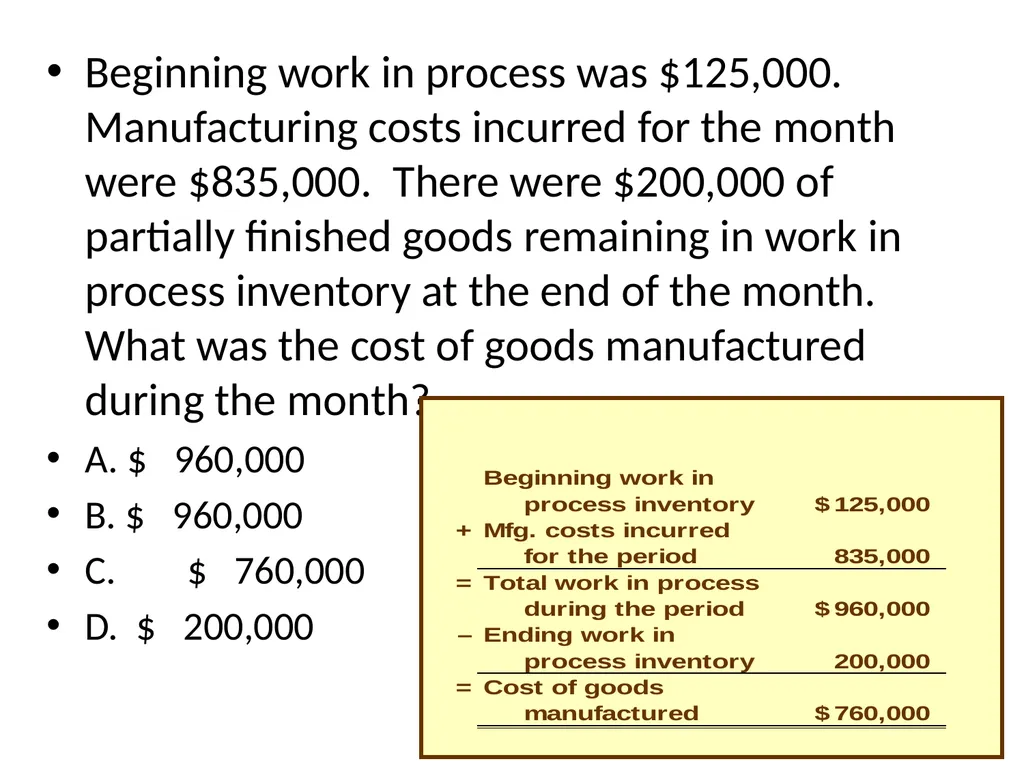
Beginning work in process was $125,000. Manufacturing costs incurred for the month were $835,000. There were $200,000 of partially finished goods remaining in work in process inventory at the end of the month. What was the cost of goods manufactured during the month?
A. $ 960,000
B. $ 960,000
C. $ 760,000
D. $ 200,000<br>
A. $ 960,000
B. $ 960,000
C. $ 760,000
D. $ 200,000<br>
40
Beginning work in process was $125,000. Manufacturing costs incurred for the month were $835,000. There were $200,000 of partially finished goods remaining in work in process inventory at the end of the month. What was the cost of goods manufactured during the month?
A. $1,160,000
B. $ 910,000
C. $ 760,000
D. Cannot be determined. Quick Check <br>
A. $1,160,000
B. $ 910,000
C. $ 760,000
D. Cannot be determined. Quick Check <br>
41
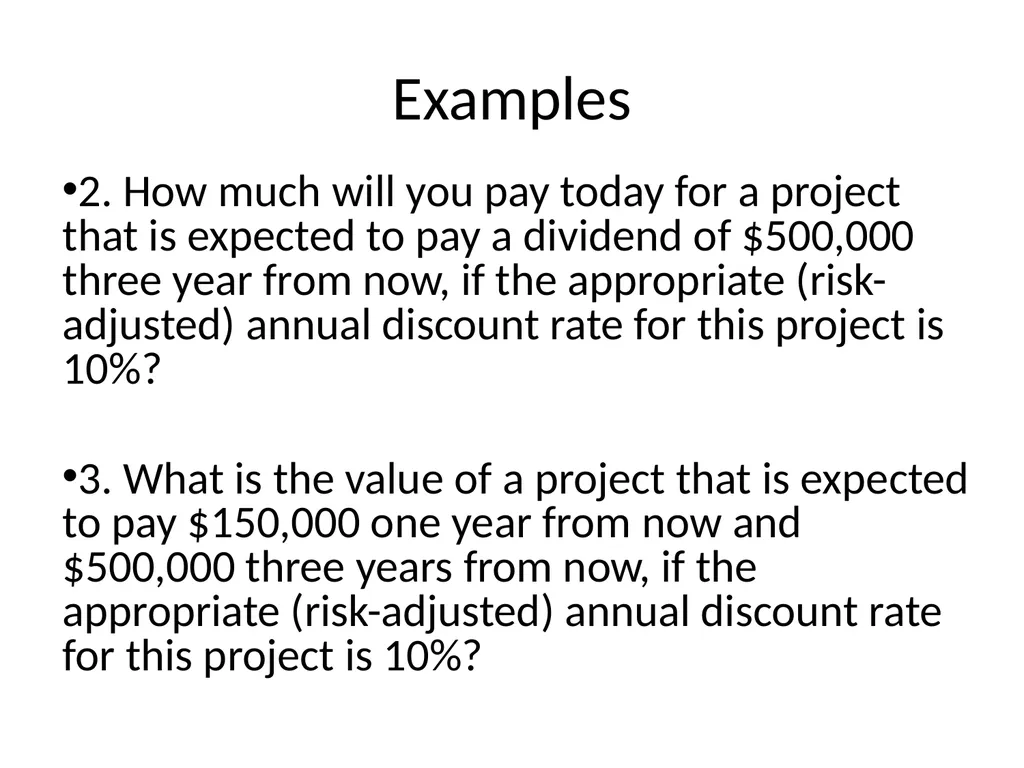
Examples 2. How much will you pay today for a project that is expected to pay a dividend of $500,000 three year from now, if the appropriate (risk-adjusted) annual discount rate for this project is 10%?
3. What is the value of a project that is expected to pay $150,000 one year from now and $500,000 three years from now, if the appropriate (risk-adjusted) annual discount rate for this project is 10%?<br>
3. What is the value of a project that is expected to pay $150,000 one year from now and $500,000 three years from now, if the appropriate (risk-adjusted) annual discount rate for this project is 10%?<br>
42
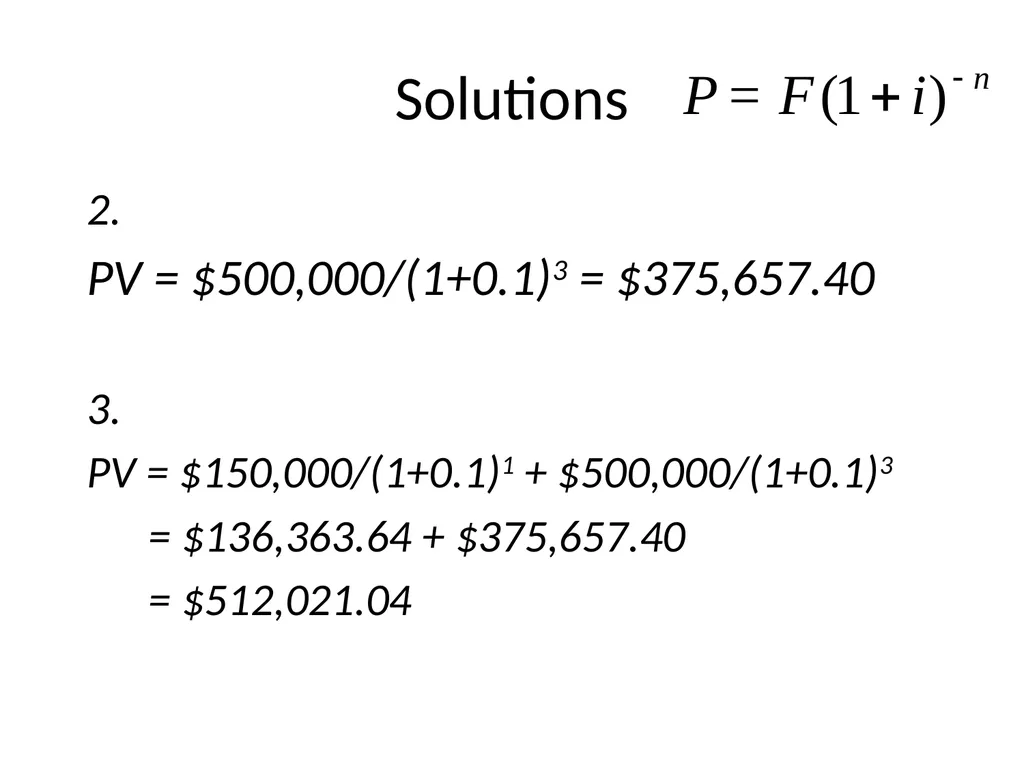
Solutions 2.
PV = $500,000/(1+0.1)3 = $375,657.40
3.
PV = $150,000/(1+0.1)1 + $500,000/(1+0.1)3
= $136,363.64 + $375,657.40
= $512,021.04<br>
PV = $500,000/(1+0.1)3 = $375,657.40
3.
PV = $150,000/(1+0.1)1 + $500,000/(1+0.1)3
= $136,363.64 + $375,657.40
= $512,021.04<br>
43
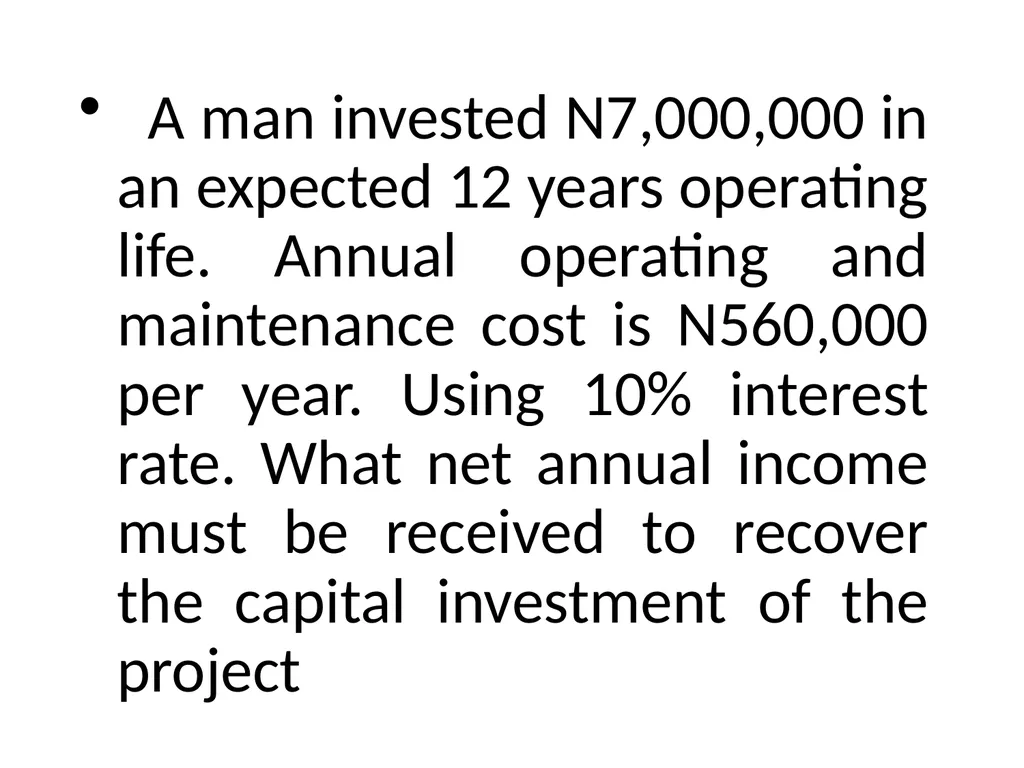
A man invested N7,000,000 in an expected 12 years operating life. Annual operating and maintenance cost is N560,000 per year. Using 10% interest rate. What net annual income must be received to recover the capital investment of the project<br>
44
Costs, Profit, Contribution and Break-Even Analysis Cost Classification and Cost Allocation In order to make meaningful decisions a manager must have cost data for each product, department and function of the business. The problem with this is how to accurately define the costs and how to allocate the costs to the various products and departments
The management accountant classifies costs into fixed and variable costs or direct and indirect costs.<br>
The management accountant classifies costs into fixed and variable costs or direct and indirect costs.<br>
45
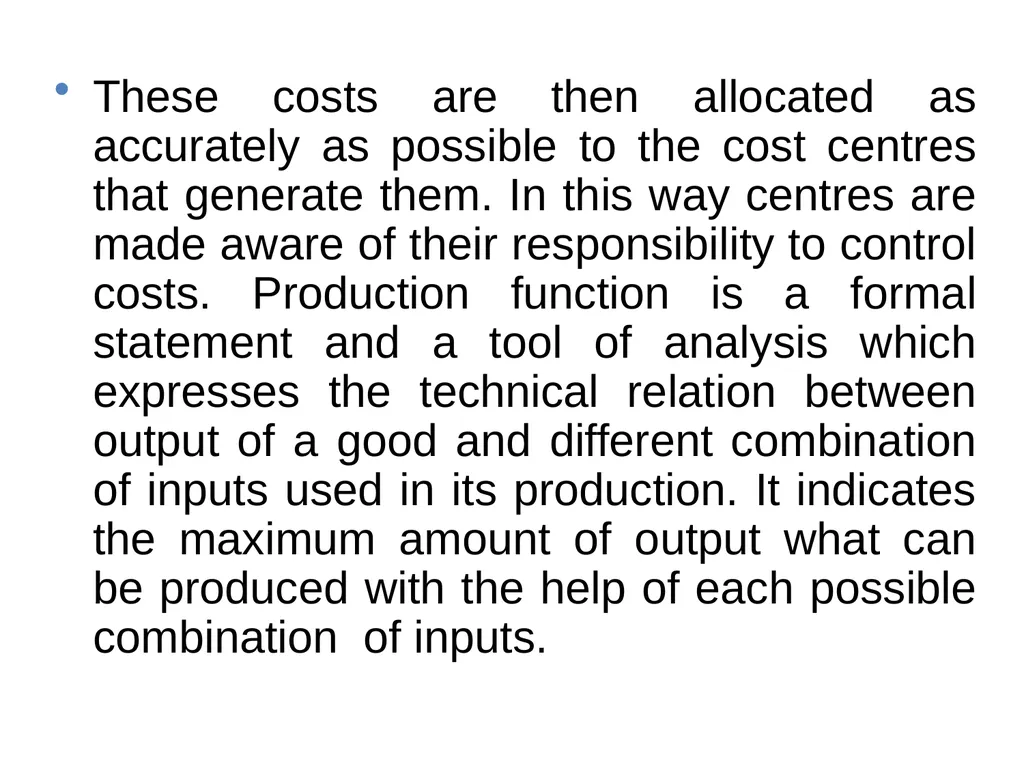
These costs are then allocated as accurately as possible to the cost centres that generate them. In this way centres are made aware of their responsibility to control costs. Production function is a formal statement and a tool of analysis which expresses the technical relation between output of a good and different combination of inputs used in its production. It indicates the maximum amount of output what can be produced with the help of each possible combination of inputs.<br>
46
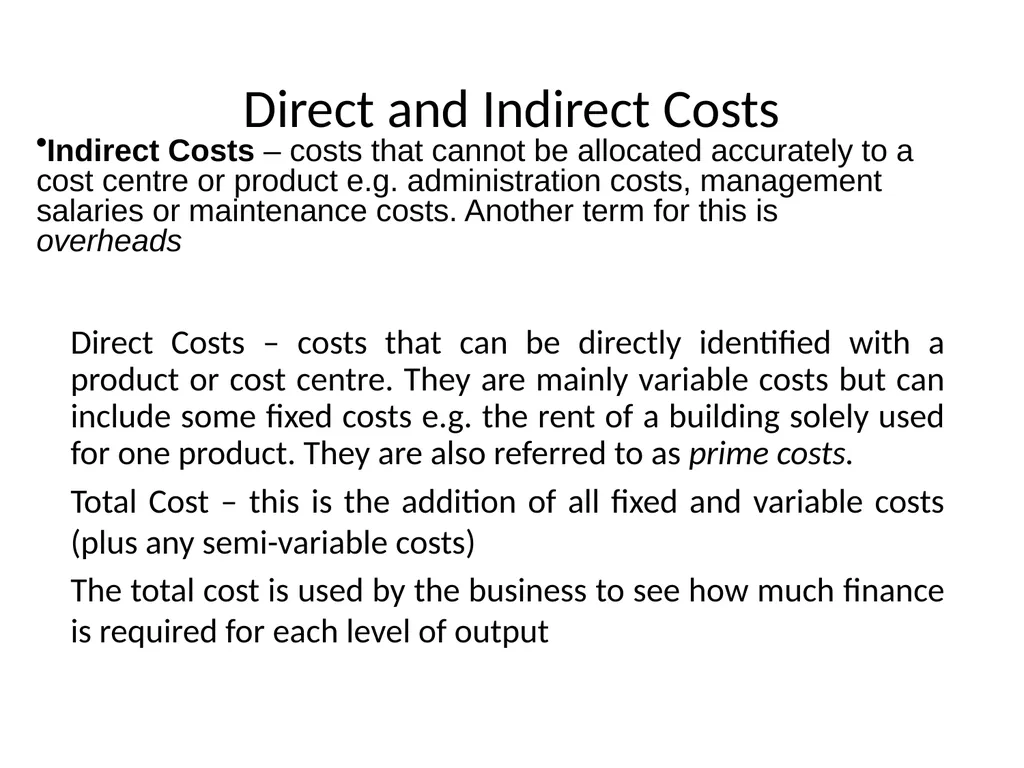
Direct and Indirect Costs Indirect Costs – costs that cannot be allocated accurately to a cost centre or product e.g. administration costs, management salaries or maintenance costs. Another term for this is overheads Direct Costs – costs that can be directly identified with a product or cost centre. They are mainly variable costs but can include some fixed costs e.g. the rent of a building solely used for one product. They are also referred to as prime costs.
Total Cost – this is the addition of all fixed and variable costs (plus any semi-variable costs)
The total cost is used by the business to see how much finance is required for each level of output<br>
Total Cost – this is the addition of all fixed and variable costs (plus any semi-variable costs)
The total cost is used by the business to see how much finance is required for each level of output<br>
47
Construction Management & Engineering<br>
48
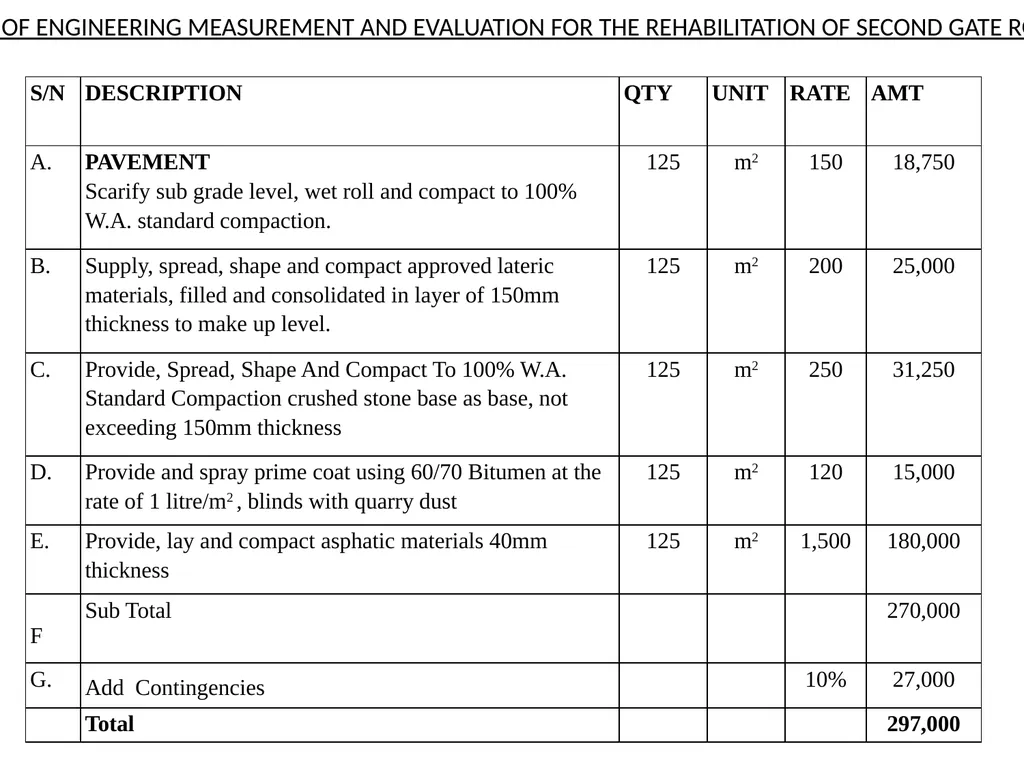
BILL OF ENGINEERING MEASUREMENT AND EVALUATION FOR THE REHABILITATION OF SECOND GATE ROAD<br>
49
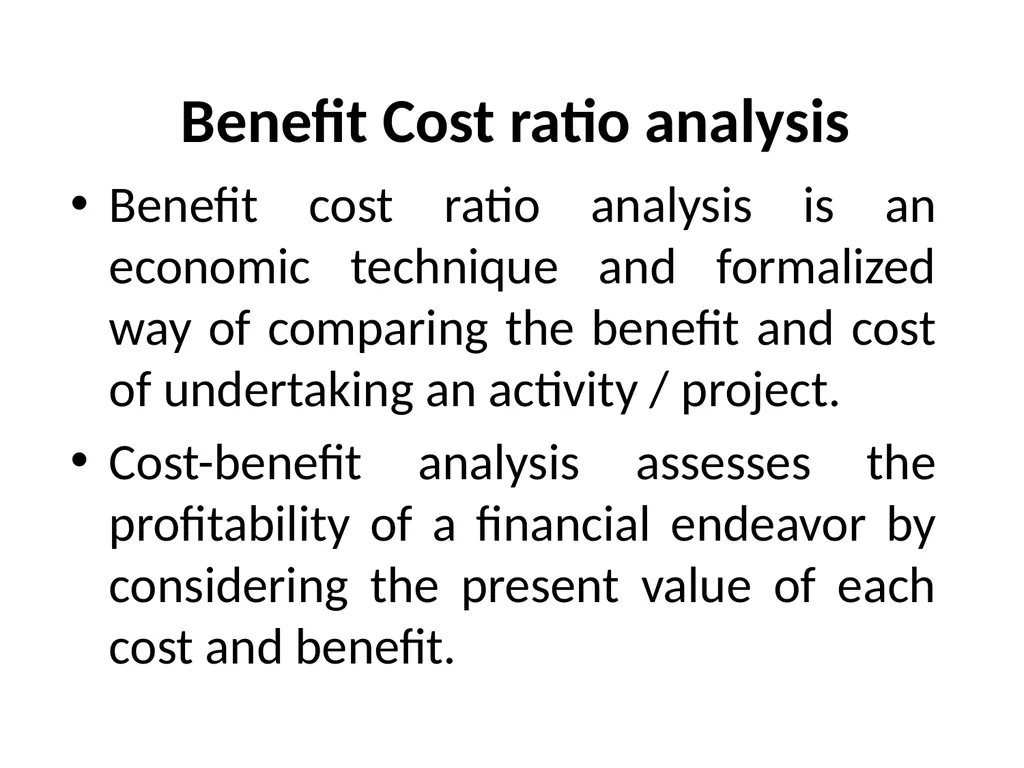
Benefit Cost ratio analysis Benefit cost ratio analysis is an economic technique and formalized way of comparing the benefit and cost of undertaking an activity / project.
Cost-benefit analysis assesses the profitability of a financial endeavor by considering the present value of each cost and benefit.<br>
Cost-benefit analysis assesses the profitability of a financial endeavor by considering the present value of each cost and benefit.<br>
50
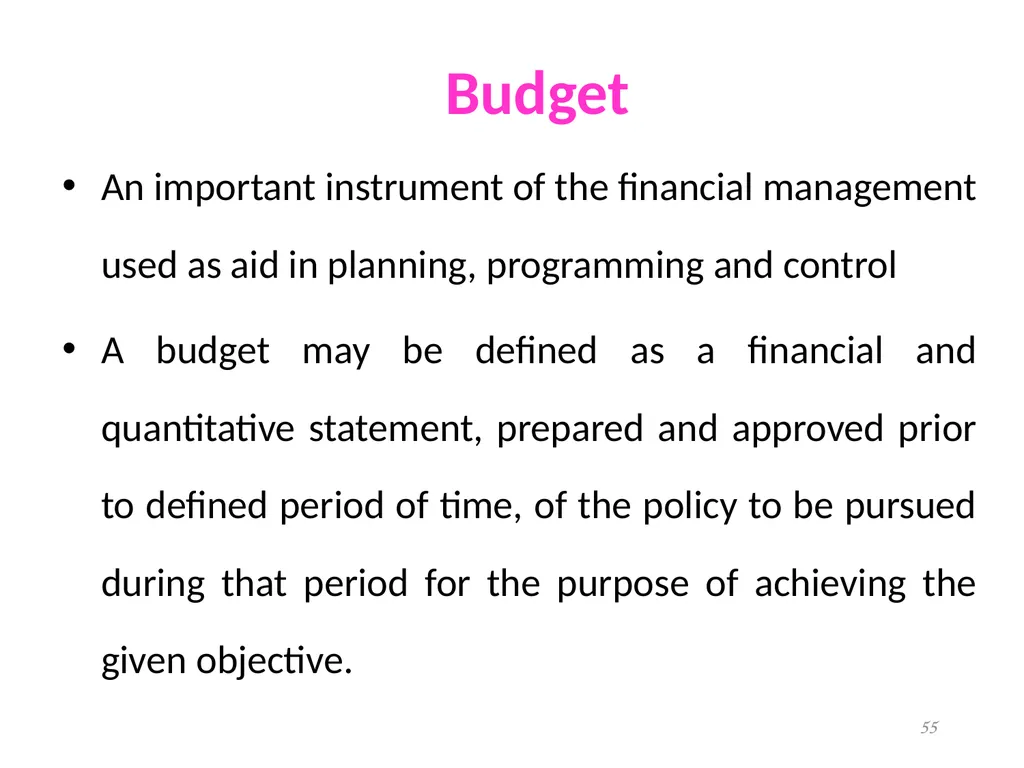
55 Budget An important instrument of the financial management used as aid in planning, programming and control
A budget may be defined as a financial and quantitative statement, prepared and approved prior to defined period of time, of the policy to be pursued during that period for the purpose of achieving the given objective.<br>
A budget may be defined as a financial and quantitative statement, prepared and approved prior to defined period of time, of the policy to be pursued during that period for the purpose of achieving the given objective.<br>
51
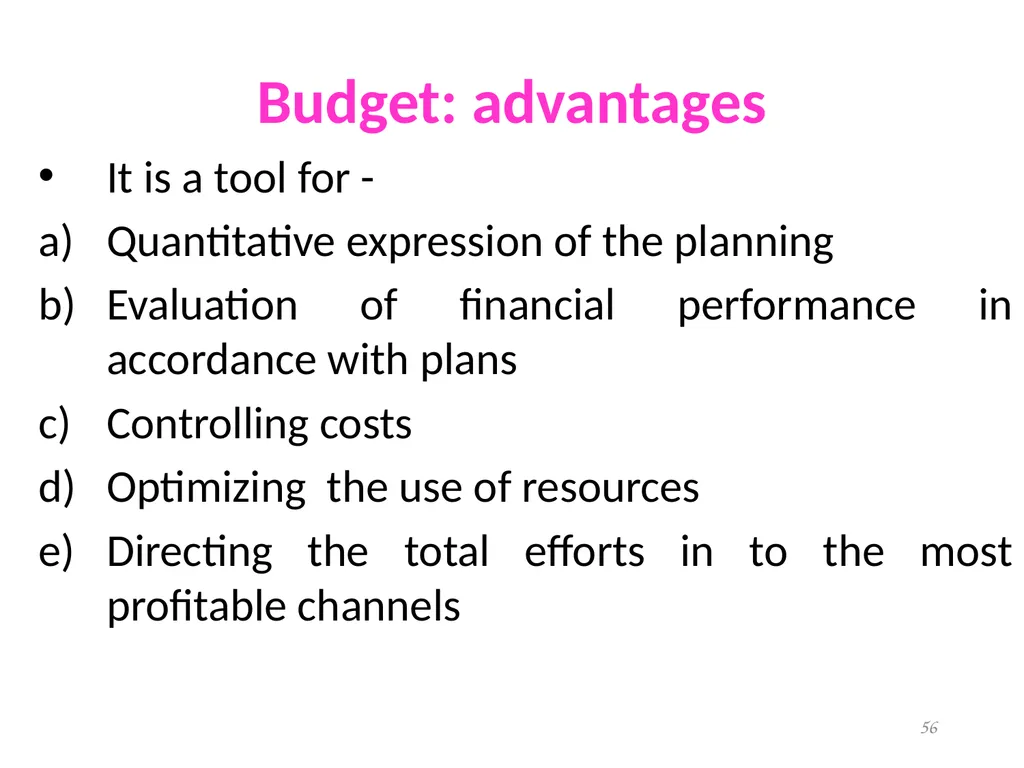
56 Budget: advantages It is a tool for -
Quantitative expression of the planning
Evaluation of financial performance in accordance with plans
Controlling costs
Optimizing the use of resources
Directing the total efforts in to the most profitable channels<br>
Quantitative expression of the planning
Evaluation of financial performance in accordance with plans
Controlling costs
Optimizing the use of resources
Directing the total efforts in to the most profitable channels<br>
52
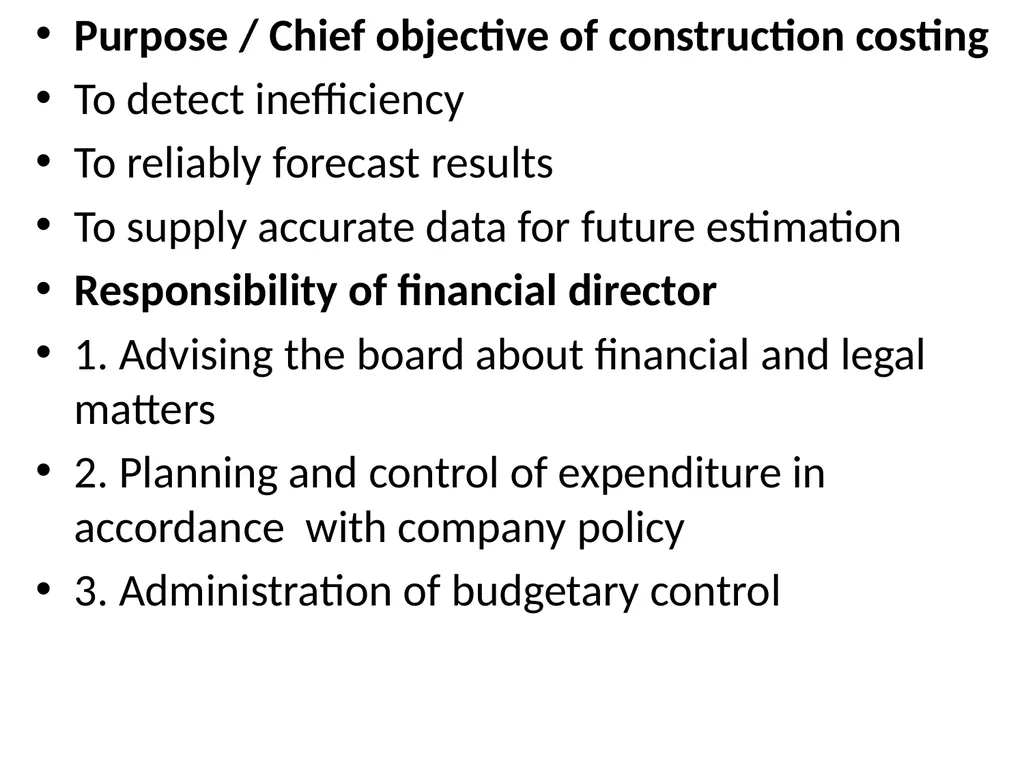
Purpose / Chief objective of construction costing
To detect inefficiency
To reliably forecast results
To supply accurate data for future estimation
Responsibility of financial director
1. Advising the board about financial and legal matters
2. Planning and control of expenditure in accordance with company policy
3. Administration of budgetary control<br>
To detect inefficiency
To reliably forecast results
To supply accurate data for future estimation
Responsibility of financial director
1. Advising the board about financial and legal matters
2. Planning and control of expenditure in accordance with company policy
3. Administration of budgetary control<br>
53
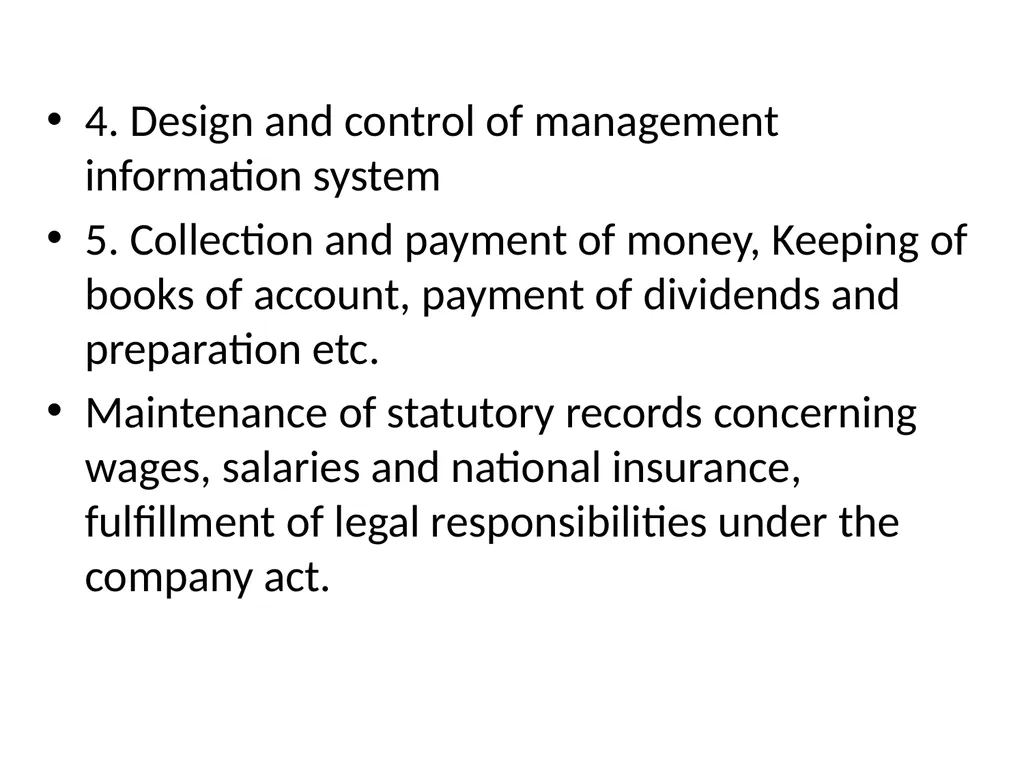
4. Design and control of management information system
5. Collection and payment of money, Keeping of books of account, payment of dividends and preparation etc.
Maintenance of statutory records concerning wages, salaries and national insurance, fulfillment of legal responsibilities under the company act.<br>
5. Collection and payment of money, Keeping of books of account, payment of dividends and preparation etc.
Maintenance of statutory records concerning wages, salaries and national insurance, fulfillment of legal responsibilities under the company act.<br>
54
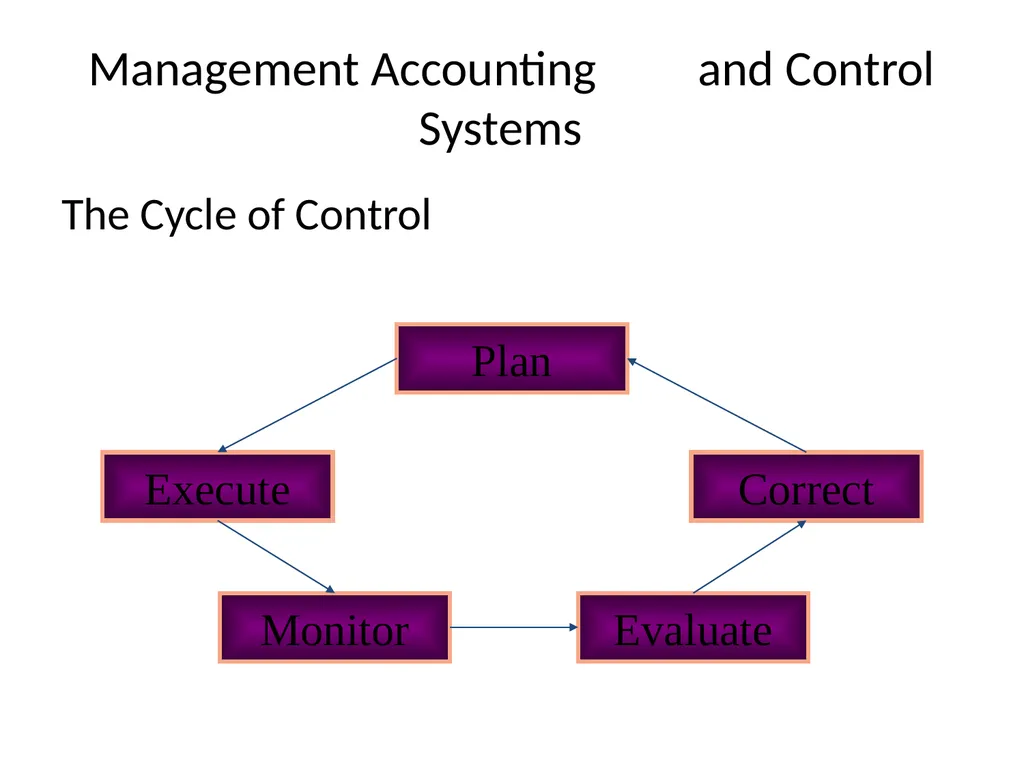
Management Accounting and Control Systems The Cycle of Control Plan Monitor Evaluate Execute Correct<br>
55
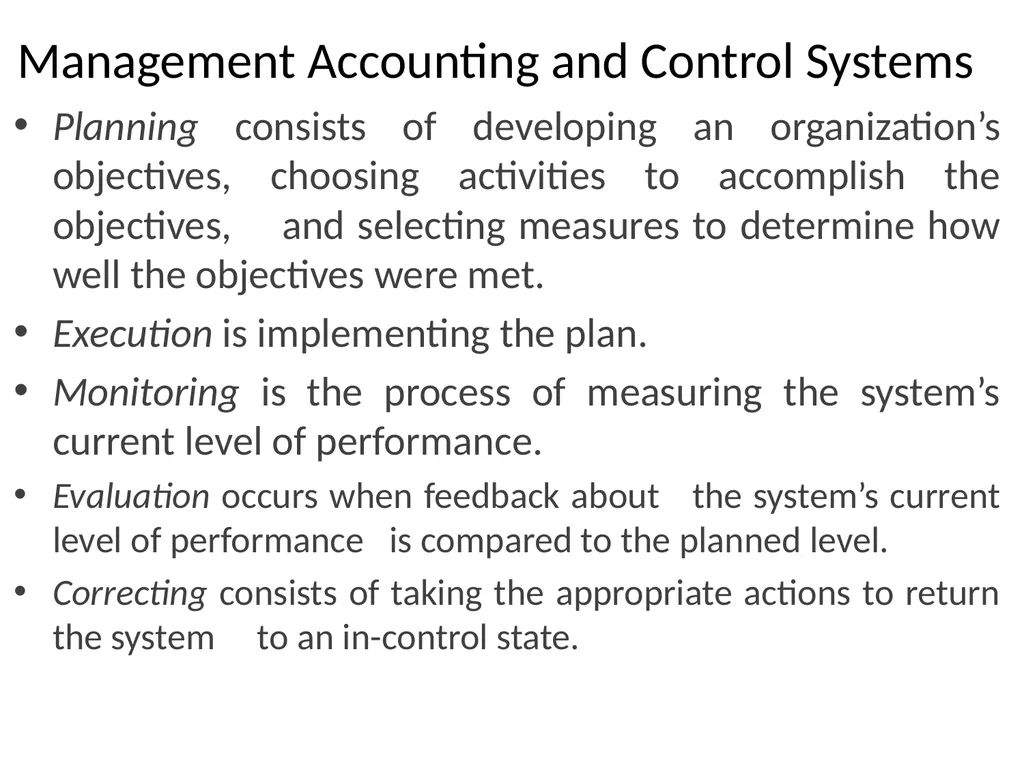
Management Accounting and Control Systems Planning consists of developing an organization’s objectives, choosing activities to accomplish the objectives, and selecting measures to determine how well the objectives were met.
Execution is implementing the plan.
Monitoring is the process of measuring the system’s current level of performance.
Evaluation occurs when feedback about the system’s current level of performance is compared to the planned level.
Correcting consists of taking the appropriate actions to return the system to an in-control state.<br>
Execution is implementing the plan.
Monitoring is the process of measuring the system’s current level of performance.
Evaluation occurs when feedback about the system’s current level of performance is compared to the planned level.
Correcting consists of taking the appropriate actions to return the system to an in-control state.<br>
56
Control Variables
Output
Price
Product Quality
Advertising
R&D
Basic Managerial Question: How much of the control variable should be used to maximize net benefits? Marginal (Incremental) Analysis<br>
Output
Price
Product Quality
Advertising
R&D
Basic Managerial Question: How much of the control variable should be used to maximize net benefits? Marginal (Incremental) Analysis<br>
57
Relationship to
The Capital Outlay Decision The time value of money is used to determine whether future benefits are sufficiently large to justify current outlays
Mathematical tools of the time value of money are used in making capital allocation decisions<br>
Mathematical tools of the time value of money are used in making capital allocation decisions<br>
58
The time value of money describes the greater benefit of receiving money now rather than later. It is founded on time preference. The principle of the time value of money explains why interest is paid or earned: Interest, whether it is on a bank deposit or debt, compensates the depositor or lender for the time value of money. It also underlies investment. Investors are willing to forgo spending their money now if they expect a favourable return on their investment in the future.<br>
59
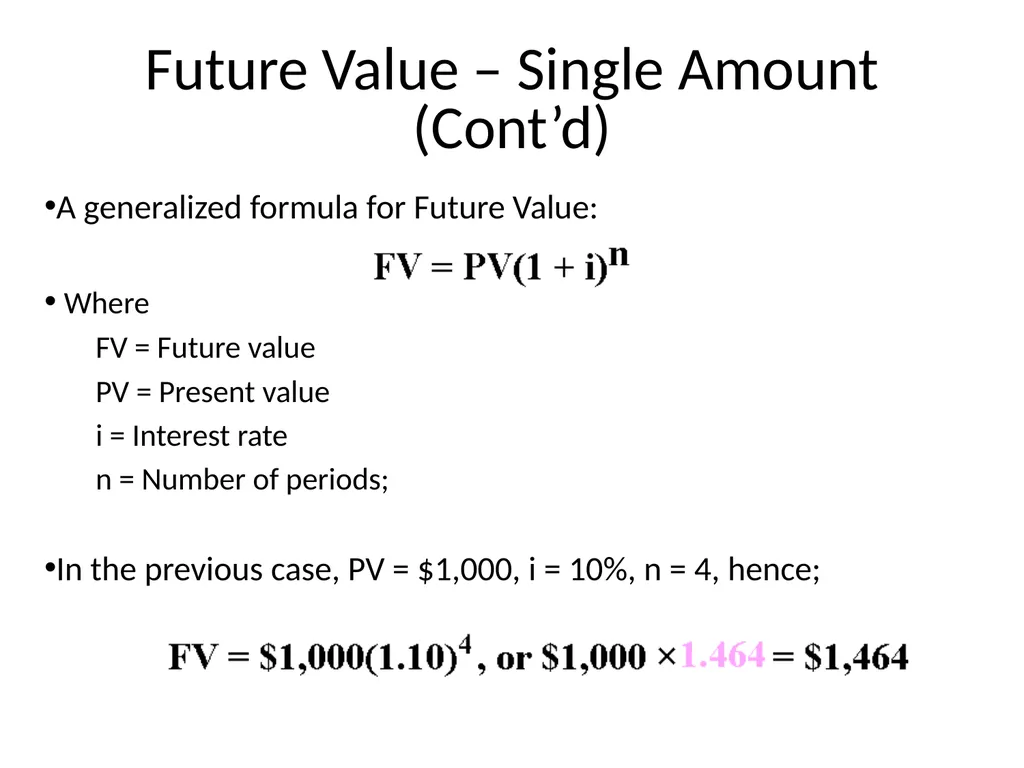
Future Value – Single Amount (Cont’d) A generalized formula for Future Value:
Where
FV = Future value
PV = Present value
i = Interest rate
n = Number of periods;
In the previous case, PV = $1,000, i = 10%, n = 4, hence;<br>
Where
FV = Future value
PV = Present value
i = Interest rate
n = Number of periods;
In the previous case, PV = $1,000, i = 10%, n = 4, hence;<br>
60
time value of money The time value of money (TVM) is the idea that money available at the present time is worth more than the same amount in the future due to its potential earning capacity. This core principle of finance holds that, provided money can earn interest, any amount of money is worth more the sooner it is received.<br>
61
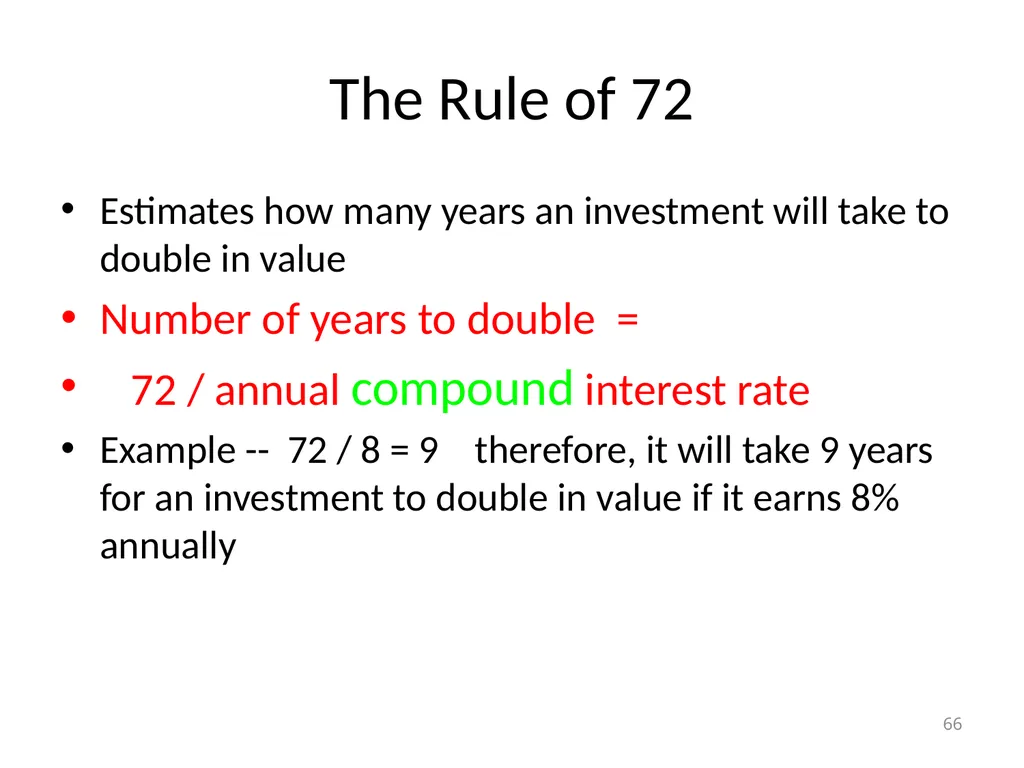
66 The Rule of 72 Estimates how many years an investment will take to double in value
Number of years to double =
72 / annual compound interest rate
Example -- 72 / 8 = 9 therefore, it will take 9 years for an investment to double in value if it earns 8% annually<br>
Number of years to double =
72 / annual compound interest rate
Example -- 72 / 8 = 9 therefore, it will take 9 years for an investment to double in value if it earns 8% annually<br>
62
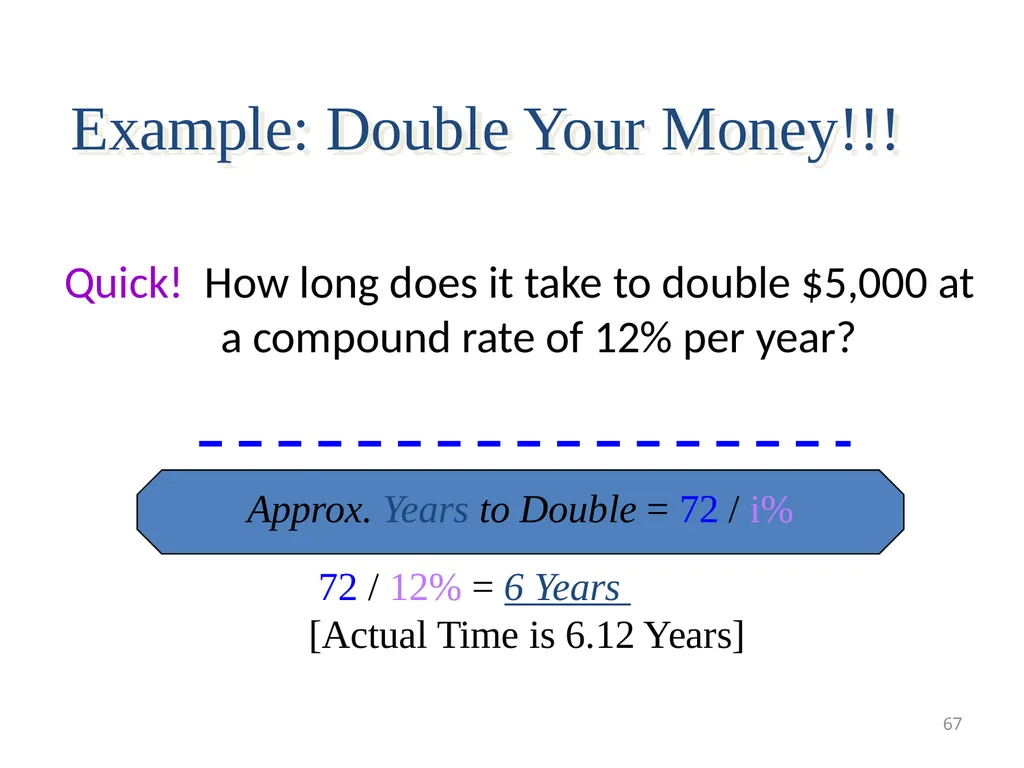
67 Approx. Years to Double = 72 / i%
72 / 12% = 6 Years
[Actual Time is 6.12 Years] Quick! How long does it take to double $5,000 at a compound rate of 12% per year? Example: Double Your Money!!!<br>
72 / 12% = 6 Years
[Actual Time is 6.12 Years] Quick! How long does it take to double $5,000 at a compound rate of 12% per year? Example: Double Your Money!!!<br>
63
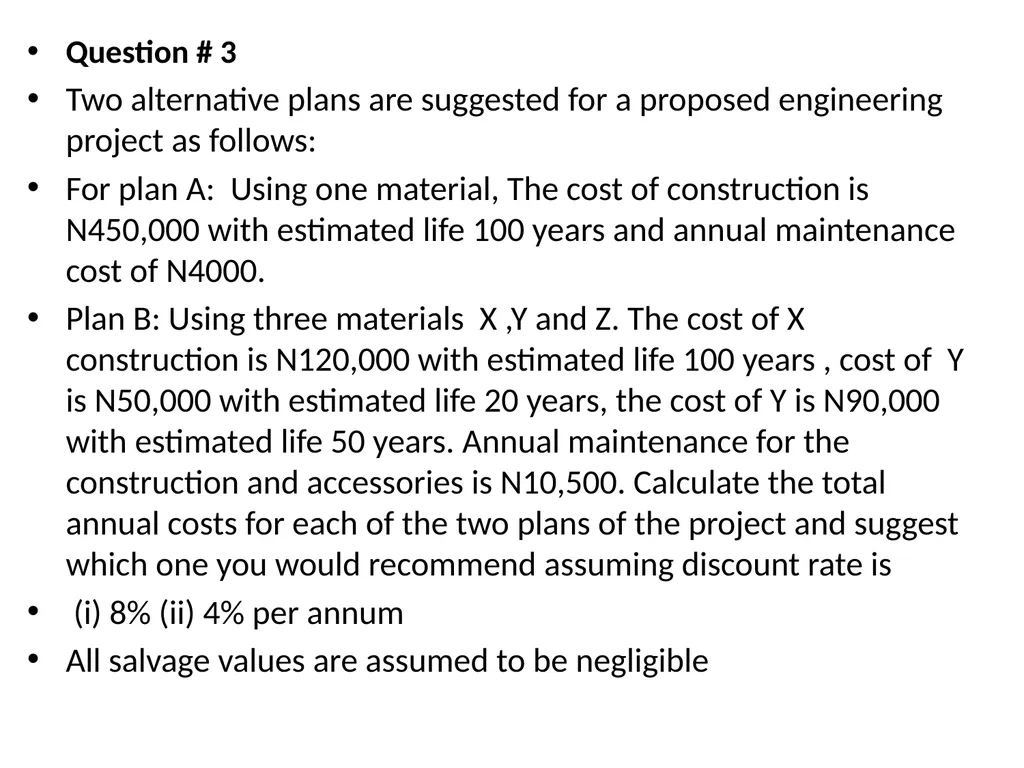
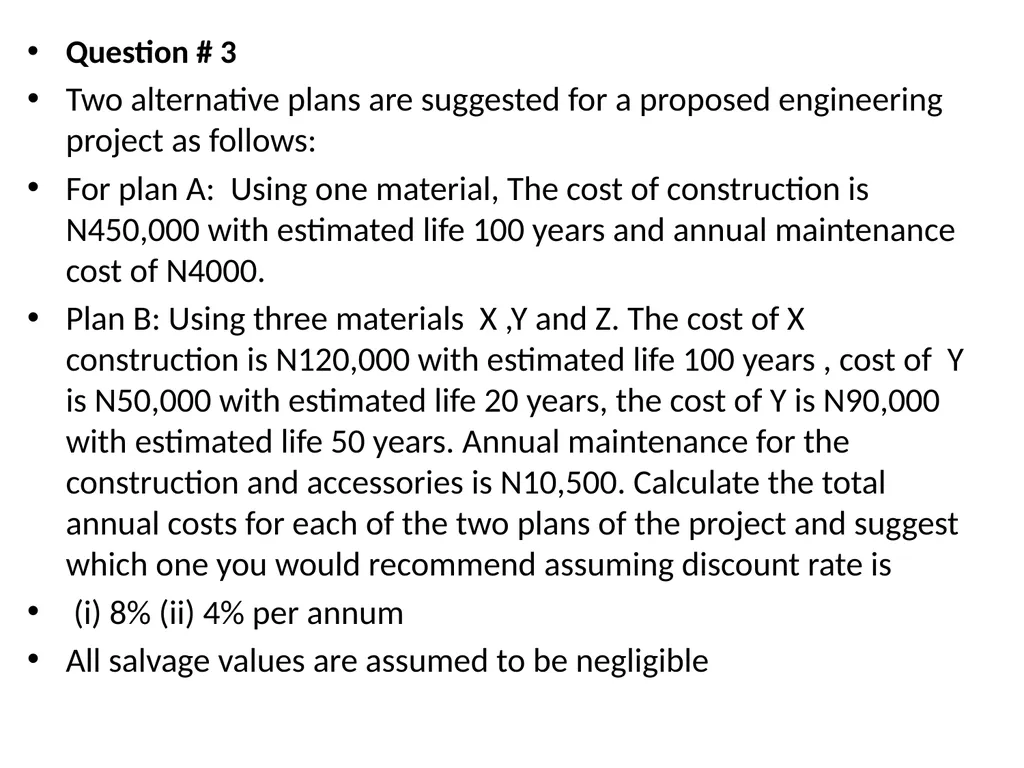
Question # 3
Two alternative plans are suggested for a proposed engineering project as follows:
For plan A: Using one material, The cost of construction is N450,000 with estimated life 100 years and annual maintenance cost of N4000.
Plan B: Using three materials X ,Y and Z. The cost of X construction is N120,000 with estimated life 100 years , cost of Y is N50,000 with estimated life 20 years, the cost of Y is N90,000 with estimated life 50 years. Annual maintenance for the construction and accessories is N10,500. Calculate the total annual costs for each of the two plans of the project and suggest which one you would recommend assuming discount rate is
(i) 8% (ii) 4% per annum
All salvage values are assumed to be negligible<br>
Two alternative plans are suggested for a proposed engineering project as follows:
For plan A: Using one material, The cost of construction is N450,000 with estimated life 100 years and annual maintenance cost of N4000.
Plan B: Using three materials X ,Y and Z. The cost of X construction is N120,000 with estimated life 100 years , cost of Y is N50,000 with estimated life 20 years, the cost of Y is N90,000 with estimated life 50 years. Annual maintenance for the construction and accessories is N10,500. Calculate the total annual costs for each of the two plans of the project and suggest which one you would recommend assuming discount rate is
(i) 8% (ii) 4% per annum
All salvage values are assumed to be negligible<br>
64
ENG 384 Mid Semester Test
On Monday
23rdMarch 2020
8am-10am
Students are to be seated by 7:30am<br>
On Monday
23rdMarch 2020
8am-10am
Students are to be seated by 7:30am<br>
65
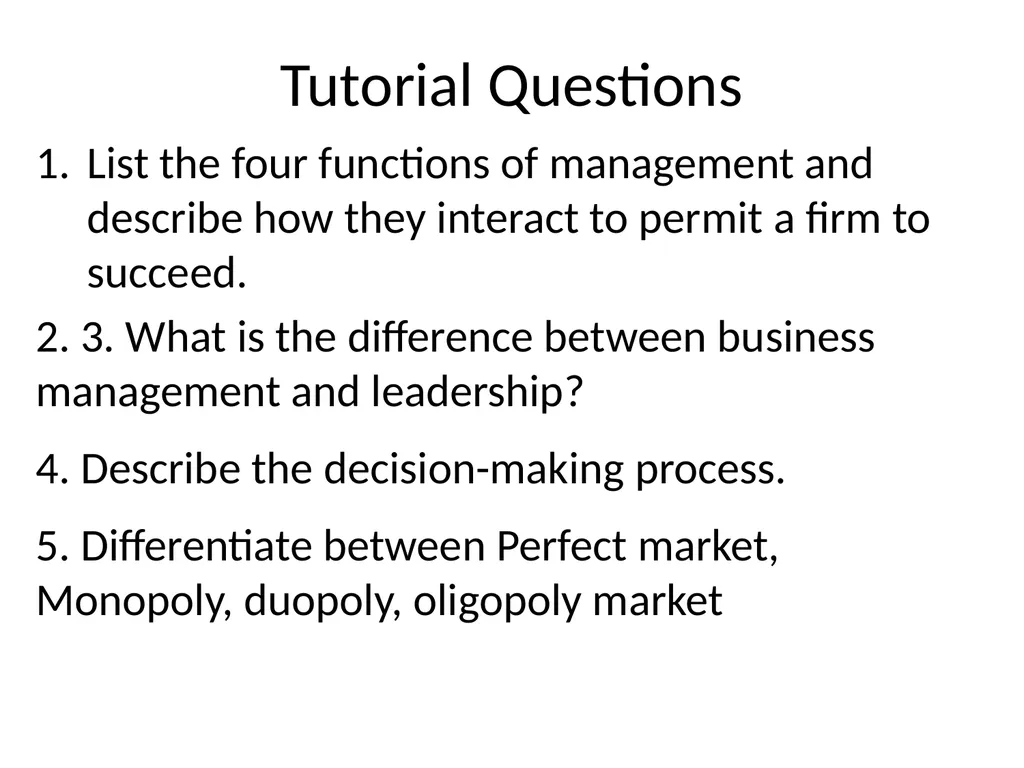
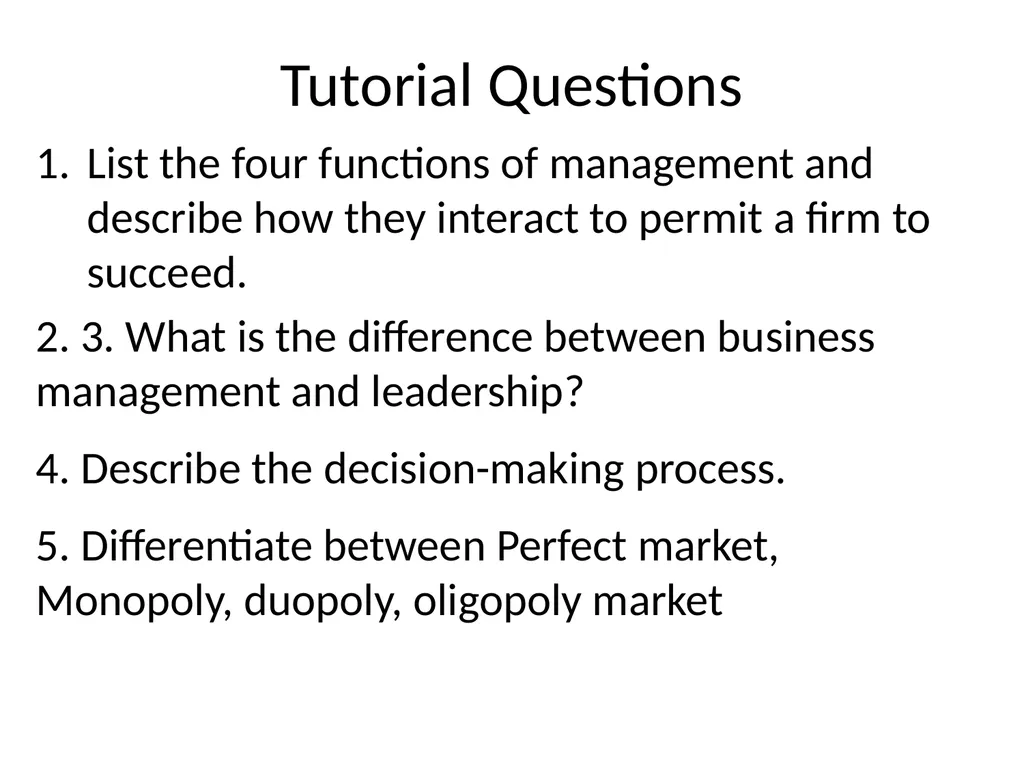
Tutorial Questions List the four functions of management and describe how they interact to permit a firm to succeed.
2. 3. What is the difference between business management and leadership?
4. Describe the decision-making process.
5. Differentiate between Perfect market, Monopoly, duopoly, oligopoly market<br>
2. 3. What is the difference between business management and leadership?
4. Describe the decision-making process.
5. Differentiate between Perfect market, Monopoly, duopoly, oligopoly market<br>
66
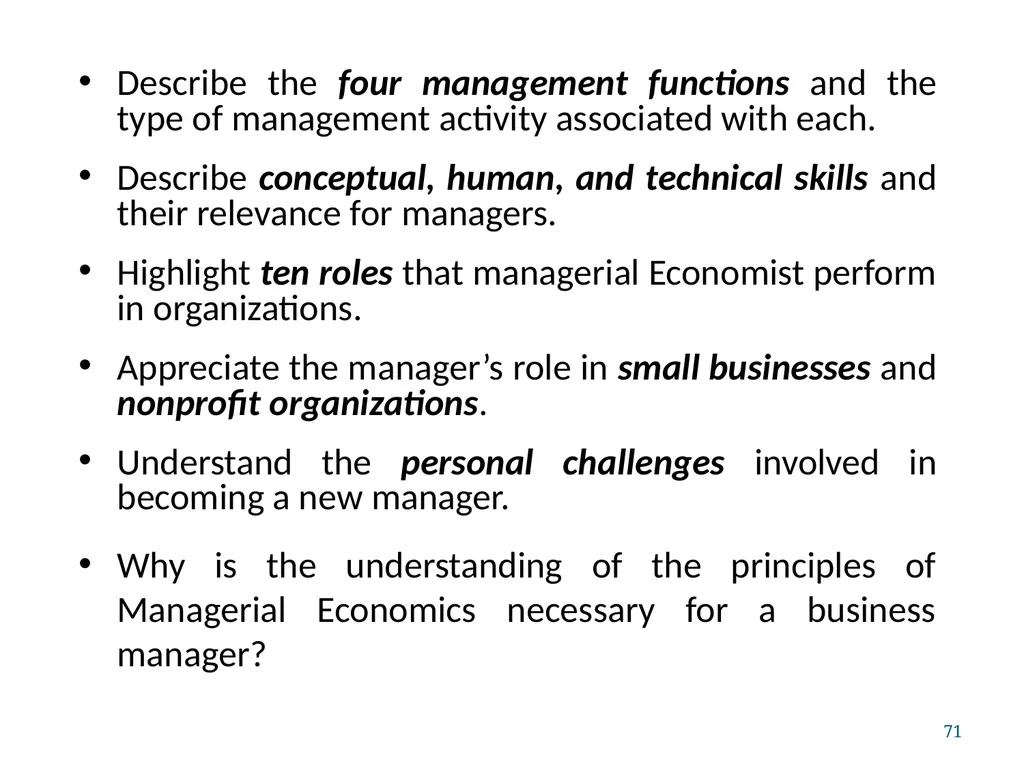
71 Describe the four management functions and the type of management activity associated with each.
Describe conceptual, human, and technical skills and their relevance for managers.
Highlight ten roles that managerial Economist perform in organizations.
Appreciate the manager’s role in small businesses and nonprofit organizations.
Understand the personal challenges involved in becoming a new manager.
Why is the understanding of the principles of Managerial Economics necessary for a business manager? 0<br>
Describe conceptual, human, and technical skills and their relevance for managers.
Highlight ten roles that managerial Economist perform in organizations.
Appreciate the manager’s role in small businesses and nonprofit organizations.
Understand the personal challenges involved in becoming a new manager.
Why is the understanding of the principles of Managerial Economics necessary for a business manager? 0<br>
67
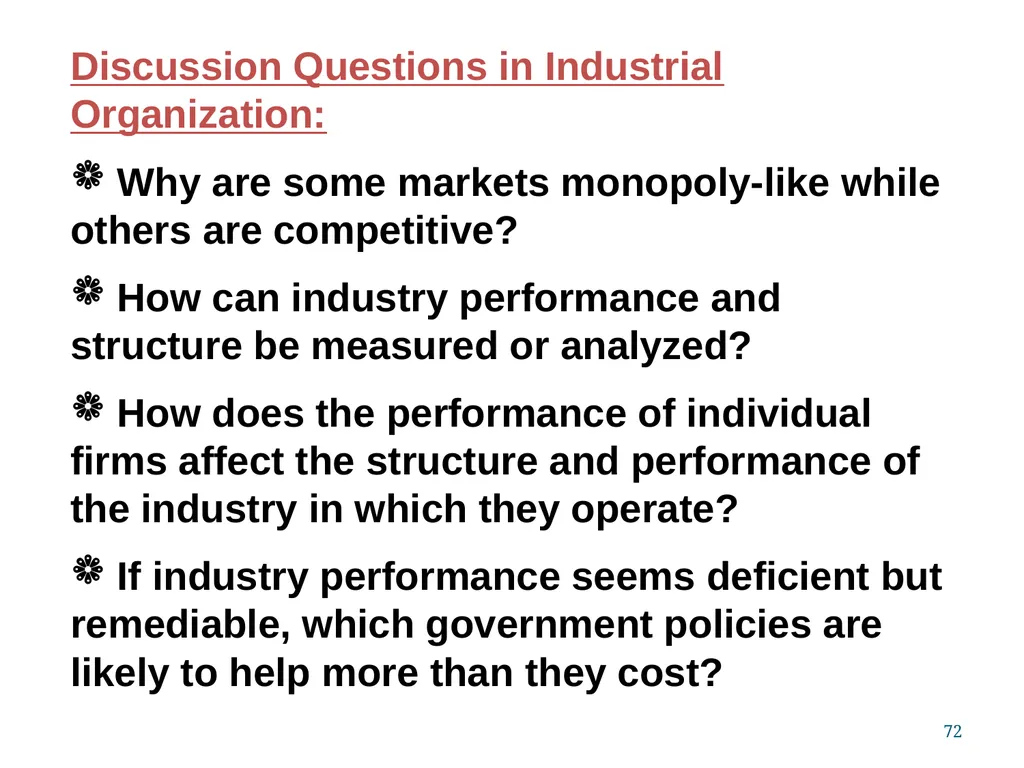
72 Discussion Questions in Industrial Organization:
Why are some markets monopoly-like while others are competitive?
How can industry performance and structure be measured or analyzed?
How does the performance of individual firms affect the structure and performance of the industry in which they operate?
If industry performance seems deficient but remediable, which government policies are likely to help more than they cost?<br>
Why are some markets monopoly-like while others are competitive?
How can industry performance and structure be measured or analyzed?
How does the performance of individual firms affect the structure and performance of the industry in which they operate?
If industry performance seems deficient but remediable, which government policies are likely to help more than they cost?<br>
68
Question # 3
Two alternative plans are suggested for a proposed engineering project as follows:
For plan A: Using one material, The cost of construction is N450,000 with estimated life 100 years and annual maintenance cost of N4000.
Plan B: Using three materials X ,Y and Z. The cost of X construction is N120,000 with estimated life 100 years , cost of Y is N50,000 with estimated life 20 years, the cost of Y is N90,000 with estimated life 50 years. Annual maintenance for the construction and accessories is N10,500. Calculate the total annual costs for each of the two plans of the project and suggest which one you would recommend assuming discount rate is
(i) 8% (ii) 4% per annum
All salvage values are assumed to be negligible<br>
Two alternative plans are suggested for a proposed engineering project as follows:
For plan A: Using one material, The cost of construction is N450,000 with estimated life 100 years and annual maintenance cost of N4000.
Plan B: Using three materials X ,Y and Z. The cost of X construction is N120,000 with estimated life 100 years , cost of Y is N50,000 with estimated life 20 years, the cost of Y is N90,000 with estimated life 50 years. Annual maintenance for the construction and accessories is N10,500. Calculate the total annual costs for each of the two plans of the project and suggest which one you would recommend assuming discount rate is
(i) 8% (ii) 4% per annum
All salvage values are assumed to be negligible<br>
69
ENG 384 Mid Semester Test
On Monday
23rdMarch 2020
8am-10am
Students are to be seated by 7:30am<br>
On Monday
23rdMarch 2020
8am-10am
Students are to be seated by 7:30am<br>
70
Tutorial Questions List the four functions of management and describe how they interact to permit a firm to succeed.
2. 3. What is the difference between business management and leadership?
4. Describe the decision-making process.
5. Differentiate between Perfect market, Monopoly, duopoly, oligopoly market<br>
2. 3. What is the difference between business management and leadership?
4. Describe the decision-making process.
5. Differentiate between Perfect market, Monopoly, duopoly, oligopoly market<br>
71
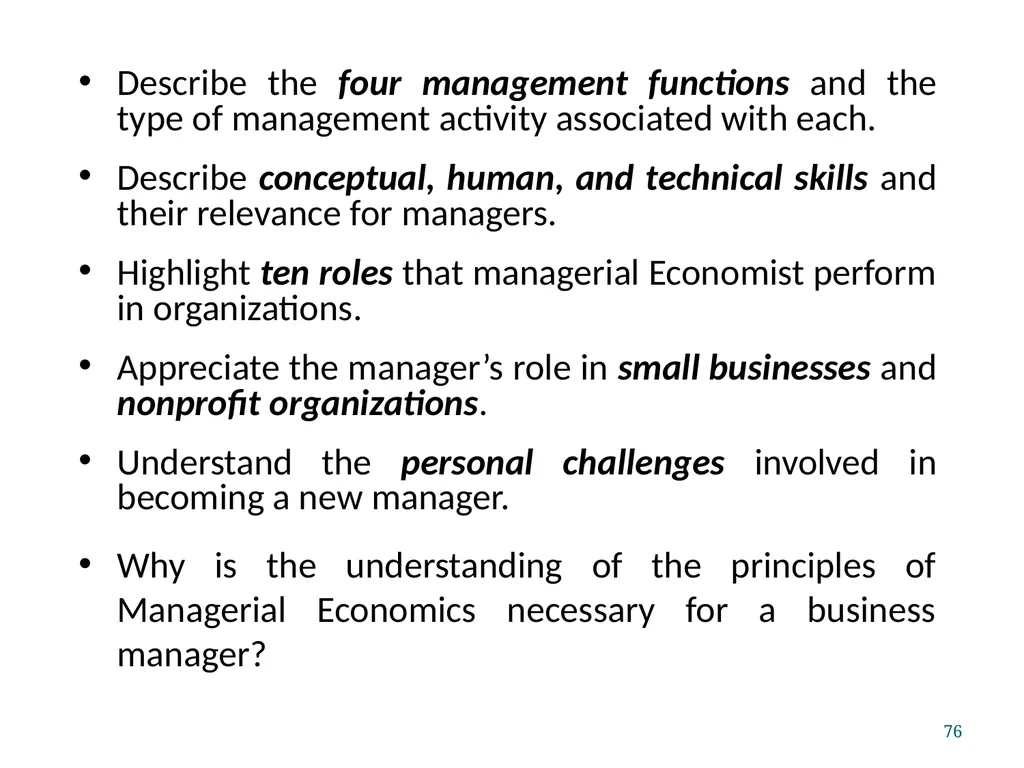
76 Describe the four management functions and the type of management activity associated with each.
Describe conceptual, human, and technical skills and their relevance for managers.
Highlight ten roles that managerial Economist perform in organizations.
Appreciate the manager’s role in small businesses and nonprofit organizations.
Understand the personal challenges involved in becoming a new manager.
Why is the understanding of the principles of Managerial Economics necessary for a business manager? 0<br>
Describe conceptual, human, and technical skills and their relevance for managers.
Highlight ten roles that managerial Economist perform in organizations.
Appreciate the manager’s role in small businesses and nonprofit organizations.
Understand the personal challenges involved in becoming a new manager.
Why is the understanding of the principles of Managerial Economics necessary for a business manager? 0<br>
72
Thank you for your attention!<br>