English II Final exam study guide You must be familiar with the entire play of Macbeth and know the story. These slides should be studied for additional help on the test. Soliloquy, Aside, Monologue Soliloquy Longer speech One character
"English II Final exam study guide You must be" is the property of its rightful owner. Permission is granted to
download and print the materials on this website for personal, non-commercial use only, and to display it
on your personal computer provided you do not modify the materials and that you retain all copyright
notices contained in the materials. By downloading content from our website, you accept the terms of this
agreement.
Presentation Transcript
01
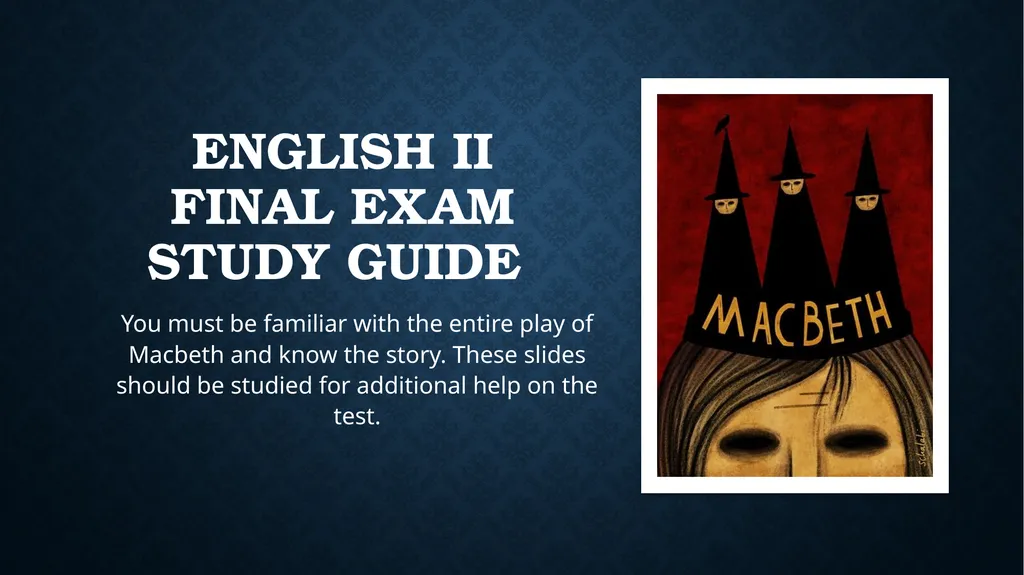
English II Final exam study guide You must be familiar with the entire play of Macbeth and know the story. These slides should be studied for additional help on the test.<br>
02
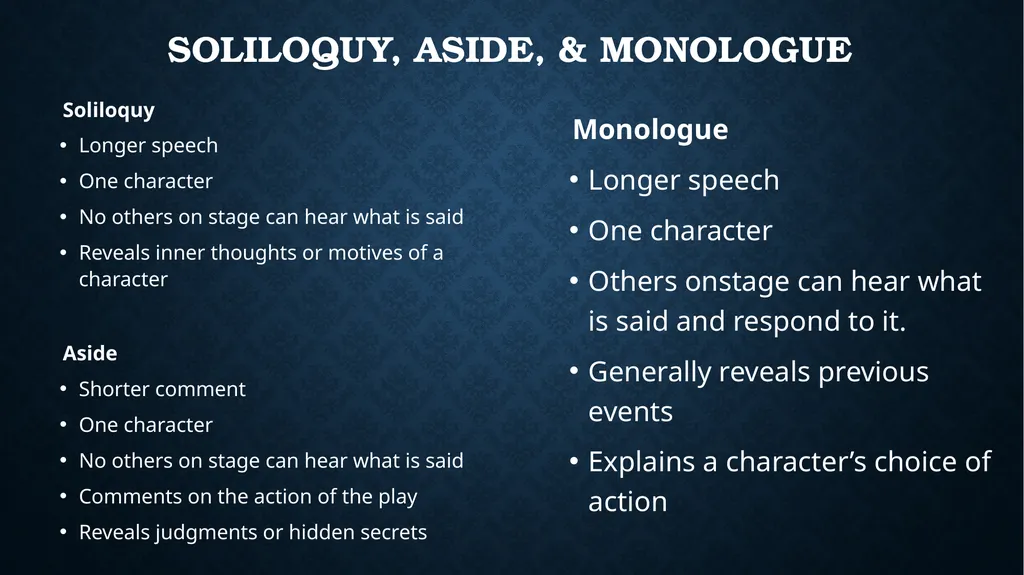
Soliloquy, Aside, & Monologue Soliloquy
Longer speech
One character
No others on stage can hear what is said
Reveals inner thoughts or motives of a character
Aside
Shorter comment
One character
No others on stage can hear what is said
Comments on the action of the play
Reveals judgments or hidden secrets Monologue
Longer speech
One character
Others onstage can hear what is said and respond to it.
Generally reveals previous events
Explains a character’s choice of action<br>
03
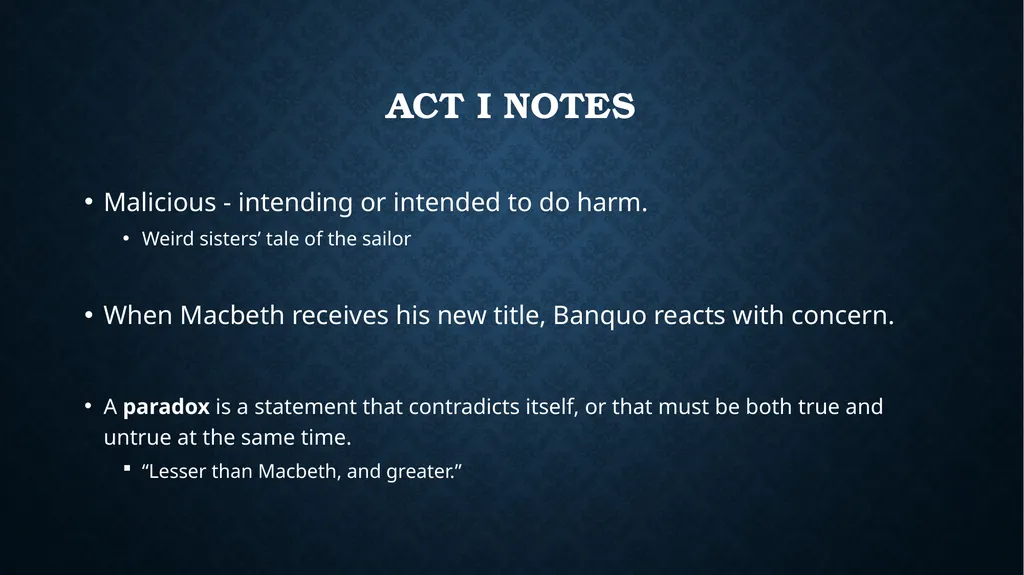
Act I Notes Malicious - intending or intended to do harm.
Weird sisters’ tale of the sailor
When Macbeth receives his new title, Banquo reacts with concern.
A paradox is a statement that contradicts itself, or that must be both true and untrue at the same time.
“Lesser than Macbeth, and greater.”<br>
04
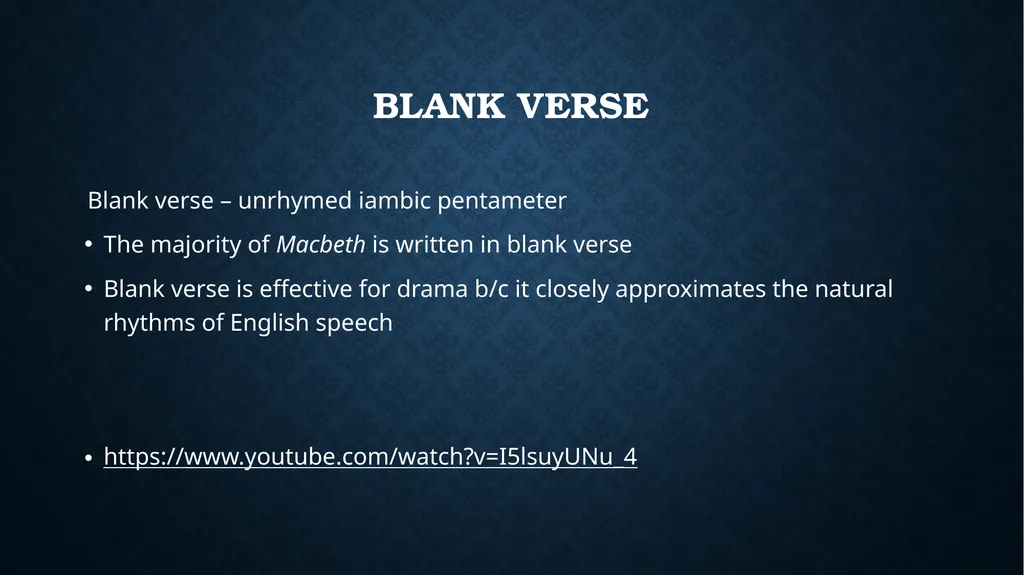
Blank verse Blank verse – unrhymed iambic pentameter
The majority of Macbeth is written in blank verse
Blank verse is effective for drama b/c it closely approximates the natural rhythms of English speech
https://www.youtube.com/watch?v=I5lsuyUNu_4<br>
05
Tragedy Elements of a tragedy
Central character who makes mistakes and is high-ranking
Catastrophe near the end or conclusion
Tragic flaw - a trait in a character leading to his downfall, and the character is often the hero of the literary piece
Macbeth’s tragic flaw
His lust for power<br>
06
Act II Notes When Lennox and Macduff arrive at Macbeth’s castle in the morning, Macduff wonders if the porter has stayed up late and slept in.
The porter’s cursing is ironic because he invokes the devil without knowing about the crime
Banquo wants to meet with the other nobles in order to discover the purpose of the murder.
The natural disturbances that continue all night after Duncan’s murder (screaming owl, chimneys being blown down, Duncan’s horses turning wild) symbolize the evil of Macbeth’s deeds.<br>
07
Act III Notes Barren scepter =
No heirs to the throne
Macbeth explains to the hired murderers that they must keep his plan a secret because he and Banquo have friends in common who would be upset.
When Macbeth begins talking to Banquo’s ghost, Lady Macbeth reacts by telling the others Macbeth has an illness.
Vivid example of figurative language
“O, full of scorpions is my mind, dear wife!” = metaphor
Hecate (queen of witches) intends to ensure Macbeth’s downfall by making him overconfident.
At the beginning of scene 6, Lennox speaks about Macbeth’s sorrow in a sarcastic tone.<br>
08
Act IV Notes In response to Macbeth’s question, the witches call upon apparitions who answer most of his questions.
Know the four apparitions and what each of them said to Macbeth
When Macbeth hears that no one born of a woman will harm him, he decides to kill Macduff anyway.
Malcolm pretends that he is too evil to become king in order to ascertain Macduff’s loyalty.
When Ross joins Malcolm and Macduff in Scene 3, he says to Macduff, “Let not your ears despise my tongue forever, / Which shall possess them with the heaviest sound / That ever yet they heard.” He means
Please do not hate me because I bring bad news<br>
09
Act V Notes The gentlewoman in Scene 1 refuses to repeat Lady Macbeth’s sleep-talk to the doctor because there is no witness to confirm the truth of the gentlewoman’s words.
The “damned spot” to which Lady Macbeth refers to is Duncan’s bloodstain
“Tomorrow, tomorrow, tomorrow…” - V.v
Macbeth says this after he finds out Lady Macbeth is dead
He thinks life is a meaningless path to death
“Life’s but a walking shadow” – example of figurative language
Motifs (images that occur repeatedly in the play)
Daggers, woods, children
Macbeth finally realizes that the witches and apparitions deceived him with ambiguous messages<br>
10
Additional Notes for the Test Figurative language
Simile, metaphor, personification, symbolism, etc
Theme
Ambition
the devastation which follows when ambition oversteps moral boundaries
Act I, Sc. v: Lady Macbeth receives Macbeth's letter, analyses his character, and invokes the forces of evil.
Act I, Sc. vii: Macbeth reflects on what is needed to achieve his ambition and Lady Macbeth taunts him to 'screw your courage to the sticking place.'
Act III, Sc. i: Macbeth determines to kill Banquo in order to prevent his children succeeding to Scotland's throne.
Fate and free will
the extent to which we control our own destinies
Act I, Sc. iii: Macbeth and Banquo encounter the witches on the heath. Macbeth reflects on their prophecies.
Act II, Sc. i: Macbeth talks with Banquo about their encounter with the witches, sees a visionary dagger and makes his decision to kill Duncan.
Act IV, Sc. i: Macbeth visits the witches who offer him further prophecies.<br>
11
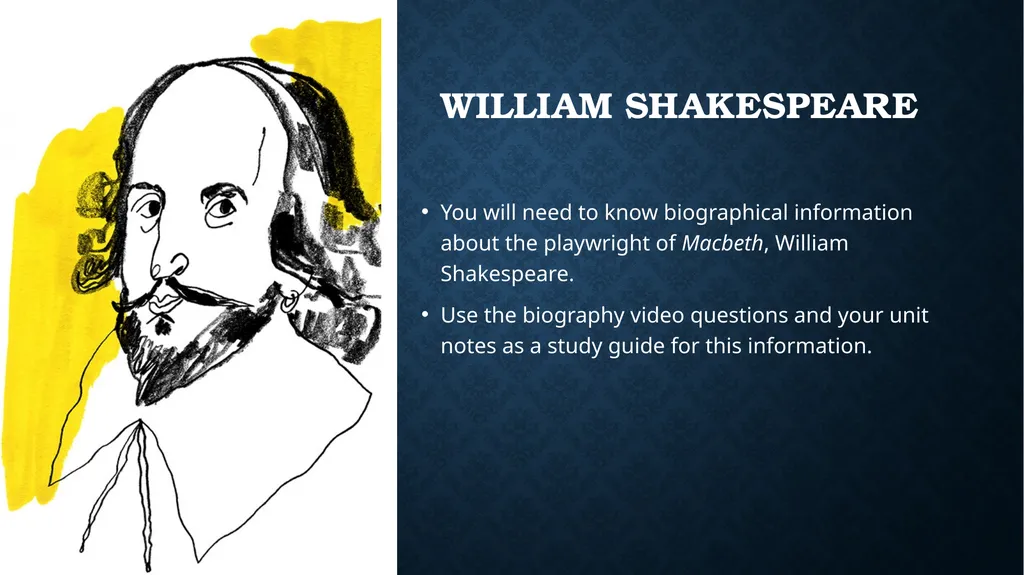
William Shakespeare You will need to know biographical information about the playwright of Macbeth, William Shakespeare.
Use the biography video questions and your unit notes as a study guide for this information.<br>
12
Additional information Know all of the Unit Vocabulary terms
There will be a translation section on the test. You will read significant passages from scenes and choose from a list of correct translations into modern English.<br>
13
End of study guide The slides after this one will not be part of the test for Spring 2025. You do not need to study that information.<br>
14
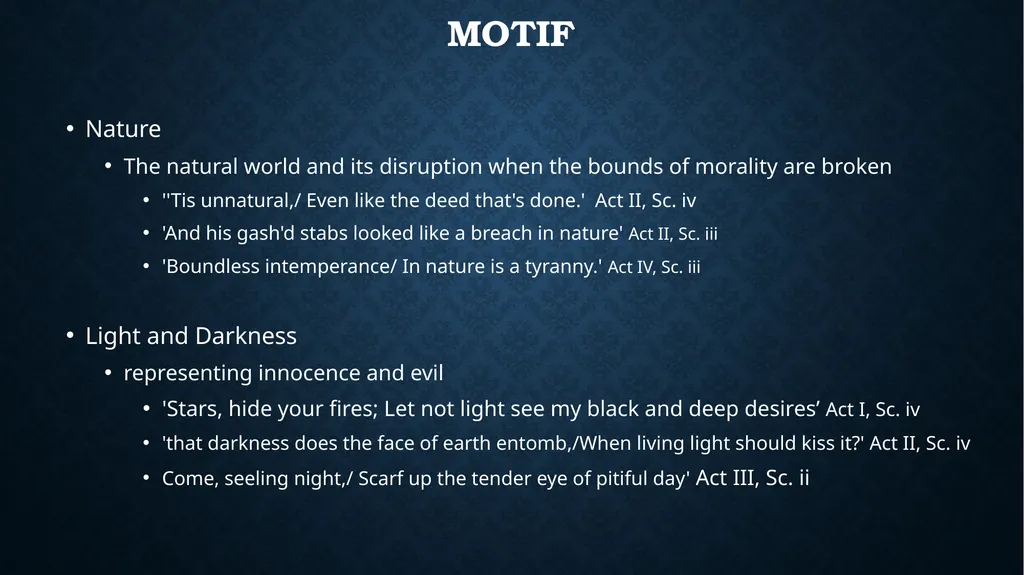
Motif Nature
The natural world and its disruption when the bounds of morality are broken
''Tis unnatural,/ Even like the deed that's done.' Act II, Sc. iv
'And his gash'd stabs looked like a breach in nature' Act II, Sc. iii
'Boundless intemperance/ In nature is a tyranny.' Act IV, Sc. iii
Light and Darkness
representing innocence and evil
'Stars, hide your fires; Let not light see my black and deep desires’ Act I, Sc. iv
'that darkness does the face of earth entomb,/When living light should kiss it?' Act II, Sc. iv
Come, seeling night,/ Scarf up the tender eye of pitiful day' Act III, Sc. ii<br>
15
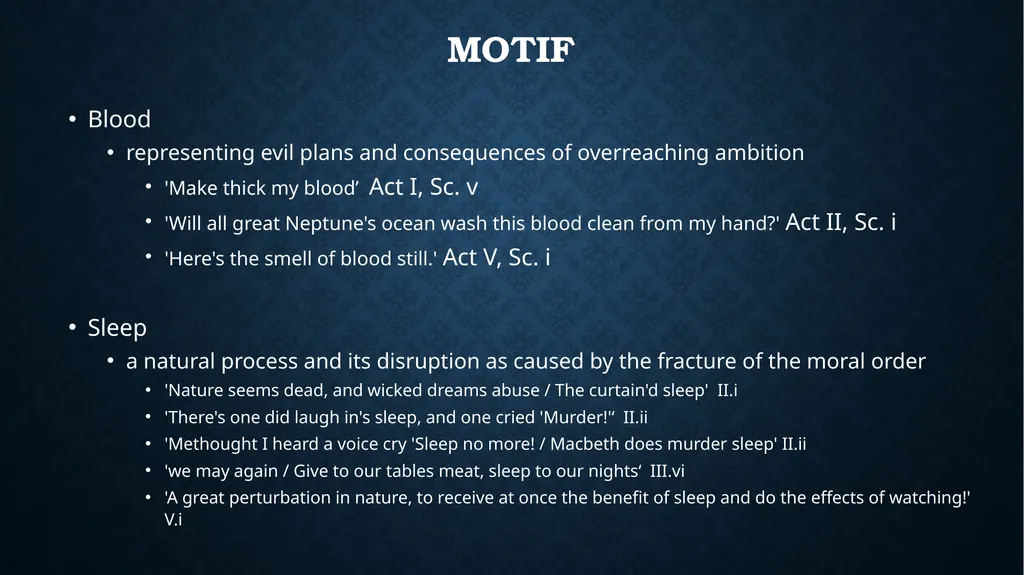
Motif Blood
representing evil plans and consequences of overreaching ambition
'Make thick my blood’ Act I, Sc. v
'Will all great Neptune's ocean wash this blood clean from my hand?' Act II, Sc. i
'Here's the smell of blood still.' Act V, Sc. i
Sleep
a natural process and its disruption as caused by the fracture of the moral order
'Nature seems dead, and wicked dreams abuse / The curtain'd sleep' II.i
'There's one did laugh in's sleep, and one cried 'Murder!'‘ II.ii
'Methought I heard a voice cry 'Sleep no more! / Macbeth does murder sleep' II.ii
'we may again / Give to our tables meat, sleep to our nights‘ III.vi
'A great perturbation in nature, to receive at once the benefit of sleep and do the effects of watching!' V.i<br>