Enterprise Risk Management Insights Operationalization Prepared for the Committee on Finance IT June 18th 2010 Background Key findings: The current state of ERM implementation Types of ERM program Organisation of ERM functions
"Enterprise Risk Management Insights &" is the property of its rightful owner. Permission is granted to
download and print the materials on this website for personal, non-commercial use only, and to display it
on your personal computer provided you do not modify the materials and that you retain all copyright
notices contained in the materials. By downloading content from our website, you accept the terms of this
agreement.
Presentation Transcript
01
Enterprise Risk Management
Insights & Operationalization Prepared for the Committee on Finance & IT
June 18th 2010<br>
02
Background
Key findings:
The current state of ERM implementation
Types of ERM program
Organisation of ERM functions
Operationalization of ERM
Open questions
Next steps
About BMR Contents<br>
03
Background to the study<br>
04
A perfect storm ERM has been a topic of discussion and analysis since the mid 1990s – but economic turmoil has thrown risk management into sharper focus
Regulatory developments – for example, the introduction of SEC Rule 33-9089 – are acting as a powerful catalyst for ERM adoption
Management teams and Boards are under increasing pressure from regulators, investors and the media to demonstrate the effectiveness of risk management efforts – both in protecting shareholder interests AND in adding value
By 2009, FERF had identified a gap in knowledge among FEI members – most of whom knew that they should do something about ERM, but weren’t sure exactly what to do | 4<br>
05
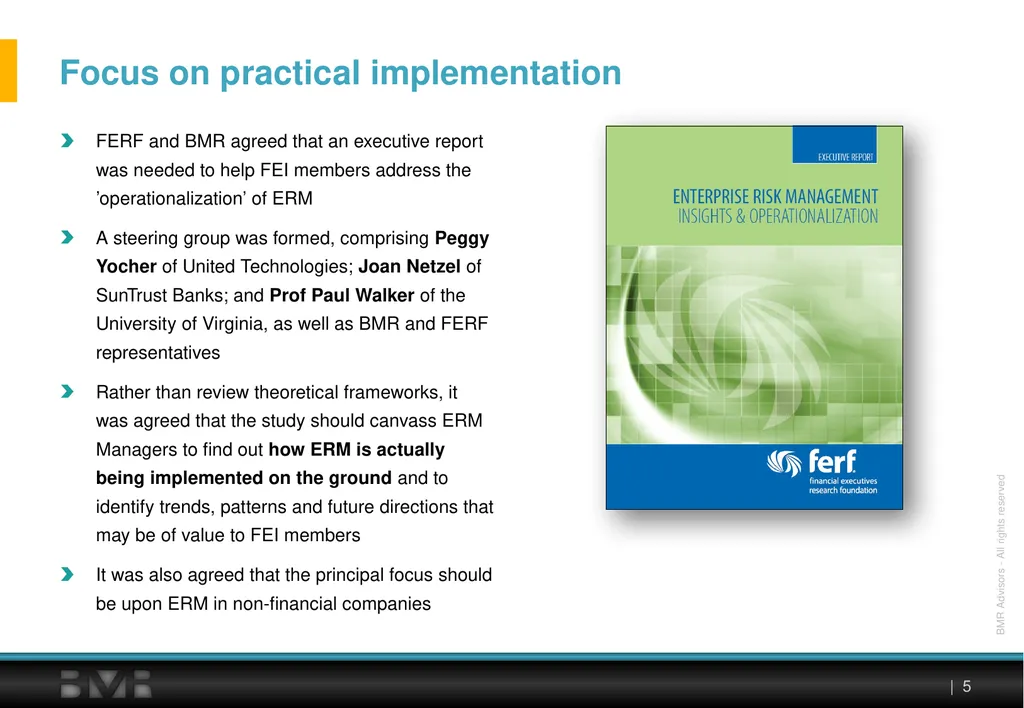
Focus on practical implementation FERF and BMR agreed that an executive report was needed to help FEI members address the ’operationalization’ of ERM
A steering group was formed, comprising Peggy Yocher of United Technologies; Joan Netzel of SunTrust Banks; and Prof Paul Walker of the University of Virginia, as well as BMR and FERF representatives
Rather than review theoretical frameworks, it was agreed that the study should canvass ERM Managers to find out how ERM is actually being implemented on the ground and to identify trends, patterns and future directions that may be of value to FEI members
It was also agreed that the principal focus should be upon ERM in non-financial companies | 5<br>
06
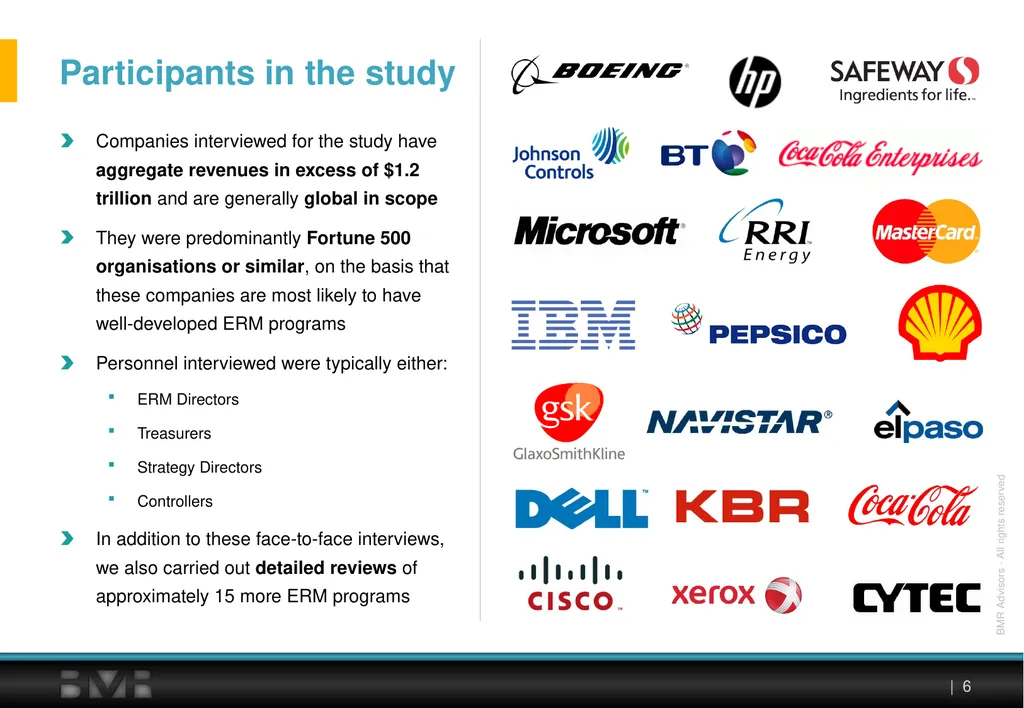
Participants in the study Companies interviewed for the study have aggregate revenues in excess of $1.2 trillion and are generally global in scope
They were predominantly Fortune 500 organisations or similar, on the basis that these companies are most likely to have well-developed ERM programs
Personnel interviewed were typically either:
ERM Directors
Treasurers
Strategy Directors
Controllers
In addition to these face-to-face interviews, we also carried out detailed reviews of approximately 15 more ERM programs | 6<br>
07
Key findings 1. Current state of ERM implementation 2. Two types of ERM program 3. Organization of ERM programs 4. Operationalization of ERM<br>
08
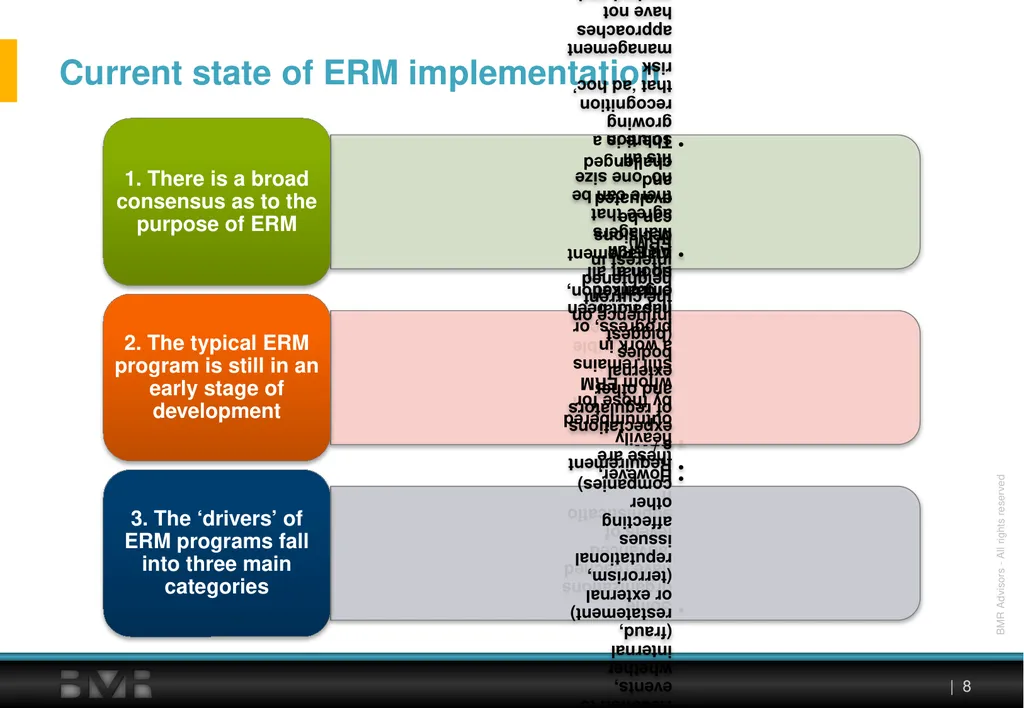
Current state of ERM implementation | 8<br>
09
Key findings 1. Current state of ERM implementation 2. Two types of ERM program 3. Organization of ERM programs 4. Operationalization of ERM<br>
10
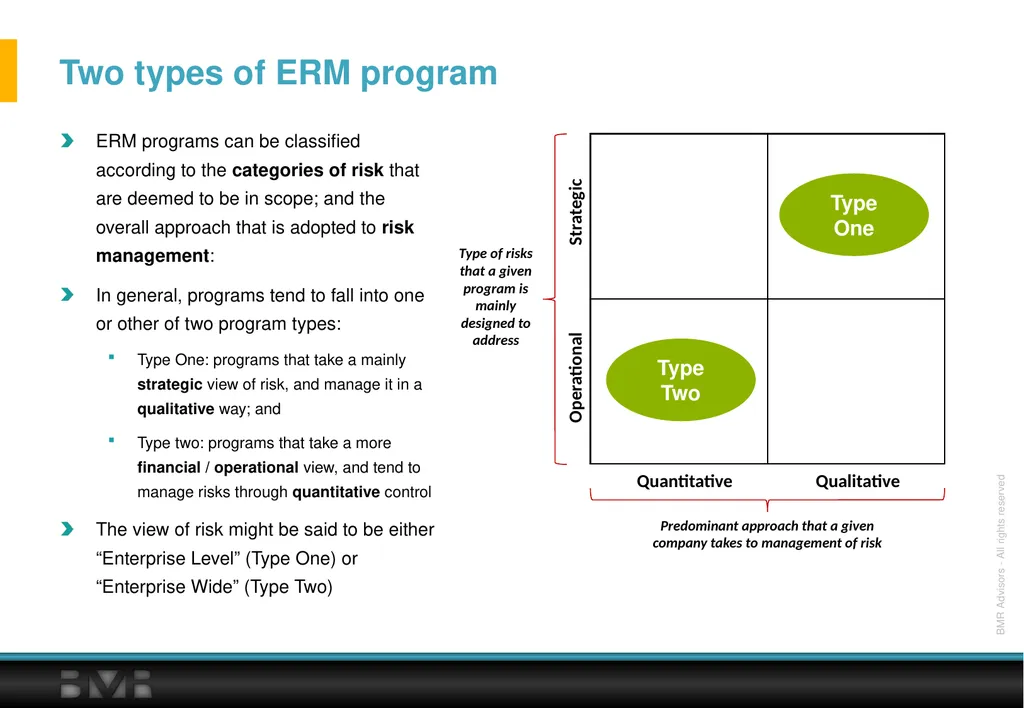
Two types of ERM program ERM programs can be classified according to the categories of risk that are deemed to be in scope; and the overall approach that is adopted to risk management:
In general, programs tend to fall into one or other of two program types:
Type One: programs that take a mainly strategic view of risk, and manage it in a qualitative way; and
Type two: programs that take a more financial / operational view, and tend to manage risks through quantitative control
The view of risk might be said to be either “Enterprise Level” (Type One) or “Enterprise Wide” (Type Two) Quantitative Qualitative Operational Strategic Type One Type Two Type of risks that a given program is mainly designed to address Predominant approach that a given company takes to management of risk<br>
11
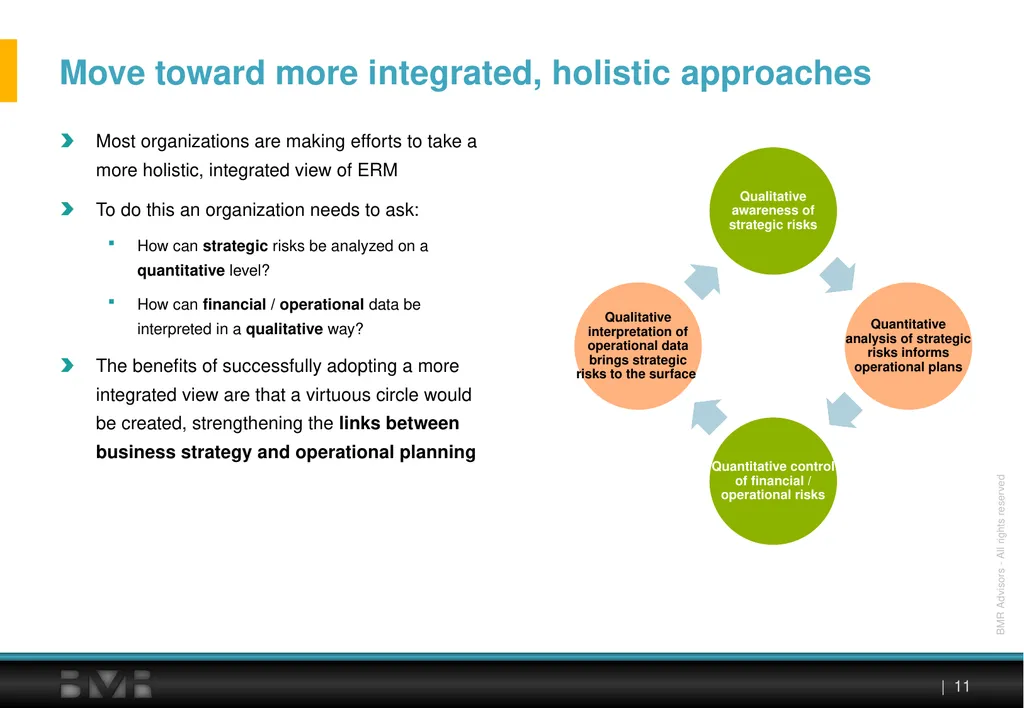
Move toward more integrated, holistic approaches Most organizations are making efforts to take a more holistic, integrated view of ERM
To do this an organization needs to ask:
How can strategic risks be analyzed on a quantitative level?
How can financial / operational data be interpreted in a qualitative way?
The benefits of successfully adopting a more integrated view are that a virtuous circle would be created, strengthening the links between business strategy and operational planning | 11<br>
12
Key findings 1. Current state of ERM implementation 2. Two types of ERM program 3. Organization of ERM programs 4. Operationalization of ERM<br>
13
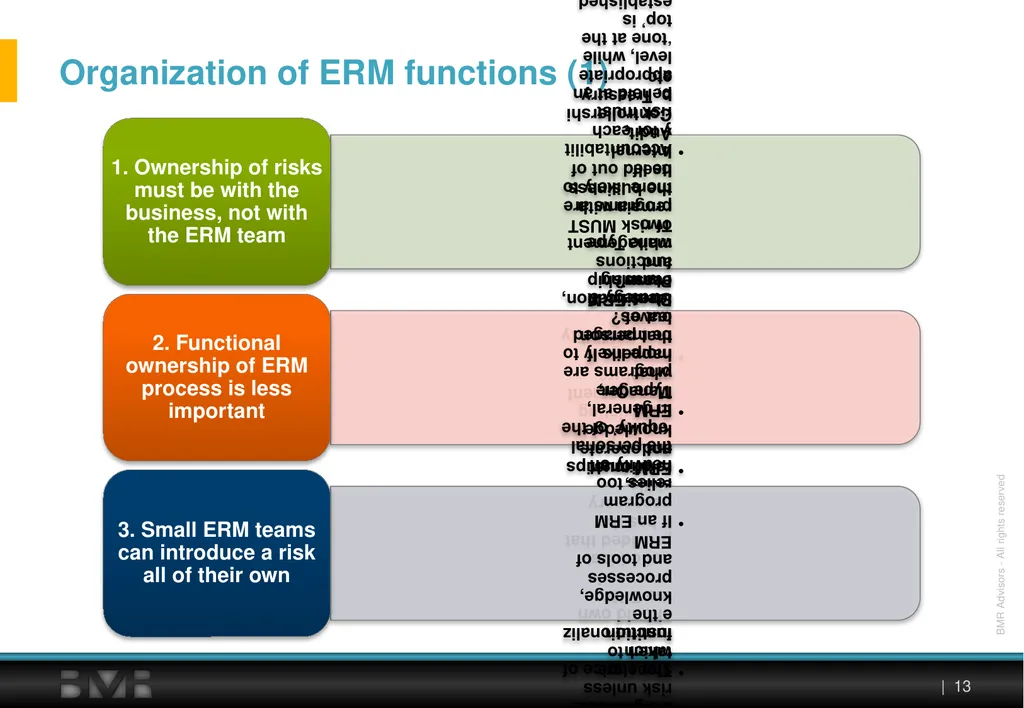
Organization of ERM functions (1) | 13<br>
14
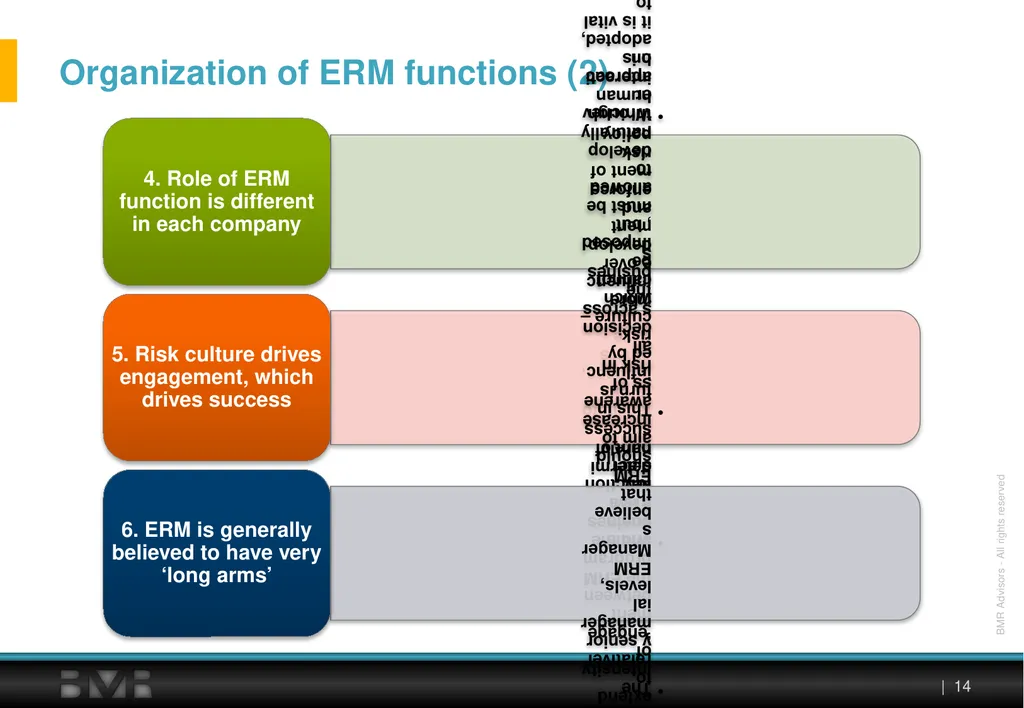
Organization of ERM functions (2) | 14<br>
15
Key findings 1. Current state of ERM implementation 2. Two types of ERM program 3. Organization of ERM programs 4. Operationalization of ERM<br>
16
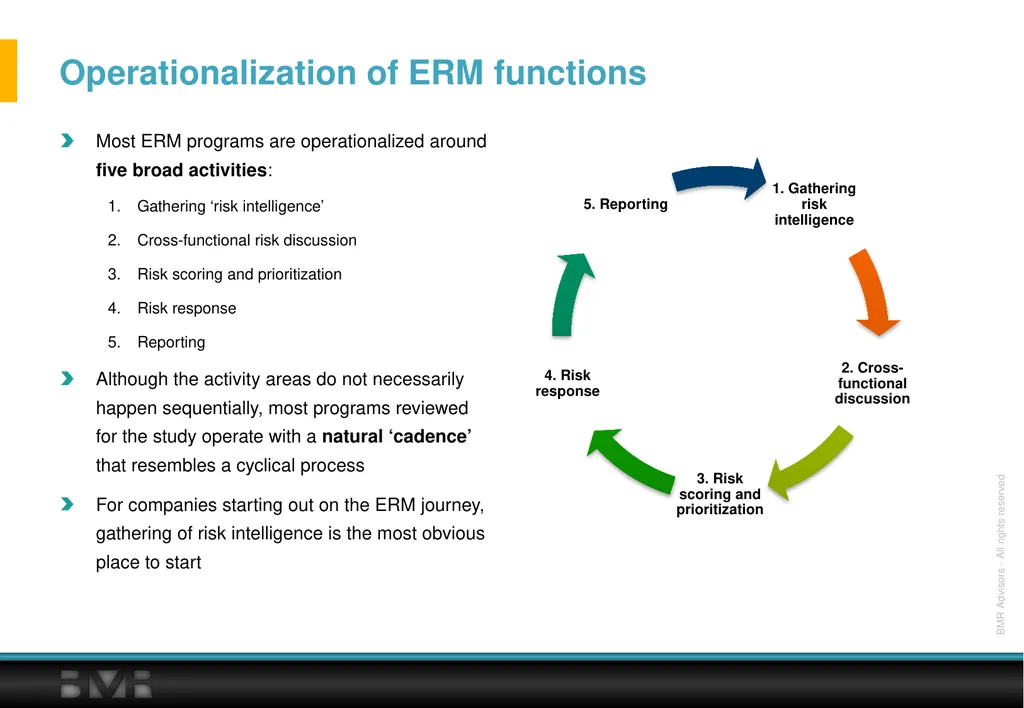
Operationalization of ERM functions Most ERM programs are operationalized around five broad activities:
Gathering ‘risk intelligence’
Cross-functional risk discussion
Risk scoring and prioritization
Risk response
Reporting
Although the activity areas do not necessarily happen sequentially, most programs reviewed for the study operate with a natural ‘cadence’ that resembles a cyclical process
For companies starting out on the ERM journey, gathering of risk intelligence is the most obvious place to start<br>
17
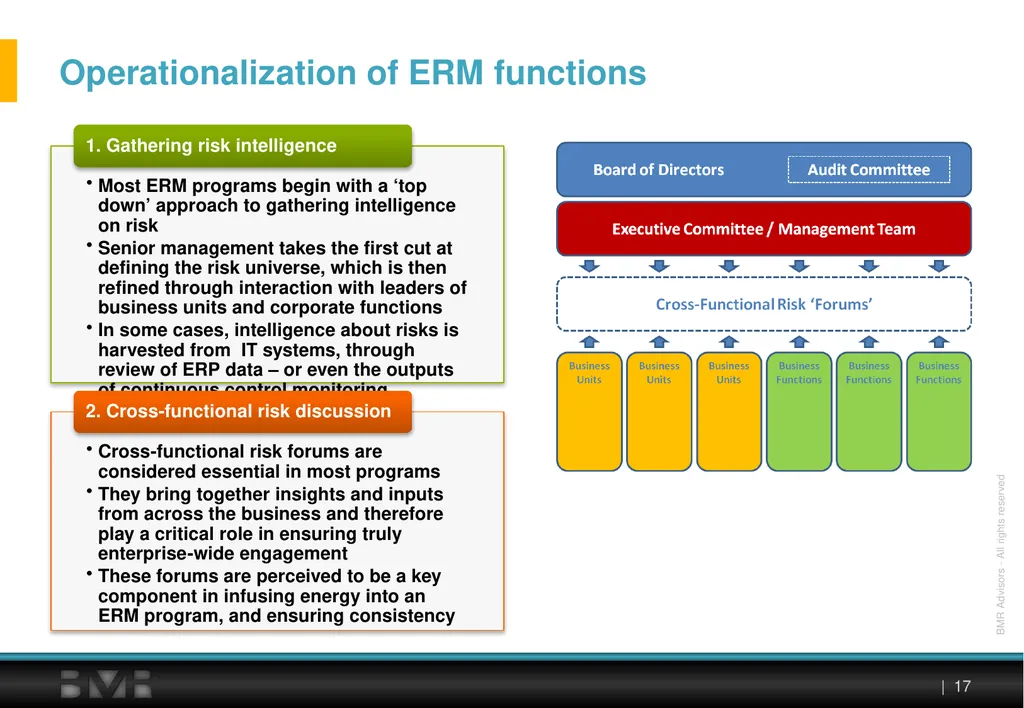
Operationalization of ERM functions | 17<br>
18
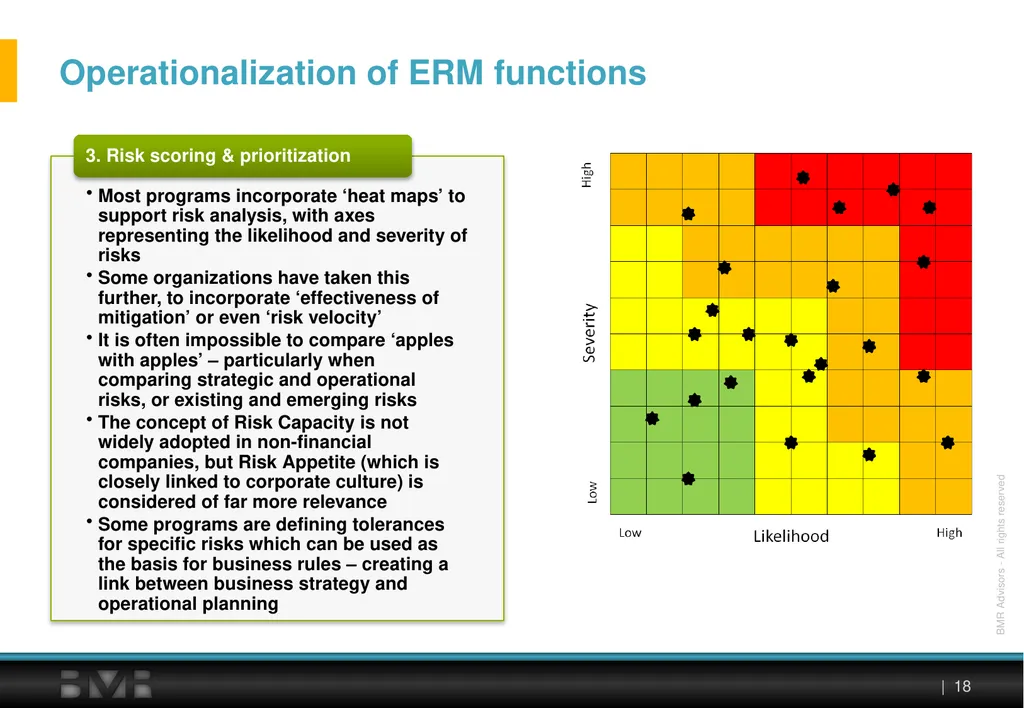
Operationalization of ERM functions | 18<br>
19
Operationalization of ERM functions | 19<br>
20
Open questions<br>
21
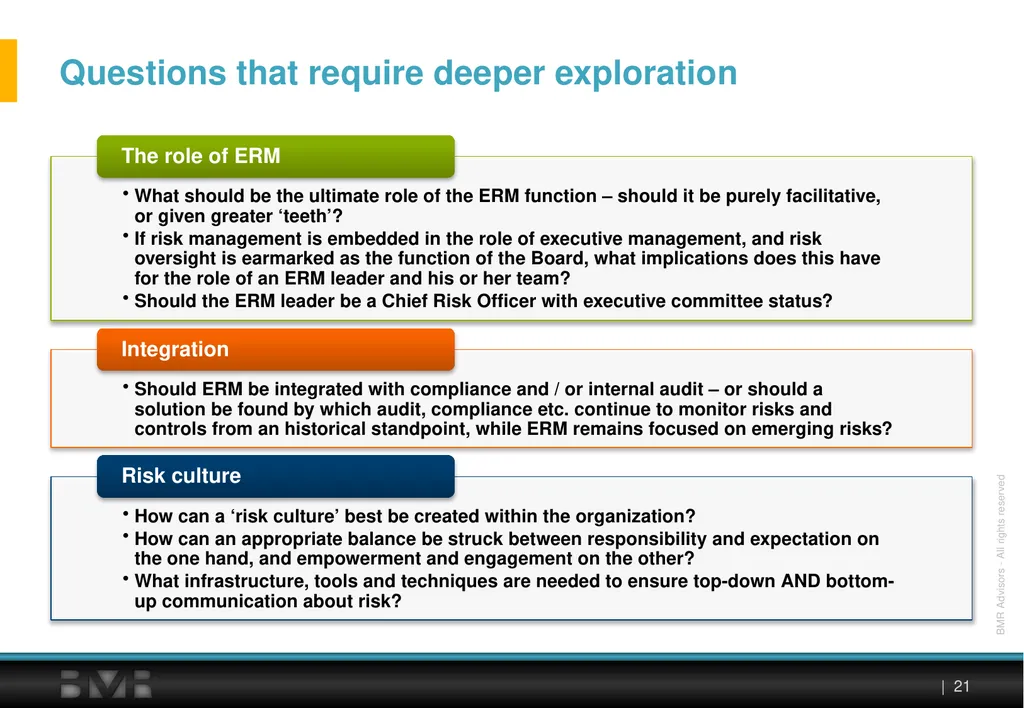
Questions that require deeper exploration | 21<br>
22
Next steps<br>
23
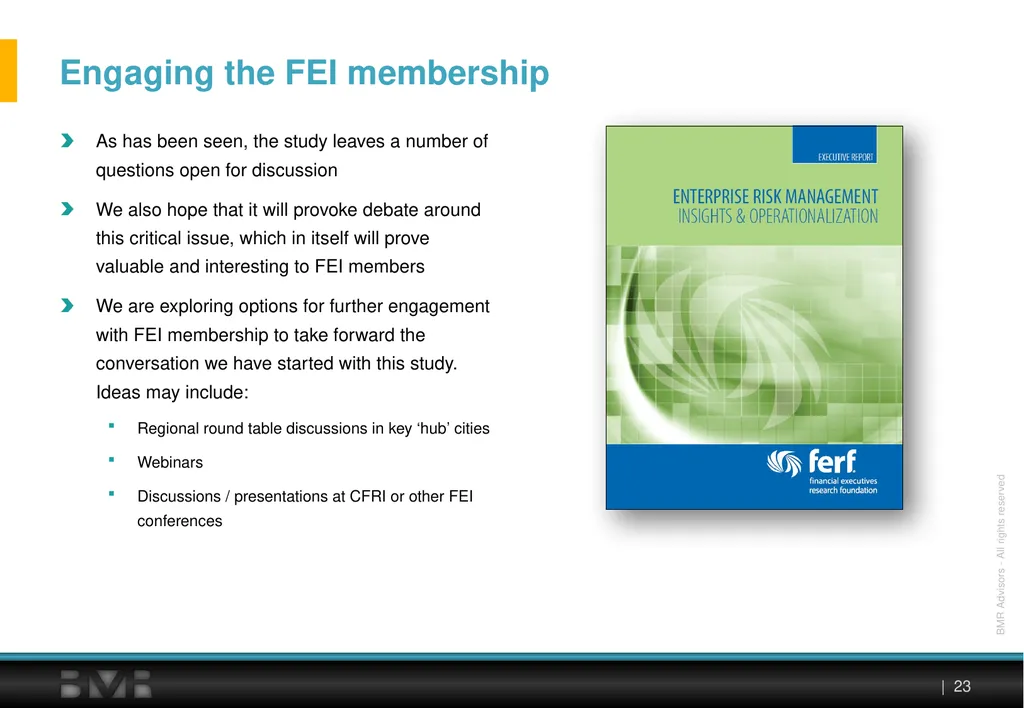
Engaging the FEI membership As has been seen, the study leaves a number of questions open for discussion
We also hope that it will provoke debate around this critical issue, which in itself will prove valuable and interesting to FEI members
We are exploring options for further engagement with FEI membership to take forward the conversation we have started with this study. Ideas may include:
Regional round table discussions in key ‘hub’ cities
Webinars
Discussions / presentations at CFRI or other FEI conferences | 23<br>
24
About BMR<br>
25
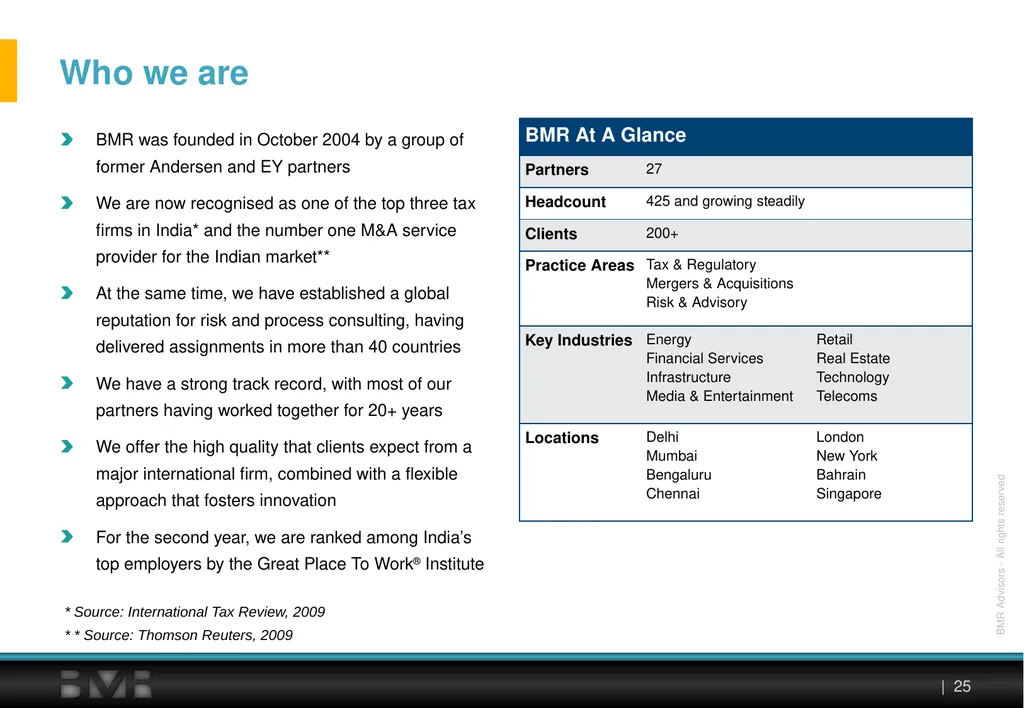
Who we are BMR was founded in October 2004 by a group of former Andersen and EY partners
We are now recognised as one of the top three tax firms in India* and the number one M&A service provider for the Indian market**
At the same time, we have established a global reputation for risk and process consulting, having delivered assignments in more than 40 countries
We have a strong track record, with most of our partners having worked together for 20+ years
We offer the high quality that clients expect from a major international firm, combined with a flexible approach that fosters innovation
For the second year, we are ranked among India’s top employers by the Great Place To Work® Institute * Source: International Tax Review, 2009 * * Source: Thomson Reuters, 2009 | 25<br>
26
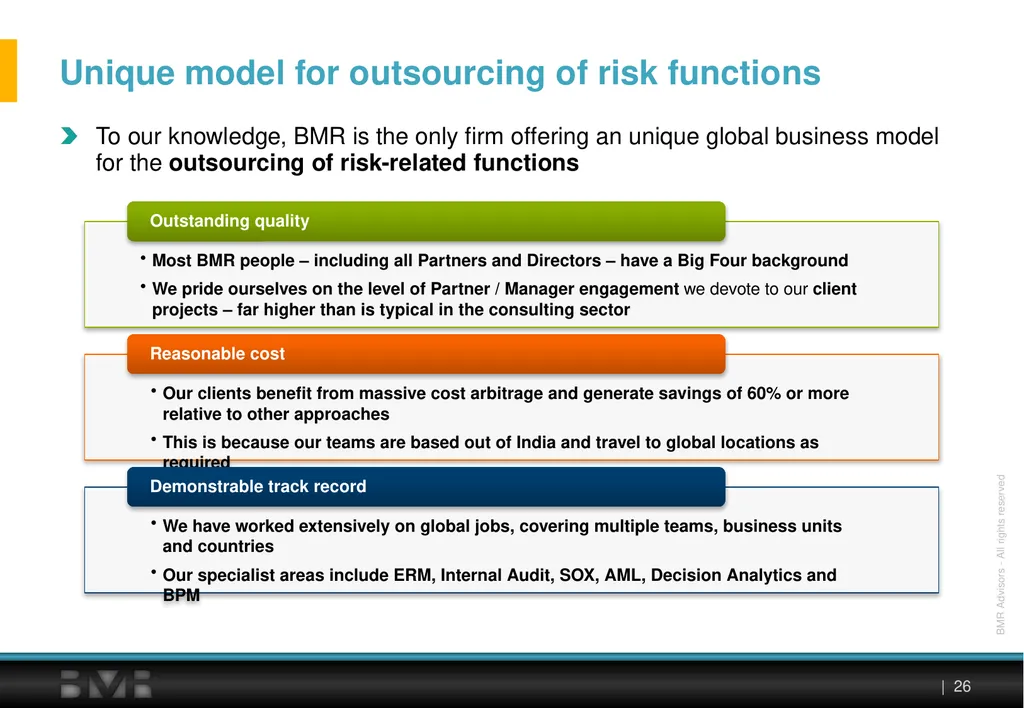
Unique model for outsourcing of risk functions | 26 To our knowledge, BMR is the only firm offering an unique global business model for the outsourcing of risk-related functions<br>