
Entrepreneur Local Learning Centers SEMINAR 19:



Description: Entrepreneur Local Learning Centers SEMINAR 19: THE ART OF NEGOTIATION In seminar 6: How to sell, we introduced you to the seven steps for success in sales. This Seminar will go more in-depth on the last three steps than in the previous
Related Topics
Download Presentation
"Entrepreneur Local Learning Centers SEMINAR 19:" is the property of its rightful owner. Permission is granted to download and print the materials on this website for personal, non-commercial use only, and to display it on your personal computer provided you do not modify the materials and that you retain all copyright notices contained in the materials. By downloading content from our website, you accept the terms of this agreement.
Presentation Transcript
slide1. Entrepreneur
Local Learning Centers<br>
slide2. SEMINAR 19: THE ART OF NEGOTIATION In seminar 6: How to sell, we introduced you to the seven steps for success in sales.
This Seminar will go more in-depth on the last three steps than in the previous seminar: finding a solution, negotiating, and closing.<br>
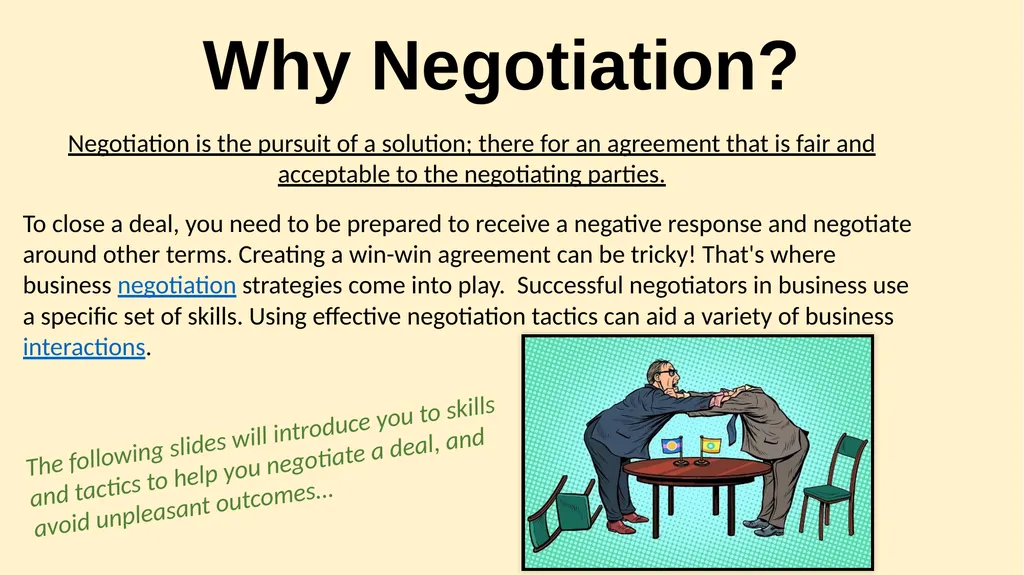
slide3. Why Negotiation? Negotiation is the pursuit of a solution; there for an agreement that is fair and acceptable to the negotiating parties. The following slides will introduce you to skills and tactics to help you negotiate a deal, and avoid unpleasant outcomes… To close a deal, you need to be prepared to receive a negative response and negotiate around other terms. Creating a win-win agreement can be tricky! That's where business negotiation strategies come into play. Successful negotiators in business use a specific set of skills. Using effective negotiation tactics can aid a variety of business interactions.<br>
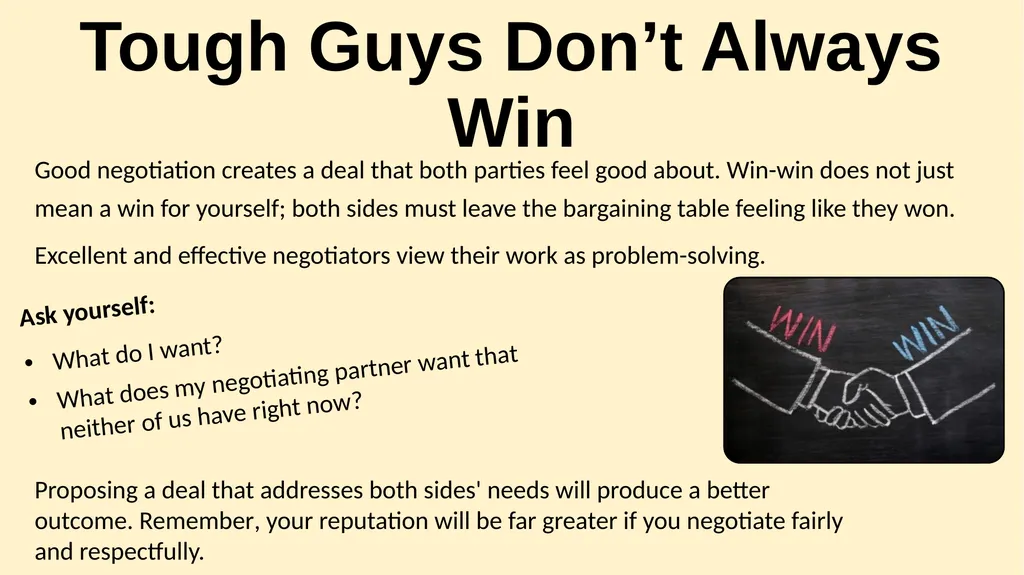
slide4. Tough Guys Don’t Always Win Good negotiation creates a deal that both parties feel good about. Win-win does not just mean a win for yourself; both sides must leave the bargaining table feeling like they won.
Excellent and effective negotiators view their work as problem-solving. Ask yourself:
What do I want?
What does my negotiating partner want that neither of us have right now? Proposing a deal that addresses both sides' needs will produce a better outcome. Remember, your reputation will be far greater if you negotiate fairly and respectfully.<br>
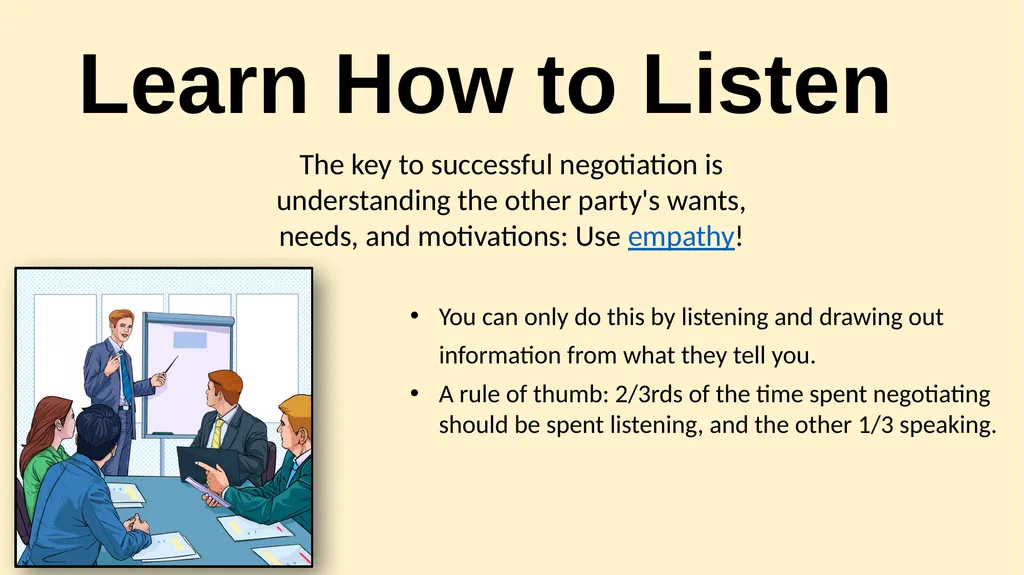
slide5. Learn How to Listen The key to successful negotiation is understanding the other party's wants, needs, and motivations: Use empathy! You can only do this by listening and drawing out information from what they tell you.
A rule of thumb: 2/3rds of the time spent negotiating should be spent listening, and the other 1/3 speaking.<br>
slide6. Playing Fair In negotiations, the goal is to be fair and honest. If both parties can understand this and be empathetic to the other’s needs, both stand to benefit far more.
A run for the money, business resources, or a “dog eat dog” deal isn’t an actual negotiation.
In any negotiation, each side must be ready to concede reasonably. Don’t forget to express appreciation for the other party and what they bring to the discussion.
Be open, fair, and honest; this attitude will gain you the most from business negotiations.<br>
slide7. Find the Best Alternative to a Negotiated Agreement (BATNA) In other words, what is the best you can get if the other person refuses to negotiate? This is not necessarily your ideal result! This is your alternate plan when the talks start to get out of control. You need to define your best alternative to a negotiated agreement beforehand. It provides an option (plan B) if negotiations fall through.
It determines your walk-away point (the worst price you are willing to accept) and helps us make rational decisions during negotiations.<br>
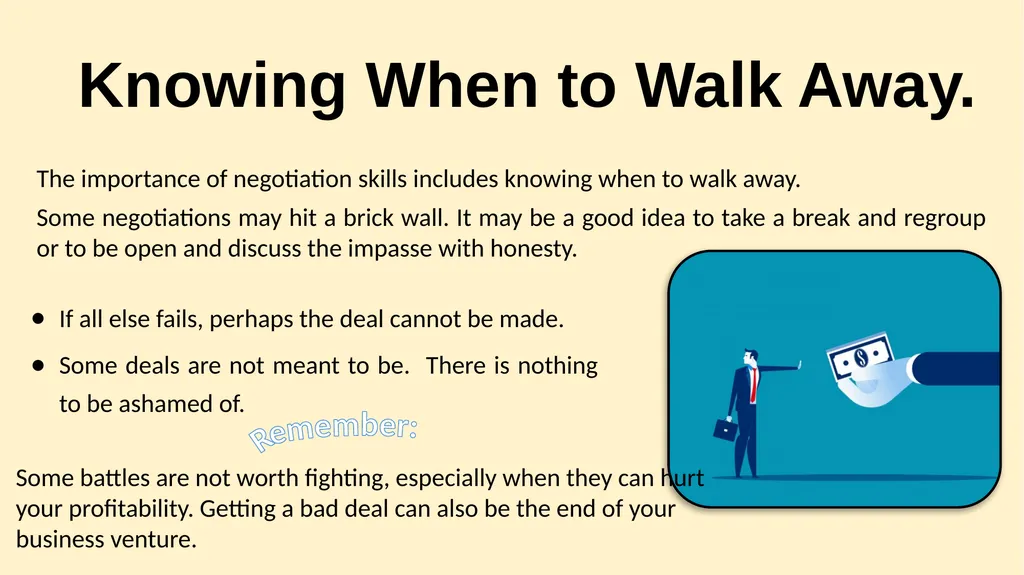
slide8. Knowing When to Walk Away. The importance of negotiation skills includes knowing when to walk away.
Some negotiations may hit a brick wall. It may be a good idea to take a break and regroup or to be open and discuss the impasse with honesty. If all else fails, perhaps the deal cannot be made.
Some deals are not meant to be. There is nothing to be ashamed of. Some battles are not worth fighting, especially when they can hurt your profitability. Getting a bad deal can also be the end of your business venture. Remember:<br>
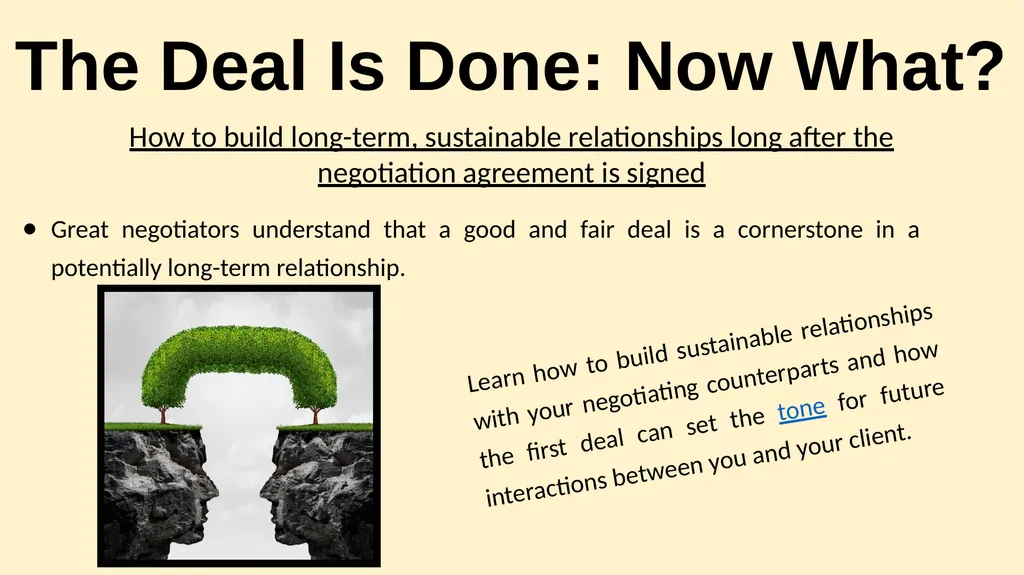
slide9. The Deal Is Done: Now What? How to build long-term, sustainable relationships long after the negotiation agreement is signed Great negotiators understand that a good and fair deal is a cornerstone in a potentially long-term relationship. Learn how to build sustainable relationships with your negotiating counterparts and how the first deal can set the tone for future interactions between you and your client.<br>
slide10. TRUE OR FALSE You need to be tough, impose your rules and ways, and only think about what’s good for business and negotiation.<br>
slide11. Click here to continue. Congratulations, you are correct! You need to listen and find a win-win solution!<br>
slide12. Sorry. Please try again. Click here to try again.<br>
slide13. TRUE OR FALSE A bad deal means that I will only lose money.<br>
slide14. Click here to continue. Congratulations, you are correct! A bad deal can also mean losing a potential opportunity in the future, and a bad reputation.<br>
slide15. Sorry. Please try again. Click here to try again.<br>
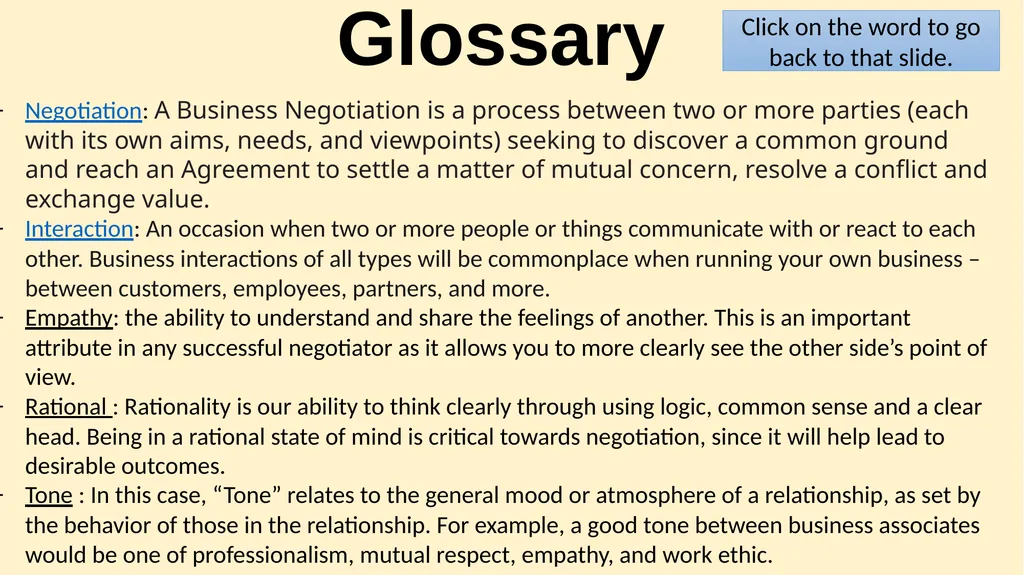
slide16. Glossary Click on the word to go back to that slide. Negotiation: A Business Negotiation is a process between two or more parties (each with its own aims, needs, and viewpoints) seeking to discover a common ground and reach an Agreement to settle a matter of mutual concern, resolve a conflict and exchange value.
Interaction: An occasion when two or more people or things communicate with or react to each other. Business interactions of all types will be commonplace when running your own business – between customers, employees, partners, and more.
Empathy: the ability to understand and share the feelings of another. This is an important attribute in any successful negotiator as it allows you to more clearly see the other side’s point of view.
Rational : Rationality is our ability to think clearly through using logic, common sense and a clear head. Being in a rational state of mind is critical towards negotiation, since it will help lead to desirable outcomes.
Tone : In this case, “Tone” relates to the general mood or atmosphere of a relationship, as set by the behavior of those in the relationship. For example, a good tone between business associates would be one of professionalism, mutual respect, empathy, and work ethic.<br>
slide17. Congratulations, you have completed this module! The next Module will be: What Are Joint Ventures<br>
slide2. SEMINAR 19: THE ART OF NEGOTIATION In seminar 6: How to sell, we introduced you to the seven steps for success in sales.
This Seminar will go more in-depth on the last three steps than in the previous seminar: finding a solution, negotiating, and closing.<br>
slide3. Why Negotiation? Negotiation is the pursuit of a solution; there for an agreement that is fair and acceptable to the negotiating parties. The following slides will introduce you to skills and tactics to help you negotiate a deal, and avoid unpleasant outcomes… To close a deal, you need to be prepared to receive a negative response and negotiate around other terms. Creating a win-win agreement can be tricky! That's where business negotiation strategies come into play. Successful negotiators in business use a specific set of skills. Using effective negotiation tactics can aid a variety of business interactions.<br>
slide4. Tough Guys Don’t Always Win Good negotiation creates a deal that both parties feel good about. Win-win does not just mean a win for yourself; both sides must leave the bargaining table feeling like they won.
Excellent and effective negotiators view their work as problem-solving. Ask yourself:
What do I want?
What does my negotiating partner want that neither of us have right now? Proposing a deal that addresses both sides' needs will produce a better outcome. Remember, your reputation will be far greater if you negotiate fairly and respectfully.<br>
slide5. Learn How to Listen The key to successful negotiation is understanding the other party's wants, needs, and motivations: Use empathy! You can only do this by listening and drawing out information from what they tell you.
A rule of thumb: 2/3rds of the time spent negotiating should be spent listening, and the other 1/3 speaking.<br>
slide6. Playing Fair In negotiations, the goal is to be fair and honest. If both parties can understand this and be empathetic to the other’s needs, both stand to benefit far more.
A run for the money, business resources, or a “dog eat dog” deal isn’t an actual negotiation.
In any negotiation, each side must be ready to concede reasonably. Don’t forget to express appreciation for the other party and what they bring to the discussion.
Be open, fair, and honest; this attitude will gain you the most from business negotiations.<br>
slide7. Find the Best Alternative to a Negotiated Agreement (BATNA) In other words, what is the best you can get if the other person refuses to negotiate? This is not necessarily your ideal result! This is your alternate plan when the talks start to get out of control. You need to define your best alternative to a negotiated agreement beforehand. It provides an option (plan B) if negotiations fall through.
It determines your walk-away point (the worst price you are willing to accept) and helps us make rational decisions during negotiations.<br>
slide8. Knowing When to Walk Away. The importance of negotiation skills includes knowing when to walk away.
Some negotiations may hit a brick wall. It may be a good idea to take a break and regroup or to be open and discuss the impasse with honesty. If all else fails, perhaps the deal cannot be made.
Some deals are not meant to be. There is nothing to be ashamed of. Some battles are not worth fighting, especially when they can hurt your profitability. Getting a bad deal can also be the end of your business venture. Remember:<br>
slide9. The Deal Is Done: Now What? How to build long-term, sustainable relationships long after the negotiation agreement is signed Great negotiators understand that a good and fair deal is a cornerstone in a potentially long-term relationship. Learn how to build sustainable relationships with your negotiating counterparts and how the first deal can set the tone for future interactions between you and your client.<br>
slide10. TRUE OR FALSE You need to be tough, impose your rules and ways, and only think about what’s good for business and negotiation.<br>
slide11. Click here to continue. Congratulations, you are correct! You need to listen and find a win-win solution!<br>
slide12. Sorry. Please try again. Click here to try again.<br>
slide13. TRUE OR FALSE A bad deal means that I will only lose money.<br>
slide14. Click here to continue. Congratulations, you are correct! A bad deal can also mean losing a potential opportunity in the future, and a bad reputation.<br>
slide15. Sorry. Please try again. Click here to try again.<br>
slide16. Glossary Click on the word to go back to that slide. Negotiation: A Business Negotiation is a process between two or more parties (each with its own aims, needs, and viewpoints) seeking to discover a common ground and reach an Agreement to settle a matter of mutual concern, resolve a conflict and exchange value.
Interaction: An occasion when two or more people or things communicate with or react to each other. Business interactions of all types will be commonplace when running your own business – between customers, employees, partners, and more.
Empathy: the ability to understand and share the feelings of another. This is an important attribute in any successful negotiator as it allows you to more clearly see the other side’s point of view.
Rational : Rationality is our ability to think clearly through using logic, common sense and a clear head. Being in a rational state of mind is critical towards negotiation, since it will help lead to desirable outcomes.
Tone : In this case, “Tone” relates to the general mood or atmosphere of a relationship, as set by the behavior of those in the relationship. For example, a good tone between business associates would be one of professionalism, mutual respect, empathy, and work ethic.<br>
slide17. Congratulations, you have completed this module! The next Module will be: What Are Joint Ventures<br>