04
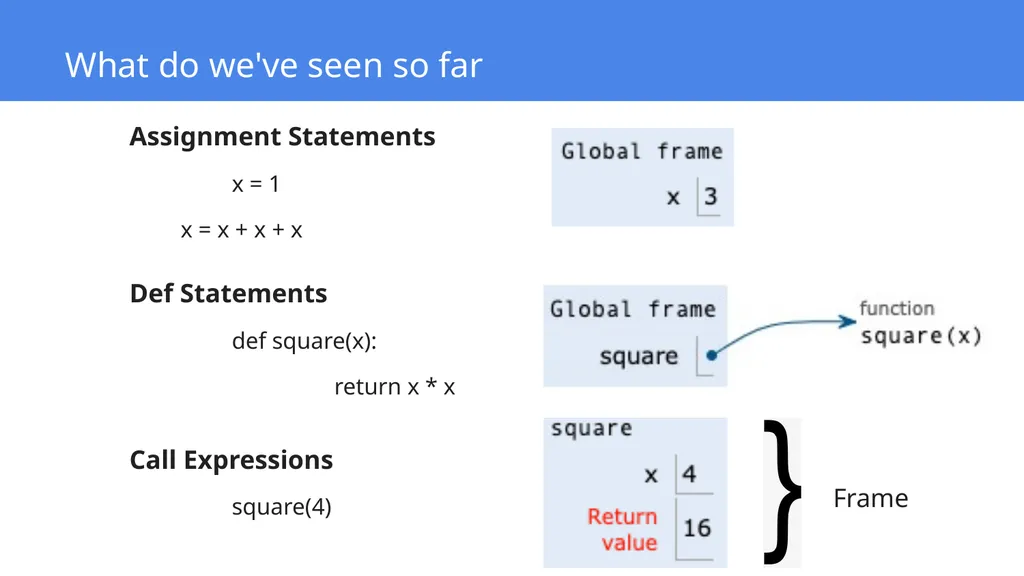
What do we've seen so far Assignment Statements
x = 1
x = x + x + x Def Statements
def square(x):
return x * x Call Expressions
square(4) Frame<br>
05
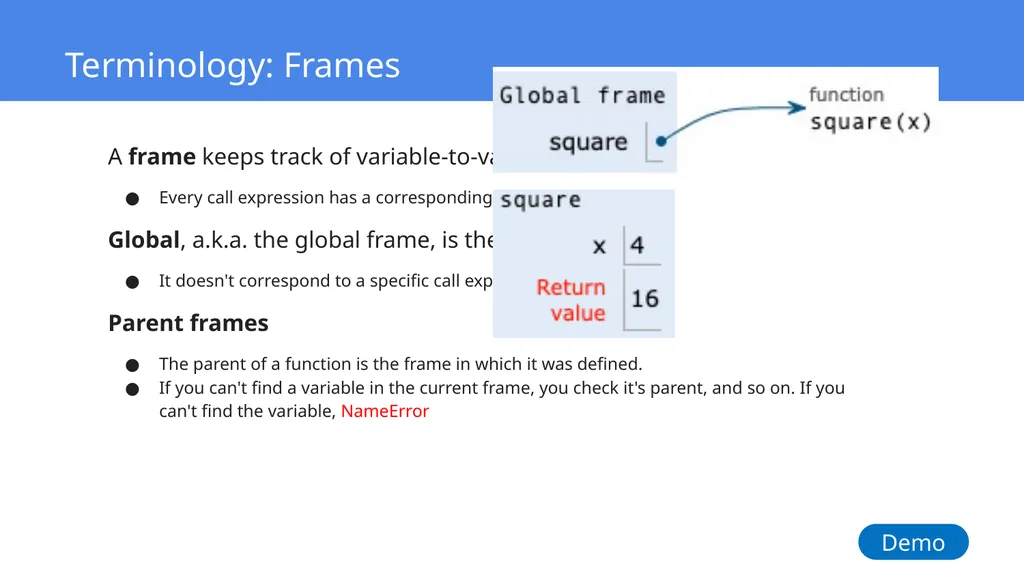
Terminology: Frames A frame keeps track of variable-to-value bindings.
Every call expression has a corresponding frame.
Global, a.k.a. the global frame, is the starting frame.
It doesn't correspond to a specific call expression.
Parent frames
The parent of a function is the frame in which it was defined.
If you can't find a variable in the current frame, you check it's parent, and so on. If you can't find the variable, NameError Demo<br>
06
How to draw an Environment Diagram When a function is defined:
Create a function value:
func <name>(<formal parameters>) [parent=<label>]
Bind <name> to the function value in the current frame Its parent is the current frame. def add_one(x):� y = x + 1� return y Bind the name to the function value Create a function value<br>
07
How to draw an Environment Diagram def add_one(x):� y = x + 1� return y�add_one(4) When a function is applied:
Add a local frame, titled with the <name> of the function being applied.
Copy the parent of the function (not always the current frame) to the local frame: [parent=<label>]
Bind the <formal parameters> to the arguments in the local frame.
Execute the body of the function in the environment that starts with the local frame Create a new frame with name and parent Bind the formal parameters Execute the body of the function Demo<br>
08
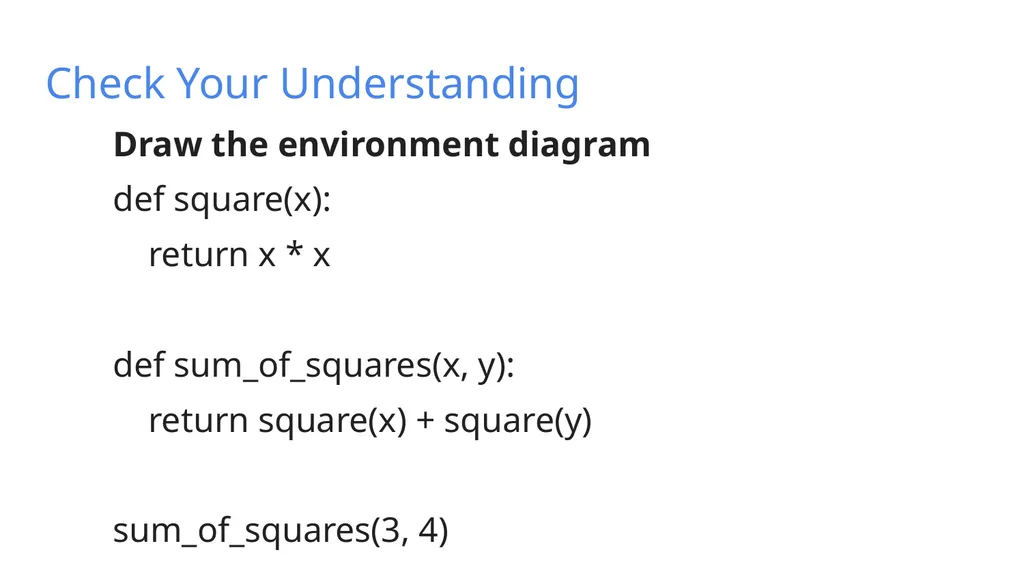
Draw the environment diagram
def square(x):
return x * x
def sum_of_squares(x, y):
return square(x) + square(y)
sum_of_squares(3, 4) Check Your Understanding<br>
09
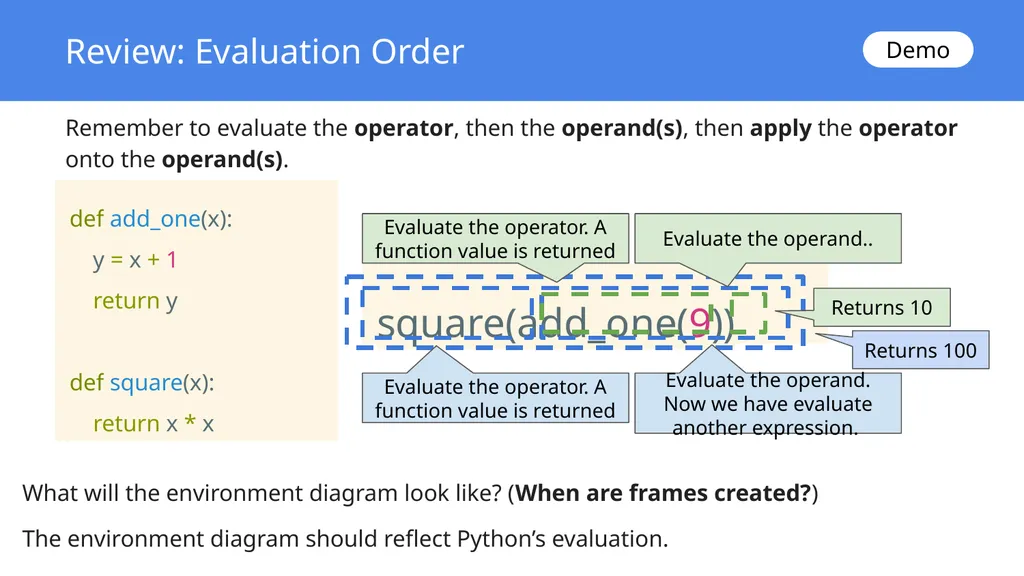
square(add_one(9)) Review: Evaluation Order def add_one(x):� y = x + 1� return y��def square(x):� return x * x Remember to evaluate the operator, then the operand(s), then apply the operator onto the operand(s). What will the environment diagram look like? (When are frames created?)
The environment diagram should reflect Python’s evaluation. Evaluate the operator. A function value is returned Evaluate the operand. Now we have evaluate another expression. Evaluate the operator. A function value is returned Evaluate the operand.. Returns 10 Returns 100 Demo<br>
11
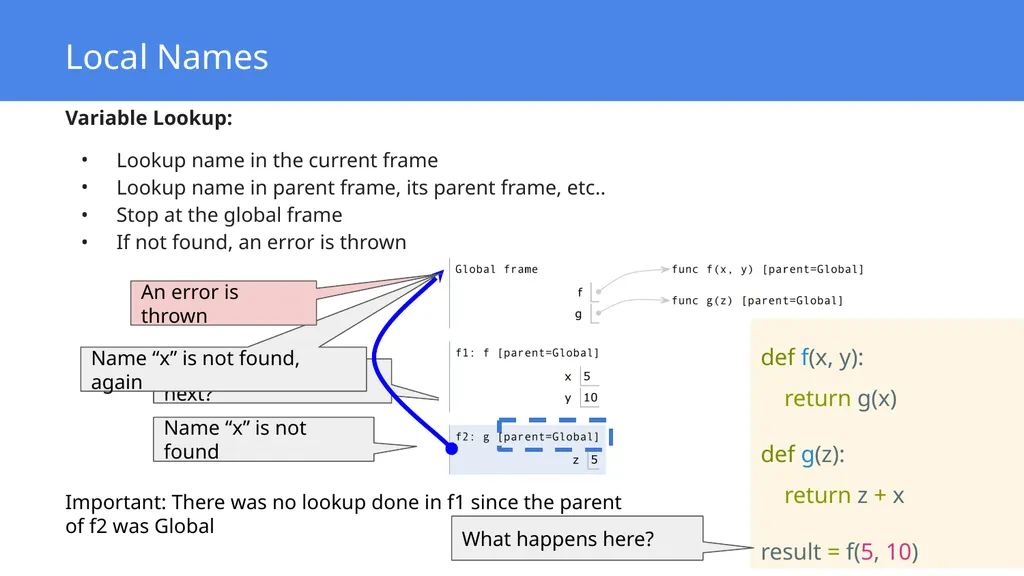
Where do we look next? Local Names Variable Lookup:
Lookup name in the current frame
Lookup name in parent frame, its parent frame, etc..
Stop at the global frame
If not found, an error is thrown def f(x, y):� return g(x)��def g(z):� return z + x��result = f(5, 10) Name “x” is not found Name “x” is not found, again An error is thrown What happens here? Important: There was no lookup done in f1 since the parent of f2 was Global<br>
12
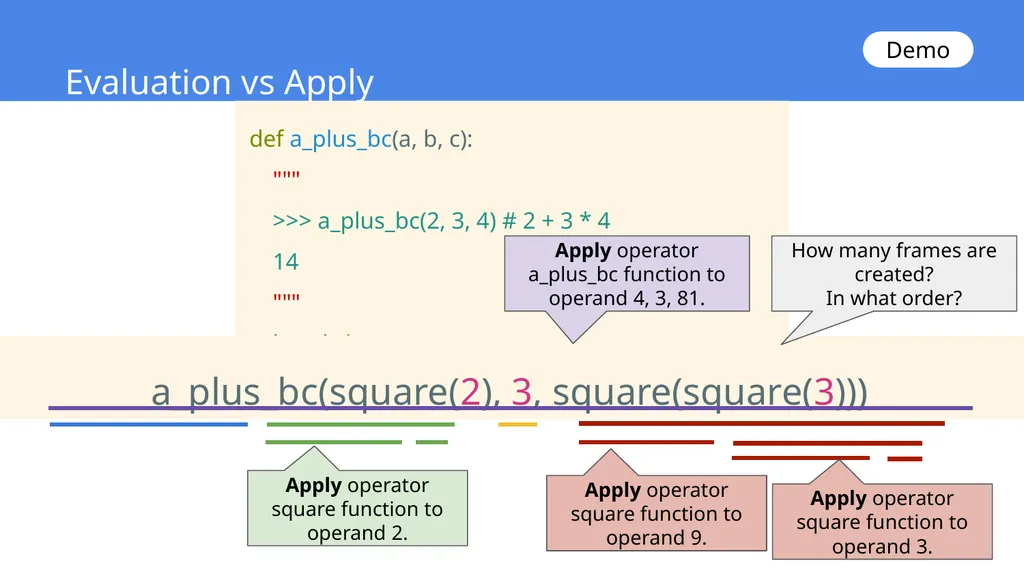
Evaluation vs Apply def a_plus_bc(a, b, c):� """� >>> a_plus_bc(2, 3, 4) # 2 + 3 * 4� 14� """� bc = b * c� return a + bc a_plus_bc(square(2), 3, square(square(3))) Demo How many frames are created?�In what order? Apply operator square function to operand 2. Apply operator square function to operand 3. Apply operator square function to operand 9. Apply operator a_plus_bc function to operand 4, 3, 81.<br>
14
Lambda Expressions<br>
15
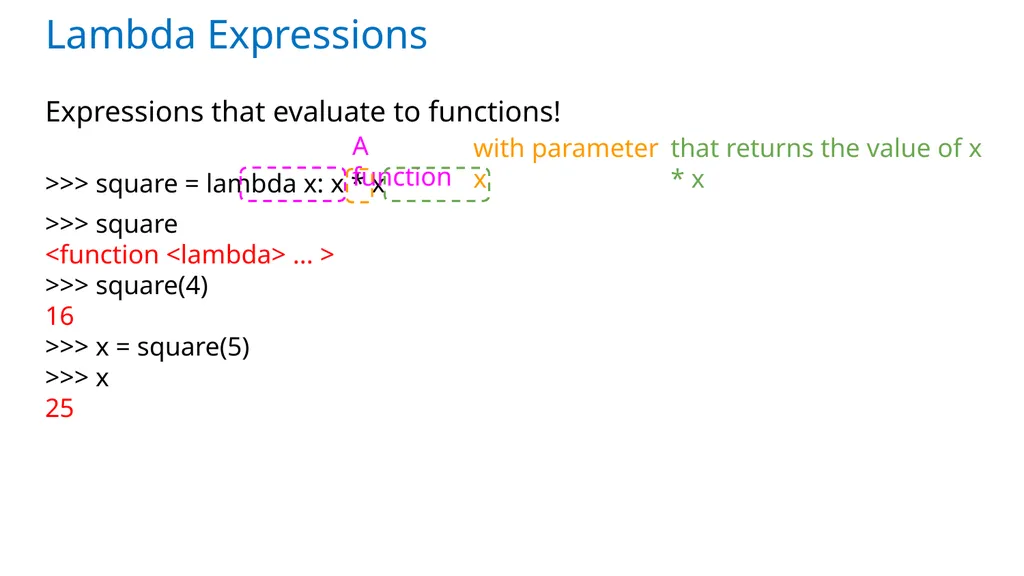
Lambda Expressions Expressions that evaluate to functions! >>> square = lambda x: x * x >>> square
<function <lambda> ... >
>>> square(4)
16
>>> x = square(5)
>>> x
25<br>
16
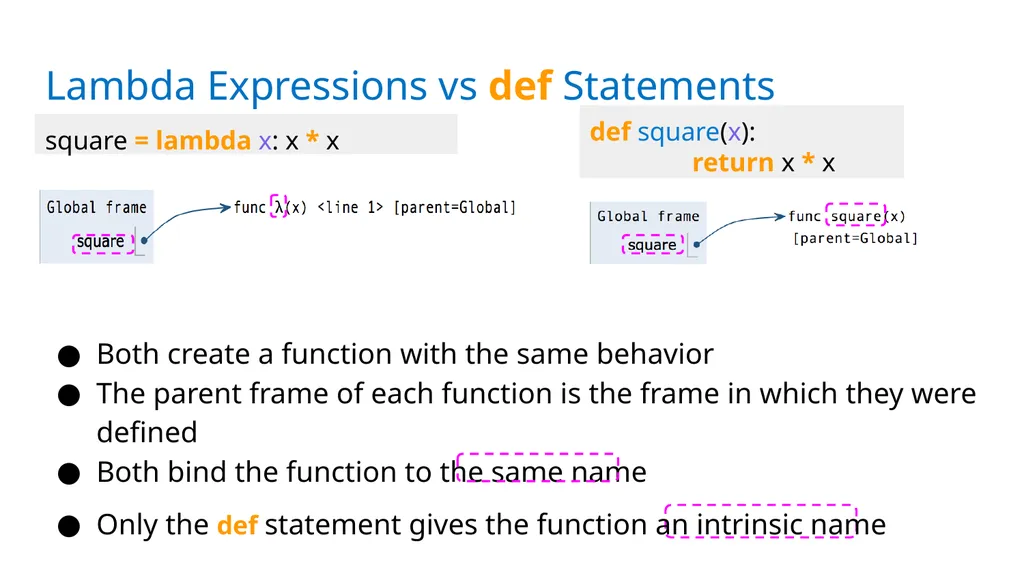
Lambda Expressions vs def Statements Both create a function with the same behavior
The parent frame of each function is the frame in which they were defined
Both bind the function to the same name def square(x):
return x * x square = lambda x: x * x Only the def statement gives the function an intrinsic name<br>
17
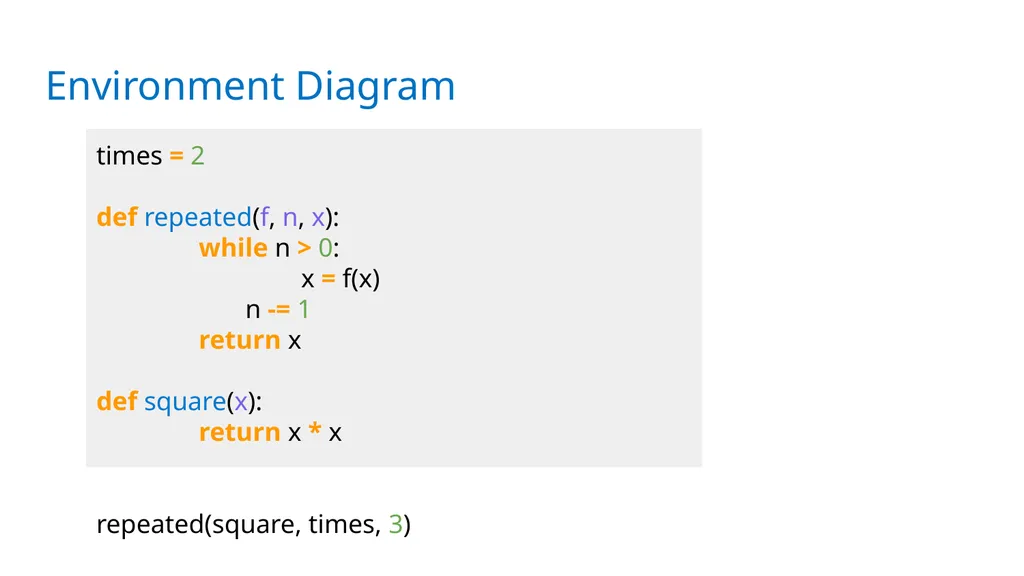
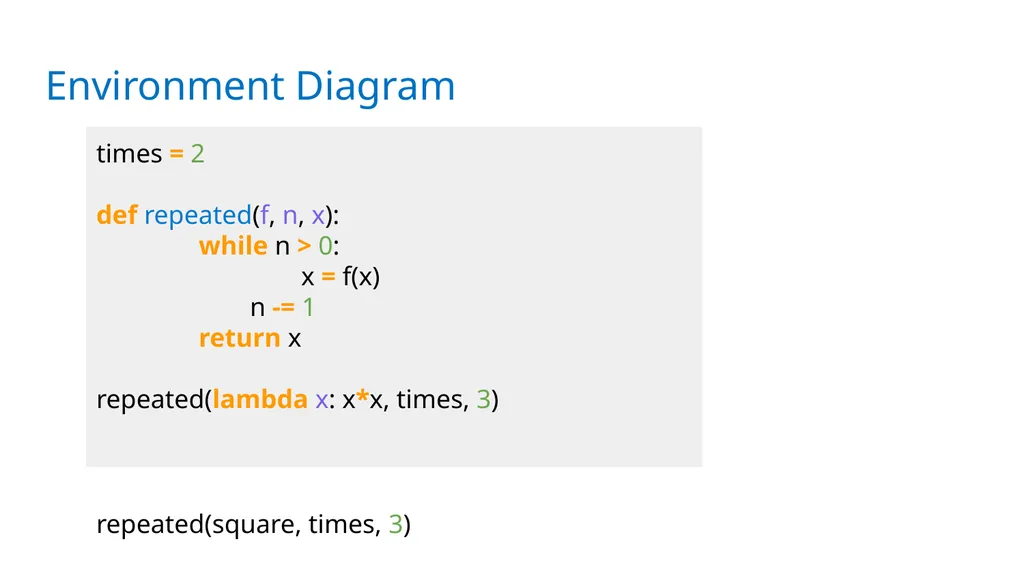
Environment Diagram times = 2
def repeated(f, n, x):
while n > 0:
x = f(x)
n -= 1
return x
def square(x):
return x * x
repeated(square, times, 3)<br>
18
Environment Diagram times = 2
def repeated(f, n, x):
while n > 0:
x = f(x)
n -= 1
return x
def square(x):
return x * x
repeated(square, times, 3) times = 2
def repeated(f, n, x):
while n > 0:
x = f(x)
n -= 1
return x
repeated(lambda x: x*x, times, 3)<br>
19
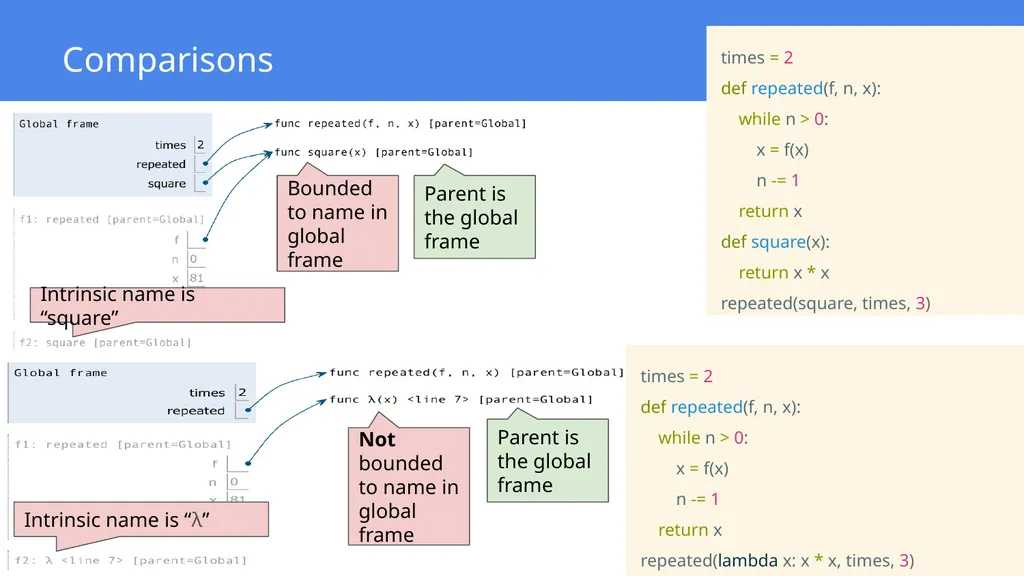
Comparisons times = 2�def repeated(f, n, x):� while n > 0:� x = f(x)� n -= 1� return x�def square(x):� return x * x�repeated(square, times, 3) times = 2�def repeated(f, n, x):� while n > 0:� x = f(x)� n -= 1� return x�repeated(lambda x: x * x, times, 3) Bounded to name in global frame Not bounded to name in global frame Parent is the global frame Parent is the global frame Intrinsic name is “square” Intrinsic name is “λ”<br>
20
Higher Order Functions<br>
21
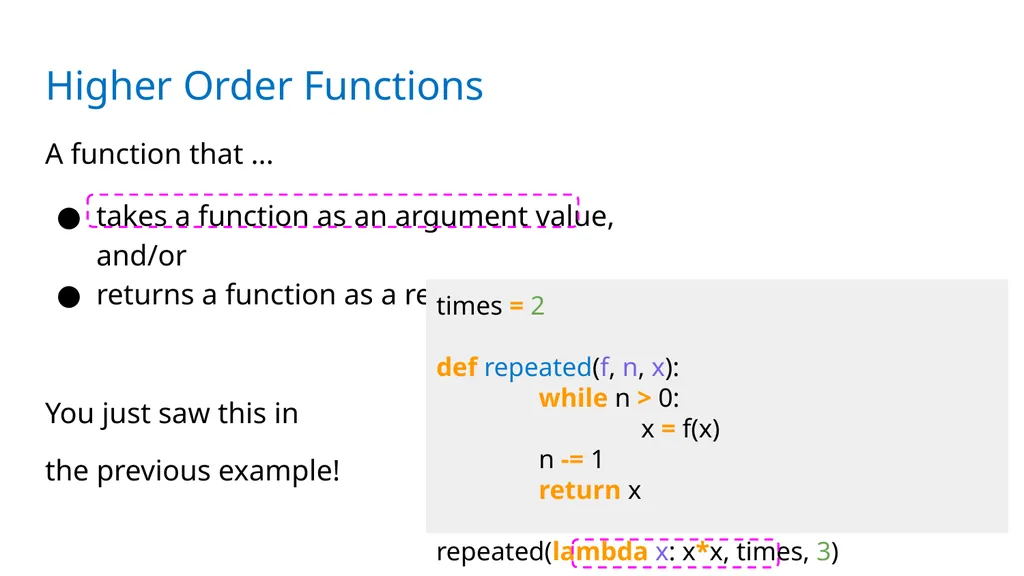
Higher Order Functions A function that ...
takes a function as an argument value, and/or
returns a function as a return value
You just saw this in
the previous example! times = 2
def repeated(f, n, x):
while n > 0:
x = f(x)
n -= 1
return x
repeated(lambda x: x*x, times, 3)<br>
22
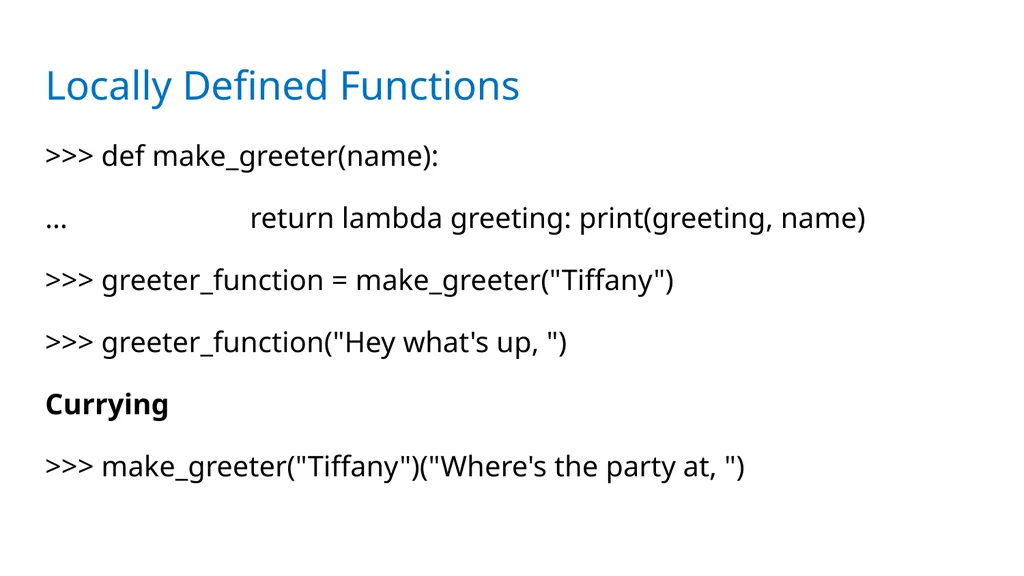
Locally Defined Functions >>> def make_greeter(name):
… return lambda greeting: print(greeting, name)
>>> greeter_function = make_greeter("Tiffany")
>>> greeter_function("Hey what's up, ")
Currying
>>> make_greeter("Tiffany")("Where's the party at, ")<br>
23
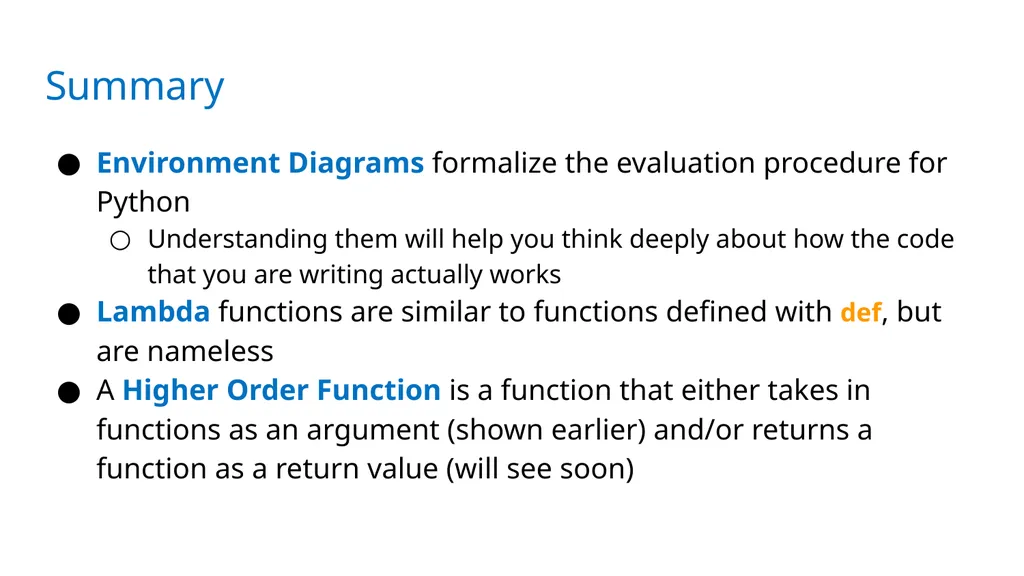
Summary Environment Diagrams formalize the evaluation procedure for Python
Understanding them will help you think deeply about how the code that you are writing actually works
Lambda functions are similar to functions defined with def, but are nameless
A Higher Order Function is a function that either takes in functions as an argument (shown earlier) and/or returns a function as a return value (will see soon)<br>