
Environmental Impact Assessment Course Code: GeES
JO
Published · 210 slides · 0 views

1 / 1




Description
Environmental Impact Assessment Course Code: GeES 531 Cr.h : 3 By Dr. Kindie Gebeyehu Department of Geography and Environmental Studies 2012 E.C Post graduate Regular Program 2nd semester for First year Students CHAPTER ONE INTRODUCTION TO
Related Topics
Share
Embed code
Download this presentation From Below
"Environmental Impact Assessment Course Code: GeES" is the property of its rightful owner. Permission is granted to download and print the materials on this website for personal, non-commercial use only, and to display it on your personal computer provided you do not modify the materials and that you retain all copyright notices contained in the materials. By downloading content from our website, you accept the terms of this agreement.
Presentation Transcript
01
Environmental Impact Assessment
Course Code: GeES 531
Cr.h : 3
By Dr. Kindie Gebeyehu
Department of Geography and Environmental Studies 2012 E.C Post graduate Regular Program 2nd semester for First year Students<br>
Course Code: GeES 531
Cr.h : 3
By Dr. Kindie Gebeyehu
Department of Geography and Environmental Studies 2012 E.C Post graduate Regular Program 2nd semester for First year Students<br>
02
CHAPTER ONE
INTRODUCTION TO EIA: PROCESSES AND SYSTEMS
1.1. Background Environmental Impact Assessment
EIA is now increasingly being seen and used within the wider context of serving sustainable development objectives.
Environmental impact assessment (EIA) is a process which can be used to improve decision-making and ensure that development options under conservation are environmentally, socially and economically sound and sustainable.<br>
EIA is now increasingly being seen and used within the wider context of serving sustainable development objectives.
Environmental impact assessment (EIA) is a process which can be used to improve decision-making and ensure that development options under conservation are environmentally, socially and economically sound and sustainable.<br>
03
Back ground…… It is concerned with identifying, predicting and evaluating the foreseeable/ predictable impacts, both beneficial and adverse of proposed development projects and alternatives
It aims to eliminate or minimize negative impacts and optimize positive impacts through mitigation and enhancement measures and relates to a process rather than a particular activity
EIA relates to a process rather than a particular activity, the environmental impact study itself being only one component of the process…<br>
It aims to eliminate or minimize negative impacts and optimize positive impacts through mitigation and enhancement measures and relates to a process rather than a particular activity
EIA relates to a process rather than a particular activity, the environmental impact study itself being only one component of the process…<br>
04
1. Environmental Impact Assessment Introduction
Environmental Impact Assessment (EIA) is a relatively recent phenomenon: Simply defined, EIA is a systematic process to identify, predict and evaluate the environmental effects of proposed actions and projects
This process is applied prior to major decisions and commitments being made.
Whenever appropriate social, cultural and health effects are considered as an integral part of EIA, particular attention is given in EIA practice to preventing, mitigating and offsetting the significant adverse effects of proposed undertakings.<br>
Environmental Impact Assessment (EIA) is a relatively recent phenomenon: Simply defined, EIA is a systematic process to identify, predict and evaluate the environmental effects of proposed actions and projects
This process is applied prior to major decisions and commitments being made.
Whenever appropriate social, cultural and health effects are considered as an integral part of EIA, particular attention is given in EIA practice to preventing, mitigating and offsetting the significant adverse effects of proposed undertakings.<br>
05
EIA has continuously acquired a greater importance through understanding it as an integrated part of the planning process devoted to the identification, quantification and qualification of environmental impacts due to the development of a plan or a project as well as the definition of policies and strategies to monitor and control the impacts
EIA is now increasingly being seen and used within the wider context of serving sustainable development objectives.<br>
EIA is now increasingly being seen and used within the wider context of serving sustainable development objectives.<br>
06
EIA is recognized as a planning tool used to predict the likely/probable/expected environmental impacts of a proposed activity such as a project, plan, program or legislative action so that they can be addressed at an appropriate stage in the design or formulation before further decisions are taken on the activity or action.
The EIA involves a systematic process for identifying, predicting and evaluating potential effects or impacts associated with a new development project, plan, program or legislative action.
The EIA process is the various stages a proposed activity undergoes from proposal to approval for implementation<br>
The EIA involves a systematic process for identifying, predicting and evaluating potential effects or impacts associated with a new development project, plan, program or legislative action.
The EIA process is the various stages a proposed activity undergoes from proposal to approval for implementation<br>
07
In most countries of the world there are regulations ruling environmental issues and formal procedures have to be followed while developing a project.
Required documents of such a process include the environmental impact statement (EIS), a professional report produced for the purpose to achieve project authorization/approval.<br>
Required documents of such a process include the environmental impact statement (EIS), a professional report produced for the purpose to achieve project authorization/approval.<br>
08
The terms impact assessment and environmental impact assessment are umbrella terms frequently used to cover a broad range of techniques, e.g.
Social impact assessment (SIA),
Risk assessment (RA);
Environmental impact assessment (EIA) health impact assessment (HIA).
To date, EIA itself has been applied generally at the project level, but increasing attention is now being given to impact assessment at the level of polices, plans and programs (this is known as Strategic Environmental Assessment- SEA).<br>
Social impact assessment (SIA),
Risk assessment (RA);
Environmental impact assessment (EIA) health impact assessment (HIA).
To date, EIA itself has been applied generally at the project level, but increasing attention is now being given to impact assessment at the level of polices, plans and programs (this is known as Strategic Environmental Assessment- SEA).<br>
09
Definitions of commonly used terms Environmental system: A system centered on a defined human community at a certain time, composed of physical, biological and socio-economic factors and their multiple links
Environmental effects: refer to changes of environmental factors due to the implementation of a project.
Environmental effects due to a Project may be grouped and classified as:
Direct or indirect - related to main purposes or secondary aspects of the Project<br>
Environmental effects: refer to changes of environmental factors due to the implementation of a project.
Environmental effects due to a Project may be grouped and classified as:
Direct or indirect - related to main purposes or secondary aspects of the Project<br>
10
First order; second order, higher order - The first-order effects are the immediate consequences of the proposed activity;
second-order effects are the immediate consequences of the first-order effects, etc.
Higher- order effects are more difficult to assess than the first-order effects, but they can be more important than the first-order effects.
Non-cumulative and cumulative - There are combined effects of a proposed activity and other, already existing or planned activities.
In one case, the effects of several activities can cancel each other but in many cases they reinforce/ strengthen one another.<br>
second-order effects are the immediate consequences of the first-order effects, etc.
Higher- order effects are more difficult to assess than the first-order effects, but they can be more important than the first-order effects.
Non-cumulative and cumulative - There are combined effects of a proposed activity and other, already existing or planned activities.
In one case, the effects of several activities can cancel each other but in many cases they reinforce/ strengthen one another.<br>
11
Positive and negative - with the meaning of favorable or unfavorable according to a given set of criteria
Significant and insignificant according to their relevance (intensity/power & importance} according to a given set of criteria.<br>
Significant and insignificant according to their relevance (intensity/power & importance} according to a given set of criteria.<br>
12
Reversible and irreversible - permanent or long lasting as opposed to short term.
Physical, biological, socio-economic- according to the nature of the effect. Cultura1 effects may be considered a part of socioeconomic effects.
Environmental impacts: The consequences of environmental effects of a project which are of significance to human society.
Impacts are always measured as differences between situations with and without the project.
Parameters used to qualify and quantify impacts are related to magnitude/intensity, geographic area of influence and significance according to some set of established criteria.<br>
Physical, biological, socio-economic- according to the nature of the effect. Cultura1 effects may be considered a part of socioeconomic effects.
Environmental impacts: The consequences of environmental effects of a project which are of significance to human society.
Impacts are always measured as differences between situations with and without the project.
Parameters used to qualify and quantify impacts are related to magnitude/intensity, geographic area of influence and significance according to some set of established criteria.<br>
13
Environmental preservation: Maintaining a certain environmental system unaffected or natural by changes due to human action and activities.
Environmental conservation: Planned changes of the environmental system by human action, carried out in such a way as to achieve sustainability.
Environmental impact mitigation: Measures to control adverse impacts (intensity, significance, area of influence).
Such measures may be preventive, corrective and compensatory, corresponding to avoidance, correction or compensation of the impacts respectively.<br>
Environmental conservation: Planned changes of the environmental system by human action, carried out in such a way as to achieve sustainability.
Environmental impact mitigation: Measures to control adverse impacts (intensity, significance, area of influence).
Such measures may be preventive, corrective and compensatory, corresponding to avoidance, correction or compensation of the impacts respectively.<br>
14
3. Purpose of EIA
The purpose of EIA is to:
Provide information for decision-making on the environmental consequences of proposed actions; and
Promote environmentally sound and sustainable development through the identification of appropriate enhancement and mitigation measures.<br>
The purpose of EIA is to:
Provide information for decision-making on the environmental consequences of proposed actions; and
Promote environmentally sound and sustainable development through the identification of appropriate enhancement and mitigation measures.<br>
15
Purpose of EIA……. Agenda 21, the global action plan for sustainable development, emphasizes the importance of integrated environment and development decision-making and promotes the use of EIA and other policy instruments for this purpose.
The EIA process makes sure that environmental issues are raised when a project or plan is first discussed and that all relevant concerns are addressed as a project proceeds/continue towards implementation.<br>
The EIA process makes sure that environmental issues are raised when a project or plan is first discussed and that all relevant concerns are addressed as a project proceeds/continue towards implementation.<br>
16
Recommendations resulting from EIA may lead to redesigning some project components and suggest changes affecting project viability or causing delays in project implementation.
Environmental Impact Assessment is a part of project preparation.
Close integration of EIA with others aspects of project preparation ensures that: environmental considerations are given due weight in project selection, sitting and designing decisions.<br>
Environmental Impact Assessment is a part of project preparation.
Close integration of EIA with others aspects of project preparation ensures that: environmental considerations are given due weight in project selection, sitting and designing decisions.<br>
17
The main purposes of EIA can then be stated in the following manner:
Identify and forecast the possible positive and negative impacts to the environment resulting from proposed projects.
Provide for a plan which, upon implementation, will reduce or offset the negative impacts of a project resulting in acceptable environmental changes.
Measure the level of plan implementation and the degree of effectiveness of the above environmental protection provisions.<br>
Identify and forecast the possible positive and negative impacts to the environment resulting from proposed projects.
Provide for a plan which, upon implementation, will reduce or offset the negative impacts of a project resulting in acceptable environmental changes.
Measure the level of plan implementation and the degree of effectiveness of the above environmental protection provisions.<br>
18
The aims and objectives of EIA can be divided into two categories፡
The immediate (short term) aim of EIA is to inform the process of decision-making by identifying the potentially significant environmental effects and risks of development proposals.
The ultimate (long term) aim of EIA is to promote sustainable development by ensuring that development proposals do not undermine critical resource and ecological functions or the well being, lifestyle and livelihood of the communities and peoples who depend on them.<br>
The immediate (short term) aim of EIA is to inform the process of decision-making by identifying the potentially significant environmental effects and risks of development proposals.
The ultimate (long term) aim of EIA is to promote sustainable development by ensuring that development proposals do not undermine critical resource and ecological functions or the well being, lifestyle and livelihood of the communities and peoples who depend on them.<br>
19
Immediate objectives of EIA are to:
Enable to take into account environmental issues at an early stage and in a systematic manner so that improve the environmental design of the proposal;
Ensure that resources are used appropriately and efficiently;
Identify appropriate measures for mitigating the potential impacts of the proposal; and
Facilitate informed decision making, including setting the environmental terms and conditions for implementing the proposal.<br>
Enable to take into account environmental issues at an early stage and in a systematic manner so that improve the environmental design of the proposal;
Ensure that resources are used appropriately and efficiently;
Identify appropriate measures for mitigating the potential impacts of the proposal; and
Facilitate informed decision making, including setting the environmental terms and conditions for implementing the proposal.<br>
20
Long term objectives of EIA are to:
Protect human health and safety;
Avoid irreversible/ permanent changes and serious damage to the environment;
Safeguard valued resources, natural areas and ecosystem components; and
Enhance the social aspects of the proposal.<br>
Protect human health and safety;
Avoid irreversible/ permanent changes and serious damage to the environment;
Safeguard valued resources, natural areas and ecosystem components; and
Enhance the social aspects of the proposal.<br>
21
Scope of Environmental Impact Assessment (EIA) EIA is a management tool.
It provides information upon which decisions may be taken.
It must involve the participation of various groups or stakeholders, such as project proponent/advocators/supporters or developer, investor, regulators, planners, local communities, non-governmental organizations, and politicians who will make decisions about a proposed major activity.<br>
It provides information upon which decisions may be taken.
It must involve the participation of various groups or stakeholders, such as project proponent/advocators/supporters or developer, investor, regulators, planners, local communities, non-governmental organizations, and politicians who will make decisions about a proposed major activity.<br>
22
It is increasingly a requirement for international assistance for grants and loans from some major donors, investors and various financial and development organizations such as the World Bank, European Union, and African Development Bank among several others.<br>
23
The potential scope of a comprehensive EIA process is considerable and could include the appraisal/Evaluation of policies, plans, programmes and specific development projects.
The primary purpose is to encourage the consideration of environmental issues in the planning and decision - making in order to ensure that the action is compatible with the environment.<br>
The primary purpose is to encourage the consideration of environmental issues in the planning and decision - making in order to ensure that the action is compatible with the environment.<br>
24
Nature and Scope of environmental issues and impacts
Numerous reports on the state of the world indicate the environmental problems facing society.
The Global Environmental Outlook (GEO) prepared by UNEP provides an authoritative statement of the major issues and their regional variations.
In the GEO-2000 report, UNEP advises that full scale emergencies now exist on a number of issues, including water scarcity, land degradation, tropical forest clearance, species loss and climate warming.<br>
Numerous reports on the state of the world indicate the environmental problems facing society.
The Global Environmental Outlook (GEO) prepared by UNEP provides an authoritative statement of the major issues and their regional variations.
In the GEO-2000 report, UNEP advises that full scale emergencies now exist on a number of issues, including water scarcity, land degradation, tropical forest clearance, species loss and climate warming.<br>
25
Some of these issues, such as climate warming and biodiversity loss, are global or so pervasive that they affect all countries.
Other environmental problems are concentrated regionally and thus affect only certain countries or are more serious for some than others.<br>
Other environmental problems are concentrated regionally and thus affect only certain countries or are more serious for some than others.<br>
26
Environmental issues can also be grouped under ‘green’ And ‘brown’ agendas.
The green agenda focuses on natural resource management and environmental protection issues, such as rural land and water use, forestry and fisheries and habitat and species conservation.
The brown agenda is concerned with issues of industrial pollution, waste management and urban development.<br>
The green agenda focuses on natural resource management and environmental protection issues, such as rural land and water use, forestry and fisheries and habitat and species conservation.
The brown agenda is concerned with issues of industrial pollution, waste management and urban development.<br>
27
The impacts of a development proposal examined in EIA can be direct, such as the effect of toxic discharge on air and water quality, or indirect, the effect on human health from exposure to particulates or contaminants, which have built up in food chains.
Other environmental and social impacts are induced, for example by a new road opening up an undeveloped area to subsequent settlement or by involuntary resettlement of people displaced by the construction of a large reservoir.<br>
Other environmental and social impacts are induced, for example by a new road opening up an undeveloped area to subsequent settlement or by involuntary resettlement of people displaced by the construction of a large reservoir.<br>
28
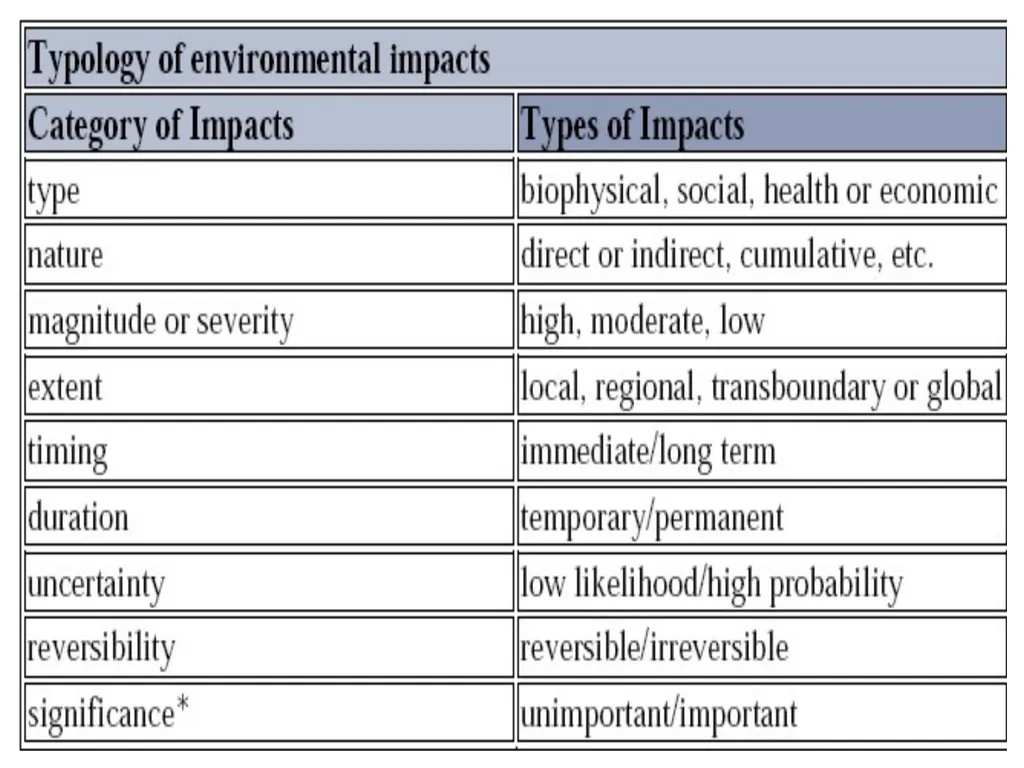
Certain adverse impacts may appear relatively insignificant when considered in the context of an individual action or proposal but have a cumulative effect on the environment when added to all other actions and proposals; for example, deforestation resulting from plot by plot clearance for subsistence agriculture.<br>
29
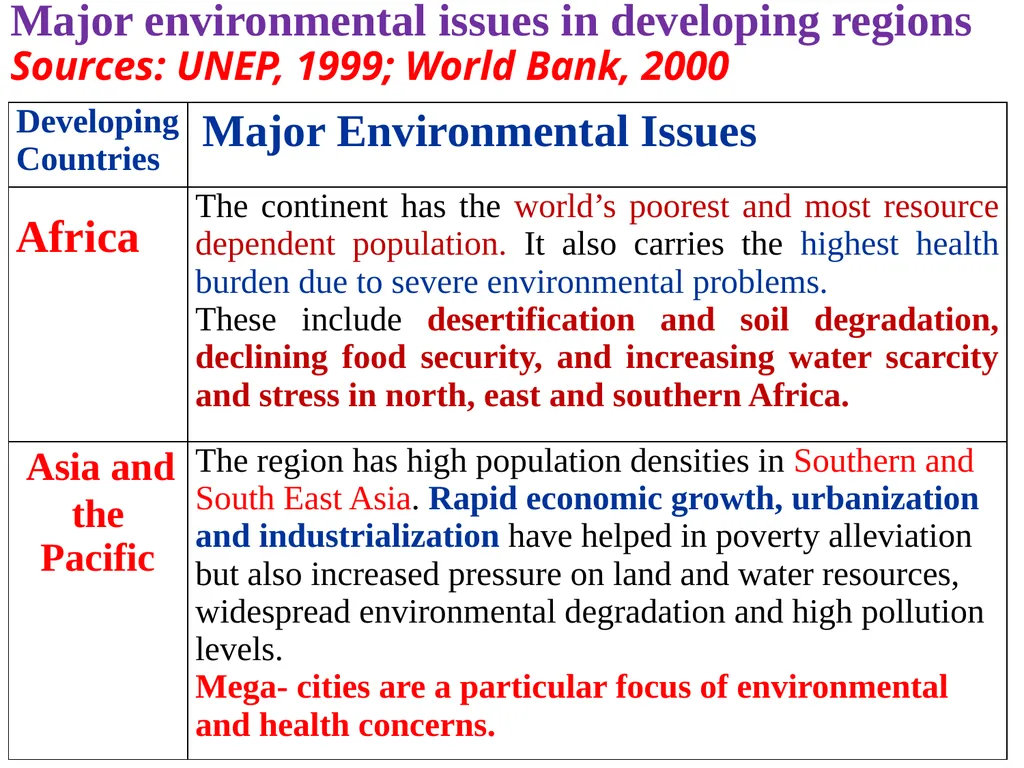
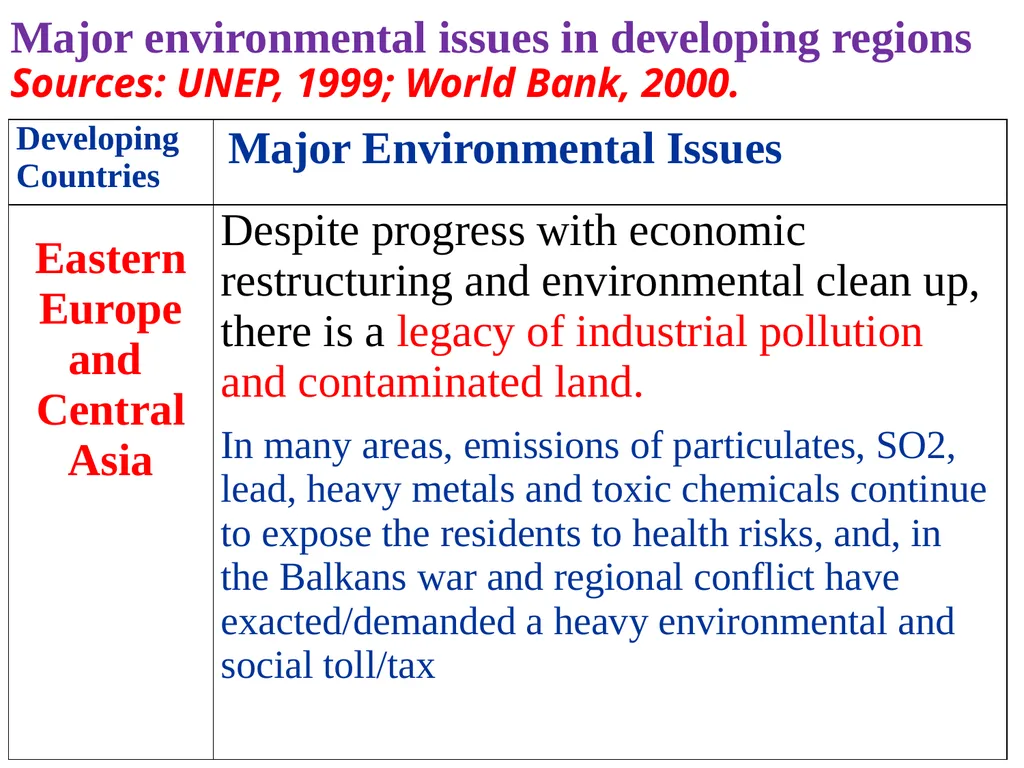
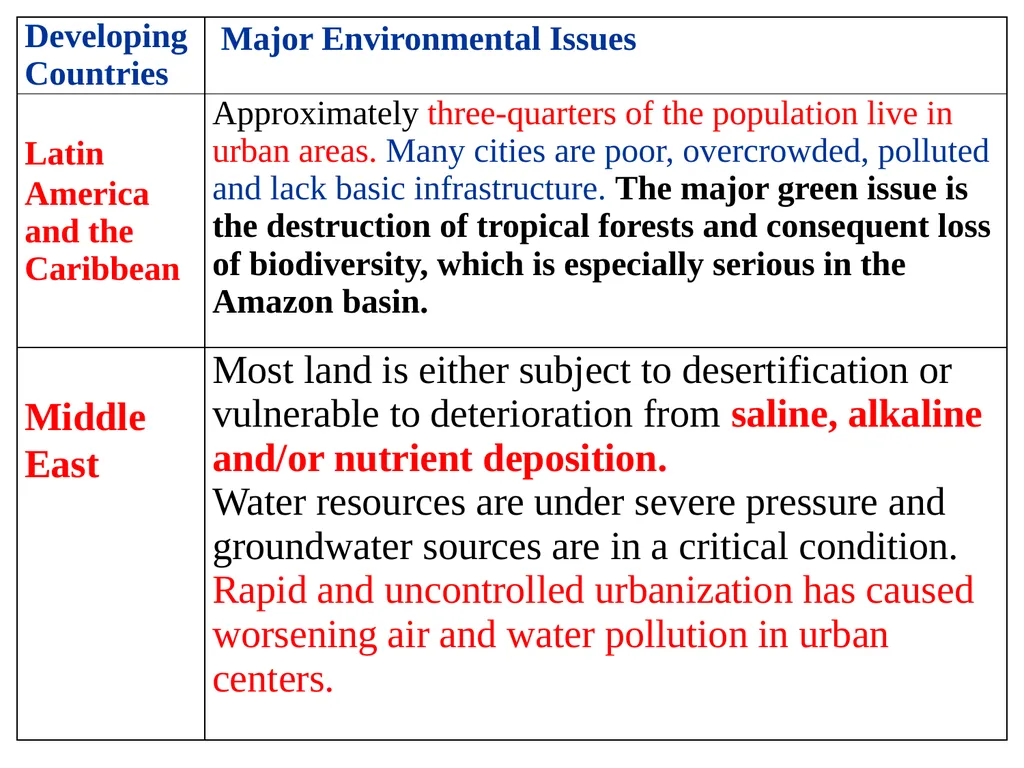
The major environmental challenges facing different parts of the world are listed in the table below<br>
30
Major environmental issues in developing regions
Sources: UNEP, 1999; World Bank, 2000<br>
31
Major environmental issues in developing regions
Sources: UNEP, 1999; World Bank, 2000.<br>
32
Impact significance is not necessarily related to the impact magnitude.
Sometimes very small impacts, such as the disturbance of the nest of a pair of endangered birds, may be significant.
When determining the significance of the potential impacts of a proposal, all of the above factors should be taken into consideration.<br>
Sometimes very small impacts, such as the disturbance of the nest of a pair of endangered birds, may be significant.
When determining the significance of the potential impacts of a proposal, all of the above factors should be taken into consideration.<br>
33
In many early examples of EIA practice, only the biophysical impacts of proposals were considered (such as effects on air and water quality, flora and fauna, noise levels, climate and hydrological systems).
Increasingly EIA processes are used to analyze a range of impact types within a single framework.
These include social, health, and economic aspects. However this trend toward integrated assessment for decision-making is by no means universal or uniform.<br>
Increasingly EIA processes are used to analyze a range of impact types within a single framework.
These include social, health, and economic aspects. However this trend toward integrated assessment for decision-making is by no means universal or uniform.<br>
34
Even in EIA systems where this trend is well established, the degree and extent of integration varies with legal requirements and accepted practice.
In some countries, social impacts are not assessed or are given only limited consideration.
In other countries, EIAs are supplemented by related, but separate studies of social and health impacts.<br>
In some countries, social impacts are not assessed or are given only limited consideration.
In other countries, EIAs are supplemented by related, but separate studies of social and health impacts.<br>
35
Despite a lack of internationally consistent practice, integrated impact assessment, linking biophysical and socio-economic effects, is identified as an important priority in Agenda 21.
As a widely adopted process that already covers other impacts, EIA is recognized as one of the best available mechanisms for implementing an integrated approach.
In practice, achieving this approach will require greater attention to be given to the identification of social, health and other impacts in the EIA process.<br>
As a widely adopted process that already covers other impacts, EIA is recognized as one of the best available mechanisms for implementing an integrated approach.
In practice, achieving this approach will require greater attention to be given to the identification of social, health and other impacts in the EIA process.<br>
36
Various types of environmental assessments based on themes or concerns The various types of impact assessments to be described in this unit include those on climate, population, development, ecology, risk, social, strategic, and health.<br>
37
The description of the various types of impact assessments listed above are as follows:
1. Climate impact assessment A climate impact assessment will investigate the impact on man, plants and animals of climatic changes which may occur as a consequence of a change in climate.
A change could occur due to changes in such environmental issues as depletion of the stratospheric ozone layer, increases in ground - level ultraviolet radiation, heat waves, extreme events such as droughts, flooding and accompanying ecosystem damages and health risks.
A current climate impact assessment that is receiving worldwide attention is that due to global warming associated with green-house gas emissions.<br>
A change could occur due to changes in such environmental issues as depletion of the stratospheric ozone layer, increases in ground - level ultraviolet radiation, heat waves, extreme events such as droughts, flooding and accompanying ecosystem damages and health risks.
A current climate impact assessment that is receiving worldwide attention is that due to global warming associated with green-house gas emissions.<br>
38
2 . Demographic impact assessment Demography is the statistical and mathematical study of the size, composition (age, race, sex, or marital status), and spatial distribution of human populations and how these features change over time.
A demographic impact assessment will examine the effects of population or its changes usually in a given area on socio - economic or health parameters of interest.
For example, population changes in the labour market and migration.
Most often, national and global population continues to rise, which makes population change an essential component to demographic.<br>
A demographic impact assessment will examine the effects of population or its changes usually in a given area on socio - economic or health parameters of interest.
For example, population changes in the labour market and migration.
Most often, national and global population continues to rise, which makes population change an essential component to demographic.<br>
39
3. Development impact assessment This refers to a project-level EIA of a development activity in isolation, such as the establishment of a new 100 ha fish farm or the construction of a dam on a major river, and the impacts that would be exerted on the environment.
A project - level EIA is relatively simple and reaches to meaningful conclusions.
It informs decision - makers and other stakeholders of potential environmental impacts, and suggests ways to reduce or minimize the impacts that would arise from a development activity.
It is intended to drive decisions in the context of the given project.
It may not effectively include the cumulative effects (or total impacts) of the development in a region.<br>
A project - level EIA is relatively simple and reaches to meaningful conclusions.
It informs decision - makers and other stakeholders of potential environmental impacts, and suggests ways to reduce or minimize the impacts that would arise from a development activity.
It is intended to drive decisions in the context of the given project.
It may not effectively include the cumulative effects (or total impacts) of the development in a region.<br>
40
4. Ecological Impact Assessment (EcIA) An ecological impact assessment will examine the effects of an event or activity, such as flooding, drought, oil spill, or wind farm on a receiving environment and its components of air, water, soil and biota.
It assesses also the potential effects of a development on habitats, vegetation and species; particularly those protected by national and international legislation or considered to be of particular nature conservation importance.
It is an essential or integral part of Environmental Impact Assessment (EIA).<br>
It assesses also the potential effects of a development on habitats, vegetation and species; particularly those protected by national and international legislation or considered to be of particular nature conservation importance.
It is an essential or integral part of Environmental Impact Assessment (EIA).<br>
41
5. Risk Assessment Risk is usually defined as the product of the probability or uncertainty of something happening and its impact (consequence).
A risk analysis is an analysis of both of these components, and is therefore more than just an impact assessment.
Environmental risk assessment is the analysis and evaluation of the uncertainty of unwanted potential environmental effects which could be problematic and the various measures to reduce risk.
For example, the environmental risk and negative impacts of fish farming (aquaculture) could be an analysis of the probability and local impact of organic waste load from feed, drugs (antibiotics) used in pathogens and disease control, nutrient salts, or genetic effects and various measures to reduce them.
An analysis of the risk factors in fish farming is beneficial in order to take a risk based approach to fish culture.
Animal welfare is a topic that also could be considered in risk assessment.<br>
A risk analysis is an analysis of both of these components, and is therefore more than just an impact assessment.
Environmental risk assessment is the analysis and evaluation of the uncertainty of unwanted potential environmental effects which could be problematic and the various measures to reduce risk.
For example, the environmental risk and negative impacts of fish farming (aquaculture) could be an analysis of the probability and local impact of organic waste load from feed, drugs (antibiotics) used in pathogens and disease control, nutrient salts, or genetic effects and various measures to reduce them.
An analysis of the risk factors in fish farming is beneficial in order to take a risk based approach to fish culture.
Animal welfare is a topic that also could be considered in risk assessment.<br>
42
6 Social impact assessment (SIA) Social impact assessment can be defined as the process of assessing or estimating, in advance, the social consequences that are likely to follow from specific policy actions or project development, particularly in the context of appropriate national, state or local environmental policy legislation.
Social impacts include all social and cultural consequences to human populations of any public or private actions that alter the ways in which people live, work, play, relate to one another, organize to meet their needs, and generally cope as members of society (Rabel J. Burdge and Frank Vanclay 1996).
It is an essential part of all EIAs where it is evident that altering the environment also alters the social and cultural organization of human populations.
Hence, it is considered as a key dimension of the EIA process.
Examples of the close interactions can be found in the context of land tenure and rights, rural livelihoods and traditional practices.<br>
Social impacts include all social and cultural consequences to human populations of any public or private actions that alter the ways in which people live, work, play, relate to one another, organize to meet their needs, and generally cope as members of society (Rabel J. Burdge and Frank Vanclay 1996).
It is an essential part of all EIAs where it is evident that altering the environment also alters the social and cultural organization of human populations.
Hence, it is considered as a key dimension of the EIA process.
Examples of the close interactions can be found in the context of land tenure and rights, rural livelihoods and traditional practices.<br>
43
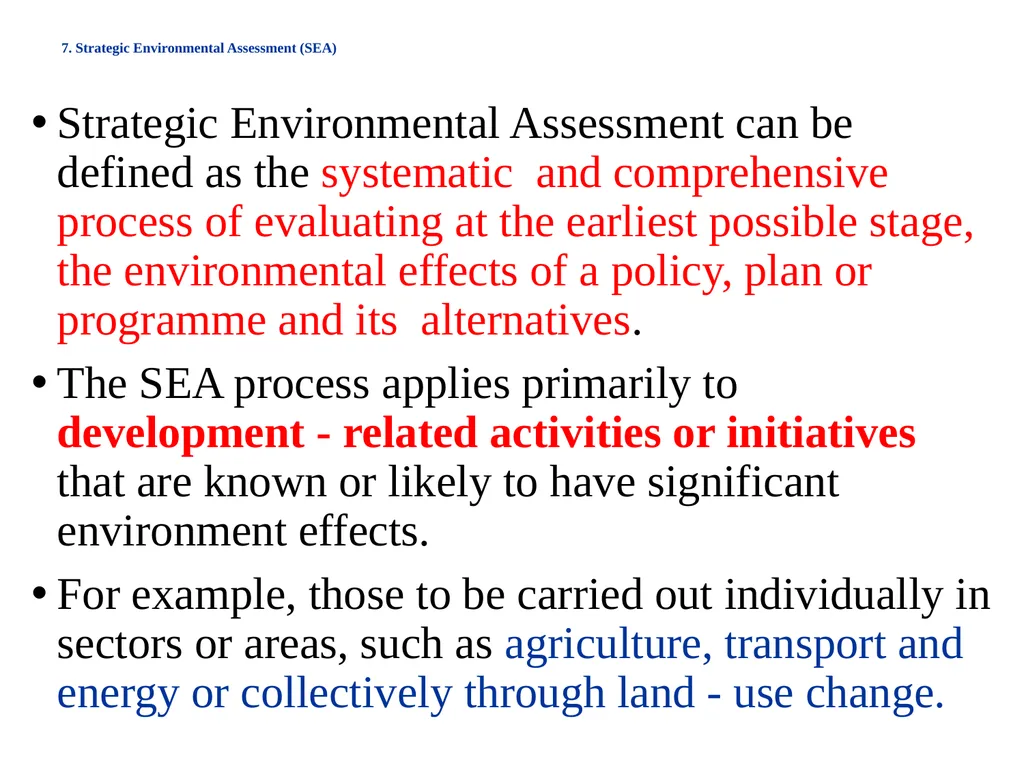
7. Strategic Environmental Assessment (SEA) Strategic Environmental Assessment can be defined as the systematic and comprehensive process of evaluating at the earliest possible stage, the environmental effects of a policy, plan or programme and its alternatives.
The SEA process applies primarily to development - related activities or initiatives that are known or likely to have significant environment effects.
For example, those to be carried out individually in sectors or areas, such as agriculture, transport and energy or collectively through land - use change.<br>
The SEA process applies primarily to development - related activities or initiatives that are known or likely to have significant environment effects.
For example, those to be carried out individually in sectors or areas, such as agriculture, transport and energy or collectively through land - use change.<br>
44
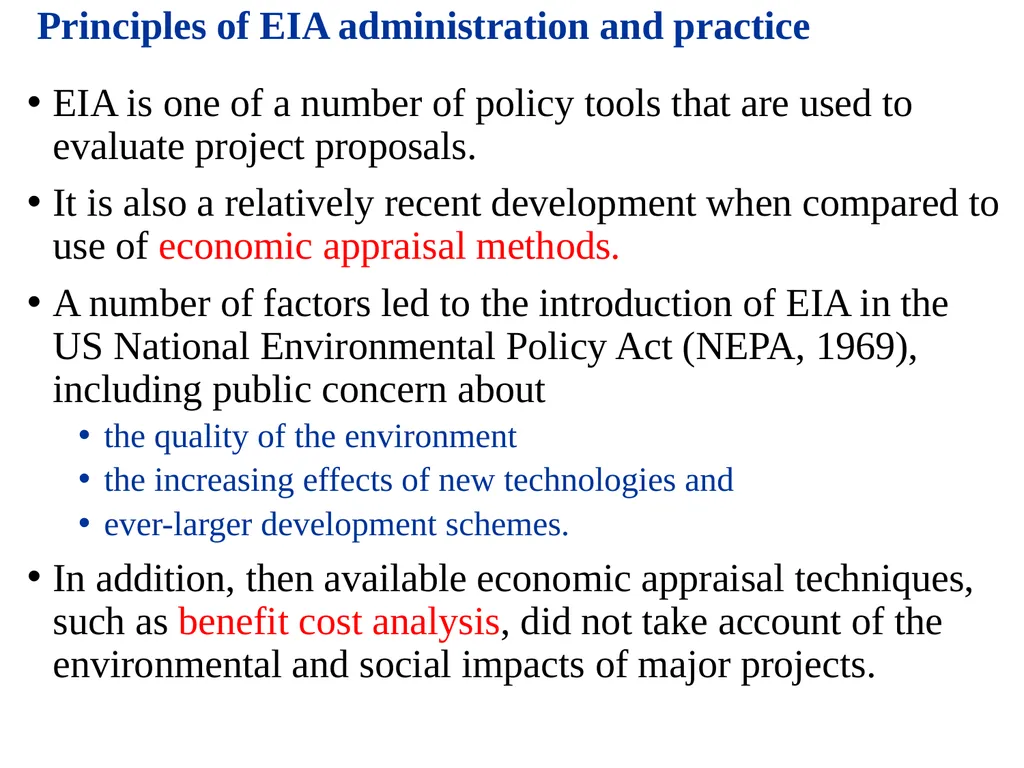
Principles of EIA administration and practice EIA is one of a number of policy tools that are used to evaluate project proposals.
It is also a relatively recent development when compared to use of economic appraisal methods.
A number of factors led to the introduction of EIA in the US National Environmental Policy Act (NEPA, 1969), including public concern about
the quality of the environment
the increasing effects of new technologies and
ever-larger development schemes.
In addition, then available economic appraisal techniques, such as benefit cost analysis, did not take account of the environmental and social impacts of major projects.<br>
It is also a relatively recent development when compared to use of economic appraisal methods.
A number of factors led to the introduction of EIA in the US National Environmental Policy Act (NEPA, 1969), including public concern about
the quality of the environment
the increasing effects of new technologies and
ever-larger development schemes.
In addition, then available economic appraisal techniques, such as benefit cost analysis, did not take account of the environmental and social impacts of major projects.<br>
45
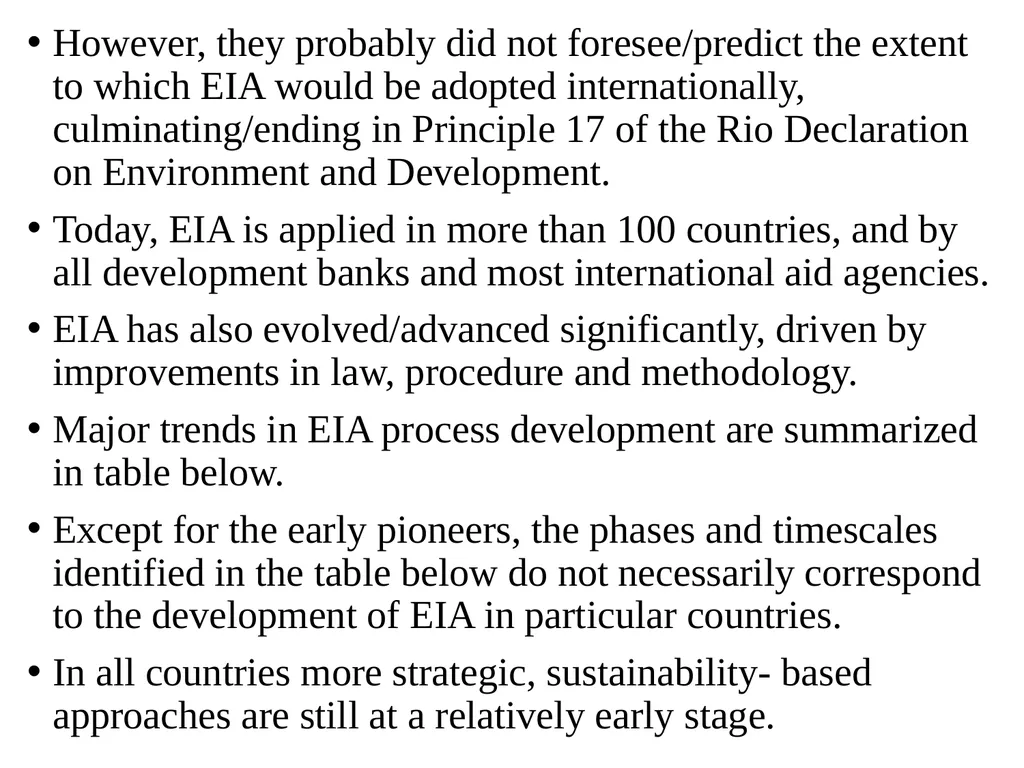
However, they probably did not foresee/predict the extent to which EIA would be adopted internationally, culminating/ending in Principle 17 of the Rio Declaration on Environment and Development.
Today, EIA is applied in more than 100 countries, and by all development banks and most international aid agencies.
EIA has also evolved/advanced significantly, driven by improvements in law, procedure and methodology.
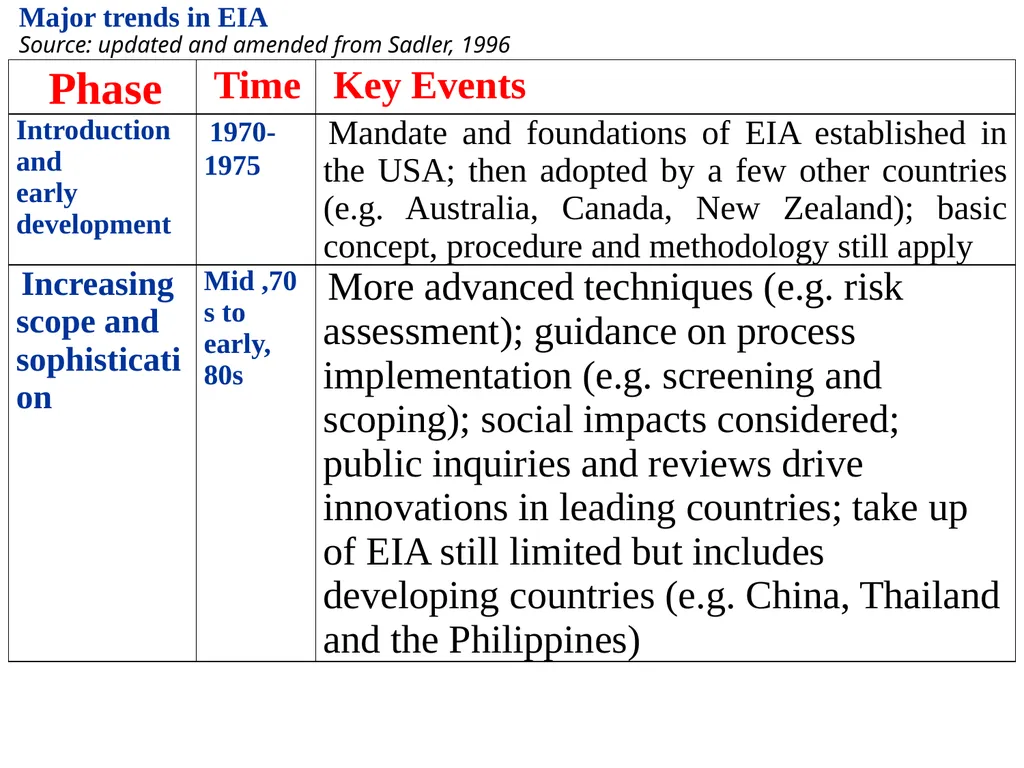
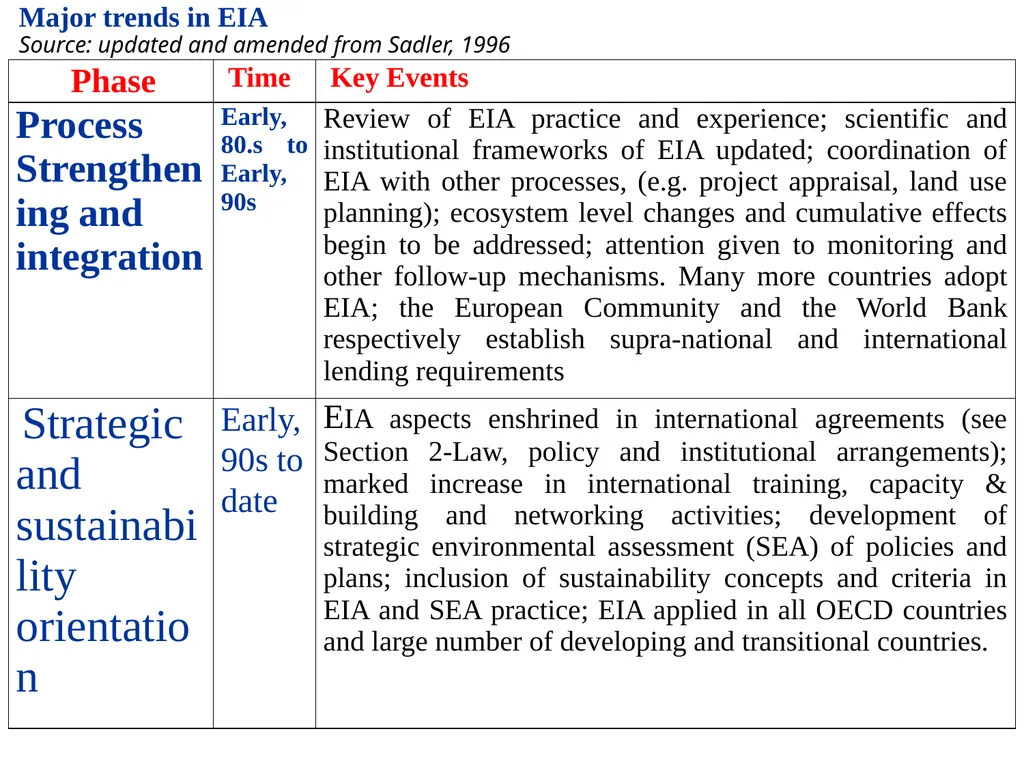
Major trends in EIA process development are summarized in table below.
Except for the early pioneers, the phases and timescales identified in the table below do not necessarily correspond to the development of EIA in particular countries.
In all countries more strategic, sustainability- based approaches are still at a relatively early stage.<br>
Today, EIA is applied in more than 100 countries, and by all development banks and most international aid agencies.
EIA has also evolved/advanced significantly, driven by improvements in law, procedure and methodology.
Major trends in EIA process development are summarized in table below.
Except for the early pioneers, the phases and timescales identified in the table below do not necessarily correspond to the development of EIA in particular countries.
In all countries more strategic, sustainability- based approaches are still at a relatively early stage.<br>
46
Major trends in EIA
Source: updated and amended from Sadler, 1996<br>
47
Major trends in EIA
Source: updated and amended from Sadler, 1996<br>
48
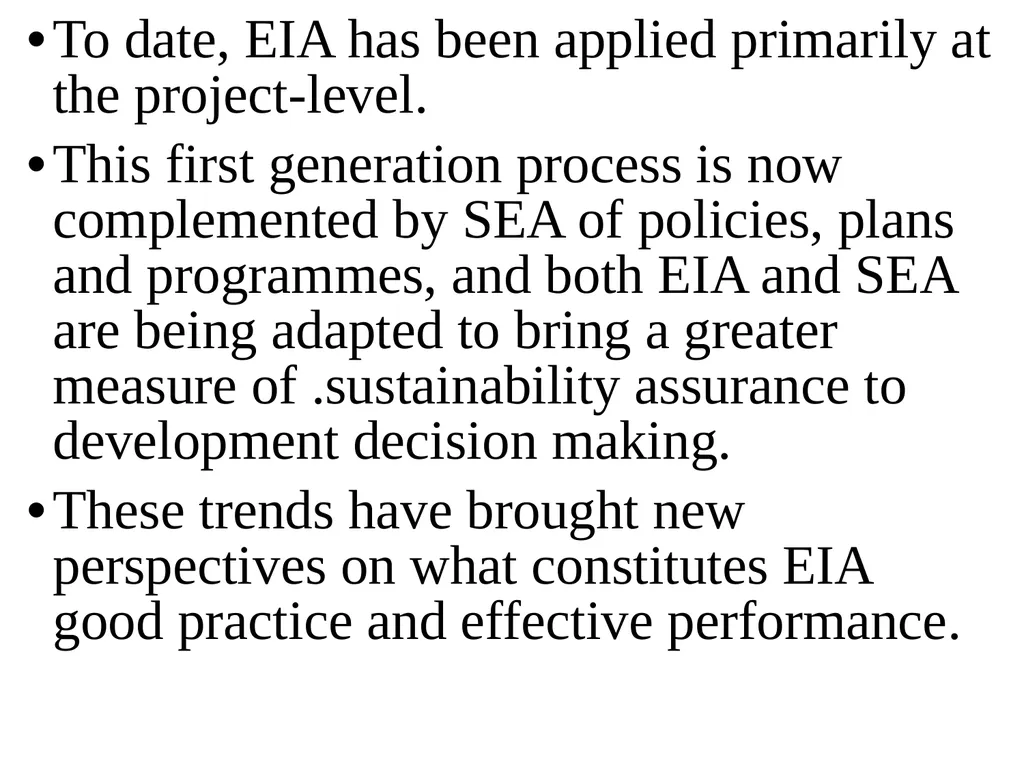
To date, EIA has been applied primarily at the project-level.
This first generation process is now complemented by SEA of policies, plans and programmes, and both EIA and SEA are being adapted to bring a greater measure of .sustainability assurance to development decision making.
These trends have brought new perspectives on what constitutes EIA good practice and effective performance.<br>
This first generation process is now complemented by SEA of policies, plans and programmes, and both EIA and SEA are being adapted to bring a greater measure of .sustainability assurance to development decision making.
These trends have brought new perspectives on what constitutes EIA good practice and effective performance.<br>
49
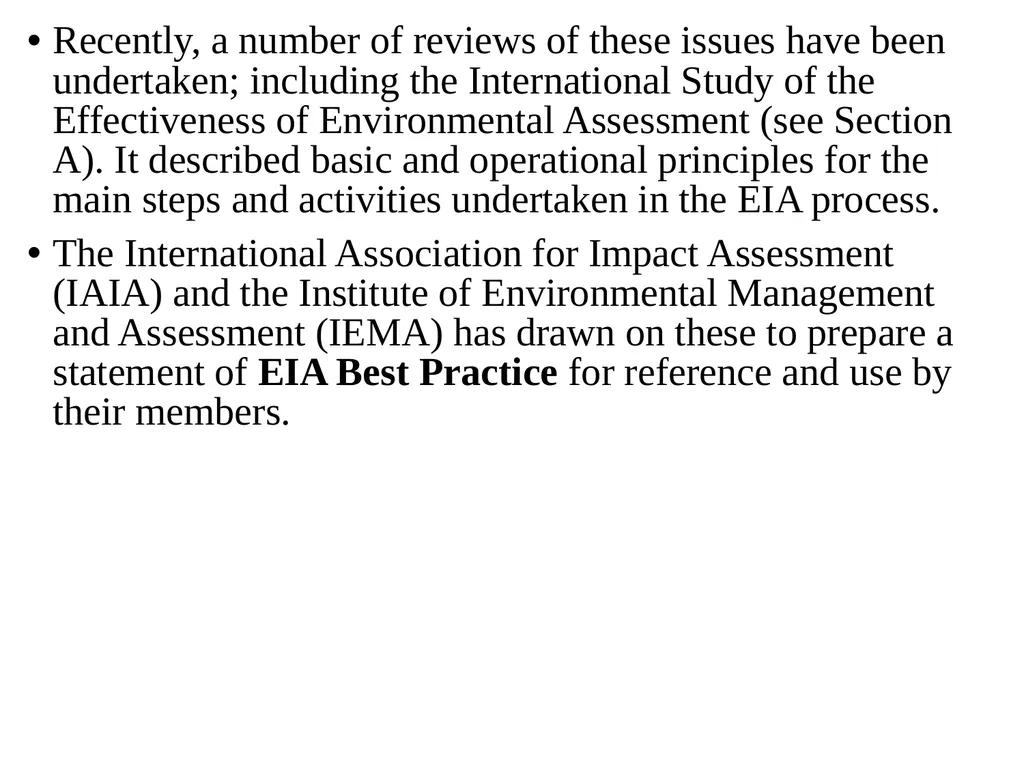
Recently, a number of reviews of these issues have been undertaken; including the International Study of the Effectiveness of Environmental Assessment (see Section A). It described basic and operational principles for the main steps and activities undertaken in the EIA process.
The International Association for Impact Assessment (IAIA) and the Institute of Environmental Management and Assessment (IEMA) has drawn on these to prepare a statement of EIA Best Practice for reference and use by their members.<br>
The International Association for Impact Assessment (IAIA) and the Institute of Environmental Management and Assessment (IEMA) has drawn on these to prepare a statement of EIA Best Practice for reference and use by their members.<br>
50
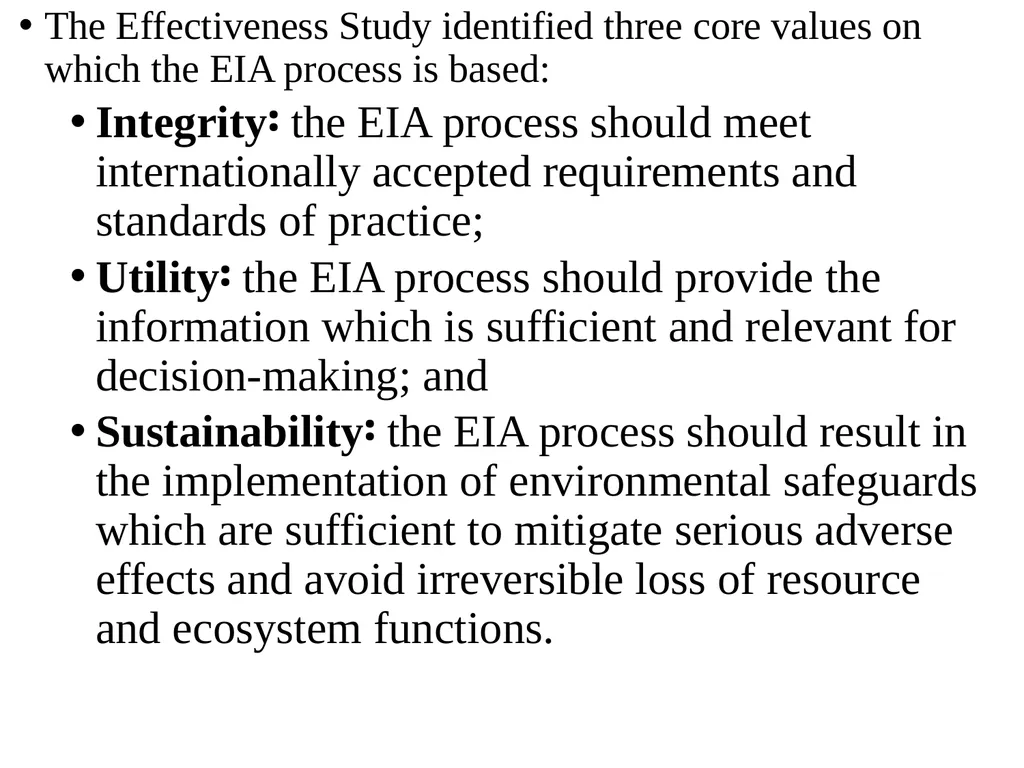
The Effectiveness Study identified three core values on which the EIA process is based:
Integrity፡ the EIA process should meet internationally accepted requirements and standards of practice;
Utility፡ the EIA process should provide the information which is sufficient and relevant for decision-making; and
Sustainability፡ the EIA process should result in the implementation of environmental safeguards which are sufficient to mitigate serious adverse effects and avoid irreversible loss of resource and ecosystem functions.<br>
Integrity፡ the EIA process should meet internationally accepted requirements and standards of practice;
Utility፡ the EIA process should provide the information which is sufficient and relevant for decision-making; and
Sustainability፡ the EIA process should result in the implementation of environmental safeguards which are sufficient to mitigate serious adverse effects and avoid irreversible loss of resource and ecosystem functions.<br>
51
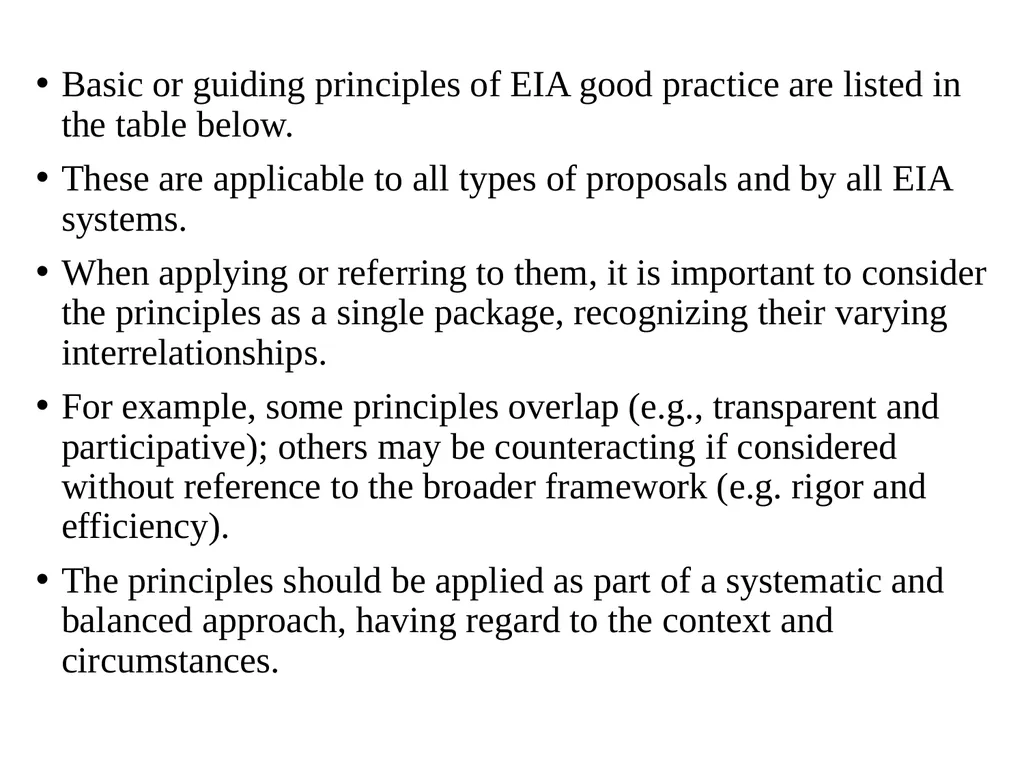
Basic or guiding principles of EIA good practice are listed in the table below.
These are applicable to all types of proposals and by all EIA systems.
When applying or referring to them, it is important to consider the principles as a single package, recognizing their varying interrelationships.
For example, some principles overlap (e.g., transparent and participative); others may be counteracting if considered without reference to the broader framework (e.g. rigor and efficiency).
The principles should be applied as part of a systematic and balanced approach, having regard to the context and circumstances.<br>
These are applicable to all types of proposals and by all EIA systems.
When applying or referring to them, it is important to consider the principles as a single package, recognizing their varying interrelationships.
For example, some principles overlap (e.g., transparent and participative); others may be counteracting if considered without reference to the broader framework (e.g. rigor and efficiency).
The principles should be applied as part of a systematic and balanced approach, having regard to the context and circumstances.<br>
52
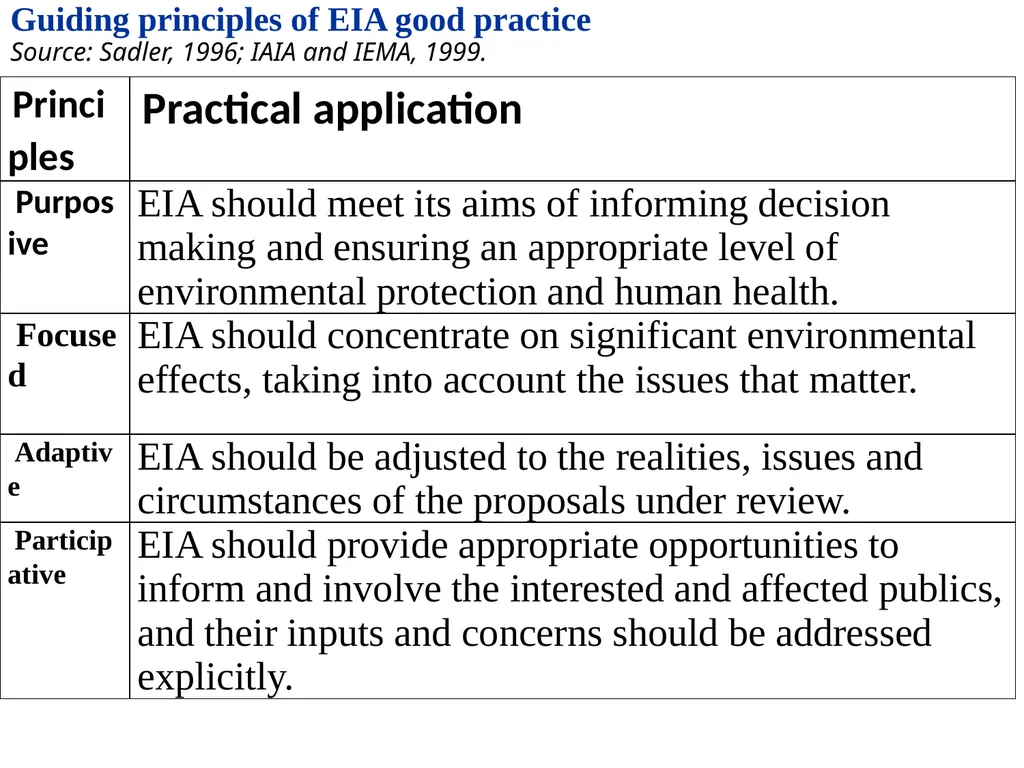
Guiding principles of EIA good practice
Source: Sadler, 1996; IAIA and IEMA, 1999.<br>
53
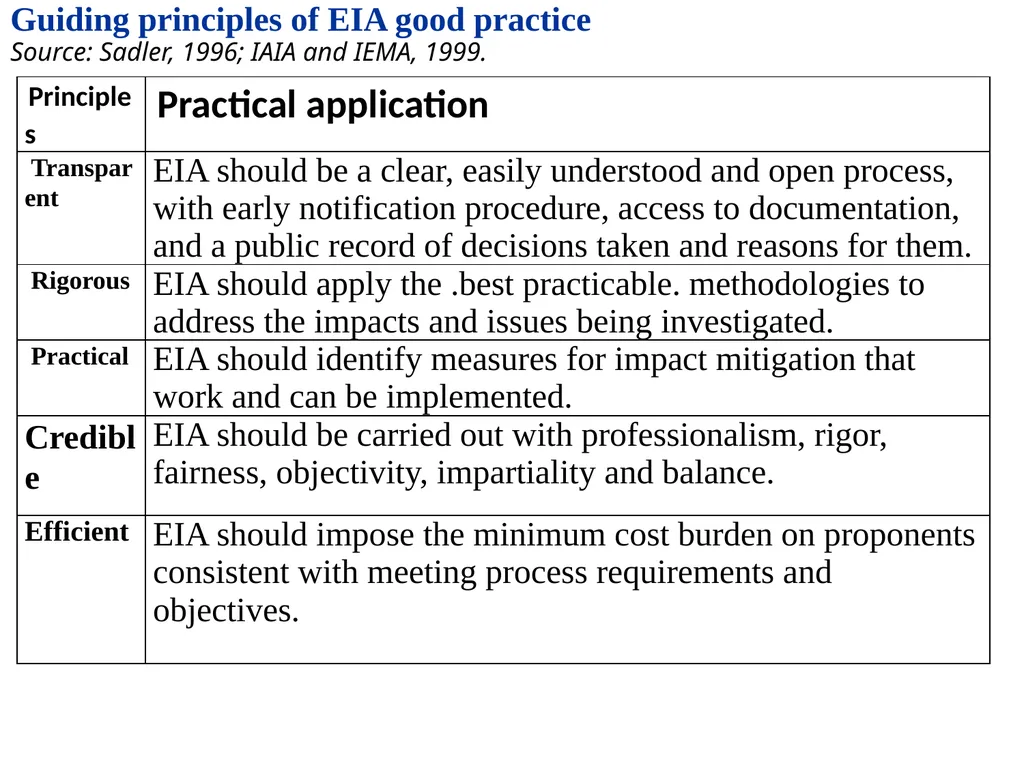
Guiding principles of EIA good practice
Source: Sadler, 1996; IAIA and IEMA, 1999.<br>
54
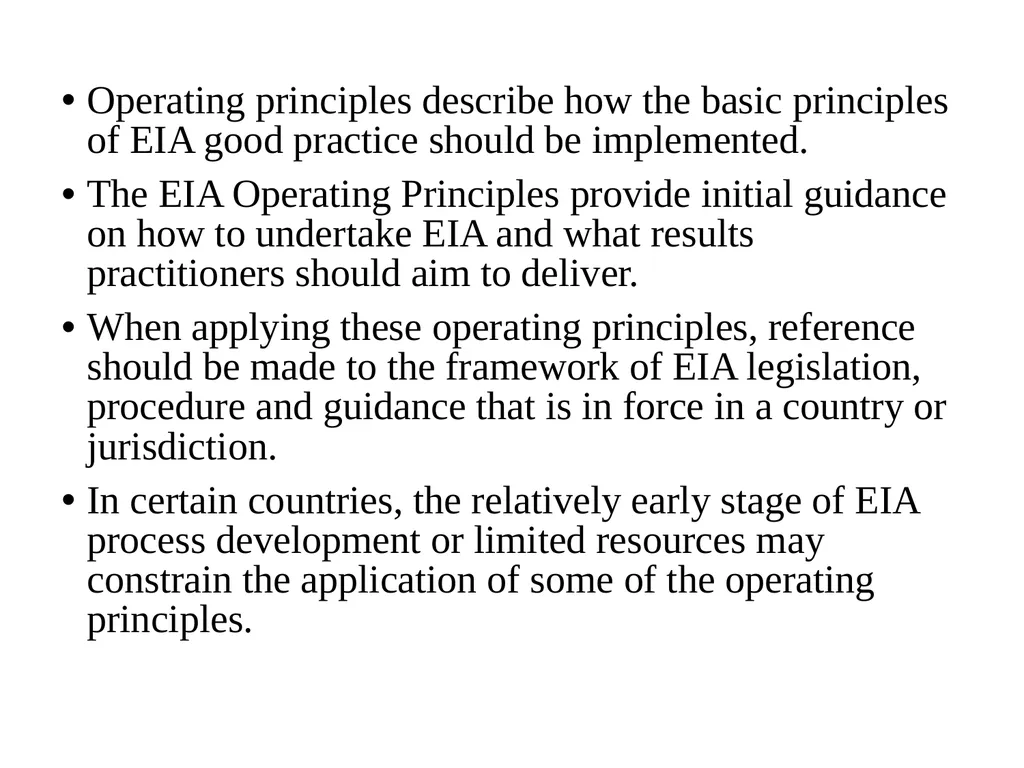
Operating principles describe how the basic principles of EIA good practice should be implemented.
The EIA Operating Principles provide initial guidance on how to undertake EIA and what results practitioners should aim to deliver.
When applying these operating principles, reference should be made to the framework of EIA legislation, procedure and guidance that is in force in a country or jurisdiction.
In certain countries, the relatively early stage of EIA process development or limited resources may constrain the application of some of the operating principles.<br>
The EIA Operating Principles provide initial guidance on how to undertake EIA and what results practitioners should aim to deliver.
When applying these operating principles, reference should be made to the framework of EIA legislation, procedure and guidance that is in force in a country or jurisdiction.
In certain countries, the relatively early stage of EIA process development or limited resources may constrain the application of some of the operating principles.<br>
55
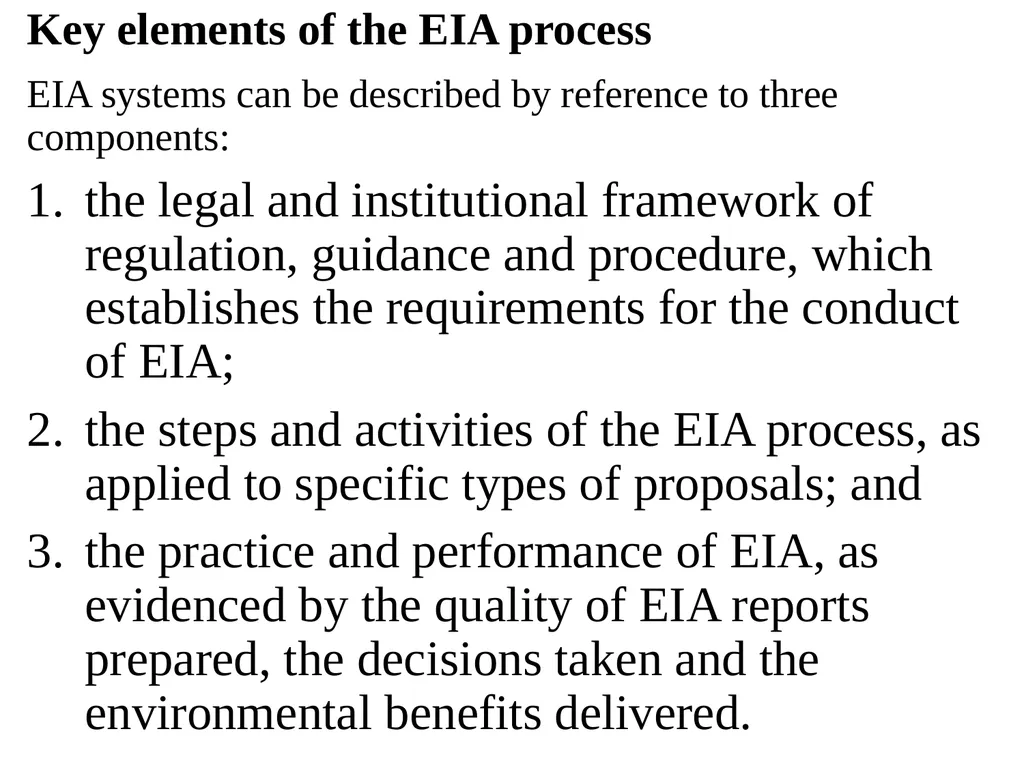
Key elements of the EIA process EIA systems can be described by reference to three components:
the legal and institutional framework of regulation, guidance and procedure, which establishes the requirements for the conduct of EIA;
the steps and activities of the EIA process, as applied to specific types of proposals; and
the practice and performance of EIA, as evidenced by the quality of EIA reports prepared, the decisions taken and the environmental benefits delivered.<br>
the legal and institutional framework of regulation, guidance and procedure, which establishes the requirements for the conduct of EIA;
the steps and activities of the EIA process, as applied to specific types of proposals; and
the practice and performance of EIA, as evidenced by the quality of EIA reports prepared, the decisions taken and the environmental benefits delivered.<br>
56
Legal and institutional framework
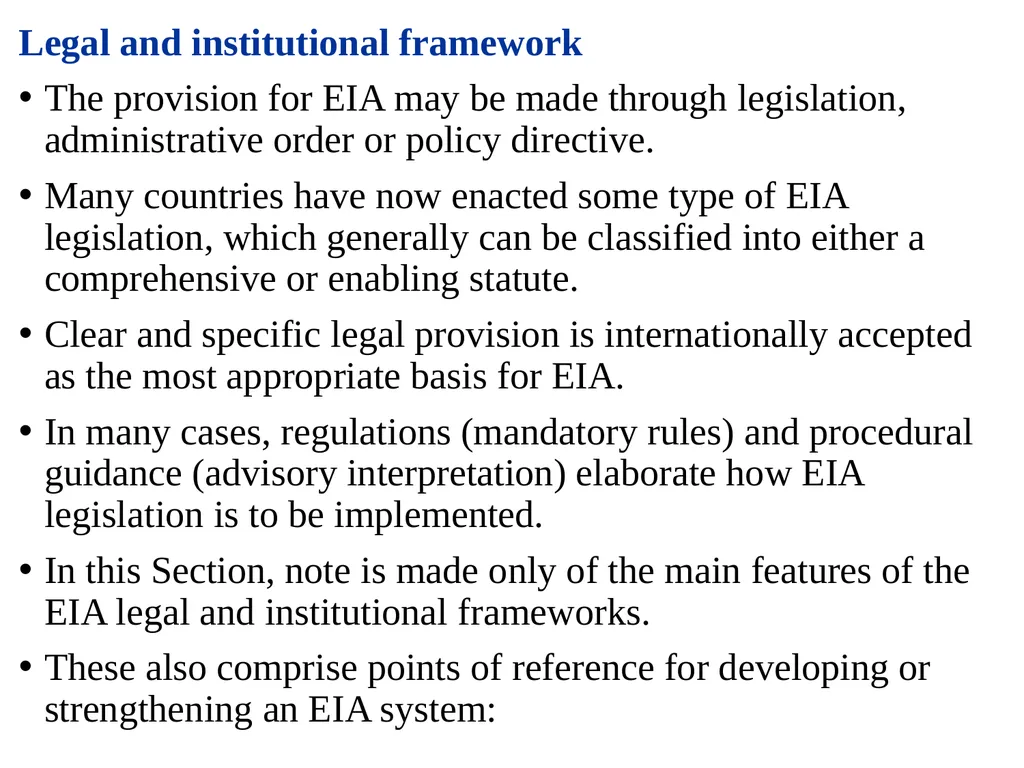
The provision for EIA may be made through legislation, administrative order or policy directive.
Many countries have now enacted some type of EIA legislation, which generally can be classified into either a comprehensive or enabling statute.
Clear and specific legal provision is internationally accepted as the most appropriate basis for EIA.
In many cases, regulations (mandatory rules) and procedural guidance (advisory interpretation) elaborate how EIA legislation is to be implemented.
In this Section, note is made only of the main features of the EIA legal and institutional frameworks.
These also comprise points of reference for developing or strengthening an EIA system:<br>
The provision for EIA may be made through legislation, administrative order or policy directive.
Many countries have now enacted some type of EIA legislation, which generally can be classified into either a comprehensive or enabling statute.
Clear and specific legal provision is internationally accepted as the most appropriate basis for EIA.
In many cases, regulations (mandatory rules) and procedural guidance (advisory interpretation) elaborate how EIA legislation is to be implemented.
In this Section, note is made only of the main features of the EIA legal and institutional frameworks.
These also comprise points of reference for developing or strengthening an EIA system:<br>
57
Basic responsibilities
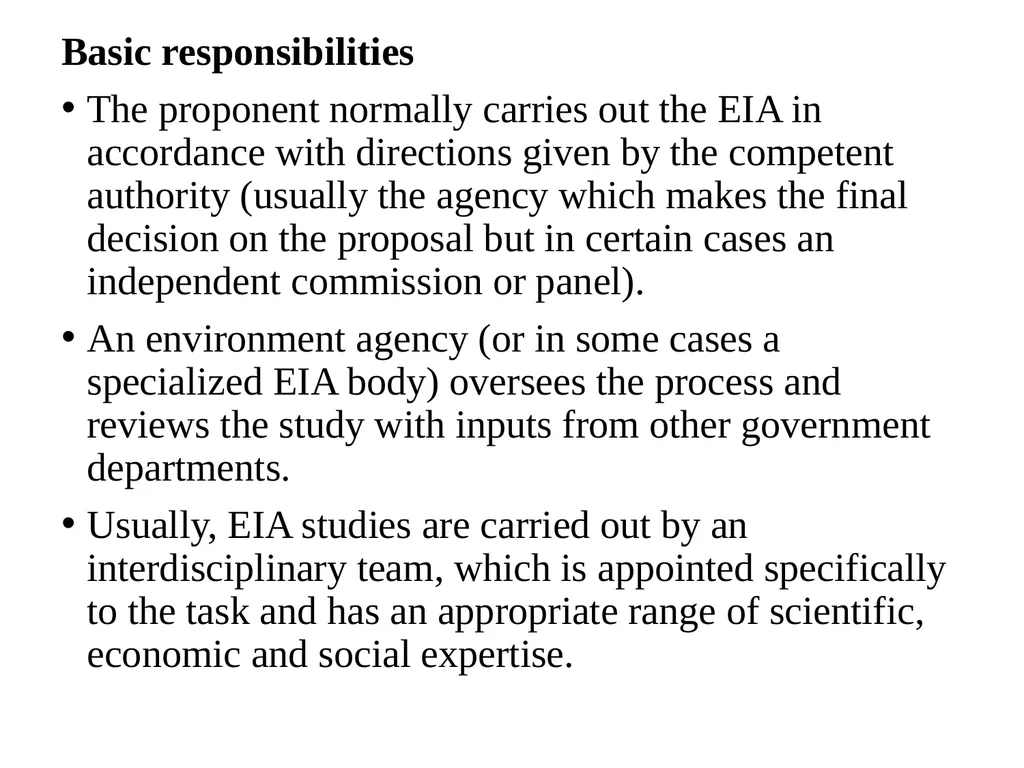
The proponent normally carries out the EIA in accordance with directions given by the competent authority (usually the agency which makes the final decision on the proposal but in certain cases an independent commission or panel).
An environment agency (or in some cases a specialized EIA body) oversees the process and reviews the study with inputs from other government departments.
Usually, EIA studies are carried out by an interdisciplinary team, which is appointed specifically to the task and has an appropriate range of scientific, economic and social expertise.<br>
The proponent normally carries out the EIA in accordance with directions given by the competent authority (usually the agency which makes the final decision on the proposal but in certain cases an independent commission or panel).
An environment agency (or in some cases a specialized EIA body) oversees the process and reviews the study with inputs from other government departments.
Usually, EIA studies are carried out by an interdisciplinary team, which is appointed specifically to the task and has an appropriate range of scientific, economic and social expertise.<br>
58
Scope of application
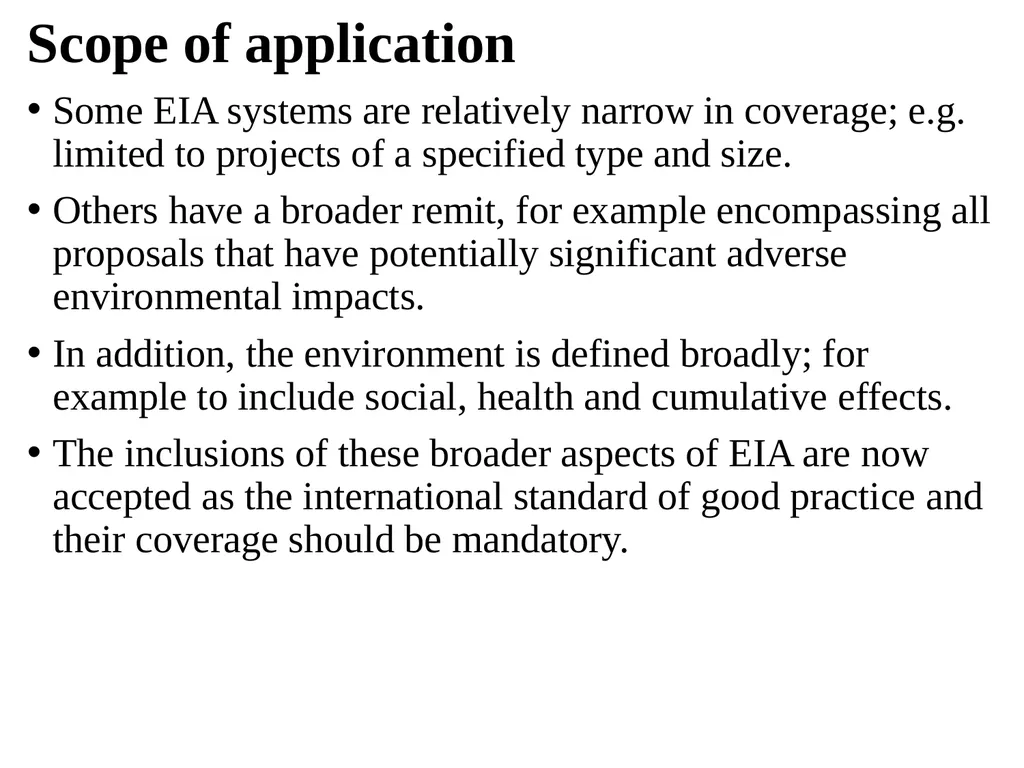
Some EIA systems are relatively narrow in coverage; e.g. limited to projects of a specified type and size.
Others have a broader remit, for example encompassing all proposals that have potentially significant adverse environmental impacts.
In addition, the environment is defined broadly; for example to include social, health and cumulative effects.
The inclusions of these broader aspects of EIA are now accepted as the international standard of good practice and their coverage should be mandatory.<br>
Some EIA systems are relatively narrow in coverage; e.g. limited to projects of a specified type and size.
Others have a broader remit, for example encompassing all proposals that have potentially significant adverse environmental impacts.
In addition, the environment is defined broadly; for example to include social, health and cumulative effects.
The inclusions of these broader aspects of EIA are now accepted as the international standard of good practice and their coverage should be mandatory.<br>
59
Consideration of alternatives
Consideration of alternatives is mandatory in some EIA systems but discretionary in others.
Varied provision is made for including a range of alternatives to a proposal, and there are different requirements for the evaluation and comparison of alternatives as part of the EIA process.
At a minimum, explicit provision should be made for the consideration of the main or reasonable alternatives to a proposal (including no action).
This component is a critical determinant of effective EIA.<br>
Consideration of alternatives is mandatory in some EIA systems but discretionary in others.
Varied provision is made for including a range of alternatives to a proposal, and there are different requirements for the evaluation and comparison of alternatives as part of the EIA process.
At a minimum, explicit provision should be made for the consideration of the main or reasonable alternatives to a proposal (including no action).
This component is a critical determinant of effective EIA.<br>
60
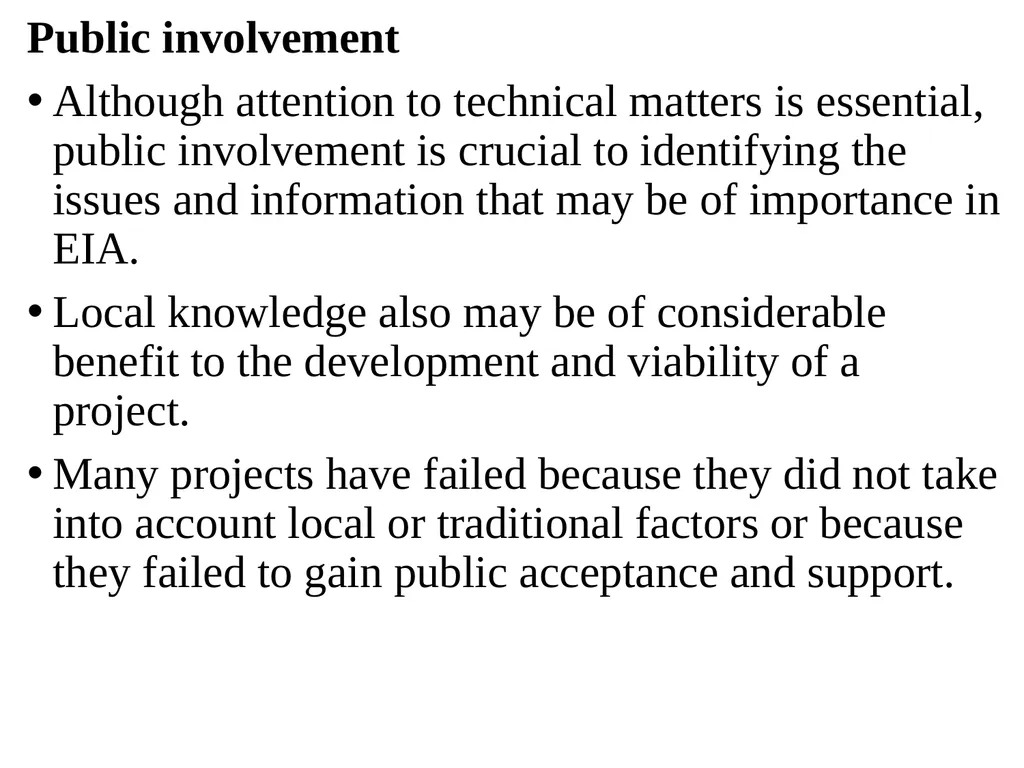
Public involvement
This is a cornerstone of EIA and most systems include provision for public involvement.
However, there are marked differences in specific requirements; e.g. regarding access to information, procedures for notification and involvement of the public, the stage of the
EIA process at which these are applied and third party rights o appeal.
At a minimum, public involvement should take account of the concerns of those directly affected by a proposal.<br>
This is a cornerstone of EIA and most systems include provision for public involvement.
However, there are marked differences in specific requirements; e.g. regarding access to information, procedures for notification and involvement of the public, the stage of the
EIA process at which these are applied and third party rights o appeal.
At a minimum, public involvement should take account of the concerns of those directly affected by a proposal.<br>
61
Quality control and assurance
Within EIA systems, the components described above provide a set of legal and institutional controls on the quality and effectiveness of the process.
In addition, the main stages of the EIA process itself constitute a further set of procedural checks and balances.
The respective functions of each stage are described below; however, they should be applied iteratively as part of a .whole process approach to provide EIA quality assurance.<br>
Within EIA systems, the components described above provide a set of legal and institutional controls on the quality and effectiveness of the process.
In addition, the main stages of the EIA process itself constitute a further set of procedural checks and balances.
The respective functions of each stage are described below; however, they should be applied iteratively as part of a .whole process approach to provide EIA quality assurance.<br>
62
EIA process
The particular components, stages and activities of an EIA process will depend upon the requirements of the country or donor.
However, most EIA processes have a common structure (see flow chart below and watch the video) and the application of the main stages is a basic standard of good practice.
Typically, the EIA process begins with screening to ensure time and resources are directed at the proposals that matter environmentally.
It should end with some form of follow up on the implementation of the
decisions and actions taken as a result of an EIA report.<br>
The particular components, stages and activities of an EIA process will depend upon the requirements of the country or donor.
However, most EIA processes have a common structure (see flow chart below and watch the video) and the application of the main stages is a basic standard of good practice.
Typically, the EIA process begins with screening to ensure time and resources are directed at the proposals that matter environmentally.
It should end with some form of follow up on the implementation of the
decisions and actions taken as a result of an EIA report.<br>
63
EIA practice and outcomes
Marked variations occur in the quality of EIA practice and outcomes among countries, reflecting the legal provisions, institutional arrangements and procedures that are in force in different jurisdictions.
In addition, the quality of EIA practice varies on a case-by-case basis within the same system, depending upon events, the complexity of the proposal, the experience of those involved and the time and money allocated.
Strengths and weaknesses of EIA practice are well documented in the literature, generally and with reference to the experience of certain countries and types of projects.<br>
Marked variations occur in the quality of EIA practice and outcomes among countries, reflecting the legal provisions, institutional arrangements and procedures that are in force in different jurisdictions.
In addition, the quality of EIA practice varies on a case-by-case basis within the same system, depending upon events, the complexity of the proposal, the experience of those involved and the time and money allocated.
Strengths and weaknesses of EIA practice are well documented in the literature, generally and with reference to the experience of certain countries and types of projects.<br>
64
Widely recognized deficiencies of EIA practice include:
Technical shortcomings, expressed by the poor quality of many EIA reports. The accuracy of impact predictions, the utility of mitigation and management measures, and the relevance of reports for decision-making often fall short of internationally accepted standards.
Procedural limitations, including inconsistencies in process administration and guidance. Time delays and costs of applying EA remain a serious concern for project proponents. Affected communities are more concerned with the lack of quality control of EIA studies or enforcement of mitigation measures.
Structural issues, stemming from the application of EIA as a separate process, unrelated to the project cycle or the larger context of decision-making.
In order to be effective, EIA requires a coherent policy-planning framework and systematic follow up procedures. Often neither area is well established.<br>
Technical shortcomings, expressed by the poor quality of many EIA reports. The accuracy of impact predictions, the utility of mitigation and management measures, and the relevance of reports for decision-making often fall short of internationally accepted standards.
Procedural limitations, including inconsistencies in process administration and guidance. Time delays and costs of applying EA remain a serious concern for project proponents. Affected communities are more concerned with the lack of quality control of EIA studies or enforcement of mitigation measures.
Structural issues, stemming from the application of EIA as a separate process, unrelated to the project cycle or the larger context of decision-making.
In order to be effective, EIA requires a coherent policy-planning framework and systematic follow up procedures. Often neither area is well established.<br>
65
A number of studies have drawn attention to the particular constraints on EIA practice in developing countries as compared to developed ones.
However, most developing countries have some experience in EIA and some have a considerable track record, predating the introduction of the EIA Directive in Europe.
There are particular limitations on domestic EIA practice in poorer countries, where typically institutional arrangements are weak, and human, technical and financial resources are lacking.
In these circumstances, the development banks and international aid agencies play a major role, both long-term through capacity building for the environment and immediately through their own EIA requirements.<br>
However, most developing countries have some experience in EIA and some have a considerable track record, predating the introduction of the EIA Directive in Europe.
There are particular limitations on domestic EIA practice in poorer countries, where typically institutional arrangements are weak, and human, technical and financial resources are lacking.
In these circumstances, the development banks and international aid agencies play a major role, both long-term through capacity building for the environment and immediately through their own EIA requirements.<br>
66
What constitute good outcomes for EIA practice? Where international standards apply or can be approximated, the following targets should be within the reach of EIA practice:
screens out environmentally unsound projects;
modifies the design of feasible proposals to reduce their environmental impact;
identifies the best practicable environmental option;
predicts the significant adverse effects of proposals with reasonable accuracy;
identifies mitigation measures that work successfully to avoid, reduce and offset major impacts;
influences decision making and approvals and the implementation of terms and conditions; and
results in environmental gains and benefits relative to other options.<br>
screens out environmentally unsound projects;
modifies the design of feasible proposals to reduce their environmental impact;
identifies the best practicable environmental option;
predicts the significant adverse effects of proposals with reasonable accuracy;
identifies mitigation measures that work successfully to avoid, reduce and offset major impacts;
influences decision making and approvals and the implementation of terms and conditions; and
results in environmental gains and benefits relative to other options.<br>
67
Costs and benefits of EIA Although there are costs associated with undertaking EIA, experience has shown that the potential savings over the life of a project can repay the investment many times over.
The savings can be economic (e.g. identification of least cost alternative) as well as
environmental (e.g. impact reduction, maintaining other resource use opportunities).
Generally the earlier EIA process is introduced in the project cycle, the greater the potential returns.
When EIA is integrated into the project preparation phase, environmental design considerations can be introduced in the first place rather than the proposal having to be modified later.<br>
The savings can be economic (e.g. identification of least cost alternative) as well as
environmental (e.g. impact reduction, maintaining other resource use opportunities).
Generally the earlier EIA process is introduced in the project cycle, the greater the potential returns.
When EIA is integrated into the project preparation phase, environmental design considerations can be introduced in the first place rather than the proposal having to be modified later.<br>
68
Benefits
The benefits of EIA can be direct, such as the improved design or location of a project, or indirect, such as better quality EIA work or raised environmental awareness of the personnel involved in the project.
In these cases, there will be with flow-on effects in their future work. As mentioned above, these potential gains from EIA increase the earlier the process is applied in the design process.<br>
The benefits of EIA can be direct, such as the improved design or location of a project, or indirect, such as better quality EIA work or raised environmental awareness of the personnel involved in the project.
In these cases, there will be with flow-on effects in their future work. As mentioned above, these potential gains from EIA increase the earlier the process is applied in the design process.<br>
69
In general the benefits of EIA include:
Better environmental planning and design of a proposal. Carrying out an EIA entails an analysis of alternatives in the design and location of projects. This can result in the selection of an improved technology, which lowers waste outputs or an environmentally optimum location for a project. A well-designed project can minimize risks and impacts on the environment and people, and thereby avoid associated costs of remedial treatment or compensation for damage.
Ensuring compliance with environmental standards. Compliance with environmental standards reduces damage to the environment and disruption to communities. It also avoids the likelihood of penalties, fines and loss of trust and credibility.<br>
Better environmental planning and design of a proposal. Carrying out an EIA entails an analysis of alternatives in the design and location of projects. This can result in the selection of an improved technology, which lowers waste outputs or an environmentally optimum location for a project. A well-designed project can minimize risks and impacts on the environment and people, and thereby avoid associated costs of remedial treatment or compensation for damage.
Ensuring compliance with environmental standards. Compliance with environmental standards reduces damage to the environment and disruption to communities. It also avoids the likelihood of penalties, fines and loss of trust and credibility.<br>
70
Savings in capital and operating costs.
EIA can avoid the undue costs of unanticipated impacts.
These can escalate if environmental problems have not been considered from the start of proposal design and require rectification later.
An anticipate and avoid approach is much cheaper than react and cure.
Generally, changes which must be made late in the project cycle are the most expensive.
Reduced time and costs of approvals of development applications. If all
environmental concerns have been taken into account properly before submission for project approval, then it is unlikely that delays will occur as a result of decision-makers asking for additional information or alterations to mitigation measures.<br>
EIA can avoid the undue costs of unanticipated impacts.
These can escalate if environmental problems have not been considered from the start of proposal design and require rectification later.
An anticipate and avoid approach is much cheaper than react and cure.
Generally, changes which must be made late in the project cycle are the most expensive.
Reduced time and costs of approvals of development applications. If all
environmental concerns have been taken into account properly before submission for project approval, then it is unlikely that delays will occur as a result of decision-makers asking for additional information or alterations to mitigation measures.<br>
71
Increased project acceptance by the public.
This is achieved by an open and transparent EIA process, with provision of opportunities for public involvement of people who are most directly affected by and interested in the proposal, in an appropriate way that suits their needs.<br>
This is achieved by an open and transparent EIA process, with provision of opportunities for public involvement of people who are most directly affected by and interested in the proposal, in an appropriate way that suits their needs.<br>
72
Costs
It can be difficult to determine the exact costs of an EIA because major projects typically require a large number of investigations and reports, often for closely related purposes (e.g. engineering feasibility studies of hydrology and surface materials).
The World Bank notes that the cost of preparing an EIA rarely exceeds one per cent of the project costs and this percentage can be reduced further if local personnel are used to do most of the work.
For Bank projects, the relative cost of an EIA typically ranges from only 0.06 per cent to 0.10 per cent of total project costs.
The total cost of an EIA might range from a few thousand dollars for a very small project, to over a million dollars for a large and complex project, which has a significant environmental impact and requires extensive data collection and analysis.<br>
It can be difficult to determine the exact costs of an EIA because major projects typically require a large number of investigations and reports, often for closely related purposes (e.g. engineering feasibility studies of hydrology and surface materials).
The World Bank notes that the cost of preparing an EIA rarely exceeds one per cent of the project costs and this percentage can be reduced further if local personnel are used to do most of the work.
For Bank projects, the relative cost of an EIA typically ranges from only 0.06 per cent to 0.10 per cent of total project costs.
The total cost of an EIA might range from a few thousand dollars for a very small project, to over a million dollars for a large and complex project, which has a significant environmental impact and requires extensive data collection and analysis.<br>
73
Although many proponents complain that EIA causes excessive delays in projects, many of these are caused by poor administration of the process rather than by the process itself. These occur when:
the EIA is commenced too late in the project cycle;
the terms of reference are poorly drafted;
the EIA is not managed to a schedule;
the technical and consultative components of EIA are inadequate; and
the EIA report is incomplete or deficient as a basis for decision making.<br>
the EIA is commenced too late in the project cycle;
the terms of reference are poorly drafted;
the EIA is not managed to a schedule;
the technical and consultative components of EIA are inadequate; and
the EIA report is incomplete or deficient as a basis for decision making.<br>
74
Similar considerations apply to the timeframe for the EIA process.
Most projects merely
require screening and might take only an hour or two of work.
Where further EIA work is necessary, the time taken can range from a few days or weeks, for a small irrigation or a minor infrastructure project, to two years or more for a large dam or a major infrastructure project.
Generally speaking, the costs and time involved in EIA should decrease as experience is gained with the process and there is a better understanding of the impacts associated with different types of projects and the use of appropriate methods.
Over a longer timeframe, the availability of baseline data should also increase.
All participants in the EIA process are .stakeholders., who pursue particular interests and hold different views and preferences.
Full public involvement, open to all affected and interested parties, provides the best means of ensuring the EIA process is fair and credible.
It allows decision-makers and participants themselves to gain an understanding of the diversity and balance of opinion on the issues at stake.<br>
Most projects merely
require screening and might take only an hour or two of work.
Where further EIA work is necessary, the time taken can range from a few days or weeks, for a small irrigation or a minor infrastructure project, to two years or more for a large dam or a major infrastructure project.
Generally speaking, the costs and time involved in EIA should decrease as experience is gained with the process and there is a better understanding of the impacts associated with different types of projects and the use of appropriate methods.
Over a longer timeframe, the availability of baseline data should also increase.
All participants in the EIA process are .stakeholders., who pursue particular interests and hold different views and preferences.
Full public involvement, open to all affected and interested parties, provides the best means of ensuring the EIA process is fair and credible.
It allows decision-makers and participants themselves to gain an understanding of the diversity and balance of opinion on the issues at stake.<br>
75
In addition, there are a number of specific measures that can help to make the EIA process transparent, accessible and accountable to the public.
Examples of measures that reinforce the fairness of the process include:
requiring the proponent to register all consultants, their expertise and responsibilities with the administering agency;
publishing these details in the terms of reference and the EIA report;
making all EIA documents and reports available to the public; and
publishing reasons for decisions . screening and final approvals together with requirements and terms and conditions for mitigation and environmental management plans.<br>
Examples of measures that reinforce the fairness of the process include:
requiring the proponent to register all consultants, their expertise and responsibilities with the administering agency;
publishing these details in the terms of reference and the EIA report;
making all EIA documents and reports available to the public; and
publishing reasons for decisions . screening and final approvals together with requirements and terms and conditions for mitigation and environmental management plans.<br>
76
Capacity building is the long-term, voluntary process of increasing the ability of a country to identify and solve its own problems and risks, and to maximize its opportunities.
In this context, countries should firstly aim to carry out their own EIAs of proposals.
Second, they should aim to use local experts as much as possible when undertaking EIAs of proposals financed by the World Bank and other multilateral lending agencies.
Where this is not possible without compromising the quality of EIAs and outside experts must be engaged, every opportunity should be taken to transfer their expertise to local personnel.
This strategy will make the implementation of EIA recommendations more effective and strengthen the basis of EIA expertise locally.
Capacity building can be carried out in a number of ways, including institutional
strengthening, technical assistance and advice, and EIA training programmes.
A systematic, long-term commitment will be necessary to overcome limited capacity of many developing countries to undertake EIA.
In addition, this process should be backed by activities to strengthen education and research institutions.
EIA-specific training can be done at many different levels and over different periods to meet a variety of needs.<br>
In this context, countries should firstly aim to carry out their own EIAs of proposals.
Second, they should aim to use local experts as much as possible when undertaking EIAs of proposals financed by the World Bank and other multilateral lending agencies.
Where this is not possible without compromising the quality of EIAs and outside experts must be engaged, every opportunity should be taken to transfer their expertise to local personnel.
This strategy will make the implementation of EIA recommendations more effective and strengthen the basis of EIA expertise locally.
Capacity building can be carried out in a number of ways, including institutional
strengthening, technical assistance and advice, and EIA training programmes.
A systematic, long-term commitment will be necessary to overcome limited capacity of many developing countries to undertake EIA.
In addition, this process should be backed by activities to strengthen education and research institutions.
EIA-specific training can be done at many different levels and over different periods to meet a variety of needs.<br>
77
A systematic EIA capacity building programme will need to provide a range of different activities.
These could include advice on drafting or strengthening EIA legislation and procedures, improving their application to relevant sectors, such as energy and mining, and strengthening particular aspects of practice, such as public involvement.
Pilot projects involving local experts in actual EIAs of proposals can be used to transfer hands on knowledge and skills.
Supporting activities include developing resource materials and establishing a network of practitioners with experience in EIA or technical analysis.<br>
These could include advice on drafting or strengthening EIA legislation and procedures, improving their application to relevant sectors, such as energy and mining, and strengthening particular aspects of practice, such as public involvement.
Pilot projects involving local experts in actual EIAs of proposals can be used to transfer hands on knowledge and skills.
Supporting activities include developing resource materials and establishing a network of practitioners with experience in EIA or technical analysis.<br>
78
Perspectives on sustainable development Sustainable development is an evolving concept, which is continually being redefined and reinterpreted.
The starting point for most people is the Brundtland definition (described above), which also can be formally stated as twin principles of intra- and intergenerational equity.
In practice, these principles mean improving the welfare of the world’s poor and maintaining the development opportunities for the generations that follow.
The challenge of sustainable development may be summarized by comparing three overriding indicators:
First, human activity is estimated to currently consume or pre-empt 40 per cent of net primary productivity on land.
Second, 60 per cent of the world’s population lives close to or under the poverty line.
Third, the worlds population is projected to double by mid-century.
Without major policy and technology changes, UNEP and other institutions have concluded that such trends threaten the stability of the world community and the global environment.<br>
The starting point for most people is the Brundtland definition (described above), which also can be formally stated as twin principles of intra- and intergenerational equity.
In practice, these principles mean improving the welfare of the world’s poor and maintaining the development opportunities for the generations that follow.
The challenge of sustainable development may be summarized by comparing three overriding indicators:
First, human activity is estimated to currently consume or pre-empt 40 per cent of net primary productivity on land.
Second, 60 per cent of the world’s population lives close to or under the poverty line.
Third, the worlds population is projected to double by mid-century.
Without major policy and technology changes, UNEP and other institutions have concluded that such trends threaten the stability of the world community and the global environment.<br>
79
Why EIA is important Reducing the burden of environmental impacts is necessary if development is to become sustainable.
These impacts are more complex, larger in scale and further reaching in their potential consequences than thirty years ago when EIA was first introduced.
As a res EIA has become of ever increasing importance as a tool for development decision making.
This role is formally recognized in Principle 17 of the Rio Declaration on Environment and Development:
Environmental impact assessment, as a national instrument, shall be undertaken for proposed activities that are likely to have a significant adverse impact on the environment and are subject to a decision of a competent national authority.<br>
These impacts are more complex, larger in scale and further reaching in their potential consequences than thirty years ago when EIA was first introduced.
As a res EIA has become of ever increasing importance as a tool for development decision making.
This role is formally recognized in Principle 17 of the Rio Declaration on Environment and Development:
Environmental impact assessment, as a national instrument, shall be undertaken for proposed activities that are likely to have a significant adverse impact on the environment and are subject to a decision of a competent national authority.<br>
80
Why EIA is important…… In practice, EIA is applied primarily to prevent or minimize the adverse effects of major development proposals, such as power stations, dams and reservoirs, industrial complexes, etc.
It is also used as a planning tool to promote sustainable development by integrating environmental considerations into a wide range of proposed actions.
Most notably, strategic environmental assessment (SEA) of policies and plans focuses on the highest levels of decision making, when better account can be taken of the environment in considering development alternatives and options.
More limited forms of EIA can be used to ensure that smaller scale projects, conform to appropriate environmental standards or site and design criteria.
Such projects include dredging activities, road realignment and upgrading, and housing subdivisions.<br>
It is also used as a planning tool to promote sustainable development by integrating environmental considerations into a wide range of proposed actions.
Most notably, strategic environmental assessment (SEA) of policies and plans focuses on the highest levels of decision making, when better account can be taken of the environment in considering development alternatives and options.
More limited forms of EIA can be used to ensure that smaller scale projects, conform to appropriate environmental standards or site and design criteria.
Such projects include dredging activities, road realignment and upgrading, and housing subdivisions.<br>
81
What are the aims and objectives of EIA? The aims and objectives of EIA can be divided into two categories.
The immediate aim of EIA is to inform the process of decision-making by identifying the potentially significant environmental effects and risks of development proposals.
The ultimate (long term) aim of EIA is to promote sustainable development by ensuring that development proposals do not undermine critical resource and ecological functions or the well being, lifestyle and livelihood of the communities and peoples who depend on them.<br>
The immediate aim of EIA is to inform the process of decision-making by identifying the potentially significant environmental effects and risks of development proposals.
The ultimate (long term) aim of EIA is to promote sustainable development by ensuring that development proposals do not undermine critical resource and ecological functions or the well being, lifestyle and livelihood of the communities and peoples who depend on them.<br>
82
Limitations of EIA EIA is also a way of ensuring that environmental factors are considered in decision making process along with the traditional economic and technical factors.
Importantly EIA requires the scientific (technical) and value issues to be dealt with in a single assessment process.
This helps in the proper consideration of all advantages and disadvantages of a proposal.
Environmental considerations may, therefore, be set aside in favor of what are felt to be more important considerations.
Alternatively, predicted adverse effects on the environment might lead to strict conditions being imposed to avoid these effects or remedy any adverse effects, or perhaps lead to the complete abandonment of a proposal.<br>
Importantly EIA requires the scientific (technical) and value issues to be dealt with in a single assessment process.
This helps in the proper consideration of all advantages and disadvantages of a proposal.
Environmental considerations may, therefore, be set aside in favor of what are felt to be more important considerations.
Alternatively, predicted adverse effects on the environment might lead to strict conditions being imposed to avoid these effects or remedy any adverse effects, or perhaps lead to the complete abandonment of a proposal.<br>
83
Limitations of EIA….. However, it is most important to recognize that EIA cannot be regarded as a means of introducing an environmental ‘’veto’’ power into administrative decision-making processes.
Decisions that are unsatisfactory from an environmental point of view can still be made, but with full knowledge of the environmental consequences.
The final decision about a proposal depends upon the likely severity of the adverse effects, balanced against other expected benefits.<br>
Decisions that are unsatisfactory from an environmental point of view can still be made, but with full knowledge of the environmental consequences.
The final decision about a proposal depends upon the likely severity of the adverse effects, balanced against other expected benefits.<br>
84
Limitations of EIA….. In other words, EIA is an administrative process that identifies the potential environmental effects of undertaking a proposal, and presents these environmental effects alongside the other advantages and disadvantages of the proposal to the decision-makers.
In the vast majority of EIA procedures this means that the outcome of the EIA process provides advice to the decision-makers it does not provide a final decision.
So, the EIA procedures cannot be expected to stop a proposal although this is an outcome that some members of the general community and environment groups may expect.<br>
In the vast majority of EIA procedures this means that the outcome of the EIA process provides advice to the decision-makers it does not provide a final decision.
So, the EIA procedures cannot be expected to stop a proposal although this is an outcome that some members of the general community and environment groups may expect.<br>
85
In summary then:
only a very small fraction of proposals are halted, permanently or temporarily, as a direct result of EIA at the end of the review process;
preemption or early withdrawal of unsound proposals has been reported though it has proved difficult to document;
EIA has been useful in developing support for and confirmation of positive environmentally sound proposals;
the greening or environmental improvement of proposed activities is frequently seen; and
particular indirect effects of EIA are both instrumental (such as where policy or institutional adjustments are made as a result of EIA experience) and educational where participation in the EIA process leads to positive changes in environmental attitudes and behavior.
With regard to the last point there is considerable advantage to the general community where those people involved with the proposal, as well as decision-makers, are required to think about the environmental effects (and thence avoid negative effects), and the public can be made aware of the details of the proposal.
The limited power of EIA may seem to greatly reduce its value. However, as you have seen there are many benefits that come from using EIA.<br>
only a very small fraction of proposals are halted, permanently or temporarily, as a direct result of EIA at the end of the review process;
preemption or early withdrawal of unsound proposals has been reported though it has proved difficult to document;
EIA has been useful in developing support for and confirmation of positive environmentally sound proposals;
the greening or environmental improvement of proposed activities is frequently seen; and
particular indirect effects of EIA are both instrumental (such as where policy or institutional adjustments are made as a result of EIA experience) and educational where participation in the EIA process leads to positive changes in environmental attitudes and behavior.
With regard to the last point there is considerable advantage to the general community where those people involved with the proposal, as well as decision-makers, are required to think about the environmental effects (and thence avoid negative effects), and the public can be made aware of the details of the proposal.
The limited power of EIA may seem to greatly reduce its value. However, as you have seen there are many benefits that come from using EIA.<br>
86
Environmental Impact Assessment (EIA) Steps
EIA is a process comprising a series of steps which should be integrated with the phases of project development and allow a timely public participation. Main steps or phases of EIA process are described in the sequence.
1. Screening
This phase of the process has main objective to determine whether further environmental studies and investigations related to the plan or project are required or not and what regulatory requirements are to be satisfied for project approval.
A typical decision of the screening phase is to classify the project in one of the categories: no EIA required; fully detailed EIA; intermediate requirements.
Project parameters used for screening decisions are based on Project size, location, capital expenditures, environmental significance, local conditions, etc.
The result of the screening process is, in many cases a document known as Initial Environmental Examination or Evaluation (IEE), which classifies the project according to its environmental sensitivity.
Major tools used in this step of EIA are in the form of Check Lists of environmental aspects related to the type of Project being considered.<br>
EIA is a process comprising a series of steps which should be integrated with the phases of project development and allow a timely public participation. Main steps or phases of EIA process are described in the sequence.
1. Screening
This phase of the process has main objective to determine whether further environmental studies and investigations related to the plan or project are required or not and what regulatory requirements are to be satisfied for project approval.
A typical decision of the screening phase is to classify the project in one of the categories: no EIA required; fully detailed EIA; intermediate requirements.
Project parameters used for screening decisions are based on Project size, location, capital expenditures, environmental significance, local conditions, etc.
The result of the screening process is, in many cases a document known as Initial Environmental Examination or Evaluation (IEE), which classifies the project according to its environmental sensitivity.
Major tools used in this step of EIA are in the form of Check Lists of environmental aspects related to the type of Project being considered.<br>
87
2. Scoping
Scoping occurs at an early stage of the project cycle, typically during general planning and pre-feasibility studies. It is aimed at identifying the key environmental issues of the project.
Scoping is very important since it identifies the environmental problems at an early stage of project development allowing taking action at planning/design level (preventive mitigation). It also allows to concentrate further and resource consuming efforts on important issues avoiding unnecessary expenditures.
An important and essential result of the scoping activity is the establishment of the Terms of Reference (TOR) for further EIA action. Although there are no universally recognized standards for TOR, they should in all cases be sufficient to determine: the time needed for the studies; the geographical area involved; the cost of studies; the type of expertise required.<br>
Scoping occurs at an early stage of the project cycle, typically during general planning and pre-feasibility studies. It is aimed at identifying the key environmental issues of the project.
Scoping is very important since it identifies the environmental problems at an early stage of project development allowing taking action at planning/design level (preventive mitigation). It also allows to concentrate further and resource consuming efforts on important issues avoiding unnecessary expenditures.
An important and essential result of the scoping activity is the establishment of the Terms of Reference (TOR) for further EIA action. Although there are no universally recognized standards for TOR, they should in all cases be sufficient to determine: the time needed for the studies; the geographical area involved; the cost of studies; the type of expertise required.<br>
88
Terms of Reference for EIA studies have therefore to take into account a number of fundamental questions such as:
Purpose - what type of study is being considered (e.g. detailed EIA, other studies); what output is required; who will use the output.
Responsibility - is the study team responsible for all issues or is responsibility shared with other organizations; is the team responsible for the collection of baseline data, etc
Extent and depth - is the study for a site specific project, a regional or sectoral program? depth of study; quality of input data and results.
Expertise - what experts, for how long; baseline data collection; budget
For illustration purpose an example of Term of Reference proposed by ESCAP - Environmental and Development Series, 1990 - for preparation of an environmental impact assessment of a proposed project is given below:<br>
Purpose - what type of study is being considered (e.g. detailed EIA, other studies); what output is required; who will use the output.
Responsibility - is the study team responsible for all issues or is responsibility shared with other organizations; is the team responsible for the collection of baseline data, etc
Extent and depth - is the study for a site specific project, a regional or sectoral program? depth of study; quality of input data and results.
Expertise - what experts, for how long; baseline data collection; budget
For illustration purpose an example of Term of Reference proposed by ESCAP - Environmental and Development Series, 1990 - for preparation of an environmental impact assessment of a proposed project is given below:<br>
89
Introduction
- Purpose of the terms of Reference: An adequate EIA report has to be able to evaluate and quantify the effects of the project in environmental values and thus to specify the constraints which must be followed in implementing and carrying out the project, assuming the project is approved. The resulting EIA report will be suitable for review and evaluation by the Sponsoring Agency. The main purpose of the Terms of Reference (TOR) is to describe the requirements for the EIA to be prepared by the Agency proposing to undertake the project.<br>
- Purpose of the terms of Reference: An adequate EIA report has to be able to evaluate and quantify the effects of the project in environmental values and thus to specify the constraints which must be followed in implementing and carrying out the project, assuming the project is approved. The resulting EIA report will be suitable for review and evaluation by the Sponsoring Agency. The main purpose of the Terms of Reference (TOR) is to describe the requirements for the EIA to be prepared by the Agency proposing to undertake the project.<br>
90
Responsibility for preparing EIA report: Responsibility for preparing the EIA report belongs to the agency which is sponsoring or proposing to undertake the project. The EIA study may be carried out by the agency itself or a consultant employed by the agency. The role of the Sponsoring Agency is:
to define the TORs for a competent report,
to review the report and assess its competence,
to ask for additional work if lacking, then to determine whether the project should be approved based on a balancing of its potential for improving the national welfare versus its impacts on environmental resources. If approved, to specify the conditions to be applied to project implementation including requirements for continuing monitoring.<br>
to define the TORs for a competent report,
to review the report and assess its competence,
to ask for additional work if lacking, then to determine whether the project should be approved based on a balancing of its potential for improving the national welfare versus its impacts on environmental resources. If approved, to specify the conditions to be applied to project implementation including requirements for continuing monitoring.<br>
91
3. Generation of baseline data: to document the status quo and to establish the basis for assessing the environmental impacts of the proposal.
4. Examination of alternatives: to establish the preferred or most environmentally sound and benign option for achieving proposal objectives.
5. Impact analysis and impact prediction: to identify and predict the likely environmental, social and other related effects of the proposal.<br>
4. Examination of alternatives: to establish the preferred or most environmentally sound and benign option for achieving proposal objectives.
5. Impact analysis and impact prediction: to identify and predict the likely environmental, social and other related effects of the proposal.<br>
92
6. Mitigation and impact management: to establish the measures that are necessary to avoid, minimize or offset predicted adverse impacts and, where appropriate, to incorporate these into an environmental management plan or system.
7. Evaluation of significance: to determine the relative importance and acceptability of residual impacts (i.e., impacts that cannot be mitigated).<br>
7. Evaluation of significance: to determine the relative importance and acceptability of residual impacts (i.e., impacts that cannot be mitigated).<br>
93
8. Preparation of an environmental impact statement (EIS) or report: to document clearly and impartially impacts of the proposal, the proposed measures for mitigation, the significance of effects, and the concerns of the interested public and the communities affected by the proposal.
9. Review of the EIS: to determine whether the report meets its terms of reference, provides a satisfactory assessment of the proposal(s) and contains the information required for decision making.
10. Decision making: to approve or reject the proposal and to establish the terms and conditions for its implementation.<br>
9. Review of the EIS: to determine whether the report meets its terms of reference, provides a satisfactory assessment of the proposal(s) and contains the information required for decision making.
10. Decision making: to approve or reject the proposal and to establish the terms and conditions for its implementation.<br>
94
11. Follow up: to ensure that the terms and condition of approval are met; to monitor the impacts of development and the effectiveness of mitigation measures; to strengthen future EIA applications and mitigation measures; and, where required, to undertake environmental audit and process evaluation to optimize environmental management.<br>
95
EIA effectiveness elements EIA is effective when it:
includes proper and suitable methods for assessing impacts;
includes the formulation of alternatives, selection of a proposed alternative, and mitigation of adverse impacts;
includes the placement of appropriate weight on environmental impacts relative to economic and technical factors;
is fair and provides opportunities for public participation before a decision is made;
is central and contributes to decision-making;
is applied flexibly to the various stages of the EIA process; and
takes into account environmental and socio-economic factors.<br>
includes proper and suitable methods for assessing impacts;
includes the formulation of alternatives, selection of a proposed alternative, and mitigation of adverse impacts;
includes the placement of appropriate weight on environmental impacts relative to economic and technical factors;
is fair and provides opportunities for public participation before a decision is made;
is central and contributes to decision-making;
is applied flexibly to the various stages of the EIA process; and
takes into account environmental and socio-economic factors.<br>
96
Context specific elements that enable effective EIA application There are certain context specific elements that enable effective EIA application. Following Fischer (2005), these include:
Providing formal requirements, clear provisions and competences to conduct and effectively consider EIA.
Establishing clear, transparent and consistent value frames and expectations.
Considering and influencing traditional decision making approaches.
Establishing a clear focus— addressing the right issues at the right time.
Clearly defining roles of assessors and planners.
Achieving a willingness to cooperate in integration.
Acknowledging and dealing with uncertainties.
Providing appropriate funding, time and support.
Each of these is subsequently described in further detail.<br>
Providing formal requirements, clear provisions and competences to conduct and effectively consider EIA.
Establishing clear, transparent and consistent value frames and expectations.
Considering and influencing traditional decision making approaches.
Establishing a clear focus— addressing the right issues at the right time.
Clearly defining roles of assessors and planners.
Achieving a willingness to cooperate in integration.
Acknowledging and dealing with uncertainties.
Providing appropriate funding, time and support.
Each of these is subsequently described in further detail.<br>
97
Providing formal requirements, clear provisions and competences to conduct and effectively consider EIA Formal requirements are the basis for EIA to be applied in a consistent manner (Sadler, 1996). Furthermore, explicit provisions to consider assessment results in decision making show commitment and are likely to be a key condition for effective EIA.
Without formal requirements and provisions, EIA is bound to be “toothless” and highly sensitive to political struggles and power games.
Formal requirements give certainty to the actors involved in EIA and project planning processes (Partidario, 1997; Fischer, 2002).
Provisions in the form of clear and established guidance help EIA to be routinely and confidently applied (following Wilburn et al., 2004).
Furthermore, provisions for regular internal reporting on EIA processes will help decision makers and other actors to learn from experiences, thus advancing knowledge.
Formal requirements should ask for EIA to take results of other prior assessments (e.g. of SEA) to be taken into account (see Tomlinson and Fry, 2002).
For Canada, Hazell and Benevides (1997) found that assessments that were legally required by the 1991 Farm Income Protection Act were “superior” to those prepared under the Federal Cabinet Directive in that they were more effectively leading to a better consideration of the environment in decision making.
Another important aspect for effective EIA is an allocation of clear competences, which may not always be easy to achieve if e.g. decision making power is split between different administrations.<br>
Without formal requirements and provisions, EIA is bound to be “toothless” and highly sensitive to political struggles and power games.
Formal requirements give certainty to the actors involved in EIA and project planning processes (Partidario, 1997; Fischer, 2002).
Provisions in the form of clear and established guidance help EIA to be routinely and confidently applied (following Wilburn et al., 2004).
Furthermore, provisions for regular internal reporting on EIA processes will help decision makers and other actors to learn from experiences, thus advancing knowledge.
Formal requirements should ask for EIA to take results of other prior assessments (e.g. of SEA) to be taken into account (see Tomlinson and Fry, 2002).
For Canada, Hazell and Benevides (1997) found that assessments that were legally required by the 1991 Farm Income Protection Act were “superior” to those prepared under the Federal Cabinet Directive in that they were more effectively leading to a better consideration of the environment in decision making.
Another important aspect for effective EIA is an allocation of clear competences, which may not always be easy to achieve if e.g. decision making power is split between different administrations.<br>
98
Establishing clear, transparent and consistent value frames and expectations Clear goals that are coming out of a common belief system provide guidance for EIA. In this context, common expectations of what EIA should achieve are important.
Faludi (2000) suggested that “planning doctrines” or “paradigms” can act as normative or “value” frames (also called “policy frames” by Schön and Rein, 1994).
In this context, mega-objectives for planners and assessors are needed.
If there is no consensus on underlying goals, planning has been said to mean “endless argument, and reasoned choice becomes difficult” (Faludi, 2000, p. 315).
The existence of sustainable development strategies and linkages to existing environmental objectives that are accepted by all actors have been shown to be particularly useful (Wilburn et al., 2004).<br>
Faludi (2000) suggested that “planning doctrines” or “paradigms” can act as normative or “value” frames (also called “policy frames” by Schön and Rein, 1994).
In this context, mega-objectives for planners and assessors are needed.
If there is no consensus on underlying goals, planning has been said to mean “endless argument, and reasoned choice becomes difficult” (Faludi, 2000, p. 315).
The existence of sustainable development strategies and linkages to existing environmental objectives that are accepted by all actors have been shown to be particularly useful (Wilburn et al., 2004).<br>
99
Considering and influencing traditional decision making approaches:
Compartmentalized organizational structures and bureaucratic prerogatives may be in the way of effective EIA application (see, for example, Diamantini and Geneletti, 2004).
Therefore, careful consideration of decision making traditions is of crucially important for effective EIA application.
However, achievement of a full commitment by actors and stakeholders is likely to take some time.
In order to avoid frustration about initial EIA “failures”, it is therefore important that actors involved in EIA processes are made aware of any potential problems and uncertainties.<br>
Compartmentalized organizational structures and bureaucratic prerogatives may be in the way of effective EIA application (see, for example, Diamantini and Geneletti, 2004).
Therefore, careful consideration of decision making traditions is of crucially important for effective EIA application.
However, achievement of a full commitment by actors and stakeholders is likely to take some time.
In order to avoid frustration about initial EIA “failures”, it is therefore important that actors involved in EIA processes are made aware of any potential problems and uncertainties.<br>
100
Establishing a clear focus —addressing the right issues at the right time A clear focus is important for the effective application of EIA.
The problem of boundary setting in planning processes was recognized as early as the 1950s.
Simon (1957) established that there is often ambiguity about the boundaries of the problem for which a solution is to be found.
In order to overcome confusion and disagreement with the choice and form of alternatives, clear “framing” of the issues to be considered in an EIA is needed (Valve, 1999).
Effective framing should help to create situations in which EIA actors do not only struggle to define the issues to be addressed, but are actually dealing with the question what can be done to address them.
In this context, the definition of clear and relevant tasks is of great importance.<br>
The problem of boundary setting in planning processes was recognized as early as the 1950s.
Simon (1957) established that there is often ambiguity about the boundaries of the problem for which a solution is to be found.
In order to overcome confusion and disagreement with the choice and form of alternatives, clear “framing” of the issues to be considered in an EIA is needed (Valve, 1999).
Effective framing should help to create situations in which EIA actors do not only struggle to define the issues to be addressed, but are actually dealing with the question what can be done to address them.
In this context, the definition of clear and relevant tasks is of great importance.<br>
101
Clearly defining roles of assessors and planners It should be possible to overcome cognitive limitations, at least to some extent, if environmental assessment (including EIA and SEA) systems are put into place that clearly allocate tasks to different tiers of decision making (see also chapters 14 and 15 on SEA).
In this context, the role of the assessor and planner may be more clearly defined.
Policy situations are marked by a low degree of knowledge and concreteness. Here, planners may find themselves as policy mediators, supporting a “wide debate on overall objectives and values”.
In plan situations, planners may find themselves acting as “entrepreneurs, advocating values and norms, reflecting those formulated in higher tier policies”.
In project and programme situations, there is often a high degree of knowledge and concreteness.
Planners may therefore act as technicians, using previously defined stakeholder values in multi-criteria analysis and cost-benefit analysis (Leknes, 2001; Fischer, 2003).<br>
In this context, the role of the assessor and planner may be more clearly defined.
Policy situations are marked by a low degree of knowledge and concreteness. Here, planners may find themselves as policy mediators, supporting a “wide debate on overall objectives and values”.
In plan situations, planners may find themselves acting as “entrepreneurs, advocating values and norms, reflecting those formulated in higher tier policies”.
In project and programme situations, there is often a high degree of knowledge and concreteness.
Planners may therefore act as technicians, using previously defined stakeholder values in multi-criteria analysis and cost-benefit analysis (Leknes, 2001; Fischer, 2003).<br>
102
Achieving a willingness to cooperate in integration Whilst integration is at the heart of any balanced decision making, so far there is no clear evidence as to whether integration improves the position of “the environment” or whether it rather waters down “weaker” aspects (see Kidd and Fischer, 2007). Integration requires trust and “acceptance for the need to compromise, which may involve concessions from all sides” (German Presidency of the EC Council, 1999, p1). Insufficient political will and a limited societal support base are barriers for the effective application of EIA (Sadler and Verheem, 1996). These barriers will take time to overcome. Only if administrations, agencies, politicians and other decision makers consider themselves as real actors in the PPP process, is it likely that they are going to be willing to get fully involved. Power relationships need to be identified, as integration is likely to bring actors with differing powers together and those issues that are supported by powerful interests often receive more attention. Furthermore, clear communication of assessment results is important, as participants’ awareness of how their decisions can influence the environment can increase (see Kaljonen, 1999; PIARC, 1999). In this context, experts need to present their findings in a way that makes sense to the policy maker (Alton and Underwood, 2003; Cherp and Antypas, 2003). Organisational and political support and positive attitudes will increase the willingness to cooperate in integration and are important building blocks of effective SEA systems (see Sadler, 1996; Elling, 1998; Fischer, 2002).<br>
103
Acknowledging and dealing with uncertainties It is important that actors involved in EIA are made aware of and acknowledge that uncertainties and unforeseeable impacts are likely to occur in all EIA situations.
Furthermore, all actors need to recognize that information about the effects of alternatives and the possibilities of mitigation are often going to be incomplete (Niekerk and Voogd, 1996).<br>
Furthermore, all actors need to recognize that information about the effects of alternatives and the possibilities of mitigation are often going to be incomplete (Niekerk and Voogd, 1996).<br>
104
Providing appropriate funding, time and support Appropriate funding, time and support are of essential importance for being able to conduct EIA in a meaningful manner.
Sufficient time needs to be made available in the interest of reliable results and effective consultation and participation.
Appropriate support mechanisms help PPP makers and assessors to deliver an effective and efficient EIA process.
Support can be provided, for example, by suitable agencies, centres of expertise or coordination units (German Presidency of the EC Council, 1999, point 12).
Other possibilities include advisory bodies that are jointly established by several ministries or departments, bringing together different networks of experts and different sectors. Finally, education and training are important.<br>
Sufficient time needs to be made available in the interest of reliable results and effective consultation and participation.
Appropriate support mechanisms help PPP makers and assessors to deliver an effective and efficient EIA process.
Support can be provided, for example, by suitable agencies, centres of expertise or coordination units (German Presidency of the EC Council, 1999, point 12).
Other possibilities include advisory bodies that are jointly established by several ministries or departments, bringing together different networks of experts and different sectors. Finally, education and training are important.<br>
105
Practical exercise Students are to research other decision making support tools and find out how they work, including e.g. cost-benefit analysis – CBA, multi-criteria analysis – MCA, life-cycle-assessment – LCA, technology assessment, risk assessment, generic modelling tools and others; students should prepare a table as to how these differ from EIA.<br>
106
CHAPTER TWO
LAW, POLICY AND INSTITUTIONAL FRAMEWORKS Introduction
This topic provides insight into the different types of EIA systems, the range of legal, policy and institutional arrangements that can be provided and the directions in which these are developing.
It also examines the factors that need to be considered when establishing or modifying a national EIA system.
Learning Outcomes of this Section
On successful completion of this Section, you will be able to:
Understand the purpose, scope and content of EIA policy and legislation
Understand the EIA requirements of International Organizations and relevant International Environmental Agreements
Demonstrate understanding of the legal principles underpinning a functional EIA system
Show familiarity with duties placed on local authorities and developers<br>
This topic provides insight into the different types of EIA systems, the range of legal, policy and institutional arrangements that can be provided and the directions in which these are developing.
It also examines the factors that need to be considered when establishing or modifying a national EIA system.
Learning Outcomes of this Section
On successful completion of this Section, you will be able to:
Understand the purpose, scope and content of EIA policy and legislation
Understand the EIA requirements of International Organizations and relevant International Environmental Agreements
Demonstrate understanding of the legal principles underpinning a functional EIA system
Show familiarity with duties placed on local authorities and developers<br>
107
2.1 About EIA Systems EIA is an evolving /developing process. When establishing or strengthening an EIA system, there is an opportunity to build upon the experience of others and to move towards legal and policy frameworks that support environmental sustainability.
EIA systems have become progressively more broadly based, encompassing a wider range of impacts, higher levels of decision-making and new areas of emphasis. In particular, there are trends toward:
More systematic procedures for EIA implementation, quality control, compliance and enforcement;<br>
EIA systems have become progressively more broadly based, encompassing a wider range of impacts, higher levels of decision-making and new areas of emphasis. In particular, there are trends toward:
More systematic procedures for EIA implementation, quality control, compliance and enforcement;<br>
108
Integrated consideration of biophysical, social, risk, health and other impacts;
Extended temporal and spatial frameworks, which include cumulative, transboundary and ecosystem-level effects and, to a lesser extent, global change; increasing provision for strategic environmental assessment (SEA) of policy, plan and programme proposals;
Incorporation of sustainability perspectives and principles into EIA and SEA processes; and
Greater linkage of EIA systems with other planning, regulatory and management regimes.<br>
Extended temporal and spatial frameworks, which include cumulative, transboundary and ecosystem-level effects and, to a lesser extent, global change; increasing provision for strategic environmental assessment (SEA) of policy, plan and programme proposals;
Incorporation of sustainability perspectives and principles into EIA and SEA processes; and
Greater linkage of EIA systems with other planning, regulatory and management regimes.<br>
109
These trends are identified in the International Study of EA Effectiveness.
This study also illustrates how EIA has become institutionalized and looks at the strengths and weaknesses of current practice in relation to different legal policy and institutional arrangements.
Every EIA system is distinctive to some degree, reflecting the political system of a country.
An EIA framework or components from one country (or international organization) may not be readily imported into another, at least without significant adaptation.
The information gathered during the Training Needs Analysis should help in identifying current and needed activities in the development of an EIA system.<br>
This study also illustrates how EIA has become institutionalized and looks at the strengths and weaknesses of current practice in relation to different legal policy and institutional arrangements.
Every EIA system is distinctive to some degree, reflecting the political system of a country.
An EIA framework or components from one country (or international organization) may not be readily imported into another, at least without significant adaptation.
The information gathered during the Training Needs Analysis should help in identifying current and needed activities in the development of an EIA system.<br>
110
What are the key features to look for, and how do they differ EIA systems?
It can be used to develop a profile of the key provisions that apply, including:
the designation of an authority responsible for overseeing the implementation of EIA procedure;
the requirement for public participation, and whether it is a mandatory or discretionary procedure; and
procedural checks and balances for EIA quality control, comprising key stages of the EIA process.<br>
It can be used to develop a profile of the key provisions that apply, including:
the designation of an authority responsible for overseeing the implementation of EIA procedure;
the requirement for public participation, and whether it is a mandatory or discretionary procedure; and
procedural checks and balances for EIA quality control, comprising key stages of the EIA process.<br>
111
The matrix will be most useful when used to compare the EIA systems of countries in the same region.
When completed, the table can be used to identify directions in which legal, policy and institutional arrangements might be strengthened.
In some developing countries for example the arrangements for public participation made by individual countries may vary significantly, reflecting different traditions and styles of governance.
Some countries have established a separate EIA authority; in others the EIA process is administered by the environment department or by the planning authority.
No single EIA model is appropriate for all countries.<br>
When completed, the table can be used to identify directions in which legal, policy and institutional arrangements might be strengthened.
In some developing countries for example the arrangements for public participation made by individual countries may vary significantly, reflecting different traditions and styles of governance.
Some countries have established a separate EIA authority; in others the EIA process is administered by the environment department or by the planning authority.
No single EIA model is appropriate for all countries.<br>
112
Two main types of legal provision are made for EIA:
General environmental or resource management law, which incorporates EIA requirements and procedure; and
An EIA specific law, which can either be comprehensive or take the form of a framework or enabling statute /order.<br>
General environmental or resource management law, which incorporates EIA requirements and procedure; and
An EIA specific law, which can either be comprehensive or take the form of a framework or enabling statute /order.<br>
113
2.2 EIA Policy and Legislation Specific legislation that have set precedents or have been used by other countries include:
US National Environmental Policy Act (NEPA, 1969)
New Zealand Resource Management Act (RMA, 1991)
Canadian Environmental Assessment Act (CEAA, 1993; proclaimed in 1995)
European Commission (EC) Directive on EIA (1985, amended 1997)
FDRE Environmental Policy Document
FDRE Environnemental Impact Assessment Guideline Document<br>
US National Environmental Policy Act (NEPA, 1969)
New Zealand Resource Management Act (RMA, 1991)
Canadian Environmental Assessment Act (CEAA, 1993; proclaimed in 1995)
European Commission (EC) Directive on EIA (1985, amended 1997)
FDRE Environmental Policy Document
FDRE Environnemental Impact Assessment Guideline Document<br>
114
International environmental law and policy of relevance to EIA
As demonstrated, significant developments have taken place in international environmental law and policy which are relevant to or applicable by the EIA systems of all countries. These can be divided into:
Non-binding instruments, such as the Rio Declaration, that establish important principles for sustainable development, including those which need to be reflected in EIA arrangements (e.g. the application of the precautionary/Prospective principle);
Legal conventions and treaties related to environmental protection at the global or regional level, which carry obligations for signatory countries that may be met through EIA arrangements; and
Legal conventions and protocols that apply specifically to EIA arrangements .<br>
As demonstrated, significant developments have taken place in international environmental law and policy which are relevant to or applicable by the EIA systems of all countries. These can be divided into:
Non-binding instruments, such as the Rio Declaration, that establish important principles for sustainable development, including those which need to be reflected in EIA arrangements (e.g. the application of the precautionary/Prospective principle);
Legal conventions and treaties related to environmental protection at the global or regional level, which carry obligations for signatory countries that may be met through EIA arrangements; and
Legal conventions and protocols that apply specifically to EIA arrangements .<br>
115
A number of international environmental agreements establish substantive/practical obligations on the countries that ratify them.
The Conventions on Climate Change and Biological Change are flagship agreements because of their global scope, the importance of the issues that are addressed and their ratification by a large number of countries.
EIA is specified as a mechanism for implementing certain aspects of both agreements.<br>
The Conventions on Climate Change and Biological Change are flagship agreements because of their global scope, the importance of the issues that are addressed and their ratification by a large number of countries.
EIA is specified as a mechanism for implementing certain aspects of both agreements.<br>
116
2.3 EIA Requirements of International organizations The World Bank and the regional development banks, such as the African Development Bank, Asian Development Bank, European Bank for Reconstruction and Development, and Inter-American Development Bank, now have well-established EIA procedures, which apply to their lending activities and projects undertaken by borrowing countries.
Although their operational policies and requirements vary in certain respects, the development banks follow a relatively standard procedure for the preparation and approval of an EIA report.
This procedure generally follows the stages outlined in the flow chart shown on the verso of the topic divider.
Borrowing countries are responsible for the preparation of the EIA, and this requirement possibly more than any other has influenced the introduction and development of EIA in many developing countries.<br>
Although their operational policies and requirements vary in certain respects, the development banks follow a relatively standard procedure for the preparation and approval of an EIA report.
This procedure generally follows the stages outlined in the flow chart shown on the verso of the topic divider.
Borrowing countries are responsible for the preparation of the EIA, and this requirement possibly more than any other has influenced the introduction and development of EIA in many developing countries.<br>
117
EIA Requirements of International organizations……. The EIA policies and arrangements of the development banks remain important, especially in countries that have weak or non-existent domestic arrangements.
Recently, the World Bank has made a number of changes to make the application of its EIA procedure more systematic, notably through its linkage to new environmental and social safeguard policies.
In addition, the Banks broader environmental policy has moved from a do no harm approach to minimize the adverse effects of its projects to the use of SEA as part of a strategy of promoting long-term sustainability and integrating environment into sector programmes and macro policies (see table below).<br>
Recently, the World Bank has made a number of changes to make the application of its EIA procedure more systematic, notably through its linkage to new environmental and social safeguard policies.
In addition, the Banks broader environmental policy has moved from a do no harm approach to minimize the adverse effects of its projects to the use of SEA as part of a strategy of promoting long-term sustainability and integrating environment into sector programmes and macro policies (see table below).<br>
118
The World Bank environmental agenda;
Source: World Bank (1999: 8-10)<br>
119
Many countries provide various types of guidance on how to apply their EIA procedure.
Where the guidance is official, it is usually prepared by the overseeing authority to ensure compliance with EIA requirements.
This material is aimed primarily at the proponent, government agencies and others with designated responsibility for implementation of EIA arrangements.
In certain countries, procedural guidance is oriented more toward promoting EIA good practice for key stages and activities of the process, such as screening and scoping.
When procedural guidance is not available, it may be developed by reference to guidelines prepared by other countries or international agencies.
There are many examples on which to draw.
A useful starting point is the IIED Directory of Impact Assessment Guidelines.
It contains numerous entries organized by country, sector and agency, and includes guidelines issued by development banks, bilateral-donor, intergovernmental and UN organizations.<br>
Where the guidance is official, it is usually prepared by the overseeing authority to ensure compliance with EIA requirements.
This material is aimed primarily at the proponent, government agencies and others with designated responsibility for implementation of EIA arrangements.
In certain countries, procedural guidance is oriented more toward promoting EIA good practice for key stages and activities of the process, such as screening and scoping.
When procedural guidance is not available, it may be developed by reference to guidelines prepared by other countries or international agencies.
There are many examples on which to draw.
A useful starting point is the IIED Directory of Impact Assessment Guidelines.
It contains numerous entries organized by country, sector and agency, and includes guidelines issued by development banks, bilateral-donor, intergovernmental and UN organizations.<br>
120
In many jurisdictions, more than one set of EIA procedures may apply to a proposal.
The lack of coherence between the EIA requirements of various governments or agencies can lead to uncertainty, confusion and added expense for proponents.
Problems commonly occur when:
Countries receive aid from a number of donors, each having its own prescribed assessment process; or
A proposal is transboundary in nature, requiring compliance with EIA procedures in two or more countries, states or levels of government.<br>
The lack of coherence between the EIA requirements of various governments or agencies can lead to uncertainty, confusion and added expense for proponents.
Problems commonly occur when:
Countries receive aid from a number of donors, each having its own prescribed assessment process; or
A proposal is transboundary in nature, requiring compliance with EIA procedures in two or more countries, states or levels of government.<br>
121
The problems of coherence of EIA for international bilateral aid were addressed by the Working Party of the Development Assistance Committee.
A practical guide on this subject was prepared to aid both officials in bilateral donor agencies and their counterparts in developing countries.
It summarizes the various EIA procedures used by the different agencies and provides two key means of promoting coherence:
A framework ToR for the EIA of development assistance projects; and
A comprehensive checklist for managing EIA.<br>
A practical guide on this subject was prepared to aid both officials in bilateral donor agencies and their counterparts in developing countries.
It summarizes the various EIA procedures used by the different agencies and provides two key means of promoting coherence:
A framework ToR for the EIA of development assistance projects; and
A comprehensive checklist for managing EIA.<br>
122
Experience in many countries indicates that the foundations of an effective EIA system are established by the following arrangements:
explicit basis in law and regulation;
clear statement of objective(s) and requirement(s);
mandatory compliance and enforcement;
comprehensive scope of application to proposals with potentially significant impacts;
prescribed process of steps and activities;
provision for public consultation and access to information; and
linkage to project authorization, permitting and condition setting.<br>
explicit basis in law and regulation;
clear statement of objective(s) and requirement(s);
mandatory compliance and enforcement;
comprehensive scope of application to proposals with potentially significant impacts;
prescribed process of steps and activities;
provision for public consultation and access to information; and
linkage to project authorization, permitting and condition setting.<br>
123
In terms of legal provision, aspects of specific importance include:
Broad definition of the environment and effects;
Duty to avoid, mitigate or remedy adverse effects arising from an activity;
Requirement for an EIA report to specify mitigation measures the proponent intends to apply;
Procedural guidance on compliance and good practice in applying EIA arrangements; and
Giving reasons for decisions on proposals subject to EIA.<br>
Broad definition of the environment and effects;
Duty to avoid, mitigate or remedy adverse effects arising from an activity;
Requirement for an EIA report to specify mitigation measures the proponent intends to apply;
Procedural guidance on compliance and good practice in applying EIA arrangements; and
Giving reasons for decisions on proposals subject to EIA.<br>
124
These components can be used to evaluate how current EIA systems measure up against accepted standards for law, policy and institutional arrangements.
Where these prerequisites are in place, they do not guarantee, in themselves, good EIA practice and effective performance. Other factors may intervene.
However, where the basic arrangements are inadequate, then the EIA process is very unlikely to lead in the direction of good outcomes.<br>
Where these prerequisites are in place, they do not guarantee, in themselves, good EIA practice and effective performance. Other factors may intervene.
However, where the basic arrangements are inadequate, then the EIA process is very unlikely to lead in the direction of good outcomes.<br>
125
In developing countries experience has shown a number of underlying conditions will determine whether and how an EIA system is instituted.
These are interrelated and reinforcing, and include:
A functional legal regime;
Sound administration and flexible policy-making;
Stakeholder understanding of the aims of the process and its potential benefits;
Political commitment;
Institutional capacity for implementation;
Adequate technical capacity, data and information;
Public involvement; and
Financial capacity.<br>
These are interrelated and reinforcing, and include:
A functional legal regime;
Sound administration and flexible policy-making;
Stakeholder understanding of the aims of the process and its potential benefits;
Political commitment;
Institutional capacity for implementation;
Adequate technical capacity, data and information;
Public involvement; and
Financial capacity.<br>
126
2.4 Principles for a Functional EIA System Legislation should make clear and explicit provision for the EIA process and identify the responsibilities of the various participants.
It needs to be framed specifically to achieve the goals or outcomes that have been identified and incorporate provision for periodic review (to allow for the lessons of experience, changing societal expectations and new demands).
A functional legal system is needed if EIA legislation is to be implemented effectively.<br>
It needs to be framed specifically to achieve the goals or outcomes that have been identified and incorporate provision for periodic review (to allow for the lessons of experience, changing societal expectations and new demands).
A functional legal system is needed if EIA legislation is to be implemented effectively.<br>
127
Sound administration and flexible policy-making
The legal and institutional arrangements for EIA need to be implemented fairly, consistently and efficiently.
EIA policy should be developed flexibly and its effectiveness monitored, giving particular attention to the following factors:
The reasons for introducing EIA and the problems that it is meant to resolve;
The goals of the EIA process and how their achievement can be measured;
The most appropriate approaches to implementing, enforcing and monitoring the outcomes of the EIA process; and
Mechanisms for reviewing and adapting the EIA process to ensure that it continues to meet needs.<br>
The legal and institutional arrangements for EIA need to be implemented fairly, consistently and efficiently.
EIA policy should be developed flexibly and its effectiveness monitored, giving particular attention to the following factors:
The reasons for introducing EIA and the problems that it is meant to resolve;
The goals of the EIA process and how their achievement can be measured;
The most appropriate approaches to implementing, enforcing and monitoring the outcomes of the EIA process; and
Mechanisms for reviewing and adapting the EIA process to ensure that it continues to meet needs.<br>
128
Stakeholder perception of the aims and benefits of the process
It is important for all stakeholders to have a realistic understanding of the role that EIA is intended to play in development approvals.
Also, in order to ensure continued support for the EIA process, its benefits need to be explicitly recognized and acknowledged, and if necessary, action taken to add value.<br>
It is important for all stakeholders to have a realistic understanding of the role that EIA is intended to play in development approvals.
Also, in order to ensure continued support for the EIA process, its benefits need to be explicitly recognized and acknowledged, and if necessary, action taken to add value.<br>
129
Political commitment
The EIA process cannot succeed in its aims without political commitment, public support and adequate resources.
Poorer developing countries with weak economies and/or unstable political conditions might need to gradually introduce or strengthen their EIA systems.<br>
The EIA process cannot succeed in its aims without political commitment, public support and adequate resources.
Poorer developing countries with weak economies and/or unstable political conditions might need to gradually introduce or strengthen their EIA systems.<br>
130
Institutional capacity
The successful operation of an EIA system requires the responsible institutions to have the capability to carry out the key functions and activities.
Otherwise, even if EIA legislation is in place, its potential benefits will not be delivered.
Even where institutional capacity is sufficient, particular care may need to be taken to facilitate good communication, coordination and cooperation between the various government departments responsible for development and environmental management.<br>
The successful operation of an EIA system requires the responsible institutions to have the capability to carry out the key functions and activities.
Otherwise, even if EIA legislation is in place, its potential benefits will not be delivered.
Even where institutional capacity is sufficient, particular care may need to be taken to facilitate good communication, coordination and cooperation between the various government departments responsible for development and environmental management.<br>
131
Technical capacity, data and information
In particular, the successful operation of the EIA system depends upon the availability of qualified people with the technical skills and expertise to carry out the research, analysis and preparation of an EIA report to the level necessary to inform decision-making.
The quality of technical work also reflects upon the availability of baseline data and information on the natural environment, and the research and education system that is in place in a particular country.<br>
In particular, the successful operation of the EIA system depends upon the availability of qualified people with the technical skills and expertise to carry out the research, analysis and preparation of an EIA report to the level necessary to inform decision-making.
The quality of technical work also reflects upon the availability of baseline data and information on the natural environment, and the research and education system that is in place in a particular country.<br>
132
Public involvement
Although attention to technical matters is essential, public involvement is crucial to identifying the issues and information that may be of importance in EIA.
Local knowledge also may be of considerable benefit to the development and viability of a project.
Many projects have failed because they did not take into account local or traditional factors or because they failed to gain public acceptance and support.<br>
Although attention to technical matters is essential, public involvement is crucial to identifying the issues and information that may be of importance in EIA.
Local knowledge also may be of considerable benefit to the development and viability of a project.
Many projects have failed because they did not take into account local or traditional factors or because they failed to gain public acceptance and support.<br>
133
Financial support
Part of the political commitment to the EIA process is the provision of adequate funds to administer the process and carry out required activities.
Where necessary, this commitment should include funds for EIA capacity building and training.
Often, too, there is a need to provide funding for public involvement programmes, especially in cases where major projects result in involuntary resettlement or other types of social dislocation.
Generally, the need for these programmes is greatest where financial resources are scarcest.
Realistically, in many cases progress will be limited without international assistance.
In the long term, adequate funding will depend upon the recognition of the benefits that the EIA process brings to a country.
These benefits need to be recorded (such as in case studies) so that they are available for later use.<br>
Part of the political commitment to the EIA process is the provision of adequate funds to administer the process and carry out required activities.
Where necessary, this commitment should include funds for EIA capacity building and training.
Often, too, there is a need to provide funding for public involvement programmes, especially in cases where major projects result in involuntary resettlement or other types of social dislocation.
Generally, the need for these programmes is greatest where financial resources are scarcest.
Realistically, in many cases progress will be limited without international assistance.
In the long term, adequate funding will depend upon the recognition of the benefits that the EIA process brings to a country.
These benefits need to be recorded (such as in case studies) so that they are available for later use.<br>
134
Getting ready
The development or modification of a country’s EIA procedures requires:
Gaining the support of government;
Establishing the pre-conditions noted in the previous section;
Understanding other planning and regulatory processes and their relationship with the EIA system so as to avoid duplication of requirements and functions;
Consideration of the relative strengths and weaknesses of legal, policy and institutional arrangements;
Identification of appropriate means of implementing them; and
Taking account of key trends and directions for EIA development and their relevance to the political, social and economic circumstances.<br>
The development or modification of a country’s EIA procedures requires:
Gaining the support of government;
Establishing the pre-conditions noted in the previous section;
Understanding other planning and regulatory processes and their relationship with the EIA system so as to avoid duplication of requirements and functions;
Consideration of the relative strengths and weaknesses of legal, policy and institutional arrangements;
Identification of appropriate means of implementing them; and
Taking account of key trends and directions for EIA development and their relevance to the political, social and economic circumstances.<br>
135
Steps towards establishing an EIA system
A number of steps can be taken in adopting or adapting a national EIA system to meet the needs of a particular country, including the following:
Establish the goals and objectives of the EIA process;
Review EIA systems established in neighboring and other countries, especially
Those that are similar in nature and level of development;
Identify, and cater for, international obligations and commitments such as those arising from ratifying the Conventions on Biological Diversity and Climate Change;<br>
A number of steps can be taken in adopting or adapting a national EIA system to meet the needs of a particular country, including the following:
Establish the goals and objectives of the EIA process;
Review EIA systems established in neighboring and other countries, especially
Those that are similar in nature and level of development;
Identify, and cater for, international obligations and commitments such as those arising from ratifying the Conventions on Biological Diversity and Climate Change;<br>
136
Steps towards establishing an EIA system….. Learn from the experience of others (consider international reviews such as the effectiveness study but also look for regional examples);
Incorporate features that will facilitate the move towards sustainability;
Identify appropriate standards and procedures;
Develop trial guidelines to test the system in practice;
Draft or revise the legislation necessary to implement the necessary changes; and
Incorporate measures to appropriately monitor and review the EIA process to ensure that it is working as intended, and, where necessary, adapt it to meet new requirements and needs of the country.<br>
Incorporate features that will facilitate the move towards sustainability;
Identify appropriate standards and procedures;
Develop trial guidelines to test the system in practice;
Draft or revise the legislation necessary to implement the necessary changes; and
Incorporate measures to appropriately monitor and review the EIA process to ensure that it is working as intended, and, where necessary, adapt it to meet new requirements and needs of the country.<br>
137
Experience with the operation of EIA systems has generated a number of rules of thumb that may be generally applicable or useful when adopting or adapting legal, policy and institutional arrangements.<br>
138
Developing Rules of Thumb
Consider the following in developing the list:
Without a clear legal and institutional framework, EIA is ad hoc and the benefits are lost or reduced.
EIA relies on and is assisted by other environmental policy and regulatory systems which set objectives and standards (e.g. for ambient air quality, emission and discharge limits etc.)
Other EIA systems always need to be adapted to the political culture of a specific country particularly in the area of public involvement.
EIA should apply equally to private and publicly funded projects; their environmental significance is what matters.<br>
Consider the following in developing the list:
Without a clear legal and institutional framework, EIA is ad hoc and the benefits are lost or reduced.
EIA relies on and is assisted by other environmental policy and regulatory systems which set objectives and standards (e.g. for ambient air quality, emission and discharge limits etc.)
Other EIA systems always need to be adapted to the political culture of a specific country particularly in the area of public involvement.
EIA should apply equally to private and publicly funded projects; their environmental significance is what matters.<br>
139
Developing Rules of Thumb… In order to achieve maximum effectiveness, the EIA process should be integrated with the project cycle at the earliest pre-feasibility stage.
A quick start up to gain hands on experience with EIA arrangements is usually preferable to lengthy preparatory studies.
This approach will pay most dividends when it is part of an explicit attempt to learn and adapt as you go.
Even though institutional capability may be at an early stage, EIA can still lead to substantial benefits in the form of better environmental protection.
When proponents, the government and the public are experienced in the process they are more likely to have realistic expectations of the process and its outcomes.<br>
A quick start up to gain hands on experience with EIA arrangements is usually preferable to lengthy preparatory studies.
This approach will pay most dividends when it is part of an explicit attempt to learn and adapt as you go.
Even though institutional capability may be at an early stage, EIA can still lead to substantial benefits in the form of better environmental protection.
When proponents, the government and the public are experienced in the process they are more likely to have realistic expectations of the process and its outcomes.<br>
140
CHAPTER THREE
PUBLIC INVOLVEMENT IN EIA Introduction
Public involvement is a fundamental principle of the EIA process.
Timely, well planned and appropriately implemented public involvement programmes will contribute to EIA studies and to the successful design, implementation, operation and management of proposals.
Specifically public involvement is a valuable source of information on key impacts, potential mitigation measures and the identification and selection of alternatives.
It also ensures the EIA process is open, transparent and robust, characterized by defensible analysis.<br>
Public involvement is a fundamental principle of the EIA process.
Timely, well planned and appropriately implemented public involvement programmes will contribute to EIA studies and to the successful design, implementation, operation and management of proposals.
Specifically public involvement is a valuable source of information on key impacts, potential mitigation measures and the identification and selection of alternatives.
It also ensures the EIA process is open, transparent and robust, characterized by defensible analysis.<br>
141
Learning Outcomes of this Section On successful completion of this Section, you will be able to:
Describe the principles and appreciate the importance of effective public engagement in successful EIA implementation;
Demonstrate knowledge of how to implement a public involvement programme within an EIA context; and
Appreciate the arguments for public involvement<br>
Describe the principles and appreciate the importance of effective public engagement in successful EIA implementation;
Demonstrate knowledge of how to implement a public involvement programme within an EIA context; and
Appreciate the arguments for public involvement<br>
142
3.1 What is public involvement?
Nearly all EIA systems make provision for some type of public involvement.
This term includes public consultation (or dialogue) and public participation, which is a more interactive and intensive process of stakeholder engagement.
Most EIA processes are undertaken through consultation rather than participation.
At a minimum, public involvement must provide an opportunity for those directly affected by a proposal to express their views regarding the proposal and its environmental and social impacts.
The purpose of public involvement is to:
inform the stakeholders about the proposal and its likely effects;
canvass their inputs, views and concerns; and
take account of the information and views of the public in the EIA and decision making.<br>
Nearly all EIA systems make provision for some type of public involvement.
This term includes public consultation (or dialogue) and public participation, which is a more interactive and intensive process of stakeholder engagement.
Most EIA processes are undertaken through consultation rather than participation.
At a minimum, public involvement must provide an opportunity for those directly affected by a proposal to express their views regarding the proposal and its environmental and social impacts.
The purpose of public involvement is to:
inform the stakeholders about the proposal and its likely effects;
canvass their inputs, views and concerns; and
take account of the information and views of the public in the EIA and decision making.<br>
143
The key objectives of public involvement are to:
obtain local and traditional knowledge that may be useful for decision-making;
facilitate consideration of alternatives, mitigation measures and tradeoffs;
ensure that important impacts are not overlooked and benefits are maximized;
reduce conflict through the early identification of contentious issues;
provide an opportunity for the public to influence project design in a positive manner (thereby creating a sense of ownership of the proposal);
improve transparency and accountability of decision-making; and
increase public confidence in the EIA process.<br>
obtain local and traditional knowledge that may be useful for decision-making;
facilitate consideration of alternatives, mitigation measures and tradeoffs;
ensure that important impacts are not overlooked and benefits are maximized;
reduce conflict through the early identification of contentious issues;
provide an opportunity for the public to influence project design in a positive manner (thereby creating a sense of ownership of the proposal);
improve transparency and accountability of decision-making; and
increase public confidence in the EIA process.<br>
144
The basic types of public involvement are organized as a ladder of steps of increasing intensity and interaction.
When reviewing them, note their different requirements with regard to planning and designing a public involvement programme.
Information and notification, strictly speaking, are preconditions of meaningful public involvement.
On its own, information disclosure is not a sufficient provision in public involvement for an EIA of a major proposal.
Consultation denotes an exchange of information designed to canvass the views of stakeholders on a proposal and its impacts.
Participation is a more interactive process of engaging the public in addressing the issues, establishing areas of agreement and disagreement and trying to reach common positions.
Negotiation among stakeholders is an alternative dispute resolution (ADR) mechanism, which is based on joint fact-finding, consensus building and mutual accommodation of different interests.<br>
When reviewing them, note their different requirements with regard to planning and designing a public involvement programme.
Information and notification, strictly speaking, are preconditions of meaningful public involvement.
On its own, information disclosure is not a sufficient provision in public involvement for an EIA of a major proposal.
Consultation denotes an exchange of information designed to canvass the views of stakeholders on a proposal and its impacts.
Participation is a more interactive process of engaging the public in addressing the issues, establishing areas of agreement and disagreement and trying to reach common positions.
Negotiation among stakeholders is an alternative dispute resolution (ADR) mechanism, which is based on joint fact-finding, consensus building and mutual accommodation of different interests.<br>
145
In practice, public involvement in EIA largely corresponds to consultation.
However, participation will be appropriate in many circumstances, for example, where a local population is displaced or relocated as a result of a project.
A few countries also make provision for mediation or negotiation facilitated by a neutral third party.
In principle, these approaches to public involvement in EIA are distinctive and relatively separate.
However, they may be used in combination; for example,
Consultation and participation can be appropriate at different stages of the same EIA process.<br>
However, participation will be appropriate in many circumstances, for example, where a local population is displaced or relocated as a result of a project.
A few countries also make provision for mediation or negotiation facilitated by a neutral third party.
In principle, these approaches to public involvement in EIA are distinctive and relatively separate.
However, they may be used in combination; for example,
Consultation and participation can be appropriate at different stages of the same EIA process.<br>
146
Chapter Four
Decision making theory and practice This chapter is sub-divided into different parts.
Firstly, EIA’s role as an advocacy / support instrument in decision making and recent integration attempts are discussed.
Secondly, the roles of actors interacting in and through EIA are identified.
Thirdly, organizational behavior is explored. Decision making models are introduced and influences on effective decision making are established.
Finally, EIA as part of the decision making process is elaborated on.<br>
Firstly, EIA’s role as an advocacy / support instrument in decision making and recent integration attempts are discussed.
Secondly, the roles of actors interacting in and through EIA are identified.
Thirdly, organizational behavior is explored. Decision making models are introduced and influences on effective decision making are established.
Finally, EIA as part of the decision making process is elaborated on.<br>
147
1. EIA’s role to act as an advocacy instrument in decision making and recent integration attempts The original purpose of EIA was to support the consideration of the biophysical environment in decision-making for development proposals.
In this context, Gibson (2001) noted that EIA:
“has generally been viewed as a means of adding environmental considerations into predominantly financial, technical and political decision-making processes, encouraging some adjustments to the usual objectives in the interests of avoiding serious environmental harm”.<br>
In this context, Gibson (2001) noted that EIA:
“has generally been viewed as a means of adding environmental considerations into predominantly financial, technical and political decision-making processes, encouraging some adjustments to the usual objectives in the interests of avoiding serious environmental harm”.<br>
148
EIA’s role…… EIA is not only a simple environmental protection tool, but an instrument for strengthening environmental management processes.
Furthermore, over the past 40 years, EIA has been followed by the development of many other forms of impact assessment, including, for example,
Health impact assessment,
Social impact assessment,
Risk assessment and others.
Since the beginning of the 1990s, EIA has also increasingly been used at strategic levels of decision-making.
Here, it has become known as strategic environmental assessment (SEA).<br>
Furthermore, over the past 40 years, EIA has been followed by the development of many other forms of impact assessment, including, for example,
Health impact assessment,
Social impact assessment,
Risk assessment and others.
Since the beginning of the 1990s, EIA has also increasingly been used at strategic levels of decision-making.
Here, it has become known as strategic environmental assessment (SEA).<br>
149
EIA’s role…… Over the past 20 years, discussions have intensified on whether EIA should not only focus on biophysical (and in this context, human health) aspects, but also take account of social and economic considerations.
In this context, there has been a growing interest in more integrated forms of assessment.
This has led to the development of sustainability assessment (SA), which seeks to integrate economic, social and environmental components.<br>
In this context, there has been a growing interest in more integrated forms of assessment.
This has led to the development of sustainability assessment (SA), which seeks to integrate economic, social and environmental components.<br>
150
EIA’s role…… Emerging evidence on whether integration in assessment leads to more balanced decisions suggests that in many situations it may be preferable to keep EIA as an advocacy environmental assessment instrument.
This was shown and discussed by e.g. Morrison-Saunders and Fischer (2006) for EIA and Tajima and Fischer (2013) for SEA.
Similarly, Pope et al. (2004) argued that integration through sustainability assessment:
“can be seen to overly promote the prevailing / fundamental economic agenda and thereby undermine 30 years worth of hard-won environmental policy gains”.<br>
This was shown and discussed by e.g. Morrison-Saunders and Fischer (2006) for EIA and Tajima and Fischer (2013) for SEA.
Similarly, Pope et al. (2004) argued that integration through sustainability assessment:
“can be seen to overly promote the prevailing / fundamental economic agenda and thereby undermine 30 years worth of hard-won environmental policy gains”.<br>
151
EIA’s role…… The greatest concern from those who advocate the consideration of environmental aspects through EIA is that environmental impacts are becoming increasingly traded-off for socio-economic gains.
In fact, the increasing emphasis on integrated assessment is seen by some (Kidd and Fischer, 2007):
as part of an incremental erosion of the environmental focus within the field of impact assessment as environmental concerns are increasingly subordinated to broader sustainability and governance debates.<br>
In fact, the increasing emphasis on integrated assessment is seen by some (Kidd and Fischer, 2007):
as part of an incremental erosion of the environmental focus within the field of impact assessment as environmental concerns are increasingly subordinated to broader sustainability and governance debates.<br>
152
EIA’s role…… Putting it somewhat more bluntly/directly/frankly, Dovers (2002) asserted that:
“environmental and social issues matter, until it matters economically”.
Along similar lines, the Environmental Protection Authority (EPA) of Western Australia suggested that:
“traditional thinking is generally based on the model which sees the economy as the main game, with social and environmental issues peripheral” (EPA, 2004).
Therefore, integrated forms of impact assessment may simply serve to promote dominant economic perspectives over broader sustainability and environmental concerns (Scrase and Sheate, 2002).
Integration of different substantive (economic, social and environmental) aspects through EIA therefore has to be seen with some skepticism / uncertainty.<br>
“environmental and social issues matter, until it matters economically”.
Along similar lines, the Environmental Protection Authority (EPA) of Western Australia suggested that:
“traditional thinking is generally based on the model which sees the economy as the main game, with social and environmental issues peripheral” (EPA, 2004).
Therefore, integrated forms of impact assessment may simply serve to promote dominant economic perspectives over broader sustainability and environmental concerns (Scrase and Sheate, 2002).
Integration of different substantive (economic, social and environmental) aspects through EIA therefore has to be seen with some skepticism / uncertainty.<br>
153
2. Actors interacting in and through EIA EIA is a decision making support instrument which acts as a communication platform on which numerous actors come together and interact.
Regulators set the overall framework and monitor compliance with EIA legislation.
Developers need to apply the instrument and are supported by facilitators (i.e. consultants and advisors).
Furthermore, those potentially affected are given an opportunity to comment or, if they feel impacts are unacceptable, to object. Figure below shows the actors coming together in and through EIA.
These include the developers and their facilitators (consultants and other advisors).
Furthermore, it includes the affected parties (e.g. statutory / legislative bodies and the general public).
Finally, it includes those setting the rules for planning and EIA, i.e. the regulators.<br>
Regulators set the overall framework and monitor compliance with EIA legislation.
Developers need to apply the instrument and are supported by facilitators (i.e. consultants and advisors).
Furthermore, those potentially affected are given an opportunity to comment or, if they feel impacts are unacceptable, to object. Figure below shows the actors coming together in and through EIA.
These include the developers and their facilitators (consultants and other advisors).
Furthermore, it includes the affected parties (e.g. statutory / legislative bodies and the general public).
Finally, it includes those setting the rules for planning and EIA, i.e. the regulators.<br>
154
Figure : Actors interacting in EIA<br>
155
3. Organizational behavior Organizational behavior is understood as the study of human behavior in organizational contexts.
The focus is both, on individual as well as group behaviors (including processes and actions; see Brooks, 2003).
The study of organizational behavior developed in the management sciences.
However, it has roots in many traditional disciplines, including psychology, social psychology, sociology, anthropology, political science and economics.<br>
The focus is both, on individual as well as group behaviors (including processes and actions; see Brooks, 2003).
The study of organizational behavior developed in the management sciences.
However, it has roots in many traditional disciplines, including psychology, social psychology, sociology, anthropology, political science and economics.<br>
156
Organizational behavior….. There are different dimensions of organizational behavior that can be allocated to micro, macro, and meso scales.
Micro themes are psychological principles that govern the exercise of leadership, motivation, decision-making, negotiation, and creativity.
Macro themes consist of sociological, cultural and institutional factors shaping organizational structures and systems, inter- organizational relationships, and networks.
Finally, in between the micro and macro scales are "meso" factors, including teamwork, group dynamics, and organizational culture (London Business School, 2007).
There are three overarching themes in organizational management, including (Brooks, 2003):
the management of change,
communication, and
conflict.<br>
Micro themes are psychological principles that govern the exercise of leadership, motivation, decision-making, negotiation, and creativity.
Macro themes consist of sociological, cultural and institutional factors shaping organizational structures and systems, inter- organizational relationships, and networks.
Finally, in between the micro and macro scales are "meso" factors, including teamwork, group dynamics, and organizational culture (London Business School, 2007).
There are three overarching themes in organizational management, including (Brooks, 2003):
the management of change,
communication, and
conflict.<br>
157
Organizational behavior….. These three areas influence an organization's competitiveness and ability to meet its objectives.
Overall, developing a good understanding of organizational behavior should enable those in charge of an organization (or, in the case of EIA, of a decision process) to
“explain and predict human behavior in organizations and even control it if appropriate” .
Generally speaking, a good understanding of organizational behavior can help decision makers to optimize conditions for smoother processes and more effective outcomes.
Subsequently, a selected number of theories and models that are relevant for EIA will be introduced.
These include theories of motivation and goal setting as well as SMART metrics.
Furthermore, organizational learning and the role of power are explored.
Political processes and knowledge on how to support conflict resolution are discussed and factors for the successful construction of an environmental problem are introduced.<br>
Overall, developing a good understanding of organizational behavior should enable those in charge of an organization (or, in the case of EIA, of a decision process) to
“explain and predict human behavior in organizations and even control it if appropriate” .
Generally speaking, a good understanding of organizational behavior can help decision makers to optimize conditions for smoother processes and more effective outcomes.
Subsequently, a selected number of theories and models that are relevant for EIA will be introduced.
These include theories of motivation and goal setting as well as SMART metrics.
Furthermore, organizational learning and the role of power are explored.
Political processes and knowledge on how to support conflict resolution are discussed and factors for the successful construction of an environmental problem are introduced.<br>
158
3.1. Motivation, goal setting theory and SMART metrics Theories of motivation include Maslow’s hierarchy of needs.
Developed in 1943, this model of human motivation is based on a pyramid, which has physiological needs (food, water, shelter, and clothing) at the bottom of the hierarchy, followed by security needs, love and belonging needs, esteem needs, and finally at the top of the pyramid growth needs.
The lower needs are the most powerful and instinctive.
Maslow’s pyramid helps explain why people, especially those in marginal circumstances, are likely to support options and alternatives that will help them meeting their basic needs.
With regards to EIA, what is of particular interest is that people affected by projects may have an interest in safeguarding the environment, because they depend on it for their basic needs (i.e. air, water, food, and shelter).<br>
Developed in 1943, this model of human motivation is based on a pyramid, which has physiological needs (food, water, shelter, and clothing) at the bottom of the hierarchy, followed by security needs, love and belonging needs, esteem needs, and finally at the top of the pyramid growth needs.
The lower needs are the most powerful and instinctive.
Maslow’s pyramid helps explain why people, especially those in marginal circumstances, are likely to support options and alternatives that will help them meeting their basic needs.
With regards to EIA, what is of particular interest is that people affected by projects may have an interest in safeguarding the environment, because they depend on it for their basic needs (i.e. air, water, food, and shelter).<br>
159
Goal setting theory provides for another motivation-related model, which was developed first over 50 years ago by Locke.
This concept thinks of goals as being motivators. Five areas should be considered when setting goals, namely:
goal clarity;
level of challenge;
commitment (buy in);
feedback; and
task complexity.<br>
This concept thinks of goals as being motivators. Five areas should be considered when setting goals, namely:
goal clarity;
level of challenge;
commitment (buy in);
feedback; and
task complexity.<br>
160
Understanding these five areas can help making EIA processes more effective.
Feedback is seen to be a particular important motivator.
Commitment is connected with the presence of values in many processes, including cultural, religious and others.
This implies that people are likely to perform better with regards to a goal if this is consistent with their own values and personal standards.
Finally, recognition and improved reputation is an important motivational factor.
In management, the acronym SMART is frequently used.
This stands for goals and objectives that are Specific, Measurable, Attainable (or Agreed), Relevant (or Realistic) and Time-bound.
The ideas on goals and motivation presented in this section should be born in mind when designing EIA objectives, follow-up, monitoring and evaluation criteria.
They can help to motivate collaborators and relevant stakeholders.<br>
Feedback is seen to be a particular important motivator.
Commitment is connected with the presence of values in many processes, including cultural, religious and others.
This implies that people are likely to perform better with regards to a goal if this is consistent with their own values and personal standards.
Finally, recognition and improved reputation is an important motivational factor.
In management, the acronym SMART is frequently used.
This stands for goals and objectives that are Specific, Measurable, Attainable (or Agreed), Relevant (or Realistic) and Time-bound.
The ideas on goals and motivation presented in this section should be born in mind when designing EIA objectives, follow-up, monitoring and evaluation criteria.
They can help to motivate collaborators and relevant stakeholders.<br>
161
3.2 Organizational learning In recent years, enabling individual, organizational and wider social learning has increasingly been portrayed as being one of EIA’s main roles.
In this context, many authors have drawn on Kolb’s work who saw learning as a continuous process of experience, reflection, and action.
His model is based on the belief that people learn through their experiences.
Kolb’s model led on to studies on cognitive styles.
These styles deal with the way information is organized and processed.
Subsequently, four cognitive styles were identified that are linked to the phases of Kolb’s cycle.<br>
In this context, many authors have drawn on Kolb’s work who saw learning as a continuous process of experience, reflection, and action.
His model is based on the belief that people learn through their experiences.
Kolb’s model led on to studies on cognitive styles.
These styles deal with the way information is organized and processed.
Subsequently, four cognitive styles were identified that are linked to the phases of Kolb’s cycle.<br>
162
These are (Brooks, 2003, p35):
the activist (linked to concrete experimentation),
the reflector (reflective observation),
the theorist (abstract conceptualization), and finally
the pragmatist (active experimentation/ testing)”
To date, empirical evidence for the importance of learning has been generated mostly for strategic environmental assessment (SEA; see e.g. Jha-Thakur et al 2009; Fischer et al 2009).
At a more conceptual level, learning and EIA have been discussed by e.g. Diduck and Mitchell (2003) and Sinclair et al (2008).<br>
the activist (linked to concrete experimentation),
the reflector (reflective observation),
the theorist (abstract conceptualization), and finally
the pragmatist (active experimentation/ testing)”
To date, empirical evidence for the importance of learning has been generated mostly for strategic environmental assessment (SEA; see e.g. Jha-Thakur et al 2009; Fischer et al 2009).
At a more conceptual level, learning and EIA have been discussed by e.g. Diduck and Mitchell (2003) and Sinclair et al (2008).<br>
163
3.3 Making EIA an effective instrument - the role of power Different sources of power have been identified, these include:
Coercive/ tough power (threat of disciplinary action or sanction)
Reward power (being rewarded with a benefit)
Expert power (possessing special skills or knowledge)
Legitimate or position power (holding a formal position)
Referent power or charismatic authority (admiration or respect for an individual)
Further sources of power include e.g. control of knowledge and information, control of boundaries, control of technology, control of boundaries, control of the informal organization, and interpersonal alliances.<br>
Coercive/ tough power (threat of disciplinary action or sanction)
Reward power (being rewarded with a benefit)
Expert power (possessing special skills or knowledge)
Legitimate or position power (holding a formal position)
Referent power or charismatic authority (admiration or respect for an individual)
Further sources of power include e.g. control of knowledge and information, control of boundaries, control of technology, control of boundaries, control of the informal organization, and interpersonal alliances.<br>
164
3.4 Political processes and knowledge on how to support conflict resolution An understanding of political processes and knowledge on how to support conflict resolution are important when applying EIA as it is often conducted in situations of conflict and in the presence of power differences.
Generally speaking, politics can be described as
“a process of bargaining and negotiation that is used to overcome conflicts and differences of opinion” (Daft, 1992, p403).
Conflict often occurs when at least one party feels its interests have been frustrated. Conflict often arises due to:
difference in status;
scarcity of resources (e.g. budget);
dependency on others;
the existence of winners and losers; and
cultural differences.<br>
Generally speaking, politics can be described as
“a process of bargaining and negotiation that is used to overcome conflicts and differences of opinion” (Daft, 1992, p403).
Conflict often occurs when at least one party feels its interests have been frustrated. Conflict often arises due to:
difference in status;
scarcity of resources (e.g. budget);
dependency on others;
the existence of winners and losers; and
cultural differences.<br>
165
Conflicts can be avoided or accommodated and EIA may play an important role in this.
Furthermore, if conflicts cannot be easily avoided or accommodated, compromising may be necessary.
Collaboration in order to resolve conflict is often seen as the most preferable solution.
Factors likely to influence how to best handle conflicts include:
the time available to resolve the conflict;
the level of importance of the issue stimulating the conflict;
whether one of the styles is more suitable to the circumstances; and
issues of commitment, motivation and precedence.<br>
Furthermore, if conflicts cannot be easily avoided or accommodated, compromising may be necessary.
Collaboration in order to resolve conflict is often seen as the most preferable solution.
Factors likely to influence how to best handle conflicts include:
the time available to resolve the conflict;
the level of importance of the issue stimulating the conflict;
whether one of the styles is more suitable to the circumstances; and
issues of commitment, motivation and precedence.<br>
166
3.5. Factors for the successful construction of an environmental problem Hannigan (2006) outlined six factors for successful construction of an environmental problem, including:
Scientific authority and validation of claims;
Existence of ‘popularizers’ who can bridge environmentalism and science;
Media attention in which the problem is ‘framed’ as novel and important;
Dramatization of the problem in symbolic and visual terms;
Economic incentives for taking positive action; and
Recruitment of an institutional sponsor who can ensure both legitimacy and continuity.<br>
Scientific authority and validation of claims;
Existence of ‘popularizers’ who can bridge environmentalism and science;
Media attention in which the problem is ‘framed’ as novel and important;
Dramatization of the problem in symbolic and visual terms;
Economic incentives for taking positive action; and
Recruitment of an institutional sponsor who can ensure both legitimacy and continuity.<br>
167
For issues that may not have powerful advocates, such as particulate levels in city air, knowledge of the factors may assist in helping to give stronger credibility or drawing attention to them.
While an EIA process may not necessarily be doing all these things, bearing them in mind may help communicate the importance of an issue both, among decision makers and the public.
In public participation processes, it might be helpful to structure communication along some of these lines, i.e. mention scientific authorities and their claims, reference popularizers and media attention to specific issues, consider how to discuss problems in symbolic and visual terms.<br>
While an EIA process may not necessarily be doing all these things, bearing them in mind may help communicate the importance of an issue both, among decision makers and the public.
In public participation processes, it might be helpful to structure communication along some of these lines, i.e. mention scientific authorities and their claims, reference popularizers and media attention to specific issues, consider how to discuss problems in symbolic and visual terms.<br>
168
4. Decision making models One of the main purposes of EIA is to act as a decision making aid, and as a consequence it is often defined as a ‘systematic decision support process’ .
Though frequently ‘the decision’ in EIA is portrayed as occurring between the EIA review and post decision making stages, in reality it consists of many implicit and explicit decision moments that cover the entire process.
In fact, EIA is understood to influence decisions in three main ways, including:
providing better information;
enabling attitudes and perceptions to change through participation and involvement; and
changing established routines over a longer period of time.
In theory, decisions are made via an uninterrupted linear process that results in rational solutions.
Yet in practice, things do not always go that way. Subsequently, four key models of decision making that are of relevance for EIA are therefore explored.
Then the various influences on decisions that assessors should be aware of are discussed.<br>
Though frequently ‘the decision’ in EIA is portrayed as occurring between the EIA review and post decision making stages, in reality it consists of many implicit and explicit decision moments that cover the entire process.
In fact, EIA is understood to influence decisions in three main ways, including:
providing better information;
enabling attitudes and perceptions to change through participation and involvement; and
changing established routines over a longer period of time.
In theory, decisions are made via an uninterrupted linear process that results in rational solutions.
Yet in practice, things do not always go that way. Subsequently, four key models of decision making that are of relevance for EIA are therefore explored.
Then the various influences on decisions that assessors should be aware of are discussed.<br>
169
Finally, some generic decision aids that may be helpful to anyone involved with EIA processes are considered (see Box).
Box: Decisions made throughout the EIA process<br>
Box: Decisions made throughout the EIA process<br>
170
4.1 Four key decision making models of relevance for EIA There are four key decision making models that are of relevance for EIA. These include:
the rational model;
the bounded rational model;
the garbage can model; and
the political or coalition approach to decision making.
In the first – the rational – model, decision making is understood as a rational, linear process that will produce rational outcomes.
It is used to explain microeconomic behaviour and is the accepted model in many disciplines up to the present.
The steps in rational decision making are as follows:
identifying a problem that requires a decision;
gathering information and materials that will help solve that problem;
generating potential solutions to the problem; and
making a rational choice, selecting the best solution, and then implementing it.<br>
the rational model;
the bounded rational model;
the garbage can model; and
the political or coalition approach to decision making.
In the first – the rational – model, decision making is understood as a rational, linear process that will produce rational outcomes.
It is used to explain microeconomic behaviour and is the accepted model in many disciplines up to the present.
The steps in rational decision making are as follows:
identifying a problem that requires a decision;
gathering information and materials that will help solve that problem;
generating potential solutions to the problem; and
making a rational choice, selecting the best solution, and then implementing it.<br>
171
The rational model is a logical normative model.
The main difficulties with it lie not with the model’s process, but rather with its underlying assumptions.
Thus, the model implies that a person will:
“always make a rational decision based on the ability to evaluate all the alternatives and effectively calculate the potential success of each alternative (Brooks, 2003, p36).”
In addition, it suggests that the decision is being made in a stable, slow-moving environment and that the decision maker has ample of time to gather all the information, reflect on all the alternatives, and reach a rational solution.
The logical steps in the model are reminiscent of the EIA process.
In practice, some routine decision processes may nearly follow a rational approach (Butler, 1991).
However, quite a number of decisions (including many in EIA) face more pressures and unknowns than this model’s assumptions allow for.<br>
The main difficulties with it lie not with the model’s process, but rather with its underlying assumptions.
Thus, the model implies that a person will:
“always make a rational decision based on the ability to evaluate all the alternatives and effectively calculate the potential success of each alternative (Brooks, 2003, p36).”
In addition, it suggests that the decision is being made in a stable, slow-moving environment and that the decision maker has ample of time to gather all the information, reflect on all the alternatives, and reach a rational solution.
The logical steps in the model are reminiscent of the EIA process.
In practice, some routine decision processes may nearly follow a rational approach (Butler, 1991).
However, quite a number of decisions (including many in EIA) face more pressures and unknowns than this model’s assumptions allow for.<br>
172
This is why the concept of bounded rationality was introduced by Simon (1957).
This addresses the rational model’s potential weaknesses and incongruence with many decision making contexts, which are not benefiting from unlimited time and perfect information.
The bounded rationality model has been shown to be more consistent with the way those driving and managing processes behave.
In reality, there are often time pressures and imperfect information, causing decision makers to find solutions that will ‘satisfice’.
These may not necessarily be the best solutions, though.
While the rational model can at times explain more routine decisions, the bounded rational model is more suited to explain unfamiliar, non-routine, and potentially contentious issues .
Its six explicit assumptions are listed in Box<br>
This addresses the rational model’s potential weaknesses and incongruence with many decision making contexts, which are not benefiting from unlimited time and perfect information.
The bounded rationality model has been shown to be more consistent with the way those driving and managing processes behave.
In reality, there are often time pressures and imperfect information, causing decision makers to find solutions that will ‘satisfice’.
These may not necessarily be the best solutions, though.
While the rational model can at times explain more routine decisions, the bounded rational model is more suited to explain unfamiliar, non-routine, and potentially contentious issues .
Its six explicit assumptions are listed in Box<br>
173
Assumptions of the bounded rational model Managers respond to problems rather than going out of their way to find them.
Cognitive limits exist in the search process - human mind is limited in comprehension of problem.
Time pressures frequently apply (decisions have to be made with incomplete information).
Disjointed, incremental decision making often occurs, not a smooth continuous rational process.
Intuition and judgment may have to be the basis for making a decision rather than computation.
Satisficing (satisfactory and ‘will do’) solutions rather than optimal solutions are arrived at.<br>
Cognitive limits exist in the search process - human mind is limited in comprehension of problem.
Time pressures frequently apply (decisions have to be made with incomplete information).
Disjointed, incremental decision making often occurs, not a smooth continuous rational process.
Intuition and judgment may have to be the basis for making a decision rather than computation.
Satisficing (satisfactory and ‘will do’) solutions rather than optimal solutions are arrived at.<br>
174
The third model is the ‘garbage can model’ (Cohen et al, 1972), which is different from the two rationality based models in that it is not a sequence of steps, starting with a problem and ending with a solution. Rather, this model proposes four independent streams, which include problems, solutions, participants, and choice opportunities. An organisation acts as a ‘garbage can’ in which these streams flow. A decision will be made when problems and solutions can be connected during a time when there are choice ‘opportunities’ (to be made by individuals). This model is more random and likely to be of relevance for volatile processes or environments (Brooks, 2003). Butler (1991) notes that organisations following this model exhibit several features, including:
ambiguity in the decision process;
difficult to determine cause and effect relationships; and
fluid participation (i.e. turnover of participants).<br>
ambiguity in the decision process;
difficult to determine cause and effect relationships; and
fluid participation (i.e. turnover of participants).<br>
175
4.2 Choosing the right methodological approach to running EIA As was explained above, different decision theories and models may be applicable to different decision making situations.
In particular, the structuredness of a specific decision making situation may help to define an associated acting strategy.
This has been said to depend on the uncertainty of (a) objectives (i.e. what it is that is supposed to be achieved); and of (b) the means or methods to achieve something.
The contingency model of organizational decision making (Thompson and Tuden, 1956) charts the four decision making models introduced above and assigns them to a specific decision making situation.<br>
In particular, the structuredness of a specific decision making situation may help to define an associated acting strategy.
This has been said to depend on the uncertainty of (a) objectives (i.e. what it is that is supposed to be achieved); and of (b) the means or methods to achieve something.
The contingency model of organizational decision making (Thompson and Tuden, 1956) charts the four decision making models introduced above and assigns them to a specific decision making situation.<br>
176
5 Influences on effective decision making The model of bounded rationality introduced above identified some of the key constraints on decision making and rational approaches towards it, including time pressures and incomplete information. Hammond et al. (2002) identified uncertainties, risk tolerance, and linkages to future choices as critical factors that influence decisions. Brooks (2003, p37) singled out what he called ‘cognitive biases’ as compromising “the rationality and objectivity of decision making”. Cognitive biases are distortions in thinking that can develop in an individual’s cognitive structure over time and are influenced by beliefs, attitudes, values, and the person’s own personality. Cognitive dissonance means there is inconsistency between a person’s beliefs and actions. Whilst this may be observed in practice, cognitive biases are more common and less noticeable for most people. Common cognitive biases include e.g. the illusion of control, where an individual believes he or she can handle a complex problem but in fact cannot. Furthermore, they include status quo biases, i.e. a tendency to prefer that things stay relatively the same. Also, they include the so-called ‘bandwagon effect’ and ‘groupthink’, representing a tendency to do or believe the same things as others do. Finally, they include what has been called ‘professional deformation’, namely a tendency to look at things only according to the conventions of one’s profession, forgetting broader points of view. Cognitive biases can thus decrease the quality of decisions and decision making.
Decision making is inherent in and frequently required throughout the EA process. Decisions must be made relating to project scope, approval, implementation, evaluation and follow up, among others. EIA is a specific ‘systematic decision support process’ (Fischer, 2007, pxiii) aimed at (a) helping reduce or mitigate negative environmental impacts, (b) enhancing environmental opportunities, where possible, and (c) producing more environmentally and socially sustainable outcomes. But there are also other more generic aids for decision making that can be utilised by all parties in the EIA process. A few of these from organisational behaviour and management will be introduced below, following discussion of criteria for effective decision making processes.<br>
Decision making is inherent in and frequently required throughout the EA process. Decisions must be made relating to project scope, approval, implementation, evaluation and follow up, among others. EIA is a specific ‘systematic decision support process’ (Fischer, 2007, pxiii) aimed at (a) helping reduce or mitigate negative environmental impacts, (b) enhancing environmental opportunities, where possible, and (c) producing more environmentally and socially sustainable outcomes. But there are also other more generic aids for decision making that can be utilised by all parties in the EIA process. A few of these from organisational behaviour and management will be introduced below, following discussion of criteria for effective decision making processes.<br>
177
Box : Six criteria for an effective decision making process An effective decision making process:
Focuses on what is important
Is logical and consistent
Acknowledges both subjective and objective factors and blends analytical and intuitive thinking
Requires only as much information and analysis as is necessary to resolve the particular dilemma
Encourages and guides the gathering of relevant information and informed opinion
Is straightforward, reliable, easy to use, and flexible<br>
Focuses on what is important
Is logical and consistent
Acknowledges both subjective and objective factors and blends analytical and intuitive thinking
Requires only as much information and analysis as is necessary to resolve the particular dilemma
Encourages and guides the gathering of relevant information and informed opinion
Is straightforward, reliable, easy to use, and flexible<br>
178
They then introduce a ‘PrOACT approach’ which relates to the Problem, Objectives, Alternatives, Consequences, and Tradeoffs of decision making situations and which looks similar to a traditional EIA approach. They device strategies for decision making that are connected with the consideration of uncertainty, risk tolerance, and linked decisions.<br>
179
6 EIA as part of the decision making process Following on from what has been said above, EIA is part of a larger process of decision-making to approve major proposals. The resulting decision is based on information from a number of different sources. In the context of decision making, a large number of trade-offs are normally made. In this context, a balance should be struck between various benefits and costs. Environmental, economic and social elements should be weighed, and uncertainties and arguments over the significance of risks and impacts should be addressed. In this context EIA plays an important role. The different factors that will be of importance in the final approval of a proposal include:
findings of significant impact contained in the EIA report;
inputs from economic and social appraisals; and
other external pressures or political inputs to decision-making.
As discussed above, EIA is not the only assessment instrument used in decision making. Rather, it is usually applied next to economic and other (social, equality and others) appraisal. In practice, this means that the decision made involves trade-offs and may not represent the most environmentally friendly choice. Frequently, environmental considerations carry less weight than economic issues (see Fischer, 2003a). An important question in this context is whether EIA should be neutral or rather act as an advocacy instrument for the environment. The predominant view is that the role of the EIA practitioner is to (following UN, 2006c):
“provide a clear, objective statement of the environmental impacts and their mitigation;
bring the feasible alternatives and the environmentally preferred option to the attention of decision-makers; and, more arguably
give contestable advice on the environmental acceptability of the proposal (for example, whether it can be justified in the circumstances)”.
EIA should enable the input of a wide range of external views and interests into the development project planning process. In this context, it is important that many development proposals (in particular those that are large scale) are controversial and encompass a wide range of issues on which opinion can be divided.<br>
findings of significant impact contained in the EIA report;
inputs from economic and social appraisals; and
other external pressures or political inputs to decision-making.
As discussed above, EIA is not the only assessment instrument used in decision making. Rather, it is usually applied next to economic and other (social, equality and others) appraisal. In practice, this means that the decision made involves trade-offs and may not represent the most environmentally friendly choice. Frequently, environmental considerations carry less weight than economic issues (see Fischer, 2003a). An important question in this context is whether EIA should be neutral or rather act as an advocacy instrument for the environment. The predominant view is that the role of the EIA practitioner is to (following UN, 2006c):
“provide a clear, objective statement of the environmental impacts and their mitigation;
bring the feasible alternatives and the environmentally preferred option to the attention of decision-makers; and, more arguably
give contestable advice on the environmental acceptability of the proposal (for example, whether it can be justified in the circumstances)”.
EIA should enable the input of a wide range of external views and interests into the development project planning process. In this context, it is important that many development proposals (in particular those that are large scale) are controversial and encompass a wide range of issues on which opinion can be divided.<br>
180
7 Practical element Students should discuss how public decisions are made in Pakistan; furthermore, a role play should be conducted around decision making; the suggestion here is to focus on tourism development in a hypothetical country. Whilst the concrete outline is for the lecturer to prepare, a possible case could be organised as follows (following a personal communication with Aleh Cherp from Central European University in 2008):
o Think up a hypothetical country, where one part is fairly well developed and the other is not; prepare a map with features (mountains, coastline, archaeological sites, sensitive environments, such as wet lands or deserts, towns and infrastructure).
o Use an assumed interest of a developer to build a number of big hotels near the coastline as the basis for your case study; the developer wants to have the hotels near the coast in an environmentally sensitive area in the less developed part where a large proportion of people leading traditional lifestyles (indigenous people).
o Divide the student cohort into different groups which represent national ministries of e.g. economic development, environment, indigenous people and infrastructure.
o Each of the student groups should discuss the developer’s proposal from the point of view of the ministries they represent and should think of ‘counter’ or amended suggestions, keeping in mind the importance of the developer investing in the country.
o Spokespersons’ of the ministries are then to get together and discuss the development and their own ‘counter’ / amended suggestions in front of all students and try to come up with a solution that everyone can agree on. The lecturer is to take on the role of the country’s president (who needs to be convinced).
o All students to reflect on the exercise in terms of issues of decision processes, power and environmental issues; how could EIA has facilitated this process<br>
o Think up a hypothetical country, where one part is fairly well developed and the other is not; prepare a map with features (mountains, coastline, archaeological sites, sensitive environments, such as wet lands or deserts, towns and infrastructure).
o Use an assumed interest of a developer to build a number of big hotels near the coastline as the basis for your case study; the developer wants to have the hotels near the coast in an environmentally sensitive area in the less developed part where a large proportion of people leading traditional lifestyles (indigenous people).
o Divide the student cohort into different groups which represent national ministries of e.g. economic development, environment, indigenous people and infrastructure.
o Each of the student groups should discuss the developer’s proposal from the point of view of the ministries they represent and should think of ‘counter’ or amended suggestions, keeping in mind the importance of the developer investing in the country.
o Spokespersons’ of the ministries are then to get together and discuss the development and their own ‘counter’ / amended suggestions in front of all students and try to come up with a solution that everyone can agree on. The lecturer is to take on the role of the country’s president (who needs to be convinced).
o All students to reflect on the exercise in terms of issues of decision processes, power and environmental issues; how could EIA has facilitated this process<br>
181
General EIA guidelines
The General Guidelines describe the format to be used in preparing the EIA report, the contents of such a report, and the degree of detail or depth required.
External assistance
Consulting firms or other groups which are expected to participate in the studies. In some cases international expertise may be needed.
Background information
- Specific background studies and reports. Describe and summarize the available information which relates to the environmental aspects of the proposed project. Should include the results of any preliminary EIA which may have been made.
- General background studies and reports. Briefly describe any known available references (such as the United States EPA publications) which may be of special value for the proposed EIA study Should list such references and should indicate how a copy may be obtained.<br>
The General Guidelines describe the format to be used in preparing the EIA report, the contents of such a report, and the degree of detail or depth required.
External assistance
Consulting firms or other groups which are expected to participate in the studies. In some cases international expertise may be needed.
Background information
- Specific background studies and reports. Describe and summarize the available information which relates to the environmental aspects of the proposed project. Should include the results of any preliminary EIA which may have been made.
- General background studies and reports. Briefly describe any known available references (such as the United States EPA publications) which may be of special value for the proposed EIA study Should list such references and should indicate how a copy may be obtained.<br>
182
Specific EIA guidelines - orientation on work to be done
Specific environmental effects. List each known or suspected adverse environmental effect of significance. Present a summary of known pertinent/ appropriate information on the extent of the effect, present in detail the specifications for the additional information on the subject to be developed by the EIA study.
Corrective measures. Propose corrective measures including discussion of alternative approaches, the recommended measures, the costs of such measures, and suggested means of financing them.
Monitoring. The report should include monitoring measures and should describe the needed monitoring program including discussion of applicable parameters, such as field/sampling stations, measurements analyses, frequency of measurements/sampling, presentation and collation and interpretation of data, format for preparation of monitoring reports, suggested distribution of the reports, etc.)<br>
Specific environmental effects. List each known or suspected adverse environmental effect of significance. Present a summary of known pertinent/ appropriate information on the extent of the effect, present in detail the specifications for the additional information on the subject to be developed by the EIA study.
Corrective measures. Propose corrective measures including discussion of alternative approaches, the recommended measures, the costs of such measures, and suggested means of financing them.
Monitoring. The report should include monitoring measures and should describe the needed monitoring program including discussion of applicable parameters, such as field/sampling stations, measurements analyses, frequency of measurements/sampling, presentation and collation and interpretation of data, format for preparation of monitoring reports, suggested distribution of the reports, etc.)<br>
183
Should present estimates of costs of the proposed monitoring& suggestions for assignment of responsibility for carrying out and financing the monitoring work.
EIA study organization. The following main items are to be considered:
Work tasks - including definition of activities and required skills
Study schedule - duration of activities, deadlines
Review sessions - number of opportunities, frequency, scope.
Printing or reproduction of EIA report - provisions for publications and distribution
Study team - description of the multidisciplinary work team and its qualifications<br>
EIA study organization. The following main items are to be considered:
Work tasks - including definition of activities and required skills
Study schedule - duration of activities, deadlines
Review sessions - number of opportunities, frequency, scope.
Printing or reproduction of EIA report - provisions for publications and distribution
Study team - description of the multidisciplinary work team and its qualifications<br>
184
Time constraints: The time period allowed for should be indicated.
Budget: The approximate budget allowance for EIA study has to be indicated.
Proposals will be evaluated on the basis of the quantity and quality of work proposed to be done within the indicated budget.
Outside assistance: Consulting firms or other groups, which are expected to participate.
In some cases some foreign expertise may be needed.
Additional information: Other questions on any aspect of proposed EIA study.
Main EIA techniques and tools used during the scoping phase are baseline studies, checklists, matrices and network diagrams.<br>
Budget: The approximate budget allowance for EIA study has to be indicated.
Proposals will be evaluated on the basis of the quantity and quality of work proposed to be done within the indicated budget.
Outside assistance: Consulting firms or other groups, which are expected to participate.
In some cases some foreign expertise may be needed.
Additional information: Other questions on any aspect of proposed EIA study.
Main EIA techniques and tools used during the scoping phase are baseline studies, checklists, matrices and network diagrams.<br>
185
3. Prediction and mitigation
This is the central part of EIA and has the following objectives:
Forecast of environmental impacts due to the project on the basis of available data and prediction methods and models.
Forecasts are usually carried out for several Project alternatives and degrees of mitigation.
It is to be remembered that environmental impacts are always measured as the difference between the scenarios with and without the Project.
Conception/ideas and detail of measures for the mitigation of environmental impacts, including:
preventive,
corrective and compensatory mitigation;
measures for environmental enhancement;
their cost, schedule and involved responsibilities.<br>
This is the central part of EIA and has the following objectives:
Forecast of environmental impacts due to the project on the basis of available data and prediction methods and models.
Forecasts are usually carried out for several Project alternatives and degrees of mitigation.
It is to be remembered that environmental impacts are always measured as the difference between the scenarios with and without the Project.
Conception/ideas and detail of measures for the mitigation of environmental impacts, including:
preventive,
corrective and compensatory mitigation;
measures for environmental enhancement;
their cost, schedule and involved responsibilities.<br>
186
During this phase of EIA, emphasis is given to:
the methods and tools of environmental impact prediction, including use of mathematical modeling techniques and other forecasting models;
the interpretation and application of forecasts for project alternatives with and without mitigation measures;
the comparison of possible options and selection of preferred options for the project and the environmental mitigation measures.<br>
the methods and tools of environmental impact prediction, including use of mathematical modeling techniques and other forecasting models;
the interpretation and application of forecasts for project alternatives with and without mitigation measures;
the comparison of possible options and selection of preferred options for the project and the environmental mitigation measures.<br>
187
Prediction and mitigation……….. Techniques and tools used during this phase include:
checklists,
matrices,
network diagrams,
mathematical models,
overlays and economic/social analysis.
Management and monitoring established by law between government and the public; between individuals and groups involved in economic activities; developed to articulate legal, administrative and financial relations among public agencies;
Motivated by social stimuli among groups and individuals.<br>
checklists,
matrices,
network diagrams,
mathematical models,
overlays and economic/social analysis.
Management and monitoring established by law between government and the public; between individuals and groups involved in economic activities; developed to articulate legal, administrative and financial relations among public agencies;
Motivated by social stimuli among groups and individuals.<br>
188
4. Management and monitoring
This phase of EIA is also often referred to as the Environmental Action or Environmental Management Plan, oriented towards the implementation of mitigation measures in the short and long terms including also the institutional requirements for this implementation. The institutional framework to be considered encompasses multiple relationships such as:
established by law between government and the public;
between individuals and groups involved in economic activities;
developed to articulate legal, administrative and financial relations among public agencies;
motivated by social stimuli among groups and individuals.<br>
This phase of EIA is also often referred to as the Environmental Action or Environmental Management Plan, oriented towards the implementation of mitigation measures in the short and long terms including also the institutional requirements for this implementation. The institutional framework to be considered encompasses multiple relationships such as:
established by law between government and the public;
between individuals and groups involved in economic activities;
developed to articulate legal, administrative and financial relations among public agencies;
motivated by social stimuli among groups and individuals.<br>
189
Management and monitoring….. Environmental management is therefore concerned with the definition of who is responsible for data collection, data interpretation and implementation of measures and also with the enabling institutional mechanisms such as:
changes in law;
changes in prices;
institutional changes;
changes in culture influenced by education and information.<br>
changes in law;
changes in prices;
institutional changes;
changes in culture influenced by education and information.<br>
190
The main objective of monitoring is to compare predicted and observed impacts, a comparison which results in a desired input for possible adjustments of managerial action, as well as an accumulation of knowledge.
Monitoring should not be seen as an open ended commitment to collect data, but an adjustable process adapted in intensity, frequency and scope to the significance, importance and past observation of environmental impacts.
Environmental Management is usually needed during the entire lifetime of the project.
Although most of the activities are associated with Project implementation and operation, some are even necessary at an earlier stage of planning (e.g. preventive action to avoid environmental degradation prior to project implementation).<br>
Monitoring should not be seen as an open ended commitment to collect data, but an adjustable process adapted in intensity, frequency and scope to the significance, importance and past observation of environmental impacts.
Environmental Management is usually needed during the entire lifetime of the project.
Although most of the activities are associated with Project implementation and operation, some are even necessary at an earlier stage of planning (e.g. preventive action to avoid environmental degradation prior to project implementation).<br>
191
5. Auditing
The last phase of EIA is focused on an evaluation of the adequacy of the process as applied to a particular project. An audit carried out sometime after completion of the implementation includes:
An analysis of technical aspects such as the adequacy of the baseline studies; the accuracy of predictions; the suitability of mitigation measures, etc.
An analysis of procedural aspects such as the efficiency of adopted procedures; the fairness in the treatment of public involved; the degree of articulation and coordination of rules and responsibilities.
An analysis of decision making aspects such as the utility and adequacy of decision making and the implications in the achievement of the project objectives.
It is quite evident that Auditing is essential both to justify past action and build up expertise. In the context of a project, audits may be carried out at more than one occasion.<br>
The last phase of EIA is focused on an evaluation of the adequacy of the process as applied to a particular project. An audit carried out sometime after completion of the implementation includes:
An analysis of technical aspects such as the adequacy of the baseline studies; the accuracy of predictions; the suitability of mitigation measures, etc.
An analysis of procedural aspects such as the efficiency of adopted procedures; the fairness in the treatment of public involved; the degree of articulation and coordination of rules and responsibilities.
An analysis of decision making aspects such as the utility and adequacy of decision making and the implications in the achievement of the project objectives.
It is quite evident that Auditing is essential both to justify past action and build up expertise. In the context of a project, audits may be carried out at more than one occasion.<br>
192
6. Environmental Impacts Statement – EIS
Possibly the most important result of the EIA process is the EIS Report which in many countries and regions of the world has to comply with legal requirements and is used as a major input for Project approval and environmental licensing.
Since the main purpose of EIA is to present the consequences of different choices of action and to make recommendations for decision making, the EIS Report has to contain such recommendations as a crucial component.<br>
Possibly the most important result of the EIA process is the EIS Report which in many countries and regions of the world has to comply with legal requirements and is used as a major input for Project approval and environmental licensing.
Since the main purpose of EIA is to present the consequences of different choices of action and to make recommendations for decision making, the EIS Report has to contain such recommendations as a crucial component.<br>
193
EIS formats may vary considerably from country to country and according to the sector of economy represented by the project. A typical format of such a report includes:
Executive Summary
Project description
Summary of EIA methodology, including limits of the study and the reasons for the limitation.
Applicable policy, legal and administrative frameworks.
Summary of baseline data, including explicitly present conditions and environmental trends. Also includes the no-action option and its consequences.
Description of governmental and non-governmental participation during the EIA process.
Environmental impacts. Mitigation and enhancement measures. Inclusions of economic aspects, uncertainties, assumptions and limitations of data.<br>
Executive Summary
Project description
Summary of EIA methodology, including limits of the study and the reasons for the limitation.
Applicable policy, legal and administrative frameworks.
Summary of baseline data, including explicitly present conditions and environmental trends. Also includes the no-action option and its consequences.
Description of governmental and non-governmental participation during the EIA process.
Environmental impacts. Mitigation and enhancement measures. Inclusions of economic aspects, uncertainties, assumptions and limitations of data.<br>
194
Environmental Action Plan including the implementation of mitigation measures (costs, training, institutional strengthening) and monitoring program.
Recommendations and guidance for decision making.
Provisions for auditing - who en when. Appendices including a glossary of terms, list of specialist team who prepared the EIA, record of public meetings, catalogue of information, further details.
7. EIA and the Project Cycle
In order to achieve its objectives in an efficient manner the EIA process has to be carried out in close coordination with the phases of project development.
The need for an effective harmonization of the EIA process and the phases of the project cycle is clearly noticeable in most of the recent integrated approaches proposed by Funding and Development Agencies (e.g. World Bank, EU, ESCAP, ADB, etc.), Professional Organizations (FAO, ICOLD, etc.) and Government Policies and Regulations.<br>
Recommendations and guidance for decision making.
Provisions for auditing - who en when. Appendices including a glossary of terms, list of specialist team who prepared the EIA, record of public meetings, catalogue of information, further details.
7. EIA and the Project Cycle
In order to achieve its objectives in an efficient manner the EIA process has to be carried out in close coordination with the phases of project development.
The need for an effective harmonization of the EIA process and the phases of the project cycle is clearly noticeable in most of the recent integrated approaches proposed by Funding and Development Agencies (e.g. World Bank, EU, ESCAP, ADB, etc.), Professional Organizations (FAO, ICOLD, etc.) and Government Policies and Regulations.<br>
195
Fig. 1 and 2, show the relationship between the phases of project development and EIA phases inherent to such approaches which are also the foundation of the Lome IV orientation of the Commission of European Committees.<br>
196
Environmental Impact Assessment Methodologies and Tools
1. Selection of the methodologies
Numerous techniques and methods have been developed for evaluating and presenting the effects of proposed and ongoing developmental activities on the Environment. Critical assessment criteria as the one-developed by the Council on Environmental Quality of the United States of America (Source: ESCAP) include the following questions.
Whether the project will result in the loss of precious/irreplaceable natural resources and if so, how this is justified.
Whether the project will sacrifice important long-term environmental resources and values (ERVs) in favor of immediate gains.
whether the project will create environmental issues which are likely to be highly controversial and if so, how this will be managed.<br>
1. Selection of the methodologies
Numerous techniques and methods have been developed for evaluating and presenting the effects of proposed and ongoing developmental activities on the Environment. Critical assessment criteria as the one-developed by the Council on Environmental Quality of the United States of America (Source: ESCAP) include the following questions.
Whether the project will result in the loss of precious/irreplaceable natural resources and if so, how this is justified.
Whether the project will sacrifice important long-term environmental resources and values (ERVs) in favor of immediate gains.
whether the project will create environmental issues which are likely to be highly controversial and if so, how this will be managed.<br>
197
Selection of the methodologies……. Whether the project will endanger species survival and if so, how this is justified whether the project will establish a precedent for future actions involving sensitive environmental issues.
Whether the project, while in itself not causing serious impacts, will be related to other actions where the accumulated total effects could be serious.
Whether the project is consistent with national foreign exchange policies and whether the consideration has been given, in the project feasibility study, to alternative projects which could realize the desired development objectives, and whether any of these alternatives might represent a better overall solution when all applicable project constraints including environmental effects have been considered.<br>
Whether the project, while in itself not causing serious impacts, will be related to other actions where the accumulated total effects could be serious.
Whether the project is consistent with national foreign exchange policies and whether the consideration has been given, in the project feasibility study, to alternative projects which could realize the desired development objectives, and whether any of these alternatives might represent a better overall solution when all applicable project constraints including environmental effects have been considered.<br>
198
An appropriate methodology for evaluation of a Project should have the following qualities and characteristics: It should be/have:
It should be systematic in approach.
able to organize a large mass of heterogeneous data.
able to quantify, relatively accurately, the impact.
capable of summarizing such data.
able to aggregate the data into sets with least loss of information because of the aggregation.
a good predictive capability.
able to, finally, display the raw data and the derived information in a meaningful fashion<br>
It should be systematic in approach.
able to organize a large mass of heterogeneous data.
able to quantify, relatively accurately, the impact.
capable of summarizing such data.
able to aggregate the data into sets with least loss of information because of the aggregation.
a good predictive capability.
able to, finally, display the raw data and the derived information in a meaningful fashion<br>
199
Each of the methodologies for the assessment of environment impact has their advantages and disadvantages and their usefulness is largely a matter of choice and judgment of the analyst.
Still, there are some general objective criteria for selection and these are stated below:
General
Simplicity
Manpower, time and budget constraints
Flexibility
Impact identification
Comprehensiveness
Specificity
Timing and duration
Impact measurement
Commensurate units
Explicit indicators
Magnitude
Objective criteria<br>
Still, there are some general objective criteria for selection and these are stated below:
General
Simplicity
Manpower, time and budget constraints
Flexibility
Impact identification
Comprehensiveness
Specificity
Timing and duration
Impact measurement
Commensurate units
Explicit indicators
Magnitude
Objective criteria<br>
200
Impact interpretation and evaluation
Significance
Explicit/clear criteria
Portrayal/ description of with " and "without" situation
Aggregation
Uncertainty
Risk
Depth of analysis
Alternative comparison
Public involvement
Impact communication
Affected parties
Setting description
Summary format
Key issues
Compliance<br>
Significance
Explicit/clear criteria
Portrayal/ description of with " and "without" situation
Aggregation
Uncertainty
Risk
Depth of analysis
Alternative comparison
Public involvement
Impact communication
Affected parties
Setting description
Summary format
Key issues
Compliance<br>
201
Impact assessment methodologies are progressively changing from a static, piecemeal approach to one that reflects the dynamism of nature and the environment.
Consequently, the trend is away from mere listing of potential impacts towards more complex modes whereby the methodology can identify feedback paths, higher-order impacts than merely those apparent, first order ones, and uncertainties.
In short, the methodological trend is approaching an overall management perspective.<br>
Consequently, the trend is away from mere listing of potential impacts towards more complex modes whereby the methodology can identify feedback paths, higher-order impacts than merely those apparent, first order ones, and uncertainties.
In short, the methodological trend is approaching an overall management perspective.<br>
202
2. General methodologies/tools.
Among the more important techniques and methodologies useful for assessing the impacts o f developmental activities on the environment in developing countries are:
Ad hoc
Checklist
Matrices
Networks
Overlays
Environmental index using factor analysis
Cost/benefit analysis
Simulation modeling
It is important to understand their drawbacks in order to determine which methods are more appropriate. An evaluation of various methodologies (16) is presented as Table 1.<br>
Among the more important techniques and methodologies useful for assessing the impacts o f developmental activities on the environment in developing countries are:
Ad hoc
Checklist
Matrices
Networks
Overlays
Environmental index using factor analysis
Cost/benefit analysis
Simulation modeling
It is important to understand their drawbacks in order to determine which methods are more appropriate. An evaluation of various methodologies (16) is presented as Table 1.<br>
203
Table 1. Summary of Current EIA Methodology Evaluation<br>
204
2.1. Ad hoc
As the name indicates this method is a "do as you go along" method, being a simple description of the project's effects on the environment without any cause-effect relationship and without any sort of weighting. The main deficiencies of this method are:
no assurance of inclusion of all relevant impacts
lack of consistency, use of different criteria
It has utility only when other methods cannot be used because of lack of information, resources, data, and other means.<br>
As the name indicates this method is a "do as you go along" method, being a simple description of the project's effects on the environment without any cause-effect relationship and without any sort of weighting. The main deficiencies of this method are:
no assurance of inclusion of all relevant impacts
lack of consistency, use of different criteria
It has utility only when other methods cannot be used because of lack of information, resources, data, and other means.<br>
205
2.2. Checklist
Checklists are lists of environmental effects due to the proposed action, with no particular measurement or evaluation of impact.
Checklists for different types of undertakings have been prepared by a variety of financial, regulatory and professional organization (such as ADB, WORLD BANK, ICOLD, ESCAP etc.) to ensure competent attention is given to environmental parameters.
They can also include the preparation of Term of Reference (ToRs) and budgeting for detailed project EIA.
Advantage of checklists is that they are good for impact identification and are capable of bringing the relevant aspects to the attention and awareness of the audiences.<br>
Checklists are lists of environmental effects due to the proposed action, with no particular measurement or evaluation of impact.
Checklists for different types of undertakings have been prepared by a variety of financial, regulatory and professional organization (such as ADB, WORLD BANK, ICOLD, ESCAP etc.) to ensure competent attention is given to environmental parameters.
They can also include the preparation of Term of Reference (ToRs) and budgeting for detailed project EIA.
Advantage of checklists is that they are good for impact identification and are capable of bringing the relevant aspects to the attention and awareness of the audiences.<br>
206
Different checklists are in common use today. Disadvantages of checklists are that they merely identify the possible potential effects without any rating as to their relative magnitudes.
As a result they are most applicable at the stage of initial environmental examination (IEE).
They are used as a means of checking whether all of the important items have been included, and do not represent a methodology for EIA by itself.
Even Oregon checklist, presented in table 2, which goes a step further and provides an idea of the nature of the impact by means of assigning a rating to the impact, is not suitable for impact measurement and does not help much in the decision making process.
It identifies the impact and leaves the interpretation to the decision makers.
The new ADB checklist was produced to enable ADB staff to prepare an IEE with the minimum of work and competent attention to be given to the environmental parameter including preparation of TOR's and budgeting for a detailed EIA project.<br>
As a result they are most applicable at the stage of initial environmental examination (IEE).
They are used as a means of checking whether all of the important items have been included, and do not represent a methodology for EIA by itself.
Even Oregon checklist, presented in table 2, which goes a step further and provides an idea of the nature of the impact by means of assigning a rating to the impact, is not suitable for impact measurement and does not help much in the decision making process.
It identifies the impact and leaves the interpretation to the decision makers.
The new ADB checklist was produced to enable ADB staff to prepare an IEE with the minimum of work and competent attention to be given to the environmental parameter including preparation of TOR's and budgeting for a detailed EIA project.<br>