
Environmental Microbiology Third Grade / Biology
TG
Published · 9 slides · 0 views

1 / 1
Description
Environmental Microbiology Third Grade Biology department Dr Thana Noor Environmental Microbiology Undergraduate Biology Dr Thana Noor Environmental Microbiology Undergraduate Biology Dr Thana Noor What dose extreme environments mean?
Related Topics
Share
Embed code
Download this presentation From Below
"Environmental Microbiology Third Grade / Biology" is the property of its rightful owner. Permission is granted to download and print the materials on this website for personal, non-commercial use only, and to display it on your personal computer provided you do not modify the materials and that you retain all copyright notices contained in the materials. By downloading content from our website, you accept the terms of this agreement.
Presentation Transcript
01
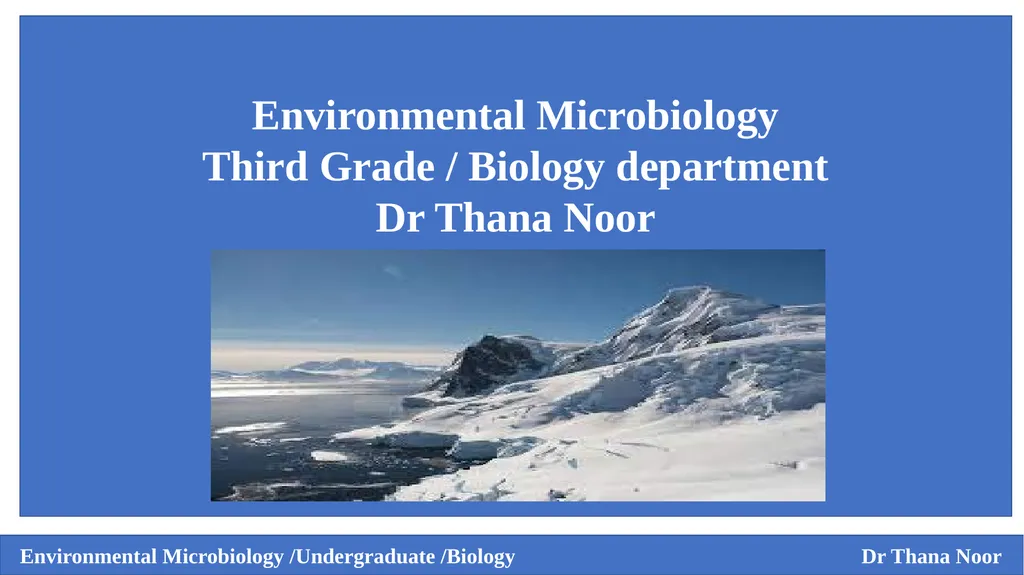
Environmental Microbiology
Third Grade / Biology department
Dr Thana Noor Environmental Microbiology /Undergraduate /Biology Dr Thana Noor<br>
Third Grade / Biology department
Dr Thana Noor Environmental Microbiology /Undergraduate /Biology Dr Thana Noor<br>
02
Environmental Microbiology /Undergraduate /Biology Dr Thana Noor What dose extreme environments mean?
There are two definitions of extreme Environments, The first characterizes an environments as extreme if the environmental conditions are at one or two extreme (high or low).these environmental conditions can include pH, temperature, salinity, pressure and nutrients. The second definition refers to Environments in which conditions select for extremely low microbial diversity.
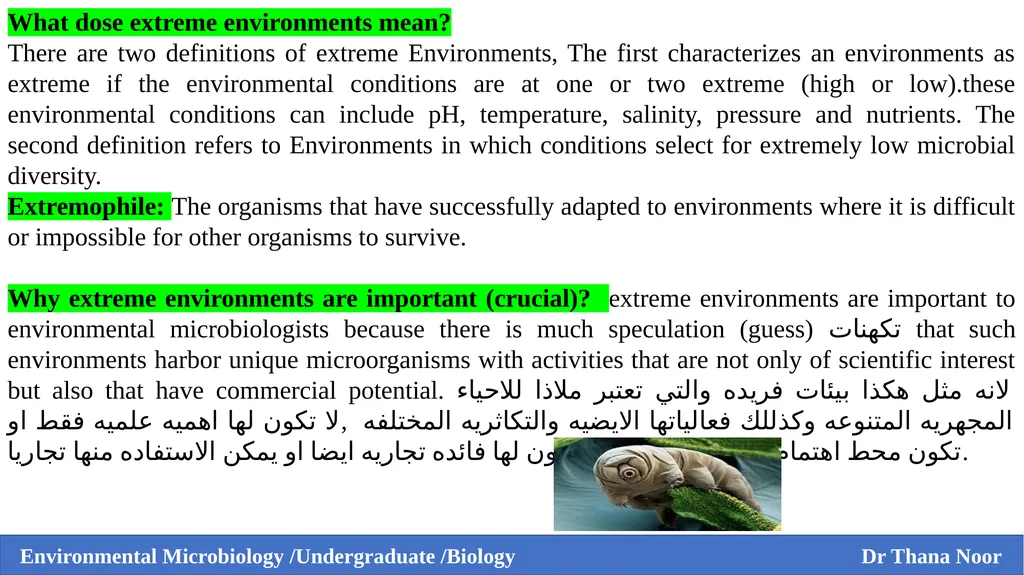
Extremophile: The organisms that have successfully adapted to environments where it is difficult or impossible for other organisms to survive.
Why extreme environments are important (crucial)? extreme environments are important to environmental microbiologists because there is much speculation (guess) تكهنات that such environments harbor unique microorganisms with activities that are not only of scientific interest but also that have commercial potential. لانه مثل هكذا بيئات فريده والتي تعتبر ملاذا للاحياء المجهريه المتنوعه وكذللك فعالياتها الايضيه والتكاثريه المختلفه , لا تكون لها اهميه علميه فقط او تكون محط اهتمام العلماء فقط وانما يكون لها فائده تجاريه ايضا او يمكن الاستفاده منها تجاريا.<br>
There are two definitions of extreme Environments, The first characterizes an environments as extreme if the environmental conditions are at one or two extreme (high or low).these environmental conditions can include pH, temperature, salinity, pressure and nutrients. The second definition refers to Environments in which conditions select for extremely low microbial diversity.
Extremophile: The organisms that have successfully adapted to environments where it is difficult or impossible for other organisms to survive.
Why extreme environments are important (crucial)? extreme environments are important to environmental microbiologists because there is much speculation (guess) تكهنات that such environments harbor unique microorganisms with activities that are not only of scientific interest but also that have commercial potential. لانه مثل هكذا بيئات فريده والتي تعتبر ملاذا للاحياء المجهريه المتنوعه وكذللك فعالياتها الايضيه والتكاثريه المختلفه , لا تكون لها اهميه علميه فقط او تكون محط اهتمام العلماء فقط وانما يكون لها فائده تجاريه ايضا او يمكن الاستفاده منها تجاريا.<br>
03
Environmental Microbiology /Undergraduate /Biology Dr Thana Noor What kind of developments that the microbial communities that survive through stressful environmental conditions can achieve?
ما نوع التطورات التي يمكن أن تحققها المجتمعات الميكروبية التي تعيش في ظروف بيئية مرهقة
1- Remediation approaches for some contaminated sites including acid mine drainage sites and radioactive waste sites.
2- Application of novel enzymes adapted to extreme PH or temperatures.
3- Understanding evolutionary history and possible impacts of future climate change.
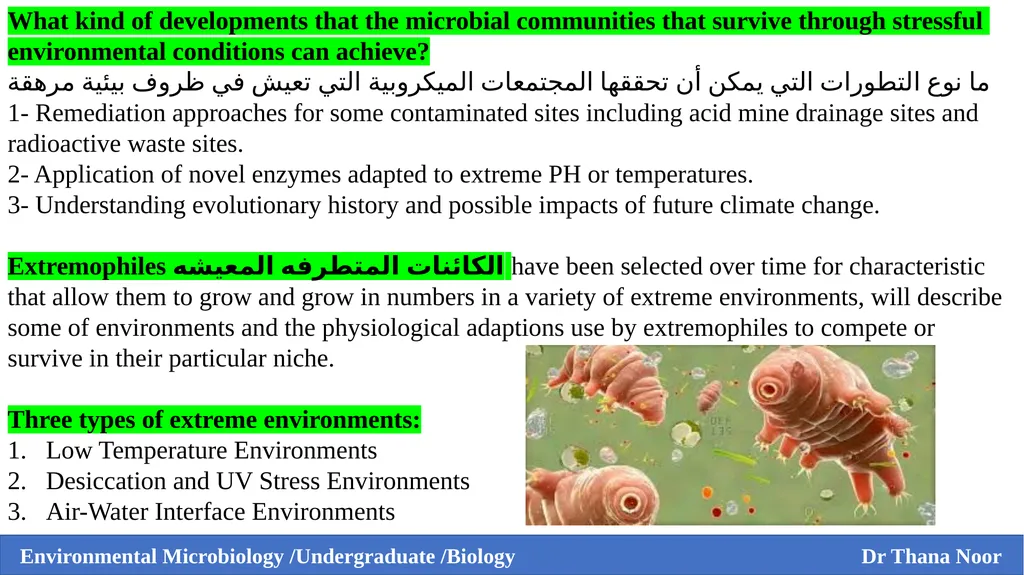
Extremophiles الكائنات المتطرفه المعيشه have been selected over time for characteristic that allow them to grow and grow in numbers in a variety of extreme environments, will describe some of environments and the physiological adaptions use by extremophiles to compete or survive in their particular niche.
Three types of extreme environments:
Low Temperature Environments
Desiccation and UV Stress Environments
Air-Water Interface Environments<br>
ما نوع التطورات التي يمكن أن تحققها المجتمعات الميكروبية التي تعيش في ظروف بيئية مرهقة
1- Remediation approaches for some contaminated sites including acid mine drainage sites and radioactive waste sites.
2- Application of novel enzymes adapted to extreme PH or temperatures.
3- Understanding evolutionary history and possible impacts of future climate change.
Extremophiles الكائنات المتطرفه المعيشه have been selected over time for characteristic that allow them to grow and grow in numbers in a variety of extreme environments, will describe some of environments and the physiological adaptions use by extremophiles to compete or survive in their particular niche.
Three types of extreme environments:
Low Temperature Environments
Desiccation and UV Stress Environments
Air-Water Interface Environments<br>
04
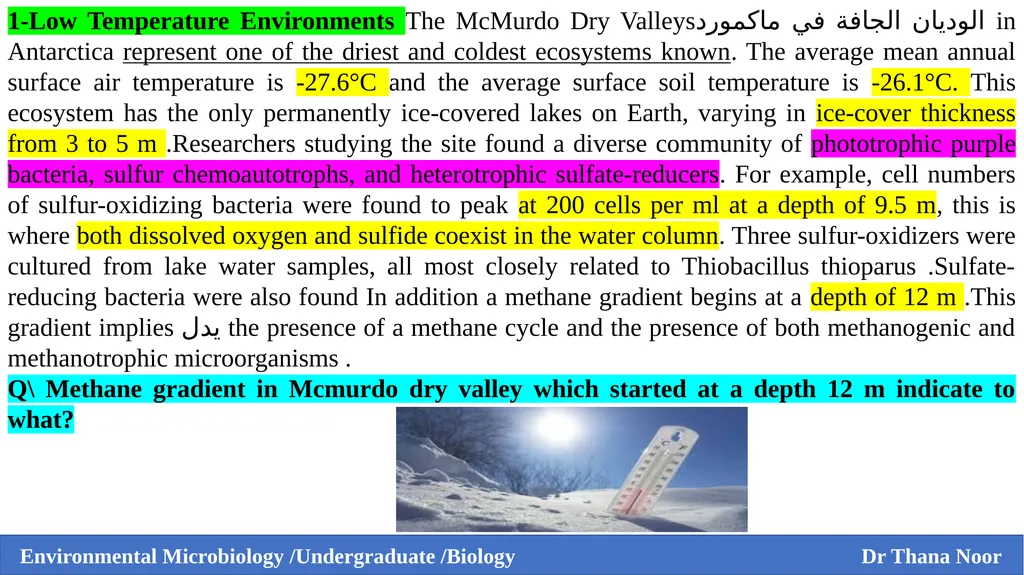
Environmental Microbiology /Undergraduate /Biology Dr Thana Noor 1-Low Temperature Environments The McMurdo Dry Valleysالوديان الجافة في ماكمورد in Antarctica represent one of the driest and coldest ecosystems known. The average mean annual surface air temperature is -27.6°C and the average surface soil temperature is -26.1°C. This ecosystem has the only permanently ice-covered lakes on Earth, varying in ice-cover thickness from 3 to 5 m .Researchers studying the site found a diverse community of phototrophic purple bacteria, sulfur chemoautotrophs, and heterotrophic sulfate-reducers. For example, cell numbers of sulfur-oxidizing bacteria were found to peak at 200 cells per ml at a depth of 9.5 m, this is where both dissolved oxygen and sulfide coexist in the water column. Three sulfur-oxidizers were cultured from lake water samples, all most closely related to Thiobacillus thioparus .Sulfate-reducing bacteria were also found In addition a methane gradient begins at a depth of 12 m .This gradient implies يدل the presence of a methane cycle and the presence of both methanogenic and methanotrophic microorganisms .
Q\ Methane gradient in Mcmurdo dry valley which started at a depth 12 m indicate to what?<br>
Q\ Methane gradient in Mcmurdo dry valley which started at a depth 12 m indicate to what?<br>
05
Environmental Microbiology /Undergraduate /Biology Dr Thana Noor Cold-adapted microorganisms: Their ability to survive and grow in the cold requires specialized adaptations For example, these microorganisms synthesize cold-adapted enzymes which have had to evolve specific structural features that make them highly flexible in comparison to their warm temperature equivalents .This flexibility, particularly around the active site of the enzyme.
هذه الميكروبات لها القدره على البقاء والنمو في البرد بواسطه تكيفات متخصصة ، على سبيل المثال ، تقوم هذه الكائنات الدقيقة بتجميع إنزيمات متكيفة مع البرودة وذلك عن طريق تطوير ميزات هيكلية محددة داخل الخليه الميكروبيه مما تجعلها مرنة للغاية مقارنة بدرجات الحرارة الدافئة المكافئة لها.
Q\How could microorganisms adapt in extreme cold environments
(the site where the enzyme interacts with its substrate) means that the enzyme can operate efficiently at low temperatures. This also means that at high temperatures the enzyme becomes unstable. In fact, it is these two properties of cold active enzymes that makes them suitable for biotechnological application: their high activity at low temperature and their low stability at elevated (high مرتفعه) temperatures. Low temperature enzymes that have been examined or used in industry include α- amylase, cellulase, β- galactosidase, lipase proteases, xylanase.<br>
هذه الميكروبات لها القدره على البقاء والنمو في البرد بواسطه تكيفات متخصصة ، على سبيل المثال ، تقوم هذه الكائنات الدقيقة بتجميع إنزيمات متكيفة مع البرودة وذلك عن طريق تطوير ميزات هيكلية محددة داخل الخليه الميكروبيه مما تجعلها مرنة للغاية مقارنة بدرجات الحرارة الدافئة المكافئة لها.
Q\How could microorganisms adapt in extreme cold environments
(the site where the enzyme interacts with its substrate) means that the enzyme can operate efficiently at low temperatures. This also means that at high temperatures the enzyme becomes unstable. In fact, it is these two properties of cold active enzymes that makes them suitable for biotechnological application: their high activity at low temperature and their low stability at elevated (high مرتفعه) temperatures. Low temperature enzymes that have been examined or used in industry include α- amylase, cellulase, β- galactosidase, lipase proteases, xylanase.<br>
06
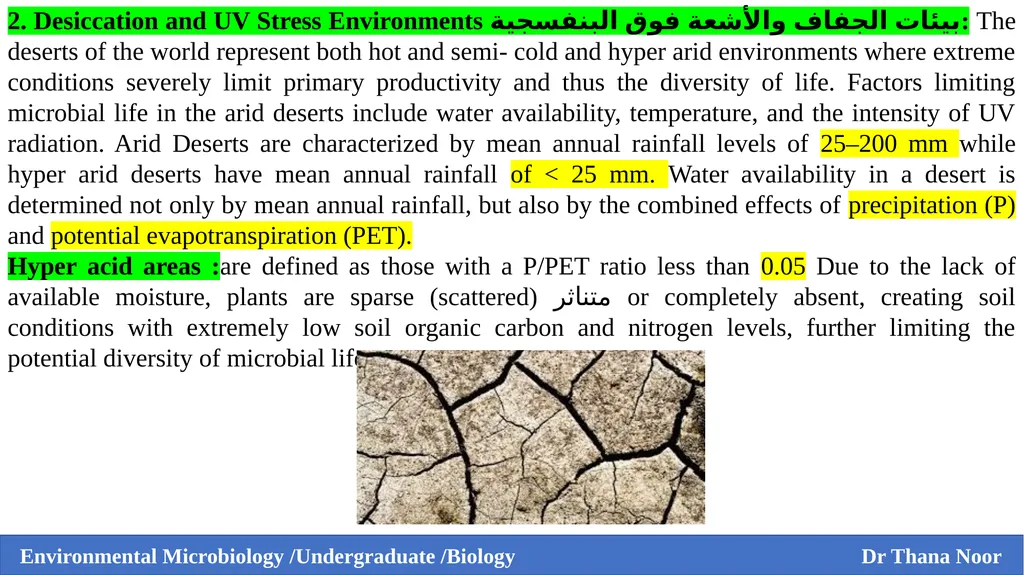
Environmental Microbiology /Undergraduate /Biology Dr Thana Noor 2. Desiccation and UV Stress Environments بيئات الجفاف والأشعة فوق البنفسجية: The deserts of the world represent both hot and semi- cold and hyper arid environments where extreme conditions severely limit primary productivity and thus the diversity of life. Factors limiting microbial life in the arid deserts include water availability, temperature, and the intensity of UV radiation. Arid Deserts are characterized by mean annual rainfall levels of 25–200 mm while hyper arid deserts have mean annual rainfall of < 25 mm. Water availability in a desert is determined not only by mean annual rainfall, but also by the combined effects of precipitation (P) and potential evapotranspiration (PET).
Hyper acid areas :are defined as those with a P/PET ratio less than 0.05 Due to the lack of available moisture, plants are sparse (scattered) متناثر or completely absent, creating soil conditions with extremely low soil organic carbon and nitrogen levels, further limiting the potential diversity of microbial life.<br>
Hyper acid areas :are defined as those with a P/PET ratio less than 0.05 Due to the lack of available moisture, plants are sparse (scattered) متناثر or completely absent, creating soil conditions with extremely low soil organic carbon and nitrogen levels, further limiting the potential diversity of microbial life.<br>
07
Environmental Microbiology /Undergraduate /Biology Dr Thana Noor Commonly studied feature in arid environments is the
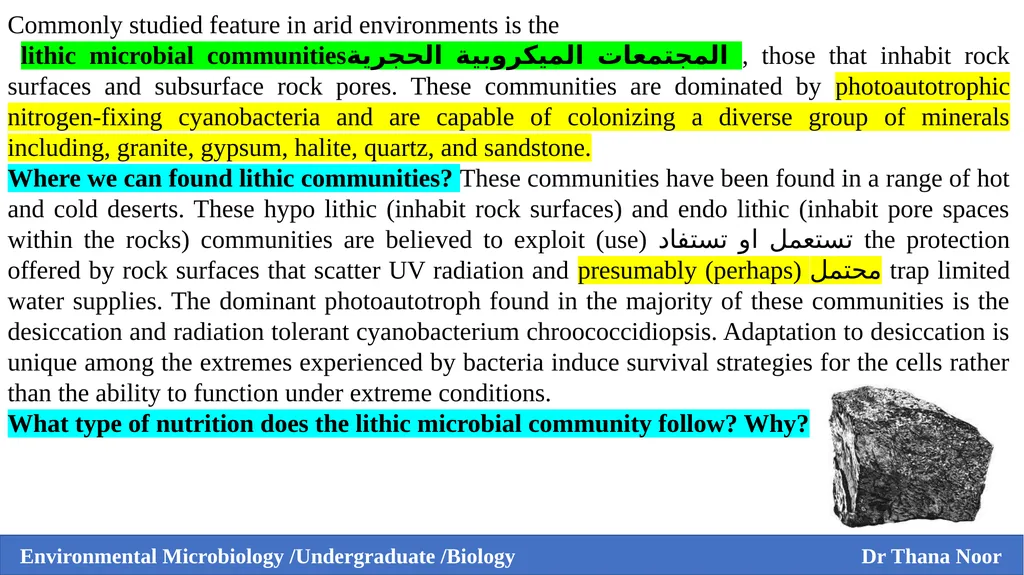
lithic microbial communitiesالمجتمعات الميكروبية الحجرية , those that inhabit rock surfaces and subsurface rock pores. These communities are dominated by photoautotrophic nitrogen-fixing cyanobacteria and are capable of colonizing a diverse group of minerals including, granite, gypsum, halite, quartz, and sandstone.
Where we can found lithic communities? These communities have been found in a range of hot and cold deserts. These hypo lithic (inhabit rock surfaces) and endo lithic (inhabit pore spaces within the rocks) communities are believed to exploit (use) تستعمل او تستفاد the protection offered by rock surfaces that scatter UV radiation and presumably (perhaps) محتمل trap limited water supplies. The dominant photoautotroph found in the majority of these communities is the desiccation and radiation tolerant cyanobacterium chroococcidiopsis. Adaptation to desiccation is unique among the extremes experienced by bacteria induce survival strategies for the cells rather than the ability to function under extreme conditions.
What type of nutrition does the lithic microbial community follow? Why?<br>
lithic microbial communitiesالمجتمعات الميكروبية الحجرية , those that inhabit rock surfaces and subsurface rock pores. These communities are dominated by photoautotrophic nitrogen-fixing cyanobacteria and are capable of colonizing a diverse group of minerals including, granite, gypsum, halite, quartz, and sandstone.
Where we can found lithic communities? These communities have been found in a range of hot and cold deserts. These hypo lithic (inhabit rock surfaces) and endo lithic (inhabit pore spaces within the rocks) communities are believed to exploit (use) تستعمل او تستفاد the protection offered by rock surfaces that scatter UV radiation and presumably (perhaps) محتمل trap limited water supplies. The dominant photoautotroph found in the majority of these communities is the desiccation and radiation tolerant cyanobacterium chroococcidiopsis. Adaptation to desiccation is unique among the extremes experienced by bacteria induce survival strategies for the cells rather than the ability to function under extreme conditions.
What type of nutrition does the lithic microbial community follow? Why?<br>
08
Environmental Microbiology /Undergraduate /Biology Dr Thana Noor The survival strategies that lithic microbial communities followed is:
● The ability to protect and repair DNA exposed to UV radiation
● Maintenance of protein stability in the dehydrated state
● Maintenance of membrane integrity
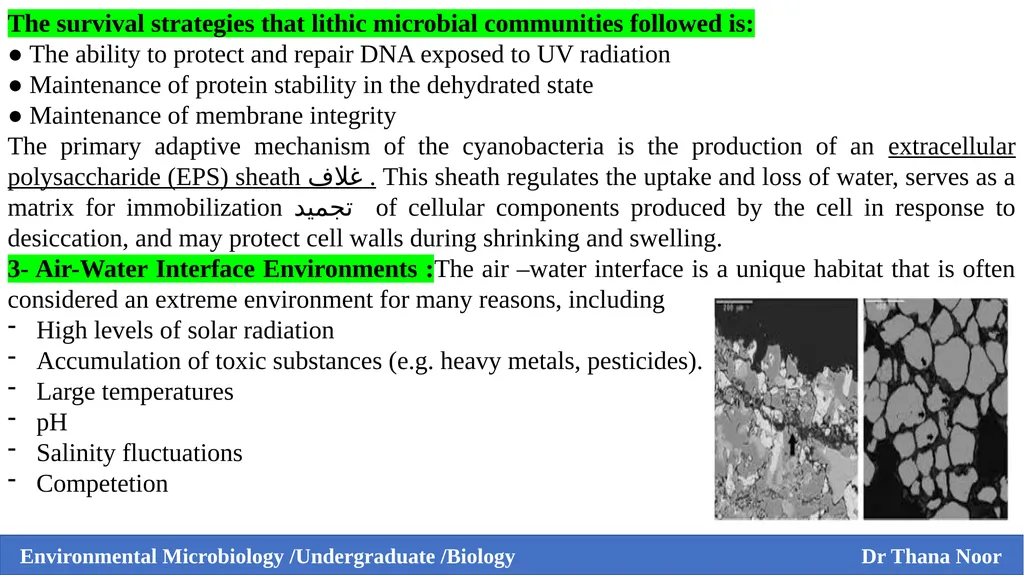
The primary adaptive mechanism of the cyanobacteria is the production of an extracellular polysaccharide (EPS) sheath غلاف . This sheath regulates the uptake and loss of water, serves as a matrix for immobilization تجميد of cellular components produced by the cell in response to desiccation, and may protect cell walls during shrinking and swelling.
3- Air-Water Interface Environments :The air –water interface is a unique habitat that is often considered an extreme environment for many reasons, including
High levels of solar radiation
Accumulation of toxic substances (e.g. heavy metals, pesticides).
Large temperatures
pH
Salinity fluctuations
Competetion<br>
● The ability to protect and repair DNA exposed to UV radiation
● Maintenance of protein stability in the dehydrated state
● Maintenance of membrane integrity
The primary adaptive mechanism of the cyanobacteria is the production of an extracellular polysaccharide (EPS) sheath غلاف . This sheath regulates the uptake and loss of water, serves as a matrix for immobilization تجميد of cellular components produced by the cell in response to desiccation, and may protect cell walls during shrinking and swelling.
3- Air-Water Interface Environments :The air –water interface is a unique habitat that is often considered an extreme environment for many reasons, including
High levels of solar radiation
Accumulation of toxic substances (e.g. heavy metals, pesticides).
Large temperatures
pH
Salinity fluctuations
Competetion<br>
09
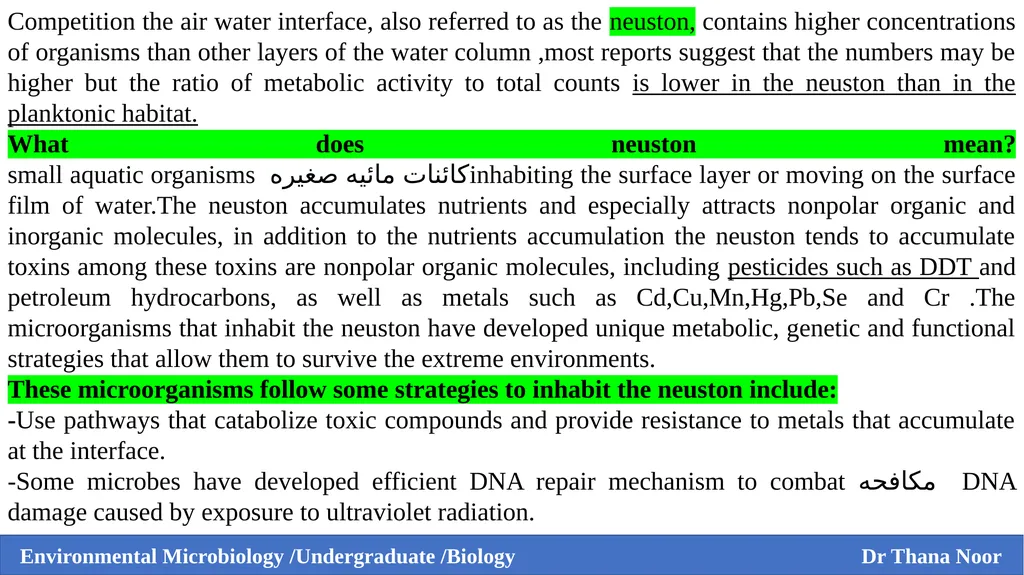
Environmental Microbiology /Undergraduate /Biology Dr Thana Noor Competition the air water interface, also referred to as the neuston, contains higher concentrations of organisms than other layers of the water column ,most reports suggest that the numbers may be higher but the ratio of metabolic activity to total counts is lower in the neuston than in the planktonic habitat.
What does neuston mean? small aquatic organisms كائنات مائيه صغيرهinhabiting the surface layer or moving on the surface film of water.The neuston accumulates nutrients and especially attracts nonpolar organic and inorganic molecules, in addition to the nutrients accumulation the neuston tends to accumulate toxins among these toxins are nonpolar organic molecules, including pesticides such as DDT and petroleum hydrocarbons, as well as metals such as Cd,Cu,Mn,Hg,Pb,Se and Cr .The microorganisms that inhabit the neuston have developed unique metabolic, genetic and functional strategies that allow them to survive the extreme environments.
These microorganisms follow some strategies to inhabit the neuston include:
-Use pathways that catabolize toxic compounds and provide resistance to metals that accumulate at the interface.
-Some microbes have developed efficient DNA repair mechanism to combat مكافحه DNA damage caused by exposure to ultraviolet radiation.<br>
What does neuston mean? small aquatic organisms كائنات مائيه صغيرهinhabiting the surface layer or moving on the surface film of water.The neuston accumulates nutrients and especially attracts nonpolar organic and inorganic molecules, in addition to the nutrients accumulation the neuston tends to accumulate toxins among these toxins are nonpolar organic molecules, including pesticides such as DDT and petroleum hydrocarbons, as well as metals such as Cd,Cu,Mn,Hg,Pb,Se and Cr .The microorganisms that inhabit the neuston have developed unique metabolic, genetic and functional strategies that allow them to survive the extreme environments.
These microorganisms follow some strategies to inhabit the neuston include:
-Use pathways that catabolize toxic compounds and provide resistance to metals that accumulate at the interface.
-Some microbes have developed efficient DNA repair mechanism to combat مكافحه DNA damage caused by exposure to ultraviolet radiation.<br>