
Environmental Policy for Environmental Elements J.

Description: Environmental Policy for Environmental Elements J. Badshah SGIDT, Patna (Bihar Animal Sciences University, Patna) Environmental Elements SITE SELECTION AND SITING FOR CONSTRUCTION, REPLACEMENT OR EXPANSION OF A DAIRY PLANT Nearby land uses,
Related Topics
Download Presentation
"Environmental Policy for Environmental Elements J." is the property of its rightful owner. Permission is granted to download and print the materials on this website for personal, non-commercial use only, and to display it on your personal computer provided you do not modify the materials and that you retain all copyright notices contained in the materials. By downloading content from our website, you accept the terms of this agreement.
Presentation Transcript
slide1. Environmental Policy for Environmental Elements J. Badshah
SGIDT, Patna
(Bihar Animal Sciences University, Patna)<br>
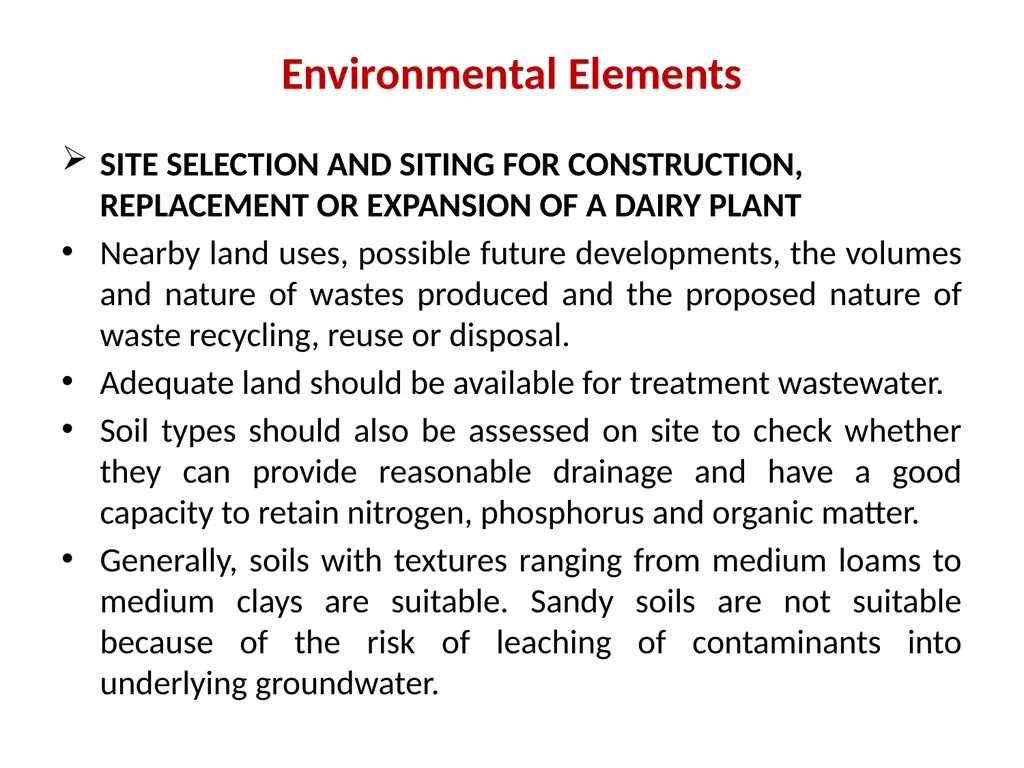
slide2. Environmental Elements SITE SELECTION AND SITING FOR CONSTRUCTION, REPLACEMENT OR EXPANSION OF A DAIRY PLANT
Nearby land uses, possible future developments, the volumes and nature of wastes produced and the proposed nature of waste recycling, reuse or disposal.
Adequate land should be available for treatment wastewater.
Soil types should also be assessed on site to check whether they can provide reasonable drainage and have a good capacity to retain nitrogen, phosphorus and organic matter.
Generally, soils with textures ranging from medium loams to medium clays are suitable. Sandy soils are not suitable because of the risk of leaching of contaminants into underlying groundwater.<br>
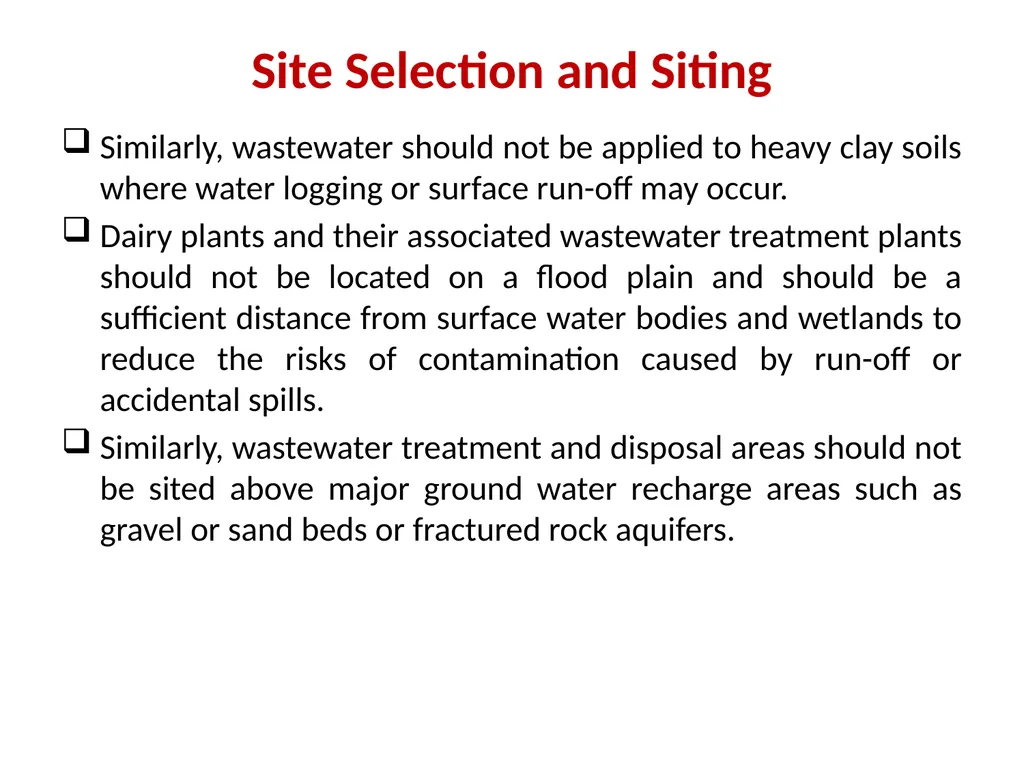
slide3. Site Selection and Siting Similarly, wastewater should not be applied to heavy clay soils where water logging or surface run-off may occur.
Dairy plants and their associated wastewater treatment plants should not be located on a flood plain and should be a sufficient distance from surface water bodies and wetlands to reduce the risks of contamination caused by run-off or accidental spills.
Similarly, wastewater treatment and disposal areas should not be sited above major ground water recharge areas such as gravel or sand beds or fractured rock aquifers.<br>
slide4. BUFFER DISTANCES In order to provide a basic level of protection from odour, dust and noise, a dairy plant should not be located within a minimum buffer distance of designated residential areas or other sensitive land uses.
This is to protect the amenity of the area from unintended or accidental emissions which may arise from causes such as equipment failure, accidents and abnormal weather conditions. The buffer distance is measured from the nearest dairy activity capable of emitting odour or particle emissions.
Air modelling studies may be necessary at the design stage for large operations when the buffer distances are close to the recommended minima.<br>
slide5. BUFFER DISTANCES Siting should also consider the need to protect sensitive natural water resources. Thus a dairy plant should not be sited within 100 metres of surface waters, nor be located on a flood plain or in declared special water supply catchment areas unless adequate protection of surface and ground waters can be demonstrated by the proponent.
An ideal buffer distance between dairy processing operations and residential areas would be at least a kilometre.
However, for facilities that operate their own anaerobic, aerobic or facultative wastewater treatment lagoons and irrigation-based disposal areas, this separation distance may vary from 200 to 2,200 metres – the distance depends on the flow rate and strength of the treated and disposed wastewater.<br>
slide6. AIR QUALITY Types of emissions
The main emissions from dairy manufacturing processes are odours and particles.
Odours in and around milk processing plants come from the biological decomposition of milk-
derived organic matter, generally found in wastewater. Often these odours are due to poor housekeeping, overloaded or improperly run wastewater treatment and disposal facilities, and prolonged storage of strong wastes such as whey.<br>
slide7. Particles Particle emissions are caused either by combustion of solid or liquid fuel or, more often, spray drying of milk and whey.
Excessive emissions are often sporadic and happen during plant upsets, shutdowns or start-ups.
The use of solid or liquid fuel such as briquettes and oil can result in fallout – carbonaceous ash particulate is usually emitted during boiler upsets or tube soot-blowing operations.
Milk powder particles – while not toxic – accumulate on flat surfaces such as roofing, guttering and rainwater tanks, and may seriously compromise the quality of storm water discharged from the site or taint the drinking water.
A further source of annoyance to residents and factory workers is powder settling on nearby motor vehicles.<br>
slide8. Source of Noise The State Environment Protection Policy (Control of Noise from Commerce, Industry and Trade, No. N-1) requires that any noise due to activities at a premises in a sensitive area must not exceed the noise limits for the area, as determined by the methods set out in the policy.
The limits are tighter outside the normal working day – such as the evening and especially at night.<br>
slide9. WASTE WATER QUALITY Protection of surface and groundwaters : Activities at dairy plants have the potential to contaminate both surface waters and groundwater.
Water and land pollution can be avoided by appropriate siting, design, management and control of the dairy plant.
Sources of dairy wastewater :Approximately 65% of dairy factory losses enter wastewater discharge streams and these can have a major impact on the environment.
The main sources of dairy processing plant wastewater are raw material (predominantly milk) and product losses from leaking equipment and pipelines, and spills caused by equipment overflows and malfunctions and by poor handling procedures materials used for cleaning and sanitising by-products such as whey from the manufacture of cheese and casein.<br>
slide10. Environmental policy and guidelines Waste management and reuse facilities must comply with the relevant environmental policies including those listed below.
State Environment Protection Policy (The Air Environment), which specifies the objectives for specific gaseous components and particulate emissions.
State Environment Protection Policy (Waters of Victoria) – Schedule E lists emission limits for waste discharges to water. More stringent requirements may be necessary with environmental sensitive water areas.
State Environment Protection Policy (Waters of Victoria) – clause 22 requires that waste be discharged preferably to land where practical and environmental beneficial.<br>
slide11. Environmental policy and guidelines Waste water Irrigation (EPA Publication 168). In particular, wastewater storage and disposal should be designed and built to contain all waste in at least 90% of wet years.
People and organisations that use land irrigation should ensure that there is enough land area for both present and future wastewater disposal.
State Environment Protection Policy (Waters of Victoria) – clause 23 refers to minimisation of waste generation.
State Environment Protection Policy (Groundwaters of Victoria) (draft 1994) requires that groundwater is protected from activities potentially detrimental to its quality, as well as from hydro – geological testing and assessment.
State Environment Protection Policy (Industrial and Commercial Noise N1). Industrial Waste Management Policy (Waste Minimisation) 1990 requires all premises subject to works approval to have comprehensive waste management plans – covering all aspects of waste minimisation and identifying options for waste minimisation, the handling, storage and disposal of wastes.<br>
slide12. THANKS ejazbadshah@gmail.com<br>
SGIDT, Patna
(Bihar Animal Sciences University, Patna)<br>
slide2. Environmental Elements SITE SELECTION AND SITING FOR CONSTRUCTION, REPLACEMENT OR EXPANSION OF A DAIRY PLANT
Nearby land uses, possible future developments, the volumes and nature of wastes produced and the proposed nature of waste recycling, reuse or disposal.
Adequate land should be available for treatment wastewater.
Soil types should also be assessed on site to check whether they can provide reasonable drainage and have a good capacity to retain nitrogen, phosphorus and organic matter.
Generally, soils with textures ranging from medium loams to medium clays are suitable. Sandy soils are not suitable because of the risk of leaching of contaminants into underlying groundwater.<br>
slide3. Site Selection and Siting Similarly, wastewater should not be applied to heavy clay soils where water logging or surface run-off may occur.
Dairy plants and their associated wastewater treatment plants should not be located on a flood plain and should be a sufficient distance from surface water bodies and wetlands to reduce the risks of contamination caused by run-off or accidental spills.
Similarly, wastewater treatment and disposal areas should not be sited above major ground water recharge areas such as gravel or sand beds or fractured rock aquifers.<br>
slide4. BUFFER DISTANCES In order to provide a basic level of protection from odour, dust and noise, a dairy plant should not be located within a minimum buffer distance of designated residential areas or other sensitive land uses.
This is to protect the amenity of the area from unintended or accidental emissions which may arise from causes such as equipment failure, accidents and abnormal weather conditions. The buffer distance is measured from the nearest dairy activity capable of emitting odour or particle emissions.
Air modelling studies may be necessary at the design stage for large operations when the buffer distances are close to the recommended minima.<br>
slide5. BUFFER DISTANCES Siting should also consider the need to protect sensitive natural water resources. Thus a dairy plant should not be sited within 100 metres of surface waters, nor be located on a flood plain or in declared special water supply catchment areas unless adequate protection of surface and ground waters can be demonstrated by the proponent.
An ideal buffer distance between dairy processing operations and residential areas would be at least a kilometre.
However, for facilities that operate their own anaerobic, aerobic or facultative wastewater treatment lagoons and irrigation-based disposal areas, this separation distance may vary from 200 to 2,200 metres – the distance depends on the flow rate and strength of the treated and disposed wastewater.<br>
slide6. AIR QUALITY Types of emissions
The main emissions from dairy manufacturing processes are odours and particles.
Odours in and around milk processing plants come from the biological decomposition of milk-
derived organic matter, generally found in wastewater. Often these odours are due to poor housekeeping, overloaded or improperly run wastewater treatment and disposal facilities, and prolonged storage of strong wastes such as whey.<br>
slide7. Particles Particle emissions are caused either by combustion of solid or liquid fuel or, more often, spray drying of milk and whey.
Excessive emissions are often sporadic and happen during plant upsets, shutdowns or start-ups.
The use of solid or liquid fuel such as briquettes and oil can result in fallout – carbonaceous ash particulate is usually emitted during boiler upsets or tube soot-blowing operations.
Milk powder particles – while not toxic – accumulate on flat surfaces such as roofing, guttering and rainwater tanks, and may seriously compromise the quality of storm water discharged from the site or taint the drinking water.
A further source of annoyance to residents and factory workers is powder settling on nearby motor vehicles.<br>
slide8. Source of Noise The State Environment Protection Policy (Control of Noise from Commerce, Industry and Trade, No. N-1) requires that any noise due to activities at a premises in a sensitive area must not exceed the noise limits for the area, as determined by the methods set out in the policy.
The limits are tighter outside the normal working day – such as the evening and especially at night.<br>
slide9. WASTE WATER QUALITY Protection of surface and groundwaters : Activities at dairy plants have the potential to contaminate both surface waters and groundwater.
Water and land pollution can be avoided by appropriate siting, design, management and control of the dairy plant.
Sources of dairy wastewater :Approximately 65% of dairy factory losses enter wastewater discharge streams and these can have a major impact on the environment.
The main sources of dairy processing plant wastewater are raw material (predominantly milk) and product losses from leaking equipment and pipelines, and spills caused by equipment overflows and malfunctions and by poor handling procedures materials used for cleaning and sanitising by-products such as whey from the manufacture of cheese and casein.<br>
slide10. Environmental policy and guidelines Waste management and reuse facilities must comply with the relevant environmental policies including those listed below.
State Environment Protection Policy (The Air Environment), which specifies the objectives for specific gaseous components and particulate emissions.
State Environment Protection Policy (Waters of Victoria) – Schedule E lists emission limits for waste discharges to water. More stringent requirements may be necessary with environmental sensitive water areas.
State Environment Protection Policy (Waters of Victoria) – clause 22 requires that waste be discharged preferably to land where practical and environmental beneficial.<br>
slide11. Environmental policy and guidelines Waste water Irrigation (EPA Publication 168). In particular, wastewater storage and disposal should be designed and built to contain all waste in at least 90% of wet years.
People and organisations that use land irrigation should ensure that there is enough land area for both present and future wastewater disposal.
State Environment Protection Policy (Waters of Victoria) – clause 23 refers to minimisation of waste generation.
State Environment Protection Policy (Groundwaters of Victoria) (draft 1994) requires that groundwater is protected from activities potentially detrimental to its quality, as well as from hydro – geological testing and assessment.
State Environment Protection Policy (Industrial and Commercial Noise N1). Industrial Waste Management Policy (Waste Minimisation) 1990 requires all premises subject to works approval to have comprehensive waste management plans – covering all aspects of waste minimisation and identifying options for waste minimisation, the handling, storage and disposal of wastes.<br>
slide12. THANKS ejazbadshah@gmail.com<br>