
Environmental Scan State Human Resources Division
KB
Published · 14 slides · 0 views
1 / 1
Description
Environmental Scan State Human Resources Division Office of Financial Management June 2013 What is environmental scanning? Environmental scanning is the art of systematically exploring and interpreting the external environment to better
Related Topics
Share
Embed code
Download this presentation From Below
"Environmental Scan State Human Resources Division" is the property of its rightful owner. Permission is granted to download and print the materials on this website for personal, non-commercial use only, and to display it on your personal computer provided you do not modify the materials and that you retain all copyright notices contained in the materials. By downloading content from our website, you accept the terms of this agreement.
Presentation Transcript
01
Environmental Scan State Human Resources Division
Office of Financial Management
June 2013<br>
Office of Financial Management
June 2013<br>
02
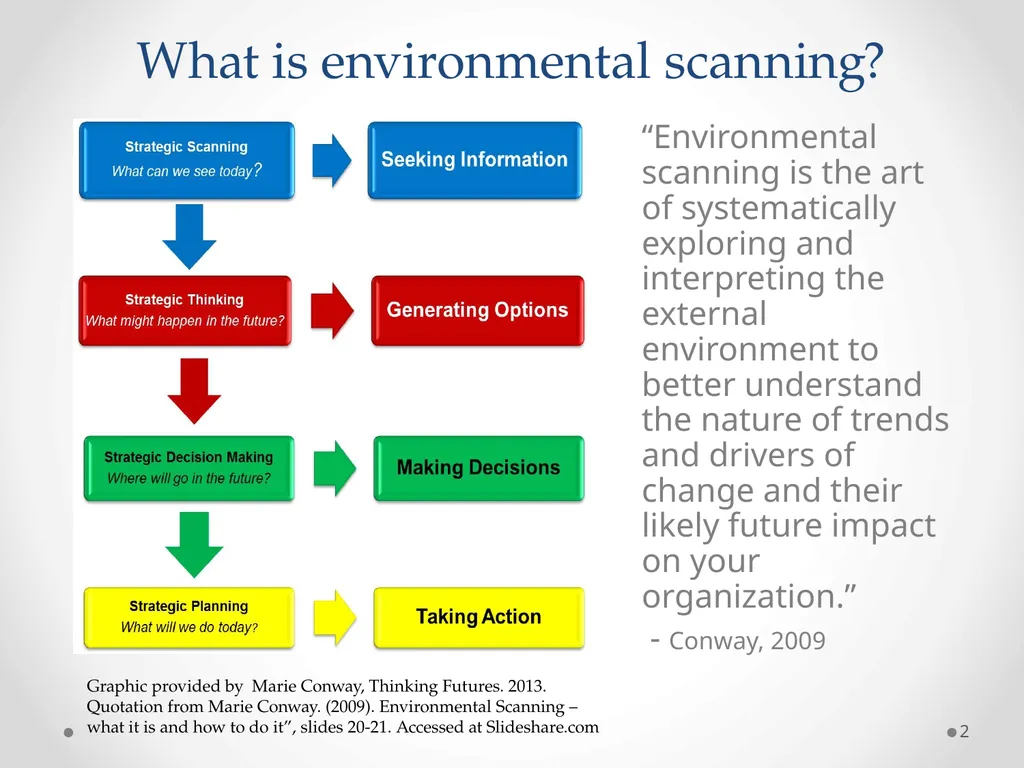
What is environmental scanning? “Environmental scanning is the art of systematically exploring and interpreting the external environment to better understand the nature of trends and drivers of change and their likely future impact on your organization.”
- Conway, 2009 Graphic provided by Marie Conway, Thinking Futures. 2013.
Quotation from Marie Conway. (2009). Environmental Scanning – what it is and how to do it”, slides 20-21. Accessed at Slideshare.com 2<br>
- Conway, 2009 Graphic provided by Marie Conway, Thinking Futures. 2013.
Quotation from Marie Conway. (2009). Environmental Scanning – what it is and how to do it”, slides 20-21. Accessed at Slideshare.com 2<br>
03
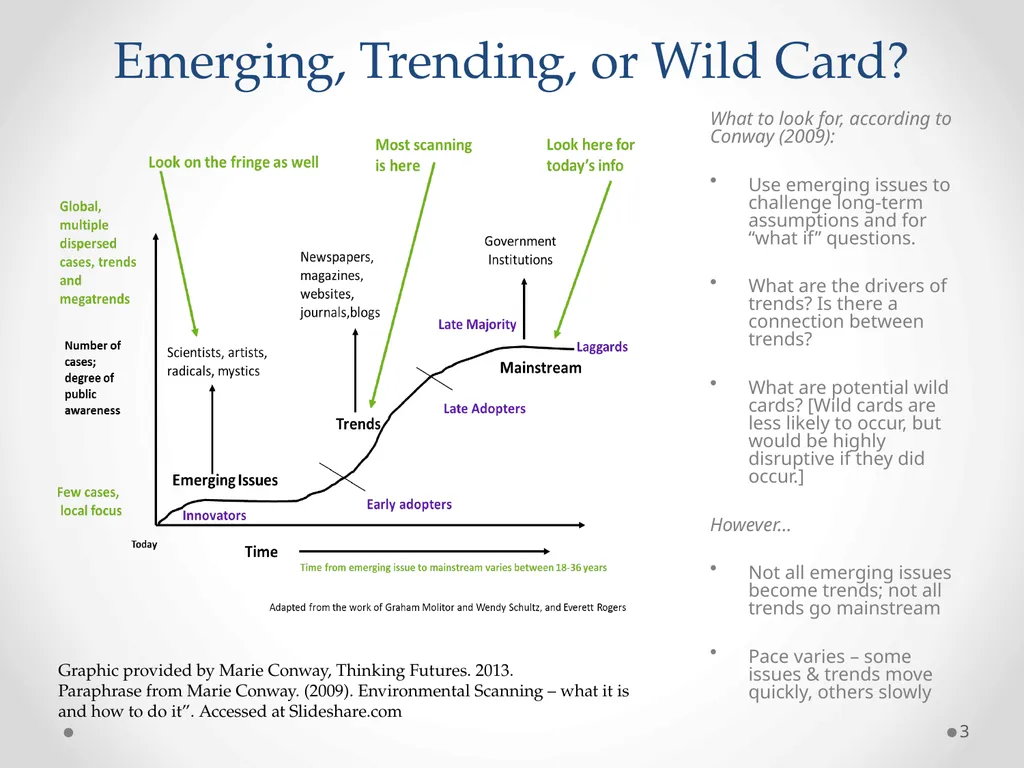
Emerging, Trending, or Wild Card? What to look for, according to Conway (2009):
Use emerging issues to challenge long-term assumptions and for “what if” questions.
What are the drivers of trends? Is there a connection between trends?
What are potential wild cards? [Wild cards are less likely to occur, but would be highly disruptive if they did occur.]
However…
Not all emerging issues become trends; not all trends go mainstream
Pace varies – some issues & trends move quickly, others slowly Graphic provided by Marie Conway, Thinking Futures. 2013.
Paraphrase from Marie Conway. (2009). Environmental Scanning – what it is and how to do it”. Accessed at Slideshare.com 3<br>
Use emerging issues to challenge long-term assumptions and for “what if” questions.
What are the drivers of trends? Is there a connection between trends?
What are potential wild cards? [Wild cards are less likely to occur, but would be highly disruptive if they did occur.]
However…
Not all emerging issues become trends; not all trends go mainstream
Pace varies – some issues & trends move quickly, others slowly Graphic provided by Marie Conway, Thinking Futures. 2013.
Paraphrase from Marie Conway. (2009). Environmental Scanning – what it is and how to do it”. Accessed at Slideshare.com 3<br>
04
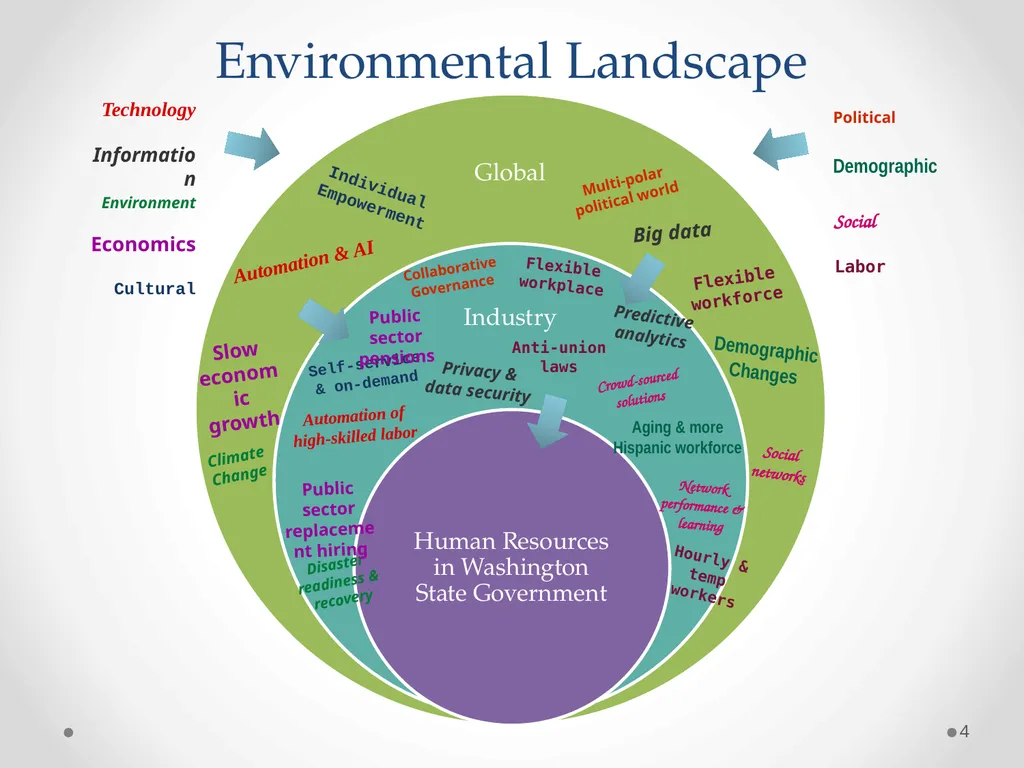
Environmental Landscape Climate Change Disaster readiness & recovery Individual Empowerment Self-service & on-demand Slow economic growth Social networks Multi-polar political world Collaborative Governance Demographic Changes Aging & more Hispanic workforce Big data Predictive analytics Flexible workforce Hourly & temp workers Crowd-sourced solutions Anti-union laws Public sector replacement hiring Flexible workplace Privacy & data security Network performance & learning Automation & AI Automation of high-skilled labor Technology Economics Cultural Environment Political Social Demographic Labor Information Public sector pensions 4<br>
05
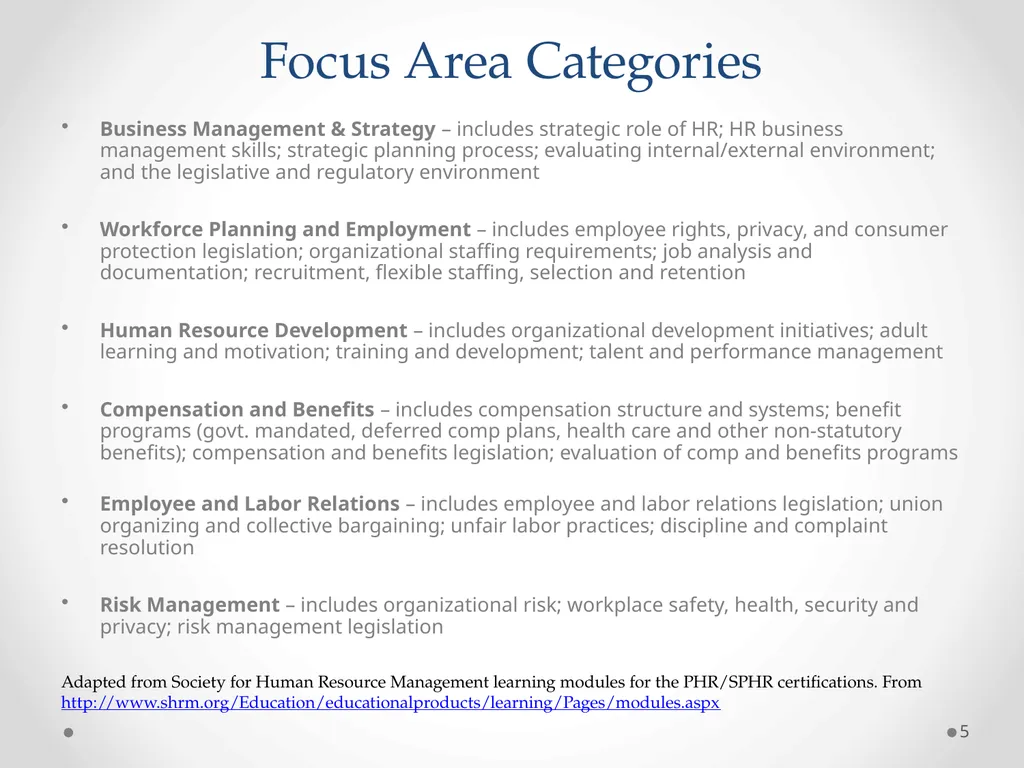
Focus Area Categories Business Management & Strategy – includes strategic role of HR; HR business management skills; strategic planning process; evaluating internal/external environment; and the legislative and regulatory environment
Workforce Planning and Employment – includes employee rights, privacy, and consumer protection legislation; organizational staffing requirements; job analysis and documentation; recruitment, flexible staffing, selection and retention
Human Resource Development – includes organizational development initiatives; adult learning and motivation; training and development; talent and performance management
Compensation and Benefits – includes compensation structure and systems; benefit programs (govt. mandated, deferred comp plans, health care and other non-statutory benefits); compensation and benefits legislation; evaluation of comp and benefits programs
Employee and Labor Relations – includes employee and labor relations legislation; union organizing and collective bargaining; unfair labor practices; discipline and complaint resolution
Risk Management – includes organizational risk; workplace safety, health, security and privacy; risk management legislation 5 Adapted from Society for Human Resource Management learning modules for the PHR/SPHR certifications. From http://www.shrm.org/Education/educationalproducts/learning/Pages/modules.aspx<br>
Workforce Planning and Employment – includes employee rights, privacy, and consumer protection legislation; organizational staffing requirements; job analysis and documentation; recruitment, flexible staffing, selection and retention
Human Resource Development – includes organizational development initiatives; adult learning and motivation; training and development; talent and performance management
Compensation and Benefits – includes compensation structure and systems; benefit programs (govt. mandated, deferred comp plans, health care and other non-statutory benefits); compensation and benefits legislation; evaluation of comp and benefits programs
Employee and Labor Relations – includes employee and labor relations legislation; union organizing and collective bargaining; unfair labor practices; discipline and complaint resolution
Risk Management – includes organizational risk; workplace safety, health, security and privacy; risk management legislation 5 Adapted from Society for Human Resource Management learning modules for the PHR/SPHR certifications. From http://www.shrm.org/Education/educationalproducts/learning/Pages/modules.aspx<br>
06
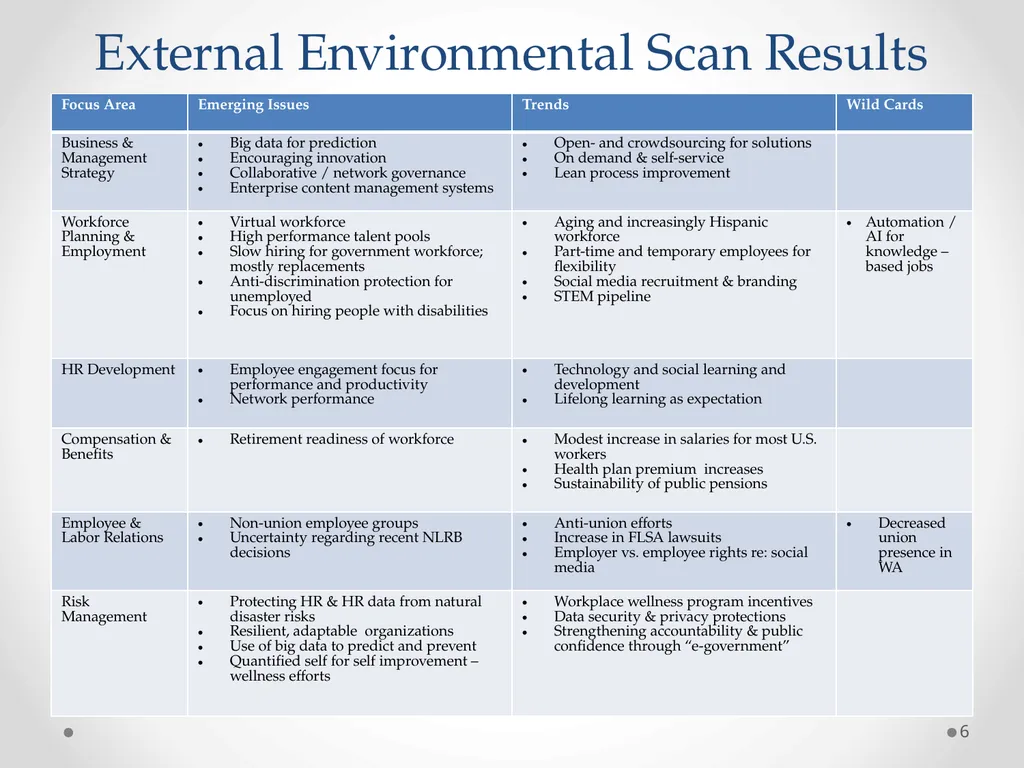
External Environmental Scan Results 6<br>
07
Business Management Strategy Key Trends:
Open-sourced and crowd-sourced solutions
Self-service and on-demand access to data, information, and other decision-making tools
Lean process improvement
Enterprise content management to increase efficiency
Emerging Issues:
Use of “big data” to anticipate events for more effective strategic planning
Encouraging innovation for creative problem solving
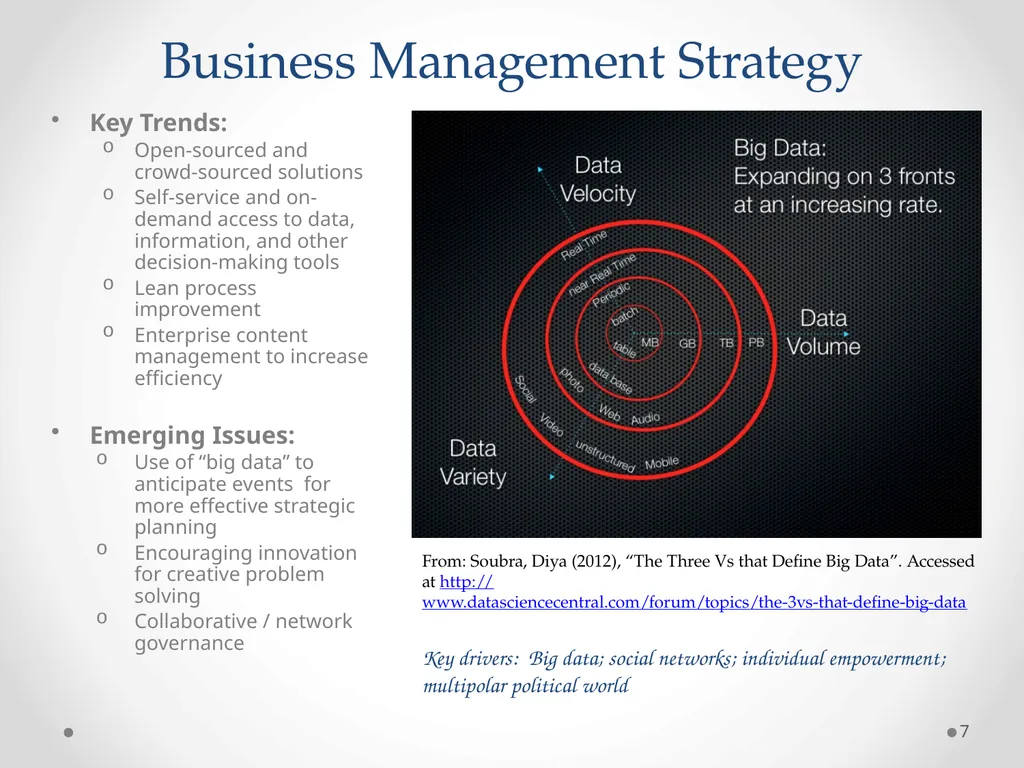
Collaborative / network governance Key drivers: Big data; social networks; individual empowerment; multipolar political world From: Soubra, Diya (2012), “The Three Vs that Define Big Data”. Accessed at http://www.datasciencecentral.com/forum/topics/the-3vs-that-define-big-data 7<br>
Open-sourced and crowd-sourced solutions
Self-service and on-demand access to data, information, and other decision-making tools
Lean process improvement
Enterprise content management to increase efficiency
Emerging Issues:
Use of “big data” to anticipate events for more effective strategic planning
Encouraging innovation for creative problem solving
Collaborative / network governance Key drivers: Big data; social networks; individual empowerment; multipolar political world From: Soubra, Diya (2012), “The Three Vs that Define Big Data”. Accessed at http://www.datasciencecentral.com/forum/topics/the-3vs-that-define-big-data 7<br>
08
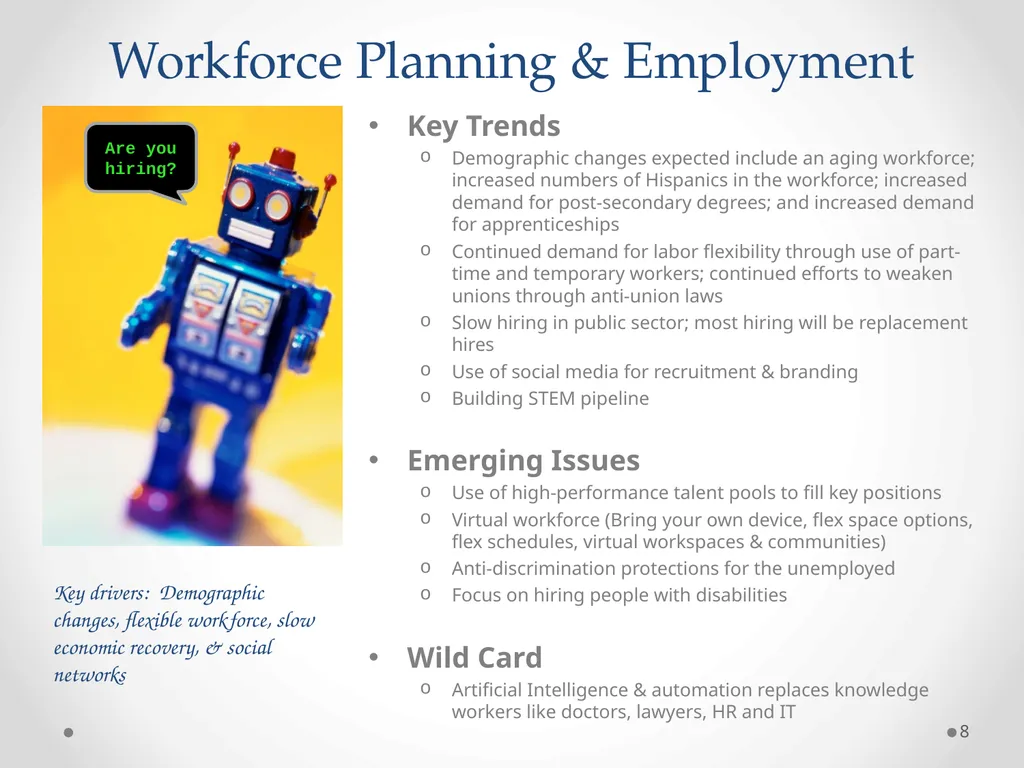
Workforce Planning & Employment Key Trends
Demographic changes expected include an aging workforce; increased numbers of Hispanics in the workforce; increased demand for post-secondary degrees; and increased demand for apprenticeships
Continued demand for labor flexibility through use of part-time and temporary workers; continued efforts to weaken unions through anti-union laws
Slow hiring in public sector; most hiring will be replacement hires
Use of social media for recruitment & branding
Building STEM pipeline
Emerging Issues
Use of high-performance talent pools to fill key positions
Virtual workforce (Bring your own device, flex space options, flex schedules, virtual workspaces & communities)
Anti-discrimination protections for the unemployed
Focus on hiring people with disabilities
Wild Card
Artificial Intelligence & automation replaces knowledge workers like doctors, lawyers, HR and IT Are you hiring? Key drivers: Demographic changes, flexible workforce, slow economic recovery, & social networks 8<br>
Demographic changes expected include an aging workforce; increased numbers of Hispanics in the workforce; increased demand for post-secondary degrees; and increased demand for apprenticeships
Continued demand for labor flexibility through use of part-time and temporary workers; continued efforts to weaken unions through anti-union laws
Slow hiring in public sector; most hiring will be replacement hires
Use of social media for recruitment & branding
Building STEM pipeline
Emerging Issues
Use of high-performance talent pools to fill key positions
Virtual workforce (Bring your own device, flex space options, flex schedules, virtual workspaces & communities)
Anti-discrimination protections for the unemployed
Focus on hiring people with disabilities
Wild Card
Artificial Intelligence & automation replaces knowledge workers like doctors, lawyers, HR and IT Are you hiring? Key drivers: Demographic changes, flexible workforce, slow economic recovery, & social networks 8<br>
09
Human Resource Development Key Trends
Online and social learning – expectation for multiplatform, on demand, & high-quality
Expectation for lifelong learning – multiple career changes, need for adaptability
Emerging Issue
Focus on employee engagement as key driver of performance & productivity
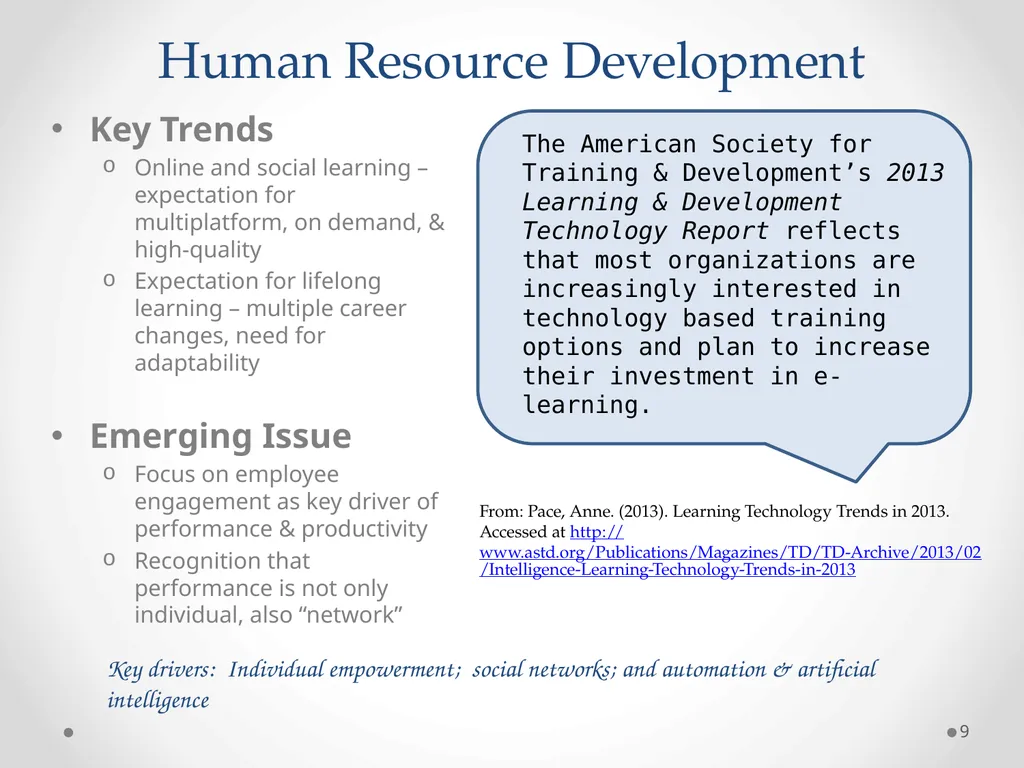
Recognition that performance is not only individual, also “network” Key drivers: Individual empowerment; social networks; and automation & artificial intelligence From: Pace, Anne. (2013). Learning Technology Trends in 2013. Accessed at http://www.astd.org/Publications/Magazines/TD/TD-Archive/2013/02/Intelligence-Learning-Technology-Trends-in-2013 9 The American Society for Training & Development’s 2013 Learning & Development Technology Report reflects that most organizations are increasingly interested in technology based training options and plan to increase their investment in e-learning.<br>
Online and social learning – expectation for multiplatform, on demand, & high-quality
Expectation for lifelong learning – multiple career changes, need for adaptability
Emerging Issue
Focus on employee engagement as key driver of performance & productivity
Recognition that performance is not only individual, also “network” Key drivers: Individual empowerment; social networks; and automation & artificial intelligence From: Pace, Anne. (2013). Learning Technology Trends in 2013. Accessed at http://www.astd.org/Publications/Magazines/TD/TD-Archive/2013/02/Intelligence-Learning-Technology-Trends-in-2013 9 The American Society for Training & Development’s 2013 Learning & Development Technology Report reflects that most organizations are increasingly interested in technology based training options and plan to increase their investment in e-learning.<br>
10
Compensation & Benefits Key Trends
Modest increase in compensation for most U.S. workers
Health plan premiums continue to increase, but more slowly
Continued concerns about the sustainability of public pensions
Emerging Issues
Concern about employee readiness to retire; most workers have insufficient savings Key drivers: Slow economic recovery, individual empowerment 10<br>
Modest increase in compensation for most U.S. workers
Health plan premiums continue to increase, but more slowly
Continued concerns about the sustainability of public pensions
Emerging Issues
Concern about employee readiness to retire; most workers have insufficient savings Key drivers: Slow economic recovery, individual empowerment 10<br>
11
Employee & Labor Relations Key Trends
Anti-union legislation
Increase in FLSA lawsuits
Social media policies versus employees rights
Emerging Issues
Non-union employee groups
Uncertainty over recent NLRB decisions due to recess appointment decision
Wild Card
Decreased union presence in Washington state Key drivers: Flexible workforce; individual empowerment; social networks 11<br>
Anti-union legislation
Increase in FLSA lawsuits
Social media policies versus employees rights
Emerging Issues
Non-union employee groups
Uncertainty over recent NLRB decisions due to recess appointment decision
Wild Card
Decreased union presence in Washington state Key drivers: Flexible workforce; individual empowerment; social networks 11<br>
12
Risk Management Key Trends
Workplace wellness programs - incentives & ROI
Concerns about data security & privacy protections
Accountability and public confidence through increased transparency
Emerging Issues
Use of big data to predict and prevent
“Quantified self” data in wellness programs
Protecting HR and HR data from natural disaster risks
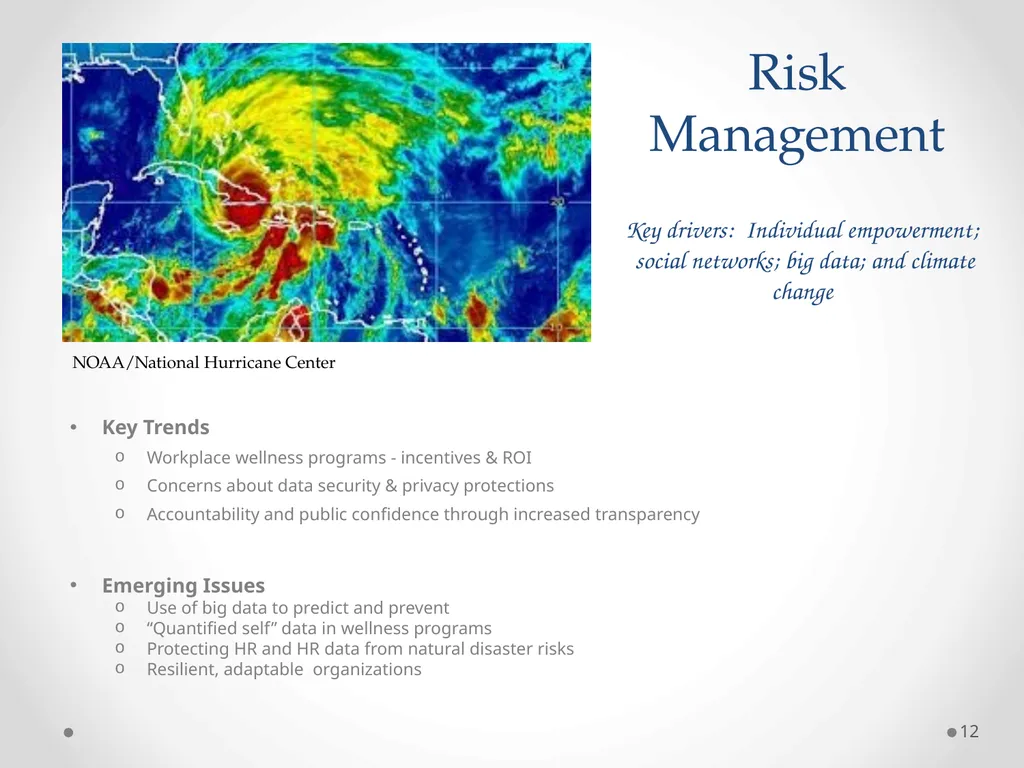
Resilient, adaptable organizations Key drivers: Individual empowerment; social networks; big data; and climate change NOAA/National Hurricane Center 12<br>
Workplace wellness programs - incentives & ROI
Concerns about data security & privacy protections
Accountability and public confidence through increased transparency
Emerging Issues
Use of big data to predict and prevent
“Quantified self” data in wellness programs
Protecting HR and HR data from natural disaster risks
Resilient, adaptable organizations Key drivers: Individual empowerment; social networks; big data; and climate change NOAA/National Hurricane Center 12<br>
13
Next Steps How would we respond to these challenges?
What actions can we take today to better prepare ourselves for the future?
What possibilities haven’t we considered? How likely are these possibilities and what would we do?
Internal scan – What resources do we already have? What other resources will we need?
Strategic plan – How do our goals, objectives, and actions today prepare us for possible tomorrows? 13<br>
What actions can we take today to better prepare ourselves for the future?
What possibilities haven’t we considered? How likely are these possibilities and what would we do?
Internal scan – What resources do we already have? What other resources will we need?
Strategic plan – How do our goals, objectives, and actions today prepare us for possible tomorrows? 13<br>
14
Sources American Bar Association
American Society for Training and Development
Brookings Institute
Corporate Leadership Council
Deloitte
Families and Work Institute
Federal Times
Governing Magazine
Government Technology
Govloop
HR Specialist
Human Resource Executive Online
IBM Center for the Business of Government
National Association of State Personnel Executives
National Center for Education Statistics
National Conference of State Legislatures
National Governors Association
National Labor Relations Board
Pew Research Center
Pew Stateline
Public Administration (PA) Times
Public CIO
Slate
Society for Human Resource Management
The Center for Public Education
The Futurist
The New York Times
The Week
Time Magazine
TLNT: The Business of HR
USA Today
U.S. Bureau of Labor Statistics
U.S. Department of Labor
U.S. National Intelligence Council
Washington Post
Washington State Economic and Revenue Forecast Council
Washington State Office of the Chief Information Officer
World at Work 14<br>
American Society for Training and Development
Brookings Institute
Corporate Leadership Council
Deloitte
Families and Work Institute
Federal Times
Governing Magazine
Government Technology
Govloop
HR Specialist
Human Resource Executive Online
IBM Center for the Business of Government
National Association of State Personnel Executives
National Center for Education Statistics
National Conference of State Legislatures
National Governors Association
National Labor Relations Board
Pew Research Center
Pew Stateline
Public Administration (PA) Times
Public CIO
Slate
Society for Human Resource Management
The Center for Public Education
The Futurist
The New York Times
The Week
Time Magazine
TLNT: The Business of HR
USA Today
U.S. Bureau of Labor Statistics
U.S. Department of Labor
U.S. National Intelligence Council
Washington Post
Washington State Economic and Revenue Forecast Council
Washington State Office of the Chief Information Officer
World at Work 14<br>