
Equity Incentive Programs: Strategies for Employee
Description: Equity Incentive Programs: Strategies for Employee Retention and Strategic Growth Dave Shafer Attorney, Business Corporate Group PilieroMazza PLLC September 15, 2020 Dave Shafer Dave counsels clients on a broad range of business and
Related Topics
Download Presentation
"Equity Incentive Programs: Strategies for Employee" is the property of its rightful owner. Permission is granted to download and print the materials on this website for personal, non-commercial use only, and to display it on your personal computer provided you do not modify the materials and that you retain all copyright notices contained in the materials. By downloading content from our website, you accept the terms of this agreement.
Presentation Transcript
slide1. Equity Incentive Programs:
Strategies for Employee Retention and Strategic Growth Dave Shafer
Attorney, Business & Corporate Group
PilieroMazza PLLC September 15, 2020<br>
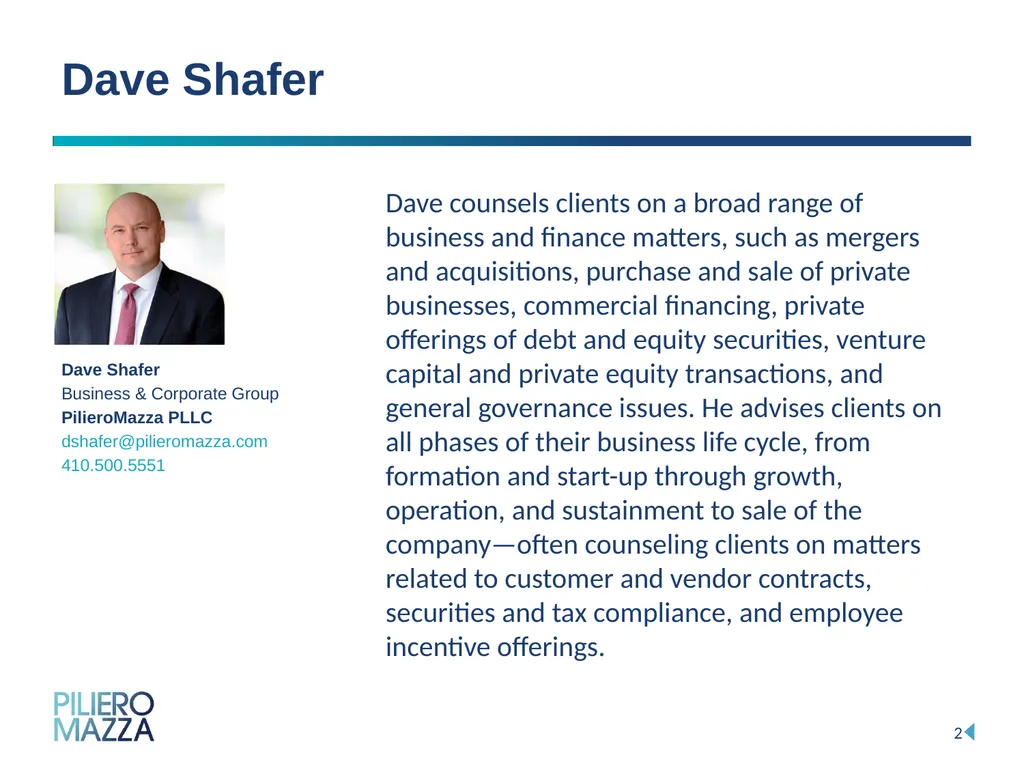
slide2. Dave Shafer Dave counsels clients on a broad range of business and finance matters, such as mergers and acquisitions, purchase and sale of private businesses, commercial financing, private offerings of debt and equity securities, venture capital and private equity transactions, and general governance issues. He advises clients on all phases of their business life cycle, from formation and start-up through growth, operation, and sustainment to sale of the company—often counseling clients on matters related to customer and vendor contracts, securities and tax compliance, and employee incentive offerings. 2 Dave Shafer
Business & Corporate Group
PilieroMazza PLLC
dshafer@pilieromazza.com
410.500.5551<br>
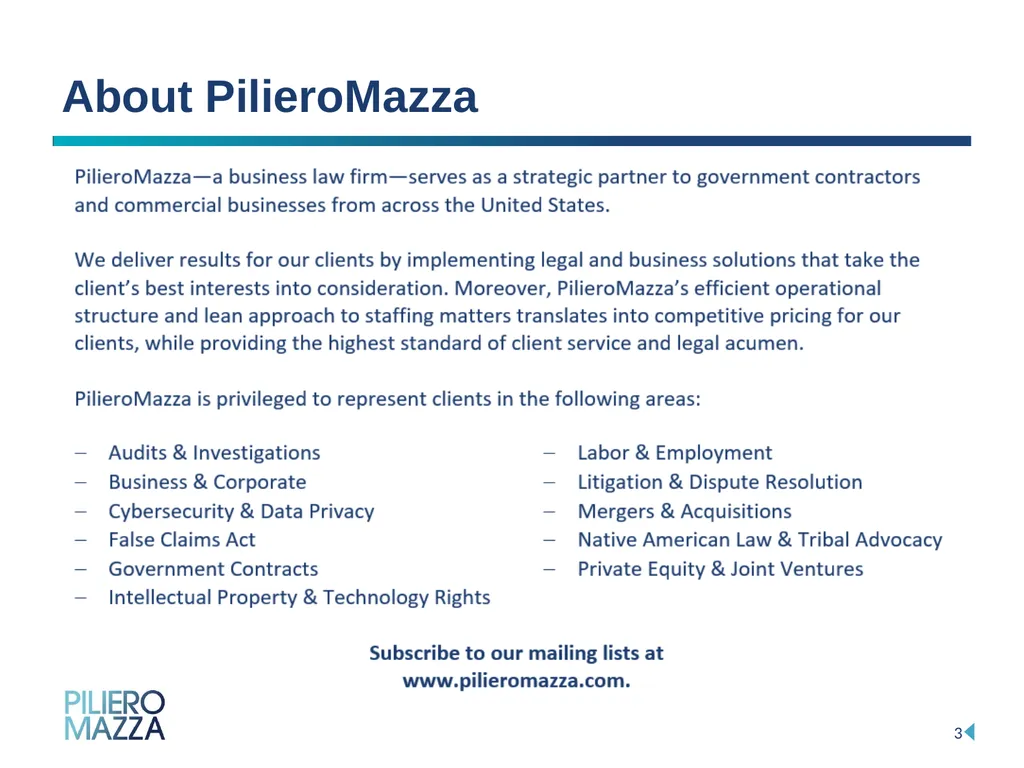
slide3. About PilieroMazza 3<br>
slide4. Overview and Agenda SDVOSB Regulatory Environment
Potential Purposes of Incentive Programs
Strategic Considerations
Incentive Plans Available
Synthetic Equity Options
True Equity Options
Implementation and Integration 4<br>
slide5. SDVOSB Regulatory Environment Unconditional and Direct Ownership
At least 51% of the SDVOSB must be unconditionally and directly owned by one or more SDVs
Financial Benefits Requirement
SBA’s rules require that the veteran receives the financial benefits commensurate with his or her ownership 5<br>
slide6. Employee Incentives under SBA Limits 6 Attracting and retaining talent is crucial to company growth
In some ways, SDVOSBs are at a disadvantage in the talent market
Certain models for employee incentives are limited or not available:
Bonuses/Compensation is limited by the general rule that the veteran must remain the highest compensated individual
Equity Incentive Plans (e.g. stock option plans, profits interest plans, or restricted stock/unit plans) are limited by the fact that the veteran cannot be diluted below 51%<br>
slide7. Purposes of Incentive Plans 7 Recruit: All forms of incentive plans are helpful in recruiting employees
Retain: Incentive plans can reward employees who remain at the company
Motivate: Incentive plans can reward employees for a company’s appreciating value and can align their interests with the shareholders<br>
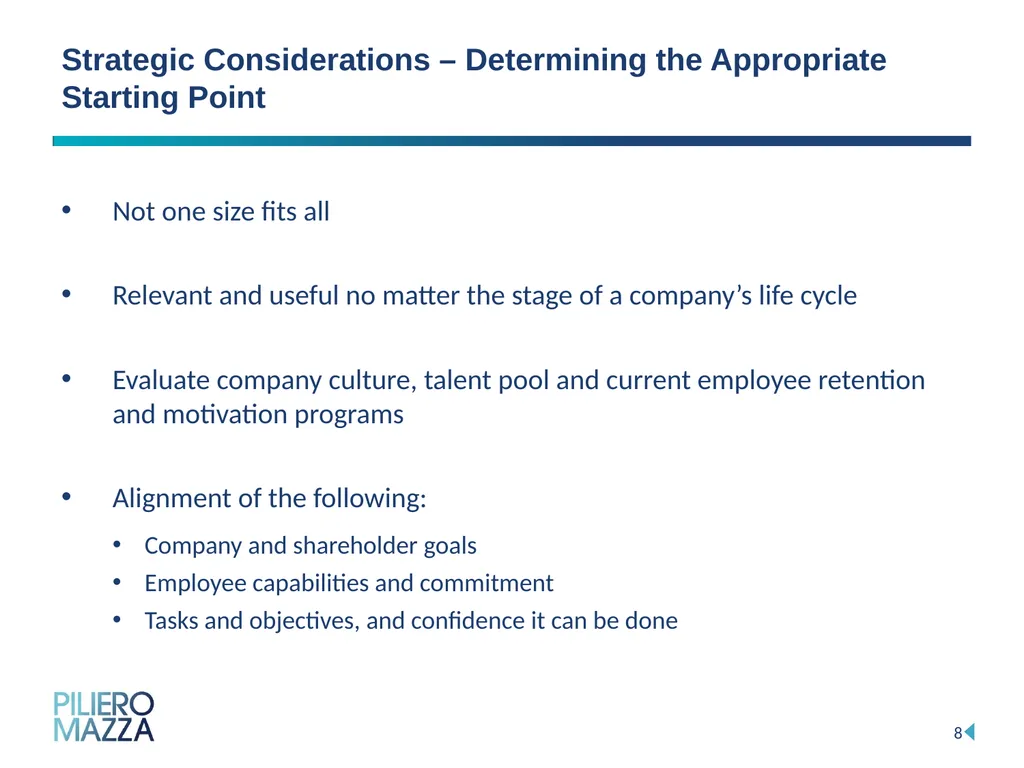
slide8. Strategic Considerations – Determining the Appropriate Starting Point 8 Not one size fits all
Relevant and useful no matter the stage of a company’s life cycle
Evaluate company culture, talent pool and current employee retention and motivation programs
Alignment of the following:
Company and shareholder goals
Employee capabilities and commitment
Tasks and objectives, and confidence it can be done<br>
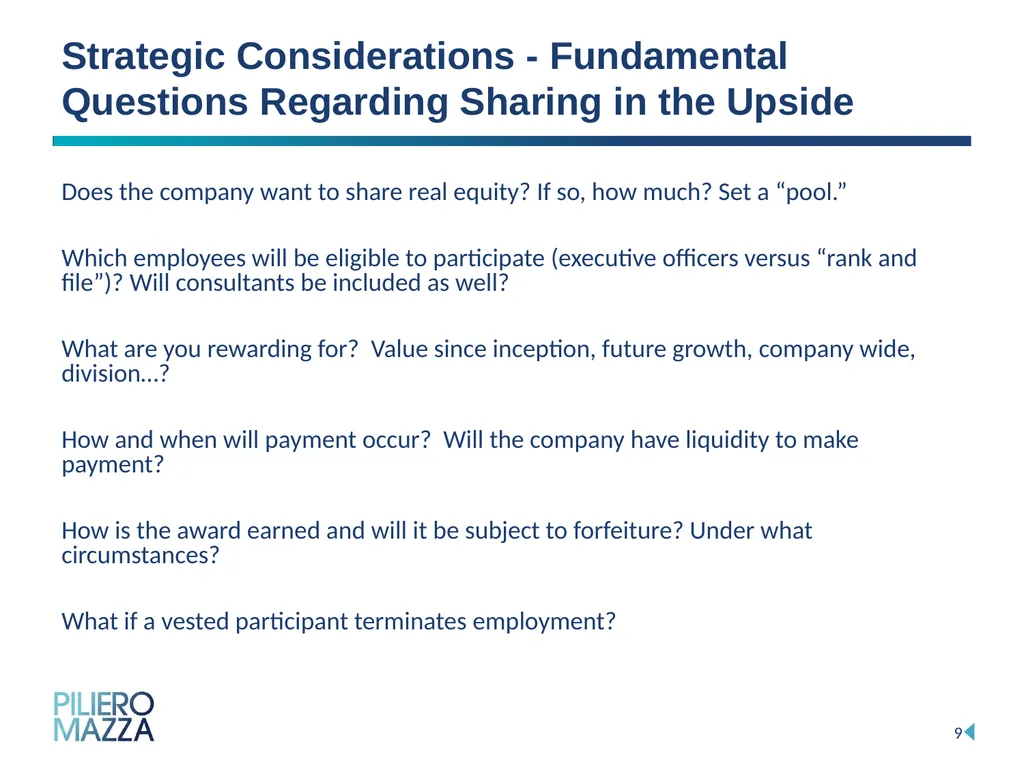
slide9. Strategic Considerations - Fundamental Questions Regarding Sharing in the Upside 9 Does the company want to share real equity? If so, how much? Set a “pool.”
Which employees will be eligible to participate (executive officers versus “rank and file”)? Will consultants be included as well?
What are you rewarding for? Value since inception, future growth, company wide, division…?
How and when will payment occur? Will the company have liquidity to make payment?
How is the award earned and will it be subject to forfeiture? Under what circumstances?
What if a vested participant terminates employment?<br>
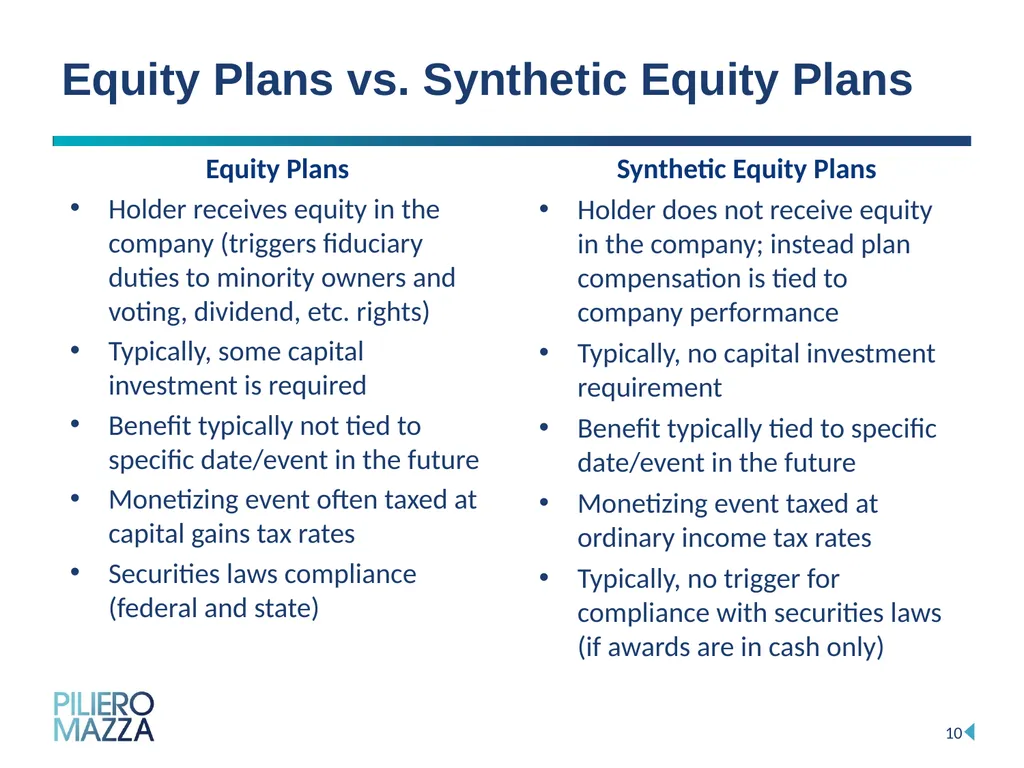
slide10. Equity Plans vs. Synthetic Equity Plans 10 Equity Plans
Holder receives equity in the company (triggers fiduciary duties to minority owners and voting, dividend, etc. rights)
Typically, some capital investment is required
Benefit typically not tied to specific date/event in the future
Monetizing event often taxed at capital gains tax rates
Securities laws compliance (federal and state) Synthetic Equity Plans
Holder does not receive equity in the company; instead plan compensation is tied to company performance
Typically, no capital investment requirement
Benefit typically tied to specific date/event in the future
Monetizing event taxed at ordinary income tax rates
Typically, no trigger for compliance with securities laws (if awards are in cash only)<br>
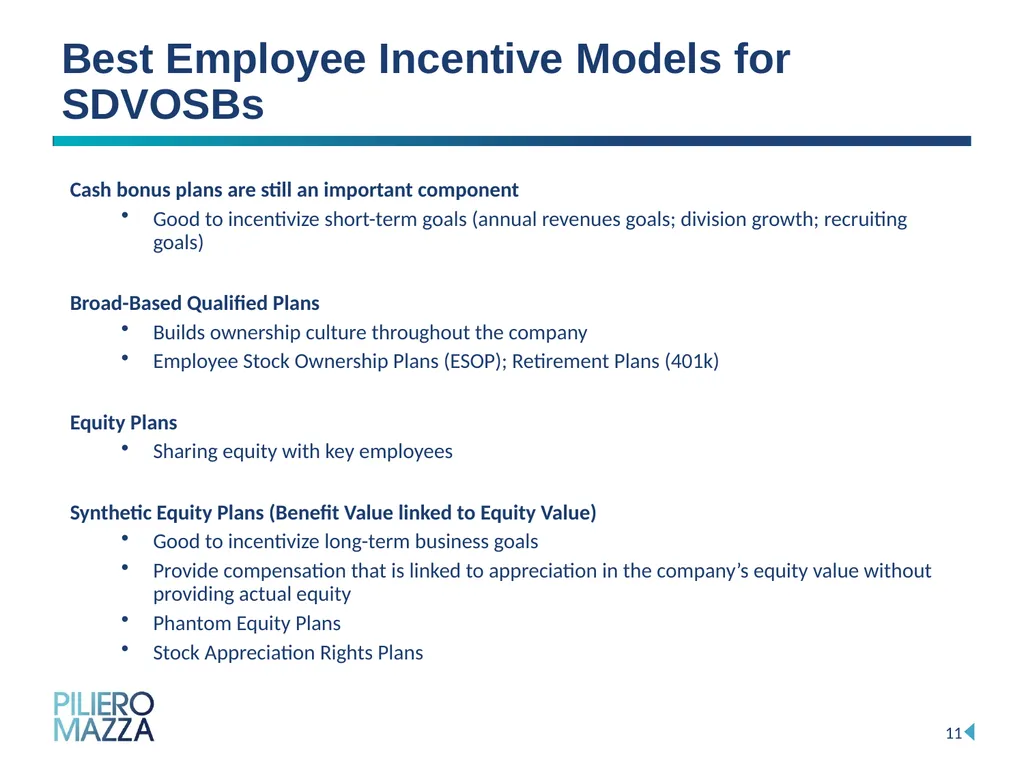
slide11. Best Employee Incentive Models for SDVOSBs Cash bonus plans are still an important component
Good to incentivize short-term goals (annual revenues goals; division growth; recruiting goals)
Broad-Based Qualified Plans
Builds ownership culture throughout the company
Employee Stock Ownership Plans (ESOP); Retirement Plans (401k)
Equity Plans
Sharing equity with key employees
Synthetic Equity Plans (Benefit Value linked to Equity Value)
Good to incentivize long-term business goals
Provide compensation that is linked to appreciation in the company’s equity value without providing actual equity
Phantom Equity Plans
Stock Appreciation Rights Plans 11<br>
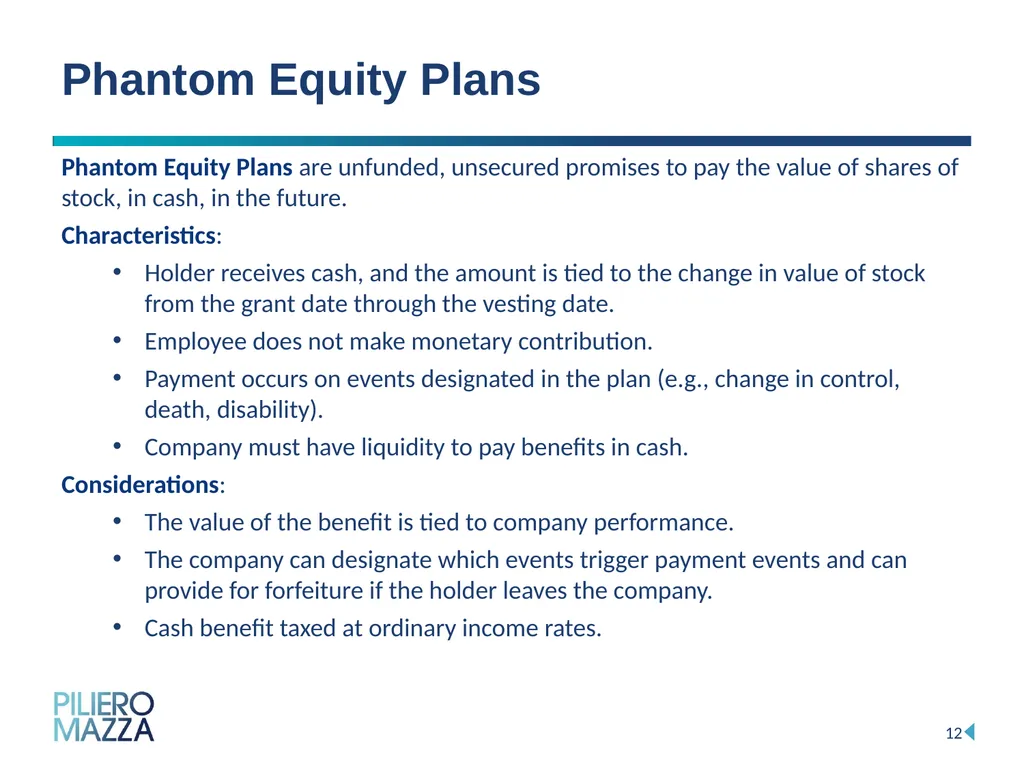
slide12. Phantom Equity Plans 12 Phantom Equity Plans are unfunded, unsecured promises to pay the value of shares of stock, in cash, in the future.
Characteristics:
Holder receives cash, and the amount is tied to the change in value of stock from the grant date through the vesting date.
Employee does not make monetary contribution.
Payment occurs on events designated in the plan (e.g., change in control, death, disability).
Company must have liquidity to pay benefits in cash.
Considerations:
The value of the benefit is tied to company performance.
The company can designate which events trigger payment events and can provide for forfeiture if the holder leaves the company.
Cash benefit taxed at ordinary income rates.<br>
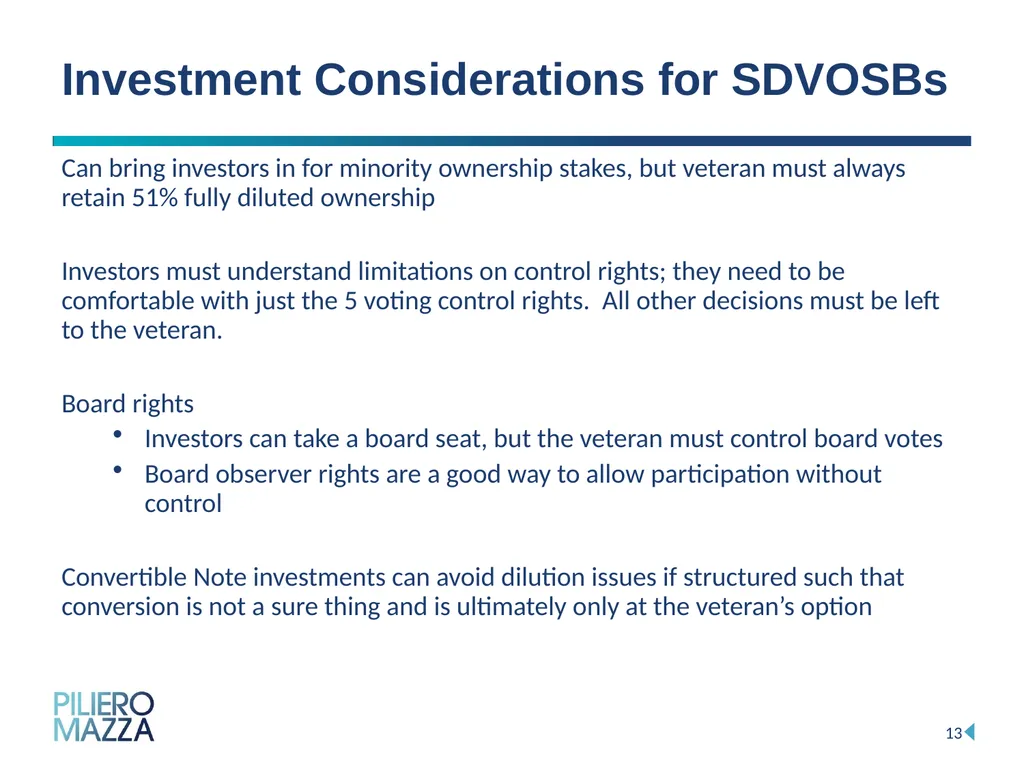
slide13. Investment Considerations for SDVOSBs 13 Can bring investors in for minority ownership stakes, but veteran must always retain 51% fully diluted ownership
Investors must understand limitations on control rights; they need to be comfortable with just the 5 voting control rights. All other decisions must be left to the veteran.
Board rights
Investors can take a board seat, but the veteran must control board votes
Board observer rights are a good way to allow participation without control
Convertible Note investments can avoid dilution issues if structured such that conversion is not a sure thing and is ultimately only at the veteran’s option<br>
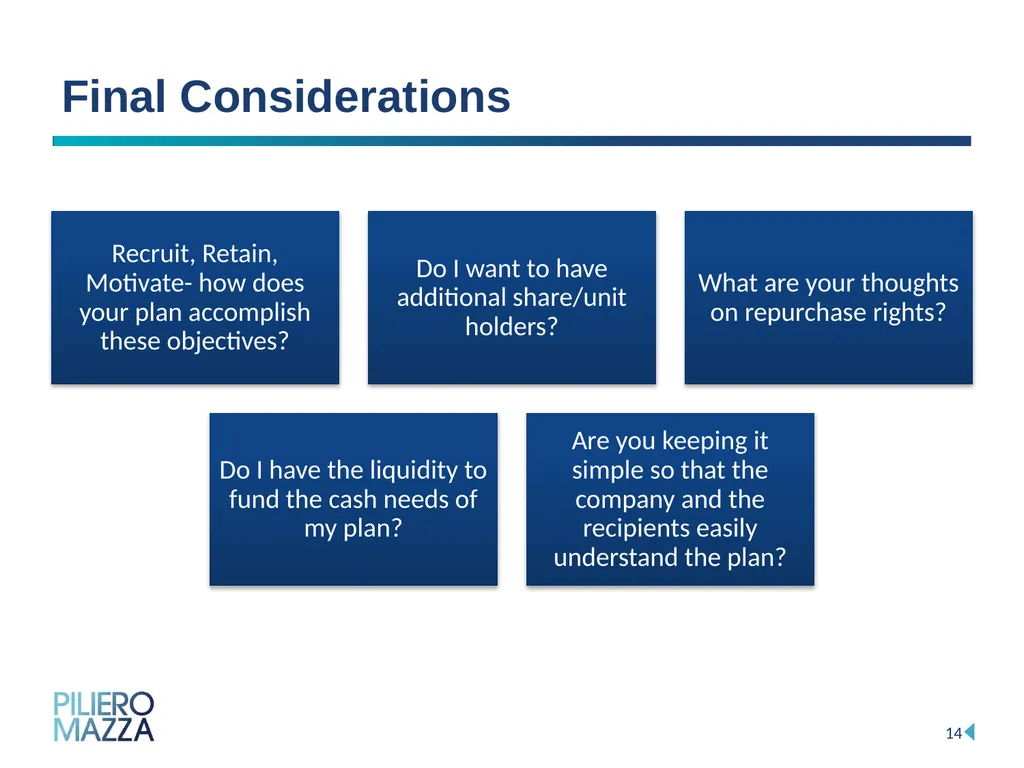
slide14. Final Considerations 14<br>
slide15. Questions? 15 Dave Shafer
Business & Corporate Group
PilieroMazza PLLC
dshafer@pilieromazza.com
410.500.5551<br>
Attorney, Business & Corporate Group
PilieroMazza PLLC September 15, 2020<br>
slide2. Dave Shafer Dave counsels clients on a broad range of business and finance matters, such as mergers and acquisitions, purchase and sale of private businesses, commercial financing, private offerings of debt and equity securities, venture capital and private equity transactions, and general governance issues. He advises clients on all phases of their business life cycle, from formation and start-up through growth, operation, and sustainment to sale of the company—often counseling clients on matters related to customer and vendor contracts, securities and tax compliance, and employee incentive offerings. 2 Dave Shafer
Business & Corporate Group
PilieroMazza PLLC
dshafer@pilieromazza.com
410.500.5551<br>
slide3. About PilieroMazza 3<br>
slide4. Overview and Agenda SDVOSB Regulatory Environment
Potential Purposes of Incentive Programs
Strategic Considerations
Incentive Plans Available
Synthetic Equity Options
True Equity Options
Implementation and Integration 4<br>
slide5. SDVOSB Regulatory Environment Unconditional and Direct Ownership
At least 51% of the SDVOSB must be unconditionally and directly owned by one or more SDVs
Financial Benefits Requirement
SBA’s rules require that the veteran receives the financial benefits commensurate with his or her ownership 5<br>
slide6. Employee Incentives under SBA Limits 6 Attracting and retaining talent is crucial to company growth
In some ways, SDVOSBs are at a disadvantage in the talent market
Certain models for employee incentives are limited or not available:
Bonuses/Compensation is limited by the general rule that the veteran must remain the highest compensated individual
Equity Incentive Plans (e.g. stock option plans, profits interest plans, or restricted stock/unit plans) are limited by the fact that the veteran cannot be diluted below 51%<br>
slide7. Purposes of Incentive Plans 7 Recruit: All forms of incentive plans are helpful in recruiting employees
Retain: Incentive plans can reward employees who remain at the company
Motivate: Incentive plans can reward employees for a company’s appreciating value and can align their interests with the shareholders<br>
slide8. Strategic Considerations – Determining the Appropriate Starting Point 8 Not one size fits all
Relevant and useful no matter the stage of a company’s life cycle
Evaluate company culture, talent pool and current employee retention and motivation programs
Alignment of the following:
Company and shareholder goals
Employee capabilities and commitment
Tasks and objectives, and confidence it can be done<br>
slide9. Strategic Considerations - Fundamental Questions Regarding Sharing in the Upside 9 Does the company want to share real equity? If so, how much? Set a “pool.”
Which employees will be eligible to participate (executive officers versus “rank and file”)? Will consultants be included as well?
What are you rewarding for? Value since inception, future growth, company wide, division…?
How and when will payment occur? Will the company have liquidity to make payment?
How is the award earned and will it be subject to forfeiture? Under what circumstances?
What if a vested participant terminates employment?<br>
slide10. Equity Plans vs. Synthetic Equity Plans 10 Equity Plans
Holder receives equity in the company (triggers fiduciary duties to minority owners and voting, dividend, etc. rights)
Typically, some capital investment is required
Benefit typically not tied to specific date/event in the future
Monetizing event often taxed at capital gains tax rates
Securities laws compliance (federal and state) Synthetic Equity Plans
Holder does not receive equity in the company; instead plan compensation is tied to company performance
Typically, no capital investment requirement
Benefit typically tied to specific date/event in the future
Monetizing event taxed at ordinary income tax rates
Typically, no trigger for compliance with securities laws (if awards are in cash only)<br>
slide11. Best Employee Incentive Models for SDVOSBs Cash bonus plans are still an important component
Good to incentivize short-term goals (annual revenues goals; division growth; recruiting goals)
Broad-Based Qualified Plans
Builds ownership culture throughout the company
Employee Stock Ownership Plans (ESOP); Retirement Plans (401k)
Equity Plans
Sharing equity with key employees
Synthetic Equity Plans (Benefit Value linked to Equity Value)
Good to incentivize long-term business goals
Provide compensation that is linked to appreciation in the company’s equity value without providing actual equity
Phantom Equity Plans
Stock Appreciation Rights Plans 11<br>
slide12. Phantom Equity Plans 12 Phantom Equity Plans are unfunded, unsecured promises to pay the value of shares of stock, in cash, in the future.
Characteristics:
Holder receives cash, and the amount is tied to the change in value of stock from the grant date through the vesting date.
Employee does not make monetary contribution.
Payment occurs on events designated in the plan (e.g., change in control, death, disability).
Company must have liquidity to pay benefits in cash.
Considerations:
The value of the benefit is tied to company performance.
The company can designate which events trigger payment events and can provide for forfeiture if the holder leaves the company.
Cash benefit taxed at ordinary income rates.<br>
slide13. Investment Considerations for SDVOSBs 13 Can bring investors in for minority ownership stakes, but veteran must always retain 51% fully diluted ownership
Investors must understand limitations on control rights; they need to be comfortable with just the 5 voting control rights. All other decisions must be left to the veteran.
Board rights
Investors can take a board seat, but the veteran must control board votes
Board observer rights are a good way to allow participation without control
Convertible Note investments can avoid dilution issues if structured such that conversion is not a sure thing and is ultimately only at the veteran’s option<br>
slide14. Final Considerations 14<br>
slide15. Questions? 15 Dave Shafer
Business & Corporate Group
PilieroMazza PLLC
dshafer@pilieromazza.com
410.500.5551<br>