
Equivalence and Equivalent Effect SYAFRYADIN


Description: Equivalence and Equivalent Effect SYAFRYADIN 1101138 Equivalence and Equivalent Effect Roman Jakobson: The Nature of Linguistic Meaning and Equivalence Nida and the Science of Translating Semantic and Communicative translation Koller
Related Topics
Download Presentation
"Equivalence and Equivalent Effect SYAFRYADIN" is the property of its rightful owner. Permission is granted to download and print the materials on this website for personal, non-commercial use only, and to display it on your personal computer provided you do not modify the materials and that you retain all copyright notices contained in the materials. By downloading content from our website, you accept the terms of this agreement.
Presentation Transcript
slide1. Equivalence and Equivalent Effect SYAFRYADIN 1101138<br>
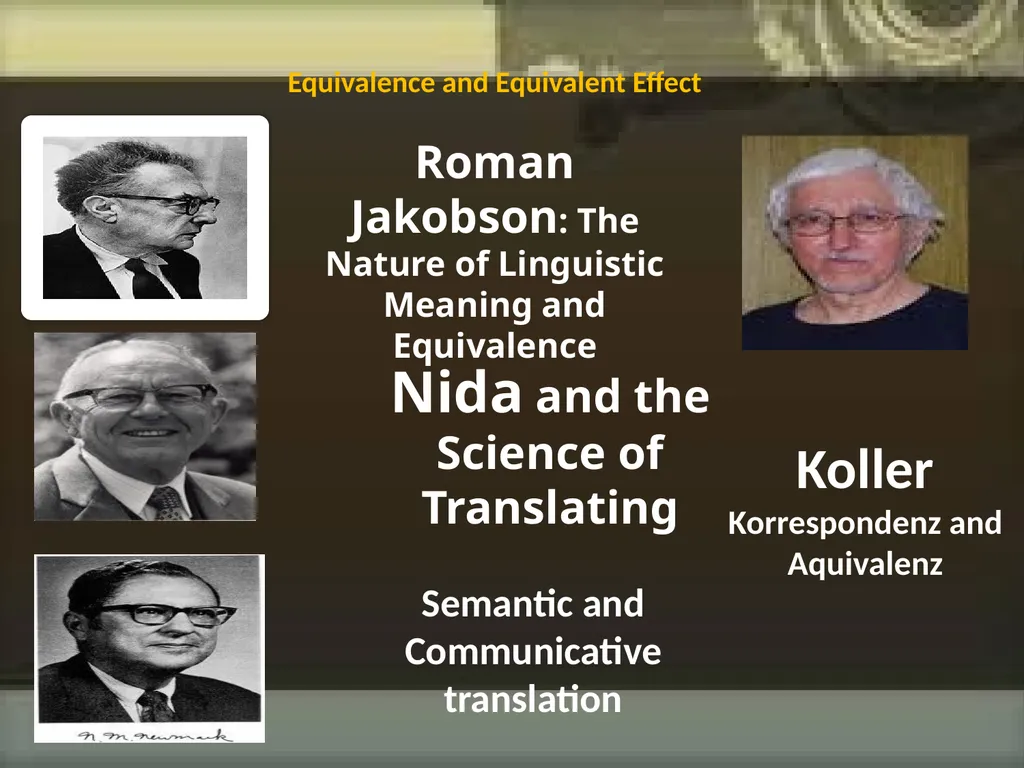
slide2. Equivalence and Equivalent Effect Roman Jakobson: The Nature of Linguistic Meaning and Equivalence Nida and the Science of Translating Semantic and Communicative translation Koller
Korrespondenz and Aquivalenz<br>
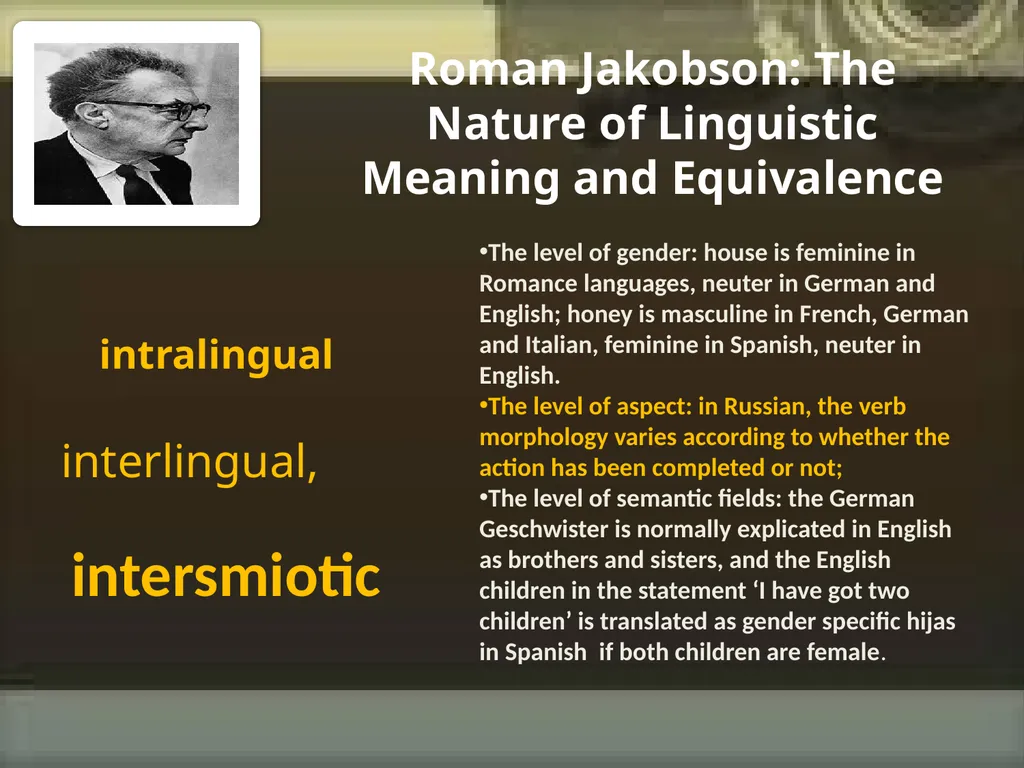
slide3. Roman Jakobson: The Nature of Linguistic Meaning and Equivalence intralingual interlingual, intersmiotic The level of gender: house is feminine in Romance languages, neuter in German and English; honey is masculine in French, German and Italian, feminine in Spanish, neuter in English.
The level of aspect: in Russian, the verb morphology varies according to whether the action has been completed or not;
The level of semantic fields: the German Geschwister is normally explicated in English as brothers and sisters, and the English children in the statement ‘I have got two children’ is translated as gender specific hijas in Spanish if both children are female.<br>
slide4. Nida and the Science of Translating The nature of Meaning: Advances in Semantics and Pragmatics The Influence of Chomsky Formal and Dynamic equivalence<br>
slide5. Nida and the Science of Translating The nature of Meaning:
Advances in Semantics and Pragmatics Nida describes various scientific approaches to meaning related to work that had been carried out by theorists in semantics and pragmatics. Meaning is divided into several parts like linguistic meaning, referential meaning (denotative dictionary meaning), emotive (connotative meaning) meaning<br>
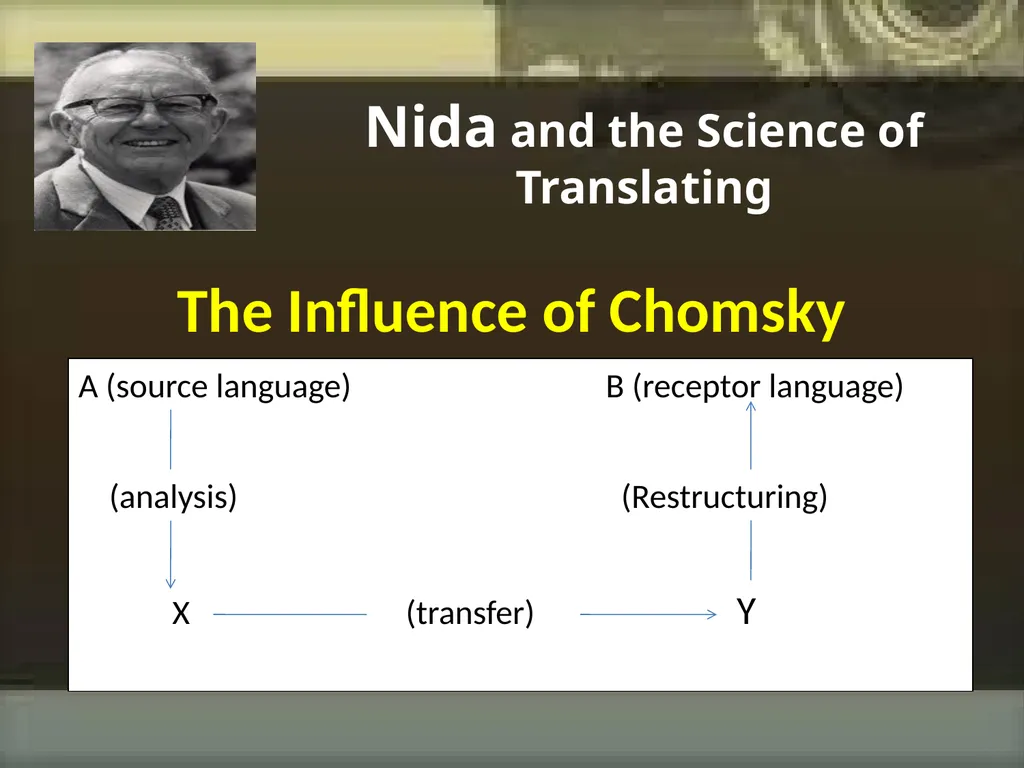
slide6. Nida and the Science of Translating The Influence of Chomsky A (source language) B (receptor language)
(analysis) (Restructuring)
X (transfer) Y<br>
slide7. Nida and the Science of Translating Formal and Dynamic equivalence Formal equivalence
It focuses attention on the message itself, in both form and content. Formal equivalence is thus keenly oriented towards the ST structure, which exerts strong influence in determining accuracy and correctness.
Dynamic equivalence
It is based on what Nida calls the principle of equivalent effect, where the relationship between receptor and message should be substantially the same as that which existed between the original receptors and message.<br>
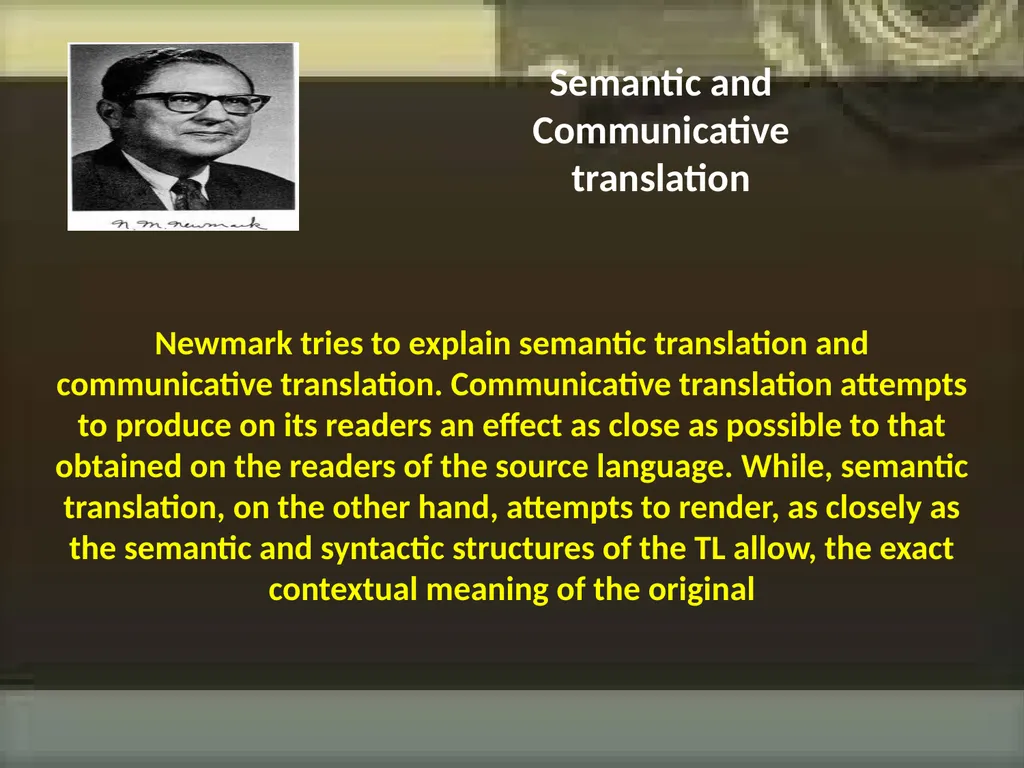
slide8. Semantic and Communicative translation Newmark tries to explain semantic translation and communicative translation. Communicative translation attempts to produce on its readers an effect as close as possible to that obtained on the readers of the source language. While, semantic translation, on the other hand, attempts to render, as closely as the semantic and syntactic structures of the TL allow, the exact contextual meaning of the original<br>
slide9. Koller
Korrespondenz and Aquivalenz<br>
slide2. Equivalence and Equivalent Effect Roman Jakobson: The Nature of Linguistic Meaning and Equivalence Nida and the Science of Translating Semantic and Communicative translation Koller
Korrespondenz and Aquivalenz<br>
slide3. Roman Jakobson: The Nature of Linguistic Meaning and Equivalence intralingual interlingual, intersmiotic The level of gender: house is feminine in Romance languages, neuter in German and English; honey is masculine in French, German and Italian, feminine in Spanish, neuter in English.
The level of aspect: in Russian, the verb morphology varies according to whether the action has been completed or not;
The level of semantic fields: the German Geschwister is normally explicated in English as brothers and sisters, and the English children in the statement ‘I have got two children’ is translated as gender specific hijas in Spanish if both children are female.<br>
slide4. Nida and the Science of Translating The nature of Meaning: Advances in Semantics and Pragmatics The Influence of Chomsky Formal and Dynamic equivalence<br>
slide5. Nida and the Science of Translating The nature of Meaning:
Advances in Semantics and Pragmatics Nida describes various scientific approaches to meaning related to work that had been carried out by theorists in semantics and pragmatics. Meaning is divided into several parts like linguistic meaning, referential meaning (denotative dictionary meaning), emotive (connotative meaning) meaning<br>
slide6. Nida and the Science of Translating The Influence of Chomsky A (source language) B (receptor language)
(analysis) (Restructuring)
X (transfer) Y<br>
slide7. Nida and the Science of Translating Formal and Dynamic equivalence Formal equivalence
It focuses attention on the message itself, in both form and content. Formal equivalence is thus keenly oriented towards the ST structure, which exerts strong influence in determining accuracy and correctness.
Dynamic equivalence
It is based on what Nida calls the principle of equivalent effect, where the relationship between receptor and message should be substantially the same as that which existed between the original receptors and message.<br>
slide8. Semantic and Communicative translation Newmark tries to explain semantic translation and communicative translation. Communicative translation attempts to produce on its readers an effect as close as possible to that obtained on the readers of the source language. While, semantic translation, on the other hand, attempts to render, as closely as the semantic and syntactic structures of the TL allow, the exact contextual meaning of the original<br>
slide9. Koller
Korrespondenz and Aquivalenz<br>