
ERSEA Training 2025-26 Location: Mountain Arts
BR
Published · 120 slides · 0 views

1 / 1





















Description
ERSEA Training 2025-26 Location: Mountain Arts Center Date: 2725 Pre-training notes Take breaks as you need them if I havent stopped in time Please put your phones on silent This PowerPoint was developed so that it could be useful AFTER
Related Topics
Share
Embed code
Download this presentation From Below
"ERSEA Training 2025-26 Location: Mountain Arts" is the property of its rightful owner. Permission is granted to download and print the materials on this website for personal, non-commercial use only, and to display it on your personal computer provided you do not modify the materials and that you retain all copyright notices contained in the materials. By downloading content from our website, you accept the terms of this agreement.
Presentation Transcript
01
ERSEA Training
2025-26 Location: Mountain Arts Center
Date: 2/7/25<br>
02
Pre-training notes Take breaks as you need them if I haven’t stopped in time
Please put your phones on silent
This PowerPoint was developed so that it could be useful AFTER the training
This presentation is a little different than the one the teachers saw 2<br>
Please put your phones on silent
This PowerPoint was developed so that it could be useful AFTER the training
This presentation is a little different than the one the teachers saw 2<br>
03
This training was created for
office staff that take any part in the ERSEA process<br>
04
E R S E A Eligibility
Recruitment
Selection
Enrollment
Attendance 4<br>
Recruitment
Selection
Enrollment
Attendance 4<br>
05
Our new recruitment year begins on March 1, 2025. This is the day that parents can begin filling out an application for their child to be considered for the 25-26 school year.
On March 1, throw away the blank copies of the 24-25 enrollment applications and begin using the 25-26 version with parents.<br>
On March 1, throw away the blank copies of the 24-25 enrollment applications and begin using the 25-26 version with parents.<br>
06
eligibility What makes a child ELIGIBLE for Head Start? 6<br>
07
eligibility The only true eligibility requirement for a child to be eligible for Head Start is that they must be a certain age. 7<br>
08
eligibility To be eligible for enrollment consideration on day 1 of the school year, a child must be at least 3 and no older than 4 on August 1st. 8<br>
09
eligibility A parent cannot be denied the opportunity to fill out an enrollment application if their child is, or will be, age eligible during the school year. 9<br>
10
Clarifications on age eligibility If a child turns 3 after the school cut off date (August 1), they can be considered for enrollment on the day they turn 3.
If a child is already 5 on the day the parent fills out the application, this child is still age eligible for Head Start as long as he didn’t turn 5 until after August 1.
Once a child is enrolled in Head Start, that child is allowed to remain enrolled for as many years as he is age eligble (1, 2, or 3 possible school years). 10<br>
If a child is already 5 on the day the parent fills out the application, this child is still age eligible for Head Start as long as he didn’t turn 5 until after August 1.
Once a child is enrolled in Head Start, that child is allowed to remain enrolled for as many years as he is age eligble (1, 2, or 3 possible school years). 10<br>
11
When a parent fills out the enrollment application for the upcoming 25-26 school year, the child can remain on the waiting list from March 1, 2025 all the way until the end of the 25-26 school year without the need for reverification. However, if the child enrolls and then withdraws, the child can only be placed back on the waiting list for a 30 day period. He would then need to be reverified if he has not been reenrolled before that 30 days expires.<br>
12
The enrollment application must be done INTERVIEW STYLE with the parent. You cannot give the application to the parent and allow them to fill in the information.<br>
13
You cannot take an enrollment application over the phone except in the following situation:
If a parent is incarcerated and the person the child is living with does not have legal guardianship, a phone application is acceptable and the parent’s signature can be obtained by mailing a copy of the application to the parent.<br>
If a parent is incarcerated and the person the child is living with does not have legal guardianship, a phone application is acceptable and the parent’s signature can be obtained by mailing a copy of the application to the parent.<br>
14
Once you have established that the child will be age eligible for the program, now you need to determine if the person sitting in front of you is allowed to fill out the application.<br>
15
Who can fill out the enrollment application? The only person that can fill out an enrollment application and provide income documentation is a “custodial” parent/guardian.
Custodial Parent/Guardian – Parent/guardian who has either sole physical custody of the child or the parent with whom the child resides for a majority of the time. 15<br>
Custodial Parent/Guardian – Parent/guardian who has either sole physical custody of the child or the parent with whom the child resides for a majority of the time. 15<br>
16
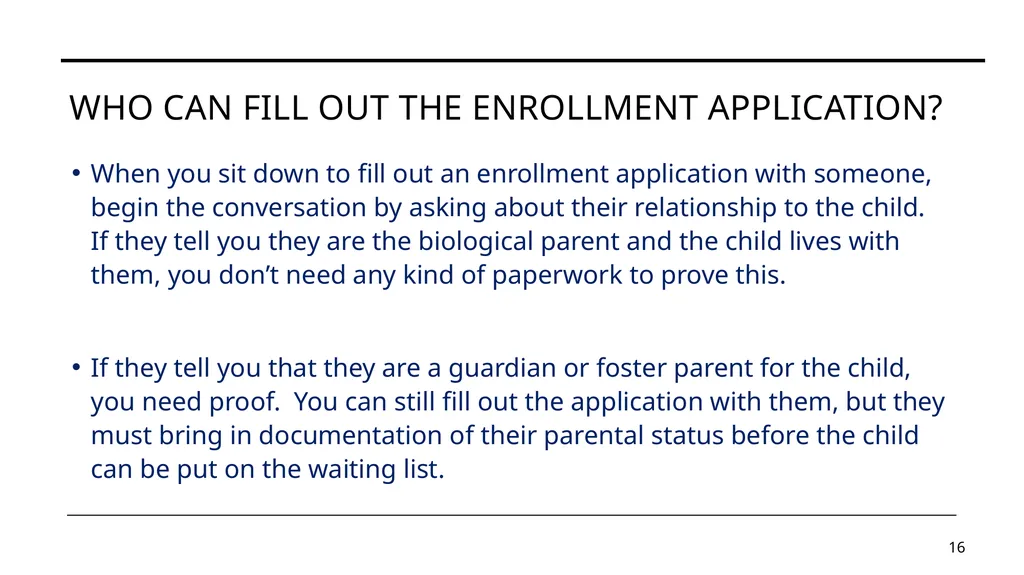
Who can fill out the enrollment application? When you sit down to fill out an enrollment application with someone, begin the conversation by asking about their relationship to the child. If they tell you they are the biological parent and the child lives with them, you don’t need any kind of paperwork to prove this.
If they tell you that they are a guardian or foster parent for the child, you need proof. You can still fill out the application with them, but they must bring in documentation of their parental status before the child can be put on the waiting list. 16<br>
If they tell you that they are a guardian or foster parent for the child, you need proof. You can still fill out the application with them, but they must bring in documentation of their parental status before the child can be put on the waiting list. 16<br>
17
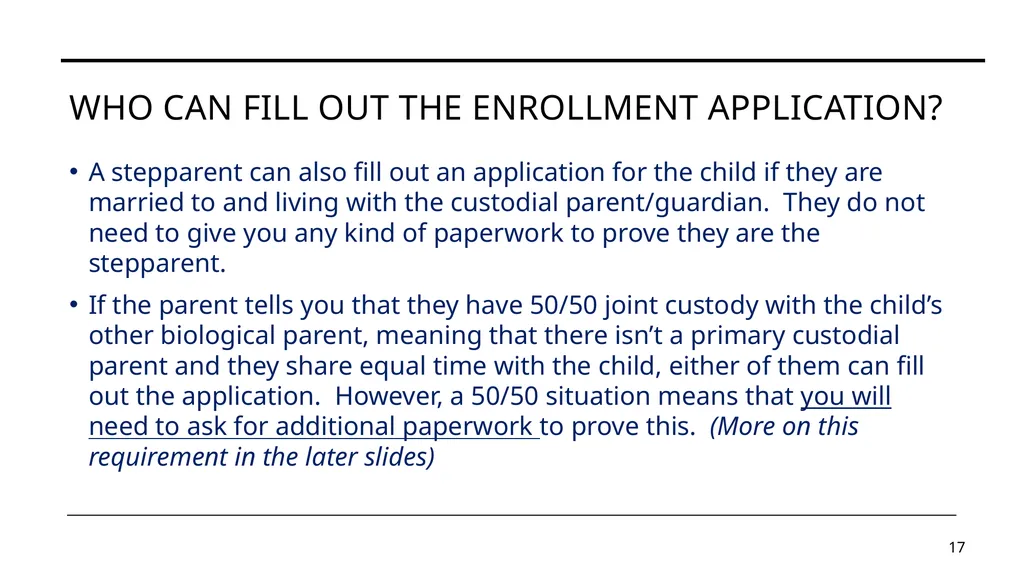
Who can fill out the enrollment application? A stepparent can also fill out an application for the child if they are married to and living with the custodial parent/guardian. They do not need to give you any kind of paperwork to prove they are the stepparent.
If the parent tells you that they have 50/50 joint custody with the child’s other biological parent, meaning that there isn’t a primary custodial parent and they share equal time with the child, either of them can fill out the application. However, a 50/50 situation means that you will need to ask for additional paperwork to prove this. (More on this requirement in the later slides) 17<br>
If the parent tells you that they have 50/50 joint custody with the child’s other biological parent, meaning that there isn’t a primary custodial parent and they share equal time with the child, either of them can fill out the application. However, a 50/50 situation means that you will need to ask for additional paperwork to prove this. (More on this requirement in the later slides) 17<br>
18
Verifying the Child’s Age<br>
19
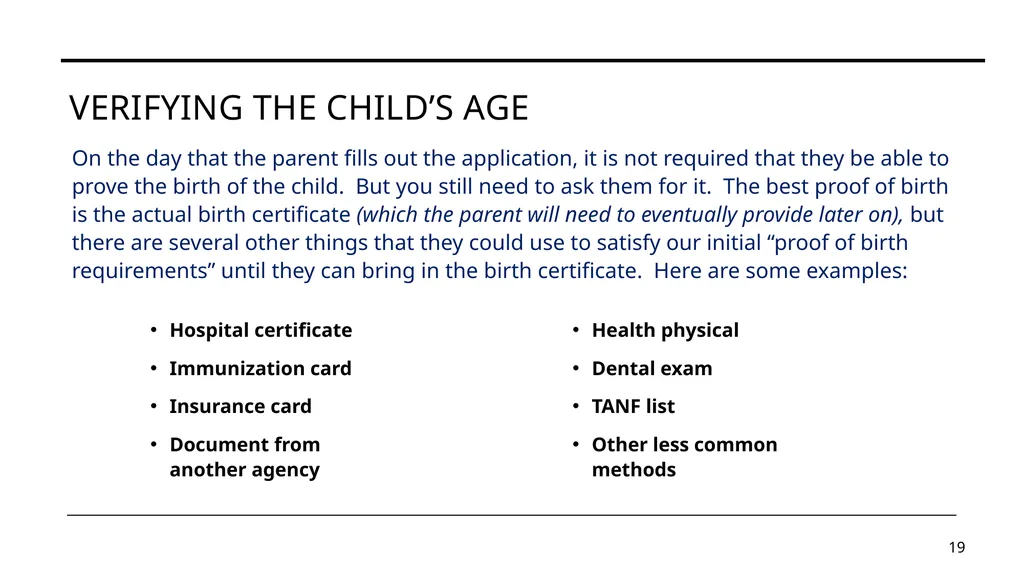
Verifying the child’s age On the day that the parent fills out the application, it is not required that they be able to prove the birth of the child. But you still need to ask them for it. The best proof of birth is the actual birth certificate (which the parent will need to eventually provide later on), but there are several other things that they could use to satisfy our initial “proof of birth requirements” until they can bring in the birth certificate. Here are some examples: 19 Hospital certificate
Immunization card
Insurance card
Document from another agency Health physical
Dental exam
TANF list
Other less common methods<br>
Immunization card
Insurance card
Document from another agency Health physical
Dental exam
TANF list
Other less common methods<br>
20
Preparing to fill out the application<br>
21
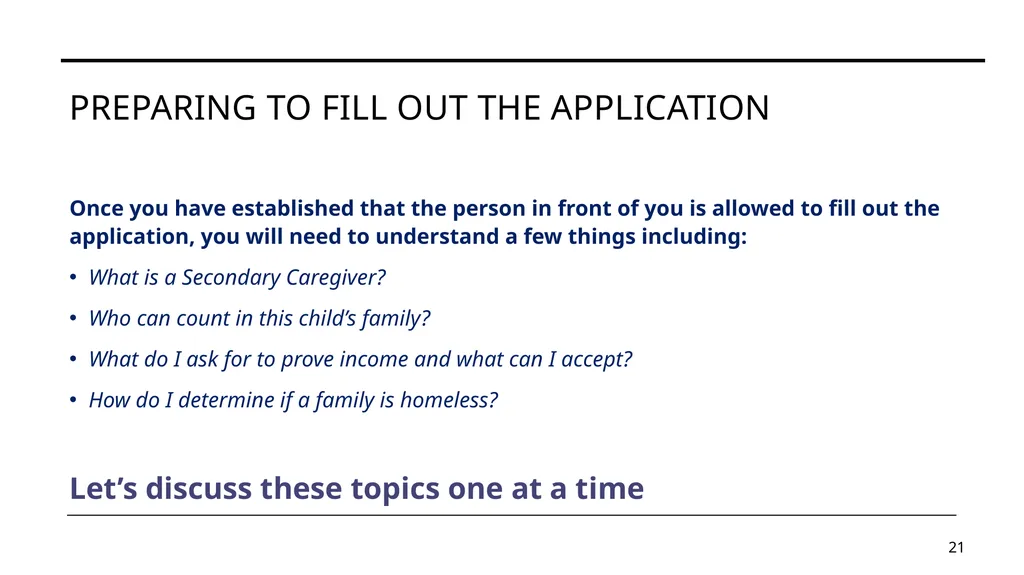
Preparing to fill out the application Once you have established that the person in front of you is allowed to fill out the application, you will need to understand a few things including:
What is a Secondary Caregiver?
Who can count in this child’s family?
What do I ask for to prove income and what can I accept?
How do I determine if a family is homeless?
Let’s discuss these topics one at a time 21<br>
What is a Secondary Caregiver?
Who can count in this child’s family?
What do I ask for to prove income and what can I accept?
How do I determine if a family is homeless?
Let’s discuss these topics one at a time 21<br>
22
Preparing to fill out the application Once you have established that the person in front of you is allowed to fill out the application, you will need to understand a few things including:
What is a Secondary Caregiver?
Who can count in this child’s family?
What do I ask for to prove income and what can I accept?
How do I determine if a family is homeless? 22<br>
What is a Secondary Caregiver?
Who can count in this child’s family?
What do I ask for to prove income and what can I accept?
How do I determine if a family is homeless? 22<br>
23
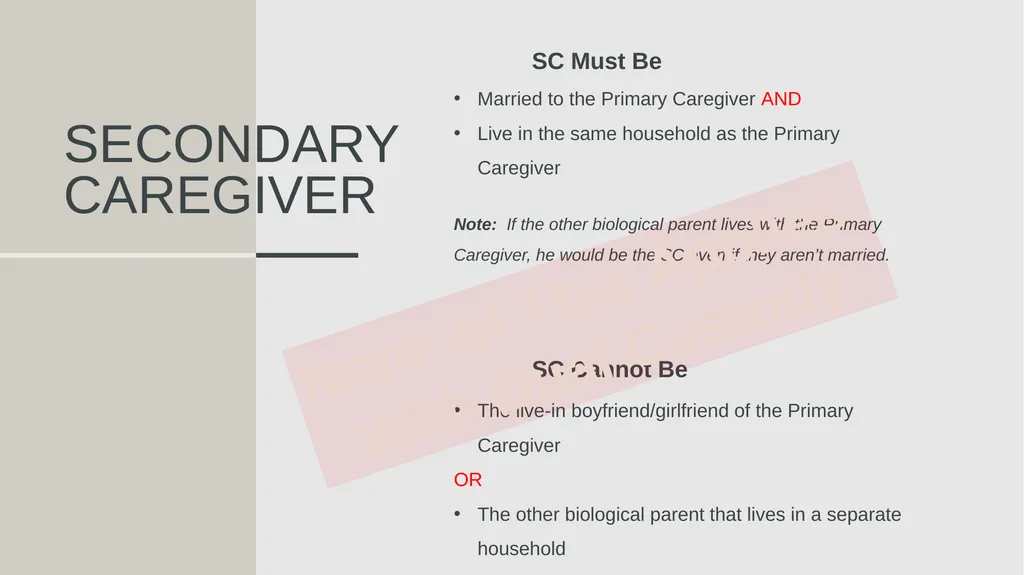
Secondary Caregiver SC Must Be Married to the Primary Caregiver AND
Live in the same household as the Primary Caregiver SC Cannot Be The live-in boyfriend/girlfriend of the Primary Caregiver
OR
The other biological parent that lives in a separate household Note: If the other biological parent lives with the Primary Caregiver, he would be the SC even if they aren’t married. None of This Applies
With Dual Custody<br>
Live in the same household as the Primary Caregiver SC Cannot Be The live-in boyfriend/girlfriend of the Primary Caregiver
OR
The other biological parent that lives in a separate household Note: If the other biological parent lives with the Primary Caregiver, he would be the SC even if they aren’t married. None of This Applies
With Dual Custody<br>
24
Preparing to fill out the application Once you have established that the person in front of you is allowed to fill out the application, you will need to understand a few things including:
What is a Secondary Caregiver?
Who can count in this child’s family?
What do I ask for to prove income and what can I accept?
How do I determine if a family is homeless? 24<br>
What is a Secondary Caregiver?
Who can count in this child’s family?
What do I ask for to prove income and what can I accept?
How do I determine if a family is homeless? 24<br>
25
Determining a child’s family<br>
26
Determining a child’s family 26 One of the most important things that the interviewer must understand when filling out an enrollment application with a parent is how to determine the number of people in a child’s FAMILY. The interviewer must use the Head Start definition of “Family” in order to determine who those people are.
Even if the interviewer doesn’t actually fill out the Eligibility Verification form that determines a child’s enrollment, the staff person that does fill out the EV form is completely dependent upon the interviewer accurately listing the family members on the enrollment application.<br>
Even if the interviewer doesn’t actually fill out the Eligibility Verification form that determines a child’s enrollment, the staff person that does fill out the EV form is completely dependent upon the interviewer accurately listing the family members on the enrollment application.<br>
27
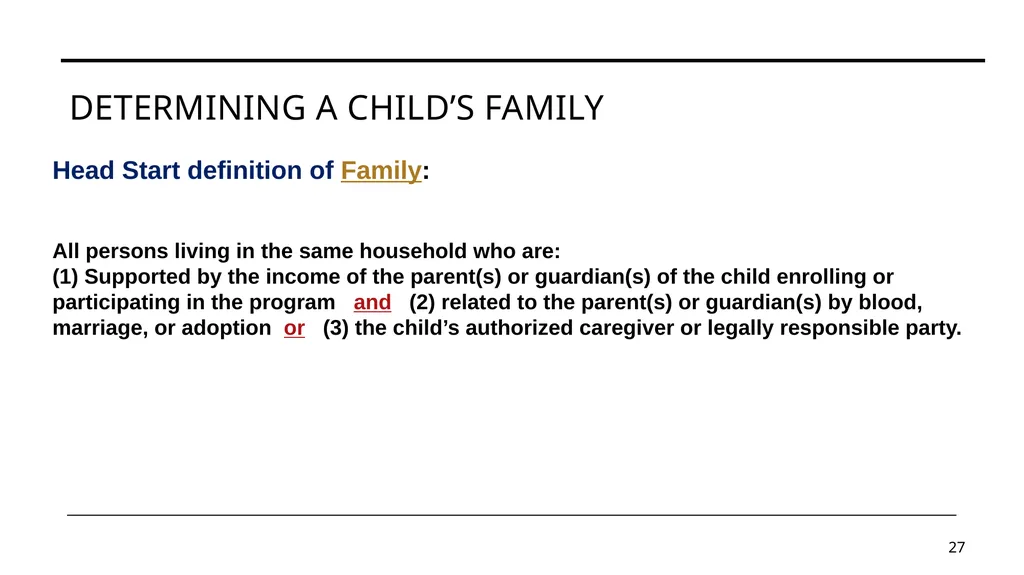
Determining a child’s family 27 Head Start definition of Family:
All persons living in the same household who are:
(1) Supported by the income of the parent(s) or guardian(s) of the child enrolling or participating in the program and (2) related to the parent(s) or guardian(s) by blood, marriage, or adoption or (3) the child’s authorized caregiver or legally responsible party.<br>
All persons living in the same household who are:
(1) Supported by the income of the parent(s) or guardian(s) of the child enrolling or participating in the program and (2) related to the parent(s) or guardian(s) by blood, marriage, or adoption or (3) the child’s authorized caregiver or legally responsible party.<br>
28
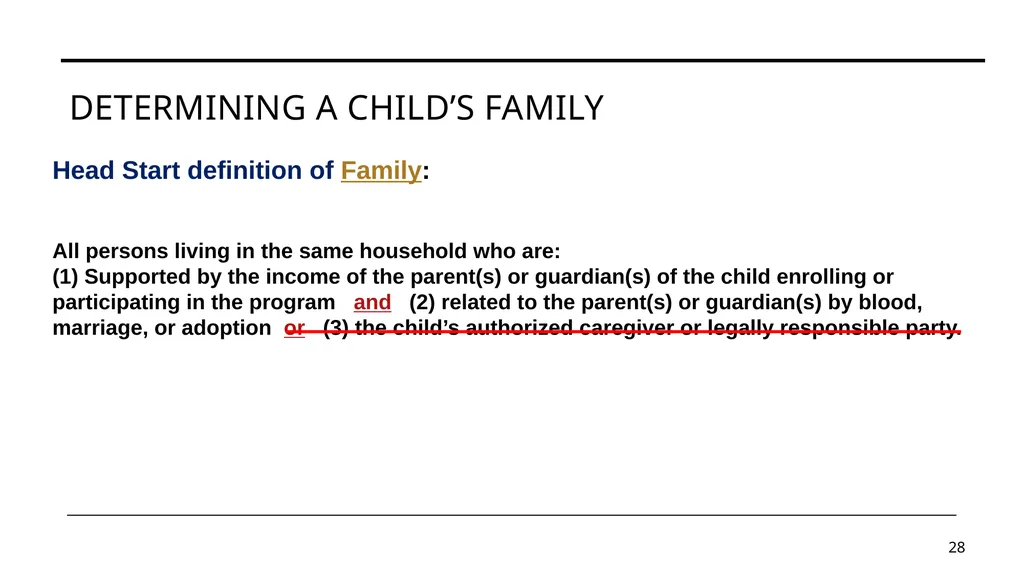
Determining a child’s family 28 Head Start definition of Family:
All persons living in the same household who are:
(1) Supported by the income of the parent(s) or guardian(s) of the child enrolling or participating in the program and (2) related to the parent(s) or guardian(s) by blood, marriage, or adoption or (3) the child’s authorized caregiver or legally responsible party.<br>
All persons living in the same household who are:
(1) Supported by the income of the parent(s) or guardian(s) of the child enrolling or participating in the program and (2) related to the parent(s) or guardian(s) by blood, marriage, or adoption or (3) the child’s authorized caregiver or legally responsible party.<br>
29
Determining a child’s family 29 Let’s take a look at some potential family situations you may encounter…..
Handout Scenarios<br>
Handout Scenarios<br>
30
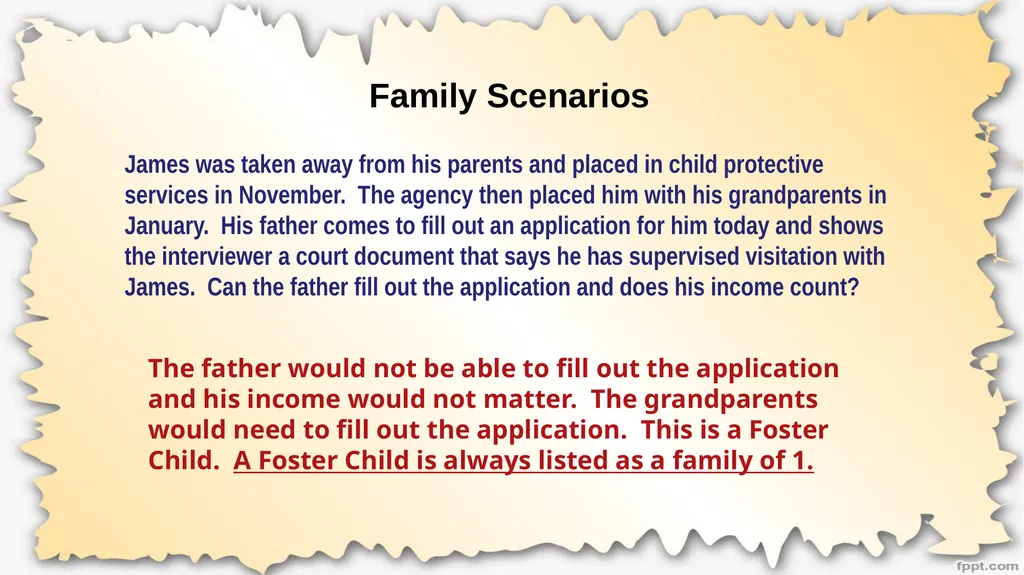
Family Scenarios James was taken away from his parents and placed in child protective services in November. The agency then placed him with his grandparents in January. His father comes to fill out an application for him today and shows the interviewer a court document that says he has supervised visitation with James. Can the father fill out the application and does his income count? The father would not be able to fill out the application and his income would not matter. The grandparents would need to fill out the application. This is a Foster Child. A Foster Child is always listed as a family of 1.<br>
31
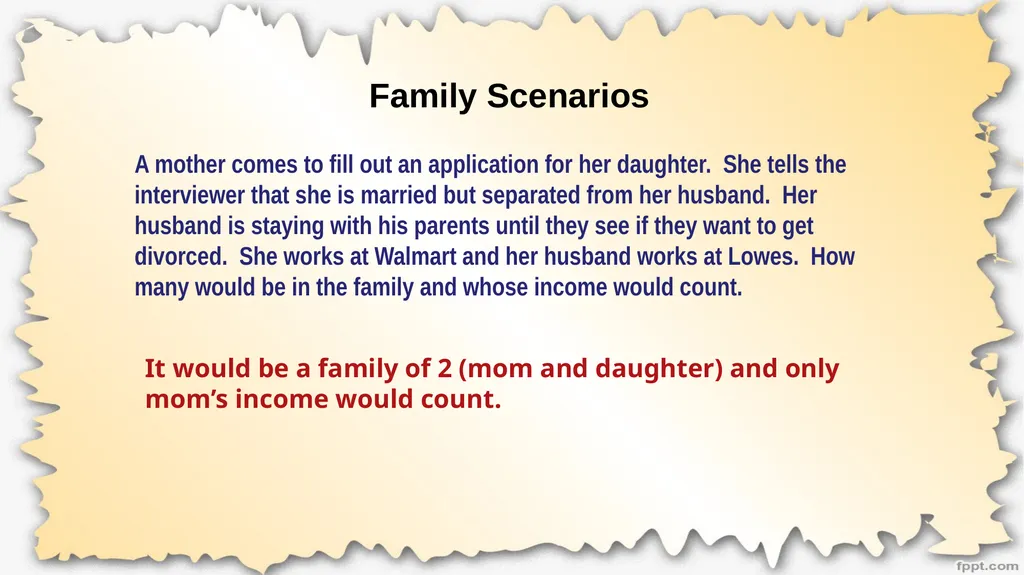
Family Scenarios A mother comes to fill out an application for her daughter. She tells the interviewer that she is married but separated from her husband. Her husband is staying with his parents until they see if they want to get divorced. She works at Walmart and her husband works at Lowes. How many would be in the family and whose income would count. It would be a family of 2 (mom and daughter) and only mom’s income would count.<br>
32
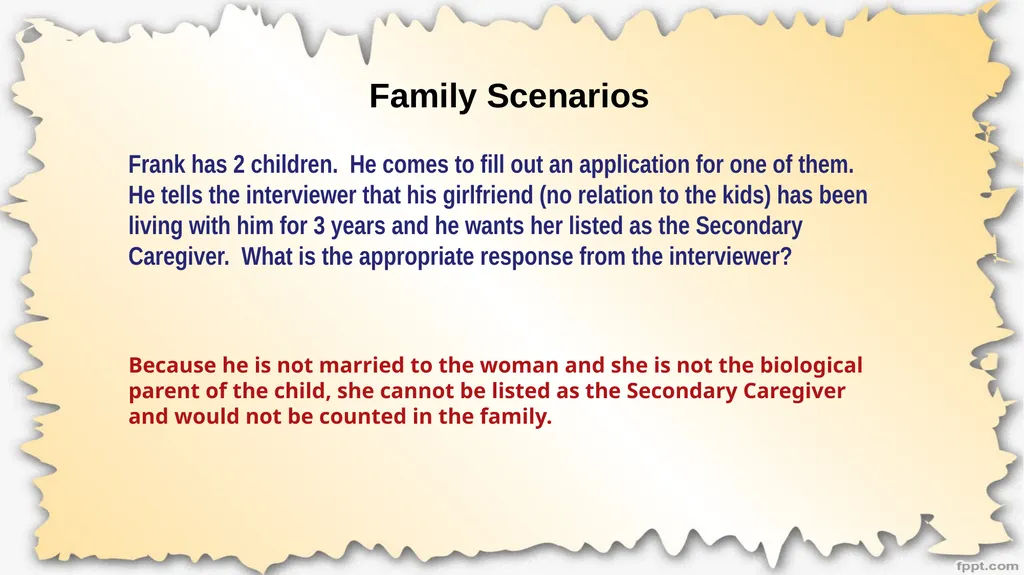
Family Scenarios Frank has 2 children. He comes to fill out an application for one of them. He tells the interviewer that his girlfriend (no relation to the kids) has been living with him for 3 years and he wants her listed as the Secondary Caregiver. What is the appropriate response from the interviewer? Because he is not married to the woman and she is not the biological parent of the child, she cannot be listed as the Secondary Caregiver and would not be counted in the family.<br>
33
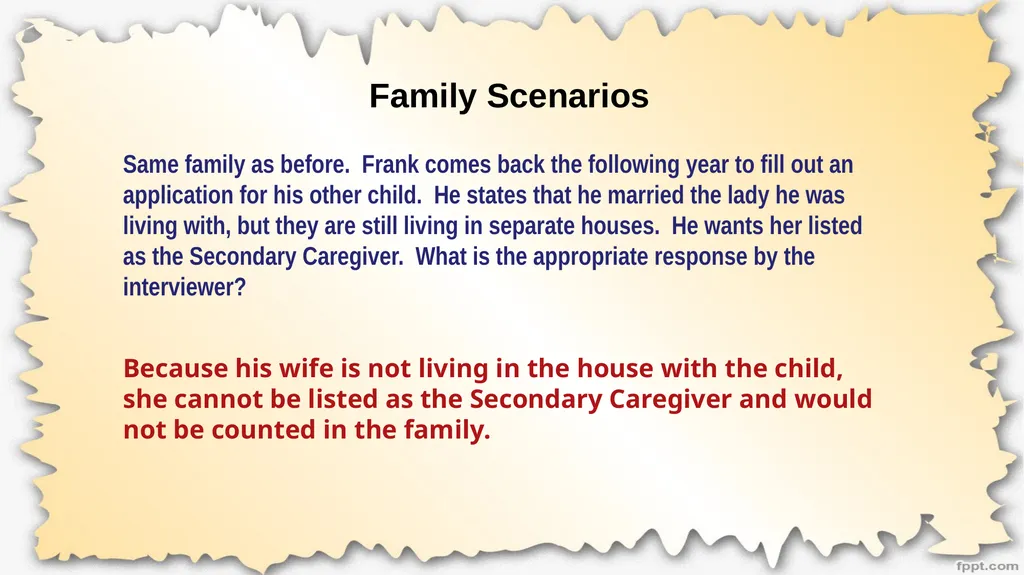
Family Scenarios Same family as before. Frank comes back the following year to fill out an application for his other child. He states that he married the lady he was living with, but they are still living in separate houses. He wants her listed as the Secondary Caregiver. What is the appropriate response by the interviewer? Because his wife is not living in the house with the child, she cannot be listed as the Secondary Caregiver and would not be counted in the family.<br>
34
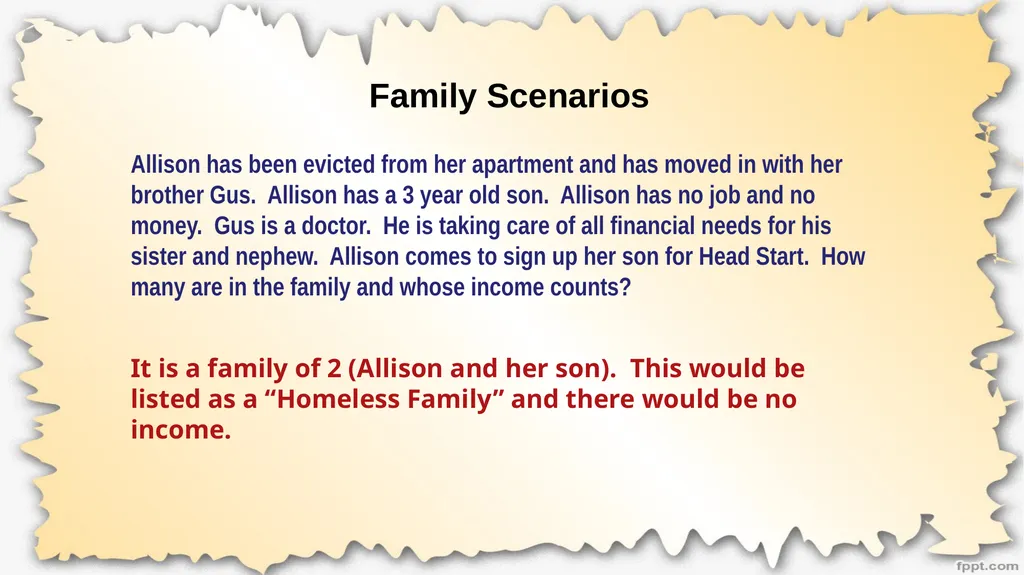
Family Scenarios Allison has been evicted from her apartment and has moved in with her brother Gus. Allison has a 3 year old son. Allison has no job and no money. Gus is a doctor. He is taking care of all financial needs for his sister and nephew. Allison comes to sign up her son for Head Start. How many are in the family and whose income counts? It is a family of 2 (Allison and her son). This would be listed as a “Homeless Family” and there would be no income.<br>
35
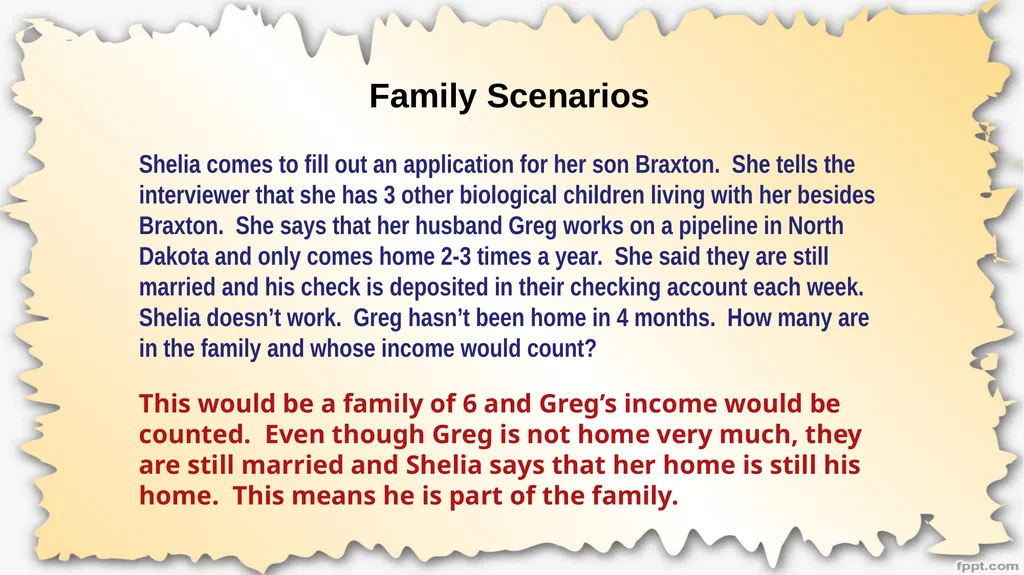
Family Scenarios Shelia comes to fill out an application for her son Braxton. She tells the interviewer that she has 3 other biological children living with her besides Braxton. She says that her husband Greg works on a pipeline in North Dakota and only comes home 2-3 times a year. She said they are still married and his check is deposited in their checking account each week. Shelia doesn’t work. Greg hasn’t been home in 4 months. How many are in the family and whose income would count? This would be a family of 6 and Greg’s income would be counted. Even though Greg is not home very much, they are still married and Shelia says that her home is still his home. This means he is part of the family.<br>
36
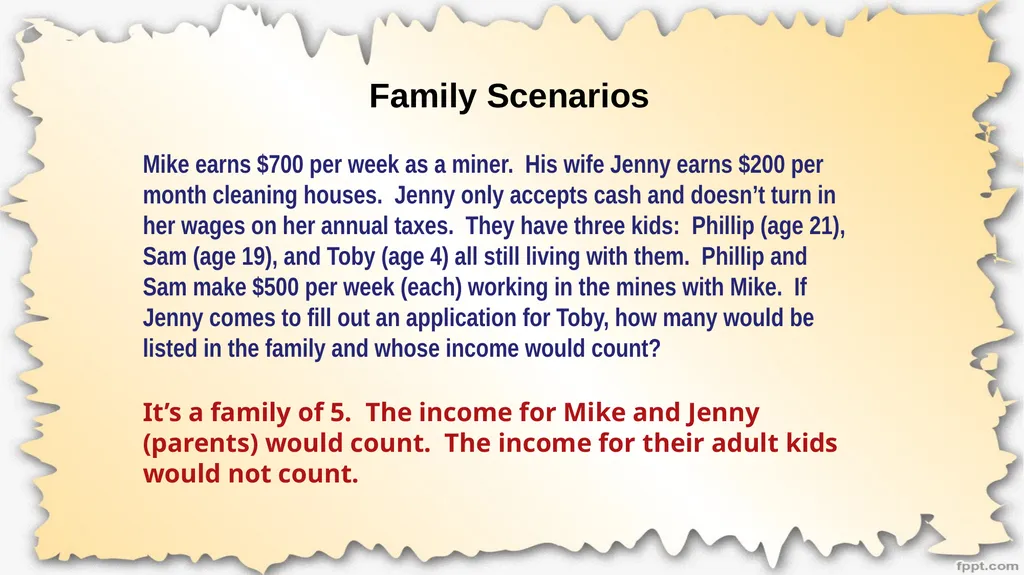
Family Scenarios Mike earns $700 per week as a miner. His wife Jenny earns $200 per month cleaning houses. Jenny only accepts cash and doesn’t turn in her wages on her annual taxes. They have three kids: Phillip (age 21), Sam (age 19), and Toby (age 4) all still living with them. Phillip and Sam make $500 per week (each) working in the mines with Mike. If Jenny comes to fill out an application for Toby, how many would be listed in the family and whose income would count? It’s a family of 5. The income for Mike and Jenny (parents) would count. The income for their adult kids would not count.<br>
37
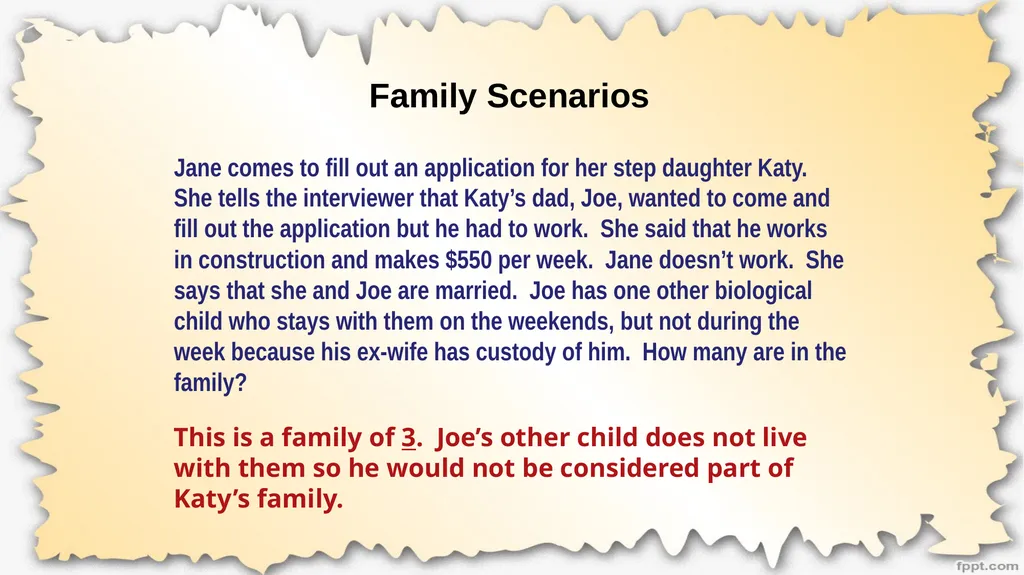
Family Scenarios Jane comes to fill out an application for her step daughter Katy. She tells the interviewer that Katy’s dad, Joe, wanted to come and fill out the application but he had to work. She said that he works in construction and makes $550 per week. Jane doesn’t work. She says that she and Joe are married. Joe has one other biological child who stays with them on the weekends, but not during the week because his ex-wife has custody of him. How many are in the family? This is a family of 3. Joe’s other child does not live with them so he would not be considered part of Katy’s family.<br>
38
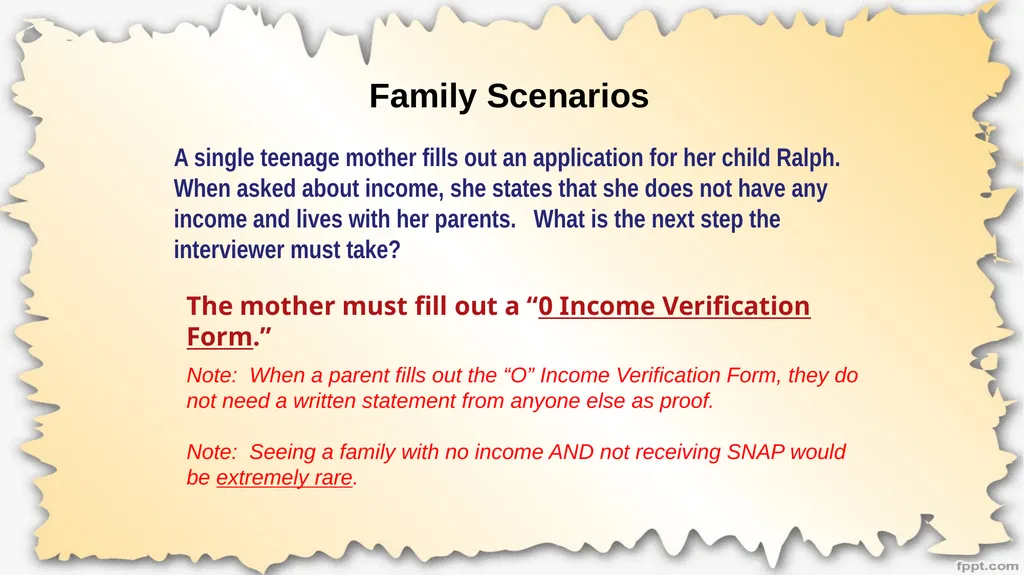
Family Scenarios A single teenage mother fills out an application for her child Ralph. When asked about income, she states that she does not have any income and lives with her parents. What is the next step the interviewer must take? The mother must fill out a “0 Income Verification Form.” Note: When a parent fills out the “O” Income Verification Form, they do not need a written statement from anyone else as proof.
Note: Seeing a family with no income AND not receiving SNAP would be extremely rare.<br>
Note: Seeing a family with no income AND not receiving SNAP would be extremely rare.<br>
39
Preparing to fill out the application Once you have established that the person in front of you is allowed to fill out the application, you will need to understand a few things including:
What is a Secondary Caregiver?
Who can count in this child’s family?
What do I ask for to prove income and what can I accept?
How do I determine if a family is homeless? 39<br>
What is a Secondary Caregiver?
Who can count in this child’s family?
What do I ask for to prove income and what can I accept?
How do I determine if a family is homeless? 39<br>
40
Verifying income 40 Once you have determined the size of the family, you will need to obtain income verification/documentation from the Primary & Secondary Caregivers. There are a lot of things you must understand to accurately obtain income documentation.
Note: Regardless of how many people are in the child’s family, you only obtain income documentation for the Primary and Secondary Caregivers.<br>
Note: Regardless of how many people are in the child’s family, you only obtain income documentation for the Primary and Secondary Caregivers.<br>
41
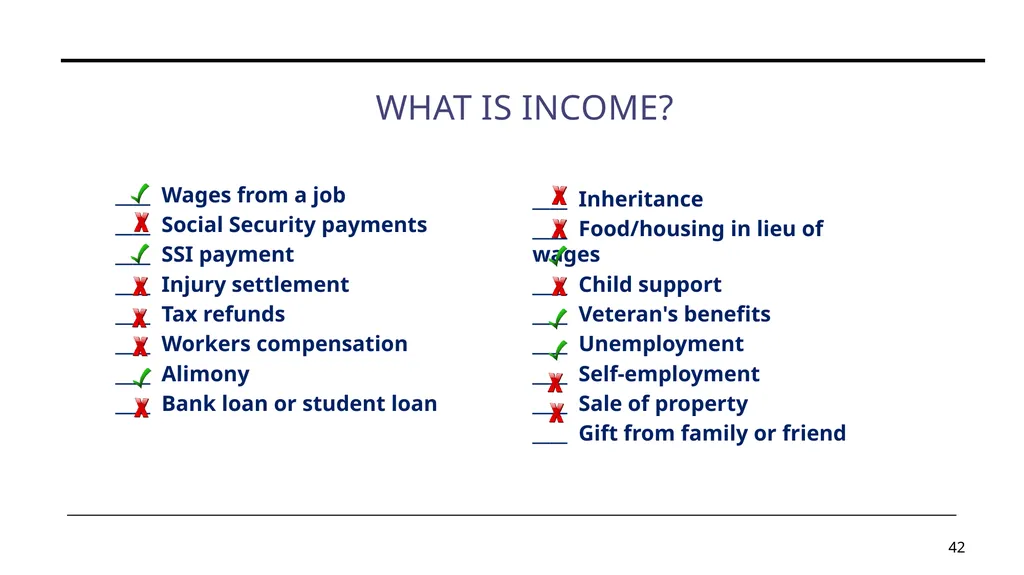
Verifying income 41 When asking the parent to provide you with income documentation, you must know what does/doesn’t count toward the family income or can be used to verify their income. Let’s look at a list and you tell me which item you would need to accept from a parent as income …………….<br>
42
What is income? 42 ____ Wages from a job
____ Social Security payments
____ SSI payment
____ Injury settlement
____ Tax refunds
____ Workers compensation
____ Alimony
____ Bank loan or student loan ____ Inheritance
____ Food/housing in lieu of wages
____ Child support
____ Veteran's benefits
____ Unemployment
____ Self-employment
____ Sale of property
____ Gift from family or friend<br>
____ Social Security payments
____ SSI payment
____ Injury settlement
____ Tax refunds
____ Workers compensation
____ Alimony
____ Bank loan or student loan ____ Inheritance
____ Food/housing in lieu of wages
____ Child support
____ Veteran's benefits
____ Unemployment
____ Self-employment
____ Sale of property
____ Gift from family or friend<br>
43
Categorically eligible children 43 So now that we know what counts as income, what should we ask for?
First, we need to determine if the family has any situation that would make the child “Categorically Eligible.” This term just means that the child is automatically eligible for Head Start regardless of any other family circumstance such as income.<br>
First, we need to determine if the family has any situation that would make the child “Categorically Eligible.” This term just means that the child is automatically eligible for Head Start regardless of any other family circumstance such as income.<br>
44
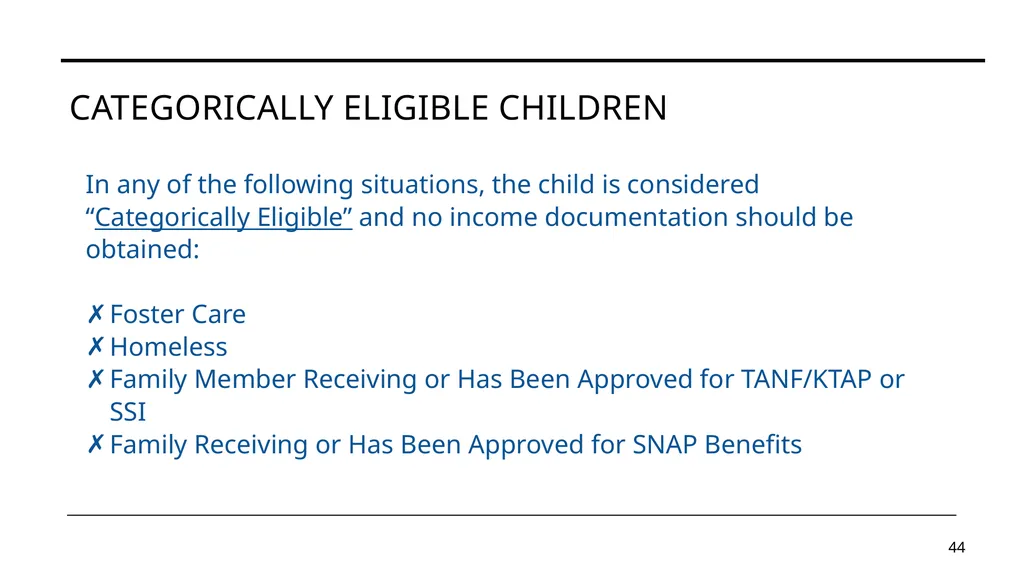
Categorically eligible children 44 In any of the following situations, the child is considered “Categorically Eligible” and no income documentation should be obtained:
Foster Care
Homeless
Family Member Receiving or Has Been Approved for TANF/KTAP or SSI
Family Receiving or Has Been Approved for SNAP Benefits<br>
Foster Care
Homeless
Family Member Receiving or Has Been Approved for TANF/KTAP or SSI
Family Receiving or Has Been Approved for SNAP Benefits<br>
45
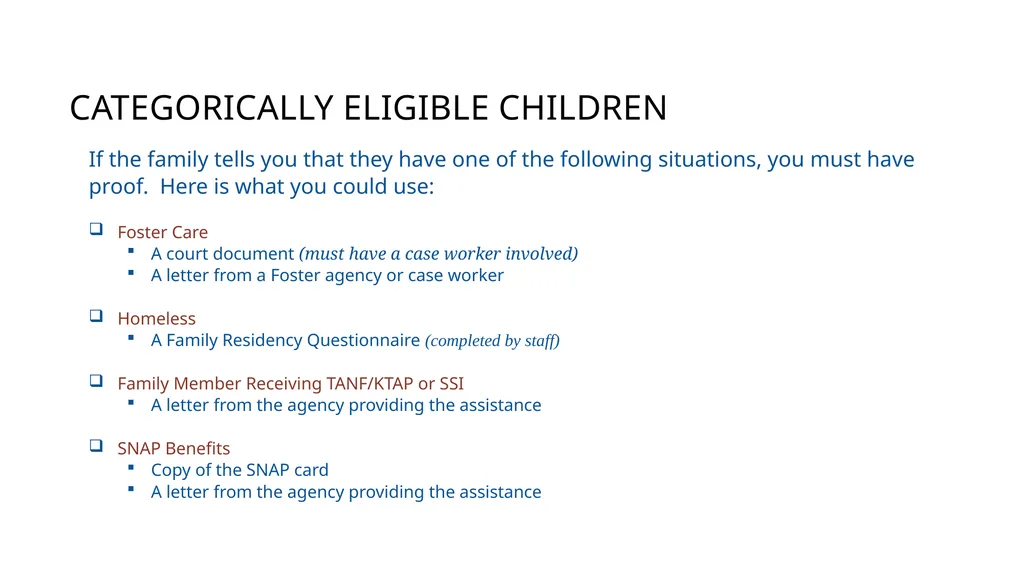
Categorically eligible children 45 If the family tells you that they have one of the following situations, you must have proof. Here is what you could use:
Foster Care
A court document (must have a case worker involved)
A letter from a Foster agency or case worker
Homeless
A Family Residency Questionnaire (completed by staff)
Family Member Receiving TANF/KTAP or SSI
A letter from the agency providing the assistance
SNAP Benefits
Copy of the SNAP card
A letter from the agency providing the assistance<br>
Foster Care
A court document (must have a case worker involved)
A letter from a Foster agency or case worker
Homeless
A Family Residency Questionnaire (completed by staff)
Family Member Receiving TANF/KTAP or SSI
A letter from the agency providing the assistance
SNAP Benefits
Copy of the SNAP card
A letter from the agency providing the assistance<br>
46
Verifying income 46 If the family doesn’t have any situation that would make the child Categorically Eligible, you will then ask for documentation to prove the family’s income level. As with determining family members, verifying income can be very complicated.<br>
47
Verifying income 47 In order to be certain that you are obtaining documentation from a family that truly represents their income, you must have a conversation with them to determine what you need.
For example, if you ask a single parent about her job and she tells you that she has worked at Walmart for the past 2 years, ask if she can give you a copy of her W-2 from the previous calendar year. That would be the easiest form of documentation.<br>
For example, if you ask a single parent about her job and she tells you that she has worked at Walmart for the past 2 years, ask if she can give you a copy of her W-2 from the previous calendar year. That would be the easiest form of documentation.<br>
48
Verifying income 48 But determining income is not always as simple as a parent handing you a W-2. That’s why you must understand what to ask for to represent their true income.
As a rule, you can always start the income conversation by asking if they can bring you a W-2 or other tax form from the previous calendar year. They may agree to do that, but ask a few questions to see if that previous calendar year income is the best thing to accept.<br>
As a rule, you can always start the income conversation by asking if they can bring you a W-2 or other tax form from the previous calendar year. They may agree to do that, but ask a few questions to see if that previous calendar year income is the best thing to accept.<br>
49
Verifying income 49 Here’s an example of when you wouldn’t want to accept a W-2:
Mom tells you that her husband worked for a construction company for 6 years making $20 per hour but the company closed in October of last year. Today is March 1 and her husband still hasn’t found another job. She says she can provide last year’s tax information. However, if you accept her tax form, will it really show the family’s true financial situation at this time? No it won’t. But if she can provide you with his unemployment documents for a recent 1 month period, that should be what you use to verify their income.<br>
Mom tells you that her husband worked for a construction company for 6 years making $20 per hour but the company closed in October of last year. Today is March 1 and her husband still hasn’t found another job. She says she can provide last year’s tax information. However, if you accept her tax form, will it really show the family’s true financial situation at this time? No it won’t. But if she can provide you with his unemployment documents for a recent 1 month period, that should be what you use to verify their income.<br>
50
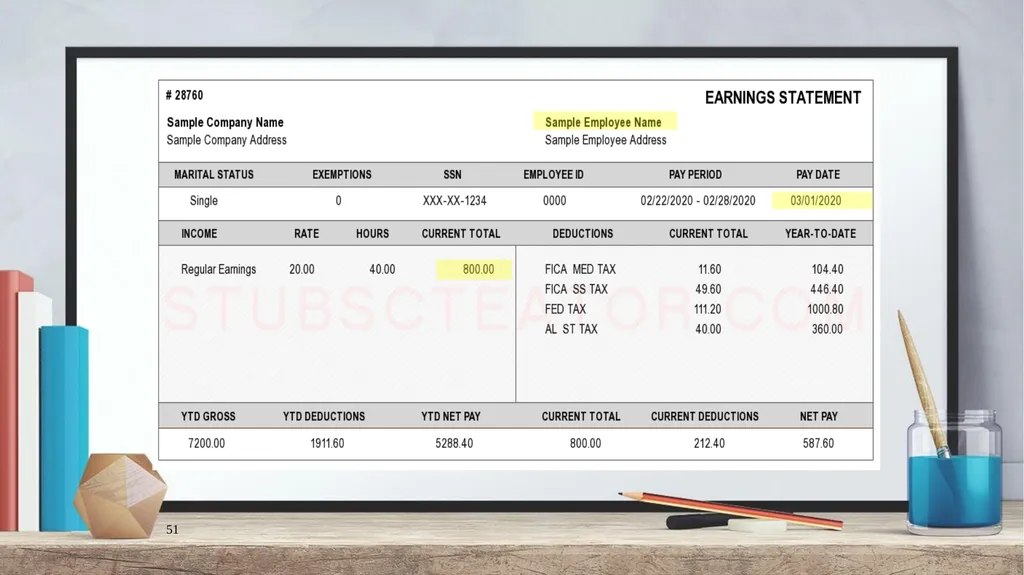
Verifying income 50 Income must be obtained for a full, consecutive 1 month period if the parent is presenting pay stubs. The ending period on the pay stub cannot be more than 30 days prior to the day you are accepting it. (Example on next slide)
Note: You cannot use a letter/statement from a 3rd party, such as Community Based Services, to verify a family’s income<br>
Note: You cannot use a letter/statement from a 3rd party, such as Community Based Services, to verify a family’s income<br>
51
Determining Income 51<br>
52
Verifying income 52 But what if a parent cannot provide last year’s tax information, pay stubs, or any other document that verifies their income?
For instance, if a person mows grass for a living and receives cash for payment, they wouldn’t have a document to prove their income. So what should the interviewer ask for?<br>
For instance, if a person mows grass for a living and receives cash for payment, they wouldn’t have a document to prove their income. So what should the interviewer ask for?<br>
53
Verifying income 53 When a parent has income that can’t be proved by a document from an employer, you could accept a written statement from either the employer OR the parent that shows the amount they receive. The statement must show an amount and a time period. For example, the statement could look like this…………………<br>
54
I make $200 per month mowing grass for my neighbors.
Walter White 3/19/25<br>
Walter White 3/19/25<br>
55
Verifying income 55 What should I do in a situation when the parent says they don’t have any income?
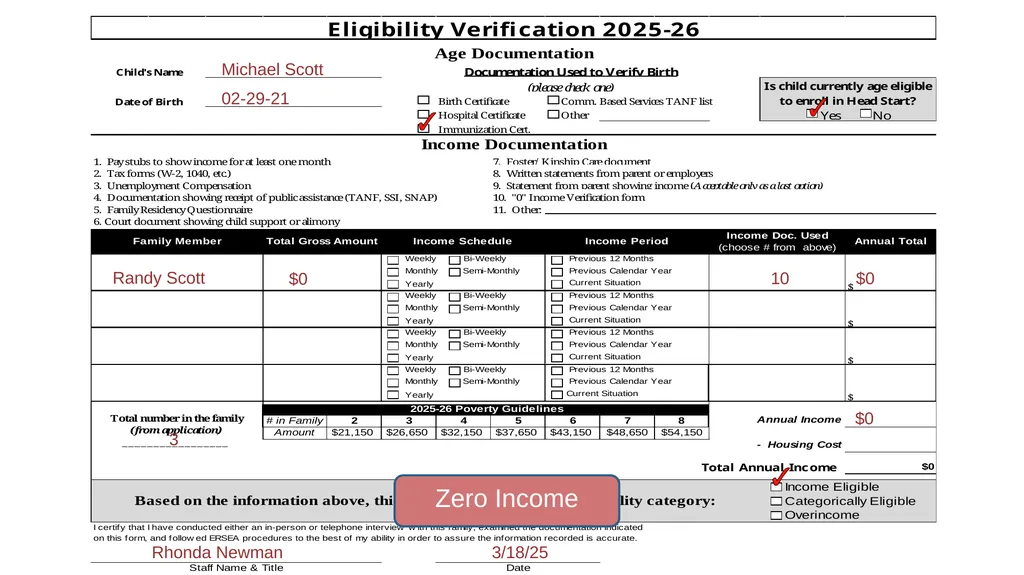
After having a conversation with the parent, if you feel that he/she truly doesn’t have an income AND doesn’t receive SNAP, you will need to fill out a Zero Income form that describes the situation. It looks like this………………….<br>
After having a conversation with the parent, if you feel that he/she truly doesn’t have an income AND doesn’t receive SNAP, you will need to fill out a Zero Income form that describes the situation. It looks like this………………….<br>
56
All 3 questions must be answered, signed and dated by both parties<br>
57
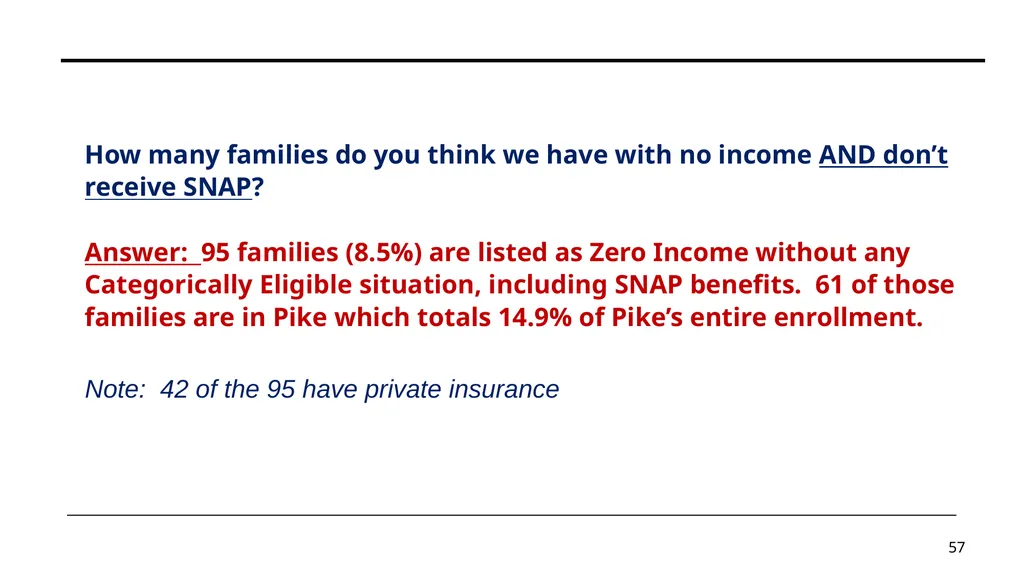
57 How many families do you think we have with no income AND don’t receive SNAP?
Answer: 95 families (8.5%) are listed as Zero Income without any Categorically Eligible situation, including SNAP benefits. 61 of those families are in Pike which totals 14.9% of Pike’s entire enrollment.
Note: 42 of the 95 have private insurance<br>
Answer: 95 families (8.5%) are listed as Zero Income without any Categorically Eligible situation, including SNAP benefits. 61 of those families are in Pike which totals 14.9% of Pike’s entire enrollment.
Note: 42 of the 95 have private insurance<br>
58
Verifying income 58 When accepting income documentation, be sure to look at the date on the document. Here is a timeline that each kind of income documentation must meet…………………….<br>
59
59 Income Documents
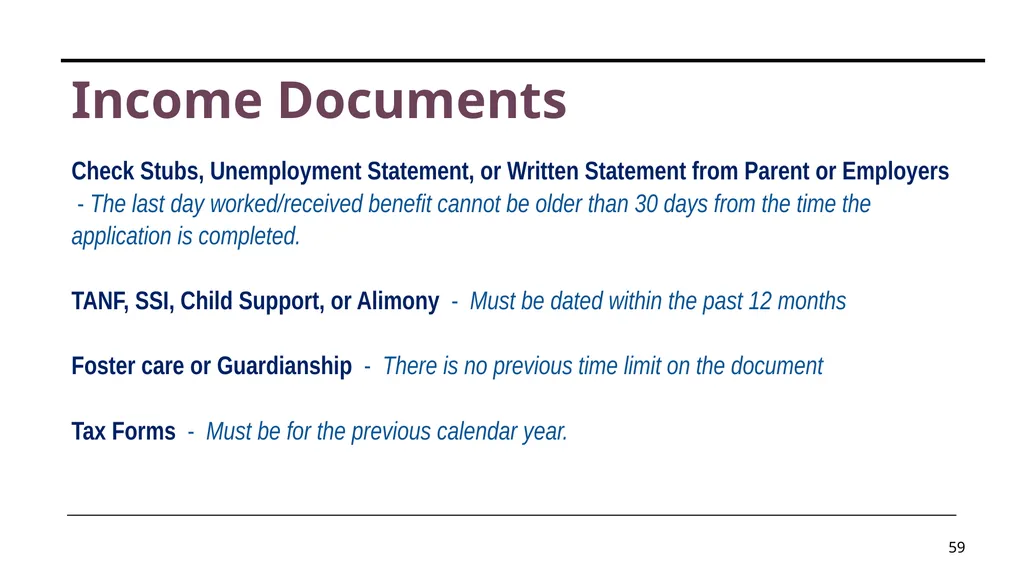
Check Stubs, Unemployment Statement, or Written Statement from Parent or Employers - The last day worked/received benefit cannot be older than 30 days from the time the application is completed.
TANF, SSI, Child Support, or Alimony - Must be dated within the past 12 months
Foster care or Guardianship - There is no previous time limit on the document
Tax Forms - Must be for the previous calendar year.<br>
Check Stubs, Unemployment Statement, or Written Statement from Parent or Employers - The last day worked/received benefit cannot be older than 30 days from the time the application is completed.
TANF, SSI, Child Support, or Alimony - Must be dated within the past 12 months
Foster care or Guardianship - There is no previous time limit on the document
Tax Forms - Must be for the previous calendar year.<br>
60
60 Income Documents
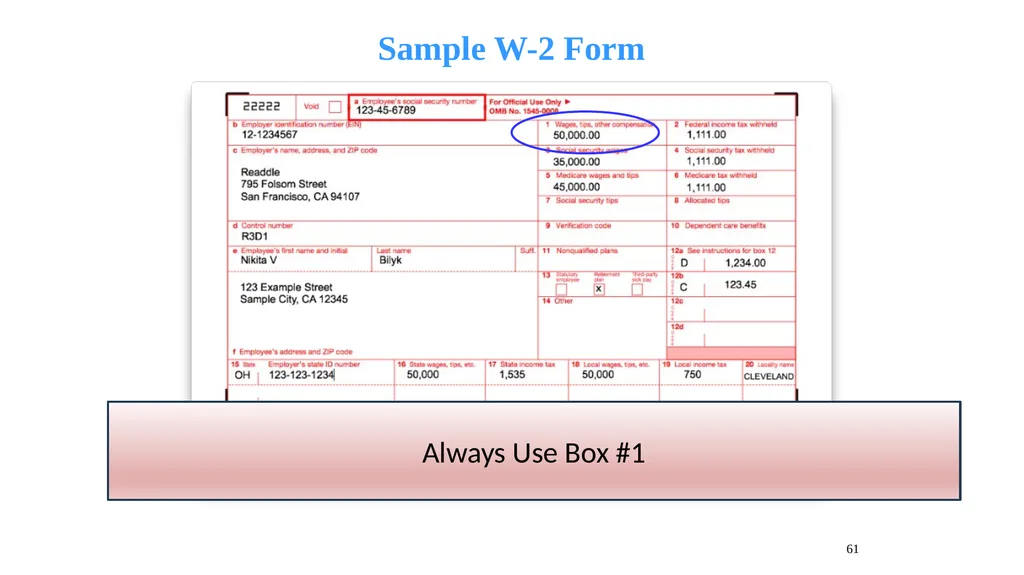
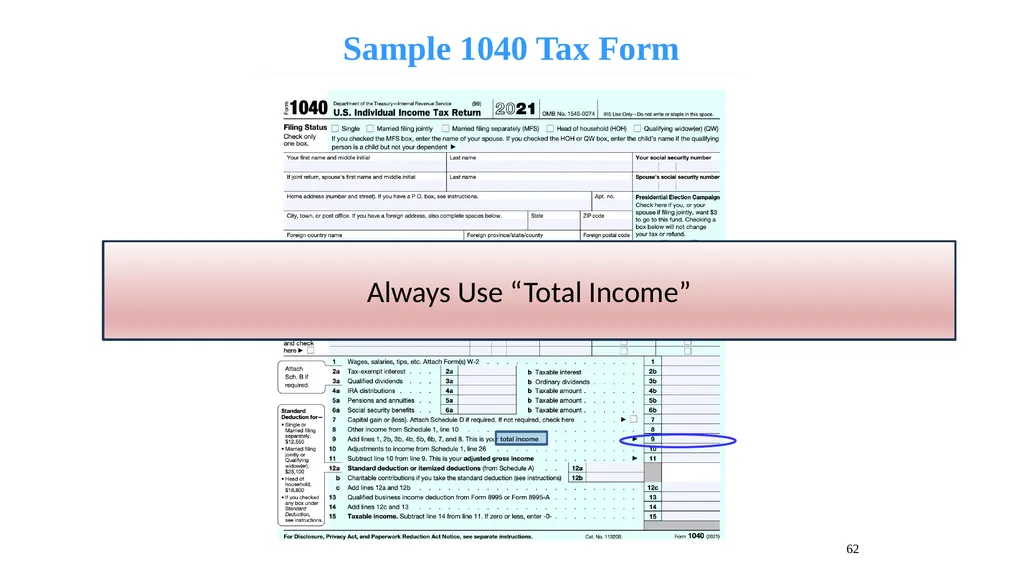
If the parent gives me tax forms (i.e. 1040, W-2) from the previous calendar year, what part of the document should I use as their income?<br>
If the parent gives me tax forms (i.e. 1040, W-2) from the previous calendar year, what part of the document should I use as their income?<br>
61
61 Sample W-2 Form Always Use Box #1<br>
62
62 Sample 1040 Tax Form Always Use “Total Income”<br>
63
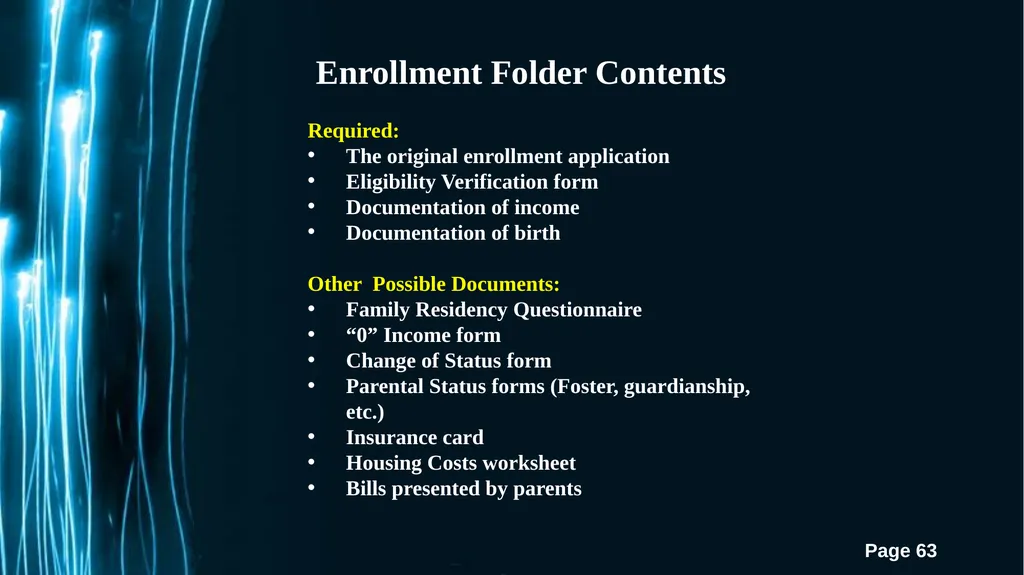
Enrollment Folder Contents
Required:
The original enrollment application
Eligibility Verification form
Documentation of income
Documentation of birth
Other Possible Documents:
Family Residency Questionnaire
“0” Income form
Change of Status form
Parental Status forms (Foster, guardianship, etc.)
Insurance card
Housing Costs worksheet
Bills presented by parents<br>
Required:
The original enrollment application
Eligibility Verification form
Documentation of income
Documentation of birth
Other Possible Documents:
Family Residency Questionnaire
“0” Income form
Change of Status form
Parental Status forms (Foster, guardianship, etc.)
Insurance card
Housing Costs worksheet
Bills presented by parents<br>
64
Preparing to fill out the application Once you have established that the person in front of you is allowed to fill out the application, you will need to understand a few things including:
What is a Secondary Caregiver?
Who can count in this child’s family?
What do I ask for to prove income and what can I accept?
How do I determine if a family is homeless? 64<br>
What is a Secondary Caregiver?
Who can count in this child’s family?
What do I ask for to prove income and what can I accept?
How do I determine if a family is homeless? 64<br>
65
Determining Homelessness<br>
66
When you think of a homeless person, most people think of someone living on the streets sleeping on a bench. But some families that may be identified as homeless for Head Start purposes could appear to have a normal situation. Determining Homelessness<br>
67
The McKinney-Vento Act defintion is what programs must use to deterimine homelessness. Determining Homelessness<br>
68
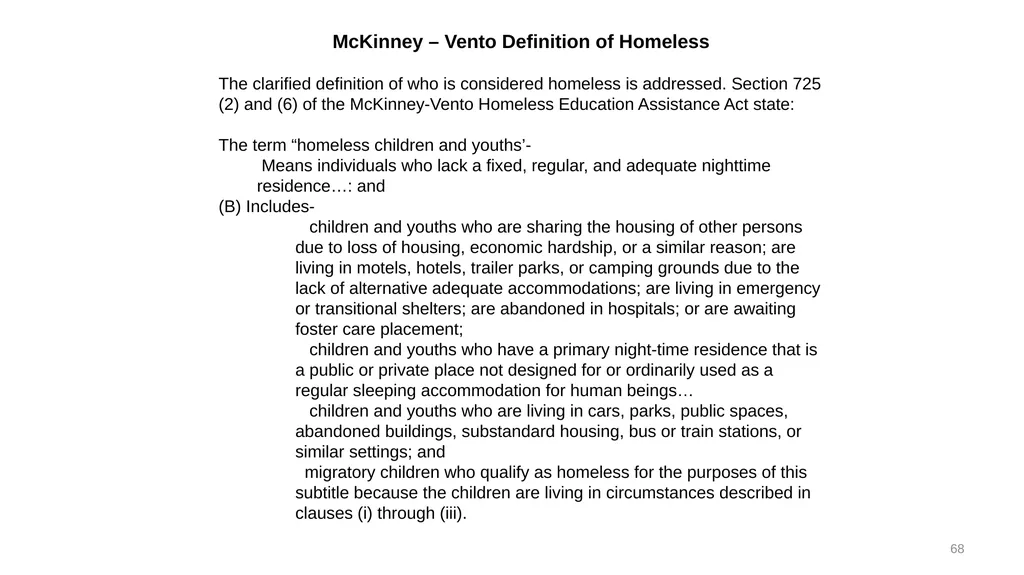
68 McKinney – Vento Definition of Homeless
The clarified definition of who is considered homeless is addressed. Section 725 (2) and (6) of the McKinney-Vento Homeless Education Assistance Act state:
The term “homeless children and youths’-
Means individuals who lack a fixed, regular, and adequate nighttime residence…: and
(B) Includes-
children and youths who are sharing the housing of other persons due to loss of housing, economic hardship, or a similar reason; are living in motels, hotels, trailer parks, or camping grounds due to the lack of alternative adequate accommodations; are living in emergency or transitional shelters; are abandoned in hospitals; or are awaiting foster care placement;
children and youths who have a primary night-time residence that is a public or private place not designed for or ordinarily used as a regular sleeping accommodation for human beings…
children and youths who are living in cars, parks, public spaces, abandoned buildings, substandard housing, bus or train stations, or similar settings; and
migratory children who qualify as homeless for the purposes of this subtitle because the children are living in circumstances described in clauses (i) through (iii).<br>
The clarified definition of who is considered homeless is addressed. Section 725 (2) and (6) of the McKinney-Vento Homeless Education Assistance Act state:
The term “homeless children and youths’-
Means individuals who lack a fixed, regular, and adequate nighttime residence…: and
(B) Includes-
children and youths who are sharing the housing of other persons due to loss of housing, economic hardship, or a similar reason; are living in motels, hotels, trailer parks, or camping grounds due to the lack of alternative adequate accommodations; are living in emergency or transitional shelters; are abandoned in hospitals; or are awaiting foster care placement;
children and youths who have a primary night-time residence that is a public or private place not designed for or ordinarily used as a regular sleeping accommodation for human beings…
children and youths who are living in cars, parks, public spaces, abandoned buildings, substandard housing, bus or train stations, or similar settings; and
migratory children who qualify as homeless for the purposes of this subtitle because the children are living in circumstances described in clauses (i) through (iii).<br>
69
Indentifying Homeless Families<br>
70
Scenarios A mother and child have moved in with the mother’s boyfriend. She tells the interviewer that she moved in with this same boyfriend last year and after a month, he kicked them out. They had to stay in a homeless shelter for a couple of days until her parents agreed to take her into their home where she lived until last week when she moved in with that same boyfriend once again. Her parents told her if she left, not to call them if he kicked them out again. She tells the interviewer she is worried the same thing will happen again. Is this a homeless family? Probably not. Though it may not be a completely stable situation, it doesn’t seem to meet the qualifications of the MV Act<br>
71
Scenarios A family is living in a house owned by a friend. The friend has told the family that they can stay there as long as they like and they don’t pay rent. Is the family homeless? Probably not, but it may depend on how they ended up there. For example, if the family lost their housing and the friend is just letting them stay there because they didn’t have anywhere else to go, it may be homeless.<br>
72
Scenarios A family is living in a small two bedroom trailer. They have three children, two boys and a girl. All 3 children must share a bedroom and since the room is so small, they must also share a bed. Is this a homeless family? More information would be needed. We would need to know the ages of the kids. Does the girl have to share the bed with the boys? It’s possible this could be a homeless scenario, but it would depend on what the staff member learns during the conversation.<br>
73
Scenarios A mother and her child are living with her parents. She tells the interviewer that she and her son lived in an apartment until three months ago when the rent became too expensive. So at that time, they moved back in with her parents and plan on moving into a low income apartment when one becomes available. Is this family homeless? Probably. It could be looked at as a “homeless” family because economic hardship forced the family to move in with relatives. But the family has been there for three months and if the interviewer feels that it is a stable situation, this may not be a homeless family.<br>
74
Scenarios A father and mother come in July to fill out an application for their son. During the interview, the father mentions that he hopes the weather cools down soon because their air conditioner stopped working and their trailer gets very hot. He states that it gets so hot that they have to leave the windows open all night just to be able to sleep. Does this make the family homeless? No. Though the air conditioner would definitely make life easier for the family, the fact that they do not have one would not make them homeless.<br>
75
Scenarios A husband, wife, and their two children are staying in a camper at a local campground. They also tell the interviewer that they have a home in South Carolina but they stay in Kentucky during the week so the husband can work at a nearby construction job. The couple tells the interviewer that they cannot stand to be apart all week so the whole family travels with the father when he works construction jobs away from home. Are they homeless? No. The family has a home and is making a choice to stay in the camper as a convenience.<br>
76
Scenarios A mother comes to fill out an application for her son. When asked her address, the woman tells the interviewer that she and her 3 children are currently staying at a Domestic Violence Shelter and are hiding from her husband. She says that he is staying at their home but that she hopes to be given the house in a few weeks when the divorce is final. Is this family homeless? Yes. On the day that she is filling out this application, it appears that the mother does not plan on going home until things are resolved and is currently living in a shelter. This would be a clear situation that should be identified as “homeless”.<br>
77
Scenarios A family was living in a mobile home last month. They are currently building a house and in order to build it in the same place they were living, they had to sell their mobile home so it could be moved out of the way and they are currently living with the husband’s parents for the next 6 months or so until the house is finished. Is the family homeless? No. The family made the choice to sell their home and the choice had nothing to do with economic circumstances<br>
78
Scenarios A family is living in a mobile home. The parent tells the interviewer that the windows and roof leak when it rains. She says that they place cups and bowls in the floor to catch the water. Is this a homeless family? Very possible. Simply having a leak in the roof wouldn’t make a family homeless, but the situation she describes might cross the line into “substandard housing” and qualify as homeless.<br>
79
79 Dual Custody We now see Dual Custody situations much more frequently than in years past. Dual Custody means that the biological parents have 50-50, equal custody of their child. If this is the case, even though the parents are not living in the same home, both will be listed as the PC and SC.
The staff member doing the application with the parent must ask specific questions to make sure that the parent’s responses show that there is really a Dual Custody, 50-50 split of where the child resides.<br>
The staff member doing the application with the parent must ask specific questions to make sure that the parent’s responses show that there is really a Dual Custody, 50-50 split of where the child resides.<br>
80
80 Dual Custody If it is a true Dual Custody situation, there are a few things that the interviewer must understand to fill out the application correctly. You must determine if any of the following situations are true:
Either parent receives TANF, SSI or SNAP benefits
Either parent could be determined as Homeless<br>
Either parent receives TANF, SSI or SNAP benefits
Either parent could be determined as Homeless<br>
81
81 Dual Custody If any of those situations (TANF, SSI, SNAP, or homeless) are true for either parent in a Dual Custody situation, you would:
List the two biological parents as the PC and SC
List all the members of both parents’ families on the application in the Additional Family Members section
Divide the number of family members by 2 to determine the number you will list on the application in the “Total Family Members” section
Obtain the document that proves one of those situations mentioned above to serve as income verification.<br>
List the two biological parents as the PC and SC
List all the members of both parents’ families on the application in the Additional Family Members section
Divide the number of family members by 2 to determine the number you will list on the application in the “Total Family Members” section
Obtain the document that proves one of those situations mentioned above to serve as income verification.<br>
82
82 Dual Custody If none of those situations (TANF, SSI, SNAP, homeless) are true for either parent in a Dual Custody situation, then you would need to do the following:
List the two biological parents as the PC and SC
List all the members of both parents’ families on the application in the Additional Family Members section
Divide the number of family members by 2 to determine the number you will list on the application in the “Total Family Members” section
Obtain income from both families (including spouses) and divide by 2 on the Eligibility Verification form<br>
List the two biological parents as the PC and SC
List all the members of both parents’ families on the application in the Additional Family Members section
Divide the number of family members by 2 to determine the number you will list on the application in the “Total Family Members” section
Obtain income from both families (including spouses) and divide by 2 on the Eligibility Verification form<br>
83
Example of dual custody For this next scenario, let’s assume that the two parents have Dual Custody of their child and neither of them have any of the situations we mentioned in the previous slide (TANF, SSI, Foster, Homeless). 83<br>
84
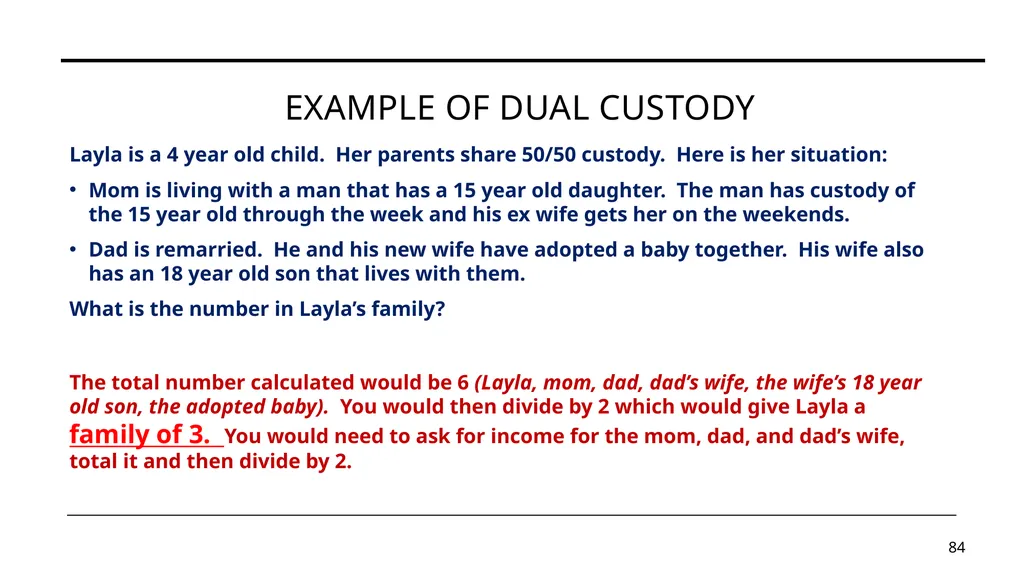
Example of dual custody Layla is a 4 year old child. Her parents share 50/50 custody. Here is her situation:
Mom is living with a man that has a 15 year old daughter. The man has custody of the 15 year old through the week and his ex wife gets her on the weekends.
Dad is remarried. He and his new wife have adopted a baby together. His wife also has an 18 year old son that lives with them.
What is the number in Layla’s family?
The total number calculated would be 6 (Layla, mom, dad, dad’s wife, the wife’s 18 year old son, the adopted baby). You would then divide by 2 which would give Layla a family of 3. You would need to ask for income for the mom, dad, and dad’s wife, total it and then divide by 2. 84<br>
Mom is living with a man that has a 15 year old daughter. The man has custody of the 15 year old through the week and his ex wife gets her on the weekends.
Dad is remarried. He and his new wife have adopted a baby together. His wife also has an 18 year old son that lives with them.
What is the number in Layla’s family?
The total number calculated would be 6 (Layla, mom, dad, dad’s wife, the wife’s 18 year old son, the adopted baby). You would then divide by 2 which would give Layla a family of 3. You would need to ask for income for the mom, dad, and dad’s wife, total it and then divide by 2. 84<br>
85
85 Completing the Eligibility
Verification (EV) Form<br>
Verification (EV) Form<br>
86
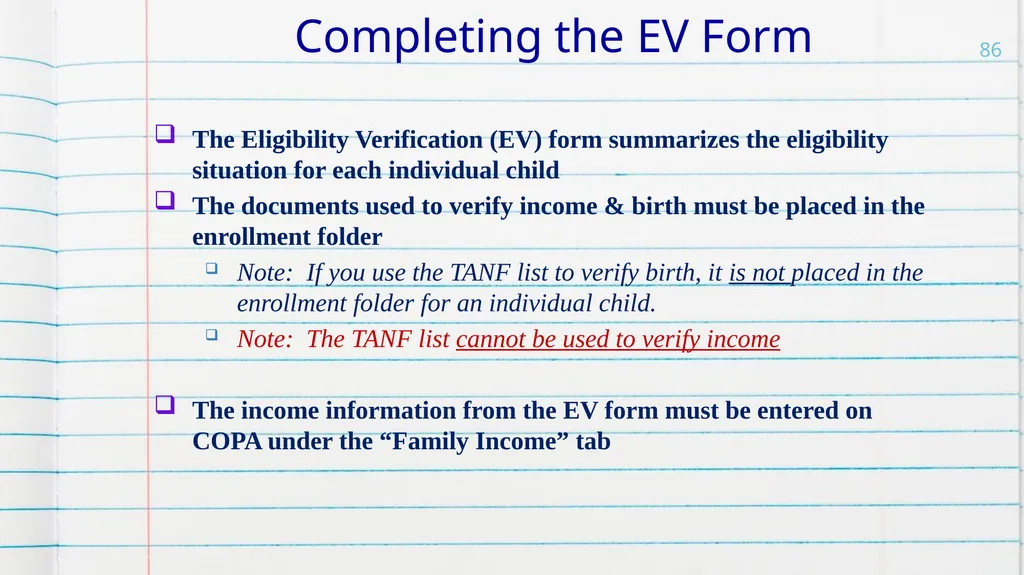
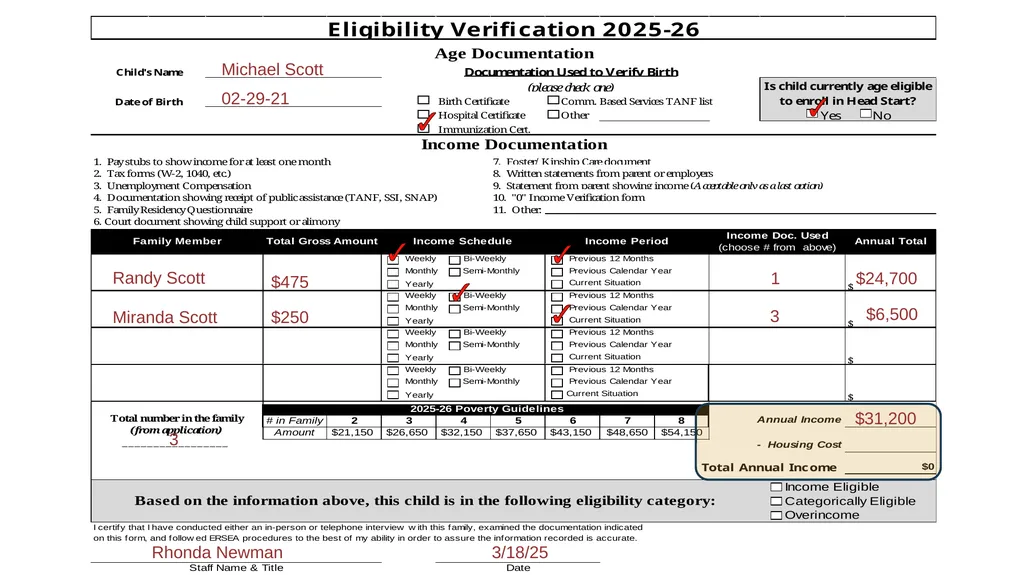
86 The Eligibility Verification (EV) form summarizes the eligibility situation for each individual child
The documents used to verify income & birth must be placed in the enrollment folder
Note: If you use the TANF list to verify birth, it is not placed in the enrollment folder for an individual child.
Note: The TANF list cannot be used to verify income
The income information from the EV form must be entered on COPA under the “Family Income” tab Completing the EV Form<br>
The documents used to verify income & birth must be placed in the enrollment folder
Note: If you use the TANF list to verify birth, it is not placed in the enrollment folder for an individual child.
Note: The TANF list cannot be used to verify income
The income information from the EV form must be entered on COPA under the “Family Income” tab Completing the EV Form<br>
87
87 There will be a change this year with how you complete the Eligibility Verification form. Completing the EV Form<br>
88
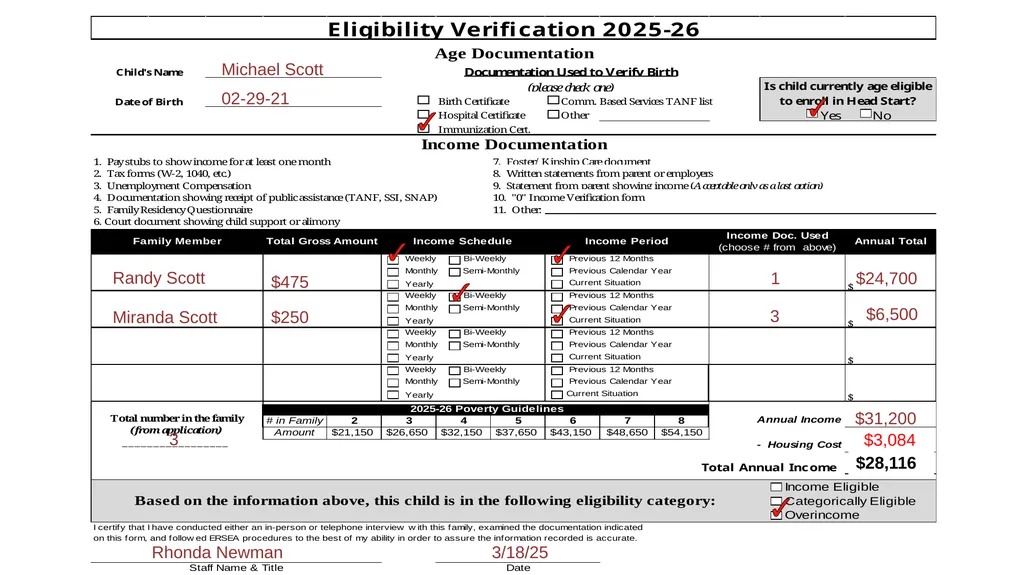
Michael Scott 02-29-21 Randy Scott $475 1 $24,700 Miranda Scott $250 3 $6,500 $31,200 3 Rhonda Newman 3/18/25<br>
89
89 Beginning this year, families who are overincome must be given the opportunity to provide you with “housing cost documentation” to increase the chances for their child to be accepted into Head Start. Completing the EV Form<br>
90
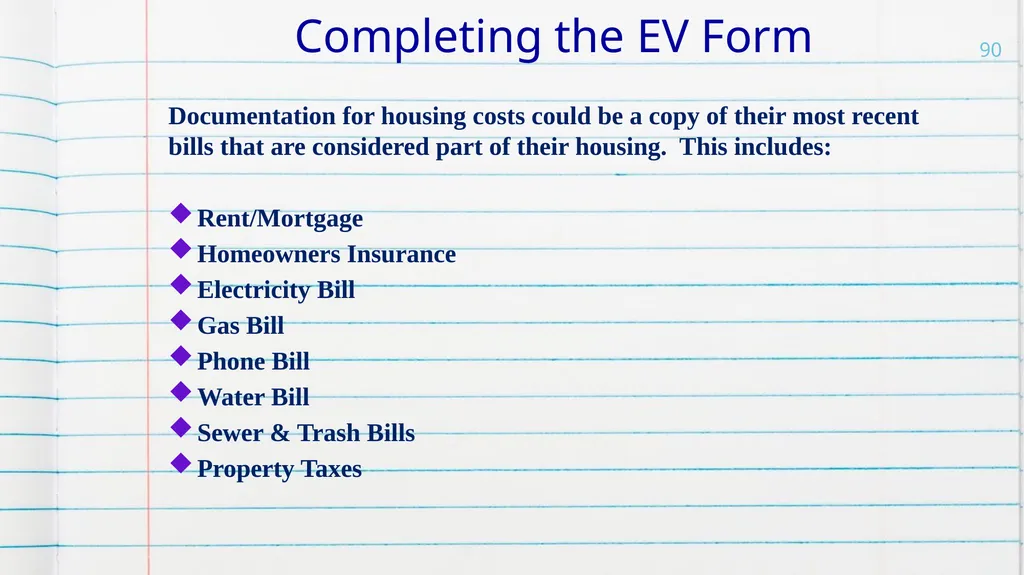
90 Documentation for housing costs could be a copy of their most recent bills that are considered part of their housing. This includes:
Rent/Mortgage
Homeowners Insurance
Electricity Bill
Gas Bill
Phone Bill
Water Bill
Sewer & Trash Bills
Property Taxes Completing the EV Form<br>
Rent/Mortgage
Homeowners Insurance
Electricity Bill
Gas Bill
Phone Bill
Water Bill
Sewer & Trash Bills
Property Taxes Completing the EV Form<br>
91
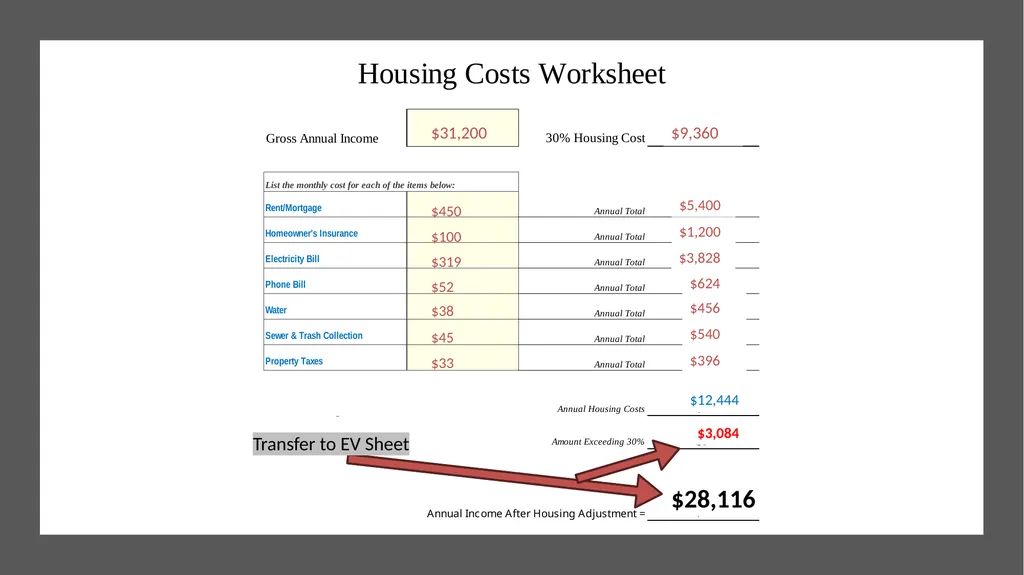
$31,200 $9,360 $450 $5,400 $100 $1,200 $319 $3,828 $52 $624 $38 $456 $45 $540 $33 $396 $12,444 $3,084 $28,116 Transfer to EV Sheet<br>
92
Michael Scott 02-29-21 Randy Scott $475 1 $24,700 Miranda Scott $250 3 $6,500 $31,200 3 Rhonda Newman 3/18/25 $3,084 $28,116<br>
93
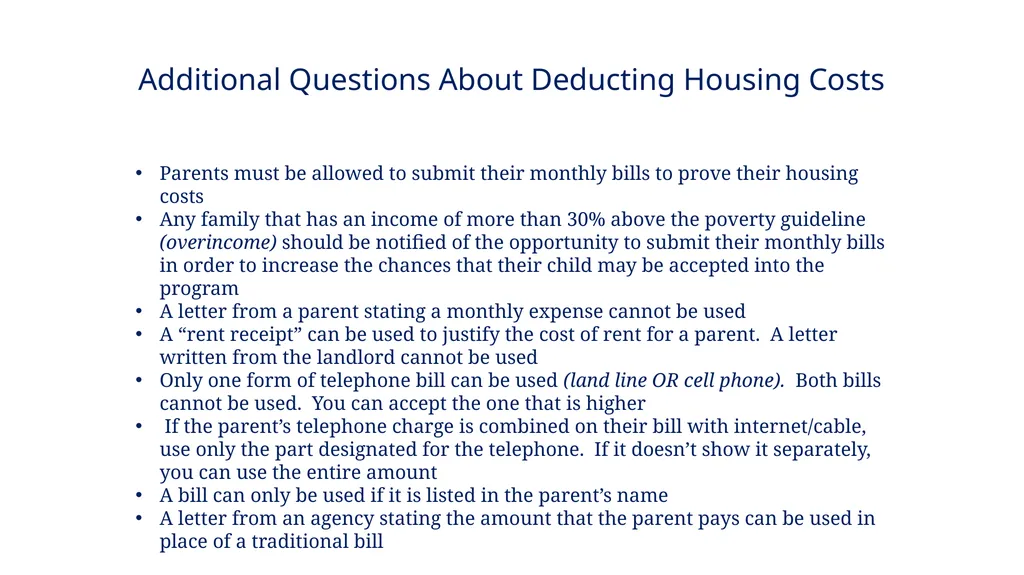
Additional Questions About Deducting Housing Costs 93 Parents must be allowed to submit their monthly bills to prove their housing costs
Any family that has an income of more than 30% above the poverty guideline (overincome) should be notified of the opportunity to submit their monthly bills in order to increase the chances that their child may be accepted into the program
A letter from a parent stating a monthly expense cannot be used
A “rent receipt” can be used to justify the cost of rent for a parent. A letter written from the landlord cannot be used
Only one form of telephone bill can be used (land line OR cell phone). Both bills cannot be used. You can accept the one that is higher
If the parent’s telephone charge is combined on their bill with internet/cable, use only the part designated for the telephone. If it doesn’t show it separately, you can use the entire amount
A bill can only be used if it is listed in the parent’s name
A letter from an agency stating the amount that the parent pays can be used in place of a traditional bill<br>
Any family that has an income of more than 30% above the poverty guideline (overincome) should be notified of the opportunity to submit their monthly bills in order to increase the chances that their child may be accepted into the program
A letter from a parent stating a monthly expense cannot be used
A “rent receipt” can be used to justify the cost of rent for a parent. A letter written from the landlord cannot be used
Only one form of telephone bill can be used (land line OR cell phone). Both bills cannot be used. You can accept the one that is higher
If the parent’s telephone charge is combined on their bill with internet/cable, use only the part designated for the telephone. If it doesn’t show it separately, you can use the entire amount
A bill can only be used if it is listed in the parent’s name
A letter from an agency stating the amount that the parent pays can be used in place of a traditional bill<br>
94
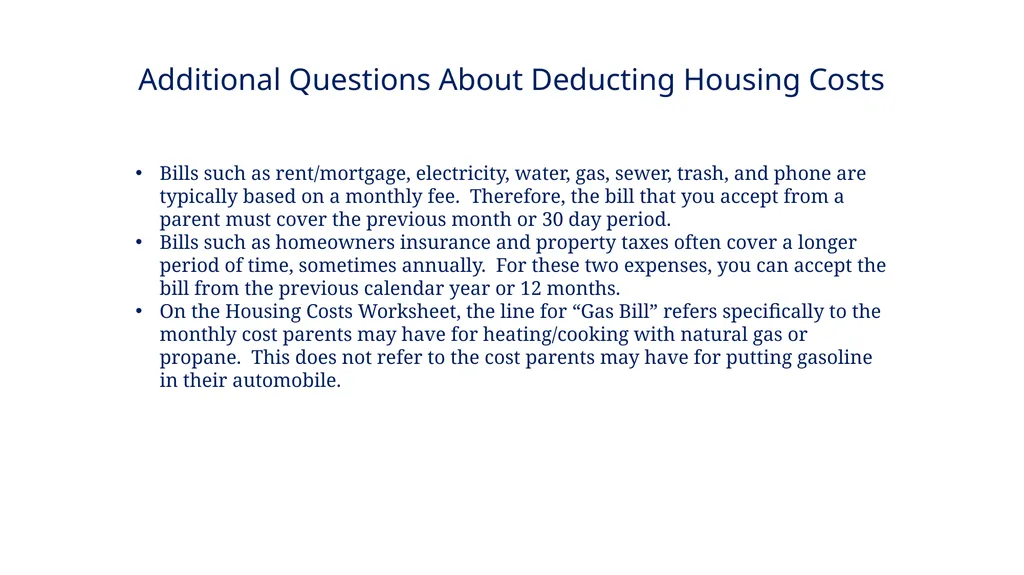
Additional Questions About Deducting Housing Costs 94 Bills such as rent/mortgage, electricity, water, gas, sewer, trash, and phone are typically based on a monthly fee. Therefore, the bill that you accept from a parent must cover the previous month or 30 day period.
Bills such as homeowners insurance and property taxes often cover a longer period of time, sometimes annually. For these two expenses, you can accept the bill from the previous calendar year or 12 months.
On the Housing Costs Worksheet, the line for “Gas Bill” refers specifically to the monthly cost parents may have for heating/cooking with natural gas or propane. This does not refer to the cost parents may have for putting gasoline in their automobile.<br>
Bills such as homeowners insurance and property taxes often cover a longer period of time, sometimes annually. For these two expenses, you can accept the bill from the previous calendar year or 12 months.
On the Housing Costs Worksheet, the line for “Gas Bill” refers specifically to the monthly cost parents may have for heating/cooking with natural gas or propane. This does not refer to the cost parents may have for putting gasoline in their automobile.<br>
95
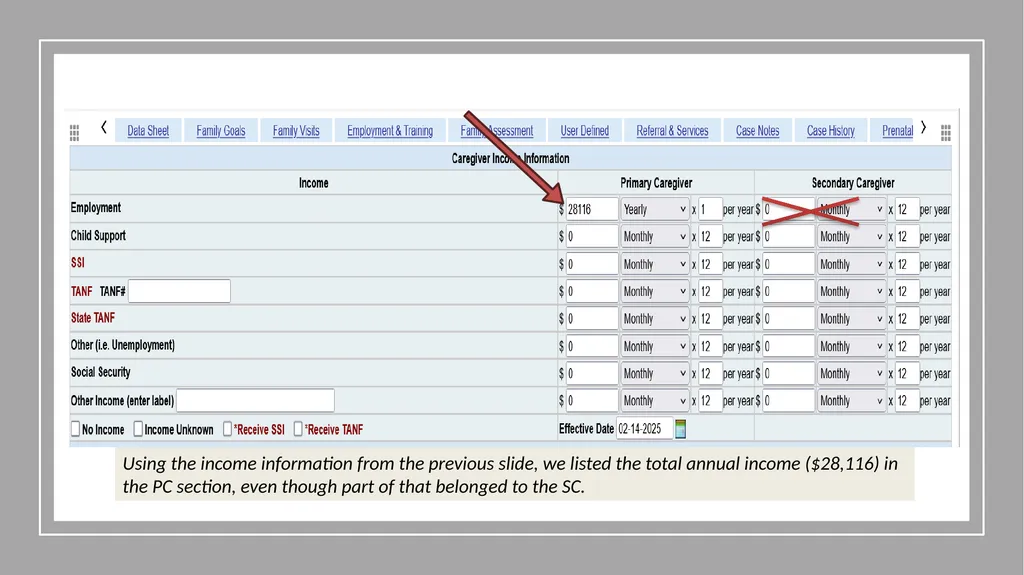
95 When housing costs are used to reduce the total annual income as shown in the previous slide, you need to be aware of how to list the income on COPA. Completing the EV Form<br>
96
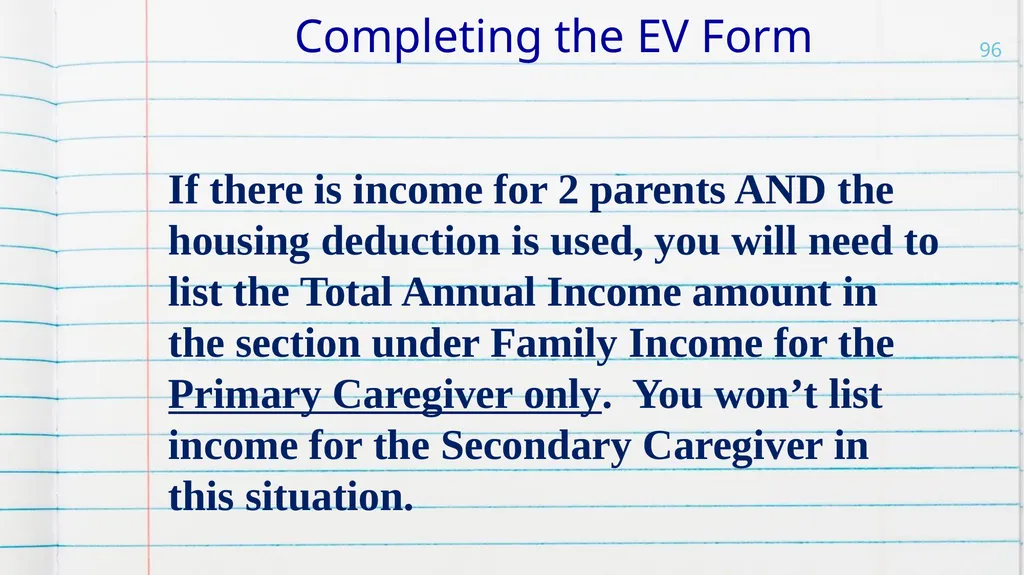
96 If there is income for 2 parents AND the housing deduction is used, you will need to list the Total Annual Income amount in the section under Family Income for the Primary Caregiver only. You won’t list income for the Secondary Caregiver in this situation. Completing the EV Form<br>
97
Using the income information from the previous slide, we listed the total annual income ($28,116) in the PC section, even though part of that belonged to the SC.<br>
98
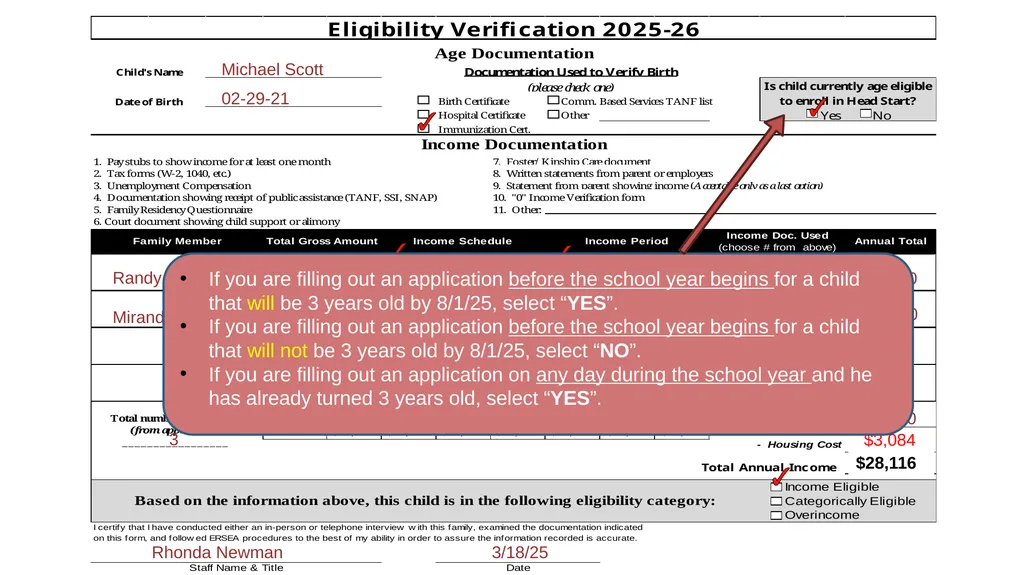
Michael Scott 02-29-21 Randy Scott $475 1 $24,700 Miranda Scott $250 3 $6,500 $31,200 3 Rhonda Newman 3/18/25 $3,084 $28,116 If you are filling out an application before the school year begins for a child that will be 3 years old by 8/1/25, select “YES”.
If you are filling out an application before the school year begins for a child that will not be 3 years old by 8/1/25, select “NO”.
If you are filling out an application on any day during the school year and he has already turned 3 years old, select “YES”.<br>
If you are filling out an application before the school year begins for a child that will not be 3 years old by 8/1/25, select “NO”.
If you are filling out an application on any day during the school year and he has already turned 3 years old, select “YES”.<br>
99
Michael Scott 02-29-21 Randy Scott $0 10 $0 $0 3 Rhonda Newman 3/18/25 Zero Income<br>
100
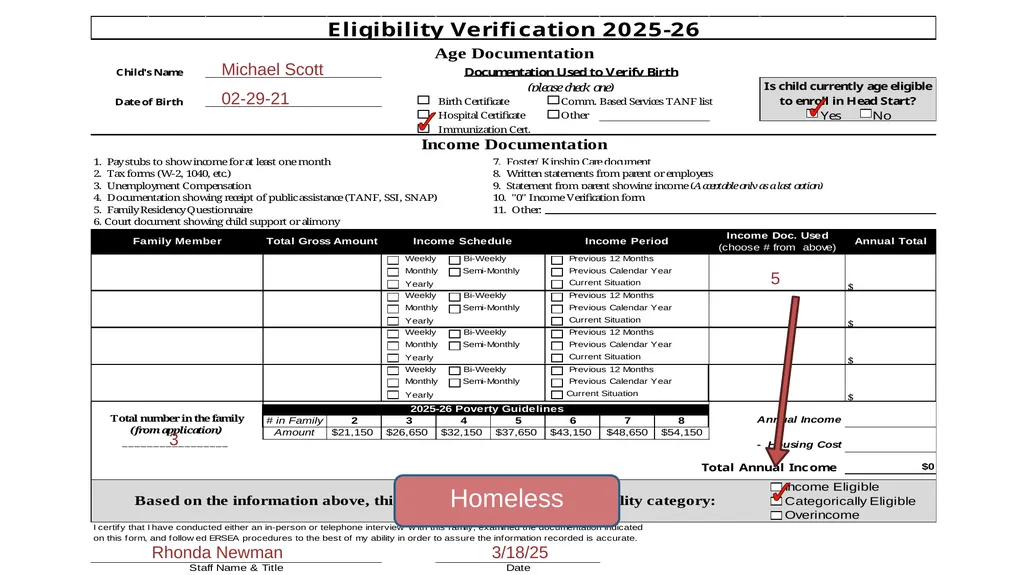
Michael Scott 02-29-21 5 3 Rhonda Newman 3/18/25 Homeless<br>
101
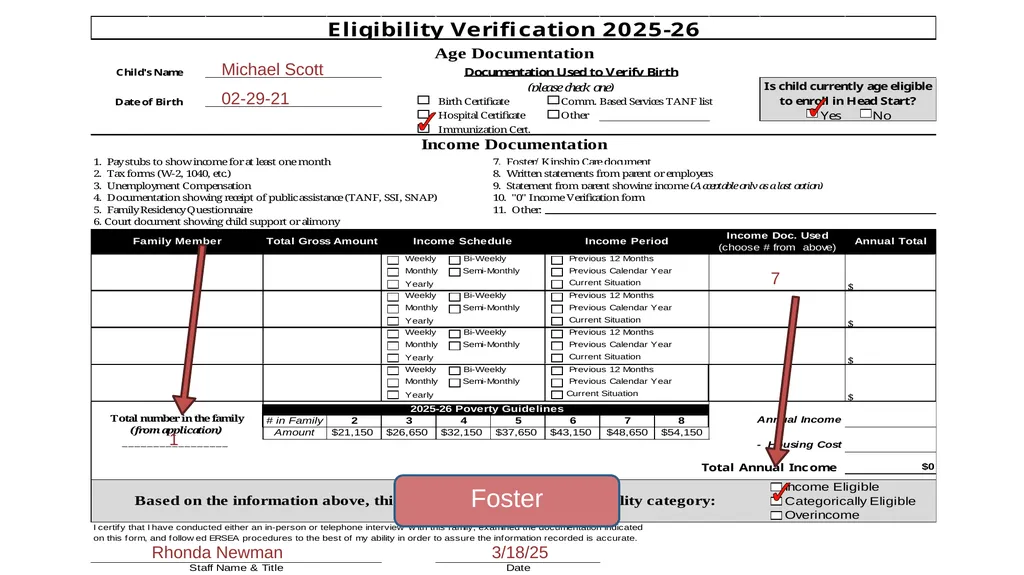
Michael Scott 02-29-21 7 1 Rhonda Newman 3/18/25 Foster<br>
102
Filling out the enrollment application Change Presentation<br>
103
Recruiting Kids for your classroom<br>
104
Each program must obtain a number of applications that is greater than the number of enrollment opportunities that are anticipated to be available over the course of the next enrollment year. This is your minimum recruitment goal!! How many families should we recruit each year? Recruitment<br>
105
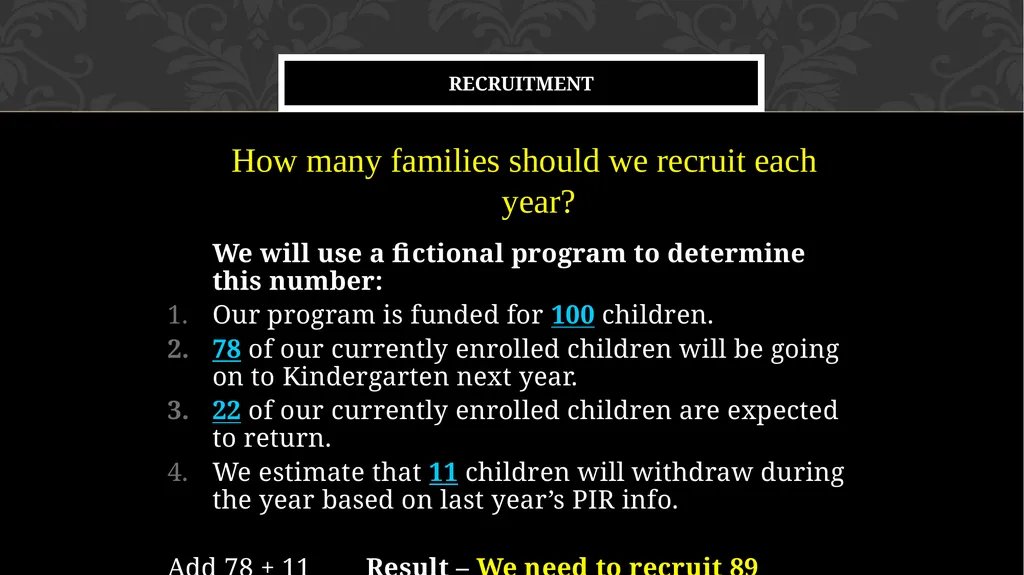
We will use a fictional program to determine this number:
Our program is funded for 100 children.
78 of our currently enrolled children will be going on to Kindergarten next year.
22 of our currently enrolled children are expected to return.
We estimate that 11 children will withdraw during the year based on last year’s PIR info.
Add 78 + 11 Result – We need to recruit 89 children How many families should we recruit each year? Recruitment<br>
Our program is funded for 100 children.
78 of our currently enrolled children will be going on to Kindergarten next year.
22 of our currently enrolled children are expected to return.
We estimate that 11 children will withdraw during the year based on last year’s PIR info.
Add 78 + 11 Result – We need to recruit 89 children How many families should we recruit each year? Recruitment<br>
106
Former parents who tell others about their own experience What is our best recruitment method? Recruitment<br>
107
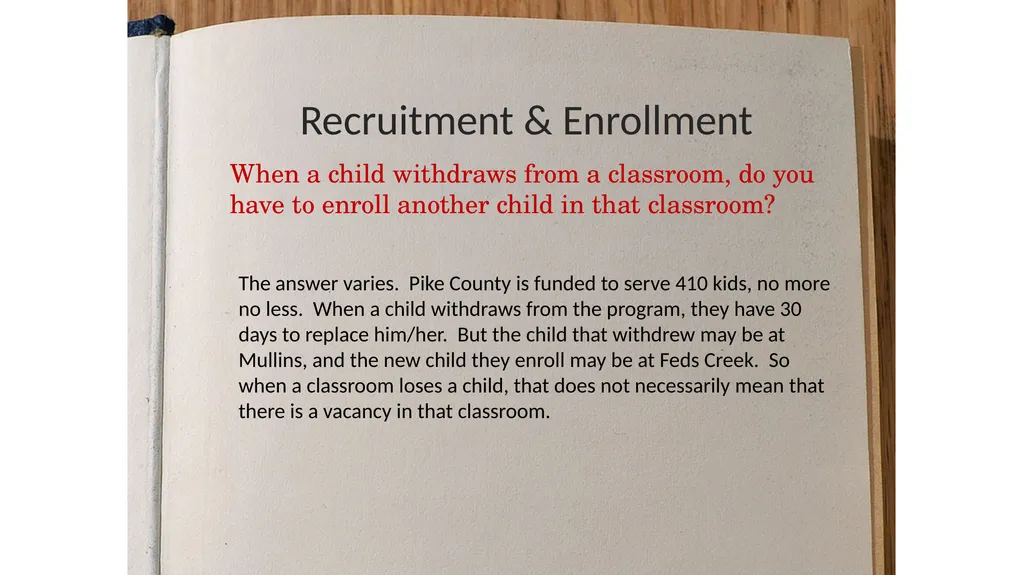
Recruitment & Enrollment When a child withdraws from a classroom, do you have to enroll another child in that classroom? The answer varies. Pike County is funded to serve 410 kids, no more no less. When a child withdraws from the program, they have 30 days to replace him/her. But the child that withdrew may be at Mullins, and the new child they enroll may be at Feds Creek. So when a classroom loses a child, that does not necessarily mean that there is a vacancy in that classroom.<br>
108
When should a child be counted in attendance?
Our policy is that if a child shows up in the classroom for any amount of time at any point in the school day, you will count that child in attendance.
If the parent takes the child offsite for some type of Head Start required service such as a dental exam, physical, etc., you will not count that child in attendance unless he makes an appearance in the classroom. 108 attendance<br>
Our policy is that if a child shows up in the classroom for any amount of time at any point in the school day, you will count that child in attendance.
If the parent takes the child offsite for some type of Head Start required service such as a dental exam, physical, etc., you will not count that child in attendance unless he makes an appearance in the classroom. 108 attendance<br>
109
Attendance If a child is UNEXPECTEDLY absent and the parent hasn’t contacted the staff within 1 hour, a staff person must contact the parent in a timely manner.
If a child has 2 consecutive UNEXPLAINED absences, the family advocate must make a home visit or direct contact with the family. The term "Unexplained " should be interpreted as: Not knowing why the child is absent due to not having contact with the parent.
A program must analyze child attendance data to identify children who have missed 10% or more of the scheduled days of school. Once identified, programs should develop strategies to improve attendance for those children including visiting the child’s home.
Classrooms must keep at least 85% child attendance each month. This is something that is frequently monitored at the grantee office.<br>
If a child has 2 consecutive UNEXPLAINED absences, the family advocate must make a home visit or direct contact with the family. The term "Unexplained " should be interpreted as: Not knowing why the child is absent due to not having contact with the parent.
A program must analyze child attendance data to identify children who have missed 10% or more of the scheduled days of school. Once identified, programs should develop strategies to improve attendance for those children including visiting the child’s home.
Classrooms must keep at least 85% child attendance each month. This is something that is frequently monitored at the grantee office.<br>
110
Additional topics<br>
111
Should the program list a child on COPA by the name that appears on their birth certificate or the name the family uses? The child’s LEGAL name must be listed on COPA as it appears on the birth certificate.<br>
112
In July, you accept a child for enrollment that has never enrolled before. He doesn’t show up on the first day of school. When you call mom, she says she changed her mind and he won’t be enrolling. She calls back two months later and says she wants him to be considered for enrollment again. Since it has been 30 days since he was supposed to enroll, do you have to do another application and EV form? No, because he never enrolled.<br>
113
Same scenario as before. However, this is a second year child that was enrolled at the end of the previous school year and he doesn’t show up on day one of the new year. Mom calls two months later and wants him considered for enrollment. Do you now need a new application and EV form? Yes. Since he was previously enrolled, you have to reverify everything if he crosses the 30 day threshold after the first day of school.<br>
114
Jack is enrolled in Head Start this year and will return next year. COPA shows that it is a "Two Parent" family. Mom and dad divorce. Mom comes to fill out an application for Jack's little brother next year. Mom says it's a "Single Parent" family now. Should the interviewer list it as a Single Parent family on COPA even though it will change the family data sheet and show that Jack is now in a Single Parent family and won't match his application? Yes, the information from the new application should be put on COPA. Jack’s “snapshot” will still have it recorded that he was in a two parent family when he was made eligible.<br>
115
Frequently Asked Questions A. Q. Which of the following CANNOT be used to verify child support? A written statement from the person receiving child support
A written statement from the person giving the child support
A court document
A letter from an attorney<br>
A written statement from the person giving the child support
A court document
A letter from an attorney<br>
116
Frequently Asked Questions A. Q. If a child has an IEP, they must automatically be accepted into the Head Start program. True
False
Depends on the disability<br>
False
Depends on the disability<br>
117
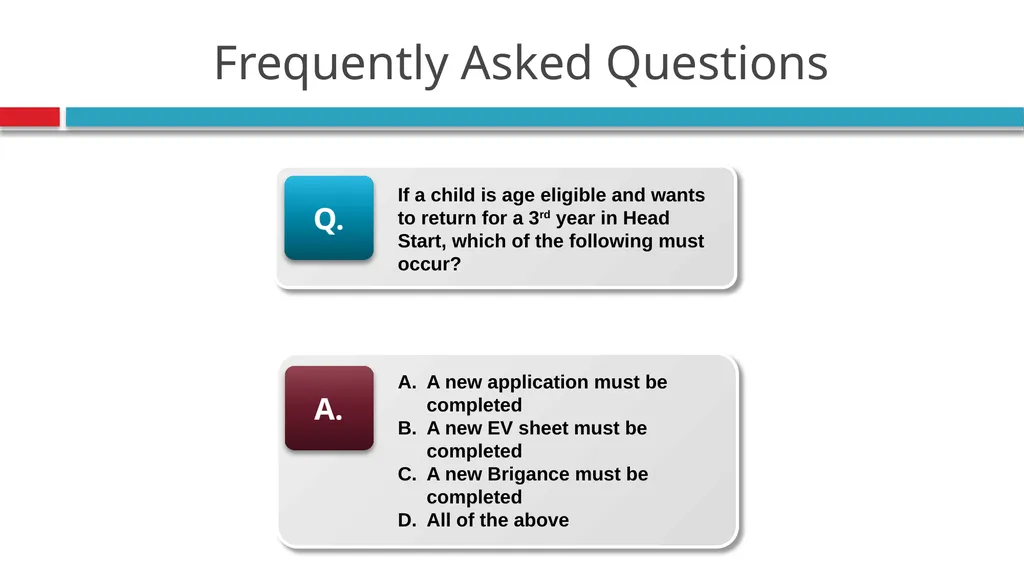
Frequently Asked Questions A. Q. If a child is age eligible and wants to return for a 3rd year in Head Start, which of the following must occur? A new application must be completed
A new EV sheet must be completed
A new Brigance must be completed
All of the above<br>
A new EV sheet must be completed
A new Brigance must be completed
All of the above<br>
118
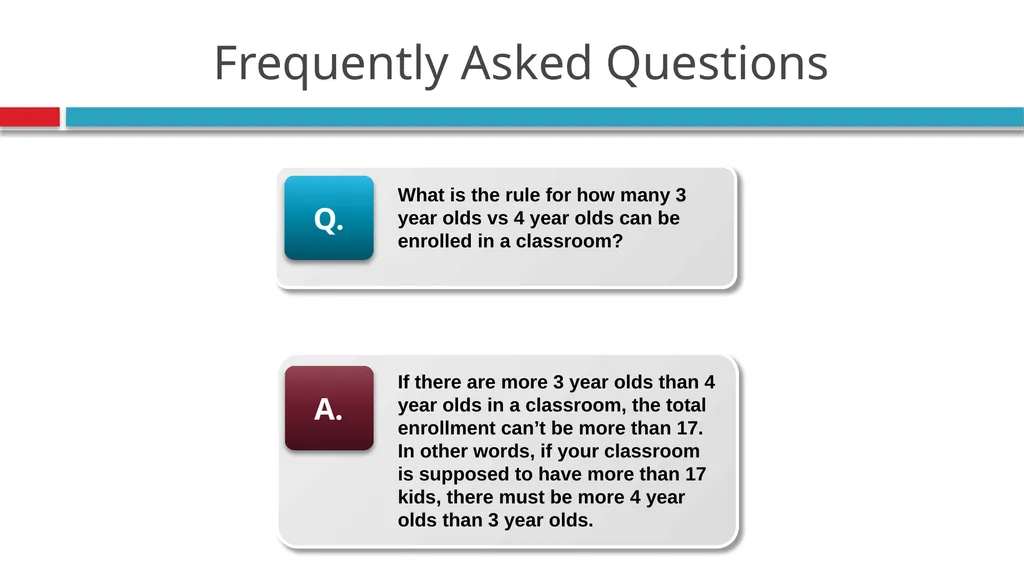
Frequently Asked Questions A. Q. What is the rule for how many 3 year olds vs 4 year olds can be enrolled in a classroom? If there are more 3 year olds than 4 year olds in a classroom, the total enrollment can’t be more than 17. In other words, if your classroom is supposed to have more than 17 kids, there must be more 4 year olds than 3 year olds.<br>
119
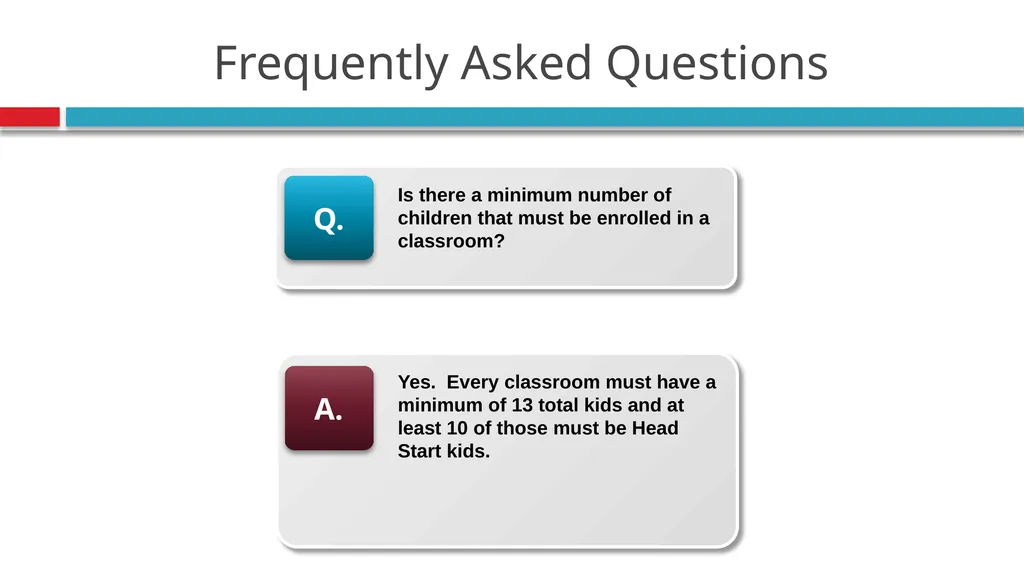
Frequently Asked Questions A. Q. Is there a minimum number of children that must be enrolled in a classroom? Yes. Every classroom must have a minimum of 13 total kids and at least 10 of those must be Head Start kids.<br>
120
Questions?<br>