
Essential Documents and Documentation: Best
MJ
Published · 33 slides · 0 views
1 / 1
Description
Essential Documents and Documentation: Best Practices According to ICH GCP E6 (R2) Derita Bran, BSN, RN, CCRC Objectives Identify documentation necessary to conduct quality clinical trials Understand Essential Documents and their
Related Topics
Share
Embed code
Download this presentation From Below
"Essential Documents and Documentation: Best" is the property of its rightful owner. Permission is granted to download and print the materials on this website for personal, non-commercial use only, and to display it on your personal computer provided you do not modify the materials and that you retain all copyright notices contained in the materials. By downloading content from our website, you accept the terms of this agreement.
Presentation Transcript
01
Essential Documents and Documentation:
Best Practices According to
ICH GCP E6 (R2) Derita Bran, BSN, RN, CCRC<br>
02
Objectives Identify documentation necessary to conduct quality clinical trials
Understand Essential Documents and their relationship to ICH GCP E6 (R2) guidance and requirements
Determine needed documentation & record keeping for your studies<br>
Understand Essential Documents and their relationship to ICH GCP E6 (R2) guidance and requirements
Determine needed documentation & record keeping for your studies<br>
03
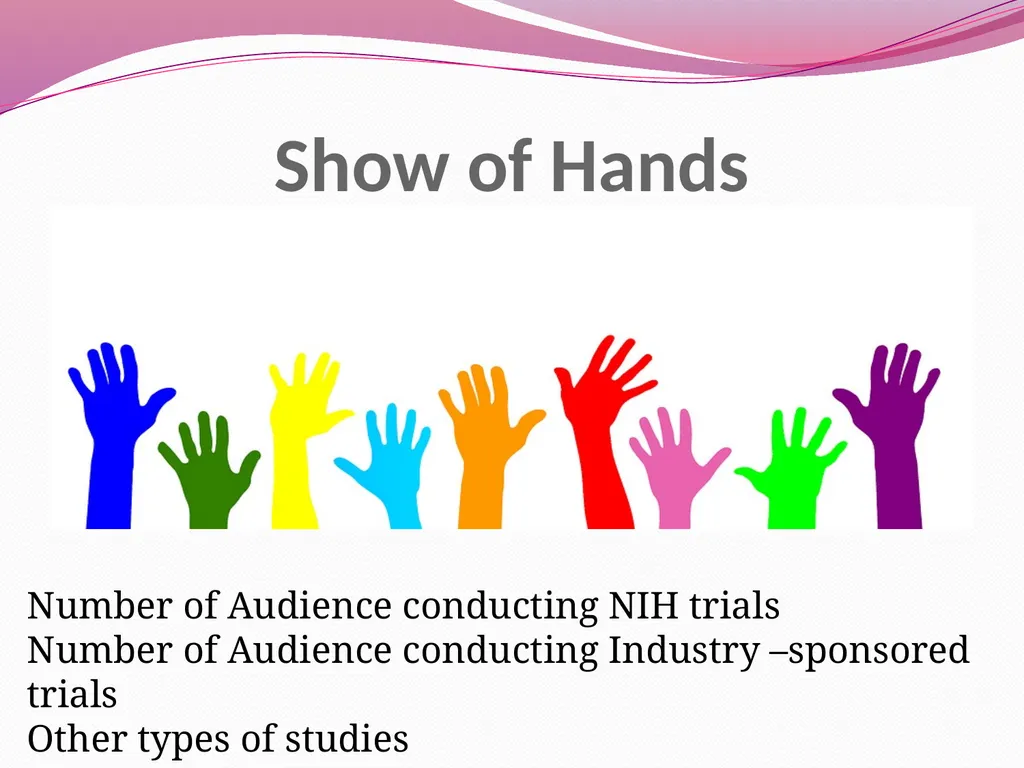
Show of Hands Number of Audience conducting NIH trials
Number of Audience conducting Industry –sponsored trials
Other types of studies<br>
Number of Audience conducting Industry –sponsored trials
Other types of studies<br>
04
ICH GCP E6 (R2) Good Clinical Practice (GCP) is an international ethical and scientific quality standard for designing, conducting, recording and reporting trials that involve the participation of human subjects.
Compliance with this standard provides public assurance that the rights, safety and well-being of trial subjects are protected, consistent with the principles that have their origin in the Declaration of Helsinki, and that the clinical trial data are credible.
This ICH GCP Guideline Integrated Addendum provides a unified standard for the European Union, Japan, the United States, Canada, and Switzerland to facilitate the mutual acceptance of data from clinical trials by the regulatory authorities in these jurisdictions.<br>
Compliance with this standard provides public assurance that the rights, safety and well-being of trial subjects are protected, consistent with the principles that have their origin in the Declaration of Helsinki, and that the clinical trial data are credible.
This ICH GCP Guideline Integrated Addendum provides a unified standard for the European Union, Japan, the United States, Canada, and Switzerland to facilitate the mutual acceptance of data from clinical trials by the regulatory authorities in these jurisdictions.<br>
05
Definition: Essential Documents According to ICH GCP E6 (R2) guidance:
Essential documents are documents which individually and collectively permit evaluation of the conduct of a study and the quality of the data produced. These documents serve to demonstrate the compliance of the investigator, sponsor, and monitor with the standards of GCP and with al applicable regulatory requirements<br>
Essential documents are documents which individually and collectively permit evaluation of the conduct of a study and the quality of the data produced. These documents serve to demonstrate the compliance of the investigator, sponsor, and monitor with the standards of GCP and with al applicable regulatory requirements<br>
06
Purpose of Study Documentation Verify that the subject’s rights and welfare are protected
Ensure integrity of the data
Show compliance with the protocol, regulations, guidance, policies, and procedures
This presentation will focus on the Essential Documents outline in
the ICH GCP E6 (R2) guidance, Sections 4.0 and 8.0<br>
Ensure integrity of the data
Show compliance with the protocol, regulations, guidance, policies, and procedures
This presentation will focus on the Essential Documents outline in
the ICH GCP E6 (R2) guidance, Sections 4.0 and 8.0<br>
07
Purpose of Essential Documents and Study Documentation Show compliance to the protocol/FDA regulation/ICH GCP guidance/SOPs, other regulatory requirements
Demonstrate the subject’s right, safety, and welfare was protected
Validate a scientific valid and ethical study
Document qualified personnel participated in the conduct of the clinical trial
Provide documents for adequate auditing and monitoring
Maintenance of current, complete, and accurate data collection<br>
Demonstrate the subject’s right, safety, and welfare was protected
Validate a scientific valid and ethical study
Document qualified personnel participated in the conduct of the clinical trial
Provide documents for adequate auditing and monitoring
Maintenance of current, complete, and accurate data collection<br>
08
Clinical Investigator Deficiencies Protocol deviations
Inadequate record keeping
Inadequate/Inaccurate source documentation
Inadequate IP accountability
Inadequate communication with the IRB
Inadequate subject protection<br>
Inadequate record keeping
Inadequate/Inaccurate source documentation
Inadequate IP accountability
Inadequate communication with the IRB
Inadequate subject protection<br>
09
Common Findings Related to Documentation/Essential Documents Eligibility criteria could not be confirmed
Discrepancies in records
Missing pages or information
AE/SAEs not captured/reported
Incorrect/incomplete documentation
Abnormal labs not assessed
Visits not documented
Phone calls not documented
Re-training not documented
ALCOA-C not followed<br>
Discrepancies in records
Missing pages or information
AE/SAEs not captured/reported
Incorrect/incomplete documentation
Abnormal labs not assessed
Visits not documented
Phone calls not documented
Re-training not documented
ALCOA-C not followed<br>
10
The QUALITY
of the
DOCUMENTATION/ESSENTIAL DOCUMENTS
CAN MAKE or
BREAK a STUDY<br>
of the
DOCUMENTATION/ESSENTIAL DOCUMENTS
CAN MAKE or
BREAK a STUDY<br>
11
End Results of Poor Documentation Shows lack of understanding of good documentation requirements
Lost confidence in site, lack of integrity and credibility
Affect the overall quality of data in question, resulting in the exclusion of data
Averse affect on subject safety
Wasted time of researchers and subjects if data can not be used
Could lead to an IRB/NIH/FDA/Sponsor/Institution audit<br>
Lost confidence in site, lack of integrity and credibility
Affect the overall quality of data in question, resulting in the exclusion of data
Averse affect on subject safety
Wasted time of researchers and subjects if data can not be used
Could lead to an IRB/NIH/FDA/Sponsor/Institution audit<br>
12
What to Document?
What to Maintain?<br>
13
Participation Activity We will take 5-10 minutes for groups to read their assigned section of the ICH GCP E6 (R2) guidance
Each group will identify the needed essential documents/documentation to show compliance with this section of the ICH GCPs
Discussion to follow<br>
Each group will identify the needed essential documents/documentation to show compliance with this section of the ICH GCPs
Discussion to follow<br>
14
ICH GCP E6 (R2): Section 4 4.1.1
Study Team credentials
Up-to-Date CV/Resume (every 3 years is industry standard)
License/certifications
Training logs/documents
4.1.2
Training log/documents
4.1.3
Training log/documents/CITI
4.1.4
Monitoring/Auditing log
Reports
4.1.5
Delegation of Responsibilities form (DOR)<br>
Study Team credentials
Up-to-Date CV/Resume (every 3 years is industry standard)
License/certifications
Training logs/documents
4.1.2
Training log/documents
4.1.3
Training log/documents/CITI
4.1.4
Monitoring/Auditing log
Reports
4.1.5
Delegation of Responsibilities form (DOR)<br>
15
ICH GCP E6 (R2): Section 4 4.2.1
Feasibility study
Database query
EDW query
Research Match query
4.2.2
Feasibility
CV/# of studies
4.2.3
Study team credentials
Site questionnaire<br>
Feasibility study
Database query
EDW query
Research Match query
4.2.2
Feasibility
CV/# of studies
4.2.3
Study team credentials
Site questionnaire<br>
16
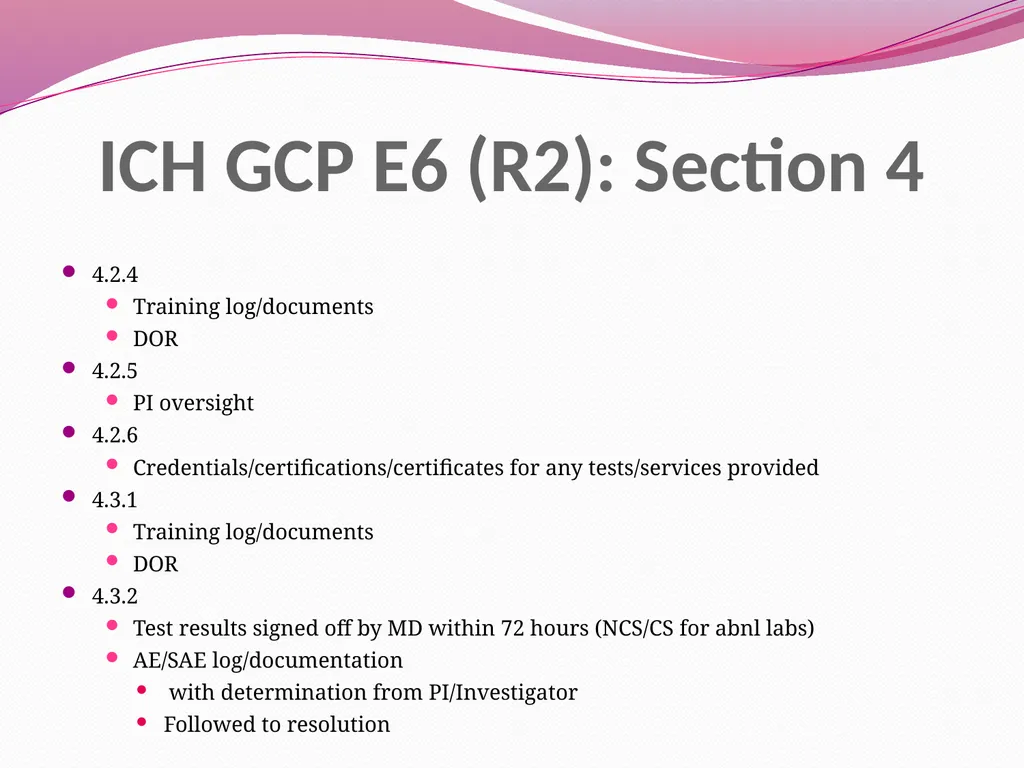
ICH GCP E6 (R2): Section 4 4.2.4
Training log/documents
DOR
4.2.5
PI oversight
4.2.6
Credentials/certifications/certificates for any tests/services provided
4.3.1
Training log/documents
DOR
4.3.2
Test results signed off by MD within 72 hours (NCS/CS for abnl labs)
AE/SAE log/documentation
with determination from PI/Investigator
Followed to resolution<br>
Training log/documents
DOR
4.2.5
PI oversight
4.2.6
Credentials/certifications/certificates for any tests/services provided
4.3.1
Training log/documents
DOR
4.3.2
Test results signed off by MD within 72 hours (NCS/CS for abnl labs)
AE/SAE log/documentation
with determination from PI/Investigator
Followed to resolution<br>
17
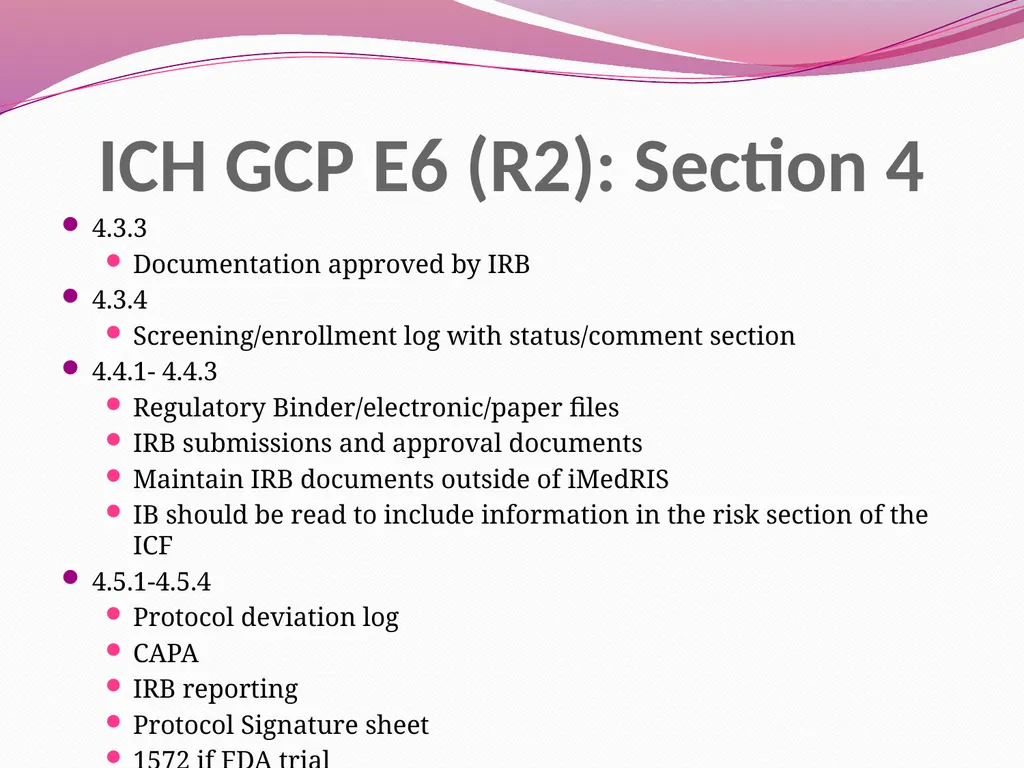
ICH GCP E6 (R2): Section 4 4.3.3
Documentation approved by IRB
4.3.4
Screening/enrollment log with status/comment section
4.4.1- 4.4.3
Regulatory Binder/electronic/paper files
IRB submissions and approval documents
Maintain IRB documents outside of iMedRIS
IB should be read to include information in the risk section of the ICF
4.5.1-4.5.4
Protocol deviation log
CAPA
IRB reporting
Protocol Signature sheet
1572 if FDA trial<br>
Documentation approved by IRB
4.3.4
Screening/enrollment log with status/comment section
4.4.1- 4.4.3
Regulatory Binder/electronic/paper files
IRB submissions and approval documents
Maintain IRB documents outside of iMedRIS
IB should be read to include information in the risk section of the ICF
4.5.1-4.5.4
Protocol deviation log
CAPA
IRB reporting
Protocol Signature sheet
1572 if FDA trial<br>
18
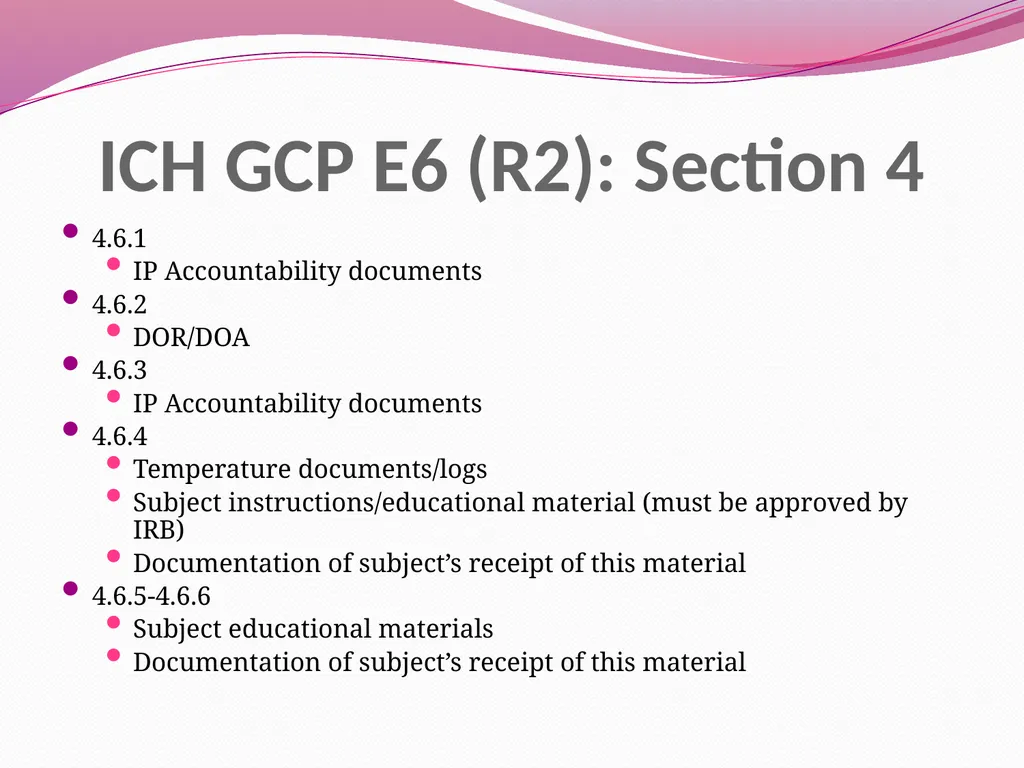
ICH GCP E6 (R2): Section 4 4.6.1
IP Accountability documents
4.6.2
DOR/DOA
4.6.3
IP Accountability documents
4.6.4
Temperature documents/logs
Subject instructions/educational material (must be approved by IRB)
Documentation of subject’s receipt of this material
4.6.5-4.6.6
Subject educational materials
Documentation of subject’s receipt of this material<br>
IP Accountability documents
4.6.2
DOR/DOA
4.6.3
IP Accountability documents
4.6.4
Temperature documents/logs
Subject instructions/educational material (must be approved by IRB)
Documentation of subject’s receipt of this material
4.6.5-4.6.6
Subject educational materials
Documentation of subject’s receipt of this material<br>
19
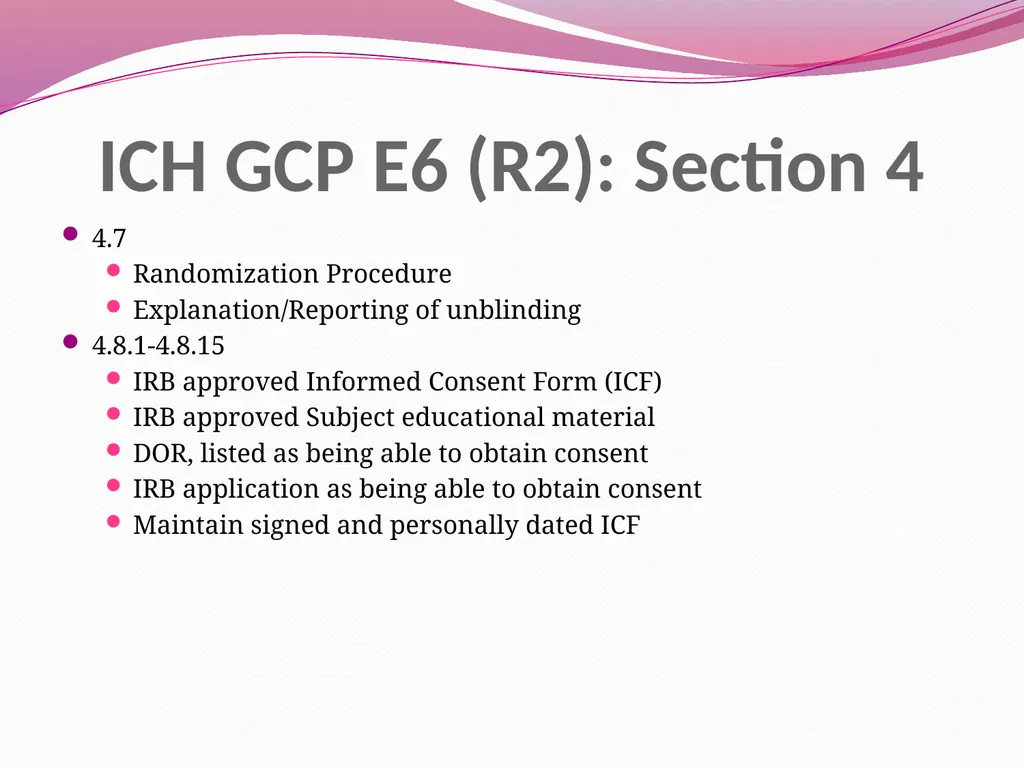
ICH GCP E6 (R2): Section 4 4.7
Randomization Procedure
Explanation/Reporting of unblinding
4.8.1-4.8.15
IRB approved Informed Consent Form (ICF)
IRB approved Subject educational material
DOR, listed as being able to obtain consent
IRB application as being able to obtain consent
Maintain signed and personally dated ICF<br>
Randomization Procedure
Explanation/Reporting of unblinding
4.8.1-4.8.15
IRB approved Informed Consent Form (ICF)
IRB approved Subject educational material
DOR, listed as being able to obtain consent
IRB application as being able to obtain consent
Maintain signed and personally dated ICF<br>
20
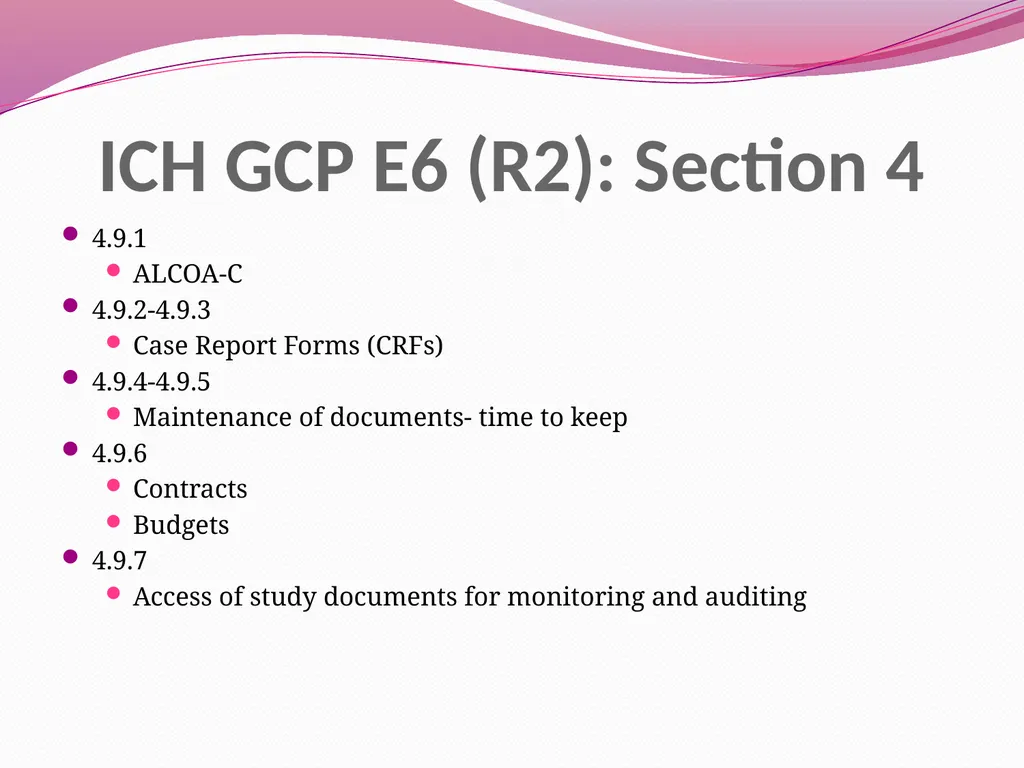
ICH GCP E6 (R2): Section 4 4.9.1
ALCOA-C
4.9.2-4.9.3
Case Report Forms (CRFs)
4.9.4-4.9.5
Maintenance of documents- time to keep
4.9.6
Contracts
Budgets
4.9.7
Access of study documents for monitoring and auditing<br>
ALCOA-C
4.9.2-4.9.3
Case Report Forms (CRFs)
4.9.4-4.9.5
Maintenance of documents- time to keep
4.9.6
Contracts
Budgets
4.9.7
Access of study documents for monitoring and auditing<br>
21
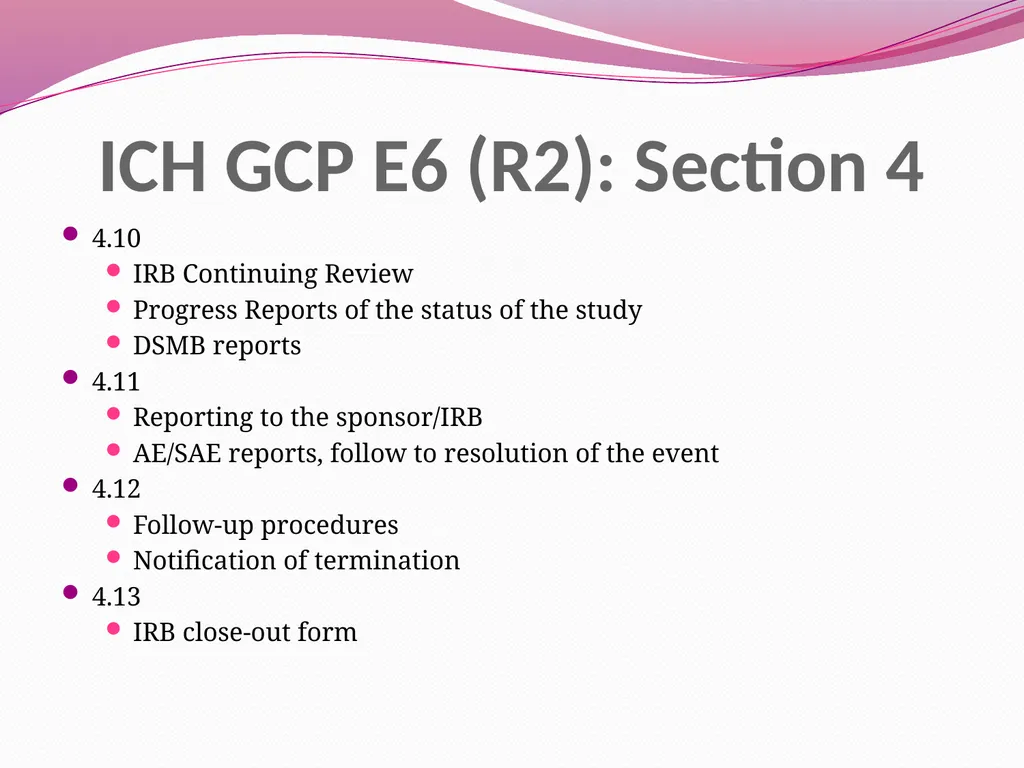
ICH GCP E6 (R2): Section 4 4.10
IRB Continuing Review
Progress Reports of the status of the study
DSMB reports
4.11
Reporting to the sponsor/IRB
AE/SAE reports, follow to resolution of the event
4.12
Follow-up procedures
Notification of termination
4.13
IRB close-out form<br>
IRB Continuing Review
Progress Reports of the status of the study
DSMB reports
4.11
Reporting to the sponsor/IRB
AE/SAE reports, follow to resolution of the event
4.12
Follow-up procedures
Notification of termination
4.13
IRB close-out form<br>
22
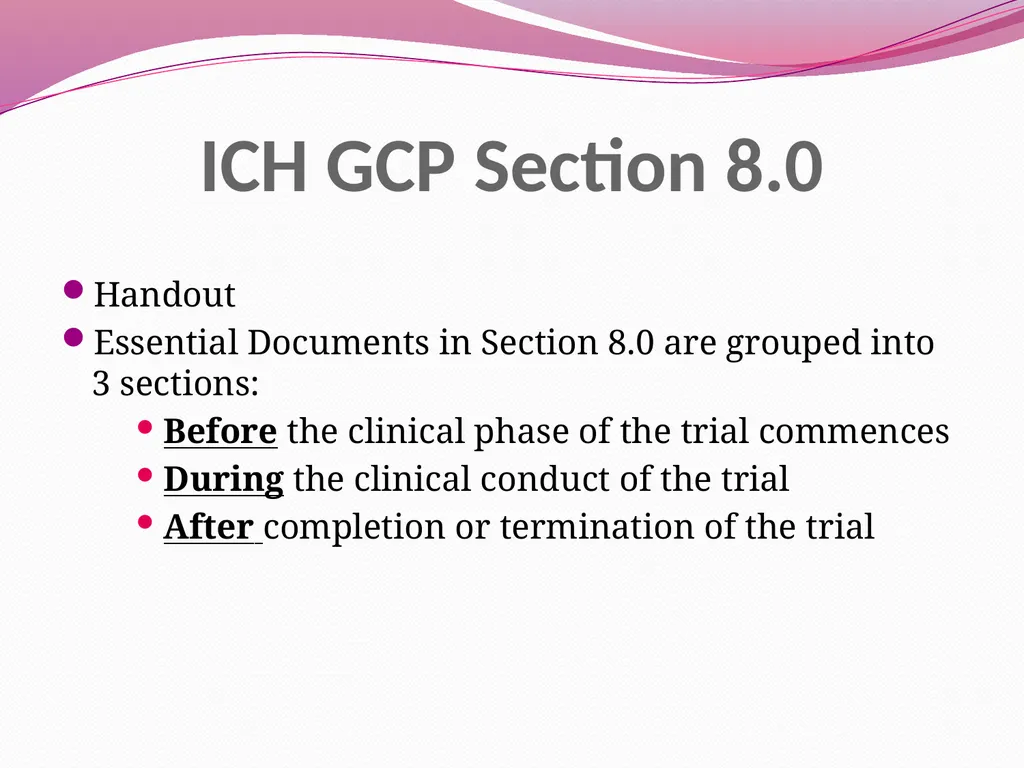
ICH GCP Section 8.0 Handout
Essential Documents in Section 8.0 are grouped into 3 sections:
Before the clinical phase of the trial commences
During the clinical conduct of the trial
After completion or termination of the trial<br>
Essential Documents in Section 8.0 are grouped into 3 sections:
Before the clinical phase of the trial commences
During the clinical conduct of the trial
After completion or termination of the trial<br>
23
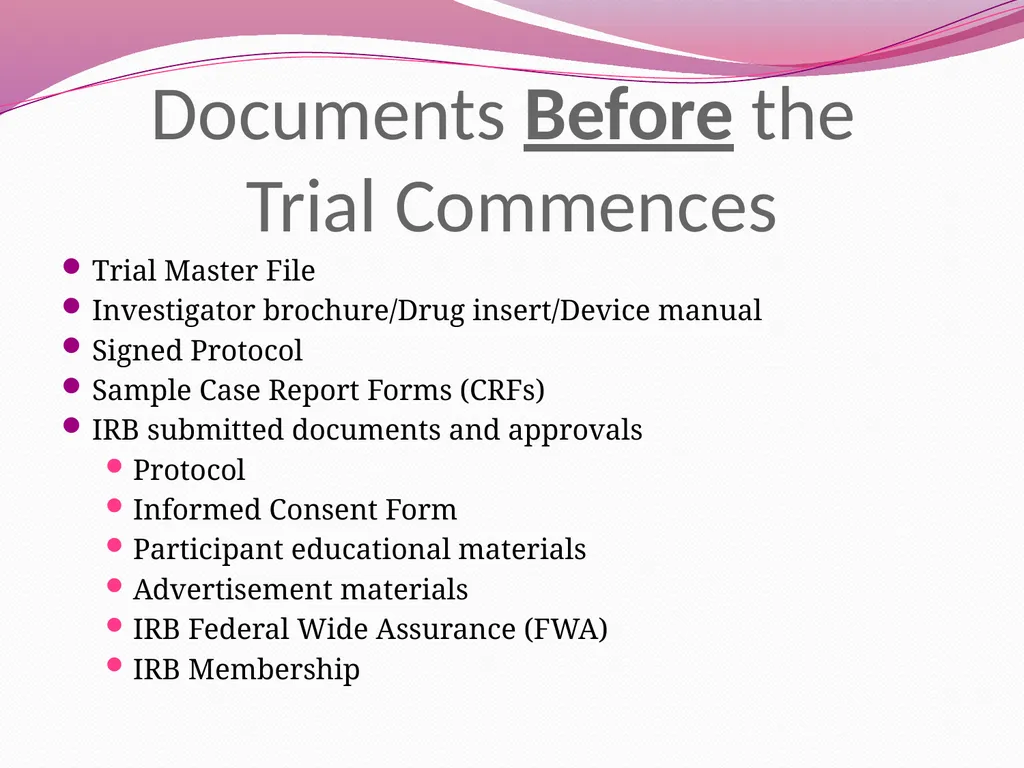
Documents Before the
Trial Commences Trial Master File
Investigator brochure/Drug insert/Device manual
Signed Protocol
Sample Case Report Forms (CRFs)
IRB submitted documents and approvals
Protocol
Informed Consent Form
Participant educational materials
Advertisement materials
IRB Federal Wide Assurance (FWA)
IRB Membership<br>
Investigator brochure/Drug insert/Device manual
Signed Protocol
Sample Case Report Forms (CRFs)
IRB submitted documents and approvals
Protocol
Informed Consent Form
Participant educational materials
Advertisement materials
IRB Federal Wide Assurance (FWA)
IRB Membership<br>
24
Documents Before the
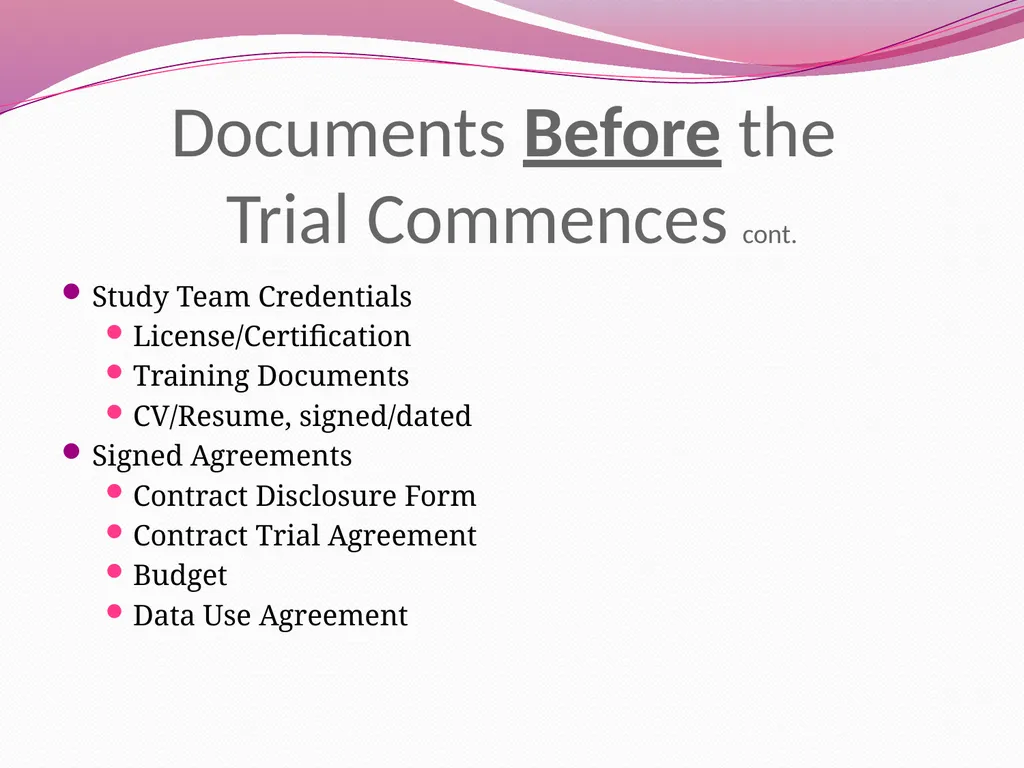
Trial Commences cont. Study Team Credentials
License/Certification
Training Documents
CV/Resume, signed/dated
Signed Agreements
Contract Disclosure Form
Contract Trial Agreement
Budget
Data Use Agreement<br>
License/Certification
Training Documents
CV/Resume, signed/dated
Signed Agreements
Contract Disclosure Form
Contract Trial Agreement
Budget
Data Use Agreement<br>
25
Documents Before the
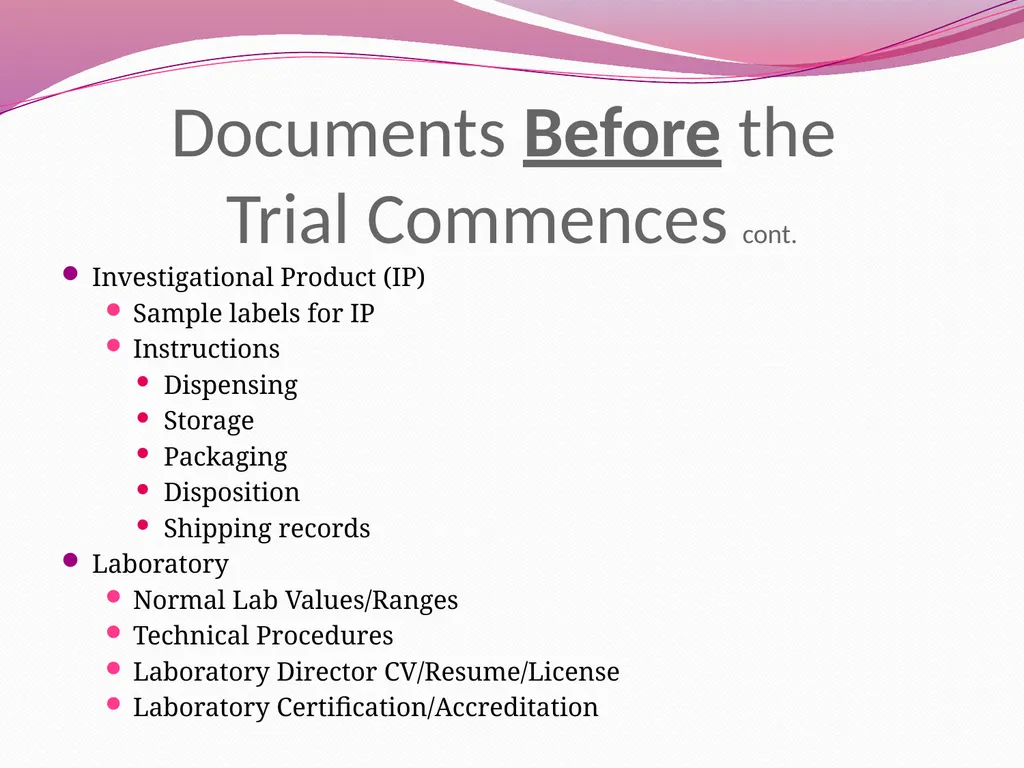
Trial Commences cont. Investigational Product (IP)
Sample labels for IP
Instructions
Dispensing
Storage
Packaging
Disposition
Shipping records
Laboratory
Normal Lab Values/Ranges
Technical Procedures
Laboratory Director CV/Resume/License
Laboratory Certification/Accreditation<br>
Sample labels for IP
Instructions
Dispensing
Storage
Packaging
Disposition
Shipping records
Laboratory
Normal Lab Values/Ranges
Technical Procedures
Laboratory Director CV/Resume/License
Laboratory Certification/Accreditation<br>
26
Documents Before the
Trial Commences cont. Participant List
Decoding Procedures for blinded trials
Sponsor Visits<br>
Decoding Procedures for blinded trials
Sponsor Visits<br>
27
Documents During the
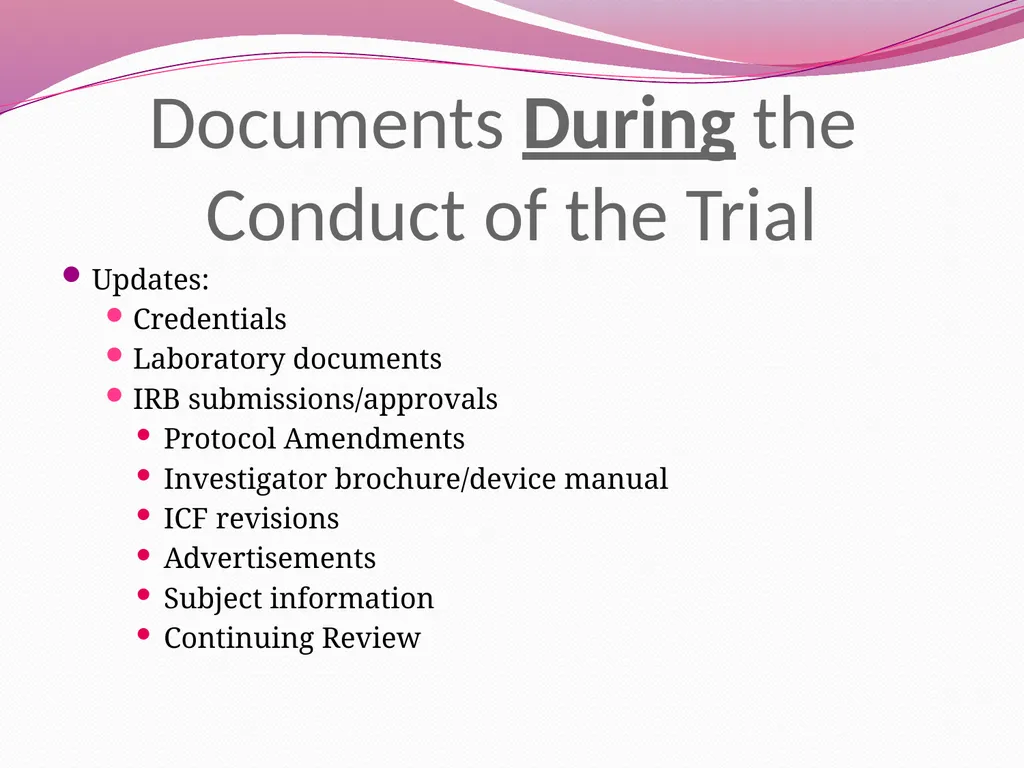
Conduct of the Trial Updates:
Credentials
Laboratory documents
IRB submissions/approvals
Protocol Amendments
Investigator brochure/device manual
ICF revisions
Advertisements
Subject information
Continuing Review<br>
Credentials
Laboratory documents
IRB submissions/approvals
Protocol Amendments
Investigator brochure/device manual
ICF revisions
Advertisements
Subject information
Continuing Review<br>
28
Documents During the
Conduct of the Trial cont. IP Accountability
Signed Informed Consent Forms
Completed CRFs
Documentation of CRF corrections
Monitoring Visits and Reports
Source Documentation to document compliance
Protocol
Regulations and Guidance
Standard operating Procedures
Relevant Communications
Letters
Meeting Notes
Phone calls<br>
Signed Informed Consent Forms
Completed CRFs
Documentation of CRF corrections
Monitoring Visits and Reports
Source Documentation to document compliance
Protocol
Regulations and Guidance
Standard operating Procedures
Relevant Communications
Letters
Meeting Notes
Phone calls<br>
29
Documents During the
Conduct of the Trial cont. Signature Sheet
Record of retained body fluids/tissue samples
Subject logs
Screening log
Identification code list (master log)
Enrollment log
Adverse Events
Evaluation
Resolution
Reporting<br>
Record of retained body fluids/tissue samples
Subject logs
Screening log
Identification code list (master log)
Enrollment log
Adverse Events
Evaluation
Resolution
Reporting<br>
30
Documents After Completion
the Trial IP Accountability
Completed master log
Audit Certificate
Final close-out monitoring report
IRB close-out form<br>
Completed master log
Audit Certificate
Final close-out monitoring report
IRB close-out form<br>
31
Best Practices GET ORGANIZED
Create process for maintenance of the Essential documents (Reg binder, etc.)
List of tasks to complete
Checklists/Logs
Don’t procrastinate
Keep up to date/keep audit ready
Prompt reporting
“Real time” documenting
ALCOA-C<br>
Create process for maintenance of the Essential documents (Reg binder, etc.)
List of tasks to complete
Checklists/Logs
Don’t procrastinate
Keep up to date/keep audit ready
Prompt reporting
“Real time” documenting
ALCOA-C<br>
32
Good Documentation Practice What is not documented---Was not done!
Document what was done AND what was not done
Include reason for any missed information
Use black or dark blue ink
Do not back or future date and entries
Create and maintain documents
Assure documentation is ALCOA-C compliant
SLIDE rule for errors
Be thorough and timely when documenting
Perform quality checks
Be Proactive when finding errors or omissions<br>
Document what was done AND what was not done
Include reason for any missed information
Use black or dark blue ink
Do not back or future date and entries
Create and maintain documents
Assure documentation is ALCOA-C compliant
SLIDE rule for errors
Be thorough and timely when documenting
Perform quality checks
Be Proactive when finding errors or omissions<br>
33
How Can Documentation/Essential Documents be Improved? Creation of site source documents per protocol
Adequate training per protocol
Delegation of this duty regarding adequate documentation
Follow ALCOA-C
Monitoring for accurate and complete documentation by study staff
Commitment to best documentation practices
Oversight/Internal QA process
Seek resources to increase knowledge
Make sure the documentation tells the entire story<br>
Adequate training per protocol
Delegation of this duty regarding adequate documentation
Follow ALCOA-C
Monitoring for accurate and complete documentation by study staff
Commitment to best documentation practices
Oversight/Internal QA process
Seek resources to increase knowledge
Make sure the documentation tells the entire story<br>