
Essential Environment: The Science Behind the
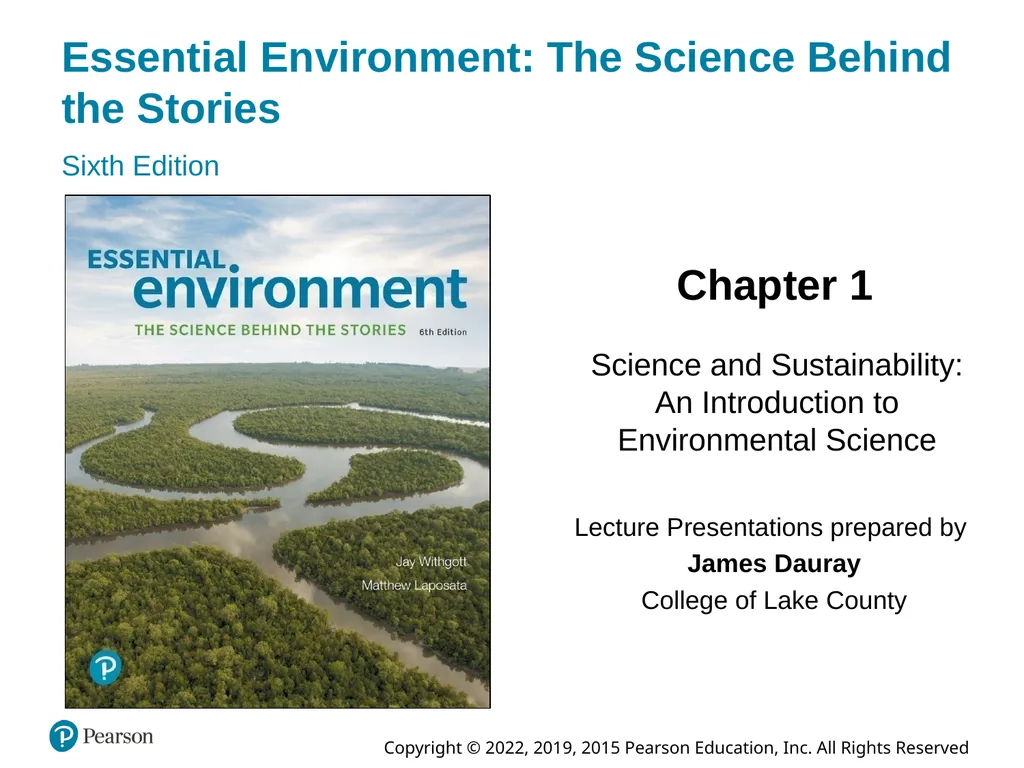
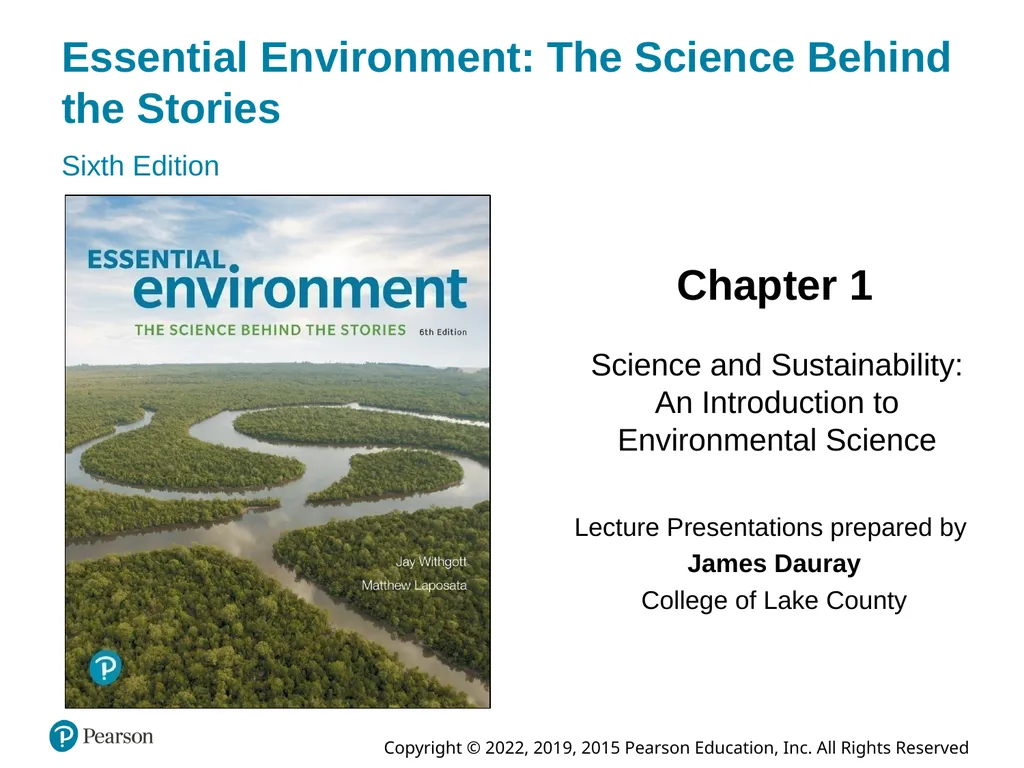

Description: Essential Environment: The Science Behind the Stories Sixth Edition Chapter 1 Science and Sustainability: An Introduction to Environmental Science Lecture Presentations prepared by James Dauray College of Lake County Copyright 2022, 2019,
Related Topics
Download Presentation
"Essential Environment: The Science Behind the" is the property of its rightful owner. Permission is granted to download and print the materials on this website for personal, non-commercial use only, and to display it on your personal computer provided you do not modify the materials and that you retain all copyright notices contained in the materials. By downloading content from our website, you accept the terms of this agreement.
Presentation Transcript
slide1. Essential Environment: The Science Behind the Stories Sixth Edition Chapter 1 Science and Sustainability: An Introduction to Environmental Science Lecture Presentations prepared by
James Dauray
College of Lake County Copyright © 2022, 2019, 2015 Pearson Education, Inc. All Rights Reserved<br>
slide2. This Lecture Will Help You Understand The field of environmental science
The importance of natural resources and ecosystem services
Population growth, resource consumption, and their consequences
An ecological footprint
The scientific method
Environmental ethics
Global environmental pressures
Concepts of sustainability and sustainable development<br>
slide3. Our Island, Earth The environment consists of all the living and nonliving things around us.
This includes continents, oceans, clouds, and ice caps that are visible from space as well as the animals, plants, and landscapes immediately around us.
Environmental science is the study of how the natural world works, how the environment affects us, and how we affect it.<br>
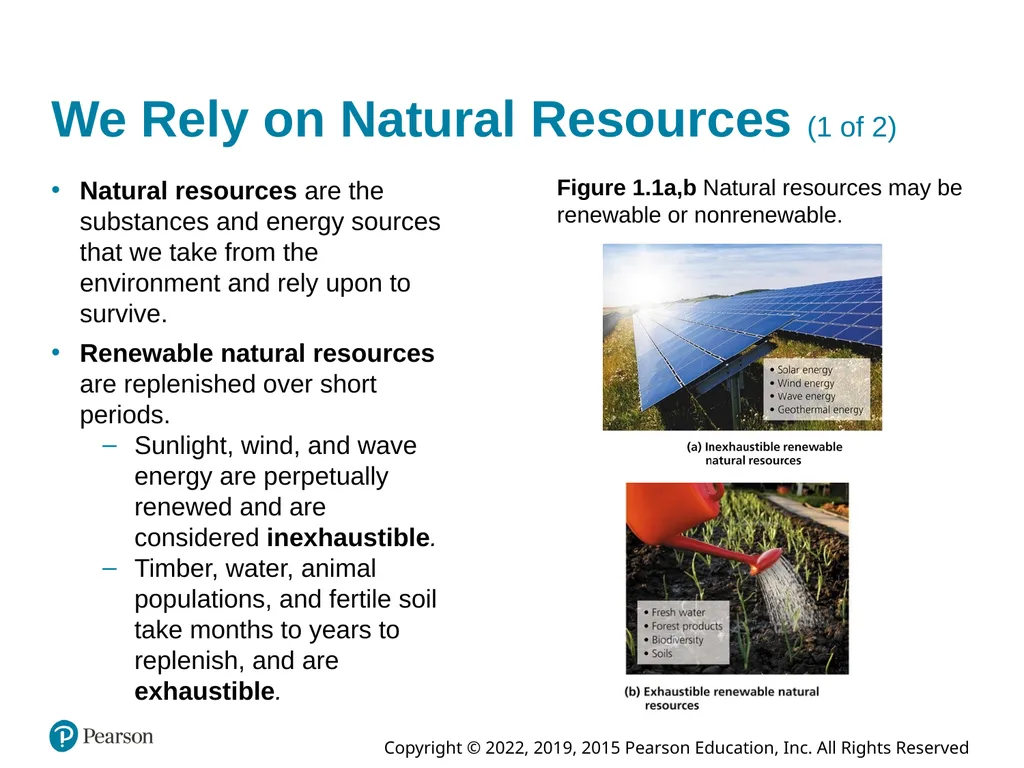
slide4. We Rely on Natural Resources (1 of 2) Natural resources are the substances and energy sources that we take from the environment and rely upon to survive.
Renewable natural resources are replenished over short periods.
Sunlight, wind, and wave energy are perpetually renewed and are considered inexhaustible.
Timber, water, animal populations, and fertile soil take months to years to replenish, and are exhaustible. Figure 1.1a,b Natural resources may be renewable or nonrenewable.<br>
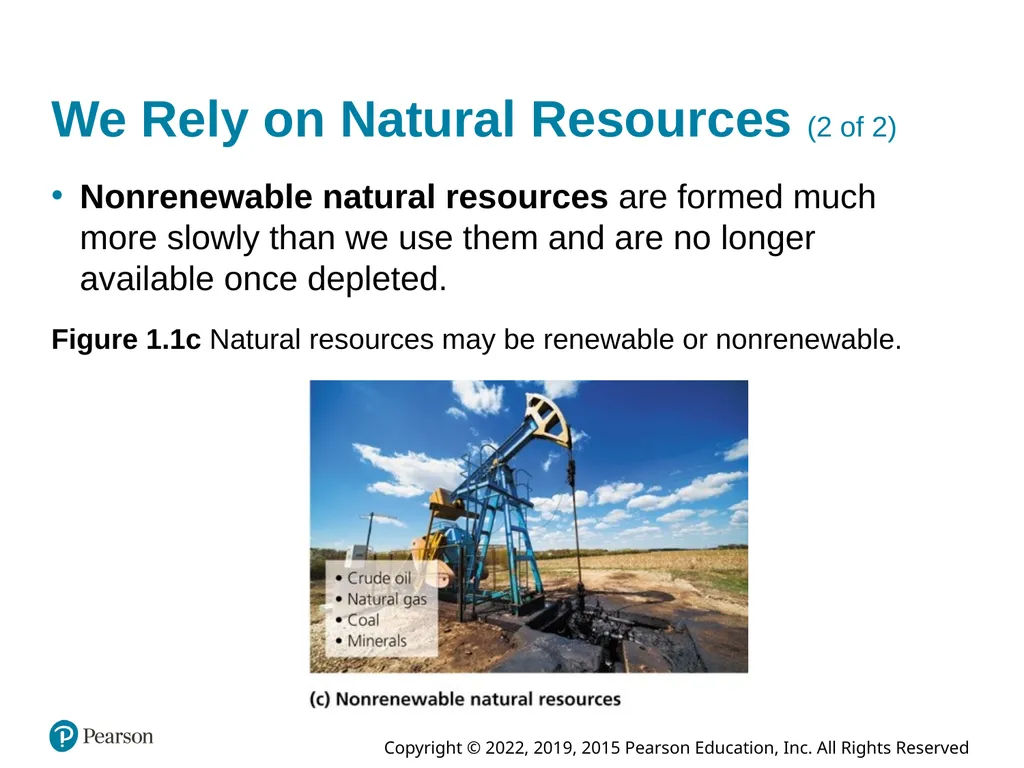
slide5. We Rely on Natural Resources (2 of 2) Nonrenewable natural resources are formed much more slowly than we use them and are no longer available once depleted. Figure 1.1c Natural resources may be renewable or nonrenewable.<br>
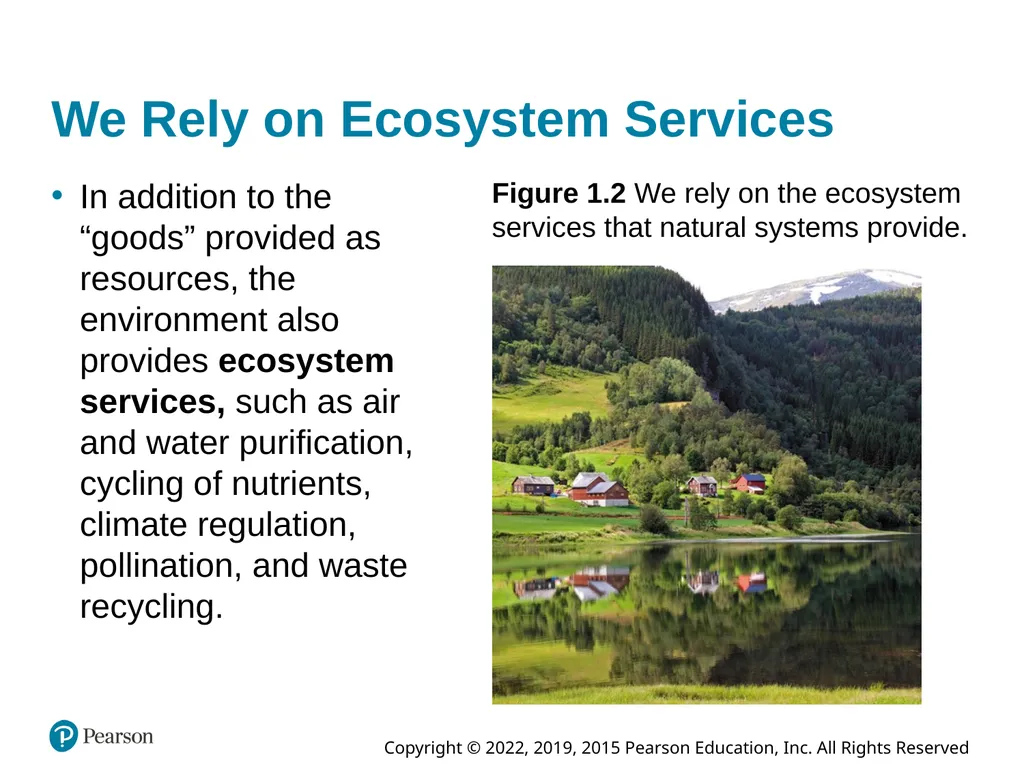
slide6. We Rely on Ecosystem Services In addition to the “goods” provided as resources, the environment also provides ecosystem services, such as air and water purification, cycling of nutrients, climate regulation, pollination, and waste recycling. Figure 1.2 We rely on the ecosystem services that natural systems provide.<br>
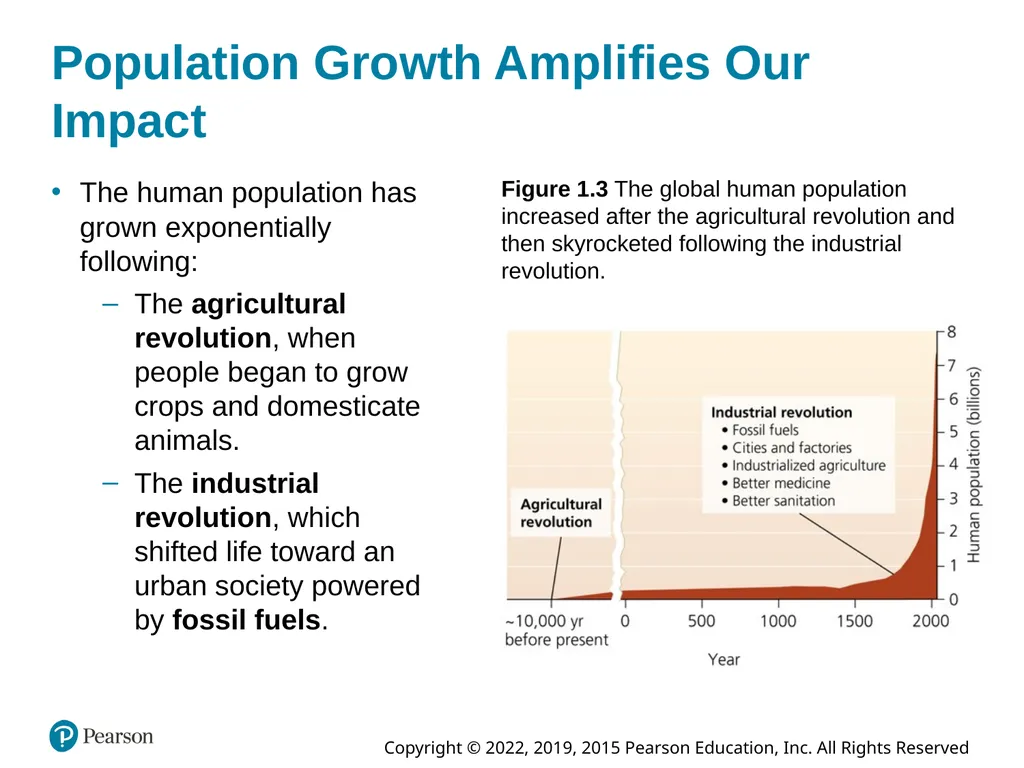
slide7. Population Growth Amplifies Our Impact The human population has grown exponentially following:
The agricultural revolution, when people began to grow crops and domesticate animals.
The industrial revolution, which shifted life toward an urban society powered by fossil fuels. Figure 1.3 The global human population increased after the agricultural revolution and then skyrocketed following the industrial revolution.<br>
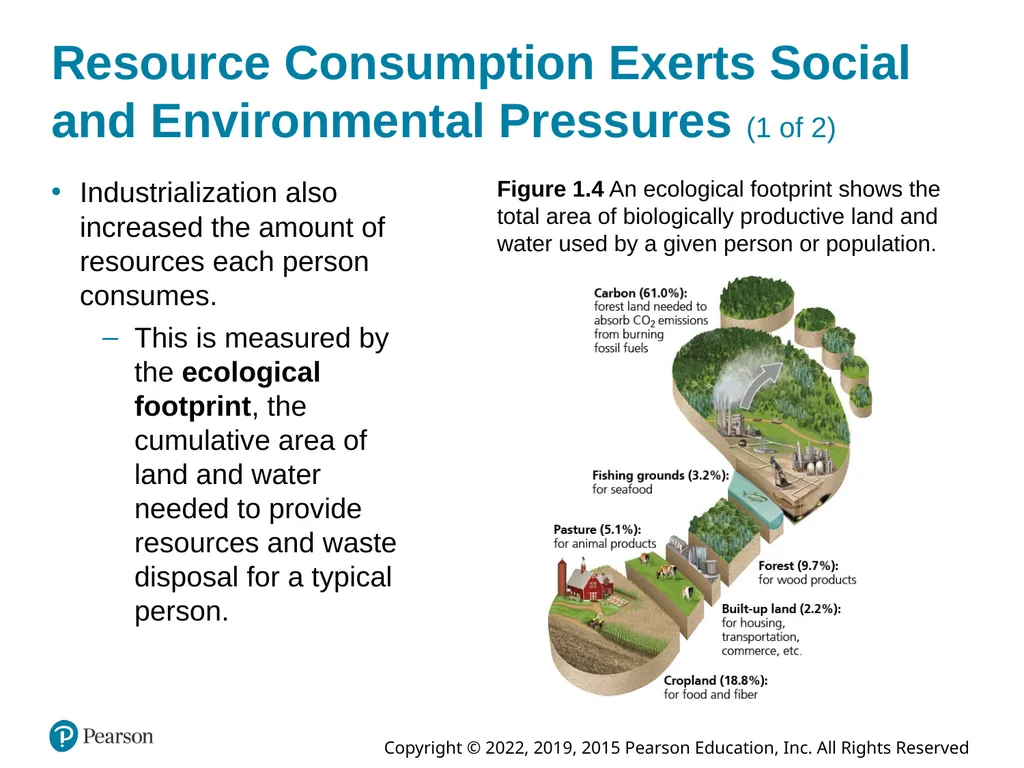
slide8. Resource Consumption Exerts Social and Environmental Pressures (1 of 2) Industrialization also increased the amount of resources each person consumes.
This is measured by the ecological footprint, the cumulative area of land and water needed to provide resources and waste disposal for a typical person. Figure 1.4 An ecological footprint shows the total area of biologically productive land and water used by a given person or population.<br>
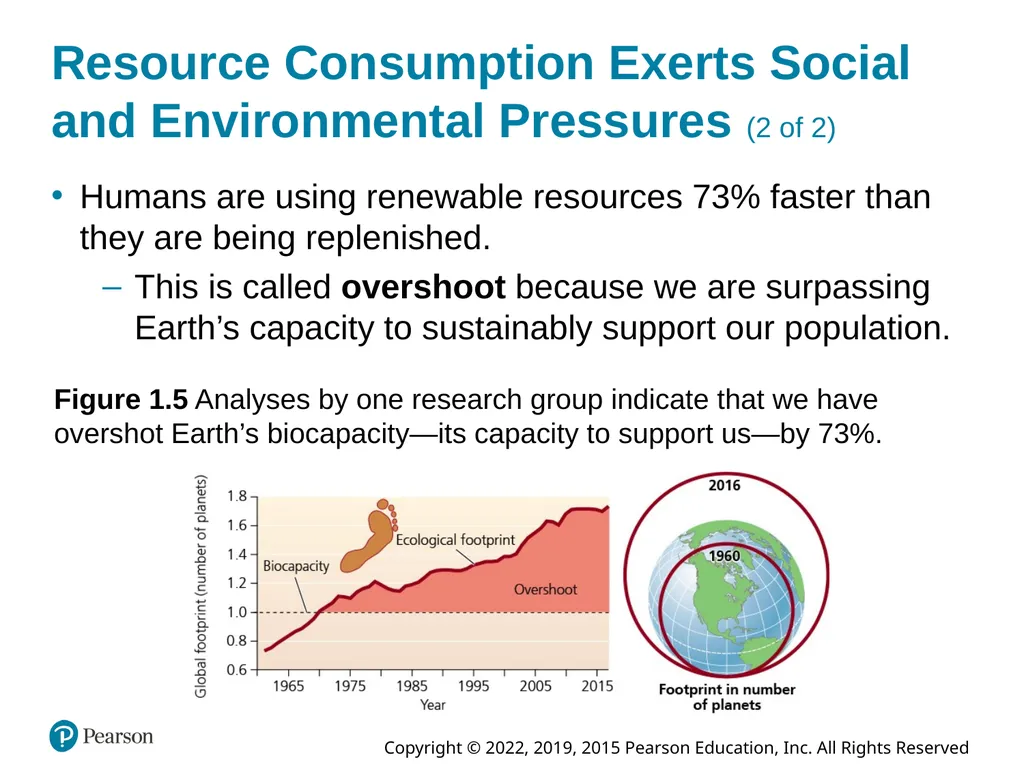
slide9. Resource Consumption Exerts Social and Environmental Pressures (2 of 2) Humans are using renewable resources 73% faster than they are being replenished.
This is called overshoot because we are surpassing Earth’s capacity to sustainably support our population. Figure 1.5 Analyses by one research group indicate that we have overshot Earth’s biocapacity—its capacity to support us—by 73%.<br>
slide10. Conserving Natural Capital Is Like Maintaining a Bank Account The Earth’s natural capital, its store of resources and ecosystem services, is like a bank account.
If you leave the principal intact and only spend the interest, the account remains full.
If you deplete the principal, the account will be drawn down until it is exhausted.
Currently, we are drawing down Earth’s natural capital, a practice that is unsustainable.<br>
slide11. Environmental Science Can Help Us Learn From the Past Historians have inferred that environmental degradation has contributed to the collapse of the Greek and Roman empires, the Angkor civilization of Southeast Asia, Easter Island, and many other civilizations of the Americas and Middle East.
Today’s society is globalized, meaning a similar collapse would affect the entire world.<br>
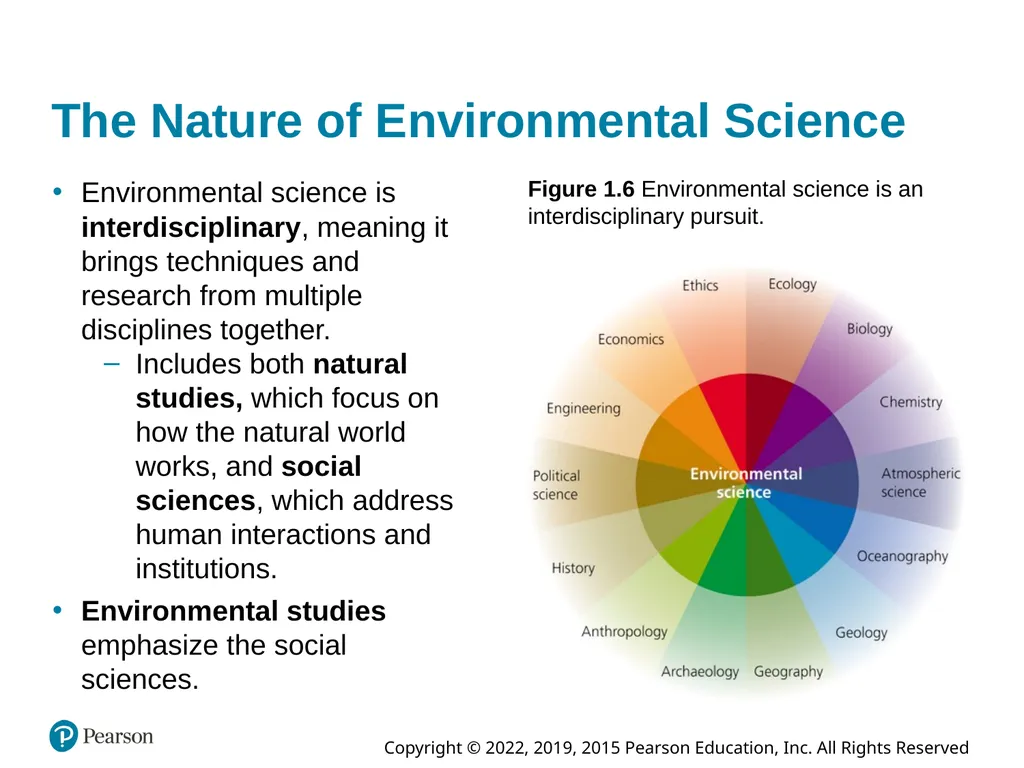
slide12. The Nature of Environmental Science Environmental science is interdisciplinary, meaning it brings techniques and research from multiple disciplines together.
Includes both natural studies, which focus on how the natural world works, and social sciences, which address human interactions and institutions.
Environmental studies emphasize the social sciences. Figure 1.6 Environmental science is an interdisciplinary pursuit.<br>
slide13. Environmental Science Is Not the Same as Environmentalism Environmental science involves the scientific study of the environment and our interactions with it.
Environmentalism is a social movement dedicated to protecting the natural world from undesirable changes brought on by human actions.<br>
slide14. The Nature of Science Science is a systematic process for learning about the world and testing our understanding about it.
Science may also refer to the accumulated body of knowledge that arises from observing, questioning, testing, and discovery.
Descriptive science involves researching organisms, materials, and systems that are new or not well-known.
Hypothesis-driven science uses experiments to test hypotheses as part of the scientific method.<br>
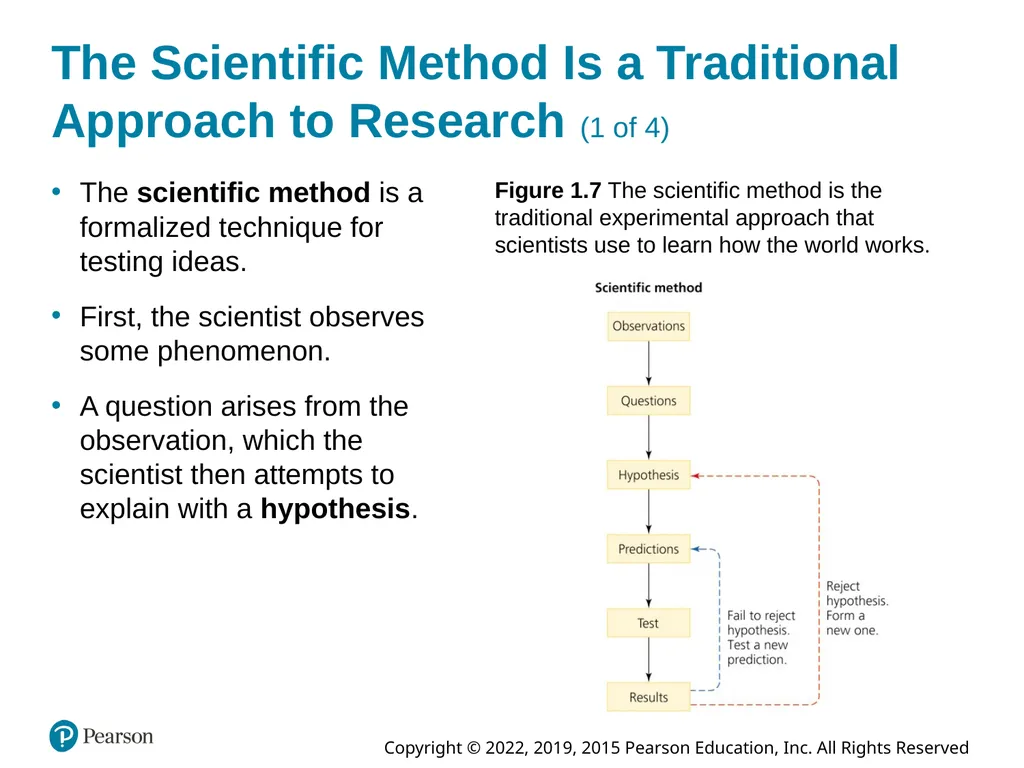
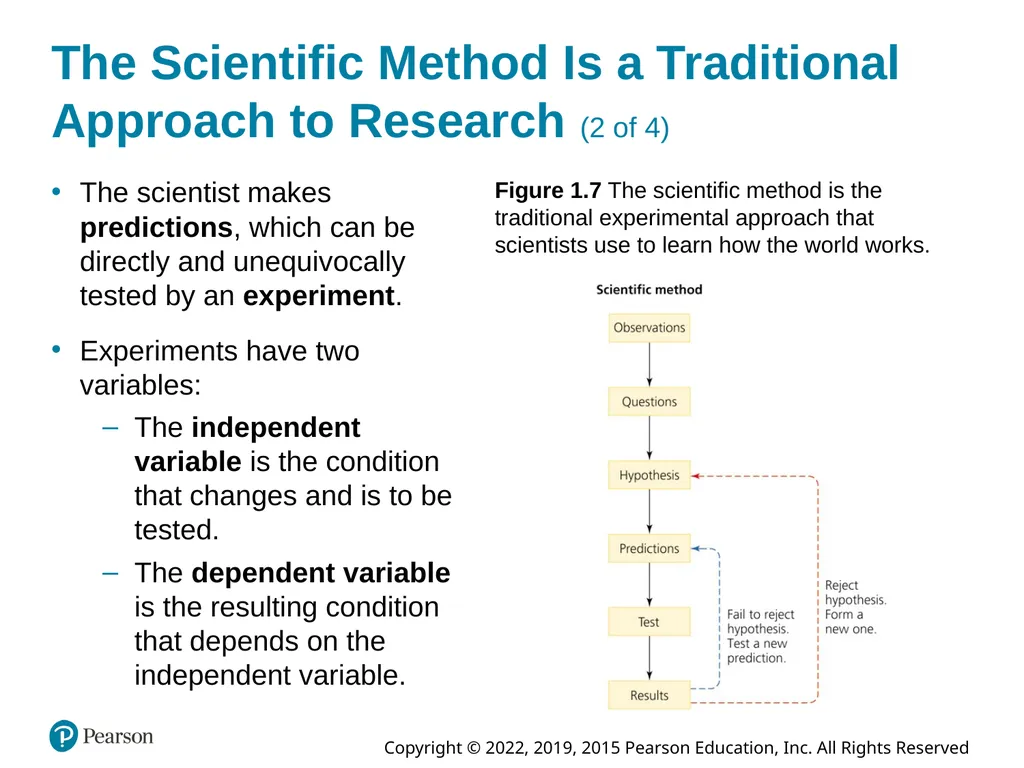
slide15. The Scientific Method Is a Traditional Approach to Research (1 of 4) The scientific method is a formalized technique for testing ideas.
First, the scientist observes some phenomenon.
A question arises from the observation, which the scientist then attempts to explain with a hypothesis. Figure 1.7 The scientific method is the traditional experimental approach that scientists use to learn how the world works.<br>
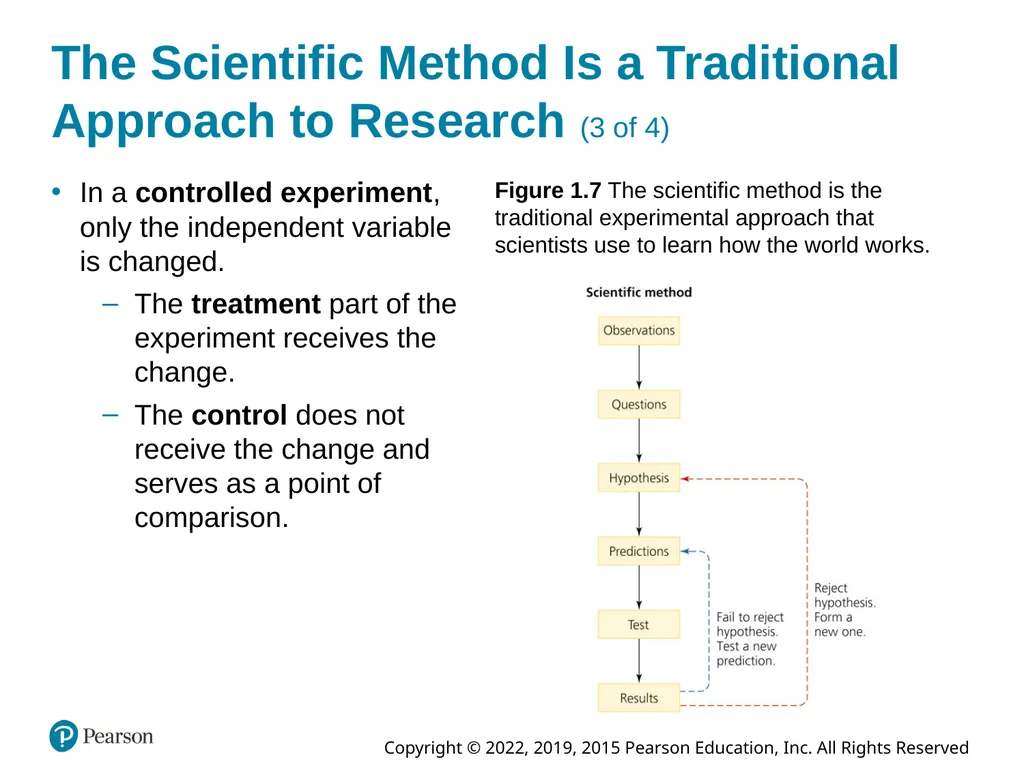
slide16. The Scientific Method Is a Traditional Approach to Research (2 of 4) The scientist makes predictions, which can be directly and unequivocally tested by an experiment.
Experiments have two variables:
The independent variable is the condition that changes and is to be tested.
The dependent variable is the resulting condition that depends on the independent variable. Figure 1.7 The scientific method is the traditional experimental approach that scientists use to learn how the world works.<br>
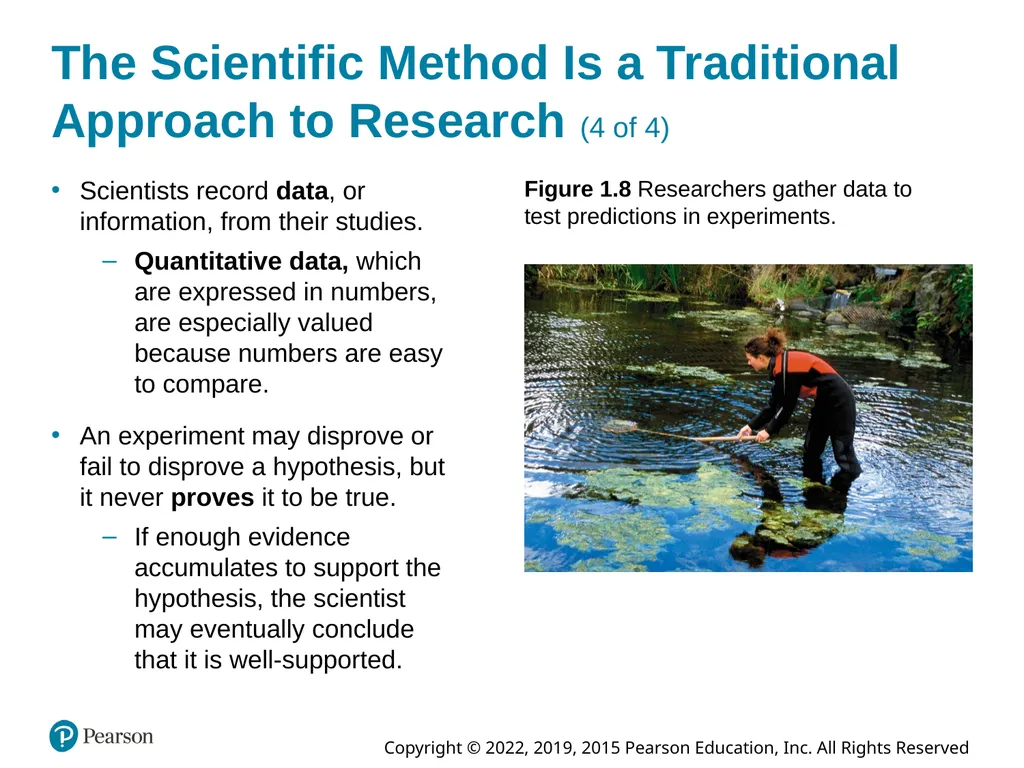
slide17. The Scientific Method Is a Traditional Approach to Research (3 of 4) In a controlled experiment, only the independent variable is changed.
The treatment part of the experiment receives the change.
The control does not receive the change and serves as a point of comparison. Figure 1.7 The scientific method is the traditional experimental approach that scientists use to learn how the world works.<br>
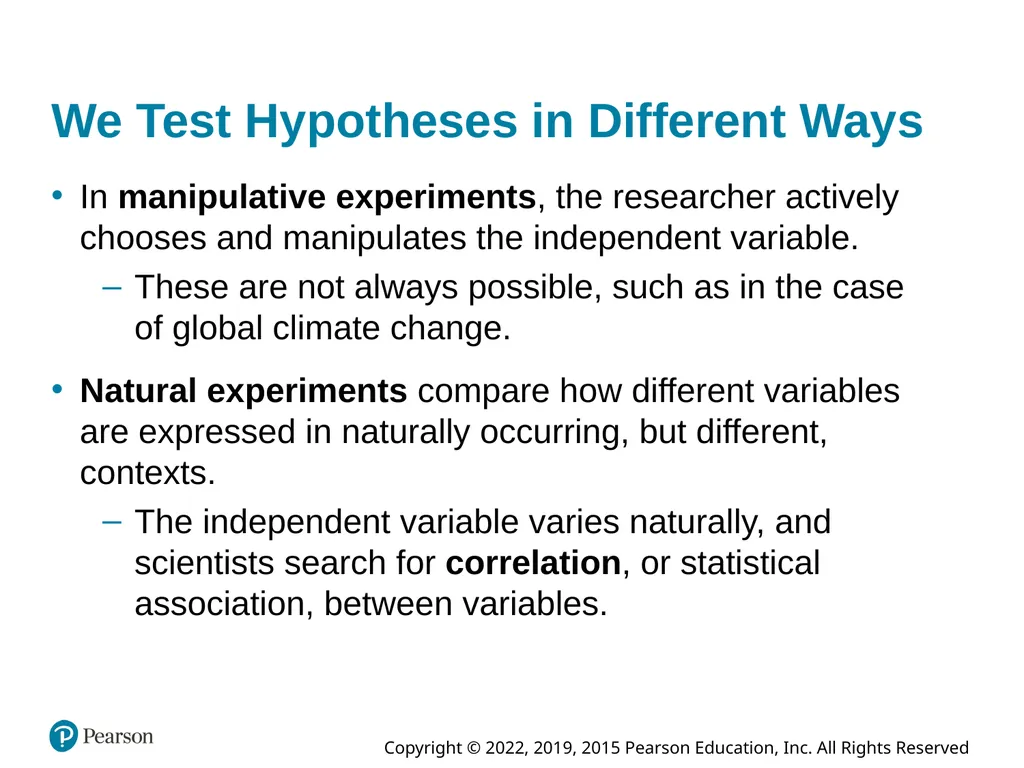
slide18. The Scientific Method Is a Traditional Approach to Research (4 of 4) Scientists record data, or information, from their studies.
Quantitative data, which are expressed in numbers, are especially valued because numbers are easy to compare.
An experiment may disprove or fail to disprove a hypothesis, but it never proves it to be true.
If enough evidence accumulates to support the hypothesis, the scientist may eventually conclude that it is well-supported. Figure 1.8 Researchers gather data to test predictions in experiments.<br>
slide19. We Test Hypotheses in Different Ways In manipulative experiments, the researcher actively chooses and manipulates the independent variable.
These are not always possible, such as in the case of global climate change.
Natural experiments compare how different variables are expressed in naturally occurring, but different, contexts.
The independent variable varies naturally, and scientists search for correlation, or statistical association, between variables.<br>
slide20. Scientists Use Graphs to Represent Data Visually (1 of 3) Graphs help to make patterns and trends in data visually apparent and easy to understand.
The following four graphs each visualize data collected in a manipulative experiment testing the effect of fertilizer on the growth rate of algae in a pond.<br>
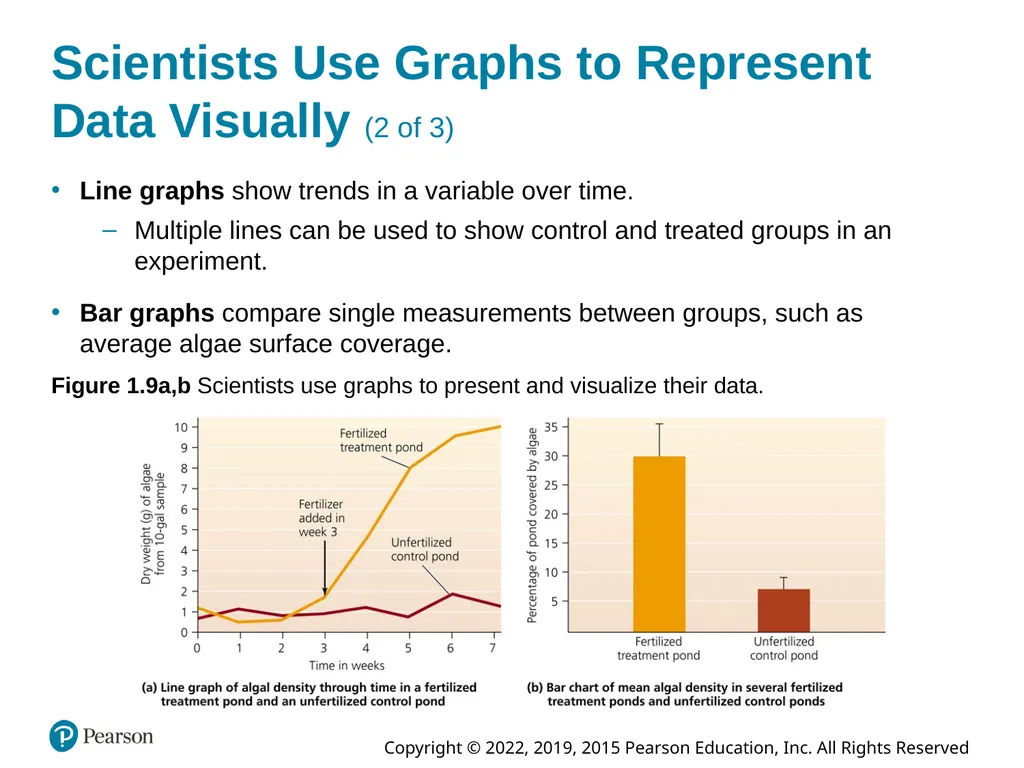
slide21. Scientists Use Graphs to Represent Data Visually (2 of 3) Line graphs show trends in a variable over time.
Multiple lines can be used to show control and treated groups in an experiment.
Bar graphs compare single measurements between groups, such as average algae surface coverage. Figure 1.9a,b Scientists use graphs to present and visualize their data.<br>
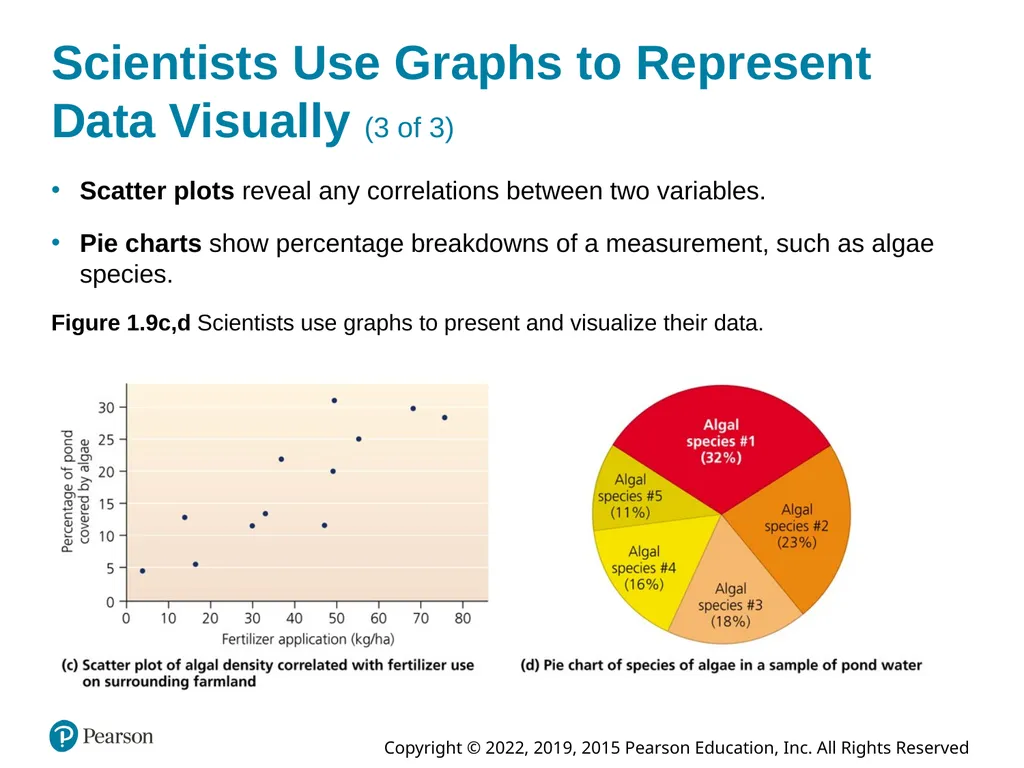
slide22. Scientists Use Graphs to Represent Data Visually (3 of 3) Scatter plots reveal any correlations between two variables.
Pie charts show percentage breakdowns of a measurement, such as algae species. Figure 1.9c,d Scientists use graphs to present and visualize their data.<br>
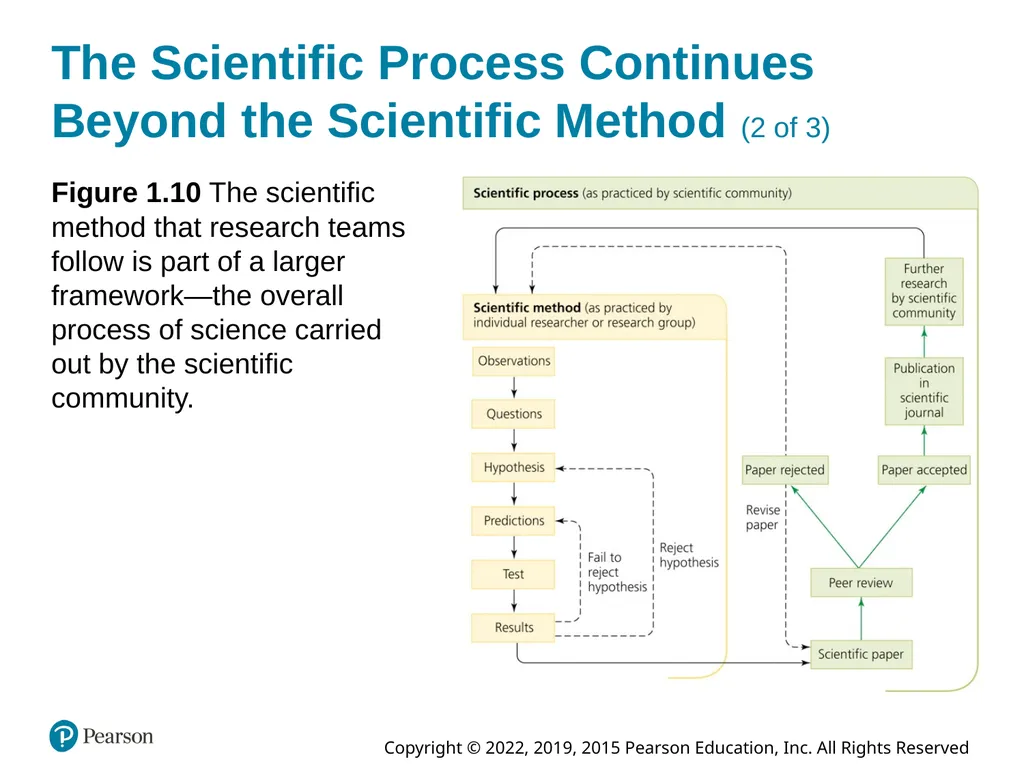
slide23. The Scientific Process Continues Beyond the Scientific Method (1 of 3) When a researcher’s work is complete, it is submitted to a journal.
The journal’s editor asks several other scientists to peer review the work, meaning they provide comments and criticism and judge whether it merits publication.
Further peer review takes place as scientists apply for grants and funding and present their research at conference presentations.
Other scientists may attempt to repeat the experiment.<br>
slide24. The Scientific Process Continues Beyond the Scientific Method (2 of 3) Figure 1.10 The scientific method that research teams follow is part of a larger framework—the overall process of science carried out by the scientific community.<br>
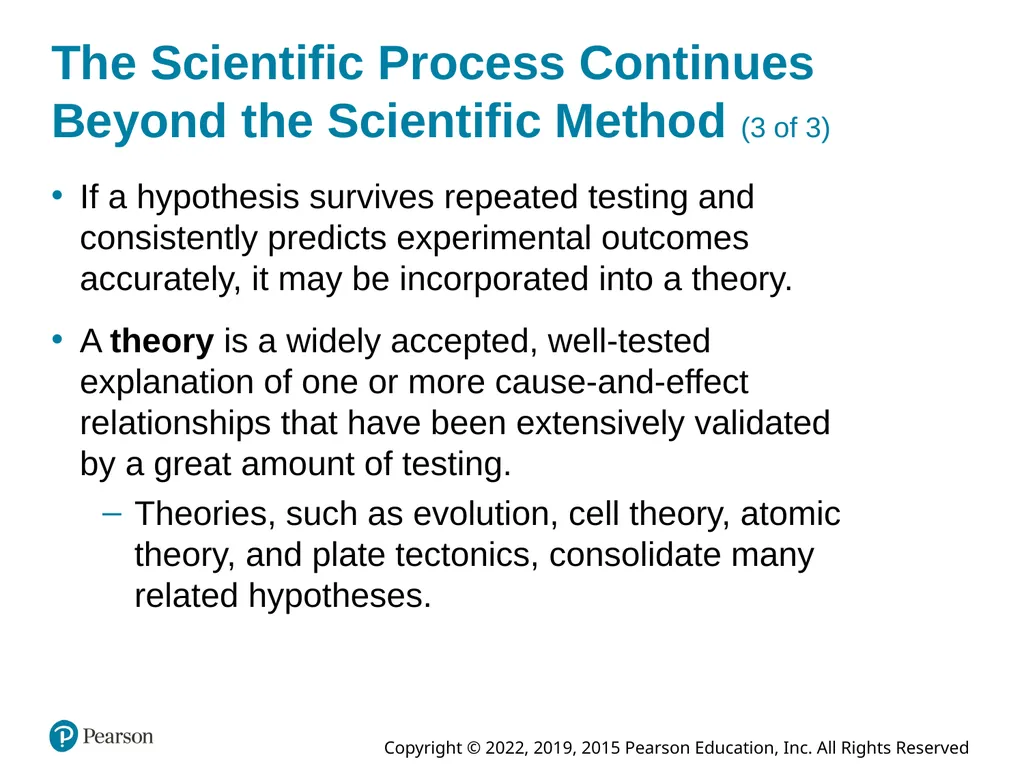
slide25. The Scientific Process Continues Beyond the Scientific Method (3 of 3) If a hypothesis survives repeated testing and consistently predicts experimental outcomes accurately, it may be incorporated into a theory.
A theory is a widely accepted, well-tested explanation of one or more cause-and-effect relationships that have been extensively validated by a great amount of testing.
Theories, such as evolution, cell theory, atomic theory, and plate tectonics, consolidate many related hypotheses.<br>
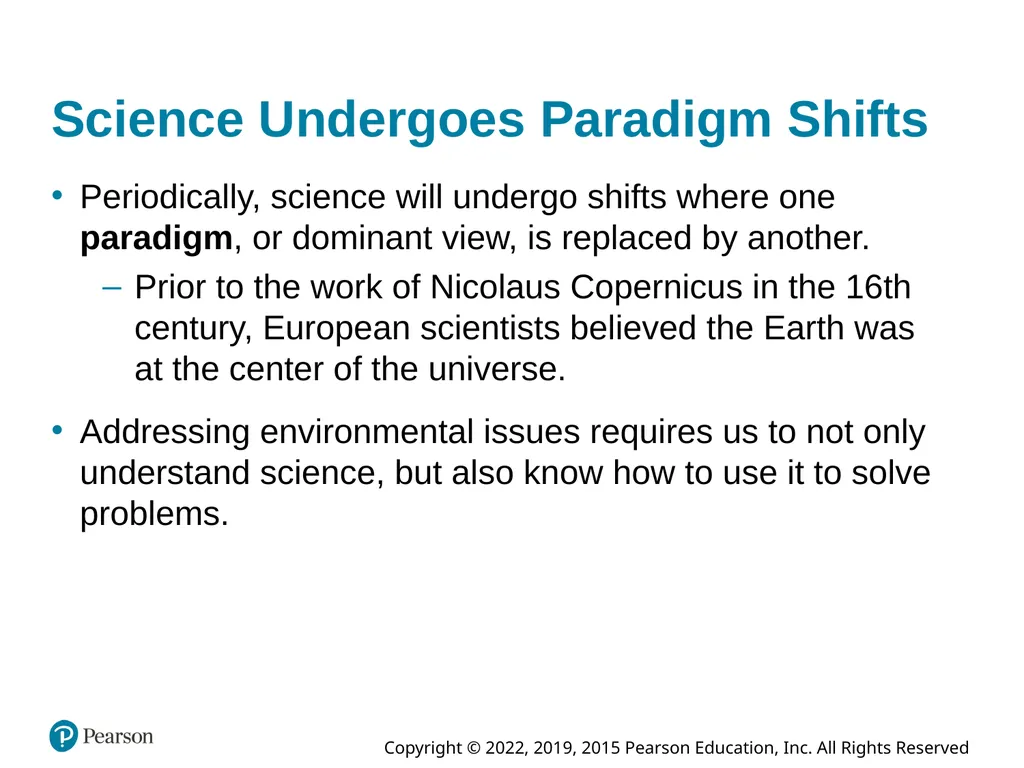
slide26. Science Undergoes Paradigm Shifts Periodically, science will undergo shifts where one paradigm, or dominant view, is replaced by another.
Prior to the work of Nicolaus Copernicus in the 16th century, European scientists believed the Earth was at the center of the universe.
Addressing environmental issues requires us to not only understand science, but also know how to use it to solve problems.<br>
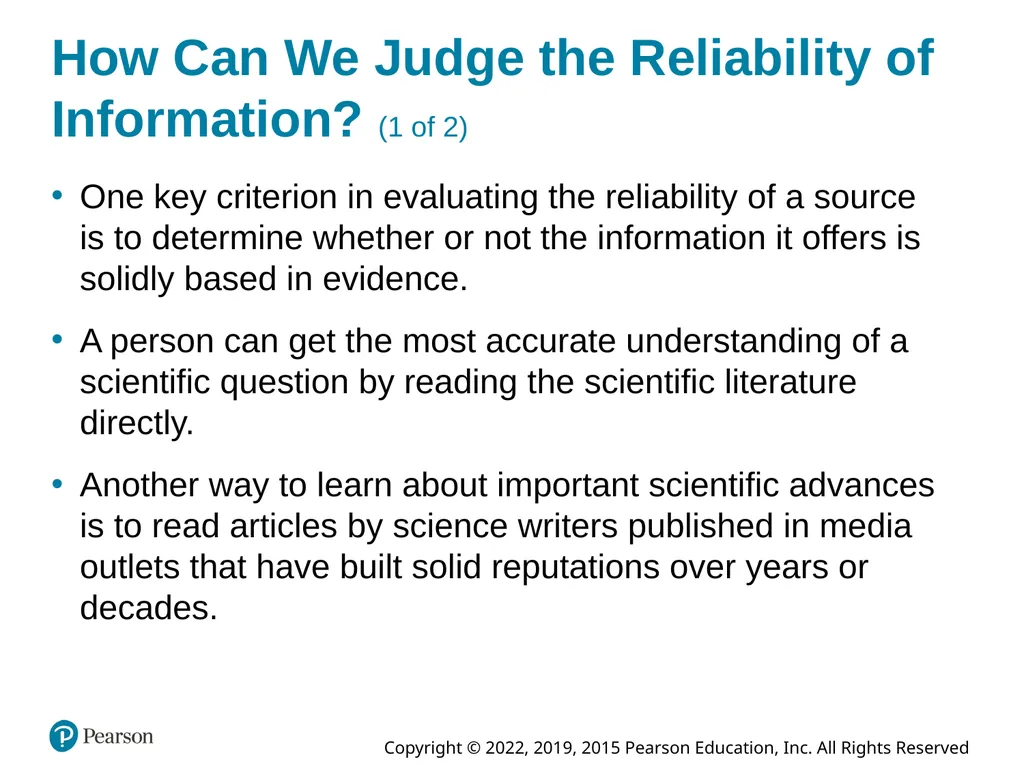
slide27. How Can We Judge the Reliability of Information? (1 of 2) One key criterion in evaluating the reliability of a source is to determine whether or not the information it offers is solidly based in evidence.
A person can get the most accurate understanding of a scientific question by reading the scientific literature directly.
Another way to learn about important scientific advances is to read articles by science writers published in media outlets that have built solid reputations over years or decades.<br>
slide28. How Can We Judge the Reliability of Information? (2 of 2) An original scientific research paper in a journal is an example of a primary source, a source that presents novel information and stands on its own.
Articles or broadcasts produced by others about the contents of a primary source are examples of a secondary source.<br>
slide29. Environmental Ethics (1 of 4) Ethics is a branch of philosophy that studies how people decide what is good and bad, right and wrong.
Ethical standards are criteria that help make this distinction.
The categorical imperative advises us to treat others as we would prefer to be treated ourselves.
The principal of utility holds that something is right when it produces the greatest practical benefit for the most people.
Relativists believe that ethics vary with social context, while universalists believe ethics are consistent across all cultures and contexts.<br>
slide30. Environmental Ethics (2 of 4) The application of ethical standards to the relationships between humans and nonhuman entities is environmental ethics.
Is the present generation obliged to conserve resources?
Can we justify some communities being more polluted?
Are humans justified driving some species to extinction?
Answers to these questions depend on:
The ethical standards adopted by a person.
The breadth of the person’s domain of ethical concern.
Domains of concern in relation to the natural world are divided into three ethical perspectives.<br>
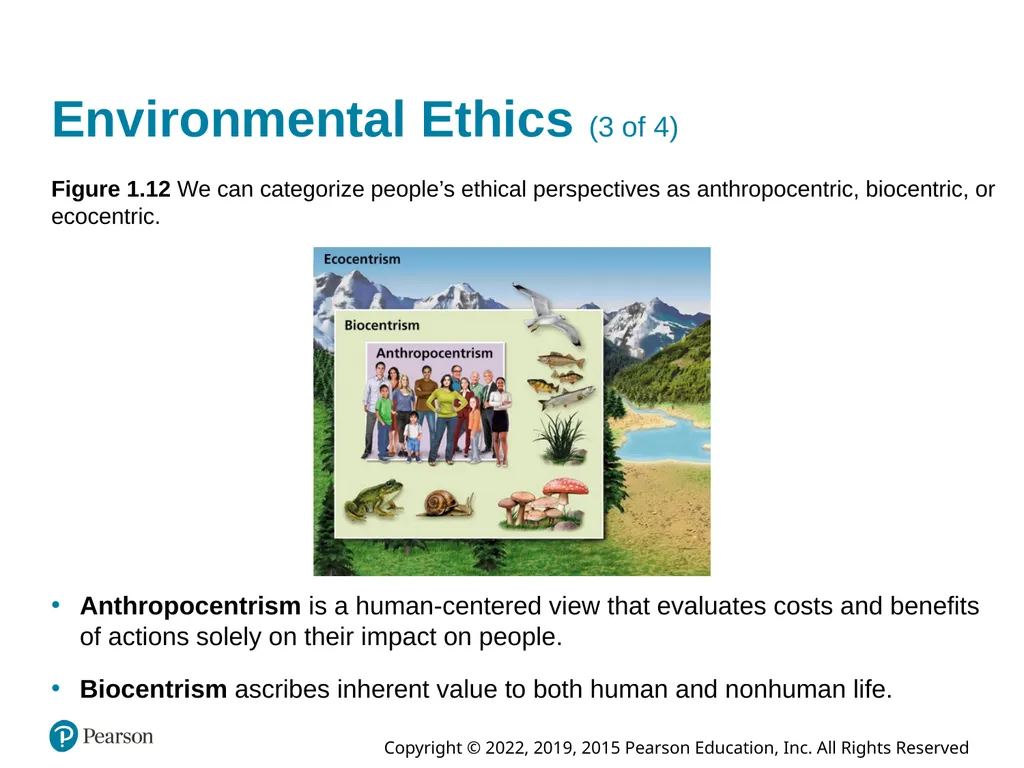
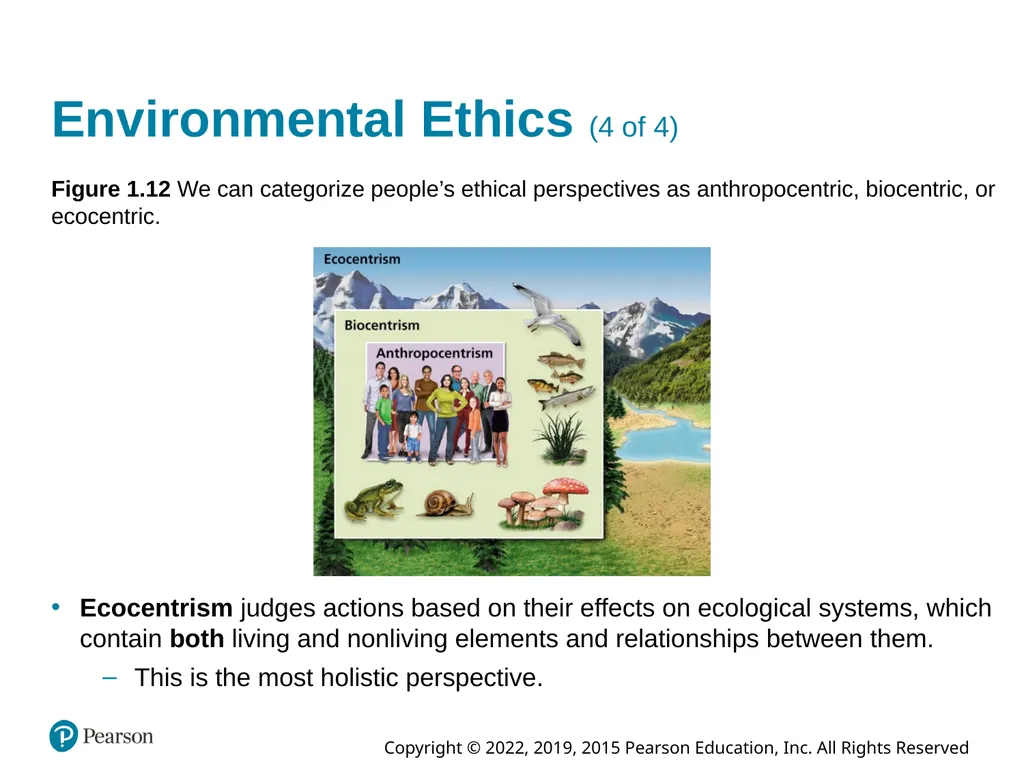
slide31. Environmental Ethics (3 of 4) Figure 1.12 We can categorize people’s ethical perspectives as anthropocentric, biocentric, or ecocentric. Anthropocentrism is a human-centered view that evaluates costs and benefits of actions solely on their impact on people.
Biocentrism ascribes inherent value to both human and nonhuman life.<br>
slide32. Environmental Ethics (4 of 4) Figure 1.12 We can categorize people’s ethical perspectives as anthropocentric, biocentric, or ecocentric. Ecocentrism judges actions based on their effects on ecological systems, which contain both living and nonliving elements and relationships between them.
This is the most holistic perspective.<br>
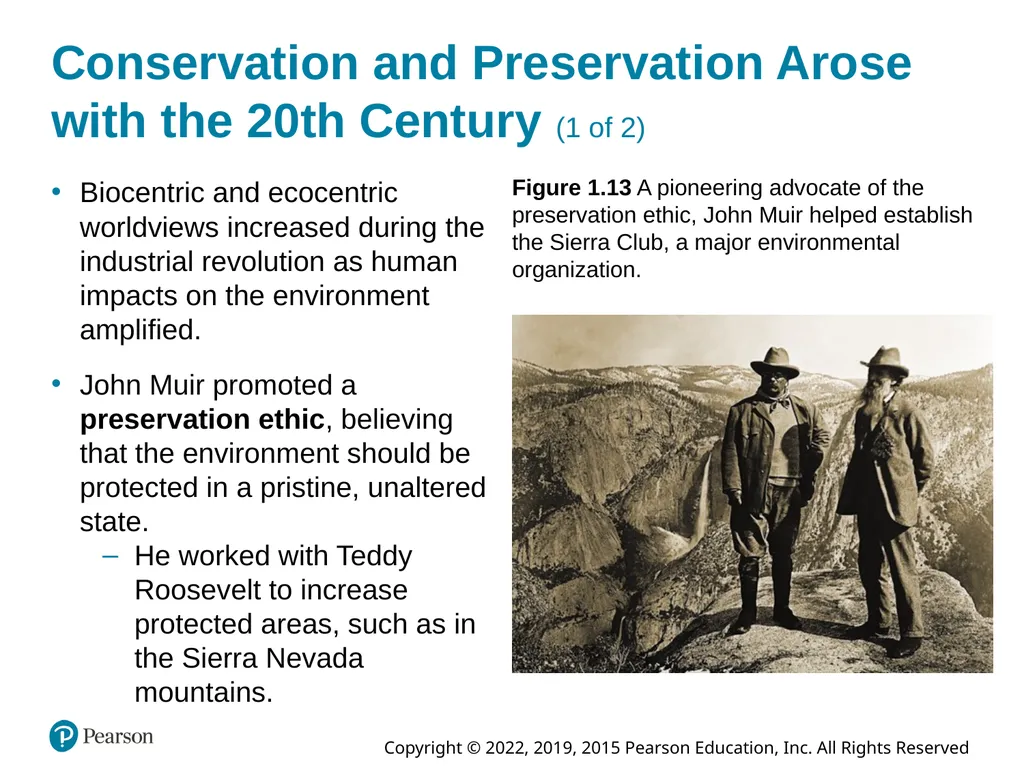
slide33. Conservation and Preservation Arose with the 20th Century (1 of 2) Biocentric and ecocentric worldviews increased during the industrial revolution as human impacts on the environment amplified.
John Muir promoted a preservation ethic, believing that the environment should be protected in a pristine, unaltered state.
He worked with Teddy Roosevelt to increase protected areas, such as in the Sierra Nevada mountains. Figure 1.13 A pioneering advocate of the preservation ethic, John Muir helped establish the Sierra Club, a major environmental organization.<br>
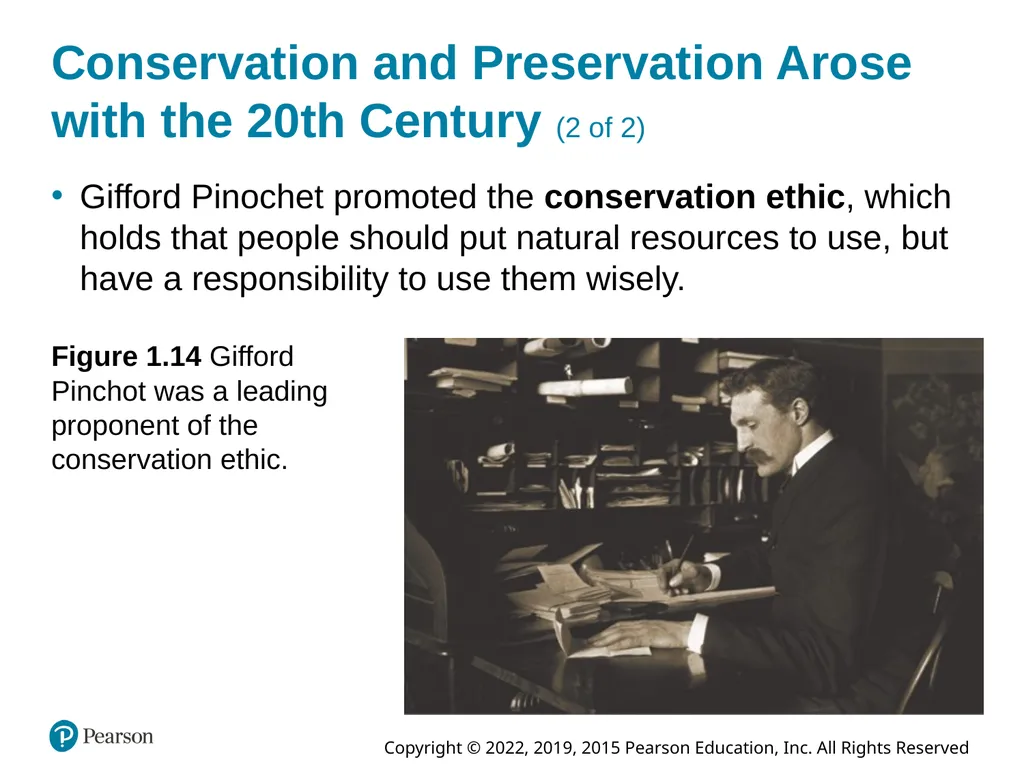
slide34. Conservation and Preservation Arose with the 20th Century (2 of 2) Gifford Pinochet promoted the conservation ethic, which holds that people should put natural resources to use, but have a responsibility to use them wisely. Figure 1.14 Gifford Pinchot was a leading proponent of the conservation ethic.<br>
slide35. Aldo Leopold’s Land Ethic Inspires Many People Aldo Leopold was originally a forest manager who embraced the government policy of shooting predators to increase the population of deer and other game animals.
Over time, he took on an ecocentric view, believing that healthy ecological systems depended on all of their interacting parts. Figure 1.15 Aldo Leopold, a wildlife manager, author, and philosopher, articulated a new relationship between people and the environment.<br>
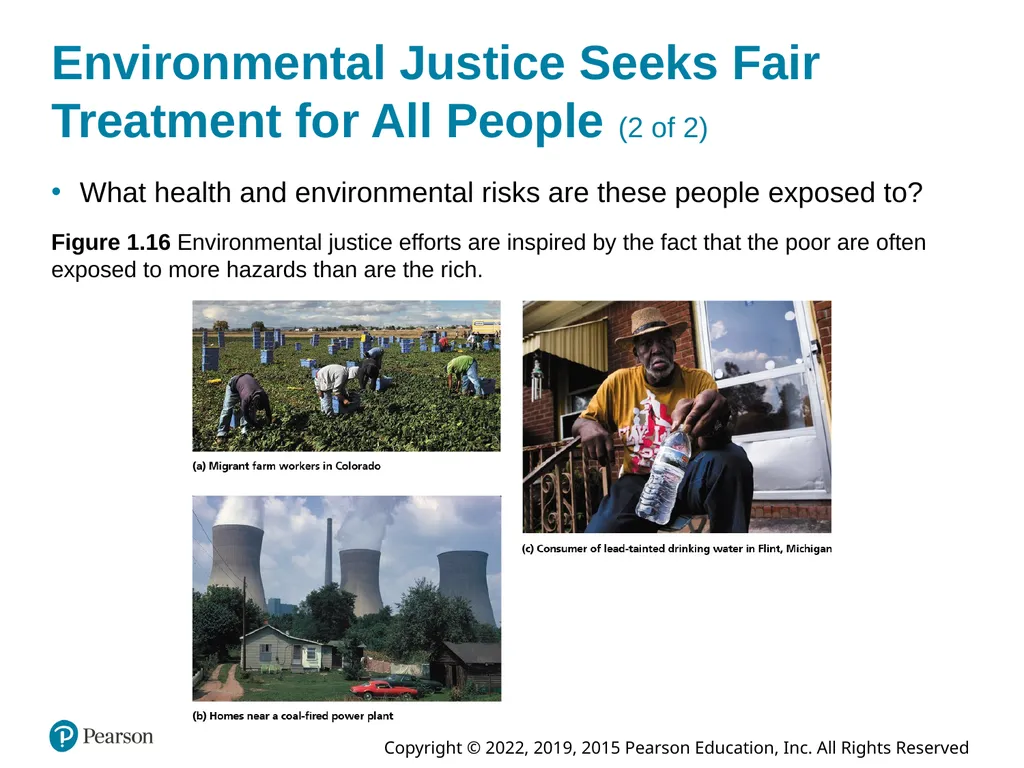
slide36. Environmental Justice Seeks Fair Treatment for All People (1 of 2) Environmental justice involves the fair and equitable treatment of all people with respect to environmental policy and practice, regardless of their income, race, or ethnicity.
Poor people and ethnic minorities tend to be exposed to more pollution, hazards, and environmental degradation than wealthier people.<br>
slide37. Environmental Justice Seeks Fair Treatment for All People (2 of 2) What health and environmental risks are these people exposed to? Figure 1.16 Environmental justice efforts are inspired by the fact that the poor are often exposed to more hazards than are the rich.<br>
slide38. Sustainability and Our Future Sustainability is a guiding principle of modern environmental science and a concept you will encounter throughout this course.
Living within our planet’s means.
Conserving Earth’s resources so that our descendants may use them.
Maintaining fully functional ecological systems.<br>
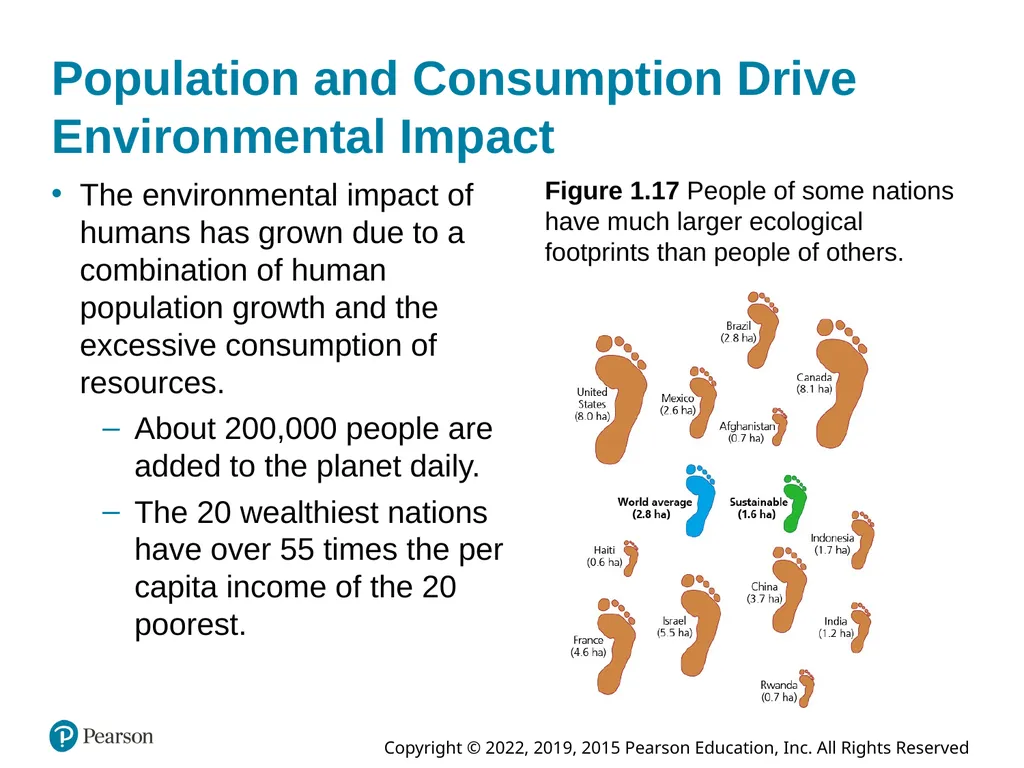
slide39. Population and Consumption Drive Environmental Impact The environmental impact of humans has grown due to a combination of human population growth and the excessive consumption of resources.
About 200,000 people are added to the planet daily.
The 20 wealthiest nations have over 55 times the per capita income of the 20 poorest. Figure 1.17 People of some nations have much larger ecological footprints than people of others.<br>
slide40. Energy Choices Will Shape Our Future Our reliance on fossil fuels is one of the best examples of how our resource consumption amplifies our environmental impact.
Fossil fuels have allowed us to power the machinery of the industrial revolution, increase crop yields, run vehicles and transportation networks, and distribute consumer goods.
Fossil fuels are nonrenewable, generate pollution, and disrupt ecosystems as they are extracted and transported.<br>
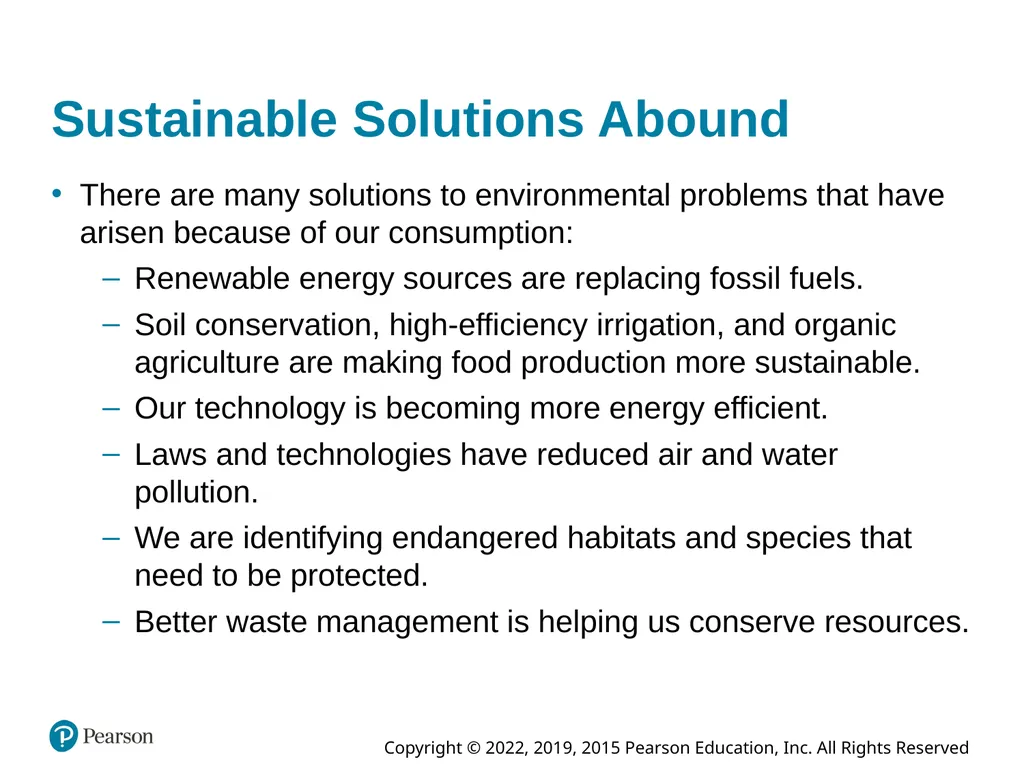
slide41. Sustainable Solutions Abound There are many solutions to environmental problems that have arisen because of our consumption:
Renewable energy sources are replacing fossil fuels.
Soil conservation, high-efficiency irrigation, and organic agriculture are making food production more sustainable.
Our technology is becoming more energy efficient.
Laws and technologies have reduced air and water pollution.
We are identifying endangered habitats and species that need to be protected.
Better waste management is helping us conserve resources.<br>
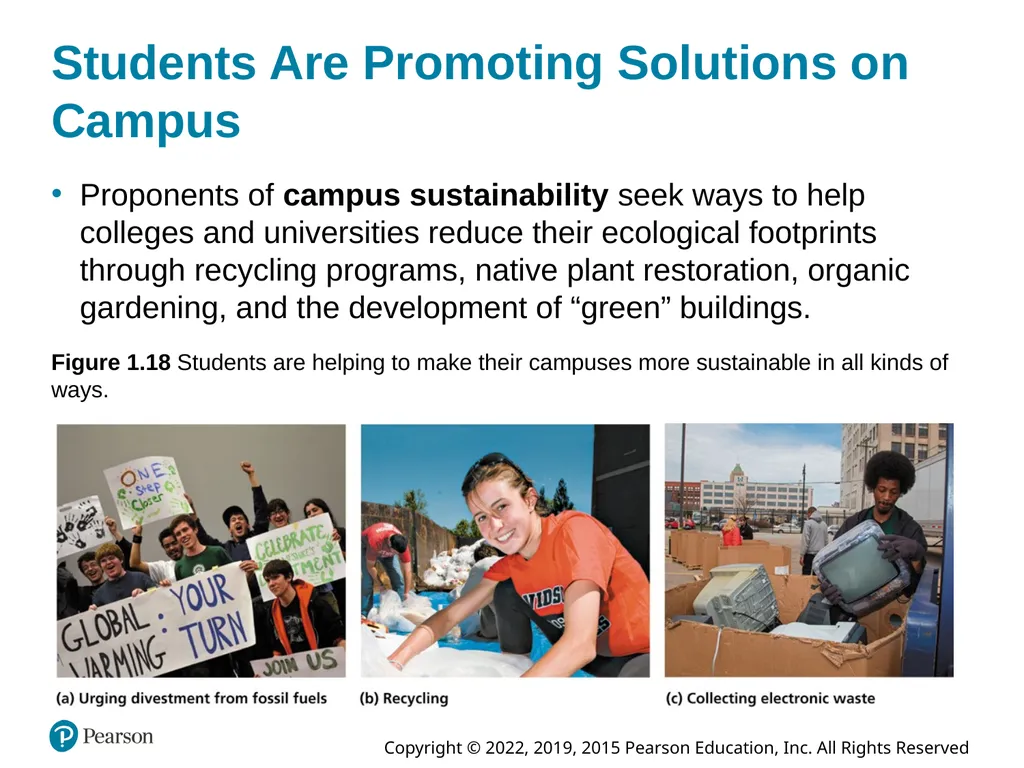
slide42. Students Are Promoting Solutions on Campus Proponents of campus sustainability seek ways to help colleges and universities reduce their ecological footprints through recycling programs, native plant restoration, organic gardening, and the development of “green” buildings. Figure 1.18 Students are helping to make their campuses more sustainable in all kinds of ways.<br>
slide43. Environmental Science Prepares You for the Future With fewer than half of the students at most schools taking any kind of environmental science course, many students are lacking environmental literacy.
By taking this course, you will gain a better understanding of how the world works, be prepared for the growth of “green-collar” jobs, and help our society navigate the challenges of creating a sustainable future.<br>
slide44. Copyright This work is protected by United States copyright laws and is provided solely for the use of instructors in teaching their courses and assessing student learning. Dissemination or sale of any part of this work (including on the World Wide Web) will destroy the integrity of the work and is not permitted. The work and materials from it should never be made available to students except by instructors using the accompanying text in their classes. All recipients of this work are expected to abide by these restrictions and to honor the intended pedagogical purposes and the needs of other instructors who rely on these materials.<br>
James Dauray
College of Lake County Copyright © 2022, 2019, 2015 Pearson Education, Inc. All Rights Reserved<br>
slide2. This Lecture Will Help You Understand The field of environmental science
The importance of natural resources and ecosystem services
Population growth, resource consumption, and their consequences
An ecological footprint
The scientific method
Environmental ethics
Global environmental pressures
Concepts of sustainability and sustainable development<br>
slide3. Our Island, Earth The environment consists of all the living and nonliving things around us.
This includes continents, oceans, clouds, and ice caps that are visible from space as well as the animals, plants, and landscapes immediately around us.
Environmental science is the study of how the natural world works, how the environment affects us, and how we affect it.<br>
slide4. We Rely on Natural Resources (1 of 2) Natural resources are the substances and energy sources that we take from the environment and rely upon to survive.
Renewable natural resources are replenished over short periods.
Sunlight, wind, and wave energy are perpetually renewed and are considered inexhaustible.
Timber, water, animal populations, and fertile soil take months to years to replenish, and are exhaustible. Figure 1.1a,b Natural resources may be renewable or nonrenewable.<br>
slide5. We Rely on Natural Resources (2 of 2) Nonrenewable natural resources are formed much more slowly than we use them and are no longer available once depleted. Figure 1.1c Natural resources may be renewable or nonrenewable.<br>
slide6. We Rely on Ecosystem Services In addition to the “goods” provided as resources, the environment also provides ecosystem services, such as air and water purification, cycling of nutrients, climate regulation, pollination, and waste recycling. Figure 1.2 We rely on the ecosystem services that natural systems provide.<br>
slide7. Population Growth Amplifies Our Impact The human population has grown exponentially following:
The agricultural revolution, when people began to grow crops and domesticate animals.
The industrial revolution, which shifted life toward an urban society powered by fossil fuels. Figure 1.3 The global human population increased after the agricultural revolution and then skyrocketed following the industrial revolution.<br>
slide8. Resource Consumption Exerts Social and Environmental Pressures (1 of 2) Industrialization also increased the amount of resources each person consumes.
This is measured by the ecological footprint, the cumulative area of land and water needed to provide resources and waste disposal for a typical person. Figure 1.4 An ecological footprint shows the total area of biologically productive land and water used by a given person or population.<br>
slide9. Resource Consumption Exerts Social and Environmental Pressures (2 of 2) Humans are using renewable resources 73% faster than they are being replenished.
This is called overshoot because we are surpassing Earth’s capacity to sustainably support our population. Figure 1.5 Analyses by one research group indicate that we have overshot Earth’s biocapacity—its capacity to support us—by 73%.<br>
slide10. Conserving Natural Capital Is Like Maintaining a Bank Account The Earth’s natural capital, its store of resources and ecosystem services, is like a bank account.
If you leave the principal intact and only spend the interest, the account remains full.
If you deplete the principal, the account will be drawn down until it is exhausted.
Currently, we are drawing down Earth’s natural capital, a practice that is unsustainable.<br>
slide11. Environmental Science Can Help Us Learn From the Past Historians have inferred that environmental degradation has contributed to the collapse of the Greek and Roman empires, the Angkor civilization of Southeast Asia, Easter Island, and many other civilizations of the Americas and Middle East.
Today’s society is globalized, meaning a similar collapse would affect the entire world.<br>
slide12. The Nature of Environmental Science Environmental science is interdisciplinary, meaning it brings techniques and research from multiple disciplines together.
Includes both natural studies, which focus on how the natural world works, and social sciences, which address human interactions and institutions.
Environmental studies emphasize the social sciences. Figure 1.6 Environmental science is an interdisciplinary pursuit.<br>
slide13. Environmental Science Is Not the Same as Environmentalism Environmental science involves the scientific study of the environment and our interactions with it.
Environmentalism is a social movement dedicated to protecting the natural world from undesirable changes brought on by human actions.<br>
slide14. The Nature of Science Science is a systematic process for learning about the world and testing our understanding about it.
Science may also refer to the accumulated body of knowledge that arises from observing, questioning, testing, and discovery.
Descriptive science involves researching organisms, materials, and systems that are new or not well-known.
Hypothesis-driven science uses experiments to test hypotheses as part of the scientific method.<br>
slide15. The Scientific Method Is a Traditional Approach to Research (1 of 4) The scientific method is a formalized technique for testing ideas.
First, the scientist observes some phenomenon.
A question arises from the observation, which the scientist then attempts to explain with a hypothesis. Figure 1.7 The scientific method is the traditional experimental approach that scientists use to learn how the world works.<br>
slide16. The Scientific Method Is a Traditional Approach to Research (2 of 4) The scientist makes predictions, which can be directly and unequivocally tested by an experiment.
Experiments have two variables:
The independent variable is the condition that changes and is to be tested.
The dependent variable is the resulting condition that depends on the independent variable. Figure 1.7 The scientific method is the traditional experimental approach that scientists use to learn how the world works.<br>
slide17. The Scientific Method Is a Traditional Approach to Research (3 of 4) In a controlled experiment, only the independent variable is changed.
The treatment part of the experiment receives the change.
The control does not receive the change and serves as a point of comparison. Figure 1.7 The scientific method is the traditional experimental approach that scientists use to learn how the world works.<br>
slide18. The Scientific Method Is a Traditional Approach to Research (4 of 4) Scientists record data, or information, from their studies.
Quantitative data, which are expressed in numbers, are especially valued because numbers are easy to compare.
An experiment may disprove or fail to disprove a hypothesis, but it never proves it to be true.
If enough evidence accumulates to support the hypothesis, the scientist may eventually conclude that it is well-supported. Figure 1.8 Researchers gather data to test predictions in experiments.<br>
slide19. We Test Hypotheses in Different Ways In manipulative experiments, the researcher actively chooses and manipulates the independent variable.
These are not always possible, such as in the case of global climate change.
Natural experiments compare how different variables are expressed in naturally occurring, but different, contexts.
The independent variable varies naturally, and scientists search for correlation, or statistical association, between variables.<br>
slide20. Scientists Use Graphs to Represent Data Visually (1 of 3) Graphs help to make patterns and trends in data visually apparent and easy to understand.
The following four graphs each visualize data collected in a manipulative experiment testing the effect of fertilizer on the growth rate of algae in a pond.<br>
slide21. Scientists Use Graphs to Represent Data Visually (2 of 3) Line graphs show trends in a variable over time.
Multiple lines can be used to show control and treated groups in an experiment.
Bar graphs compare single measurements between groups, such as average algae surface coverage. Figure 1.9a,b Scientists use graphs to present and visualize their data.<br>
slide22. Scientists Use Graphs to Represent Data Visually (3 of 3) Scatter plots reveal any correlations between two variables.
Pie charts show percentage breakdowns of a measurement, such as algae species. Figure 1.9c,d Scientists use graphs to present and visualize their data.<br>
slide23. The Scientific Process Continues Beyond the Scientific Method (1 of 3) When a researcher’s work is complete, it is submitted to a journal.
The journal’s editor asks several other scientists to peer review the work, meaning they provide comments and criticism and judge whether it merits publication.
Further peer review takes place as scientists apply for grants and funding and present their research at conference presentations.
Other scientists may attempt to repeat the experiment.<br>
slide24. The Scientific Process Continues Beyond the Scientific Method (2 of 3) Figure 1.10 The scientific method that research teams follow is part of a larger framework—the overall process of science carried out by the scientific community.<br>
slide25. The Scientific Process Continues Beyond the Scientific Method (3 of 3) If a hypothesis survives repeated testing and consistently predicts experimental outcomes accurately, it may be incorporated into a theory.
A theory is a widely accepted, well-tested explanation of one or more cause-and-effect relationships that have been extensively validated by a great amount of testing.
Theories, such as evolution, cell theory, atomic theory, and plate tectonics, consolidate many related hypotheses.<br>
slide26. Science Undergoes Paradigm Shifts Periodically, science will undergo shifts where one paradigm, or dominant view, is replaced by another.
Prior to the work of Nicolaus Copernicus in the 16th century, European scientists believed the Earth was at the center of the universe.
Addressing environmental issues requires us to not only understand science, but also know how to use it to solve problems.<br>
slide27. How Can We Judge the Reliability of Information? (1 of 2) One key criterion in evaluating the reliability of a source is to determine whether or not the information it offers is solidly based in evidence.
A person can get the most accurate understanding of a scientific question by reading the scientific literature directly.
Another way to learn about important scientific advances is to read articles by science writers published in media outlets that have built solid reputations over years or decades.<br>
slide28. How Can We Judge the Reliability of Information? (2 of 2) An original scientific research paper in a journal is an example of a primary source, a source that presents novel information and stands on its own.
Articles or broadcasts produced by others about the contents of a primary source are examples of a secondary source.<br>
slide29. Environmental Ethics (1 of 4) Ethics is a branch of philosophy that studies how people decide what is good and bad, right and wrong.
Ethical standards are criteria that help make this distinction.
The categorical imperative advises us to treat others as we would prefer to be treated ourselves.
The principal of utility holds that something is right when it produces the greatest practical benefit for the most people.
Relativists believe that ethics vary with social context, while universalists believe ethics are consistent across all cultures and contexts.<br>
slide30. Environmental Ethics (2 of 4) The application of ethical standards to the relationships between humans and nonhuman entities is environmental ethics.
Is the present generation obliged to conserve resources?
Can we justify some communities being more polluted?
Are humans justified driving some species to extinction?
Answers to these questions depend on:
The ethical standards adopted by a person.
The breadth of the person’s domain of ethical concern.
Domains of concern in relation to the natural world are divided into three ethical perspectives.<br>
slide31. Environmental Ethics (3 of 4) Figure 1.12 We can categorize people’s ethical perspectives as anthropocentric, biocentric, or ecocentric. Anthropocentrism is a human-centered view that evaluates costs and benefits of actions solely on their impact on people.
Biocentrism ascribes inherent value to both human and nonhuman life.<br>
slide32. Environmental Ethics (4 of 4) Figure 1.12 We can categorize people’s ethical perspectives as anthropocentric, biocentric, or ecocentric. Ecocentrism judges actions based on their effects on ecological systems, which contain both living and nonliving elements and relationships between them.
This is the most holistic perspective.<br>
slide33. Conservation and Preservation Arose with the 20th Century (1 of 2) Biocentric and ecocentric worldviews increased during the industrial revolution as human impacts on the environment amplified.
John Muir promoted a preservation ethic, believing that the environment should be protected in a pristine, unaltered state.
He worked with Teddy Roosevelt to increase protected areas, such as in the Sierra Nevada mountains. Figure 1.13 A pioneering advocate of the preservation ethic, John Muir helped establish the Sierra Club, a major environmental organization.<br>
slide34. Conservation and Preservation Arose with the 20th Century (2 of 2) Gifford Pinochet promoted the conservation ethic, which holds that people should put natural resources to use, but have a responsibility to use them wisely. Figure 1.14 Gifford Pinchot was a leading proponent of the conservation ethic.<br>
slide35. Aldo Leopold’s Land Ethic Inspires Many People Aldo Leopold was originally a forest manager who embraced the government policy of shooting predators to increase the population of deer and other game animals.
Over time, he took on an ecocentric view, believing that healthy ecological systems depended on all of their interacting parts. Figure 1.15 Aldo Leopold, a wildlife manager, author, and philosopher, articulated a new relationship between people and the environment.<br>
slide36. Environmental Justice Seeks Fair Treatment for All People (1 of 2) Environmental justice involves the fair and equitable treatment of all people with respect to environmental policy and practice, regardless of their income, race, or ethnicity.
Poor people and ethnic minorities tend to be exposed to more pollution, hazards, and environmental degradation than wealthier people.<br>
slide37. Environmental Justice Seeks Fair Treatment for All People (2 of 2) What health and environmental risks are these people exposed to? Figure 1.16 Environmental justice efforts are inspired by the fact that the poor are often exposed to more hazards than are the rich.<br>
slide38. Sustainability and Our Future Sustainability is a guiding principle of modern environmental science and a concept you will encounter throughout this course.
Living within our planet’s means.
Conserving Earth’s resources so that our descendants may use them.
Maintaining fully functional ecological systems.<br>
slide39. Population and Consumption Drive Environmental Impact The environmental impact of humans has grown due to a combination of human population growth and the excessive consumption of resources.
About 200,000 people are added to the planet daily.
The 20 wealthiest nations have over 55 times the per capita income of the 20 poorest. Figure 1.17 People of some nations have much larger ecological footprints than people of others.<br>
slide40. Energy Choices Will Shape Our Future Our reliance on fossil fuels is one of the best examples of how our resource consumption amplifies our environmental impact.
Fossil fuels have allowed us to power the machinery of the industrial revolution, increase crop yields, run vehicles and transportation networks, and distribute consumer goods.
Fossil fuels are nonrenewable, generate pollution, and disrupt ecosystems as they are extracted and transported.<br>
slide41. Sustainable Solutions Abound There are many solutions to environmental problems that have arisen because of our consumption:
Renewable energy sources are replacing fossil fuels.
Soil conservation, high-efficiency irrigation, and organic agriculture are making food production more sustainable.
Our technology is becoming more energy efficient.
Laws and technologies have reduced air and water pollution.
We are identifying endangered habitats and species that need to be protected.
Better waste management is helping us conserve resources.<br>
slide42. Students Are Promoting Solutions on Campus Proponents of campus sustainability seek ways to help colleges and universities reduce their ecological footprints through recycling programs, native plant restoration, organic gardening, and the development of “green” buildings. Figure 1.18 Students are helping to make their campuses more sustainable in all kinds of ways.<br>
slide43. Environmental Science Prepares You for the Future With fewer than half of the students at most schools taking any kind of environmental science course, many students are lacking environmental literacy.
By taking this course, you will gain a better understanding of how the world works, be prepared for the growth of “green-collar” jobs, and help our society navigate the challenges of creating a sustainable future.<br>
slide44. Copyright This work is protected by United States copyright laws and is provided solely for the use of instructors in teaching their courses and assessing student learning. Dissemination or sale of any part of this work (including on the World Wide Web) will destroy the integrity of the work and is not permitted. The work and materials from it should never be made available to students except by instructors using the accompanying text in their classes. All recipients of this work are expected to abide by these restrictions and to honor the intended pedagogical purposes and the needs of other instructors who rely on these materials.<br>