
Essential Environment: The Science Behind the
KB
Published · 81 slides · 0 views
1 / 1




Description
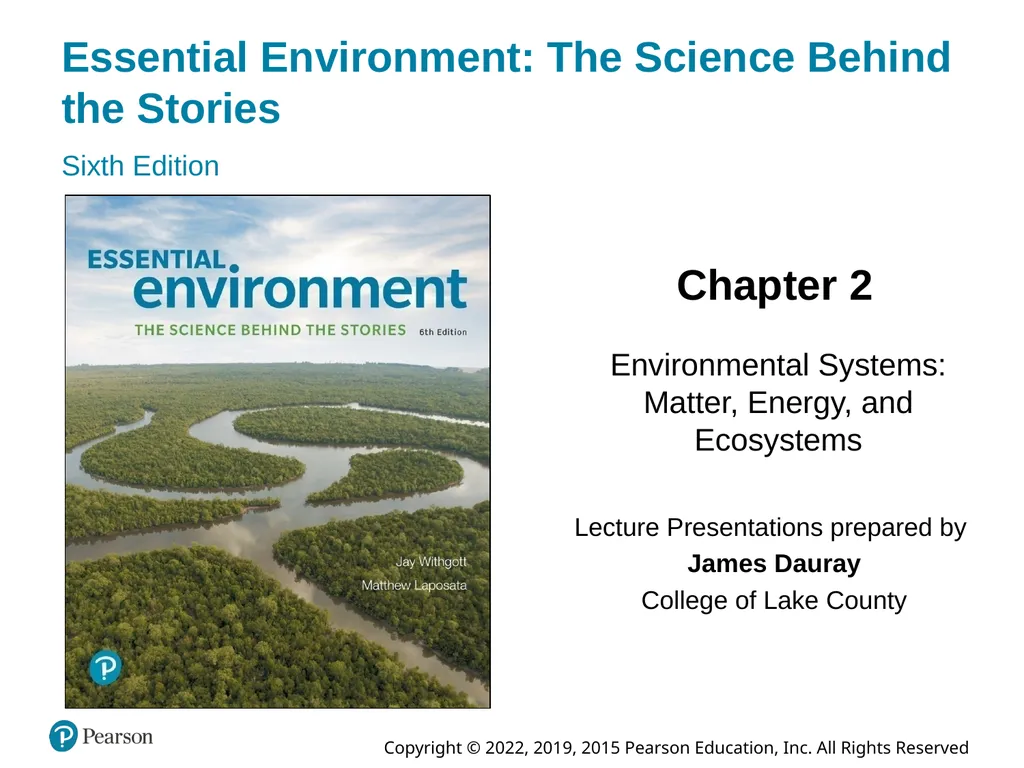
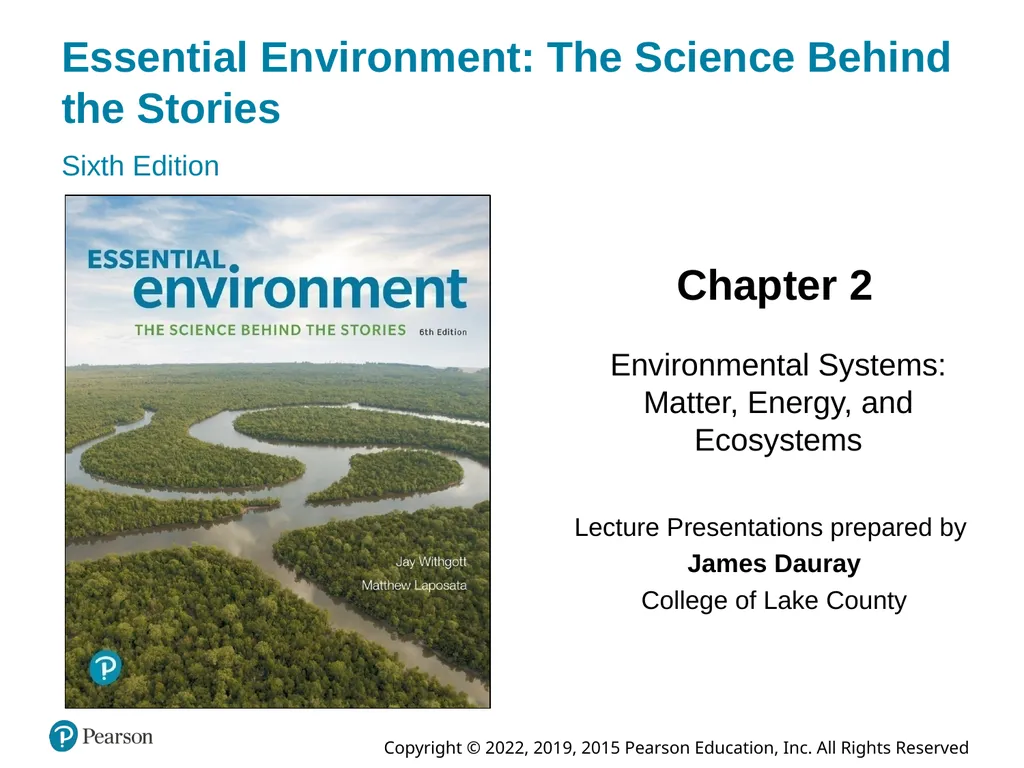
Essential Environment: The Science Behind the Stories Sixth Edition Chapter 2 Environmental Systems: Matter, Energy, and Ecosystems Lecture Presentations prepared by James Dauray College of Lake County Copyright 2022, 2019, 2015 Pearson
Related Topics
Share
Embed code
Download this presentation From Below
"Essential Environment: The Science Behind the" is the property of its rightful owner. Permission is granted to download and print the materials on this website for personal, non-commercial use only, and to display it on your personal computer provided you do not modify the materials and that you retain all copyright notices contained in the materials. By downloading content from our website, you accept the terms of this agreement.
Presentation Transcript
01
Essential Environment: The Science Behind the Stories Sixth Edition Chapter 2 Environmental Systems: Matter, Energy, and Ecosystems Lecture Presentations prepared by
James Dauray
College of Lake County Copyright © 2022, 2019, 2015 Pearson Education, Inc. All Rights Reserved<br>
James Dauray
College of Lake County Copyright © 2022, 2019, 2015 Pearson Education, Inc. All Rights Reserved<br>
02
This Lecture Will Help You Understand Environmental systems
Fundamentals of matter and chemistry
Forms of energy and the laws of thermodynamics
Photosynthesis and cellular respiration
Ecosystems and interactions
Fundamentals of landscape ecology
Ecosystem services
Water, carbon, nitrogen, and phosphorus cycles<br>
Fundamentals of matter and chemistry
Forms of energy and the laws of thermodynamics
Photosynthesis and cellular respiration
Ecosystems and interactions
Fundamentals of landscape ecology
Ecosystem services
Water, carbon, nitrogen, and phosphorus cycles<br>
03
Central Case Study: The Vanishing Oysters of the Chesapeake Bay (1 of 3) The Chesapeake Bay, once one of the most economically productive oyster harvesting areas, has experienced a complete collapse in the past century.<br>
04
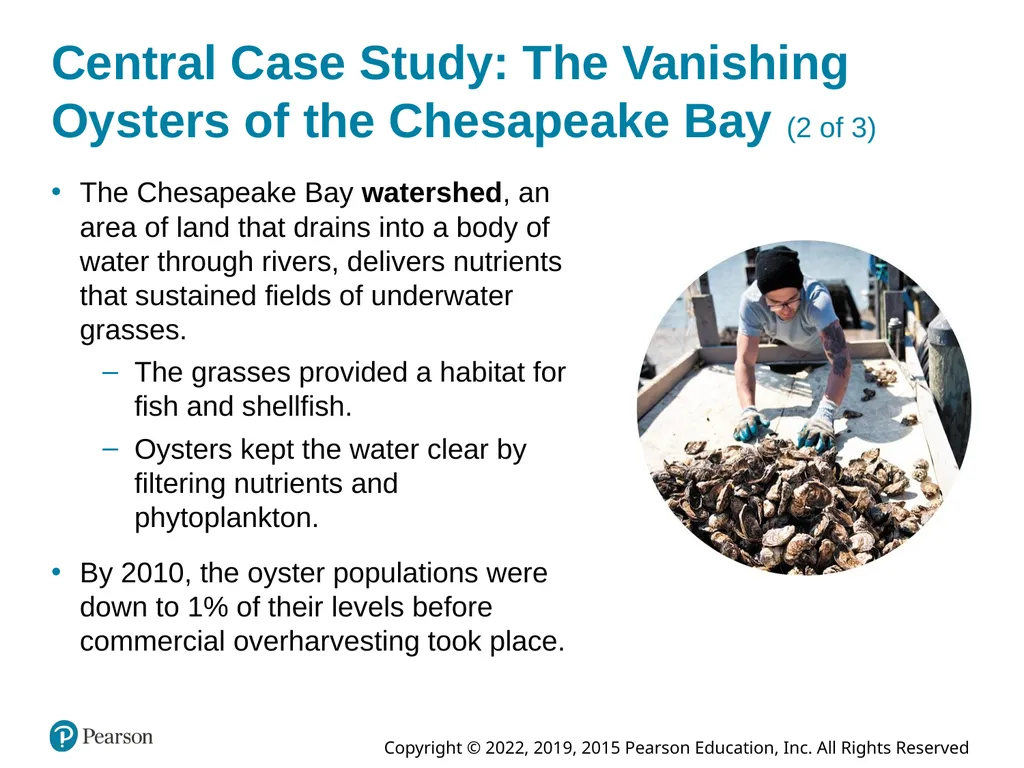
Central Case Study: The Vanishing Oysters of the Chesapeake Bay (2 of 3) The Chesapeake Bay watershed, an area of land that drains into a body of water through rivers, delivers nutrients that sustained fields of underwater grasses.
The grasses provided a habitat for fish and shellfish.
Oysters kept the water clear by filtering nutrients and phytoplankton.
By 2010, the oyster populations were down to 1% of their levels before commercial overharvesting took place.<br>
The grasses provided a habitat for fish and shellfish.
Oysters kept the water clear by filtering nutrients and phytoplankton.
By 2010, the oyster populations were down to 1% of their levels before commercial overharvesting took place.<br>
05
Central Case Study: The Vanishing Oysters of the Chesapeake Bay (3 of 3) The bay has also been polluted with excessive nitrogen and phosphorus nutrients from fertilizing, animal manure, and fossil fuel combustion in the watershed.
These nutrients, combined with the loss of the oysters, led to an overpopulation of phytoplankton.
Decomposition of dead plankton has depleted the water, creating hypoxia.
The E P A has identified the bay as dangerously polluted waters and has begun work to restore it.<br>
These nutrients, combined with the loss of the oysters, led to an overpopulation of phytoplankton.
Decomposition of dead plankton has depleted the water, creating hypoxia.
The E P A has identified the bay as dangerously polluted waters and has begun work to restore it.<br>
06
Earth’s Environmental Systems (1 of 2) A system is a network of relationships among parts that influence each other through the exchange of energy, matter, or information.
The Chesapeake Bay receives inputs of fresh water, sediment, nutrients, and pollution from its watershed.
Fishermen harvest some of the bay’s output: matter and energy in the form of seafood.
There are many ways to delineate natural systems.<br>
The Chesapeake Bay receives inputs of fresh water, sediment, nutrients, and pollution from its watershed.
Fishermen harvest some of the bay’s output: matter and energy in the form of seafood.
There are many ways to delineate natural systems.<br>
07
Earth’s Environmental Systems (2 of 2) Scientists divide the Earth’s components into spheres.
The lithosphere is the rock and sediment in the planet’s upper mantle and crust.
The atmosphere is the air surrounding the planet.
The hydrosphere encompasses all water – salty, fresh, solid, liquid, or vapor.
The biosphere includes all of the living organisms of the Earth and the nonliving components that they interact with.
Environmental scientists use a “systems approach” in solving problems, because they are multifaceted and complex.<br>
The lithosphere is the rock and sediment in the planet’s upper mantle and crust.
The atmosphere is the air surrounding the planet.
The hydrosphere encompasses all water – salty, fresh, solid, liquid, or vapor.
The biosphere includes all of the living organisms of the Earth and the nonliving components that they interact with.
Environmental scientists use a “systems approach” in solving problems, because they are multifaceted and complex.<br>
08
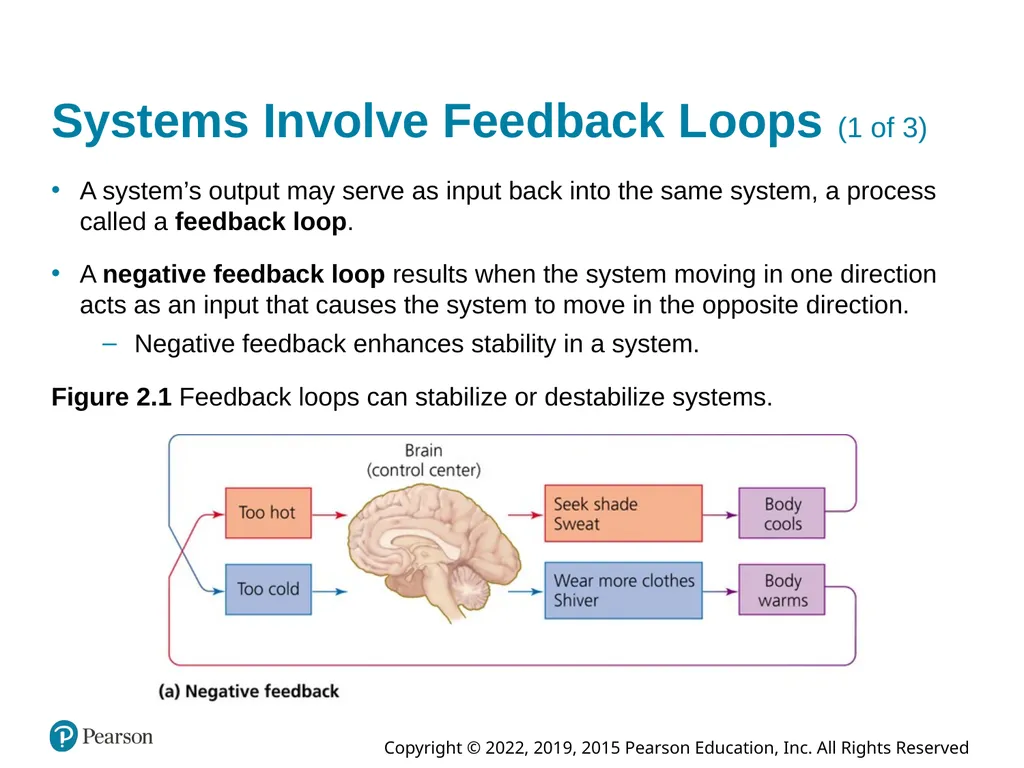
Systems Involve Feedback Loops (1 of 3) A system’s output may serve as input back into the same system, a process called a feedback loop.
A negative feedback loop results when the system moving in one direction acts as an input that causes the system to move in the opposite direction.
Negative feedback enhances stability in a system. Figure 2.1 Feedback loops can stabilize or destabilize systems.<br>
A negative feedback loop results when the system moving in one direction acts as an input that causes the system to move in the opposite direction.
Negative feedback enhances stability in a system. Figure 2.1 Feedback loops can stabilize or destabilize systems.<br>
09
Systems Involve Feedback Loops (2 of 3) Negative feedback systems with processes that move in opposing directions at equivalent rates are in dynamic equilibrium.
This contributes to homeostasis, the tendency of a system to maintain stable internal conditions.
The steady state of a homeostatic system may change over time, as seen with the gradual change experienced by the Earth:
Changes in atmospheric and ocean composition.
Global warming.<br>
This contributes to homeostasis, the tendency of a system to maintain stable internal conditions.
The steady state of a homeostatic system may change over time, as seen with the gradual change experienced by the Earth:
Changes in atmospheric and ocean composition.
Global warming.<br>
10
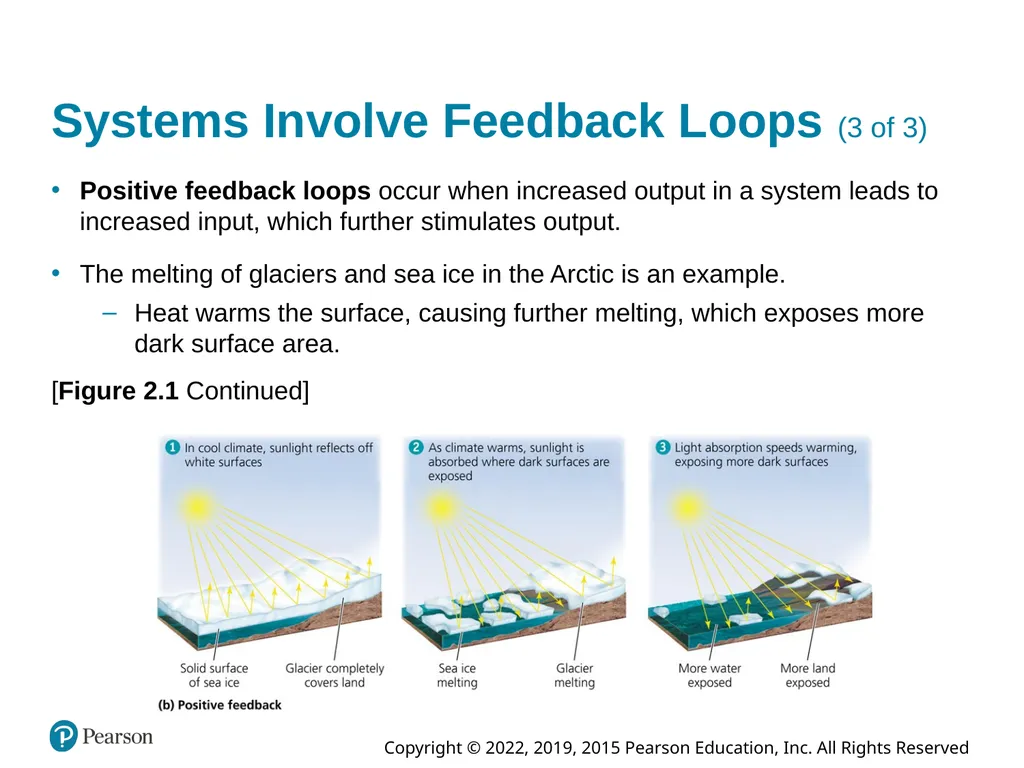
Systems Involve Feedback Loops (3 of 3) Positive feedback loops occur when increased output in a system leads to increased input, which further stimulates output.
The melting of glaciers and sea ice in the Arctic is an example.
Heat warms the surface, causing further melting, which exposes more dark surface area. [Figure 2.1 Continued]<br>
The melting of glaciers and sea ice in the Arctic is an example.
Heat warms the surface, causing further melting, which exposes more dark surface area. [Figure 2.1 Continued]<br>
11
Environmental Systems Interact (1 of 7) Systems are not isolated – they may exchange energy, matter, and information with other systems.
How a system is defined may depend on what you are studying.
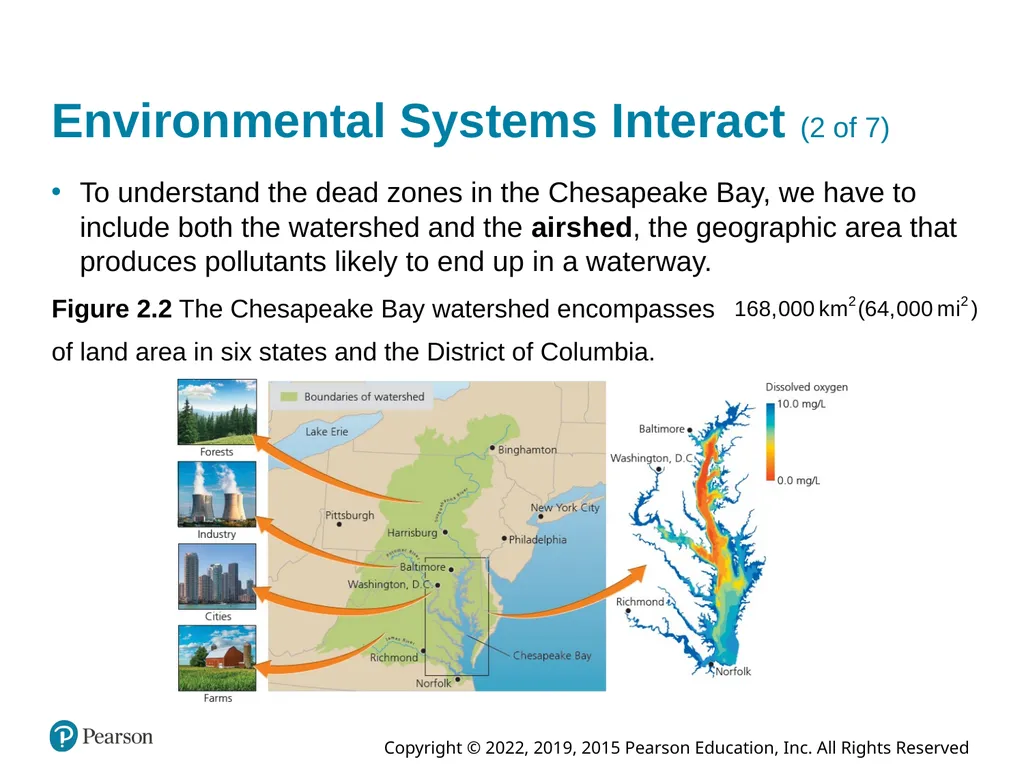
For example, a scientist studying runoff, precipitation that flows over land and into waterways, might define the Chesapeake Bay watershed as a system.
A scientist studying hypoxia would define the bay and its watershed as a system.<br>
How a system is defined may depend on what you are studying.
For example, a scientist studying runoff, precipitation that flows over land and into waterways, might define the Chesapeake Bay watershed as a system.
A scientist studying hypoxia would define the bay and its watershed as a system.<br>
12
Environmental Systems Interact (2 of 7) To understand the dead zones in the Chesapeake Bay, we have to include both the watershed and the airshed, the geographic area that produces pollutants likely to end up in a waterway. Figure 2.2 The Chesapeake Bay watershed encompasses of land area in six states and the District of Columbia.<br>
13
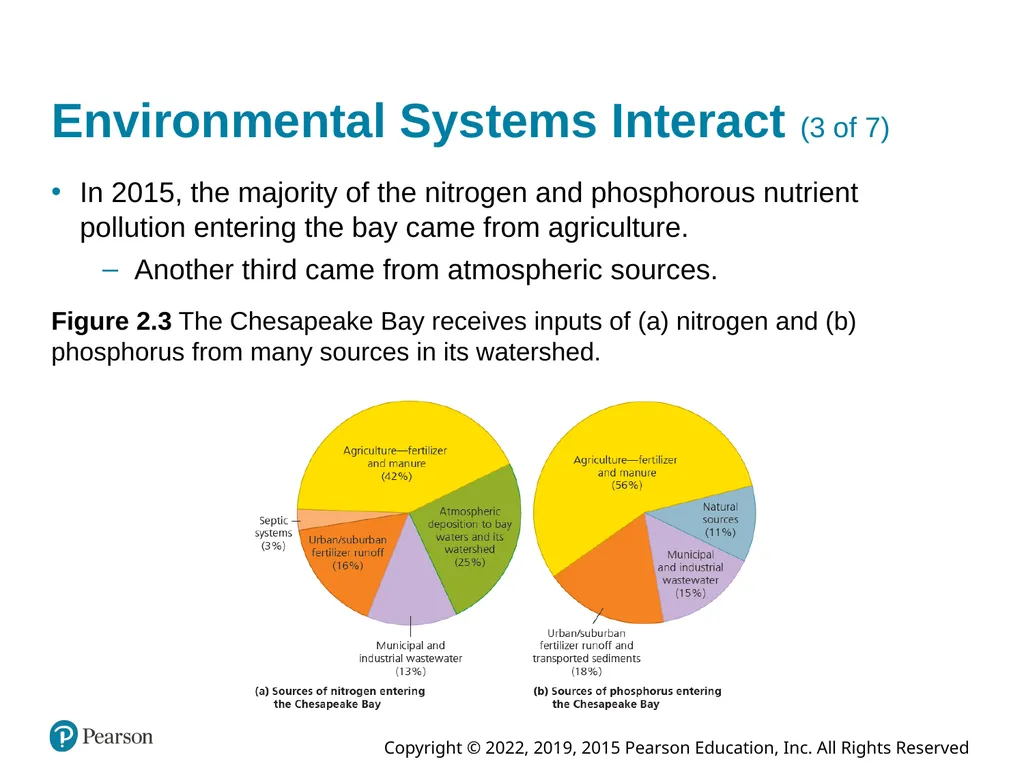
Environmental Systems Interact (3 of 7) In 2015, the majority of the nitrogen and phosphorous nutrient pollution entering the bay came from agriculture.
Another third came from atmospheric sources. Figure 2.3 The Chesapeake Bay receives inputs of (a) nitrogen and (b) phosphorus from many sources in its watershed.<br>
Another third came from atmospheric sources. Figure 2.3 The Chesapeake Bay receives inputs of (a) nitrogen and (b) phosphorus from many sources in its watershed.<br>
14
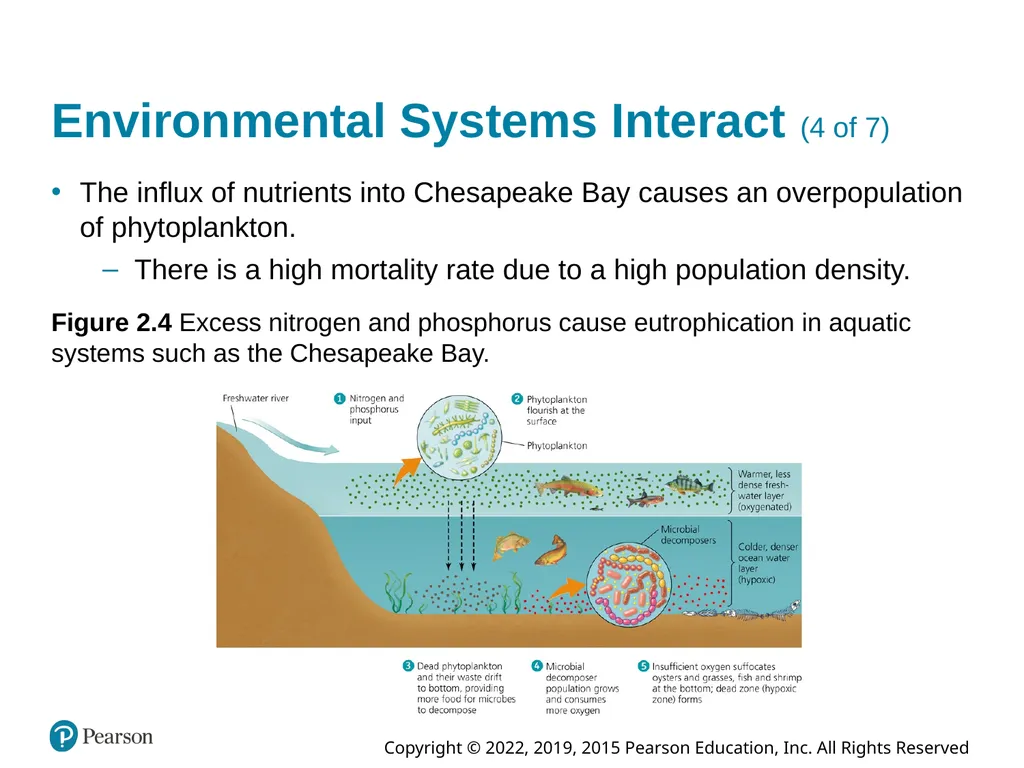
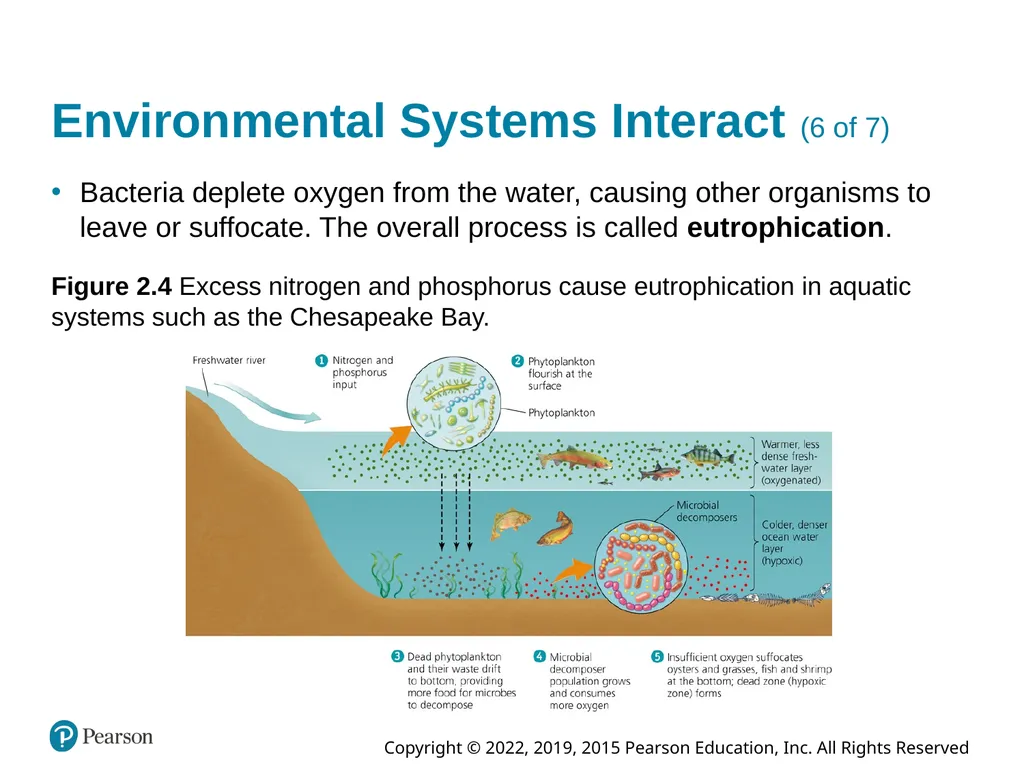
Environmental Systems Interact (4 of 7) The influx of nutrients into Chesapeake Bay causes an overpopulation of phytoplankton.
There is a high mortality rate due to a high population density. Figure 2.4 Excess nitrogen and phosphorus cause eutrophication in aquatic systems such as the Chesapeake Bay.<br>
There is a high mortality rate due to a high population density. Figure 2.4 Excess nitrogen and phosphorus cause eutrophication in aquatic systems such as the Chesapeake Bay.<br>
15
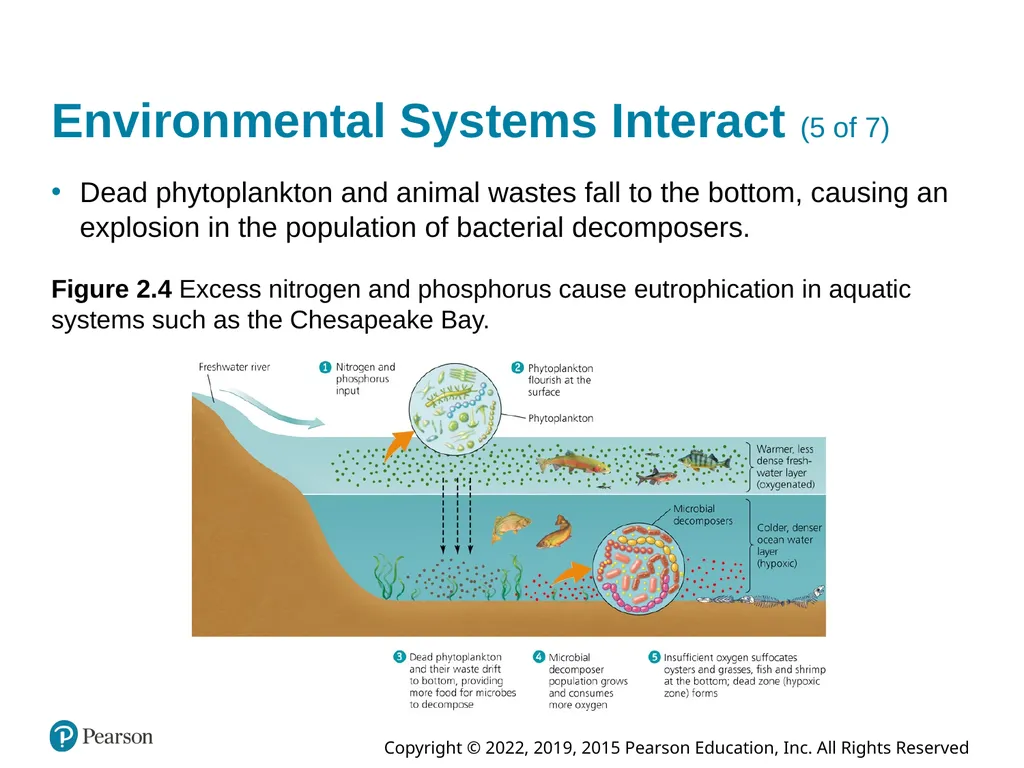
Environmental Systems Interact (5 of 7) Dead phytoplankton and animal wastes fall to the bottom, causing an explosion in the population of bacterial decomposers. Figure 2.4 Excess nitrogen and phosphorus cause eutrophication in aquatic systems such as the Chesapeake Bay.<br>
16
Environmental Systems Interact (6 of 7) Bacteria deplete oxygen from the water, causing other organisms to leave or suffocate. The overall process is called eutrophication. Figure 2.4 Excess nitrogen and phosphorus cause eutrophication in aquatic systems such as the Chesapeake Bay.<br>
17
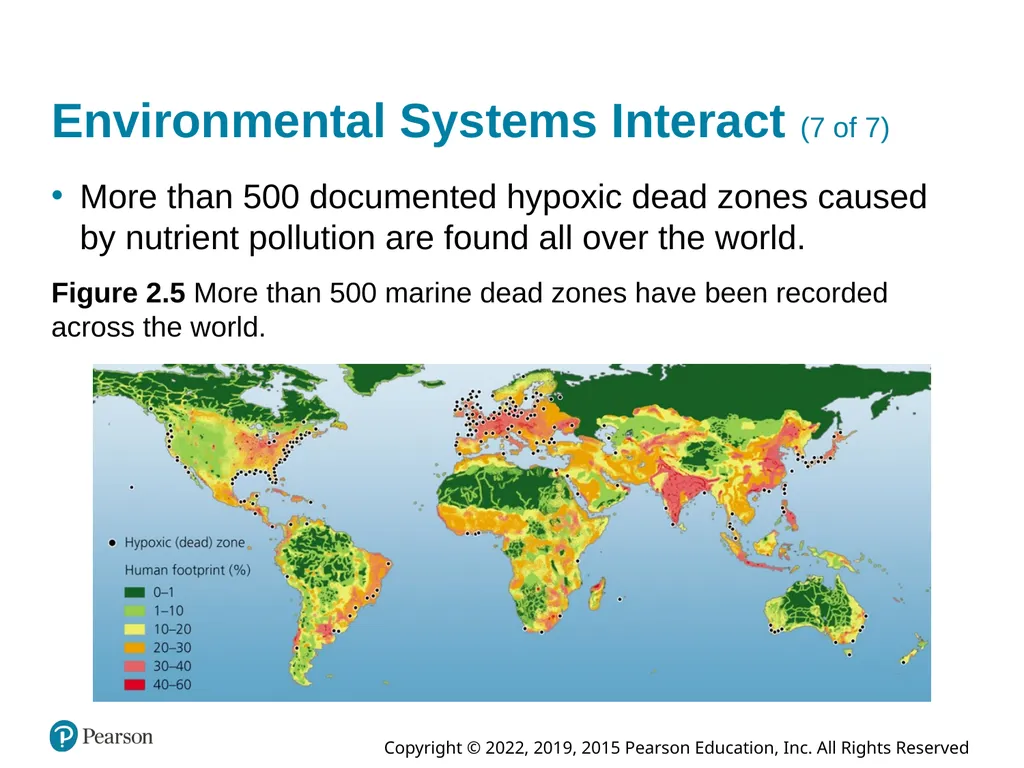
Environmental Systems Interact (7 of 7) More than 500 documented hypoxic dead zones caused by nutrient pollution are found all over the world. Figure 2.5 More than 500 marine dead zones have been recorded across the world.<br>
18
Matter, Chemistry, and the Environment Understanding the Fukushima Daiichi accident requires knowledge of the basic properties of matter, energy, and chemistry.
Matter is defined as any material that has mass and occupies space.
Chemistry studies the interaction of matter.<br>
Matter is defined as any material that has mass and occupies space.
Chemistry studies the interaction of matter.<br>
19
Matter Is Conserved The law of conservation of matter states that matter can be transformed from one type of substance to another, but not created or destroyed.
Matter in ecosystems constantly cycles.
Undesirable matter, like nuclear waste and pollution, can’t be destroyed.<br>
Matter in ecosystems constantly cycles.
Undesirable matter, like nuclear waste and pollution, can’t be destroyed.<br>
20
Atoms and Elements Are Chemical Building Blocks (1 of 7) Nuclear reactors use an element called uranium to power their reactors.
Elements are substances with specific properties that cannot be broken down into substances with other properties.
These are organized according to their properties and behavior by the periodic table of elements.<br>
Elements are substances with specific properties that cannot be broken down into substances with other properties.
These are organized according to their properties and behavior by the periodic table of elements.<br>
21
Atoms and Elements Are Chemical Building Blocks (2 of 7) Atoms are the smallest units that still have all of the element’s chemical properties.
Atoms of each element are made of three particles:
Protons, which are positively charged and determine the element’s atomic number.
Neutrons, which have no charge.
Electrons, which are negatively charged.
The most abundant elements in the Earth are oxygen, hydrogen, silicon, nitrogen, and carbon.<br>
Atoms of each element are made of three particles:
Protons, which are positively charged and determine the element’s atomic number.
Neutrons, which have no charge.
Electrons, which are negatively charged.
The most abundant elements in the Earth are oxygen, hydrogen, silicon, nitrogen, and carbon.<br>
22
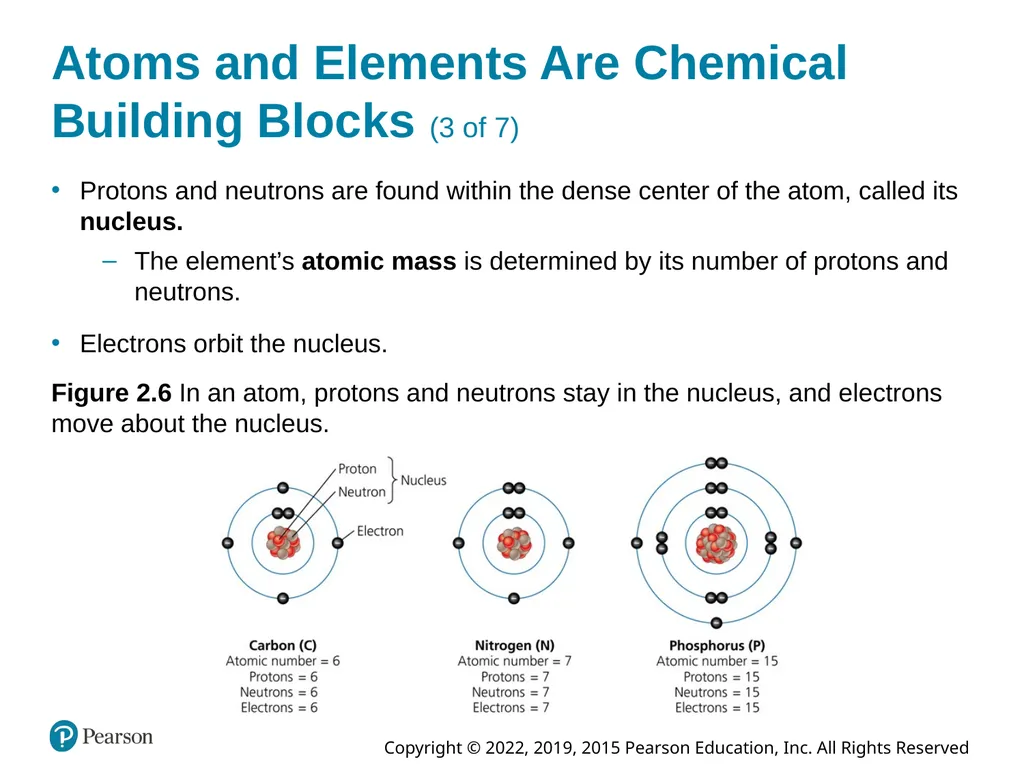
Atoms and Elements Are Chemical Building Blocks (3 of 7) Protons and neutrons are found within the dense center of the atom, called its nucleus.
The element’s atomic mass is determined by its number of protons and neutrons.
Electrons orbit the nucleus. Figure 2.6 In an atom, protons and neutrons stay in the nucleus, and electrons move about the nucleus.<br>
The element’s atomic mass is determined by its number of protons and neutrons.
Electrons orbit the nucleus. Figure 2.6 In an atom, protons and neutrons stay in the nucleus, and electrons move about the nucleus.<br>
23
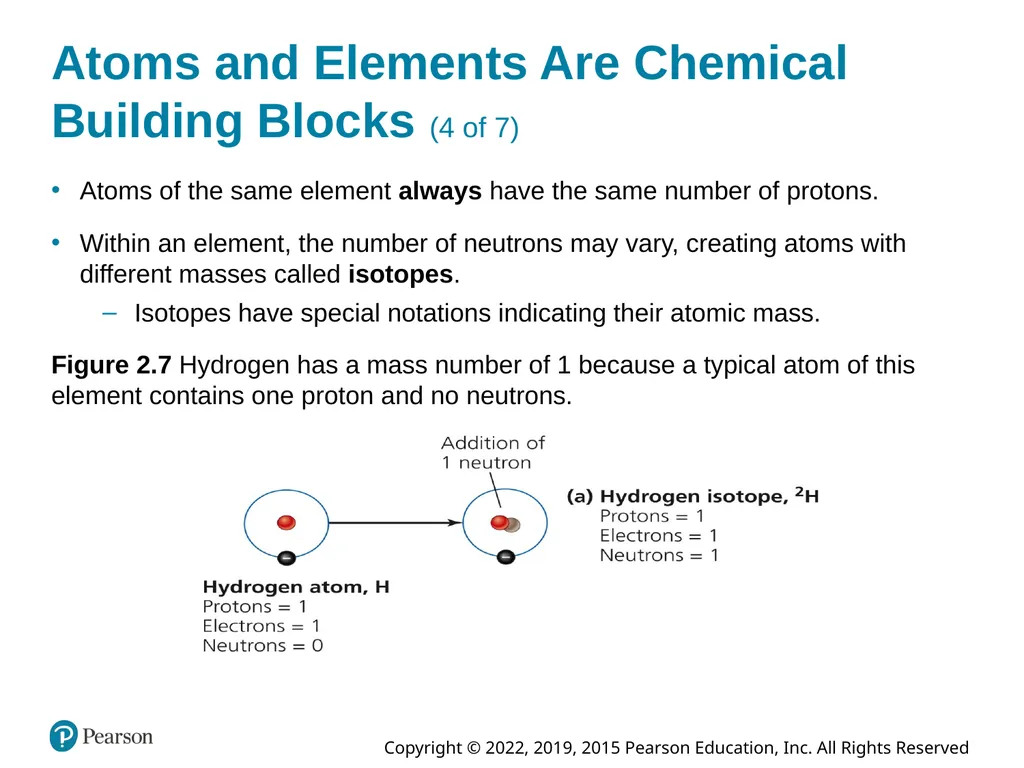
Atoms and Elements Are Chemical Building Blocks (4 of 7) Atoms of the same element always have the same number of protons.
Within an element, the number of neutrons may vary, creating atoms with different masses called isotopes.
Isotopes have special notations indicating their atomic mass. Figure 2.7 Hydrogen has a mass number of 1 because a typical atom of this element contains one proton and no neutrons.<br>
Within an element, the number of neutrons may vary, creating atoms with different masses called isotopes.
Isotopes have special notations indicating their atomic mass. Figure 2.7 Hydrogen has a mass number of 1 because a typical atom of this element contains one proton and no neutrons.<br>
24
Atoms and Elements Are Chemical Building Blocks (5 of 7) Some isotopes are radioactive, meaning they “decay” and change their identity by emitting subatomic particles and high-energy radiation.
Isotopes with this property are called radioisotopes.
Radioisotopes release a lot of energy in a short period of time, making them damaging to living tissue.<br>
Isotopes with this property are called radioisotopes.
Radioisotopes release a lot of energy in a short period of time, making them damaging to living tissue.<br>
25
Atoms and Elements Are Chemical Building Blocks (6 of 7) Radioisotopes decay into smaller and smaller radioisotopes, until they eventually become stable.
An isotope’s half-life indicates the amount of time it will take for half of its atoms to decay.
Uranium-235, a radioisotope used to generate nuclear power, has a half-life of about 700 million years.<br>
An isotope’s half-life indicates the amount of time it will take for half of its atoms to decay.
Uranium-235, a radioisotope used to generate nuclear power, has a half-life of about 700 million years.<br>
26
Atoms and Elements Are Chemical Building Blocks (7 of 7) Atoms may also gain or lose electrons, becoming charged ions.
The charge of an ion indicates how its electrons have been affected.
For example, C a2+ has lost two electrons, H+ has lost one. [Figure 2.7 Continued]<br>
The charge of an ion indicates how its electrons have been affected.
For example, C a2+ has lost two electrons, H+ has lost one. [Figure 2.7 Continued]<br>
27
Atoms Bond to Form Molecules and Compounds (1 of 2) Molecules are combinations of two or more atoms chemically bonded together, such as O2.
If the molecule is made of two or more different elements, it is classified as a compound.
Water, H2O, and carbon dioxide, C O2, are examples of compounds.
Atoms form bonds due to the interaction of their electrons.<br>
If the molecule is made of two or more different elements, it is classified as a compound.
Water, H2O, and carbon dioxide, C O2, are examples of compounds.
Atoms form bonds due to the interaction of their electrons.<br>
28
Atoms Bond to Form Molecules and Compounds (2 of 2) Ionic bonds occur when ions of different charges attract and bind to each other.
Sodium chloride, N a C l, is an example.
Covalent bonds form when electrons are shared between atoms that lack an electrical charge.
Hydrogen gas, H2, contains a covalent bond.
Atoms and molecules can also come together in mixtures, where they don’t react with each other.
Evenly distributed mixtures are called solutions.<br>
Sodium chloride, N a C l, is an example.
Covalent bonds form when electrons are shared between atoms that lack an electrical charge.
Hydrogen gas, H2, contains a covalent bond.
Atoms and molecules can also come together in mixtures, where they don’t react with each other.
Evenly distributed mixtures are called solutions.<br>
29
Hydrogen Ions Determine Acidity (1 of 2) In any aqueous solution, a small number of water molecules split apart into hydrogen ions (H+) and hydroxide ions (O H−).
Pure water contains equal concentrations of these two ions and is considered neutral.
Acidic solutions have higher concentrations of hydrogen ions.
Basic or alkaline solutions have higher concentrations of hydroxide ions.<br>
Pure water contains equal concentrations of these two ions and is considered neutral.
Acidic solutions have higher concentrations of hydrogen ions.
Basic or alkaline solutions have higher concentrations of hydroxide ions.<br>
30
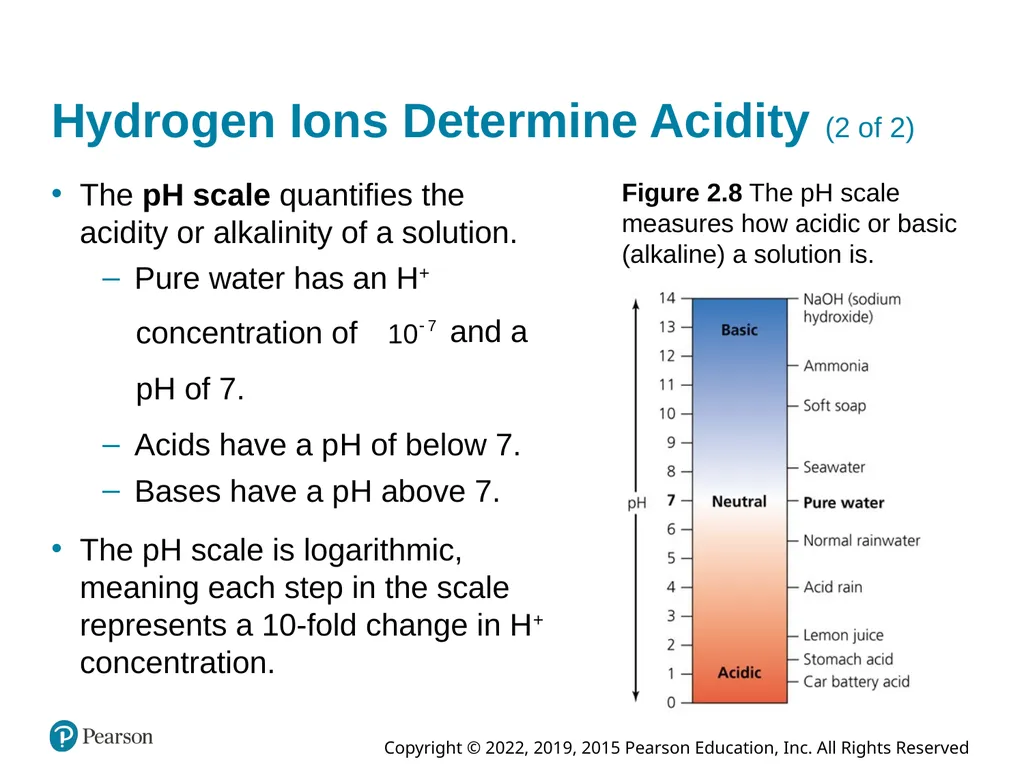
Hydrogen Ions Determine Acidity (2 of 2) The p H scale quantifies the acidity or alkalinity of a solution.
Pure water has an H+ concentration of and a p H of 7. Acids have a p H of below 7.
Bases have a p H above 7.
The p H scale is logarithmic, meaning each step in the scale represents a 10-fold change in H+ concentration. Figure 2.8 The p H scale measures how acidic or basic (alkaline) a solution is.<br>
Pure water has an H+ concentration of and a p H of 7. Acids have a p H of below 7.
Bases have a p H above 7.
The p H scale is logarithmic, meaning each step in the scale represents a 10-fold change in H+ concentration. Figure 2.8 The p H scale measures how acidic or basic (alkaline) a solution is.<br>
31
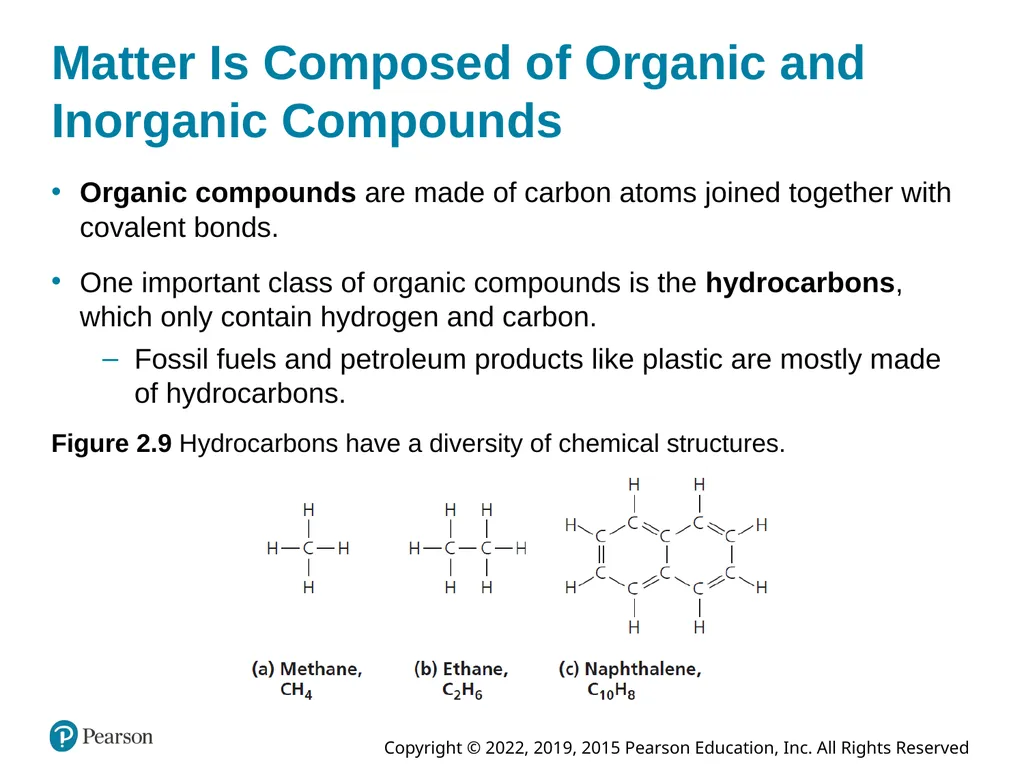
Matter Is Composed of Organic and Inorganic Compounds Organic compounds are made of carbon atoms joined together with covalent bonds.
One important class of organic compounds is the hydrocarbons, which only contain hydrogen and carbon.
Fossil fuels and petroleum products like plastic are mostly made of hydrocarbons. Figure 2.9 Hydrocarbons have a diversity of chemical structures.<br>
One important class of organic compounds is the hydrocarbons, which only contain hydrogen and carbon.
Fossil fuels and petroleum products like plastic are mostly made of hydrocarbons. Figure 2.9 Hydrocarbons have a diversity of chemical structures.<br>
32
Macromolecules Are the Building Blocks of Life (1 of 3) Organic compounds also include polymers, long chains of repeated molecules.
Polymers and lipids are referred to as macromolecules, because they are so large.
Proteins are polymers made of amino acids.
They are found in skin, hair, muscles, as part of the immune system, and as enzymes that catalyze chemical reactions.<br>
Polymers and lipids are referred to as macromolecules, because they are so large.
Proteins are polymers made of amino acids.
They are found in skin, hair, muscles, as part of the immune system, and as enzymes that catalyze chemical reactions.<br>
33
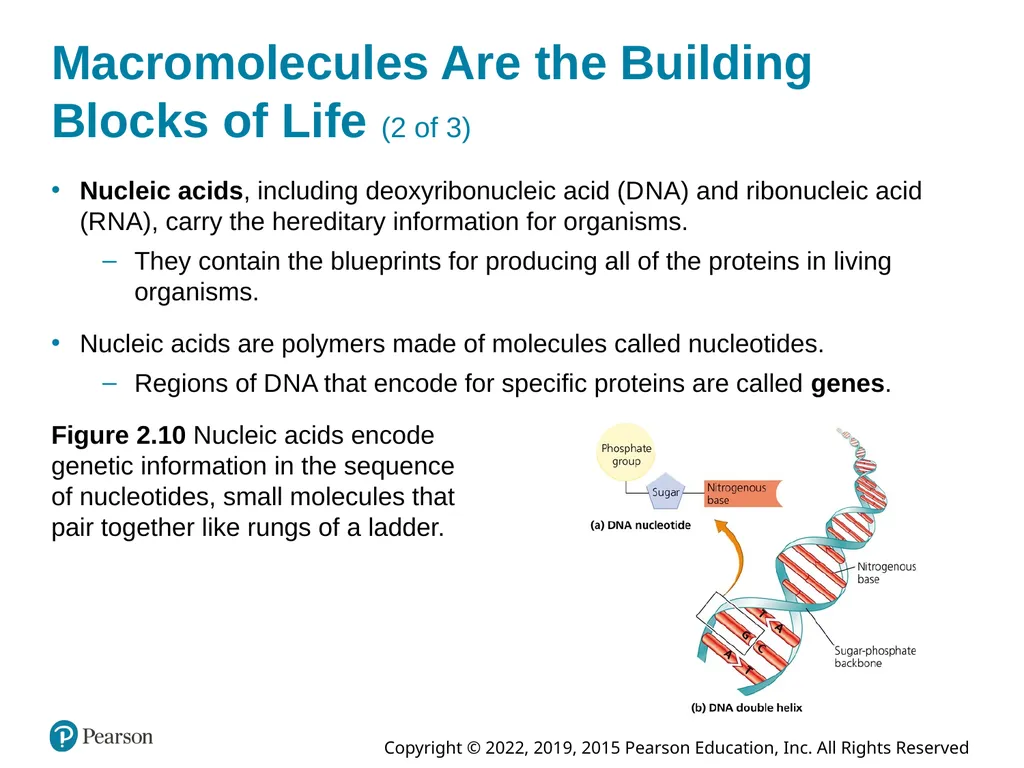
Macromolecules Are the Building Blocks of Life (2 of 3) Nucleic acids, including deoxyribonucleic acid (D N A) and ribonucleic acid (R N A), carry the hereditary information for organisms.
They contain the blueprints for producing all of the proteins in living organisms.
Nucleic acids are polymers made of molecules called nucleotides.
Regions of D N A that encode for specific proteins are called genes. Figure 2.10 Nucleic acids encode genetic information in the sequence of nucleotides, small molecules that pair together like rungs of a ladder.<br>
They contain the blueprints for producing all of the proteins in living organisms.
Nucleic acids are polymers made of molecules called nucleotides.
Regions of D N A that encode for specific proteins are called genes. Figure 2.10 Nucleic acids encode genetic information in the sequence of nucleotides, small molecules that pair together like rungs of a ladder.<br>
34
Macromolecules Are the Building Blocks of Life (3 of 3) Carbohydrates include simple and complex sugars, such as:
Glucose, or blood sugar.
Cellulose, a complex carbohydrate found in leaves, bark, stems, and roots.
Chitin, which is found in insect exoskeletons.
Lipids include a diverse group of molecules that do not dissolve in water:
Fats and oils, which store energy.
Waxes, which are structural.
Steroids, which are part of hormones.<br>
Glucose, or blood sugar.
Cellulose, a complex carbohydrate found in leaves, bark, stems, and roots.
Chitin, which is found in insect exoskeletons.
Lipids include a diverse group of molecules that do not dissolve in water:
Fats and oils, which store energy.
Waxes, which are structural.
Steroids, which are part of hormones.<br>
35
Energy: An Introduction (1 of 2) Energy is the capacity to change the position, composition, or temperature of matter.
Potential energy is the energy of position.
For example, river water held behind a dam contains potential energy.
Kinetic energy is the energy of motion.
River water rushing through a dam and downstream contains kinetic energy.
Energy is able to be converted back and forth between these two forms.<br>
Potential energy is the energy of position.
For example, river water held behind a dam contains potential energy.
Kinetic energy is the energy of motion.
River water rushing through a dam and downstream contains kinetic energy.
Energy is able to be converted back and forth between these two forms.<br>
36
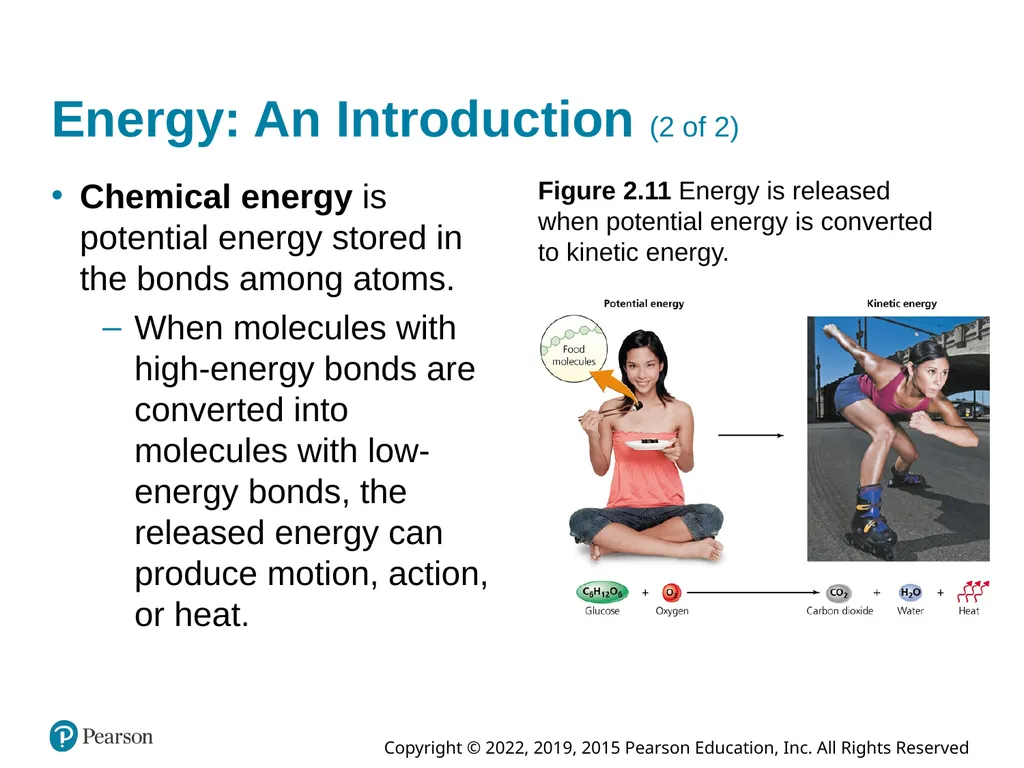
Energy: An Introduction (2 of 2) Chemical energy is potential energy stored in the bonds among atoms.
When molecules with high-energy bonds are converted into molecules with low-energy bonds, the released energy can produce motion, action, or heat. Figure 2.11 Energy is released when potential energy is converted to kinetic energy.<br>
When molecules with high-energy bonds are converted into molecules with low-energy bonds, the released energy can produce motion, action, or heat. Figure 2.11 Energy is released when potential energy is converted to kinetic energy.<br>
37
Energy Is Always Conserved, but It Changes in Quality (1 of 2) Energy can change from one form to another, but it cannot be created or destroyed.
This is the first law of thermodynamics.
The nature of energy tends to change from a more-ordered to a less-ordered state as it changes form.
This is the second law of thermodynamics.<br>
This is the first law of thermodynamics.
The nature of energy tends to change from a more-ordered to a less-ordered state as it changes form.
This is the second law of thermodynamics.<br>
38
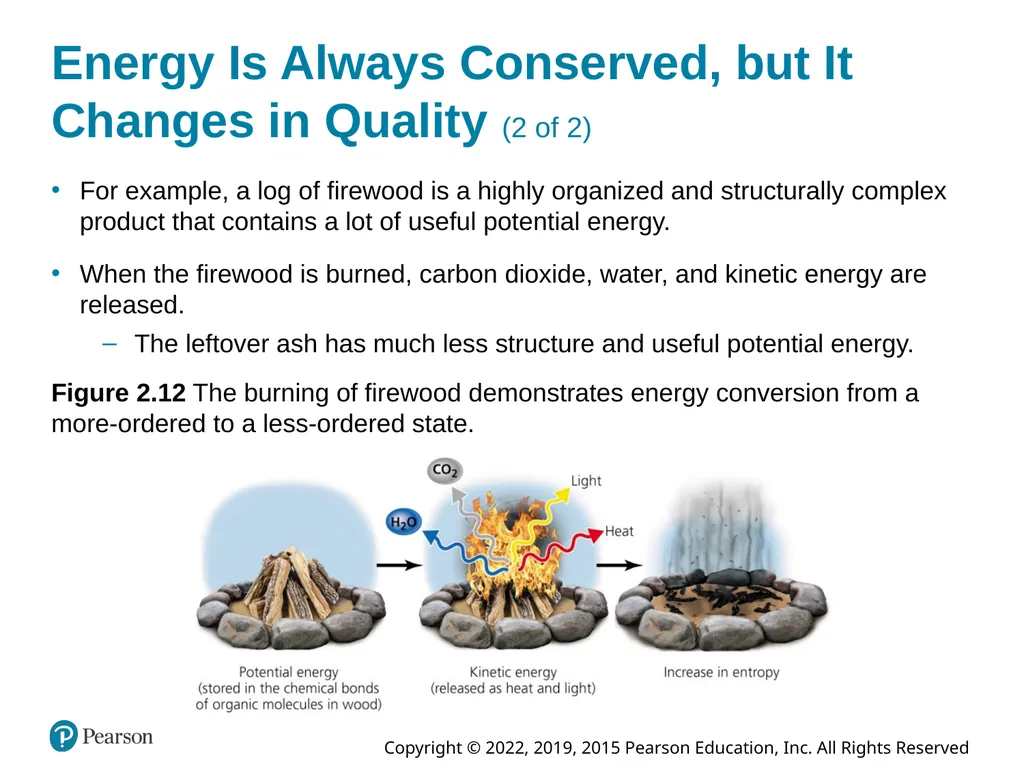
Energy Is Always Conserved, but It Changes in Quality (2 of 2) For example, a log of firewood is a highly organized and structurally complex product that contains a lot of useful potential energy.
When the firewood is burned, carbon dioxide, water, and kinetic energy are released.
The leftover ash has much less structure and useful potential energy. Figure 2.12 The burning of firewood demonstrates energy conversion from a more-ordered to a less-ordered state.<br>
When the firewood is burned, carbon dioxide, water, and kinetic energy are released.
The leftover ash has much less structure and useful potential energy. Figure 2.12 The burning of firewood demonstrates energy conversion from a more-ordered to a less-ordered state.<br>
39
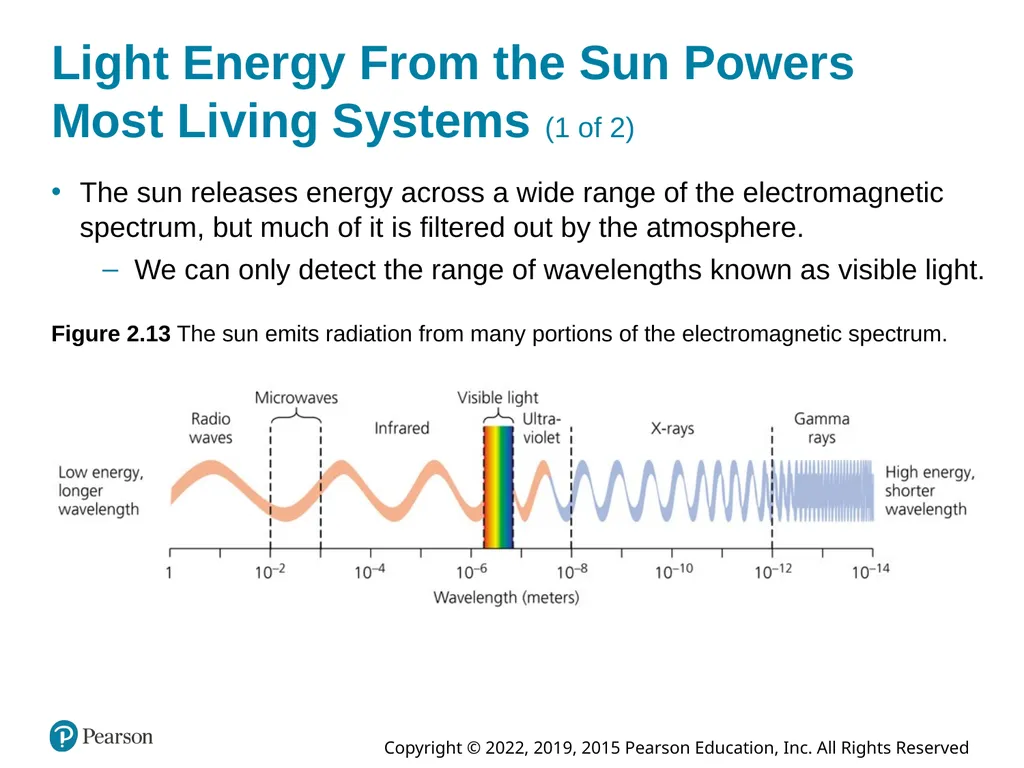
Light Energy From the Sun Powers Most Living Systems (1 of 2) The sun releases energy across a wide range of the electromagnetic spectrum, but much of it is filtered out by the atmosphere.
We can only detect the range of wavelengths known as visible light. Figure 2.13 The sun emits radiation from many portions of the electromagnetic spectrum.<br>
We can only detect the range of wavelengths known as visible light. Figure 2.13 The sun emits radiation from many portions of the electromagnetic spectrum.<br>
40
Light Energy From the Sun Powers Most Living Systems (2 of 2) Organisms called autotrophs use the sun’s radiation directly to produce their own food.
They use a process called photosynthesis to transform molecules with low-energy bonds (water and carbon dioxide) into sugar molecules with high-energy bonds.<br>
They use a process called photosynthesis to transform molecules with low-energy bonds (water and carbon dioxide) into sugar molecules with high-energy bonds.<br>
41
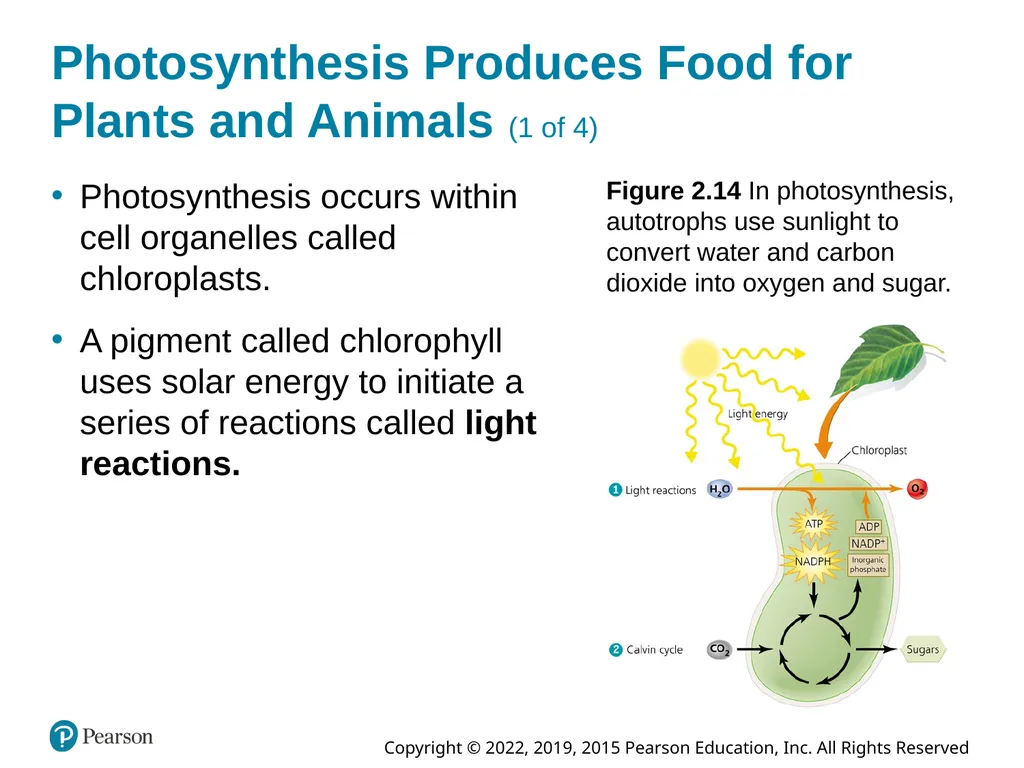
Photosynthesis Produces Food for Plants and Animals (1 of 4) Photosynthesis occurs within cell organelles called chloroplasts.
A pigment called chlorophyll uses solar energy to initiate a series of reactions called light reactions. Figure 2.14 In photosynthesis, autotrophs use sunlight to convert water and carbon dioxide into oxygen and sugar.<br>
A pigment called chlorophyll uses solar energy to initiate a series of reactions called light reactions. Figure 2.14 In photosynthesis, autotrophs use sunlight to convert water and carbon dioxide into oxygen and sugar.<br>
42
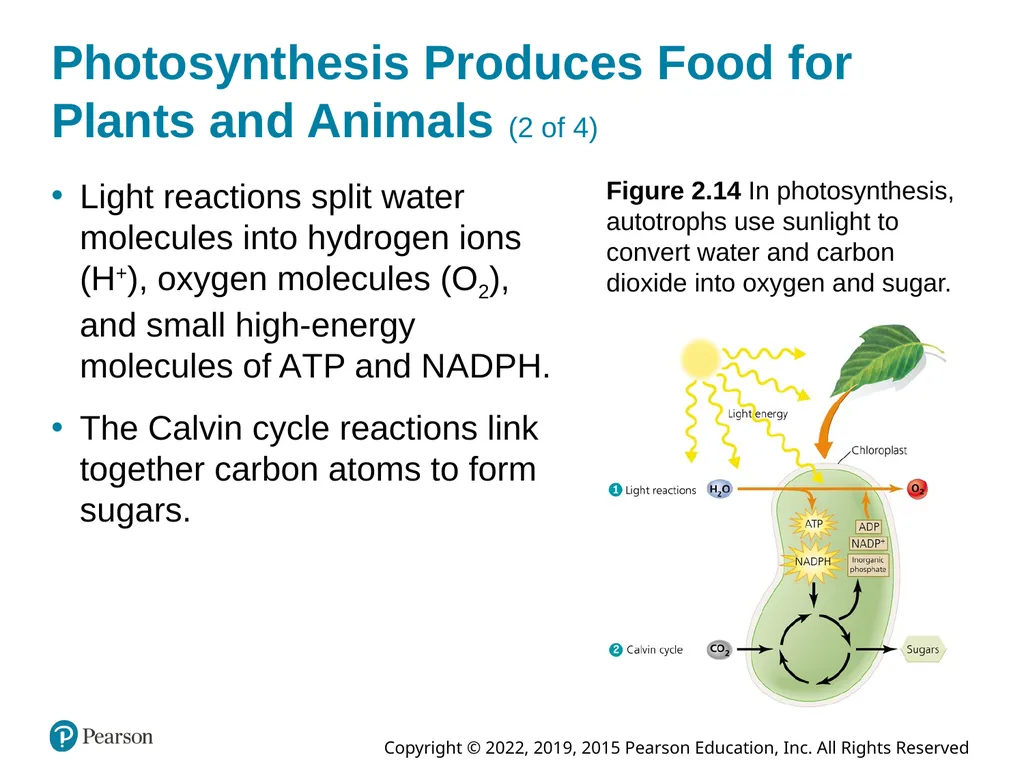
Photosynthesis Produces Food for Plants and Animals (2 of 4) Light reactions split water molecules into hydrogen ions (H+), oxygen molecules (O2), and small high-energy molecules of A T P and N A D P H.
The Calvin cycle reactions link together carbon atoms to form sugars. Figure 2.14 In photosynthesis, autotrophs use sunlight to convert water and carbon dioxide into oxygen and sugar.<br>
The Calvin cycle reactions link together carbon atoms to form sugars. Figure 2.14 In photosynthesis, autotrophs use sunlight to convert water and carbon dioxide into oxygen and sugar.<br>
43
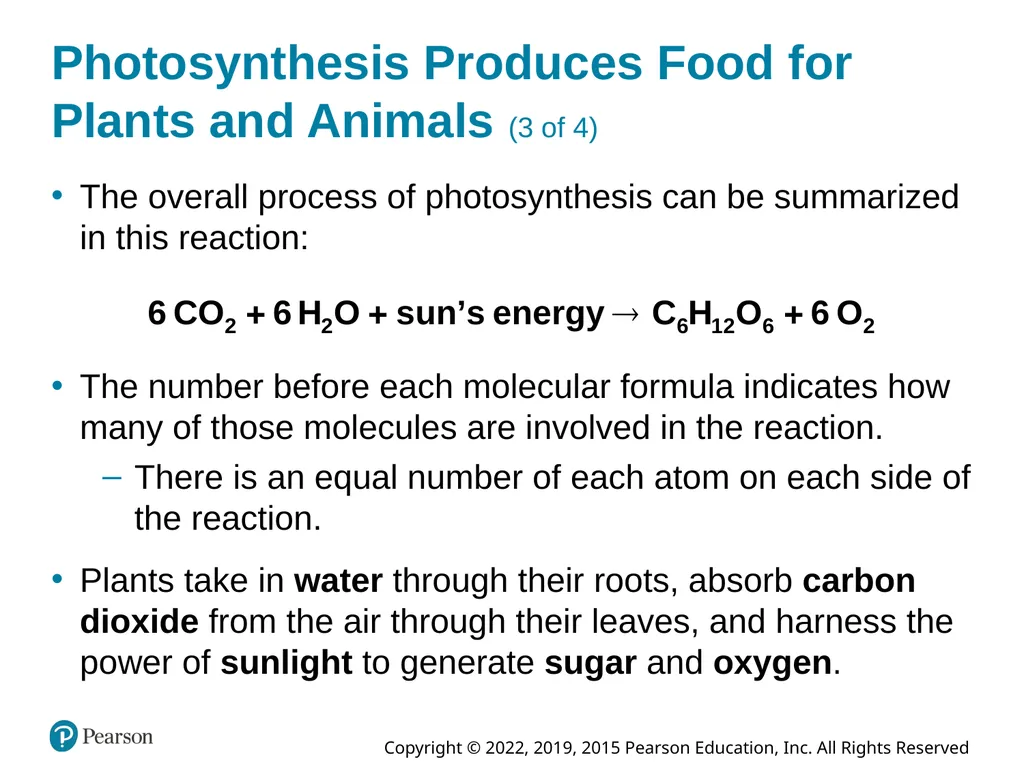
Photosynthesis Produces Food for Plants and Animals (3 of 4) The overall process of photosynthesis can be summarized in this reaction: The number before each molecular formula indicates how many of those molecules are involved in the reaction.
There is an equal number of each atom on each side of the reaction.
Plants take in water through their roots, absorb carbon dioxide from the air through their leaves, and harness the power of sunlight to generate sugar and oxygen.<br>
There is an equal number of each atom on each side of the reaction.
Plants take in water through their roots, absorb carbon dioxide from the air through their leaves, and harness the power of sunlight to generate sugar and oxygen.<br>
44
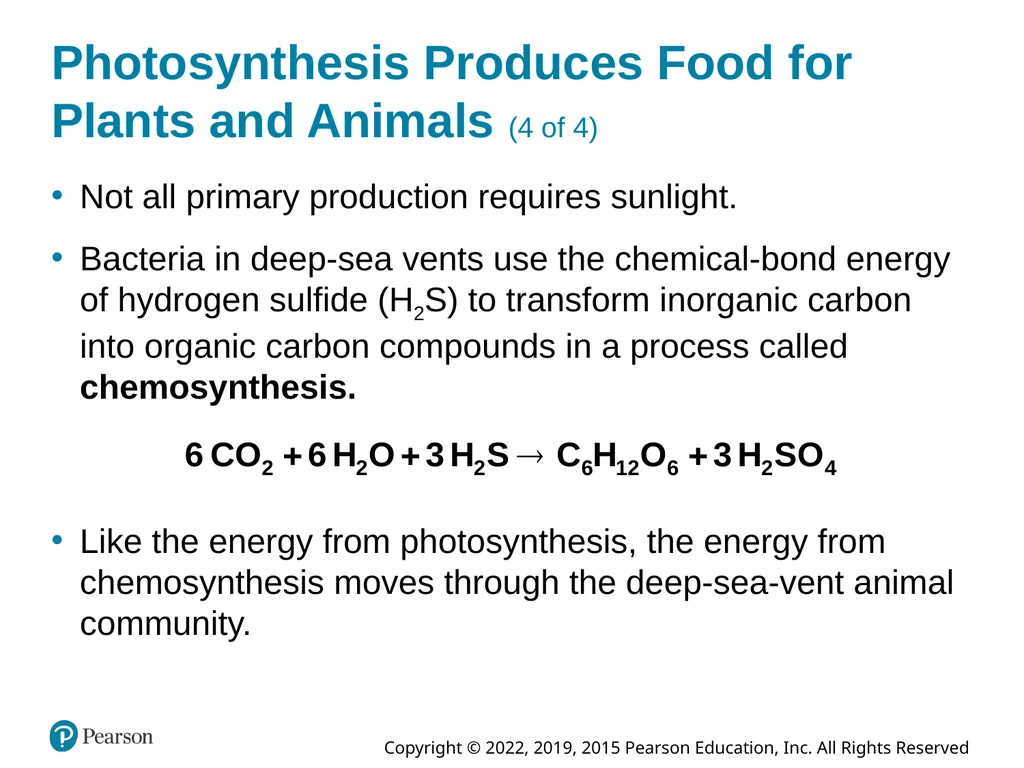
Photosynthesis Produces Food for Plants and Animals (4 of 4) Not all primary production requires sunlight.
Bacteria in deep-sea vents use the chemical-bond energy of hydrogen sulfide (H2S) to transform inorganic carbon into organic carbon compounds in a process called chemosynthesis. Like the energy from photosynthesis, the energy from chemosynthesis moves through the deep-sea-vent animal community.<br>
Bacteria in deep-sea vents use the chemical-bond energy of hydrogen sulfide (H2S) to transform inorganic carbon into organic carbon compounds in a process called chemosynthesis. Like the energy from photosynthesis, the energy from chemosynthesis moves through the deep-sea-vent animal community.<br>
45
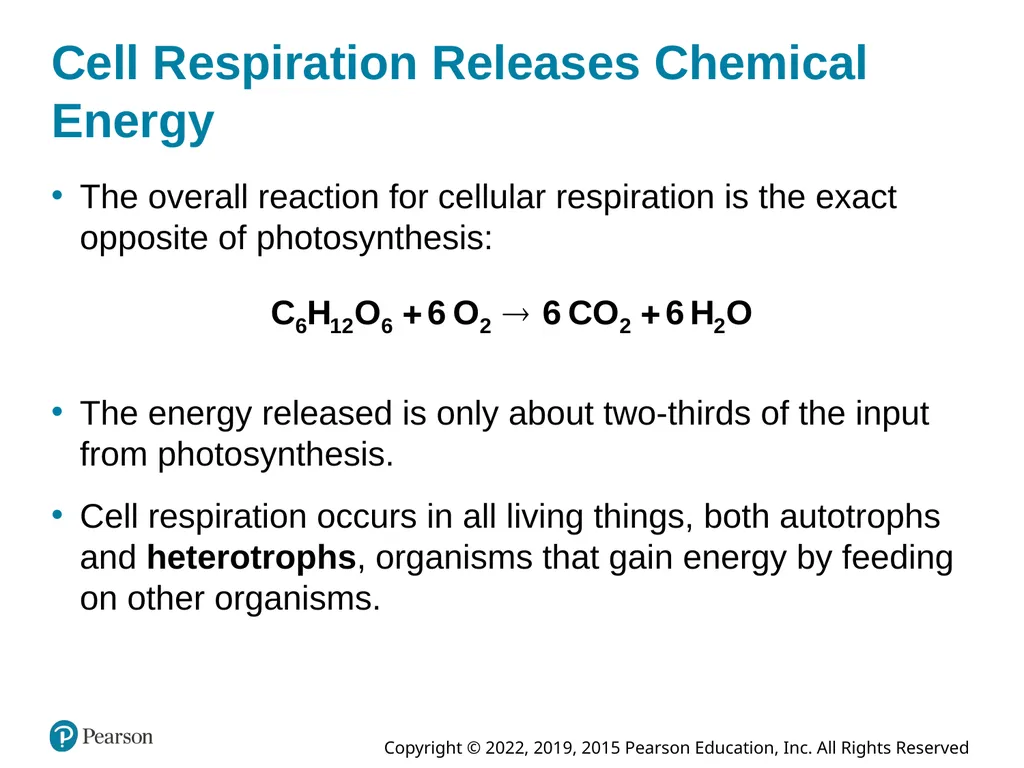
Cell Respiration Releases Chemical Energy The overall reaction for cellular respiration is the exact opposite of photosynthesis: The energy released is only about two-thirds of the input from photosynthesis.
Cell respiration occurs in all living things, both autotrophs and heterotrophs, organisms that gain energy by feeding on other organisms.<br>
Cell respiration occurs in all living things, both autotrophs and heterotrophs, organisms that gain energy by feeding on other organisms.<br>
46
Ecosystems An ecosystem consists of all organisms and nonliving entities that occur and interact in a particular area at the same time.
Ecological communities only include living organisms.
In ecosystems, energy flows and matter cycles between the living and nonliving components.<br>
Ecological communities only include living organisms.
In ecosystems, energy flows and matter cycles between the living and nonliving components.<br>
47
Ecosystems Are Systems of Interacting Living and Nonliving Entities The Chesapeake Bay estuary is an ecosystem where rivers flow into the ocean, mixing salt and fresh water.
Organisms are affected by the flow of water, nutrients, and sediment from the rivers.
The chemical and physical conditions of the bay’s waters are affected by the photosynthesis, respiration, and decomposition of its life.<br>
Organisms are affected by the flow of water, nutrients, and sediment from the rivers.
The chemical and physical conditions of the bay’s waters are affected by the photosynthesis, respiration, and decomposition of its life.<br>
48
Energy Is Converted Into Biomass The conversion of solar energy into chemical bonds in sugars is called primary production.
The total chemical energy produced by autotrophs is called gross primary production.
The energy that remains after respiration is used to generate biomass (leaves, stems, and roots) is net primary production.
Energy used by consumers to generate their own biomass is secondary production.<br>
The total chemical energy produced by autotrophs is called gross primary production.
The energy that remains after respiration is used to generate biomass (leaves, stems, and roots) is net primary production.
Energy used by consumers to generate their own biomass is secondary production.<br>
49
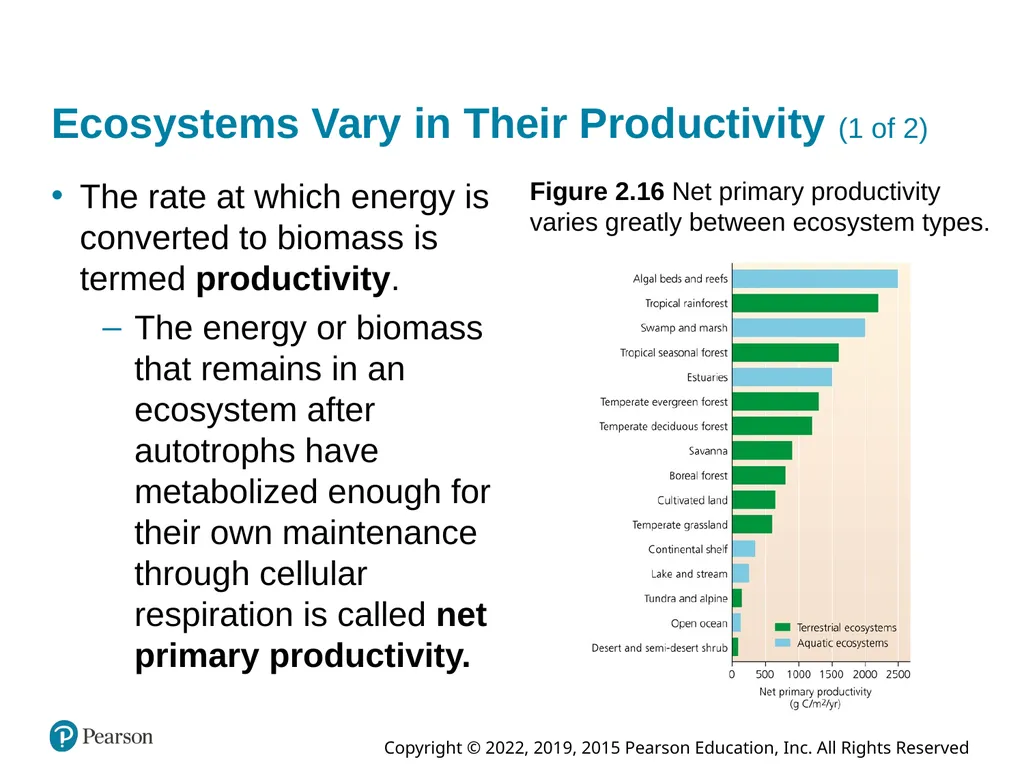
Ecosystems Vary in Their Productivity (1 of 2) The rate at which energy is converted to biomass is termed productivity.
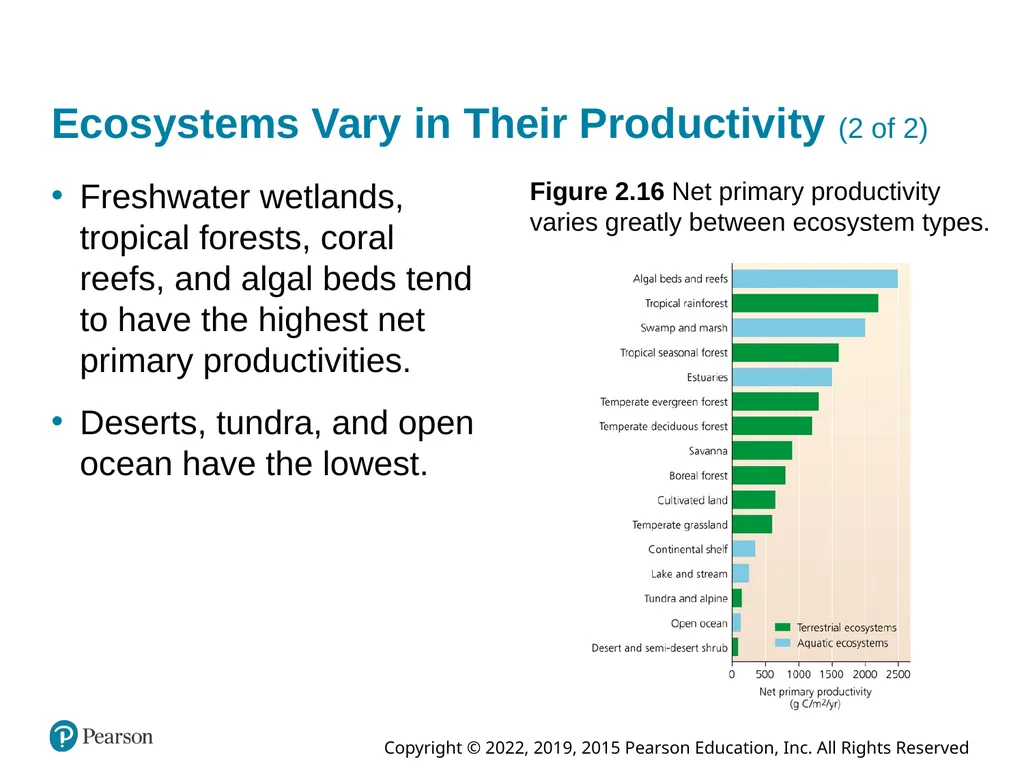
The energy or biomass that remains in an ecosystem after autotrophs have metabolized enough for their own maintenance through cellular respiration is called net primary productivity. Figure 2.16 Net primary productivity varies greatly between ecosystem types.<br>
The energy or biomass that remains in an ecosystem after autotrophs have metabolized enough for their own maintenance through cellular respiration is called net primary productivity. Figure 2.16 Net primary productivity varies greatly between ecosystem types.<br>
50
Ecosystems Vary in Their Productivity (2 of 2) Freshwater wetlands, tropical forests, coral reefs, and algal beds tend to have the highest net primary productivities.
Deserts, tundra, and open ocean have the lowest. Figure 2.16 Net primary productivity varies greatly between ecosystem types.<br>
Deserts, tundra, and open ocean have the lowest. Figure 2.16 Net primary productivity varies greatly between ecosystem types.<br>
51
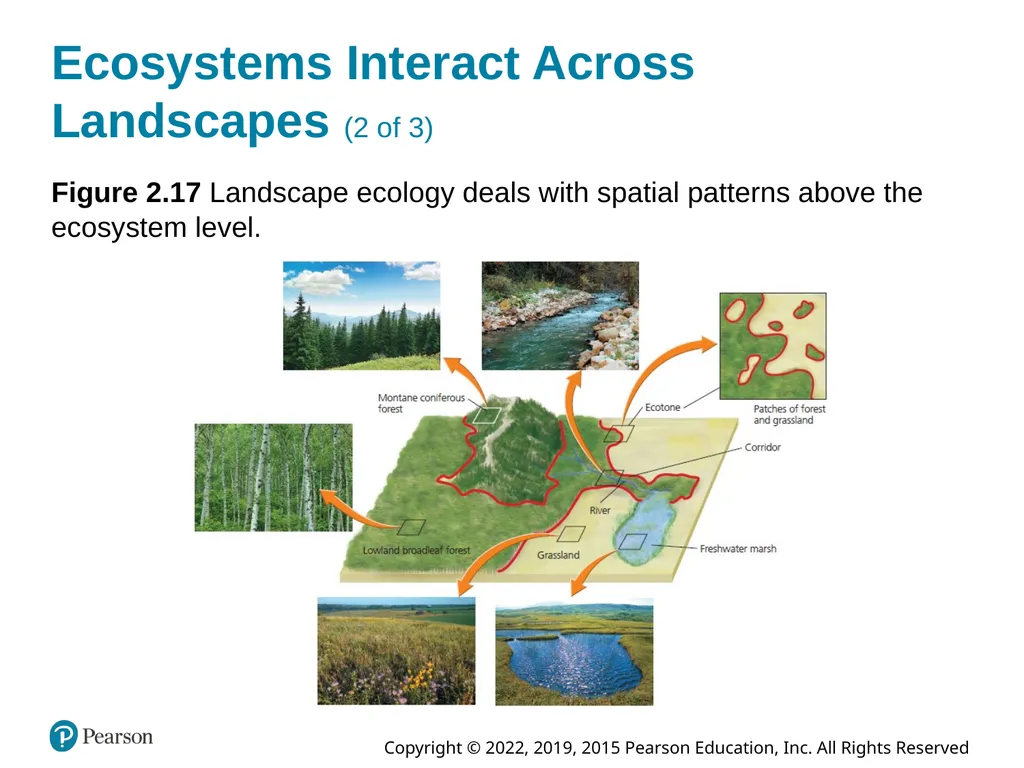
Ecosystems Interact Across Landscapes (1 of 3) Ecosystems occur at different scales; for example, adjacent ecosystems may interact and share resources extensively.
Areas where ecosystems meet in a transitional zone are called ecotones.
In landscape ecology, scientists view systems on a larger geographic scale that includes multiple ecosystems.
A landscape is made of a spatial array of patches, which may be specific ecosystems or areas of habitat of an organism.
Patches are spread out spatially over a landscape in a mosaic.<br>
Areas where ecosystems meet in a transitional zone are called ecotones.
In landscape ecology, scientists view systems on a larger geographic scale that includes multiple ecosystems.
A landscape is made of a spatial array of patches, which may be specific ecosystems or areas of habitat of an organism.
Patches are spread out spatially over a landscape in a mosaic.<br>
52
Ecosystems Interact Across Landscapes (2 of 3) Figure 2.17 Landscape ecology deals with spatial patterns above the ecosystem level.<br>
53
Ecosystems Interact Across Landscapes (3 of 3) Conservation biologists study the loss, protection, and restoration of biodiversity in landscapes.
Landscape-level analyses are aided by satellite imaging and computer software that layer multiple sets of data called geographic information systems (G I S).
G I S includes data on geology, hydrology, vegetation, animal species, human development, and more.
G I S is used in the Chesapeake Bay to monitor its restoration progress.<br>
Landscape-level analyses are aided by satellite imaging and computer software that layer multiple sets of data called geographic information systems (G I S).
G I S includes data on geology, hydrology, vegetation, animal species, human development, and more.
G I S is used in the Chesapeake Bay to monitor its restoration progress.<br>
54
Modeling Helps Ecologists Understand Systems (1 of 2) The biosphere contains many complex systems, which are often studied as models.
A model is a simplified representation of a complex natural process.
Ecological modeling involves constructing and testing models to explain and predict ecological systems.<br>
A model is a simplified representation of a complex natural process.
Ecological modeling involves constructing and testing models to explain and predict ecological systems.<br>
55
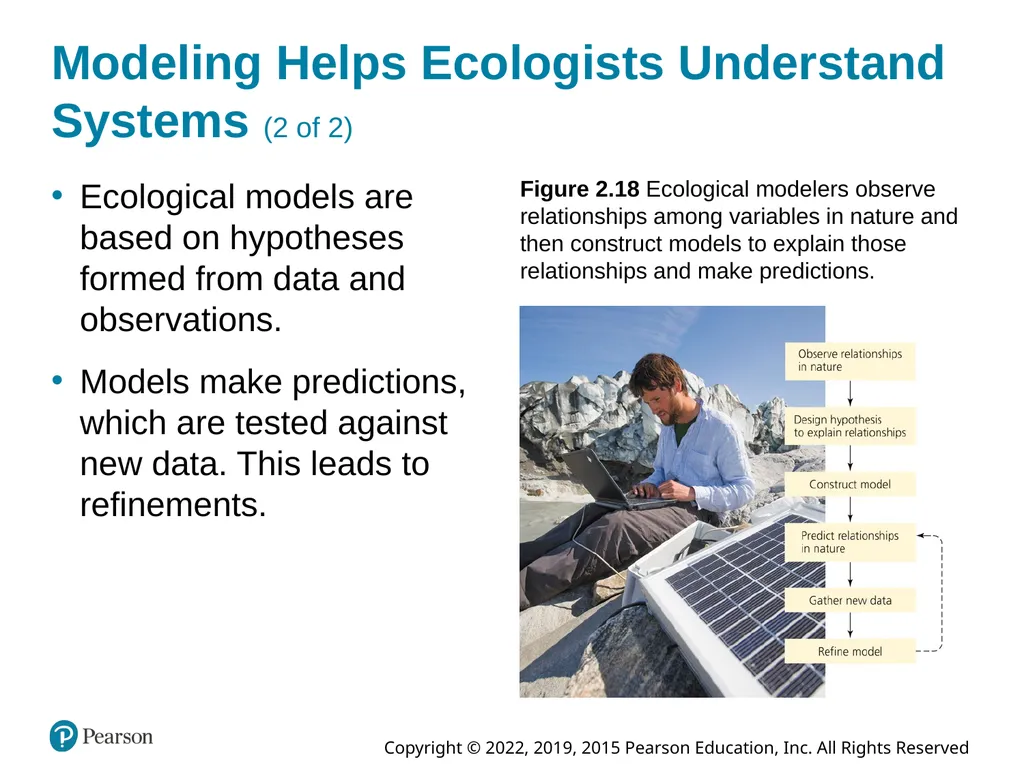
Modeling Helps Ecologists Understand Systems (2 of 2) Ecological models are based on hypotheses formed from data and observations.
Models make predictions, which are tested against new data. This leads to refinements. Figure 2.18 Ecological modelers observe relationships among variables in nature and then construct models to explain those relationships and make predictions.<br>
Models make predictions, which are tested against new data. This leads to refinements. Figure 2.18 Ecological modelers observe relationships among variables in nature and then construct models to explain those relationships and make predictions.<br>
56
Ecosystem Services Sustain Our World Human society depends on the services provided by ecological processes, including:
Soil formation
Water purification
Pollination
Breakdown of biodegradable waste
Stability of negative feedback cycles
The most important may be the cycling of the elements we call macronutrients and micronutrients.<br>
Soil formation
Water purification
Pollination
Breakdown of biodegradable waste
Stability of negative feedback cycles
The most important may be the cycling of the elements we call macronutrients and micronutrients.<br>
57
Biogeochemical Cycles (1 of 2) Nutrients move through ecosystems in nutrient cycles, also known as biogeochemical cycles.
Elements or molecules travel through the atmosphere, hydrosphere, lithosphere, and biosphere in dynamic equilibrium.
Nutrients move from one reservoir, or pool, to another for varying amounts of time, called the residence time.
You, a cow, grass, sedimentary rocks, and the atmosphere are all reservoirs for carbon.<br>
Elements or molecules travel through the atmosphere, hydrosphere, lithosphere, and biosphere in dynamic equilibrium.
Nutrients move from one reservoir, or pool, to another for varying amounts of time, called the residence time.
You, a cow, grass, sedimentary rocks, and the atmosphere are all reservoirs for carbon.<br>
58
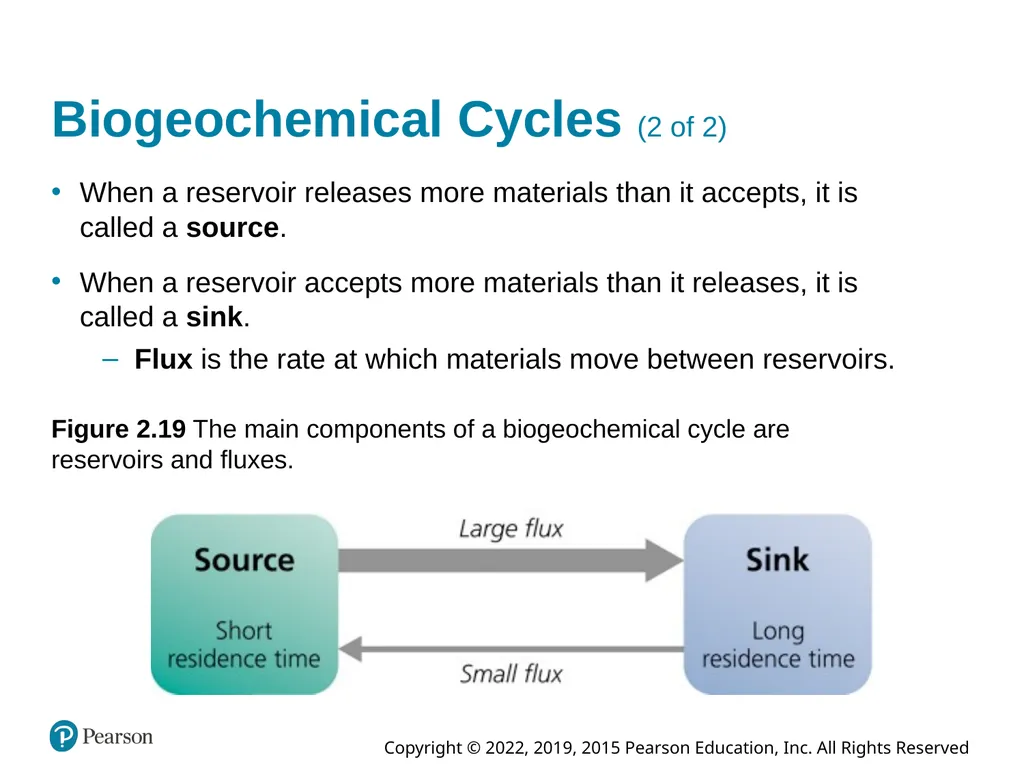
Biogeochemical Cycles (2 of 2) When a reservoir releases more materials than it accepts, it is called a source.
When a reservoir accepts more materials than it releases, it is called a sink.
Flux is the rate at which materials move between reservoirs. Figure 2.19 The main components of a biogeochemical cycle are reservoirs and fluxes.<br>
When a reservoir accepts more materials than it releases, it is called a sink.
Flux is the rate at which materials move between reservoirs. Figure 2.19 The main components of a biogeochemical cycle are reservoirs and fluxes.<br>
59
The Water Cycle Affects All Other Cycles (1 of 7) Water is the medium for all biochemical reactions, and it plays key roles in nearly every environmental system.
Carries nutrients, sediments, and pollution.
Returns atmospheric pollutants to the surface through rain or snow.
The hydrologic cycle summarizes how water flows as a solid, liquid, and gas through our environment.
The oceans are the main reservoir (97%) for water.
Only about 3% of water is fresh water, and two-thirds of that is frozen in glaciers, ice caps, and snowfields.<br>
Carries nutrients, sediments, and pollution.
Returns atmospheric pollutants to the surface through rain or snow.
The hydrologic cycle summarizes how water flows as a solid, liquid, and gas through our environment.
The oceans are the main reservoir (97%) for water.
Only about 3% of water is fresh water, and two-thirds of that is frozen in glaciers, ice caps, and snowfields.<br>
60
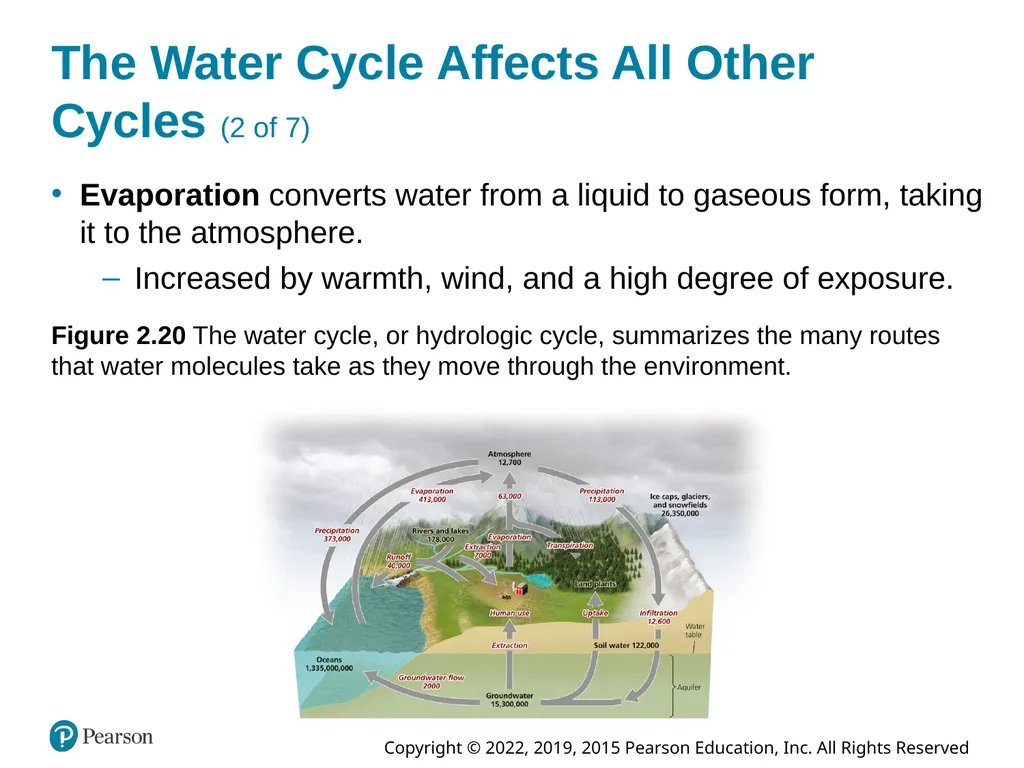
The Water Cycle Affects All Other Cycles (2 of 7) Evaporation converts water from a liquid to gaseous form, taking it to the atmosphere.
Increased by warmth, wind, and a high degree of exposure. Figure 2.20 The water cycle, or hydrologic cycle, summarizes the many routes that water molecules take as they move through the environment.<br>
Increased by warmth, wind, and a high degree of exposure. Figure 2.20 The water cycle, or hydrologic cycle, summarizes the many routes that water molecules take as they move through the environment.<br>
61
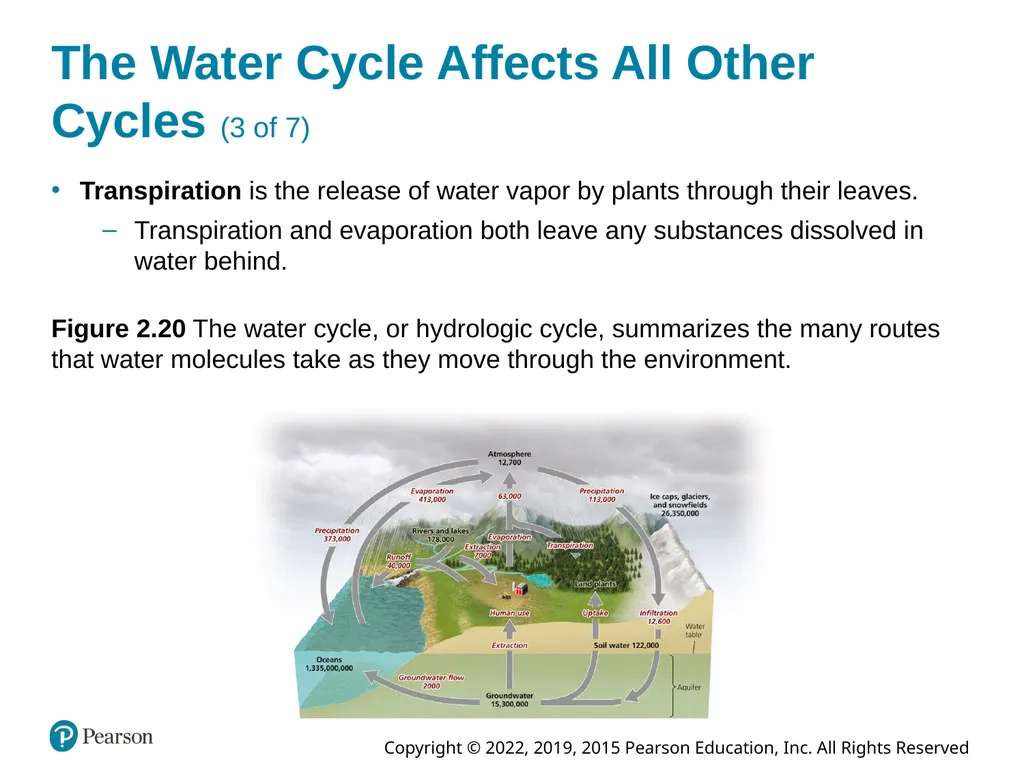
The Water Cycle Affects All Other Cycles (3 of 7) Transpiration is the release of water vapor by plants through their leaves.
Transpiration and evaporation both leave any substances dissolved in water behind. Figure 2.20 The water cycle, or hydrologic cycle, summarizes the many routes that water molecules take as they move through the environment.<br>
Transpiration and evaporation both leave any substances dissolved in water behind. Figure 2.20 The water cycle, or hydrologic cycle, summarizes the many routes that water molecules take as they move through the environment.<br>
62
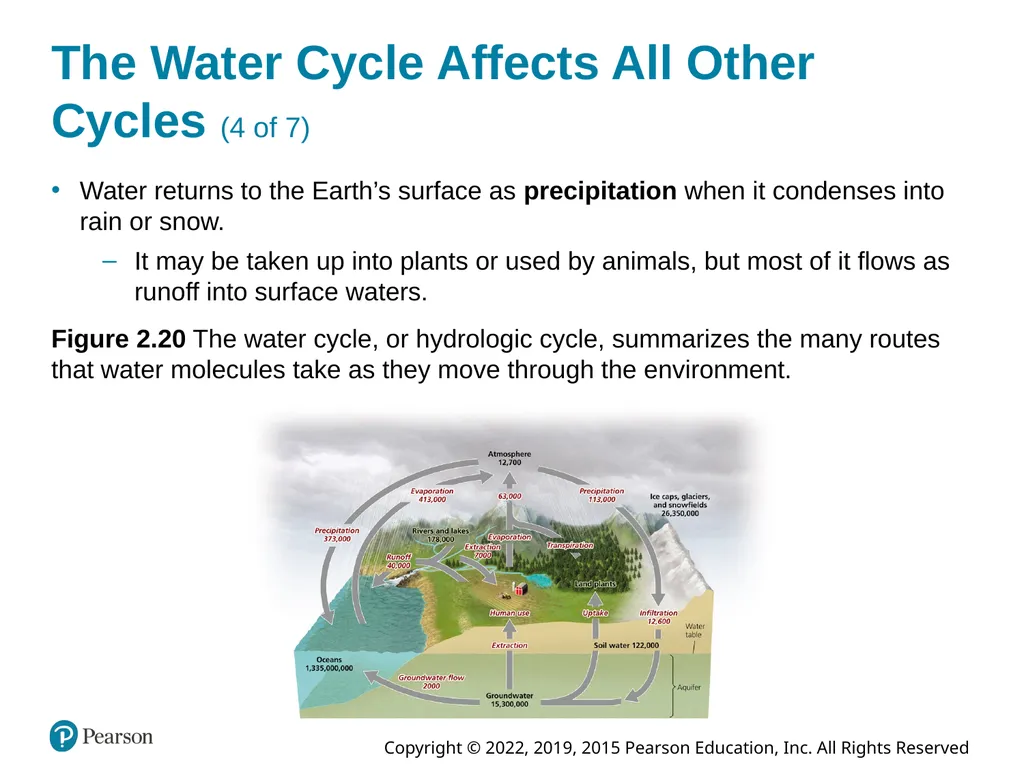
The Water Cycle Affects All Other Cycles (4 of 7) Water returns to the Earth’s surface as precipitation when it condenses into rain or snow.
It may be taken up into plants or used by animals, but most of it flows as runoff into surface waters. Figure 2.20 The water cycle, or hydrologic cycle, summarizes the many routes that water molecules take as they move through the environment.<br>
It may be taken up into plants or used by animals, but most of it flows as runoff into surface waters. Figure 2.20 The water cycle, or hydrologic cycle, summarizes the many routes that water molecules take as they move through the environment.<br>
63
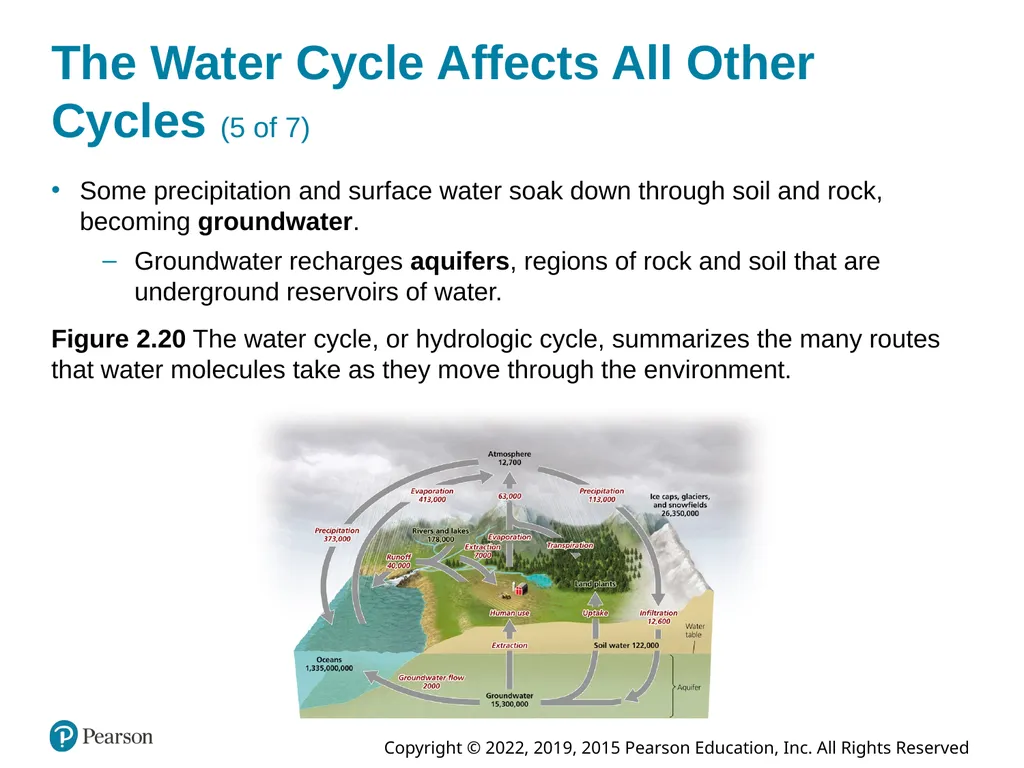
The Water Cycle Affects All Other Cycles (5 of 7) Some precipitation and surface water soak down through soil and rock, becoming groundwater.
Groundwater recharges aquifers, regions of rock and soil that are underground reservoirs of water. Figure 2.20 The water cycle, or hydrologic cycle, summarizes the many routes that water molecules take as they move through the environment.<br>
Groundwater recharges aquifers, regions of rock and soil that are underground reservoirs of water. Figure 2.20 The water cycle, or hydrologic cycle, summarizes the many routes that water molecules take as they move through the environment.<br>
64
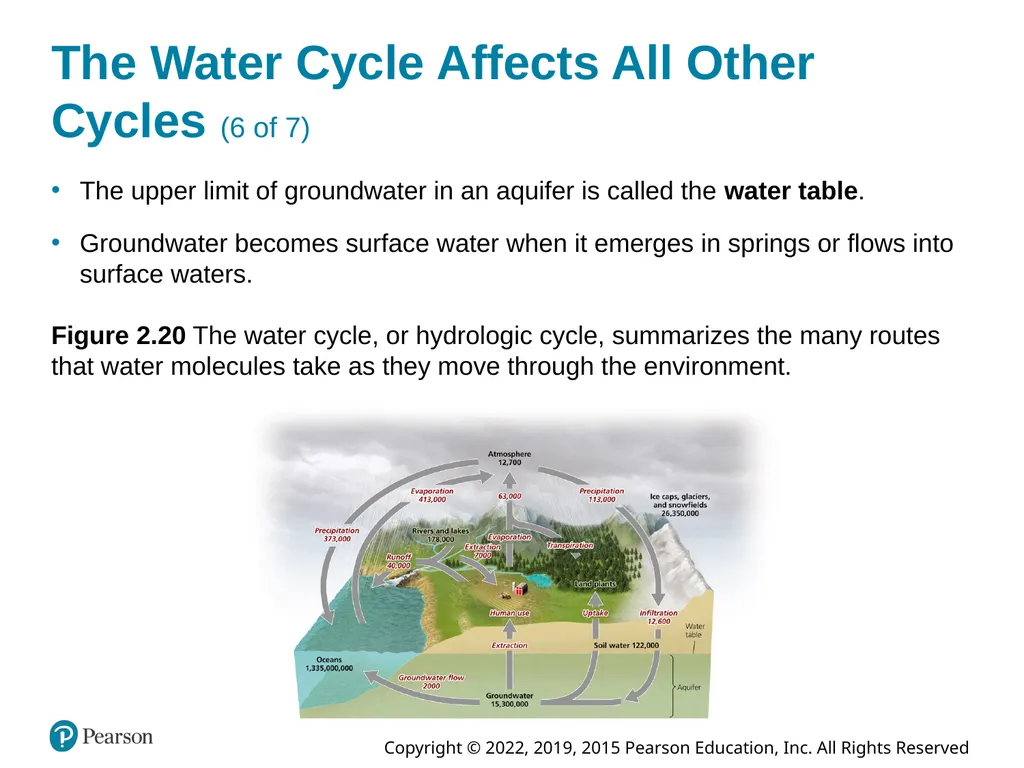
The Water Cycle Affects All Other Cycles (6 of 7) The upper limit of groundwater in an aquifer is called the water table.
Groundwater becomes surface water when it emerges in springs or flows into surface waters. Figure 2.20 The water cycle, or hydrologic cycle, summarizes the many routes that water molecules take as they move through the environment.<br>
Groundwater becomes surface water when it emerges in springs or flows into surface waters. Figure 2.20 The water cycle, or hydrologic cycle, summarizes the many routes that water molecules take as they move through the environment.<br>
65
The Water Cycle Affects All Other Cycles (7 of 7) Human activity impacts every aspect of the water cycle.
Damming rivers slows the movement of water and increases evaporation from reservoirs.
Removing vegetation increases runoff and decreases infiltration and transpiration.
Withdrawal of groundwater lowers water tables.
Air pollution can change the chemical nature of precipitation.<br>
Damming rivers slows the movement of water and increases evaporation from reservoirs.
Removing vegetation increases runoff and decreases infiltration and transpiration.
Withdrawal of groundwater lowers water tables.
Air pollution can change the chemical nature of precipitation.<br>
66
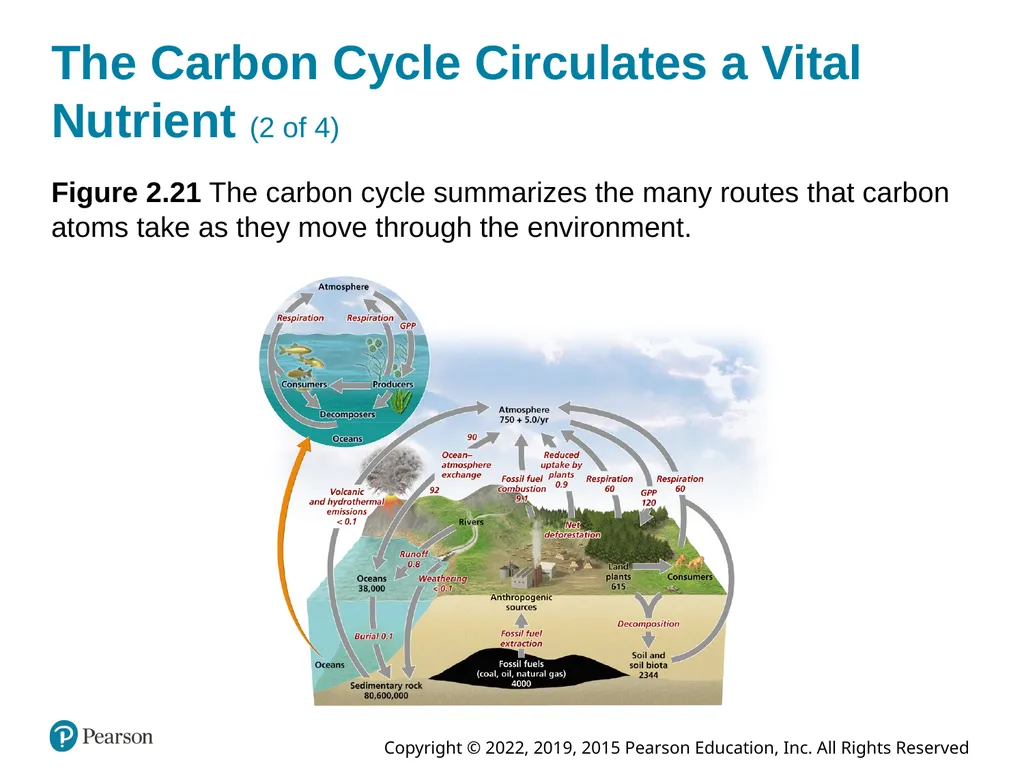
The Carbon Cycle Circulates a Vital Nutrient (1 of 4) Carbon is found in all organic molecules, including carbohydrates, fats, and proteins, which make up living organisms.
The carbon cycle describes the routes that carbon takes through the environment.<br>
The carbon cycle describes the routes that carbon takes through the environment.<br>
67
The Carbon Cycle Circulates a Vital Nutrient (2 of 4) Figure 2.21 The carbon cycle summarizes the many routes that carbon atoms take as they move through the environment.<br>
68
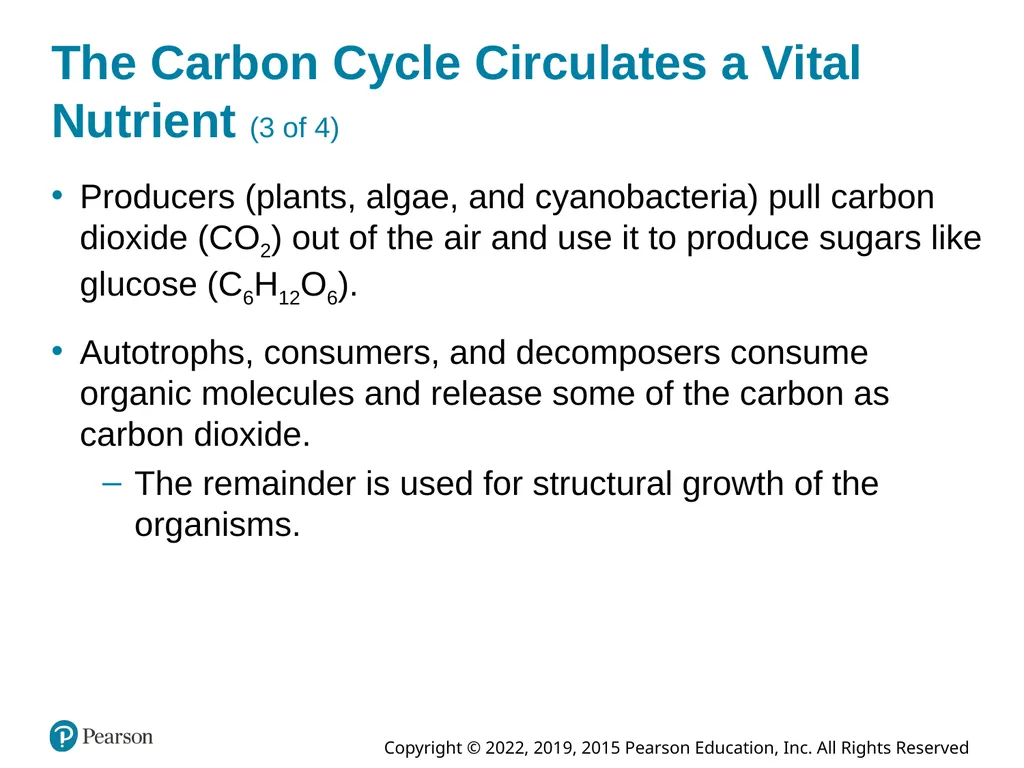
The Carbon Cycle Circulates a Vital Nutrient (3 of 4) Producers (plants, algae, and cyanobacteria) pull carbon dioxide (C O2) out of the air and use it to produce sugars like glucose (C6H12O6).
Autotrophs, consumers, and decomposers consume organic molecules and release some of the carbon as carbon dioxide.
The remainder is used for structural growth of the organisms.<br>
Autotrophs, consumers, and decomposers consume organic molecules and release some of the carbon as carbon dioxide.
The remainder is used for structural growth of the organisms.<br>
69
The Carbon Cycle Circulates a Vital Nutrient (4 of 4) As aquatic organisms die, their remains may settle in sediments in ocean basins or freshwater wetlands.
Pressure over long periods of time can convert soft tissue sediments into oil and skeletons into sedimentary rock like limestone.
Sedimentary rock is the largest reservoir in the carbon cycle.
Released during uplift, erosion, volcanic eruptions, or the burning of fossil fuels.
The oceans are the second-largest reservoir of carbon, absorbing carbon-containing compounds from the atmosphere and other sources, which are then incorporated into the shells of marine organisms.<br>
Pressure over long periods of time can convert soft tissue sediments into oil and skeletons into sedimentary rock like limestone.
Sedimentary rock is the largest reservoir in the carbon cycle.
Released during uplift, erosion, volcanic eruptions, or the burning of fossil fuels.
The oceans are the second-largest reservoir of carbon, absorbing carbon-containing compounds from the atmosphere and other sources, which are then incorporated into the shells of marine organisms.<br>
70
The Nitrogen Cycle Involves Specialized Bacteria (1 of 6) Nitrogen is an essential ingredient in D N A, R N A, and proteins.
Nitrogen gas (N2) makes up 78% of the atmosphere, but is chemically inert and cannot leave the atmosphere without assistance.
Under the right conditions, nitrogen can become biologically active and enter the biosphere and lithosphere, a process called the nitrogen cycle.<br>
Nitrogen gas (N2) makes up 78% of the atmosphere, but is chemically inert and cannot leave the atmosphere without assistance.
Under the right conditions, nitrogen can become biologically active and enter the biosphere and lithosphere, a process called the nitrogen cycle.<br>
71
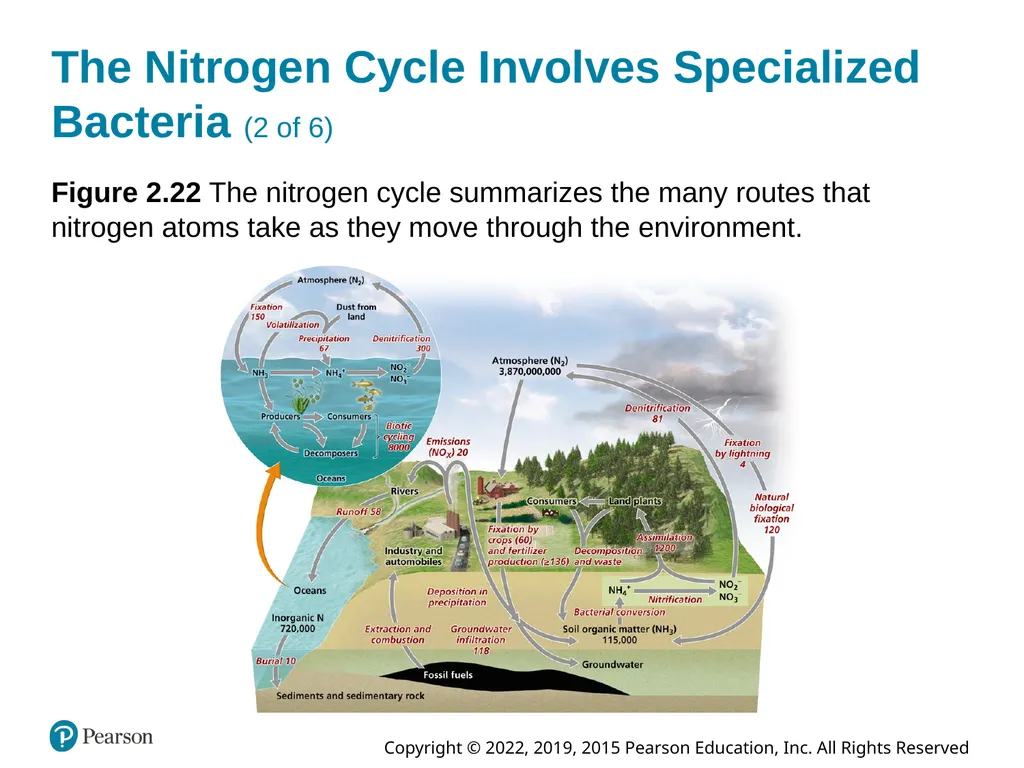
The Nitrogen Cycle Involves Specialized Bacteria (2 of 6) Figure 2.22 The nitrogen cycle summarizes the many routes that nitrogen atoms take as they move through the environment.<br>
72
The Nitrogen Cycle Involves Specialized Bacteria (3 of 6) To become biologically available, nitrogen fixation will combine nitrogen with hydrogen to form ammonia (N H3), whose water-soluble ions of ammonium (N H4+) can be taken up by plants.
The intense energy of lightning strikes can fix nitrogen.<br>
The intense energy of lightning strikes can fix nitrogen.<br>
73
The Nitrogen Cycle Involves Specialized Bacteria (4 of 6) Nitrogen-fixing bacteria convert nitrogen gas into ammonia.
The bacteria form nodules on plant roots, absorbing sugars from the roots in exchange for nitrogen fixation.
It is found in legumes, such as soybeans.<br>
The bacteria form nodules on plant roots, absorbing sugars from the roots in exchange for nitrogen fixation.
It is found in legumes, such as soybeans.<br>
74
The Nitrogen Cycle Involves Specialized Bacteria (5 of 6) Other bacteria perform a process called nitrification, which converts ammonium ions into nitrite ions (N O2−), then into nitrate (N O3−) ions, which plants can directly take up.
These ions are also added to the soil through the use of fertilizer.
Consumers obtain nitrogen by ingesting plants or other animals.
Decomposers obtain and release nitrogen from dead and decaying matter.
Denitrifying bacteria will then convert nitrates back into nitrogen gas, releasing it back into the atmosphere and completing the cycle.<br>
These ions are also added to the soil through the use of fertilizer.
Consumers obtain nitrogen by ingesting plants or other animals.
Decomposers obtain and release nitrogen from dead and decaying matter.
Denitrifying bacteria will then convert nitrates back into nitrogen gas, releasing it back into the atmosphere and completing the cycle.<br>
75
The Nitrogen Cycle Involves Specialized Bacteria (6 of 6) Nitrogen fixation has historically been a bottleneck, a step that limited the flux of nitrogen out of the atmosphere.
Industrial fixation has enabled people to artificially fix nitrogen, greatly enhancing agriculture.
Humans have effectively doubled the rate of nitrogen fixation on the Earth.
Runoff can cause excess fixed nitrogen to enter waterways, causing eutrophication.
Burning fossil fuels releases addition nitrogen into the atmosphere.<br>
Industrial fixation has enabled people to artificially fix nitrogen, greatly enhancing agriculture.
Humans have effectively doubled the rate of nitrogen fixation on the Earth.
Runoff can cause excess fixed nitrogen to enter waterways, causing eutrophication.
Burning fossil fuels releases addition nitrogen into the atmosphere.<br>
76
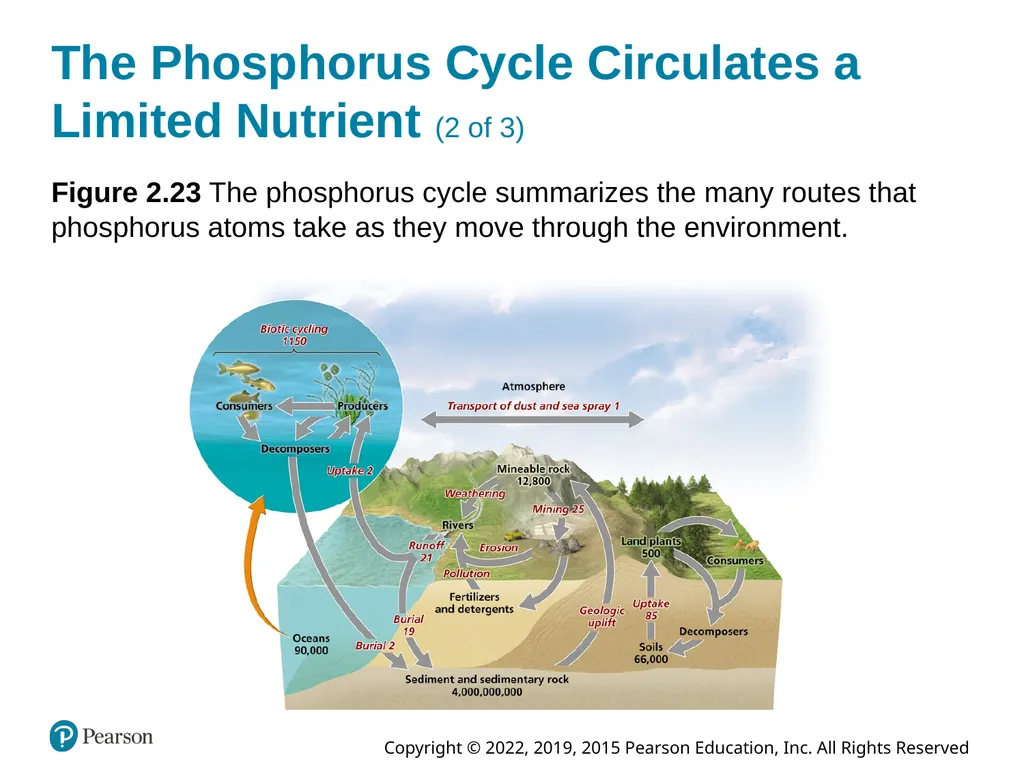
The Phosphorus Cycle Circulates a Limited Nutrient (1 of 3) Phosphorus is a key element in many organic molecules, including D N A, R N A, and A T P.
The biggest phosphorus sinks are rocks, soil, sediments, and the oceans.
Very little in the atmosphere.
The processes that move phosphorus from these sinks to living matter are called the phosphorus cycle.<br>
The biggest phosphorus sinks are rocks, soil, sediments, and the oceans.
Very little in the atmosphere.
The processes that move phosphorus from these sinks to living matter are called the phosphorus cycle.<br>
77
The Phosphorus Cycle Circulates a Limited Nutrient (2 of 3) Figure 2.23 The phosphorus cycle summarizes the many routes that phosphorus atoms take as they move through the environment.<br>
78
The Phosphorus Cycle Circulates a Limited Nutrient (3 of 3) Weathering of rocks releases phosphate (P O4−) ions into water.
These phosphates precipitate into a solid form, sink to the bottom of bodies of water, and re-enter the lithosphere as sediments.
Aquatic organisms take up phosphates directly from surrounding waters.
Terrestrial organisms take up phosphates from soil water through their roots.
Phosphates are passed through the food chain and eventually returned to the soil by decomposers.
Like nitrogen, the runoff of phosphorus increases its concentration in surface waters.
Wastewater rich in dishwater and clothes detergents is also a contributor.<br>
These phosphates precipitate into a solid form, sink to the bottom of bodies of water, and re-enter the lithosphere as sediments.
Aquatic organisms take up phosphates directly from surrounding waters.
Terrestrial organisms take up phosphates from soil water through their roots.
Phosphates are passed through the food chain and eventually returned to the soil by decomposers.
Like nitrogen, the runoff of phosphorus increases its concentration in surface waters.
Wastewater rich in dishwater and clothes detergents is also a contributor.<br>
79
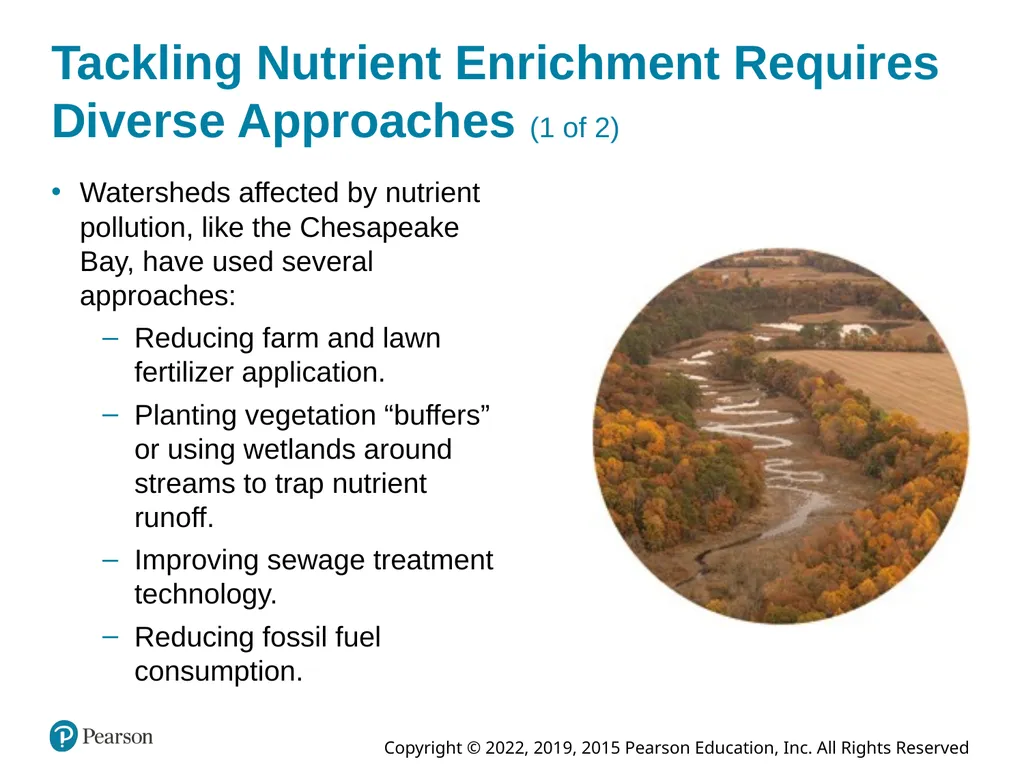
Tackling Nutrient Enrichment Requires Diverse Approaches (1 of 2) Watersheds affected by nutrient pollution, like the Chesapeake Bay, have used several approaches:
Reducing farm and lawn fertilizer application.
Planting vegetation “buffers” or using wetlands around streams to trap nutrient runoff.
Improving sewage treatment technology.
Reducing fossil fuel consumption.<br>
Reducing farm and lawn fertilizer application.
Planting vegetation “buffers” or using wetlands around streams to trap nutrient runoff.
Improving sewage treatment technology.
Reducing fossil fuel consumption.<br>
80
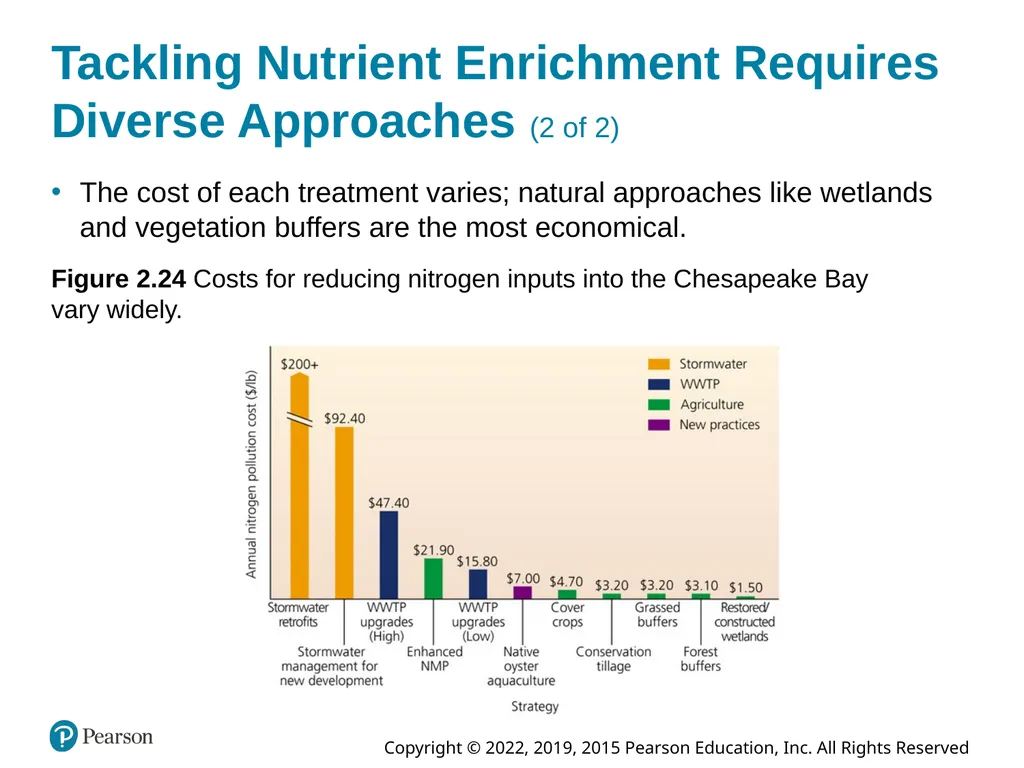
Tackling Nutrient Enrichment Requires Diverse Approaches (2 of 2) The cost of each treatment varies; natural approaches like wetlands and vegetation buffers are the most economical. Figure 2.24 Costs for reducing nitrogen inputs into the Chesapeake Bay vary widely.<br>
81
Copyright This work is protected by United States copyright laws and is provided solely for the use of instructors in teaching their courses and assessing student learning. Dissemination or sale of any part of this work (including on the World Wide Web) will destroy the integrity of the work and is not permitted. The work and materials from it should never be made available to students except by instructors using the accompanying text in their classes. All recipients of this work are expected to abide by these restrictions and to honor the intended pedagogical purposes and the needs of other instructors who rely on these materials.<br>