Estimation of Fundamental Natural Frequency, Damping Ratio and Equivalent Mass 421L521L (Lab 8) Single DOF Modeling E, I, L, ρ E, I, L, ρ M k c x mxcxkx f(t) x(t) Aexp(-ξωnt)COS(ωnsqrt(1-ξ2)t- ψ)Bsin(ωt) Time response Transient
"Estimation of Fundamental Natural Frequency," is the property of its rightful owner. Permission is granted to
download and print the materials on this website for personal, non-commercial use only, and to display it
on your personal computer provided you do not modify the materials and that you retain all copyright
notices contained in the materials. By downloading content from our website, you accept the terms of this
agreement.
Presentation Transcript
01
Estimation of Fundamental Natural Frequency, Damping Ratio and Equivalent Mass 421L/521L (Lab 8)<br>
02
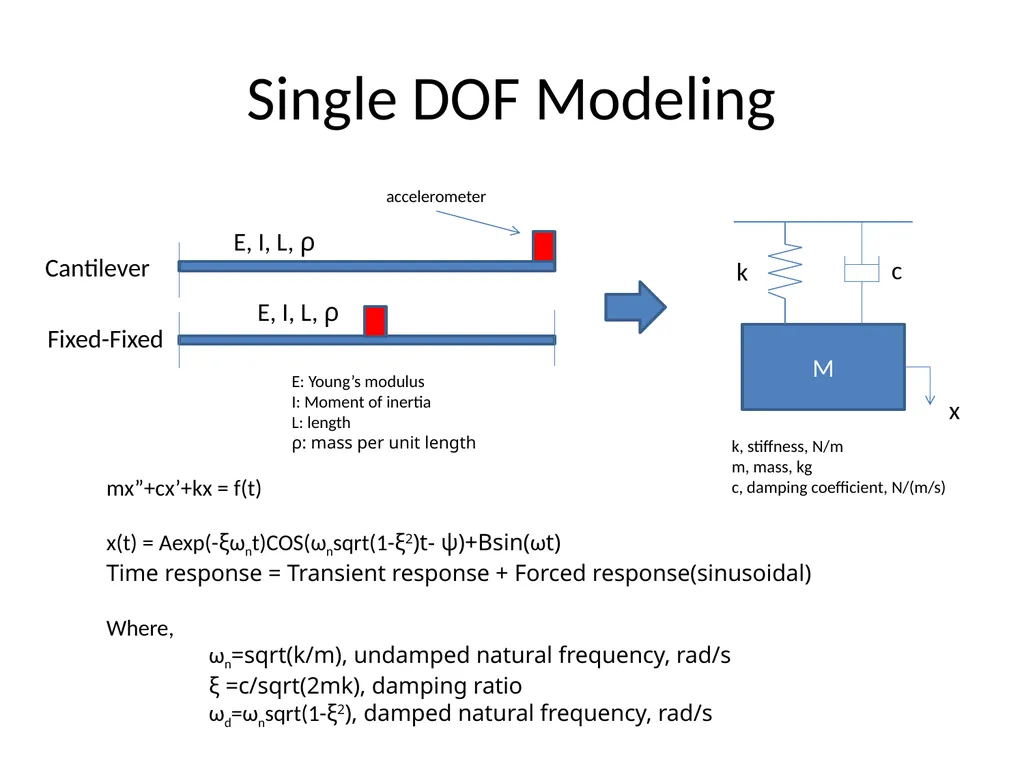
Single DOF Modeling E, I, L, ρ E, I, L, ρ M k c x mx”+cx’+kx = f(t)
Where,
ωn=sqrt(k/m), undamped natural frequency, rad/s
ξ =c/sqrt(2mk), damping ratio
ωd=ωnsqrt(1-ξ2), damped natural frequency, rad/s k, stiffness, N/m
m, mass, kg
c, damping coefficient, N/(m/s) E: Young’s modulus
I: Moment of inertia
L: length
ρ: mass per unit length Cantilever Fixed-Fixed accelerometer<br>
03
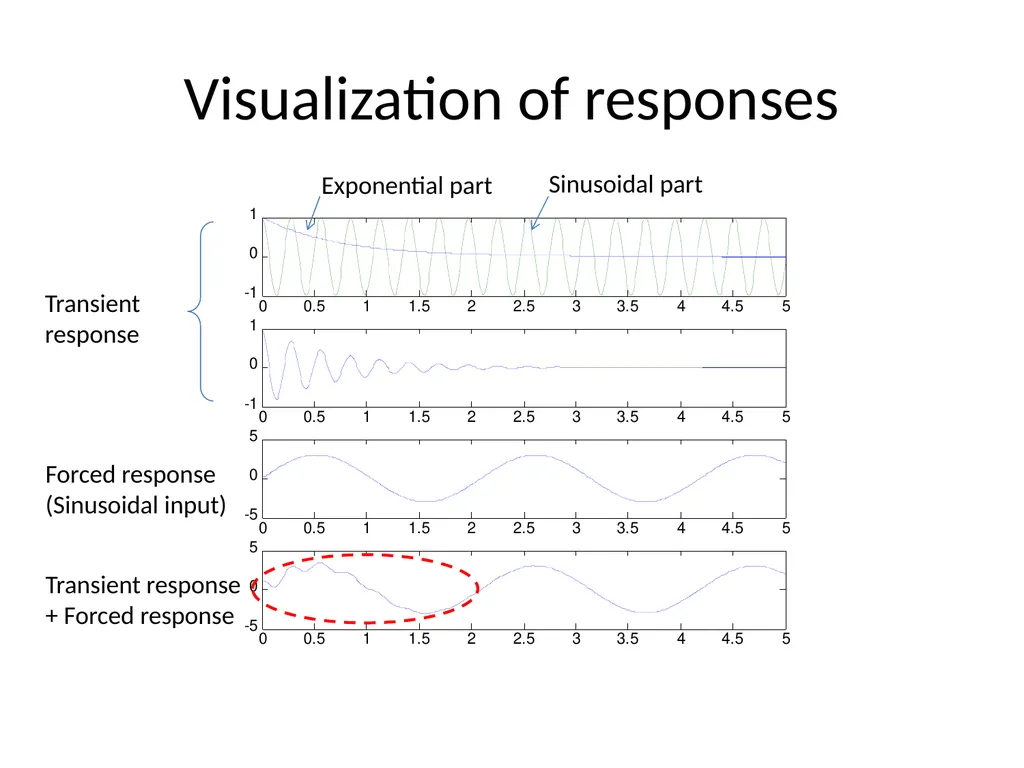
Visualization of responses Exponential part Sinusoidal part Transient
response Forced response
(Sinusoidal input) Transient response
+ Forced response<br>
04
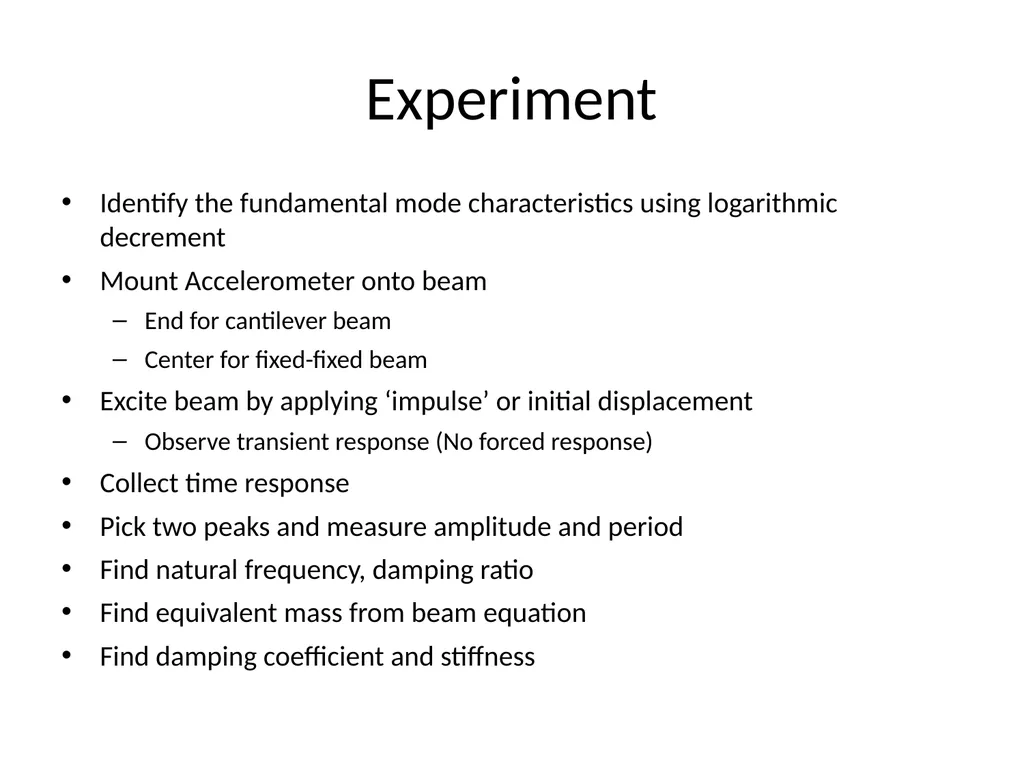
Experiment Identify the fundamental mode characteristics using logarithmic decrement
Mount Accelerometer onto beam
End for cantilever beam
Center for fixed-fixed beam
Excite beam by applying ‘impulse’ or initial displacement
Observe transient response (No forced response)
Collect time response
Pick two peaks and measure amplitude and period
Find natural frequency, damping ratio
Find equivalent mass from beam equation
Find damping coefficient and stiffness<br>
05
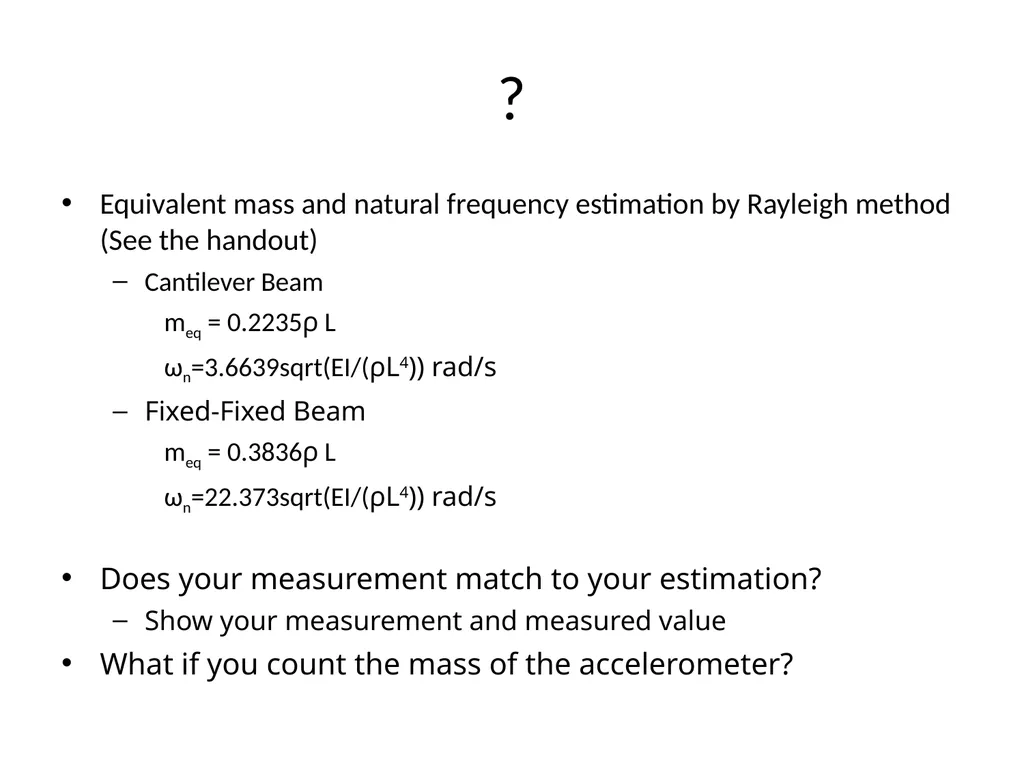
? Equivalent mass and natural frequency estimation by Rayleigh method (See the handout)
Cantilever Beam
meq = 0.2235ρ L
ωn=3.6639sqrt(EI/(ρL4)) rad/s
Fixed-Fixed Beam
meq = 0.3836ρ L
ωn=22.373sqrt(EI/(ρL4)) rad/s
Does your measurement match to your estimation?
Show your measurement and measured value
What if you count the mass of the accelerometer?<br>
06
Experimental setup: Cantilever Beam Aluminum Beam
Thickness = 4.84mm
Width = 19.09mm
Length = 640mm
Accelerometer is mounted at the end of the beam
Mass of accelerometer = 7.83 gram<br>
07
Cantilever Beam NOTE: X1,2 = time in s, y1,2 = acceleration in g, (m = ‘mili’)<br>
08
Work Sheet: Cantilever Beam<br>
09
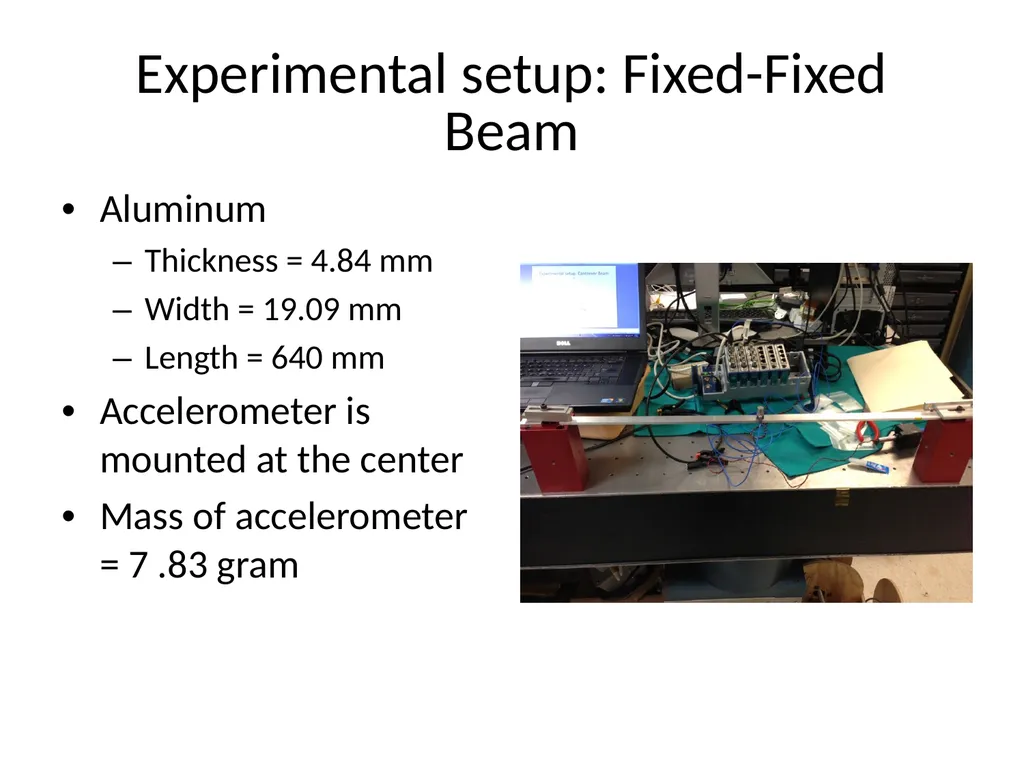
Experimental setup: Fixed-Fixed Beam Aluminum
Thickness = 4.84 mm
Width = 19.09 mm
Length = 640 mm
Accelerometer is mounted at the center
Mass of accelerometer = 7 .83 gram<br>
10
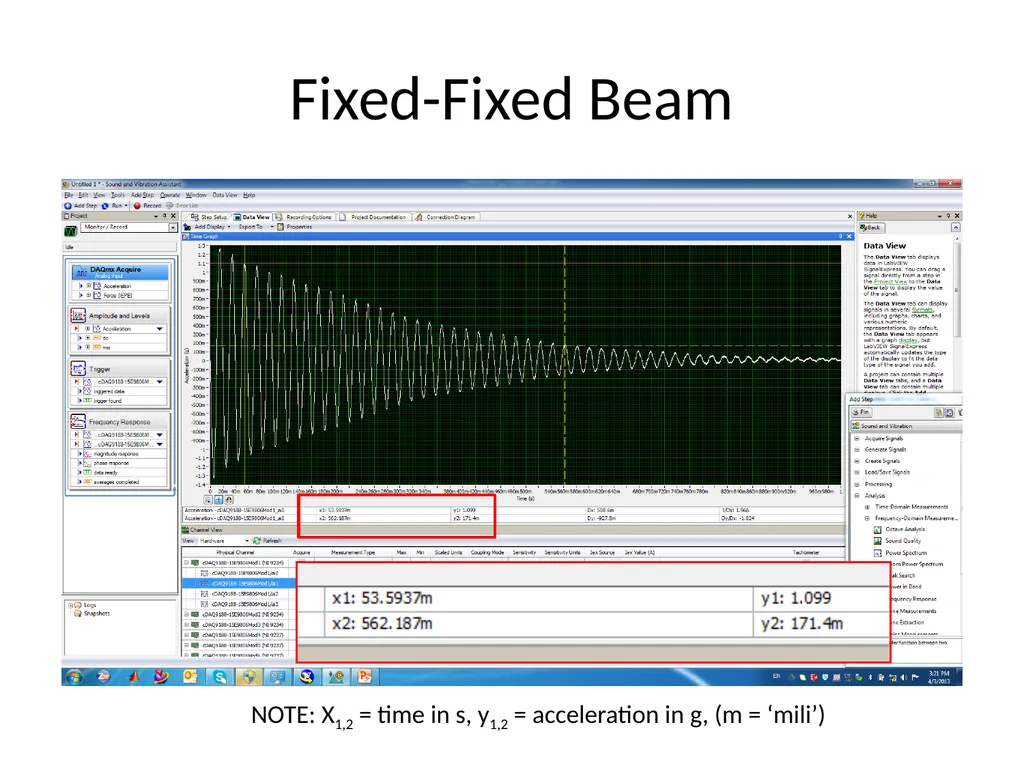
Fixed-Fixed Beam NOTE: X1,2 = time in s, y1,2 = acceleration in g, (m = ‘mili’)<br>
11
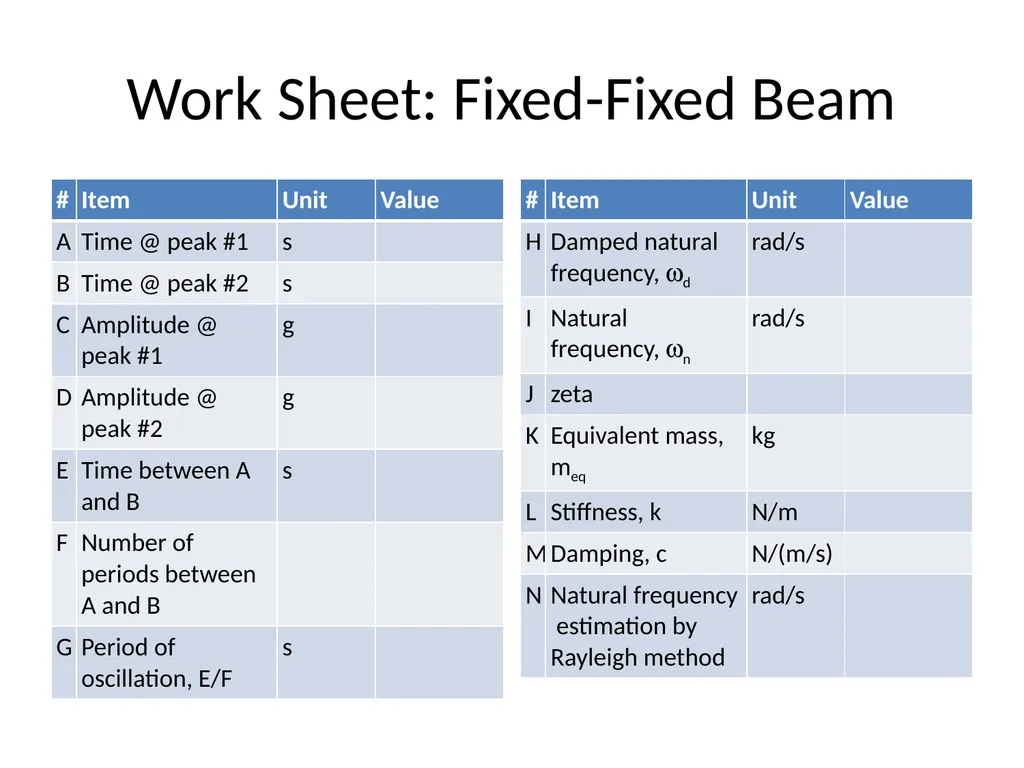
Work Sheet: Fixed-Fixed Beam<br>
12
Different material? Repeat the experiment with Steel and any nonmetal material
Compare the result<br>