Ethical Issues with Expert Witnesses Litigation Academy U.S. District Court October 11, 2018 Outline of Topics General Duties Locating an Expert Witness Fees Disclosures Omitting or Coloring Evidence Disclosures of Client Confidences
"Ethical Issues with Expert Witnesses Litigation" is the property of its rightful owner. Permission is granted to
download and print the materials on this website for personal, non-commercial use only, and to display it
on your personal computer provided you do not modify the materials and that you retain all copyright
notices contained in the materials. By downloading content from our website, you accept the terms of this
agreement.
Presentation Transcript
01
Ethical Issues with Expert Witnesses Litigation Academy
U.S. District Court
October 11, 2018<br>
02
Outline of Topics General Duties
Locating an Expert Witness
Fees
Disclosures
Omitting or Coloring Evidence
Disclosures of Client Confidences
Modifying Expert Reports<br>
03
1. General Duties Always Keep in Mind
Litigation should be focused
“to the end that the truth may be ascertained”
Fed. R. Evid. 102
~~~~~
Role of Lawyer vs. Role of Expert
Lawyer : “zealous” advocate for their client
Expert: expected to tell the truth, regardless of how it effects the client on whose behalf she is testifying
ABA says expert does not owe a duty to her client
(Formal Opinion 97-407)<br>
04
Expert’s Role ABA: “unlike attorneys, expert witnesses do not owe a duty of loyalty to their clients. An expert must remain independent from his or her ‘client’ and not become the client’s advocate. In essence, an expert must analyze, explain, and offer an accurate opinion of the relevant issue before the court, not strive to advocate and persuade the fact-finder of a certain point of view. The expert’s main duty to provide truthful and accurate information comes from the court and the ethical guidelines of his professional organization, if any.”
14 Georgetown Journal of Legal Ethics 217 (2000)<br>
05
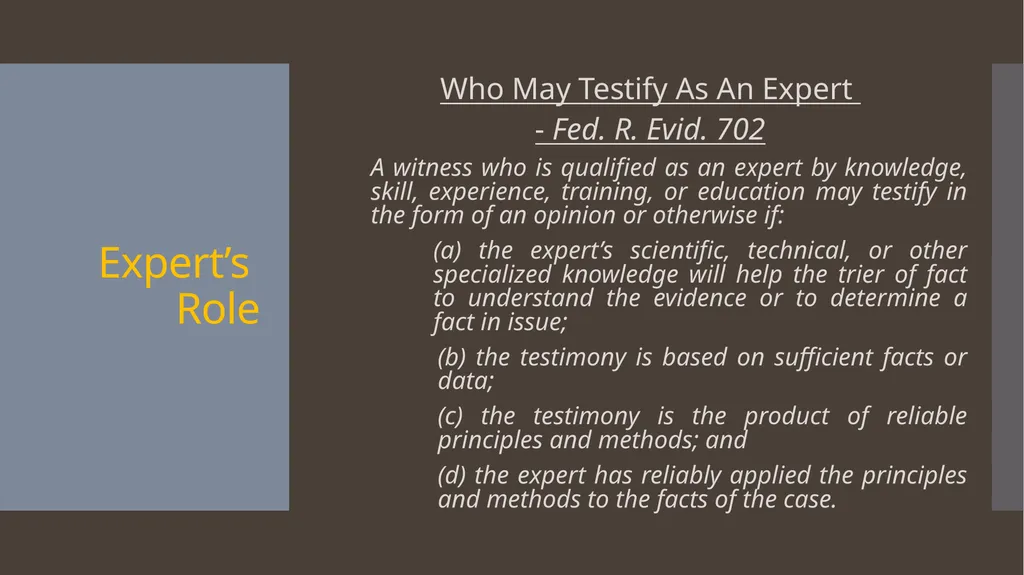
Expert’s Role Who May Testify As An Expert
- Fed. R. Evid. 702
A witness who is qualified as an expert by knowledge, skill, experience, training, or education may testify in the form of an opinion or otherwise if:
(a) the expert’s scientific, technical, or other specialized knowledge will help the trier of fact to understand the evidence or to determine a fact in issue;
(b) the testimony is based on sufficient facts or data;
(c) the testimony is the product of reliable principles and methods; and
(d) the expert has reliably applied the principles and methods to the facts of the case.<br>
06
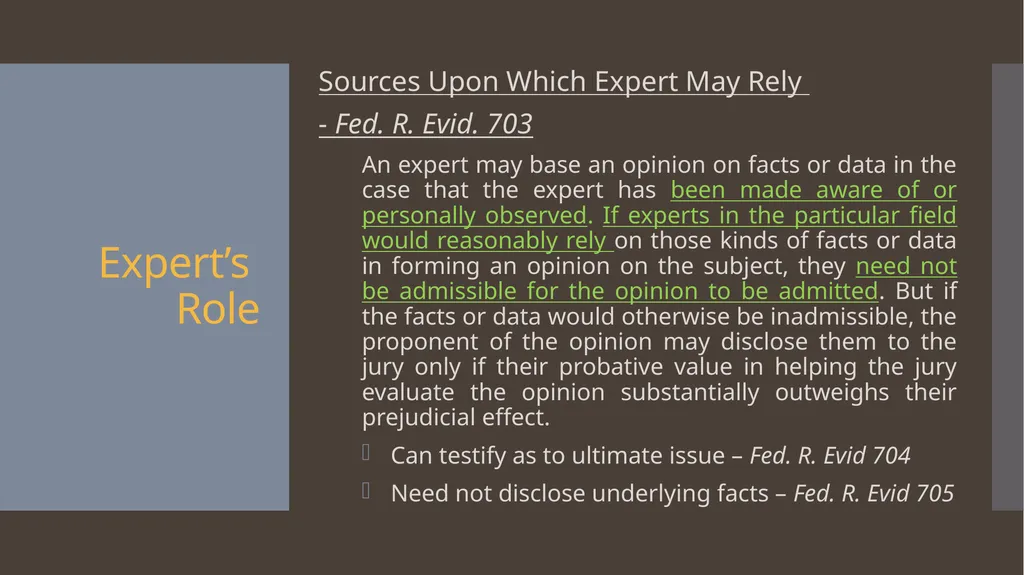
Expert’s Role Sources Upon Which Expert May Rely
- Fed. R. Evid. 703
An expert may base an opinion on facts or data in the case that the expert has been made aware of or personally observed. If experts in the particular field would reasonably rely on those kinds of facts or data in forming an opinion on the subject, they need not be admissible for the opinion to be admitted. But if the facts or data would otherwise be inadmissible, the proponent of the opinion may disclose them to the jury only if their probative value in helping the jury evaluate the opinion substantially outweighs their prejudicial effect.
Can testify as to ultimate issue – Fed. R. Evid 704
Need not disclose underlying facts – Fed. R. Evid 705<br>
07
Expert’s Role Experts may have their own
professional codes of conduct
AMA, APA, etc.<br>
08
2. Locating an Expert Witness Technical, Scientific, Medical Journals (authors)
Google the topic
Ask client
Last resort – expert witness ads/websites<br>
09
3. Expert Fees Rule 3.4. Fairness to Opposing Party and Counsel
A lawyer shall not: (b) falsify evidence, counsel or assist a witness to testify falsely, or offer an inducement to a witness that is prohibited by law;
Commentary - it is not improper to pay a witness’ expenses or to compensate an expert witness on terms permitted by law. The common law rule in most jurisdictions is that it is improper to pay an occurrence witness any fee for testifying and that it is improper to pay an expert witness a contingent fee.<br>
10
4. Disclosures Retained or specially employed to provide expert testimony – written report required. Fed. R. Civ. P. 26(a)(2)(B)
Consulting expert – no disclosure required. Fed. R. Civ. P. 26(a)(2)(C); 26(b)(4)(D)
Drafts of any report or disclosure are protected. Fed. R. Civ. P. 26(b)(4)(B)<br>
11
5. Omitting or Coloring Evidence Rule 3.3. Candor Toward the Tribunal
prevents a lawyer from falsifying evidence or assisting a witness in false testimony.
This could affect expert testimony in two ways.
First, it forbids an attorney to permit an expert witness to testify as an expert in an area that is not scientifically valid.
Second, it forbids the lawyer to coax opinions from the expert that are beyond the realm of the expert’s specialized knowledge. Such coaxing would result in unreliable testimony (from the false claim of expertise), as the expert would be testifying in an area in which she possesses no expertise.<br>
12
6. Disclosures of Client Confidences Rule 1.6. Confidentiality of Information
(a) A lawyer shall not reveal information relating to the representation of a client unless the client gives informed consent, except for disclosures that are impliedly authorized in order to carry out the representation<br>
13
7. Modifying Expert Reports Rule 8.4. Misconduct
It is professional misconduct for a lawyer to:
(c) engage in conduct involving dishonesty, fraud, deceit or misrepresentation;
~~~~~
Any time an attorney finds themselves considering engaging in a conversation with the intent of minimizing certain facts or opinions, an attorney should reconsider in light of this rule.<br>