
Ethics Theory and Business Practice 6.2 Ethical

Description: Ethics Theory and Business Practice 6.2 Ethical Relativism Part Two Friedrich Nietzsche: Morality And Power aims to explore Friedrich Nietzsches ideas about the relationship between power and morality to introduce the idea that personal
Related Topics
Download Presentation
"Ethics Theory and Business Practice 6.2 Ethical" is the property of its rightful owner. Permission is granted to download and print the materials on this website for personal, non-commercial use only, and to display it on your personal computer provided you do not modify the materials and that you retain all copyright notices contained in the materials. By downloading content from our website, you accept the terms of this agreement.
Presentation Transcript
slide1. Ethics Theory
and
Business Practice 6.2 Ethical Relativism – Part Two
Friedrich Nietzsche: Morality And Power<br>
slide2. aims to explore Friedrich Nietzsche’s ideas about the relationship between power and morality
to introduce the idea that personal interests and power agendas might influence our the way we think about business ethics<br>
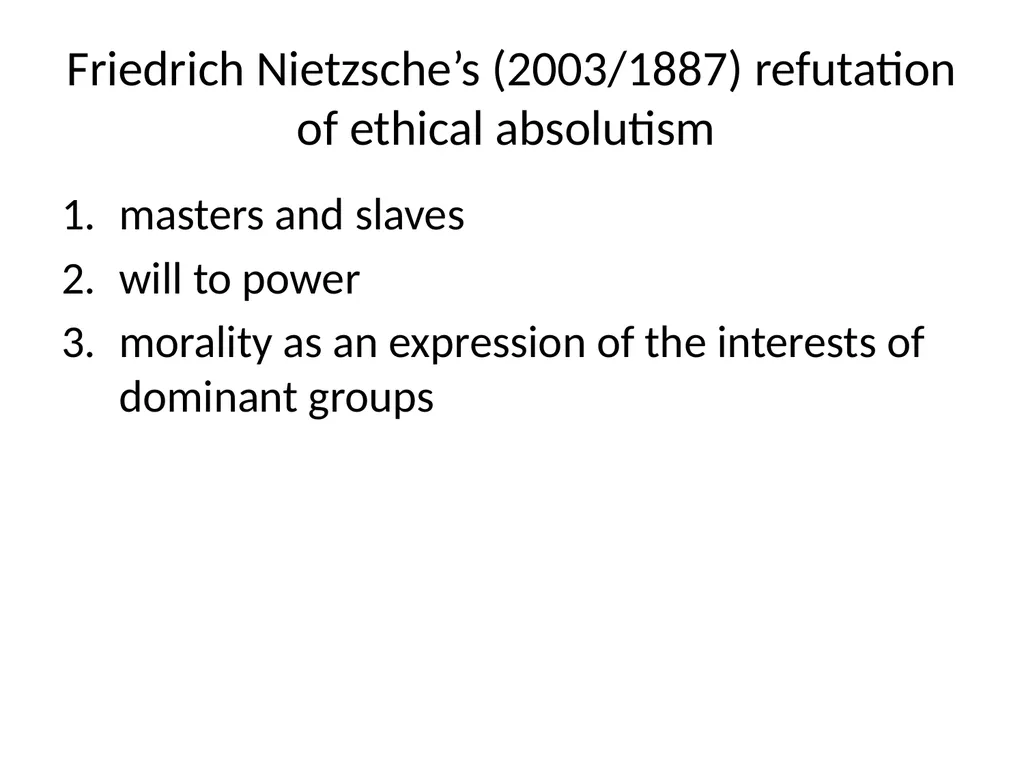
slide3. Friedrich Nietzsche’s (2003/1887) refutation of ethical absolutism masters and slaves
will to power
morality as an expression of the interests of dominant groups<br>
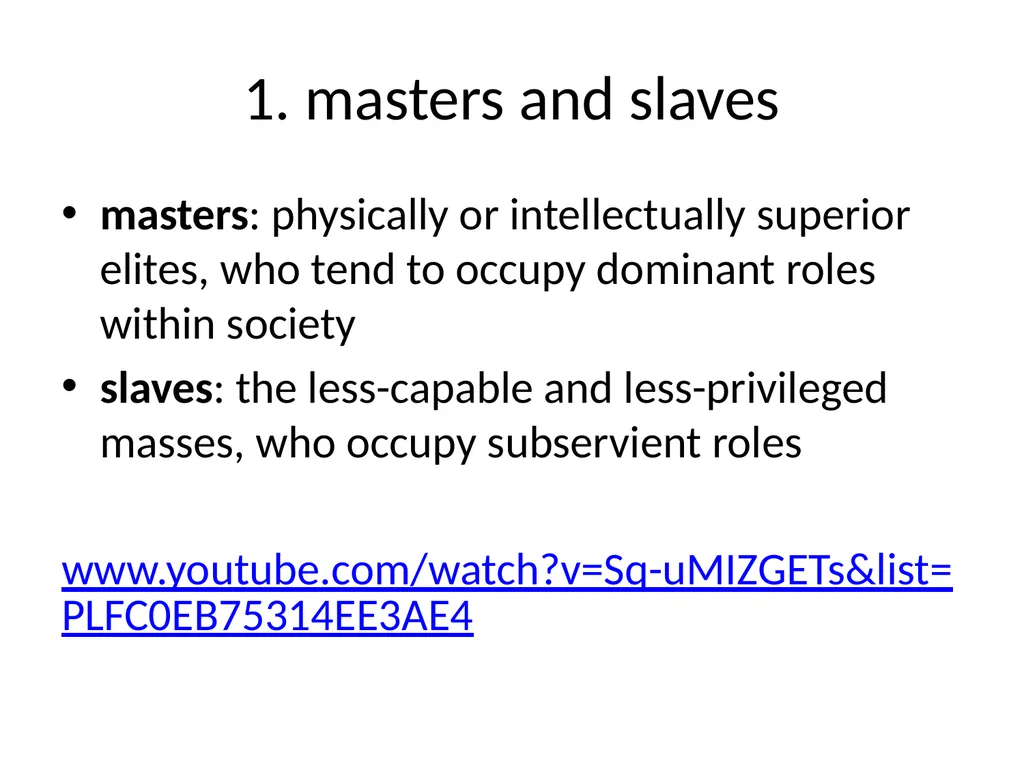
slide4. 1. masters and slaves masters: physically or intellectually superior elites, who tend to occupy dominant roles within society
slaves: the less-capable and less-privileged masses, who occupy subservient roles
www.youtube.com/watch?v=Sq-uMIZGETs&list=PLFC0EB75314EE3AE4<br>
slide5. 2. will to power all living things are fundamentally motivated by a desire to assert themselves over everything and everyone around them
will to power as a prime mover of human activity
which cannot be denied
www.youtube.com/watch?v=D7DAt-TKcQo<br>
slide6. 3. morality: an expression of the interests of dominant groups early supremacy of ‘master morality’
recent triumph of ‘slave morality’<br>
slide7. Nietzsche’s call for a return to master morality not only does slave morality have no absolute legitimacy
it also constrains gifted elites from achieving the full potential
and thus inhibits human progress<br>
slide8. two insights that Nietzsche’s work offers to business ethics it offers a justification of competitive, meritocratic elitism
www.youtube.com/watch?v=elrnAl6ygeM
it encourages us to reflect on why we believe what we do about ethics<br>
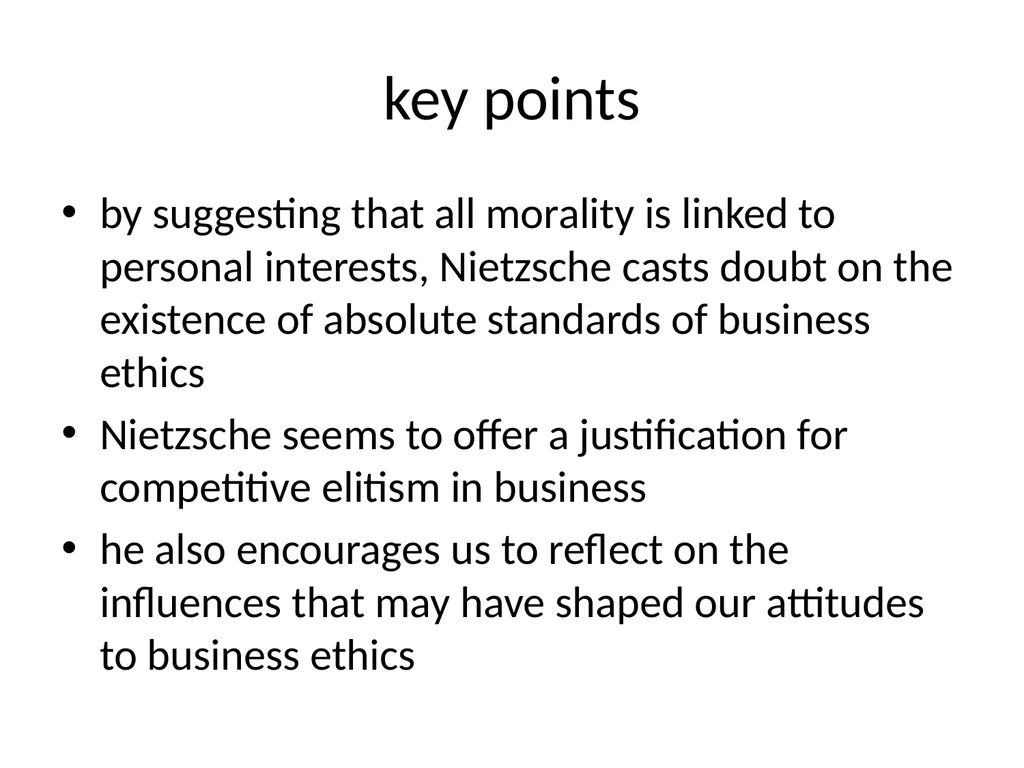
slide9. key points by suggesting that all morality is linked to personal interests, Nietzsche casts doubt on the existence of absolute standards of business ethics
Nietzsche seems to offer a justification for competitive elitism in business
he also encourages us to reflect on the influences that may have shaped our attitudes to business ethics<br>
slide10. references Nietzsche, F. (2003/1887) The Genealogy of Morals. New York: Dover.<br>
Friedrich Nietzsche: Morality And Power<br>
slide2. aims to explore Friedrich Nietzsche’s ideas about the relationship between power and morality
to introduce the idea that personal interests and power agendas might influence our the way we think about business ethics<br>
slide3. Friedrich Nietzsche’s (2003/1887) refutation of ethical absolutism masters and slaves
will to power
morality as an expression of the interests of dominant groups<br>
slide4. 1. masters and slaves masters: physically or intellectually superior elites, who tend to occupy dominant roles within society
slaves: the less-capable and less-privileged masses, who occupy subservient roles
www.youtube.com/watch?v=Sq-uMIZGETs&list=PLFC0EB75314EE3AE4<br>
slide5. 2. will to power all living things are fundamentally motivated by a desire to assert themselves over everything and everyone around them
will to power as a prime mover of human activity
which cannot be denied
www.youtube.com/watch?v=D7DAt-TKcQo<br>
slide6. 3. morality: an expression of the interests of dominant groups early supremacy of ‘master morality’
recent triumph of ‘slave morality’<br>
slide7. Nietzsche’s call for a return to master morality not only does slave morality have no absolute legitimacy
it also constrains gifted elites from achieving the full potential
and thus inhibits human progress<br>
slide8. two insights that Nietzsche’s work offers to business ethics it offers a justification of competitive, meritocratic elitism
www.youtube.com/watch?v=elrnAl6ygeM
it encourages us to reflect on why we believe what we do about ethics<br>
slide9. key points by suggesting that all morality is linked to personal interests, Nietzsche casts doubt on the existence of absolute standards of business ethics
Nietzsche seems to offer a justification for competitive elitism in business
he also encourages us to reflect on the influences that may have shaped our attitudes to business ethics<br>
slide10. references Nietzsche, F. (2003/1887) The Genealogy of Morals. New York: Dover.<br>