EU RESEARCH STRATEGY Nanotechnologies and Advanced Materials Now, 2020, and beyond Delivering Safe Nanotechnology Dr. Carlos Eduardo Lima da Cunha European Commission 1.8 billion in FP7 1.4 billion in Horizon 2020 0.5 billion until
"EU RESEARCH STRATEGY Nanotechnologies and Advanced" is the property of its rightful owner. Permission is granted to
download and print the materials on this website for personal, non-commercial use only, and to display it
on your personal computer provided you do not modify the materials and that you retain all copyright
notices contained in the materials. By downloading content from our website, you accept the terms of this
agreement.
Presentation Transcript
01
EU RESEARCH STRATEGY Nanotechnologies and Advanced Materials Now, 2020, and beyond Delivering Safe Nanotechnology Dr. Carlos Eduardo Lima da Cunha
European Commission<br>
02
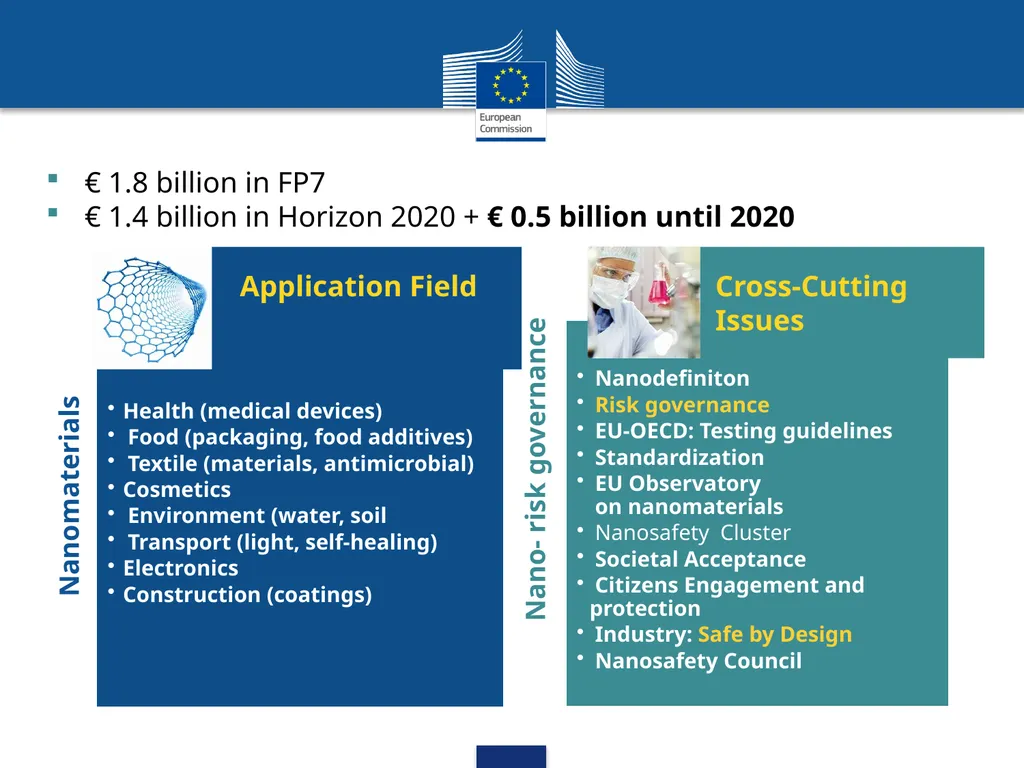
€ 1.8 billion in FP7
€ 1.4 billion in Horizon 2020 + € 0.5 billion until 2020 Application Field Cross-Cutting Issues<br>
03
EU nanosafety research policy basics Policy: Nanotechnologies innovation can only succeed if all possible or perceived as possible risks are convincingly managed
2004-2006: First efforts in nanosafety with 12 projects under FP6
2007-2013: Continuation with 48 projects under FP7
2009: EU nanosafety research policy actions shaped along the lines of:
Completeness: All technical areas to be addressed: Hazard – Exposure – Risk Assessment - Safe-by-Design
Consistency: All safety management layers to be addressed: Science and technology– regulatory research – market
Efficiency: Synergy with Member States and International cooperation
Continuity: A challenge
2017: Efforts continue under H2020 with 12 projects until now
https://www.nanosafetycluster.eu/ 3<br>
04
FP7/H2020 Nanosafety Research Investment NB: These figures do not include safety research in application-oriented projects nor nanomedicine 4 NANOREG (FP7) NANOREG II
(H2020) Ending in Oct. 2018<br>
05
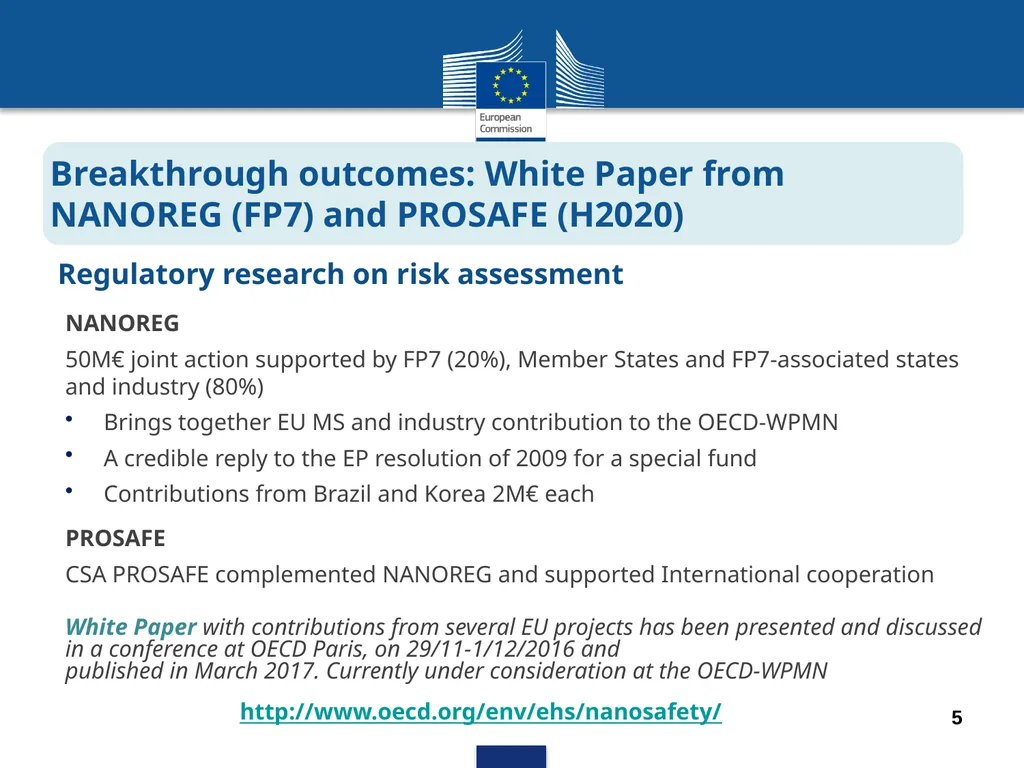
Breakthrough outcomes: White Paper from NANOREG (FP7) and PROSAFE (H2020) NANOREG
50M€ joint action supported by FP7 (20%), Member States and FP7-associated states and industry (80%)
Brings together EU MS and industry contribution to the OECD-WPMN
A credible reply to the EP resolution of 2009 for a special fund
Contributions from Brazil and Korea 2M€ each
PROSAFE
CSA PROSAFE complemented NANOREG and supported International cooperation
White Paper with contributions from several EU projects has been presented and discussed in a conference at OECD Paris, on 29/11-1/12/2016 and published in March 2017. Currently under consideration at the OECD-WPMN 5 Regulatory research on risk assessment http://www.oecd.org/env/ehs/nanosafety/<br>
06
Promising Horizon2020 projects ACEnano and npScope started on 1st Jan. 2017
Analytical techniques and tools in support of nanomaterial risk assessment
EC4SafeNano started on 1st Nov. 2016
Promoting safe innovation through consolidation and networking of nanosafety centres
PATROLS started on 1st Jan. 2018
Advanced and realistic models and assays for nanomaterial hazard assessment
GRACIOUS started on 1st Jan. 2018
Framework and strategies for nanomaterial characterisation, classification, grouping and read-across for risk analysis 6<br>
07
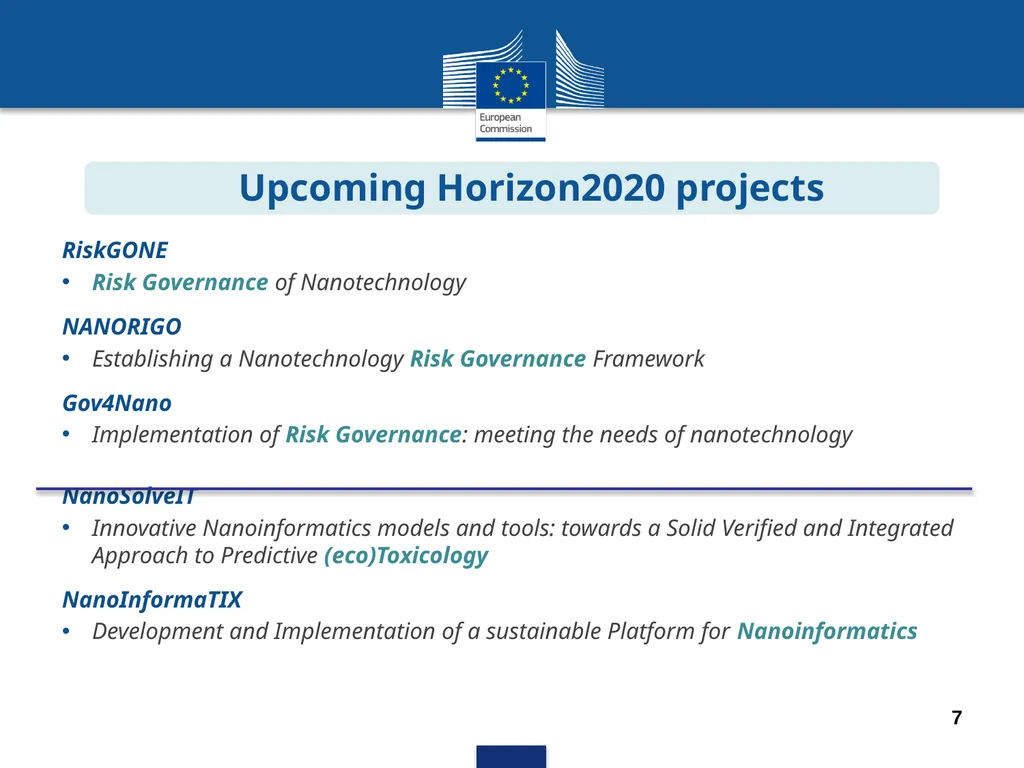
Upcoming Horizon2020 projects RiskGONE
Risk Governance of Nanotechnology
NANORIGO
Establishing a Nanotechnology Risk Governance Framework
Gov4Nano
Implementation of Risk Governance: meeting the needs of nanotechnology
NanoSolveIT
Innovative Nanoinformatics models and tools: towards a Solid Verified and Integrated Approach to Predictive (eco)Toxicology
NanoInformaTIX
Development and Implementation of a sustainable Platform for Nanoinformatics 7<br>
08
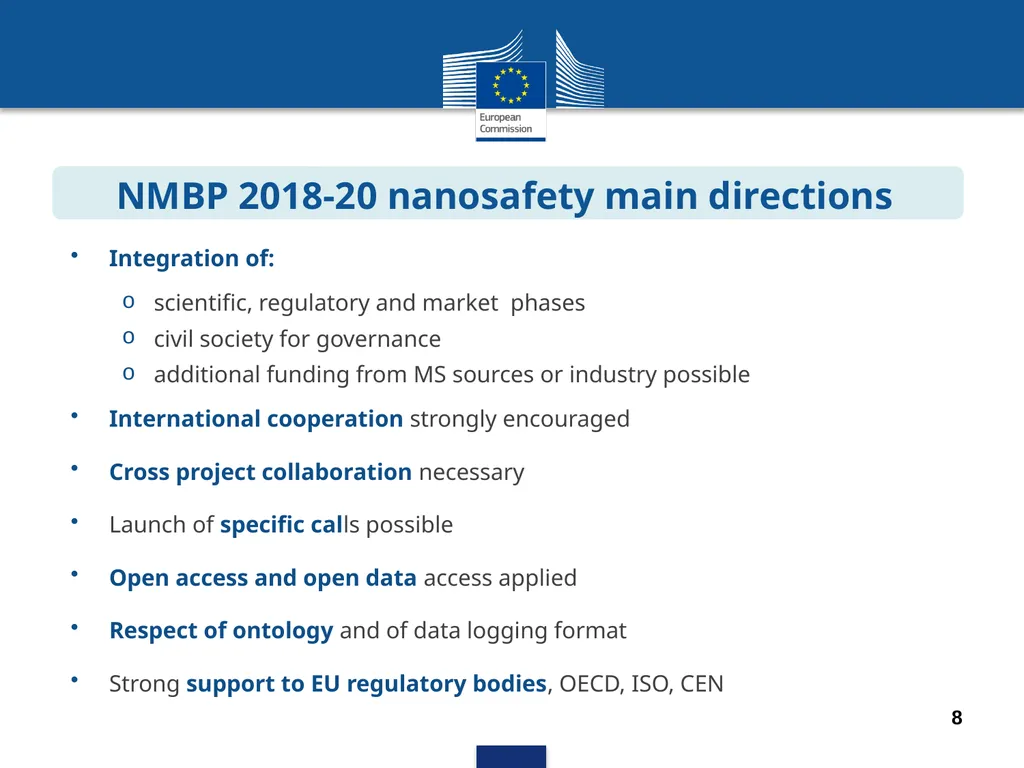
NMBP 2018-20 nanosafety main directions Integration of:
scientific, regulatory and market phases
civil society for governance
additional funding from MS sources or industry possible
International cooperation strongly encouraged
Cross project collaboration necessary
Launch of specific calls possible
Open access and open data access applied
Respect of ontology and of data logging format
Strong support to EU regulatory bodies, OECD, ISO, CEN 8<br>
09
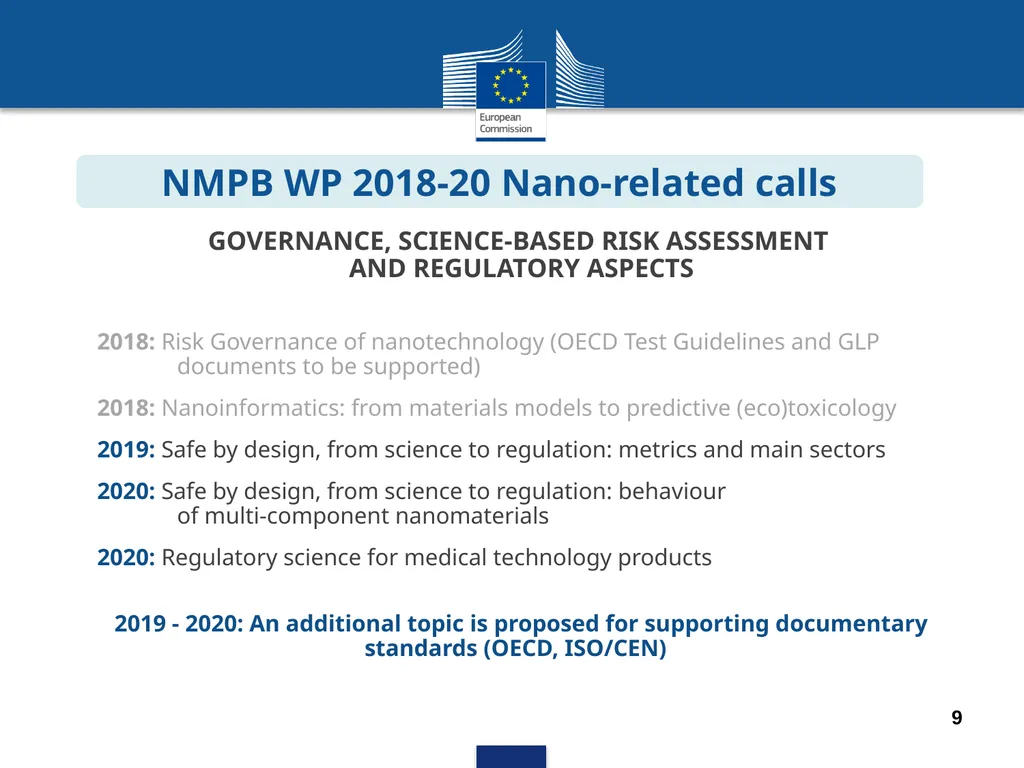
GOVERNANCE, SCIENCE-BASED RISK ASSESSMENT AND REGULATORY ASPECTS
2018: Risk Governance of nanotechnology (OECD Test Guidelines and GLP documents to be supported)
2018: Nanoinformatics: from materials models to predictive (eco)toxicology
2019: Safe by design, from science to regulation: metrics and main sectors
2020: Safe by design, from science to regulation: behaviour of multi-component nanomaterials
2020: Regulatory science for medical technology products
2019 - 2020: An additional topic is proposed for supporting documentary standards (OECD, ISO/CEN) 9 NMPB WP 2018-20 Nano-related calls<br>
10
10 Materials Characterisation and Computational Modelling
2018: Open Innovation Test Beds for Characterisation (IA)
2019: Real-time nano-characterisation technologies (RIA)
2018: Accelerating the uptake of materials modelling software (IA)
2019: Adopting materials modelling in manufacturing processes (RIA)
2020: Open Innovation Test Beds for Materials Modelling (IA)
2019: Sustainable Nano-Fabrication (CSA)
[cooperation with the nanomanufacturing programme of USA-NSF and the NNI Signature initiative] NMPB WP 2018-20 Nano-related calls<br>
11
11 FOUNDATIONS FOR TOMORROW’S INDUSTRY OPEN INNOVATION TEST BEDS
2018: Lightweight, nano-enabled multifunctional composite materials and components (IA)
2018: Safety Testing of Medical Technologies for Health (IA)
2019: Nano-enabled surfaces and membranes (IA)
2020: Bio-based nano-materials and solutions (IA)
2020: Functional materials for building envelopes (IA)
2020: Nano-pharmaceuticals production (IA) NMPB WP 2018-20 Nano-related calls<br>
12
European Union Observatory for Nanomaterials (EUON) Aims of EUON
1. Trustworthy source of information for different audience: regulators, scientists and researchers, consumers and general public, workers, NGOs, industry and other stakeholders…
2. Objective and reliable information on the market and safety of nanomaterials in the EU:
Collection and analysis of information from a wide variety of existing sources
Supplement existing information with external studies
Present the information on uses and safety of nanomaterials in a user friendly way
https://euon.echa.europa.eu/ 12<br>
13
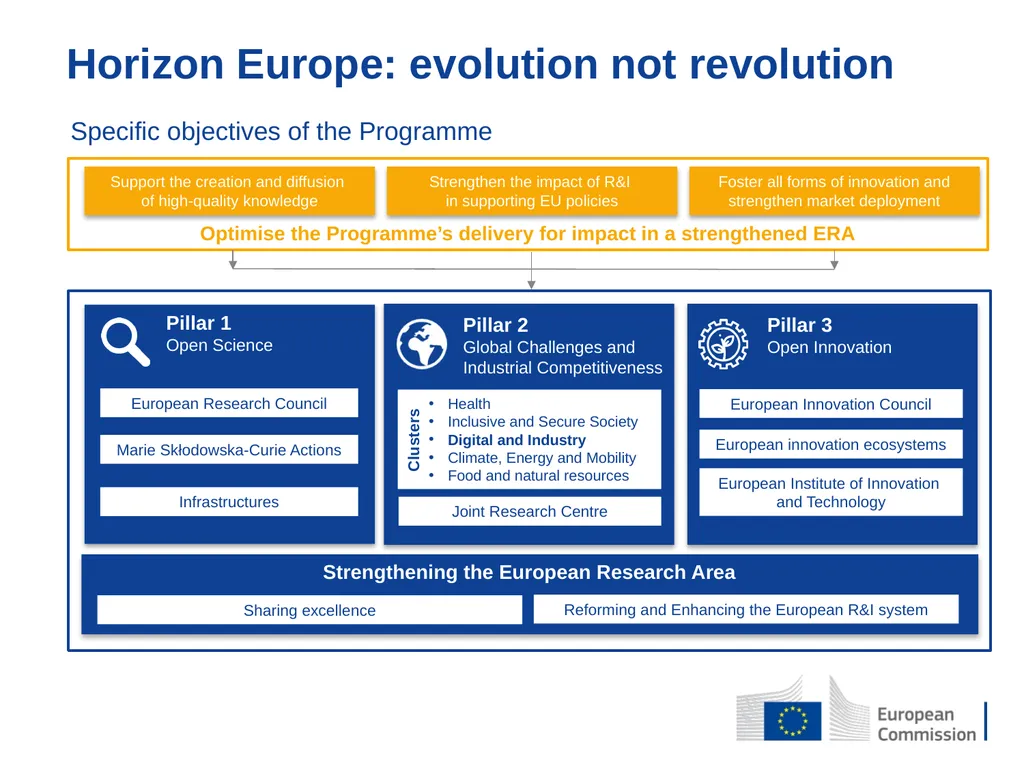
Horizon Europe: evolution not revolution<br>
14
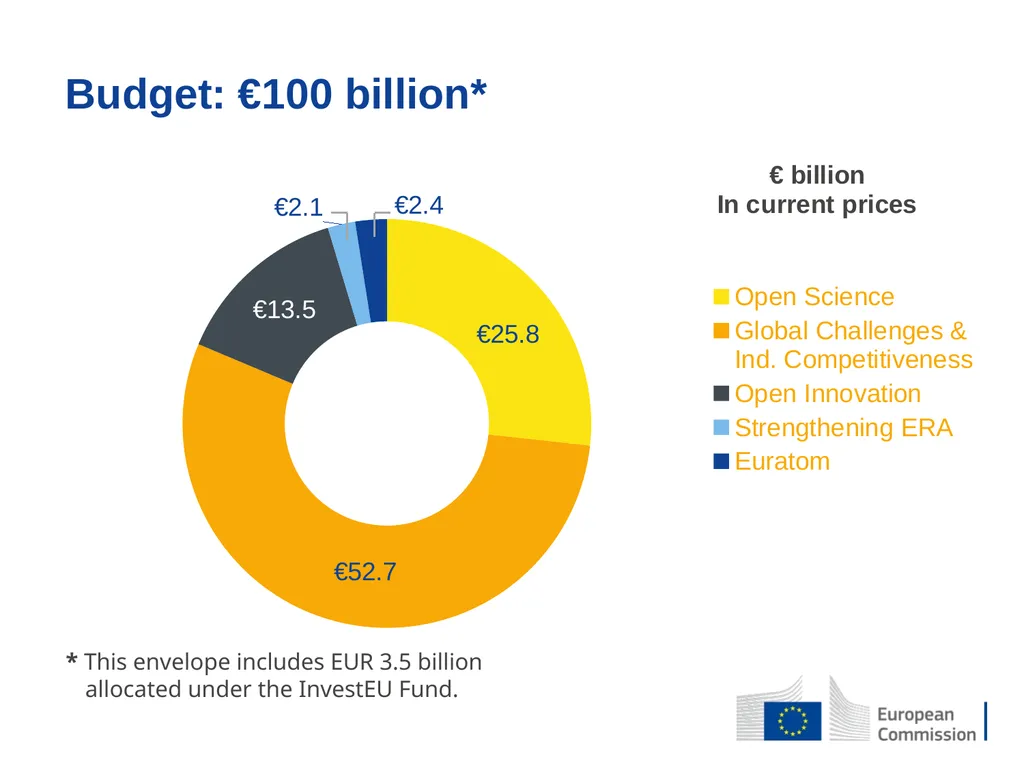
Budget: €100 billion* * This envelope includes EUR 3.5 billion allocated under the InvestEU Fund.<br>